INTRODUCTION
Due to their relative frequency in Aegean Bronze Age art, bird depictions have attracted significant scholarly attention over the years.Footnote 1 Lists and typologies of such depictions, often focusing on particular species (such as swallows), media (vase-paintings, vessels or seals), or sites (Akrotiri), have been compiled by several scholars (cf. Krüger Reference Krüger1940; Furumark Reference Furumark1941, 250–5 figs 29–31; Mylonas Reference Mylonas1969; Reference Mylonas1970; Desborough Reference Desborough1972; Davis, J.L. Reference Davis1976; Pollard Reference Pollard1977, 149–54; Vermeule and Karageorghis Reference Vermeule and Karageorghis1982; Immerwahr Reference Immerwahr, Hardy, Doumas, Sakellarakis and Warren1990; Ruuskanen Reference Ruuskanen1992; Misch Reference Misch1992; Foster Reference Foster1995; Lenz Reference Lenz1995; Guggisberg Reference Guggisberg1996; Vanschoonwinkel Reference Vanschoonwinkel and Reese1996, 365–7; Russell Reference Russell and Day2006; Gesell Reference Gesell, Tampakaki and Kaloutsakis2006; Marthari Reference Marthari and Danielidou2009; Vlachopoulos Reference Vlachopoulos2012, 115–21). The associated discussions usually focused on morphological variations, chronological developments and origins of bird depictions. More recently, the question of which species are represented in the iconography has become the subject of scientific investigation.Footnote 2 By contrast, studies attempting to reconstruct the specific meanings and functions of particular bird depictions have only rarely been undertaken.Footnote 3 Following Evans (Reference Evans1921, 114 and 222–4) and Nilsson (Reference Nilsson1950, 285–94, especially 285–6, 288, 294), bird images in Minoan iconography have in most cases been interpreted as avian epiphanies, i.e. divine manifestations in the shape of birds.Footnote 4 Other scholars have proposed a function as divine attributes and/or sacrificial victims (Alexiou Reference Alexiou1958, 252–63; Lenz Reference Lenz1995, 93–6; Gesell Reference Gesell, Tampakaki and Kaloutsakis2006, 320–1; Papageorgiou Reference Papageorgiou2014). However, the rather extensive iconographical record suggests that birds had many diverse roles and functions in the Aegean Bronze Age, varying with the bird species depicted and also differing between regions.
A recurring association that has not been examined before is the relation between birds and liquids. In the present study and accompanying catalogue (available online as Supplementary Material) this association is traced from its beginnings in the Early Bronze Age to its last manifestations at the end of the Bronze Age. Both changes and continuities can be observed over this long time span. Before we embark on our detailed analysis, however, it is necessary to introduce some methodological considerations.
METHODOLOGY
As already noted, the object of our investigation is the relationship between birds and liquids. But in what ways is this relationship constituted or created in the material record? It is proposed here that there must be a physical connection between a two- or three-dimensional depiction of a bird and a vessel that once contained liquid. However, not every liquid-containing vase decorated, for example, with a painting of a bird necessarily indicates an ideological relationship between bird and liquid. The bird motif could have had a completely different function, for example as a status symbol on an elite drinking set. Thus, there must also be some kind of spatial or functional link between the bird motif and the handling of the liquid. For example, bird motifs on pouring vessels such as jugs should be painted on the shoulder and/or in close proximity to the spout and the flow of liquid. Moreover, associated elements or motifs can be expected to underline the birds’ connection to liquids, for example by depicting aquatic plants or wavy lines, signifying water.
When these objects are handled and used, the three nodes – ‘liquids’, ‘vessels’ and ‘birds’ – create a network of interaction. Such networks are studied through the field of relational archaeology, which aims to open up new perspectives by using an object-centred approach focusing on the relations between entities and aspects of performativity (Watts Reference Watts and Watts2013). In the following three sections, we will use this approach and examine both the three constituent elements and the relationships created between them. In the fourth section, we will consider how the variation in these relationships can provide evidence regarding the perception of birds by the people who made and used these objects. A brief overview of recent work focusing on ontologies in the Aegean Bronze Age will situate the present study in the wider framework of research and illustrate what kind of conclusions can be drawn from the material record about human–animal relationships in the past.
Types of liquids
Vessels can hold both natural fluids such as water, oil, milk or blood, and man-made drinks such as beer, wine or herbal infusions. Sometimes, the shape, modification or decoration of the vessel can provide clues to its original content. For example, a narrow mouth could indicate a vessel that was designed to hold a viscous substance such as oil. Decoration with a grape vine could suggest that the vase was used for mixing, pouring or drinking wine. B. Davis (Reference Davis, Hitchcock, Laffineur and Crowley2008, 48–9, 53–4) suggested that vessels which possess a hole for draining liquid into the ground were used for blood offerings for chthonic deities or the dead.
In theory, organic residue analysis (Tzedakis, Martlew and Jones Reference Tzedakis, Martlew and Jones2008) could provide more specific evidence regarding the content of these vessels, but to our knowledge no such testing has been undertaken on any of the vases discussed here.Footnote 5 Moreover, there are some general problems connected with this method. For example, many of the vessels under investigation in the present study are closed vessels; therefore it would be difficult and sometimes even impossible to take samples from the inside for testing. Also, results can be rather ambiguous and some types of liquids are difficult to determine because they leave no specific or long-lasting traces, for example water.Footnote 6 All this hinders the meaningful application of residue analysis to our study.
As will become apparent when discussing the material, circumstantial evidence points to water and milk as the primary substances connected to birds. Each liquid possesses its own ideological connotations, but due to their directly observable effects on nature, notions of fertility and fecundity are ever-present in the beliefs surrounding both liquids. Whereas milk provides vital nourishment for the young of both humans and animals, water is essential for all living organisms including plants and therefore has a more general significance.
Types of vessels
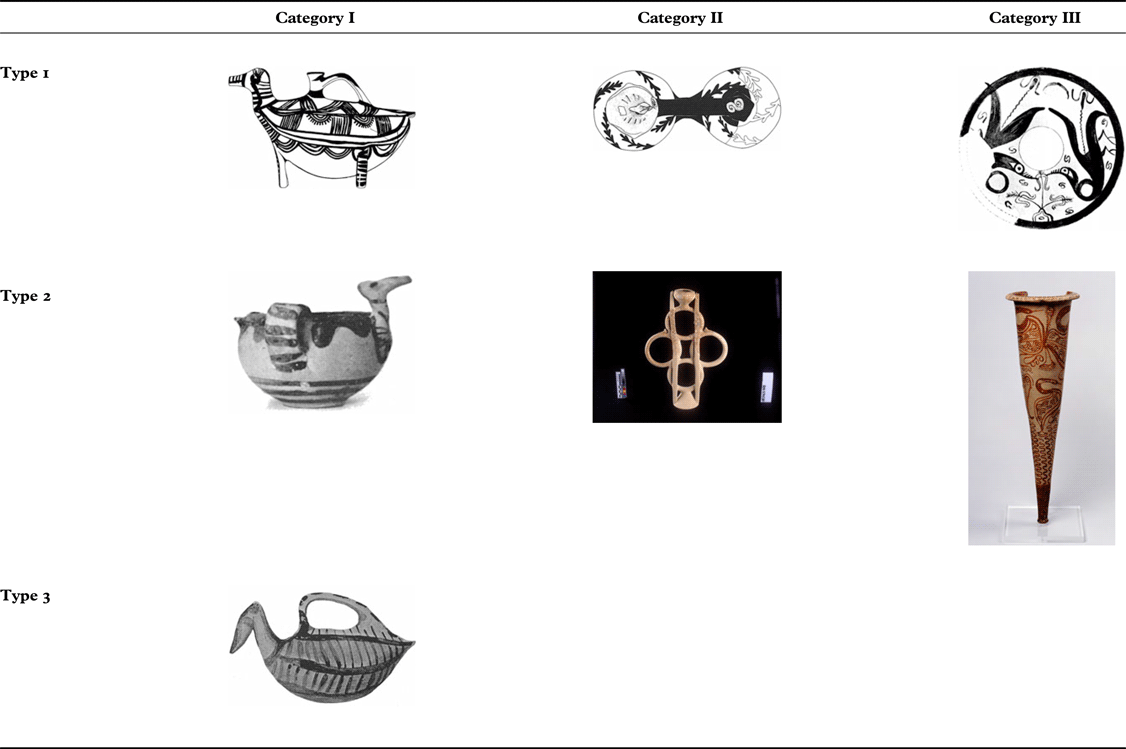
Liquid-holding vessels can be pouring vases such as jugs, jars, hydriae, askoi or rhyta, but some open vessels such as bowls can also belong to this category. The type of relationship created between the bird motif and the liquid is primarily determined by the specific vessel type and also the relative spatial arrangement of the three elements ‘liquid’, ‘vessel’ and ‘bird’. Here, various spectra of proximity can be observed, dividable into three categories with two or three subtypes (Table 1). These arrangements also have implications for the function of the vessels because they afford specific ways of handling these objects.
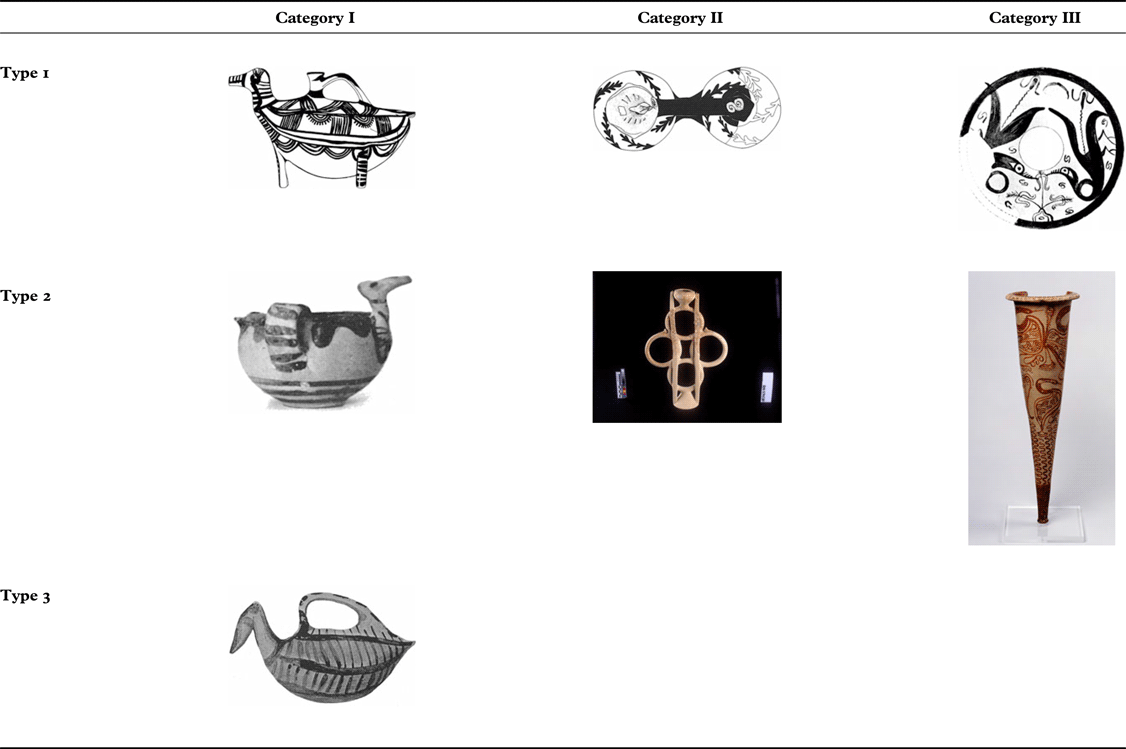
In category I, the vessel or its parts adopt the shape of a bird or bird parts. Within this category, complete vessels that are in the shape of a complete bird belong to type 1. This arrangement creates a very intimate connection between the three entities, because the whole body of the bird/vessel encloses the liquid, and if the spout is in the tail or the beak of the bird, it directly mediates the flow of liquid. In vessels belonging to category I type 2, only part of the vessel (e.g. the lug, handle or rim) is formed like a bird. In this case the relationship appears less intimate, although this is also dependent on other factors, for example whether the bird part is organically integrated into the vessel or if vessel parts visually dominate the bird parts. Category I type 3 includes objects that are formed like bird-shaped vessels, but, having no spouts, they do not actually function as vessels. In this case, the relationship of the bird to the liquid takes on a more symbolic character.
In short, the first type affords the most intimate connection between all three nodes, while the second type displays an intimate connection between the two nodes ‘vessel’ and ‘bird’ and ‘vessel’ and ‘liquid’, but a loose connection between the two nodes ‘bird’ and ‘liquid’. In the third type, the link between ‘vessel’ and ‘bird’ is still strong, but the liquid is only present by association.
The second category (category II) includes vessels with three-dimensional bird figurines attached to them. In contrast to the first two types of category I, the bird motif is in this case not involved in the basic functioning of the vessel, but is separate from it. Within category II we can differentiate two types. In vases of type 1 the figurine comes into direct physical contact with the liquid. This can be achieved by positioning the figurine either within the vessel, actually sitting in the water or other liquid, or at the spout so that it becomes wet during the act of pouring. In vessels of type 2, the figurine is positioned near the liquid, for example sitting on the rim of the vessel, but it does not become wet when the vessel is used. Thus, in type 1 the link between all three nodes is very intimate, while in the second type the ‘bird’ and ‘liquid’ elements are further removed from each other.
Category III consists of pouring vessels that are decorated by a painting of a bird. Again, we can differentiate two types within this category. In type 1, the painted bird motif is set into a close spatial relationship to the liquid, for example by positioning it on the shoulder in immediate proximity to the spout. Type 2 includes vessels which establish a nexus between birds and liquid by the frequent association of a particular motif, e.g. waterbirds, with a special pouring vessel, e.g. conical rhyta. In this case, the relationship is more indirect, but still appears significant. In sum, in type 1 the relationship between all three nodes is a very close one, whereas in type 2 the ‘liquid’ and ‘bird’ elements display a looser connection.
In general, birds are a frequent motif in Aegean vase-painting; therefore, numerous objects could potentially fall into category III. However, many of these vase-paintings on pouring vessels also show associated motifs which indicate that the bird–liquid connection is only of secondary importance (if it is present at all). Where appropriate, we will briefly refer to these vases in the discussion, but since the present study focuses on vessels that create a direct link between birds and liquids, such vases have not been included in the catalogue.
Types of birds
In the past, some scholars have doubted whether it is possible to identify particular bird species in Bronze Age Aegean iconography, especially when they appear in colourless media such as seals or if depictions display stylised or mixed traits (e.g. Nilsson Reference Nilsson1950, 290–2; Foster Reference Foster1982, 93; Morgan Reference Morgan1988, 64; Vanschoonwinkel Reference Vanschoonwinkel and Reese1996, 366). However, we agree with other researchers that paying attention to the repeated combination of particular morphological features often holds sufficient clues for species identification (cf. Masseti Reference Masseti1997; Harte Reference Harte and Sherratt2000). On largely monochrome objects, such as seals, the depiction of plumage patterns, upon which the zoological distinction of particular biological species is usually based, is hindered; it has been found that focusing on the silhouette usually provides enough information to at least determine the relevant family (Ruuskanen Reference Ruuskanen1992; Warren Reference Warren and Papadogiannakis1995; Binnberg Reference Binnberg, O'Sullivan, Marini and Binnberg2017). Since most of the bird-shaped objects under discussion here do not display detailed plumage patterns, identification is generally aimed at the family and genus level rather than the species level.
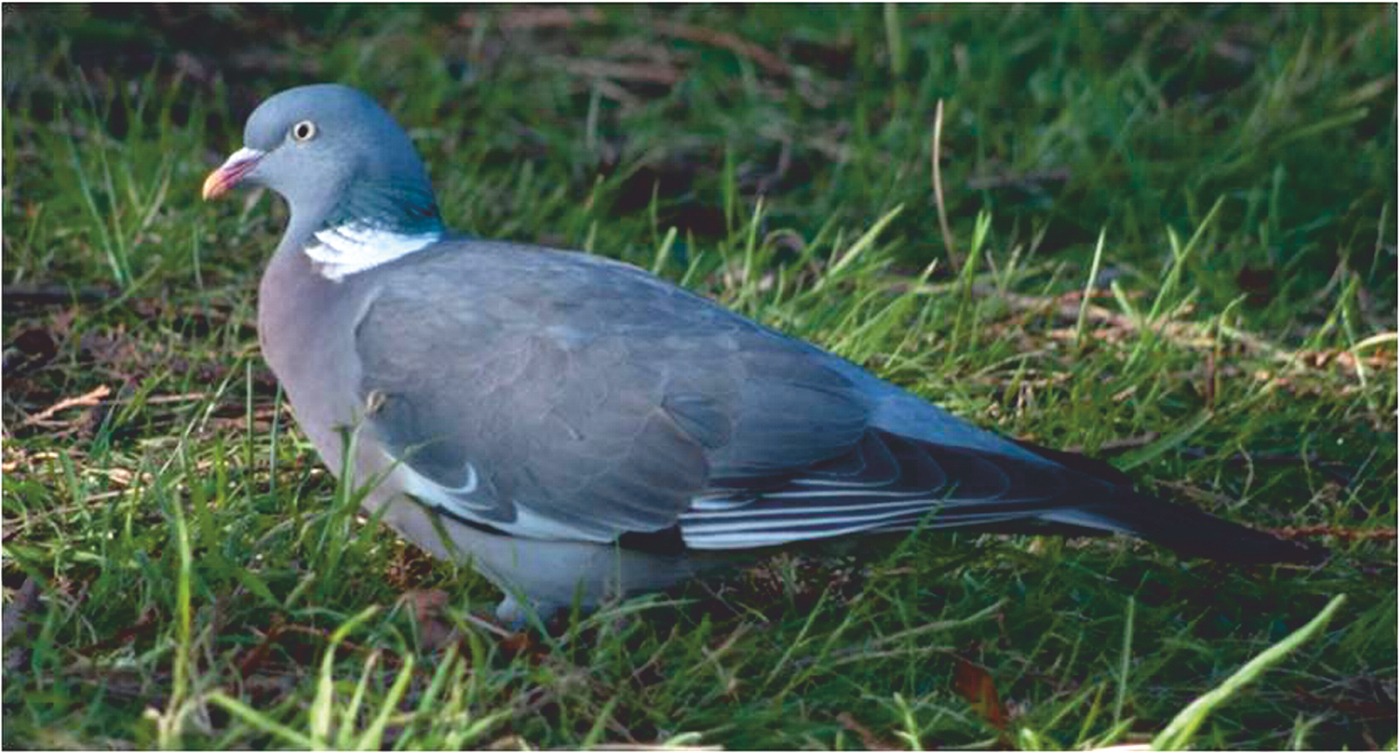
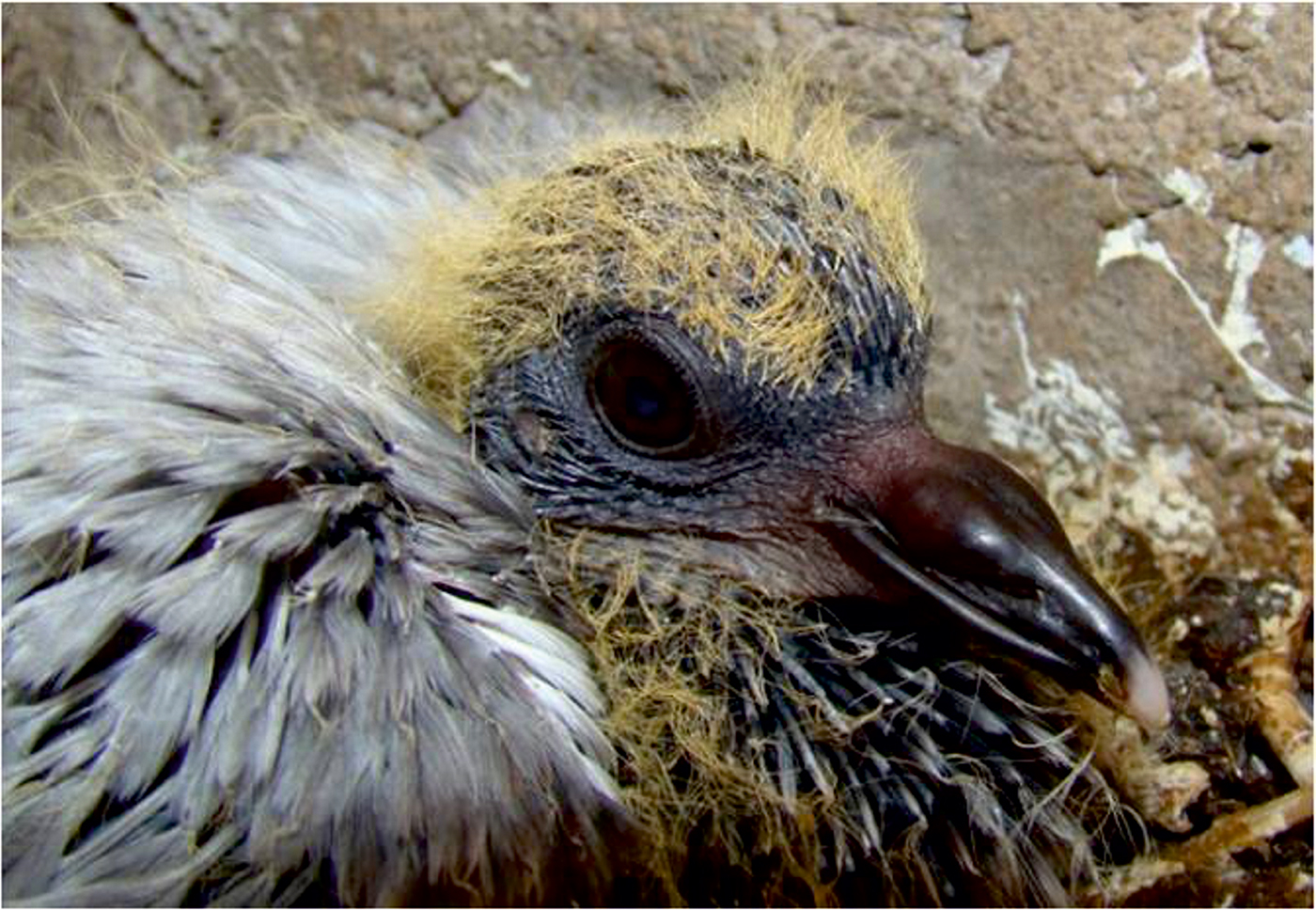
Only two types of birds seem to have been regularly connected to liquids in the Aegean Bronze Age. These are doves of the family Columbidae on the one hand and waterbirds of the family Anatidae (ducks, geese and swans) on the other. Doves and waterbirds differ significantly in their silhouettes, thus we can distinguish them relatively easily. Doves are characterised by a stout body shape, a rounded breast, a fan-shaped tail, a relatively short neck and a rounded head with a short conical beak (Fig. 1). In dove chicks, the knobby beak appears disproportionately large in relation to the small and plump body. Later in life, this changes profoundly and the head and beak are relatively small compared to the large and rounded body, a feature that distinguishes doves from other bird families.Footnote 7 In adults, plumage patterns allow differentiation into the rock dove (Columba livia), the wood pigeon (Columba palumbus) and the turtle dove (Streptopelia turtur).Footnote 8
Wood pigeon (a member of the family Columbidae). Author's photograph.

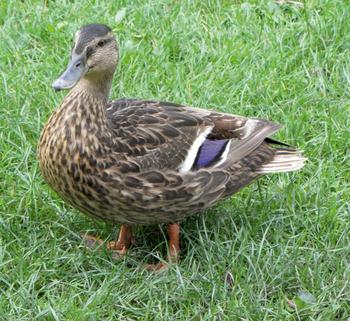
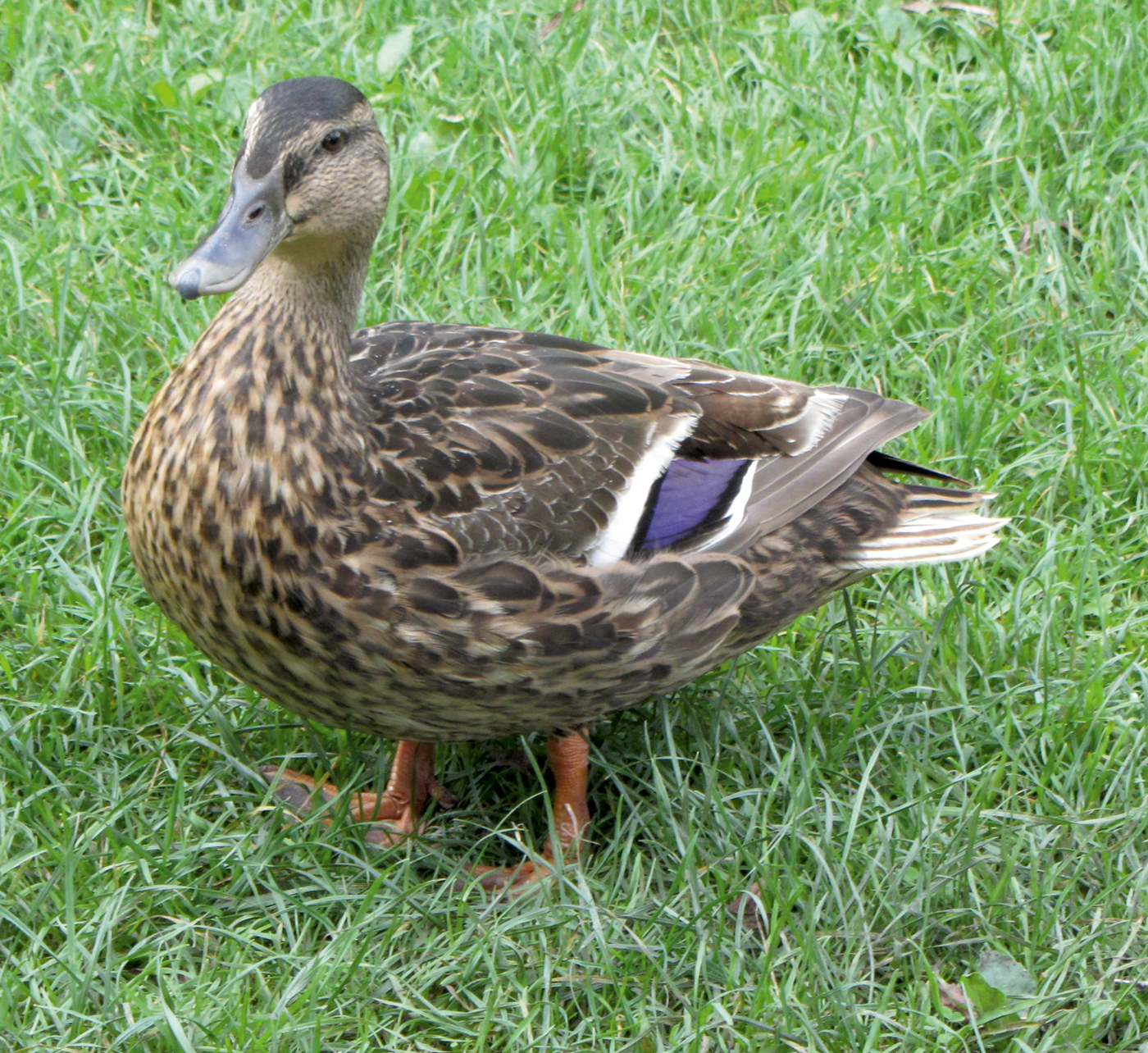
Waterbirds of the family Anatidae have elongated bodies, long necks and long, flat, slightly curved bills (Fig. 2). Ducks, geese and swans can primarily be differentiated according to body size and neck length. Although both doves and waterbirds belong to the order birds (Aves), there are significant differences between them regarding diet, behaviour and habitat. Also, their natural connection to liquids such as water or milk varies in intensity and also in obviousness, factors that will enable us to explain some peculiarities of their depictions.
Mallard (a member of the family Anatidae). Author's photograph.
Types of relationships
The detailed discussion of the material will show that all types of interaction between liquids, vessels and birds, as categorised above, can be found in the artistic record of the Aegean Bronze Age. But what can we conclude from these relational variations about human–bird relationships in the past? It is here argued that the repeated choice of any of these types is not a coincidence, but reflects a certain way of perceiving birds in relation to liquids.Footnote 9
In short, if the bird motif is consistently set into very close or even direct contact with the liquid, we can deduce that this must have been deemed necessary for the vessel to function properly in its capacity of liquid-storing and/or liquid-distributing entity. In turn, this confers agencyFootnote 10 to the bird (motif) and allows us to speculate whether the bird and/or its effigy were thought to act upon the liquid in some way. Such a literal understanding of a bird's power is often underlined by a relatively naturalistic appearance of the bird, achieved by organically rendering its natural proportions, depicting specific avian features (e.g. the depiction of wings or plumage patterns) and abstaining from adding imaginary traits (e.g. teeth).
If, on the other hand, the bird motif is consistently further removed from the liquid spatially, it was apparently not thought or desired that the bird (motif) acted directly upon the liquid. Instead, its presence seems to refer to a more abstract notion in the context of the vessel and its function; in other words it serves as a symbol. Such an understanding is often underlined by a rather stylised rendering of the bird motif itself, including the modification of natural proportions and the addition of imaginary features, for example plants growing out of a bird's body. The two ways of utilising bird motifs seem to indicate different ways of perceiving nature, because the former view accords more agency to natural entities such as birds than the latter.
In recent years, ontologies/worldviews in general and human–animal relationships in particular have increasingly been discussed by scholars studying the Aegean Bronze Age. The topic has been approached from various different angles, focusing either on iconography (Herva Reference Herva2006a; Reference Herva2006b; Shapland Reference Shapland2009; Reference Shapland2010; Reference Shapland and Watts2013; Goodison Reference Goodison, Rountree, Morris and Peatfield2012; Tully and Crooks Reference Tully and Crooks2015), animal remains in funerary contexts (Goodison Reference Goodison, Kapsomenos, Andreadaki-Vlazaki and Andrianakis2011), or studying both iconographical sources and material remains such as figurines (Morris and Peatfield Reference Morris, Peatfield and Wedde2004; Reference Morris, Peatfield, Rountree, Morris and Peatfield2012; Crooks, Tully and Hitchcock Reference Crooks, Tully, Hitchcock, Alram-Stern, Blakolmer, Deger-Jalkotzy, Laffineur and Weilhartner2016). Most studies have concentrated on the evidence from Minoan Crete, and scholars have identified a strong animist element in Cretan ontology. Thus, Herva (Reference Herva2006a, 592–5), Goodison (Reference Goodison, Rountree, Morris and Peatfield2012, 213–18), and Crooks, Tully and Hitchcock (Reference Crooks, Tully, Hitchcock, Alram-Stern, Blakolmer, Deger-Jalkotzy, Laffineur and Weilhartner2016) interpreted scenes of people touching plants and animals, shaking trees or hugging boulders depicted on Minoan gold rings as representing people communicating with sentient non-human beings. Animism is widely defined as the perception that non-human entities are persons with agency, able to act on the environment and communicate with humans (Tylor Reference Tylor1871; Hallowell Reference Hallowell and Diamond1960; Bird-David Reference Bird-David1999; Harvey Reference Harvey2005).
Some scholars have also emphasised the importance of performance, action and movement observable in Minoan iconography, both in scenes involving humans and non-humans (Herva Reference Herva2006b, 224; Goodison Reference Goodison, Rountree, Morris and Peatfield2012, 218–19). In this context, Shapland's (Reference Shapland2009, 230) observation about the way naturalism in Minoan art often aims to make an animal directly present during ritual performance is revealing. He mentions the bull's head rhyta, where the opening at the snout allows liquid (blood?) to be poured out of a natural opening, in a way animating the vessel by introducing an element of movement.Footnote 11
Morris and Peatfield (Reference Morris, Peatfield and Wedde2004; Reference Morris, Peatfield, Rountree, Morris and Peatfield2012) and Tully and Crooks (Reference Tully and Crooks2015) further argued for the presence of shamanic practices in Minoan cult, based on the identification of trance-inducing postures adopted by people in several Cretan depictions. This theory also received support from experimental approaches (Morris and Peatfield Reference Morris, Peatfield, Rountree, Morris and Peatfield2012, 240–2; also McGowan Reference McGowan2006). Shamanism is defined as a set of practices usually involving altered states of consciousness that enable certain people to directly interact with other-than-human beings by shedding their own physicality and adopting the perspective and abilities (e.g. flying) of animals or spirit-beings.Footnote 12
The evidence from the Cyclades and the Greek Mainland has received much less attention from scholars interested in ontologies.Footnote 13 A single study was undertaken by Shapland (Reference Shapland and Watts2013), who attempted to categorise Early Mycenaean ontology based on iconographical analysis. In his view, the ontology prevalent on the Greek Mainland can be called analogical, a concept adopted from the French anthropologist Descola. According to Descola (Reference Descola2013, esp. 201–31, 439–58), analogism does not perceive animals as ontologically similar to humans. Rather, humans and non-humans are inherently dissimilar entities, inhabiting a hierarchical framework and being linked to each other by various conceptual analogies. Animal imagery thus serves to express abstract notions rather than reveal an active role of animals in the order of things (as in animism). Shapland (Reference Shapland and Watts2013, 196–7) mentions the Lion Dagger from the shaft graves at Mycenae as an example, which by exchangeable relative positioning of attacker and enemy/prey on its two sides creates analogies between warriors and lions, and warfare and hunting.
Transferring the terminology of ontologies to our research into birds and their relationship with liquids, we could note that arrangements emphasising the bird's active role in the distribution of liquid would fit the animist model. By contrast, a less active and more symbolic function of the bird–liquid connection would tally with the analogical perception. The following discussion investigates what type of relationship, and hence what kind of ontology, was more prevalent in what periods and regions. The study is divided into three sections, beginning with an analysis of objects from Crete, then continuing with artefacts from the Cyclades, and finishing with a discussion of depictions from the Greek Mainland. First, the objects under consideration are described, then the bird family or, if possible, species is identified and the type of relationship that is created between bird, vessel and liquid is examined.
DISCUSSION
Crete
EM I–MM II
The earliest vessels featuring birds come from the tholos tombs at Lebena in southern Crete and they date to EM I (1–7). These seven vessels have either two or four lugs, which terminate in rather simple birds’ heads (Fig. 3). Possibly, these heads are meant to represent those of doves, because they are rounded with very short conical beaks.Footnote 14
Pyxis from Lebena (1). Image courtesy of Archaeological Museum of Heraklion – Hellenic Ministry of Culture and Sports – TAP Service.

These vessels are storage containers and they could in theory have contained either liquid or solid substances. Yet the excavators Alexiou and Warren (Reference Alexiou and Warren2004, 122) think that they were designed for valuable liquids because of their rather narrow openings and their lids which have holes so that they could be tied securely by strings. Double axes are painted onto two of these vessels (1, 4), but it is unknown whether this motif already had the cultic connections it possessed in later periods (Haysom Reference Haysom2010).
These objects belong to our category I type 2 because only some vessel elements are in the shape of bird parts. It needs to be emphasised, though, that the lugs with bird heads grow rather organically from the body so that the relationship between bird motifs and content appears quite intimate. Although the bird protomes can be interpreted as decorative embellishments of the lugs, the orientation of the multiple bird heads to the outside lends a certain protective attitude to them. Possibly, they were supposed to safeguard the contents in the belly of the vase.
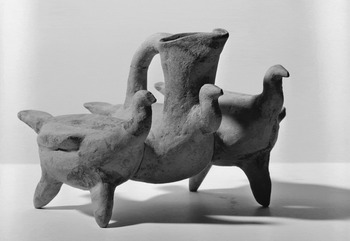
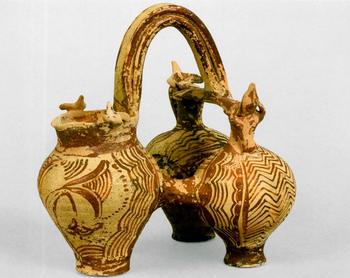
In EM II, the vessel shapes change and we find actual bird-shaped vases with handles and spouts, thus belonging to our category I type 1. Some spherical askoi (cf. Misch Reference Misch1992, 82) are given a general avian appearance by the addition of a small tail, as in a vessel from Platanos (8). A less stylised vase comes from Lebena (9) – it has a rather large spout modelled in the middle of the back and probably had bird protomes at each end, which are now lost (Fig. 4). The overall design is still similar to the EM I storage vessels described above, but the spout shows that it is a pouring vessel. Comparable is also a triple vessel from east Crete (10).Footnote 15 Three hollow bird-shaped vases are linked together, but a rather prominent handle and spout are attached only to the bird in the middle (Fig. 5). In contrast to the Lebena vessel, the direction of the spout corresponds with the orientation of the birds, resulting in a more natural appearance. Since the heads are lost on the vessel from Lebena (9), we cannot determine the bird species, but the rounded heads, short conical beaks and fan-shaped tails of the birds in the triple vessel are all characteristics of doves.Footnote 16
Juglet from Lebena (9). Image courtesy of Archaeological Museum of Heraklion – Hellenic Ministry of Culture and Sports – TAP Service.

Triple vessel from east Crete (10). Image courtesy of Bildarchiv Foto Marburg.

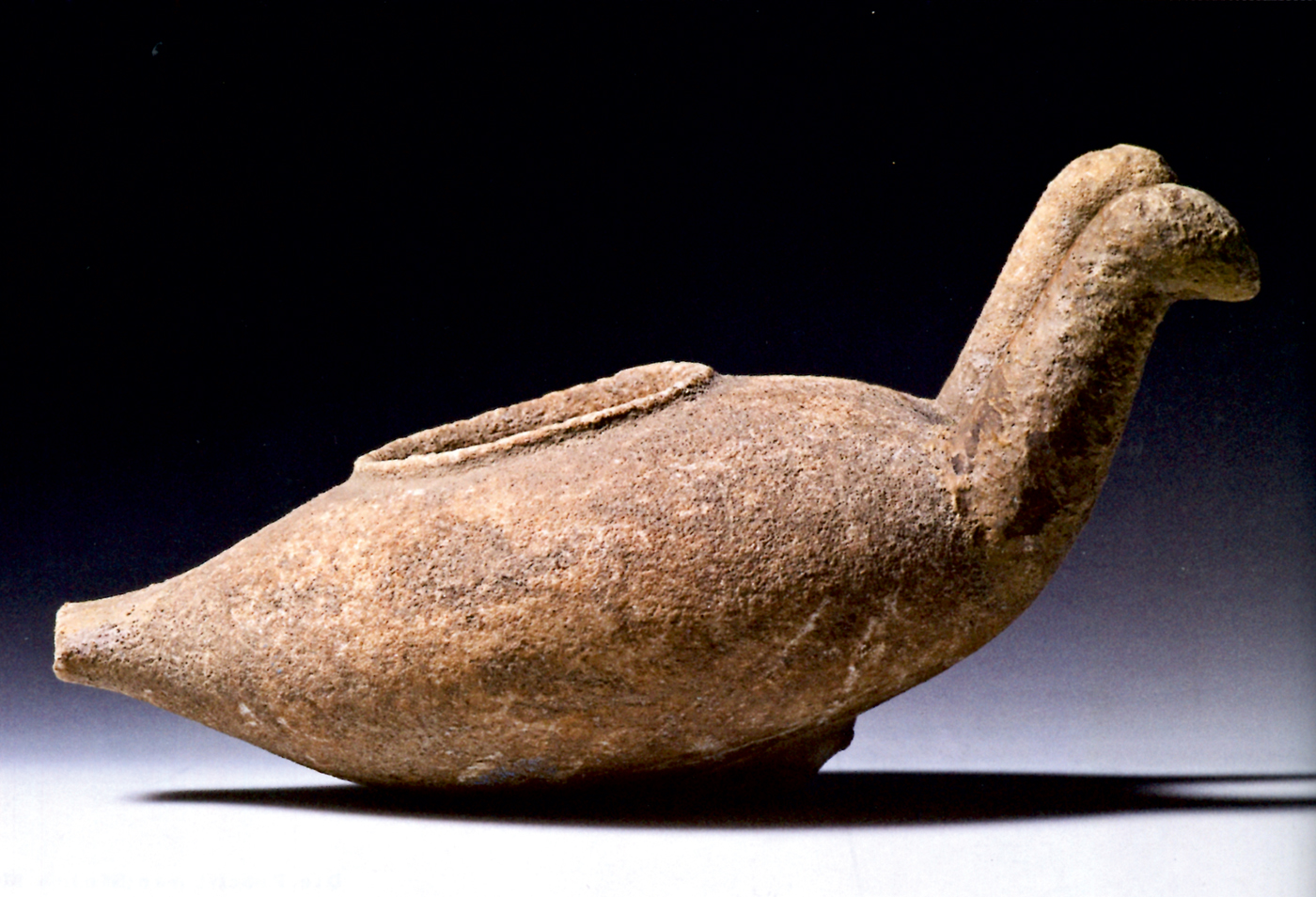
A further vessel from Lebena resembles in its body shape the triple vessel from east Crete, but it consists of only one bird (11). It has a handle, but the spout is reduced to an opening in the tail opposite the – now lost – head (Fig. 6). This arrangement means that conspicuous vessel parts such as handles and spouts are more organically integrated into the natural bird shape. Such bird-shaped vases became relatively frequent in EM II–MM I. Four vessels have been found at Koumasa (12–15), two vessels at Platanos (16, 17) and one vessel at Myrtos Pyrgos (18). In MM I–II, similar vases appear at some palaces. One vessel comes from Knossos (19) and another one from Mallia (20). Four have been found at Phaistos (21–24).Footnote 17 The plump shape of these bird vessels and the round heads with short conical beaks make them resemble doves (Branigan Reference Branigan1970, 119; Cadogan Reference Cadogan1977–8, 71). One of the vessels from Platanos (17) has wings decorated with impressed dots, possibly alluding to the plumage patterns of turtle doves.Footnote 18
Askos from Lebena (11). Image courtesy of Archaeological Museum of Heraklion – Hellenic Ministry of Culture and Sports – TAP Service.
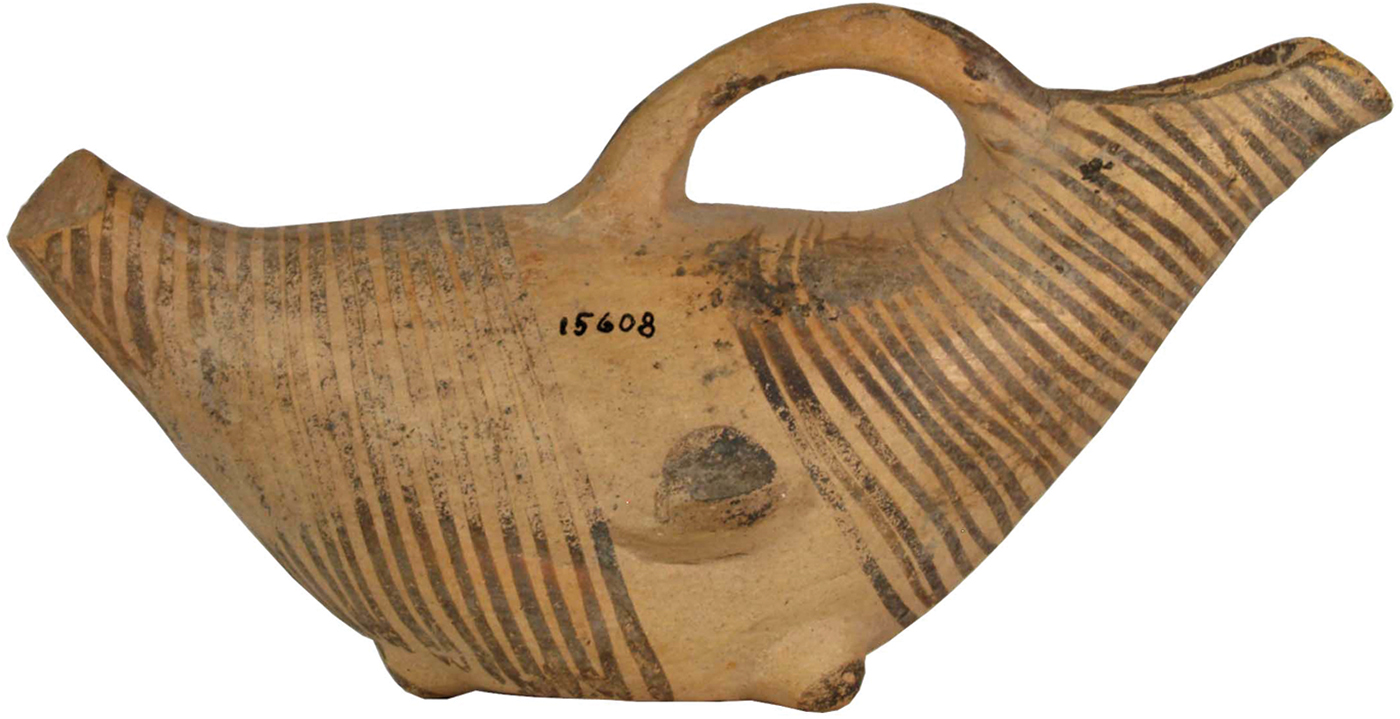
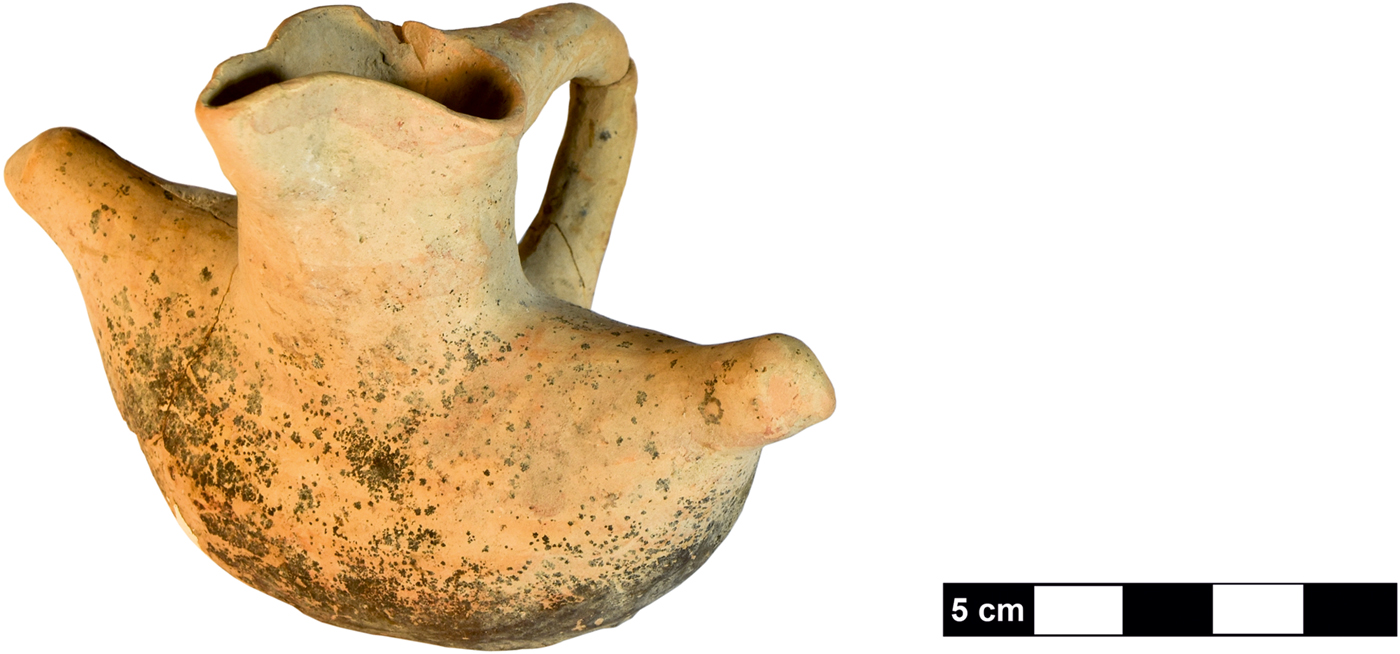
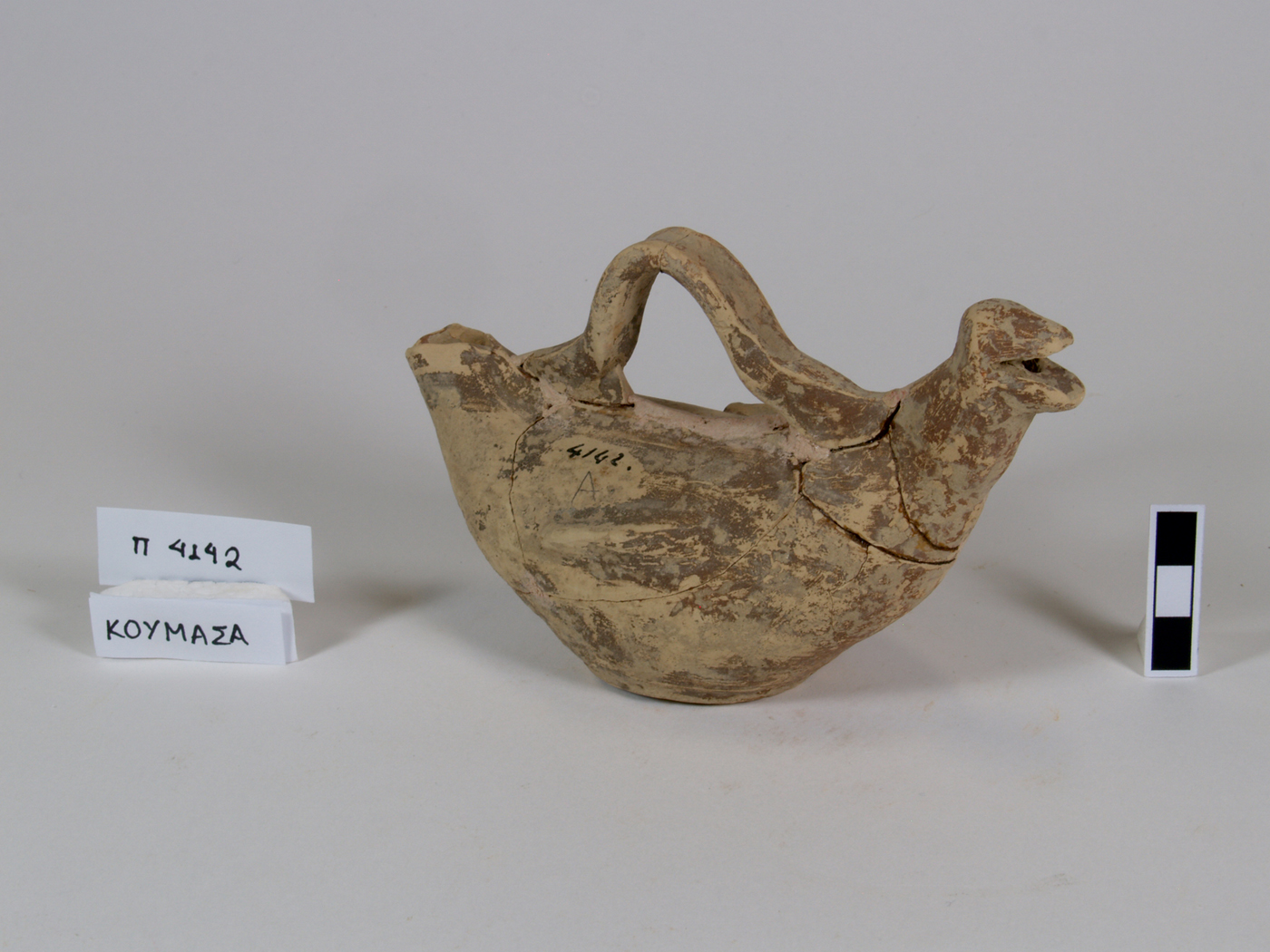
These pouring vessels all belong to our category I type 1, because the bird's body completely encloses the liquid. Some vases (14–18) can be called rhyta because the beak serves as another (hidden) spout in addition to the opening in the back, as seen in an example from Koumasa (Fig. 7). In these vases, the dove's tail or head/beak directly mediates the flow of liquid. The attachment of rudimentary wings and added details such as pellet eyes and plumage patterns combined with the reduction of spout visibility means that the vessel is no longer recognisably separate from the bird features. Rather, the vessel becomes the bird and the bird becomes the vessel; the boundaries between entities are dissolved.Footnote 19
Rhyton from Koumasa (14). Image courtesy of Archaeological Museum of Heraklion – Hellenic Ministry of Culture and Sports – TAP Service.

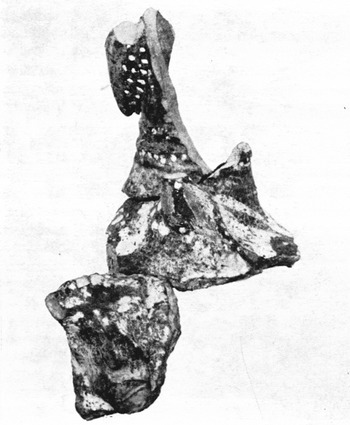
In MM I–II, some other objects also create a connection between birds and liquids. These are both open and closed vessels with bird figurines attached to them. For example, a fragment of a jug, whose spout and body are dotted with small bird figurines, comes from Phaistos (25) (Fig. 8). Another bird figurine is attached to a fragmentary double jug from Kamilari (26) (Fig. 9). Double jugs were first deposited in EM–MM I tombs, e.g. at Koumasa and Archanes, but the vase from Kamilari is the earliest known one with a dove (Karayiannis Reference Karayiannis1984, 31; Levi and Carinci Reference Levi and Carinci1988, 107).
Fragmentary jug from Phaistos (25). Levi Reference Levi1976, 576 fig. 926.
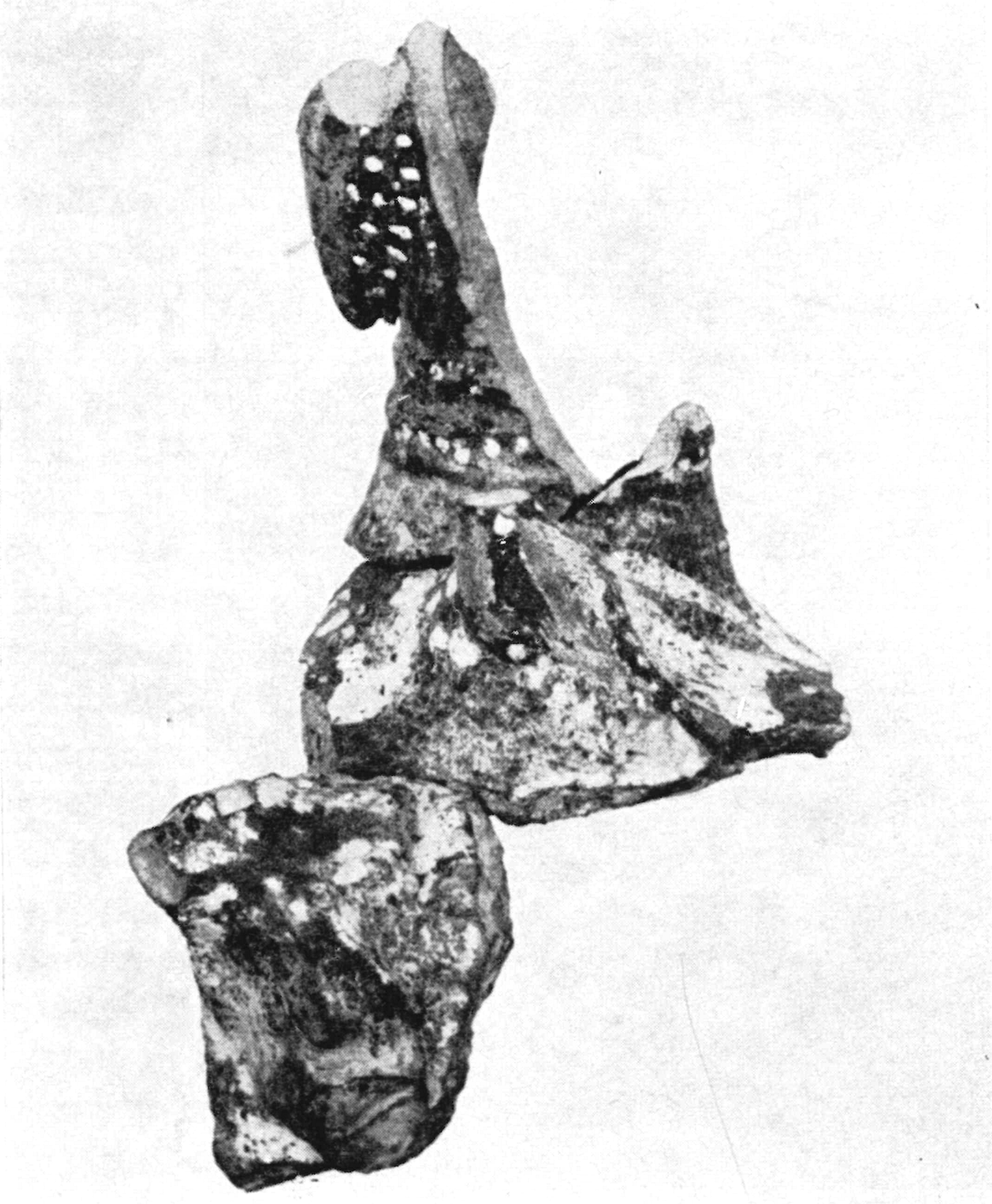
Double jug from Kamilari (26). Levi and Carinci Reference Levi and Carinci1988, pl. 48c.

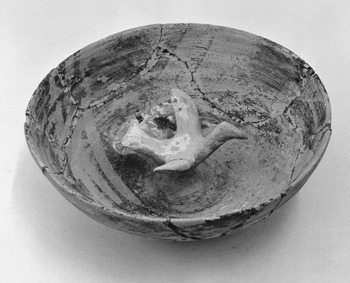
Better preserved is a bowl from Palaikastro, which displays a bird with spread wings in the middle of the vessel (27) (Fig. 10). This vessel belongs to a group of bowls that are turned into miniature dioramas by the addition of small three-dimensional figurines to their interior, for example a bull, a weasel or sheep tended by a shepherd (Evans Reference Evans1921, 180–1; Foster Reference Foster1982, 80, 85–6, 111). Foster furthermore mentions a cup from Palaikastro, dating to MM I, which features two birds attached to the rim (28). In addition to these vessels, there are several single bird figurines, for example from Archanes (Sakellarakis and Sapouna-Sakellaraki Reference Sakellarakis and Sapouna-Sakellaraki1997, 2.519–20) and Mallia (Detournay, Poursat and Vandenabeele Reference Detournay, Poursat and Vandenabeele1980, 113–14, cat. nos 164–7; Foster Reference Foster1982, 93), which are broken off from their original supports. Although we do not know the type of objects they were once attached to, it seems likely that at least some of them came from vessels. All these birds can, if they are sufficiently preserved, be identified as doves because they have rounded bodies, fan-shaped tails, curved wings and round heads with short beaks.Footnote 20 According to Foster (Reference Foster1982, 93), the bird inside the Palaikastro bowl has eyes painted in red. It may therefore be identified as a rock dove.
Bowl from Palaikastro (27). Image courtesy of Bildarchiv Foto Marburg.
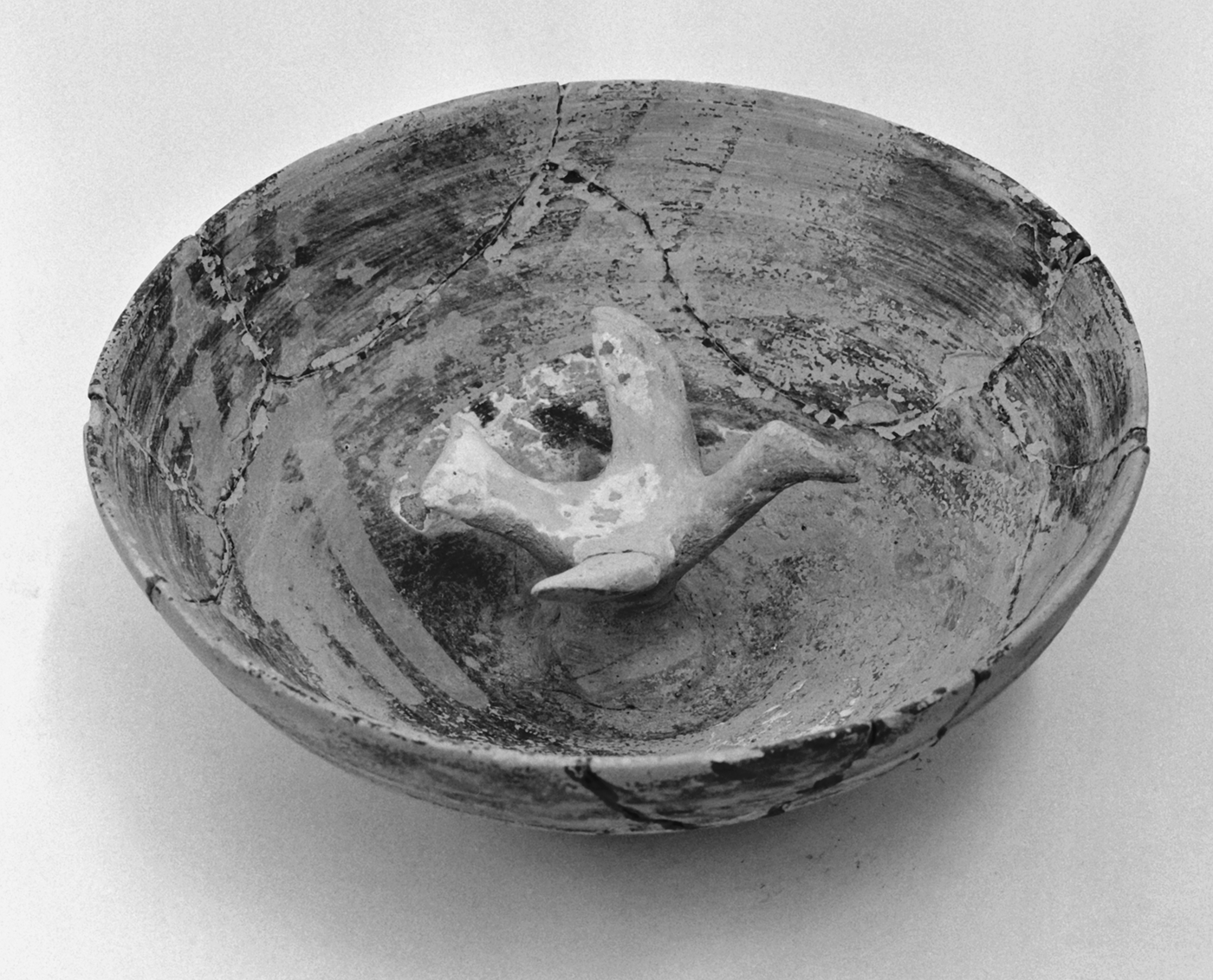
These vessels with doves attached to them belong to our category II. While Foster's cup (28) belongs to type 2, the bird figurines on the Phaistos jug (25) and the Kamilari double vase (26) are positioned at the spouts (type 1). They would have come into direct contact with the liquid. In the case of the Palaikastro bowl (27), it seems that the dove figurine inside prevents a practical use of the vessel for drinking. This seems plausible but the bowl-shape means that the vessel can still hold a liquid substance. If for instance water was poured into it, the bird would have appeared as if landing on the surface of the water and the vessel would have been turned into a bird bath. Thus, we would have a similarly close relationship between the liquid element and the bird as observed in other vessels dating to the Pre- and Protopalatial periods.
At this point, we need to pause and consider the place of the above described objects in the wider context of Cretan cultic activity at this time. In addition to the vessels featuring birds, other figural vessels both from tombs and settlements attest to the general importance of rituals centring on liquids.Footnote 21 There are, for example, vases in the shape of women holding what are commonly identified as water jugs.Footnote 22 Among them is the so-called Goddess of Myrtos, dating to EM II (Warren Reference Warren1972, 209–10; Gesell Reference Gesell, Krzyszkowska and Nixon1983, 93–4; Fowden Reference Fowden1990, 16–17; Cadogan Reference Cadogan and Krzyszkowska2010). This figural vase also has a pubic triangle painted onto her rounded body, and several scholars have drawn attention to the way she is holding her jug, cradling it like a baby (Fowden Reference Fowden1990, 17; Cadogan Reference Cadogan and Krzyszkowska2010, 42). It seems plausible to suggest that this vessel connects the two themes of water and female fertility (Gesell Reference Gesell, Krzyszkowska and Nixon1983, 94; Fowden Reference Fowden1990, 17; Peatfield Reference Peatfield and Morris1995, 223). In a similar context belong two figural vessels in the shape of women from Mallia and Mochlos (Warren Reference Warren and Rizza1973, 138–9; Marinatos and Hirmer Reference Marinatos and Hirmer1973, 111 cat. no. 10; Gesell Reference Gesell, Krzyszkowska and Nixon1983, 94; Branigan Reference Branigan1988, 101–2; Jones Reference Jones, Hitchcock, Laffineur and Crowley2008, 42–3). Their breasts are pierced so that the liquid which was poured out appeared like milk. Both Fowden (Reference Fowden1990, 17) and Yiannouli (Reference Yiannouli1998, 68) have drawn attention to the literal element observable in these depictions, an aspect that can also be sensed in the objects featuring birds.
Some vessels, for example from Koumasa, Platanos and Lebena, adopt the shape of animals other than birds (Branigan Reference Branigan1970, 80–2). Familiar are the bull-vessels from the tholoi at Koumasa and Porti with people suspended from their horns, possibly an early depiction of bull-leaping (Xanthoudides Reference Xanthoudides1924, 40 cat. no. 4126 and 62 cat. no. 5052; Younger Reference Younger, Laffineur and Niemeier1995, 525 cat. nos 7 and 9). While there may be some relationship between bulls and water, possibly inspired by their natural habitat in marshy areas, bulls are very rarely associated with wetlands in Minoan iconography; other contexts such as bull-games, hunting and possibly sacrifice predominate (Younger Reference Younger, Laffineur and Niemeier1995).
By contrast, birds and, more specifically, doves are frequently connected to pouring vessels, either in bird-shaped vases or as dove figurines attached to (the spouts of) vessels. What is it then that links birds, and especially doves, to liquids? We may find an explanation when we look at behaviour that is unique to the dove family. Usually, birds drink by regularly stopping and raising their heads to swallow, but doves are different in this respect. Unlike all other birds, doves are able to take up water in a continuous motion (Svensson, Mullarney and Zetterström Reference Svensson, Mullarney and Zetterström2009, 214). Therefore, they seem to ingest much more water when drinking than other birds and may thus have been viewed as the birds which are most capable of both storing and distributing liquids. Moreover, doves, unlike most other birds, produce a semi-liquid secretion from their crop (Svensson, Mullarney and Zetterström Reference Svensson, Mullarney and Zetterström2009, 214). During the first week, chicks are entirely fed with this highly nutritious liquid, called crop milk, which is produced by both adults. A figural seal from Koumasa (CMS II,1 133), dating to EM III–MM IA, may illustrate this feeding of young doves (Evans Reference Evans1921, 117; 1935, 487; Xanthoudides Reference Xanthoudides1924, 30 cat. no. 516). It shows a large dove flanked by two smaller birds, apparently an adult bird with chicks (Fig. 11 (a) and (b)). The adult dove is turning its head sharply towards one of the chicks as if about to feed it.
Figural seal from Koumasa (CMS II,1 133). (a) Side view; (b) Front view. Image courtesy of the CMS Heidelberg.

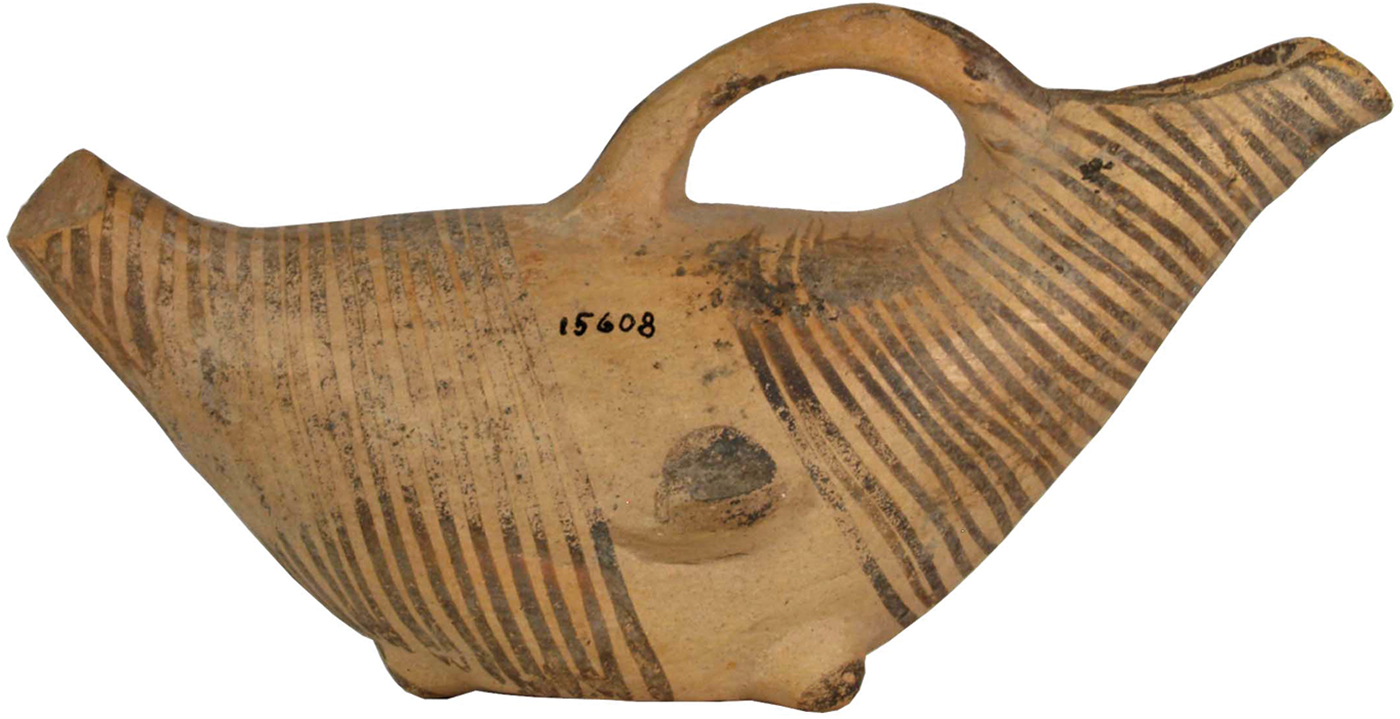
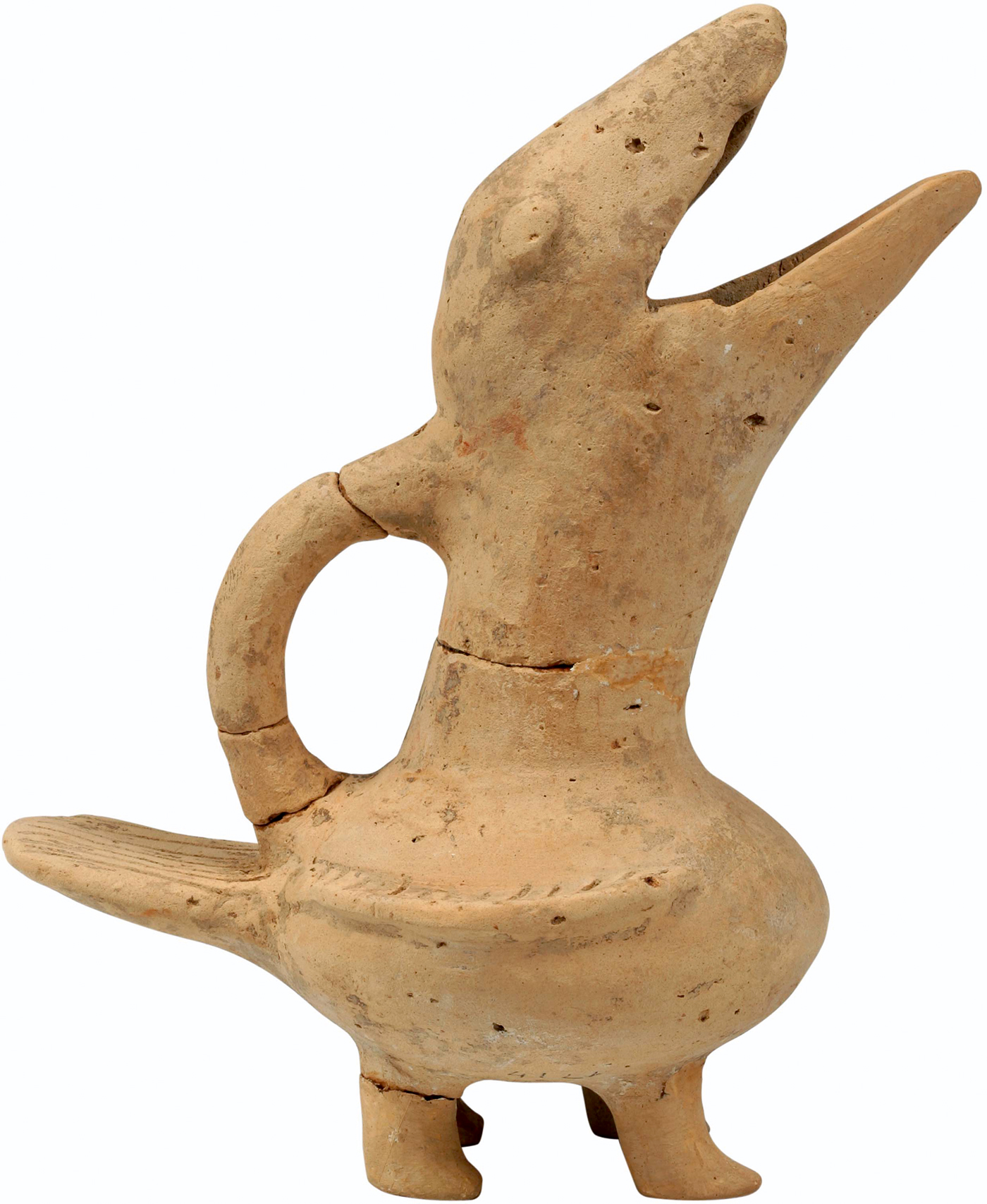
Some of the dove-shaped vessels can also be connected to this special feeding behaviour. Two vessels from Koumasa (12, 13) are rather odd-looking because the heads and beaks appear too large in comparison to the small bodies (Fig. 12).Footnote 23 A bird-shaped vessel from Knossos (19) has thin wings and shows a long beak growing from a relatively small head (Fig. 13). The same anatomical features are found in dove chicks (Fig. 14).Footnote 24 We can therefore agree with Evans’ proposition that the vessels from Koumasa (12, 13) show young birds begging for food with their wide open beaks (Evans Reference Evans1921, 115; Branigan Reference Branigan1988, 144). When liquid was poured into their beaks, the bird-shaped vessels would have conveyed the impression of being fed. Significantly, the person distributing the liquid would then have adopted the role of an adult dove. Thus, there is a remarkably complex physical interplay at work between the dove, the liquid and a human being.Footnote 25 In the vessel from Knossos (19) there is a similarly close interaction between different elements because the beak of the dove is positioned directly above the spout so that it seems as if the dove is drinking from the liquid poured out from its own body.Footnote 26
Askos from Koumasa (12). Image courtesy of Archaeological Museum of Heraklion – Hellenic Ministry of Culture and Sports – TAP Service.
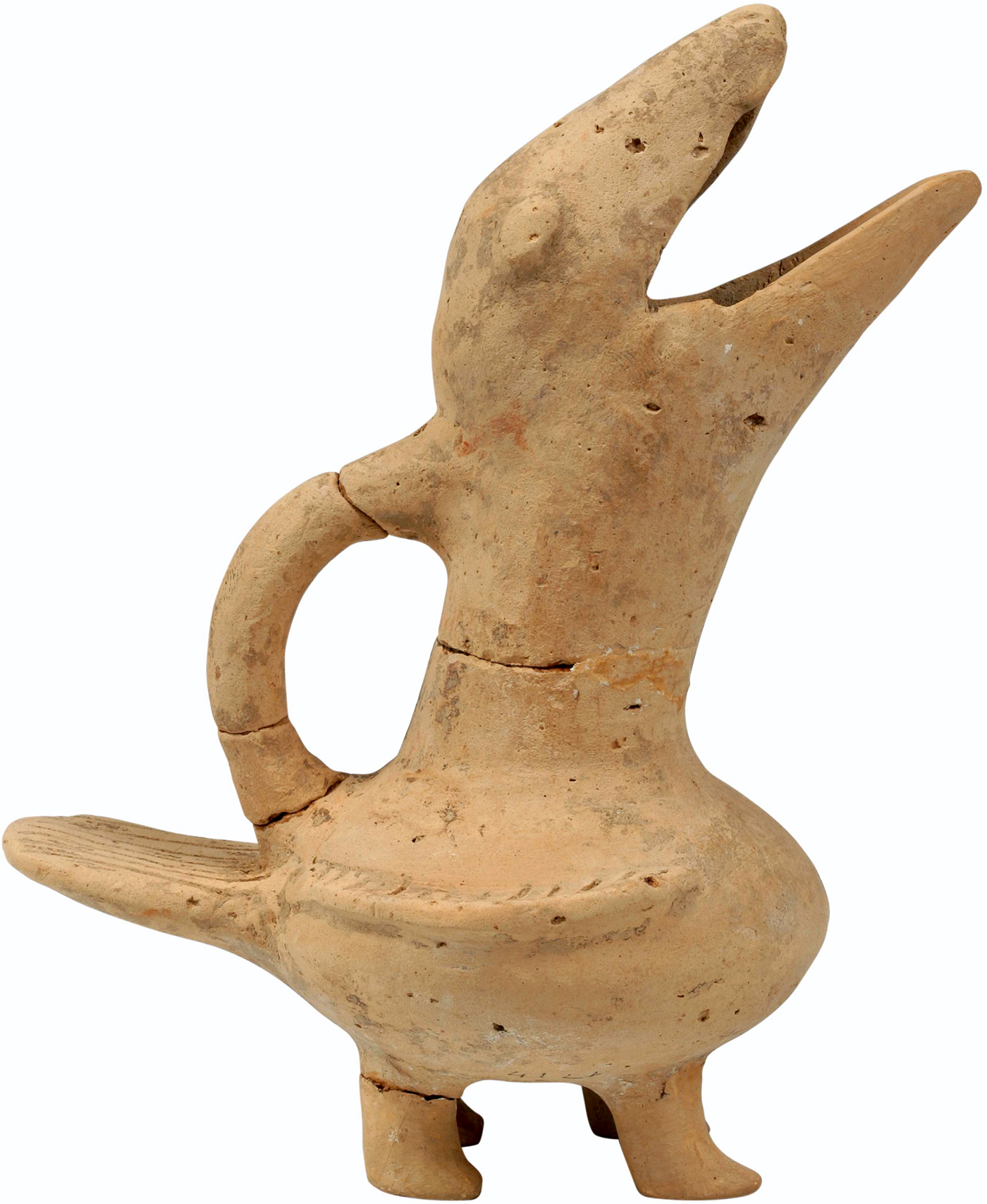
Askos from Knossos (19). Image courtesy of Archaeological Museum of Heraklion – Hellenic Ministry of Culture and Sports – TAP Service.
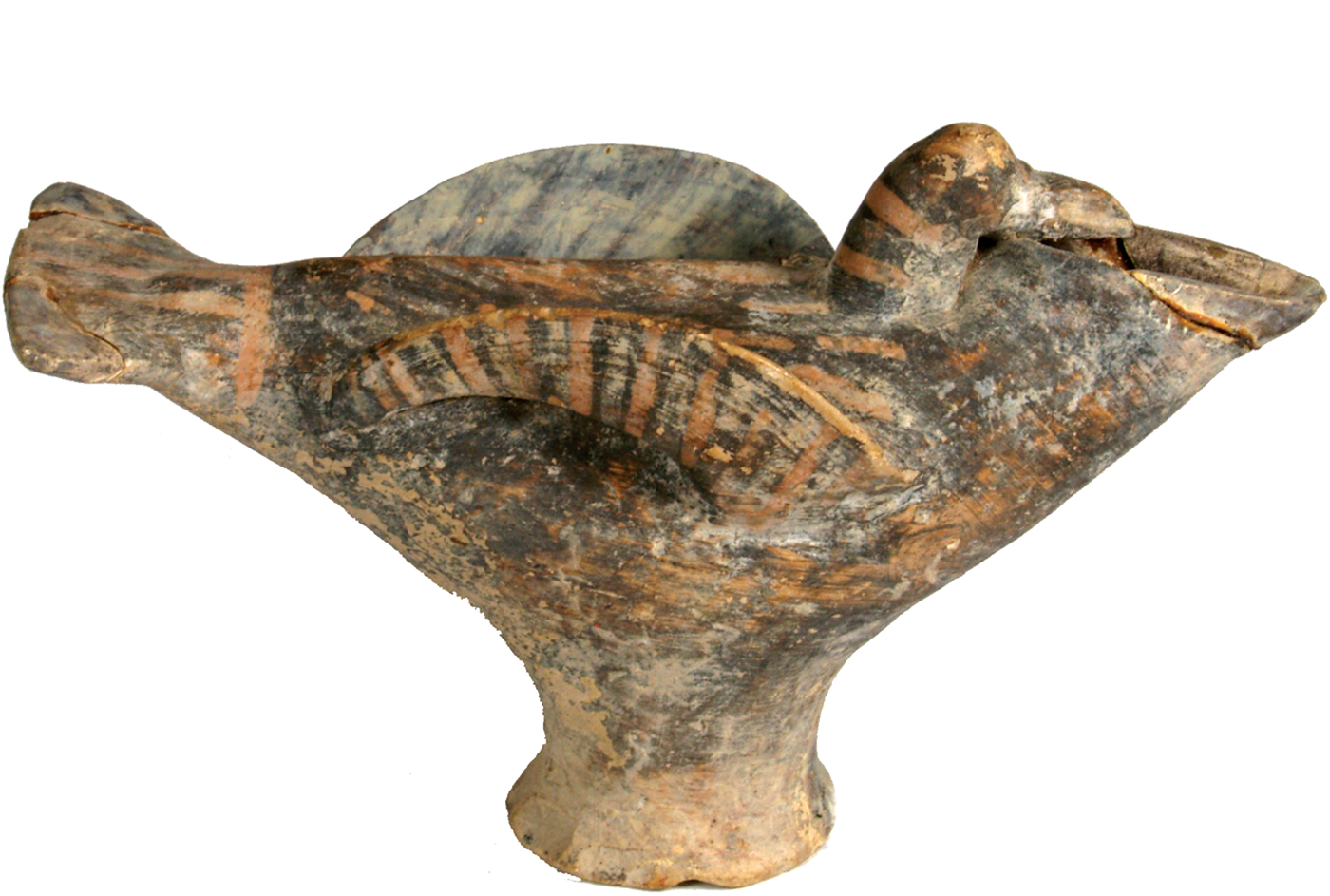
Dove chick. Photograph by Bjørn Christian Tørrissen, bjornfree.com.

Such objects seem to suggest that doves were believed to possess certain powers in relation to liquids that could also be utilised to the advantage of people's lives. We may wonder whether some of these vessels were also used in rituals aimed at regeneration, maybe to ensure the continuing flow of water/rain or milk.Footnote 27 Significantly, they assign an active role to the birds in the order of things. Next, it will be analysed whether such a view survived beyond the Pre- and Protopalatial periods.
MM III–LM IIIA2
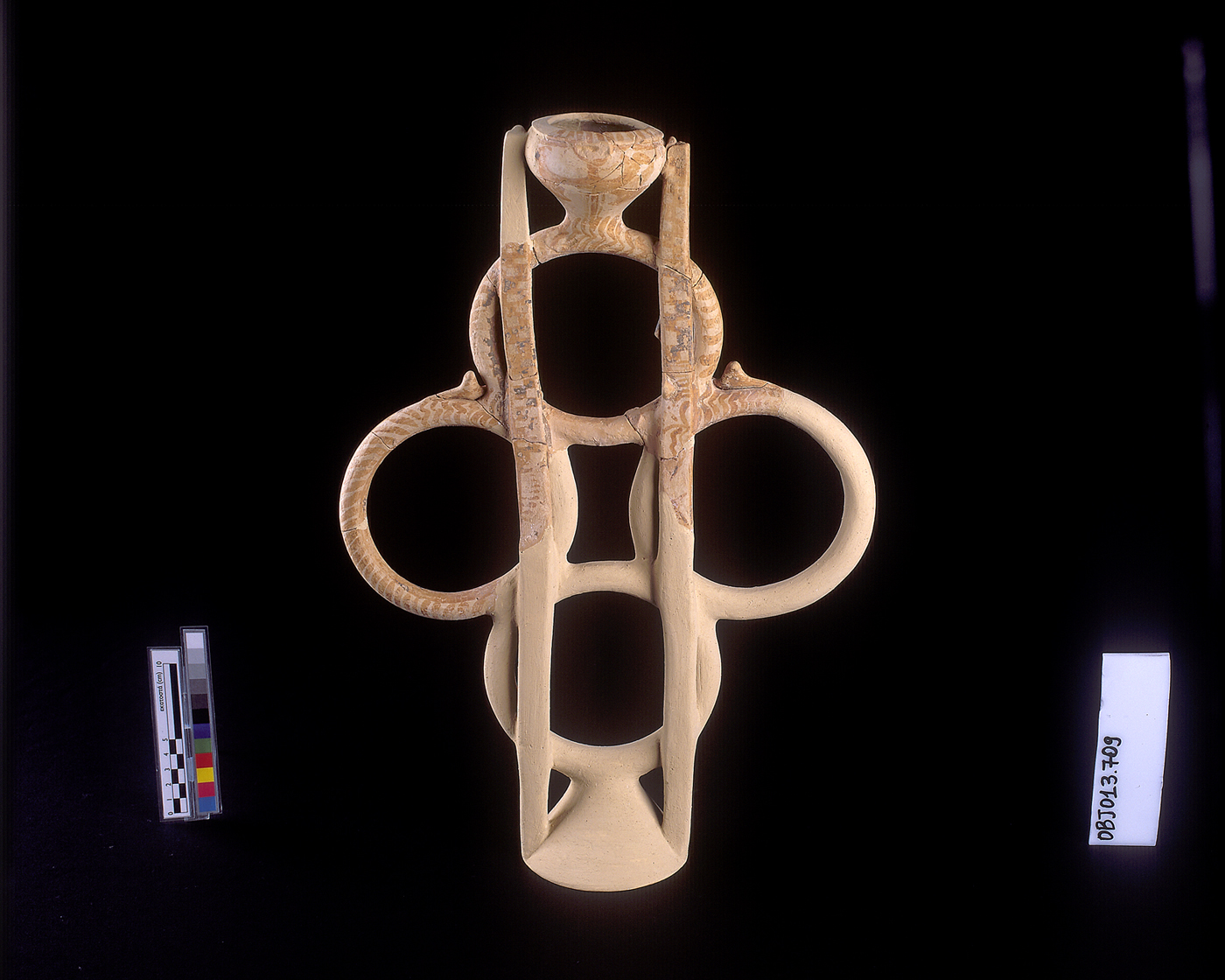
Associations between birds and liquids can also be observed in the Neopalatial and Final Palatial periods. There is one vessel from Nirou Khani (29), dated to LM IIIA1, which to date seems to be the sole survivor of the earlier Cretan tradition of bird-shaped vessels. The missing head means that it is not possible to identify the species, but the naturalistic rendering of the plumage and feathers is remarkable. More characteristic of this period are double vases which were continually used from LM I until LM IIIA2. Several of these have bird figurines attached to them (Figs 15 and 16), an arrangement which first appeared in the MM II double vase from Kamilari (26) described above. Similar vases have been found at Poros (30), Palaikastro (31), Knossos (32), Katsamba (33), Vathypetro (34), Chania (35) and Myrsini (36). In addition to these jugs, there is an unusual vessel from Zakros, dating to LM I (37) (Fig. 17). It consists of multiple hollow rings, two of which have bird figurines attached.Footnote 28 Many more single bird figurines have been found, which were apparently broken from their original supports.Footnote 29 Therefore, it is possible that only a small fraction of the original number of such composite vessels have survived intact. The figurines all have round heads, small beaks, rounded wings and fan-shaped tails, features which correspond to the anatomical characteristics of doves.
Double vase from Palaikastro (31). Knappett and Cunningham Reference Knappett and Cunningham2012, 196 fig. 6.6 (cat. no. 736).

Triple vase from Myrsini (36). Andreadaki-Vlazaki, Rethemiotakis and Dimopoulou-Rethemiotaki Reference Andreadaki-Vlazaki, Rethemiotakis and Dimopoulou-Rethemiotaki2008, 273 cat. no. 224.

Ring-shaped vessel from Zakros (37). Image courtesy of Archaeological Museum of Heraklion – Hellenic Ministry of Culture and Sports – TAP Service.
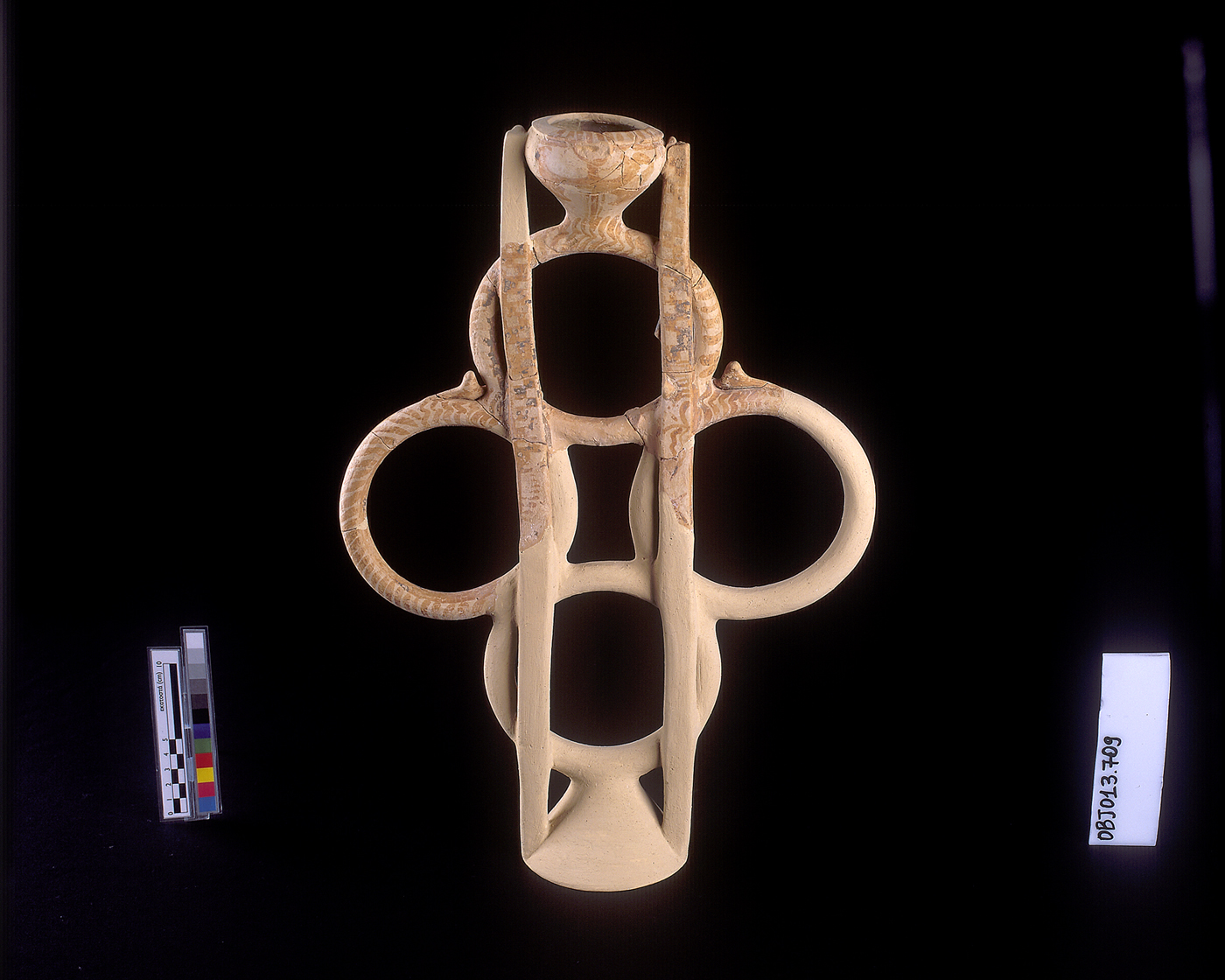
With the exception of the vessel from Nirou Khani (29), which falls into category I type 1, all the other objects listed above belong to our category II because bird figurines are attached to them. Double jugs usually consist of two vases connected merely by a narrow tube. The vessel from Myrsini (36), which is composed of three vases, is the only exception to this. Multiple small openings are present on only one of the jugs of such composite vessels, while the other ones are closed. All the double jugs and the triple jug from Myrsini belong to type 1 because the bird figurines are consistently positioned on the jug with the ‘strainer’ section. When the jugs were used, the birds’ beaks would have become wet and the doves would have appeared as if drinking from the content of the vase. In the Zakros vessel (37) (belonging to type 2), the dove figurines are attached to the rings which served as conduits for the liquid. Although the birds would not have become wet when the vessel was in use, they are still set into close proximity to the flow of liquid.
In addition to the doves, some of the vases have other animal images attached to or painted onto them. For example, the double vase from Chania (35) has a large waterbird amid foliage painted on its body and a hare modelled in relief on the handle. Bulls’ heads are attached to the Myrsini jugs (36), and fish, papyrus, a double axe and a quadruped (a bull?) are painted and modelled onto the Zakros ring-vessel (37). While the hare may indicate a general concern with fertility because these animals bear multiple litters per year, the depiction of aquatic species such as waterbirds, fish or papyrus may suggest that these vessels were originally filled with water.
The peculiar design of double and triple jugs has prompted some scholars to consider a practical purpose of this construction, e.g. to strain oil or to prevent flies from entering the vase (Bosanquet and Dawkins Reference Bosanquet and Dawkins1923, 40; Knappett and Cunningham Reference Knappett and Cunningham2012, 99), while others have suggested a rather vague ritual function (Karayiannis Reference Karayiannis1984, 33; Andreadaki-Vlazaki, Rethemiotakis and Dimopoulou-Rethemiotaki Reference Andreadaki-Vlazaki, Rethemiotakis and Dimopoulou-Rethemiotaki2008, 264 cat. no. 218). Apart from these considerations, we can observe that the design of both the composite jugs (30–36) and the Zakros ring-vessel (37) serves to complicate and lengthen the act of distributing the liquid. Moreover, the multiple small openings further separate the liquid into numerous single strands and drops – comparable to the function of a spray rose on a watering can. In the Zakros vessel (37) the liquid would have been separated into several streams by the hollow rings.
Such a physical separation of water would have resulted in a visual multiplication. This may have been desirable in rituals aimed at ensuring the abundant supply of this life-giving element.Footnote 30 The number of doves, which ranges from one to six figurines, adds another repetitious aspect to these vessels. Combined, the multiplication of both the liquid and the doves may have served to maximise direct physical contact between two elements that were thought to benefit from the presence of each other. Again, we can sense a rather literal understanding of the inner workings of nature, bestowing a decisive role to other-than-human phenomena.
LM IIIB–IIIC/Subminoan
After LM IIIA2, composite vases with bird figurines attached ceased to be made.Footnote 31 Only a ring-shaped vessel (38) dating to LM IIIB–IIIC could be a remnant of this Minoan tradition. Two small bird figurines, a bull's head and miniature vases are attached to the vessel. In contrast to the double vases discussed above, the birds which sit on the handle are no longer directly associated with the pouring of liquid (category II type 2).
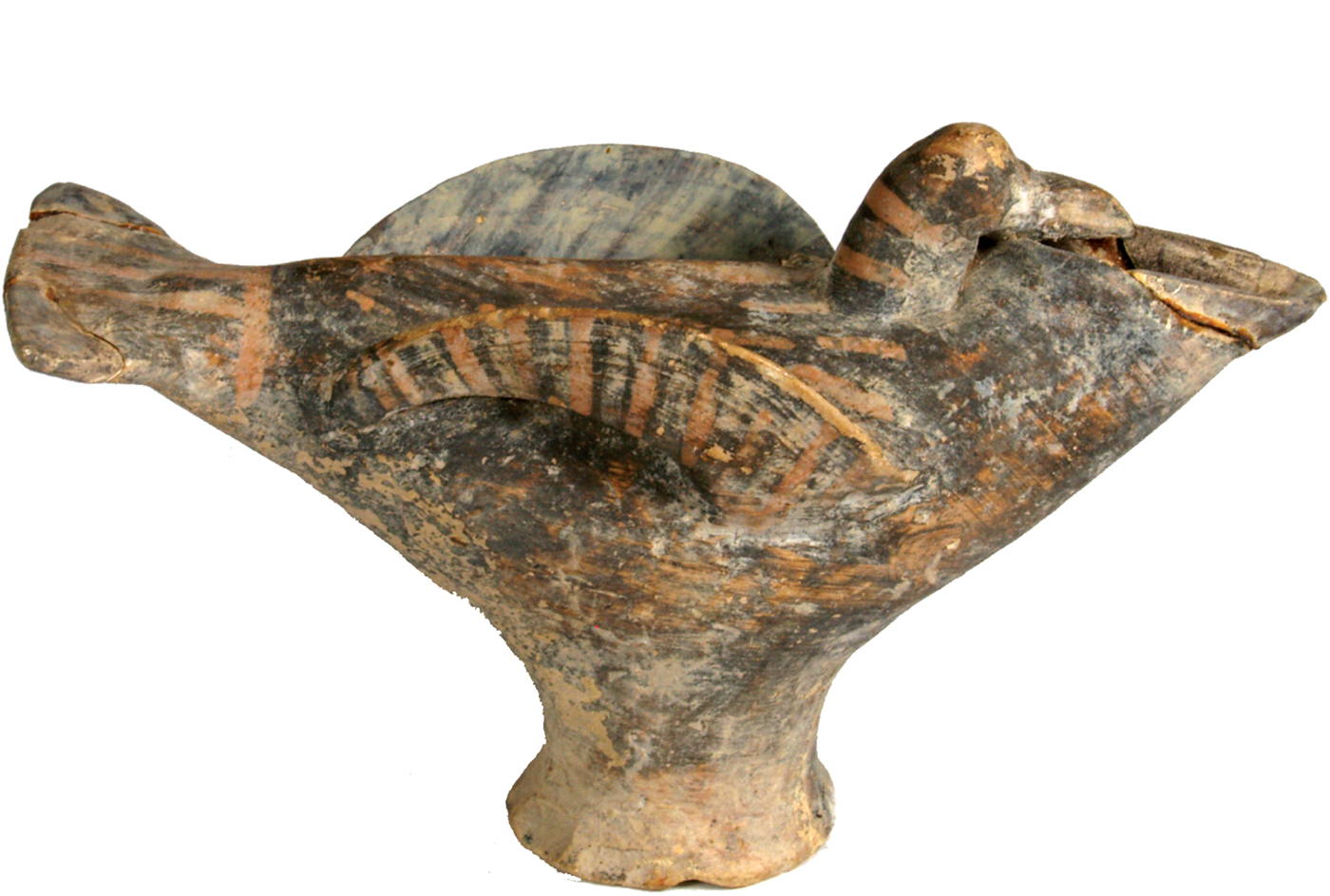
In LM IIIC and the Subminoan phase, bird-shaped vessels reappeared on Crete.Footnote 32 Four vessels come from Kavousi Vronda (39–42), two vessels each from Vrokastro (43, 44) and Karphi (45, 46), and one each from Chamaizi (47), Axios (48), Adele (49), Adromyloi (50), Mazichortia (51), Knossos (52) and Episkopi (53). As with LM IIIC pottery in general, these vessels display a remarkable uniformity in their appearance, despite their varied provenances.Footnote 33 They are slender askoi with a round spout instead of a bird's head (Fig. 18). This hinders species identification and prevents us from telling whether these were also meant to be doves. The rather elongated shape of the bodies, however, could also allude to waterbirds, which were primarily connected to liquids on the Greek Mainland (see below).Footnote 34
Askos from Karphi (45). Seiradaki Reference Seiradaki1960, 27 fig. 20.

These objects belong to our category I type 1 of bird-shaped vessels because, despite the missing heads, the vases emulate a bird's body and often show schematic wings outlined in paint. Nevertheless, vessel parts, such as spouts, handles and round pedestals which can substitute the more frequent stubby feet, visually dominate the bird parts. Moreover, the vases are decorated with geometric and abstract patterns of the LM IIIC and Subminoan period which do not have much in common with the natural plumage patterns of birds. Although the vases visually refer to some morphological features of birds, they clearly remain man-made containers of liquids. Therefore, it seems that the notion of an active and direct involvement of birds in the distribution of liquids was no longer entertained by this time.
Cyclades
EC I–II
Ideological links created between birds and liquids can also be observed in the material culture from the Cyclades. In the EC period, there are important cultural interconnections between the Cyclades and Crete. A bird-shaped flask comes from the Cycladic-style cemetery of Ayia Photia on Crete (54). It has a plump body and a long neck, which makes it resemble the EM I storage vessels from Lebena (1–7). Another vase that is similar to the Lebena vessels is a Cycladic bowl (55) in the shape of a two-headed dove dating to EC I–II (Fig. 19). The duplication of bird parts also reminds one of the EM triple-vessel from east Crete (9).
Bowl from the Cyclades (55). Hattler Reference Hattler2011, 98 cat. no. 35. Courtesy of Badisches Landesmuseum Karlsruhe.
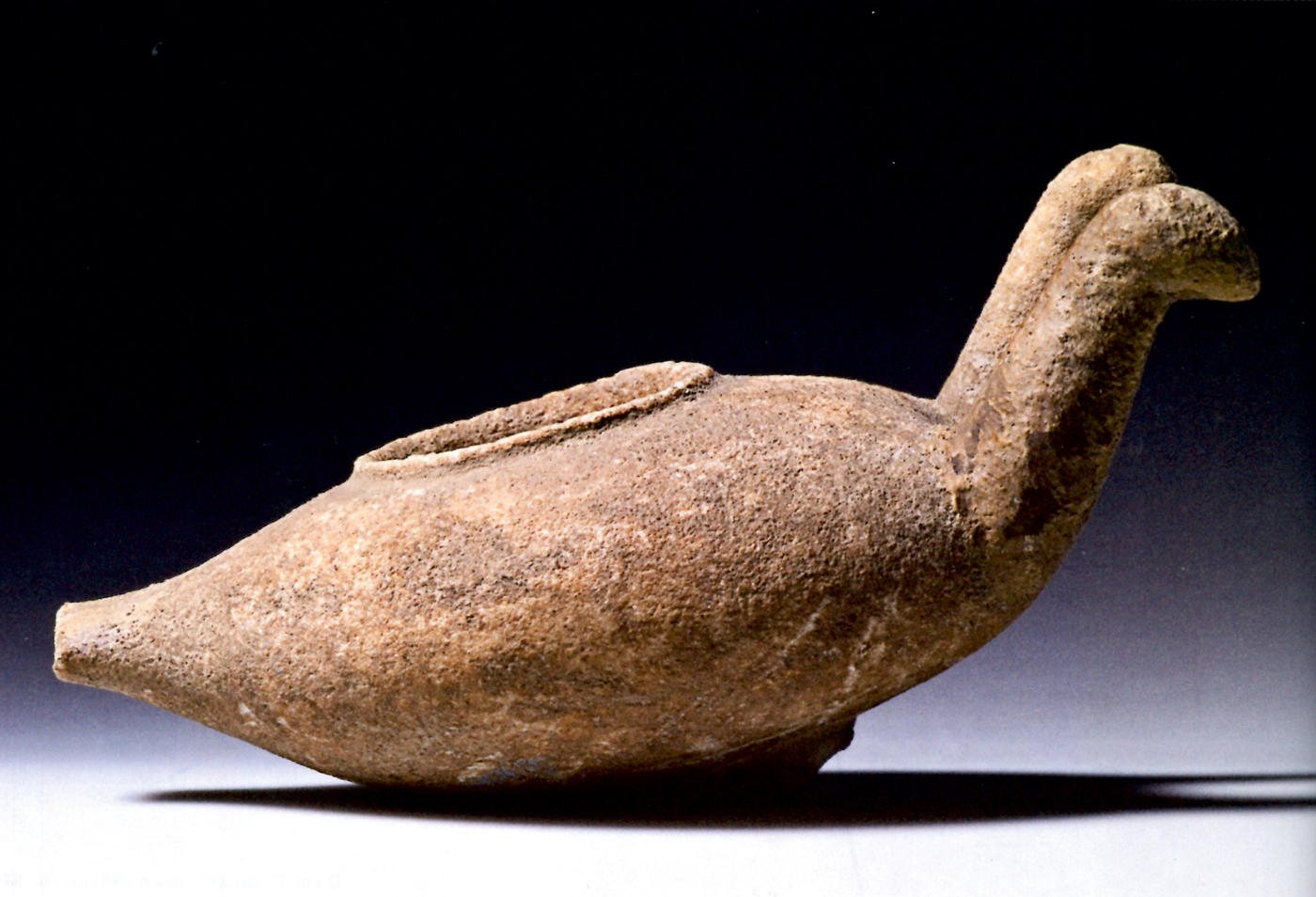
A further bird-shaped vessel was found on the Cycladic island of Ano Kouphonisi (56). In contrast to the two vases mentioned above, it is a pouring vessel. Formed to imitate the plump figure of a dove, the spout of the vase is hidden in the tail. It is directly comparable to the EM II–MM I dove-shaped vessels found at Koumasa and Platanos (14–17).Footnote 35 These figural vases could indicate that similar beliefs surrounding doves and liquids were entertained both on Crete and the Cyclades.
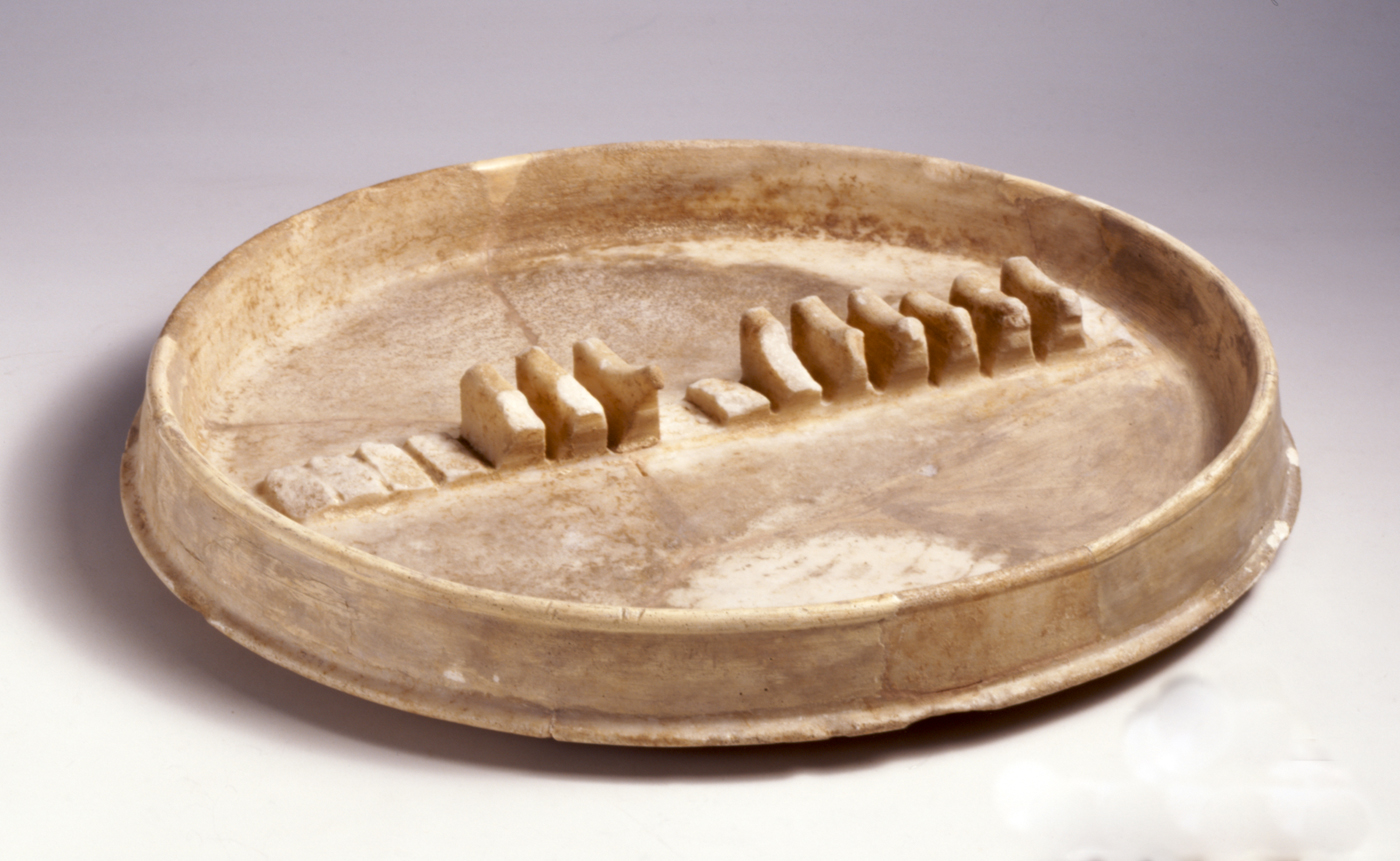
The Cyclades have also yielded a group of marble trays that do not have direct parallels on Crete. The round trays display a row of several sitting birds carved across the middle (Fig. 20). To date we know of two nearly complete ones (57, 58) and fragments of five more (59–63). They are dated to EC II. Most of them seem to come from Dhaskalio Kavos on Keros, a site that has been found to be unusual for a number of reasons, such as the amount of deliberate breakage of special artefacts brought there (Renfrew et al. Reference Renfrew, Doumas, Marangou and Gavalas2007, 430–42). The small birds have triangular bodies, flat tails and round heads with short conical beaks, suggesting doves.Footnote 36
Marble tray from Keros (?) (57). © Museum of Cycladic Art/G. Fafalis.

The trays belong to our category II because the bird figurines are not an integral part of the vessels. Instead, the carved row of birds seems to hinder a practical use of the vessels for drinking or eating (Doumas Reference Doumas1968, 174). Doumas (Reference Doumas1968, 173) observed a formal resemblance of the dove trays to the Cycladic frying pans. These are flat round trays with handles, which are decorated on one side with incised images of boats, stars, spirals (waves?) and female genitalia.Footnote 37 Some scholars, for example Davaras (Reference Davaras1982, 8) or Goodison (Reference Goodison, Tampakaki and Kaloutsakis2006, 377), believe that they held water, possibly to serve as mirrors (to reflect the sun or the stars?). If the dove trays were also filled with water, this would have conveyed the impression that the doves are drinking and/or sitting in a bird bath.Footnote 38 In this case, the numerous – on the one complete vessel up to 16 – birds would have been brought into direct physical contact with the liquid (type 1). Comparable to the later dove figurines attached to Cretan composite vessels, such an arrangement may have been desirable in a ritual context.Footnote 39
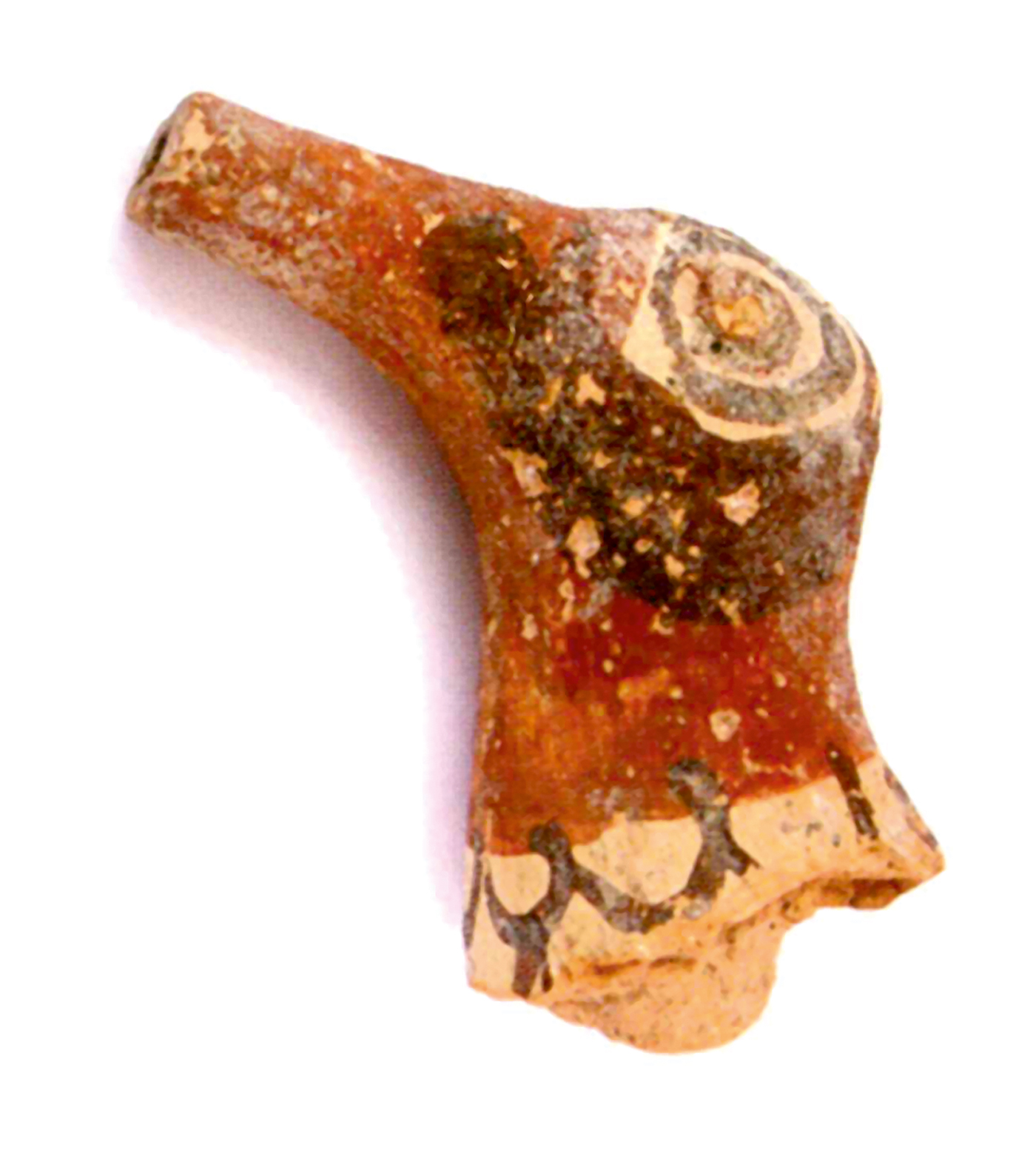
From the same site, Dhaskalio Kavos, comes another object which possibly connects a bird with a vessel. It is a terracotta fragment in the shape of the head and neck of a bird (64) (Fig. 21). The excavators think that it was originally part of an EC sauceboat, whose spout had been substituted by a bird's head. In contrast to the other bird images which we have seen before, the bird from the sauceboat has a long curved beak, a characteristic feature of a duck. This association is repeated on the design of an EC II sealing from Ayia Irini on Kea (CMS V 478), where a duck is set next to a sauceboat.
Fragment of a sauceboat from Dhaskalio Kavos on Keros (64). Renfrew et al. Reference Renfrew, Doumas, Marangou and Gavalas2007, 374 fig. 10.12. Courtesy of C. Renfrew.

Sauceboats seem to be a combination of an open drinking vessel (a cup) and a pouring vessel with a long spout (Weinberg Reference Weinberg1969, 5–7; Wiencke Reference Wiencke2000, 591–2; Morris Reference Morris, Hitchcock, Laffineur and Crowley2008, 119–20). We may wonder whether this design was meant to facilitate libations performed before drinking. If the reconstruction proposed by the excavators is correct, the duck-headed sauceboat would belong to our category I, type 2. By replacing the spout, a rather close physical connection between the liquid and the duck was created. When the vessel was tipped, liquid would have flowed around the head. Waterbirds – as this folk taxonomical category that is found in many cultures suggests – have a close affiliation with water due to their aquatic habitat. Their connection to liquids is more obvious than that of doves, which only becomes apparent after some time spent observing the behaviour of the latter.
MC III–LC I
In the subsequent period, many of the Cycladic beaked jugs of the MC II–III period are decorated with birds (Davis, J.L. Reference Davis1976), thus potentially falling into our category III. Yet these birds, which are probably falcons according to Porter (Reference Porter2011, 43), have rather peculiar bodies in the shape of red disks. Scholars have suggested that this form is linked to some kind of sun symbolism (Papagiannopoulou Reference Papagiannopoulou, Brodie, Doole, Gavalas and Renfrew2008, 442; Porter Reference Porter2011, 45). These vases are also characterised by a spout that vaguely resembles a bird's beak, so this may allude to a connection between birds and liquids, but the link to the sun appears more prominent. In the subsequent LC I period, the beaked jugs become smaller and female features such as jewellery and nipples are added to them (Goodison Reference Goodison, Brodie, Doole, Gavalas and Renfrew2008, 421–3), further reducing their avian appearance and loosening any possible connection between birds and the flow of liquid.Footnote 40
Nevertheless, two objects directly connect birds and liquids in MC III/LC I. Discovered at Akrotiri on Thera, these are fragments of two bird-shaped vessels (65, 66). The long beaks and elongated heads suggest that they are waterbirds, probably ducks (Nikolakopoulou Reference Nikolakopoulou and Krzyszkowska2010, 217). Feathers and plumage patterns are indicated in paint on the preserved heads, necks and breasts and may arguably have once covered the whole bodies (Figs 22, 23).
Fragmentary vessel (rhyton) from Akrotiri on Thera (65). Nikolakopoulou Reference Nikolakopoulou and Krzyszkowska2010, 216 fig. 21.3f. Courtesy of C. Doumas.
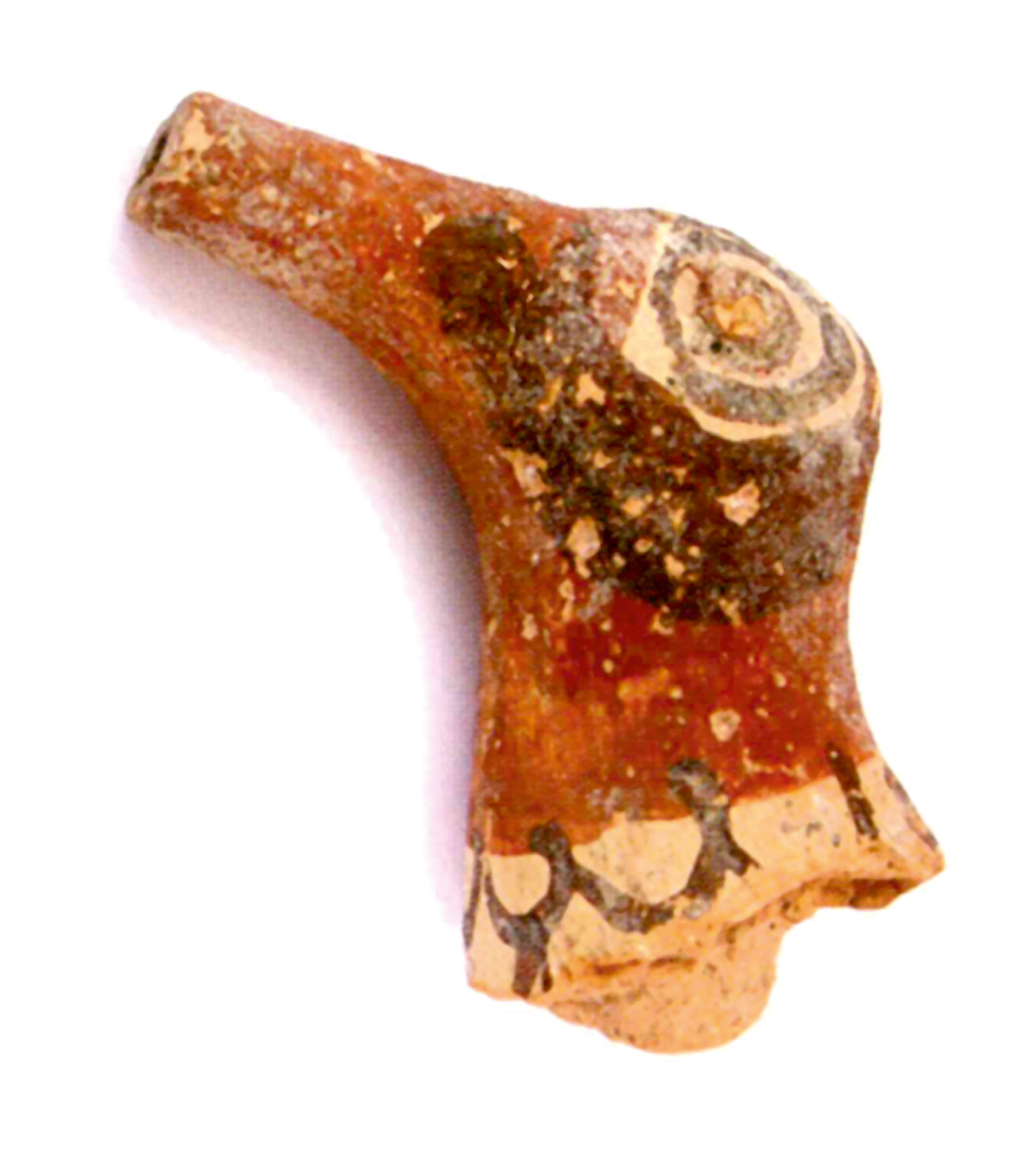
Fragmentary vessel (rhyton) from Akrotiri on Thera (66). Marinatos Reference Marinatos1971, pl. 96d. Courtesy of the Archaeological Society at Athens.

Belonging to our category I type 1, these vessels were probably rhyta with the beaks functioning as spouts. Due to their remarkably naturalistic and animated appearance (especially by the emphasis laid on the eyes), the physical boundaries between bird and vessel seem almost dissolved, creating ambiguous entities. Comparable to the much earlier Cretan dove-shaped vessels, they afford birds, in this case ducks, a specific and active role in the distribution of liquids. From the contemporaneous frescoes found in the houses of Akrotiri we can deduce that ducks and geese were, in the minds of the inhabitants, inextricably linked to an aquatic habitat, as depicted in the riverine landscape in the East Frieze of the West House (Morgan Reference Morgan1988; Televantou Reference Televantou1994) or the Reed Fresco from Xeste 3.Footnote 41 In the light of this observation, it seems plausible that ducks were believed to have a special influence on the natural supply of water.
LC IIIC
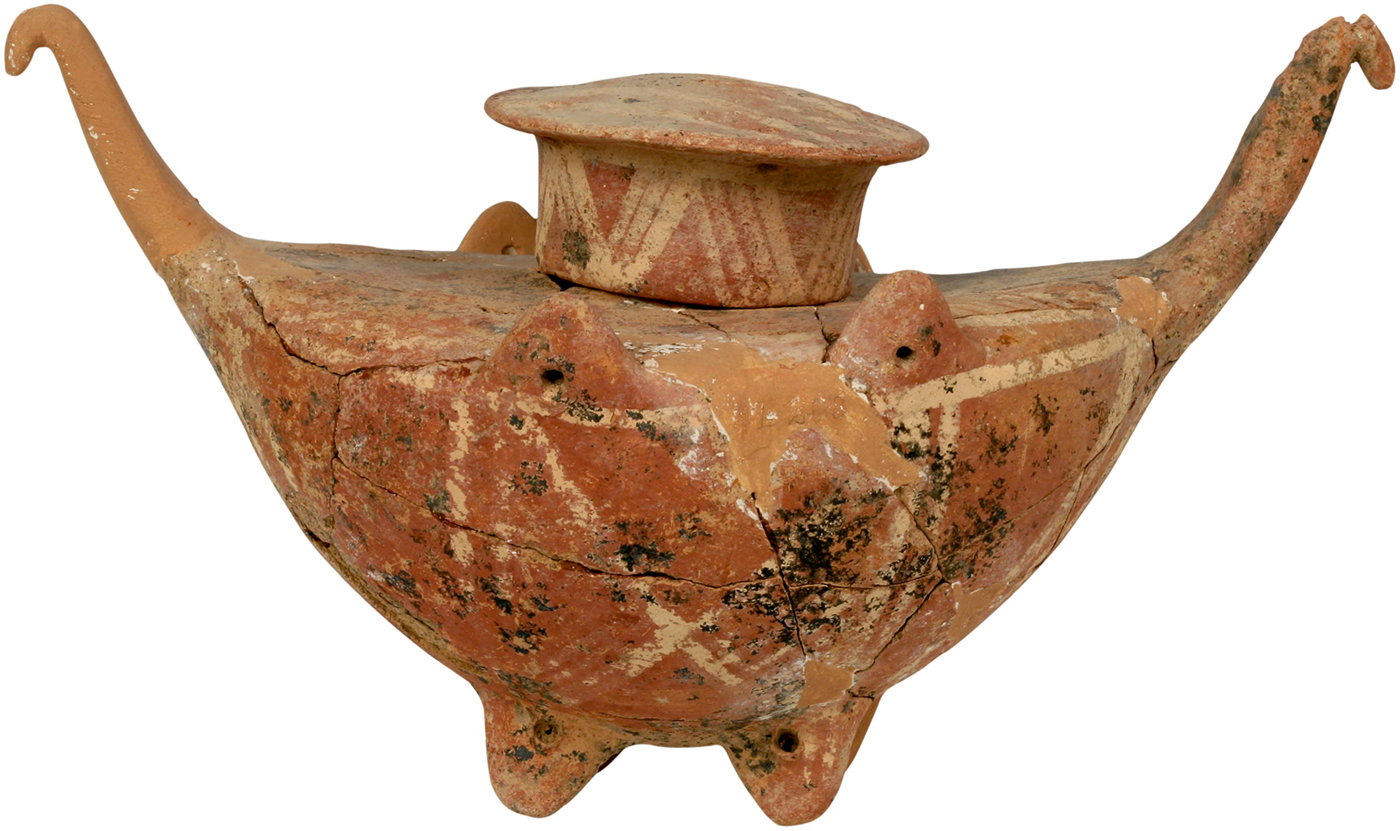
A gap of several centuries separates the Theran rhyta from the final Cycladic bird-shaped vessels. These are two vases discovered in a LC IIIC tomb at Kamini on Naxos (67, 68).Footnote 42 The vessels have handles on their backs and rounded spouts sit on top of the birds’ tails (Fig. 24). The one whose head is preserved completely has a relatively short neck and a flat curved beak, thus resembling a duck.
Askos from Kamini on Naxos (67). Vlachopoulos Reference Vlachopoulos2006, fig. 26. Courtesy of A. Vlachopoulos.

As with the rhyta from Akrotiri (65, 66), these vessels belong to our category I type 1. Although they too have a close relationship to the liquid, which is enclosed by the bird's body, they seem to have only one spout which is rather artificially attached to the top of the tail. It has no functional or visual connection to the bird features. Combined with the prominent handle it prevents the vessel from visually merging with the waterbird. Moreover, the painted decoration does not show natural plumage patterns but consists of fish and wavy lines, which further underline the thematic association with the aquatic element, but also lend an unnatural air to the artefact. Rather than engaging the bird itself in the flow of liquid, these vessels bring together conceptually related entities – vessel, liquid/water, waterbird, and fish – to create an abstract thematic complex. This is similar to the changes occurring on Crete between the last composite vessels with dove figurines in LM IIIA2 and the spouted bird-shaped askoi of LM IIIC/Subminoan.
From the same cemetery on Naxos come some stirrup jars decorated with (water)birds and fish (Vlachopoulos Reference Vlachopoulos2006, esp. 198–200), which may have fallen into our category III. Similar vases have also been found in tombs at Perati in Attica and at some sites in the Dodecanese (Mee Reference Mee1982, 32–4; Crouwel Reference Crouwel1984; Reference Crouwel and Danielidou2009; Benzi Reference Benzi1992, 83–4; Iakovidis Reference Iakovidis, Deger-Jalkotzy and Zavadil2003). Associated motifs, however, suggest that any bird–liquid connection only played a secondary role in the function of these vases. The majority of these vase-paintings feature a large octopus placed below the spout whose tentacles encompass the whole body of the vase. This animal suggests a marine rather than an aquatic setting, and the fact that a similar cluster of motifs appears on Cretan sarcophagi of the LM IIIA–IIIB period (Alberti Reference Alberti, Graziadio, Guglielmino, Lenuzza and Vitale2013) indicates some kind of mortuary significance for these stirrup jars. Thus, the two bird-shaped vessels from Naxos are the only objects that directly attest to the continuing presence of an ideological connection between birds and liquids in the Cyclades.
Greek Mainland
EH, MH, LH I–II
On the Greek Mainland, we can find many objects linking birds and liquids in the Mycenaean period. Before this time, the evidence is much more scattered. In the EH period, a fragmentary bird-shaped object from Zygouries could have been part of a vessel (69) and two spherical askoi from this period (70, 71) are modified by the addition of generic avian traits such as small tails. On the askos from Corinth (71) wings are indicated by incised lines. A single bird-shaped askos, found at Eutresis, can be dated to the MH period (72). These three vases share some traits with contemporary bird-shaped vessels from Crete (10, 21–24), and may be imitations of these (Misch Reference Misch1992, 58, 95). The askoi dating to the EH period belong to category I type 2 because they display merely a partial adoption of avian forms, while the unique vase from Eutresis with its legs, tail and wings falls into type 1.
In the Mycenaean period, the earliest attestation of the bird–liquid connection is a rock-crystal bowl from shaft grave omikron of Grave Circle B at Mycenae (73), dating to LH I. The handle is shaped like a bird's reverted neck and head (Fig. 25). The head is elongated with a long flat bill, which has a small knob at its base. This feature is a trait of mute swans (Cygnus olor), as Phillips (Reference Phillips2008, 1.185–6) has observed. Similar open vessels were made from clay in LH I–II. They have been found in tombs at Mycenae (74) and Nafplion (75). An almost identical one was found in a LH IIIB tomb at Kokla in the Argolid (76), but its similarity to the other ones suggests that its manufacture date significantly precedes its deposition date. The clay vessels are less detailed than the rock crystal bowl, but they seem to show waterbirds as well (Fig. 26).
Rock crystal bowl from Mycenae (73). Image courtesy of Bildarchiv Foto Marburg.
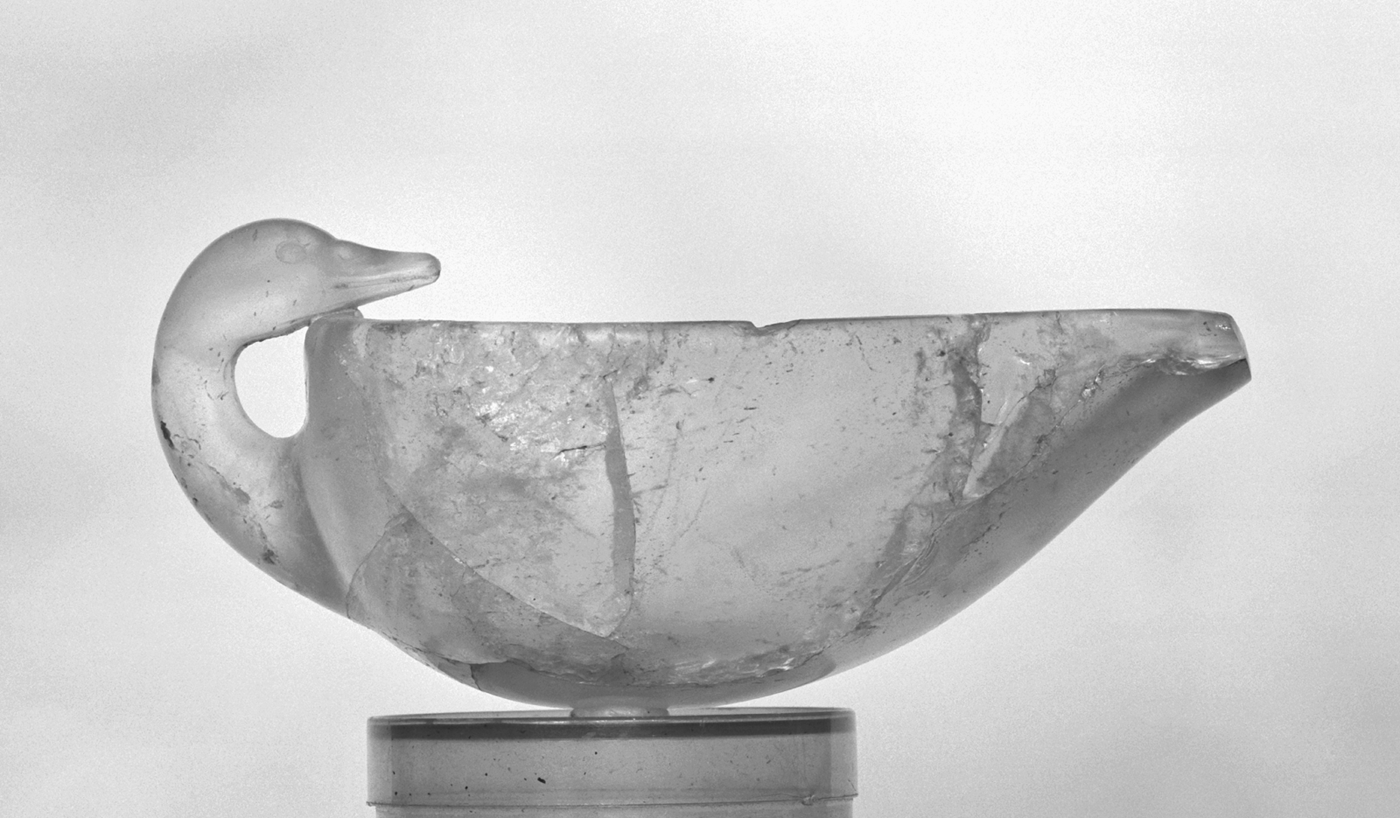
Bowl from Mycenae (74). Wace Reference Wace1939 (Reference Wace1950), pl. 21a.4.
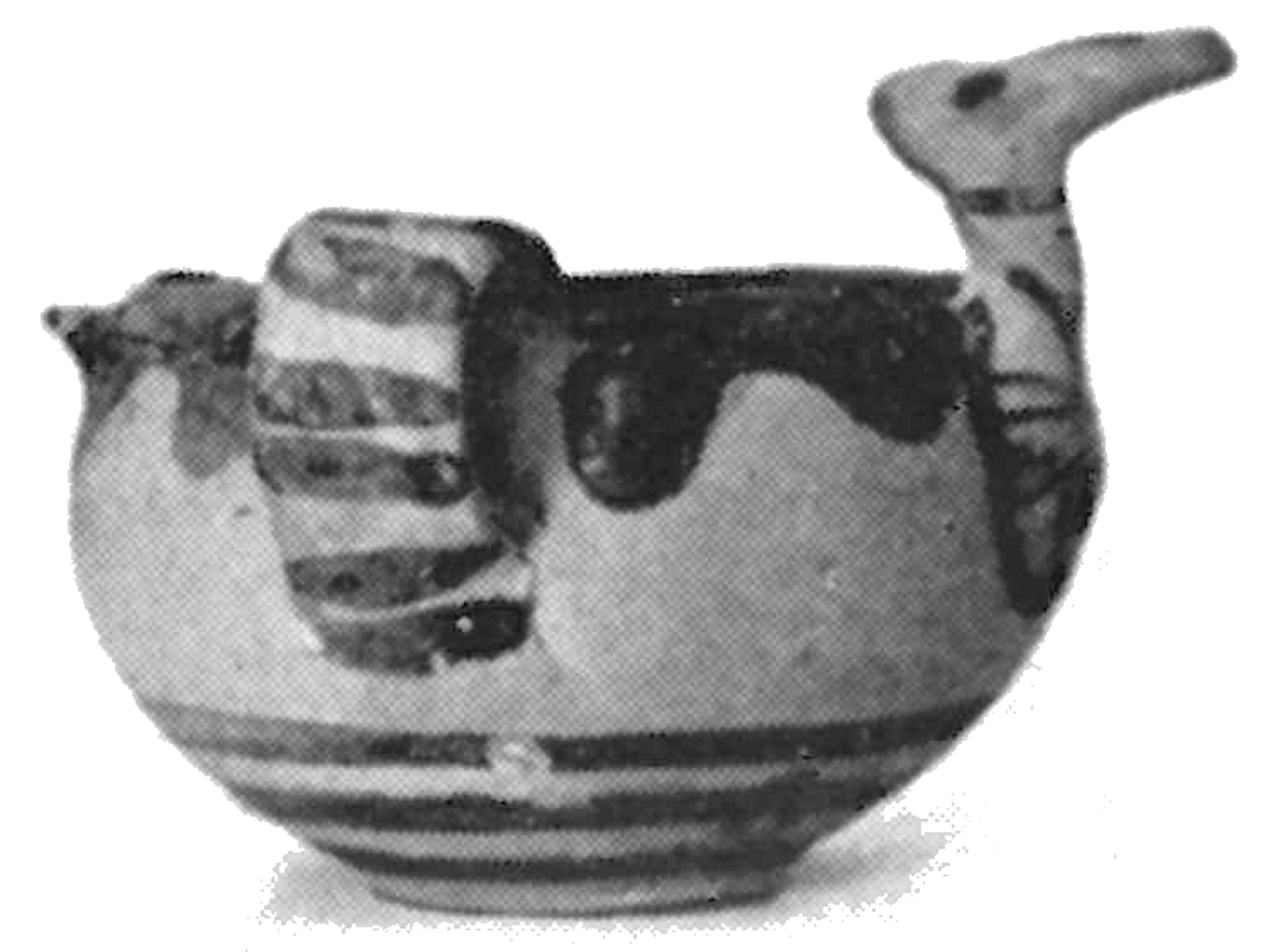
The vessels belong to our category I type 2 because only the handles adopt avian shapes. The edge opposite the handle is modified to form a shallow spout so that the bowl could also be used for pouring. As with the much earlier sauceboats, this design may have enabled libations. The waterbird features serving as handles facilitate the pouring action but they do not come into direct contact with the liquid. Although this applies to both the rock crystal bowl (73) and its terracotta variants (74–76), they significantly differ from each other in terms of style. It seems plausible that this is due to differing artistic traditions, the rock crystal bowl probably being of Cretan manufacture (Phillips Reference Phillips2008, 2.374), while the clay bowls are local products. Whereas the swan's head on the stone vase is turned back, resulting in a naturally dynamic appearance, the waterbird heads on the terracotta variants look straight ahead. Moreover, the clay bowls have additional ring handles and painted decoration under the rims which does not correspond to any plumage patterns. Here, the vessel elements dominate the bird features both visually and functionally.
LH IIIA–IIIB
Related bowls, only now made from bronze, were used from LH IIIA onwards. One such bowl (77) comes from a tomb of unknown location on the Greek Mainland, which also yielded a sword (Matthäus Reference Matthäus1979). Part of the handle adopts the shape of a waterbird protome (Fig. 27). Comparable is a LH IIIB (?) bronze tankard from the LH IIIC Tiryns Treasure (78). Here, the support for the thumb is in the shape of a complete waterbird, while a smaller ring handle directly below would have been for the index finger (Fig. 28).Footnote 43 Belonging to our category I type 2, the bird motifs facilitate the handling of the vessels, but they never come into direct contact with the liquid content.
Bronze bowl from Greece (77). Matthäus Reference Matthäus1979, pl. 21b. Courtesy of H. Matthäus.

Bronze tankard from Tiryns (78). Matthäus Reference Matthäus1980, pl. 42.360. Courtesy of H. Matthäus.

At this point one particular vessel needs to be analysed, whose hybrid nature seems to stem from different traditions.Footnote 44 This is a bronze vessel from the Sellopoulo tomb on Crete (79), dating to LM II–IIIA. The grave belongs to a group of tombs from the Knossos area which are characterised by architectural features and offerings (usually weapons or bronze vessels) with close parallels on the Greek Mainland and various degrees of hybridisation of traditional ‘Minoan’ and novel ‘Mycenaean’ features (Preston Reference Preston and Cadogan2004; Miller Reference Miller2011, esp. 26; Steinmann Reference Steinmann and Yalçin2018, 180–1). The metal vessel, of which only its upper half is preserved, possesses a large handle, and opposite this handle the indented rim is modified to form a long-billed bird protome, probably a waterbird (Fig. 29).
Bronze jug from Sellopoulo (79). Popham and Catling Reference Popham and Catling1974, 237 fig. 23.

The layout of this vessel conforms to our category I type 2. Both the bird and the overall arrangement closely resemble those of the Mycenaean metal vessels described above. The object was called a hydria by the excavators and the bird protome was explained as a way to facilitate the tipping of the vessel for pouring (Popham and Catling Reference Popham and Catling1974, 236 cat. no. 28 (B2)). However, given its position at the shallow spout, which means that the bird would have become wet when the vessel was used, this seems rather impractical. Rather, this arrangement reminds one of the positioning of dove figurines on contemporaneous Cretan double vases, which were deliberately brought into direct contact with the liquid that was poured out. Thus, the Sellopoulo vessel displays a hybridisation of ideas concerning birds and liquids apparently originating from different regions.
Returning to the Greek Mainland, there are some more artefacts linking birds and liquids in LH IIIA–IIIB. A distinct group of objects combines the shape of a bird with features of a vessel (Desborough Reference Desborough1972, 246). Three such objects have been found at Prosymna (80–82), two at Mycenae (83, 84), and one each comes from Vourvatsi (85) and Kallithea (86). Another vessel is said to be from Attica (87) and three are of unknown provenance (88–90).Footnote 45 Several, mostly fragmented ones, come from Tiryns (91–93).Footnote 46 A fragment of another such vase was found at Haghia Triada (94). The long necks and long, occasionally curved, bills of these bird-shaped figurines indicate that they represent waterbirds (Fig. 30).
Hollow figurine from Mycenae (83). Wace Reference Wace1932, pl. XXIII.14. Reproduced by kind permission of the Society of Antiquaries of London.

Although these objects can be said to belong to our category I of bird-shaped vessels because the shape and the prominent handles on their backs make them resemble the contemporaneous flat-based askoi, these zoomorphic ‘vessels’ are actually hollow figurines (type 3).Footnote 47 Thus, only a loose association between birds and liquids is created by these objects. Being quite small and frequently found associated with miniature vessels of other types, they too may have been a symbolic substitute for regular-sized vessels.Footnote 48 The lack of actual functioning vessels in the shape of waterbirds during this time seems to reinforce the impression that for the Mycenaeans it was not deemed essential that the bird features physically touched the liquid.
Some vase-paintings from this period are also worth discussing in our context. Birds such as waterbirds and large wading birdsFootnote 49 belong to the most common motifs in Mycenaean vase-painting (cf. Vermeule and Karageorghis Reference Vermeule and Karageorghis1982, 209–11, 214–16, 225–6; Güntner Reference Güntner2000, 85–127, 261–93). In most cases, they are depicted on open vessels such as kylikes, bowls and kraters.Footnote 50 Less frequently, birds are painted on pouring vessels such as jugs and spouted vessels such as stirrup jars.Footnote 51 In most cases, these are not sufficiently preserved to determine the details of the compositions and the birds’ relationship to the pouring of liquid. An exception is a group of squat stirrup jars from Mycenae dated to LH IIIA2–IIIB1 (Sakellarakis Reference Sakellarakis1992, 110–13 cat. nos 246–9). These vases show small waterbirds (ducks?) alternating with sphinxes on the body, while papyrus flowers are depicted on the shoulder. The sphinxes suggest that these vases had some ritual purpose, but the positioning of the birds on the body, spatially removed from the spout, seems to indicate that the bird–liquid connection was not of primary importance to the function of these vases.
On other pouring vases that are (nearly) complete, however, the birds are always painted on the shoulder, thus set in close proximity to the spout. Examples come from Kokla (95), Mycenae (96, 97), Midea (98, 99), Ialysos on Rhodes (100) and Berbati (101). The birds on these vases are waterbirds of the type common in Mycenaean vase-paintings of this period. They either have plump or elongated bodies, but always long necks and bills.
Belonging to our category III type 1, the bird motifs are set into a definite spatial relationship to the flow of liquid. In three cases (99–101), this relationship is reinforced by the positioning of the waterbirds, which are shown flanking a plant that grows directly below the spout (Fig. 31). Although the birds would not have been directly touched by the liquid poured out of the vessel, it would have flowed fairly close to them. Incidentally, a similar arrangement can be observed on the double vase from Chania on Crete (35), already discussed above. On this vase, a waterbird among papyrus flowers is painted on the jug with the strainer section, directly below the flow of liquid. Since the same vase also has a dove figurine attached to the upper part of the strainer section, this vessel combines ritual practices from different regions. Comparable to the Sellopoulo bronze vessel (79), the Chania double vase attests to the cultural hybridity observable in middle and western Crete in the LM III period.Footnote 52
Vase-painting on a jug from Rhodes (100). Maiuri Reference Maiuri1923–4, 227 fig. 144. Reproduction granted by the Scuola Archeologica Italiana di Atene.

In the vase-paintings, the effect of an abundant flow of water is also illustrated by the growth of (wetland) plants such as papyrus or palm trees that are depicted amid the birds and below the spouts.Footnote 53 The waterbirds are pecking at these, and on three vases (98–100) we can observe a close physical and/or visual convergence between birds and plants. For example, long-stemmed vegetal elements can be directly attached to the birds’ bodies, which results in rather unnatural but highly symbolic images. On the stirrup jar from Midea (98), the birds are shown next to a sprawling plant whose leaves mirror the form of the birds’ bodies and wings (McMullen-Fisher and Giering Reference McMullen-Fisher and Giering1994, 12) (Fig. 32). Such arrangements create the impression that waterbirds are – like the closely associated (wetland) plants – part of the thriving landscape and ecosystems that signify the abundant flow of water.Footnote 54
Vase-painting on a stirrup jar from Midea (98). Drawing by E. Markou. McMullen-Fisher and Giering Reference McMullen-Fisher, Giering and Walberg1998, pl. 65. Courtesy of K. Giering.

It seems likely that water-related fertility was the concern of the people using these vessels, probably in ritually charged situations. Such an argument is also supported by the find context of the stirrup jar from Midea. This vase was found together with part of a large female terracotta figure and a bovine figure, possibly remains of a shrine, on the Lower Terraces of the palace (Walberg Reference Walberg1994). The palatial connection of this vase also suggests that it was important for the people in charge to associate themselves with the continued flow of life-giving water.Footnote 55
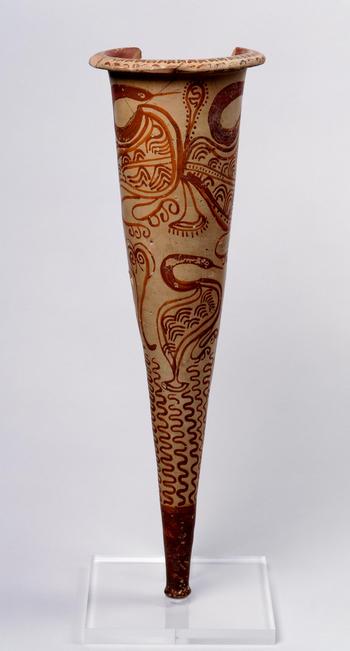
In addition to the jugs and stirrup jars, there are a few Mycenaean conical rhyta that are decorated with waterbirds. One comes from Brauron (102), another from an unknown site in Attica (103) and a third was found at Kalavarda on Rhodes (104). These rhyta belong to our category III type 2 because although the waterbirds are painted onto these vessels they do not have a close spatial relationship to the flow of liquid (Fig. 33). However, waterbirds are repeatedly depicted on conical rhyta, which does suggest an ideological link between these birds and the liquid content (Paschalidis Reference Paschalidis2001, 98–101). This association is strengthened by the fact that conical rhyta found at Knossos (105), Karphi (106) and Palaikastro (107) on Crete dating to LM II–IIIA2/IIIB also show waterbirds.
Conical rhyton from Attica (103). Image courtesy of bpk/Antikensammlung, Staatliche Museen zu Berlin.

Some scholars have interpreted conical rhyta exclusively as cult paraphernalia for performing libations, while others have advocated a wider significance, for example as implements for transferring liquids from one container to another.Footnote 56 On the rhyton from Rhodes, the waterbirds are included in a rather curious scene also involving lions or boars,Footnote 57 a mirror and a kylix, possibly for libations (Fig. 34).Footnote 58 On all rhyta, the waterbirds are shown in groups of two, three or more rather plump birds, thereby creating an impression of abundance and fecundity.Footnote 59 They may thus have symbolised the positive effects of water on nature, an allegorical function that would have been appropriate both in a ritual and in a feasting context.
Vase-painting on a conical rhyton from Rhodes (104). Karantzali Reference Karantzali, Karageorghis and Stampolidis1998, 97 fig. 10a. Courtesy of E. Karantzali.

LH IIIC/Submycenaean
The bird–liquid connection survived the fall of the palaces, attesting to the pervasiveness of this association in popular belief systems. In LH IIIC, bird-shaped vessels with elongated bodies, heads and long bills appeared (Fig. 35). Five such vessels have been found at the Klauss cemetery (108–112), two each at Kanghadi (113, 114) and Kallithea (115, 116), and one each comes from Tanagra (117), Ialysos on Rhodes (118) and Kladeos (119). To the Submycenaean phase belong three vases from Lefkandi on Euboea (120–122), one askos from Alyki (123) and five vessels from Athens (124–128). They could be ducks or geese because their necks seem too short for swans.
Rhyton from Patras – Klauss (?) (111). Kontorli-Papadopoulou Reference Kontorli-Papadopoulou1979, 157 fig. 2.1. Courtesy of T. Papadopoulos.

Belonging to our category I type 1, these bird-shaped vessels have cylindrical beaks which in most cases serve as secondary spouts.Footnote 60 Thus, the bird features have a rather intimate spatial connection to the liquid, whose flow is mediated by a part of their anatomy, the bill. Since this arrangement is a novelty on the Greek Mainland, scholars have considered these vessels to result from a possible influence from elsewhere such as Crete or Cyprus, where similar vessels were more regularly used.Footnote 61 Although the specific vessel type may indeed have come from elsewhere, we have seen that the principle idea of associating waterbirds and liquids had a long local tradition on the Greek Mainland.Footnote 62
Structurally similar vessels were indeed used in the Pre- and Protopalatial periods on Crete and on MC III–LC I Thera, but the ones from the Greek Mainland differ from them in some important details. Significantly, they possess elements that visibly obstruct the merging of bird and vessel features. For example, the beaks adopt the rather unnatural shape of a cylindrical spout. Moreover, angular handles and openings for filling the vase project rather prominently from the back. The openings are often as high as or even higher than the bird's head, drawing the eye to this characteristic vessel feature. Moreover, only a few vases attempt to depict wings and/or natural plumage patterns. Some vessels show downright unnatural features such as teeth (116). Most are decorated with geometric and abstract motifs taken from the contemporaneous vase-painting repertoire. One vessel from Kanghadi even has quadrupeds painted on its sides (114).
Comparable to the contemporaneous bird-shaped vessels from the Cycladic island of Naxos (67, 68), all these elements interact to make these objects appear like vessels which happen to be in bird shape rather than birds which have the potential to act as vessels.Footnote 63 The purpose of the waterbird features seems to consist of giving the vessel a form which is symbolically appropriate for its purpose of distributing liquid, probably water, in a ritual setting. Since the majority of these vessels come from tombs, sometimes associated with female figurines and/or miniature vessels, they may also have had a specifically funerary significance, possibly connected to notions of regeneration.Footnote 64
CONCLUSION
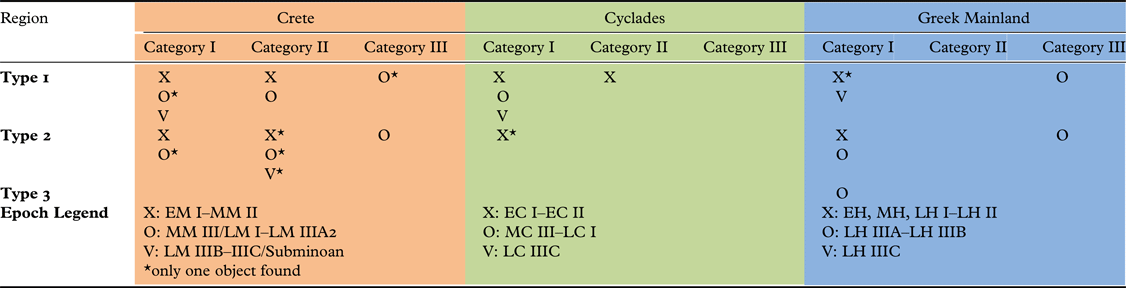
A close study of the interconnections between vessels, liquids and birds in the Aegean Bronze Age provides important insights into ritual practices and human–bird relationships. By systematically categorising different types of vessels and relative positions of bird depictions, it becomes possible to identify various interaction effects. Divergent trends can be observed both from a diachronic and a regional perspective (Table 2).
Chronological and regional distribution of categories and types.

The earliest evidence of a link created between birds and liquids comes from Crete. Here, bird-shaped vessels and bird figurines attached to vessels appear from EM I until LM IIIC and the Subminoan phase, with a gap observable in LM IIIB. The birds can consistently be identified as doves; occasionally, a more specific identification as a rock or turtle dove is possible. The association between doves and liquids may have been inspired by natural behaviour that is unique to this bird family such as the ability to drink water in a continuous motion and to produce crop milk for their young. Waterbirds sometimes appear on Cretan vessels, but they are mainly found in contexts that show a strong influence from the Greek Mainland.
Both bird-shaped vessels and bird figurines attached to vessels afford a close interaction between liquids and birds. In the Cretan vessels of the first category we can note an attempt to physically hide vessel parts within natural dove features or merge the two elements so that the bird itself seems to take over the role of the vessel. In the LM IIIC period, a significant change is observable in this regard because now vessel parts such as spouts visually dominate the rather stylised bird features.
In Cretan vessels of the second category we can observe efforts to bring the dove figurines into direct contact with the liquid during the process of handling. Beaks would have become wet so that the – relatively naturalistic – bird figurine would have appeared to be drinking from the vase. The element of multiplication that is frequently observable seems to both maximise contact between bird and liquid and create a sense of abundance. Such arrangements imply that doves were thought to have some positive effect on the liquid. One could imagine that they were believed to be able to bring rain and/or increase the fertile and nourishing aspects of water and milk, which made it necessary to award the birds an active role within the ritual. Such an attitude towards animals is consistent with animist notions.
On the Cyclades, the earliest evidence for a link between birds and liquids dates to EC I–II, and such a connection continues, albeit with considerable gaps, into the LC IIIC period. As on Crete, both bird-shaped vases and bird figurines on vessels were used. Doves seem to have played a similarly important role, at least in the EC period. However, waterbirds such as ducks and geese were also associated with the handling of liquids in the Cyclades. Because of their aquatic habitat, waterbirds possess a natural link to the element of water which is more obvious than that of doves.
In comparison to the Cretan objects, the Cycladic bird-shaped vessels of the EC and MC III–LC I periods are also characterised by a deliberate integration of vessel elements with the bird's anatomy and an emphasis on natural features. Moreover, it seems to have been deemed necessary that the liquid was directly touched by the bird elements. As on Crete, this was sometimes underlined by a repetitive appearance of bird figurines. Therefore, it seems that the people of the Cyclades also assigned birds a decisive role in the natural and ritual flow of liquids, possibly within an animist framework. Again, this had changed by LC IIIC, when the two preserved bird-shaped vessels display prominent spouts and a painted decoration that does not show a bird's natural plumage pattern but rather serves to further symbolise the aquatic element.
On the Greek Mainland, birds were occasionally associated with liquids in the EH and MH periods, and this link continues in a more consistent manner throughout the Mycenaean period from LH I to LH IIIC. The objects differ from most of the Cretan and Cycladic ones in a number of ways. Bird-shaped vessels and vase-paintings of birds on pouring vessels were used, while bird figurines attached to vessels are lacking. Only waterbirds such as swans, ducks and geese appear in this context and there is no indication that doves were thought to have a special role connected to liquids.
Both bird-shaped vessels and vase-paintings of birds from the Greek Mainland are for the most part characterised by a certain distance maintained between the bird motifs and the flow of liquid. This dissociation is achieved by the visual domination of vessel elements over bird parts – bird heads serve as handles, spouts are prominently positioned on the birds’ backs – and the frequent spatial separation of bird parts on the one hand and the openings/spouts on the other. In some cases, the liquid is even completely absent and only alluded to by the general similarity of the object to a vessel. Another feature that creates a distancing effect from the ‘real’ flow of liquid is the extensive stylisation and conspicuous depiction of unnatural features observable in Mycenaean waterbird depictions. This suggests that the Mycenaeans had a less literal understanding of the role of birds in relation to liquids than the Minoans or the people of the Cyclades. Instead of believing in an active influence of birds on the flow of liquid, the plump waterbirds among sprouting plants may have been seen as an appropriate way of symbolically referencing the positive effects of the abundance of water. With the Mycenaean expansion towards the southern Aegean in LH IIIB, such notions, which are consistent with an analogical worldview, were apparently adopted also by people on Crete and the Cyclades whose ancestors may have perceived nature in a different way.
ACKNOWLEDGEMENTS
This research is based on a PhD dissertation completed at the University of Oxford, which profited from discussions with Lisa Bendall, Irene Lemos, Lyvia Morgan and Stephanie Aulsebrook. Funding was provided by Merton College, Oxford, and the Vronwy Hankey Memorial Fund for Aegean Studies, BSA. I also thank the anonymous reviewers for their helpful and stimulating comments.
SUPPLEMENTARY MATERIAL
Supplementary Material for this paper is available at the following url: https://doi.org/10.1017/S006824541900008X.