1 Introduction
The domain of causative verbs has undergone marked changes over the past centuries. The use of get caus is increasing, while bring caus is more restricted in use (see e.g. Hollmann Reference Hollmann2003 and references therein). A comparison between English and German reveals that bring caus is undergoing systematic changes regarding its verbal territory (see Mair Reference Mair1990a: 88). While in Late Modern English bring caus was still acceptable with fully fledged direct objects (1), this use is becoming obsolete in Present-day English (2). By contrast, German still permits transitive uses of bring caus (3).Footnote 2
-
(1) [. . .] she brought miss Harriot to confess, [. . .]. (Haywood, Eliza F. Betsy Thoughtless 1751)
-
(2) ?I brought him to laugh.
-
(3) Er brachte Deutschland zum Lachen: [. . .] (Nordwest-Zeitung Online 6 Oct 2014)
‘He brought Germany to laugh.’ (lit.)
This area of lexical change also reveals marked British–American differences:Footnote 3 American English is more advanced in substituting bring caus (4) with get caus (5) or make caus (6), though the three verbs need not be completely synonymous.Footnote 4 The historical development of this distribution is as yet far from clear.
-
(4) Or suppose that I am eating escargots for the first time and cannot bring myself to forget the disgustingly slimy look and feel of snails in the garden. (BNC)
-
(5) The only way we could get him to do it was to turn on the TV to the World Cup. (COCA)
-
(6) He made us laugh. He made us cry. (Barack Obama on CNN 2014)
We distinguish between the traditional concept of ‘syntactic transitivity’, gauged in terms of the presence or absence of a direct object, and ‘semantic transitivity’, measured as ‘the effectiveness with which the verbal action takes place’ (Hopper & Thompson Reference Hopper and Thompson1980: 251). While the former refers to argument roles (e.g. subject, object), the latter has alternatively been referred to as event structure (see Zacks & Tversky Reference Zacks and Tversky2001) or participant roles (see Goldberg Reference Goldberg1995: 43), thereby relating to arguments required by the verb semantics (e.g. agents, patients). Hopper & Thompson's (Reference Hopper and Thompson1980: 253) conception of transitivity is thus a feature characterising clauses rather than verbs. Assuming with Hopper & Thompson (Reference Hopper and Thompson1980: 251) that semantic transitivity is a graded notion, the present article investigates whether ‘Moderate Transitivity Contexts’ (MTCs) serve as a refuge for weakly entrenched verbs or verb senses. The quantitative and qualitative diachronic analyses of the erosion of bring caus presented here show that this verb has undergone systematic detransitivisation during the past 400 years: fully transitive uses of bring caus which were still possible in Early Modern English (7) have come to be hardly acceptable in Present-day English (8).
Early Modern English:
-
(7)
-
(a) So that She brought the Old man to allow her fourty Shillings per week to keep the House; [. . .]. (EEPF: Head, Richard & Francis Kirkman. The English Rogue 1671)
-
(b) [. . .]; then I turn'd it, and made one side of it smooth, and flat, as a Board from End to End; then turning that side downward, cut the other side, till I brought the Plank to be about three Inches thick, [. . .]. (ECF: Defoe, Daniel. Robinson Crusoe 1719)
-
Present-day English:
-
(8)
-
(a) *She brought the old man to allow her . . ..
-
(b) *I brought the plank to be three inches thick. . .
-
Theoretical implications of the phasing-out of bring caus arise from the observation that the only contexts in which bring caus is still acceptable in Present-day English are those in which some degree of detransitivisation takes place, i.e. contexts that score low on a set of transitivity parameters (discussed in sections 2.2.1–2.2.6) such as affirmation (negation rather than affirmation), mode (irrealis rather than realis), participants (one participant rather than two), etc., as illustrated by example (9):
-
(9) I just can't bring myself to do it. (COCA)
Note that this finding is well in line with Mair (Reference Mair1990a: 88), who shows that bring caus mainly occurs with reflexives or passives, both contexts which score low on transitivity.
This article provides synchronic and diachronic data from British English corpora showing that the causative use of the verb bring displays a highly systematic pattern that is able to shed new light on the principles governing language change. It adduces empirical support for a systematic decline in the overall use of bring caus in recent centuries, as well as a shift in the range of syntactic templates or constructions in which this verb can be used. Thus, we observe two related developments:
-
I. There has been an erosion of bring caus.
-
II. The erosion of bring caus goes hand in hand with a detransitivisation process.
It is worth noting here that moderate transitivity may not be equated with intransitive uses. Some degree of transitivity seems to be retained in MTCs, but the full force of the verbal action is attenuated. In these semantic niches the effect of the verbal action on the object is reduced. The data introduced here provide first indications that successive stages of detransitivisation usher formerly fully transitive verbs out of the language system, a process that can be assumed to function as a support strategy.
The concept of ‘support strategies’ is based on the assumption that in a wide array of variation phenomena speakers employ techniques geared towards reducing processing effort (see Mondorf & Pérez-Guerra, Introduction to this issue; Mondorf Reference Mondorf2009 and references therein). This article argues that MTCs serve as a support strategy, i.e. a processing-based modulation of the distribution of certain linguistic features in line with the cognitive accessibility of the construction. Recessive bring caus is weakened in its causative force by no longer occurring in fully transitive contexts. By maintaining its syntactic frame (S V Od) but semantically weakening the causative force of bring caus, language users systematically adapt the intensity of the verbal action expressed by this verb to the decreasing relevance of bring caus in the language system. Wallace (Reference Wallace and Hopper1982: 213) relates such grounding properties of transitivity to more general cognitive constraints:
(1) People are more interested in other human beings (or at least in animate entities); (2) People tend to place themselves at the center of attention; (3) Individuated – especially concrete, definite, singular, countable – entities are more apt to attract interest than their opposites: (4) The real, the certain, the positive, the immediate, the bounded, the completed, and the dynamic are more effective in moving discourse forward, to constitute the foregrounded portion of a text, than their respective contrasting properties, which form the supportive background.
The declining frequency of bring caus goes hand in hand with an erosion of its effect on its direct object. While syntactically it is still a fully fledged transitive verb, it can only serve in highly restricted contexts. Note that this development is related but not identical to semantic bleaching (see Gabelentz Reference Gabelentz1891: 241). Bleaching of a verb in grammaticalisation would imply a reduction in lexical meaning to the benefit of grammatical function. Cases in point are the verb see in the conjunction seeing that . . . , or the verbs in the will- or going to-future. As regards bring caus, its overall frequency is declining and it does not assume more grammatical functions.
The article is structured as follows. While section 1 has set the scene for the research question under investigation, section 2 addresses theoretical prerequisites regarding transitivity as a graded notion as well as the introduction of six detransitivisation strategies which could be applied to bring caus. Section 3 outlines the data followed by three empirical studies of bring caus in section 4. Finally, section 5 discusses the theoretical implications for the role of MTCs in language change.
2 Theoretical prerequisites concerning transitivity
2.1 Syntactic vs semantic transitivity
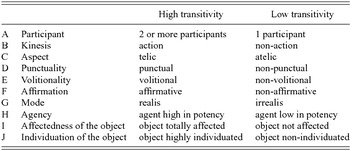
Traditional conceptions of transitivity relate to morphosyntactic criteria and lead to categorical distinctions. By contrast, Hopper & Thompson (Reference Hopper and Thompson1980: 251) view transitivity as the effectiveness of the verbal action. Their theory of transitivity moves beyond the single criterion of the presence or absence of a direct object. They define ten criteria (see table 1) which measure the extent to which a clause is transitive. These comprise agent-related, patient-related and verb-related criteria (see Givón Reference Givón and Plank1985: 90).
Criteria for measuring transitivity (based on Hopper & Thompson Reference Hopper and Thompson1980: 252)

The gradual notion of transitivity can best be illustrated for criterion A ‘Participant’. High transitivity contexts imply two or more participants (as in 10):
-
(10)


The clause is syntactically transitive as the direct object slot is filled. There is also a patient that is affected by the verbal action, so that the clause is also semantically transitive. The effectiveness of the verbal action of murder is high, i.e. the patient B is dead. Thus, we clearly have a highly transitive sentence.
By contrast, reflexive objects are coreferential with the subject. Hence, there is only one participant:
-
(11)

Syntactically the sentence is transitive, because the direct object slot is filled. Semantically, however, there is no second participant, as the agent and the patient are the same person. Why can we argue that the effectiveness with which the action takes place is lower with reflexives? After all A is as dead as B in (10). The reason is that there is some potential for control or volition, because the patient can, at least theoretically, stop the agent (see Primus Reference Primus1999). Semantically, the action is not considered a ‘fully fledged’ murder – which is reflected in our legal system and the lexical split between suicide and murder. Thus, while there is some degree of transitivity involved, it is lower than that of example (10).
Now consider the syntactically intransitive use illustrated in (12). Here, there is no patient. The effectiveness can only be gauged in terms of agent- and verb-related properties.
-
(12)

Actually, we can argue that the syntactically intransitive example (12) is more transitive than e.g. A slept, because the verb murder is intrinsically transitive, i.e. it entails that someone has been murdered. This does not apply to the verb sleep. And to push things even further, there is a potential for some degree of transitivity even for the intrinsically intransitive verb sleep, because sleep can be used with a cognate object, as in (13).
-
(13) Sir Michael was sleeping the sleep of the just. (OED: Thackeray, William Makepeace. Vanity Fair 1848)
Thus, we see that the degrees of transitivity are even more fine-grained than table 1 suggests. Since the present study is concerned with bring caus, transitivity parameters not applicable to this verb are ignored here. Instead we concentrate on those contexts in which bring caus occurs in Present-day English and gauge them in terms of their degree of transitivity.
2.2 Moderate Transitivity Contexts
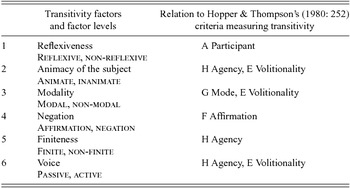
We will focus on the modulation of transitivity by means of six parameters that are fairly easy to operationalise. As some of Hopper & Thompson's (Reference Hopper and Thompson1980) ten criteria for transitivity cover more than one parameter (e.g. Agency is a function of both Volition and Animacy; Modality corresponds to the criteria Volition and Irrealis, etc.), these criteria have been split into separate parameters for an empirical analysis. Table 2 shows how the six parameters used in this study are linked to Hopper & Thompson's criteria and the following sections detail how they affect transitivity.
Moderate Transitivity Contexts of bring caus in relation to Hopper & Thompson's (Reference Hopper and Thompson1980: 252) criteria for measuring transitivity

2.2.1 Detransitivisation by means of reflexiveness
Reflexives have restricted transitivity, because the direct object is coreferential with the subject (see Hopper & Thompson Reference Hopper and Thompson1980: 277). Hence the effectiveness with which the verbal action is transferred to a patient is lower with reflexives (14) than with fully fledged objects (15). The reflexive example still licenses bring caus today, while non-reflexive examples, such as (14), are at the very least scarce.
-
(14) [. . .] Amy brought herself to utter what she was thinking. (NCF: Gissing, George. New Grub Street 1891) reflexive
-
(15) [. . .], till I bring Mr. Rushford to speak out so explicitly, [. . .] (ECF: Richardson, Samuel. Familiar Letters 1750) fully fledged object
That reflexivity is related to transitivity can also be seen for parameter D ‘Punctuality’ (see Hopper & Thompson Reference Hopper and Thompson1980: 252). The Spanish reflexive se expresses punctual actions, which are associated with higher degrees of transitivity, while the non-reflexive use signals duration (see García Reference García1975: 269). The reflexive becomes ungrammatical when accompanied by an adverbial expressing duration.
-
(16)
-
(17)


2.2.2 Detransitivisation by means of animacy
Inanimate subjects are generally less agentive than animate ones. Silverstein's Hierarchy (Reference Silverstein and Robert1976: 126), displayed in figure 1, is used by Hopper & Thompson (Reference Hopper and Thompson1980: 273) to predict that the transitivity of a clause is reduced whenever (a) the agent ranks low in animacy and (b), even more so, if the agent ranks lower on the scale than the patient.Footnote 5 , Footnote 6
Animacy hierarchy (Silverstein Reference Silverstein and Robert1976: 126)Footnote 7

Decreased agentivity results in a lower effectiveness with which the verbal action is transferred to a patient. In (18) we see that bring caus occurs with an inanimate subject in nineteenth-century English, while (19) illustrates its use with an animate subject in Present-day English.
-
(18) To think of her as your wife brings pain enough to kill me. (NCF: Wood, Ellen. East Lynne 1861) inanimate subject
-
(19) [. . .] how easily he brought his mount to jump a wall [. . .]. (BNC: wridom1) animate subject
2.2.3 Detransitivisation by means of modality
Modal verbs also effect moderate transitivity, since they express non-factual meanings or irrealis mode (see Hopper & Thompson Reference Hopper and Thompson1980: 252).Footnote 8 If a verbal action is non-factual, the effectiveness with which it is transferred to the patient is lower than that of a factual action. The following examples illustrate this contrast:
-
(20) I think a little persuasion from my uncle would bring her to accept Gilfil; [. . .] (NCF: Eliot, George. Scenes of a Clerical Life 1858) modal
-
(21) It was an object of no common interest which had brought him to encounter so many painful remembrances. (NCF: Scott, Sir Walter. The Heart of Mid-Lothian 1830) non-modal
2.2.4 Detransitivisation by means of negation
Negation expresses non-factual meanings. This reduces the effectiveness with which a verbal action is transferred to a patient (see Hopper & Thompson Reference Hopper and Thompson1980: 252). In (22) the verbal action is negatedFootnote 9 and hence we are dealing with an MTC. By contrast, (23) is not detransitivised by means of negation and bring caus is much less likely to occur.
-
(22) [. . .] if Richard, in his mild, but steady way, had not brought the old woman to listen to it. (NCF: Yonge, Charlotte Mary. The Daisy Chain 1856) negative
-
(23) [. . .] for he brought Miss Fluellen to acknowledge that men might deceive; [. . .] (NCF: Bage, Robert. Man As He Is 1792) affirmative
2.2.5 Detransitivisation by means of non-finiteness
Non-finite verb forms, i.e. gerunds, to-infinitives and imperatives, are less agentive, because the agent is not expressed in the non-finite clause, but merely implied by featuring in the main clause. This backgrounding or demotion of the agent reduces the effectiveness of the verbal action. Therefore, sentences such as (24) qualify as MTCs, in which bring caus is still in use, while (25) is more transitive.
-
(24) [. . .], some Salve must be provided [. . .] to procure the means to bring them to enjoy what they so much desire, [. . .] (EEPF: Brathwait, Richard. The Two Lancashire Lovers 1640) non-finite
-
(25) [. . .] at last, he brought them all to acknowledge that it was, upon the whole, the best thing [. . .]. (NCF: Edgeworth, Maria. Patronage 1814) finite
2.2.6 Detransitivisation by means of passivisation
Passives score low on transitivity since the patient undergoing the action specified by the verb is put centre stage, i.e. in subject position, while the instigator of the action is backgrounded by being demoted from subject position and often being omitted altogether (see Saaed Reference Saaed2016: 171).
-
(26) You are easily brought to reverse your views. (BNC: wridom1) passive
-
(27) [. . .]; she brought her to lament her situation, [. . .] (NCF: Shelley, Mary Wollstonecraft. The Fortunes of Perkin Warbeck 1830) active
3 Data
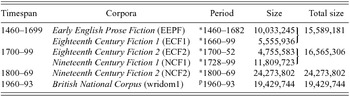
In order to monitor the decreasing use of bring caus over an extended timespan in British English, this verb has been analysed in four historically stratified corpora. The selection of corpora solely containing prose fiction permits us to keep the factor genre relatively constant over the centuries. Table 3 lists the (sub)corpora adding up to some 76 million words.Footnote 11
The corpora (* birth dates, p publication dates)Footnote 10

In order to retrieve all instances of bring caus, the Oxford English Dictionary was checked for post-fifteenth-century spelling variants of Present-day English bring. For the benefit of automatic retrieval the search by means of WordSmith was restricted to those cases in which a form of bring is accompanied by the infinitival marker to within a range of five words to the right.Footnote 12 The resulting search strings, designed to allow for most variant spellings, consisted of: br*ng*/br*t* Context word: to 5 Right. All corpus hits were manually analysed in order to eliminate cases which did not fit the semantic–syntactic template specified above. Cases that were eliminated from the tally were, for instance, fixed collocations with idiomatic meanings that need not be causative (e.g. bring to bear, bring to pass) and ambiguous instances where it was not clear whether bring is used in a causative sense:
-
(28) [. . .], had I not promised her to bring you to speake with her, she would haue destroyed her selfe ere this: [. . .] (Forde, Emanuel. Montelyon 1633) ambiguous
Also eliminated were causative uses in which bring was not followed by a to-infinitive but by an NP introduced by the preposition to.
-
(29) [. . .] and so had brought himself to the Gallows, [. . .] (EEPF: Bunyan, John. The Life and Death of Mr. Badman 1680) no to-infinitive
After this step, 1,420 tokens remained, which were manually coded for the six factors listed in the left column of table 2. As explained in sections 2.2.1–2.2.6 these factors can be matched to Hopper & Thompson's (Reference Hopper and Thompson1980: 252) criteria for measuring transitivity listed in the right column. Tokens were not coded for further parameters, because these would either have remained constant due to the semantics of the verb (e.g. Kinesis) or are difficult to assess (e.g. Affectedness of the Object). All six transitivity parameters are binary categorical factors and time is treated as a categorical factor with four levels (the four time periods).
4 Empirical diachronic study of bringcaus
The analysis of the data proceeds in three steps: first, we will take a brief look at the decline of bring caus over time and compare it to the general development of bring. In a second step, we will examine all transitivity parameters individually in order to test whether bring caus declined faster in transitive contexts than in intransitive contexts. The third and final step comprises a search for the changing patterns that bring caus has been used in.
4.1 Decline of bring caus
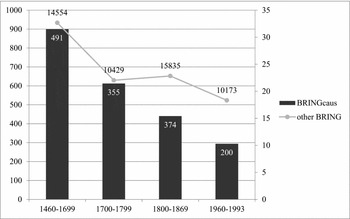
In order to assess whether bring caus has generally been decreasing in use over the past 500 years, all instances of bring were retrieved from the corpora. Figure 2 compares the diachronic development of bring caus plus to-infinitive (dark columns) with all other cases of bring including non-causative uses (light line).
bring caus + to-infinitive vs all other uses of bring (n = 1,420 vs 50,991)

Initially, both groups are decreasing at the same rate, until, in the nineteenth century, the decline of bring stalls, while the use of bring caus plus to-infinitive keeps decreasing. By the twentieth century, even bring is on the decline again, yet more slowly than bring caus plus to-infinitive. Overall, the difference in the decline rates is highly significant, yet has only a very small effect (χ2 = 65.37, df = 3, p<0.001, Phi = 0.04).
Thus what we learn from these data is that bring caus plus to-infinitive is indeed on the decline in British English. Secondly, this decline cannot – at least not exclusively – be attributed to an overall decrease in the use of bring.
4.2 Separate analyses of six transitivity factors
The following sections provide separate analyses of each of the six factors before proceeding to a combined analysis and determining some important interactions and configurations.
4.2.1 Reflexives
We have argued in section 2.2.1 that reflexives have a lowered transitivity, because the direct object is coreferential with the subject (see Hopper & Thompson Reference Hopper and Thompson1980: 277). Both the reflexive and the non-reflexive options were available in earlier stages of English.
-
(30) [. . .], she could not bring her self to cry out with that vigour and strength that acute Pains cause Women to do; [. . .] (EEPF: Estcourt, Richard. The Fair Example 1706) reflexive
-
(31) [. . .] but as he had now brought her to confess a former love [. . .] (EEPF: Head, Richard & Francis Kirkman. The English Rogue 1671) non-reflexive
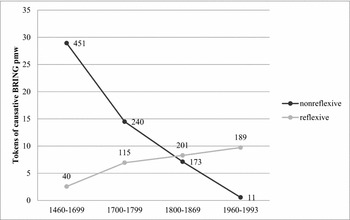
Figure 3 shows that non-reflexive uses of bring caus have plummeted since the first period, so that by the twentieth century, they arrive at only 0.6 occurrences pmw. Reflexive uses, on the other hand, are on the rise. The effect is of medium strength and highly significant (χ2 = 498.81, df = 3, p<0.001, Phi = 0.59). This contrasts starkly with the general decline of reflexives in many other contexts in both BrE and AmE (see Kirchner Reference Kirchner1951: 158; Jespersen Reference Jespersen1961: 325–31; Strang Reference Strang1970: 153; Peitsara Reference Peitsara and Rissanen1997: 321; König & Siemund Reference König and Siemund2000: 48; Rohdenburg Reference Rohdenburg, Rohdenburg and Schlüter2009: 180, Reference Rohdenburg2014b; Mondorf Reference Mondorf, Dorgeloh and Wanner2010: 229, Reference Mondorf2011: 405).
bring caus+ to-infinitive in reflexive vs non-reflexive contexts (n = 1,420)

These findings show that Andersson's (Reference Andersson1985) rate of 90 per cent reflexive bring caus (reported by Mair Reference Mair1990a: 88) is a twentieth-century phenomenon. Before the nineteenth century, reflexive uses were the minority form.
4.2.2 Animacy
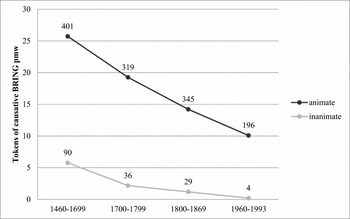
Inanimate subjects are generally less agentive than animate ones (see section 2.2.2). Across all time periods, animate subjects, like the one in (32) are far more common than inanimate ones such as (33). The latter become all but impossible in the twentieth century, as shown by figure 4.
-
(32) [. . .], he at last brought Mansoul to dance after his pipe [. . .] (EEPF: Bunyan, John. The Holy War 1682)animate subject
-
(33) This brought the Duke to know his Error, [. . .]. (ECF: Defoe, Daniel. Memoirs of a Cavalier 1720)inanimate subject
Based on the transitivity principle, we would expect that the decline of bring caus is delayed in inanimate contexts. What we find, however, is that bring caus fares better in animate, i.e. high-transitivity contexts. By the end of the four periods, bring caus with inanimate subjects has declined by 96 per cent as opposed to only 61 per cent in the case of its animate counterpart. While the chi-squared test yields a highly significant result, closer analysis reveals that the effect is small and that the low p-value only hinges on two cells: the comparatively high rate of inanimate subjects in the first period and conversely the low rate of inanimate subjects in the last period (χ2 = 46.99, df = 3, p<0.001, Phi = 0.18).
bring caus + to-infinitive with animate vs inanimate subjects (n = 1,420)

There is, however, a correlation that requires consideration. As we already know that bring caus is gravitating towards an almost exclusive use with reflexives, and the semantics of reflexives mostly require animate subjects, the rapid decline of inanimate subjects looks suspiciously like a consequence of the ‘takeover’ of the reflexive. And indeed this is the case: if we split the data into reflexive and non-reflexive tokens, the effect disappears. While the rate of inanimate subjects among non-reflexive uses of bring caus vacillates around 19 per cent, across all time periods, reflexive uses of bring caus have almost exclusively taken animate subjects (average rate of inanimates = 1.5 per cent). With the increase in reflexives over time we thus have a rise in contexts which demand animate subjects, so that animacy as a measure for detransitivisation cannot come to bear here. Moderate Transitivity by means of inanimacy is thus statistically not a supporting factor for bring caus.
4.2.3 Modality
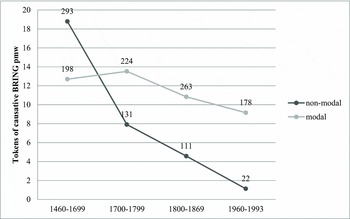
Modal verbs create moderate transitivity, since they express non-factual meanings or irrealis mode (see section 2.2.3). Figure 5 shows the diachronic influence of modality. Note that in Present-day English bring caus without modal auxiliaries has become rare. Historically, however, modal and non-modal uses of bring caus alike were common, as exemplified in (34) and (35):
-
(34) [. . .] it was sometime before he could bring her to permit him to speak to her [. . .] (EEPF: Behn, Aphra. The Fair Jilt 1688)modal
-
(35) [. . .]: but as he had now brought her to confess a former love [. . .] (EEPF: Head, Richard & Francis Kirkman. The English Rogue 1671)non-modal
Influence of modality on the use of bring caus + to-infinitive (n = 1,420)

In modal contexts bring caus is decreasing much more slowly than in non-modal contexts. The decline of non-modals is roughly parallel to that of the non-reflexive (see figure 3). While we concluded that the similarities in the curves for animates and reflexives can be explained by language-internal reasons, this is not the case for non-modals and non-reflexives. There are no semantic or grammatical a priori reasons for reflexives and modals to co-occur and we will see below that they did not always do so.
The chi-squared test confirms that modal contexts are a niche where bring caus is preserved much better than in non-modal contexts. The effect is highly significant and of medium strength (χ2 = 168.06, df = 3, p<0.001, Phi = 0.34). The distribution of the contributions to chi-square confirms what we can also see in the graph: the effect results from the reversal of preferences; while writers preferred non-modal uses of bring caus in the first period, they have come to prefer modal contexts from the second period onwards. The effect is stronger in reflexive contexts (p<0.001, Phi = 0.29), as only 50 per cent of reflexives in the earliest period co-occur with a modal but the rate rises to 92 per cent in the twentieth century. Yet, up until the twentieth century (when almost no non-reflexive tokens remain), it is also observable among non-reflexive tokens, where rates rise from 39 per cent in the first period to 56 per cent in the nineteenth century (p<0.001, Phi = 0.15).
4.2.4 Negation
Negation expresses non-factual meanings. As shown in section 2.2.4, this reduces the ‘effectiveness with which a verbal action takes place’ (Hopper & Thompson Reference Hopper and Thompson1980: 251). Historically, bring caus was perfectly acceptable in affirmative (37) as well as in negated contexts (36).
-
(36) [. . .], she would strive all she could with her Heart, but she verily believ'd she should never bring it to consent to a Marriage [. . .] (EEPF: Behn, Aphra. The False Count 1682)negation
-
(37) [. . .] so soon as we had brought my Parents to consent. (EEPF: Bellon, Peter. The Court Secret 1689) affirmation
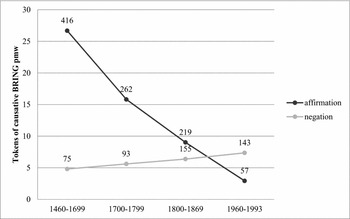
Figure 6 traces the trajectory of change for bring caus in the presence of negation. While we know that bring caus has generally gone down over the past 500 years, with negation it has even increased in use.
Influence of negation on the use of bring caus + to-infinitive (n = 1,420)

The chi-squared test confirms that negation has a highly significant effect on the use of bring caus (χ2 = 223.95, df = 3, p<0.001, Phi = 0.4). The effect results from the reversal of preferences, which is, once again, mostly brought about by the rise of the reflexive: Between the first and the third period, the rate of negated non-reflexives rose by only 9 per cent (from 14 to 23 per cent, p<0.05, Phi = 0.1), while negated reflexives skyrocketed from 33 per cent in the first period to 75 per cent in the fourth period (p<0.001, Phi = 0.26).
4.2.5 Finiteness
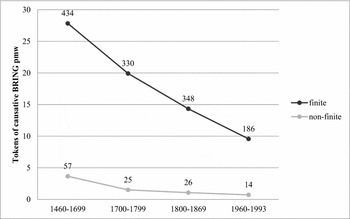
Non-finite verb forms, i.e. gerunds, to-infinitives and imperatives, are less agentive, because the agent is not expressed in the non-finite clause, but merely implied by featuring in the main clause (see section 2.2.5). Both finite and non-finite uses are possible, though non-finite verb forms have always been negligibly rare, as illustrated by figure 7.
-
(38) So that She brought the Old man to allow her fourty Shillings per week to keep the House; [. . .]. (EEPF: Head, Richard & Francis Kirkman. The English Rogue, 1671) finite
-
(39) [. . .] if hee loued so much as hee said, hee should expresse it by bring ing Dorileus to speake with her, [. . .] (EEPF: Wroth, Lady Mary. The Countesse of Montgomeries Urania 1621) non-finite
Influence of finiteness on the use of bring caus + to-infinitive (n = 1,420)

The downward-sloping curve for finite forms of bring caus is in line with its general decline over the centuries. At first glance, the decline in the use of non-finite forms appears slower, but the opposite is the case: non-finite forms decrease by 80 per cent while finite forms decrease by only 66 per cent (χ2 = 8.7, df = 3, p<0.05). However, a closer look at the data reveals that the effect is extremely small (Phi = 0.08), possibly because only 8.6 per cent of data points are non-finite and thus there is too little variation in the data for the model to determine whether the effect is non-coincidental. Furthermore, the composition of the overall chi-squared result shows that none of the values in the eight-cell table reached significance. Thus we conclude that the use of bring caus in non-finite contexts has always been rare and that these contexts do not constitute a niche supporting the use of bring caus.
4.2.6 Passivisation
Mair (Reference Mair1990a, Reference Mairb) provides three crucial observations concerning a preference of bring caus for passive over active uses:
-
1. Native speakers rate the passive versions of sentence pairs with bring caus as more natural than the active versions (Mair Reference Mair1990b: 169–70).
-
2. The examples provided in dictionary entries for bring caus feature either passive or reflexive uses (Mair Reference Mair1990a: 88fn.).
-
3. In the OED ‘all [. . .] nonreflexive examples have bring in the passive’ (Mair Reference Mair1990b: 169, emphasis in the original).
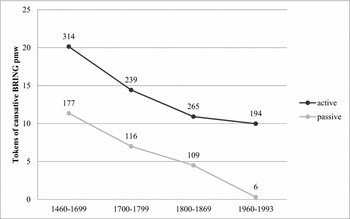
This is in line with our expectations as passives score low on agentivity since the patient undergoing the action specified by the verb is put centre stage, i.e. subject position, while the instigator of that action is backgrounded by being demoted from subject position and often being omitted altogether. Hence there is a lower effectiveness with which the verbal action is transferred to a patient. Yet, in our case, the analysis of passives reveals the opposite: Both passive and active versions occurred quite naturally in former times (see (40) and (41)). Initially, as shown in figure 8, we observe a parallel decline of both forms, but in the twentieth century, the decline of actives slows, while that of passives accelerates, making bring caus and the passive all but incompatible.
-
(40) The Prince was soon brought to consent to it, [. . .] (EEPF: Blackbourn, Richard. Clitie 1688) passive
-
(41) [. . .] so soon as we had brought my Parents to consent. (EEPF: Bellon, Peter. The Court Secret 1689) active
Influence of voice on the use of bring caus + to-infinitive (n = 1,420)

In fact, the chi-squared test shows that passives are vanishing significantly faster than active uses of bring caus (χ2 = 80.24, df = 3, p<0.001). The effect is only small, though (Phi = 0.24). Unsurprisingly, this is – once again – due to a correlation with the reflexive: Over the 500-year period observed here, passive reflexives have never been possible. This means that the surge in reflexives has shrunk the passive's potential territory and thus led to its (imminent) extinction. Furthermore, contrary to our expectations, the passive had never fully conquered this territory: in all four periods around 50 per cent of non-reflexives are active (274 tokens = 61%, 124 tokens = 52%, 64 tokens = 37% and 5 tokens = 45% respectively). Thus we show that active non-reflexives were possible – they even constituted the majority form up to the eighteenth century – and further that the ‘territory’ of bring caus has never been a space distributed between the reflexive and the passive.
4.3 Analysis of interactions and configurations
We are now interested in further interactions between these factors in order to find out whether there is a particular cluster of attributes which supports the use of bring caus. We have seen that not all transitivity factors have the same effect: while bring caus thrives in some detransitive contexts, it is dying out fast in others. Therefore, if factors interact and bring caus’s modern niche is indeed characterised by a cluster of attributes, it is highly relevant to our research question whether these are detransitivising attributes.
Configural Frequency Analysis (CFA; Krauth & Lienert Reference Krauth and Lienert1973; von Eye et al. Reference Von Eye, Mair and Mun2010; Bortz & Schuster Reference Bortz and Schuster2010: 148–50) is particularly well suited for this purpose. It tests whether the factors included in the analysis are independent of each other. However, instead of focusing on so-called ‘global’ effects, e.g. associations which hold across all four time spans, it searches for local effects, e.g. clusters of attributes which are significantly more common than expected in only one or two periods (called ‘types’) or which seem to be avoided (‘antitypes’; von Eye et al. Reference Von Eye, Mair and Mun2010: 1–3; Krauth & Lienert Reference Krauth and Lienert1973: 25–7). This is accomplished with the help of an expanded chi-squared test based on the interactions between all factors. Contrary to regular chi-squared tests, we are not interested in the overall result, but in each configuration's contribution to chi square, which is separately tested for significance.
However, the data for a CFA have to fulfil the same criteria as data analysed with a chi-squared test. Therefore, the cautionary measure that at least 80 per cent of the frequencies in a contingency table have to be five or larger also applies (see Krauth & Lienert Reference Krauth and Lienert1973: 53; Bortz & Schuster Reference Bortz and Schuster2010: 150; Field et al. Reference Field, Miles and Field2012: 818). The fully specified contingency table, including the factors animacy, modality, negation, finiteness, voice, reflexive and time period, has 256 cells. Yet 169 of these configurations never occur and a further 45 occur less than five times. These empty or near-empty cells can be split into two groups, empirical zeros and structural zeros (see von Eye et al. Reference Von Eye, Mair and Mun2010: 42), and thus can be eliminated in different ways.
Empirical zeros are configurations which were never (or rarely) observed but are theoretically possible (see von Eye et al. Reference Von Eye, Mair and Mun2010: 42). In our data, they result mostly from the scarcity of inanimate subjects (11.2 per cent) and non-finite verb phrases (8.6 per cent). Thus these two factors have low explanatory power and very small effects. Furthermore, they are partly epiphenomenal (as the decline in inanimates is mostly due to the take-over of the reflexive) and lead to empirical zeros. Therefore, animacy and finiteness will not be included in the CFA.
Structural zeros are configurations which were never observed because they are impossible. They may not only lead to too many empty cells in the configuration, but also skew the results in a more fundamental way: in a standard chi-squared test or CFA, we would calculate expected values for these cells knowing full well that we do not expect them to occur. Thus we would create an undesirable discrepancy between the statistical expectations and our linguistic expectations. This can be avoided by ‘blanking out’ those cells, i.e. excluding them from the model (see von Eye & Mair Reference Von Eye and Mair2007: 5; von Eye et al. Reference Von Eye, Mair and Mun2010: 42–3). Among the factors considered for the analysis of bring caus, the configurations [passive, reflexive] and [non-finite, passive] cannot occur and thus cause structural zeros. The latter is no longer an issue as we have already excluded finiteness from the analysis (as explained above) and the former will be blanked out.
Thus our analysis will be based on all 1,420 data points and include the following five factors: modality, negation, voice, reflexive and period. The resulting contingency table has 64 cells, of which 16 will be blanked out (i.e. all which have [passive, reflexive] as part of their specification). We will calculate CFA with the help of von Eye's script (von Eye Reference Von Eye2000) and will report significant types after adjustment according to Holm's procedure (see von Eye & Mun Reference Von Eye, Mun and Menard2008: 316; Gries Reference Gries2009: 249).Footnote 13
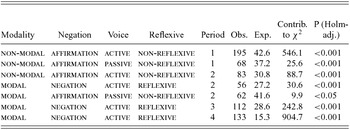
Table 4 shows all significant types as determined by the CFA specified above. These types should not be confused with the most frequent observations, though. Only configurations which occur significantly more often than expected are labelled types.
Types based on a Configural Frequency Analysis ordered by period

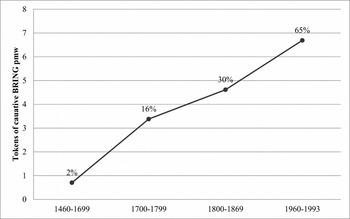
Use of [animate, modal, negation, finite, active, reflexive] bring caus + to-infinitive (n = 1,420)

In line with section 4.2.1, non-reflexives turn out to be characteristic of the usage of bring caus from the fifteenth to the eighteenth century, while reflexives take over from the nineteenth century onwards. For negation and modality, the same picture emerges: all but one of the types of the earlier centuries are [non-modal, affirmation] constructions, while [modal, negation] is characteristic of the last 200 years.
In terms of recurring types, we see that [non-modal, affirmation, active, non-reflexive] constitutes a type in both the first and the second period. The (almost) completely opposite configuration, namely [modal, negation, active, reflexive], first emerges as a type in the eighteenth century and from the nineteenth century onwards constitutes the only significant type.
These findings suggest that bring caus is specialising to [modal, negation, reflexive]. Except for four tokens, all of these are additionally characterised by the attributes [animate, finite]; thus the construction is actually specialising to [animate, modal, negation, finite, active, reflexive]. Figure 9 provides further evidence of this process. Further research will have to show whether this is a consolidation process or an intermediary stage on the way to dying out.
5 Discussion and conclusion: the role of transitivity in language change
The present article analysed the decline of bring caus and investigated the question whether Moderate Transitivity Contexts (MTCs) constitute niches in which this recessive verb survives. We showed that overall bring caus is on the decline, but it specialises to certain contexts, i.e. those with animate subjects, reflexive objects and modal, negated, finite, active verb phrases. Of the six parameters describing this niche, modal, negation and reflexive are detransitivising factors, i.e. they reduce ‘the effectiveness with which the verbal action takes place’ (Hopper & Thompson Reference Hopper and Thompson1980: 251). We are thus dealing with an MTC. That bring caus is also retained with the other three parameters [animate, finite, active] is surprising at first sight, since they are associated with high rather than moderate transitivity. However, on closer inspection it turns out that these three strategies for detransitivisation cannot be used because they are ruled out by the dominant reflexive for three reasons. Firstly, reflexives semantically gravitate towards volitional subjects, which means that inanimates are dispreferred. Therefore, detransitivisation by means of modulating animacy is not an option for bring caus. Secondly, reflexives are knock-out contexts for passives. And, thirdly, non-finite reflexives are rare in our data, for no obvious grammatical or semantic reason.
The restriction to reflexive contexts could at first sight be explained by a division of labour between bring caus and bring non-caus, which avoids ambiguity as it exists in German, see (42) and (43).
-
(42) [. . .], sollten sich die maßgeblichen Politiker für Frühförderung überlegen, wie Kinder zum Spielen gebracht werden können [. . .]. (http://liga-kind.de/fk-309-streeck-fischer/; accessed 2 June 2016) bringen caus
-
‘[. . .], politicians in charge of early learning should consider how we can get children to play [. . .].’
-
(43) Zur Kita mussten die Kinder über eine Bundesstraße [. . .], so dass die Kinder zum Spielen gebracht werden mussten, [. . .]. (www.eltern.de/foren/2005-plauderforum-neu/848238-noch-ne-frage-zur-selbstaendigkeit-kinder-3.html; accessed 2 June 2016) bringen non-caus
-
‘To reach the nursery, children had to cross a main road [. . .], so that children had to be brought to play dates [by car], [. . .].’
Thus we could describe the reflexive as a support factor reducing processing complexity. This argument, however, cannot explain the [modal, negation, reflexive] cluster, as bring non-caus also occurs in negated and modal constructions. This lends support to the assumption that – at least in the case of bring caus – MTCs serve as a refuge for a recessive and possibly dying verb sense. This use of MTCs with bring caus can be related to a series of (de-)transitivisation processes observed for weakly established verbs or verb senses (see e.g. Hundt Reference Hundt2007; Rohdenburg Reference Rohdenburg, Rohdenburg and Schlüter2009, Reference Rohdenburg and Hundt2014a, Reference Rohdenburgb; Mondorf Reference Mondorf, Dorgeloh and Wanner2010, Reference Mondorf2011, Reference Mondorf2016; Eitelmann & Mondorf Reference Eitelmann and Mondorf2015; Schneider & Mondorf Reference Schneider and Mondorf2015). Similar to bring caus they make use of MTCs as a support strategy for waxing and waning constructions. This opens up promising avenues for further research measuring the modulation of transitivity in accordance with the changing entrenchment of verbs or verb senses.