Introduction
Selective logging became one of the main forest management practices in the last decades, and the method is thought to have a relatively low short-term impact on biodiversity (Sabogal et al. Reference Sabogal, Almeida, Marmillod and Carvalho2006). However, tropical forest degradation alters forest structure, species composition, and successional processes, causing impacts that may last for several years or even decades (Blanc et al. Reference Blanc, Echard, Herault, Bonal, Marcon, Chave and Baraloto2009). In the long run, in addition to the effects on predators and herbivores, selective logging could still have major impacts on forest dynamics by affecting the soil fauna responsible for nutrient cycling and ecosystem functioning. Decomposing organisms, such as termites, are the main drivers of nutrient cycling and are important for the maintenance of the vegetation structure in tropical forests over long periods (Jouquet et al. Reference Jouquet, Traoré, Choosai, Hartmann and Bignell2011).
Even though forest management has a low impact on vegetation structure (Silva Reference Silva1996), the fundamental processes such as canopy-gap dynamics, predation, and carbon storage will be altered or disrupted (Laurence et al. Reference Laurance, Lovejoy, Vasconcelos, Bruna, Didham, Stouffer, Gascon, Bierregaard, Laurance and Sampaio2002). In tropical regions, ectotherms have a low tolerance to changes in temperature (Sunday et al. Reference Sunday, Bates and Dulvy2011), and even slight temperature increases can have a major impact on the survival and reproduction of these organisms (Walther et al. Reference Walther, Post, Convey, Menzel, Parmesan, Beebee, Fromentin, Hoegh-Guldberg and Bairlein2002). Moreover, the reduction in soil moisture is likely to have a strong impact on animals adapted to high levels of soil moisture (Oberst et al. Reference Oberst, Lenz, Lai and Evans2019), such as soil-dweller species that have a unique role in the decomposition of soil organic matter (Lavelle et al. Reference Lavelle, Bignell and Lepage1997). Therefore, by changing microclimatic conditions, selective logging may alter the decomposition process by altering the abundance and diversity of the soil fauna.
Termites are among the most abundant animals in tropical forests (Fittkau & Klinge Reference Fittkau and Klinge1973) and play an important role in nutrient cycling and the dynamics of organic matter (Griffiths et al. Reference Griffiths, Ashton, Evans, Parr and Eggleton2019; Lavelle et al. Reference Lavelle, Bignell and Lepage1997). Near forest borders, the higher sunlight incidence and the reduction in moisture alter the composition of termite species (Dambros et al. Reference Dambros, da Silva, Azevedo and de Morais2013). For example, areas as far as 90 m from roads are dominated by generalist wood-feeding termites, and compared with the intact forest, these areas have fewer species specialized in the decomposition of soil organic matter (Dambros et al. Reference Dambros, da Silva, Azevedo and de Morais2013). These results suggest that even minor changes in microclimatic conditions, such as those observed in managed areas, can have an impact on the distribution of termite species.
In addition to the direct impact of management on termite communities, disturbances could also alter the response of termites to the natural variation in soil conditions (Dambros et al. Reference Dambros, da Silva, Azevedo and de Morais2013). Many termite species use soil to build nests (Pie et al. Reference Pie, Rosengaus and Traniello2004), which are used to precisely control microclimatic conditions inside the nest (Hu et al. Reference Hu, Neoh, Appel and Lee2012). Because only highly tolerant species survive under disturbance regimes, specialists tend to be impacted most (biotic homogenization; McKinney & Lockwood Reference McKinney and Lockwood1999). Forest disturbance may reduce the natural variation in termite species composition that occurs along the environmental gradient of soil granulometry because only species that build specific types of nests can survive. However, the impact of logging on the reduction of species turnover along gradients has not been investigated.
We analyzed how termite species richness, abundance, the taxonomic and trophic composition changed in an experiment of selective logging analyzing how this management strategy affected the composition of termites along natural environmental gradients. We hypothesized that: (1) selective logging reduces the diversity of termites, especially the diversity of species that inhabit the soil, and (2) the removal of habitat specialists homogenizes communities along the natural gradient of soil granulometry.
Material and methods
Study area
The study was conducted in Claudia, Mato Grosso state, Brazil. The region is characterized by dry Amazonian forests (Ferreira et al. Reference Ferreira, Sá, Buschbacher, Batmanian, Silva and Moretti1999), which correspond to approximately 10% of the Amazonian biome. The climate in the region is classified as moist and warm (Am in the Köppen scale) with two marked seasons: a rainy season from September to April and a dry season from May to August. The mean precipitation is 2200 mm, and the mean annual temperature is 24°C (Vourlitis et al. Reference Vourlitis, Priante-Filho, Hayashi, Nogueira, Caseiro and Campelo2002).
The region is considered as a transition forest among Cerrado and Semideciduous Forests (Brasil 1979), and the vegetation is rapidly disappearing due to high deforestation rates caused by livestock activity (Kunz et al. Reference Kunz, Ivanauskas, Martins, Silva and Stefanello2008). The deforestation process created a mosaic of areas in the landscape with several types of land uses and regeneration regimes, from old impacted forests to recently impacted (Wang et al. Reference Wang, Ziv, Adami, Mitchard, Batterman, Buermann, Schwantes Marimon, Marimon Junior, Matias Reis, Rodrigues and Galbraith2019).
Sampling design and data collection
Data collection was performed in three units, denominated as ‘modules’ distant 20 km from one another. The modules are located in forests with different management histories (selective cutting of wood). Module I is located in an area that has been managed for 10 years previous to termite sampling (2002), module II for 17 years (1995), and module III for 31 years (1981). Modules I and II were installed in a continuous forest area, whereas module III was installed in a forest section surrounded the west and the east by plantations, being connected to a single large area of native vegetation.
In each module, termite sampling was conducted in several plots following the method used in the Biodiversity Research Program (PPBio). PPBio uses a standardized survey in permanent grids of plots, which allows for rapid and long biodiversity monitoring in Amazonia (Magnusson et al. Reference Magnusson, Lima, Luizão, Luizão, Costa, Castilho and Kinupp2005). Modules I and II are formed by grids composed of six Northeast-southwest and two northwest-southeast 1 km equidistant tracks, forming a rectangle of 12 km2. Each kilometer along the northwest-southeast tracks has a transect of 250 m, resulting in 12 plots in each of these modules. Module III has the same sample design as the first two but has only eight plots because of the forest fragment small size (Figure S1 in Supplementary material). Plots of all modules were installed according to the criteria stipulated by Magnusson et al. (Reference Magnusson, Lima, Luizão, Luizão, Costa, Castilho and Kinupp2005), following relief level curves to minimize soil variation within the plots. This procedure reduces soil and elevation variation and ensures that the data will not be directly influenced by variation in these factors. All plots were installed at a distance of at least 200 m from the forest edge to avoid edge effects. This minimum distance is much higher than the edge effect previously reported for termites (Dambros et al. Reference Dambros, da Silva, Azevedo and de Morais2013) and other groups (Forman & Alexander Reference Forman and Alexander1998).
Termites were sampled in the 31 plots (12 in module I, 11 in module II, and 8 in module III), following a modification of the protocol proposed by Jones & Eggleton (Reference Jones and Eggleton2000). Each plot was subdivided into five sections of 5 × 2 m spaced 50 m apart, totaling 155 sections. This division into sections allows detecting trophic groups and species to associate species composition with the environment (Dambros et al. Reference Dambros, Morais, Vasconcellos and Franklin2020). The sampling effort in each section was 1 hour/person of active search. Sampling was carried out in August, September, and October 2010 and August 2011. These months are characterized by the end of the dry period and the beginning of the rainy season in the region.
Termites were collected manually with entomological tweezers and pickaxes, which were used to dig the ground and to break larger trunks. In each section, all possible termite habitats were surveyed for termites, such as soil, dead wood, nests (epigeal, hypogeal, and arboreal up to 2 m height), foraging galleries, plant roots, animal feces, fallen fruits, and litter. The collected material was conditioned in plastic collecting bottles containing 70% EtOH. The individual colonies were screened in the laboratory and identified using identification keys (Constantino Reference Constantino1999) and compared with the material deposited at the Museum of Zoology of the University of São Paulo (MZUSP). All material was stored in 80% EtOH and deposited in the Entomological Collection of the Biological Collection of the Southern Amazon maintained by the Biodiversity Studies Center of the Mato Grosso (NEBAM-UFMT/Sinop) and MZUSP.
In each plot, we measured variables related to soil, canopy cover, litter volume, and time post-management. Soil samples were taken with the aid of a Dutch survey (Moulatlet & Emilio Reference Moulatlet and Emilio2011). The samples presented a depth of 0–10 cm and were arranged in six points distant at 50 m each. The sampling design allowed a homogenization of the plot, resulting in a single composite sample. Four canopy readings were performed every 50 m (north, south, east, and west) using a concave spherodensiometer (Concave-Model 1C-Forest Densiometers). The readings were performed between 9 a.m. and 2 p.m. Moreover, we collected litter volume (liters) at five points every 50 m in the plot. The litter contained in an area of 1 m2 was collected and compressed three times in a graduated bucket, using wood press launched at a distance of 1.5 m from the bucket. For the analyses, we used the mean value of the five measures of volume per plot. Finally, we obtained the time post-management of each plot through an interview with the owners of the areas. These areas have been left without other disturbances since the time post-management.
Data analysis
Because sections were not independent of each other due to the short distance between them, we used data at the plot (i.e., transects of 250 m each) and used plots as sampling units in all analyses. The relative frequency of each species in each section within a transect was used as a proxy for abundance in each plot. As the total of sections per transect was five, the maximum frequency that each species was bounded between zero and five. Species richness was measured as the number of species found in each plot.
The functional composition was measured as the change in the distribution of species in trophic groups. Termite species were categorized into trophic groups (Constantino Reference Constantino1999; Roisin & Leponce Reference Roisin and Leponce2004): (I) wood-feeders: species that feed on dead wood; (II) humus-feeders: species that feed on mineral soil and humus; (III) litter-feeders: species that feed on leaf and small woody litter; and (IV) intermediary-feeders: species that feed on largely decayed wood that has become soil-like. Termites inhabiting and feeding in distinct substrates, such as soil, litter, and wood, are likely to respond differently to disturbances (Ackerman et al. Reference Ackerman, Constantino, Gauch, Lehmann, Riha and Fernandes2009).
Differences in species composition between plots were measured by the Jaccard dissimilarity index. We applied a Principal Component Analysis (PCoA) to summarize the dissimilarity values in two ordination axes. The first two axes captured 20% of the variation in the Jaccard dissimilarity index. Each additional axis increased the variance explained by less than 8%. The two ordination axes were used as response variables in statistical models. The Jaccard index considers only species presence/absences in transects, not species abundances. Because termites are modular organisms, tallying the number of individuals to calculate abundance might overestimate the abundance of species with larger colonies. Although we obtained occurrence frequency in sections within transects, the Jaccard index is more sensitive to rare species than indexes weighted by abundance (Jost Reference Jost2007). These species are the most likely to be affected by changes in the environment. Therefore, we only used metrics based on the presence/absence data for the species composition analyses.
To evaluate the association between soil clay content, time post-management, litter volume and canopy cover (predictor variables) and termite abundance, species richness, and species composition (response variables), we used multiple linear regression. These regression models were run for all species and using each trophic group separately. In addition to the multiple regression models using the PCoA axes of species composition, we also investigated changes in species composition against the predictor variables using a Redundancy Analysis (RDA), which uses the raw species counts instead of the Jaccard similarity matrix.
All analyses were performed using the Vegan (Oksanen et al. Reference Oksanen, Blanchet, Friendly, Kindt, Legendre, McGlinn, Minchin, O’Hara, Simpson, Solymos, Henry, Stevens, Szoecs and Wagner2018) and Betapart (Baselga et al. Reference Baselga, Orme and Villeger2017) packages in R (R Development Core Team).
Results
We observed a total of 72 species in the three studied modules. The 17-year post-management area had the highest species richness (55 species compared with 43–44 species in the 10 and 31 years post-management modules; Table S1 in Supplementary material). Species richness and abundance were lower in areas of high soil clay content (Figure 1A; Table 1), but there was no evidence of change in species richness with time post-management in multiple regression models (Figure 1B; Table 1). Species richness was positively related to species abundance (Figure S1 in Supplementary material).
Partial regression analysis testing the effect of soil clay content and time post-management on species richness (A and B) and composition variation (C and F).

Coefficients of the association of environmental predictor variables with termite species richness, overall abundance (occurrence frequency), and species composition on multiple regression models. Species composition was measured as the first two ordination axes of a Principal Coordinate Analysis (PCoA) using the pairwise Jaccard similarity index. R 2 represents adjusted values.

** p < 0.01.
* p < 0.05.
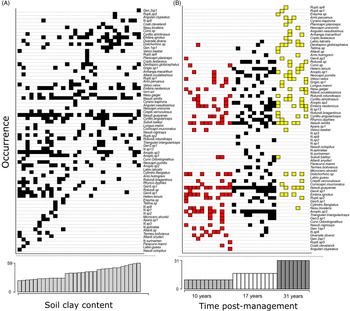
Changes in termite species composition were associated with both soil clay content and time post-management, as measured by the second PCoA ordination axis (Figure 1C–F, Table 1) and the RDA analysis (p < 0.01; Figure S2 in Supplementary material). Therefore, termite species replaced each other along these gradients (Figure 2).
Presence and absence of each termite species along the soil clay content gradient (A) and time post-management (red: 10, black: 17, yellow: 31) (B).

Concerning trophic groups, litter-feeders represented the termite group with the lowest species richness in all post-management treatments (Figure 3). Humus and wood-feeding termites were the groups with the highest species richness, and the contribution of each of these groups changed over time – the most species-rich termite group after 10 and 31 years of management was humus-feeding termites, whereas in the area managed 17 years ago, the termite group with the highest species richness was the wood-feeding group (Figure 3).
Total termite species richness of each trophic group per time post-management (10, 17, and 31).

When species richness was correlated against predictor variables separately for each trophic group, time post-management, soil clay content, and leaf-litter were associated with a decrease in wood-feeding termite species richness (partial regression model: when the effect of other variables is removed; Table S2 in Supplementary material). However, we have not detected effects of soil clay content, time post-management, canopy cover, or leaf-litter on termite species richness for other groups.
Discussion
In contrast to expectations of an effect of selective logging on canopy openness, time post-management (minimum 10 to maximum 31 years) was not associated with termite richness or abundance. Instead, we found the percentage of soil clay to be strongly associated with termite abundance, species richness, and composition. These results may indicate that the medium and long-term impact of selective logging on the termite community is low and does not change the response of species to natural environmental gradients. It is possible that the 10-year interval is enough for the forest to recover and that it is not possible to detect this impact over longer periods.
Wood-feeding termites were the group with the highest diversity 17 years post-management. These termites may have high richness after selective logging because the fall of entire trees, branches, and leaves increases food availability (Sizer et al. Reference Sizer, Tanner and Ferraz2000). A similar increase of wood-feeding termites is also observed in agroforests (Ackerman et al. Reference Ackerman, Constantino, Gauch, Lehmann, Riha and Fernandes2009), where vegetation cover is dissimilar to the natural environment, but the availability of wood increases. These results suggest that restricted logging impacts resource availability, but has a minor impact on the delicate response of termites to microclimatic conditions. The soil-feeding termites were not associated with time post-management or with changes in canopy cover. Several soil-feeding termite species are highly specialized and occur only when environmental conditions are favorable (Eggleton et al. Reference Eggleton, Bignell, Hauser, Dibog, Norgrove and Madong2002). The change in vegetation cover is generally associated with reduced soil moisture (Dambros et al. Reference Dambros, da Silva, Azevedo and de Morais2013), which impacts the abundance of species sensible to drought (Dambros et al. Reference Dambros, da Silva, Azevedo and de Morais2013; Okwakol Reference Okwakol2000).
Although species composition changed as a function of time post-management, the temporal turnover of termite species was less pronounced than the natural spatial turnover along the soil clay gradient. Clay is used by many species to build nests (Jouquet et al. Reference Jouquet, Traoré, Choosai, Hartmann and Bignell2011) and is associated with vegetation structure (e.g., palm density; Costa et al. Reference Costa, Guillaumet, Lima and Pereira2009), which causes turnover in termite species composition (Dambros et al. Reference Dambros, Morais, Azevedo and Gotelli2017). In highly disturbed areas, the natural variation in species composition tends to be relatively weak because species with narrow environmental requirements (specialists) are replaced by species with broader requirements (generalists; Mckinney & Lockwood Reference McKinney and Lockwood1999). We have not observed this drastic change from specialist to generalist species in disturbed areas. Even in recently logged areas (10 years), we observed species and trophic groups common to pristine environments (e.g., humus consumers; Ackerman et al. Reference Ackerman, Constantino, Gauch, Lehmann, Riha and Fernandes2009). More importantly, the soil clay gradient continued to be the main factor responsible for changes in species composition between plots. These results may indicate that selective logging management was unable to homogenize the soil biota, differently from observation in highly disturbed areas (Ackerman et al. Reference Ackerman, Constantino, Gauch, Lehmann, Riha and Fernandes2009).
Termites are among the most abundant animals in tropical forests and are the main decomposers of plant material in these regions (Eggleton et al. Reference Eggleton, Bignell, Sands, Mawdsley, Lawton, Wood and Bignell1996). While termites in high abundance can rapidly decompose organic material, the high diversity of species in several trophic groups allows most of the decomposition chain to occur (Griffiths et al. Reference Griffiths, Ashton, Evans, Parr and Eggleton2019). In one extreme, wood-feeding termites decompose dry and recently fallen trees and branches; in the other extreme, soil-feeding termites decompose organic matter already incorporated into the soil (Donovan et al. Reference Donovan, Eggleton and Bignell2001). The maintenance of termites in high abundance and diversity observed in this study suggest that most of the decomposition process is likely to be preserved.
Although time post-management influences species composition, this effect is weak compared with the natural variation in composition along the soil clay gradient. These results suggest that forest management with selective logging has a much lower impact on species diversity than observed by road construction (Dambros et al. Reference Dambros, da Silva, Azevedo and de Morais2013), burning (Dawes-Gromadzki Reference Dawes-Gromadzki2007), conversion of areas to pastures (Bandeira & Vasconcellos Reference Bandeira and Vasconcellos2002), or agroforestry (Ackerman et al., Reference Ackerman, Constantino, Gauch, Lehmann, Riha and Fernandes2009). Also, all decomposition groups, including those most vulnerable and responsible for maintaining soil fertility (Dibog et al. Reference Dibog, Eggleton, Norgrove, Bignell and Hauser1999), were found 10 years post-management. The soil fauna is largely responsible for organic matter decomposition (Lavelle et al., Reference Lavelle, Bignell and Lepage1997), and the maintenance of the high abundance and species diversity in managed areas may indicate that selective logging has a low long-term impact on nutrient cycling and decomposition.
Acknowledgments
We acknowledge Conselho Nacional de Desenvolvimento Científico e Tecnológico (CNPq) for financial support (Processes #558225/2009-8, #569382/2008-4, and #556858/2009-3), the Coordination for the Improvement o Higher Education Personnel - CAPES (Finance code - 0001), FAPEMAT (Process #300729/2010), and for granting of scholarships to DJR. We acknowledge FAPEAM for their doctoral scholarship.
Supplementary material
To view supplementary material for this article, please visit https://doi.org/10.1017/S0266467421000080