Introduction
The commonest cause of abscesses in the temporal lobe and cerebellum is chronic ear infection.Reference Shu-Yuan1, Reference Kornblut2 Nevertheless, very few reports of otogenic intracranial abscess have appeared in the recent literature.Reference Gower and McGruit3, Reference Wolfowitz4 The incidence of these abscesses has decreased due to: better understanding and early treatment of chronic ear infection; earlier diagnosis of complications (aided by easy availability of computed tomography (CT) and magnetic resonance imaging modalities, even in smaller towns); and earlier referral to tertiary centres. Newer antibiotics have also contributed to better management.
However, in spite of such advances, controversy still persists regarding the timing of intracranial abscess drainage and the management of the otogenic focus. The incidence of mortality is directly attributed to otogenic intracranial complications; hence, it is mandatory to treat both the intracranial abscess and the chronic ear infection as early as possible, to prevent abscess recurrence.Reference Garap and Dubey5 In fact, various authors have recommended performing otological surgery at the same time as drainage of the intracranial abscess, in order to improve outcome.Reference Hafidh, Keogh, Walsh, Walsh and Rawluk6–Reference Kurien, Job, Mathew and Chandy8
The purpose of this study was to determine the outcome for patients undergoing simultaneous treatment of chronic ear infection and drainage of otogenic intracranial abscess via a single stage, transmastoid approach.
Materials and methods
We undertook a retrospective review, analysing the clinical records of 73 patients with otogenic intracranial abscess who had been surgically treated over a 20-year period (January 1985 to December 2004). All procedures were performed by the senior author (KPM) at the Dr Balabhai Nanavati Hospital and Medical Research Centre (a tertiary centre) and the Shri H Bhagwati Municipal General Hospital (a secondary referral centre), both in Mumbai, India.
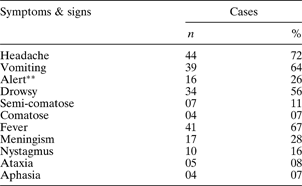
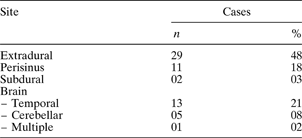
Of the 73 patients, 45 were male and 28 female. Their ages ranged from three to 65 years. All 73 patients were managed by a single stage, transmastoid approach for treatment of the otogenic focus and also drainage of the abscess. Twelve patients were lost to follow up and were thus excluded from the study. Patient symptomatology is detailed in Table I, and abscess sites in Table II.
Presenting symptoms and signs*
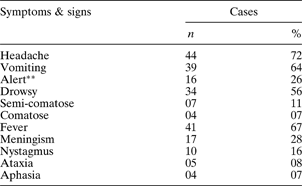
* Total n = 61 **subject in conscious, co-operative, well oriented and responding normally to commands
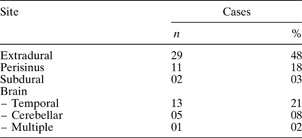
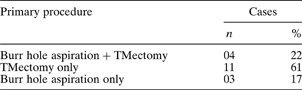
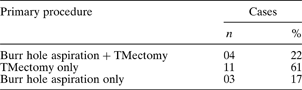
Eighteen of the patients had undergone some form of primary surgery elsewhere, and were thus classified as revision cases. These patients had a recurrence of intracranial abscess of otogenic origin, due to inadequate abscess drainage, inadequate primary otological surgery or both. The primary surgical procedures undergone by these patients are summarised in Table III.
Surgical technique
General anaesthesia was used in most of the patients. For patients in very poor general condition, local infiltration of 1:200 000 Xylocaine with adrenaline was used, with monitoring of all vital parameters.
A postauricular, C-shaped incision was made from the root of the helix to the mastoid tip. A canal wall up tympanomastoidectomy was performed for non-cholesteatomatous ears, while a canal wall down tympanomastoidectomy was performed for ears with cholesteatoma. All the cholesteatomas involved the middle ear as well as the mastoid cavity, necessitating a canal wall down procedure; this gave the best chance of eradicating disease in these extensive primary cases, and also in revision cases.Reference Bhatia, Karmarkar, DeDonato, Mutlu, Taibah and Russo9 Granulation tissue and/or cholesteatoma was removed from the mastoid and middle ear. The thin bone plate over the tegmen dura, posterior fossa dura and sigmoid sinus was inspected for erosion and correlated with the CT findings. The granulation tissue and/or cholesteatoma matrix was gently removed to expose healthy dura. During removal of the disease from the dura, the infective tract in continuation with the abscess capsule was identified. On excising the disease tract, the abscess capsule opened up and purulent material gushed out into the operative field. The mouth of the abscess capsule was incised in cruciate fashion to further facilitate drainage. The abscess cavity was then repeatedly washed with dilute hydrogen peroxide and povidone iodine (1:10) solution. The lavage was discontinued only after the returning fluid ran clear. In the last 10 patients, a 0° endoscope was used to inspect the abscess cavity and to remove any residual necrotic material.
The dural defect was then plugged with a free muscle graft collected from the local site. Fascia lata or a temporalis fascia graft was spread over the plugged dural defect extending to the healthy dura, thereby reinforcing the primary repair. Tragal cartilage was used for closure of the bony defect over the tegmen or posterior fossa dura, taking care that the free edges of the cartilage were hinged on the intracranial aspect of the bony defect. In patients with no serviceable hearing or with recurrent abscess, the eustachian tube was obliterated with fat, bone dust and bone wax, and cul-de-sac closure of the external auditory canal was performed.Reference Sanna, Dispenza, Flanagan, De Stafano and Falcioni10 In patients with serviceable hearing, the decision regarding primary or second stage middle-ear reconstruction was based on the routine principles of ossicular reconstruction in tympanoplasty.
Figure 1 shows a cerebellar and perisinus abscess, with a cholesteatoma focus, which was drained via a transmastoid approach after a canal wall down mastoidectomy. The immediate post-operative CT scan showed drainage of the cerebellar and perisinus abscesses.
(a) & (b) Axial computed tomography (CT) scans showing left cerebellar and perisinus abscess, and left-sided cholesteatoma, respectively. (c) Intra-operative photograph showing abscess drainage via a transmastoid route. (d) Axial CT scan taken immediately post-operatively, showing drained left-sided abscess. CWDM = canal wall down mastoidectomy; PFD = posterior fossa dura; SS = sigmoid sinus; R = right; L = left

Results
Sixty-one of the 73 patients treated by a single stage, transmastoid approach were followed up for at least two years after surgery. Twelve patients were lost to follow up and thus excluded from the study.
Cholesteatoma was found in the middle-ear cleft in 25 patients (41 per cent), with or without granulation tissue. In 36 patients (59 per cent), there was granulation tissue without cholesteatoma. In our series, all the abscesses were in continuity with the mastoid disease. Of the 61 patients included in analysis, 52 (85 per cent) had no post-operative complications and were leading a normal life at the time of writing. Two patients (3 per cent) developed a cerebrospinal fluid leak and two (3 per cent) developed meningitis. All four patients were successfully managed with conservative treatment, including lumbar cerebrospinal fluid drain and intravenous antibiotics.
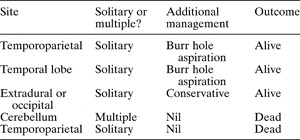
Residual abscess was detected in five patients (8 per cent); their management and outcomes are shown in Table IV. One patient with a tiny residual abscess was treated conservatively with intravenous antibiotics until resolution occurred. Two patients had residual abscesses which increased to more than 2 cm (on CT scan), despite intravenous antibiotics, and which required burr hole aspiration. These reformed abscesses (within the same abscess cavity) were, however, significantly smaller than the original abscesses, and were probably attributable to remnant necrotic material in the abscess cavity. Two subjects (3 per cent of the study group) with recurrent abscess died before any additional management could be implemented, but were included in the study.

Over two years' follow up, there was no evidence of cholesteatoma recurrence in any of the cases we operated upon.
Discussion
Although intracranial complications of chronic otitis media now occur less frequently, many cases still present. Of these intracranial complications, intracranial abscess is one of the commonest.Reference Penido Nde, Borin, Iha, Suguri, Onishi and Fukuda11
The basic concepts in treatment of intracranial abscess of otogenic origin are to promptly decompress the abscess and promptly eradicate the primary otogenic focus, to prevent reformation of the abscess. To achieve this, Singh and Maharaj advocated early ear surgery, either immediately after the neurosurgical procedure (under the same anaesthesia) or within 12 hours of the neurosurgical procedure.Reference Singh and Maharaj7 As a result of this change in treatment policy, these authors' mortality rate declined from 36 to 13 per cent.
Following a similar ideology, we began performing single stage, transmastoid drainage of intracranial abscess and eradication of the primary focus in the same sitting, and this contributed to a sharp decline in mortality (3 per cent in the current series) and morbidity. There is a role for conservative treatment of abscesses smaller than 1 cm in diameter, with intravenous antibiotics and follow-up CT scan, together with eradication of the otogenic focus at the earliest opportunity (although we did not have such a case in our series), the concept being the same as the treatment of tiny residual abscesses. Other authors have documented conservative management of tiny abscesses.Reference Mamelak, Mampalam, Obana and Rosenblum12 However, if an infective tract is identified during otological surgery, this should be followed to drain the abscess, however small. No residual otogenic focus was documented by us after otological surgery performed by the senior author (KPM). Residual or reformed intracranial abscess cases have been attributed to residual necrotic material in the abscess cavity. This fact prompted us to use an endoscope in the last 10 cases to visualise the abscess cavity, in order to evacuate all necrotic material; none of these cases suffered any recurrence.
In our series, the incidence of intracranial abscesses was 59 per cent in non-cholesteatomatous ears and 41 per cent in ears with cholesteatoma. These findings are consistent with those of Migirov et al., who found a higher incidence of granulation tissue disease compared with cholesteatoma in their patients with otogenic intracranial complications.Reference Migirov, Duvdevani and Kronenberg13
• Aspiration of intracranial abscess of otogenic origin, by burr hole and concurrent mastoidectomy, has previously been described
• An infective tract from the mastoid to the intracranial abscess can almost always be identified; hence, mastoidectomy with clearance of the infective tract and transmastoid drainage of the abscess is advocated at the same sitting
• The type of mastoidectomy depends on the type of middle-ear pathology. In cases of otogenic intracranial abscess, there is a higher incidence of non-cholesteatomatous ears vs ears with cholesteatoma
Whether or not the patient undergoes a canal wall up or canal wall down procedure is determined by the ear pathology, not the intracranial complication. A similar conclusion was reached by Singh and Maharaj, following study of a large series.Reference Singh and Maharaj7 In patients who are disease-free for more than six months, ossicular reconstruction may be considered if indicated.
Conclusion
In cases of otogenic intracranial abscess, a single stage, transmastoid approach to both the chronic ear infection and the intracranial abscess is a safe and effective treatment strategy to decrease the mortality and morbidity arising from this pathology.