Motivation is a key factor influencing performance in a broad range of settings such as academic contexts (Linnenbrink, Reference Linnenbrink, Schutz and Pekrun2007). Different models seeking to explain academic motivation, as expectancy-value, perceived self-efficacy, and causal attribution, underscore the impact of the construct of perceived control. Furthermore, the available evidence suggests that perceived control is a primary factor influencing academic emotions (Pekrun & Perry, Reference Pekrun, Perry, Pekrun and Linnembrink-García2014). On the other hand, academic motivation and emotions experienced by the student in the classroom condition the degree of academic task engagement or disengagement (Skinner, Kinderman, & Furrer, Reference Skinner, Kinderman and Furrer2009). Thus, motivation, emotions, and engagement determine to a large extent academic performance (Skinner, Pitzer, & Brule, Reference Skinner, Pitzer, Brule, Pekrun and Linnembrink-García2014). In this context, the purpose of the current study was to investigate the relationships of these variables (anxiety, control, engagement, and performance) in compulsory secondary education.
Achievement Emotions
Emotions are commonly conceived as complex psychological processes including affective, cognitive, physiological, and motivational components (e.g., feeling uneasy, worrying, being physiologically activated, and wanting to escape from anxiety) (Meyer & Turner, Reference Meyer, Turner, Schutz and Pekrun2007; Pekrun, Goetz, & Perry, Reference Pekrun, Goetz and Perry2005). In terms of academic emotions, Pekrun, Elliot, and Maier (Reference Pekrun, Elliot and Maier2009) define academic emotions as affective arousal that is tied directly to achievement activities (e.g., attending class) or achievement outcomes (success and failure).
Pekrun and Perry (Reference Pekrun, Perry, Pekrun and Linnembrink-García2014) propose a three-dimensional taxonomy of achievement emotions, according to three criteria: object focus, valence, and activation. Object focus contrasts activity-related emotions (e.g., enjoyment or boredom) vs. outcome-related emotions (e.g., hope and anxiety); positive or pleasant emotions (e.g. hope) can be distinguished from negative or unpleasant emotions (e.g., anxiety) in terms of their valence; as for activation, physiologically activating emotions (e.g., hope or anxiety) can be distinguished from deactivating emotions (e.g. boredom or hopelessness). The present study assessed anxiety, an outcome-related, unpleasant and activating emotion.
One of the most widely assessed academic emotions in the literature is anxiety, an unpleasant activating emotion experienced by students in an array of academic settings, particularly in relation to mathematics and exams (Zeidner, Reference Zeidner, Pekrun and Linnembrink-García2014). Academic anxiety arises when students believe their cognitive and/or motivational skills may be overwhelmed by the demands of a highly valued academic situation (Pekrun & Perry, Reference Pekrun, Perry, Pekrun and Linnembrink-García2014; Zeidner, Reference Zeidner, Pekrun and Linnembrink-García2014).
As for the relationship between academic anxiety and performance, the findings are inconsistent i.e., some studies found a positive correlation or no significant correlation (Pekrun et al., Reference Pekrun, Elliot and Maier2009); others found a weak negative correlation, with values ranging from r = –.14 to r = –.17 (Pekrun, Goetz, Frenzel, Barchfeld, & Perry, Reference Pekrun, Goetz, Frenzel, Barchfeld and Perry2011) or strong negative correlations ranging from r = –.24 to r = –.60 (Pekrun et al., Reference Pekrun, Elliot and Maier2009; Zeidner, Reference Zeidner, Pekrun and Linnembrink-García2014).
Academic anxiety, like emotions in general, can be conceptualized in trait-like or state-like ways (Pekrun & Perry, Reference Pekrun, Perry, Pekrun and Linnembrink-García2014; Zeidner, Reference Zeidner, Pekrun and Linnembrink-García2014). The defining characteristic of the trait vs. state distinction is the temporal generality of the emotion under analysis. On a conceptual continuum representing emotional traits versus states, academic anxiety would be located in between the trait-state dichotomy: anxiety experienced in a general academic context, such as at high school (trait-emotion); anxiety experienced in a specific course, such as mathematics (course-specific emotion); and anxiety experienced in a single achievement situation, such as a particular physics lesson (state-emotion) (Pekrun & Perry, Reference Pekrun, Perry, Pekrun and Linnembrink-García2014).
Pekrun et al. (2005) designed the Achievement Emotions Questionnaire (AEQ) assessing discrete emotions (e.g., anxiety) for each of the three main categories of academic achievement situations, that is attending class (Class-Related Emotion Scales), studying (Learning-Related Emotion Scales), and taking tests and exams (Test-Related Emotion Scales). The AEQ can be used to assess all three types of achievement emotions (trait, course-specific, and state) in each of the three types of achievement settings (classroom instruction, studying, tests and exams) (Pekrun et al., Reference Pekrun, Goetz, Frenzel, Barchfeld and Perry2011). The present study assessed class-related anxiety in the general academic context of secondary education.
Describing the personal antecedents of academic emotions in his “Control-value theory of achievement emotions”, Pekrun et al. (2009; Pekrun & Perry, Reference Pekrun, Perry, Pekrun and Linnembrink-García2014) assert that subjective appraisal of control is a determinant of academic emotions such as anxiety (see also Goldin, Epstein, Schorr, & Warner, Reference Goldin, Epstein, Schorr and Warner2011).
Perceived Control
Control constructs are widely reported to play a crucial role in several motivational theories such as outcome expectancy, perceived self-efficacy, expectancy of success, and causal attribution (Gallagher, Bentley, & Barlow, Reference Gallagher, Bentley and Barlow2014; Pereira, Barros, & Mendonça, Reference Pereira, Barros and Mendonça2012; Skinner, Reference Skinner1996). Perceived control has been the primary focus of extensive research, and is defined in terms of one’s own perceived ability to significantly determine or modify events in the surrounding environment (Hortop, Wrosch, & Gagné, Reference Hortop, Wrosch and Gagné2013; Skinner, Reference Skinner1996).
Perceived academic control reflect student’s beliefs both about various factors responsible for their academic successes (cause-effect relationships) and about whether they possess those factors as personal attributes, such as effort expenditure, intellectual aptitude or task strategies (Perry, Hladkyj, Pekrun, & Pelletier, Reference Perry, Hladkyj, Pekrun and Pelletier2001).
Students differ in how much control they generally perceive over their pursuits and outcomes (Hortop et al., Reference Hortop, Wrosch and Gagné2013). Even though different previous research (Hall, Perry, Chipperfield, Clifton, & Haynes, Reference Hall, Perry, Chipperfield, Clifton and Haynes2006; Pekrun, Goetz, Daniels, Stupnisky, & Perry, Reference Pekrun, Goetz, Daniels, Stupnisky and Perry2010; Stupnisky, Perry, Hall, & Guay, Reference Stupnisky, Perry, Hall and Guay2012) has found positive correlations between perceived academic control and academic performance, most of these correlations were weak (r < .20).
Academic engagement
As recognized by Lawson and Lawson (Reference Lawson and Lawson2013), theoretical and research literatures on school engagement reflect little consensus about definitions and contain substantial variations in how engagement is operationalized and assessed. Traditionally, three subtypes or components of academic engagement have been identified: behavioral (e.g., effort or persistence), emotional (e.g., enthusiasm or resignation), and cognitive (e.g., use of learning strategies) (Goldin et al., Reference Goldin, Epstein, Schorr and Warner2011; Ros, Goikoetxea, Gairín, & Lekue, Reference Ros, Goikoetxea, Gairín and Lekue2012; Skinner et al., Reference Skinner, Kinderman and Furrer2009; Wigfield et al., Reference Wigfield, Guthrie, Perencevich, Taboada, Klauda, McRae and Barbosa2008).
Behavioral engagement has been defined as the interactions students have with their academic environment that are active, goal directed, flexible, constructive, and persistent (Martin, Reference Martin2008; Skinner & Pitzer, Reference Skinner, Pitzer, Christenson, Reschly and Wylie2012; Wigfield et al., Reference Wigfield, Guthrie, Perencevich, Taboada, Klauda, McRae and Barbosa2008). Some indicators of behavioral engagement were planning, effort, and persistence. Frequently, this behavior is accompanied by emotional engagement (feelings of enthusiasm, enjoyment, and satisfaction) and cognitive engagement (use of self-regulated learning strategies).
Academic engagement was found to be negatively related to burnout (Salanova, Schaufeli, Martínez, & Bresó, Reference Salanova, Schaufeli, Martínez and Bresó2010), disengagement (Martin, Reference Martin2008; Martin, Anderson, Bobis, Way, & Vellar, Reference Martin, Anderson, Bobis, Way and Vellar2012) or disaffection (Skinner, Furrer, Marchand, & Kinderman, Reference Skinner, Furrer, Marchand and Kinderman2008; Skinner et al., Reference Skinner, Kinderman and Furrer2009). Behavioral disaffection with school was typically operationalized in terms of lack of effort, distraction, passivity, and lacking persistence (Martin, Reference Martin2008; Skinner et al., Reference Skinner, Furrer, Marchand and Kinderman2008, Reference Skinner, Kinderman and Furrer2009), a behavior that was often associated with sallow learning strategies, and emotions such discouragement, apathy, boredom, and frustration. In turn, this often leads to absenteeism and early school-leaving (Ros et al., Reference Ros, Goikoetxea, Gairín and Lekue2012; Salanova et al., Reference Salanova, Schaufeli, Martínez and Bresó2010).
Academic achievement has been positively associated to behavioral engagement and negatively to behavioral disaffection (Ros et al., Reference Ros, Goikoetxea, Gairín and Lekue2012; Skinner et al., Reference Skinner, Furrer, Marchand and Kinderman2008, Reference Skinner, Kinderman and Furrer2009; Wigfield et al., Reference Wigfield, Guthrie, Perencevich, Taboada, Klauda, McRae and Barbosa2008). Disaffection from school also predicts school leaving, dropping out, marginalization or social exclusion (Wigfield et al., Reference Wigfield, Guthrie, Perencevich, Taboada, Klauda, McRae and Barbosa2008).
Relating Control, Anxiety, and Engagement
Regarding the relations between these constructs, some studies confirmed that perceived academic control was negatively correlated to academic anxiety (class-, learning-, and test-related) in elementary school, secondary school, and university (Gallagher et al., Reference Gallagher, Bentley and Barlow2014; Pekrun et al., Reference Pekrun, Goetz, Frenzel, Barchfeld and Perry2011; Pereira et al., Reference Pereira, Barros and Mendonça2012). On the other hand, perceived academic control positively correlated to behavioral engagement in elementary education (Skinner et al., Reference Skinner, Furrer, Marchand and Kinderman2008, Reference Skinner, Kinderman and Furrer2009), and to effort and persistence in higher education (Pekrun et al., Reference Pekrun, Goetz, Daniels, Stupnisky and Perry2010). Likewise, behavioral disaffection negatively correlated to perceived academic control in elementary education (Skinner et al., Reference Skinner, Furrer, Marchand and Kinderman2008). Finally, class- and test-related anxiety in mathematics was a positive predictor of disengagement in secondary education (Martin et al., Reference Martin, Anderson, Bobis, Way and Vellar2012).
Additionally, recent studies have applied structural equation modeling (SEM) (or similar analyses) to examine the role of emotions and engagement as mediators between motivation and performance. Thus, teacher ratings of student reading engagement during classroom work mediated the effects of reading instruction on outcomes (Wigfield et al., Reference Wigfield, Guthrie, Perencevich, Taboada, Klauda, McRae and Barbosa2008). Furthermore, different subtypes of engagement mediated the relationship between psychological need satisfaction and student’s overall semester grade (Reeve & Tseng, Reference Reeve and Tseng2011). Finally, engagement and burnout mediated the relations between social facilitators and performance (Salanova et al., Reference Salanova, Schaufeli, Martínez and Bresó2010).
Overview of present study
Because of the lack of integrative research simultaneously assessing control, anxiety, engagement, disaffection, and performance in adolescents, the aim of this study was to use SEM to test the hypothesized relationships between these variables in compulsory secondary education.
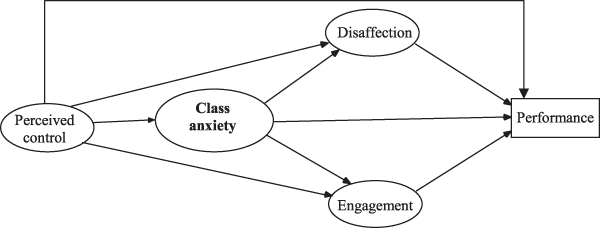
The theoretical framework for the present study was based on the model proposed by Dettmers et al. (Reference Dettmers, Trautwein, Lüdtke, Goetz, Frenzel and Pekrun2011), Linnenbrink (Reference Linnenbrink, Schutz and Pekrun2007), Pekrun and Linnenbrink-García (Reference Pekrun, Linnenbrink-García, Christenson, Reschly and Wylie2012), and Zeidner (Reference Zeidner, Pekrun and Linnembrink-García2014). Sharing multiple points of view, these authors posit that academic emotions (e.g., class-related anxiety) are influenced by motivational variables (e.g., perceived academic control) and determine the levels of engagement (e.g., behavioral engagement and disaffection) and performance on academic tasks. The hypothesized paths between these variables are depicted in Figure 1. Moreover, most of the empirical studies previously reviewed provide evidence for these proposals.
The hypothesized structural model.

As shown in Figure 1, the structural model proposes that perceived control predicts class-related anxiety, which, in turn, predicts differences in engagement and disaffection that subsequently predict academic performance. Therefore, in this study we expected that (a) class-related anxiety would be negatively predicted by perceived academic control and would positively predict disaffection and negatively predict engagement and performance; (b) anxiety would mediate the effects from perceived control to engagement and disaffection; (c) the negative relation between anxiety and performance would be explained by the mediating role of engagement and disaffection; finally (d) anxiety, engagement, and disaffection would mediate the positive relationship between perceived control and performance.
The present work makes several valuable contributions to the existing literature. Class-related anxiety was evaluated as a central variable given that it is most relevant if one considers that adolescents spend 30–34 hour per week in class. In accordance with the work of Skinner et al. (Reference Skinner, Kinderman and Furrer2009), the analysis of disaffection is of particular importance in contexts where adolescents cannot voluntarily exit, such as school during compulsory secondary education. Furthermore, engagement and disaffection were evaluated by teachers and tutors in order to obtain a more objective and comprehensive appraisal of the students´ behavior in class (Skinner et al., Reference Skinner, Kinderman and Furrer2009; Wigfield et al., Reference Wigfield, Guthrie, Perencevich, Taboada, Klauda, McRae and Barbosa2008). Whilst previous studies have sought to evaluate these variables at specific times, this study has assessed these variables throughout the entire academic year. In contrast to most previous correlational studies, the relationship between variables was analyzed using SEM, which entails a series of advantages. Moreover, the findings of the study will be discussed in the light of clinical/educational intervention programs, and to generate explanatory hypotheses concerning the etiology of academic anxiety and its impact on adolescents in order to minimize the activation and the adverse effects of this detrimental emotion.
Method
Participants
The final sample consisted of 355 students (53.2 % girls) in third and fourth year of Compulsory Secondary Education (9th to 10th grade) at different schools in Northwest of Spain. The number of students per class ranged from 14 to 29 students. Of the 371 students who responded to the first questionnaire in October, 7 failed to attend class in December, and 9 more had changed school before the end of the academic year; thus, the final sample consisted of 355 students. At the end of the academic year, the mean age of participants was 15.2 years (DT = 1.8), and there were no significant differences between boys and girls in this variable.
According data provided by the school administration, approximately 8 % of students were born in countries other than Spain, 9% of all the students were on remedial teaching programmes at school, particularly in the subjects of mathematics and Spanish language, and 13% of students had repeated any grade.
Measures
Perceived control
The Academic Control Scale (Perry et al., Reference Perry, Hladkyj, Pekrun and Pelletier2001) was utilized to measure perceived academic control. This version consists of eight items for reporting the student’s opinion on a range of factors that condition academic performance (e.g., “I have a great deal of control over my academic performance in my courses” or “When I do poorly in a course, it’s usually because I haven’t given it my best effort”). The students scored the items on a scale ranging from 1 (“I totally disagree”) to 5 (“I totally agree”).
Anxiety
Class anxiety was assessed using a Class-Related Emotion Scale taken from the Achievement Emotions Questionnaire (AEQ) of Pekrun et al., (Reference Pekrun, Goetz and Perry2005). The class-related anxiety scale consisting of eight items was administered (e.g., “I get scared that I might say something wrong in class, so I’d rather not say anything” or “Thinking about class makes me feel uneasy”). Students rated their classroom-related emotional experiences on a 5-point Likert scale ranging from 1 (totally disagree) to 5 (totally agree).
Engagement and Disaffection
The Engagement versus Disaffection with Learning: Teacher Report (Skinner et al., Reference Skinner, Furrer, Marchand and Kinderman2008) was administered. The students’ tutors assessed each student’s behavioral engagement and disaffection in the classroom. The Behavioral Engagement subscale consists of five items that evaluate the students’ attention, effort, and persistence while initiating and participating in class (e.g., “When I explain new material, this student listens carefully” or “In my class, this student does more than required”). Analogously, the Behavioral Disaffection subscale consists of five items assessing distraction in class, absence of persistence, and lack of effort (e.g., “When faced with a difficult assignment, this student doesn’t even try” or “In my class, this student does just enough to get by”). In both subscales, teachers scored the students’ behavior on a scale ranging from 1 (not at all true for this student) to 5 (very true for this student).
All of the scales (control, anxiety, engagement, and disaffection) have been used in previous studies, with the corroborated psychometric characteristics of reliability and validity. The Spanish version of these scales was designed using the cross-cultural scale translation technique.
Performance
Academic performance was assessed using the student’s mean final grade. Scoring ranged from 1 (very deficient) to 10 (excellent). The pass mark was a score ≥ 5.
Procedure
Data were obtained over a nine-month period: students responded to the perceived control scale in October and to the emotional scale in December; tutors completed the engagement and disaffection scales in April and communicated the mean final grades in June. All students freely volunteered to participate in the study and written authorization was obtained from the schools and parents. Students completed their questionnaires in their classrooms during school hours. One researcher and the tutor teacher were present during data collection. Participants (students and teachers) were informed of the aims of the research, reminded of the importance of providing sincere responses, and assured their data would remain anonymous and confidential.
Outline of data analyses
In this study, statistical analysis initially determined the reliability coefficients (Cronbach’s alpha), the descriptive statistics, and the correlations between variables using the SPSS 22 statistical package. Confirmatory factorial analysis (CFA) of the scales was then undertaken to confirm the fit of the measurement model using the AMOS 22 software (Arbuckle, Reference Arbuckle2013). Finally, a series of SEM’s were performed to contrast the proposed mediational model.
The model fit in both analyses (CFA and SEM) was evaluated by the following indexes (Byrne, Reference Byrne2010): the χ2 statistic, the χ2 /df indicator, the adjusted goodness of fit index (AGFI), the comparative fit index (CFI), the root mean square error of approximation (RMSEA), and the standardized root mean square residual (SRMR).
SEM’s were used to assess assumptions on the relationships between variables. These analyses offer several advantages over correlational methods, i.e., they allow for the analysis of statistically non-normal data; enable theoretical knowledge to be introduced into model specification; can test phenomena assessing multiple endogenous and exogenous variables; and they take into account the role of mediating variables.
Results
Preliminary analysis
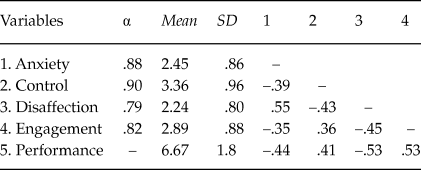
Table 1 shows the descriptive statistics, correlations between variables, and internal consistencies (Cronbach’s α). In terms of correlations two groups of constructs can be distinguished: one includes anxiety and disaffection; the other, control, engagement, and performance. The variables were positively correlated within each group, and negatively with the variables of the other group. Cronbach’s alpha values for the applied scales ranged from .79 (disaffection) to .90 (perceived control) indicating that reliability was satisfactory to excellent.
Alphas, descriptive statistics, and correlations

Note: All correlations were significant (p < .001).
Furthermore, an intraclass correlation coefficient (ICC), as proposed by Shrout and Fleiss (Reference Shrout and Fleiss1979), was calculated. This statistic estimates the proportion of variance in the data that is due to rated subjects (i.e., students) rather than due to groups (i.e., “class”) and residual. Their values may range from 0 to 1. A value of ICC = 1 indicates that all observed variance in a variable is explained by the differences between students. In the present work, the values of ICC for perceived control, anxiety, engagement, disaffection, and performance varied from .890 to .949 for data grouped by “class”. These results suggested that the vast majority of variance in these variables was accounted for at the individual level given the minor role of the grouping variable (“class”) in generating total variability.
Measurement model
In order to test the relationship between measured items and latent variables, a confirmatory factor analysis was performed. The perceived control scale (8 items) and the anxiety scale (8 items) were grouped, for factorial and structural equation analysis, using the procedure employed with these scales by Stupnisky et al. (Reference Stupnisky, Perry, Hall and Guay2012) and Pekrun et al. (Reference Pekrun, Goetz, Daniels, Stupnisky and Perry2010) i.e., calculating the mean of two correlated items with a similar significance. This grouping gave rise to four parcels for each of these latent variables (perceived control and anxiety), and their corresponding means were used as indicators. In line with the recommendations of Byrne (Reference Byrne2010), parceling was implemented to improve model parsimony by decreasing the number of parameters estimated.
All of the indicators obtained asymmetry indices and kurtosis below |1.96|, confirming the univariate normality assumption (Arbuckle, Reference Arbuckle2013; Byrne, Reference Byrne2010). No atypical multivariate observations (outliers) were found. Nevertheless, Mardia's multivariate kurtosis coefficient (32.1) exceeded the critical ratio (11.3). Thus, in order to determine the influence of non-normality on the estimators, two types of analysis were performed (Arbuckle, Reference Arbuckle2013; Byrne, Reference Byrne2010): one for the original sample using the maximum likelihood method; the other for the 500 bootstrap samples, using the maximum likelihood method; a 95% confidence interval was set to evaluate corrected bias. The comparison of the results obtained by both methods revealed no differences. Therefore, we proceeded to review the results of the analysis performed on the original sample. No re-specifications of the initial model were carried out. The measurement model is shown in Figure 2.
The measurement model for constructs of perceived control, anxiety, engagement, and disaffection.

The measurement model fitted the data well, χ2 (df = 129, N = 355) = 196.4, p < .001; χ2 /df = 1.52; GFI = .94; CFI = .97; RMSEA = .038; SRMR = .037. As Shown in Table 2, the standardized factor loadings ranged from .61 (Disaff1) to .89 (Control 2.7), and all were significant (p < .001). All correlations between latent constructs were significant (p < .001).
Indirect effects on disaffection, engagement, and performance

Notes: (a) All the total effects were significant (p < .001). (b) The probability associated to the sum of standardized indirect effects and their respective confidence intervals was estimated using the “Bias-corrected confidence interval bootstrap test” of AMOS 22 (confidence level = 95%; samples = 500). (c) CI = Confidence Interval.
Structural model
Thereafter, several SEM analyses were performed to corroborate our initial hypotheses regarding the relationships between variables (Figure 1). The nexuses among all of the variables under evaluation were established. The full mediational model, graphically depicted in Figure 3, showed a good fit with the data, χ2 (df = 144, N = 355) = 232.3, p < .001; χ2 /df = 1.60; GFI = .94; CFI = .97; RMSEA = .042; SRMR = .047.
The final structural model. Values are standardized parameter estimates.
Note: Dashed lines represent non significant paths (p > .05). For clarity of presentation, observed indicators were not drawn.

The analysis of the significant direct effects (see Figure 3) showed anxiety was negatively predicted by perceived control, and was a negative predictor of engagement and an intense and positive predictor of disaffection. Perceived control positively predicted engagement and negatively predicted disaffection. Academic performance was positively predicted by engagement, and negatively predicted by disaffection. The direct effects from anxiety ad perceived control to performance were non-significant.
Then, another SEM analysis was performed to examine an alternative model of pathways (Model 2) evaluating the sequence “Anxiety → Control → Engagement → Performance”. The fit indexes were adequate, though slightly below those in Model 1 proposed in Figure 3 (ΔCFI = –.02; ΔRAMSEA = –.01).
Participants in the study (n = 355) were assigned to one of two groups i.e., students who had repeated a grade at school (“Repeaters”: 13%; n = 46), and students who had not repeated a grade (“Non-Repeaters”: 87%; n = 309). Next, for these groups, we tested the equivalence or invariance of the structural paths hypothesized in Figure 1. The first step was to test the hypotheses on the equivalence of the structural links among the latent constructs (Byrne, Reference Byrne2010). The test of the proposed model, with factor loadings and structural links freely estimated, was performed simultaneously in both groups. The hypothesized model fitted the data well, χ2 (df = 288, N = 355) = 397.2, p < .001; χ2 /df = 1.38; CFI = .960; RMSEA = .033. This result indicated the adequacy of the structural model for both groups. The hypothesized model was also found to fit the data adequately in each group. In the second step, all the structural links were constrained to be equivalent across both groups. The fit of the constrained model was also acceptable χ2 (df = 311, N = 355) = 422.72, p < .001; χ2 /df = 1.36; CFI = .959; RMSEA = .032. All of the paths were significant, with an identical sign for both groups of students.
Finally, the indirect effects were analyzed using the bootstrap procedure with AMOS 22 (Byrne, Reference Byrne2010). Table 2 shows the total, indirect, and direct effects on engagement, disaffection, and performance. In the full mediational model, the direct effects of perceived control on disaffection (β = –.243, p < .01) and engagement (β = .261, p < .01) were significant, and the indirect effect (mediated by anxiety) was also significant for disaffection (β = –.277, p < .005; CI = –.378, –.197) and engagement (β = .170, p < .002; CI = .103, .258). This implied that anxiety partially mediated the effects of perceived control on disaffection and engagement.
In contrast, the direct effect of anxiety on performance was not significant (β = –.112, p > .05) and the sum of indirect effects of anxiety on performance (mediated through engagement and disaffection) was significant (β = –.295, p < .002; CI = –.439, –.182). Analogously, the direct effect of control on performance was not significant (β = .103, p > .05) and the sum of indirect effects of control on performance (mediated by anxiety, engagement and disaffection) was significant (β = .352, p < .003; CI = .279, .440). In both cases, this implied a total mediation. Jointly, the variables under evaluation explained 46% of the variance of academic performance.
Discussion
This study analyzed the association between class-related anxiety and perceived control with behavioral engagement, behavioral disaffection and academic performance.
Regarding the direct relationships between variables, as hypothesized, class-related anxiety was a positive predictor of disaffection and also predicted low levels of engagement. Perceived academic control protected against anxiety and disaffection, and was a positive predictor of engagement. Engagement (positively) and disaffection (negatively) significantly predicted performance. On the whole, these results agree with the findings of previous studies (Gallagher et al., Reference Gallagher, Bentley and Barlow2014; Martin et al., Reference Martin, Anderson, Bobis, Way and Vellar2012; Pekrun et al., Reference Pekrun, Goetz, Daniels, Stupnisky and Perry2010, Reference Pekrun, Goetz, Frenzel, Barchfeld and Perry2011; Pereira et al., Reference Pereira, Barros and Mendonça2012; Skinner et al., Reference Skinner, Furrer, Marchand and Kinderman2008, Reference Skinner, Kinderman and Furrer2009). In the final structural model, the direct paths from control and anxiety to performance were not significant even though the bivariate correlations were significant (r = .41 and r = –.44 respectively).
Nonetheless, the main contribution of this study concerns the mediated relations. First, Pekrun et al. (Reference Pekrun, Goetz, Daniels, Stupnisky and Perry2010), and Skinner et al. (Reference Skinner, Furrer, Marchand and Kinderman2008, Reference Skinner, Kinderman and Furrer2009) found a positive correlation between perceived control and engagement and a negative relationship between perceived control and disaffection. In this study, some of these effects of perceived control on engagement and disaffection were mediated by anxiety, suggesting that students with higher perceived control experienced less class-related anxiety that enhanced behavioral engagement and protected against behavioral disaffection.
Second, the association between anxiety and performance was mediated by engagement and disaffection. The direct path between anxiety and performance was not significant, but this relationship increased considerably since students with greater anxiety were less involved in classroom tasks (with lower levels of attention, effort, and persistence), and exhibited higher levels of disaffection (distraction in class, absence of persistence, and lack of effort). Low levels of engagement and high levels of disaffection hindered performance. The results of this mediational analysis may serve to explain that anxiety and performance were not significantly correlated as reported by Pekrun et al. (Reference Pekrun, Elliot and Maier2009) or the poor negative correlations observed by Pekrun et al. (Reference Pekrun, Goetz, Frenzel, Barchfeld and Perry2011). Some of the negative correlation between anxiety and performance were mediated by other variables such as engagement and disaffection. These mediated relationships are difficult to detect using correlational analysis, and are best explored using SEM , as was the case in this study.
Finally, anxiety, engagement, and disaffection mediated the association between perceived control and performance observed in previous research. In the present study, this relation can be primarily explained by the fact that perceived academic control fostered engagement and protected against disaffection and anxiety, which, in turn, predicted disaffection (positively) and engagement (negatively); and high levels of engagement and low levels of anxiety and disaffection anticipated higher academic performance. The mediational role of anxiety, engagement, and disaffection may explain the moderate direct correlations between perceived academic control and performance reported by Hall et al. (Reference Hall, Perry, Chipperfield, Clifton and Haynes2006), Pekrun et al. (Reference Pekrun, Goetz, Daniels, Stupnisky and Perry2010), Perry et al. (Reference Perry, Hladkyj, Pekrun and Pelletier2001) and Stupnisky et al. (Reference Stupnisky, Perry, Hall and Guay2012).
The results of this study, particularly in terms of mediated relationships, corroborated the theoretical mediational model proposed by Dettmers et al. (Reference Dettmers, Trautwein, Lüdtke, Goetz, Frenzel and Pekrun2011), Linnenbrink (Reference Linnenbrink, Schutz and Pekrun2007), and Pekrun and Linnenbrink-García (Reference Pekrun, Linnenbrink-García, Christenson, Reschly and Wylie2012). Moreover, these results correspond with previous studies that found academic emotions (Pekrun et al., Reference Pekrun, Goetz, Daniels, Stupnisky and Perry2010), engagement and disengagement (Reeve & Tseng, Reference Reeve and Tseng2011; Salanova et al., Reference Salanova, Schaufeli, Martínez and Bresó2010; Wigfield et al., Reference Wigfield, Guthrie, Perencevich, Taboada, Klauda, McRae and Barbosa2008) mediated the relations between motivational constructs and academic performance. These mediated relations may be an example of what Goldin et al. (Reference Goldin, Epstein, Schorr and Warner2011) called “engagement structures”, hypothesized ways in which emotion, cognition, and motivation interact to influence students' engagement and performance in classroom social environments.
However, the findings of the current study should be interpreted with caution given the following limitations that will spur the direction for future research.
In terms of measures, this study focused on behavioral engagement and disaffection, but other components should also be considered (Reeve & Tseng, Reference Reeve and Tseng2011; Ros et al., Reference Ros, Goikoetxea, Gairín and Lekue2012), along with other indicators of disengagement such as emotional disaffection and procrastination (Skinner et al., Reference Skinner, Furrer, Marchand and Kinderman2008) or self-handicapping (Martin, Reference Martin2008). Furthermore, besides teachers, students will be given the opportunity to self-assess engagement and disaffection in order to avoid “teacher bias”.
The present study evaluated class anxiety in general, an example of what Pekrun and Perry (Reference Pekrun, Perry, Pekrun and Linnembrink-García2014) termed a trait-emotion. The results obtained in this study may be complemented in the future by evaluating the predictors and outcomes of other pleasant and unpleasant emotions (e.g., pride and shame, respectively), and activating and deactivating emotions (e.g., enjoyment and boredom). These emotions may refer to specific subjects (course-specific emotions) or a particular classroom setting or academic topic (state-emotions) (see, for example, Pekrun et al., Reference Pekrun, Goetz, Daniels, Stupnisky and Perry2010).
Moreover, other motivational variables could be included to explain emotions, such as achievement goals (see also Daniels et al., Reference Daniels, Stupnisky, Pekrun, Haynes, Perry and Netwall2009 and Pekrun et al., Reference Pekrun, Elliot and Maier2009; Pekrun, Cusack, Murayama, Elliot, & Thomas, Reference Pekrun, Cusack, Murayama, Elliot and Thomas2014), especially the performance-avoidance goals, a motivational variable predicting academic anxiety and other negative emotions.
In this work the students’ previous performance was not included in the model. Prior research (see, for example, Daniels et al., Reference Daniels, Stupnisky, Pekrun, Haynes, Perry and Netwall2009) found that past academic performance was by far the best single predictor of future academic performance, as well as a likely predictor of other variables in the proposed model. Hence, previous performance could be included in future research to analyse its interaction with the other variables of the model, and to explain a higher percentage of variance of subsequent academic performance. This design would enable the analysis of engagement structures (Goldin et al., Reference Goldin, Epstein, Schorr and Warner2011) and their personal and social components or strands, simultaneously present and dynamically interactive in the academic context.
In terms of design, the results of the present study regarding the fit indexes of both the proposed model and the alternative model provide valuable data for design in the future longitudinal, repeated measures studies to test the mutual relationships between motivation, emotions, engagement and performance, in line with the recommendations and hypothesis of Goldin et al. (Reference Goldin, Epstein, Schorr and Warner2011) and Skinner and Pitzer (Reference Skinner, Pitzer, Christenson, Reschly and Wylie2012).
Finally, adolescents in the present study were grouped by “class”. For this reason, in spite of the inherent complexity of this type of analysis (see Preacher, Zhang, & Zypur, Reference Preacher, Zhang and Zyphur2011), an aim of further research could be to perform a multilevel SEM to test the extent to which assessed relations between variables can reflect possible “class” effects.
Regarding educational implications of the findings of this study, we must consider the important social, family, and personal consequences of anxiety bearing in mind that class-related anxiety positively predicted disaffection and negatively engagement and performance. Consequently, several authors have recognized the important contribution of schools to prevent anxiety or minimize its impact (Gallagher et al., Reference Gallagher, Bentley and Barlow2014; Mychailyszyn et al., Reference Mychailyszyn, Beidas, Benjamin, Edmunds, Podell, Cohen and Kendall2011; Pereira et al., Reference Pereira, Barros and Mendonça2012). This highlights, as Goldin et al. (2011, p. 547) assert, that social interactions may evoke strong emotional feelings, leading sometimes to deeper engagement and other times to disaffection.
Thus, according to Meyer and Turner (Reference Meyer, Turner, Schutz and Pekrun2007), teachers’ interpersonal skills at identifying and supporting (scaffolding) students’ positive emotional experiences to set and achieve a variety of classroom goals is crucial to preventing negative emotions, such as anxiety. Furthermore, Kim and Hodges (Reference Kim and Hodges2012) propose strategies designed to control negative academic emotions and to facilitate students’ positive reappraisal of the situation: attention deployment, shifting the attention from debilitating emotions to something else (e.g., the positive side of anxiety or the controllability of the situation); cognitive change, consciously re-evaluating the situation to become aware of emotions (e.g., recognizing the emotion of anxiety); and response modulation, to provoke or suppress certain emotional responses (e.g., tense or uneasy). This also enhances the development of a meta-affective response (Goldin et al., Reference Goldin, Epstein, Schorr and Warner2011), a cognitive and metacognitive process that transforms the experience of a negative emotion into positive one.
Other interventions target the predictors and the effects of anxiety (Pereira et al., Reference Pereira, Barros and Mendonça2012). Taking into account the role of perceived control as a protection against anxiety (Hortop et al., Reference Hortop, Wrosch and Gagné2013), some authors have focused on attributional retraining procedures, a control-enhancing intervention based on Weiner’s theory (Hall et al., Reference Hall, Perry, Chipperfield, Clifton and Haynes2006), where students are encouraged to attribute failure to controllable causes such as the use of inadequate strategies or lacking the effort needed, in place of immutable causes such as limited academic ability or low intelligence. Alternatively, some instructional strategies seek to minimize the impact of anxiety on performance, and to promote engagement and reduce disaffection during learning activities by giving students a developmentally calibrated sense of autonomy, control, competence, choice, and structure (Pianta, Hamre, & Allen, Reference Pianta, Hamre, Allen, Christenson, Reschly and Wylie2012).
It is also worth mentioning the multidimensional intervention programs, as developed by Martin (Reference Martin2008), integrating theories, research, and practice on motivation, emotion, and engagement. The author focuses on motivational variables (e.g., uncertain control), emotional variables (e.g., anxiety), planning, persistence, and disengagement. This intervention critically conditioned the students´ positive emotions, motivation, engagement, learning, performance, and satisfaction with life.