1. Introduction
In 1980, Roger Lewin published an article entitled “Evolutionary Theory under Fire” in Science magazine. He was reporting on a recent conference on macroevolution at the Field Museum of Natural History in Chicago and outlined a revised account of the evolutionary process presented there: “Instructions encoded in the genetic library are filtered through a net of developmental constraints, giving rise to a set of possible phenotypes; it is at this stage that natural selection works, limiting the surviving phenotypes to those with suitable adaptive features. The omnipotent position of adaptationism embodied in the Modern Synthesis is overturned” (Lewin Reference Lewin1980, 886).Footnote 1 According to Lewin, the existence of constraints meant that natural selection was involved at only one stage of the evolutionary process and thus was not the only essential factor in evolution. In 2009, at a conference celebrating Charles Darwin at the University of Chicago, Douglas Futuyma opened the Biological Sciences sessions with a talk entitled “Evolutionary Ecology and the Question of Constraints,” arguing that constraints on variation are an integral part of the evolutionary process. Discussions of the role of constraints in evolution have thus persisted for decades; yet there is still a great deal of debate over what counts as a constraint and about how to assess experimentally the relative importance of constraints and selection in evolutionary history.
In this article, I will begin by clarifying the notion of a constraint on variation and defending it against a recent critique. I will then argue that the selection-constraint distinction depends on two specifications:
(1) What counts as a variant—constraints limit or bias the production of what?
(2) Range of assessment—over what range of times or conditions is the variation assessed?
Finally, I will present a case study of butterfly eyespots showing that knowledge of 1 and 2 helps us to understand empirical work on the relative importance of constraint and selection in evolution. Acquiring a better understanding of the role of constraints is important because, along with parallelism, they represent a way to challenge the externalist view of evolutionary history, which privileges environmental ‘forcing’ as the determinant of organic form.
2. Constraints on Variation
There has been no shortage of discussions of evolutionary constraint, and biologists and philosophers have provided a series of definitions and taxonomies (Alberch Reference Alberch, Bonner and Dawid1982; Alexander Reference Alexander1985; Maynard Smith et al. Reference Maynard Smith, Burian, Kauffman, Alberch, Campbell, Goodwin, Lande, Raup and Wolpert1985; Wimsatt Reference Wimsatt and Bechtel1986; Gould Reference Gould1989; Antonovics and Tienderen Reference Antonovics and van Tienderen1991; Arnold Reference Arnold1992; Amundson Reference Amundson1994; Schwenk Reference Schwenk1995; Schwenk and Wagner Reference Schwenk, Wagner, Hall and Olson2003, Reference Schwenk, Wagner, Pigliucci and Preston2004; Schlosser Reference Schlosser, Sansom and Brandon2007; Sansom Reference Sansom2009). In this section, I will clarify what I take to be the most useful of the existing definitions by relating it to the occupation of trait space.Footnote 2
One of the first substantial contributions to the discussion of the nature of constraints in evolution was made by a group organized by the philosopher Richard Burian and the biologist Stuart Kauffman. Although this group was focused on developmental constraints in particular, removing the references to development and phenotype from their account results in a useful definition of a constraint on variation in evolution: a bias on the production of variants or a limitation on variability (Maynard Smith et al. Reference Maynard Smith, Burian, Kauffman, Alberch, Campbell, Goodwin, Lande, Raup and Wolpert1985, 266). These constraints on variation are a general version of Ron Amundson's “constraints on form,” and equivalent to Kurt Schwenk's “Class-II constraints”—on the latter account, anything leading to “nonrandom production of variants” is a constraint (Amundson Reference Amundson1994, 560–65; Schwenk Reference Schwenk1995, 254; cf. Grantham Reference Grantham2004, 38). This definition is notable for its clarity, for it links constraints and selection to the two key processes of evolution: variation and differential survival, respectively. Putting this in the context of trait space (see table 1), if certain regions are empty because certain variants are not produced, a constraint is responsible; whereas if certain regions are empty because certain variants are produced but do not persist, selection or some related process is responsible (cf. Beatty Reference Beatty2006, 361).Footnote 3 Thus, constraints bias or limit the pool of variants upon which selection acts.

| Cause | What Is Biased/Limited? | Result |
| Constraint | Production of variants | Clumpy trait space |
| Selection | Persistence of variants | Clumpy trait space |
Nevertheless, some philosophers have claimed that the distinction between constraint and selection is incoherent. For instance, Timothy Shanahan has argued that constraints are simply part of the process of selection. However, he is operating with a definition that is too broad, namely, “constraints are limits on the sorts of phenotypes that can evolve” (Shanahan Reference Shanahan2008, 137). The problem with this definition is that natural selection also limits the sorts of phenotypes that can evolve. As we have seen, empty points in trait space can be explained either by constraints (the variant did not arise) or selection (the variant did not persist). Shanahan admits that certain universal constraints, like the laws of physics, do represent causes operating independently of natural selection. These are also constraints on the ‘biased variation’ definition, since variants that violate the laws of physics do not arise. But he argues that other purported constraints are simply “manifestations of the operation of natural selection” (Shanahan Reference Shanahan2008, 140).
Shanahan's argument fails because his own description of the selective process implies a causal role for nonuniversal constraints, despite his claim that such constraints are not distinct causes. In his discussion of phylogenetic constraints, he presents two possibilities: “either (i) genetic variations that could lead to alternative structures did not arise, or (ii) genetic variations that could lead to alternative structures did arise, but produced no fitness advantage over variations for existing structures, with the result that existing structures were preserved in their descendents” (Shanahan Reference Shanahan2008, 141). However, ongoing selection cannot explain why certain variations “did not arise” but only why certain of the variations that did arise “were preserved.” If certain variations are not produced, some constraint must be responsible. This constraint might itself be the result of selection, but an existing bias or limit on variation is a constraint on the pool of variants exposed to selection and is thus a separate cause. Even if “preceding selection cannot but affect what subsequent variations will … arise,” as Karen Neander (Reference Neander1995, 586) argues, there are still “two subprocesses” at work: the production and the preservation of variation.
3. Two Specifications
The definition of a constraint on variation as anything that limits or biases the production of variants prompts two specifying questions.
3.1. What Counts as a Variant?
If constraints bias the production of variants, what is the relevant variant? A genetic variant? A structural variant? These two possibilities are separated by all the complexities of biological development. Faced with the problem of the origin of variation, biologists normally appeal to genetic variation caused by mutation or recombination. One could argue, however, that a new genetic mutant is not evolutionarily relevant unless it survives to reproductive age and leaves offspring. From this perspective, a genotype that results in an unviable embryo or a sterile individual is not a variant at all. If such cases are treated as variants, then natural selection is responsible for their nonexistence. After all, these variants were produced, they simply did not persist; the selective explanation for this lack of persistence is straightforward. But if such cases are not treated as variants, since they are not evolutionarily relevant, we can discuss various reasons why variants of this sort do not appear—various constraints.
Such constraints are developmental in the broad sense but also encompass causes often called mechanical or physical constraints. For example, one of many reasons that there are no giant insects of the kind popular in B movies of the 1950s and 1960s is that the exoskeleton surrounding their legs would buckle, which could be cited as an example of a mechanical constraint (LaBarbera Reference LaBarbera2003). However, if in some hypothetical species of insect a variant pushing the upper limit of this size range were to appear, it would likely be unable to reproduce. Should such an insect count as a variant? If so, then selection would be responsible for the nonexistence of that insect; if not, then a mechanical constraint would be responsible. Either way, this kind of case is quite different from that of a physical constraint in the universal sense: insects so large their legs would buckle are unfeasible, not impossible. When it comes to more classical developmental constraints, the same issues arise. Is trait space a space of adult individuals or genomes? If the latter, then unviable embryos count as variants, and such genomes are weeded out by selection; if the former, then developmental constraints are invoked to explain why such embryos do not survive to adulthood.
As indicated, there seems to be a series of natural break points—likely discipline specific—after which an individual may count as a variant and before which it may not. Looking at individual ontogeny and leaving aside asexual reproduction, the first obvious candidate is the new genome. Before this, there is no individual, and thus there is nothing to call a variant. The next natural break point is birth, or some kind of physical independence from the parent organism(s). This point is sometimes rather vague—think of baby marsupials in pouches—but it is likely the point after which most biologists are comfortable calling an individual a variant. A final candidate point in individual ontogeny is the mature reproductive adult—an individual may not count as a variant unless it can leave offspring. However, these three points in individual ontogeny are not the whole story. Over longer timescales, it may make more sense to treat not individuals but ongoing lineages as the relevant variants—and these may be lineages at various hierarchical levels. There does not appear to be an obvious way to argue that one or another of these accounts of variant is generally superior to the others. Nevertheless, in any given case the relevant “focal life stage” must be specified (Schwenk and Wagner Reference Schwenk, Wagner, Pigliucci and Preston2004).
3.2. Range of Assessment
Specifying what counts as a variant, however, is not enough. One must also specify the range of assessment, that is, the range of times or conditions over which the variation is assessed. For example, if we notice that individuals of species S lack a particular trait T, we are faced with a question: are individuals with trait T arising but not passing on their genes, or are they simply never arising? Even assuming that a viable juvenile individual is the relevant variant in this case, there are still many possible ranges of assessment: we could measure the occurrence of variants with trait T in one or many populations, in one or many generations, in one or many environments, and so on. Once the range of assessment is specified, however, it is possible to decide whether selection or constraint is responsible for the lack of individuals with T. If we take as the range of assessment a single population over five generations and observe no births of viable juveniles with trait T, then one or more constraints on variation are responsible. Conversely, if juveniles with trait T are born but are less reproductively successful than their non-T counterparts, then selection is responsible. These conclusions, of course, are also dependent on what counts as a variant—if the relevant variant is an individual genome, and genomes with trait T appear but produce unviable embryos, then selection is responsible even if no viable juveniles with trait T appear. Generally speaking, the wider the range of assessment, the stronger the constraint.Footnote 4
4. Case Study: Butterfly Eyespots
Biologists and philosophers will likely have different intuitions about these specifications. To make the discussion more concrete, I now turn to a recent experimental program that attempts to discover whether phenotypic variation in an existing population is limited by selection or constraint. Paul Brakefield and colleagues, based at the University of Leiden in the Netherlands, have published an extensive series of papers exploring constraints on form in the African butterfly Bicyclus anynana (e.g., Beldade, Koops, and Brakefield Reference Beldade, Koops and Brakefield2002; Frankino et al. Reference Frankino, Zwaan, Stern and Brakefield2005, Reference Frankino, Zwaan, Stern and Brakefield2007; Allen et al. Reference Allen, Beldade, Zwaan and Brakefield2008; Zwaan et al. Reference Zwaan, Zijlstra, Keller, Pijpe and Brakefield2008). I will focus on two experiments on butterfly eyespots—spots on the wings of butterflies that have various proposed functions, from predator evasion to courtship. In earlier work, researchers had determined that the sizes and colors of these eyespots are developmentally coupled: that is, selection for change in the size/color of a single eyespot changes the size/color of the other eyespots in the same direction. They then hypothesized that variants might preferentially appear along the coupled morphological axis; in other words, variants involving combinations of large and small eyespots or eyespots of different colors might not appear. This would be a classic case of a developmental constraint biasing the production of variants and is consistent with the above definition of constraint.
To test their constraint hypothesis, they attempted to artificially select for (a) coupled and decoupled eyespot sizes and (b) coupled and decoupled eyespot colors. Looking back on the experiment, Brakefield emphasizes that they were concerned with “evolutionarily relevant variation,” although he does not say what is meant by this phrase (Brakefield Reference Brakefield2006, 363). I believe ‘evolutionarily relevant’ is best interpreted, in light of the experiments, as suggesting that only phenotypes represented by ongoing lineages will count as variants. Unviable embryos, sterile adults—these are individual variants with no evolutionary relevance. Brakefield and his team are concerned with populations characterized by a particular phenotype, not with individuals. The range of assessment was relatively narrow, as is often necessary to make such problems experimentally tractable. All populations used in the artificial selection experiments were derived from a single outbred population raised in the laboratory for over a hundred generations. The experiments spanned 10 generations (Allen et al. Reference Allen, Beldade, Zwaan and Brakefield2008).
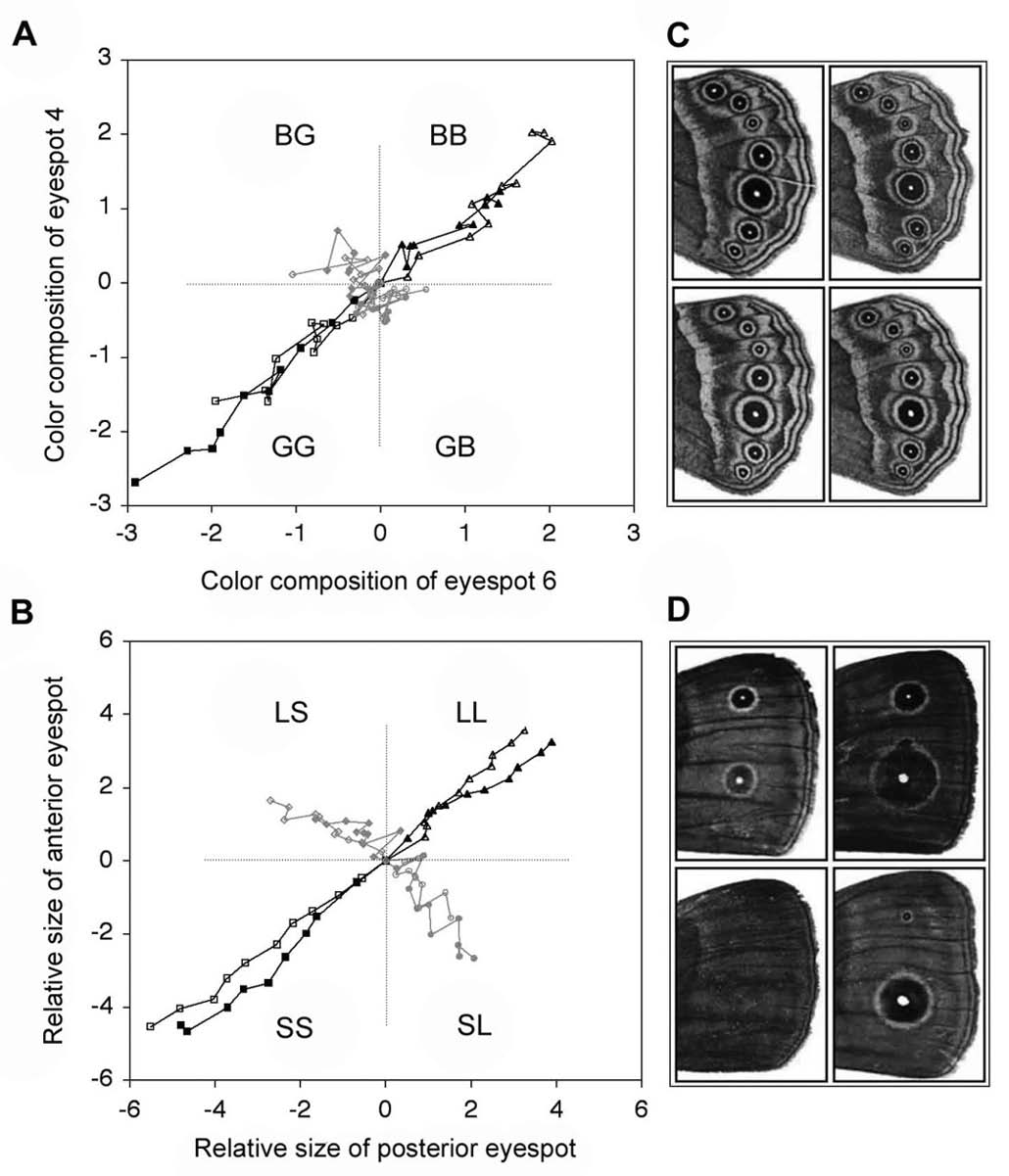
Their first task was to artificially select for decoupled eyespot sizes, attempting to create variant populations that defied this purported constraint. They discovered more flexibility than expected and were able to move the dorsal forewing eyespot sizes of B. anynana across all four quadrants of phenotypic space—both AP and ap, representing large anterior and posterior spots and small anterior and posterior spots, respectively; and Ap and aP, representing decoupling of sizes in two directions (Beldade et al. Reference Beldade, Koops and Brakefield2002, fig. 1). Their second task was to artificially select for decoupled eyespot colors. In this case, however, they found a quite different result: they were unable to create populations in which one ventral hindwing eyespot was predominantly black and another predominantly gold (Allen et al. Reference Allen, Beldade, Zwaan and Brakefield2008, fig. 2). Thus, in one case selection could overcome a purported constraint, whereas in the other it could not (see fig. 1).
Artificial selection for eyespot color and size. Selection along the coupled axis produced variants outside the range of variation in the base population (darker lines). Selection along the decoupled axis produced such variants in relative size (B) but not in color composition (A). B = black, G = gold, L = large, S = small. From Allen et al. (Reference Allen, Beldade, Zwaan and Brakefield2008).

On a small scale, this experiment addresses the constraint-selection distinction implied by the notion of a constraint on variation. Wild-type populations of B. anynana occupy only a small portion of dorsal forewing eyespot size space. It is natural to ask whether their eyespots have the size ratios they do because of (a) selection: that is, there is some selective advantage to these ratios; or (b) constraint: that is, there is a constraint preventing the production of variants with other eyespot size ratios. The experiment shows that a is the answer: since artificial selection can quickly produce lines with eyespots of many sizes and size ratios, selection must be restricting the population to the small portion of morphospace it occupies (see fig. 1, B–D). Eyespot color, however, is a different story. In this case, a constraint is responsible: selection cannot be acting to prevent the persistence of lineages with predominantly black and predominantly gold eyespots on their ventral hindwings, since constraints prevent variants of this sort from appearing in the first place (see fig. 1, A–C). Selection can only act on existing variants, and constraints prevent the production of certain variants.
The results of these experiments are most easily understood if one remembers that the relevant variant is an ongoing lineage representing a particular phenotype and that the range of assessment is 10 generations. It is possible that individuals with slightly decoupled eyespot colors appeared during the experiment, but these individuals did not count as variants. Likewise, it is possible that lineages with decoupled eyespot colors would have appeared after more generations of artificial selection, but this exceeds the relevant range of assessment.
Figure 1 represents 10 generations of directional artificial selection, although an earlier experiment on eyespot size ratios went on for 25 generations, albeit with eight generations of relaxed selection (Allen et al. Reference Allen, Beldade, Zwaan and Brakefield2008; cf. Beldade et al. Reference Beldade, Koops and Brakefield2002). These are clearly short, microevolutionary timescales, but even at this level of analysis it is variant lineages, and not variant individuals, that are evolutionarily relevant.
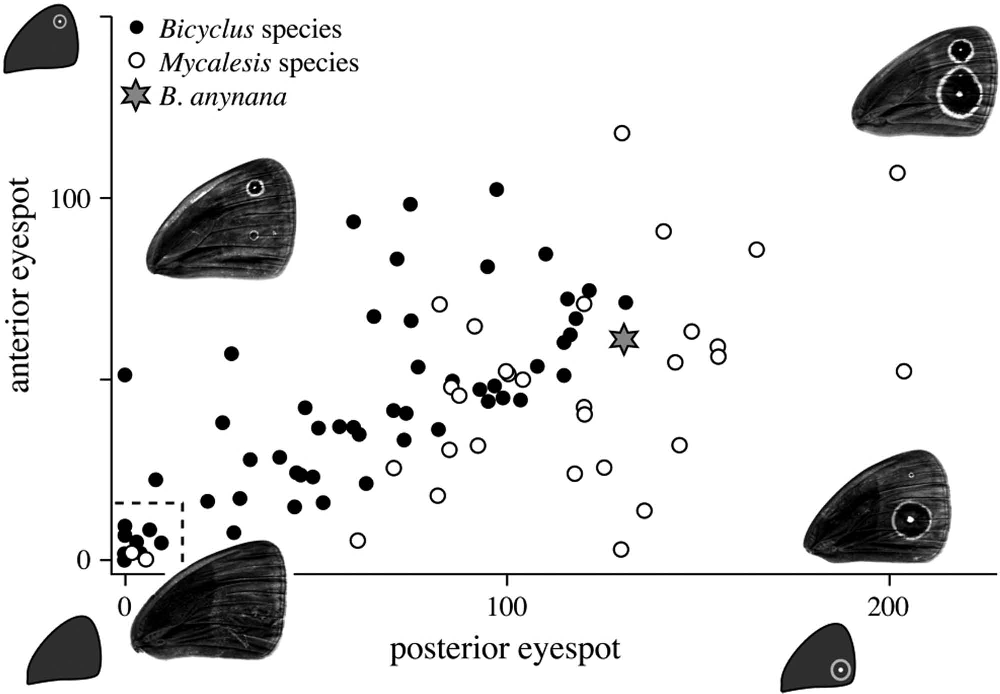
The B. anynana experiments, because they focus on questions of morphospace occupancy by populations, also have implications for evolution over longer timescales, and thus for evolutionary developmental biology or “evo-devo” more generally—as argued in a series of review articles (Beldade and Brakefield Reference Beldade and Brakefield2003; Brakefield Reference Brakefield2003; Beldade, Brakefield, and Long Reference Beldade, Brakefield and Long2005; Brakefield Reference Brakefield2006; Brakefield and Roskam Reference Brakefield and Roskam2006; Saenko et al. Reference Saenko, French, Brakefield and Beldade2008; Brakefield and Joron Reference Brakefield, Joron, Grant and Grant2010). In several of these articles, in an attempt to broaden the range of assessment without performing further experiments, the researchers expanded their taxonomic focus to included a closely related genus of butterfly, Mycalesis. They plotted many Bicyclus and Mycalesis species in dorsal forewing eyespot size space, including B. anynana in its wild-type form and its artificially selected extreme forms (fig. 2).
Dorsal forewing eyespot size space. The star in the center represents the Bicyclus anynana wild type, the filled circles represent other Bicyclus species, and the open circles represent Mycalesis species (the area enclosed by the dashed line contains species in which small or absent eyespots are difficult to measure). The four large wings represent the size and size ratio extremes achieved in the B. anynana artificial selection experiments. From Brakefield and Roskam (Reference Brakefield and Roskam2006).

As discussed above, the purported constraint on coupled eyespot sizes was easily overcome in the experiments: the extreme aP and AP morphotypes occupy regions of morphospace that are not occupied by any wild-type Bicyclus species. Interestingly, there are Mycalesis species that occupy similar areas of morphospace, which may be one reason why there is no strong constraint on this type of variation: since both Bicyclus and Mycalesis evolved from a relatively recent common ancestor, there has clearly been flexibility in eyespot size ratios over longer evolutionary timescales. However, figure 2 also suggests that some kind of constraint on eyespot size/size ratio may exist, although this is not mentioned by Brakefield and colleagues. Neither Bicyclus nor Mycalesis species occupy the extreme Ap portion of the morphospace (although Bicyclus tends more in this direction), a fact concealed in part by the shorter length of the y-axis: thus, a constraint may be preventing the production of variants with a very large anterior eyespot and an absent posterior eyespot. Because the B. anynana wild type is closest to the aP region, which may explain why its Ap variants are not extreme, experiments involving Bicyclus species closer to the Ap region would be required to confirm the existence of such a constraint.
What relevance do the dorsal forewing eyespot sizes of two butterfly genera have for macroevolution and for the larger question of the importance of constraints on variation? Philosophers James Maclaurin and Kim Sterelny (Reference Maclaurin and Sterelny2008, 80) propose that “more local, anchored morphospaces allow us to make some progress in answering global questions piecemeal,” and I suggest that the same goes for local investigations of constraints on variation—which, after all, are usually morphospace based. And although we must be wary, as Maclaurin (Reference Maclaurin2003, 473) warns, “that we do not slide from inferences made using partial theoretical morphospaces into conclusions that could only be justified by knowledge of total theoretical morphospace,” that does not mean that local studies cannot shed light on general questions. The decision of Brakefield and colleagues to add more Bicyclus and Mycalesis species to the picture is a good start. To expand this even further, which may be their ultimate intention, these researchers could include other Satyrine butterflies to see if any patterns of morphospace occupation appear; this would then suggest possible constraints, leading to more focused experiments. However, this presents clear practical difficulties: the Satyrinae are a diverse subfamily (∼2,400 species) within the most diverse of the butterfly families, the Nymphalidae or brush-footed butterflies (Peña et al. Reference Peña, Wahlberg, Weingartner, Kodandaramaiah, Nylin, Freitas and Brower2006, 30). Nevertheless, including a larger pool of related genera, and thus broadening the range of assessment, could lead to important new discoveries.
Brakefield argues that investigating constraints in evolution is a task for an “integrative evolutionary biology,” including developmental biology, natural history, ecology, phylogenetics, and so on. He and his colleagues have already shown how developmental biology can suggest possible constraints as candidates for selection experiments and account for the strength or weakness of such constraints. They have also demonstrated that consideration of the morphologies of related species can help put the results of selection experiments in context. The next step, according to Brakefield, is to combine morphological data with taxonomic relationships based on molecular phylogenies—imagine being able to group the points in figure 2 by their relatedness (Brakefield and Roskam Reference Brakefield and Roskam2006, S8). Other researchers have already begin to explore the distribution of different eyespot morphologies within particular Nymphalid groups. For example, Ullasa Kodandaramaiah (Reference Kodandaramaiah2009) shows that in Junonia and related genera—part of a different Nymphalid subfamily than Bicyclus—specific clades tend to be associated with particular eyespot configurations. However, these configurations appear to be relatively flexible, since there have been many shifts, with particular configurations evolving independently in different lineages (Kodandaramaiah Reference Kodandaramaiah2009, fig. 4). Thus, in future work, researchers may be able to fruitfully combine phylogenetic and morphological data to suggest hypothetical constraints on variation and to put these constraints in context.
5. Conclusion
Constraints on variation are factors that bias or limit the production of variants, as opposed to selection, which biases or limits the persistence of variants. However, what is meant by ‘variant’ and the relevant range of assessment depend on the question at hand: in the experiments of Brakefield and colleagues on butterfly eyespot size ratios, only a persisting population associated with a particular morphology counted as a variant, and this variation was assessed over 10 generations. In these experiments, it was shown that an apparent constraint preventing the production of variants with decoupled anterior-posterior eyespot sizes was illusory. Thus, at a local level, environmental ‘forcing’ was maintaining the particular dorsal forewing eyespot pattern characteristic of wild-type Bicyclus anynana. However, just because the selection-constraint distinction depends on what counts as a variant and on the range of assessment, that does not mean it should be abandoned. As the Brakefield Lab experiments demonstrate, as long as researchers specify what counts as a variant, the selection-constraint distinction can help us to assess the relative importance of environmental ‘forcing’ in particular cases. Such an assessment has the potential to shed light on questions ranging from evo-devo and the origin of variation to convergence and the internalism-externalism debate.