Ron Gass, a British social scientist and both a long-time employee and the former director of the OECD, recently declared: ‘Let us not forget … that the Club of Rome was born in the corridors of the OECD’.Footnote 1 In this article I argue that, even though the intimate relationships between the Club of Rome and the OECD have largely been ignored in public memory and in historical research, they are central to understanding the foundation and early evolution of the Club of Rome. The Club’s first report, The limits to growth, was published in 1972, but forty years later its electrifying conclusions, which modelled the ‘overshoot and collapse’ of the global system by the mid twenty-first century, still provoke intense debates.Footnote 2 The result of a ground-breaking exercise in cybernetic modelling at MIT, which was ultimately published in thirty languages and sold over thirty million copies, made many people aware for the first time that with continuing growth the world would eventually run out of resources. The results also brought international fame to the newly founded Club of Rome, which has since become a key reference point in the public memory of the 1970s and environmental discourses more generally. It boasts considerable authority as a private, non-state, and global group of experts concerned about the fate of humanity and a wise warden for the ecological survival of planet earth. However, this extraordinary public and academic attention has largely overlooked the constitutive entanglements with one international organization, the OECD, that characterize the Club of Rome’s foundation and early history.
This OECD–Club of Rome nexus is in need of explanation. The OECD, founded in 1961 as the successor of the Organization for European Economic Co-operation (OEEC) that had distributed European Marshall Plan aid, soon became ‘a kind of temple of growth for industrialized countries; growth for growth’s sake was what mattered’.Footnote 3 By the late 1960s, however, faced by increasing popular anxiety about unsustainable growth in Western societies, scientists and bureaucrats within the OECD, led by the charismatic science director Alexander King, launched a debate on ‘the problems of modern society’. The topic assumed such importance that it was central to discussions at the OECD’s ministerial meetings in 1969 and 1970.Footnote 4 In 1968, frustrated about governmental inability to deal with the long-term and interrelated ecological problems of planet earth, this elite group of engineers, scientists, and businessmen, all male and all from the global North, founded the Club of Rome. They built a transnational network to advance their view of planetary crisis both through the OECD (thus targeting key economists and ministers from member countries) and through the Club of Rome, whose reports forcefully shaped public debates. Indeed, almost all the key personalities in the formative period of the Club of Rome until the publication of Limits to growth worked for the OECD Secretariat or were members of its science committee.
In historical research on the 1970s, the Club of Rome and its famous report are frequently mentioned as indicative of an emerging environmental consciousness. A new awareness of a global interconnectedness accompanying what has been described as the ‘shock of the global’ was stimulated by the widespread use of computer modelling, which generated both doomsday scenarios and euphoria.Footnote 5 More specifically, even though the public perception of the Club of Rome is largely shaped by the autobiographical accounts of its key protagonists, a growing body of studies has revealed the complex story of this organization, the transnational networks of actors involved, the influence of the Club in specific countries and on various academic disciplines such as futures studies, and its larger role in the emergence of transnational expertise and Atlanticism.Footnote 6 Historians have also shown how this organization of experts, entrepreneurs, and non-elected high-level government bureaucrats built and advanced the notion of planet management, and what conditions underlay the widespread appeal and proliferation of the Club’s first report.Footnote 7 However, even though the working background of some of the foremost Club of Rome personalities within the OECD is known, these interrelationships receive little attention in the extensive literature dealing with the Club, including its official history, or in the emerging literature on the OECD.Footnote 8
Analysing the nexus between these two projects – one a pillar of the post-war economic order, the other an intellectual insurgency against that order – yields interesting conclusions, not only regarding the origins of the Club of Rome and of technocratic environmentalism more generally, but also on the divisive intellectual consequences of the social and political turmoil of the late 1960s and early 1970s. While narrowing a gap in the historical knowledge about the Club of Rome and the OECD, this article presents a thick description of the making of this transnational network’s ‘knowledge regime’, which was fundamentally dependent on what could only be known through computers. It thus offers a more complete understanding of the role of knowledge and science in public perceptions of environmental problems and in environmental policy-making.Footnote 9 Analysing the OECD–Club of Rome nexus provides a privileged view into the social history of international policy-making and the related personal entanglements and ideological transfers at a critical moment of post-war history. Rather than following the money, the approach taken here – that of a social history focusing on group relations – is used to examine a transnational network of key individuals as they moved through different national and international organizations, but also through private institutions.Footnote 10
The analysis demonstrates that a profound questioning of quantitative, GDP-focused growth appeared both earlier and in unexpected quarters. The social, intellectual, and economic turmoil of the late 1960s prompted a rethinking of central tenets of the growth paradigm, even within those technocratic institutions that had aspired to guide the post-war industrial growth regime. A focus on the OECD’s debates enables a more thorough understanding of the dilemmas faced by supranational organizations in dealing with long-term, interrelated, and global problems. It also provides a case study of the autonomy of international bureaucracies vis-à-vis their member countries – a question hitherto theoretically discussed mainly in political science literature.Footnote 11 Furthermore, analysing this network at the heart of the OECD–Club of Rome nexus enables a rethinking of the role of private, non-state actors in international politics and their influence on both states and international organizations. In this regard, the concept of transnational discourse communities can be used as a useful instrument to analyse private actors in global politics, who often form networks and have distinct political or ideological agendas. Rather than directly influencing policy-makers, transnational discourse communities feed their arguments into international or national discourses, often through international organizations, thus legitimizing certain policy-changes or reforms.Footnote 12 Finally, it will be argued that this case study identifies the 1970s as a pivotal turning point in twentieth-century history.
Gestation: the crisis of the growth paradigm and the evolution of heterodox thinking within the OECD
The global hegemony of the growth paradigm during the 1950s and 1960s produced a consensus around a shared set of concepts and goals that guided self-styled rational policies, which were geared towards overcoming social conflicts by raising national incomes and strengthening welfare states.Footnote 13 During the 1960s, in sharp contrast to the anxieties about the ups and downs of economic cycles that had hitherto dominated policy discourses, politicians came to regard continued growth as the normal state of the economy and recessions as avoidable blunders. The optimism of this period is striking. Characteristically, the chairman of US President Lyndon Johnson’s Council of Economic Advisors, Arthur Okun, argued that, with modern growth theory at hand for all governments, recessions were ‘now … preventable, like airplane crashes’.Footnote 14
By the late 1960s, however, this harmony was starting to crumble, and the myth of growth as a magic bullet and universal yardstick was losing force. Particularly important for the changing societal paradigms in this era were the protests and social unrest that unfolded around the world in the context of ‘1968’. All around the world, policy-makers were deeply worried by this truly transnational phenomenon that criticized not only war, racism, and conservative values, but also the injustices and exclusions produced by capitalist growth and its materialism.Footnote 15 Yet other developments were also contributing to these shifts. Rapidly emerging powerful ecological movements spread the image of a vulnerable planet threatened by seemingly uncontrollable technological and economic developments. Quantitative growth was increasingly criticized in widely read publications such as Galbraith’s critique in The affluent society (1958), Carson’s Silent spring (1962), or Mishan’s The cost of economic growth (1967). The economic upturn of the 1960s had been accompanied by increasing competition in world markets, decreasing profits for private enterprises, intensifying balance of payments problems, and growing rates of inflation. While these worried Western policy-makers far more than later retrospections suggest, efforts to win the Cold War by ‘modernizing’ the ‘Third World’ were also faltering, quite apart from vain efforts to win the war in Vietnam.Footnote 16
The OECD, exercising its role as ‘keeper of the keys’ of capitalist growth economics, reacted to these developments, as did other international organizations, established policy forums, and governments.Footnote 17 The general framework within which the emerging environmental problems were conceptualized and operationalized was what has been called ‘planet management’.Footnote 18 However, with regard to critiques of GNP growth and the incorporation of environmental problems within economic analyses, the OECD debates began earlier, influenced discussions in other fora, and were in their initial form more far-reaching and profound.
Founded in 1948 as a western European institution charged with monitoring Marshall Plan aid, by the mid 1950s the OEEC had achieved its two primary tasks of European reconstruction and payments liberalization, and was increasingly caught up in an organizational crisis around inner-European trade disputes. In 1961, however, it was reorganized as an Atlantic (including the US and Canada) and then triadic (Japan joined in 1964, Australia and New Zealand by 1974) think tank, now named OECD. Here Western countries coordinated their policies both in the Cold War setting and vis-à-vis the emerging power bloc of decolonizing countries in the global South. The core organizational focus was the promotion of economic growth as the overarching policy goal, and the OECD played a pivotal role in the emergence of productivist and productivity-driven growth policies. In the context of Cold War competition and decolonization, it had thus become the quintessential ‘growth conscience’ of industrialized countries. Yet by the late 1960s a profound questioning of the growth paradigm had also emerged, which was symptomatic of the wider ideological currents sketched above.Footnote 19
The driving forces of this growth-critical and ecologically oriented debate on what were called the ‘problems of modern society’ were two of the most powerful men within the organization: the head of the OECD since its foundation in 1961, Secretary-General Thorkil Kristensen, and the organization’s long-time science director and unofficial intellectual leader, Alexander King. Kristensen, born in 1899 in a Danish farming family, was an internationally respected economist and liberal-conservative politician. He had gained considerable experience as the Danish Minister of Finance from 1945 to 1947 and from 1950 to 1953 in implementing the Marshall Plan and advocating harsh austerity policies, and had a considerable influence on the formation and outlook of the OECD. Politically an unconventional conservative with strong ties to agricultural interests and market-liberal leanings, in the late 1950s he had already cautioned against confusing GNP with ‘welfare’. Furthermore, during the 1960s he was one of the protagonists in the debates about overpopulation in developing countries.Footnote 20
King, born in 1909 into a Scottish cashier’s family, was a chemist, international civil servant, and environmentalist with a humanist, liberal, and plannerist outlook. Since 1956 he had pioneered the OECD’s science and educational work as deputy director of the European Productivity Agency, and he became arguably the most powerful OECD official in the 1950s and 1960s, not least because of his long experience and his very close personal contacts to Kristensen.Footnote 21 While he had originally pioneered the application of growth models to boost science, education, and economic output, by the late 1960s he became increasingly worried about the fundamental changes that resulted from economic growth. King was deeply concerned at the increasing environmental deterioration of the landscape, ‘technology out of control’, the nuclear threat, the student revolts, the hippies, and a situation in which ‘the majority were enjoying the affluence that technology was delivering and craved more – much more’.Footnote 22 Thus, from the mid 1960s, Kristensen and King began to emphasize the absurdity of aiming at quantitative growth in perpetuity, the looming ecological problems, and governments’ inability to deal with these adequately.
Next to the General Secretariat, the centre of this critique was the Scientific Affairs Directorate and the OECD’s Science Committee. Here national delegates from member countries and international bureaucrats coordinated the science policies of OECD countries and had increasingly focused on environmental problems and long-term forecasts. The science branch of the organization had initially developed out of the organization’s productivity work in the 1950s. This shifted to promoting the planned expansion of skilled manpower and scientific personnel in the aftermath of the Sputnik shock in the late 1950s, and then to the advancement of the human capital theory as a tool to boost growth through science, technology, and education in western Europe in the 1960s. However, in the late 1960s the science branch of the OECD became more sceptical of the growth paradigm.Footnote 23
There are several reasons for this shift in perspective. To begin with, the OECD’s science branch was the only part of the organization that collaborated with experts from disciplines other than economics, such as sociologists, historians, and political scientists. This disciplinary logic should not be underestimated, as the future controversies arising within the OECD would reveal. Furthermore, the science branch had already worked for years on related questions, especially in the fields of education and science policies, environmental policies, and technological forecasting.Footnote 24 Owing to its unorthodox outlook, King’s directorate became widely regarded as the ‘“enfants terribles” of the house’.Footnote 25
Interestingly, the nonconformist outlook of these international bureaucrats in the OECD’s science directorate seems to have also influenced the work of the national delegations in the related committees: the OECD’s Committee for Research Cooperation pioneered early work on environmental questions, focusing on the scientific and technological aspects of issues such as radioactive waste, air and water pollution, chemical safety, and car exhaust fumes.Footnote 26 At least from 1967, the OECD’s Committee for Science Policy (CSP), transformed in 1972 into the Committee for Science and Technology Policy (CSTP), became very active in discussing the relations between growth, society, and science. Because arguments critical of growth were voiced repeatedly, this committee established itself as the ‘OECD’s acknowledged and indispensable trouble-maker, the “court jester” if you like’, as a high-ranking OECD official remembered.Footnote 27 Thus, contrary to standard international relations accounts, the OECD’s work in the late 1960s and early 1970s, particularly in the field of science policies, followed a strong departmental and epistemic dynamic. Debates were not launched and shaped mainly by national governments and delegates, but by international bureaucrats, especially within a certain department, and by close contact with outside experts.Footnote 28
Alongside these discussions in the context of work on science and the environment, the emerging critique of quantitative growth within the OECD also built on other debates. In the context of detente and convergence theory, it was at the centre of discussions about the foundation of a ‘Center for the Study of the Common Problems of Advanced Societies’, originally envisaged under OECD auspices. This US initiative, launched in 1966 by the Ford Foundation, the Johnson administration, and the national security advisor McGeorge Bundy, resulted in the foundation of the International Institute for Applied Systems Analysis (IIASA) in 1972. From the beginning it aimed at strengthening the East–West dialogue through a scientific debate about the unwanted by-products of economic growth. In an outline formulated in April 1967, the fundamental difficulty was identified as ‘the unwanted byproducts of industrialization and urbanization’ that all ‘advanced industrialized nations of the world face’.Footnote 29 As will be shown in the following sections, this focus on growth, on the problematization of modern or advanced societies (be they capitalist or communist), and on the reliance on systems theory prefigured key issues of later debates.
Midwifery: the foundation of the Club of Rome and the OECD’s Bellagio message
The Club of Rome’s origins within the OECD are also a tale of the possibilities and limits of supranational technocratic bureaucracies in general, which continuously have to balance the needs of sovereign nations against global and potentially long-term problems.Footnote 30 Kristensen, King, and their associates around the science directorate and the CSP were fundamentally sceptical about the potential of existing political institutions to catalyse the controversial global debate they deemed necessary, because they regarded these institutions as the ‘guardians of the status quo and hence the enemies of change’.Footnote 31 They saw themselves ‘faced with the extraordinary arrogance of the economist, the naïvety of the natural scientist, the ignorance of the politician, and the bloody-mindedness of the bureaucrat’, all unable to tackle the ensemble of problems they had identified.Footnote 32 Even though the OECD was involved in some critical discussions about the negative by-products of growth, Kristensen and King felt that the intergovernmental institution they headed was nearly as inadequate for these challenges as were national governments:
Kristensen and I felt that governments, although willing to debate these things, were not capable of acting quickly enough or responsively enough to these changes. The bureaucracies of governments, even more than the ministers, are post facto mechanisms. They only react after events, and do not foresee them. They are not prepared for them. It was at that time that Kristensen and I got in touch with Aurelio Peccei. The Club of Rome was actually born inside the OECD around such concerns.Footnote 33
In this situation, King met the Italian industrialist and global visionary Aurelio Peccei, at that time an executive of Fiat and the managing director of both Olivetti and Italconsult. Educated as an economist, Peccei had worked for Fiat in the early 1930s, had been involved in the Italian anti-fascist resistance (where he was almost executed in 1944), and had rebuilt Fiat in Argentina. By the mid 1960s he had become a globally well-connected speaker, author, and political adviser, who was rallying around global and long-term problems of humanity’s future. In particular, this charismatic and polyglot intellectual became highly influential through his book The chasm ahead (1969), which pointed to a series of increasing and interrelated macro-problems such as population growth, technological progress, and resource scarcity.Footnote 34
The two founding fathers of the Club of Rome first met in late 1967 or early 1968 in the OECD’s headquarters in Paris. Their connection came about owing to transnational connections among system scientists from the Soviet Union and the US, together with King’s OECD contacts in the Secretariat and the CSP.Footnote 35 King and Peccei immediately discovered that they shared a ‘vision of global dangers that could threaten mankind such as over-population, environmental degradation, worldwide poverty and misuse of technology’. Since there ‘did not seem to be any single body capable of analyzing, let alone starting significant action against the global threats’, they sat down in King’s office in the OECD’s headquarters, the Château de la Muette, and drew up a list of people whom they wanted to involve in these issues.Footnote 36
In April 1968 King and Peccei brought together twenty European leading industrialists, academics, and bureaucrats for a meeting in the Villa Farnesina in Rome. The background paper, ‘A tentative framework for initiating system wide planning of world scope’, which was presented ‘to set the tone of the meeting’, was prepared by the OECD consultant Erich Jantsch. Since 1965, Jantsch, who was an Austrian systems analyst and astrophysicist, had directed a large OECD research project under King. His 1967 OECD report Technological forecasting in perspective was a state-of-the-art study that influenced futures scholars and planners well into the 1970s and became one of the ‘bestsellers’ of the OECD.Footnote 37 However, according to King and Peccei, the meeting was ‘a monumental flop’ and the discussions remained technical and inconclusive. After two days of ‘peripheral semantic or theological debates’, the participants could not manage to ‘agree among themselves, not even on mere prolegomena’.Footnote 38 Many participants were deterred by the scholarly tone of Jantsch’s paper and the technicality of the discussion, but an underlying and more serious problem was the European–American animosity that had been reinforced by the Vietnam War and the involvement of think tanks and planning institutions such as the RAND Corporation in this conflict.Footnote 39
Despite this disappointment, after the meeting four participants decided to form a group which they called the ‘Club of Rome’: Peccei, King, Jantsch, and Hugo Thiemann, the Swiss director of the Geneva branch of the Battelle Memorial Institute and later research manager of the Nestlé Group.Footnote 40 After this core group had been established, it held several informal meetings, mostly sponsored by the Battelle Institute and Peccei, and started to co-opt other members.
In late October 1968, only half a year after the founding meeting of the Club of Rome, the OECD, in collaboration with the Rockefeller Foundation, held a ‘Working Symposium on Long-Range Forecasting and Planning’ in Bellagio, Italy. An analysis of this meeting demonstrates the importance of the OECD in this process and the concerns that were driving these people. At this conference (which was organized by Jantsch), eighteen academics, businessmen, and bureaucrats in the field of technological forecasting discussed the long-term impacts of scientific and technological advances, and formulated a surprisingly blunt critique of unbridled economic growth.Footnote 41 With this event the OECD aimed to set the use of computer techniques and long-range planning firmly on the agenda of international – and in particular of European – academics and policy-makers.Footnote 42
At the same time, the symposium served the Club of Rome core group, all of whom were present at the meeting, as an ideal place for the recruitment of new members: the MIT computer engineer and systems scientist Jay W. Forrester, the Turkish-American cyberneticist and system theorist Hasan Özbekhan, the Hungarian physicist and Nobel prize laureate Dennis Gabor, and the French-American environmentalist René Dubos all subsequently joined the Club. Forrester and Özbekhan would later compete to write the first study of the Club of Rome.Footnote 43 Forrester actually presented the first attempt at an application to complex social systems of the ‘Industrial Dynamics’ concept. This concept, which he and his co-workers had developed in the previous decade, would later be commissioned for the first report to the Club of Rome.Footnote 44 Forrester, who was then professor of management at MIT, had been working as a developer of feedback-oriented defence systems for North America. He had used computer simulations to aid businesses to forecast fluctuations in demand, personnel, and inventories, and had then used this technique of system dynamics to help politicians manage urban developments. Through their encounter with Forrester, the network around King and Peccei thus made contact with one of the central ‘doomsday men’, whom Jacob Darwin Hamblin has described as a protagonist of the military origins of catastrophic environmentalism.Footnote 45
The discussions at Bellagio were heated, controversial, and very productive. They revolved around a shared perception of the current ‘time of planetary emergency’, as succinctly summarized by Peccei: ‘The present state of disorganization of the world system, the uncontrolled forces we unleash against its compartmented structure, the exponential growth of interacting phenomena, many of them approaching critical maxima … is bound to bring civilization as we understand it, and possibly all mankind, to its gravest crisis and even to assured disaster in a not distant future.’Footnote 46
According to Forrester, one of the most active participants, the conference ‘highlight’ was a discussion of the dynamics and the condition of ecological equilibrium, which reached the conclusion that a variety of threatening changes were ‘occurring as exponential growth rates’. Building on this observation, drawn from the efforts at long-range forecasting in which the OECD had been involved for many years, Forrester claimed that ‘no exponential growth rate can continue forever’.Footnote 47
While disagreement prevented achieving the goal of formulating a ‘platform for the new planning’, as the organizers had envisaged, the conference was regarded as a success. All the participants signed up to a statement called ‘The Bellagio Declaration on Planning’, which anticipated many of the major themes of later Club of Rome debates. Four aspects of this declaration are striking. First, the renowned businessmen and academics at the Bellagio meeting expressed deep concern about the global crisis of interrelated economic, social, and technological trends that were ‘irreversible and world-wide’, led to a deterioration of the ‘quality of individual life and of that of the community’, and threatened ‘our whole future’. Second, building on cybernetic arguments widespread at the time, the declaration called for an integrated approach of long-term ‘international planning’. This is a type of planning that deals not simply with isolated symptoms (as is often done by governments or international organizations) but rather attacks the basic causes by ‘plan[ning] systems as a whole’. Third, the declaration cautioned against the risks of unlimited growth and rejected the technocratic belief in the ability of science and technology to solve the multiplicity of problems facing humanity. Science, they claimed, could make situations that are ‘inherently bad, more efficiently bad’. Finally, the Bellagio declaration proclaimed that these problems should be solved by apolitical and technocratic management techniques and demanded urgent action ‘irrespective of political, social and economic ideologies’.Footnote 48 Above all, in their scepticism towards economic growth and technological solutions, and the use of computer-assisted long-term planning techniques, the experts were breaking new ground.
Jason Churchill may have exaggerated the Club of Rome’s influence in Canada when he claims that the Club ‘subsequently accepted as its mission to spread the Bellagio message to the world’s leading policy-makers’.Footnote 49 Yet the symposium, its debates, and the final declaration articulated in nascent form a worldview that could be called the ‘Bellagio message’. This was to become highly influential in the coming years through the transnational network at the core of the OECD–Club of Rome nexus. Contrary to standard accounts that highlight the divisions between official intergovernmental organization and international private actors, a transnational discourse community was able to use the resources and contacts provided by one international organization, the OECD, to spur the launch of a private club. In different forms, the ‘Bellagio message’ was spread through both.
Entanglements: the formation of the OECD–Club of Rome nexus
In the years following the Bellagio meeting, more members were co-opted into the Club of Rome, which became incorporated in Switzerland in 1970, though still claiming to be a ‘non-organization’ or a ‘mobile grouping of individuals’.Footnote 50 Since one could not apply for membership but had to be personally invited, early members of the Club were largely acquaintances of the executive committee and later of existing members.Footnote 51 Among the networks activated in this initial period, the OECD was of particular importance, providing a fascinating case study of the porosity of international organizations, and the links between official and private actors in this key period of globalization.
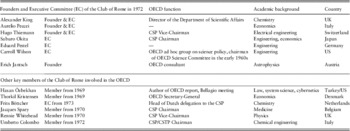
The personal overlap between the OECD and the Club of Rome in its initial phase is remarkable.Footnote 52 Not only were three of the four persons that founded the Club working in or with the OECD. Besides the Italian industrialist Peccei and the German industrial designer Eduard Pestel, who secured the funding from the Volkswagen foundation for the first report, all the crucial personalities in the formative period of the Club of Rome were closely connected to the OECD. As demonstrated in Table 1, almost the entire core group of the Club of Rome, its ‘executive committee’ – which has been characterized as the true ‘motor’ of the Club of Rome, and who signed the 1972 report, Limits to growth – also had positions within the OECD.Footnote 53
Personal entanglements between the OECD and the Club of Rome.

This transnational group of experts at the interface of national governments, international organizations, and the Club of Rome formed a unique circle of elite environmentally conscious planners. Even though claiming to speak for the entire globe, they represented a very narrow fraction of the global population, in part because of their organizational base in the OECD, often dubbed the ‘Club of the Rich’.Footnote 54 They were all highly educated and largely white men and thus reproduced the tradition of upper-class gentlemen’s clubs, and all came from countries in the global North (mostly European, some US and Japan). With close ties to elite universities, transnational business, and international organizations, they acted from economic positions of privilege and power. Furthermore, the entire network had academic backgrounds in the natural sciences (in particular chemistry and physics) or engineering, with only a few trained in economics, and none in the social sciences or humanities. Finally, almost all had spent at least part of their career as national government experts or administrators.
All these factors influenced the perspective and politics of the network at the heart of the OECD–Club of Rome nexus. Given the social positioning of this elite club of mainly white professionals from the global North, its ‘global’ perspective of managing the entire planet became very controversial. Critics pointed out that the challenges of ‘modern societies’ were often grouped together as ‘developed’, in opposition to the supposedly ‘underdeveloped’ global South. This reflected an emerging north–south divide that has come to characterize the debate on growth ever since the conferences of Founex (1971) and Stockholm (1972). Then as now, developing countries feared that the discussion about environmental limits was being used by the North to block their ‘development’.Footnote 55 Another area of controversy was the group’s engineering approach to socioeconomic problems, which can at least partly be attributed to their disciplinary backgrounds in the natural sciences and engineering and their working experiences in government institutions. This approach, especially pronounced through the use of systems analyses and computer modelling, became highly influential through the Limits to growth report, but continued to constitute a key line of discontent with its arguments and results.Footnote 56 Further, in sharp contrast to environmental movements at that time, this group addressed elites, encouraging them to manage the planet differently, and provided top-down and techno-fix solutions. From a longer perspective, the debate was characterized by a fundamental ambivalence. While criticizing materialism, technocracy, the optimism of the focus on quantitative growth, and the disregard of ecological and social phenomena beyond the economic sphere, its outlook was still largely based on the same planning euphoria and technocracy characteristic of the cybernetic era.Footnote 57 It can thus be interpreted as a precursor of the discourse of ecological modernization.Footnote 58
Key figures of the Club of Rome’s foundational period with OECD ties were, on the Secretariat side, King, Jantsch, and Secretary-General Kristensen, who became an official member of the Club after leaving the OECD in late 1969, but who had already been involved in earlier discussions. In the context of the CSP, three succeeding chairmen and its two vice-chairmen were all early members of the Club of Rome: the Belgian health expert Jacques Spaey, the Japanese economist and planner Saburo Okita, the Italian chemist and research director of one of the largest chemical corporations (Montedison S.p.A.) Umberto Colombo, the British physicist Rennie Whitehead, and Hugo Thiemann. Other delegates to the CSP also became influential members. For example, Frits Böttcher, responsible for the Club’s public relations campaign leading to the publication of the Limits to growth, was head of the Netherlands delegation to the CSP. Carroll Wilson, the US member of the Club’s executive committee, was the US representative to the OECD ad hoc group on science policy, and chairman of the Science Committee in the early 1960s.Footnote 59
Despite these close personal overlaps, the relationship between the Club and the OECD was complicated and at times strained. On the one hand, at the root of the idea to establish a private club was the frustration with state bureaucracies and international organizations, regarded as structurally unable to effectively tackle the long-term by-products of quantitative growth. From this perspective, only a non-partisan, neutral expert organization could credibly tackle this interrelated, global, long-term, and holistic ensemble of problems.Footnote 60 King, later reflecting on the intended role and goals of the private Club, described it as a stick with which to stab the established body of politics and international institutions and ‘make it jump a bit’.Footnote 61
While this critique was basic to the Club’s worldview, it did not prevent members from exploiting their close contacts to governments and international institutions, or from letting governments or business communities sponsor the Club’s annual general meetings and major projects.Footnote 62 Members of the group used the OECD in different ways: as a conference host, information resource, pool of experts, and platform for publications. In this constellation, King was the fulcrum, the ‘logical “trait d’union”’ between the two institutions.Footnote 63 While Peccei was the charismatic, passionate, and motivating ‘salesman’, King’s high-level OECD position brought a strong ‘sense of legitimacy’ to the Club of Rome.Footnote 64
As a result, this elite group became highly influential in launching a global debate, initially by informally talking to government officials, businessmen, and ministers, and then, much more successfully, by publishing Limits to growth, the computer-assisted analysis produced at MIT, and launching a major public relations campaign.Footnote 65 They shared a set of normative and principled beliefs that revolved around the interconnected crisis phenomena of the ‘problématique’, the limits to exponential quantitative growth, and the need for long-term planetary management. They generated shared causal beliefs, in particular regarding the detrimental social and ecological effects of uncontrolled growth, technology, and markets; and they pursued a common policy enterprise both within the OECD and in other organizations and contexts, in particular the Club of Rome. Sharing many characteristics of epistemic communities, this transnational network thus blurred the lines between the ‘official’ OECD and the ‘private’ Club, not only in terms of overlapping membership but also in terms of discourses.Footnote 66 While the Club functioned as a ‘detonator’, its core members used international organizations ‘as transmission belts’, as Peccei explicitly put it, and thus acquired a strong leverage.Footnote 67 The most important ‘transmission belt’ was the OECD.
Transfers: intellectual crossings, ‘problems of modern society’ and the ‘problématique’
In addition to the entangled personal networks, legitimacy, and organizational support, the transfer of ideas, frameworks, and methods was also remarkable. In 1970, when the Club of Rome first defined its overall objective as an investigation of the ‘predicament of mankind’, it even used OECD language, also claiming to contribute ‘toward an understanding of the problems of modern society’.Footnote 68
Immediately after the Bellagio conference, the outgoing Secretary-General Kristensen and his close associate King launched an initiative to reframe the core vision of the OECD in line with the Bellagio message. At the Ministerial Council meeting in February 1969, only months before leaving the organization, Kristensen presented a note entitled ‘Problems of modern society’ that highlighted a set of new problems arising within industrialized countries owing to technological advancements and high growth rates.Footnote 69 Kristensen analysed the problems of affluence and discussed ‘the bad by-products of technology, the problems of pollution, of living in cities that are gradually becoming cluttered up by automobiles, of the alienation of the individual’.Footnote 70 However, the ‘intellectual author’ of this concept, which came to play a pivotal role in the OECD for several years, was Alexander King.Footnote 71
The similarities in concepts and approaches between the OECD and the Club of Rome testify to the close organizational networks and personal entanglements. Both the OECD discourse about ‘problems of modern society’ and the Club of Rome’s catchphrase of the ‘problématique’ put the social and ecological crises caused by the growth economy squarely at the centre of attention. Both argued that the 1960s’ focus on quantitative growth had led to overpopulation, alienation, social discontent in the workplace, environmental destruction, and student unrest. All these seemingly unrelated problems were merged into one. This systemic perspective had the advantage of putting the interrelationships between these trends into the spotlight, but its pervasiveness, explaining all problems of the time as directly causally related, tended to become arbitrary and trite.Footnote 72 The discussion of this new perspective among OECD ministers in September 1969 revealed, much to the surprise of the Secretariat, ‘an extreme sense of urgency’. According to King, the ministers, faced with recent student uprisings around the world, ‘admitted that if, in this next decade, we continue with economic growth for its own sake, as a major aim of the highly industrialized countries, the result could be dissolution of our institutions, due to accumulation of the by-products of technology and to individual and social dissatisfaction’.Footnote 73 The events of 1968, especially in France, had sent shockwaves throughout the establishment of the capitalist West. The OECD debates about the ‘problems of modern society’ were a direct reaction to this turmoil, which was interpreted as resulting from a rejection of ‘growthmanship’ and consumerism.Footnote 74
In Kristensen’s last months as secretary-general, he and King worked hard to strengthen the new outlook they had proposed for the OECD. Their most important initiative was the formation of an ad hoc group of science and economic experts charged with studying new concepts of science policy to confront the ‘problems of modern societies’.Footnote 75 Owing to the OECD’s prestige in the science policy field, member countries supported this project and, shortly before leaving the organization, Kristensen appointed Harvey Brooks, a distinguished physics professor at Harvard University, as chairman of the expert group. To a considerable degree the ten science experts assembled by the Secretariat and Brooks overlapped with the network around King and the Club of Rome. King and Kristensen both became experts in this group, together with two other members of the Club, Okita and Spaey. Thus, four of ten OECD experts were also members of the Club of Rome, and another, Umberto Colombo, was close to the Club and joined it in 1972.Footnote 76
No wonder, then, that the OECD expert group was strongly influenced by the ideas of the emerging Club of Rome network. In 1971 the group published Science, growth and society (known as the Brooks Report), which not only influenced the science ministers’ meeting the same year but also became a ‘watershed’ in science policy-making throughout the OECD world. Like the Piganiol Report of 1963 that launched an era of policy-making in which the expansion of science was geared towards boosting growth, the Brooks Report initiated a fundamentally different perspective on the relations between society, growth, and science. It replaced the optimism of the 1960s with concern about the negative impacts of science, technology, and growth on society and the environment.Footnote 77 The arguments in the report were based on a very distinct discussion of tendencies of ‘saturation’ that anticipated some of the arguments of Limits to growth. They are thus worth quoting at length:
Many aspects of developed societies are approaching a condition that may be described as saturation, in the sense that things cannot go on growing much longer in some lines without reaching fairly fundamental limits. … This does not mean that growth will stop in the next decade, or even that the time limits for growth in the future can now be foreseen in every instance, but only that a declining rate of growth is foreseeable within the lifetime of people now alive.Footnote 78
While the interrelationships between bureaucrats, scientists, and entrepreneurs around King were particularly strong during Kristensen’s tenure as Secretary-General of the OECD (1960–September 1969), they continued to be key to OECD debates under the new secretary-general, the Dutch financial official Emile van Lennep. In October 1969 van Lennep met Peccei, who explained the plans of the Club of Rome. Following this meeting, the new secretary-general, obviously interested, requested a report of the Club’s activities. He was briefed by King, who argued that the questions discussed by the Club of Rome were ‘clearly related to our preoccupations with modern society problems’, but should not be seen as competition but rather as a ‘useful complement of new knowledge’.Footnote 79 In his first months at the helm of the OECD, van Lennep spent most of his time refining and discussing the new outlook, which became encapsulated in his paper ‘Problems of modern society: economic growth, environment and welfare’.Footnote 80 In March 1970 King even organized a meeting at the Château de la Muette between the core Secretariat and several members of the Club of Rome. The purpose was to discuss possible overlaps and cross-fertilizations between the OECD work on ‘problems of modern society’ and the planned Club of Rome study ‘The predicament of mankind’.Footnote 81
At that time, other international organizations were also launching similar debates in hopes of becoming the leading international agents in implementing possible actions resulting from these new public concerns. The initiative that came closest to approximating the OECD’s efforts was carried out by the Nixon administration, which pressed for the creation of a ‘Committee on the Challenges for Modern Societies’ (CCMS) within NATO. The aim was to use environmental problems to further East–West dialogue, to broaden the concept of security to include environmental security, and ‘to improve [NATO’s] image, especially with young people, by demonstrating its concern to influence for good the nature of the society it is designed to protect’.Footnote 82 Nixon’s speechwriter had heard Kristensen’s talk at the February 1969 OECD Ministerial Meeting and had proposed using this phrase, copied with only a slight modification, as a new umbrella term to redefine NATO. Given this inter-organizational competition, van Lennep was not only concerned that NATO would ‘walk away with King’s ideas’, using them to justify its new activities, but also that within the NATO context the ‘initially so creative thoughts by Alexander King will lead to “more of the same”’. In the end, the OECD and NATO developed similar work on the problems/challenges of modern society, but the OECD initiative turned out to be more far-reaching and successful.Footnote 83
Tensions: internal disputes and the defence of economic orthodoxy in the face of Limits to growth
The attempts to give the OECD a new orientation were not universally welcomed, even within the Secretariat. On the contrary, it provoked a tense dispute between two OECD fractions. King faced vehement opposition from the top macro-economists in the Economics and Statistics Department, headed by Christopher Dow, who dismissed all attempts to redefine the core of the OECD’s policy aims. Arguing that the OECD should continue to identify itself with a policy that sees ‘the highest possible growth of production as an end in itself’, they defended the traditional economic orthodoxy against ‘Dr. King’s side’.Footnote 84 This conflict between different divisions within the OECD, had been governed so loosely under Kristensen that their directors developed into separate ‘robber barons’. Ensuing tensions evolved into a struggle over the hegemony of economists and economics within the organization, since the science division was the only department of the OECD that employed a significant number of non-economists.Footnote 85 Furthermore, the outlook that some of the OECD cadres had come to take by the early 1970s was increasingly regarded with suspicion by member-state governments and other international organizations, highlighting the importance of inter-organizational competition discussed earlier. In the European Commission, for example, a rapporteur wondered whether it was still the same organization, and member countries regarded the OECD’s long-term outlook as ‘esoteric’ and pressed for refocusing on quantitative growth.Footnote 86
How did the cradle of the Club of Rome react when its offshoot published its first report in 1972? After all, Limits to growth was consciously set up as a ‘detonator’ to give a jolt to established governments and international organizations. At first, it did indeed impress and unsettle the OECD. But once the public debate took off, the views expressed in Limits to growth deepened the internal fractures within the OECD and provoked hostile reactions, leading to a revitalization of the strong pro-growth position.
In February 1972 OECD Secretary-General van Lennep was the first person in Europe to obtain a copy of the yet unpublished report. It was sent to him by King, whose accompanying letter provides a fascinating account of the thinking of one of the founders of the Club of Rome. After King had assessed possible counter-arguments against the report, actually anticipating most of the criticism waged against it in the coming years, he warned van Lennep that its analysis was ‘probably not misleading’. It seems that King was intensely concerned, even though he believed that ‘we are not yet on the edge of disaster’.Footnote 87 At this stage, OECD experts felt unable to assess whether the forecasts were correct. Shortly after receiving the report, van Lennep publicly declared: ‘Maybe these forecasts are exaggerated, maybe not. Under all circumstances they have to be taken into consideration in the framework of economic policy.’ This uncertainty was shared among the core of the OECD Secretariat.Footnote 88 Even Christopher Dow, the strongest opponent of any shift in the original OECD goals, conceded that some of the problems raised by the Club of Rome were ‘worth thinking seriously about’, although he was ‘somewhat irked by the idea of a “zero growth policy” to be found in some writing of this ilk’.Footnote 89
However, as the public debate became more heated and demands for no growth or negative growth started to be voiced from such diverse actors as ecological movements, prominent scientists, and the European Commission, fractures within the Secretariat deepened.Footnote 90 The macro-economists in the OECD came to look with disdain on the lack of economic understanding that they felt the MIT team had demonstrated and were annoyed by the Club’s ‘prophetic seers view’. In fact, the lack of any real economic analysis underpinning the MIT’s exhaustion model, which allowed little scope for supply or demand market responses, became a central point of criticism by economists, both at the time and still in contemporary commentaries. On the other hand, van Lennep remembers that the natural scientists around King regarded the economists condescendingly. From this standpoint they were seen as men who were apparently not yet ready to grasp the failure of their economic models and understand that the real problems lay in the interrelations of the different developments referred to as ‘the problématique’.Footnote 91 Although this disciplinary dimension of the controversy cannot be fully explored here, it highlights an interesting avenue for future research on international organizations and transnational discourses.
While the OECD’s secretary-general was attempting a fine balancing act, arguing against ecological blindness and mainstream growthmanship while countering more radical critics of growth, the organization’s public views were less ambiguous.Footnote 92 Symptomatically, a 1973 booklet on the OECD’s approach to environmental problems expressed the organization’s official position by postulating, in line with the mainstream reaction of that time, that the entire approach of questioning economic growth was flawed. The task of governments ‘in maintaining or promoting an acceptable human environment must now be developed in the framework of policies for economic growth’.Footnote 93 According to the official OECD position, growth was the necessary precondition for progress. Rather than the economy functioning within given environmental constraints, the environment should be managed within the framework of growth economics.
In 1975 the OECD launched the so-called Interfutures project, whose 1979 study is widely regarded as an official refutation of Limits to growth. Ironically, the idea for this group was developed by King, and the international group of government experts was chaired by Saburo Okita, both early members of the Club of Rome.Footnote 94 Yet, from the beginning, member countries demanded that Interfutures should authoritatively counter growth critics, whose arguments were especially prominent in the late 1970s. They hoped that this rebuttal of Limits to growth with the ‘stamp of OECD’, a ‘reputable organization’, would effectively counter the views of the private Club of Rome.Footnote 95 And, indeed, the OECD’s extensive promulgation of the study’s key conclusion – that there were no physical limits to growth – was quite effective and fostered the public conviction that the hypotheses of the Club of Rome were now officially rejected. The report argued that, rather than physical limits, there were political, economic, and social limits that had to be overcome by a mix of market-oriented structural reforms, environmental policies, and some redistribution. This foreshadowed not only the OECD’s turn towards neoliberalism but also the norm of ‘sustainable growth’ that came to dominate international environmental politics in the 1980s and 1990s.Footnote 96 Thus, while the Club of Rome was born in the corridors of the OECD, its first report effectively ended these intimate relationships.
Conclusion
This article has discussed the unlikely but close links between the international organization widely seen as the ‘temple of growth for industrialized countries’ – the OECD – and the world’s most famous growth critic – the Club of Rome. It has demonstrated how the social, intellectual, and economic turmoil of the late 1960s prompted rethinking of the growth paradigm. It has also shown that this rethinking occurred not only within social movements and among dissident intellectuals but within some of the institutions at the centre of the post-war industrial growth regime. Since similar debates can be found in other international organizations, the temporary breakdown of the high-modernist, growth-oriented consensus within the OECD can be understand as representative of broader intellectual developments at that time. Fissures within the growth-oriented consensus of technocratic elites also characterized the World Bank’s shift from GDP to ‘human needs’ under Robert McNamara, the G77’s advocacy of redistributionist rather than productivist solutions to poverty in its New International Economic Order, NATO’s debate about ‘challenges for modern societies’, and debates on domestic policies in countries all around the globe.Footnote 97
The analysis of the gestation, midwifery, entanglements, transfers, and tensions that characterize the OECD–Club of Rome nexus also opens up a more profound and complex understanding of both organizations and the actors driving them. It puts in perspective the public perception of the Club of Rome as a private, non-governmental, and global think tank by analysing its origins within an all-male elite group of engineers, scientists, and businessmen and its intimate interrelationships and personal overlaps with the OECD, an intergovernmental organization representing the industrialized capitalist countries. This social positioning fundamentally shaped the network’s outlook, most importantly with regard to its systemic analysis of interrelated global problems in a computer-engineering perspective, the technocratic outlook from the perspective of the global North, and top-down management approach.
While this critical perspective had some influence on various policy areas within the OECD, such as economics, science, education, and manpower, in the longer term it did not transform the overall outlook of the organization, let alone the broader policy-making scene. Although national leaders all over the world ‘usually listened politely and with interest’ when King, Peccei, and Kristensen visited them to advance the Club of Rome message, this rarely led to any policy changes.Footnote 98 The strongest impact concerned the outlook of several OECD reports (in particular expert reports such as the Brooks Report, which could diverge markedly from member country interests, since expert reports did not depend on anonymous consent) and in initiating the institutionalization of new bodies: the OECD became the first international organization to set up a directorate for environmental policies at a time when no member country had an environmental ministry. It launched an ambitious undertaking to define social indicators intended to measure progress towards increasing the ‘quality of life’ and to supplement or improve GDP. Yet, while the former initially aimed at developing policies ‘to prevent, reduce or eliminate the undesirable consequences of growth’, the OECD’s environmental work came to focus on framing environmental problems in such a way as to make them seemingly compatible with continued growth and with the international free market regime, thus paving the ground for what has been characterized as ‘liberal environmentalism’.Footnote 99 The social indicator programme ultimately failed because of disagreements, a continuous loss of interest among member countries, and the path dependencies of the growth statistics. It never produced any tangible results.Footnote 100
The strongest force behind the backlash against the critiques of growth came with the onset of economic turmoil, soaring energy prices, and stagflation from 1973/74 onwards. While the energy shortages and their effects on industrialized countries were largely interpreted by the public as proof of the Club of Rome’s predictions, within the OECD these developments did not strengthen the faction critical of growth. On the contrary, the debate on the ‘problems of modern society’ was choked by a combination of changing member-state interests, an attempt by the top level of the Secretariat to better position the OECD, and a shift of influence within the organization.Footnote 101 The growth critique sparked a bitter controversy between the macro-economic branch of the organization and the science experts and environmental scientists around King, which the latter lost when the OECD refocused on trade, energy, and growth. In particular, the publication of the Club of Rome’s first report polarized the debate to such a degree that not only the OECD but Western policy-making circles more generally returned to the promotion of quantitative growth.
This was, of course, only the first chapter in the long history of political disputes that ensued from Limits to growth and environmentalism more generally. On the one hand, the Club of Rome managed to communicate its key message that ever-growing populations, pollution, and consumption levels would eventually bring the world system to collapse and that short-term and piece-meal approaches that did not take into account the interconnectedness and often global nature of these problems were doomed to fail. It legitimated global simulations and the use of complex modelling as a policy-relevant tool of analysis and political debate. On the other hand, even though today the scenarios outlined in the Limits to growth seem to have proven quite accurate, they have been continuously attacked. While these warnings have contributed to unmaking the previously unquestioned confidence in ever-continuing growth, they also mark the beginning of the folding of environmental and social concerns into the growth framework.Footnote 102
What does this case study contribute to global history? To begin with, the OECD–Club of Rome nexus, which has been analysed as a transnational discourse community, encourages a rethinking of the role of private, non-state actors in international politics, particularly regarding their relations to and influence through both state and international organizations. Rather than presupposing strict boundaries between (inter-)state and non-state actors, the foundational period of the Club of Rome highlights the porosity of international organizations and the many links between official and private actors. Next, the case study offers a new perspective on the dilemmas faced by supranational organizations and their autonomy vis-à-vis member countries. Faced with long-term, interrelated, and global problems such as environmental degradation and looming resource scarcities, the transnational discourse community at the centre of this study deemed the OECD (and states more generally) unable to deal with these issues. However, countering the standard narrative, according to which international organizations are merely the neutral tools of their member states to fulfil predetermined preferences, in this case a network of international bureaucrats acted quite independently from member country interests. Not only did they use the resources and contacts provided by the OECD to spur the launch of a private club, but they also managed for some years to significantly influence the outlook of the OECD itself, thus in turn influencing member countries.
In terms of methods, studying a transnational network of individuals and their activities proves highly useful, not least since it demonstrates how blurred the lines are between international organizations, private think tanks, and transnational discourse (or epistemic) communities. Deeper analysis could further transform our understanding not only of the Club of Rome but also of many other transnational networks, and of private or official international organizations. A similar focus could be a platform for global historians to study the emergence of a transnational elite civil service that seeks to manage global issues through technocratic means.
Finally, this case study of the OECD–Club of Rome nexus strengthens the newly emerging interpretation of the 1970s as a pivotal turning point in modern history. It demonstrates that the emergence of private authority in the international system and the related erosion of the power of the state is not a post-Cold War phenomenon, as is often stated.Footnote 103 Rather, transnational networks and private actors played a key role in shaping global agendas much earlier, attesting to the start of the recent wave of globalization around the 1970s. Both on the level of discourse regarding global and interrelated problems beyond the reach of nation-states or the Cold War divide and also on that of actors in increasingly important transnational networks, it exemplifies the diminishing role of the industrial-territorial nation-state so characteristic of the twentieth century.Footnote 104
Matthias Schmelzer works at the Konzeptwerk Neue Ökonomie (Leipzig), is associate researcher at the Centre for Social and Economic History (University of Zürich), and is Permanent Fellow at the DFG-Research Group ‘Post-growth societies’, University of Jena. He has recently published The hegemony of growth: the OECD and the making of the growth paradigm (2016).