Introduction
Amnestic mild cognitive impairment (aMCI) has been conceptualized as a transitional state between normal cognitive aging and fully developed dementia (Petersen, Reference Petersen2007; Petersen et al., Reference Petersen, Smith, Waring, Ivnik, Tangalos and Kokmen1999). In aMCI the predominant cognitive feature is an impairment in episodic memory. Older adults with aMCI develop dementia at the rate of 10 to 15% per year (Mitchell & Shiri-Feshki, Reference Mitchell and Shiri-Feshki2009; Petersen et al., Reference Petersen, Smith, Waring, Ivnik, Tangalos and Kokmen1999) and are particularly prone to develop Alzheimer's disease (AD) (Fischer et al., Reference Fischer, Jungwirth, Zehetmayer, Weissgram, Hoenigschnabl, Gelpi and Tragl2007; Griffith et al., Reference Griffith, Netson, Harrell, Zamrini, Brockington and Marson2006; Guarch, Marcos, Salamero, Gasto, & Blesa, Reference Guarch, Marcos, Salamero, Gasto and Blesa2007; Winblad et al., Reference Winblad, Palmer, Kivipelto, Jelic, Fratiglioni, Wahlund and Petersen2004). As a result, efforts have focused on identifying and characterizing individuals with aMCI early in their course in the hope of developing interventions that will prevent the progression to AD. The diagnosis of aMCI generally relies on a combination of self and informant reports of cognitive decline, neuropsychological test performance, and clinical judgment (Arnaiz & Almkvist, Reference Arnaiz and Almkvist2003; Bennett, Golob, Parker, & Starr, Reference Bennett, Golob, Parker and Starr2006; Mitchell & Shiri-Feshki, Reference Mitchell and Shiri-Feshki2009; Morris et al., Reference Morris, Storandt, Miller, McKeel, Price, Rubin and Berg2001; Petersen, Reference Petersen2004).
Neuropsychological tests used to characterize aMCI have included verbal paradigms such as story memory and list-learning tasks (Fleisher et al., Reference Fleisher, Sowell, Taylor, Gamst, Petersen and Thal2007; Lopez et al., Reference Lopez, Becker, Jagust, Fitzpatrick, Carlson, DeKosky and Kuller2006). Some researchers favor list-learning tasks as this method of presentation allows for enhanced learning and shows strong sensitivity, compared to other memory tasks, in the detection of aMCI (Rabin et al., Reference Rabin, Pare, Saykin, Brown, Wishart, Flashman and Santulli2009; Ribeiro, Guerreiro, & De Mendonca, Reference Ribeiro, Guerreiro and De Mendonca2007; Sarazin et al., Reference Sarazin, Berr, De Rotrou, Fabrigoule, Pasquier, Legrain and Dubois2007). Individuals with aMCI generally perform poorly on list-learning tasks (approximately 1–1.5 SD below demographically matched peers), especially when lengthy word lists are used, in comparison with their performance on other tasks such as story or design memory paradigms (Perri et al., Reference Perri, Carlesimo, Serra and Caltagirone2005; Sarazin et al., Reference Sarazin, Berr, De Rotrou, Fabrigoule, Pasquier, Legrain and Dubois2007; Tremont, Miele, Smith, & Westervelt, Reference Tremont, Miele, Smith and Westervelt2010). A key feature of list-learning tasks is that they require the active organization of information (Tremont, Halpert, Javorsky, & Stern, Reference Tremont, Halpert, Javorsky and Stern2000); therefore, individuals with even mild executive dysfunction will perform poorly on the list-learning tasks as compared to other memory tasks in which the information is presented within a meaningful context.
Some list-learning tasks use a cued-learning format. In the learning phase, subjects search for exemplars using category cues, ensuring semantic processing. In the retrieval phase, items are recalled in relation to category cues to optimize encoding specificity (Tulving & Thompson, Reference Tulving and Thompson1973). By combining a cued-learning format with a basic list-learning task, participants show enhanced acquisition, as evidenced by an increased number of words recalled. This may be due to the formation of an association when the words were originally presented (Estevez-Gonzalez, Kulisevsky, Boltes, Otermin, & Garcia-Sanchez, Reference Estevez-Gonzalez, Kulisevsky, Boltes, Otermin and Garcia-Sanchez2003; Ribeiro et al., Reference Ribeiro, Guerreiro and De Mendonca2007; Tremont et al., Reference Tremont, Halpert, Javorsky and Stern2000; Tulving & Thompson, Reference Tulving and Thompson1973). Moreover, individuals with aMCI display deficits that could be related to the weak implementation of semantic strategies in learning; use of cueing during learning and recall may enhance encoding and retrieval processes and improve the measurement of storage and retrieval capacity (Ribeiro et al., Reference Ribeiro, Guerreiro and De Mendonca2007; Sarazin et al., Reference Sarazin, Berr, De Rotrou, Fabrigoule, Pasquier, Legrain and Dubois2007).
As well as level of performance on memory and other tasks, it is also possible to measure speed of performance. There is extensive literature on processing speed in the elderly, with several studies finding support for the idea that such measures have practical utility in the detection of early dementia (Backman, Jones, Berger, Laukka, & Small, Reference Backman, Jones, Berger, Laukka and Small2005; Economou, Papageorgiou, Karageorgiou, & Vassilopoulos, Reference Economou, Papageorgiou, Karageorgiou and Vassilopoulos2007; Lopez et al., Reference Lopez, Becker, Jagust, Fitzpatrick, Carlson, DeKosky and Kuller2006). Meta-analyses conducted by Backman et al. (Reference Backman, Jones, Berger, Laukka and Small2005) concluded that those with MCI had reduced performance on tests of episodic memory and perceptual speed. Slowed processing speed may reflect reduced neural resources in aMCI consistent with recent fMRI research demonstrating functional compensation (hyperactivation) in memory-critical brain regions even on relatively simple tasks where patients’ performance is at equivalent levels to cognitively intact elders (Woodard et al., Reference Woodard, Seidenberg, Nielson, Antuono, Guidotti, Durgerian and Rao2009). As Woodard and colleagues (2009) and others (Rypma & D'Esposito, Reference Rypma and D'Esposito2000) have observed, even mild neuropathological burden may interfere with efficient memory functioning contributing to more effortful processing, which would, therefore, increase the amount of time necessary for processing.
In addition to level and speed of performance, intraindividual variability on reaction time tasks may improve detection of individuals at risk for subsequent cognitive decline (Christensen et al., Reference Christensen, Dear, Anstey, Parslow, Sachdev and Jorm2005; Dixon et al., Reference Dixon, Garret, Lentz, MacDonald, Strauss and Hultsch2007; Gorus, De Raedt, Lambert, Lemper, & Mets, Reference Gorus, De Raedt, Lambert, Lemper and Mets2008; Hultsch et al., Reference Hultsch, MacDonald, Hunter, Levy-Bencheton and Strauss2000). Intraindividual variability has been defined as the variability or inconsistency of performance of a single person across repeated trials of a task during a single testing occasion (Gorus et al., Reference Gorus, De Raedt, Lambert, Lemper and Mets2008; Hultsch et al., Reference Hultsch, MacDonald, Hunter, Levy-Bencheton and Strauss2000), while interindividual variability has been commonly defined as the variability between groups within a single testing occasion. At present, it is unclear what specific mechanisms underlie the increased intraindividual variability associated with various neurological conditions, including dementia, though terms such as “neurological integrity,” “integrity of functional brain networks” and “brain dysfunction” are commonly used in conjunction with behavioral variability (Bielak, Hultsch, Strauss, MacDonald, & Hunter, Reference Bielak, Hultsch, Strauss, MacDonald and Hunter2010; Kelly, Uddin, Biswal, Castellanos, & Milham, Reference Kelly, Uddin, Biswal, Castellanos and Milham2008). Research has examined intraindividual variability using simple and complex multi-trial reaction time tasks among participants with mild dementia (Hultsch et al., Reference Hultsch, MacDonald, Hunter, Levy-Bencheton and Strauss2000), MCI (Christensen et al., Reference Christensen, Dear, Anstey, Parslow, Sachdev and Jorm2005; Dixon et al., Reference Dixon, Garret, Lentz, MacDonald, Strauss and Hultsch2007), and aMCI (Gorus et al., Reference Gorus, De Raedt, Lambert, Lemper and Mets2008), as compared to healthy controls. In general, individuals with mild dementia, MCI, and aMCI manifest poorer accuracy, higher reaction times, and increased intraindividual variability, though these findings have not conclusively contributed to diagnostic status or group membership. There is also some evidence that intraindividual variability is more strongly associated with poor performance on cognitive tests that rely on more fluid (e.g., episodic memory) as opposed to crystallized (e.g., vocabulary) processing abilities (Bielak et al., Reference Bielak, Hultsch, Strauss, MacDonald and Hunter2010).
The current study sought to extend knowledge about the relationship between performance level, speed and variability in older adults with memory impairment (aMCI). We used a novel task, the Cued-Recall Retrieval Speed Task (CRRST), to simultaneously measure level of performance (number of items correctly recalled) and speed of retrieval for correct items. The use of two dependent variables (accuracy and speed) within a single task may permit examination of distinct aspects of memory, both relevant to the diagnosis of aMCI. Our memory task is based on a well-established test, the Free and Cued Selective Reminding Test (FCSRT), where items are learned and recalled in relation to category cues (Buschke, Reference Buschke1984; Grober & Buschke, Reference Grober and Buschke1987; Grober, Buschke, Crystal, Bang, & Dresner, Reference Grober, Buschke, Crystal, Bang and Dresner1988; Grober & Kawas, Reference Grober and Kawas1997; Grober, Lipton, Hall, & Crystal, Reference Grober, Lipton, Hall and Crystal2000; Grober, Merling, Heimlich, & Lipton, Reference Grober, Merling, Heimlich and Lipton1997; Petersen, Smith, Kokmen, Ivnik, & Tangalos, Reference Petersen, Smith, Kokmen, Ivnik and Tangalos1992) to maximize task performance (Tulving & Thompson, Reference Tulving and Thompson1973). We hypothesized that individuals with aMCI would show reduced overall performance on our computerized CRRST such that there would be significantly reduced accuracy, and possibly slower retrieval speed, and greater variability in task performance as compared to healthy elderly adults. We also hypothesized that the combination of accuracy and reaction time data would lead to better classification of aMCI than accuracy alone.
Methods
Participants
Participants were a subset of individuals drawn from the Einstein Aging Study (EAS), a longitudinal community-based study of aging, of individuals 70 years and older residing in Bronx, NY. Details about the EAS study design and recruitment are described by Lipton and colleagues (Reference Lipton, Katz, Kuslansky, Sliwinski, Stewart, Verghese and Buschke2003). Briefly, potential participants were recruited through systematic sampling from Medicare or voter registration lists for Bronx County. Participants who were excluded reported severe sensory loss or medical conditions that would interfere with the completion of the neuropsychological assessment, were non-English speakers, or were institutionalized. The study was approved by the local institution review board and all participants provided written informed consent.
Participant cognitive status was evaluated at a diagnostic case conference attended by a study neurologist and neuropsychologist. For the current study, 465 participants evaluated between March 2005 and May 2007 were administered the cognitive measure described below in addition to a neuropsychological test battery (for a complete list of measures see Holtzer, Verghese, Xue, & Lipton, Reference Holtzer, Verghese, Xue and Lipton2006). Participants who met diagnostic criteria for dementia based on the Diagnostic and Statistical Manual of Mental Disorders (4th ed., text revision; American Psychiatric Association, 2000) were excluded from the current analysis. Ten participants were excluded due to missing aMCI data. Also, 65 participants were excluded based on cognitive impairment in the additional domains of attention, language, visuospatial, and/or executive functioning.
The remaining participants were categorized into two groups: amnestic mild cognitive impairment (aMCI, n = 87) and healthy elderly adults (HEA, n = 303). aMCI was diagnosed using standard criteria that included the presence of an objective memory impairment and subjective memory complaint (Petersen et al., Reference Petersen, Smith, Waring, Ivnik, Tangalos and Kokmen1999) in the context of intact general cognition. The FCSRT (Buschke, Reference Buschke1984; Grober & Buschke, Reference Grober and Buschke1987; Grober et al., Reference Grober, Buschke, Crystal, Bang and Dresner1988) and the Logical Memory I Subtest of the Wechsler Memory Scale-Revised (Wechsler, Reference Wechsler1987) were used to assess verbal memory. Memory impairment was defined using a cut-score derived from previous analyses as a score of 24 or less on the free-recall condition out of a total score of 48 on the FCSRT (Grober & Kawas, Reference Grober and Kawas1997; Grober et al., Reference Grober, Lipton, Hall and Crystal2000) and/or an age-adjusted scaled score of 5 or below on the Logical Memory I Test (Steinberg, Bieliauskas, Smith, & Ivnik, Reference Steinberg, Bieliauskas, Smith and Ivnik2005). Presence of subjective cognitive complaint was determined by endorsement of one or more items on the Cognitive Impairment Questionnaire of the Consortium to Establish a Registry for Alzheimer's Disease (CERAD; Heyman, Fillenbaum, & Mirra, Reference Heyman, Fillenbaum and Mirra1991; Heyman, Fillenbaum, & Nash, Reference Heyman, Fillenbaum and Nash1997), a yes/no rating scale of current functioning across several cognitive domains. Additionally, the Blessed Information-Memory-Concentration scores (BIMC; Blessed, Tomlinson, & Roth, Reference Blessed, Tomlinson and Roth1968), a test of general cognition and functional status, was used to rule out dementia.
Outcome Measure
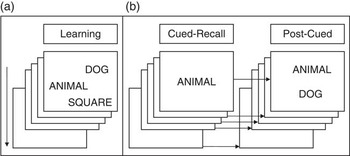
The Cued-Recall Retrieval Speed Task (CRRST) is a computer-administered test of verbal learning and memory. The test was displayed and data recorded using the E-Prime program (Psychology Software Tools) and oral responses were recorded using a voice key and microphone. Participants were presented with three stages of the exercise: learning, cued-recall, and post-cued recall (Figure 1). In the learning stage, participants were presented with a category cue and two possible exemplars (one a member of the semantic category and the other a foil). For example, to the category cue animal the exemplars were dog (correct) and square (foil) (see Figure 1). Participants had 10 seconds to orally identify the correct matching word. Participants were asked to produce a response for a total of 16 cues. In the cued-recall stage, participants were presented with the cue alone and were asked to recall the correct matching word as soon as possible and were given a time interval of 5 s to do so before the correct answer was revealed. Participants produced oral responses by speaking into a microphone, which registered reaction time. Verbal output was measured at the start of sound of the first syllable. A research assistant recorded whether the response was correct, incorrect, or absent. Regardless of the type of response given by participants, the correct matching word was presented in the post-cued stage (for 2 s), which immediately followed each presentation within the cued-recall stage. Each trial of the cued-recall stage included the single presentation of each of the 16 cues. There was one trial of the learning stage and six trials of the cued-recall and post-cued stages. Participants provided a total of 96 responses for the cued-recall stage, which was the primary outcome measure of interest for this study. Correctness and reaction time (in ms) were recorded for each response. There was no overlap in categories or words between the FCSRT and the CRRST; additionally, the CRRST was only moderately associated with the FCSRT (correlations ranging from 0.36 to 0.41 with p-values < .0001) and was not used to categorize aMCI.
Visual display of learning and cued-recall stages of the computerized cued learning exercise. a: Sixteen category cues presented with two possible exemplars (one correct, one incorrect) for 10 s sequentially. b: Six trials of: 16-item cued-recall (5 s) immediately followed by post-cue presentation (2 s).

Statistical Analysis
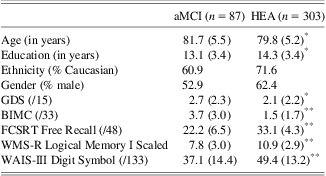
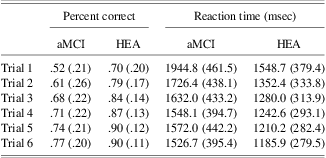
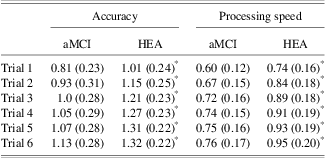
Descriptive statistics were calculated for all variables between the independent samples; t tests or χ2 analyses were carried out to determine whether participant groups differed on key demographic and neuropsychological variables (Table 1). Summaries of reaction time and percent correct per trial by group are displayed in Table 2. For analyses, measures of processing speed and accuracy were used to eliminate skewness and stabilize variance. Processing speed was calculated using the inverse transformation of reaction time for correct responses. Accuracy was calculated using the arcsine transformation of the square root of the percentage of correct. Data from incorrect responses and failures to respond were omitted from these analyses. Accuracy and processing speed data for each group were summarized into mean and standard deviation values for each of the six cued-recall trials (Table 3). The trajectories of processing speed and accuracy over the 6 trials between the aMCI and HEA groups were compared using linear mixed effects models with random intercept (Laird & Ware, Reference Laird and Ware1982). Age, gender, years of education, and depressive symptoms were adjusted in all analyses as these variables are also predictors of AD (Arnaiz & Almkvist, Reference Arnaiz and Almkvist2003), and there is variability in cognitive function due to age alone (Hultsch, MacDonald, & Dixon, Reference Hultsch, MacDonald and Dixon2002). A quadratic trend over trials was present for both processing speed and accuracy. The variances of the random error and random intercept in the linear mixed effects model are measures of the within- and between-person variability, respectively, and are allowed to differ between the aMCI and HEA groups. The assumptions of normality and constant variances within groups were checked and adequately met. All data analyses were performed using SAS 9.1 (Cary, NC: SAS Institute Inc., 2002).
Participant demographics and neuropsychological test data

Note. Data are presented as mean raw scores (SD) except where indicated. aMCI = amnestic mild cognitive impairment; HEA = healthy elderly adults; GDS = Geriatric Depression Scale; BIMC = Blessed Information-Memory-Concentration; FCSRT = Free and Cued Selective Reminding Task; WMS-R = Wechsler Memory Scale-Revised; WAIS-III = Wechsler Adult Intelligence Scale-Third Edition.
*Group difference significant at p < .01; **group difference significant at p < .0001.
Percent correct and reaction time on CRRST in persons with aMCI and HEA (untransformed data)

Note. Data are presented as mean (SD). Percent correct measured as number correct out of 16. Reaction time measured in milliseconds. aMCI = amnestic mild cognitive impairment; HEA = healthy elderly adults.
Accuracy and processing speed on CRRST in persons with aMCI and HEA (transformed data)

Note. Data are presented as mean (SD). Higher values in processing speed indicate faster responses. aMCI = amnestic mild cognitive impairment; HEA = healthy elderly adults; Accuracy = arcsine transformation of square root of percent correct; Processing speed = inverse transformation of reaction time.
*Group differences significant with p < .0001 for accuracy and processing speed.
Results
Table 1 includes basic demographic and neuropsychological test data including age, education, ethnicity, gender, BIMC scores, FCSRT scores, and Logical Memory I scaled scores. We also present data from our larger test battery including the Digit Symbol-Coding subtest score from the Wechsler Adult Intelligence Scale-Third Edition (WAIS-III; Wechsler, Reference Wechsler1997), a test of processing speed, and scores on the 15-item short form of the Geriatric Depression Scale (GDS; Sheikh & Yesavage, Reference Sheikh and Yesavage1986), a self-report measure of depressive symptoms. Participants with aMCI were slightly older, had less education, and exhibited slightly more depressive symptoms than HEAs, though both groups were well below the cutoff scores for clinical depression and cognitive impairment (Sheikh & Yesavage, Reference Sheikh and Yesavage1986; Wechsler, Reference Wechsler1997). As expected, the aMCI group was impaired in terms of episodic memory and showed worse BIMC scores, though scores were well above the cutoff associated with dementia (Blessed et al., Reference Blessed, Tomlinson and Roth1968; Grober et al., Reference Grober, Buschke, Crystal, Bang and Dresner1988). The aMCI group also showed mild deficits in processing speed (i.e., Digit Symbol) consistent with other reports of mild decrements in processing speed in aMCI on the order of 1SD below expected levels (i.e., “low average” performance) (Grundman et al., Reference Grundman, Petersen, Ferris, Thomas, Aisen, Bennett and Thal2004). The aMCI and HEA groups did not significantly differ in their gender and ethnic distributions. In the linear mixed effects models, we examine the trajectory of the processing speed and accuracy over trials, and found no significant difference in the quadratic trend between the aMCI and HEA groups for both measures; therefore, a common coefficient of the quadratic term was used for the aMCI and HEA groups when examining processing speed and accuracy.
In comparison with HEAs, individuals with aMCI showed reduced accuracy on the first trial (difference in arcsine of square root of percent correct = −0.19; p < .0001) and all subsequent trials (Table 3). Groups did not significantly differ in their linear slope of improvement across trials (difference in linear slope = −0.0002 unit per trial; p = .962). When the trial was examined categorically, the HEA group significantly differed from the aMCI group in accuracy at every trial (Table 3). In the HEA group, all trials differed significantly from each other (p < .0001) except when comparing trial 5 to trial 6, which did not show any significant change (p > .05). In the aMCI group, significant differences were also seen comparing earlier trials to later trials though the p-values were somewhat attenuated and trial 4 did not differ from trial 5 (p > .05). Compared to HEAs, individuals with aMCI showed greater between-person variability in accuracy across trials; the between-person variability among aMCI is 2.08 times of that among the HEA group, p = .0001 from the Wald's test. Within-person variability in accuracy did not significantly differ between aMCI and HEA groups, with an estimated ratio of 0.93 for aMCI vs. HEA, p = .319.
The average processing speed increased in both aMCI and HEA groups across trials of the CRRST (Table 3). The aMCI group had a lower processing speed (estimated difference = −0.13; p < .0001) on the first trial and a lower linear slope of improvement across trials (estimated difference in the linear slope = −0.01/trial; p = .0199) compared to the HEA group. When the trial was examined categorically, the HEA group significantly differed from the aMCI group in processing speed at every trial (Table 3). In the HEA group, all trials differed significantly from each other (p < .01) but in the aMCI group, earlier trials differed from later trials (p < .0001); middle trials 4 and 5 did not differ significantly from later trials (p > .05). These results indicated that individuals with aMCI took longer to retrieve the learned words and also learned at a slower rate as compared to HEAs. As predicted, individuals with aMCI exhibited significantly greater within-person variability in processing speed across trials compared to HEA (estimated ratio of variance of aMCI vs. HEA = 1.22; p = .0098) but did not show differing between-person variability (estimated ratio of variance of aMCI vs. HEA = 0.98; p = .9203).
We then examined whether combining speed and accuracy leads to better classification of aMCI. We performed ROC analyses for speed and accuracy separately and combined. The repeated measures of speed and accuracy over six trials were summarized using mean score and variation (standard deviation) among the scores. The probability of aMCI given speed and/or accuracy was estimated by logistic regression models. Area under the ROC curve (AUC) as a measure of the classification accuracy was then compared among the three models using the nonparametric approach of DeLong, DeLong, and Clarke-Pearson (Reference DeLong, DeLong and Clarke-Pearson1988). Adjusting for confounders, AUCs using speed alone, accuracy alone, and speed and accuracy combined were 0.788, 0.773 and 0.804, respectively. Speed alone was slightly better in classification of aMCI than accuracy alone but the difference was not statistically significant (p = .530). Combining speed and accuracy did not show significant improvement in classification of aMCI compared to using speed alone (p = .200), but did show better classification compared to using accuracy alone (p = .012).
Discussion
The current study introduced the CRRST, a 6-trial cued-recall memory task that measures accuracy, reaction time, and within- and between-person variability. Previous research has established the value of using cued list-learning tasks to assess memory impairment in preclinical dementia patients (Auriacombe et al., Reference Auriacombe, Helmer, Amieva, Berr, Dubois and Dartigues2010; Grober & Kawas, Reference Grober and Kawas1997; Grober et al., Reference Grober, Lipton, Hall and Crystal2000, Reference Grober, Merling, Heimlich and Lipton1997; Ribeiro et al., Reference Ribeiro, Guerreiro and De Mendonca2007; Sarazin et al., Reference Sarazin, Berr, De Rotrou, Fabrigoule, Pasquier, Legrain and Dubois2007). Research has also shown that measures of task accuracy (Perri et al., Reference Perri, Carlesimo, Serra and Caltagirone2005; Sarazin et al., Reference Sarazin, Berr, De Rotrou, Fabrigoule, Pasquier, Legrain and Dubois2007; Tremont et al., Reference Tremont, Miele, Smith and Westervelt2010), processing speed (Backman et al., Reference Backman, Jones, Berger, Laukka and Small2005; Dixon et al., Reference Dixon, Garret, Lentz, MacDonald, Strauss and Hultsch2007), and variability (Christensen et al., Reference Christensen, Dear, Anstey, Parslow, Sachdev and Jorm2005; Dixon et al., Reference Dixon, Garret, Lentz, MacDonald, Strauss and Hultsch2007; Gorus et al., Reference Gorus, De Raedt, Lambert, Lemper and Mets2008; Hultsch et al., Reference Hultsch, MacDonald, Hunter, Levy-Bencheton and Strauss2000) are indicators of early cognitive impairment in older adults. To our knowledge, the current study was the first to examine accuracy, reaction time, and variability within a single cued list-learning task in healthy older adults and those with aMCI.
Accuracy Results
Consistent with their diagnostic classification, individuals with aMCI performed less accurately across trials compared to HEAs. When comparing within group results, the HEA group significantly improved in trial-to-trial accuracy, except when progressing from trial 5 to trial 6. This could suggest that during the fifth trial, HEAs reached their threshold for memory capacity (i.e., approximately 14 words correct) and, therefore, performance on trial 6 did not differ statistically from the previous trial (refer to Table 2). The aMCI group also differed in trial-to-trial accuracy but to a lesser degree. Overall, individuals with aMCI had more difficulty encoding/learning words at the start of the task and did not initially benefit as much from multiple presentations of the list but were able to improve over the course of the task.
When examining within-person variability in the aMCI and HEA groups, we found no difference between the groups. The aMCI group had a learning rate that was comparable to HEAs, such that from trial 1 to trial 6 both groups were able to recall approximately four additional words. Unlike previous studies (Estevez-Gonzalez et al., Reference Estevez-Gonzalez, Kulisevsky, Boltes, Otermin and Garcia-Sanchez2003; Ribeiro et al., Reference Ribeiro, Guerreiro and De Mendonca2007), we found similar learning rates for the aMCI and HEA groups, even though the aMCI group was never able to perform at the same group level as HEAs. Results suggest that our method of individual cued-retrieval was able to facilitate recall in individuals with aMCI, whereas other studies using different encoding methods were unable to do the same. Results also suggest that measures of accuracy can define groups that differ in speed and variability. Additionally, the aMCI group had greater between-person variability compared to the HEAs, which means that there was more variability amongst individuals in the aMCI group as compared to the HEA group. These findings may explain why some individuals characterized as aMCI remain stable or revert back to HEA over time (i.e., the instability of the MCI diagnosis) (Jak et al., Reference Jak, Bangen, Wierenga, Delano-Wood, Corey-Bloom and Bondi2009). Traditional neuropsychological measures may not account for the within- and between-person variability and therefore fail to capture subtle differences between individuals.
Processing Speed Results
Those with aMCI had a lower average processing speed on all trials and a lower rate of linear improvement across trials compared to HEAs. Individuals with aMCI took longer to retrieve learned words during each cued-recall trial and also learned at a slower rate compared to HEAs. This is consistent with the known episodic memory deficit in aMCI and the idea that those in the early stages of AD have a short-term memory deficit that becomes apparent over several learning trials (Petersen, Smith, Ivnik, Kokmen, & Tangalos, Reference Petersen, Smith, Ivnik, Kokmen and Tangalos1994). We also found that the average processing speed increased for both aMCI and HEA participants, demonstrating that both groups were able to respond more quickly across trials. Each group improved in its performance by taking less time to retrieve words and demonstrated an ability to learn from the previous trial presentation. Those with aMCI, however, had a slower processing speed compared to the HEAs during all trials of the CRRST, and, therefore, took longer to retrieve the words during each trial. The results indicate that HEAs were better able to access and retrieve words and use the multi-presentational aspect of the task to facilitate the learning process throughout the task.
Individuals with aMCI exhibited significantly greater within-person variability in processing speed across trials compared to HEAs. This is consistent with findings from Burton and colleagues (2006) study that compared intraindividual variability in individuals with AD or Parkinson's disease, and found that the more severe the cognitive disturbance, the greater the inconsistency in task performance. Based on these findings and the idea that aMCI may represent an early stage of AD (Petersen, Reference Petersen2007; Petersen et al., Reference Petersen, Smith, Waring, Ivnik, Tangalos and Kokmen1999), we expected to see this increased variability. Also, when comparing trial-to-trial processing speed, there was more variability within the aMCI group. There was no steady increase or decrease in the aMCI group; rather, the processing speed fluctuated whereas in the HEA group, processing speed declined at a steady rate. These findings demonstrate that the HEAs were able to respond more quickly after multiple presentations whereas those with aMCI had difficulty learning from the multiple presentations. These results are consistent with the findings of Hultsch et al. (Reference Hultsch, MacDonald, Hunter, Levy-Bencheton and Strauss2000), such that processing speed variability increased for aMCI individuals as compared to HEAs across trials. There was no difference in the between-person variability between the aMCI and HEA groups, indicating that members of each group behaved similarly to other members of their own group. Therefore, measures of processing speed provide information about group differences not captured by accuracy alone.
Discriminative Validity Results
A final analysis found that measures of retrieval speed led to better classification of aMCI than accuracy alone. This is notable since aMCI was defined, in part, on a measure of accuracy on another test of episodic memory. This finding is compatible with prior work (e.g., Backman et al., Reference Backman, Jones, Berger, Laukka and Small2005; Dixon et al., Reference Dixon, Garret, Lentz, MacDonald, Strauss and Hultsch2007; Hertzog, Dixon, Hultsch, & MacDonald, Reference Hertzog, Dixon, Hultsch and MacDonald2003), which suggests that speed represents a critical neurocognitive resource for a variety of higher order cognitive abilities and potential indicator of preclinical AD, and that a decline in this resource is linked to corresponding declines in complex cognitive tasks and functional abilities. Investigating speed in relation to number of items recalled appears to add discriminative validity above and beyond accuracy. The CRRST may improve detection of preclinical AD based on its ability to tap the number of items retained and retrieved over time (i.e., basic storage capacity or “availability” of information) along with the efficiency with which that stored information is accessed (“accessibility”). Additionally, this type of research could be used to examine the predictive value of speed and accuracy together in determining the onset of aMCI in healthy elderly adults.
Summary of Findings, Limitations, and Conclusions
The Cued-Recall Retrieval Speed Task (CRRST) provides valuable information about individuals with aMCI not available on traditional tasks that assess accuracy without attention to learning rate and variability in processing speed. Specifically, we observed greater variability in learning and processing speed measures for individuals with aMCI, which could be attributable to compromised neural mechanisms. Dixon et al. (Reference Dixon, Garret, Lentz, MacDonald, Strauss and Hultsch2007) suggested that rate of cognitive performance could reflect underlying neural integrity and could indicate the extent to which neural resources are available to support higher level cognitive processing. As a result, when these neural mechanisms are compromised, there is greater observable cognitive impairment, such as we find in individuals with aMCI or AD. Backman and colleagues (2005) have also proposed that neurocognitive markers may be early behavioral manifestations of preclinical changes associated with impairment. Their meta-analysis of cognitive characteristics of preclinical AD showed that deficits in episodic memory as well as reductions of neurocognitive speed may also occur during the preclinical phase. Our study supports previous findings that neurocognitive measures of processing speed and variability could be used to identify deficits in performance, which may be used to reliably discriminate between healthy and cognitively impaired older adults.
Recent research has called attention to the stability of the aMCI diagnosis, with some individuals progressing to dementia and others reverting to normal cognition or remaining stable over time (Busse, Hensel, Guhne, Angermeyer, & Riedel-Heller, Reference Busse, Hensel, Guhne, Angermeyer and Riedel-Heller2006; Loewenstein, Acevedo, Agron, & Duara, Reference Loewenstein, Acevedo, Agron and Duara2007; Petersen, Reference Petersen2004). It is possible that these various diagnostic states have different profiles with regard to learning rate and variability across memory task trials and that a measure such as the CRRST could aid in differentiation. Future research should confirm the CRRST's ability to discriminate aMCI from healthy cognitive aging and investigate its utility in categorizing various forms of MCI. In this work, we would also hope to compare the relative value of accuracy vs. speed and variability in predicting cognitive/diagnostic outcomes.
Recently, Bielak and colleagues (2010) found that intraindividual variability is sensitive to even subtle cognitive changes and that challenging cognitive tasks improve sensitivity to detect such changes. They also argued that: “variability in responding while under high cognitive demand may be most attuned to the integrity of the neurological system” (p. 585). Our study was designed with these ideas in mind, and we strove to develop a task of sufficient difficulty and complexity. A limitation, however, was that we did not employ a longitudinal approach. In future longitudinal work, we will examine the trajectory of change in the intraindividual variability in older adults in various stages of cognitive decline and the impact of disease severity on such variability. Further research could examine our task across multiple occasions and determine whether there is greater inconsistency in performance across occasions as well. This inconsistency in performance might then be useful as a neurological marker to discriminate between aMCI and HEAs, and eventually serve as a diagnostic tool.
In summary, our findings provide preliminary evidence for the utility of a computerized cued list-learning task in the assessment of individuals with aMCI that permits investigation of both storage capacity or “availability” of information as assessed through number of items recalled over task trials and accessibility to information as assessed through measurement of processing speed and learning rates across trials. Participants in the current study tolerated the task and we obtained a range of scores in both groups, suggesting that the task is appropriate in terms of level of difficulty for these groups. After controlling for age, education, gender and depression, older adults with aMCI had poorer accuracy and learning, slower retrieval speeds, and greater variability in performance on a cued-recall task compared to healthy elderly adults. Importantly, the combination of accuracy and reaction time data appears to have better discriminative validity than accuracy alone. We are following participants over time and hope to determine the utility of this task as a predictor of diagnostic conversion. We believe that behavioral markers of neurocognitive resources, such as speed of processing and variability in task performance may provide a more complete picture of cognitive impairment and also be an early indicator of dementia. Further exploration of these variables, independently and jointly, and their underlying neural mechanisms may enhance understanding of cognitive trajectories and aid in the ability to detect incident dementia at its earliest time point.
Acknowledgments
This study was supported by NIH Grant: 5P01AG003949-23, P.I.: R. B. Lipton. The Albert Einstein College of Medicine owns the patent rights for controlled learning-cued recall retrieval speed measurement and makes it available without charge for research but licenses it for commercial use. Albert Einstein College of Medicine owns US Patent 7,314,444 for “Memory Assessment by Retrieval Speed.” The authors thank Sylvia Alcala, Betty Forro, Alicia Gomez, Charlotte Magnotta, April Russo, Mary Joan Sebastian and Diane Sparacchio for assistance with recruitment and neuropsychological assessment as well as the dedicated participants. There are no conflicts of interest to report.