Implications
A combination of passive surveillance, clinical observations and anecdotal evidence suggests that the epidemiology of the major helminth diseases of the UK livestock is changing. A detailed analysis of post mortem returns over the past 30 years reveals the most likely contributing factor to be climate change, in particular, changes in temperature and rainfall. This is manifested through altered overwinter survival of the free-living stages of these parasites and, where applicable, their intermediate hosts. Any change in the incidence, geographical distribution and seasonality of these important endemic parasites has obvious implications for disease control, animal productivity and welfare. We need improved diagnosis and early detection of livestock parasitic disease, coupled with increased awareness and preparedness to deal changing disease patterns.
Introduction
Climate change is arguably the greatest long-term challenge facing the human race today (IPCC, 2007). Increasing global temperatures will bring changes in weather patterns and rising sea levels, while altered rainfall patterns are predicted to increase the incidence of both drought and flooding events (Alcamo et al., Reference Alcamo, Moreno, Nováky, Bindi, Corobov, Devoy, Giannakopoulos, Martin, Olesen and Shvidenko2007). Among the most important effects of these changes will be the emergence and spread of infectious diseases, including those of animals (Khasnis and Nettleman, Reference Khasnis and Nettleman2005; Vallat, Reference Vallat2008). In the UK, recent outbreaks of ‘exotic’ diseases, such as foot-and-mouth disease, avian influenza and bluetongue, have given stark indications of the potential impact of emerging infectious diseases of animals on national economies, animal welfare and human health.
The field of climate change and its effects on the dynamics of pathogens of veterinary importance has lagged well behind the climate change-focused research in other disciplines, to the extent that, in the Fourth Assessment Report of the Intergovernmental Panel on Climate Change (IPCC), no animal pathogens were listed in an extensive overview by Rosenzweig et al. (Reference Rosenzweig, Casassa, Karoly, Imeson, Liu, Menzel, Rawlins, Root, Seguin and Tryjanowski2007). Published work has focused on the emergence of new diseases and the spread of disease vectors (e.g. Wittmann and Baylis, Reference Wittmann and Baylis2000; Colebrook and Wall, Reference Colebrook and Wall2004; Randolph, Reference Randolph2004; Purse et al., Reference Purse, Mellor, Rogers, Samuel, Mertens and Baylis2005; Gould et al., Reference Gould, Higgs, Buckley and Gritsun2006), but effects on endemic disease have hardly been addressed by robust science. Veterinarians have been urged to wake up to this fact in the veterinary press (Anon, 2007c).
This paper focuses on challenges ahead in the study of the effects of climate change on established infectious diseases, using parasitic worms affecting ruminants in the UK as an example. Parasitic helminths belonging to the classes Nematoda (roundworms) and Trematoda (flatworms) are ubiquitous on livestock farms. In temperate regions, arguably every single-farmed ruminant will be infected by one or more helminth species at some stage in its life. If the level of infection is high, this may lead to clinical disease and death of the animal. Exact numbers of deaths from these infections can only be guessed at as there is currently no active surveillance of helminth disease in the UK. Based on submissions to the main UK network of veterinary investigation laboratories, and published mortality rates, a conservative estimate would be thousands of sheep and hundreds of cattle per year. The total cost of helminth-induced subacute and chronic disease, presenting itself as anorexia, weight loss, diarrhoea, impaired reproduction, abortion and reduced milk yield and its prophylactic treatment eclipses mortality-related costs to the farming industry (Brunsdon, Reference Brunsdon1988; Ward, Reference Ward2006; Louie et al., Reference Louie, Vlassoff and Mackay2007). In the UK sheep industry, costs associated with gastrointestinal nematode infection related to reduced lamb growth rates plus treatment and prevention measures alone was estimated to be £84 million per annum (Nieuwhof and Bishop, Reference Nieuwhof and Bishop2005). Losses due to lungworm disease in 100-cow dairy herds have been calculated at £15 000 to 20 000 per outbreak (Woolley, Reference Woolley1997). Liver fluke infection affects farm income especially in terms of poor productivity, reduced milk yield and livers trimmed or condemned at slaughter. In the UK, costs of chronic infection in cattle alone have been estimated at £40 million per year (Bennett and IJpelaar, Reference Bennett and IJpelaar2005).
Any effects of climatic change on helminths may be compounded by the rapid development and spread of anthelmintic resistance in parasites of sheep and, more recently, cattle (reviewed by Wolstenholme et al., Reference Wolstenholme, Fairweather, Prichard, von Samson-Himmelstjerna and Sangster2004). The inexorable rise of parasite populations resistant to the few anthelmintic drugs available for their control poses a direct, ever increasing, threat to the sustainability of intensive livestock industries, including that of the UK (Waller, Reference Waller1986; Jackson and Coop, Reference Jackson and Coop2000; Kaplan, Reference Kaplan2004). Indeed, the recent emergence of multidrug resistant nematodes has been the final straw in driving several sheep enterprises out of business (Sargison et al., Reference Sargison, Jackson, Bartley and Moir2005). As we will discuss below, climate change may speed up the spread of anthelmintic resistance through parasite populations.
Climate change has the potential to increase the transmission intensity of highly pathogenic, ubiquitous parasites to levels uncontrollable by current management strategies. However, currently, research in the field has hardly progressed beyond describing perceived changes and speculation on causality. There is an urgent need to identify and quantify potential changes in parasitic challenge to animals to provide veterinarians and farmers with informed advice on the best practice for parasite control in food-producing animals in the coming decades. The study of the effects of climate change on parasites of livestock may also contribute very significantly to the wider study of climatic effects on disease transmission, and predicted overall growth or decline of a large number of other species.
Climate change may have short-term effects on parasites, which in turn will lead to parasite adaptation (Poulin, Reference Poulin2007; Skelly et al., Reference Skelly, Joseph, Possingham, Feidenburg, Farrugia, Kinnison and Hendry2007). At the same time, it may have effects on hosts and, in the case of farmed animals, on host management. These layers of complexity make it hard to predict the longer-term future accurately. One of the conclusions of the UK Government Foresight Project 2006 on infectious diseases was that ‘we must understand how climate affects infectious diseases today before we can predict climate change’s impacts of the future’ (Brownlie et al., Reference Brownlie, Peckham, Waage, Woolhouse, Lyall, Meagher, Tait, Baylis and Nicoll2006). A pioneer of modelling the effects of global warming climate on infectious diseases, Professor D. J. Rogers, recently expressed his concern that, as future predictions cannot be disproved until the time comes, the work on models of responses of infectious diseases to climate change may ‘reverse the trend of scientific enquiry’ (Anon, 2007e). In light of the uncertainty presented by the differences in opinion on climate change scenarios between climatologists alone, this uncertainty seems a real danger indeed. There is an urgent need for the identification of methods to be deployed to build hypotheses that can be tested in the present. In order to predict the future, we will need realistic models based on the present and the past.
The bridging of gaps in our understanding of the effects of temperature and rainfall on the free-living stages of the parasites under study, therefore, forms an integral part of the study of future climate change. This review will start by exploring the likely changes in the abundance of these free-living stages. It will then focus on likely ways in which the parasites will adapt. The immediate climate-driven effects, and the parasite evolution that inevitably follows, will alter host–parasite interactions. Last, we will turn our attention towards ways to combat increased exposure of farmed ruminants to parasitic helminths, and attempt to guide future research priorities.
Helminth parasites
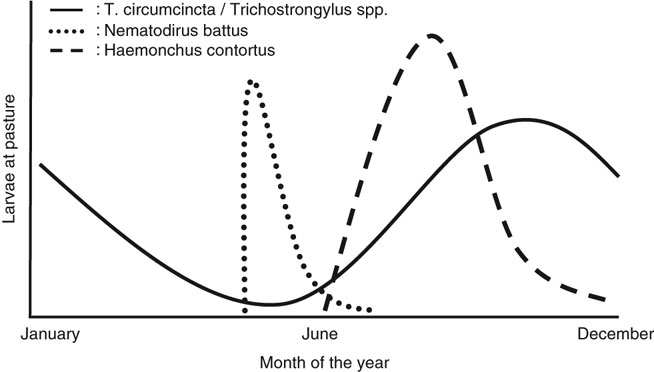
The major economically important helminth parasites affecting livestock in the UK are the gastrointestinal nematodes (roundworms) and the flukes (flatworms). The major nematode species infecting sheep are Teladorsagia circumcincta, Nematodirus battus, Haemonchus contortus and Trichostrongylus spp., and, in cattle, Ostertagia ostertagi, Cooperia oncophora and the lungworm, Dictyocaulus viviparus. Fluke, most notably the liver fluke, Fasciola hepatica, infects both sheep and cattle. The respective helminth groups have different transmission patterns, ecological requirements and dispersal strategies. However, they all possess free-living larval stages, which are directly affected by climatic factors, most notably temperature and rainfall. As a result, they display a seasonal pattern of infection in grazing livestock (e.g. Figure 1). Their seasonal and spatial prevalence can also be influenced indirectly through their invertebrate intermediate hosts (where appropriate) and the presence and movements of their definitive vertebrate hosts.
Schematic view of the traditionally observed seasonality of parasitic nematodes affecting sheep. T. circumcincta and Trichostrongylus spp. may overwinter at pasture and numbers of larvae decline in spring. During the lambing season, hypobiotic larvae overwintering in ewes mature and start to produce eggs; lambs increase pasture contamination levels over several worm generations. Although the epidemiology of F. hepatica is very different, the pattern of abundance of infectious metacercariae is similar to that of T. circumcincta/Trich. spp. larvae. However, Fasciola peak abundance is normally timed somewhat later in autumn. N. battus overwinters as infective larvae in the egg. In spring, a mass hatch of eggs is followed by a rapid decline of the larval population. The H. contortus population entirely overwinters in the adult host. Worms mature during the lambing season; Female adult worms are highly fecund and pasture contamination builds up rapidly. The relatively high temperature threshold for development of H. contortus and the inhibition of developing larvae in hosts in autumn result in a rapid fall in the number of larvae at pasture in autumn. As a result of climate change, these windows for parasite transmission are likely to shift and/or expand.

The eggs of the helminths involved must develop into infective stages, and migrate onto herbage, at pasture before transmission can occur. Assuming that hosts are present, the success rate of this non-parasitic phase is affected predominantly by climatic factors (as reviewed by O’Connor et al., Reference O’Connor, Walkden-Brown and Kahn2006) and, therefore, these parasites are likely to be highly sensitive to climate change. Increases in mean daily temperature as small as 1°C are thought to have significant effects on entire ecosystems (Fischlin et al., Reference Fischlin, Midgley, Price, Leemans, Gopal, Turley, Rounsevell, Dube, Tarazona and Velichko2007) and significantly increase development rates of nematodes (Kutz et al., Reference Kutz, Hoberg, Polley and Jenkins2005). Global warming, therefore, has the potential to increase parasite-related losses in livestock dramatically.
Simultaneously, climatic changes influence a parasite’s environment. Its longevity may be affected indirectly through alterations in the behaviour and abundance of predators and natural enemies of nematodes (Thieltges et al., Reference Thieltges, Jensen and Poulin2008). Patterns of herbage growth influence the probability of ingestion by a host (Morgan et al., Reference Morgan, Medley, Torgerson, Shaikenov and Milner-Gulland2007). Changes in the rate of herbage growth can in turn influence the protein, energy, macroelement and trace element nutrition of ruminant hosts that graze on it, thus affecting the immune status of the host (Greer, Reference Greer2008). In addition, stocking densities and the length of the grazing period are likely to be adapted to herbage availability (Menzel and Fabian, Reference Menzel and Fabian1999). Such factors may well compound the direct effects of climate change on helminth parasites and make future parasite epidemiology very hard to predict. Until relatively recently, there was a seasonal pattern of parasite infection in livestock in the UK such that control strategies could follow a ‘blueprint’ based on predictable appearance of certain species at certain times of the grazing season. This is best exemplified by the seasonality of helminth parasites in sheep (Figure 1). This pattern of infection may well change as a result of climate change.
Parasites may thrive in a wide variety of climatic environments
Hypobiosis
Hypobiosis, or arrested larval development, is a particular feature of many nematode species and refers to the temporary, often seasonal, cessation in development at a precise point in the life cycle (Michel, Reference Michel1974; Michel et al., Reference Michel, Lancaster and Hong1976). Arrest of larvae at early stages of in-host development ensures enhanced survival of parasite populations during adverse climatic conditions. A subsequent synchronised mass maturation of arrested larvae may be triggered and cause severe pathology and clinical disease. It has been predicted that, with warming, there may be selection against parasites entering an arrested stage and an increase in reproductive rate as a consequence of reduced density-dependent constraints (Hudson et al., Reference Hudson, Cattadori, Boag and Dobson2006).
High biotic potential
Successful transmission of these parasites is aided by synchronisation of the release of eggs or larvae onto pasture with weather-related suitability for development and survival of these stages plus the presence of the appropriate host species. The chances of at least a small part of the population successfully completing the life cycle is greatly enhanced by the high biotic potential of these parasites. For example, the nematode H. contortus is highly fecund, a single adult female can shed between 5000 and 10 000 eggs per day (Gordon, Reference Gordon1948; Levine and Todd, Reference Levine and Todd1975). Infections normally comprise at least several hundred adults, so, once introduced, H. contortus can establish and rapidly increase levels of pasture contamination. Similarly, an adult liver fluke can shed 20 000 to 50 000 eggs per day, that is, approximately one egg every few seconds (Walker et al., Reference Walker, Hoey, Fletcher, Brennan, Fairweather and Trudgett2006). Fluke numbers are further multiplied by asexual replication within the snail intermediate host, such that each invading miracidium can give rise to upwards of 1000 infective cercariae. These parasites have adopted high-output strategies, which, at pasture, are normally combined with high loss rates of free-living stages. Such a strategy may increase the probability of establishment in new, suboptimal, environments. If climatic changes optimise the development of parasitic larvae, dramatic increases in the size of populations of these parasites may be expected and these are likely to lead to acute disease, and deaths in affected ruminants.
Genetic adaptation
Population genetic studies of several sheep and cattle nematodes, including Ostertagia, Haemonchus and Teladorsagia, reveal that these parasites are highly genetically diverse and, typically, have extremely large effective population sizes (Blouin et al., Reference Blouin, Yowell, Courtney and Dame1995). Furthermore, some liver fluke isolates have been shown to be triploid, which provides further options for genetic recombination and increased diversity (Fletcher et al., Reference Fletcher, Hoey, Orr, Trudgett, Fairweather and Robinson2004). These parasites, therefore, appear to have the potential for high rates of true genetic change (microevolution). On top of this, the genotype of certain parasites has been shown to code for more than one phenotype (a trait known as phenotypic plasticity; Stearns, Reference Stearns1992; Poulin, Reference Poulin2007). Different expressions of the same genotype may be triggered by environmental conditions (Jarrett, Reference Jarrett2008; van Dijk and Morgan, Reference van Dijk and Morgan2009) and, if certain phenotypes fare better when these conditions change, the proportion of the population expressing this phenotype is likely to increase. The proportion of larvae entering hypobiosis following certain climatic, or immunological, stimuli may be an example of phenotypic plasticity. This trait opens the door to very rapid adaptation to climate change (Davis et al., Reference Davis, Shaw and Etterson2005; Visser, Reference Visser2008).
Predicted climatic effects on parasite ecology
It is well established that the development and death rates of free-living stages are mainly driven by temperature and rainfall. Recent work has shown that UV light is highly detrimental to the longevity of infective nematode larvae and is likely to be a third important driver of larval abundance at pasture (van Dijk et al., Reference van Dijk, De Louw, Kalis and Morgan2009). With respect to climate change, UV levels are likely to remain relatively constant. However, if increases in temperature allow for transmission of parasites outside of windows of high UV activity, increases in parasite abundance may be higher than predicted from temperature alone (van Dijk et al., Reference van Dijk, De Louw, Kalis and Morgan2009). Therefore, UV intensity may have to be considered in predictions for the future and its effects further quantified at pasture. However, in this review, we will focus on temperature and rainfall.
Temperature
At temperatures below the maximum development threshold (the temperature above which parasites are adversely affected and development ceases), the development rates of eggs and early larval stages of helminths increase with increasing temperatures (Claxton et al., Reference Claxton, Sutherst, Ortiz and Clarkson1999; Hsu and Levine, Reference Hsu and Levine1977; Rose and Small, Reference Rose and Small1984). The economically important parasites have upper development thresholds approximating 30°C (Jehan and Gupta, Reference Jehan and Gupta1974; Pandey et al., Reference Pandey, Chaer and Dakkak1989; van Dijk and Morgan, Reference van Dijk and Morgan2009). The mean daily temperature, in temperate regions, rarely exceeds 25°C (Jenkins et al., Reference Jenkins, Perry and Prior2007) and the effect of global warming on the free-living stages would appear to be easily predictable: these parasites would be expected to benefit from increased development rates, and perhaps a widening of the windows during which transmission is possible. The first papers on the effects of warming on parasite populations indeed suggest that small increases in temperature may lead to significant increases in developmental success of parasite populations (Kutz et al., Reference Kutz, Hoberg, Polley and Jenkins2005; Poulin, Reference Poulin2006). However, whether this will result in population growth is not easy to predict:
(1) Increases in mean temperatures may have contrasting effects on different stages in the life cycle. Alongside development rates of eggs and immature larvae, their death rates, and those of the infective larvae, also increase. Especially during the summer, the population, in terms of numbers of infective stages at pasture per time unit, will only increase in size if benefits to larval development outstrip a shorter life span. The sensitivity of larvae to increased temperatures differs between species (e.g. Boag and Thomas, Reference Boag and Thomas1985), and the degree to which species benefit from it may vary significantly. During the winter, the effects of warming on the survival of larvae, which have developed during the autumn, may again vary between different species. Larvae of all economically important nematodes survive for many months when kept at a temperature range of −2 to +4°C (Boag and Thomas, Reference Boag and Thomas1985; Troell et al., Reference Troell, Waller and Hoglund2005; van Dijk and Morgan, Reference van Dijk and Morgan2008). N. battus, T. circumcincta and Trichostrongylus spp. appear to tolerate much lower temperatures very well (Andersen et al., Reference Andersen, Wang and Levine1966; Andersen and Levine, Reference Andersen and Levine1968; Ash and Atkinson, Reference Ash and Atkinson1986; Pandey et al., Reference Pandey, Chaer and Dakkak1993), whereas H. contortus appears sensitive to temperature drops below −3°C (Rose, Reference Rose1963; Todd et al., Reference Todd, Levine and Boatman1976; Philip, Reference Philip1983). Overwinter survival rates of the latter species may, therefore, be enhanced if fewer ‘extreme’ frost events take place. Similarly, increased, intramolluscan, overwinter survival of preinfective stages is likely for F. hepatica (Luzon-Pena et al., Reference Luzon-Pena, Rojo-Vazquez and Gomez-Bautista1994).
As all infective nematode larvae are surrounded by a cuticle, they cannot eat and have a finite energy reserve. If the temperature falls below the threshold for larval activity, approximating 5°C to 10°C (Wharton, Reference Wharton1981), these larvae curl up and remain immotile, thereby limiting the use of their energy reserves. The implications of this are that, if temperature rises above this threshold, larvae lose energy and ultimately die faster. Temperature increases in winter are likely to lead to increased larval activity, at times when few susceptible hosts are present at pasture, and therefore, decrease overwinter survival rates and the relative importance of the survival of these larvae in the year-to-year on-farm persistence of these parasites.
(2) Developmental temperature thresholds differ between species. The minimum temperature at which development takes place varies between 4 and 5°C for T. circumcincta and Trichostrongylus spp. (Wang, Reference Wang1967; Beveridge et al., Reference Beveridge, Pullman, Martins and Barelds1989; Pandey et al., Reference Pandey, Chaer and Dakkak1989) to 10°C to 12°C for H. contortus, N. battus and F. hepatica (Rowcliffe and Ollerenshaw, Reference Rowcliffe and Ollerenshaw1960; Gibson and Everett, Reference Gibson and Everett1976; van Dijk and Morgan, Reference van Dijk and Morgan2008). Obviously, global warming may only significantly extend transmission windows if the temperature increases above this threshold. For T. circumcincta, for example, with a development threshold close to average winter temperatures in temperate regions, developmental windows may significantly increase into the winter months, whereas for H. contortus, development during the coldest months may not be possible for many years to come. Development thresholds are likely to be strong determinants of parasite epidemiology and overwinter survival strategies in particular (van Dijk, Reference van Dijk2008). To what extent they distinguish the strategies of parasites at pasture may be co-determined by the rate at which temperatures rise and fall in spring and autumn – if temperatures increase and fall very rapidly, then predicted differences in developmental windows of opportunity between species may be nullified.
(3) At above-development threshold temperatures, the change in the proportion of egg populations being able to develop as a result of temperature increases varies between species. For arctic-adapted species like N. battus and T. circumcincta (Hoberg et al., Reference Hoberg, Monsen, Kutz and Blouin1999; Hoberg, Reference Hoberg2005), a large proportion of the population is able to develop at the lower threshold for development (Pandey et al., Reference Pandey, Chaer and Dakkak1989; Rossanigo and Gruner, Reference Rossanigo and Gruner1995; van Dijk and Morgan, Reference van Dijk and Morgan2008 and Reference van Dijk and Morgan2009). Although the larval development rates of these parasites increase with increasing temperatures, the increase in the proportion of the egg population being able to benefit from these increases is relatively small. Also, at temperatures over 25°C, the proportion of eggs being able to develop actually declines rapidly (Rossanigo and Gruner, Reference Rossanigo and Gruner1995; van Dijk and Morgan, Reference van Dijk and Morgan2008). For tropic-adapted species like H. contortus (Hoberg et al., Reference Hoberg, Lichtenfels and Gibbons2004), and Trichostrongylus spp., the proportion of eggs developing increases rapidly up to the optimum development temperature, which is higher than for the arctic-adapted species (Jehan and Gupta, Reference Jehan and Gupta1974; Coyne and Smith, Reference Coyne and Smith1992; Rossanigo and Gruner, Reference Rossanigo and Gruner1995). Therefore, at above development threshold temperatures, these species are likely to benefit more from temperature increases than arctic-adapted species.
(4) Some species, apart from temperature requirements for egg development, also have specific temperature requirements for the hatching of their eggs. The eggs of N. battus are thought to hatch when a cold spell (temperatures encountered during the winter) is followed by a temperature rise over 10°C in spring (Christie, Reference Christie1962; Ash and Atkinson, Reference Ash and Atkinson1986). Recent work has shown that the hatching of N. battus eggs is also bound by an upper temperature threshold of approximately 17°C (van Dijk and Morgan, Reference van Dijk and Morgan2008 and Reference van Dijk and Morgan2009). Therefore, alterations in spring temperatures may prevent the eggs of this parasite from hatching.
(5) Warming rates differ between months of the year and also between regions within the UK. Actual responses of different species of parasites to global warming may, therefore, differ considerably from predictions based on mean annual increases in temperature. Different species may benefit to different degrees in different regions.
(6) The life cycles of trematodes (e.g. F. hepatica, Dicrocoelium dendriticum and Paramphistomum spp.) involve intermediate hosts (Abrous et al., Reference Abrous, Rondelaud and Dreyfuss1997 and Reference Abrous, Rondelaud and Dreyfuss2000). Increases in temperature associated with climate change can have a significant effect not only on Galba spp. snail development, but also on the rate of development of the free-living stages of F. hepatica within the snail. Once infected, the rate of emergence of infective cercariae from snails has been shown to increase with increasing temperatures (Poulin, Reference Poulin2006). However, the snails have their own temperature thresholds for (breeding) activity, and development (Claxton et al., Reference Claxton, Sutherst, Ortiz and Clarkson1999; Hodasi, Reference Hodasi1976). Temperature-driven increased abundance of the free-living stages infecting snails may not amount to an increased force of infection for the final host if the snail population does not benefit from climate change in a similar fashion (Mangal et al., Reference Mangal, Paterson and Fenton2008). Moreover, higher trematode burdens per snail may increase their mortality rates (Rondelaud et al., Reference Rondelaud, Abrous and Dreyfuss2002). It has also been suggested that the size of individual snails may be more important than the total number of snails available for infection (Ollerenshaw, Reference Ollerenshaw1959; Yoder and Coggins, Reference Yoder and Coggins1998). This would suggest that an influence of climate change on the availability of preferred food sources for the snail may also have an indirect effect on the parasite population. Indeed, Rondelaud et al. (Reference Rondelaud, Abrous and Dreyfuss2002) showed that cercarial production rates of snails vary with their food sources.
Moisture
As a result of climate change, periods of drought, followed by a limited number of days with heavy rainfall, have been predicted to become more frequent (Hennessy et al., Reference Hennessy, Gregory and Mitchell1997; Tapiador et al., Reference Tapiador, Sanchez and Gaertner2007). Several studies have reported a positive correlation between rainfall and the emergence of trichostrongyloid larvae on herbage or the increase of worm burdens in tracer animals (e.g. Williams and Bilkovich, Reference Williams and Bilkovich1973; Bryan and Kerr, Reference Bryan and Kerr1989; Stromberg, Reference Stromberg1997). Such associations are most dramatic in semi-arid regions, where absence of rain may bring parasite transmission to a halt during the driest months and sharp peaks of larval emergence can be seen after periods of rainfall (Chiejina and Fakae, Reference Chiejina and Fakae1989; Onyali et al., Reference Onyali, Onwurili and Ajayi1990; Agyei, Reference Agyei1997; Sissay et al., Reference Sissay, Uggla and Waller2007). Moisture is also prerequisite for both Galba spp. snails and the free-living miracidial and cercarial stages of F. hepatica, and the prevalence of fasciolosis is greatest following wet seasons (Andrews, Reference Andrews1999). However, even during dry seasons, suitable microhabitats probably exist on most UK farms for the maintenance of F. hepatica and consequent disease in certain cohorts of ruminant livestock (Skuce et al., Reference Skuce, Sargison, Kenyon, Jackson and Mitchell2008).
Development of nematodes
The development of eggs into infective Trichostrongylus spp. and H. contortus, larvae takes place in dung, which is passed with a certain moisture reserve. Development of these larvae has been shown to cease only during summers of 2 to 3 months drought accompanied by relative humidities as low as 20% and maximum mean monthly temperatures approximating 32°C (Onyali et al., Reference Onyali, Onwurili and Ajayi1990; Garcia Romero et al., Reference Garcia Romero, Valcarcel and Rojo Vazquez1997). On warm spring and summer days, such nematodes can reach the L3 stage even in dung, which becomes very desiccated before development is completed (Chiejina and Fakae, Reference Chiejina and Fakae1989).
The eggs of N. battus, and of the trematode F. hepatica, develop in the soil. Soil particles are normally surrounded by a layer of water, which is retained by forces of capillarity, osmotic pressure and gravity (Parkin, Reference Parkin1975). Studying the eggs of N. battus, Parkin (Reference Parkin1975) showed that this parasite is able to take up water at osmotic pressures reflecting soil saturations between full water capacity and wilting point. Only eggs incubated in molar solutions appear not to be able to develop beyond the second larval stage while those incubated in salt solutions of strengths between 10−4 and 0.1 M manage to develop just as well as aqueous controls (Parkin, Reference Parkin1976). In temperate regions, the availability of water is, therefore, unlikely to be a crucial limiting factor in the developmental phase of these parasites.
Migration of nematodes
Infective larvae of most pathogenic nematodes develop in dung and then have to migrate out to pasture. Ostertagia, Haemonchus and Cooperia spp. proved not to be able to escape from cattle dung once it had become desiccated (Williams and Bilkovich, Reference Williams and Bilkovich1973; Chiejina and Fakae, Reference Chiejina and Fakae1989; Agyei, Reference Agyei1997). On dry, warm days, cattle faeces rapidly form a crust on the pat surface and it appears this crust, although it may protect them from further desiccation in the development stage, cannot be penetrated by L3. In the tropics, the sudden migration of these larvae, made possible by the arrival of the rainy season, may result in very sharp and dangerous peaks of larval emergence (Fakae and Chiejina, Reference Fakae and Chiejina1988; Chiejina and Fakae, Reference Chiejina and Fakae1989; Agyei, Reference Agyei1997). In temperate regions, it was also documented that drought-breaking rains may suddenly increase larval density on herbage 10-fold (Bryan and Kerr, Reference Bryan and Kerr1989). Cattle faeces can clearly function as a reservoir of larvae during drought. Sheep pellets may trap larvae in a similar fashion (van Dijk, Reference van Dijk2008). When heavy showers or even sustained periods of light rainfall follow a few weeks of drought, larval availability may suddenly reach dangerous levels. However, prolonged periods of drought may reduce the numbers of live larvae in the faecal depot quite rapidly (van Dijk, Reference van Dijk2008). Also, in temperate regions, dew may be sufficient to allow for constant migration of larvae out of dung.
Several pasture-based studies (Skinner and Todd, Reference Skinner and Todd1980; Krecek et al., Reference Krecek, Murrell and Douglass1990; Niven et al., Reference Niven, Anderson and Vizard2002) have suggested that a film of moisture is needed for the migration of larvae onto herbage, and this has become the established view among veterinary parasitologists. If this is indeed the case, larval migration is only possible either just after rains or when dew is found on grass leaves (Langrova et al., Reference Langrova, Janskovska, Borovsky and Fiala2003). Studies by Callinan and Westcott (Reference Callinan and Westcott1986) suggested that relative humidity, and not necessarily free water, is the main driver behind larval migration. Extensive studies by Crofton (Reference Crofton1948) and Rees (Reference Rees1950) suggested that gradients in relative humidity and temperature experienced by the larvae determined their migratory behaviour. Crofton (Reference Crofton1948) proposed that larvae, above a certain temperature threshold, move continuously and randomly. However, when larvae move on a gradient of higher to lower relative humidities, they may stop and turn back. Such gradient-steered behaviour has been demonstrated for the free-living nematode Caenorhabditis elegans (Yamada and Oshima, Reference Yamada and Oshima2003). Recent work proposed that UV light may also trigger larval movement away from damaging levels to more shaded areas of the lower grass stem (van Dijk et al., Reference van Dijk, De Louw, Kalis and Morgan2009). The theory of random, yet gradient-steered, movement explains why studies normally retrieve 90% of recovered larvae from the lower (cooler and more humid) 2.5 cm of the grass stems (Crofton, Reference Crofton1948; Rees, Reference Rees1950; Silangwa and Todd, Reference Silangwa and Todd1964; Callinan and Westcott, Reference Callinan and Westcott1986) and also why studies retrieve a consistently low percentage of approximately 2% to 3% of larvae off herbage, a percentage which does not increase any further after the initial 24-h migration of larvae (Crofton, Reference Crofton1948; Rees, Reference Rees1950; Silangwa and Todd, Reference Silangwa and Todd1964; Callinan and Westcott, Reference Callinan and Westcott1986; Langrova et al., Reference Langrova, Janskovska, Borovsky and Fiala2003). Free water may not be needed for the migration of nematode larvae onto herbage and the migration of larvae is, indeed, likely to be a random process (van Dijk, Reference van Dijk2008).
Trematodes
With regards to trematodes, adequate moisture supply has been shown to be essential for most stages in their life cycle: the survival of the eggs of both flukes and snails, the infection of snails by miracidia, the shedding of cercariae and the survival of encysted metacercariae (Kendall and McCullough, Reference Kendall and McCullough1951; Ollerenshaw, Reference Ollerenshaw1959; Smith and Wilson, Reference Smith and Wilson1980). Below certain levels of soil moisture, parasite development is severely limited by the aestivation of snails (Kendall, Reference Kendall1949). Mathematical models of the ecology of parasites with pond-dwelling snails have ignored the influence of rainfall (Mangal et al., Reference Mangal, Paterson and Fenton2008). However, Lymnaea snails do not live inside water bodies but around their edges (Kendall, Reference Kendall1949; Ollerenshaw, Reference Ollerenshaw1959) and, therefore, models of F. hepatica will quite likely have to explicitly include a measure representing the soil moisture status. Defining the parameter that best describes soil moisture status, and quantifying its relation with the development and survival of both the parasite and the snail, poses a real challenge to furthering our understanding of the epidemiology of this parasite. Traditional models, attempting to forecast the risk of acute fasciolosis in autumn/winter, that have attempted to relate climatic conditions to disease incidence in sheep, incorporated total rainfall, transpiration and the number of rainy days (>1 mm rain; Ollerenshaw and Rowlands, Reference Ollerenshaw and Rowlands1959; Ross, Reference Ross1970), but the effects of these parameters were not analysed in statistical models.
The likely effects of changing temperature and rainfall patterns can be summarised as follows. Although increases in mean temperature are likely to increase the development rates of the free-living stages, concurrent effects on death rates and effects on other stages of the life cycle make it hard to make a general prediction for overall population growth of parasites. Given the differences in temperature thresholds for development and hatching, and larval death rates, between species, it is likely that some species will benefit overall while others will not. Different species may benefit at different times of the year. Some species, most likely the arctic-adapted species, may only benefit short term, with a new plateau, or even collapse, of the population as temperature increases further. Meanwhile, in temperate regions, populations of especially tropically adapted species may continue to grow with further temperature increases leading to species shifts. Emergence patterns of larvae, which have developed in desiccated dung, may be altered by changes in rain patterns, but it is not clear to what extent. In contrast to the relative independence of nematodes on rainfall, soil moisture is thought to be an essential factor for all stages in the life cycle of F. hepatica. However, the influence of moisture parameters on fluke abundance has not been quantified.
The study of the behaviour of certain species in different geographical locations, representing different climatic environments, and the geographical origin of species, may yield important information on their future behaviour. Changes in parasite epidemiology may have to be studied at either a regional, or local scale. It will be difficult to assess the overall effect of multiple climate change-induced processes working on parasite populations simultaneously in any other way than through mathematical modelling. It will be a stern challenge to incorporate realistic climatic scenarios and climate stochasticity in these models, and extensive collaborations with climatologists are likely to be required.
Evidence for recent changes
In recent years, repeated suggestions of important changes in the epidemiology of helminths have been reported in the UK. First, reports suggesting an increased incidence of infection at pasture have surfaced. An increased incidence of parasitic gastroenteritis (e.g. Anon, 2004, 2005a and 2006a) has been signalled by the veterinary surveillance network. The incidence of fasciolosis (e.g. Anon, 2007d; Pritchard et al., Reference Pritchard, Forbes, Williams, Salimi-Bejestani and Daniel2005) and dictyocaulosis (David, Reference David1997; van Dijk, Reference van Dijk2004) appears to have increased significantly over the same period of time. At the same time, in recent years, different ages and species of animals have been affected by clinical disease. Pathogenic nematodes have traditionally caused disease in immunologically naive young animals, but, increasingly, adult animals also appear to be affected (van Dijk, Reference van Dijk2004; van Dijk and Morgan, Reference van Dijk and Morgan2006; Sargison et al., Reference Sargison, Wilson, Bartley, Penny and Jackson2007). Acute fasciolosis, associated with sudden death, is normally only witnessed in sheep, but was recently also described in calves (Anon, 2007b) and adult pigs (Anon, 2006b). Traditionally, rumen flukes (Paramphistomum spp.) were thought to be ubiquitous in the UK, yet rarely found in cattle grazing in the British Isles. Recently, diagnosing the presence of these parasites has become a routine event in veterinary surveillance laboratories in England, Wales and Ireland (Anon, 2008; Foster et al., Reference Foster, Otter, O’Sullivan, Cranwell, Twomey, Millar and Taylor2008; Murphy et al., Reference Murphy, Power, Sanchez-Miguel, Casey, Toolan and Fagan2008).
Second, changes in the traditional seasonality of parasite abundance and disease have been described. Expansion of the transmission windows into the autumn of nematodes like T. circumcincta and Trichostrongylus spp. has been described (Anon, 2005b and 2007a). Concurrently, in Scotland, many cases of heavy infestations of lambs with T. circumcincta have been diagnosed in spring. Historically, as overwinter survival rates of larvae are considered to be too low, this had rarely been observed (Connan, Reference Connan1986). Teladorsagiosis had, as a result of the periparturient relaxation of immunity in ewes in spring and subsequent autoinfection over several worm generations in lambs, normally been witnessed from late into the summer onwards (Sargison et al., Reference Sargison, Scott and Jackson2002).
Third, within the UK, some helminth parasites appear to have expanded their transmission range spatially. The highly pathogenic, blood-feeding, nematode H. contortus was traditionally associated with the warmer south, whereas in Scotland, only the occasional outbreak related to the recent introduction of newly bought-in animals was diagnosed. Increasingly, evidence is mounting that the parasite is successfully completing its life cycle in Scotland and extending its geographical distribution (e.g. Anon, 2006c; Sargison et al., Reference Sargison, Wilson, Bartley, Penny and Jackson2007). F. hepatica was, traditionally, mainly an inhabitant of the wetter western parts of the UK. However, subacute fasciolosis is increasingly diagnosed in the eastern parts of the UK, notably in East Anglia and eastern Scotland (Pritchard et al., Reference Pritchard, Forbes, Williams, Salimi-Bejestani and Daniel2005; Sargison et al., Reference Sargison, Wilson, Bartley, Penny and Jackson2007).
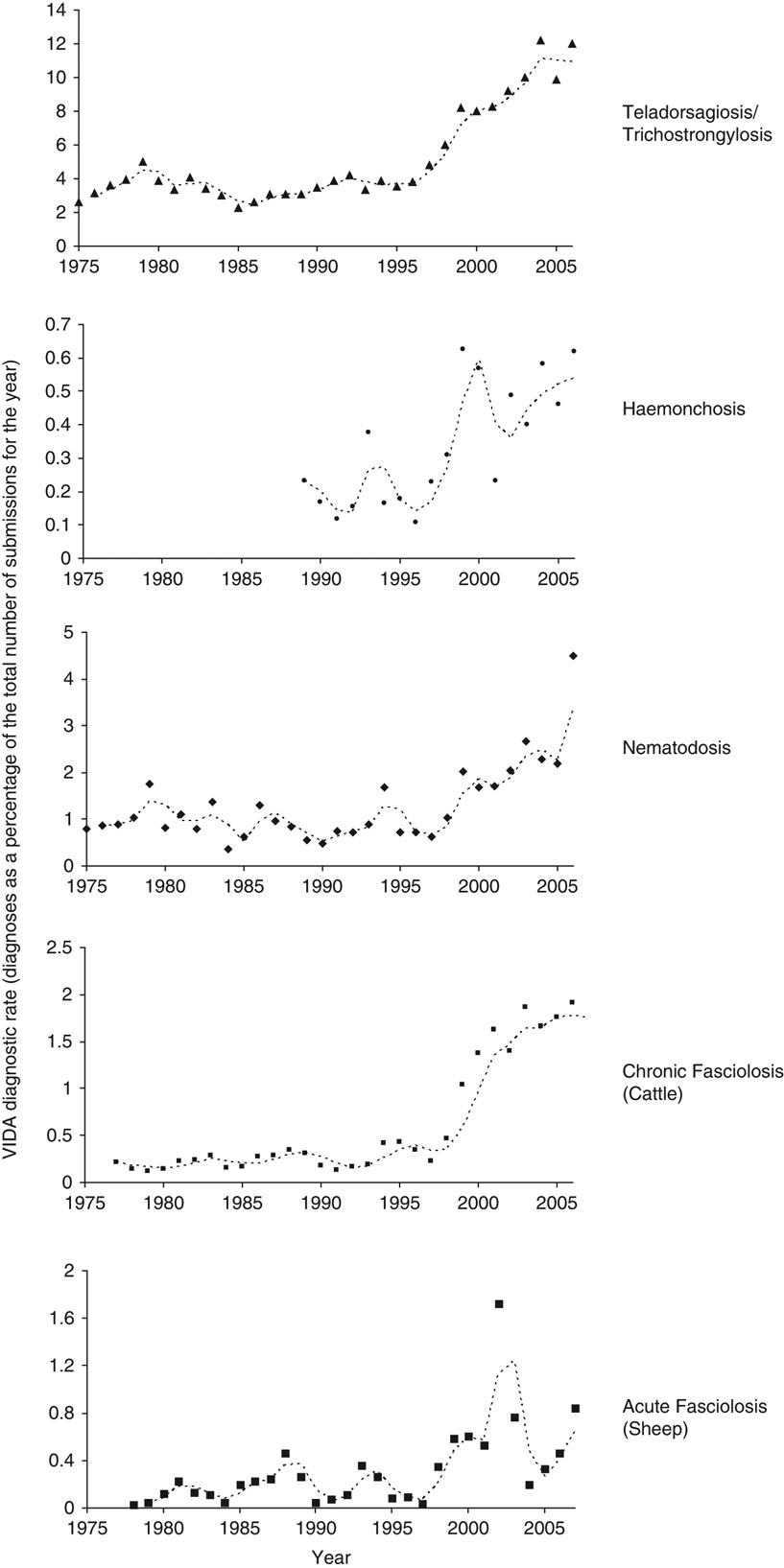
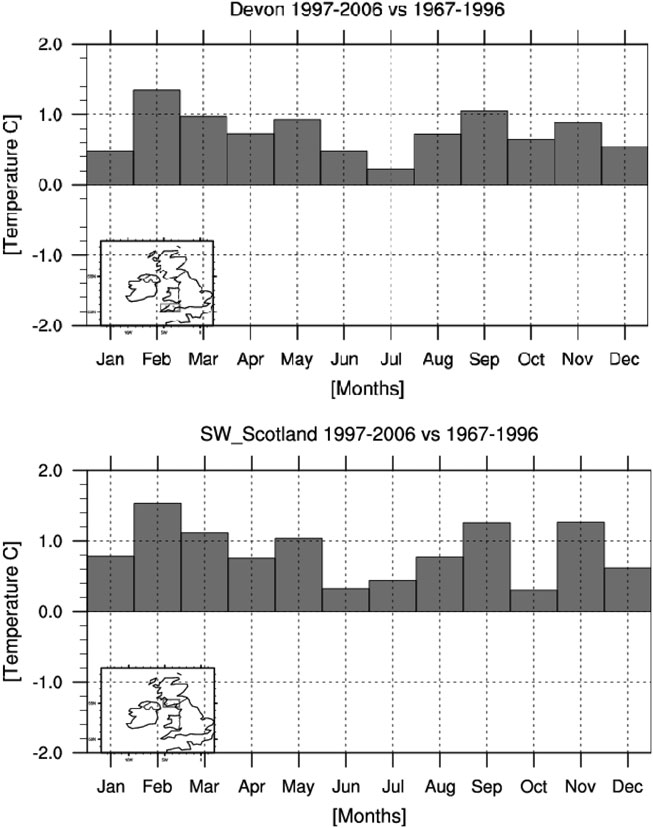
Many of the above-described observed patterns were confirmed in a robust analysis of long-term surveillance data. van Dijk et al. (Reference van Dijk, David, Baird and Morgan2008) analysed data on three different classes of gastrointestinal nematodes-affecting sheep. Over the past 5 to 10 years, the authors detected highly significant increases in GB annual diagnostic rates of H. contortus, N. battus, T. circumcincta and Trichostrongylus spp., approximately 4 to 5 times that of the levels experienced in the previous 20 to 25 years (see Figure 2) and coinciding with significant increases in mean temperature. For all species, there were signs that, in warmer environments, parasite transmission opportunities extended further into the autumn. In contrast to patterns described for Scotland above, for species such as T. circumcincta and Trichostrongylus spp., overwintering at pasture as larvae, significant decreases in observed spring disease frequency were observed. Most likely, this highlights that species in different regions, or even different localities within a region, may be affected by climate change in different ways (see Figure 3). Climate-related regional differences in grazing management may also have an important part to play.
GB long-term trends in Veterinary Investigation Diagnosis Analysis (VIDA) recorded diagnostic rates of disease in sheep and cattle resulting from infections with helminth parasites. Trend lines drawn by exponential smoothing. Disease incidence, in all classes, shows a highly significant increase (Spearman’s rho ⩾0.450, P ⩽ 0.005) apparently starting in the late 1990s. Data sourced at VLA Weybridge.

Mean monthly mean temperature 1997 to 2006 as an anomaly of the previous 30 years, in two livestock-dense areas in the UK (Southwest Scotland and Devon). Warming not only occurs at different rates during different months of the year, there are also differences between regions within the UK. Overall the southwest of Scotland appears to be warming at a slightly faster rate. Such mean monthly differences may appear small yet represent a significant difference in degree-days (Hsu and Levine, Reference Hsu and Levine1977) available for development.

Regional differences in parasite epidemiology, a shift in the relative importance of the autumn months and an overall UK decrease in the abundance of infective larvae in spring can all be explained by above-mentioned predicted effects of global warming on the free-living stages of these parasites. The observed temporal shifts in parasite abundance may indicate that the benefits of increased development rates outstrip the disadvantages of increased death rates during some times of the year, but not in others. However, especially for Haemonchus and Trichostongylus spp., the parasite population would also be predicted to benefit from increased developmental opportunities in spring and early summer. It is very likely that this illustrates the simple fact that the abundance of parasites, apart from climatic factors, strongly depends on their opportunity for interaction with hosts, which will be further discussed below.
Confounding factors
A number of factors other than climate change may influence patterns of helminth parasitism in the UK livestock. Confounders may include the following:
Anthelmintic resistance
Recent surveys show that anthelmintic resistance is now widespread in large parts of the UK, affecting up to 80% of lowland sheep farms (Bartley et al., Reference Bartley, Jackson, Johnston, Coop, Mitchell, Sales and Jackson2003), and numerous cases of multidrug resistance have been identified (Sargison et al., Reference Sargison, Wilson, Bartley, Penny and Jackson2007). There are also reports of emerging resistance to triclabendazole, the drug of choice to treat fluke infections, in the west of Scotland (Mitchell et al., Reference Mitchell, Maris and Bonniwell1998; Brennan et al., Reference Brennan, Fairweather, Trudgett, Hoey, McCoy, McConville, Meaney, Robinson, McFerran, Ryan, Lanusse, Mottier, Alvarez, Solana, Virkel and Brophy2007). However, as anthelmintic resistance has not been described in N. battus, it cannot explain the rise in the diagnostic rate of nematodirosis. Anthelmintic resistance alone can also not account for observed changes in temporal and spatial patterns of disease abundance in Great Britain. For example, for H. contortus and N. battus, significant increases in parasite abundance have been identified for the colder northern parts of GB, but not for the warmer southern parts (van Dijk et al., Reference van Dijk, David, Baird and Morgan2008). Anthelmintic resistance is likely to confound many of the observed changes but, currently, the rate of increase of the presence of resistant worm populations on farms cannot be quantified. Moreover, conversely, effects of anthelmintic resistance on disease rates may be confounded by climate change. Predicted changes to the UK weather are likely to lead to both longer grazing seasons and extended parasite transmission seasons which will, in turn, require increased anthelmintic treatment frequency thus compounding the problem. Climate change may also alter the proportion of the parasite population outside of the host, not exposed to the drug, at the time of anthelmintic treatment (the population in refugia; Martin et al., Reference Martin, Le Jambre and Claxton1981; Sissay et al., Reference Sissay, Asefa, Uggla and Waller2006). For example, summer droughts may decrease the relative size of the pasture population of nematodes (Papadopoulos et al., Reference Papadopoulos, Himonas and Coles2001), thereby increasing the rate of build up of anthelmintic resistance at this time of the year.
Parasite evolution
As stated previously, helminth parasites typically have enormous biotic potential and are inherently genetically diverse. This provides them with the ability to adapt rapidly to changes in their environment (Gasnier et al., Reference Gasnier, Rondelaud, Abrous, Carreras, Boulard, Diez-Banos and Cabaret2000). Important drivers for parasite evolution, apart from a changing climatic environment, include changing host–parasite interaction patterns, density dependence and competition between parasites (Poulin, Reference Poulin2007). Indirectly, on a farm, all of these (e.g. changes in grazing patterns, lambing season and the seasonal succession of worm species) are likely to be driven by the weather and, therefore, parasite evolution is unlikely to be a true confounder.
Farm management practices
Changes in the EU subsidy support and low-economic returns from livestock farming have generally resulted in reduced manpower and increasing flock sizes. Intuitively, this might be expected to make parasite control logistically more difficult to achieve or of lower priority. However, van Dijk et al. (Reference van Dijk, David, Baird and Morgan2008), analysing census data, did not find indications that these factors have led to an intensification of sheep farming in the UK.
Motivation to submit samples
van Dijk et al. (Reference van Dijk, David, Baird and Morgan2008) did not find evidence that submission rates to veterinary laboratories are correlated with farmers’ income. Increased awareness of anthelmintic resistance may have increased the number of samples submitted for testing of effectiveness of treatments but, in the Veterinary Investigation Diagnosis Analysis database, such submissions are recorded under a separate category.
Animal movements
Parasitic pathogens may be introduced to new environments or onto new premises this way. For example, H. contortus, originally only endemic in the southern parts of England, appears to have been introduced to Scotland through animal movement. Robinson and Christley (Reference Robinson and Christley2006) reported a slight upward trend in cattle movements in recent years. To our knowledge, analyses describing recent trends in the UK sheep movements are not available. It is unlikely that an increase in animal movements would result in upward trends for all species at approximately the same time.
After consideration of confounders, climate change is likely to be a driver behind the trends described above. However, the proportion of increase in diagnoses ascribed to anthelmintic resistance can currently not be estimated.
Changing host–parasite interaction
Apart from changes in the way parasites may utilise the host for overwinter survival (as discussed below), alterations in the seasonality of worm species are likely to lead to changes in the frequency and intensity of host contact and within-host encounter rates of different species of parasites. Predictions of future parasite epidemiology will, therefore, have to be co-shaped by host immunity and co-infection of hosts.
Host immunity
Lower-level, trickle-type, nematode infections are often tolerated by hosts, whereas mass invasions of the same parasites may invoke strong immune responses and an expulsion of all established worms (Behnke et al., Reference Behnke, Barnard and Wakelin1992; Rothwell, Reference Rothwell1989). Given these dose-dependent responses of hosts, climate-driven higher infections levels may not necessarily present the optimum strategy for population growth of parasites (e.g. Eriksen et al., Reference Eriksen, Nansen, Roepstorff, Lind and Nilsson1992; Boes et al., Reference Boes, Medley, Eriksen, Roepstorff and Nansen1998). Working with a natural host–parasite system, Hudson et al. (Reference Hudson, Cattadori, Boag and Dobson2006) even proposed that host immune systems may mitigate climate-driven effects on free-living stages altogether. However, the observed changes described above strongly suggest that this may not be the case for intensively farmed livestock.
Lower survival rates of larvae at pasture during warmer winters (Kao et al., Reference Kao, Leathwick, Roberts and Sutherland2000; van Dijk et al., Reference van Dijk, David, Baird and Morgan2008) are likely to lead to lower levels of infections, and immunity, in young animals in spring followed by a more rapid and prolonged build-up of infective larvae later in the grazing season. As a result, animals may be older when first encountering higher levels of infection and the effect of this on parasite populations is not clear. Similarly, little work has been carried out on the contribution of infections of older, immune, animals to the total on-farm population of parasites. Therefore, it is not known what role higher levels of infections of these animals in autumn would play in on-farm parasite epidemiology. However, it is likely that, in warmer autumns, higher numbers of ingested larvae will eventually hypobiose in these animals, leading to an increase in intensity of pasture contamination by adult animals in the following year. The uncertainty surrounding the effects of higher levels of infections of immune animals in autumn is compounded by evidence that the immune response of hosts is also influenced by seasonality and may wane during the autumn (Altizer et al., Reference Altizer, Dobson, Hosseini, Hudson, Pascual and Rohani2006; Cornell et al., Reference Cornell, Bjornstad, Cattadori, Boag and Hudson2008).
Co-infection
As a result of changes in seasonality, the transmission windows of two worm species traditionally overlapping may be separated. However, predicted expanding transmission windows for all species involved make an increase in the overlap of these windows a more likely prospect. If one parasite species limits the energy available to a host to mount an effective immune response (Medley, Reference Medley2002) to another species, ‘mutualism’ might be observed between these species. Co-infections may also lead to an increased virulence of individual species (Alizon and van Baalen, Reference Alizon and van Baalen2008). However, if humoral and non-humoral immune responses against two species are very similar, the response to one species may also limit the establishment of the other (Lello et al., Reference Lello, Boag, Fenton, Stevenson and Hudson2004). Recent work has suggested that, in the long-term, antigenically similar parasites cannot co-exist in one host (Alizon and van Baalen, Reference Alizon and van Baalen2008). Furthermore, one species may affect the other negatively by altering the physiological status of the intestine, for example, the pH (Mapes and Coop, Reference Mapes and Coop1973), or through competition for the same intestinal surface (Keymer, Reference Keymer1982; Boag et al., Reference Boag, Lello, Fenton, Tompkins and Hudson2001).
T. circumcincta live in the abomasum of sheep, whereas T. colubriformis is an inhabitant of the small intestine. Under laboratory conditions, a dose-dependent synergistic effect has been described for concurrent infections with these species (Dobson et al., Reference Dobson, Barnes and Windon1992; Steel et al., Reference Steel, Jones and Symons1982; Sykes et al., Reference Sykes, Poppi and Elliot1988). When sheep were infected with high doses of both worms, their adult worm burdens and weight loss exceeded those expected from single species infections. Such positive effects of one worm species on the establishment rate of another have also been described for naturally infected, non-domesticated, animals (Lello et al., Reference Lello, Boag, Fenton, Stevenson and Hudson2004). However, Jackson et al. (Reference Jackson, Jackson, Coop and Huntley1992) reported a negative interaction between T. circumcincta and T. vitrinus, like T. colubriformis, an inhabitant of the small intestine. Similarly, Mapes and Coop (Reference Mapes and Coop1973) showed how the abomasal parasite, H. contortus, suppressed the establishment of N. battus in the small intestine. At pasture, in groups of naturally infected lambs, the opposite was observed (van Dijk, J., unpublished data): high H. contortus egg outputs by lambs were heavily suppressed during the mass invasion of these lambs with N. battus larvae, but resumed once the lambs had managed to remove the resulting established N. battus worm burden. Negative interactions were also established between two abomasal parasites, T. circumcincta and H. contortus (Dobson and Barnes, Reference Dobson and Barnes1995). It appears that the effects of co-infection of hosts cannot be easily predicted in terms of their location in the intestinal tract (crowding). Poorly understood physiological perturbations caused by one species may disrupt the other (Mapes and Coop, Reference Mapes and Coop1973; Dobson and Barnes, Reference Dobson and Barnes1995). In single-species infections, it was shown that immune responses are necessary for density dependence (Paterson and Viney, Reference Paterson and Viney2002). This is likely to also be the case for multispecies infections. Thus, immune reactions against one, two or multiple species within one host may be depending on the density of the individual species (Conwill-Jenkins and Phillipson, Reference Conwill-Jenkins and Phillipson1971; Behnke et al., Reference Behnke, Barnard and Wakelin1992; Medley, Reference Medley2002). An immune response may be targeted towards one species but be directed towards a different species, if the number of worms exceeds a certain threshold. For worms affecting livestock, such threshold levels are known neither for single nor for multispecies infections.
Parasite adaptation
Changes in overwinter survival rates of larvae at pasture and an extension of windows of opportunity for transmission are likely to drive adaptations of overwintering strategies of parasites. Alterations in the seasonality of species, leading to increased competition between species within the host, may select for worms developing a strategy to avoid co-infection. For N. battus, the hatching of eggs may become increasingly difficult in the future and the parasite is likely to have to explore alternative mechanisms for hatching (van Dijk and Morgan, Reference van Dijk and Morgan2008 and Reference van Dijk and Morgan2009). As temperature thresholds for development and hatching of larvae are strong determinants of the epidemiology of all helminths, it is likely that adaptations of these temperature thresholds would represent effective ways to influence the timing of appearance at pasture. Crofton (Reference Crofton1965) and Crofton et al. (Reference Crofton, Whitlock and Glazer1965) showed that adaptation of developmental thresholds of H. contortus may indeed occur in the field. However, it was estimated that the observed divergence had occurred over hundreds of worm generations. Recent evidence indeed suggests that adaptations of temperature thresholds are very slow to occur (Troell et al., Reference Troell, Waller and Hoglund2005; van Dijk and Morgan, Reference van Dijk and Morgan2008 and Reference van Dijk and Morgan2009).
An alternative means to alter patterns of emergence at pasture include adaptations to the process of hypobiosis. This trait appears highly adaptable to local climate, as demonstrated by its absence in areas where development and transmission are secured all-year-round (El-Azazy, Reference El-Azazy1990; Waruiru et al., Reference Waruiru, Thamsborg, Nansen, Kyvsgaard, Bogh, Munyua and Gathuma2001). Local environmental cues driving the hypobiotic process include temperature (Jacobs and Rose, Reference Jacobs and Rose1990; Fernandez et al., Reference Fernandez, Fiel and Steffan1999), photoperiod (Langrova and Janskova, Reference Langrova and Janskova2004; Lutzelschwab et al., Reference Lutzelschwab, Fiel, Pedonesse, Najle, Rodriquez, Steffan, Saumell, Fuse and Iglesias2005), and drought (Giangaspero et al., Reference Giangaspero, Bahhady, Orita and Gruner1992; Ndamukong and Ngone, Reference Ndamukong and Ngone1996). Interestingly, Langrova and Janskova (Reference Langrova and Janskova2004) suggested that the proportion of larvae arresting may also depend on the effects of these environmental cues on the hosts. Gaba and Gourbiere (Reference Gaba and Gourbiere2008) showed that the duration of hypobiosis is crucial to the success and stability of parasite populations. Alterations of the hypobiotic period may therefore be expected. Gaba and Gourbiere (Reference Gaba and Gourbiere2008) demonstrated that, if the timing of the arrest of development were to change as a result of climate change, the consequences for parasite populations are highly unpredictable.
van Dijk and Morgan (Reference van Dijk and Morgan2008 and Reference van Dijk and Morgan2009) proposed that climate change may represent increased uncertainty in transmission opportunities of helminth parasites. They held this uncertainty responsible for apparent bet-hedging in N. battus. Instead of hatching in spring, as traditionally observed, this parasite appears to increasingly also hatch in autumn, leading to an observed significant rise in autumn disease in certain regions (van Dijk et al., Reference van Dijk, David, Baird and Morgan2008). Apart from increases in climatic uncertainty, changing farm management practices may also represent increased uncertainty to parasites. Such uncertainty is likely to lead to parasites hedging their bets (Fenton and Hudson, Reference Fenton and Hudson2002; Meyers and Bull, Reference Meyers and Bull2002), i.e., adopting more than one phenotypic strategy.
In conclusion, true genetic change (microevolution) is likely to be a slow process involving many parasite generations. However, changes in the phenotype distribution of parasites without a change in genotype (phenotypic plasticity), as well as dispersal to new, better-suited, habitats, can occur relatively rapidly, i.e., within years (Davis et al., Reference Davis, Shaw and Etterson2005; Visser, Reference Visser2008). Therefore, parasite adaptation may rapidly lead to unexpected epidemiological patterns at pasture. It is of great, clinical, importance to determine which parasite traits are likely to be plastic.
Conclusions and recommendations
We found clear indications that climate change, apart from affecting the well-documented spatial spread of exotic diseases, has already changed the overall abundance, seasonality and spatial spread of endemic helminths in the UK. The observed changes are likely to be driven by the direct influence of temperature, and perhaps rainfall, on the free-living stages of these parasites. For the individual stages in the life cycles of these parasites, these influences have been studied in some detail. However, as it is still unclear which aspects of temperature (e.g. minimum, maximum, mean, falling and rising temperature fluctuations) best describe the effects on parasites, it will remain a challenge to quantify the effects of realistic warming scenarios. Also, especially with respect to snail-borne parasites like F. hepatica, it remains impossible to quantify the effects of rainfall-related parameters on the development and abundance of parasite and intermediate host. Climatic parameters, such as environmental temperature, often have contrasting effects on different stages of the life cycle. It may only be possible to get to grips with the effects of climate change on parasite population dynamics, and start to develop worm control strategies for the future, by taking all such effects into account simultaneously. Mathematical models are ideally placed to address these issues, especially when interfaced with Geographical Information Systems technology.
Observed recent changes in the epidemiology of nematodes, putatively related to climate change, can all be explained by the effects of temperature. It appears that, overall, for these parasites, the positive effects of extra development opportunities and increased development rates, through warming, outweigh the negative effects on environmental survival. However, the net effect of temperature on parasite dynamics is likely to vary between regions within the UK, between years and even between the months of the year.
Addressing the complexity in the population dynamics of the free-living stages is a challenge in itself. Changes in host–parasite dynamics and parasite–parasite competition within hosts, brought about by changes in seasonality, will go hand in hand with changes in the abundance of free-living stages. Currently, the effects of these factors are largely to be addressed in real pasture situations and the direction of their overall impact can only be guessed at. Add to this likely climate-induced changes in farm management (e.g. pasture management and parasite control policies; Morgan and Wall, Reference Morgan and Wall2009) and land use and it is clear that there is a mountain to climb before we can predict even the near future with any certainty. Moreover, changes that do not favour the persistence of parasite species on farms, as well as changes that do, will lead to parasite adaptation. There are already indications that parasites adapt rapidly to, for example, temperature changes. In order to be able to anticipate short-term adaptation, there is a need to describe parasite traits that are likely to be plastic, to understand their underlying genotypic and phenotypic mechanisms and work out expected rates of adaptation.
Helminth parasites are likely to be highly sensitive indicators of the effects of climate change on infectious organisms. On one farm, several or all parasite species are likely to be present. These species have different temperature-related thresholds and vital rates, moisture requirements and overwinter survival strategies. The study of such semi-controlled host–parasite systems, in particular the study of on-farm species shifts, may give vital information on infectious organisms and strategies that are likely to benefit from climate change. At the same time, farm management, which may change abruptly, poses rapid changes to the environment of these parasites and their hosts. Such environments may be ideally suited to study (rates of) parasite adaptation.
At this moment in time, measurable changes in the UK parasite epidemiology, likely to be at least in part related to climate change, have already taken place. Analysing these recent changes, therefore, may be a fruitful and reliable way of developing testable hypotheses on future parasite epidemiology. In order to be able to analyse these and future changes, it is vital to establish a baseline and to conduct parasite surveillance. Given the likely regional differences in parasite epidemiology, and responses to climate change, it is important to conduct this sort of surveillance at the appropriate scale. This also highlights the urgent need for laboratories involved in generating surveillance data to work along centrally agreed laboratory protocols and case definitions. Obviously, were such protocols to be agreed between countries and continents the impact of the surveillance undertaken would be dramatically increased.
Apart from analysing recent changes, another strategy that may give us vital clues on future parasite epidemiology is the study of parasites, which have already adapted to new environments. Once again, as some helminth species arrived here from the Tropics while others originated in the Arctic, these parasites are likely to provide useful models. Similarly, the study of the behaviour of endemic parasites at different latitudes may become increasingly important.
In short, we identify the following priorities for further research:
1. Improved diagnosis and active surveillance of parasitic helminth disease in the UK livestock.
2. Identification of the easily obtainable, essential, climatic parameters driving the abundance of the free-living stages of helminth parasites and quantification of their effects upon these stages. In particular, the effects of rainfall and humidity, likely to be essential for population growth of snail-borne parasites like F. hepatica.
3. Quantification of the overall effects of climatic changes on parasite dynamics. Once the effect of essential climatic parameters on free-living stages has been identified, the resultant effect can only be addressed in (mathematical) modelling frameworks. A clear challenge here will be to optimise the number of parameters to be included: too few and the models will give unrealistic output; too many and the models cannot be analysed. An explicit analysis of parameter uncertainty, after modelling parameters stochastically, is likely to assist in the optimisation process (Morgan et al., Reference Morgan, Milner-Gulland, Torgerson and Medley2004). A second stern challenge is posed by the incorporation of the logistics of grazing strategies, and pasture use, in these models. Morgan et al. (Reference Morgan, Medley, Torgerson, Shaikenov and Milner-Gulland2007), working with groups of migrating hosts, have shown that this is achievable.
4. Research towards better tests for anthelmintic resistance, as well as increased active surveillance for anthelmintic resistance, so that we can quantify its effects and take appropriate steps to manage its spread. If anthelmintic resistance cannot be measured in populations, it is unlikely that the true extent of the effects of climate change will ever be quantified.
5. Investigation of which traits of these parasites are likely to adapt rapidly, as well as likely rates of adaptation. The degree to which larval populations hypobiose, and perhaps the length of the period of arrested development, are examples of traits likely to adapt rapidly.
6. Investigation into the effect of infections of different age groups, in particular infections of older, partially immune, animals in autumn on worm population dynamics.
7. Investigation into the effect of changing patterns of co-infection of hosts on the population growth of individual species. At realistic pasture levels of infection, for the pathogenic parasites concerned, very little is known about this subject.
8. Identification of likely adaptation of farm management to climate change. Are farmers currently adapting grazing, lambing and calving patterns? In terms of worm control, in the absence of clear guidance, how do farmers envisage to react to observed changes in the short term?
9. Continuing research into alternative strategies for parasite control, especially vaccination and rotational grazing, so that we have options for the control of endemic parasites that are more of a threat than ever as a result of climate change.
Climate change and the need to develop sustainable parasite control strategies pose a tremendous challenge to the livestock sector. It is likely that close collaboration between veterinary parasitologists, biologists, climatologists and modellers will be required to head these challenges. It appears all have their work cut out for some years to come.