Introduction
Cold-water coral reefs are biodiversity hotspots of the deep sea. In contrast to their shallow, tropical counterparts, these reefs are dominated by only a handful of reef framework-forming scleractinian corals, yet these few species build vast and structurally complex reefs that support up to an estimated 1300 species (Roberts et al., Reference Roberts, Wheeler, Freiwald and Cairns2009). Since the discovery of the ecological importance of these diverse, deep-sea communities, and the rapid technological advancement for exploring the deep sea at the end of the last century, interest in cold-water corals has grown rapidly. For the North Atlantic, Lophelia pertusa is the best studied, arguably most significant, and most widespread reef-building cold-water coral (e.g. Rogers, Reference Rogers1999; Freiwald & Roberts, Reference Freiwald and Roberts2005). Despite this attention, observations of the behavioural ecology of L. pertusa remain limited due to the inaccessibility of their remote, deep-sea homes. However, in contrast to many deep-sea species, L. pertusa has an extensive depth range (39–3380 m, Mortensen, Reference Mortensen2001) and is able to survive collection and transport to marine laboratories where they can be maintained for months to years (e.g. Hennige et al., Reference Hennige, Wicks, Kamenos, Perna, Findlay and Roberts2015). This allows an insight into their behaviours that is beyond the scope of our current capabilities in situ. Here we report on feeding behaviours recorded in laboratory mesocosms that suggest that the feeding strategies of L. pertusa are more diverse than previously thought.
It has been established that the diet of L. pertusa consists predominantly of zooplankton and phytodetritus (Carlier et al., Reference Carlier, Le Guilloux, Olu, Sarrazin, Mastrototaro, Taviani and Clavier2009; Mueller et al., Reference Mueller, Larsson, Veuger, Middelburg and van Oevelen2014), and previous laboratory observations reported that polyps caught food items through nematocyst adhesion (Mortensen, Reference Mortensen2001): that is, they capture items that come into contact with their tentacles. Polyps then transfer particles to the centre of the oral disc and into the pharynx for consumption. Mortensen (Reference Mortensen2001) noted that small amounts of mucus were also excreted when potential prey had come into contact with the tentacles but had subsequently escaped. Our understanding of the production of mucus in relation to feeding was previously limited to Mortensen's observations and it was thought that L. pertusa was limited to consuming food items that came into direct contact with its tentacles. Indeed, mucus excretion has been predominantly reported as a disturbance response (Mortensen, Reference Mortensen2001), an antifouling strategy (Reitner, Reference Reitner, Freiwald and Roberts2005) and to have a role in skeletal growth (Reitner, Reference Reitner, Freiwald and Roberts2005). However, we have now produced video evidence on a freshly collected L. pertusa specimen that L. pertusa is able to construct mucus nets that it casts into the water column to capture food.
Methods
Colonies of Lophelia pertusa were collected using a modified video-assisted Van Veen grab from 141–167 m depth at the Mingulay Reef Complex, Outer Hebrides, UK (56°49′N 7°23′W, see figure 1 in Hennige et al., Reference Hennige, Wicks, Kamenos, Bakker, Findlay, Dumousseaud and Roberts2014), in June 2011 during the ‘RRS Discovery’ D366/7 Cruise. Upon return to the surface, corals were placed in a holding tank at ambient seabed temperature conditions (9.5°C) for 2 days, to recover from collection, at which time polyps were extended and feeding and mucus was no longer visibly being produced (Hennige et al., Reference Hennige, Wicks, Kamenos, Bakker, Findlay, Dumousseaud and Roberts2014). Corals were then carefully fragmented into smaller pieces (Hennige et al., Reference Hennige, Wicks, Kamenos, Bakker, Findlay, Dumousseaud and Roberts2014). These fragments had 5–20 polyps, and were taken from the top of sampled colonies to ensure that relatively young polyps were used consistently, as polyp age can determine physiological response (Maier et al., Reference Maier, Hegeman, Weinbauer and Gattuso2009). Coral fragments were transferred to tanks in a 10°C temperature-controlled room, fed cultured Artemia salina, and acclimatized for 5 days (comparable to Naumann et al., Reference Naumann, Orejas and Ferrier-Pagès2014).
The fragment presented here was filmed for 1 h using a Canon PowerShot G9. The video was edited using Final Cut Pro X (version 10.3) and sped up five times.
Results and discussion
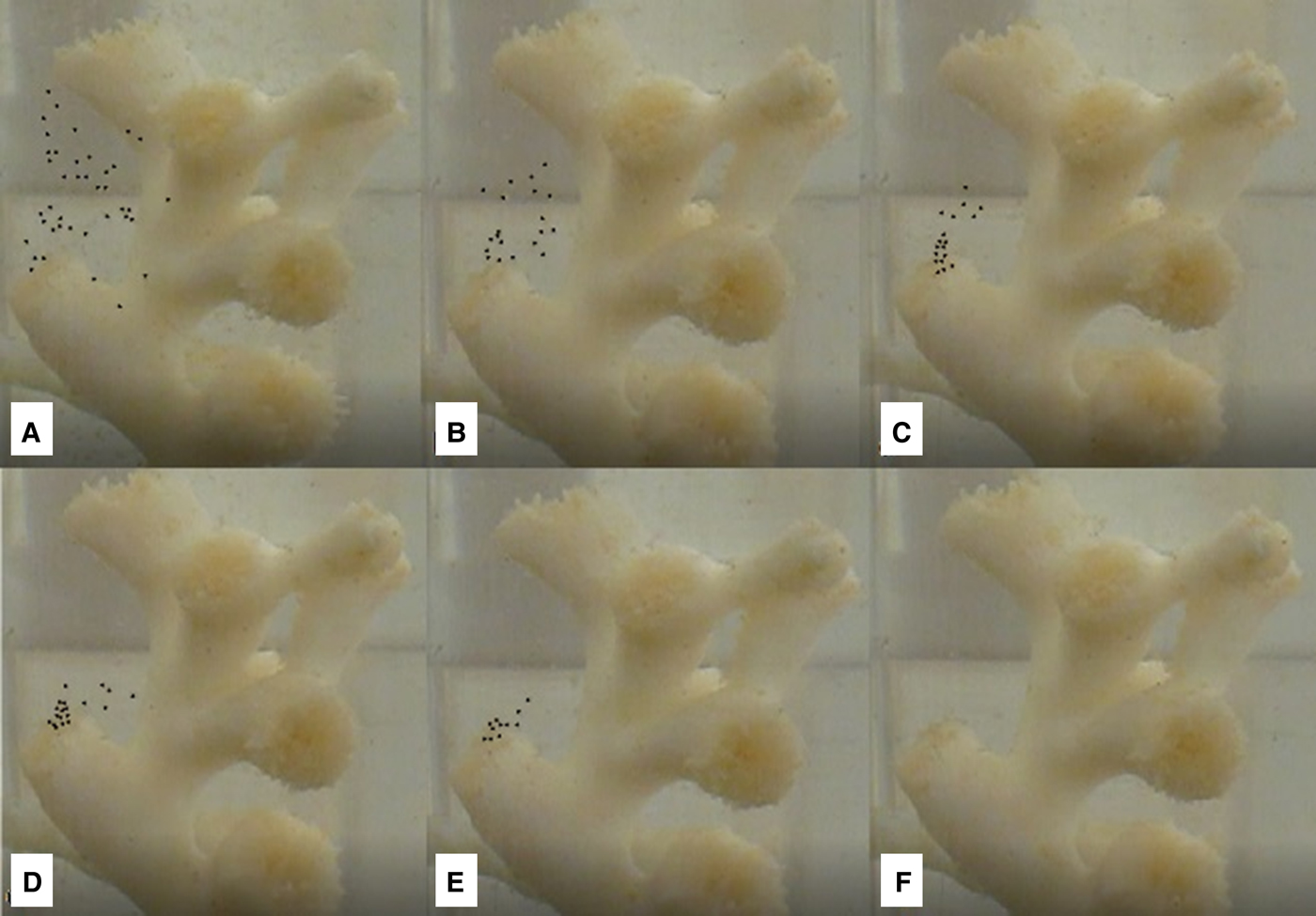
Following the introduction of A. salina, small quantities of mucus were released creating two distinct and separate mucus nets. Subsequently the nets and captured A. salina were consumed (Figure 1). The entire process from net production to consumption lasted ~18 min, far longer than an ROV (remotely operated vehicle) generally spends on a single patch of coral during deep-sea expeditions, making it difficult to observe such behaviours in situ. The key sequence is presented in still images (Figure 1) and video clips are included as a digital supplement (Video S1). Whilst corals habitually produce mucus as a stress response when collected, our acclimation procedures and observations that the mucus nets were only produced in the presence of food allows us to conclude that this is a feeding behaviour.
Production and consumption of mucus net: (a) free swimming A. salina, (b) production of mucus net and trapping of plankton, (c–e) pulling in of mucus net towards oral disc, (f) absence of mucus net after consumption. The black dots approximately represent visible A. salina.

These observations suggest that L. pertusa has a more diverse range of feeding strategies than previously thought. The prevalence and frequency of the use of mucus nets remains unknown, however other benthic species use a similar strategy and have been more comprehensively studied. Polychaetes (e.g. Hediste diversicolor; Riisgård, Reference Riisgård1991) and gastropods (e.g. Dendropoma maximum; Ribak et al., Reference Ribak, Heller and Genin2005) for example, produce mucus nets as part of their suspension feeding strategies. In both cases, environmental cues, such as food availability, have been shown to influence choice of feeding method.
Scleractinian coral mucus is functionally important and a prominent source of dissolved organic matter (DOM) in both warm- and cold-water coral reefs (Rix et al., Reference Rix, de Goeij, Mueller, Struck, Middelburg, van Duyl, Al-Horani, Wild, Naumann and van Oevelen2016). It plays a key role in nutrient cycling (Wild et al., Reference Wild, Mayr, Wehrmann, Schöttner, Naumann, Hoffmann and Rapp2008) and drives the ‘sponge loop’ – the key trophic pathway to transfer DOM, the most abundant nutrient-rich resource on tropical coral reefs, to higher trophic levels (de Goeij et al., Reference de Goeij, van Oevelen, Vermeij, Osinga, Middelburg, de Goeij and Admiraal2013). Our observations suggest that the functions of mucus for the coral itself may also be more diverse and important than first appears.
Supplementary material
The supplementary material for this article can be found at https://doi.org/10.1017/S0025315419000298
Author ORCID
Fiona Murray, 0000-0003-3312-0175.
Acknowledgements
This paper is a contribution to the UK Ocean Acidification Research Programme supported by Natural Environment Research Council NE/H017305/1, NE/K009028/1, NE/K009028/2.