Introduction
Adults can be highly variable in the way that they pronounce a word (e.g., Labov, Reference Labov1972), and children must ultimately learn to match this variation in their own output. Young children must also learn to match the output of basic phonological characteristics, e.g., pronouncing /f/ as voiceless labiodental fricative [f] rather than as the bilabial stop [pʰ], as some children do before mastery (e.g., Bernhardt & Stemberger, Reference Bernhardt and Stemberger1998). Are there any interactions between the child's learning to match the target speech sounds with their learning to match input variability? Can a child's output limitations lead to a skewing of the statistics, with some variants used at far higher frequency than in the adult input, and others at far lower frequency? This paper addresses the acquisition of variability in one aspect of the phonology of Akan, involving labio-palatalized consonants and front rounded vowels, before labio-palatalized consonants have been mastered.
A number of widely used theories have arisen that address phonological variability, including Optimality Theory (OT: e.g., Bernhardt & Stemberger, Reference Bernhardt and Stemberger1998; Boersma & Hayes, Reference Boersma and Hayes2001), exemplar models (e.g., Pierrehumbert, Reference Pierrehumbert, Bybee and Hopper2001; Frisch, Reference Frisch, Hannahs and Bosch2018), and Usage-Based Grammar (e.g., Bybee, Reference Bybee2006). These theories assume explicit mechanisms for how this variability is learned from input, and have frequently been applied to developmental data. However, the mechanisms are generally assumed as a whole without attempting to validate each assumption underlying them; analyses of developmental data usually show how the mechanisms are useful in a given instance, but do not always go on to argue that the mechanisms are also necessary and so are empirically supported by the data. Further, studies often do not address e.g., limits on overgeneralization in developing systems, and how well the theories account for those limits. The Akan data addressed here contributes to these issues.
Roberts (Reference Roberts1997) notes that there are several aspects to the mastery of input variation. First, a child must learn to recognize the variants that they are exposed to. Secondly, the child must learn to pronounce all variants that are used by every speaker in their speech community. Thirdly, the child must approximate the statistical distribution of variants in their own subgroup and understand the sociolinguistic importance of the statistics of variation. Roberts suggests that children may first learn the variation, becoming aware of sociolinguistic issues only later. Stemberger and Chávez-Peón (Reference Stemberger, Chávez-Peón and Rojas2018) address one instance of variability in Valley Zapotec and report that multiple variants are present for the same word in the speech of children as young as 1;8. Smith, Durham and Richards (Reference Smith, Durham and Richards2013) report use of multiple vowel variants for Scottish English at 2;10 (the youngest age in their study), and report (along with Díaz-Campos, Reference Díaz-Campos and Face2004, for Spanish and Nardy, Chevrot & Barbu, Reference Nardy, Chevrot and Barbu2013, for French) that by 3;6 or 4;0 children have begun to reflect sociolinguistic differences in their output of variable inputs. We do not know whether the variability that we address in Akan has any sociolinguistic conditioning, but we address whether children produce variability that statistically matches adult variation.
We first provide background in four areas:
(1) Akan phonology, secondary articulation in consonants, and variation involving labio-palatalized consonants;
(2) Development in other languages of labio-palatal glides, front rounded vowels, and secondary articulation in consonants, to establish an empirical basis for expectations about early vs late development; plus relevant information about Akan vowel development;
(3) Three variables that have been proposed as affecting whether an element is mastered early vs late: markedness, complexity and frequency; and
(4) Interaction between input variation and child output limitations, leading to predictions about the acquisition of variation involving Akan labio-palatalized consonants.
Akan phonology
The Akan language is a member of the Kwa sub-group of the Niger-Congo language family. It is mainly spoken in Southern Ghana and some parts of Côte d'Ivoire (Dolphyne, Reference Dolphyne1988; Abakah, Reference Abakah2016). The two largest dialects are Twi and Fante, with Twi sub-divided into Asante and Akuapem (Dolphyne, Reference Dolphyne1988); there are a number of additional dialects with fewer speakers. This paper focuses on the Asante dialect of Akan.
There have been a number of studies on the phonology and phonetics of Akan (e.g., Schachter & Fromkin, Reference Schachter and Fromkin1968; Dolphyne, Reference Dolphyne1988; Abakah, Reference Abakah2012), but it has not been studied as thoroughly as most European languages, and some details have yet to be reported. Research on phonological development in under-studied languages can reveal new details about adult pronunciations (e.g., Stemberger & Chávez-Peón, Reference Stemberger and Chávez-Peón2014, Reference Stemberger, Chávez-Peón and Rojas2018, for Valley Zapotec).
Table 1 lists the consonants and vowels of Akan, as a function of the complexity of place of articulation (which is important for this paper). Note that consonantal and vocalic place features are the same, but e.g., consonantal [Coronal] can have different effects on tongue shape than vocalic [Coronal]. Most of the consonants have only one articulator place feature (plus dependent features such as [+anterior] or [+back]), or none at all (glottals); the only Akan vowel with just one place feature is /a/. A few consonants (including the alveolopalatals and the approximants) and most vowels have two articulator features. Front rounded vowels and the labio-palatal glide are the most complex vocalic sounds, with three articulator features. The most complex consonants have secondary places of articulation, including palatalization (e.g., /dʲ/, /sʲ/), labiovelarization (e.g., /kʷ/, /ŋʷ/) and labiopalatalization (e.g., /dᶣ/, /ɕᶣ/), which combine vocalic articulations like those of /j, w, ɥ/ with the primary consonantal place features of the base consonant. Examples of labiovelarized and labio-palatalized consonants and their corresponding features are indicated in Table 1 below.
segmental inventory of adult Akan, by complexity of place features

Akan has a vowel system that is common among African languages, with a major distinction between [ATR] (/i, e, u, o/ and [æ]) and [RTR] (/ɪ, ɛ, a, ʊ, ɔ/). There are cooccurrence restrictions within roots and assimilation involving affixes for [ATR/RTR] and for vowel rounding. There are also several nasalized vowels, and each vowel or syllabic consonant has either a high tone (e.g., [á]) or a low tone (e.g., [à]). Schachter and Fromkin (Reference Schachter and Fromkin1968) report that [y] occurs, noting that there is variability across dialects and implying (but not overtly stating) that it is variable even within the speech of one speaker. A word such as dua ‘tree’, broadly transcribed as /dᶣìá/, may vary between [dᶣìá] and [dỳá]; we refer to the transfer of the vocalic features [Dorsal, Coronal, Labial] from the consonant to the vowel as Labiopalatalization Shift. Because [y] and [ʏ] are predictable, we will use allophonic square brackets rather than phonemic slashes. More recent discussions of Akan phonology do not mention front rounded vowels (e.g., Dolphyne, Reference Dolphyne1988; Abakah, Reference Abakah2016). Below, we provide preliminary quantitative data from five adult native speakers, to document that Labiopalatalization Shift exists, that it is restricted to high vowels (as Schachter and Fromkin imply), and that the front-rounded-vowel variant is in the minority; we return below to the issue of whether we can be sure that it is the minority pattern in child-directed speech.
Secondary articulation is essentially the imposition of an approximant-like constriction similar to [j, w, ɥ] (with slightly greater constriction than in high vowels) onto a consonant in addition to its primary consonantal constriction (e.g., Ladefoged & Maddieson, Reference Ladefoged and Maddieson2007, p. 354). Abakah (Reference Abakah2004) reports that all consonants in Akan are contextually rounded before rounded vowels and describes e.g., /ku/ as [kʷu]; the [d] in [dỳá] is similarly contextually rounded. We note that this contextual rounding differs from contrastively labiovelarized consonants in e.g., /kʷa/, in that [kʷʰa] usually has a perceptible glide-like element before the vowel, due to a lengthened transition into the vowel, while /ku/ does not. There is a noticeable off-glide in [dᶣi] but not in [dy]. Rather than talking about shifting the articulation onto the vowel, one could talk about merging the secondary articulation of the consonant with the articulation of the vowel; [ku] and [dy] can be viewed as parallel outcomes, except that [Labial] spreads from the vowel to the consonant in [ku] and from the consonant to the vowel in [dy]. The result is that complexity that was originally associated with the consonant in /dᶣi/ has become part of the vowel in [dy].
Relevant aspects of phonological development in other languages and in Akan
One source of information needed to develop expectations about early vs late development of speech sounds in Akan is research on similar sounds in other languages. There is research on the acquisition of labiovelarized consonants in several languages, but not on labio-palatalized consonants. Demuth (Reference Demuth and McLeod2007) reported for Sesotho that labiovelarized consonants are mastered by 3;0, and that mismatches most often involve deletion of the secondary articulation (e.g., /sʷ/ as [s]). Mahura and Pascoe (Reference Mahura and Pascoe2016) reported for Setswana that labiovelarized consonants were successfully produced on some tokens in their youngest age group (3;0-3;5), but that mismatches involving deletion of the secondary articulation continued until 4;5. Nwokah (Reference Nwokah1986) reported late mastery in Igbo for labiovelarized consonants, with mismatches still occurring at age 4. Nwokah reports that, in addition to the (most common) deletion of the secondary articulation (e.g., /kʷ/ as [k]), the feature [Labial] can be promoted from secondary to primary articulation (e.g., /kʷ/ as [p], with vocalic [Labial] replacing consonantal [Dorsal]), or the primary articulation can be deleted to yield an approximant (e.g., /kʷ/ as [w]). No mismatches have previously been reported where the secondary articulation was shifted onto the following vowel.
Development of the labio-palatal glide /ɥ/ has been addressed for French and (French-based) Haitian Creole; the nature of the mismatches was not reported. MacLeod, Sutton, Trudeau and Thordardottir (Reference MacLeod, Sutton, Trudeau and Thordardottir2011) report for French that /ɥ/ met a 75% accuracy criterion for three-year-olds and a 90% criterion for four-year-olds. Archer, Champion, Tyrone and Walters (Reference Archer, Champion, Tyrone and Walters2018) report for Haitian Creole a 20% match for /ɥ/ among 3-year-olds, but mastery (100%) by 4;0.
Development of the front rounded vowels /y/ and /ʏ/ has been addressed for several languages. Stoel-Gammon and Dunn (Reference Stoel-Gammon and Dunn1985) report that the vowel system tends to be mastered much earlier than the consonant system. Fox (Reference Fox, Hua and Dodd2006) reports for German that all vowels (including /y/ and /ʏ/) are mastered by 1;6. There are a number of reports that /y/ and /ʏ/ are among the later vowels to be fully mastered: ca. 3;0 in Dutch (Beers, Reference Beers1995); after 3;0 in Finnish (Leiwo, Kulju & Aoyama, Reference Leiwo, Kulju and Aoyama2006); ca. 4;0 in Swedish (Lundeborg Hammarström, Reference Lundeborg Hammarström2019); after 4;0 in Hungarian (Zajdó & Stoel-Gammon, Reference Zajdó and Stoel-Gammon2003); and with lingering mismatches even for five-year-olds in Mandarin (Hsu, Reference Hsu1996). The vowels /y/ and /ʏ/ appear early in segmental inventories, but are often among the last vowels to be fully mastered. The nature of the mismatches is rarely reported, but examples suggest that unrounding (to [i, ɪ]) and backing (to [u, ʊ]) are most common.
Amoako (Reference Amoako2020) reports general characteristics of vowel development for Akan. Vowels show a surprising degree of mismatch even for five-year-olds. The two most common mismatches involve the feature [ATR] becoming [RTR] (e.g., /i/ as [ɪ]), possibly due to assimilation to adjacent vowels, and assimilation of rounding from a nearby vowel (e.g., bepo ‘mountain’ /bɪ́ǃpʰɔ́/ as [pʰʊ́!pʰɔ́]); that such mismatches are common even for five-year-olds may potentially be related to vowel harmony and cooccurrence restrictions within roots involving [ATR/RTR] and rounding. Unrounding was uncommon; all attested examples involve the mid vowels /o, ɔ/ unrounding to [ə, ʌ]. Backing errors were common only for the low vowel [æ] to [a]. If the vowels [y, ʏ] were to show a high rate of mismatch in features other than [ATR/RTR], they would stand out as different from all other vowels except [æ], which is of similar low frequency.
On the basis of the literature, we make the following predictions for Akan:
1) Labiovelarization and labiopalatalization will be mastered late, but some tokens of labiovelarized consonants will be present even at age 3. The most common mismatch will be deletion of the secondary articulation, with less common mismatches involving promotion of [Labial] to a primary articulation or deletion of the primary articulation (resulting in an approximant).
2) The labio-palatal glide /ɥ/ will be present even at age 3, but there will be some mismatches at least at age 3.
3) The front rounded vowels [y] and [ʏ] should be present even at age 3, though some level of mismatch is possible (especially backing or unrounding).
The vowels [y, ʏ] raise special issues, because they are predictable in the output. The term “mastery” can be used for both contrastive and predictable aspects of phonology (such as the contrastive voicelessness of the English stops /p, t, k/ and the predictable aspiration of [pʰ, tʰ, kʰ] in word-initial position). The variability of [y, ʏ] in Akan means that we cannot predict which tokens will target [dᶣ] and which [dỳ]. If the word dua /dᶣìá/ ‘tree’ is pronounced [dìá], the mismatch could involve loss of secondary articulation from labio-palatalized [dᶣ], or unrounding of front rounded vowel [ỳ]. We address this ambiguity below.
Three variables that may affect early vs late mastery: markedness, complexity, frequency
There are three factors that make predictions relevant to the mastery of labiopalatalization and the associated variability. In this instance, markedness and complexity make the same predictions, in opposition to the predictions of frequency, providing further information about what happens when different factors conflict.
Jakobson (Reference Jakobson1968/1941) proposed that markedness has an effect on acquisition: less marked elements tend to be mastered before more marked elements. This is assumed in some variants of OT (e.g., Prince & Smolensky, Reference Prince and Smolensky2004). Marked elements occur in fewer languages than unmarked elements; if a language has the marked element it always also has the unmarked element (but not vice versa). Maddieson (Reference Maddieson1980, Reference Maddieson1984) created a database of segmental inventories from 317 languages carefully selected to give a subsample of all human languages without overrepresentation of particular language families. Table 2 presents the relative frequency in the languages of the world of the speech sounds relevant to this paper.
cross-linguistic frequency of relevant vowels, approximants, and secondary articulation

The vowels /i, u/ and the glides /j, w/ occur in most languages, but front rounded /y, ɥ/ are much less common. Secondary articulation is also relatively uncommon, with labiovelarization being more common than labiopalatalization (occurring only once in the sample, in Akan). Labiovelarized consonants are unmarked relative to labio-palatalized consonants and should be acquired earlier. For labio-palatal segments, the expected order of acquisition by markedness is front rounded vowels, then the labio-palatal glide, then labio-palatalized consonants. Markedness relations are unclear for labiovelarized consonants and the labio-palatal glide /ɥ/, which differ along multiple dimensions. It should be noted that markedness is statistically related to frequency and complexity, since more marked elements tend to be of lower frequency in a given language than less marked elements (Jakobson, Reference Jakobson1968/1941), and more complex elements tend to be more marked than less complex elements (Greenberg, Reference Greenberg1965).
Articulatory complexity affects mastery of speech sounds in the output (e.g., Bernhardt & Stemberger, Reference Bernhardt and Stemberger1998, Reference Bernhardt and Stemberger2018), with less-complex elements (whether consonants, syllables, or phonological words) being mastered before more-complex elements. Bernhardt and Stemberger (Reference Bernhardt and Stemberger2018), reviewing cross-linguistic data for mastery of /l/, report that light (non-velarized) [l] is mastered relatively early (e.g., in Slovenian and Swedish), but that dark (velarized) [ɫ] is mastered late (e.g., in English and Portuguese); the addition of the secondary constriction delays mastery on average by about two years compared to light /l/, despite the high phoneme frequency of /l/ in English. Labio-palatalized consonants are complex and expected to be mastered relatively late, just as labiovelarized consonants are (e.g., Nwokah, Reference Nwokah1986). Vowels are often complex in terms of place, with e.g., /u/ combining a high back-tongue constriction with rounding; but this complexity seems to have less impact on vowel acquisition, with the vowel system developing earlier than the consonant system (e.g., Stoel-Gammon & Dunn, Reference Stoel-Gammon and Dunn1985).
Finally, frequency has been shown to affect mastery: high-frequency elements are mastered earlier than low-frequency elements. Pye, Ingram, and List (Reference Pye, Ingram, List, Nelson and van Kleeck1987) and Ingram (Reference Ingram1988) first showed that consonants are acquired earlier in languages where they are of high frequency (such as /tʃ/ in Quiche Mayan and /v/ in Swedish) than in languages where they are of low frequency (such as/ tʃ/ and /v/ in English). Bernhardt and Stemberger (Reference Bernhardt and Stemberger1998), while emphasizing the important role of frequency, noted that other factors can lead to the late acquisition even of high-frequency speech sounds: the consonants of English that are mastered latest (the “late eight”; Shriberg, Reference Shriberg1993) include /l, ɹ, s/, which are among the most frequent consonants in English. Beckman and Edwards (Reference Beckman and Edwards2010) find that phoneme frequency accounts for a significant portion of the variance relating to age-of-acquisition for speech sounds. Ambridge, Kidd, Rowland and Theakston (Reference Ambridge, Kidd, Rowland and Theakston2015) describe frequency effects as “ubiquitous” in language development. In adult Akan, front rounded vowels have lower token frequency than labio-palatalized consonants before /i, ɪ/ because they are the minority variant, and are lower in type frequency because labio-palatalized consonants additionally occur before other vowels.
These three factors make predictions about mastery of the variants associated with labio-palatalized consonants in Akan.
1) Since [y] is unmarked relative to [ɥ], and [Cᶣ] is even more marked, we expect that [y] will develop earliest, [ɥ] second, and [Cᶣ] last. Labiopalatalization Shift is favored.
2) Similarly, since complexity has less effect on vowels, and [Cᶣ] is the most complex, we expect that [y] will develop earliest, [ɥ] second, and [Cᶣ] last. Labiopalatalization Shift is favored.
3) In contrast, since [y] is less frequent, we expect that variants with [Cᶣ] will develop earlier than those with [y].
Interaction between input variation and child output limitations
One last issue is whether the child's output should reflect the adult input statistics or differ from it. If adults produce labio-palatalized consonants on X% of trials and front rounded vowels on Y% of trials, one could assume that that is what the child targets. Labio-palatalized consonants as in [dᶣi] would be targeted on X% of trials (with correct output or with mismatches such as [di]), while front rounded vowels as in [dy] would be targeted on the remaining Y% of trials (with correct output or with mismatches such as [di] and [du]). Alternatively, the child might deviate from adult statistics, over-using one variant or the other, possibly targeting only one variant. Theories differ on why deviations from adult statistics might occur, with two basic motivations: a general tendency to overgeneralize patterns in the data, especially high-frequency patterns (possible in all theoretical approaches); and a bias towards over-using an already-mastered adult variant and avoiding a still-inaccurate adult variant (possible in some theoretical approaches but not others). There is currently no theory that clearly lays out the conditions under which other factors can override frequency effects.
Most current theories predict earlier mastery of high frequency patterns, as noted above. In OT (e.g., Bernhardt & Stemberger, Reference Bernhardt and Stemberger1998; Boersma & Hayes, Reference Boersma and Hayes2001), this derives from error-driven learning and competition: high frequency entails more frequent trials and hence (before the system learns to produce the correct output form) more frequent learning trials. All other things being equal, in the case of two input variants, the more frequent variant will be learned earlier. Once the more frequent variant is learned, it will tend to outcompete the yet-to-be-mastered variant, leading to some overgeneralization of the more frequent variant. In exemplar models (e.g., Beckman & Edwards, Reference Beckman and Edwards2010), high-frequency items benefit from having more stored exemplars, leading to earlier learning; some degree of overgeneralization of the high-frequency patterns is natural in the system. Smith et al. (Reference Smith, Durham and Richards2013) present a possible example: in child-directed speech in their study of Scottish English, adults used the vowel [ʌʉ] more than twice as often as [u:] (.63 vs .37), and children used [ʌʉ] even more often (.76 vs .24). All other things being equal, current models predict over-use of the more frequent variant from variable pronunciations (though it is unclear what percentage of tokens should be affected by overgeneralization).
All other things are not equal. Some things are easier to master than others, with e.g., more-complex targets delayed relative to less-complex targets. There may be a point in development where a less-complex variant can be successfully output while a more-complex variant is not yet a possible output, regardless of differences in frequency. What happens for competing variants depends on whether phonological planning is sensitive to the child's output limitations. Non-modular theories allow such interactions, while modular theories do not (because modular systems are designed so that anything that happens in later modules cannot affect what happens in earlier modules); see McAllister Byun and Tessier (Reference McAllister Byun and Tessier2016) for a recent review of arguments for non-modularity (without discussion of input variability).
Consider first the most common variant of OT as applied to phonological development (e.g., Barlow & Gierut, Reference Barlow and Gierut1999; Bernhardt & Stemberger, Reference Bernhardt and Stemberger1998; Tessier, Reference Tessier2016). OT is based on the assumption that the output of a particular target word must be constructed from a full set of possible outputs, which are always in competition. The system of ranked constraints resolves the competition between alternative output elements; the rankings must be learned for each adult language, and the child's output differs from that of adults due to differences in constraint rankings. If a child is unable to output an adult target, the system resolves the competition in a non-adult fashion and outputs a different element that is the most optimal (the best it can do), given the limitations on output. If the constraint against fricatives is high-ranked, the child is unable to output the fricative /s/, instead selecting an accessible output, matching as many other features as possible. Depending on the relative ranking of constraints, the system might match the fact that /s/ is an obstruent (outputting the stop [t]) or a continuant (outputting the glide [j] or the lateral [l]), or eliminate the supralaryngeal articulation (outputting [h]). When an error occurs, the constraints are re-ranked to make that incorrect output less likely on the next attempt. There are different principles for re-ranking, and here we assume (following Bernhardt & Stemberger, Reference Bernhardt and Stemberger1998; Boersma & Hayes, Reference Boersma and Hayes2001) (a) that ranking is variable, slightly higher or lower around a mean value on particular trials, so that there is variability in the output, (b) that re-ranking is always by a small amount, to prevent catastrophic instability in the output, (c) that constraints whose violation prevented the target output are re-ranked slightly lower, and (d) that constraints that would have prevented the erroneous output are re-ranked slightly higher. Over accumulated learning trials, re-ranking gradually corrects errors, until a ranking is reached that is compatible with the input.
If the adult input presents two competing alternatives, the resolution of competition between the variants in OT may interact with the child's non-adult constraint rankings. For adult Akan, the constraints must be set to statistically favor labio-palatalized consonants over front rounded vowels. Early in development, it is likely that neither labio-palatalized consonants nor front rounded vowels will be possible outputs; the child will output something else (such as [di], with loss of the secondary articulation from /dᶣi/ or with unrounding from [dy]). There will be more learning trials for the more frequent labiopalatalized-consonant variants than for the less frequent front-rounded-vowel variants. But cross-linguistically vowels develop at a faster pace than consonants, so the shifted output [Cy] is likely to develop first, at first at very low frequency. As constraint rankings are adjusted further, the percentage of tokens with the [Cy] output increases, outcompeting non-adult competitors such as [Ci] and [Cu]. In adult speech, competition from the more frequent output [Cᶣi] keeps the output [Cy] in check, at low frequency. But when [Cᶣi] is not a possible output, [Cᶣi] will lose the competition with [Cy] as well as with [Ci]. Re-ranking to prevent the incorrect output [Ci] will gradually decrease the competitiveness of [Ci], which consequently will lose more often to the correct output [Cy], so that the [Cy] variant will be used more often than in adult speech. Eventually, when [Cᶣi] becomes a possible output, it will increase in frequency to become the most frequent output, and [Cy] will decrease back to its input frequency, out-competed by the more frequent variant. While it is in principle possible to set the constraint rankings such that [Cy] is output in e.g., only 25% of tokens, with the other 75% of tokens failing to match any adult input, such rankings require constant adjustment (to decrease the viability of the [Cy] output as the viability of non-adult competitors such as [Ci] decreases), and over-use of the front-rounded-vowel variants is likely. Further, the output [Cy] is a more faithful output than [Ci] is for the input /Cᶣi/, because the [Labial] in the input is present in the output (albeit in the wrong location); cf. the example from Smith (Reference Smith1973), where English queen /kwiːn/ is output as [kʰiːm], with /kw/ reduced to [k] and the [Labial] from /w/ migrating to the coda consonant. Given that [Cy] is a partially faithful output for target /Cᶣi/, error correction will lead to over-use, which must be corrected later.
Modular variants of OT also exist, though they are rarely used in research on phonological development. Hale and Reiss (Reference Hale and Reiss1998) maintain that the output of the phonological constraint system should be based on the adult perceived forms, and that the child's deviation from adult-like forms should be considered to be the result of motor limitations. The child constructs phonological outputs which are a good approximation of the adult input, which are then reduced by the motor system. Constraints must be ranked to output different phonological variants on different trials, in a way that matches the input statistics. For Akan, we predict that the percentage of tokens for /Cᶣ/ targets that contain [y, ʏ] will not exceed the range observed in adult speech.
To the extent that approaches such as exemplar models (e.g., Pierrehumbert, Reference Pierrehumbert, Bybee and Hopper2001) and Usage-Based Grammar (e.g., Bybee, Reference Bybee2006; Sosa & Bybee, Reference Sosa, Bybee, Ball, Perkins, Muller and Howard2008) are non-modular and based on competition, they can potentially overgeneralize the Labiopalatalization-Shift variants, despite their lower frequency. Modularity is rarely addressed in this literature; insofar as an analysis is crucially modular or non-modular, the issue is neither the focus of argumentation nor assumed to need empirical evidence (for recent discussion, see McAllister Byun & Tessier, Reference McAllister Byun and Tessier2016). This study provides relevant empirical data from the mastery of input variation in the output of Akan children.
Methods
Participants
Four native speakers of the Asante dialect of Akan were recruited from the Greater Vancouver Area: two males and two females, ranging in age from 25 years to 35 years, with a mean age of 31 years. They had lived outside of Ghana for less than ten years. All reported additional competence in the Fante and Akwapem dialects of Akan as well as in English, two reported being fluent in the Gã language, and one reported some exposure to French. None reported any speech or hearing problems. Each consultant was given a $20 gift card to a coffee shop as a token of appreciation for participating.
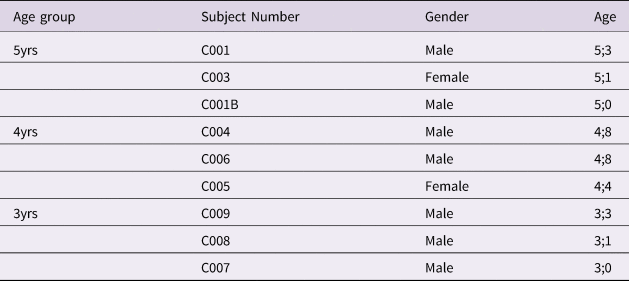
Nine typically developing children were recruited, who have always lived in Ghana (in the Asante region), who spoke the Asante dialect as their primary language, and who were between the ages of three and five years, with three children from each age group. Children were recruited from Kumasi through a preschool. Table 3 provides information about the children.
Summary of child participants (by age)

Based on information provided by parents/guardians, the children spoke no other dialect of Akan or other indigenous Ghanaian language, but did have some exposure to English. Parents/guardians reported no known speech or hearing disorders or developmental/language-related issues. Parental consent was provided for each child's participation and for multiple use of the data and audio recordings. Each child received a coloring book and coloring pencils as a token of appreciation for participating.
Materials
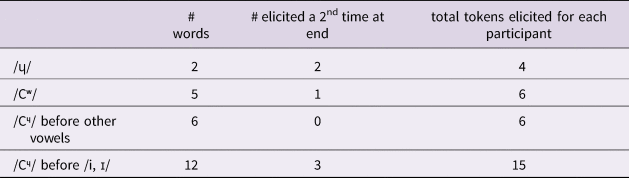
This is part of a general cross-linguistic project on phonological development (Bernhardt & Stemberger, Reference Bernhardt, Stemberger, Babatsouli, Ingram and Mueller2017), intended to be of use clinically for children with protracted phonological development, and to allow comparison with typically developing children. An Akan word list was constructed following the guidelines laid out in Bérubé, Bernhardt, and Stemberger (Reference Bérubé, Bernhardt and Stemberger2015), with 103 words that sampled all consonants, vowels, tones, and syllable types across different word positions and in words of different lengths, with each element sampled at least twice; all words can be easily and relatively unambiguously depicted with pictures or physical objects that are culturally appropriate for the language community. Some words were repeated at the end to allow evaluation of consistency. Amoako, Stemberger, Bernhardt and Tessier (Reference Amoako, Stemberger, Bernhardt and Tessier2020) present more detailed information about the word list, as well as results for general consonant development. Materials can be found on the web at http://phonodevelopment.sites.olt.ubc.ca/. Twenty-five of the words in the list are relevant to this paper and are listed in the Appendix, with spelling, transcription in IPA, and gloss. Six words were elicited twice. All consonants were targeted in both word-initial and word-medial position. Details are provided in Table 4.
target words analyzed in this study

This project is designed to obtain preliminary data on all aspects of a child's phonological system, in a way that allows comparison across languages, but that means that the amount of data on any given part of the phonological system is limited. Follow-up with more focused studies is desirable. It is possible that the inclusion of two tokens of the same word could skew our results, if the two tokens tend to output the same variants; we address this below.
Procedures
The word list was piloted with Akan-speaking adults, to confirm the initial transcriptions obtained from the dictionary and certified by the first author, providing a reference for what adult pronunciations would be expected (including allophonic characteristics). The first author administered the test as it was intended to be presented to children. Pictures were presented as a slide show (one picture per slide) using a laptop computer. Consultants were asked to name the pictures in Asante-Twi, as they appeared on the screen. For pictures which needed further description, especially where target words appeared in a particular context, the author provided prompts such as ne a esi pono no so no yɛ ____? “the object on the table is ___”, ɛyɛ dodoɔ sɛe? “how many are these”, and so on. For target verbs, consultants watched corresponding video clips and were asked to name the activity displayed in each video. Each word was elicited twice, followed by a use of the target word in a sentence, to provide a more naturalistic pronunciation. The session was audio-recorded using an M-Audio Microtrack II digital recorder with an external table-top microphone with excellent frequency response. Recordings were saved in an uncompressed .WAV file format, at a sampling rate of 44kHz. Recording sessions took place in either the homes of the consultant or at the Totem Field Studios elicitation room in the Department of Linguistics at the University of British Columbia. Each recording session lasted for approximately forty minutes. All sound files were backed up on an encrypted hard drive.
After all the adult consultants were recorded, their pronunciations were narrowly transcribed by both authors, using standard IPA symbols, and using perception-based transcription supplemented with acoustic information in Praat (Boersma & Weenink, Reference Boersma and Weenink2011). The transcribers first transcribed two sound files independently to ensure data reliability; one from a male consultant and the other from a female consultant. A discussion of these transcriptions was held to establish transcription conventions as a guide for subsequent transcriptions. Where transcriptions differed, both transcribers re-transcribed those particular tokens and discussed them until a consensus was reached, including reference to acoustic information using Praat. The recordings from the two other consultants were transcribed by the first author and checked by the second author, with similar consensus building afterwards. It should be noted that the second author is an advanced second-language speaker of a language that has front rounded vowels, including /y/. For the speech sounds relevant to this paper, Praat was used in several ways. First, a cursor was placed at the end of the transition from the consonant to the vowel so that identification as unrounded [i, ɪ] vs rounded [y, ʏ] could be made without the preceding consonant affecting perception; in all tokens, the transition ended and was followed by a steady state, ruling out the possibility that rounding diminished steadily throughout the vowel. Secondly, F2 was examined visually to confirm that it was substantially lower in suspected tokens of [y, ʏ] than in the child's [i, ɪ]. Lastly, the transition was checked to see if it was of typical duration for a consonant vs substantially lengthened (typical for contrastive secondary articulation).
Testing procedures for the child participants were similar to those used for the adult consultants, using the same recording equipment and file settings. All child testing and recordings were conducted in Akan by a trained assistant (an elementary-school teacher) recruited in Kumasi, Ghana. All children were recorded in their respective homes. If a child could not first identify the picture, cues were provided by the assistant, to aid the child in identifying that picture (e.g., what the object is used for). When a target word was not produced spontaneously after several attempts at elicitation, delayed imitation was used; e.g., where the target word was ‘frog’, a prompt such as “Is this a frog or a cup?”. In a tiny percentage of trials, direct imitation was used as the last resort, e.g., “Say: frog”.
The first author transcribed data from all nine children independently; the second author independently transcribed the data from three children (one from each age), and checked the data from the remaining six children against the author's transcriptions. Initial reliability for the independently transcribed data was 84.6% for consonants, and 100% after consensus building. One challenge for transcription involved the clarity of recordings. Recording children in their homes resulted in the masking of some tokens by background noise, e.g., doors slamming, siblings in the background, etc. Some tokens overlapped with the prompts being provided by the assistant. As a result, about 10% of the child tokens were discarded. Where more than one token of a target word was produced, tokens produced spontaneously with no adult overlap or background noise were selected for transcription over imitated tokens. In the rare event that the child spontaneously produced more than one clear token of a target word, both tokens were transcribed. This paper focuses on the production of labio-palatal glides and consonants with a secondary articulation; see appendix A for a full list of the relevant target words, with target pronunciation.
All statistical evaluation in this paper is done both by token and by child. Fisher's Exact Test of Probability (two-tailed) is used for by-token analysis of 2×2 contingency tables, to determine whether the two things being contrasted differ in the proportion of use of A vs B. To ensure that the differences are general across children, a two-tailed Sign Test is used for by-child analysis, to show that significantly more children show the difference than do not; the low number of participants sometimes interferes with this test, if the focus is on an output characteristic that is not used by all the children.
Results
Establishing what adults do
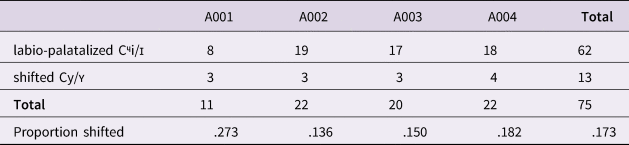
Adults showed variability on labio-palatalized consonants before high front vowels, but no variability on the labio-palatal glide /ɥ/, labiovelarized consonants (/Cʷ/), or labio-palatalized consonants before other vowels. Table 5 shows results for /Cᶣi, ɪ/ from the words spoken in isolation; A001 produced one token of each word, and the others produced two tokens, with a pause between. Table 6 shows results from the words produced in a sentence of the speaker's choice.
Adults: labio-palatalized Cᶣ before high front unrounded vowels (in isolation)

Adults: labio-palatalized Cᶣ before high front unrounded vowels (in a sentence)

Before the high front vowels /i, ɪ/, the majority of tokens are as standardly described: a labio-palatalized consonant followed by an unrounded high front vowel. In most tokens, there was a salient short glide-like element (a lengthened transition into the following vowel); in occasional tokens, especially involving fricatives, the consonants were heavily rounded but there was no glide-like element. In a minority of tokens, the following high front vowel was rounded [y, ʏ], preserving the vowel's [ATR] or [RTR] quality, with no glide-like element. There was limited variability across speakers, with Labiopalatalization-Shift variants accounting for 17% of tokens in isolation and 25% of tokens in a sentence context; the small difference between the two contexts did not approach significance (Fisher's, two-tailed), for the group or for any speaker. The two tokens per word for speakers A002-A004 in Table 5 showed inconsistency for the shifted variants; for the 10 instances in which [Cy, ʏ] was used in one token, the other token had [Cy, ʏ] in only 1 token (10% of instances, which does not differ from the overall usage of [Cy, ʏ] at 17%), suggesting that the two tokens can be treated as independent.
There is limited information about child-directed speech, from when the assistant administering the recording session prompted the child by using the target word in a sentence. The rate of prompting decreased with age: 8–11 words at age 3, 6–10 words at age 4, 0–4 words at age 5. The [Cy, ʏ] variant occurred in 25.7% of the 73 prompts, with little variation across different recording sessions; this is the same as for the reference adults in the sentence context. In 81% of prompts, the word was spoken once; if there were 2 or more tokens, and [Cy, ʏ] was used for 1 token, [Cᶣi, ɪ] was usually used for another token (68% of instances, not different from the overall usage of [Cᶣi, ɪ] at 74.3%), suggesting that the two tokens can be treated as independent. Of the twelve word types, one was never prompted, four were prompted only with [i, ɪ], and seven were prompted sometimes with [i, ɪ] and sometimes with [y, ʏ]. The best estimate of input to children is that Labiopalatalization Shift occurs in about 25% of tokens. Whether prompts may have primed the children to use the same variant is addressed below.
The simplest labio-palatal consonant: approximant /ɥ/
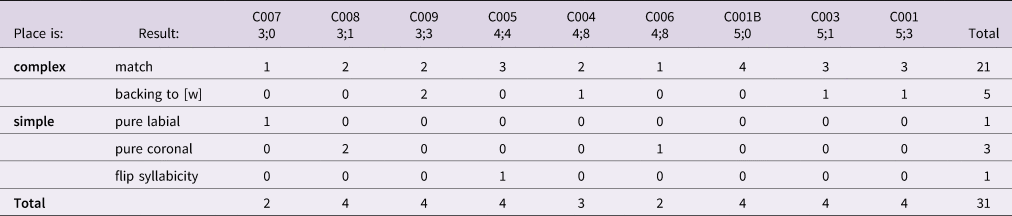
Table 7 presents the children's data for the approximant /ɥ/, to provide a picture of a less complex labio-palatal. Results are presented from the youngest child (on the left) to the oldest child (on the right). Output patterns are grouped as complex (two or more place features maintained) vs simple (only one place feature retained). The outputs labelled “pure labial” and “pure coronal” contain true consonants and can be viewed as the “promotion” of the wide vocalic constrictions of the approximant to narrower consonantal articulations.
Children: approximant /ɥ/

The rate of matching (overall .677) increases with age (three-year-olds .500, four-year-olds .667, five-year-olds .833); only one child matched on all tokens. In half the mismatches, the labio-palatal glide is backed to the labiovelar glide [w]. Most of the remaining mismatches involve mismatch for manner of articulation, reducing place to just labial ([β]) or just coronal ([ð, l, ɹ]). The remaining mismatch alters timing and syllable structure rather than features: the bisyllabic sequence /ɥɪa/ was output as [yja], with the approximant output as a vowel and the following vowel abbreviated to a glide. This flipping of syllabicity resembles labiopalatalization shift, in that it realizes complexity in a consonant as complexity in a vowel.
Labiovelars: a simpler secondary articulation
Table 8 presents the children's data for labiovelarized consonants, to provide a picture of consonants that non-variably have a secondary articulation in adult speech and that have been addressed for other languages. Output patterns are grouped into those that maintain a secondary articulation in the consonant, those that simplify the consonant by shifting the secondary articulation into the vowel, and those that do not have a secondary articulation (with a single articulation retained). The “Match Cʷ” row includes all output tokens that were labiovelarized, whether full segmental matches or not; five of the 32 tokens produced with labiovelarization (.156), e.g., C007's /kʷ/ as [ʔʷ], were mismatched on other features (parallel to the child's treatment of simple stops, e.g., /k/ as [ʔ]). We distinguish between “shift secondary”, where the entire secondary articulation is shifted onto the following vowel to yield [u] or [ʊ] (a change to [+high]), and “shift Labial”, where just labiality is shifted to the following vowel, yielding e.g., [æ] as [œ] and /a/ as [ɔ] (remaining [-high]). “Delete primary” results in [w], while “promote Labial” results in a true labial consonant with loss of the primary place of articulation (e.g., [β]).
Children: labiovelarized Cʷ

Actual labiovelarized consonants were produced on over half the tokens (.615); all subjects produced at least one matching token, and only two children showed less than 50% accuracy (the youngest three-year-old, and the youngest four-year-old). There was an increase of matching in the oldest age group: three-year-olds .529, four-year-olds .500, five-year-olds .867. The most common type of mismatch (45% of mismatches) involves deletion of the secondary articulation; deletion of the primary constriction, yielding [w], is less common (15% of mismatches), and promotion of [Labial] from the secondary constriction to replace the primary constriction occurred only once. There were also two tokens (10% of mismatches) where the secondary constriction was fully shifted to the vowel to yield [u] or [ʊ], and five tokens (25% of mismatches) where [Labial] was shifted onto the vowel to yield a non-high rounded vowel, a front vowel in 2 tokens (e.g., /kʷæ/ as [kʰœ]) and a back vowel in three tokens /(e.g., /kʷæ/ as [kʰɔ]). Shift mismatches have not been reported for other languages.
There was no significant difference between /ɥ/ (Table 7) and /Cʷ/ (Table 8), either by token (Fisher's, two-tailed) or by child (two-tailed Sign Test, with three children showing greater match on /ɥ/ vs five with greater match on /Cʷ/, and one tie). Both are at about 50% accuracy for the youngest children and are not yet at 100% accuracy for the oldest children.
Labio-palatalized consonants with no adult variability
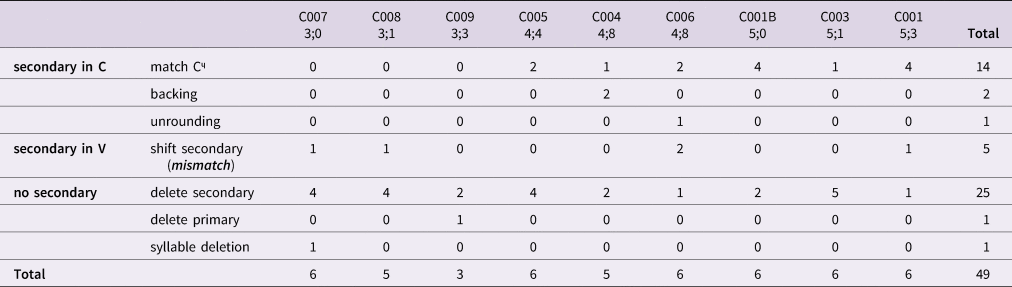
Table 9 shows the results for non-variable labio-palatalized consonants before vowels other than /i/ and /ɪ/, for each of the 9 children. Output patterns are grouped into those that maintain a secondary articulation in the consonant, those that simplify the consonant by shifting the secondary articulation into the vowel, and those that do not have a secondary articulation (with a single articulation retained). “Backing” and “unrounding” maintain a secondary articulation, but simplified to labiovelarization or palatalization (e.g., /dʑᶣa/ as [dʑʷa] or [dʑʲa]). “Shift secondary” is labiopalatalization shift, resulting in a high front rounded vowel [y, ʏ] replacing the target vowel. “Delete primary” results in a glide, and “promote Labial” results in a labial consonant with loss of the primary place of articulation.
Children: labio-palatalized Cᶣ before vowels other than /i/ and /ɪ/

First, the proportion of tokens that actually had labio-palatalized consonants was low at all ages, but increased with age: three-year-olds .000, four-year-olds .294, five-year-olds .500. These labio-palatalized consonants show lower match than the approximant /ɥ/ (Table 7: by token (Fisher's, two-tailed), p < .002; by child (two-tailed Sign Test), /ɥ/ greater match than /Cᶣ/ for all nine children, p < .005) and, than labiovelar /Cʷ/ (Table 8: by token, p < .002; by child, /Cʷ/ greater match than both /Cᶣ/ for all nine children, p < .005). Second, a few mismatches retained a secondary articulation, losing either the [Labial] or [Coronal] component of labiopalatalization. Third, four of the nine children had one or two tokens where the secondary articulation was shifted onto the vowel, creating a high front rounded vowel; there were no tokens where just [Labial] was shifted onto the vowel. This labiopalatalization shift is not present in adult speech, and these children show a lower frequency of use than for adult labiopalatalization shift (though this fails to reach significance) and was not observed in all children (4/9 children vs 5/5 adults; Fisher's, two-tailed, p < .05). Fourth, most mismatches (71.4%) involved loss of the secondary articulation, at all ages, and such deletions outnumber tokens that maintain a secondary articulation. Fifth, the single instance where the primary constriction was deleted did not yield the expected labio-palatal glide [ɥ], but was backed to [w] (by C009, who backed 2/4 tokens of target /ɥ/ to [w]; Table 7).
Labio-palatalized consonants with adult variability
Table 10 shows the results for variable labio-palatalized consonants before high front vowels, for each of the 9 children. Output patterns are grouped into those that maintain a secondary articulation in the consonant, those that simplify the consonant by shifting the secondary articulation into the vowel, and those that do not have a secondary articulation (with a single articulation retained). Note that “shift secondary” here is a match to the adult front-rounded-vowel variants. “Cᶣ + lab-assim” denotes a mismatch where a labio-palatalized consonant has an obvious glide-like transition followed by a high front rounded vowel (assimilation of [Labial] onto the vowel; e.g., [dᶣy]).
Children: labio-palatalized Cᶣ before high front vowels

First, the proportion of tokens that actually had labio-palatalized consonants was low at all ages; only three children exceeded 10% of tokens, and only one reached 50% of tokens. There was an increase after age 3: three-year-olds .000, four-year-olds .237, five-year-olds .229. These labio-palatalized consonants show lower match than the approximant /ɥ/ (Table 7: by token (Fisher's, two-tailed), p < .002; by child (two-tailed Sign Test), /ɥ/ greater match than /Cᶣ/ for all nine children, p < .005) and, than labiovelar /Cʷ/ (Table 8: by token, p < .002; by child, /Cʷ/ greater match than both /Cᶣ/ for all nine children, p < .005). Labio-palatalized consonants before /i, ɪ/ showed marginally lower match than before other vowels (Table 9), but this does not reach statistical significance, by token (p = .081) or by child (with five children showing greater match for /Cᶣ/ before other vowels, and four ties, p = .063). Second, when the child did not match an adult variant, most of the mismatches involved loss of the secondary articulation (71.7% of mismatched tokens). There was some deletion of the primary place of articulation, yielding an approximant, and promotion of [Labial] to a primary consonantal constriction ([f, ɸ]).
Third, the proportion of tokens with Labiopalatalization Shift is greater for seven of the nine children than it is for any of the adults. If we compare all the adult data (from sentences, like in real-life input) to all the child data (Fisher's two-tailed), contrasting the number of tokens with shift vs all other tokens, the differences are significant at the p < .001 level. If we compare the full adult data to that of each child, five out of nine children are significantly different from adults at the p < .05 level or lower. Two children, however, fall within the adult range. There is no obvious change with age: three-year-olds .400, four-year-olds .525, five-year-olds .514. Across children, eleven of the twelve word types were produced with Labiopalatalization Shift at least once. There are only nine instances (for seven children) where we have used two tokens of the same word where one token had [y, ʏ]; the other token also had [y, ʏ] in 5 instances (55.6%), which is right on chance for general use of [y, ʏ] (54.9% of trials), suggesting that the two tokens can legitimately be used as independent (as also found above for adults). Fourth, there were a number of tokens with a front rounded vowel after a correct /Cᶣ/ or after some other labial consonant (such as [ɥ] or [f]).
Since the assistant prompted the target word on some trials, with Labiopalatalization Shift on 25% of tokens, one might ask whether there is a priming effect: whether the child is more likely to use a shifted variant after the adult did. There were small differences (by token) in the use of the [y, ʏ] variant when the assistant prompted with [y, ʏ] (.677), with [i, ɪ] (.421), with both (.600), or used no prompt (.508), with none of these differences even approaching significance (Fisher's, two-tailed), nor did any differences approach significance in a by-child analysis (two-tailed Sign Test). While the numbers might suggest that a larger study might find a small effect of priming, it clearly does not account for the high rate of Labiopalatalization Shift found in the children's speech here.
Table 11 presents the vowels [y, ʏ] that the children produced in labiopalatalized-consonant words. The bottom row repeats the number of tokens that ambiguously could result from either [Cᶣi, ɪ] or [Cy, ʏ] targets.
Children: high front rounded vowels

Every child produced at least one token of a high front rounded vowel, and there were only three tokens that could unambiguously be viewed as mismatches (ignoring the [ATR/RTR] mismatches on 22% of [ATR] targets and 6% of [RTR] targets, which do not differ statistically from /i, ɪ/ targets generally): one token each of [ʉ, ʊ, œ]. Although outputs of /Cᶣi, ɪ/ as [Ci, ɪ] could also possibly result from unrounding of [Cy, ʏ], there are two reasons to conclude that there are few tokens of [Cy, ʏ] unrounding. First, when labiopalatalization shifts to the vowel in /Cᶣ/ before other vowels (Table 9), all 5 tokens resulted in rounded [Cy, ʏ] and none resulted in unrounded [i, ɪ]; this suggests that the rate of unrounding errors is less than 1 in 5, meaning that at most 6 of the 32 tokens of /Cᶣi, ɪ/ that result in [Ci, ɪ] involve vowel unrounding. Second, we can look at the relative frequency of outputs that result in a consonant with vs without a secondary articulation; this tells us how often, when the secondary articulation does not shift to the vowel, it is realized as a secondary articulation vs simplified. For /Cᶣ/ before other vowels (Table 9), secondary articulation is maintained on the C in 17 tokens and absent in 26 tokens (.605 deletion). For /Cᶣ/ before /i, ɪ/ (Table 10), secondary articulation is maintained on the C in 20 tokens and absent in 37 tokens (.649 deletion). This suggests that in /Cᶣ/ targets, the secondary articulation is maintained vs absent at about the same rate, regardless of the following vowel. We suggest that few of the [Ci, ɪ] outputs were due to unrounding of [y, ʏ], and that possibly none were. Accuracy for high front rounded vowels (ignoring [ATR/RTR] mismatches) was high: 3-year-olds .826, 4-year-olds .893, and 5-year-olds .905. We suggest that high front rounded vowels in Akan are mastered before 3;0, earlier than /ɥ/ (50% accuracy at age 3).
Figure 1 examines the level of shift in Tables 8–10 (the “secondary in V” rows), comparing /Cʷ/ vs /Cᶣ/ before other vowels (“Cᶣ-other”) vs /Cᶣ/ before /i, ɪ/ (“Cᶣi”).
Proportions of shift on the three types of consonants with secondary articulation

Labio-palatalized consonants before /i, ɪ/ showed significantly more shifts than the other consonants, while labio-palatalized consonants before other vowels did not differ from labiovelarized consonants in the rate of shifts. However, none of the labio-palatalized consonants showed shift of just the [Labial] element (the striped portion of the columns), while the labiovelarized consonants showed more shift of just [Labial] (combined with backing in a few tokens). Labiovelarized consonants are significantly different from labio-palatalized consonants before /i, ɪ/ (by token (Fisher's, two-tailed), p < .001; by child (two-tailed Sign Test), p < .025) and before other vowels (by token p < .05; by child ns, due to the fact that some children produced no shifts). The majority of shift errors for labiovelarized consonants (shifting just [Labial]) are different in kind from Labiopalatalization Shift (shifting the entire secondary articulation) in the adult input.
Backing mismatches occurred across all relevant speech sound types: /ɥ/ as [w], /Cᶣ/ as [Cʷ] and [Cy, ʏ] as [ʉ, ʊ]. Backing occurred for five of the nine children, including at least one child in each age group. Child C004 had backing mismatches for all three speech sound types; C001 had backing for /ɥ/ and [y].
Another characteristic of these consonants in the adult input is that the feature [Labial] is in the consonants in /ɥ/, /Cʷ/, and /Cᶣ/, but in the vowel in the Labiopalatalization-Shift variants [Cy, ʏ]. Table 12 presents the proportion of mismatch tokens (summed over all 9 children), in which [Labial] is output in the consonant, in the vowel, in neither the consonant nor the vowel, or in both the consonant and the vowel. The different phoneme types differ in several ways.
Proportion of mismatch tokens (all children) as a function of where [Labial] appears in the output

First, both groups of labio-palatalized consonants have a higher proportion of mismatches that do not contain the feature [Labial] at all, as compared to the labiovelarized consonants and the approximant /ɥ/: Fisher's, two-tailed, p < .002. Second, if the feature [Labial] is found in just the consonant or in just the vowel, the approximant /ɥ/ is more likely to have it in the consonant, whereas the consonants with secondary articulation are more likely to have it in the vowel: p < .05. For consonants with secondary articulation, [Labial] winds up in just the consonant primarily when the primary articulation is deleted (and an approximant results) or when [Labial] is promoted to be the only place feature in the consonant; 80% of such mismatches were made by three-year-olds, which is a significantly higher rate than for the older age groups (p < .001). Lastly, labio-palatalized consonants before /i, ɪ/ have mismatches where both the consonant and the vowel have the feature [Labial], while the other consonants never do: p < .001.
Discussion and Conclusions
Our expectations about how children might deal with the variability of labio-palatalized consonants in the adult input were partly founded on effects of complexity, markedness and frequency on the mastery of speech sounds, as well as previous research on related speech sounds in other languages. Our results matched previous research. Akan-learning children master the front rounded vowels [y, ʏ] earlier (before age 3) than the labio-palatal approximant /ɥ/ and labiovelarized consonants, which matched the adult targets on only half the tokens at age 3 and still showed mismatches at age 5. Secondary articulations add complexity to a consonant and are mastered relatively late, just as English-learning children master the dark (velarized) /l/ later than children learning Swedish light (non-velarized) /l/ (e.g., Bernhardt & Stemberger, Reference Bernhardt and Stemberger2018). Labiovelarization was not fully mastered even by the five-year-olds in our study (replicating Nwokah, Reference Nwokah1986, for Igbo), but it is in advance of labiopalatalization, possibly an effect of relative complexity: labiovelarized [Dorsal, Labial] vs labio-palatalized [Dorsal, Coronal, Labial].
We replicate research in other languages that the most frequent mismatch for labiovelarized consonants is deletion of the secondary articulation. We also replicate Nwokah's (Reference Nwokah1986) findings for Igbo that there are less frequent mismatches where the primary articulation is deleted (resulting in [w]) or where [Labial] is promoted to be the sole consonantal place of articulation (but restricted to the youngest children in our sample). Our results extend these findings to labio-palatalized consonants. We also found that [Labial] was sometimes shifted from the labiovelarized consonant to the following vowel, which has never been reported before. This may be related to Labiopalatalization Shift in Akan.
We confirmed that adults use Labiopalatalization Shift for syllables where a labio-palatalized consonant precedes a high front vowel (reported by Schachter & Fromkin, Reference Schachter and Fromkin1968) leading to the front rounded vowels [y, ʏ], without affecting [ATR/RTR]. Since this is usually not mentioned in research on Akan phonology, our results contribute to the basic documentation of the language (including estimation of the relative frequencies of the two variable outputs).
All 9 children recognized this input variability and attempted to produce both variants. All children produced at least one token with a high front rounded vowel, with no perceptible offglide after the consonant. All four-year-olds and five-year-olds produced labio-palatalized consonants (or, for one child, mismatches retaining secondary articulation with backing or unrounding). No three-year-old successfully produced a labio-palatalized consonant, but, given that the many mismatches involving deletion of the secondary articulation look just like the most common mismatches for labiovelarized consonants and labio-palatalized consonants before other vowels, it makes most sense to assume that labio-palatalized consonants were also being targeted before /i, ɪ/. By 3;0, Akan children are targeting both of the adult variants, consistent with the early production of variation reported for other languages. The children produced a few tokens that had both a noticeable offglide and a rounded vowel ([Cᶣy, ʏ]), which does not happen in adult tokens; we suggest that these tokens are a combination of the two adult variants, with the vocalic features [Dorsal, Coronal, Labial] present independently both in the consonant and in the vowel.
The adults in our study used Labiopalatalization-Shift variants in a minority of tokens with little individual variation (range .157-.257), even in child-directed speech. Some children in the study output the Labiopalatalization-Shift variants at significantly greater frequency than the adults did. However, we do not have data from the caregivers for these children; we cannot rule out the possibility that adults use the Labiopalatalization-Shift variants at different frequencies in child-directed speech, and that children were matching the frequencies in their own caretakers' child-directed speech. We consider this unlikely, but further research is needed to address this possibility.
We would like to stress the limits to the variation observed for these nine children. No child overgeneralized the low-frequency front-rounded-vowel variants to 100% of tokens. While it is possible that a larger study would find some children overgeneralizing to 100%, this study suggests that only a small percentage of children would do so. This raises the issue of whether theories allow overgeneralization to 100%, and, if so, how common they predict it will be.
Non-modular versions of theories, which allow the child's output limitations to have an impact on phonological planning, predict the over-use of Labiopalatalization Shift, if the vowels [y, ʏ] are mastered earlier than consonants with a similar secondary articulation. This was the case, since the three-year-olds output front rounded vowels but no labio-palatalized consonants. Given competition in the output between two variable input forms, the more easily output form is at an advantage and will tend to be over-used. In OT, in the adult phonological system, the more frequent variant probabilistically outcompetes the less frequent variant, keeping the low-frequency variant in check; but in a child system where the frequent variant is not a possible output, the frequent variant loses and cannot keep the low-frequency variant in check. It is possible to set up the system so that the less frequent variant will be at about the same low frequency as in the input even when the more frequent variant is not a possible output (as observed for two children), but the nature of learning in our preferred variants of OT tends to lead to over-use. It is unclear how much over-use of the infrequent variant is possible. Rankings exist that could output [Cy, ʏ] on 100% of tokens, but it is unclear whether those extreme rankings could be achieved through slow and gradual change driven by error correction; further research with children and with modeling is needed to see how well OT succeeds. Non-modular versions of Usage-Based Grammar and exemplar models can presumably also accommodate the over-use of an infrequent variant that has been mastered earlier, but it is unclear whether the degree of over-use is statistically limited in such approaches. We suspect that non-modular Usage-Based Grammar would be compatible with a period in development where Labiopalataliztion Shift would be overgeneralized to 100% of tokens, but the theory is not sufficiently elaborated to tell us how commonly this would be expected across children. These data present a challenge: all theories need to demonstrate that they can account for the range of variation from no over-use to output in 75% of tokens, but never (or at least, only for a small percentage of children) to output in 100% of tokens.
Theories that draw a strong modular boundary between phonological planning based on input and limitations on a child's output in motor implementation have a difficult time with our results. Such modular theories predict that a child will target the different variants based on their frequency in the input, possibly shifted towards over-use of the more frequent variant. For impossible outputs such as [dᶣi], motor implementation would deal with them in a child-specific fashion. For labiovelarized stops, the secondary articulation is shifted to the vowel in a minority of tokens and is shifted as a unit in a minority of shift errors. It seems likely that motor implementation would reduce labio-palatalized consonants before /i, ɪ/ in a similar way, bumping up the frequency of shifted outputs in a modest way that cannot account for the extreme level of over-use for many of the children. Indeed, if we add the amount of shift observed for labiovelarized consonants to the base rate of shift in adult input, eight of the nine children use shift for /Cᶣi/ at a greater rate than expected; three of the children who used shift in over 50% of tokens for /Cᶣi/ showed no shifted tokens for /Cʷ/. The over-use of Labiopalatalization shift for /Cᶣi/ seems to be an exaggeration of its frequency in adult input, and not due to any other child-specific aspect of dealing with impossible outputs, as modular theories would predict.
Developmental studies of labiovelarization in other languages have not mentioned mismatches where the secondary articulation is shifted onto the following vowel, but have reported the other mismatch types that we found in Akan. In promotion mismatches, [Labial] acts independently of the rest of the secondary articulation. In Akan, we find shift mismatches for labiovelarized consonants, and our suspicion is that they are due to overgeneralization of Labiopalatalization Shift, yet, like promotion errors, [Labial] acts independently of the rest of the secondary articulation. We suggest that [Labial] tends to act independently in child-specific mismatch patterns, and when the entire secondary articulation holds together as a unit, it is due to overgeneralization of the Labiopalatalization Shift input pattern.
One final aspect of our results is that labio-palatalized consonants before /i, ɪ/ showed one mismatch pattern distinct from any of the other speech sounds addressed here: the feature [Labial] appeared twice, in both the consonant and the vowel. This appeared as an audible glide-like transition in [Cᶣy, ʏ], but also with promotion of [Labial] in e.g., [fʏ] and deletion of the primary articulation as in [wʏ]. The lack of such errors for the targets /ɥ/, /Cʷ/, and /Cᶣ/ before other vowels suggests that such duplication of [Labial] is not inherent in children's mismatches for marked glides and consonants with secondary articulation, but results from something specific to /Cᶣi, ɪ/. The obvious culprit is the variation between output of [Labial] in the consonant in [Cᶣi, ɪ] but in the vowel in [Cy, ʏ]; with competition between [Labial] in two different locations, a mismatch arises where [Labial] wins in both locations. This requires that the competition between the two outcomes is an active part of the process of phonological planning that interacts with a child's output limitations. It is not the case that one of the variants is selected for production, which then proceeds insulated from the non-selected variant. The children in our study were arguably targeting both variants on every trial, not one variant on some trials and the other variant on other trials.
Modularity between input-based phonological planning and a child's output limitations makes wrong predictions about phonological development, in a systematic fashion. The Akan children in this study began to reproduce the variation present in adult speech before 3;0. However, some (but not all) children diverged from the statistics of adult variation, over-using easier-to-output variants, even when they are low-frequency variants in adult speech, yet never enough to entirely eliminate mismatches from their output. Further research is needed to test the adequacy of all approaches, to tease apart the factors that lead to e.g., 10% overgeneralization vs 95% overgeneralization, and the details of how children differ from one another. Theories need to be more explicit about the degree to which children can diverge from input statistics, how often they do diverge from input statistics, and how much variation we expect across children.
Acknowledgments
This paper is derived from an MA thesis titled “Assessing phonological development among Akan-speaking children” written by the first author under the primary supervision of the second author. All data presented here are part of the data presented in this thesis. Thanks to Mr. Kenneth Boadu, a trained primary school teacher with experience in data collection and annotation, who helped recruit and test all child participants. Thanks to all the adults and children who participated in this study, and to children's families for providing consent.
Appendix
A list of all words with target labio-palatalized consonants, labiovelar consonants, or /ɥ/ that are analyzed in this paper. Words that were targeted a second time at the end of the list are bolded.