

Introduction
A massive and growing body of literature has debated capital market liberalisation, one of the most contentious topics in international economics. The desirability of free capital mobility is substantiated in a large volume of economics literature. According to these studies, capital account liberalisation brings with it benefits such as the facilitation of growthFootnote 1 and competition,Footnote 2 the transfer of technology and management skill,Footnote 3 the enhancement of policy transparency and market discipline,Footnote 4 the strengthening of efficiency at financial institutions,Footnote 5 and the smoothing of intertemporal consumption.Footnote 6 Some studies even attempt to prove that controls on capital mobility cause financial instability and precipitate the onset of currency crises.Footnote 7 In fact, international organisations such as the International Monetary Fund (IMF), the World Bank, and the World Economic Forum urge developing countries to create market conditions that attract foreign investors to exploit local competitive advantages, with capital market liberalisation as the highest priority.
The stark reality is that the world economy has lurched from one financial crisis to another since the mid-1980s, with financial deregulation in developed countries and capital market liberalisation in developing countries. Although the turbulent 1990s were followed by the relatively benign mid-2000s, the last two years have seen much worse financial turmoil in terms of its scale, depth and damage to growth. The US subprime crisis that began in 2007 brought about a massive banking meltdown in 2008 and has now led to a financial tsunami and a worldwide economic downturn. Subprime securities have infiltrated international portfolios wherever capital mobility is free. Many recent studies conclude that it is worldwide capital market liberalisation that has caused the US subprime loan collapse to evolve into the worst global economic crisis since the Great Depression. Eichengreen, Leblang and Wyplosz (1993), Kiely (2007), and Mishkin (2007) conclude that capital market liberalisation may lead to greater volatility or more crises if the conditions are not right and argue that domestic financial efficiency should be increased before liberalisation in developing economies.Footnote 8 Furman and Stiglitz (1998) point out that massive debt flows in the face of capital market capitalisation are suspected to cause crises given insufficient reserves.Footnote 9 Stiglitz (1999, 2000, and 2002) repeatedly raised the question of why liberalisation has so often led to greater instability and not to higher growth. He criticises how powerful international organisations attempt to promote free capital flows by pushing for global liberalisation without taking into consideration the chance that developing countries will undergo liberalisation-triggered crises due to their financial vulnerability to speculative activities. With this in mind, certain controls over capital flows are rational choices for developing countries.Footnote 10 Modenesi and Modenesi (2008) argue that the discussion should be stripped of the prevalent neo-liberal bias without political prejudice against capital controls.Footnote 11
However, Quinn and Inclan (1997), and Quinn and Toyoda (2007) disagree with the North-South coercion hypothesis and work to debunk the claim that the IMF forces developing countries to liberalise. They argue that countries ultimately pursue free capital mobility because of their long-run interest and not because of IMF pressure/coercion, and with the development of financial system in these countries, positive correlations between economic growth and financial openness become more and more significant.Footnote 12 Haggard and Maxfiled (1996) and Simmons and Elkins (2004) also consider ‘forced capital mobility’, argued by Stiglitz to be too strong. They argue that although US has sometimes lobbied developing countries for liberalisation and that the IMF used to include financial liberalisation in some of its structural adjustment programmes, developing countries take on IMF loans only when they consider the suggested reforms beneficial in the long run and are willing to undertake them in the first place. Instead of being ‘forced’, the financial liberalisation is merely ‘incentivized’ on the basis of free policy choices, and those incentives need to be integrated into developing countries' utility functions.Footnote 13 Moreover, Rajan and Zingales (1998) strongly criticise the argument that financial openness is imposed from outside and that developing countries are victimised. They argue that capital market liberalisation is often resisted and demonised from within by powerful local lobbies that do not want to face increased competition. One implication of this is that the vast majority of local communities may ultimately face lower relative utility if a country remains closed because a disproportionate amount of the output goes to connected players.Footnote 14
In considering to these opposing opinions, Stiglitz refines his arguments, arguing that it is critical to distinguish short-term speculative hot capital from long-term foreign direct investment (FDI). While developing countries should be open to FDI, which is good for growth, control over hot money, which is bad for stability under weak financial systems, is justified.Footnote 15 Henry (2007) also supports openness to FDI and caution regarding the liberalisation of debt and equity markets in developing countries.Footnote 16 Questioning Stiglitz's belief that FDI generally has a positive impact on economic growth in developing countries, Herzer, Klasen, and Nowak-Lehmann (2008) argue that there is no clear association between growth and FDI in developing countries based on a comprehensive empirical study using co-integration techniques on a country-by-country basis. It is found that there is no single country in which there is a positive, unidirectional long-term effect of FDI on GDP.Footnote 17 Similar results can also be found in Noorbakhsh, Paloni, and Youssef (2001), Azman-Saini, Law, and Ahmad (2010), and Alfaro, Chanda, Kalemli-Ozcan, and Sayek (2004), stating that there exists neither a long-term nor a short-term effect of FDI on growth.Footnote 18 Moreover, according to Mody and Murshid (2005) and Chakraborty and Rawlins (2004), FDI flows are empirically no less volatile than portfolios, as shown in many developing countries, often causing economic instability as well.Footnote 19
In a broader social sciences context, although Fishlow (1994), Hill (2001), and Dijkstra (2000) identify positive relationships between foreign investment and welfare, freedom, democracy, human rights, gender equality, etc., and support globally-oriented and market-friendly development strategies for developing countries,Footnote 20 quite a number of Marxist-oriented scholars are strongly critical of the hypermobility of capital. Applying a Marxist perspective to neo-liberal economic doctrine, Harvey (2005) finds that the promotion of free mobility of capital by international lending institutions since the 1980s has restored political and economic power to the upper classes. In fact, while multinational enterprises extract remarkable benefits from their investments during the process of globalisation, developing countries do not gain as much as people assume they do. Consequently, inequality increases worldwide.Footnote 21 Dickens (2000) argues that free capital mobility is good for capitalist profit but separates people from the land in underdeveloped countries, thus making them dependent on foreign economic power.Footnote 22 Castells (1978) finds that massive inflows of foreign capital into developing countries mark the end of the democratic phase of their urban development, stimulating social struggles in the context of a conflict-ridden urban transformation.Footnote 23 Klein (2007) argues that free capital mobility often results in depressions, mass poverty, and private corporations looting public wealth.Footnote 24 Critiques of the negative impacts of free capital mobility can also be found in Savitch (2010), Sheng (2011), Sheng and Tsui (2009), Sheng and Tsui (2010), and Phelps (2010).Footnote 25
We find that the existing studies have produced neither conclusive nor consistent results, and many of those results are at odds with each other. However, one fact is confirmed: that the negative impacts of free capital mobility are widely observed across countries, particularly in recent years, despite its widely documented virtues. Thus, it is not surprising that most of the nearly 200 countries in the world have some form of barriers to international capital flows, with liberalisation almost never being a complete, one-time event.Footnote 26 This article adds to the existing literature, which mainly consists of empirical studies, in that it models the diverging preferences and interests of developed and developing countries with regard to free capital mobility in a pure conceptual way. It also analyses strategic interactions between the two parties using game theory tools, displaying strategies, payoffs, and outcomes under policy choice freedom versus capital mobility freedom. Moreover, by using simple, illustrative figures supported by detailed narratives and a minimum of mathematical complexity, the author has tried to communicate the concept to a broader readership mainly consisting of non-economists with a minimum of mathematical complexity.
The rest of the article is structured as follows. Section 2 models the optimal instability-growth trade-off in a developing country, and section 3 illustrates the conflicting interests of developed and developing countries. Section 4 describes international strategic bargaining for capital flow benefit-sharing, and section 5 concludes the article.
1. Optimal trade-offs by a developing country between instability and growth
This section explores how a rational government in the developing world makes a sensible trade-off for its country between economic growth and output instability. This trade-off is based on the country's specific preferences regarding risky opportunities offered by international capital flows. Our model addresses a fundamental question: why free capital mobility is likely to do more harm than good for a developing country. Let a denote the extent of financial openness in a developing country, with (1 – a) viewed as the intensity of its capital controls. The variable a lies between 0 and 1, with a = 0 and 1 indicating the complete closure and full openness of a capital account, respectively. Let b (> 0) denote the country's degree of financial weakness, with a higher value of b representing a weaker financial system. Let σ denote expected economic instability due to volatile capital flows into and out of the country. The overall index σ includes any capital-flow-related negative occurrences or other factors, including financial turmoil, currency crises, consumption volatility, output instability, growth slowdowns, and other forms of economic fluctuation. Instability σ usually increases with wider financial openness (a larger a) and worse financial weakness (a larger b).
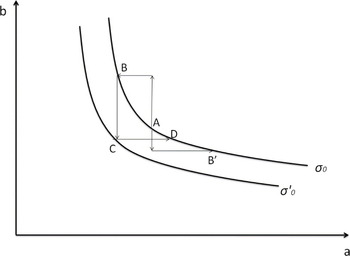
The instability function σ = σ(a, b), satisfying the properties of ∂σ/∂a > 0 and ∂σ/∂b > 0, is assumed to be concave so that a typical iso-instability curve is decreasing and convex in Figure 1. All (a, b) combinations on this curve are associated with the same level of instability; a higher curve displays a greater level of instability, for example, σo > σo′. For the given level of instability, σo, the move from point A to point B suggests the need to tighten capital controls as the country's financial system becomes weaker, and the A-to-B′ move indicates the feasibility of loosening capital controls as the country becomes financially stronger. For any given degree of financial openness, enhancing the financial system (as in the B-to-C move) can decrease economic instability (σo falls to σ′o). For a given level of financial weakness, a widening of financial openness (such as the C-to-D move) may increase economic instability (σ′o rises to σo). More capital controls are needed to reduce instability when the financial system remains weak (see a move from D to C). Because it is difficult to strengthen the financial system by giving it a lower value of b in the short term, it is reasonable to treat b as a given parameter while taking a as a choice variable in our analysis. Thus, we can rewrite σ=σ(a, b) as a = aσ(b) to determine the degree of market openness a based on financial situations b given a tolerable level of instability σ.
The iso-instability curves.

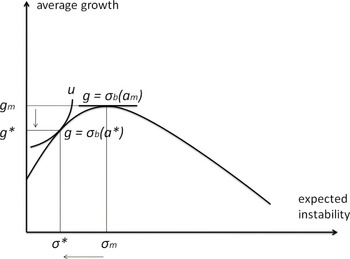
Let g denote the country's expected output growth, which is assumed to initially accelerate with more capital flows (under wider openness, that is, a larger a), then reach a maximum at some intermediate level of capital flows (associated with some am < 1), and finally decelerate as capital flows over-expand under unfettered capital mobility (in relation to an even larger a), which invites financial speculation. Normally, the marginal benefit from capital flows in terms of growth is diminishing with more and more flows as a < am, and will become negative afterwards when a > am. Alternatively, this relation between output growth and capital flows, g = G(a), can be reinterpreted as that between growth and instability, g = g(σ), because unfettered capital flows are highly positively related to financial volatility or economic instability. The curve of g = g(σ) specified in this way characterises risky opportunities for growth for the country, with the risk of instability rising when the nation's capital account is left wider open. Note that instability accompanies growth due to financial vulnerability to free capital movement.
It is easy to verify the two equivalent forms of the risky opportunity relationship: g = g(σ) = g(σb(a)) = G(a) if suppressing b after using σ = σ(a, b) = σ b(a). Plotting this relationship on the instability-growth plane yields the opportunity curve g = g(σ) in Figure 2 for a typical developing country, of which each point corresponds to a different degree of financial openness (a becomes an underlying variable). This objective set of instability-growth substitutions is beyond the country's control in the short run and constrains its policy choices by providing it with opportunities for growth that are, however, coupled with risks of instability. As will be shown, the highest amount of growth at σm (= σb(am)) in Figure 2 may not be economically optimal. The curve g(σ) is assumed to be concave due to diminishing growth benefits from capital flows and satisfies the property of dg/dσ > 0 for σ < σm and dg/dσ < 0 for σ > σm.
The optimal trade-off between average growth and expected instability.

Generally, the country may have to slow growth down as inflation takes off, upsetting the public, or it may have to boost growth when unemployment is high, causing social unrest. Most developing countries pursue rapid growth under pressure to lower high unemployment by allowing large capital inflows, but they are also risk-averse and cannot accommodate endless capital flows without attention to the accompanying risk of financial speculation. Expected growth (as an advantage) and average instability (as a disadvantage) are treated as the objects of choice by a country and should be included in its welfare function u = u(σ, g) in the same way as marginal utility MUσ < 0 and MUg > 0. The indifference curve in Figure 2 associated with this utility function reflects the subjective trade-offs between instability and growth for the country, indicating a higher level of utility when moving upwards (greater growth) and/or leftwards (less instability).
There is only one indifference curve u that is tangent to the opportunity curve g in Figure 2, and the tangency point g(σb(a*)) indicates the country's optimal decision regarding the instability-growth trade-offs (σ*, g*), which also corresponds to its optimal choice regarding capital control intensity (1−a*). This choice is justified both by the risky opportunities for growth that the country faces under capital flows and by its policy preference for trade-offs based on its domestic socio-economic circumstances. As one seeks to analyse the developing country's optimal choice, one may use a concave quadratic function, g(σ) = − α(σ − σm )2 + β, as an expression of risky opportunities (symmetric around σm, at which growth reaches its peak β); a log-quasi-linearutility function, u(σ, g) = g*exp(−cσ), as a proxy for risk attitudes; and an inverse-proportion function, σ(a, b) = a·b, to describe the instability and growth relationship.
2. Diverging interests of developing and developed countries
This section presents a simple model that reveals the economic reason why developed countries pressure their developing counterparts into premature liberalisation. The trade-offs are equivalent to that between instability and growth for developing countries as shown above and that involving foreign openness and domestic growth for developed countries to be discussed below. Note that a vast body of literature documents that most of the foreign investment flowing into the developing world is actually concentrated in emerging economies such as China, India, Brazil, Mexico, and Russia.Footnote 27 In fact, these economies, which are undergoing rapid economic growth in a transitional phase between developing and developed status attracted more foreign investment than the whole developed world.Footnote 28 Therefore, the model developed to analyse strategic interactions between developing and developed countries fits the realities of emerging economies in particular.
Consider a world consisting only of two countries, a developing country (denoted by A) and a developed country (denoted by B). The indifference curve u and the opportunity set g for A have been discussed earlier; let us now specify those two curves for B. Because both parties are seeking high growth g but are averse to severe instability σ, country B's welfare function u = uB(σ, g) exhibits the same property as country A's u = uA(σ, g): that is, MUσ < 0 and MUg > 0. A likely difference between the two countries may be that B is less risk-averse than A because the former is financially and managerially stronger than the latter in dealing with the risk of instability. Country A's growth as induced by long-term real FDI from country B will enhance the former's ability to import from the latter, and this positive spill-over effect will be reinforced via a closer economic partnership between the two countries. Note that the effects of foreign investment on host countries (whether positive or negative) and their extent differ greatly and heavily depend on the properties of FDI flows. In particular, horizontal FDI, in which multi-plant firms roughly duplicate the same activities in multiple countries, has been distinguished from vertical FDI, in which firms locate different stages of production in different countries. While developed countries are often both the source and the host of most FDI in the case of the former type, which mainly aims to avoid trade costs, the latter type is predominately represented in developed source countries and developing host countries and has production cost minimisation as its priority. Empirically, the former benefits both parties more equally, while the latter predominantly benefits investors; the host benefits less or only marginally from the investment due to trade dependence, profit repatriation, and preferential treatment in the form of tax exemptions, free land use, and labour imports granted to foreign investors. Some research even reveals that horizontal FDI is empirically ineffective in improving a host community's welfare.Footnote 29
However, if openness in A is too wide for capital flows to be manageable, instability may arise, threatening A's economic growth. As A's ability to import from B is weakened and its profits from B's operations in A are reduced, B's growth will be adversely affected in turn. Therefore, we assume that developed country B's growth g = G(a) initially rises with A's widened opening a, then reaches a peak at some level of a′m, and finally declines as foreign openness becomes even greater. Interestingly, Krugman (1998) observes that as volatility increases in host countries, there will be new profit opportunities for foreign investors. Therefore, FDI may increase in the face of a crisis, leading to significant capital returns afterwards.Footnote 30 However, in this article, we do not consider this kind of fire-sale FDI, partially for simplicity's sake but more because the majority of the related literature indeed confirms the assumption that net potential losses are greater than benefits in the case of greater economic volatility.Footnote 31 However, developing country A's financial openness a may have different implications for the instability faced by each country because of those countries’ differing financial conditions. A wider financial opening (higher a) attracting more capital flows from country B to country A may imply greater instability for A but more expected benefits for speculators who come mostly from country B and usually move massive short-term liquid capital across borders. Their speculative activity causes large economic fluctuations and heavy economic losses in financially weak country A, which rarely spread to financially strong country B.
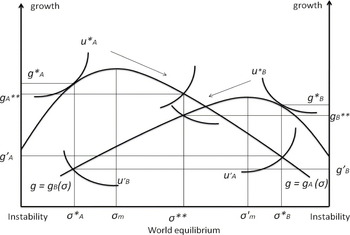
Combining g = G(a) with σ = σ(a), we discover a relationship between growth g and instability σ as the opportunity curve for developed country B; that is, g = gB(σ) with dg/dσ > 0 for σ < σ′m and dg/dσ < 0 for σ > σ′m, as shown in Figure 3. Much of curve gB(σ) lies below curve gA(σ) in accordance with Solow's theory that developing countries grow faster than their developed counterparts if both types of economies share the same potential for growth. The Solow model addresses long-run economic growth within the framework of neo-classical economics. A number of economists use the Solow model to analyse growth differences between developed and developing countries. Using cross-country panel data, Ding and Knight (2009) examine the extent to which the gap in the growth rate between emerging economies and developed countries can be explained using the Solow model. They find that the Solow model, augmented by both human capital and structural change, provides a good account of international variation in economic growth.Footnote 32 Using the augmented Solow model, Miketa and Mulder (2005) analyse energy productivity convergence across developed and developing countries. They argue that energy productivity growth is high in emerging countries that initially lag behind in terms of energy productivity levels.Footnote 33 Using the Solow Model, Schneider (2005) examines the role of high-technology trade, intellectual property rights, and foreign direct investment in determining a country's rate of economic growth. The empirical part of the study is conducted using a panel data set for developed and developing countries. It is suggested that foreign technology plays a significant role in the growth process for emerging economies exhibiting high economic growth and in their efforts to catch up to developed countries.Footnote 34 The Solow model as used to analyse growth differences between developed and developing countries can also be found in Ishise and Sawada (2009), Odour (2010), and McDonald, and Roberts (2002).Footnote 35 Note that some recent developments in the economics of growth have involved attempts to blend classical contributions to development theory. For example, Ros (2000) points out empirical shortcomings of the Solow model and considers the neo-classical explanation for growth differences between developed and developing countries unsatisfactory. He suggests that a moderate dose of increasing returns to scale combined with the presence of a labour surplus better explains cross-country development than the Solow model.Footnote 36 Ros's approach provides a critical evaluation of the strengths and limitations of the modern economics of growth and sheds new lights on the further development of growth theories. As a research mainly devoted to applying simple economics models to a widely discussed topic on International Relations; however, we are back to mainstream economics: that is, the Solow model, which effectively provides development economics with simple and rigorous formulations as shown in the vast body of relevant past literature.
Conflicts of interest between developed and developing countries.

Country B tries to maximise growth and minimise instability given the opportunity for free capital inflows into A. B's optimal trade-off between growth and volatility occurs at a different level of openness a than does A's. We put the trade-offs by both economies into the same diagram for comparison, as depicted in Figure 3. OA is on the left and OB on the right, with the σ axes pointing in opposite directions. The tangency point B indicates A's opennessas optimal for B, with domestic growth gB* and instability σB*, reaching a maximum utility of UB*. For country A, the optimal instability-growth trade-off would need to be (σ*A, g*A) for the maximum possible level of utility U*A to be attained. On the one hand, control over foreign capital inflows would make country B worse off because its utility is only U′B and could thus be improved. On the other hand, capital mobility freedom as requested by B would push A's utility down to U′A. It is obvious that both parties have keen conflicts of interests with regard to capital mobility.
International strategic bargaining on capital flow benefits
The conflicts of interest regarding openness between developed and developing countries can be resolved through international negotiations. This section provides a sequential bargaining solution to close the model based upon differences between levels of patience in the two types of countries. One major feature of this bargaining is that developed countries are anxious to push for financial opening in reluctant developing countries without carefully considering the latter's weak financial systems. This feature is found to have important implications for capital flow benefit-sharing after negotiations.
Ultimately, in practice, an equilibrium can be attained via international negotiations that create a compromise when there exist extreme conflicts of interest between the two parties in question. Then, each country's welfare will be affected by its relative bargaining power, which eventually determines the world equilibrium level of country A's financial openness. This openness level corresponds to a practical trade-off at point (gB**,σ**) for developed country B (with a lower growth rate and less instability than before) and at point (gA**,σ**) for developing country A (with a lower growth rate and greater instability than before). Obviously, this negotiated solution implies a certain complementary relationship between instability and growth in both developed and developing countries, which is termed the bargaining effect. The remaining problem is now to identify some practical dimension on which both countries can negotiate. For convenience's sake, we apply Rubinstein (1982)'s simple modelFootnote 37 for bargaining between two countries (A and B), in which B seeks out greater foreign openness and a higher domestic growth rate, while A cares about economic volatility along with financial openness, which may enhance output growth.
This model is a classical infinite-horizon game of perfect information suitable for our purposes. In this trade-off model, there is serious disagreement between the two countries (A and B) over country A's financial openness, which affects the two countries' respective levels of welfare. Suppose for simplicity's sake that U*B – U′B = U*A – U′A = uo. The two countries must agree on how to share the welfare of uo via negotiations, and their relative bargaining power is assumed to rest only upon their degree of impatience. Also for simplicity's sake, we do not consider non-linear utility function for negotiations, allow no per-period bargaining cost, and focus on the delay cost represented by the discount factor in which the two parties differ. Obviously, developed countries are the first movers to make requests regarding openness in developing countries, and usually, country B initiates negotiations with country A about welfare-sharing. The subgame perfect equilibrium division of uo between the two actors is readily available in standard microeconomics textbooks such as Green, Mas-Colell and Whinston (1995),Footnote 38 as given below:

where πi refers to the bargaining benefit accruing to country i = A, B; 0 ≤ η ≤ 1 and 0 ≤ λ ≤ 1 are the discount factors of countries A and B, respectively. What we are concerned about next is which πi is larger than the other for any particular combination (λ, η).
Let us analyse this bargaining equilibrium in the context of the effort to reach an agreement between the two sides regarding the financial openness of the developing country. There are two considerations worthy of our attention in this analysis. One is that developed country B is the first mover, and the other is that B is anxious to push for financial liberalisation in developing country A (which, however, is reluctant to liberalise; the discount factor is smaller for B than for A (λ < η)). In general, whichever country has a larger discount factor when the other country's discount factor is fixed will receive more welfare uo. All uo goes to B and nothing to A if A's η = 0 (impossible under λ < η). Even if B is a myopic negotiator with λ = 0 (probable in reality), A does not receive the entirety of uo, and B can still receive a positive share of uo due to its first-mover advantage (πA = ηuo and πB = (1 − η) uo). This advantage also makes it possible for B to do better than A if both have equal discount factors (if λ = η (= r < 1), then πB = uo/(1 + r) > uo/2 and πA = uor/(1 + r)< uo/2)).
Unfortunately, the advantage for B will shrink in favour of A if the developed country becomes increasingly impatient about the gradual opening by developing countries subject to more or less financial weakness. To prove this assertion, we need to examine the following derivatives of the bargaining benefit function:
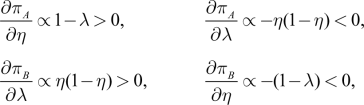
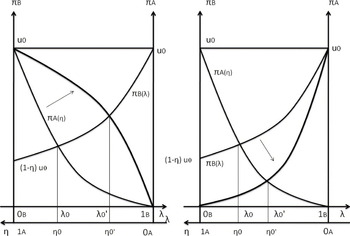
where uo/(1 − λη)2 has been omitted from the derivatives. One can plot the benefit function for country A in the (η, πA)-graph with λ treated as a parameter and, for country B in the (λ, πB)-graph, with η treated as a parameter. One can then put the two graphs together, as in Figure 4, to investigate strategic interactions between A and B in their sequential negotiations. The two benefit curves intersect at two threshold discount factors: ηo = (51/2 − 1)/2 and λo = (3 − 51/2)/2, where ηo + λo = 1 and λo = λo.
Bargaining benefit sharing between developed and developing countries.

Two important conclusions can be drawn from Figure 4 as part of our analysis of bargaining benefit divisions between developed and developing countries. (1) πA < πB as λ > λo and η < ηo. The results reverse if the condition changes: namely, πA = πB if λ∈ [0, λo) = Λ, and η∈ (ηo, 1] = H. This reversal implies that if developed countries are anxious (low λ < λo) about financial openness and if their developing counterparts are patient (high η > ηo), the latter will be able to obtain more bargaining benefits than will the former (πA > πB). Clearly, the less patient the developed country is, the smaller the amount of benefits that can be captured. (2) As λ falls to λ′ and η rises to η′ (as a parametric change in each benefit function), there will be an upward shift in curve πA(η) (because ∂πA/∂λ< 0) and a downward shift in curve πB(λ) (because ∂πB/∂η < 0) in Figure 4, thereby causing the two threshold discount factors to change in such a way that λo goes up to λ′o and ηo drops to η′o, where η′o + λ′o = 1. Both sets of points, Λ and H, will thus be enlarged, and the chances that πA > πB will increase accordingly. This clearly confirms that a higher degree of impatience on the part of a developed country faced with a more reluctant developing country in terms of its financial openness will not actually serve the interests of the former country. In other words, it does not pay for a developed country to force its developing counterparts to liberalise their capital markets prematurely.
Note that the reality may be more complicated than that shown in the game. In fact, a number of studies document the asymmetric power relationship between developed and developing countries and the unfair bargaining outcomes that result from their strategic interactions. Moreover, powerful international organisations such as the IMF and World Bank are heavily influenced by developed countries, and they follow neo-liberal economic doctrine, which is the mainstream/dominant ideology in these countries. Consequently, the multinational enterprises that predominantly originate in developed countries will enjoy beneficial treatment in developing countries and reap the greater share of the benefit of investment.Footnote 39 With consideration of relative bargaining power depending on factors besides the degree of impatience, including institutional arrangements, power relations, economic dependence, etc., U*B − U′B < U*A − U′A may be likely. In such a case, impatient developed countries may successfully push reluctant developing countries to open their capital accounts wider. In the short run, the former can benefit a great deal at the expense of the latter without experiencing negative consequences. In the long run, however, the economic crisis and the recession in developing countries will spill over to developed countries in the face of increasing globalisation and the increasing interdependence of countries. In a broader socio-political context, serious socio-political unrest and international conflicts may evolve as a result of such coercion, unfairness, and poverty (as related to these other phenomena), ultimately undermining global economic prosperity.Footnote 40
Conclusion
In this article, we have developed a new model to illustrate the growth instability trade-off for developing countries with regard to capital mobility. Our model has revealed that free capital mobility is likely to do more harm than good for developing nations because premature liberalisation exposes the affected countries to greater volatility due to their financial weakness. Developing countries differ in their subjective preferences and objective opportunities in relation to international capital flows, and all of these factors have different implications for the rational trade-offs between growth and instability. We have established that high instability is indeed an inevitable price of rapid growth in developing countries and that many countries do care about economic instability in seeking high growth under conditions of financial vulnerability.
Financially advanced countries are anxiously requesting that reluctant countries liberalise their weak capital markets. Unfortunately, this could decrease the former's first-mover advantage in favour of the latter. Our analysis of a standard bargaining model applied to global financial integration has proven that it does not pay for a developed country to push its developing counterparts to prematurely liberalise their markets. Indeed, the more impatient developed countries become in their push for wider openness in financially weak countries, the greater the losses will be by the former in their sequential negotiations with the latter regarding the division of capital mobility benefits.
As a pilot study mainly devoted to a theoretical construct, this article nevertheless has several limitations. First, our argument mainly focuses on the relationship between financial liberalisation and economic instability. It would be more useful if a well-conceived model could be developed to model how the level of development of a financial system mediates the relationship between growth and liberalisation. Secondly, we assume that the developing country maximise the social welfare of its citizens. Given divergent individual-level preferences regarding the issue, however, it would be of practical relevance to model public choice considerations, institutions, and interest groups that are all relevant to government policymaking. Therefore, developing a persuasive model of a developing country's domestic politics may be a task for future research. Thirdly, liberalisation is both forced and incentivised, and the incentives at play need to be included in the developing country's utility function and bargaining game with an aim of deriving more insight into developing countries’ behaviours. Providing simple illustrative graphs that should be understandable to a broad readership, we have explored this widely debated issue using simple, formal proofs. Hopefully, our colleagues can further and deepen this research in related areas and provide more practical policy recommendations for mutually beneficial solutions for both developed and developing countries.