INTRODUCTION
The majority of nutrient recommendation publications and ration balancing programmes for cattle (USA: dairy cattle, NRC 2001; beef cattle, NRC 2016; United Kingdom: ARC 1980; AFRC 1993; and Brazil: BR-Corte, Valadares Filho et al. Reference Valadares Filho, Marcondes, Chizzotti and Paulino2010) do not consider the inherent mineral contents from feedstuffs, or do not give a recommendation of the absorption coefficient for trace minerals within feedstuffs. Therefore, minerals are typically supplemented to beef cattle diets without taking into consideration the inherent minerals within the feedstuffs (Spears Reference Spears1996). Despite this, two points may be considered in this context for reducing mineral input for cattle. First, in most tropical areas, cattle depend exclusively on forages to meet their mineral requirements (Perdomo et al. Reference Perdomo, Shirley and Chicco1977; Ibrahim et al. Reference Ibrahim, Zemmelink and Tamminga1998; Costa e Silva et al. Reference Costa e Silva, Engle, Valadares Filho, Rotta, Valadares, Silva and Pacheco2015; Costa et al. Reference Costa, Ponsano, Souza and Malafaia2016). Second, when mineral supply in a production system is reduced, environmental excretion and costs are reduced (Khorasani et al. Reference Khorasani, Janzen, McGill and Kennelly1997; Humer & Zebeli Reference Humer and Zebeli2015).
Some researchers (Esser et al. Reference Esser, Hoffman, Coblentz, Orth and Weigel2009; Prados et al. Reference Prados, Valadares Filho, Santos, Zanetti, Nunes, Costa, Mariz, Detmann, Amaral, Rodrigues and Valadares2016; Zanetti et al. Reference Zanetti, Godoi, Estrada, Engle, Silva, Alhadas, Chizzotti, Prados, Renno and Valadares Filho2017) have demonstrated that animals fed typical feedlot diets can meet their mineral requirements exclusively from basal feed ingredients. This is made possible because the mineral content in feedstuffs is, in general, high (Playne et al. Reference Playne, Echevarría and Megarrity1978). Mineral bioavailability in feedstuffs is affected by the mineral distribution in plant cells, the form of the mineral, association with cell components, and interaction with other minerals (Čerešňáková et al. Reference Čerešňáková, Fľak, Poláčiková and Chrenková2005; Pogge et al. Reference Pogge, Drewnoski and Hansen2014; Berrett et al. Reference Berrett, Wagner, Neuhold, Caldera, Sellins and Engle2015). Mineral availability in the rumen depends on mineral content, fibre content and passage rate (Flachowsky & Grün Reference Flachowsky and Grün1992; Berrett et al. Reference Berrett, Wagner, Neuhold, Caldera, Sellins and Engle2015). Furthermore, the solubility of minerals in general is increased under low pH conditions. Therefore, mineral content in feedstuffs can be divided into three fractions: very soluble, moderately soluble (minerals that are predominately associated with the fibre and/or protein fractions of the feedstuff), and un-releasable or insoluble minerals (Spears Reference Spears and Fahey1994).
Minerals that are not released from feedstuffs are unavailable for absorption. Minerals released from feedstuffs incubated in rumen have been reported to be highly correlated with mineral availability to the animal (Flachowsky et al. Reference Flachowsky, Grün, Polzin and Kronemann1994). Therefore, this technique is an inexpensive, simple, rapid and reproducible technique that may allow absorption coefficients for minerals contained in feedstuffs to be estimated (Olubobokun et al. Reference Olubobokun, Craig and Pond1990). Therefore, the current study hypothesized that a proportion of mineral content within feedstuffs is released under ruminal and abomasal digestive conditions and these values should be considered in formulating diets for ruminants. The objectives were to evaluate the extent of mineral release under ruminal and simulated abomasal conditions.
MATERIAL AND METHODS
Two experiments were conducted in the Experimental Feedlot of the Animal Science Department of the Universidade Federal de Viçosa, Viçosa, MG, Brazil, following the recommendations of the Ethics Committee for Animal Use and Care. Twenty-four samples of feedstuffs were evaluated (12 concentrate and 12 forage typically fed to beef cattle) to determine mineral release.
Concentrate trial
Concentrate feedstuffs were divided into two groups where six ingredients were considered as energy concentrates (i.e. low protein content): ground maize (Zea mays L.), ground ear maize (Zea mays L.), ground sorghum (Sorghum vulgare), rice bran (Oryza sativa), soybean hulls (Glycine max (L.) Merr) and wheat bran (Triticum aestivum) while the other six ingredients were considered as protein concentrates (i.e. high protein content): maize gluten (Zea mays L.), cottonseed meal (Gossypium hirsutum), ground bean (Phaseolus vulgaris L.), peanut meal (Arachis hypogaea L.), soybean meal (Glycine max (L.) Merr) and sunflower meal (Helianthus annuus).
Concentrates were randomly divided into four groups and feedstuffs were incubated in the rumen of four cannulated crossbred bulls. The procedure of incubation was conducted four times, and within each of these periods, each concentrate group was incubated in the rumen of a different bull as part of a Latin square design. The bulls received ad libitum access to a diet composed of: 500 g maize silage/kg dry matter (DM) and a concentrate supplement composed of 800 g ground maize/kg, 86 g soybean meal/kg, 60 g wheat bran/kg, 14 g urea/kg, 1·0 g ammonium sulphate/kg, 9·0 g salt/kg, 9·0 g mineral premix/kg, 15 g sodium bicarbonate/kg and 5 g magnesium oxide/kg. The diet contained 120 g crude protein (CP)/kg DM.
Forage trial
The forages examined in the current experiment were maize silage (Zea mays L), brachiaria decumbens grass (Urochloa decumbens), elephant grass (Pennisetum purpureum), Brachiaria humidicola grass (Urochloa humidicola), Marandu grass (Urochloa brizantha cv Marandu), brachiaria MG-4 grass (Urochloa brizantha cv MG-4), Mombaça grass (Panicum maximum cv Mombaça), Mulato grass (hybrid Urochloa decumbens × Urochloa ruziziensis), peanut forage (Arachis pintoi), Tanzania grass (Panicum maximum cv Tanzânia), Tifton 85 hay (Cynodon spp.) and Brachiaria Xaraes grass (Urochloa brizantha cv Xaraés).
Samples of feedstuffs, except maize silage, were collected 45 d after regrowth, at the Agrostology Sector from Animal Sciences Department at Universidade Federal de Viçosa, Viçosa, MG, Brazil. The 45 d of regrowth, during the transition between rainy and dry seasons, was not irrigated, as usual for Brazilian pastures. The samples (leaves and stems) were harvested 10 cm above the soil. All samples were oven-dried at 55 °C for 72 h. Forages were randomly divided into three groups and incubated in the rumen of three cannulated crossbred bulls. The procedure of incubation was replicated three times and within each of these periods, each forage type was incubated in a different bull as part of a Latin square design. The bulls had ad libitum access to a diet that contained 1000 g/kg elephant grass containing 161 g CP/kg DM.
Ruminal incubation
All samples were ground through a 2-mm sieve using a knife mill (TECNAL, Piracicaba, São Paulo, Brazil) for in situ ruminal incubation. Nylon bags (Sefar Nitex, Switzerland; 50-μm porosity, 400 cm2 surface area) were individually identified. Six grams of each feedstuff were weighed into each bag and incubated in each animal. The bag surface area to mass ratio was 15 mg/cm2. The number of bags varied as a function of incubation time to guarantee enough residual samples after incubation (i.e. more bags per sample were incubated for the longer incubation times relative to shorter incubations times). The incubation times were 0, 2, 4, 8, 16, 24, 48 and 72 h for concentrates and 0, 3, 6, 12, 24, 36, 48, 72 and 120 h for forages. The times were different for concentrate and forage feedstuffs due different degradation rates. Samples were incubated in the rumen by attaching the bags to a steel chain with a weight at the end to allow for continual immersion within the ruminal contents.
Bags were placed into the rumen in reverse order of incubation hours so that all bags were removed at the same time for washing. After the incubation period, bags were washed by hand with running cold tap water and the end-point for washing was when the rinsing water had a high clarity. The bags for time 0 were not incubated in the rumen, but as with incubated bags they were rinsed in running water. Samples were oven-dried at 55 °C for 72 h. After drying, bags were placed in an oven at 105 °C for 2 h and weighed. Residual samples in bags were used to estimate the parameters of ruminal DM degradation, and total ash (TA) and mineral release. Residues of each feedstuff were removed from nylon bags and placed in a labelled plastic bag, to obtain a sample of each feedstuff per animal/incubation time.
Abomasal digestion simulation
Residual samples of ruminal incubation at 24 h were submitted to a simulation of abomasal digestion as described by Berrett et al. (Reference Berrett, Wagner, Neuhold, Caldera, Sellins and Engle2015). In total 400 mg of sample was weighed into plastic tubes and 15 ml of a solution of 50 g/l pepsin and 1·2 N HCl (hydrochloric acid) was added to each tube to simulate abomasal digestion conditions. Tubes were then allowed to incubate in a water bath at 39 °C with gentle swirling every 15 min. After 1 h, residual content was filtered through ashless filter paper (CAT no. 1541-090, Whatman, General Electric). The residual content was oven-dried at 105 °C for 12 h, and analysed for ash and mineral content.
Analytical procedures
All feedstuffs were analysed for DM (method 934·01), TA (method 930·05), and total nitrogen (N, method 981·10), according to the AOAC protocols (AOAC 2012). Crude protein content was obtained by multiplying total nitrogen content by 6·25. Neutral detergent fibre (NDF) was obtained according to Mertens (Reference Mertens2002) without addition of sodium sulphite and with addition of a thermostable α-amylase. Neutral detergent fibre was expressed in ash- and protein-free basis.
Mineral analysis was performed on all samples (initial and residual) by weighing the samples into pre-weighed acid-washed crucibles then drying the samples in a forced-air oven at 105 °C for 12 h. After the drying period, samples were reweighed to measure DM content. Samples were then placed in muffle furnace and ashed at 600 °C for 12 h. Samples were removed and placed in a desiccator for 30 min to cool. Samples were then weighed and re-suspended with 5 ml of HCl (1·2 N HCl). During re-suspension the crucibles were heated using a heat plate. Mineral concentrations (calcium [Ca], phosphorus [P,] sodium [Na], potassium [K], magnesium [Mg], sulphur [S], copper [Cu], zinc [Zn], manganese [Mn], cobalt [Co] and iron [Fe]) of the samples were analysed through inductively coupled plasma optical emission spectroscopy methods (Optima 7300 DV, Perkin Elmer; Braselton et al. Reference Braselton, Stuart, Mullaney and Herdt1997).
Statistical analysis
A Latin square experimental design was used to assist and organize the information collected in the field, allowing for measurement of degradation of different feedstuffs without the confounding effect of animal. The objective was to control sources of variation and to avoid bias without estimating variability. The Latin square design, in this case, was not used as a way to analyse data for comparative differences among feedstuffs, animals, or collection periods, but to collect source data to generate the following equations.
The profiles for DM degradation, TA and mineral release in the rumen were estimated using the asymptotic model of Ørskov & McDonald (Reference Ørskov and McDonald1979). The following model was used to estimate the parameters of degradability:
 $$Y = a + b\; \times (1 - \; e^{( - kd\; \times t)} )$$
where Y is fraction degraded or released in the time t (g/100 g), of DM, TA or individual mineral; ‘a’ is the immediately soluble fraction (g/100 g); ‘b’ is the insoluble but potentially degradable/releasable fraction (g/100 g); ‘e’ is the Euler's number (e = 2·71828183…) and kd is degradation/releasing rate of ‘b’ (/h). The effective degradation/release was estimated based on the model of Ørskov & McDonald (Reference Ørskov and McDonald1979):
 $$E = \; a + \; \displaystyle{{b\; \times kd} \over {kd + kp}}$$
where E is effective degradation (or released) fraction, of DM, TA or each mineral; ‘a’, ‘b’ and kd are the parameters estimated from Eqn (1); and kp is passage rate, considered in the current study as 0·05.
The NLIN procedure of SAS (SAS Institute Inc., Cary, NC, USA) was used to estimate the parameters from the models. Pearson correlations between analysed contents in feedstuffs and ruminal TA and effective mineral release were performed (CORR procedure; SAS Institute Inc., Cary, NC, USA). All statistical procedures were conducted using 0·05 as the critical level for the probability for the type I error.
Additionally, to identify concentrate and forage sub-groups of mineral release, a cluster analysis was performed using ‘a’, ‘b’ and kd estimates for TA as response variable. Non-hierarchical k-means clustering method was performed (Johnson & Wichern Reference Johnson and Wichern1998; Khattree & Naik Reference Khattree and Naik2000) by using the FASTCLUS procedure of SAS (SAS Institute Inc., Cary, NC, USA). Initially, a maximum of five clusters was established for each clustering procedure. If this procedure created at least one cluster with only one observation (feed), a new clustering was made with a maximum of four clusters. This procedure was repeated until each and every cluster had at least two observations (feeds). The efficiency of clustering was also evaluated through the over-all R 2 and the CCC (cubic clustering criterion).
RESULTS
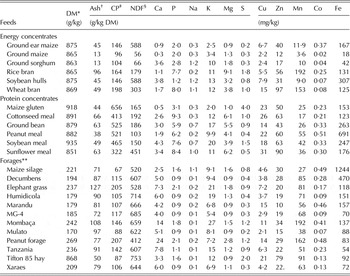
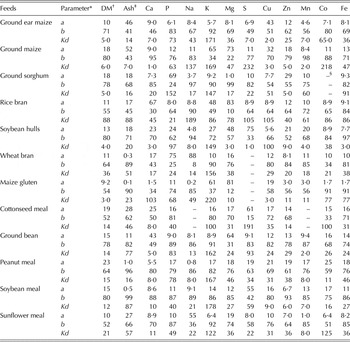
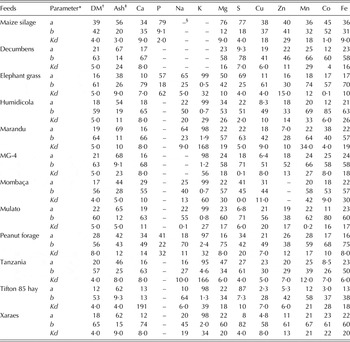
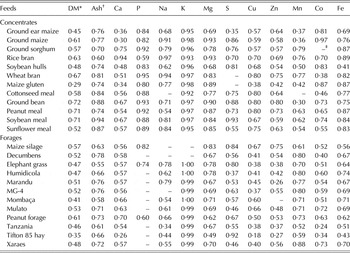
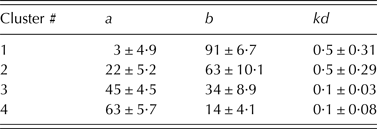
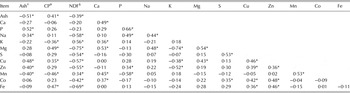
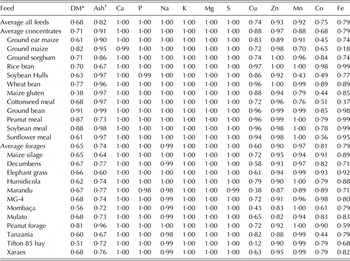
Substantial variability was observed between concentrate and forage feedstuffs for all analysed constituents (Table 1). For certain feeds in the current study, the model proposed by Ørskov & McDonald (Reference Ørskov and McDonald1979) did not converge due to different degradation responses. In this case, the model was not adopted because a negative slope was observed; indicative of a greater mineral amount in the residual than in the incubated sample. Calculated parameters of the model, ‘a’, ‘b’ and kd, for concentrate and forage feedstuffs are presented in Tables 2 and 3, respectively. Substantial variability was observed for the effective ruminal degradation and total and individual mineral release (Table 4). When feedstuffs were clustered according with the ‘a’, ‘b’ and kd estimates of TA ruminal release, four groups were identified (Table 5). From group ‘1’ to group ‘4’, an increase in the fraction ‘a’, and a reduction in both fraction ‘b’ and release rate was observed. A negative correlation was observed between NDF content and mineral release (Table 6). In general, the solubility values for DM, TA and each mineral for majority of feedstuffs ranged between 0·6–0·8, 0·7–0·9 and 0·9–1·0, respectively, except for Cu, Co and Fe (Table 7).
Chemical composition of concentrate and forage feedstuffs

* Dry matter.
† Total mineral content.
‡ Crude protein.
§ Neutral detergent fibre.
** The forages: Decumbens grass (Urochloa decumbens), Elephant grass (Pennisetum purpureum), Humidicola grass (Urochloa humidicola), Marandu grass (Urochloa brizantha cv Marandu), MG-4 grass (Urochloa brizantha cv MG-4), Mombaça grass (Panicum maximum cv Mombaça), Mulato grass (hybrid Urochloa decumbens × Urochloa ruziziensis), Peanut forage (Arachis pintoi), Tanzania grass (Panicum maximum cv Tanzânia), Tifton 85 hay (Cynodon spp.) and Xaraes grass (Urochloa brizantha cv Xaraés) were collected after 45 d of regrowth.
Dry matter and total and individual mineral parameters of ruminal release of concentrate feeds

* ‘a’ is the immediately soluble fraction; ‘b’ is the insoluble by potentially degradable/releasable fraction; and kd is degradation/release rate of ‘b’ (%/h).
† Dry matter.
‡ Total mineral content.
§ (−) means that the model proposed by Ørskov & McDonald (Reference Ørskov and McDonald1979) did not converge due to different release response of minerals.
DM and total and individual mineral parameters of ruminal release of forage feeds

* ‘a’ is the immediately soluble fraction; ‘b’ is the insoluble by potentially degradable/releasable fraction; and kd is degradation/releasing rate of ‘b’ (%/h).
† Dry matter.
‡ Total mineral content.
§ (−) means that the model proposed by Ørskov & McDonald (Reference Ørskov and McDonald1979) did not converge due to different release response of minerals.
Coefficients of DM rumen effective degradation, and total and individual mineral rumen release in concentrate and forage feeds considering passage rate = 0·05/h

* Dry matter.
† Total mineral content.
‡ (–) means that the model proposed by Ørskov & McDonald (Reference Ørskov and McDonald1979) did not converge due to different release response of minerals.
Cluster classification based in soluble (‘a’), insoluble but potentially degradable/releasable fraction (‘b’); and release rate of ‘b’ (kd) fractions of total ash of feeds

Cluster #1: wheat bran, maize gluten, ground bean, peanut meal, soybean meal; Cluster #2: ground sorghum, rice bran, soybean hulls, cottonseed meal, sunflower meal; Cluster #3: ground ear maize, ground maize, elephant grass, Mombaça, peanut forage, tanzania; and Cluster #4: maize silage, decumbens, humidicola, marandu, MG-4, Mulato, Tifton-85 hay, Xaraes.
Pearson correlation coefficients between content and ruminal release of total ash, and individual minerals of different concentrate and forage feedstuffs (n = 24) *

* P < 0·05.
† Total mineral content.
‡ Crude protein.
§ Neutral detergent fibre.
Coefficients of DM abomasal digestion and total ash, and individual mineral abomasal release of concentrate and forage feedstuffs

* Dry matter.
† Total mineral content.
DISCUSSION
Mineral contents
Reports regarding the availability of minerals from feedstuffs are important to improve the precision of diet formulation and mineral supplementation for cattle. Moreover, mineral content of feedstuffs is an important factor for maintaining buffering capacity in ruminants (Jasaitis et al. Reference Jasaitis, Wohlt and Evans1987). Research in tropical countries has focused primarily on investigating the impact of protein and energy supplementation on cattle performance (Corah Reference Corah1996; Sath et al. Reference Sath, Pauly and Holtenius2012). Furthermore, trace element content is extremely variable in feedstuffs when compared with CP or NDF content (Adams Reference Adams1975; Playne et al. Reference Playne, Echevarría and Megarrity1978; Genther & Hansen Reference Genther and Hansen2014). In the current study, while the coefficients of variation (CV) for CP and NDF in forage group were 35·4 and 15·2%, respectively, differences between mineral contents were even greater. The average coefficient of variation for minerals in forages was 82·6 and 99·7% when all groups were considered. The smallest CV between minerals was 54·1% for K and the greatest CV was 133·3% for Fe.
Feedstuff Ca, Mg, K, Cl and Fe contents are in appropriate concentrations to meet the mineral requirements of beef cattle (Minson Reference Minson1990; Chládek & Zapletal Reference Chládek and Zapletal2007). Smart et al. (Reference Smart, Gudmundson and Christensen1981), in a review about the interactions across Cu, Zn and Se in soil, plants and cattle, reported that basal feedstuffs can provide trace minerals to the animal, however, concentrations can be inadequate. Thus, Yoshihara et al. (Reference Yoshihara, Mizuno, Ogura, Sasaki and Sato2013) estimated mineral intake and nutritional quality for grazed cattle varying numbers and combinations of 17 temperate pasture species; they suggested that by improving the number of plant species or products in diet formulation or in grazed pastures, improvement in mineral balance can be obtained in cattle.
Rumen mineral release
Mineral requirements from ruminal fauna are not negligible (Bravo et al. Reference Bravo, Meschy, Bogaert and Sauvant2000), consequently mineral release from ingested feeds is important. Although mineral solubilization does not guarantee mineral utilization, absorption, or tissue deposition, absorption is largely affected by mineral intake and mineral solubilization in the gastrointestinal tract prior to absorption (Field Reference Field1981; Flachowsky et al. Reference Flachowsky, Grün, Polzin and Kronemann1994). Like this, Van Eys & Reid (Reference Van Eys and Reid1987) have reported that reduced mineral release from forages decreases performance in grazing cattle.
High variability in mineral content between feedstuffs, and different solubilities between minerals have been described (Čerešňáková et al. Reference Čerešňáková, Fľak, Poláčiková and Chrenková2007). In the current study, high variability was observed for effective release among minerals and effective release in each mineral between feeds. Feeds with low DM degradation did not necessarily have low mineral release coefficients (Emanuele et al. Reference Emanuele, Staples and Wilcox1991). Mineral release profiles in relationship to DM digestibility can be associated with concentration of minerals in the digestible part of the plant. Most minerals are associated with the organic constituents within feeds (Broadley et al. Reference Broadley, White, Hammond, Zelko and Lux2007; Maathuis & Diatloff Reference Maathuis, Diatloff and Maathuis2012; He et al. Reference He, Veneklaas, Kuo and Lambers2014). This is most likely the reason for the lack of a relationship between DM digestibility and mineral solubility.
The average effective release of K was 0·98 for concentrates and forages, being the lowest variation measured among minerals. Potassium in the plant cell is not associated with organic matter and persists as the K+ ion (Amtmann & Rubio Reference Amtmann, Rubio and Hetherington2012) and this helps to explain the high release of K. Phosphorus release was assumed to be similar to that of K. However, P within the concentrate feeds is primarily associated with phytate. Rumen micro-organisms synthesize a phytase enzyme in significant amounts (Ray et al. Reference Ray, Jarrett and Knowlton2013) that help to liberate P from the plant cell. Feeds with low P content were contaminated with P from rumen micro-organisms and consequently P concentrations in the residual DM after rumen incubation were greater than the P content in the intact feeds, which caused P release to have negative values. This behaviour for P has been related to feeds with low P content and high NDF content (Bonhomme Reference Bonhomme1990; Bravo et al. Reference Bravo, Meschy, Bogaert and Sauvant2000). However, P contamination was observed at times >8 h, probably due to the lag time for bacterial growth and adherence to fibre. Phosphorus content in the residual DM of forages submitted to ruminal incubation (t = 8 h) indicates that 0·52 (maximum: maize silage, 0·77; minimum: Tanzania, 0·37) of initial P was released, and after this time, the P content of residue increased.
Group ‘1’ was characterized by reduced fraction ‘a’ (3 ± 4·9), but greater fraction ‘b’ and release rate (91 ± 6·7 and 0·5 ± 0·31, respectively). In contrast, group ‘4’ was characterized by greater fraction ‘a’ (63 ± 5·7), but reduced fraction ‘b’ and release rate (14 ± 4·1 and 0·1 ± 0·08, respectively). Only concentrates assigned to group ‘1’ were characterized by ‘highest release rate’: wheat bran, maize gluten, ground bean, peanut meal and soybean meal. This group was composed only of concentrate feedstuffs considered as protein feeds, reaffirming a correlation of 0·41 between CP content and TA release. However, across minerals, a positive and significant relationship between CP content and mineral release was observed only for Mg, Cu and Fe. Furthermore, from these five feeds, four are by-product feeds that were processed during manufacturing (i.e. heat, pressing, substances added). This may be the reason for a high mineral release rate from these feedstuffs. A second group (group ‘2’) was similarly composed exclusively of concentrate feeds (ground sorghum, rice bran, soybean hulls, cottonseed meal, sunflower meal). These feeds presented a high release rate (0·5 ± 0·29), like group ‘1’, but greater fraction ‘a’ (22 ± 5·2) and lower fraction ‘b’ (63 ± 10·1). In contrast, group ‘4’ was composed exclusively of forages (maize silage, Decumbens, Humidicola, Marandu, MG-4, Mulato, Tifton-85 hay and Xaraes). This could be related to high K content and solubility in these feeds. Group ‘3’ was composed of ground ear maize, ground maize, elephant grass, Mombaça, peanut forage and Tanzania, with ‘a’ = 45 ± 4·5, ‘b’ = 34 ± 8·9, and kd = 0·09 ± 0·032.
Relations between feed content and ruminal mineral release
Associations between nutrient contents and mineral release within feedstuffs do exist (Emanuele & Staples Reference Emanuele and Staples1990). The correlation between NDF content and ruminal TA release was negative (r = –0·39), which may be related to the high capacity of NDF to exchange cations (McBurney et al. Reference McBurney, Allen and Van Soest1986; Jasaitis et al. Reference Jasaitis, Wohlt and Evans1987). Moreover, minerals associated with the plant cell wall have a lower bioavailability or require a longer fermentation time for maximal release (Emanuele & Staples Reference Emanuele and Staples1990; Flachowsky & Grün Reference Flachowsky and Grün1992). A negative correlation between Ca release and NDF content, for example, can be explained by the function of Ca in the cell in that it helps to regulate the control of cell wall enzymes, assists with cell wall stabilization and binds with pectin in the cell wall to help support the plant (Demarty et al. Reference Demarty, Morvan and Thellier1984; Spears Reference Spears1996). Furthermore, with the advancement of plant maturity, NDF and silica concentrations are increased (Smith et al. Reference Smith, Nelson and Boggino1971; Jung & Allen Reference Jung and Allen1995; Spanghero et al. Reference Spanghero, Zanfi, Signor, Davanzo, Volpe and Venerus2015). Silica content was not measured in the current study; however, this relationship may be confirmed when a correlation of 0·57 was observed between NDF and ruminal TA content, and the average correlation between each mineral and NDF contents was r = −0·31. Among minerals, only K and Mn were positively correlated with NDF content (0·56 and 0·34, respectively).
The correlation between TA content and ruminal TA release was negative (r = –0·51). Ma & Yamaji (Reference Ma and Yamaji2006) reported that insoluble silica is incorporated into the plant cell wall to improve cellular protection. However, ruminal release of each mineral was increased by the contents of other nutrients (average of r = 0·35). As minerals occur in feeds in soluble and insoluble forms, a greater concentration of each mineral is associated with the soluble fraction.
Abomasal mineral release
In general, minerals with nutritional importance have greater solubility as pH decreases. At a high pH, minerals typically become insoluble, thus decreasing the chances of absorption. The 24 h ruminal residues had negative mineral release values in some cases. This could be related to contamination from minerals of ruminal fluid origin (Moreira et al. Reference Moreira, Leonel, Vieira and Pereira2013). In comparison with residual samples incubated in the rumen for 24 h, solubility of minerals with nutritional interest was numerically greater than DM and TA. Few reports have been published investigating mineral solubility of different feedstuffs in ruminant animals. It is difficult to explain the reason for the reduced availability of these minerals and the greater solubility of other minerals. In cattle, Berrett et al. (Reference Berrett, Wagner, Neuhold, Caldera, Sellins and Engle2015) reported solubilities ranging between 0·52 and 0·68 for Cu and 0·75 and 0·87 for Zn. These values are similar to those reported in the current experiment. Regarding Fe solubility, Lestienne et al. (Reference Lestienne, Besançon, Caporiccio, Lullien-Péllerin and Tréche2005) reported that this reduced value could be related to interactions with phenolic compounds in the feed matrix.
In general, high solubility of minerals was observed after simulated abomasal digestion. As already mentioned, solubility is an essential step to mineral absorption. The absorption coefficients recommended by nutritionists are lower than solubility values reported in the current research, except for Na and K, which are considered highly soluble. A portion of absorption coefficients described in the literature is related to apparent absorption, which includes the endogenous fraction in the reported values. Costa e Silva et al. (Reference Costa e Silva, Engle, Valadares Filho, Rotta, Valadares, Silva and Pacheco2015) determined the true absorption coefficients for minerals. Among the minerals evaluated, only the absorption coefficient of Co was close to the average Co release under simulated abomasal conditions. The Mn and Fe absorption coefficients were close to the ruminal release of these minerals. Mineral homoeostasis is controlled mainly by absorption mechanisms (Field Reference Field1981) and may help explain these differences. However, current understanding of the mechanisms for mineral absorption in beef cattle are limited (Spears Reference Spears2003; Han et al. Reference Han, So, Domby and Engle2012).
In conclusion, mineral content and ruminal release are highly variable among plant species and between each mineral. In general, ruminal mineral release is high, with the greatest values for K, while Ca, S, Cu, Zn, Mn and Co have the lowest ruminal release, being proportional to the DM digested. Concentrated feeds have a greater mineral release rate than forages. Mineral release is affected by NDF content and mineral concentration. Under simulated abomasal conditions, most minerals are released, and consequently available for absorption. Based on this information, mineral content from basal feed ingredients should be considered as highly available and total mineral content may be used in diet formulation, thereby reducing the level of mineral supplement often routinely used and hence reducing costs and environmental excretion of minerals.
The author gratefully acknowledges the National Council of Scientific and Technological Development (CNPq), National Institute of Science and Technology in Animal Science (INCT – Ciência Animal), Coordination of Improvement of Personal Higher Education (CAPES), and Foundation for Research Support of the State of Minas Gerais (FAPEMIG) for providing a research grant for this research.