Introduction
In usage-based approaches to language acquisition, language knowledge in a learner's mind consists of thousands of linguistic constructions, which are complex categories learned on the basis of language input and domain-general cognitive processes, including categorization. Therefore, linguistic constructions should display prototype effects, in which some category members are more central than others (e.g., Bybee, Reference Bybee2010). Ibbotson, Theakston, Lieven, and Tomasello (Reference Ibbotson, Theakston, Lieven and Tomasello2012) recently used a semantic priming task and offered evidence for the psychological reality of prototype effects of English transitive semantics in adult native English speakers. Given the possible differences in first language (L1) and second language (L2) input (e.g., Ellis & Laporte, Reference Ellis, Laporte, de Groot and Kroll1997; Muñoz, Reference Muñoz2008) and in the nature of L1 and L2 learning (e.g., Bley-Vroman, Reference Bley-Vroman2009; DeKeyser, Reference DeKeyser2000), L2 learners may or may not have the same kind of representations that L1 speakers have. The current study has two goals. First, I aimed to replicate Ibbotson et al.’s (Reference Ibbotson, Theakston, Lieven and Tomasello2012) findings with adult native English speakers. Second, I intended to conduct the first study that seeks evidence for the operation of the categorization process in L2 learning from adult ESL learners.
What are linguistic constructions?
Linguistic constructions are conventional form-meaning mappings in a particular language (e.g., Bybee, Reference Bybee2010; Goldberg, Reference Goldberg2006, Reference Goldberg and MacWhinney1999; Tomasello, Reference Tomasello2003, Reference Tomasello and Bavin2009). For example, the English transitive construction has the form Subject-Verb-Object, and its prototypical meaning involves two participants, one acting on the other (Goldberg, Reference Goldberg and MacWhinney1999). Moreover, construction meaning is not determined exclusively by the verbs that appear in them. We know the general sense of the event when we hear The dax got mibbed by the gazze, although we do not know the content words, including the verb (Tomasello, Reference Tomasello and Bavin2009). In He sneezed his tooth right across town, the meaning of causing something to move does not come from the verb, which is intransitive, but from the semantics of the cause-motion construction (Goldberg, Reference Goldberg2003). Therefore, for hearers to make sense of a construction, they have to rely on information from the verb and the syntactic frame; the form and the meaning of a construction are not mutually exclusive but instead “reinforce and complement each other” (Ellis & Larsen-Freeman, Reference Ellis and Larsen-Freeman2009, p.97).
Construction learning as category learning
Constructions are complex categories learned implicitly on the basis of language input and domain-general cognitive processes. Tomasello (Reference Tomasello2003) proposed that children learn linguistic structures through the cognitive abilities of intention-reading and pattern-finding, the latter including categorization, analogy, and distributional analysis. They develop adult-like constructions by gradually schematizing early item-based concrete constructions. For example, children's initial representation of verb argument constructions (VACs), such as the transitive construction, is closely associated with particular verbs. Later, with more input, children process similarities in the form and meaning of various transitive sentences (e.g., She kicked the ball, He broke his watch) and subsequently develop a more abstract, verb-general representation of the construction. Regarding meaning, Ellis and Larsen-Freeman (Reference Ellis and Larsen-Freeman2009) argued that verbs that typically appear in the same VAC tend to be semantically related; therefore, the schematic meaning of a construction can be induced from these verbs. Goldberg (Reference Goldberg and MacWhinney1999) similarly argued that verbs that frequently occur in particular constructions and can be applied to a large number of situations “act as a center of gravity” (p. 209) and form the prototypical semantics of that construction. Thus, in usage-based approaches, as emphasized by Gries and Ellis (Reference Gries and Ellis2015), the creation and entrenchment of construction knowledge are driven by the accumulation of statistical probabilities of occurrence between verbs and constructions in previously-encountered linguistic input. The theoretical claims for the abstract, verb-general construction meaning have been supported by several empirical L1 studies (e.g., Ambridge, Noble & Lieven, Reference Ambridge, Noble and Lieven2014; Bencini & Goldberg, Reference Bencini and Goldberg2000; Goldwater & Markman, Reference Goldwater and Markman2009; Johnson & Goldberg, Reference Johnson and Goldberg2012).
Prototypes and prototype effects
Like non-linguistic categories, linguistic constructions should display prototype effects, or graded category membership (e.g., Bybee, Reference Bybee2010). Coined by Rosch and her colleagues (e.g., Mervis & Rosch, Reference Mervis and Rosch1981; Rosch, Reference Rosch and Scholnick1983), the notion of the prototype refers to a category member with a maximum number of defining features of the category – that is, features that are likely to be found in the largest number of category members, but are unlikely to be shared by members of other categories. Moreover, the category itself is a set of differently-weighted features, and a category member must have cumulative weightings of its features that meet a minimum threshold level. However, each member may not have exactly the same features, and a feature may not be shared by all category members. The notion of prototype has influenced analyses of various linguistic phenomena (e.g., Andersen & Shirai, Reference Andersen, Shirai, Ritchie and Bhatia1996; Dąbrowska, Rowland & Theakston, Reference Dąbrowska, Rowland and Theakston2009; Diessel & Tomasello, Reference Diessel and Tomasello2005; Ibbotson & Tomasello, Reference Ibbotson and Tomasello2009).
One way to investigate the psychological reality of prototype effects is to use priming methods. In their classic study, Franks and Bransford (Reference Franks and Bransford1971) used a methodology called prototype-plus-distortion to demonstrate the prototype effects for a non-linguistic category. In the first phase of their experiment, called the acquisition phase, their participants, who were adults, saw various patterns and combinations of common geometric figures (e.g., squares, circles, triangles) which were transformed from the base or the prototype, defined as the pattern and combination of geometric figures that had the least transformational distance from the whole set of stimuli. That is, the prototype was “the central tendency or best representative” (p. 67) of the stimuli, and the transformations from the base included substituting one type of figure by another, switching positions of geometric figures, and/ or deleting figures. Later, in the recognition phase, participants saw (1) previously seen pictures, (2) new pictures that were also transformed from the base, and (3) the prototype, and they were asked if they had seen these pictures before. All stimuli consisted of common geometric shapes, not free forms. An important finding was that the participants falsely reported that they had seen the prototype and that they were more confident that they had seen it than previously seen pictures or unseen pictures (“foils”). According to Ibbotson et al. (Reference Ibbotson, Theakston, Lieven and Tomasello2012), the traditional explanation for false memory is based on Bartlett's (Reference Bartlett1932) theory of remembering; that is, false positive recalls result from people's difficulty differentiating what they have experienced from what is in their constructive memory, which is based on inference or knowledge. Only one L1 study has applied this theory to linguistic construction semantics and provided supporting evidence in adults, namely Ibbotson et al. (Reference Ibbotson, Theakston, Lieven and Tomasello2012).
Prototypes and L2 acquisition
Usage-based researchers have proposed that, like L1 acquisition, L2 acquisition is also driven by domain-general cognitive abilities (e.g., Ellis, Reference Ellis2008, Reference Ellis, Gass and Mackey2011, Reference Ellis, Trousdale and Hoffmann2013; Ellis & Wulff, Reference Ellis, Wulff, Dąbrowska and Divjak2015). In recent years, usage-based approaches have received increasing L2 research attention (e.g., Ellis & Larsen-Freeman, Reference Ellis and Larsen-Freeman2009; Eskildsen, Reference Eskildsen2012; Ortega, Reference Ortega2013; Ortega, Tyler, Park & Uno, Reference Ortega, Tyler, Park and Uno2016; Tyler, Reference Tyler2010), and work by Nick Ellis and colleagues has been instrumental in this area. Using corpus data, these researchers have investigated the role of prototypes in the acquisition of L2 English (e.g., Ellis & Ferreira-Junior, Reference Ellis and Ferreira-Junior2009; Römer, O'Donnell & Ellis, Reference Römer, O'Donnell and Ellis2014; Wulff, Ellis, Römer, Bardovi-Harlig & Leblanc, Reference Wulff, Ellis, Römer, Bardovi-Harlig and Leblanc2009). For example, Ellis and Ferreira-Junior (Reference Ellis and Ferreira-Junior2009) investigated the use of three English constructions – the verb locative, the verb object locative, and the ditransitive construction – in a 5-year longitudinal data of speech produced by adult immigrants in Britain and their native-speaker conversation partners. The researchers found that the verbs first used by the non-native speakers in each of these constructions were frequent in the native speakers’ speech, semantically prototypical, and applicable to a variety of situations. In addition, the psychological reality of the form and the semantics of ESL VACs has been investigated. For example, using a sentence sorting task, Gries and Wulff (Reference Gries and Wulff2005) demonstrated that L2 learners can perceive semantic similarities between sentences in the transitive construction, even though the transitive sentences contain different verbs and a transitive verb can also appear in other constructions (e.g., throw can appear in the transitive, caused-motion, resultative, and the ditransitive construction). Thus, the researchers argued for the ontological status of abstract, verb-independent semantics of various VACs, including the transitive construction.
While these studies seem to support usage-based researchers’ claims, psycholinguistic ESL research has suggested several possible differences between the representation and the acquisition of English VACs in native English speakers and ESL learners. For example, Römer et al. (Reference Römer, O'Donnell and Ellis2014) asked native English speakers and advanced ESL learners whose L1 was German, Czech, or Spanish to complete 20 VAC frames (e.g., she ____ against the. . .) with the first verb that came into their mind. Overall, although the learners’ and the native speakers’ VAC mental representations seemed to overlap, the two groups exhibited different verb-construction associations. For example, compared to the native speakers, the ESL learners supplied more semantically general and highly frequent verbs (e.g., be) and fewer specific, less frequent verbs (e.g., lean, push). Moreover, the learners associated the Verb-against-Noun construction with verbs denoting a reaction or argument, such as fight and argue. On the other hand, the native English speakers associated this construction with verbs expressing physical contact or collision, such as lean and push. In addition to L1 influence, in light of usage-based approaches (e.g., Gries & Ellis, Reference Gries and Ellis2015), the results from this study may also suggest the possible difference in the amount or the intensity of VAC input that the two participant groups had received (e.g., Ellis & Laporte, Reference Ellis, Laporte, de Groot and Kroll1997; Littlemore, Reference Littlemore2009; Muñoz, Reference Muñoz2008).
Previous research additionally suggested that the nature of L1 and L2 VAC learning may be different. The L1 literature suggests that initial VAC construction learning is facilitated by input skewed towards one particular verb which is frequent and semantically prototypical in that construction, because such input reflects the structure of child-directed speech and facilitates detection of the underlying VAC (Goldberg, Casenhiser & Sethuraman, Reference Goldberg, Casenhiser and Sethuraman2004; Goldberg, Casenhiser & White, Reference Goldberg, Casenhiser and White2007). However, unlike L1 researchers (e.g., Casenhiser & Goldberg, Reference Casenhiser and Goldberg2005; Goldberg et al., Reference Goldberg, Casenhiser and Sethuraman2004), L2 researchers have not observed the benefits of skewed input for L2 learning; L2 learners seemed to benefit more from exposure to balanced input, in which a set of lexical verbs appears an equal number of times in the target construction, when their learning was assessed with subsequent tasks such as a sentence acceptability judgment task or a listening comprehension task (McDonough & Nekrasova–Becker, Reference McDonough and Nekrasova–Becker2014; McDonough & Trofimovich, Reference McDonough and Trofimovich2013; Nakamura, Reference Nakamura2012; Year & Gordon, Reference Year and Gordon2009). These L2 researchers suggested that the absence of a skewed-input effect may have resulted from L2 learners’ use of explicit learning strategies, whereas L1 learners may have learned input-based linguistic patterns at a more implicit level. This thus suggests an important difference in construction learning between L1 and L2 learners.
Empirical evidence for prototype effects in L2 learners
To date, no study has investigated the psychological reality of the prototype effects of construction semantics in English L2 learners. Such an investigation is important because the result may provide evidence for the operation of the domain-general process of categorization in L2 learning. The result may, on the other hand, provide evidence for differences between L1 and L2 learning if prototypes effects are found to be different from those in adult native English speakers. Such differences can be expected for at least two reasons. First, the amount, intensity, quality, and structure of input that adult L2 learners receive and the input that children learning their L1 receive is different (e.g., Ellis & Laporte, Reference Ellis, Laporte, de Groot and Kroll1997; Littlemore, Reference Littlemore2009; Muñoz, Reference Muñoz2008). Second, the nature of L1 and L2 learning may differ. While some previous research on the interplay between implicit and explicit learning has suggested differences in task performance as a function of explicit processes (e.g., Taylor, Krakauer & Ivry, Reference Taylor, Krakauer and Ivry2014), category learning is generally considered implicit (e.g., Ellis & Larsen-Freeman, Reference Ellis and Larsen-Freeman2009). However, unlike child L1 learners, older L2 learners may be unable or less apt at inducing abstract linguistic patterns implicitly (e.g., Bley-Vroman, Reference Bley-Vroman2009; DeKeyser, Reference DeKeyser2000), although some previous research has suggested some similarities in abstract pattern learning between the two groups (Wonnacott, Reference Wonnacott2011; Wonnacott, Newport & Tanenhaus, Reference Wonnacott, Newport and Tanenhaus2008). The L1 may also play a role (e.g., Römer et al., Reference Römer, O'Donnell and Ellis2014). It is possible, therefore, that the differences in L1 and L2 learning will result in different prototype effects in native speakers and L2 learners.
As noted, Ibbotson et al. (Reference Ibbotson, Theakston, Lieven and Tomasello2012) recently conducted the first study to provide evidence for prototype effects of English transitive semantics in native English speakers. The researchers used the prototype-plus-distortion methodology (cf. Franks & Bransford, Reference Franks and Bransford1971) and adopted Næss’ (Reference Næss2007) definition of prototypical transitive semantics. According to Næss’ typological study, the semantics of the transitive construction have three key semantic dimensions: the agent intentionality and instigation, and the affectedness of the patient. Næss’ proposed prototypical transitive semantics is based on his Maximally Distinct Arguments Hypothesis: “A prototypical transitive clause is one where the two participants are maximally semantically distinct in terms of their roles in the event described by the clause” (p.30). The two common participants in a transitive clause are an agent and a patient. Drawing on this definition, Ibbotson et al. (Reference Ibbotson, Theakston, Lieven and Tomasello2012) constructed sentences with prototypical transitive semantics (e.g., John opened the door), or “an agent intentionally instigating an action that directly results in the patient being affected” (p.1270). They additionally constructed sentences carrying three types of non-prototypical transitive semantics (“distortions”) by reducing the degree of agent intentionality, instigation, or the affectedness of the patient (e.g., John broke the plate accidentally, The oven baked the cake, and Peter climbed the mountain, respectively). In the first experiment phase, participants listened to distortion sentences and some foils, which were ditransitive constructions. The sentences were read by a researcher, and participants were asked to repeat each sentence aloud. In the subsequent recognition phase, the participants listened to (1) some previously-seen distortion sentences, (2) unseen distortion sentences, (3) unseen foils, and (4) unseen sentences with prototypical transitive semantics. These sentences were also read by a researcher, and after each sentence, the participants had to fill out a questionnaire asking how confident they were that they had heard the sentence before. Results showed that adult native English speakers were significantly more accurate in classifying the first three types of sentences as previously seen or unseen than in rejecting new sentences carrying prototypical transitive semantics. Importantly, they falsely reported that they had seen sentences expressing prototypical transitive semantics, and this false recognition was greater than that of other new transitive sentences. This study thus provides psychological support for the prototype effects of English transitive semantics in adult native speakers. Because previous research suggested that native English speakers have prototypical knowledge of the transitive semantics (e.g., Pyykkönen, Matthews & Järvikivi, Reference Pyykkönen, Matthews and Järvikivi2009), Ibbotson et al. (Reference Ibbotson, Theakston, Lieven and Tomasello2012) argued that native English speakers have an implicit representation of English transitive semantics, in which semantic features of this construction are connected. In the adults, exposure to the distortions in the first phase activated the prototypical transitive semantics, leading to the false positive recalls.
The current study
In this study, I aim to replicate the findings in Ibbotson et al. (Reference Ibbotson, Theakston, Lieven and Tomasello2012) and to address the L2 literature gap by investigating whether English transitive semantics shows prototype effects in advanced ESL learners. The research questions are as follows:
1. Will the English transitive semantics show prototype effects in native English speakers?
2. Will the English transitive semantics show prototype effects in advanced ESL learners?
Experiment I
Participants
There were two groups of participants. The first consisted of 20 adult native English speakers (age range 18–24, M=19.9, SD=1.3) who were undergraduate students at a large Midwestern U.S. university. The second group consisted of 22 adult ESL learners with advanced English proficiency (age range 20–44, M=28.0, SD=5.7). They were undergraduate or graduate students at the university and shared the same L1 (Chinese). I operationalized the ESL proficiency level as a TOEFL internet-based score of at least 100 out of 120 (range 100–110, M=104, SD=3.2). This minimum score is required by many leading U.S. universities for graduate admissions of international students. Prior to coming to the U.S., these participants were educated in China and received English education mainly in formal English classrooms. They did not report having any immersion experience (e.g., in an English immersion school) in their early years. Participants in both groups had a variety of educational backgrounds, but none of them majored in linguisticsFootnote 1. All participants received five USD for their participation.
Materials
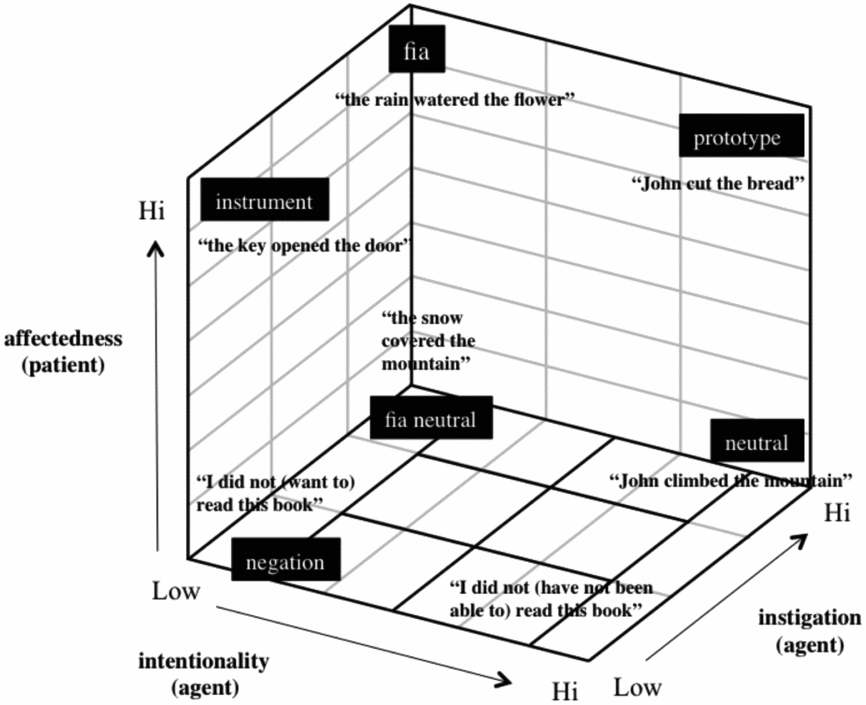
As in the study by Ibbotson et al. (Reference Ibbotson, Theakston, Lieven and Tomasello2012), the characterization of prototypical semantics in the current study is defined along three semantic dimensions based on Næss’ (Reference Næss2007) work: intentionality, instigation, and affectedness. Intentionality means how purposeful the agent is in initiating the action. Instigation, on the other hand, refers to the degree at which the agent is the direct cause of the event, and affectedness means how much the action changes or influences the patient. These three dimensions are shown in Figure 1, which is taken from Ibbotson et al.’s study.
Semantic dimensions of the transitive construction (reproduced from Ibbotson et al., Reference Ibbotson, Theakston, Lieven and Tomasello2012, with permission). Copyright © 2012 Cognitive Science Society, Inc. All rights reserved. This permission does not include the right to grant others permission to photocopy or otherwise reproduce this material except for accessible versions made by non-profit organisations serving the blind, visually impaired and other persons with print disabilities (VIPs).

Transitive sentences with four types of semantics – prototype, instrument, force or involuntary agent, and neutral – were used as test sentences:
Prototype
Prototypical transitive semantics is characterized as “an agent intentionally instigating an action that affects the patient” (Ibbotson et al., Reference Ibbotson, Theakston, Lieven and Tomasello2012, p. 1272), as exemplified in She ate the sandwich. With a high level of intentionality, instigation, and affectedness, sentences expressing this prototypical meaning are at the top far right corner of Figure 1. Decreasing the degree of agent intentionality, instigation, or the affectedness of the patient creates distortions from the prototypical transitive semantics. The following three types of distortion sentences were created.
Instrument
An instrument refers to “an entity used or controlled by another entity to achieve an effect on a third entity” (Ibbotson et al, Reference Ibbotson, Theakston, Lieven and Tomasello2012, p. 1272), such as The key in The key opens the door. The semantics deviates from the prototypical transitive semantics because The key is inanimate, so it cannot have intention to do or instigate the action. With the low degree of intentionality and instigation and the high degree of affectedness, instrument sentences are in the top front left of Figure 1.
Force or Involuntary Agent (FIA)
According to Ibbotson et al. (Reference Ibbotson, Theakston, Lieven and Tomasello2012), a force or an involuntary agent is a self-driven natural force without volition to act. That is, the agent does not intentionally bring about an event but is the direct cause of the action due to its inherent power (e.g., The sun in The sun dried the shirt). FIA can also be a human or an animate entity that can have volition to act, but unintentionally instigate an action, such as He in He (accidentally) hurt his own fingers. This type of distortion is in the top center of Figure 1 due to the low degree of intentionality and the high degree of instigation and affectedness.
Neutral
In neutral sentences, the object “is not directly involved with the event either in terms of participating in its instigation or in registering its effect” (Ibbotson et al., Reference Ibbotson, Theakston, Lieven and Tomasello2012, p. 1272). However, the agent has volition to bring about the action and is the direct cause of it (e.g., He climbed the mountain). Therefore, this type of sentences is in the bottom far right corner of Figure 1.
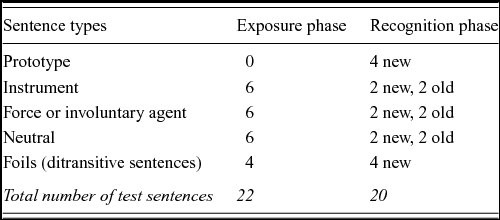
The present study had two phases: exposure and recognition. In the exposure phase, stimuli were six sentences from each of the distortion categories, and four foils, which were ditransitive sentences. These foils thus have different semantics from those of the transitive sentences. In the latter phase, four types of test sentences were used: (1) four sentences with prototypical semantics, which were importantly not presented in the first phase, (2) two new sentences from each distortion category, (3) two previously encountered sentences from each distortion category, and (4) four new ditransitive foils. The types and number of test sentences in the two phases are summarized in Table 1. “Old” denotes sentences appearing in both phases, while “new” denotes sentences appearing only in the second phase.
Types and number of sentences in the two study phases

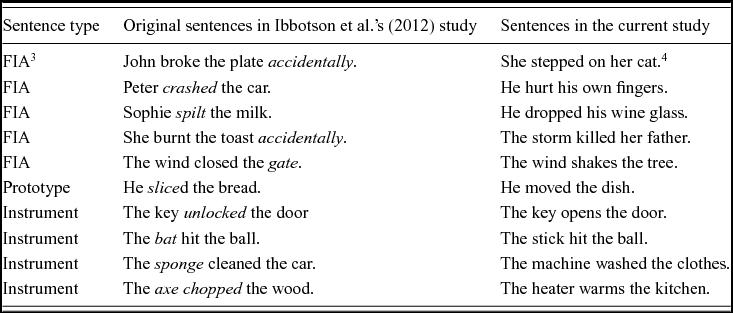
The number of sentences in the experiment (22 and 20 in the first and second phase respectively) was equal to the number of sentences for adult native speakers in the study by Ibbotson et al. (Reference Ibbotson, Theakston, Lieven and Tomasello2012). In both phases, the same test sentences were used with both groups of participants. These sentences were based on the sentences used with adults in the L1 study, but differed from the original sentences in two important ways. First, some vocabulary words were simplified. In a previous pilot test with some low-proficiency ESL learners at the university's English Language Center, I asked low-proficiency ESL learners to identify words in the test sentences that they did not know. The words they identified included unlock, bat, crash, spilt, sponge, chopped, sliced Footnote 2. One word in the test sentence (i.e., spilt) is also the British equivalent of spilled in American English. Since lack of knowledge about a word meaning would arguably affect construction comprehension and thus the priming of the transitive semantics and since teaching potentially unknown words before the experiment may affect participants’ recognition of sentences, I replaced these potentially unknown words by more frequent words, as indicated by the Corpus of Contemporary American English (COCA), or words that should be more frequent in the context. For example, bat (frequency=8,002) in The bat hit the ball was replaced with stick (frequency=24,514). However, the semantic category of the transitive construction in each sentence was retained. In Table 2, the sentences in the middle column are original sentences in Ibbotson et al.’s study. These ten sentences were modified on this first basis and the resulting sentences are in the far right column. The resulting sentences were read by an experienced English instructor at the university's English Language Center, who confirmed that these sentences should not be difficult for low-proficiency ESL learners. Thus, these sentences should not be difficult for advanced ESL learners either.
Sentences in which words were simplified for ESL learners. Words in italics were words that some low-proficiency ESL learners in a previous pilot study did not know.

Note: FIA=force or involuntary agent
Second, several other sentences in the original study were modified to eliminate overlap of verbs, common nouns, and proper nouns between test sentences. In usage-based approaches, the transitive construction is abstract and is independent from the lexical items through which the construction is instantiated (e.g., Goldberg, Reference Goldberg2003). As Ibbotson et al. (Reference Ibbotson, Theakston, Lieven and Tomasello2012) pointed out, previous literature suggested that, in research in which the prototype-plus-distortion methodology is used with verbal materials, participants may have false positive recalls of new sentences because new sentences share elements with previously-encountered test sentences. That is, lexical overlap can be a confound; false recognition may not have resulted from consistency of meaning between new and old sentences or from inference (Liben & Posnansky, Reference Liben and Posnansky1977; Paris & Mahoney, Reference Paris and Mahoney1974; Small & Butterworth, Reference Small and Butterworth1981). In Ibbotson et al.’s (Reference Ibbotson, Theakston, Lieven and Tomasello2012) study, in the test sentences for adults, the extent of lexical overlap between sentences in the first phase and distortion or prototype sentences in the second phase was low. That is, in both cases, the overall mean overlap was below 10%. Besides, the overall mean lexical overlap between sentences in the first phase and new distortion sentences in the second phase (9%) was greater than the overlap between sentences in the first phase and prototype sentences (6%). This thus suggested that the greater false-recognition of prototype sentences by adults in their study did not result from greater lexical overlap between sentences in the first phase and the prototype sentences. In the present study, an additional attempt was made to reduce overlap of verbs, common nouns, and proper nouns (i.e., a person's name) across the test sentences. The resulting overlap of content words between phase one sentences and phase two new distortion sentences was 0%. The resulting overlap of content words between phase one sentences and phase two prototype sentences was almost 0%; it was found after the completion of the experiment that one word, namely water, appeared as a verb in one first phase distortion sentence (The rain watered the flowers) and as a noun in one prototype sentence (They drank the water). However, the overlaps of content words in both cases were comparable. This sentence modification is not against the concept of the prototype-plus-distortion methodology because, in this experiment, what must overlap among transitive sentences was their semantic features, not lexical items. Because of the vocabulary simplification and/or avoidance of content word overlap, only ten sentences from the original study were used in this experiment. All participants heard the test sentences in the same order. In each phase, the semantic category of each sentence (e.g., instrument, as in The key unlocked the door) was the same as the semantic category of the sentence in the same order in the original study (e.g., The key opens the door). The test sentences in the two phases are listed in Appendix A.
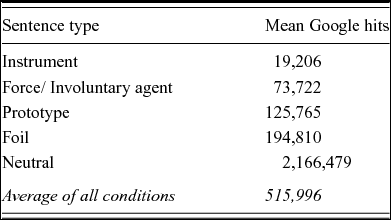
Because participants may have greater false positive recalls of prototype sentences than of distortion sentences if prototype sentences are much more frequent in natural language input, average occurrences per sentence type based on a Google search of the test sentences were calculated and shown in Table 3.Footnote 5 The average of hits of prototype sentences is the median and is lower than the average of all sentence types; therefore, if greater false positive recalls are observed, that should not result from the fact that prototype sentences have significantly higher frequency.
Mean Google hits for each sentence type

Procedure
In the exposure phase, participants listened to the test sentences played from an audio file. The sentences in the file were read one at a time by a female native English speaker, who had a Midwestern American accent and read the sentences at a normal speed of declarative sentences. The reading was also natural, without any attempt to deliberately emphasize any particular word. As in Ibbotson et al.’s (Reference Ibbotson, Theakston, Lieven and Tomasello2012) study, participants were instructed to repeat each sentence out loud right after each sentence. Participants also received the same instruction as in the original study – they were informed that the objective of the experiment was to record their reading for a language processing study. The purpose of this instruction was to encourage participants to concentrate on the experiment and counter their expectations of a memory test, which may lead them to mentally rehearse the sentences. The interval between sentences, or the time the participants had to repeat each sentence, was approximately 4 secondsFootnote 6.
In the recognition phase, which immediately followed the exposure phase, participants were given a form with 5-point Likert scale. As in the L1 study, the form consisted of five rating categories: definitely not heard before, probably not heard before, unsure, probably heard before, and definitely heard before. Participants were then informed that they would listen to more sentences and that they have to rate how confident they were that they had heard each sentence in the first phase. The researcher then opened an audio file from which participants heard test sentences one by one. The sentences in the file were read one at a time by the same female native English speaker. Participants then rated their recognition confidence after they heard each sentence. The participants had about 4 seconds to indicate their answer. They then completed a background questionnaire. The total time of the experiment was approximately 15 minutes.
Results
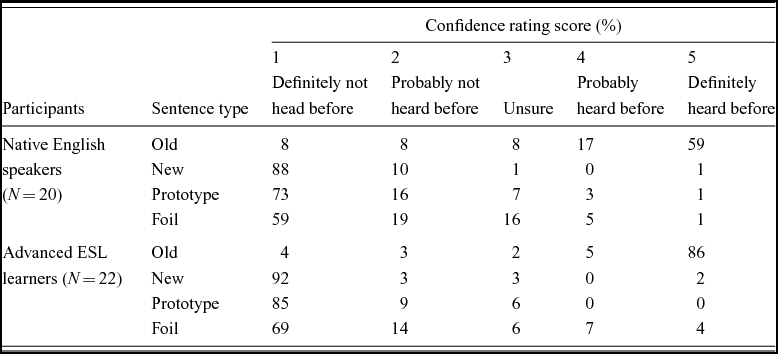
Participants’ confidence rating scores from the recognition phase were the outcome measure. First, to see the general pattern of performance, the percentage of scores (1–5) on the Likert scale for each type of sentence–old sentences, new transitive sentences with non-prototypical transitive semantics, prototype sentences, and foils – was calculated. Percentages were used because the number of sentences in each category was not equal. Note that in the following analyses, new transitive sentences with non-prototypical transitive semantics will be briefly called “new sentences”, but readers should keep in mind that prototype sentences in the recognition phase were also new. Table 4 shows results from both groups of participants.
Percentages of scores (1-5) given to each sentence type

Overall, participants in both groups seemed accurate in classifying the four types of sentences. For example, the rating scores for old sentences skewed towards five, and the rating scores for new sentences and prototype sentences skewed towards one. The distribution of the native speakers’ scores for prototype sentences differed from the distribution of scores from adult native speakers in the study by Ibbotson et al. (Reference Ibbotson, Theakston, Lieven and Tomasello2012), in which the scores for prototype sentences skewed towards 4. In addition, 0% and 4% of the ESL learners’ and the native speakers’ scores for prototype sentences respectively were in the range of 4–5. Because the data were not normally distributed, a Mann-Whitney test was run and the results additionally revealed that between the two groups the rating accuracy for prototype sentences did not differ significantly, U=199.5, z=−.553, p=.580, r=−.09. Therefore, overall both groups did not seem to have false positive recalls of prototype sentences, and between the two groups there was no difference in the false recalls.
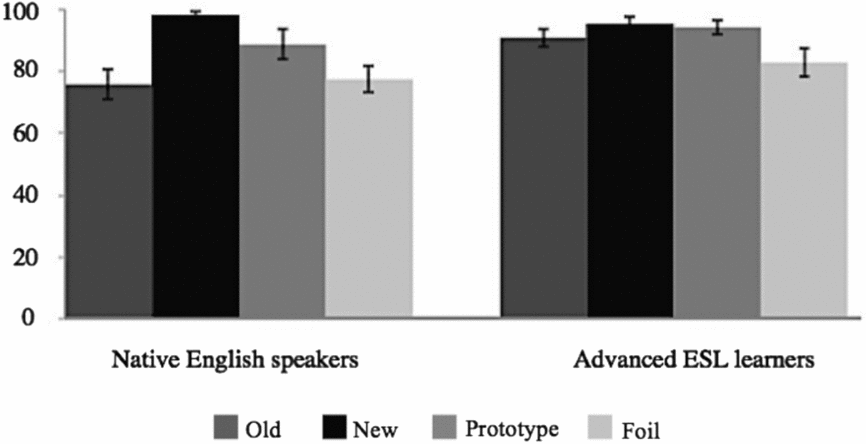
Figure 2 shows the participant's accuracy in sentence recognition. For old sentences, participants were considered accurate if they responded 4 or 5. For new sentences, prototype sentences, and foils, participants were accurate if they answered 1 or 2. In both groups, overall, both native English speakers and advanced ESL learners seemed more accurate at classifying new sentences than at classifying prototype sentences. Therefore, subsequent analyses were conducted to shed light on whether these two types of sentences were treated differently.
Confidence rating accuracy in Experiment I

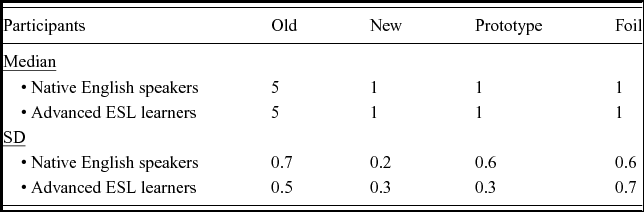
Based on a Kolmogorov–Smirnov test of normality, the confidence rating scores were significantly non-normally distributed (p < .001). Table 5 reports the median for each sentence type from the two participant groups. The median is reported because the rating scores for each sentence type were not normally distributed and were highly skewed. Participants in both groups treated old sentences differently from new sentences and prototype sentences. Moreover, new and prototype sentences had the same median. For the native speakers, the median score for prototype sentences was lower than the median score of 4 from the adult native English speakers in Ibbotson et al.’s (Reference Ibbotson, Theakston, Lieven and Tomasello2012) study.
Median and SD of confidence rating score across the four sentence types

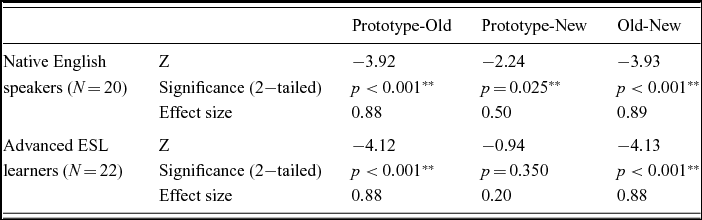
To assess significant differences in the rating scores in different condition pairs, Wilcoxon signed rank tests were conducted. Table 6 shows the comparisons between the sentence types. For both groups, in each of the prototype-old pair and the old-new pair, one type of sentence differed significantly from the other. Results from the native speaker group showed a significant difference between prototype sentences and new sentences. That is, the former type appeared more likely to elicit false positive recognition. By contrast, advanced ESL learners did not treat prototype and new sentences significantly differently.
Comparisons between prototype, old, and new conditions

Note: Effect sizes estimated as r=z / √N
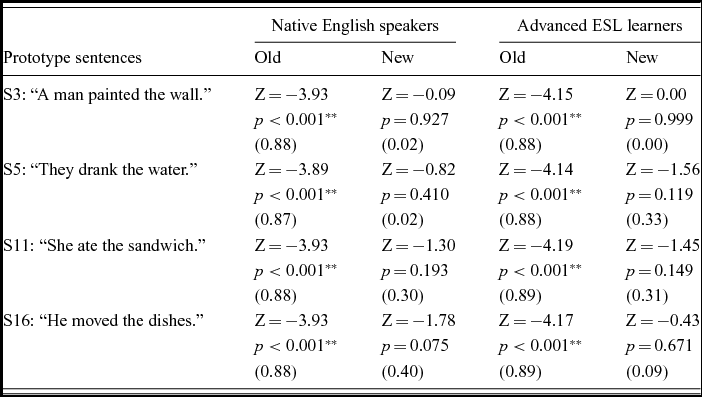
Because the number of prototype and distortion sentences was relatively small, item analyses were also performed to see if the results for each sentence type also held for individual sentences. Wilcoxon signed rank tests were conducted to compare the rating score for each prototype sentence against the rating scores for sentences in the other two categories (old and new sentences). In this experiment, each prototype sentence had a lower mean score than old sentences as a group, and Table 7 shows that, in both participant groups, each prototype sentence was treated significantly differently from old sentences. However, each prototype sentence was not treated significantly different from new sentences, and the effect sizes were low. In the case of the native speakers, therefore, prototype sentences were treated differently from new sentences only at the sentence group level. In the ESL learner group, together with the group analysis (Table 6), the results strongly suggested that these learners treated prototype sentences like new sentences – as being unheard of before.
Pair comparisons of each prototype sentence against old and new sentences; the number in the parentheses indicates effect size (r=z / √N)

Note: The number preceding each sentence (e.g., S3) indicates the order of the sentence in the recognition phase. Additional details about item analyses for this experiment are provided in Appendix B and Appendix C.
Given no clear evidence for prototype effects in the native speakers, another group of native English participants was recruited to do the experiment with the original test sentences used by Ibbotson et al. (Reference Ibbotson, Theakston, Lieven and Tomasello2012). Since in the first native speaker group prototype sentences significantly differed from new sentences only at the sentence group level (Table 6), the inclusion of this second group of native speakers should offer two benefits. First, research replication confirms confidence in the results and the validity of an original study (Abbuhl, Reference Abbuhl, Mackey and Gass2011), which in this case is the first study that investigated prototype effects of English transitive semantics in adult native English speakers. Second, results from this second group may shed light on any methodological issues that may have contributed to the differences between the results from the native speakers in Experiment I and the results from adult native speakers in the original study, in which the scores for prototype sentences as a group and the scores for each individual prototype sentence differed significantly from the scores for new sentences. The experiment with the second group of adult native speakers is discussed in the following section.
Experiment II
Participants
Participants were 21 native English speakers who were undergraduate students at the same Midwestern U.S. university (age range=18–22, M=20.4, SD=1.4). They had a variety of educational backgrounds, but none majored in linguistics. Some participants received five USD for their participation; the rest were recruited from a class of which the instructor gave extra credit in return for voluntary participation.
Materials
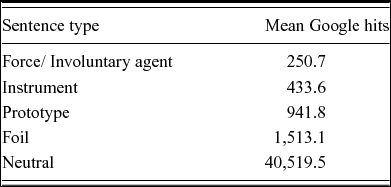
The test sentences in the original study by Ibbotson et al. (Reference Ibbotson, Theakston, Lieven and Tomasello2012), shown in Appendix D, were used. Each sentence belonged to the same semantic category as the sentence appearing in the same order in the list in Experiment I. Table 8, taken from the original study, shows the frequency of each type of transitive sentence from Google search. The frequency of prototype sentences is in the middle. Thus, if participants have greater false-positive recognition of the prototype sentences than to other sentences, the false-recognition should not result from the disproportionally higher frequency of prototype sentences.
Mean Google hits for original sentences. (Reproduced from Ibbotson et al., Reference Ibbotson, Theakston, Lieven and Tomasello2012, with permission). Copyright © 2012 Cognitive Science Society, Inc. All rights reserved. This permission does not include the right to grant others permission to photocopy or otherwise reproduce this material except for accessible versions made by non-profit organisations serving the blind, visually impaired and other persons with print disabilities (VIPs).

Procedure
The procedure was the same as that in Experiment I. Sentences used in this experiment were read by the same native speaker who read the sentences in Experiment I. The interval between sentences in both phases (i.e., the time they had to repeat each sentence in the first phase and the time they had to indicate their answer in the second phase) was also approximately 4 seconds.
Results
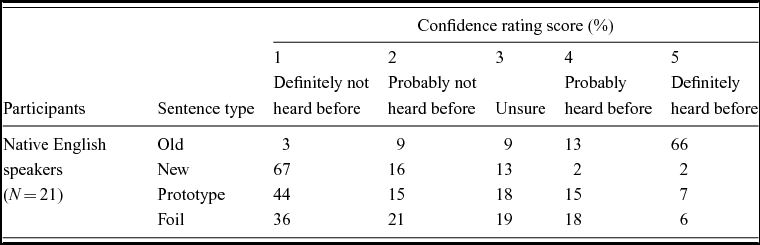
Table 9 shows the percentage of rating scores given to each type of sentence. Generally, participants were accurate at classifying old and new sentences; the distribution of the scores for these two conditions clearly skewed towards 5 and 1 respectively. Prototype sentences were treated differently from new sentences. Only 59% of scores for prototype sentences were 1 or 2, while 83% of scores for new sentences were in this range. Therefore, participants were less confident that prototype sentences were new. They also demonstrated a greater tendency to have false-positive recognition of prototype sentences than to have false-positive recognition of new sentences; 22% of scores for prototype sentences were in the range of 4–5, while merely 4% of scores for new sentences fell in this range.
Percentages of scores (1-5) given to each type of original test sentences

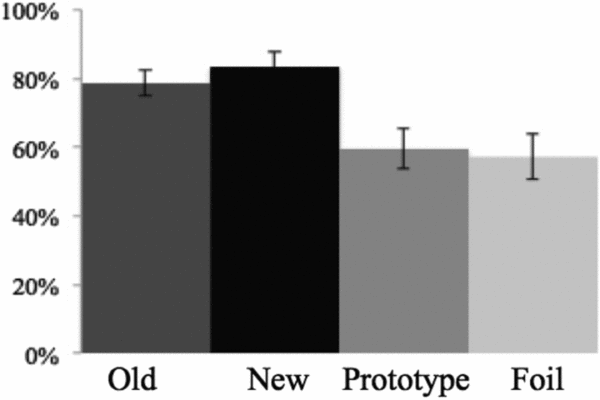
Figure 3 shows participants’ accuracy in sentence recognition. The calculation was similar to the calculation used to plot Figure 2 in Experiment I. The participants were quite accurate at classifying old and new sentences; the accuracy was 79% and 83% respectively. These were approximately the same as the rating accuracy for these two types of sentences in Ibbotson et al.’s study (about 78% and 81% respectivelyFootnote 7). Moreover, in this experiment, participants were clearly much less accurate in classifying prototype sentences than participants in Experiment I. That is, the accuracy in rating prototype sentences in this experiment was 60%, while the native speakers’ accuracy in Experiment I was 89%. However, the accuracy of 60% was higher than adult native speakers’ accuracy in rating prototype sentences in Ibbotson et al.’s study, which was as low as around 12%. Although the number of participants in Experiment II (N=21) was lower than the number of participants in the original study (N=35), the difference was striking because in both cases the exact same test sentences were used with adult native English speakers. There were only two differences between Experiment II and the original study. First, the English speakers in Ibbotson's study were undergraduate students in the UK, while the English speakers in the current study were American undergraduate students. Moreover, while in both studies the test sentences were presented auditorily, in Ibbotson's study, the test sentences were read by a researcher to the participants, but in this study, participants listened to the test sentences from an audio clip.
Confidence rating accuracy in Experiment II

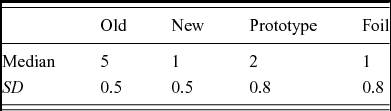
A Kolmogorov–Smirnov test of normality indicated that the confidence rating scores were non-normally distributed (p < .001). Table 10 summarizes the median of the rating scores for each sentence type. In comparison to the native speakers’ median recognition score for prototype sentences in Experiment I (median =1), the median recognition score for prototype sentences here was higher (median=2). Thus, this second group of native speakers was more likely to treat prototype sentences differently from new sentences. However, this median was still lower than the median score for prototype sentences obtained from adult native speakers in Ibbotson et al.’s (Reference Ibbotson, Theakston, Lieven and Tomasello2012) study, in which the median score was 4.
Median and SD of confidence rating score for original test sentences

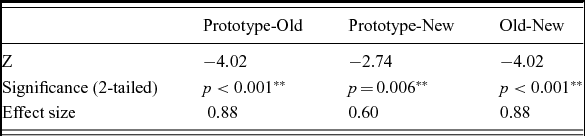
The significant difference in the rating scores in different condition pairs were assessed with Wilcoxon signed rank tests and were reported in Table 11. In both prototype-old pair and the old-new pair, one type of sentence was significantly different from the other. In addition, and more importantly, the results showed a significant difference between prototype sentences and new sentences, suggesting that exposure to distortions led to false-positive recalls of prototype sentences.
Comparisons between original prototype, old, and new sentences

Note: Effect sizes estimated as r=z / √N.
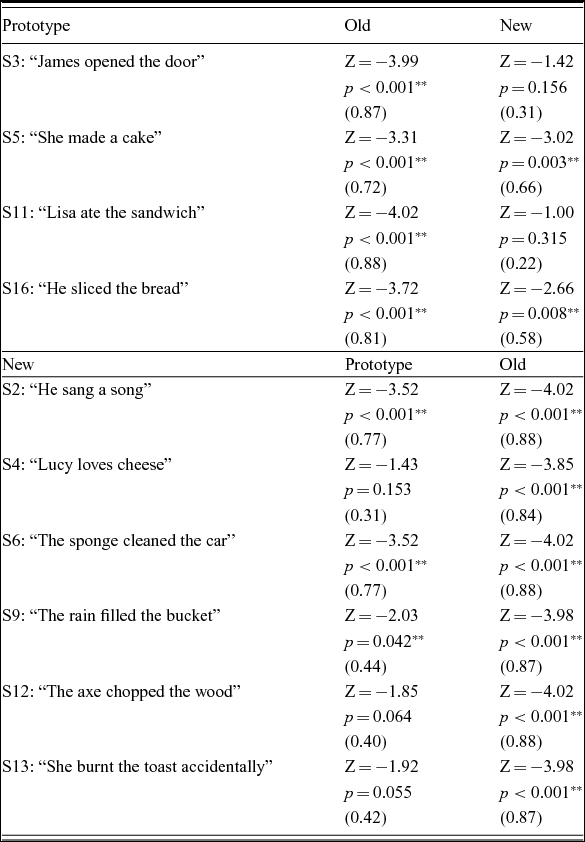
Item analyses were also performed to see if results for each sentence type also held for individual sentences. Table 12 shows comparisons of the rating score for each prototype and each new sentence against the sentences in the other two categories based on Wilcoxon signed rank tests. Two prototype sentences (S5 and S16), which had a higher mean score than new sentences as a whole, were individually significantly different from new sentences. However, the others (S3 and S11) were not, and the effect sizes were low. In this experiment, each new sentence had a lower mean rating score than prototype sentences a whole. Table 12 shows that three new sentences (S2, S6, S9) were significantly different from prototype sentences, while the difference between two new sentences (S12, S13) and prototype sentences approached significance, and one new sentence (S4) was not significantly different from prototype sentences. Evidence for prototype effects in this experiment was therefore stronger than that in Experiment I, in which no prototype sentence was individually significantly different from new sentences. However, the effects were not as strong as those from adult native speakers in Ibbotson et al.’s (Reference Ibbotson, Theakston, Lieven and Tomasello2012) study – in which every prototype sentence significantly differed from new sentences and five out of six new sentences were individually significantly different from prototype sentences.
Pair comparison of scores for each prototype sentence and each new sentence against scores for sentences in the other two categories; number in the parentheses indicates effect size (r=z / √N)

Note: The number preceding each sentence (e.g., S2) indicates the order of the sentence in the recognition phase. Additional details about item analyses for this experiment are provided in Appendix E.
Discussion
This study suggested weak evidence for the psychological reality of prototype effects of English transitive semantics in adult native English speakers. Results from the native speakers in Experiment I showed that, when (1) overall frequency of sentence types was accounted for (Table 3), (2) there was minimal overlap between verbs, common nouns, and proper names between sentences in the exposure phase and the recognition phase, and (3) the vocabulary was simplified for the ESL learners, there was a significant difference between prototype sentences and new sentences only in the sentence group analysis. Subsequent item analyses showed that the difference of individual prototype sentences from new sentences was not reliable. Thus, Experiment I did not clearly support the psychological reality of prototype effects in English transitive semantics as defined by Næss (Reference Næss2007). Results from Experiment II, in which the original test sentences were used, provided stronger support for the effects. Prototype sentences were treated significantly differently from new sentences, and individually half of the prototype sentences were treated significantly differently from new sentences. The differences in the results from the native speakers in Experiment I and II also suggested that prototype effects were reduced when there was an additional attempt to remove overlap of verbs and common and proper nouns across the test sentences.
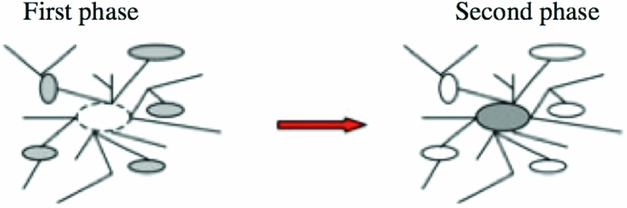
One possible explanation for false-positive recognition of prototype sentences in adult native English speakers was provided by Ibbotson et al. (Reference Ibbotson, Theakston, Lieven and Tomasello2012). In their study, the researchers argued that exposure to non-prototypical transitive semantics in the first phase primed the prototypical transitive semantics in the second phase, leading to such false recognition. They proposed a radial category of transitive semantics, illustrated in Figure 4. The ovals represent “clusters of semantic features of the test sentences” and the lines show “connectivity between the features” (p. 1281).
Schematic representation of radial prototype structure in the two experiment phases (reproduced from Ibbotson et al., Reference Ibbotson, Theakston, Lieven and Tomasello2012, with permission). Copyright © 2012 Cognitive Science Society, Inc. All rights reserved. This permission does not include the right to grant others permission to photocopy or otherwise reproduce this material except for accessible versions made by non-profit organisations serving the blind, visually impaired and other persons with print disabilities (VIPs).

In the figure, peripheral ovals represent distortions from the prototype, which is represented by the central oval, or the exemplar that minimizes the distance between the experienced distortions. According to Ibbotson et al. (Reference Ibbotson, Theakston, Lieven and Tomasello2012), this radial category of transitive semantics exists in the linguistic representation of native English speakers because there is independent evidence that they have prototypical knowledge of the English transitive semantics (e.g., Koornneef & Van Berkum, Reference Koornneef and Van Berkum2006; Pyykkönen et al., Reference Pyykkönen, Matthews and Järvikivi2009). Drawing on activation theories (e.g., Anderson, Budiu & Reder, Reference Anderson, Budiu and Reder2001), which posit that, in a mental network, activation of semantic⁄encyclopedic neighborhoods is responsible for false recognition, Ibbotson et al. (Reference Ibbotson, Theakston, Lieven and Tomasello2012) argued that exposure to the related but non-prototypical transitive semantics activated the prototypical transitive semantics, leading to the false positive recalls.
Results from the current study, however, suggested that results from the prototype-plus-distortion methodology based on linguistic materials can be affected by content word overlap between the two phases. As Ibbotson et al. (Reference Ibbotson, Theakston, Lieven and Tomasello2012) noted, some researchers have observed that familiarity with previously encountered words enhances false-positive recognition of new sentences (e.g., Liben & Posnansky, Reference Liben and Posnansky1977; Paris & Mahoney, Reference Paris and Mahoney1974). Therefore, possibly a part of the difference between (1) the results from adults in their study and results from Experiment II on the one hand and (2) the results from native speakers in Experiment I on the other hand stemmed from the decrease in content word overlap. The sentence modifications in the current study were based on reasonable grounds. In the semantic priming task, results from the ESL learners would not be indicative of their semantic representations if they could not recognize words from the audio clip and could not understand the test sentences. Moreover, the attempt to eliminate content word repetition between the two phases was not against the prototype-plus-distortion methodology. The task was a semantic priming task, not a lexical priming task. Without content word overlap, if prototype effects exist, the effects should be observed if prototypical transitive semantics is independent of the lexical items that appear in the transitive construction.
However, the content word overlap reduction alone may not be able to account for the different results from the adult native English speakers in Experiment I and Experiment II.Footnote 8 First, the differences may be explained in part by the fact that, in Experiment II, there was a greater overlap of the broader semantic context between phase one test sentences and phase two prototype sentences than between phase one sentences and phase two new sentences. In Experiment II, words in prototype and new sentences in the second phase, such as sliced, open, made, and loves, can be substituted in some contexts by words in the exposure phase such as cut, unlock, baked, and likes respectively. As noted, in Experiment II, the overall mean lexical overlap between sentences in the first phase and new distortion sentences in the second phase (9%) was comparable to the mean lexical overlap between sentences in the first phase and prototype sentences (6%). Moreover, there seems to be similar levels of semantic relatedness between words in the first phase and words in the prototype and new sentences in the second phase, although the relatedness should be tested with a more formal measure. Therefore, in Experiment II, content word overlap and semantic relatedness of individual lexical items may not have been solely responsible for the greater false recognition of prototype sentences than false recognition of new sentences. Instead, the overlap of the broader semantic context between phase one sentences and phase two prototype sentences could have affected the results. In particular, in Experiment II, two out of the four prototype sentences (i.e., She made a cake and He sliced the bread) which were falsely treated as being previously encountered and were individually treated differently from new sentences may sound familiar to the participants because, in the first phase, related verbs (i.e., baked, cut) appeared with the same objects (i.e., The oven baked the cake and The knife cut the bread). On the other hand, in the case of new distortion sentences (e.g., Lucy loves cheese), a related verb (e.g., likes) did not appear with the same object (e.g., Sophie likes cake) in the first phase. In light of these findings, the greater false recalls of prototype sentences when compared to those of new distortion sentences seemed to result not only from exposure to the distorted abstract transitive semantics based on the reduced degree of intentionality, instigation, and affectedness in the first phase, but also from exposure to the co-occurrences of semantically related verbs and the same object nouns in the first phase. Therefore, it seems that the greater false recalls of prototype sentences entailed some level of semantic/spreading activation, not purely lexical processing. This is compatible with usage-based views, in which simultaneous processing of words and related more abstract semantics in adults is accommodated, but which level of activation is stronger is contextually determined (e.g., Ibbotson, Reference Ibbotson2013). The influence of broader semantic context may also explain why prototype effects were not observed in Experiment I. In that experiment, while the participants were exposed the abstract distorted transitive semantics along Næss's (Reference Næss2007) sematic dimensions, between the two phases there was less overlap of content words and no overlap of such broader context (i.e., semantically related verbs co-occurring with the same object). As a result, there was less semantic cross-activation between sentences in the two phases. In addition, in phase one in Experiment I, five and 13 distortion sentences were in the present tense and the past tense respectively, while in phase one in Experiment II, two and 16 distortion sentences were in the respective tenses. Because in both experiments, all phase two prototype sentences were in the past tense, the smaller number of phase one distortion sentences in the past tense in Experiment I may have decreased the possibility for the participants’ false positive recalls of prototype sentences. As discussed, however, in usage-based approaches, the abstract prototypical English transitive semantics is independent from the lexical items or the tense through which the construction is instantiated (e.g., Goldberg, Reference Goldberg2003).
There are also other differences between results from Experiment II and those from Ibbotson et al.’s (Reference Ibbotson, Theakston, Lieven and Tomasello2012) study that deserve investigation in future research. In Experiment II, the prototype sentence Lisa ate the sandwich was not treated individually different from new sentences (Table 12) and the effect size was low (Z=0.22), although bread, which is semantically related to sandwich, appeared in the first phase. In light of the previous discussion, this may have resulted from less semantic cross-activation because in the first phase there was no distortion sentence containing a verb that is semantically related to ate and that occurred with the same object noun sandwich. Also, one prototype sentence, James opened the door, was not treated individually differently from new sentences and the effect size was low (Z=0.31) although a related verb occurred with the same object in the first phase (The key unlocked the door). It seems, therefore, that exposure to distorted abstract transitive semantics in the first phase and to co-occurrence of a semantically related verbs and the same object noun in the two phases are necessary, but may not be sufficient for greater false positive recalls of individual prototype sentences to be observed. Interestingly, in Ibbotson et al.’s (2102) study, both Lisa ate the sandwich and James opened the door led to false positive recalls and were individually treated significantly differently from new sentences. In the case of Lisa ate the sandwich, the results from Ibbotson et al. (Reference Ibbotson, Theakston, Lieven and Tomasello2012) were particularly intriguing because it seems that mere exposure to distorted abstract transitive semantics (i.e., this verb-noun combination did not appear in the first phase) brought about the false positive recalls of this sentence. Future research based on more test sentences may, therefore, investigate how false positive recalls of prototype sentences are influenced by exposure to abstract distorted transitive semantics based on Næss’ (Reference Næss2007) definition and exposure to the same verb-object noun combinations in the two phases (i.e., contextual overlap). Furthermore, it will be interesting if future research investigates if participants will have greater false positive recalls of prototype sentences when compared to those of new sentences if in the second phase new distortion sentences contain verb-object noun combinations that also appear in the first phase. If greater false recalls of prototype sentences are observed, there will be a strong piece of evidence for usage-based researchers’ claim based on the prototype-plus-distortion methodology.
Another issue that future research may address is whether the different types of tasks in Ibbotson et al.’s (Reference Ibbotson, Theakston, Lieven and Tomasello2012) study and Experiment II affected the different results. In both cases, participants were adult native English speakers and were undergraduate students. However, the rating accuracy for prototype sentences in the original study was around 12%, while the rating accuracy for the same sentences in Experiment II was 60%. This difference was also reflected in the median score for prototype sentences: the median score in the original study was as high as four, while the median score in Experiment II was only two. Therefore, even if Experiment II had more participants, it seems that results similar to those in the original study are difficult to obtain. Methodologically, the only difference between the original study and Experiment II was that, in the original study, participants listened to test sentences read by an experimenter, while, in the latter study, participants listened to test sentences from an audio clip. However, as a reviewer pointed out, while Experiment II was aimed to be an exact replication, the methodological change might have contributed to the different results. Possibly, in Experiment II, listening to sentences from an audio clip prompted the participants to focus more on words in the test sentences and on accurate sentence repetition. On the other hand, in Ibbotson et al.’s (Reference Ibbotson, Theakston, Lieven and Tomasello2012) study, because the participants had normal conversation with the experimenter during the introduction to the study, subsequent listening to the experimenter may have led the participants to process the test sentences in a more conversational-like manner. This is a methodological issue that future studies can address.
Regarding the second research question, prototype effects were not found in advanced ESL learners, who seemed accurate in classifying both prototype and new sentences. The lack of the effects may have stemmed from the learners’ greater attention to words in the sentences and their attempt to say the sentence as heard. Moreover, as in the case of the native speakers in Experiment I, the methodological issues previously discussed could have affected the learners’ false positive recalls of prototype sentences. Another possible explanation relates to the type of knowledge representation. That is, because linguistic category learning is implicit learning (e.g., Ellis & Larsen-Freeman, Reference Ellis and Larsen-Freeman2009) and only implicit linguistic knowledge can display prototype effects (Roehr, Reference Roehr2008), the results could suggest that the ESL learners’ mental representation of the English transitive construction is not yet in the form of implicit, abstract, and verb-independent schemata. This explanation is in line with L2 researchers’ arguments that, unlike children learning their L1, older L2 learners may not be able to induce or may be less successful in inducing abstract linguistics patterns implicitly because the loss of the mental capacity necessary for the implicit induction of the underlying abstract linguistic patterns (e.g., Bley-Vroman, Reference Bley-Vroman2009; DeKeyser, Reference DeKeyser2000). Moreover, the explanation is compatible with the suggestions in the previous empirical research on ESL VAC construction learning that, unlike native English speakers, who learn their L1 implicitly, L2 learners may rely more explicit learning strategies (McDonough & Nekrasova–Becker, Reference McDonough and Nekrasova–Becker2014; McDonough & Trofimovich, Reference McDonough and Trofimovich2013; Nakamura, Reference Nakamura2012; Year & Gordon, Reference Year and Gordon2009). The difference in the nature of VAC learning may lead to different mental representations of English transitive construction semantics between native English speakers and ESL learners.
In addition, if language acquisition indeed results from the accumulation of statistics in previously-encountered input (e.g., Ellis, Reference Ellis2008, Reference Ellis, Gass and Mackey2011, Reference Ellis, Trousdale and Hoffmann2013; Gries & Ellis, Reference Gries and Ellis2015), the absence of prototype effects in the advanced ESL learners could be attributable to the differences in the input that L1 and L2 learners receive. Although the ESL learners were advanced learners, they learned English primarily in formal classrooms in their home countries. Several researchers have argued that the amount, intensity, quality, and structure of input that adult L2 learners and children receive are different. In Ellis and Laporte's (Reference Ellis, Laporte, de Groot and Kroll1997) observation, for example, English input in formal English classrooms differ from child-directed L1 input in several ways, including the input amount and the nature of the interactions (naturalistic L1 exposure vs explicit instruction in L2 classrooms). Moreover, Littlemore (Reference Littlemore2009) stated that, unlike L1 child-directed speech, the input that adult L2 learners receive from adult native speakers may contain more peripheral than prototypical members of a linguistic category. Muñoz (Reference Muñoz2008) further noted that, in formal ESL classrooms, the amount of L2 input is much less intense, and input intensity is indispensible for the development of neural representation of multiple languages. Besides the possible influence of L1 in ESL VAC construction representation (Römer et al., Reference Römer, O'Donnell and Ellis2014), the difference between the native English speakers and the ESL learners in terms of transitive construction semantics may therefore have resulted from the different input that the two groups had received.
In the current study, another group of advanced ESL learners was not recruited to do the experiment with the original test sentences used by Ibbotson et al. (Reference Ibbotson, Theakston, Lieven and Tomasello2012). Based on the previous discussion, a comparison of results from Ibbotson et al.’s study and the two experiments in the current study seem to reveal several factors that could have affected false positive recalls of prototype sentences compared to false positive recalls of new sentences. These include exposure to the distorted abstract transitive semantics in the first phase, overlap of content words in the two phases, the repetition of verb-object noun combinations in some prototype sentences in the second phase and sentences in the first phase (i.e., broader contextual overlap), and how participants were exposed to test sentences in the first phase (i.e., whether participants listened to pre-recorded sentences or an experimenter). Given these factors and no previous evidence that ESL learners have implicit knowledge of prototypical and non-prototypical English transitive semantics, it is unclear if using the stimuli in Ibbotson et al.’s (Reference Ibbotson, Theakston, Lieven and Tomasello2012) study would lead to a conclusion about the representation of advanced ESL learners’ English prototypical and non-prototypical English transitive semantics.Footnote 9 To use the sentences, one also needs to ensure that ESL learners do not have any problems understanding all the words. In future research, if a similar priming task is used, researchers could conduct a vocabulary test with prospective participants before the priming task. Moreover, to minimize the possibility that exposure to words in the test will influence results from the priming task, the test and the task should not be conducted on the same day. Given the scarcity of relevant empirical studies, the existence and the exact nature of the representation of prototypical and non-prototypical English transitive semantics in ESL learners are worthy of further investigation.
Although the results from the current study do not provide strong evidence that verb-independent construction semantics or prototype effects are psychologically real, previous studies have supported the ontological status of construction meanings in L1 learning (e.g., Ambridge et al., Reference Ambridge, Noble and Lieven2014; Bencini & Goldberg, Reference Bencini and Goldberg2000; Johnson & Goldberg, Reference Johnson and Goldberg2012), and even in L2 learning (Gries & Wulff, Reference Gries and Wulff2005). However, it seems that additional evidence, and perhaps other methodologies, are necessary to support the psychological reality of graded category membership of construction semantics. Such evidence would further strengthen the theoretical argument that the process of categorization operates in L1 and L2 learning.
Limitations
The current study has some limitations that future studies can address. First, as Ibbotson et al. (Reference Ibbotson, Theakston, Lieven and Tomasello2012) also pointed out, the number of prototype and distortion sentences was quite small. Having more sentences may lead to the false-recognition of prototype sentences in the recognition phase. Second, in each group the number of participants was lower than that in the original study, but as noted, the effect sizes for the insignificant differences between new and prototype sentences were also low. Moreover, this study did not investigate how L1 can influence L2 transitive semantics, and further corpus studies could further confirm that the prototypical transitive semantics defined by Næss (i.e., an agent intentionally instigating an action on the patient which is directly being affected) is indeed the semantics carried by English transitive sentences that native speakers and ESL learners frequently encounter. Although the results from Ibbotson et al. (Reference Ibbotson, Theakston, Lieven and Tomasello2012) suggested the psychological reality of this definition of prototypical transitive semantics, such corpus studies would further demonstrate that Næss’ definition is in line with usage-based researchers’ claim about how prototypical semantics of VACs is formed. Finally, although the participants were prevented from deliberately memorize the test sentences in the first phase, individual differences in false memory may have affected the results. Such individual differences are determined by factors such as working memory (e.g., Zhu, Chen, Loftus, Lin, He, Chen, Li, Moyzis, Lessard & Dong, Reference Zhu, Chen, Loftus, Lin, He, Chen, Li, Moyzis, Lessard and Dong2010). Consequently, the relationship between individual differences and false memory could also be investigated in future research.
Conclusion
The current study investigated whether the English transitive semantics would show prototype effects, which would be evidence for the cognitive process of categorization, in L1 and L2 learning. Results suggested some, but not strong, evidence in adult native English speakers, and revealed the complexity that may arise in the use of the prototype-plus-distortion methodology to investigate the verb-independent English prototypical transitive semantics. Moreover, given the lack of evidence that advanced ESL learners have implicit knowledge of English transitive semantics and given the lack of prototype effects from these learners in the current study, possibly adult ESL learners did not have an implicit and verb-general semantic representation of this English construction. The study thus suggested that, besides the possible differences between native English speakers and ESL learners regarding the associations of verbs and VAC constructions (e.g., Römer et al., Reference Römer, O'Donnell and Ellis2014), the mental presentation of transitive semantics between the two groups may also differ. However, the existence and the exact nature of advanced ESL learners’ English transitive semantic representation deserve further investigation. The overall results suggest that usage-based researchers may need additional evidence for the prototype effects of construction semantics to further strengthen the claim language acquisition results from the interaction between language input and domain-general cognitive abilities. Given the recent rise in L2 research motivated by usage-based approaches, it is also my hope that the results from the current study will generate further discussions regarding the nature of L2 acquisition and representation from a usage-based perspective, as well as the type of methods that should be used to investigate the psychological reality of L2 VAC representations and prototype effects.
Appendix A. List of test sentences in Experiment I

Appendix B. Item analysis for results from native English speakers in Experiment I
Mean of recognition scores for each prototype sentence and mean recognition scores for new sentences

Mean of recognition scores for each new sentence and mean recognition scores for prototype sentences

Pair comparison of each sentence vs. sentences in the other conditions; number in the parentheses indicates effect size (r=z / √N)

Appendix C. Item analysis for results from advanced ESL learners in Experiment I
Mean of recognition scores for each prototype sentence and mean recognition scores for new sentences

Mean of recognition scores for each new sentence and mean recognition scores for prototype sentences

Pair comparison of each sentence vs. sentences in the other conditions; number in the parentheses indicates effect size (r=z / √N)

Appendix D. Test sentences in Experiment II. Reproduced with the kind permission of Paul Ibbotson
These are test sentences used with adult native English speakers in Ibbotson et al.’s (Reference Ibbotson, Theakston, Lieven and Tomasello2012) study.

Appendix E. Item analysis for results from native English speakers in Experiment II
Mean of recognition scores for each prototype sentence and mean recognition scores for new sentences

Mean of recognition scores for each new sentence and mean recognition scores for prototype sentences

Pair comparison of each sentence vs. sentences in the other conditions; number in the parentheses indicates effect size (r=z / √N)