


1. INTRODUCTION
Since the invention of laser (Maiman, Reference Mangles, Murphy, Najmudin, Thomas, Collier, Dangor, Divall, Foster, Gallacher, Hooker, Jaroszynski, Langley, Mori, Norreys, Tsung, Viskup, Walton and Krushelnick1960), exotic research and amelioration in laser technology have ushered a new era, where highly intense lasers are available. The interaction of such highly intense laser beams with plasmas has opened new vistas of potential applications such as laser-driven accelerators (Tajima & Dawson, Reference Tajima and Dawson1979; Faure et al., Reference Faure, Glinec, Pukhov, Kiselev, Gordienko, Lefebvre, Rousseau, Burgy and Malka2004; Geddes et al., Reference Geddes, Toth, Tilborg, Esarey, Schroeder, Bruhwiler, Nieter, Cary and Leemans2004; Mangles et al., Reference Maiman2004), inertial confinement fusion (Deutsch et al., Reference Deutsch, Furukawa, Mima, Murakami and Nishihara1996; Hora, Reference Hora2007), X-ray lasers (Amendt et al., Reference Amendt, Eder and Wilks1991; Eder et al., Reference Eder, Amendt, DaSilva, London, MacGowan, Matthews, Penetrante, Rosen, Wilks, Donnelly, Falcone and Strobel1994; Faenov et al., Reference Faenov, Magunov, Pikuz, Skobelev, Gasilov, Stagira, Calegari, Nisoli, Silvestri, Poletto, Villoresi and Andreev2007), laser plasma channeling (Singh & Walia, Reference Singh and Walia2010), etc. Propagation of laser beams through plasmas up to several Rayleigh lengths is an important prerequisite for the feasibility of all these applications. In the absence of an optical guiding mechanism, the propagation distance is limited approximately to a Rayleigh length due to diffraction divergence. Therefore, diffraction broadening is one of the fundamental phenomena that negate the efficient coupling of laser energy with plasmas. In conventional optics, diffraction of laser beams can be averted using optical fibers or relying on phenomenon of self-focusing. The phenomenon of self-focusing arises due to nonlinear response of material medium to the field of incident laser beam that leads to modification of its dielectric properties in such a way that the medium starts behaving like a converging lens. In collisionless plasmas, this modification of dielectric properties occurs due to the ponderomotive force that expels electrons from the high-field region to low-field region (Kaw et al., Reference Kaufman and Cohen1973; Max, Reference Max1976; Sodha et al., Reference Sodha, Ghatak and Tripathi1976).
Several nonlinear effects such as stimulated Raman scattering (Salih et al., Reference Salih, Mahmoud and Sharma2005; Fuchs et al., Reference Fuchs, Labaune, Depierreux and Tikhonchuk2000), stimulated Brillouin scattering (Divol et al., Reference Divol, Berger, Cohen, Williams, Langdon, Lasinski, Froula and Glenzer2003; Tikhonchuk et al., Reference Tikhonchuk, Mounaix and Pesme1997), excitation of electron-plasma wave (EPW) (Rosenbluth & Liu, Reference Rypdal and Rasmussen1972; Tajima & Dawson, Reference Tajima and Dawson1979), filamentation of laser beam (Campillo et al., Reference Campillo, Shapiro and Suydam1973; Gupta et al., Reference Gupta, Sharma, Chauhan, Rafat and Sharma2009), etc. come into picture during the propagation of electromagnetic beams through plasmas. Some of these phenomena lead to anomalous electron and ion heating, others to scattering of electromagnetic energy out of the plasma or to deteriorate the symmetry of energy deposition to plasma (Brueckner & Jorna, Reference Brueckner and Jorna1974). These nonlinear phenomena are therefore of central importance in laser-driven fusion studies. Hence, to have a deep understanding of laser–plasma interaction physics there have been ongoing conscious efforts to consistently improve upon the understanding of these phenomena by carrying out comprehensive studies encompassing theoretical as well as experimental aspects.
Propagation of intense laser beams through plasmas can excite natural modes of vibration of plasmas i.e., EPW or ion acoustic waves. The plasma waves can be driven either by beating two co-propagating laser beams, differing in frequencies by plasma frequency or by a single short laser pulse of duration equal to the plasma period. Excitation of EPW by beating two laser beams has become an appealing process in view of its potential applications such as electron acceleration (Tajima & Dawson, Reference Tajima and Dawson1979), plasma heating and current drive in tokamak (Cohen et al., Reference Cohen, Kaufman and Watson1972; Kaufman & Cohen, Reference Kaw, Schmidt and Wilcox1973), controlling (Stenflo et al., Reference Stenflo, Shukla and Yu1986) and sounding (Weyl, Reference Weyl1970) ionosphere, plasma lasers (Milroy et al., Reference Nakatsutsumi, Davies, Kodama, Green, Lancaster, Akli, Beg, Chen, Clark, Freeman, Gregory, Habara, Heathcote, Hey, Highbarger, Jaanimagi, Key, Krushelnick, Ma, Macphee, MacKinnon, Nakamura, Stephens, Storm, Tampo, Theobald, Woerkom, Weber, Wei, Woolsey and Norreys1979). The EPW excited by beating of two intense laser beams can also be used as a diagnostic tool for obtaining information of plasma parameters (Kroll et al., Reference Kroll, Ron and Rostoker1964; Cano et al., Reference Cano, Fidone and Zanfagna1971; Weibel, Reference Weibel1976). The excited EPW can scatter third laser beam, and, using the known frequency difference, one can accurately estimate the plasma density. Such a method of excitation and detection has the inherent advantage of not requiring that a probe be inserted in the plasma. It could thus be used in measuring the properties of space plasmas where probing is difficult and costly. Another interesting feature of the optical beating to excite EPW lies in the fact that if one uses only one laser, the plasma is heated in the portion of laser beam where the frequency is equal to the plasma frequency. If one uses two lasers, however, there will be a second stage of heating, when the plasma has expanded sufficiently, so that the plasma frequency, in the volume of interaction of the two beams, is now equal to the difference frequency of the laser beams (Weyl, Reference Weyl1970; Xu et al., Reference Xu, Yu, Zhang and Xu1988).
Excitation of EPW by beating of two laser beams in the plasma has been investigated extensively both experimentally as well as theoretically by a number of workers in the past. First theoretical analysis of the plasma wave excitation by beating two laser beams and consequent application in the charged particle acceleration was proposed by Rosenbluth & Liu (Reference Rypdal and Rasmussen1972) and subsequently by Tajima & Dawson (Reference Tajima and Dawson1979). Darrow et al. (Reference Darrow, Umstadter, Katsouleas, Mori, Clayton and Joshi1986, Reference Darrow, Mori, Katsouleas, Joshi, Umstadter and Clayton1987) have reported a model for the excitation of EPW in rippled density plasma. Gupta et al. (Reference Gupta, Sharma and Gupta2005) investigated the effect of cross-focusing of two coaxial laser beams on the excitation of EPW in an underdense plasma where relativistic and ponderomotive nonlinearities are operative. Tiwari & Tripathi (Reference Tiwari and Tripathi2006) investigated the beat-wave excitation of plasma waves in a clustered gas. Experimental studies on the detection of beat plasma waves in a long-scale-length plasma were first reported by Amini & Chen (Reference Amini and Chen1984). They showed that collective Thomson scattering by optical mixing of two antiparallel CO2 laser beams in a plasma gives a precise measurement of the plasma wave frequency.
Laser beams with different intensity profiles behave differently in the plasmas. Most of the investigations on excitation of EPW outlined above have been carried out under the assumption of uniform laser beams or laser beams having the Gaussian irradiance of intensity along their wavefronts. In contrast to this picture, investigations on intensity profile of Vulcan Petawatt laser at the Rutherford Appelton laboratory by Patel et al. (Reference Patel, Key, Mackinnon, Berry, Borghesi, Chambers, Chen, Clarke, Damian, Eagleton, Freeman, Glenzer, Gregori, Heathcote, Hey, Izumi, Kar, King, Nikroo, Niles, Park, Pasley, Patel, Shepherd, Snavely, Steinman, Stoeckl, Storm, Theobald, Town, Maren, Wilks and Zhang2005) and Nakatsutsumi et al. (Reference Milroy, Capjack and James2008) suggest that the intensity profile of the laser beam is not exactly Gaussian, but is having deviations from it. The suggested intensity profile that fits with the experimental data is q-Gaussian of the form  $f\,(r) = f\,(0){\left( {1 + {r^2}/qr_0^2} \right)^{ - q}}$, where the values of relevant parameters q and r 0 can be obtained by fitting the experimental data. The average square of the electric vector in case of q-Gaussian irradiance is much higher in the case of q-Gaussian irradiance. Hence, for the sake of completeness of analysis on beat wave excitation of EPW it becomes vital to take into account the deviation of intensity profile of laser beams from Gaussian distribution. A review of literature reveals the fact that no earlier theoretical investigation on excitation of EPW has been carried out for the laser beams having q-Gaussian irradiance of intensity along the wavefronts of the laser beams. The aim of this paper is to investigate for the first time the cross-focusing of two q-Gaussian laser beams in collisionless plasmas and to delineate its effect on excitation of EPW at beat frequency.
This paper is structured as follows. In Section II, the dielectric function of the plasma under the effect of ponderomotive nonlinearity has been obtained. In Section III, the nonlinear coupled differential equations governing the evolution of spot size of the laser beams have been derived with the help of moment theory approach. The normalized power of excited EPW has been obtained in Section IV. The detailed discussion and conclusions drawn from the results of present investigation have been summarized in Sections V and VI, respectively.
2. DIELECTRIC FUNCTION OF PLASMA
Consider the propagation of two coaxial, linearly polarized laser beams having q-Gaussian intensity distribution (Sharma & Kourakis, Reference Sharma and Kourakis2010; Singh & Gupta, Reference Singh and Gupta2015) along their wavefronts, through an underdense plasma of equilibrium electron density n 0
 $${{\bf E}_j}(r,z,t) = {A_j}(r,z){e^{{\rm \iota} ({\rm \omega _j}t - {k_j}z)}}{{\bf e}_x}, $$
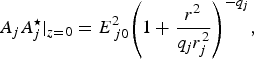 $${A_j}A_j^{\rm \star} { \vert _{z = 0}} = E_{\,j0}^2 {\left( {1 + \displaystyle{{{r^2}} \over {{q_j}r_j^2}}} \right)^{ - {q_j}}},$$
where j = 1, 2, and ωj, k j, respectively, are the angular frequency and vacuum wave numbers of the fields of the laser beams,  ${{\bf e}_x}$ is the unit vector along the x-axis, r j are the radii of laser beams at the plane of incidence, that is, z = 0. The parameter q j describes the deviation of intensity distributions of the laser beams from the Gaussian intensity distribution. As the value of q j increases, the intensity distributions of the laser beams converge toward the Gaussian distribution and become exactly Gaussian for q j = ∞, that is,
 $$\mathop {\lim} \limits_{q \to \infty} \;{A_j}A_j^{\rm \star} = E_{\,j0}^2 {e^{ - {{{r^2}} / {r_j^2}}}}. $$
For z > 0, energy-conserving ansatz for the intensity distribution of q-Gaussian laser beams are
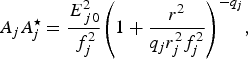 $${A_j}A_j^{\rm \star} = \displaystyle{{E_{\,j0}^2} \over {\,f_j^2}} {\left( {1 + \displaystyle{{{r^2}} \over {{q_j}r_j^2 f_j^2}}} \right)^{ - {q_j}}},$$
where r jf j are the instantaneous radii of the laser beams. Hence, the functions f j are termed as the dimensionless beam width parameters that are measures of both axial intensity and spot size of laser beams.
When such high-amplitude q-Gaussian laser beams propagate through the plasma, due to nonuniform intensity distribution along their wavefronts, the plasma electrons experience the ponderomotive force (Max, Reference Max1976)
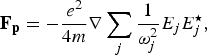 $${{\bf F}_{\bf p}} = - \displaystyle{{{e^2}} \over {4m}}\nabla \sum\limits_j \displaystyle{1 \over {{\rm \omega}_j^2}} {E_j}E_j^{\rm \star}, $$
where e and m are the charge and the mass of electrons, respectively, which results in their ambipolar diffusion from the high-field to the low-field regions. The electron density n responds to the laser electric fields according to Max (Reference Max1976)
 $$n = {n_0}{e^{ - \sum\nolimits_j {{{\rm \beta}_j}{E_j}E_j^{\rm \star}}}}, $$
where  ${\rm \beta}_j = {e^2}/8m{\rm \omega} _j^2 {T_0}{K_0}$ is the coefficient of the ponderomotive nonlinearity, T 0 is the equilibrium temperature of plasma, and K 0 is the Boltzmann constant. In this paper, we shall be considering the case where light beam varies in the space, but propagate in a steady-state manner in time. Consequently, the ponderomotive force completely dominates ion inertia, and must be balanced by pressure forces. The formal conditions for Eq. (5) to be valid are (Max, Reference Max1976): macroscopic scale length L must satisfy L ≫ λd; macroscopic velocities must be small compared with the sound speed c s = (T e/M i)1/2 and macroscopic time scales must be long compared with (L/c s).
The redistribution of electrons results in the modification of dielectric properties of the plasma. The modified dielectric function of the plasma can be written as
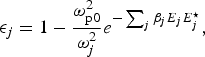 $${{\rm \epsilon} _j} = 1 - \displaystyle{{{\rm \omega}_{{\rm p}0}^2} \over {{\rm \omega}_j^2}} {e^{ - \sum\nolimits_j {{\rm \beta}_j{E_j}E_j^{\rm \star}}}}, $$
where
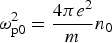 $${\rm \omega}_{{\rm p0}}^2 = \displaystyle{{4{\rm \pi} {e^2}} \over m}{n_0}$$
is the plasma frequency in the absence of laser beams. Equation (6) can be written as
 $${{\rm \epsilon} _j} = {{\rm \epsilon} _{0j}} + {\rm \phi}_j({A_1}A_1^{\rm \star}, {A_2}A_2^{\rm \star} )$$
where
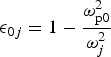 $${{\rm \epsilon} _{0j}} = 1 - \displaystyle{{{\rm \omega}_{{\rm p}0}^2} \over {{\rm \omega} _j^2}} $$
are the linear parts of the dielectric function and
 $${\rm \phi}_j({A_1}A_1^{\rm \star}, {A_2}A_2^{\rm \star} ) = \displaystyle{{{\rm \omega}_{{\rm p0}}^2} \over {{\rm \omega} _j^2}} \left\{ {1 - {e^{ - \sum\nolimits_j {{\rm \beta}_j{E_j}E_j^{\rm \star}}}}} \right\}$$
are the nonlinear parts of the dielectric function.
3. CROSS-FOCUSING OF LASER BEAMS
Starting from Ampere's and Faraday's laws for an isotropic, nonconducting, and nonabsorbing medium ( ${\bf J} = 0,\;{\rm \rho} = 0,\!$
 ${\rm \mu} = 1$), we get
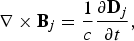 $$\nabla \times {{\bf B}_j} = \displaystyle{1 \over c}\displaystyle{{{\rm \partial} {{\bf D}_j}} \over {{\rm \partial} t}},$$
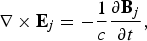 $$\nabla \times {{\bf E}_j} = - \displaystyle{1 \over c}\displaystyle{{{\rm \partial} {{\bf B}_j}} \over {{\rm \partial} t}},$$
where  ${{\bf E}_j}$ and
 ${{\bf B}_j}$ are the electric and magnetic fields associated with the laser beams and
 ${{\bf D}_j} = {{\rm \epsilon} _j}{{\bf E}_j}$ are the electric displacement vectors. Eliminating
 ${{\bf B}_j}$ from Eqs. (9) and (10), it can be shown that the electric fields
 ${{\bf E}_j}$ of the laser beams satisfy the wave equation
 $${\nabla ^2}{{\bf E}_j} - \nabla (\nabla \cdot {{\bf E}_j}) + \displaystyle{{{\rm \omega}_j^2} \over {{c^2}}}{{\rm \epsilon} _j}{{\bf E}_j} = 0.$$
Even if  ${{\bf E}_j}$ has longitudinal components, the polarization term
 $\nabla (\nabla \cdot {{\bf E}_j})$ of Eq. (11) can be neglected by assuming that the root-mean-square radii of laser beams are much greater than their vacuum wavelengths or the laser frequencies are much greater than the plasma frequency (Lam et al., Reference Lam, Lippman and Tappert1977). Under this approximation Eq. (11) reduces to
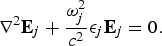 $${\nabla ^2}{{\bf E}_j} + \displaystyle{{{\rm \omega} _j^2} \over {{c^2}}}{{\rm \epsilon} _j}{{\bf E}_j} = 0.$$
Using Eq. (1) in Eq. (12) we get
 $${\rm \iota} \displaystyle{{d{E_j}} \over {dz}} = \displaystyle{1 \over {2{k_j}}}\nabla _ \bot ^2 {E_j} + \displaystyle{{{k_j}} \over {2{\rm \varepsilon} _{0j}}}{\rm \phi}_j({A_1}A_1^{\rm \star}, {A_2}A_2^{\rm \star} ){A_j}.$$
Equation (13) is a well-known nonlinear Schrödinger wave equation that describes stationary beam propagation in the z-direction with an assumption that wave-amplitude scale length along the z-axis is much larger as compared with characteristic scale in the transverse direction.
Due to its symmetry properties the wave Eq. (13) possesses a number of conserved quantities that can be obtained directly from the Noether's theorem (Rasmussen & Rypdal, Reference Rasmussen and Rypdal1986; Rypdal & Rasmussen, Reference Rosenbluth and Liu1986). In view of self-focusing of the laser beams the two most important invariants are
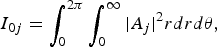 $${I_{0j}} = \int_0^{{2}{\rm \pi}} \int_0^\infty \vert {A_j}{ \vert ^2}rdrd{\rm \theta}, $$
 $${H_j} = \int_0^{2{\rm \pi}} \int_0^\infty \displaystyle{1 \over {2k_j^2}} ( \vert {\nabla _ \bot} {A_j}{ \vert ^2} - {F_j})rdrd{\rm \theta}, $$
where
 $${F_j} = \displaystyle{1 \over {2{{\rm \epsilon} _{0j}}}}\int_0^{{A_j}A_j^{\rm \star}} {\rm \phi}_j({A_1}A_1^{\rm \star}, {A_2}A_2^{\rm \star} )d({A_j}A_j^{\rm \star} ).$$
The first invariant I 0j is merely a statement of the conservation of energy of the laser beams and second invariant H j relates the wavefront curvature of the laser beams to the plasma nonlinearity (Schmitt & Ong, Reference Schmitt and Ong1983).
Now from the definition of second-order spatial moments of the intensity distribution, the mean-square radii of the laser beams are given by
 $$\lt R_j^2 (z) \,\gt = \displaystyle{1 \over {{I_{0j}}}}\int_0^{2{\rm \pi}} \int_0^\infty {r^2}{A_j}A_j^{\rm \star} rdrd{\rm \theta}. $$
Following the procedure of Lam et al. (Reference Lam, Lippman and Tappert1975, Reference Lam, Lippman and Tappert1977), we get the following differential equation governing the evolution of mean-square radius of the laser beams with distance of propagation
 $$\displaystyle{{{d^2}} \over {d{z^2}}} \lt R_j^2 (z)\, \gt = 4\displaystyle{{{H_j}} \over {{I_{0j}}}} - \displaystyle{4 \over {{I_{0j}}}}\int_0^{2{\rm \pi}} \int_0^\infty {Q_j}rdrd{\rm \theta}, $$
where
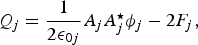 $${Q_j} = \displaystyle{1 \over {2{{\rm \epsilon} _{0j}}}}{A_j}A_j^{\rm \star} {\rm \phi}_j - 2{F_j},$$
Using Eqs. (3), (14), and (17) it can be shown that
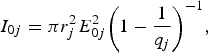 $${I_{0j}} = {\rm \pi} r_j^2 E_{0j}^2 {\left( {1 - \displaystyle{1 \over {{q_j}}}} \right)^{ - 1}},$$
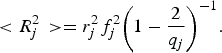 $$\lt R_j^2\, \gt = r_j^2 f_j^2 {\left( {1 - \displaystyle{2 \over {{q_j}}}} \right)^{ - 1}}.$$
Using Eqs. (15), (19)–(21) in (18) we get the following coupled differential equations governing the cross-focusing of the two laser beams.
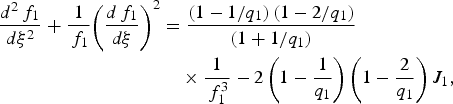 $$\eqalign{ \displaystyle{{{d^2}{\,f_1}} \over {d{{\rm \xi} ^2}}} + \displaystyle{1 \over {{\,f_1}}}{\left( {\displaystyle{{d{\,f_1}} \over {d{\rm \xi}}}} \right)^2} &= \displaystyle{{\left( {1 - {1 / {{q_1}}}} \right)\left( {1 - {2 / {{q_1}}}} \right)} \over {\left( {1 + {1 / {{q_1}}}} \right)}} \cr & \quad \times\displaystyle{1 \over {\,f_1^3}} - 2\left( {1 - \displaystyle{1 \over {{q_1}}}} \right)\left( {1 - \displaystyle{2 \over {{q_1}}}} \right){J_1},} $$
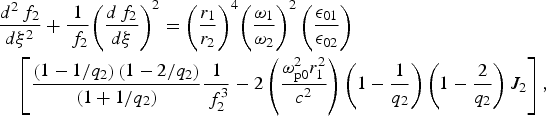 $$\eqalign{& \displaystyle{{{d^2}{\,f_2}} \over {d{{\rm \xi} ^2}}} + \displaystyle{1 \over {{\,f_2}}}{\left( {\displaystyle{{d{\,f_2}} \over {d{\rm \xi}}}} \right)^2} = {\left( {\displaystyle{{{r_1}} \over {{r_2}}}} \right)^4}{\left( {\displaystyle{{{{\rm \omega} _1}} \over {{{\rm \omega} _2}}}} \right)^2}\left( {\displaystyle{{{{\rm \epsilon} _{01}}} \over {{{\rm \epsilon} _{02}}}}} \right) \cr & \quad \left[ {\displaystyle{{\left( {1 - {1 / {{q_2}}}} \right)\left( {1 - {2 / {{q_2}}}} \right)} \over {\left( {1 + {1 / {{q_2}}}} \right)}}\displaystyle{1 \over {\,f_2^3}} - 2\left( {\displaystyle{{{\rm \omega} _{{\rm p}0}^2 r_1^2} \over {{c^2}}}} \right)\left( {1 - \displaystyle{1 \over {{q_2}}}} \right)\left( {1 - \displaystyle{2 \over {{q_2}}}} \right){J_2}} \right],} $$
where  ${\rm \xi} = z/{k_1}r_1^2 $ is the dimensionless distance of propagation, and
 $${J_1} = \displaystyle{{{\rm \beta} _{1}E_{10}^2} \over {\,f_1^3}} {T_1} + \displaystyle{{{\rm \beta} _{2}E_{20}^2} \over {\,f_1^3}} {\left( {\displaystyle{{{r_1}} \over {{r_2}}}} \right)^2}{\left( {\displaystyle{{{\,f_1}} \over {{\,f_2}}}} \right)^4}{T_2},$$
 $${J_2} = \displaystyle{{{\rm \beta}_{1}E_{10}^2} \over {\,f_2^3}} {T_3} + \displaystyle{{{\rm \beta}_{2}E_{20}^2} \over {\,f_2^3}} {\left( {\displaystyle{{{r_1}} \over {{r_2}}}} \right)^2}{\left( {\displaystyle{{{\,f_1}} \over {{\,f_2}}}} \right)^4}{T_4},$$
 $${T_1} = \int_0^\infty {x^3}{\left( {1 + \displaystyle{{{x^2}} \over {{q_1}}}} \right)^{ - 2{q_1} - 1}}G(x){\kern 1pt} dx,$$
 $${T_2} = \int_0^\infty {x^3}{\left( {1 + \displaystyle{{{x^2}} \over {{q_1}}}} \right)^{ - {q_1}}}{\left( {1 + \displaystyle{{{x^2}} \over {{q_2}}}{{\left( {\displaystyle{{{r_1}{\,f_1}} \over {{r_2}{\,f_2}}}} \right)}^2}} \right)^{ - {q_2} - 1}}G(x)dx,$$
 $${T_3} = \int_0^\infty {x^3}{\left( {1 + \displaystyle{{{x^2}} \over {{q_1}}}} \right)^{ - {q_1} - 1}}{\left( {1 + \displaystyle{{{x^2}} \over {{q_2}}}{{\left( {\displaystyle{{{r_1}{\,f_1}} \over {{r_2}{\,f_2}}}} \right)}^2}} \right)^{ - {q_2}}}G(x)dx,$$
 $${T_4} = \int_0^\infty {x^3}{\left( {1 + \displaystyle{{{x^2}} \over {{q_2}}}{{\left( {\displaystyle{{{r_1}{\,f_1}} \over {{r_2}{\,f_2}}}} \right)}^2}} \right)^{ - 2{q_2} - 1}}G(x)dx,$$
 $$G(x) = {e^{ - \left\{ {\displaystyle{{{\rm \beta}_{1}E_{10}^2} \over {\,f_1^2}} {{\left( {1 + \displaystyle{{{x^2}} \over {{q_1}}}} \right)}^{ - {q_1}}} + \displaystyle{{{\rm \beta}_{2}E_{20}^2} \over {\,f_2^2}} {{\left( {1 + \displaystyle{{{x^2}} \over {{q_2}}}{{\left( {\displaystyle{{{r_1}{\,f_1}} \over {{r_2}{\,f_2}}}} \right)}^2}} \right)}^{ - {q_2}}}} \right\}}},$$
 $$x = \displaystyle{r \over {{r_1}{\,f_1}}}.$$
For initially plane wavefronts Eqs. (22) and (23) are subjected to boundary conditions f j = 1 and df j / dξ = 0 at ξ = 0.
4. EXCITATION OF BEAT WAVE
In the dynamics of excitation of EPW, it must be mentioned here that the contribution of ions is negligible because they only provide a static positive background, that is, only plasma electrons are responsible for the excitation of EPW. The background plasma density is modified via ponderomotive nonlinearity. Therefore, the amplitude of EPW, which depends on the background electron density, gets strongly coupled to the laser beams. The dynamics of generated plasma wave is governed by
• Equation of continuity:
(24) $$\displaystyle{{{\rm \partial} N} \over {{\rm \partial} t}} + \nabla (N{\bf v}) = 0,$$
• Equation of motion
(25)$$m\displaystyle{{d{\bf v}} \over {dt}} = - e{\bf E} - 3\displaystyle{{{K_0}{T_0}} \over N}\nabla N,$$• Poisson's Equation
(26)$$\nabla \cdot {\bf E} = - 4{\rm \pi} eN,$$
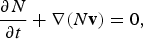


where N is the total electron density,  ${\bf E}$ is the sum of electric fields of laser beams and EPW
 $$N = {n_0} + {n^{\prime}},$$
 $$E = \sum\limits_j {{\bf E}_{\bf j}} + {\bf E^{\prime}},$$
 ${\bf v} = {{\bf v}_{\bf e}}$ = oscillatory velocity of electrons using the linear perturbation theory, we get the following wave equation governing the dynamics of EPW
 $$\displaystyle{{{{\rm \partial} ^2}n^{\prime}} \over {{\rm \partial} {t^2}}} - v_{{\rm th}}^2 {\nabla ^2}n^{\prime} + {\rm \omega} _{\rm p}^2 n^{\prime} = \displaystyle{e \over m}{n_0}\nabla \sum\limits_j {E_j}.$$
Taking
 $$n^{\prime} = {n_1}{e^{{\rm \iota} ({\rm \omega} t - kz)}},$$
where ω = ω2 − ω1 and k = k 2 − k 1, we get the density perturbation associated with the plasma wave
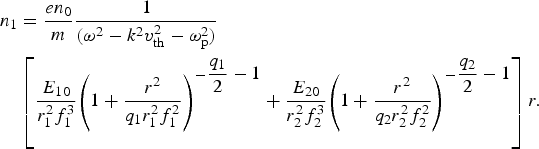 $$\eqalign{& {n_1} = \displaystyle{{e{n_0}} \over m}\displaystyle{1 \over {({\rm \omega} ^2 - {k^2}v_{{\rm th}}^2 - {\rm \omega} _{\rm p}^2 )}} \cr & \quad \left[ {\displaystyle{{{E_{10}}} \over {r_1^2 f_1^3}} {{\left( {1 + \displaystyle{{{r^2}} \over {{q_1}r_1^2 f_1^2}}} \right)}^{ - \displaystyle{{{q_1}} \over 2} - 1}} + \displaystyle{{{E_{20}}} \over {r_2^2 f_2^3}} {{\left( {1 + \displaystyle{{{r^2}} \over {{q_2}r_2^2 f_2^2}}} \right)}^{ - \displaystyle{{{q_2}} \over 2} - 1}}} \right]r.} $$
Using the Poisson's equation
 $$\nabla {\bf E^{\prime}} = - 4{\rm \pi} en^{\prime},$$
 $$E^{\prime} = {E_{{\rm e} \cdot {\rm p}}}{e^{{\rm \iota} ({\rm \omega} t - kz)}},$$
we get
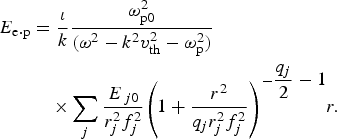 $$\eqalign{ {E_{{\rm e} \cdot {\rm p}}} &= \displaystyle{{\rm \iota} \over k}\displaystyle{{{\rm \omega}_{{\rm p0}}^2} \over {({{\rm \omega} ^2} - {k^2}v_{{\rm th}}^2 - {\rm \omega} _{\rm p}^2 )}} \cr & \quad \times\sum\limits_j \displaystyle{{{E_{\,j0}}} \over {r_j^2 f_j^2}} {\left( {1 + \displaystyle{{{r^2}} \over {{q_j}r_j^2 f_j^2}}} \right)^{ - \displaystyle{{{q_j}} \over 2} - 1}}r.} $$
Defining the normalized power of EPW as
 $${\rm \eta} = \displaystyle{{{P_{{\rm e} \cdot {\rm p}}}} \over {{P_1}}},$$
where
 $${P_{{\rm e} \cdot {\rm p}}} = \displaystyle{{{v_{\rm g}}} \over {8{\rm \pi}}} \int_0^\infty {E_{{\rm e} \cdot {\rm p}}}E_{{\rm e} \cdot {\rm p}}^{\rm \star} 2{\rm \pi} rdr,$$
 $${P_1} = \displaystyle{c \over {8{\rm \pi}}} \int_0^\infty {E_1}E_1^{\rm \star} 2{\rm \pi} rdr,$$
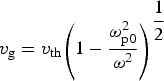 $${v_{\rm g}} = {v_{{\rm th}}}{\left( {1 - \displaystyle{{{\rm \omega} _{{\rm p0}}^2} \over {{{\rm \omega}^2}}}} \right)^{\displaystyle{1 \over 2}}}$$
we get
 $$\eqalign{ {\rm \eta} &= 2\left( {\displaystyle{{{v_{\rm g}}} \over c}} \right)\left( {1 - \displaystyle{1 \over {{q_1}}}} \right)\displaystyle{{{\rm \omega}_{{\rm p0}}^2} \over {r_1^2 {k^2}{{\rm \omega} ^4}}} \cr & \quad \int_0^\infty \displaystyle{1 \over {D({\rm \omega}_1,{\omega _2})}}X({E_{10}},{E_{20}})dx,} $$
where
 $$D({\rm \omega}_1,{\rm \omega} _2) = {\left\{ {1 - \displaystyle{{{k^2}v_{{\rm th}}^2} \over {{\rm \omega}^2}} - \displaystyle{{{\rm \omega}_{{\rm p0}}^2} \over {{{({\rm \omega}_2 - {\rm \omega}_1)}^2}}}G(x)} \right\}^2},$$
 $$\eqalign{ X({E_{10}},{E_{20}}) &= {\left[ {\displaystyle{{{E_{10}}} \over {{\,f_1}}}{{\left( {1 + \displaystyle{{{x^2}} \over {{q_1}}}} \right)}^{ - \displaystyle{{{q_1}} \over 2} - 1}}}\right.} \cr & \left. \qquad + \displaystyle{{{E_{20}}} \over {{\,f_2}}}{{\left( {\displaystyle{{{r_1}{\,f_1}} \over {{r_2}{\,f_2}}}} \right)}^2}{{\left( {1 + \displaystyle{{{x^2}} \over {{q_2}}}{{\left( {\displaystyle{{{r_1}{\,f_1}} \over {{r_2}{\,f_2}}}} \right)}^2}} \right)}^{ - \displaystyle{{q_2} \over 2} - 1}} \right]^2}.$$
5. DISCUSSION
Equations (22) and (23) are the coupled nonlinear differential equations governing the cross-focusing of the two coaxial q-Gaussian laser beams in collisionless plasma. Equation (30) gives the normalized power of EPW generated as a result of beating of the two laser beams. Numerical computational techniques are used to investigate the beam dynamics as analytic solutions of these equations are not possible. It is worth noting to understand the physical mechanisms of various terms on the right-hand sides (RHS) of Eqs. (22) and (23). The first terms on the RHS of Eqs. (22) and (23) are responsible for diffraction divergence of the laser beams and have their origin in the Laplacian  $\nabla _ \bot ^2 $, appearing in nonlinear wave Eq. (13). The second terms on the RHS of these equations arise due to the combined effect of ponderomotive nonlinearity and nonlinear coupling between the two laser beams. These terms are responsible for nonlinear refraction of the laser beams. It is the relative competition between the diffractive and refractive terms that determine the focusing/defocusing of the laser beams in the plasma.
To analyze the effect of deviation of intensity distribution of laser beams from the Gaussian distribution and plasma density on cross-focusing of the laser beams as well as beat wave excitation of EPW, Eqs. (22), (23), and (33) have been solved for following set of laser–plasma parameters
 $${\rm \omega}_1 = 1.78 \times {10^{15}}\;{\rm rad}/{\rm s};\;\,{\rm \omega}_2 = 1.98 \times {10^{15}}\;{\rm rad/s,}$$
 $${r_1} = 15\;{\rm \mu} {\rm m};\;{r_2} = 16.67\;{\rm \mu} {\rm m,}$$
 $${T_0}{ = 10^6}\;{\rm K}.$$
Figures 1 and 2 illustrate the effect of q 1, that is, the deviation of intensity distribution of the first laser beam from Gaussian distribution on focusing/defocusing of the two laser beams. The plots in Figure 1 depict that the increase in the value of q 1 leads to the decrease in the extent of self-focusing of the first laser beam. This is due to the fact that as the value of q 1 increases toward higher values, the intensity of the first laser beam shifts toward the axial region of the wavefront and the diffraction divergence of axial rays is stronger as compared with off-axial rays. It is also observed from Figure 1 that the laser beams with higher q-values possess faster focusing. The underlying physics behind this fact is the slower focusing character of the off-axial rays.
Variation of normalized intensity of first beam with normalized distance of propagation ξ and radial distance r/r 1, keeping (ωp0r 1/c)2 = 12, 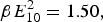 ${\rm \beta} E_{10}^2 = 1.50,$
 ${\rm \beta} E_{20}^2 = 1.0,$q 2 = 3 fixed and at different values of q 1, (a) q 1 = 3, (b) q 1 = 4, (c) q 1 = 5, and (d) q 1 = ∞, respectively.

Variation of normalized intensity of second beam with normalized distance of propagation ξ and radial distance r/r 2, keeping (ωp0r 1/c)2 = 12,  ${\rm \beta} E_{10}^2 = 1.50$,
 ${\rm \beta} E_{20}^2 = 1.0$, q 2 = 3 fixed and at different values of q 1, (a) q 1 = 3, (b) q 1 = 4, (c) q 1 = 5, and (d) q 1 = ∞, respectively.
The plots in Figure 2 depict that increase in the value of q 1 leads to increase in the extent of self-focusing of the second laser beam. This is due to the fact that the increase in the value of q 1 leads to the increase in the magnitude of refractive term as compared with the diffractive term in Eq. (23).
The plots in Figures 3 and 4 also depict the same result that increase in the value of q 2 leads to increase in the extent of self-focusing of the first laser beam and decrease in that of the second laser beam.
Variation of normalized intensity of first beam with normalized distance of propagation ξ and radial distance r/r 1, keeping (ωp0r 1/c)2 = 12,  ${\rm \beta} E_{10}^2 = 1.50$,
 ${\rm \beta} E_{20}^2 = 1.0$, q 1 = 3 fixed and at different values of q 2, (a) q 2 = 3, (b) q 2 = 4, (c) q 2 = 5, and (d) q 2 = ∞, respectively.
Variation of normalized intensity of second beam with normalized distance of propagation ξ and radial distance r/r 2, keeping (ωp0r 1/c)2 = 12,  ${\rm \beta} E_{10}^2 = 1.50$,
 ${\rm \beta} E_{20}^2 = 1.0$, q 1 = 3 fixed and at different values of decentered parameter, (a) q 2 = 3, (b) q 2 = 4, (c) q 2 = 5, and (d) q 2 = ∞, respectively.
Figures 5 and 6 describe the effect of plasma density on focusing/defocusing of the two laser beams. It is observed that the increase in plasma density leads to the increase in the extent of self-focusing of both the laser beams. This is due to the fact that increase in the plasma density leads to increase in the number of electrons contributing to the ponderomotive nonlinearity.
Variation of normalized intensity of first beam with normalized distance of propagation ξ and radial distance r/r 1, keeping  ${\rm \beta} E_{10}^2 = 1.50$,
 ${\rm \beta} E_{20}^2 = 1.0$, q 1 = 3, q 2 = 3 fixed and at different values of normalized density, (a) (ωp0r 1/c)2 = 12, (b) (ωp0r 1/c)2 = 14, (c) (ωp0r 1/c)2 = 16, and (d) (ωp0r 1/c)2 = 18, respectively.
Figures 7 and 8 illustrate the effect of deviation of intensity distributions of the laser beams from Gaussian distribution on power of generated plasma wave. It is observed that amplitude of the generated plasma wave is maximum at the focal spots of the two laser beams. This is due to the fact that the focal spots of the laser beams are the regions of very high intensity and hence act as the source for plasma wave generation. It is observed from Figure 7 that increase in the value of q 1 leads to the decrease in the amplitude of the plasma wave at the focal spots of the first laser beam; whereas there is an increase in the amplitude of plasma wave at the focal spots of the second laser beam. This is due to the fact that an increase in the value of q 1 leads to decrease in the extent of self-focusing of the first laser beam and to increase in that of the second laser beam. Similarly, the plots in Figure 8 depict that an increase in the value of q 2 leads to the increase in the amplitude of the plasma wave at the focal spots of the first laser beam and decrease in the amplitude of plasma wave at the focal spots of the second laser beam.
Variation of normalized power η of beat wave with normalized distance of propagation ξ, keeping (ωp0r 1/c)2 = 12,  ${\rm \beta} E_{10}^2 = 1.50$,
 ${\rm \beta} E_{20}^2 = 1.0$, q 2 = 3 fixed and at different values of q 1, q 1 = 3, 4, 5.
Variation of normalized power η of beat wave with normalized distance of propagation ξ, keeping (ωp0r 1/c)2 = 12,  ${\rm \beta} E_{10}^2 = 1.50$,
 ${\rm \beta} E_{20}^2 = 1.0$, q 1 = 3 fixed and at different values of q 2, q 2 = 3, 4, 5.
Figure 9 illustrates the effect of plasma density on focusing/defocusing of the two laser beams. It is observed that an increase in the value of the plasma density leads to an increase in the amplitude of plasma wave. This is due to the fact that an increase in the plasma density enhances the extent of self-focusing of both the laser beams.
Variation of normalized power η of beat wave with normalized distance of propagation ξ, keeping  ${\rm \beta} E_{10}^2 = 1.50$,
 ${\rm \beta} E_{20}^2 = 1.0$, q 1 = 3, q 2 = 3 fixed and at different values of normalized plasma density (ωp0r 1/c)2 = 12, 14, 16.
6. CONCLUSION
In this paper, the authors have investigated the cross-focusing of the two intense coaxial q-Gaussian laser beams in the collisionless plasma and subsequently its effect on beat wave excitation of EPW. Following important conclusions have been drawn from the present analysis:
• Greater is the extent of deviation of intensity distribution of one laser beam from Gaussian distribution, greater is the extent of its self-focusing and lesser is the extent of self-focusing of other laser beam.
• Increase in plasma density enhances the extent of self-focusing of both the laser beams as well as the amplitude of the generated plasma wave.
• Amplitude of generated plasma wave is maximum at the focal spots of the two laser beams.
• Increase in the q-value of one laser beam leads to the decrease in the amplitude of generated plasma wave at its focal spots, while there is an increase in the amplitude of the generated plasma wave at the focal spots of the other laser beam.
The results of the present analysis may be of importance in various contexts of laser plasma physics. Besides its obvious relevance to inertial confinement fusion and beat wave accelerators, these results can also be helpful in other applications requiring laser beams with localized energy. The present investigation may be useful for the experimentalists working in the area of laser plasma interactions.
ACKNOWLEDGEMENTS
The authors are grateful to the Ministry of Human Resources and Development of India for providing financial assistance for carrying out this work.



