INTRODUCTION
Of global rice production, Asian irrigated rice (Oryza sativa L.) constitutes 70%, which is staple food for half of the world's population (Bouman et al., Reference Bouman, Humphreys, Tuong and Barker2007). With the increase in population growth and thereof need for additional food, rice production plays an important role in food security in rice-producing countries (Jing et al., Reference Jing, Bouman, van Keulen, Hengsdijk, Cao and Dai2008). Across Asia, rice yields vary between 2 and 15 ton ha−1 depending on genotype, environment and management and their interactions (Cooper et al., Reference Cooper, Rajatasereekul, Immark, Fukai and Basnayake1999; Dobermann et al., Reference Dobermann, Witt, Abdulrachman, Gines, Nagarajan, Son, Tan, Wang, Chien, Thoa, Phung, Stalin, Muthukrishnan, Ravi, Babu, Simbahan and Adviento2003; Romyen et al., Reference Romyen, Hanviriyapant, Rajatasereekul, Khunthasuvon, Fukai, Basnayake and Skulkhu1998; Tang et al., Reference Tang, Peng, Buresh, Zou, Castilla, Mew and Zhong2007; Whitbread et al., Reference Whitbread, Blair, Konboon, Lefroy and Naklang2003). In Asia, recovery of applied nitrogen (REN) is 30–50% (Cassman et al., Reference Cassman, Kropff, Gaunt and Peng1993, Reference Cassman, Dobermann, Cruz, Gines, Samson, Descalsota, Alcantara, Dizon and Olk1996b; Dobermann and Cassman, Reference Dobermann and Cassman2002; Dobermann et al., Reference Dobermann, Witt, Abdulrachman, Gines, Nagarajan, Son, Tan, Wang, Chien, Thoa, Phung, Stalin, Muthukrishnan, Ravi, Babu, Simbahan and Adviento2003) due to significant losses through volatilization, leaching, immobilization and sub-optimal N management like timing, placement and source of N. The high variability in soil N availability within a single farm or even parcels of flooded paddies, makes it difficult to account for soil N supply so that external N input can be matched to meet N demand at critical crop growth stages (Cassman et al., Reference Cassman, Dedatta, Amarante, Liboon, Samson and Dizon1996a). As REN is an integrated measure of the availability of soil N and the applied N, information on REN at different crop stages can help optimize N input (an expensive factor of crop production for the resource poor farmers in subsistence farming) for increased crop yield with reduced production costs and downstream environmental effects. Improving REN can be achieved by N management practices and by exploiting the genetic differences in N uptake and utilization efficiency (Peng and Cassman, Reference Peng and Cassman1998; Singh et al., Reference Singh, Ladha, Castillo, Punzalan, Tirol-Padre and Duqueza1998) as improved genotypes are often more N efficient than traditional cultivars (Saito et al., Reference Saito, Linquist, Atline, Phanthaboon, Shiraiwa and Horie2006, Reference Saito, Atlin, Linquist, Phanthaboon, Shiraiwa and Horie2007). REN can be determined by N difference method or by use of enriched 15N stable isotope. Use of 15N is a robust method wherein the application of a small quantity of the enriched 15N in the soil can be traced in the plant in more diluted form at the time of harvest and the technique has been used in diverse rice farming environments (Bronson et al. Reference Bronson, Hussain, Pasuquin and Ladha2000; Ghaley et al., Reference Ghaley, Høgh-Jensen and Christiansen2010) and hence 15N is preferred over other method.
In Bhutan, rice is the staple food grain and cultivated in terraces by smallholder farmers primarily to meet the food needs of the family (Ghaley and Christiansen, Reference Ghaley and Christiansen2010). In the highlands of Western Bhutan, farmyard manure (FYM), consisting of composted bedding material from cowsheds and leaf litter from forest, is the main source of N input to the terraces, supplemented with 35–80 kg N ha−1 urea topdressing applied, at or shortly after transplanting the rice seedlings. There is a lack of knowledge regarding the optimal timing and dose of topdressed urea and the inherent soil N supply in such highland rice production systems (Ghaley et al., Reference Ghaley, Høgh-Jensen and Christiansen2010). Availability of such information may help to match the inherent N supply of the soil with the corresponding requirement for additional N input, based on local yield levels. Earlier studies (Ghaley and Christiansen, Reference Ghaley and Christiansen2010) in the study sites have recorded wide grain yield gaps of 1–2 ton ha−1 amongst the farmers both in the improved and traditional cultivars, due to the differences in fertilizer management practices in terms of timing and dose of supplemental urea application. Hence, in this study, supplemental urea was increased to 150 kg N ha−1 to increase the grain yield by 2–2.5 ton ha−1 (exploit maximum yield potential) and provided in five critical rice growth stages to assess the N recovery at different crop stages in a widely grown improved and a traditional cultivar. Further, the information on cultivar differences in N uptake and utilization efficiency are lacking in both on-farm and on-station cultivar evaluation. Hence, the study objective was to assess the uptake of 150 kg N ha−1, split into five equal topdressing at critical growth stages and to determine the genotypic differences in N utilization in two contrasting cultivars (one traditional and on improved cultivar), under field conditions using enriched 15N stable isotopes.
MATERIALS AND METHODS
Site characterization
The trials were conducted in 2007 in the experimental rice (O. sativa L.) fields of Renewable Natural Resources Research Centre, Yusipang and the rice fields were located at Khasadrapchu at an altitude of 2200 metres above sea level in Thimphu. The trial fields are representative of high-altitude rice-growing areas in terms of rainfall received, slope and altitude, FYM application and fertilization regime. More than 90% of the farmers at the trial sites grow rice for subsistence and both traditional and improved cultivars are grown. Improved cultivars are grown due to their high yield potential whereas traditional cultivars are grown for their aroma, good taste and for ritual offerings according to traditional cultural norms.
Rice is grown in terraced bunds along sloping hills with irrigation water drawn from the nearby rivers and supplemented with seasonal monsoon rainfall. Soil fertility is traditionally maintained by annual applications of 5–7 ton ha−1 of fresh composted FYM, consisting of composted bedding material from cowsheds and forest leaf litter. The dominant cropping system is a single rice crop from May to October and vegetables like chilli, peas, potatoes and tomatoes in the spring (February–May) for household consumption as well as for sale. From November to May, farmers cultivate winter wheat and barley in the paddy terraces as the main winter food crops.
Experiment layout
Nursery sowing
The nursery was sown in April in one terrace after land preparation with 2–3 cross-ploughings followed by application of FYM and puddling. Nursery was raised for Janam (JN), a traditional tall cultivar that has been cultivated for generations and is valued for its aroma, taste and high-straw yield and Khangma Maap (KM), a semi-dwarf, early-maturing cultivar released by the National Agricultural Research System of Bhutan in 1999. The detailed cultivar characteristics are summarized in Table 1. The seeds were broadcasted into puddled paddies and two to three weedings were done to remove the volunteer rice plants and other off-types.
Characteristics of rice genotypes tested at the experimental site in Western Bhutan.

Transplanting
As per the traditional practice, the seedlings were left to mature in nursery until end of June after which the transplanting took place on 6 July, 2007. The terraces for transplanting have been applied annually with 7 tons of FYM to represent the farmers practice to maintain soil fertility. The terraces were prepared by puddling, levelling and removal of weeds after which standing water was maintained in the terraces. The seedling nursery was watered a few days before transplanting to ease removal of the seedlings. The seedlings were packed in small bundles and transported to the fields and 1–3 seedlings were transplanted in a single hill.
At transplanting, field trials were laid out in split–split plot design with 0 kg N ha−1 (0 N) and 150 kg N ha−1 (150 N) as main plots; two cultivars, JN and KM as subplots and five splits of 30 kg N ha−1 each (30 N) totalling 150 N as the sub-subplots. To each sub-subplots, 150 N was applied in five equal splits of 30 N at 7, 26, 45, 70 and 83 days after transplanting (DAT) coinciding with N demand at transplanting (7 DAT), tillering initiation (26 DAT), active tillering (45 DAT), panicle initiation (70 DAT) and flowering initiation (83 DAT), respectively. Of the five splits applied in each sub-subplot, one split was labelled with 3 atom % 15N whereas the other splits were applied as unlabelled 14N urea. During the first split application at transplanting, if sub-subplot A received labelled 15N, the remaining sub-subplots received unlabelled 14N urea. During the second split application at tillering initiation, if sub-subplot B received labelled 15N, the remaining sub-subplots received unlabelled 14N urea and so on. In this way, each of the five sub-subplots provided information on uptake efficiency of 15N at five different timing over the growing period of rice crop. Such a trial design enabled a direct estimation of the partial fertilizer use efficiency of 30 N applied at each successive split application and the total fertilizer use efficiency of five-split application of 150 N.
The main plots consisted of 10 × 20 m plots and subplots consisted of 10 × 10 m plots and the sub-subplots were 0.5 m2 open rectangular iron frames (18 mm thick) measuring 50 × 100 cm with a height of 50 cm. The two main plots were placed in two separate terraces to avoid cross-contamination by N fertilizer. There were 12 treatments in total with four replications of each treatment. After transplanting of the rice seedlings, the frames were driven 20 cm into the soil to avoid exchange of water with the bordering rice plants outside the sub-subplots. The 15N sub-subplots were placed 1 m apart in the field to eliminate cross-contamination. When the monsoon rainfall was not enough and the soil started cracking, the main plots, subplots and sub-subplots were irrigated manually up to 3 cm depth of water.
Management practices
The management practices like transplanting, irrigation and weeding operations were similar in fertilized and 0 N fields. There was no major pest or disease pressure during the crop cycle, so no control measures were taken. No potassium or phosphorus fertilizers were applied in the terraces as the traditional practice of 7 ton ha−1 FYM provided 76 kg N, 38 kg P and 138 kg K ha−1, is sufficient to produce rice yields in the range of 4–6 ton ha−1 (Chettri et al., Reference Chettri, Ghimiray and Floyd2003). Due to surface application of FYM one to two months before land preparation, a considerable quantity of N is liable to be lost via volatilization, leaching and surface run-off before the terraces are prepared for transplanting.
Field data collection and sampling
During the entire crop cycle, data was recorded on the different crop management practices. This included recording dates of different cultural practices, such as nursery sowing, transplanting, topdressing, weeding and harvesting. In the main plots and subplots, a harvest area of 6 m2 (3 × 2 m) was demarcated after excluding the border rows. Within the harvest area, the crop was cut at 2 cm above ground level and the fresh biomass was recorded. Threshed grains were cleaned and grain weights were recorded along with the moisture content of the grain samples, so that all grain weights could be standardized to 14% moisture content. A sub-sample of 500 g grain and straw was weighed and dried at 70 °C for 2 days to constant weight to determine total dry matter (TDM).
In the sub-subplots, all plants within the sub-subplots were harvested and the fresh weights were recorded. The samples were separated into straw and grain, weighed and dried at 70 °C for 2 days to constant weight to determine TDM. The samples were powdered (mess 0.2 mm) and 15N and total N contents were analysed using an ANCA-SL elemental analyser coupled to a 20–20 Tracermass mass spectrometer (SerCon Ltd., Crewe, UK) using the Dumas combustion method.
Soil samples from the trial fields were collected 30–40 days before transplanting of the rice seedlings. Each soil sample consisted of 5–6 sub-samples taken from a depth of 0–20 cm topsoil and bulked into one composite sample and four composite samples each were taken from the two terraces. The soil samples were then air-dried, sieved and analysed for total soil N (Kjeldhal), carbon (Walkley-Black), available phosphorus (P) (Bray) and potassium (K) (calcium chloride extraction), pH (H20) and cation exchange capacity (CEC). Soil organic matter was computed by multiplying organic carbon content with 1.7 factor based on 58% organic carbon content in soil organic matter (Yin et al., Reference Yin, Impellitteri, You and Allen2002).
The trial sites were characterized by heavy sandy loam soils with sand, silt and clay proportions of 52.8 ± 3.1, 32.5 ± 2.8 and 14.6 ± 1.7, respectively. Total soil N content was 0.14% with high soil organic matter content of 4.1%, moderate pH (5.67), adequate available P content (>8 mg kg−1 soil) and high available K content (>50 mg kg−1 soil). The C/N ratio was moderate at 17.0 and while CEC was high (12.64 me 100 g−1 soil).
Calculations and statistics
The different agronomic parameters were calculated as given below (Bandyopadhyay and Sarkar, Reference Bandyopadhyay and Sarkar2005; Ghaley et al., Reference Ghaley, Hauggaard-Nielsen, Høgh-Jensen and Jensen2005):








where TDMN is TDM N, GY0 is grain yield without fertilizer N application, GYF is grain yield with fertilizer N application, NF is fertilizer N rate applied (kg N ha−1) and GN is grain N.
Analysis of variance (ANOVA) was carried out for a split–split plot design with N fertilizer levels as the main plots and cultivars as subplots and 15N application timing as the sub-subplots nested within the subplots. ANOVA for cultivar × topdressing timing was carried out to determine the significance of topdressing timing effects on the respective dependent variables like N uptake efficiency and resultant effects on grain and biomass yield. Cultivar and N topdressing timing interactions were treated as fixed effects, whereas residuals were treated as random effects. Differences were considered significant if p ≤ 0.05. Levels of significance are denoted as follows: ***significant at p ≤ 0.001, **significant at p ≤ 0.01, *significant at p ≤ 0.05, ns = not significant. Data were analysed with the Genstat software package (Genstat 8.1, 2005).
RESULTS
Grain and straw yield, TDMN and soil N supply
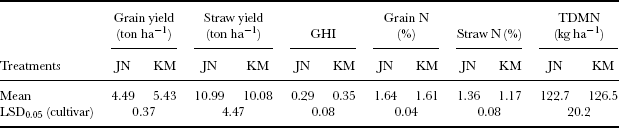
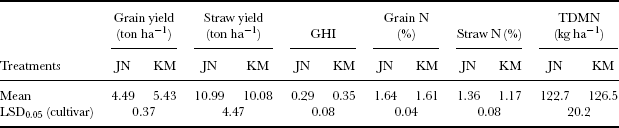
The cultivar effects were recorded on grain yield, grain harvest index (GHI) and on straw N% (Table 2). The mean rice grain yield (14% moisture content) was significantly higher by 21% (p = 0.002) in KM compared to JN. The higher yield advantage of the KM is partly attributed to the high GHI of 0.35 in KM compared to 0.29 in JN, statistically significant at p = 0.10 (Table 2). JN had significantly higher straw N% (1.36%) (p = 0.004), higher by 16% compared to KM. TDMN inclusive of grain and straw N accumulation, was not significantly different between cultivars. Based on TDMN in 0 N terraces, soil N supplied 93.9 kg N ha−1and 94.9 kg N ha−1(data not shown) in JN and KM, respectively. Hence, with equivalent TDMN accumulation in KM and JN, KM produced higher grain yield and comparable straw yield, due to higher GHI and physiological efficiency in conversion of TDMN into grain and straw.
Grain yield (ton ha−1), straw yield (ton ha−1), grain harvest index (GHI), grain N%, straw N%, total dry matter N (kg ha−1) (TDMN), in Khangma Maap (KM) and Janam (JN) rice cultivars, topdressed with 150 kg N ha−1 in 5-splits of 30 kg N ha−1 each, at different phenological crop stages (7–83 DAT) in Western Bhutan.
% 15N atom excess in grain and straw and urea N uptake
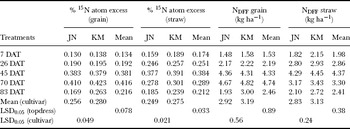
The five-split topdressing treatments (7–83 DAT) had significant effects on grain and straw % 15N atom excess, grain and straw NDFF (kg ha−1), NDFF total (grain + straw) (kg ha−1) and REN % whereas cultivars effects were recorded only in straw % 15N atom excess and straw NDFF (Table 3). Averaged across cultivars, topdressing treatments had significant effects (p = 0.002) on accumulation of grain % 15N atom excess with the highest mean grain % 15N atom excess accumulated at panicle initiation (70 DAT) (0.416 % 15N atom excess) stage (Table 3). Consequently, topdressing effects on grain NDFF was significant (p = 0.002) with highest grain NDFF at 70 DAT split (4.74 kg N ha−1), an increase of 209% more uptake than the least effective 7 DAT split (1.53 kg N ha−1). Averaged across cultivars, topdressing at 45 DAT resulted in maximum straw % 15N atom excess (0.384 % 15N atom excess) (p < 0.001) resulting in 4.37 kg N ha−1 straw NDFF accumulation, higher by 120% (p < 0.001) increase compared to the least effective 7 DAT split (1.98 kg N ha−1) and was significantly higher than topdressings applied at other crop stages. Averaged over five splits, straw % 15N atom excess in KM was significantly (p ≤ 0.02) higher (0.275 % 15N atom excess) compared to JN (0.249 % 15N atom excess), accumulating 11% (p ≤ 0.02) more straw NDFF (3.13 kg N ha−1) compared to JN (2.83 kg N ha−1).
Grain and straw % 15N atom excess, N derived from fertiliser (NDFF) (kg ha−1) in grain and straw in Khangma Maap (KM) and Janam (JN) rice cultivars topdressed with 150 kg N ha−1 in 5-splits of 30 kg N ha−1 each, at different phenological rice crop stages (7–83 DAT) in Western Bhutan.

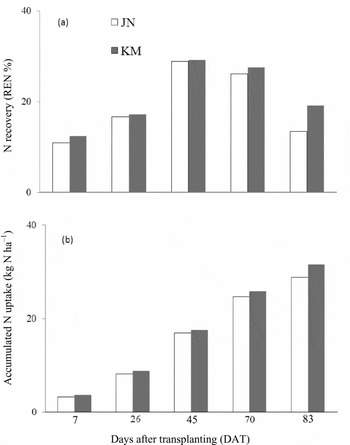
Topdressing treatments had significant (p < 0.001) effects on NDFF total (straw + grain) with the highest N accumulation at 45 DAT (8.71 kg N ha−1) and 70 DAT (8.04 kg N ha−1) of the 30 N split (Figure 1b), an increase of 148% and 129%, respectively, compared to the least effective 7 DAT split. Summed over five topdressing timings, KM took up 31.6 kg N ha−1 of the applied 150 kg N ha−1 applied, more than 10% compared to JN (28.8 kg N ha−1) (Figure 1b), but not significantly different. Averaged across topdressing treatments, REN% in KM was 21% compared to 19% in JN with no significant differences between the cultivars (Figure 1a). However, topdressing treatments has significant effects (p < 0.001) on REN% with the maximum N uptake recorded at active tillering 45 DAT (29%) followed by panicle initiation (27%). Across the cultivars, the least REN% was recorded at transplanting (7 DAT) as low as 12% of the applied 30 N with successive increase at tillering initiation (26 DAT) and peaking at active tillering (45 DAT), and panicle initiation (70 DAT), followed by decrease at flowering (83 DAT) (Table 3) (Figure 1a). Hence, the highest recovery of the N input can be achieved at 45–70 DAT and be treated as the most effective timings for the rice cultivation domain in the experimental sites.
(a) Nitrogen recovery (REN %) and (b) cumulative N uptake; NDFF total (NDFF grain + NDFF straw) in kg ha−1 over five topdressing regimes from 7–83 days after transplanting (DAT) coinciding with the critical growth stages of Janam (JN) and Khangma Maap (KM) cultivars in Bhutan Highlands.

N utilization efficiency
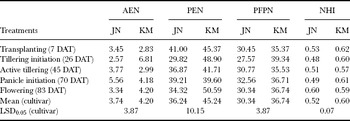
The cultivars had significant effects on Physiological efficiency in N (PEN), Partial factor productivity in N (PFPN) and nitrogen harvest index (NHI) whereas there was no topdressing treatment effects (Table 4). Agronomic efficiency in N use (AEN) (kg grain kg−1 N applied) were not different in JN and KM and ranged between 2.57–3.77 and 2.83–6.81 kg grain kg−1 N applied, respectively (Table 4). PEN (kg grain kg−1 N uptake) deviation was significantly (p ≤ 0.07) different between the cultivars with KM producing more than 9 kg grain kg−1 N uptake compared to JN, exhibiting higher N physiological efficiency of KM compared to JN. PFPN (kg grain kg−1 soil + applied N) differed significantly between the cultivars (p ≤ 0.01), with KM cultivar producing 6 kg more grain kg−1 N available than the JN. Similarly, NHI (proportion of grain N to total TDMN) differed between the cultivars (p ≤ 0.03), with KM allocating more than 8% higher N to the grain than JN. Hence, selection of cultivar with high N utilization efficiency can be evaluated by assessing PEN, PFPN and NHI, which were consistently higher in KM, contributing to higher grain yield with comparable TDMN content.
Agronomic efficiency in N (AEN; kg grain kg−1 N applied), physiological efficiency in N use (PEN; kg grain kg−1 N uptake), partial factor productivity in N use (PFPN; kg grain kg−1 soil + applied N) and N harvest index (NHI) in Khangma Maap (KM) and Janam (JN) rice cultivars topdressed with 150 kg N ha−1 in 5-splits of 30 kg N ha−1 each, at different phenological crop stages (7–83 DAT) in Western Bhutan.

DISCUSSION
Grain yield and GHI
According to the household agricultural production census carried out by Ministry of Agriculture in Bhutan, the average yields reported for rice at the trial site were 3.8 Mg ha−1 (MOA, 2001) and 4.23 Mg ha−1 (MOA, 2004), conforming to the yield levels reported in this study. Genotypic differences in N response have been widely reported between the traditional (JN) and improved (KM) cultivars (Atlin et al., Reference Atlin, Lafitte, Tao, Laza, Amante and Courtois2006; Romyen et al., Reference Romyen, Hanviriyapant, Rajatasereekul, Khunthasuvon, Fukai, Basnayake and Skulkhu1998; Saito et al., Reference Saito, Linquist, Atline, Phanthaboon, Shiraiwa and Horie2006). Higher grain yields in KM are attributed to comparatively high GHI in improved cultivars (Saito et al., Reference Saito, Linquist, Atline, Phanthaboon, Shiraiwa and Horie2006). GHI attained in the traditional cultivar JN (0.24–0.37) and the improved cultivar KM (0.31–0.40) were in the same range as reported in Northern Laos (Saito et al., Reference Saito, Atlin, Linquist, Phanthaboon, Shiraiwa and Horie2007) but low compared to higher GHI (0.50) observed in high-yielding lowland rice (Inthapanya et al., Reference Inthapanya, Sipaseuth, Sihavong, Sihathep, Chanphengsay, Fukai and Basnayake2000). However, in highland smallholder mixed farming systems, where crops and livestock are highly integrated, straw yield is highly valued for use as cattle feed and so straw production is as important as grain yield. Hence, both straw and grain yield need to be considered when screening cultivars for cultivation in such mixed farming production system.
Uptake of the supplied N
The timing of topdressing (7–83 DAT) had significant effects on NDFF with 148% higher NDFF total (grain + straw) recorded with topdressing at 45 DAT at active tillering stage compared with least effective topdressing at transplanting (7 DAT) (Figure 1b). Lower NDFF uptake during the early phase of vegetative growth (transplanting and tillering initiation) can be due to greater availability of soil N at the beginning of the monsoon period. The other possible reasons could be the lower requirement for N during the early establishment phase of the seedlings (Peng and Cassman, Reference Peng and Cassman1998; Zhang et al., Reference Zhang, Fan, Zhang, Wang, Huang and Shen2007) or due to fulfilment of N requirement by indigenous soil N supply at the early seedling stage (Xue and Yang, Reference Xue and Yang2008). Similar to early vegetative phase, lower NDFF during the flowering stage (83 DAT) could be due to limited sink in the developing spikelets in the panicle, which are already determined by the time of panicle initiation. Also, in the reproductive phase, N requirement is mostly met by re-translocation from the vegetative parts like leaves and shoots to the developing grain. Hence, the lower NDFF at flowering stage can be both due to lower sink in the developing spikelet and re-translocation of N from other vegetative plant parts.
N use efficiency
AEN use reported in this study (Table 4) are lower compared to high-yielding lowland rice production system (10.3–15) (Dobermann et al., Reference Dobermann, Witt, Dawe, Abdulrachman, Gines, Nagarajan, Satawathananont, Son, Tan, Wang, Chien, Thoa, Phung, Stalin, Muthukrishnan, Ravi, Babu, Chatuporn, Kongchum, Sookthongsa, Sun, Fu, Simbahan and Adviento2008), but in the same range as rice–wheat system in Punjab, India (4.3–14.7) (Yadav, Reference Yadav2003) and Nepal (6.4–11) (Adhikari et al., Reference Adhikari, Bronson, Panuallah, Regmi, Saha, Dobermann, Olk, Hobbs and Pasuquin1999). Higher AEN values in improved (11.6 kg grain kg−1 N) compared to traditional cultivars (2.3 kg grain kg−1 N) have been reported (Saito et al., Reference Saito, Linquist, Atline, Phanthaboon, Shiraiwa and Horie2006), and there was comparable trend in our study with higher AEN in improved compared to the traditional but with no significant differences at p = 0.05. Higher AEN in the improved cultivar, reported in this study, is in consonance with a previous field study with the same cultivar but at lower fertilization rates of 60 kg N ha−1study in Bhutan (Ghaley and Christiansen, Reference Ghaley and Christiansen2010). In lowland rice, higher AEN values ranging from 22 to 37 kg grain kg−1 N have been reported in improved cultivars (Singh et al., Reference Singh, Ladha, Castillo, Punzalan, Tirol-Padre and Duqueza1998). The relatively low AEN values in our study, could be both due to high fertilizer dose (150 N) applied and high soil fertility levels, resulting in low uptake of applied N. The improved cultivar exhibited higher PEN (45.24 kg grain kg−1 N uptake) producing more grain by 9 kg grain kg−1 N uptake compared to the traditional (36.24 kg grain kg−1 N uptake) due to higher physiological N conversion efficiency into grain. Compared to our PEN values, equivalent values of 36.3–37.2 kg grain kg−1 N uptake were reported from 8 country sites spread across 179 farmers fields of irrigated rice productions systems in Asia (Dobermann et al., Reference Dobermann, Witt, Dawe, Abdulrachman, Gines, Nagarajan, Satawathananont, Son, Tan, Wang, Chien, Thoa, Phung, Stalin, Muthukrishnan, Ravi, Babu, Chatuporn, Kongchum, Sookthongsa, Sun, Fu, Simbahan and Adviento2008) and from field studies (44–59 kg grain kg−1 N uptake) in Mali, Burkino Faso and Senegal (Wopereis et al., Reference Wopereis, Donovan, Nebie, Guindo and N'Diaye1999) but higher PEN values of 56–58 kg grain kg−1 N uptake were reported in rice in rice–wheat system in Nepal (Adhikari et al., Reference Adhikari, Bronson, Panuallah, Regmi, Saha, Dobermann, Olk, Hobbs and Pasuquin1999). Hence, the range of PEN values in our study are typical of irrigated transplanted rice production systems.
Partial factor productivity of N (kg grain kg−1 soil + applied N) is an integrative measure to assess N use efficiency. The range of PFPN (30.3–36.7 kg grain kg−1 soil + applied N) in the current study is lower than PFPN values (49.2–52.2) reported from the 179 farmer fields spread over 8 country sites (Dobermann et al., Reference Dobermann, Witt, Dawe, Abdulrachman, Gines, Nagarajan, Satawathananont, Son, Tan, Wang, Chien, Thoa, Phung, Stalin, Muthukrishnan, Ravi, Babu, Chatuporn, Kongchum, Sookthongsa, Sun, Fu, Simbahan and Adviento2008) and PFPN values (45–61 kg grain kg−1 soil + applied N) from another study in farmers’ fields in five rice producing countries in Asia (Olk et al., Reference Olk, Cassman, Simbahan, Cruz, Abdulrachman, Nagarajan, Tan and Satawathananont1999). The lower PFPN values in our study can be attributed to the relatively high fertility status of the paddy fields in the experimental sites resulting in low response to the applied N. NHI (proportion of grain N to total TDMN) was significantly higher in the improved cultivar (Table 4) and the NHI range (0.48–0.62) and cultivar differences reported in our study is in line with findings reported from other studies (Samonte et al., Reference Samonte, Wilson, Medley, Pinson, McClung and Lales2006; Ying et al., Reference Ying, Peng, Yang, Zhou, Visperas and Cassman1998).
Soil N supplying capacity
With high soil organic matter available and conducive C:N ratio for N mineralization in the experimental site, the relatively high soil N supply can be attributed to the warm monsoonal climate during paddy growth, conducive for N mineralization (Adhikari et al., Reference Adhikari, Bronson, Panuallah, Regmi, Saha, Dobermann, Olk, Hobbs and Pasuquin1999). The annual application of FYM maintains the supply of organic matter to support relatively high grain yield levels. Hence, nitrogen derived from soil constituted 75–77% of TDMN (93.9–94.9 kg N ha−1) corresponding with the results from field studies in 179 sites over 2 years in eight key rice domains in Asia (Dobermann et al., Reference Dobermann, Witt, Dawe, Abdulrachman, Gines, Nagarajan, Satawathananont, Son, Tan, Wang, Chien, Thoa, Phung, Stalin, Muthukrishnan, Ravi, Babu, Chatuporn, Kongchum, Sookthongsa, Sun, Fu, Simbahan and Adviento2002). In transplanted rice, NDFS comprises N flux from the soil N mineralization, N2 fixation and negligible quantities through irrigation water and atmospheric deposits (Cassman et al., Reference Cassman, Dobermann, Cruz, Gines, Samson, Descalsota, Alcantara, Dizon and Olk1996b). Due to ample quantities of FYM available, N contribution from N2 fixation could have been substantial in the range of 28–51 kg N ha−1 per crop cycle due to availability of food sources (FYM) for microbial activity (Roper and Ladha, Reference Roper and Ladha1995). Having accounted for N2 fixation, the remaining soil N must have come from mineralization of FYM, contributing to the rest of the soil N reflected in TDMN. The significant effect of FYM in supplying N to the crops have been reported, in several studies including a study in Bhutan (Chettri et al., Reference Chettri, Ghimiray and Floyd2003; Ghosh and Sharma, Reference Ghosh and Sharma1999; Satyanarayana et al., Reference Satyanarayana, Prasad, Murthy and Boote2002) due to ‘priming effect’ or added nitrogen interaction (ANI) (Azam Reference Azam1990; Ghosh and Sharma Reference Ghosh and Sharma1999; Jenkinson et al., Reference Jenkinson, Fox and Rayner1985) effect. Hence, FYM input plays an important role in supplying soil N for crop production.
Quantification of REN
REN values can be influenced by timing of N fertilizer, indigenous N supply, topography and method of estimation. The wide REN range in the present study (12–29%, Figure 1a) at different topdressing timing indicated the importance of timing of N supply with crop N requirement. The overall low REN can be attributed to the increasing availability of N from indigenous sources, as reported in rice field studies in the Philippines and Bangladesh (Cassman et al., Reference Cassman, Gines, Dizon, Samson and Alcantara1996c; Hossain et al., Reference Hossain, White, Elahi, Sultana, Choudhury, Alam, Rother and Gaunt2005) as well as to the terraced fields in highlands, prone to N losses due to downhill gradient flow. The N difference method has a tendency to provide a higher estimate of REN than the 15N tracer method in irrigated rice (Bronson et al., Reference Bronson, Hussain, Pasuquin and Ladha2000). In our study, REN by the difference method was higher by 25–30% (data not shown) than REN based on 15N dilution method. The differences are attributed to ANI effect, which may be real or apparent (Bronson et al., Reference Bronson, Hussain, Pasuquin and Ladha2000; Rao et al., Reference Rao, Smith, Papendick and Parr1991). A real ANI may arise due to greater mineralization of soil N following the application of N fertilizer, resulting in greater soil exploration by plant roots and enhanced uptake of unlabelled N in fertilized plots while an apparent ANI may arise as a result of pool substitution due to uptake of N mineralized from previous inputs of FYM. Both of these mechanisms could dilute the applied 15N and cause underestimation of the uptake of applied fertilizer N, which could explain the higher fertilizer uptake estimation by N difference method. The strength of the 15N labelling scheme in this study is that N uptake in each topdressing treatments were estimated under similar crop growth conditions and reflected the actual N uptake in field conditions at different phenological crop stages.
CONCLUSIONS
The experimental sites were relatively fertile supporting grain yields in the range 4–6 tons ha−1 due to incorporation of FYM on an annual basis, providing both macro- and micronutrients for the rice crop. Although the TDMN was not significantly different between the cultivars, the improved cultivar yielded significantly more grain compared with the traditional rice variety due to higher GHI, physiological efficiency of N use and higher NHI. Hence, the wider adoption use of improved cultivars may enhance rice yields without the need for greater N inputs. The relatively low REN values indicated that the paddies are fertile and so the external N input may only be suggested to meet the nutrient gap between the soil supply and the yield target. Such a strategy will not only help reduce the N losses, a costly input for the subsistence farmers but reduce the off-farm environmental effects like eutrophication of rivers and streams. Nitrogen application at 45 DAT resulted in highest REN% of 29% compared to 7 DAT, indicating that the topdressing at 45 DAT (active tillering) coincided with the maximum crop N demand. The second dose, if applied, can be targeted at panicle initiation (70 DAT) as high uptake of 27% was recorded across the cultivars. To make the best use of both fertilizer and soil-derived N, the fertilizer N recommendations for rice farmers in the Bhutan highlands should take account of previous inputs of FYM, improved cultivars and the timing of maximum crop N demand.
Acknowledgements
The author gratefully acknowledges the financial assistance by the Consultative Research Committee for Development Research/Danish International Development Agency, under the Ministry of Foreign Affairs in Denmark. The study would not have been possible without the help of Dr. Lungten Norbu, Mr. Padam Lal Giri, Hema Devi Nirola and Kalpana Rai, who provided much-needed assistance in terms of planning and implementing the field activities at the experimental site at Khasadrapchu in Thimphu in Western Bhutan. Thanks are due to Mrs. Marie Bøcker Pedersen for supporting my long hours of work at home and my lovely two kids, Miss Ida Ghaley Pedersen and Jonas Ghaley Pedersen for providing me moral support during the writing of the script. Contributions from the anonymous reviewers are acknowledged for their significant contributions in improving the scientific content of the manuscript.