Introduction
Research on women's work has attempted to analyse why the labour market is segregated in a gendered fashion.Footnote 1 These studies have shown how the interplay of market and patriarchy leads women and men to perform different economic roles in society. This segregation on the basis of gender, or the sex-typing of work, plays an important role from both the demand and supply sides in determining the work profiles of women and girl children. Studies on women's work in the British Indian province of Bengal show how the job market became more segregated on the basis of gender because of colonial economic policies.Footnote 2 This study attempts to show how a particular labour market (domestic service) became segregated by gender and age in post-partition West Bengal, and mainly in its capital city Calcutta.
The emancipating social implications of the ‘coming out’ of the bhadramahila (gentlewoman), the development of her agency, in late colonial and post-partition Calcutta have been discussed in a number of studies.Footnote 3 The toils and struggles of working middle class women whilst adjusting to their new role have also attracted the attention of a generation of film directors, including Ritwik Ghatak and Satyajit Ray,Footnote 4 as well as novelists and short-story writers.Footnote 5 In contrast, poorer women, the domestic maids or the petty traders struggling desperately to survive in post-partition Calcutta (though many more in number than working, middle class women), have failed to attract much academic or popular attention. However, a study of uprooted, single, migrant women from across the border who slaved in city homes, often receiving in return only food and shelter, reveals a different and much bleaker picture for women in domestic service in post-partition Calcutta.Footnote 6
Although the importance of domestic service declined with the advancement of industrialization in developed parts of the world,Footnote 7 the experience in developing countries was different. In India, for example, the importance of domestic service in urban women's work has been continuing or even increasing during its last 50 years of industrialization. Of the 15 major states in India, West Bengal has one of the highest rates of domestic service since colonial times. Some studies give a few passing referencesFootnote 8 regarding the changing profile of domestic service in colonial Bengal. Recent research is focused on the construction of employer-domestic relationships before independence.Footnote 9
A brief survey of the available literature on women's work in colonial Bengal highlights two important points. First, and as the censuses in the colonial period confirm, the rate of women's participation in the work force was traditionally much lower in Bengal than in other parts of the country. Second, the avenues of women's work in this region shrank between 1881 and 1931 as a result of the introduction of the ‘limited version’ of modernization in industry.Footnote 10 Unlike in other parts of the country, cultivation absorbed only a small section of women in colonial Bengal. Traditional household industries and modern industries such as jute, tea and coal mining were the main employers of women. With changes in production processes and the decline of traditional crafts, women lost their household jobs. New factory laws barred them from the coal mines. The jute industry, which had nearly 20 per cent women amongst its labour force by the turn of the nineteenth century, started to employ single, male, upcountry migrants in the place of local men and women.Footnote 11 It is interesting to note that during the same period in Bengal there was a growing social attitude towards women working outside the home.Footnote 12 This attitude was part of the middle class nationalist construction of the public-private dichotomy during that period.Footnote 13 Whilst the bhadralok (gentlemanly) ideology of glorifying the housewife also affected the lower classes,Footnote 14 working women tended to concentrate on paid domestic service since this was seen as an extension of a woman's traditional role in society.Footnote 15 Thus domestic service emerged as one of the very few available, and acceptable, areas where poor women could replace men in Bengal towards the closing decades of colonial rule. However, the incidence of educated middle class women's participation in paid work in the so-called ‘respectable’ jobs, increased after the Second World War.
The overwhelming importance of domestic service, particularly in urban women's work, continued in post-independence West Bengal, although for the first two decades men dominated women in domestic service by claiming an almost 60 per cent share of the work in urban West Bengal until 1971. However, the scenario changed during the next ten years, and women in service outnumbered men in the urban areas for the first time in 1981.Footnote 16 More importantly, in the same year there was a significant rise in girl children in domestic service below the age of 14. This paper argues that the three decades after independence were crucial in shaping domestic service as a strongly feminized area of work with a large-scale presence of girl children working in the urban areas. The high rate of participation by very young girls in paid work, in a state which historically has a low female work participation rate, has made the case unique. Specifically, this paper will try to evaluate the problem in the context of the partition of India in 1947, followed by the industrial stagnation of West Bengal post independence.
As mentioned above, the downward trend in industrial job opportunities in post independent West Bengal mainly due to sluggish investment, accompanied by the large scale immigration of men, women and children from East Pakistan (now Bangladesh), led to an unprecedented increase in labour force, and this ‘glut’ of workers led to a decline in the wage rate. The situation was exacerbated by poor refugee women who, by offering to work for a very low wage and often for no wage at all in order to survive, gradually drove out the males of the host population from this sector. These poor males from the neighbouring states of Bihar, Orissa and the United Provinces had historically made up a substantial section of the Calcutta labour market, many of whom had been employed as domestic workers in a state known for its desire for domestic servants in colonial India. The replacement of male domestic staff by females was further facilitated by the gradual decline in inter-state migration due to the lack of employment opportunities in independent West Bengal. The second stage in the changing profile of domestic service in urban West Bengal was arguably set by migrating girl children to Calcutta city in search of employment between 1971 and 1981.
The period of analysis in this paper spans the years 1951 to 1981. However, there are occasional references to more recent findings. The secondary data sources used include the Census of India and the National Sample Survey. Reports of primary surveys conducted by others have also been used. Apart from these familiar secondary sources, the paper has drawn heavily on contemporary newspaper insertions and reports and also on contemporary autobiographies and memoirs. Fictional writings of the period have also helped enrich our understanding of the society and the psyche of the period and the people concerned.
As domestic service is primarily an urban feature, and much of West Bengal's urbanization is still concentrated in the state capital, this discussion will mainly focus on the city of Calcutta. Furthermore, the reference point of the newspaper insertions and short stories and memoirs is also Calcutta. However, it has to be noted that during the period under discussion the actual geography of the ever-expanding city changed significantly. Consequently, the areas of enumeration covered by the decennial censuses on which this discussion depends differ in different years.Footnote 17
The paper has four sections. The following section documents the dominance of migrant males mainly from Bihar, Orissa and the United Provinces, employed in domestic service in the early decades of twentieth-century Calcutta. These men were gradually replaced by poor refugee women, frantically searching for jobs from the late 1940s. The next section attempts to explain this feminization of domestic service in Calcutta in the years immediately following partition. Then the case is made regarding the intra-state migration of women, and particularly of girl children who played an important role as domestic workers in Calcutta from the 1970s. The final section focuses on the grave social implications of the increasing incidence of girl children in domestic service.
Driven out of the mills? The case of migrant male domestic workers
These days people—pot-bellied gluttons in tattered clothes, from the districts of Munghyr and Gaya—have been crowding in Calcutta in search of jobs. They have either been driven out of jobs from the jute mills or have strayed from the tea gardens. Such people are utterly stupid having a gluttonous appetite and are apt in sleeping for long hours. To keep them [in domestic service] tantamounts to make camels read the scriptures.Footnote 18
This quotation from his manual for housewives, Pratapchandra Majumder (1840–1905), a close associate of Keshabchandra Sen, who was also one of the founder members of the Nababidhan Brahmo Samaj, expresses his strong displeasure at the practice of hiring up-country male domestic staff in middle class Bengali homes. Whilst advising Bengali housewives to treat their domestic workers with care, he excluded one particular group, the Hindi-speaking migrants, whom he felt could hardly be trusted with any responsibility. However, the urban middle class in contemporary Bengal did not share this opinion. There is substantial evidence to suggest that migrants from neighbouring states were very often employed in middle class Bengali homes during the first few decades of the twentieth century.
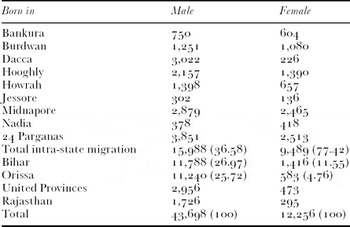
It has been noted that Calcutta, the centre of colonial trade and also the seat of colonial administration until 1911, had the dubious distinction of being the only attractive destination for migration from three utterly impoverished zones: Orissa, Bihar and eastern United Provinces. It is not surprising, therefore, that the overwhelming majority of workers in the jute mills came from these areas.Footnote 19 Those who were not absorbed by the factories ended up on the lower rungs of the unorganized sector, many of them as domestic workers (see Table 1). Majumder was possibly referring to these particular up-country males, who were unable to secure employment in the mills, or failed, even when offered factory employment, to keep their jobs. By 1931 Calcutta and the adjoining district of the 24 Parganas had around four lakhs of migrants who accounted for 31 per cent of the city population.Footnote 20
Migrant domestic workers in Calcutta in 1921 by their place of birth

Note: Percentages are given in parentheses.
Source: Haraprasad Chattopadhyaya, Internal Migration in India: A Case Study of Bengal, Calcutta, K. P. Bagchi and Co., Kolkata, 1987 pp. 424–425.
Domestic service was in fact quite prevalent in colonial Bengal, which was the first among the colonized Indian provinces to embrace English education and the Victorian way of life. Popular literary sources from the last quarter of the nineteenth century described servant culture in ordinary middle class Bengali homes as an ‘intrusion of foreign/British elements’.Footnote 21 The social reform movement in nineteenth-century Bengal, which centrally involved remodelling the traditional Bengali home, also enthusiastically propagated the Victorian model of companionate marriage.Footnote 22 Companionate marriage could be successful if the bhadramahila could be partly relieved of the burdens of housework by providing her with paid help. Help for housewives was also a mark of status.Footnote 23 According to the 1911 Census, domestic service accounted for 12 per cent of all occupations in Calcutta, while Bombay, Madras and Delhi showed 7.3 per cent, 6.68 per cent and 6.1 per cent respectively.Footnote 24
The 1921 Census shows (see Table 1) that a significant number of domestic workers came to the city from the neighbouring states of Bihar, Orissa and the United Provinces. While the total number of migrant male domestic workers coming to Calcutta from the districts of Bengal in 1921 was 15,988 (around 37 per cent), Bihar and Orissa supplied 11,788 (27 per cent) and 11,240 (around 26 per cent) respectively. A single district of Orissa, Cuttack, supplied around 9,000 male domestic workers to Calcutta in 1921. Not unexpectedly, contemporary autobiographies and memoirs make abundant reference to Bihari servants and Oriya cooks. Premankur Atarthi, (1890–1964), a notable writer, has observed in his memoir, Mahasthabir Jatak (Reminiscences of the Mahasthabir), that during his childhood days (the last decade of the nineteenth century) almost every Bengali middle class family in Calcutta had a servant who came from Bihar.Footnote 25 Many Oriya cooks are also found working in establishments known as ‘the mess’, where migrant working men and students lived and dined together.Footnote 26
Unlike male servants, female servants (maids) came mostly from within Bengal, though some came from Bihar also (see Table 1). Satyajit Ray (1921–1992) and Hirendranath Mukhopadhyay (1907–2004) both remembered household Bihari maids of their childhood days in Calcutta in the early decades of the twentieth century.Footnote 27 Evidence from other memoirs of the day, however, suggests the prevalence of part-time Bengali maids in Calcutta middle class households.Footnote 28 Bengali maids are also depicted as important characters in contemporary Bengali fiction.Footnote 29
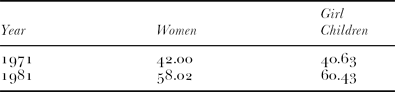
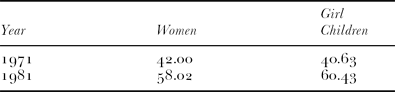
Scholars have observed on the basis of Census data that the absolute number of domestic workers in the British districts workers of Bengal almost doubled between 1921 and 1931, and in those ten years the number of female workers rose from 26 per cent to 52 per cent.Footnote 30 However, the reported outnumbering of men by women in domestic service in Bengal in the 1931 Census seems to have been reversed in later censuses conducted after independence.Footnote 31 Though domestic service continued to be the largest area of urban women's work, women were around 42 per cent of the total domestic staff even in 1971 in urban West Bengal. According to Census data, in Calcutta city, known for its historically poor sex ratio, the percentage of women was even less. In 1981 the share of women finally surpassed that of men in domestic service in urban West Bengal, a trend which not only continued but was intensified in 1991. This outnumbering was particularly significant in the youngest age group (0–14) years (see Table 4).
In search of a ‘home’: the refugee women domestic workers
Wanted a middle aged female in an elite family for household chores. Food, shelter along with a monthly salary of Rs 15/- offered. Refugees will be preferred.Footnote 32
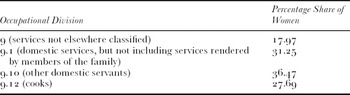
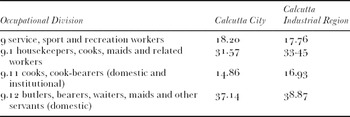
In one year, between January 1956 and December 1957, one of West Bengal's largest circulated Bangla dailies, Jugantar, carried about 150 advertisements in the situations vacant column for domestic workers and cooks, among which more than 75 per cent asked for women applicants, mostly middle-aged, single, and in search of shelter. This upward trend continued for the next 20 years: between January 1976 and December 1977, the Ananda Bazar Patrika, another Bangla daily also with a large readership, carried about 100 similar advertisements, of which almost 90 per cent asked for women applicants. However, the urban middle class possibly tended to employ domestic workers through social networks rather than through advertisements, so the newspaper data should perhaps be read as examples of new social trend. This upward trend in favour of women domestic staff is also evident from the Census data (Tables 2, 3, 4).
Percentage share of women in domestic service among all workers in the group in the Calcutta industrial region in 1951

Source: Census of India, 1951, Vol.V1, Part 1V, The Calcutta Industrial Region Tables.
Percentage share of women in domestic service among all workers in the group in Calcutta city and Calcutta industrial region in 1961

Source: Census of India, 1961, Vol. XV1 West Bengal and Sikkim Part X-A, Tables on the Calcutta Industrial Region Book (ii).
Percentage share of women and girl children (0–14) years in domestic service in urban West Bengal in 1971 and 1981
Source: Census of India 1971, Series 22 West Bengal Part 11-B (iii), General Economic Tables, and Census of India 1981, Series 22 West Bengal Part-111 A and B (iii), General Economic Tables.
Data on domestic service in West Bengal provided by the first two consecutive censuses after independence in 1951 and 1961 are not exactly comparable because of the differences in the definition of domestic service and the area of enumeration. However, a close look at Tables 2 and 3 suggests an increase in the female share in the categories related to domestic service. The data provided by the 1971 and 1981 censuses (Table 4) are more compatible and, over the ten-year period, clearly show an increase in the percentage share of both women and girl children in domestic service in urban West Bengal.
In order to understand this changing profile of domestic service in the state, the changing economic scenario in general in urban West Bengal during the initial decades of independence needs examination. During this time the province, and particularly its capital city Calcutta, saw one of the largest movements of people in history. In the 1930s most of the industries in Bengal, once an industrially advanced state, were in recession, and net investment by companies controlling them had slowed down or ceased altogether. After the war, along with independence came the dislocations of partition that severely affected trade links between East and West Bengal. As a result, there was a major decline in production of jute and tea, the two most important industries in the region. After independence, the central government policies of freight equalization for coal and steel, and emphasis on import-substitution, dealt a further heavy blow to Bengal's industry.Footnote 33 This was aggravated by the confrontationist strategy on the part of the state—followed since the beginning of Congress rule and carried on by the Left Front Government—which prevented it from lobbying pragmatically to obtain licenses and industrial investment.Footnote 34 Further obstacles to industrial resurgence were the forming of a radical trade union movement, backed by leftist intellectual support, and by central government ceasing to invest in the infrastructure sector in the mid-1960s, which adversely affected West Bengal's engineering industry and precipitated large scale unemployment in formal manufacturing in the state.
Industrial stagnation, and the consequent downward trend in job opportunities during the late 1940s and early 1950s, was accompanied by large scale immigration from bordering East Pakistan, now Bangladesh. Millions of men, women and children entered West Bengal between late 1946 and early 1971.Footnote 35 This influx of refugees caused an unprecedented increase in the labour force during these years of stagnant investment. Most workers naturally concentrated in and around Calcutta which provided some hope of a livelihood. The novel presence of women and children amongst the labour force was significant, as prior to the 1940s migrant labour to the city consisted mainly of single males from neighbouring states. Partition made the real difference in the female-male ratio as, according to census data, there were 580 women per 1,000 men in Calcutta in 1951 as against 456 women per 1,000 men in 1941. The female-male ratio further improved in favour of women (612) in 1961. In urban West Bengal the ratio moved even more in favour of women during the post-partition years. From the 554 women per 1,000 men in 1941, this increased to 657 women per 1,000 men in 1951, and again to 701 women per 1,000 men in 1961.
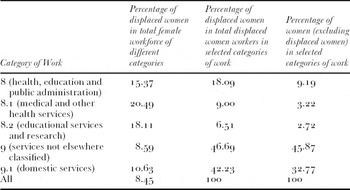
As only a small fraction of the refugees were rehabilitated by government funds, most struggled to settle by their own efforts. In an already over-populated job market wages were generally low amongst the poorly paid unorganized labour force. So in order to survive the entire family had to work. This was particularly true for the slum dwellers but also included a significant number of middle class refugees. In fact, compared with the women of the host population, the incidence of refugee women joining paid work was already significantly higher in most of the categories in 1951 (Table 5).
Employment behaviour of the displaced and the host women in Calcutta industrial region in 1951

Source: Census of India 1951, Vol. V1 Part 1V, The Calcutta Industrial Region Tables.
The data of the 1951 census shows that a substantial percentage of ‘displaced’ women (18 per cent) obtained employment in the upper levels of the services sector which included health, education and public administration, with similarly only 9 per cent for the host population. So from as early as 1951 more than 15 per cent of these jobs (taking into account the total volume of women's work in Urban West Bengal) were taken up by refugee women. Most refugee women, however, were employed in the lower rungs of the services sector as domestic workers (42 per cent), with 33 per cent taken up by the host population. A significant number of refugee women were also employed in the retail and petty trade.
The gradual increase in the percentage share of female domestic staff from 1951 onwards, and the final outnumbering of men by women in 1981, can partly be explained by the high influx of female workers to the city during the three decades under discussion. However, the question remains how refugee women could replace men in a historically male-dominated job, a domain largely constituted of single, male migrants from Bihar, Orissa and the United Provinces. Even the 1961 Census shows that of the total volume of male domestic workers in urban Calcutta, more than 75 per cent were migrants (see Table 8).
Census data suggests therefore that the refugee women must have replaced the migrant male domestic workers from the neighbouring states in substantial numbers and that this was made possible by their settling for a low wage. The up-country migrant males had come to the city alone, leaving their families behind in rural homes. Therefore, compared with the poorest section of the destitute refugee women, the migrant males had a better fall-back position and had more responsibilities. Arguably they had to send some money home from whatever small amount they received as wages.Footnote 36 The refugee women, on the other hand, in their frantic search for a means to survive were often able and ready to work for a lower wage than were the migrant males. Often destitute and in search of a safe shelter, sometimes they offered to work in return for food and accommodation only.
The particular emphasis in newspaper advertisements on employing widowed women or destitute women (nihshai (helpless) nirjhanjhat (unencumbered) anatha (destitute)) as the preferred domestic workers, requires further explanation. Among the displaced population a significant number were single women or women with children not accompanied by an adult male member of the family. They were shifted to various camps after their arrival and contemporary reports indicate that women from all levels of society, including college girls and illiterate rural women, lived in appalling conditions. There was an acute shortage of accommodation in the camps, and floating barges were also rented to provide shelter.Footnote 37 Finding shelter was a great problem for a large proportion of newcomers who had no previous roots in the city. Even educated migrant young men advertised in newspapers offering tuition to children in well-to-do families in post-partition Calcutta, in return for food and shelter. These advertisements were published in newspaper columns under the heading ‘ahar o basathan chai’ (food and shelter sought) often mentioning that the applicants were from the other side of Bengal.Footnote 38 Some newspaper advertisements preferred middle-aged, destitute widows as full-time domestic staff and cooks, and offered ‘food and shelter’ followed by a ‘meagre salary’, evidently an order of priority. Some even substituted the word ‘salary’ with ‘pocket money’, indicating the lesser importance of money compared with the employers’ assurances of secure and possibly permanent shelter.Footnote 39 Some formulated the insertion as ‘food, shelter and some salary will be given also’ (khawa thaka o betan-o dewa hoibe).Footnote 40 Others invited women to work for ‘food and shelter only’ declaring the employers’ inability to offer any wage at allFootnote 41 or a meagre amount of rupees 1 or 2 as ‘pocket money’.Footnote 42 Moreover some employers preferred children, particularly girl children, as full-time domestic workers from as early as the 1950s.Footnote 43
The frequent advertisements for maids and cooks in newspapers suggest the salary structure and nature of work the domestic workers were expected to perform in Calcutta during the years immediately following partition. Most required full-time help. Part-time maids and others presumably gained employment through local networks. Full-time women domestic staff were generally expected to perform a wide range of combined activities ranging between washing, cooking, looking after children, and housekeeping. Most advertisements, however, did not specify the duties to be performed: ‘all types of household chores’, ‘cooking, etc.’, ‘cooking and household chores’ were the preferred phrases. A typical example is worded as follows:
Wanted an unencumbered lady to help in cooking and household chores for a small family. Shelter-less refugees will be preferred. Salary between rupees 10 and 15.Footnote 44
Salary for the activities mentioned above ranged from as low as rupees 7–8 and rupees 15 per month, along with food and shelter.Footnote 45 Some advertisers required women domestic workers and housekeepers who had ‘some education’: ‘Wanted a lady with some education to help running [sic] a small family. Salary according to ability’.Footnote 46 Some also wanted their cooks and domestic staff to be able to tutor their children and in such cases 5–10 rupees extra salary were offered.Footnote 47 However, in the few cases where advertisers wanted male applicants (only 15 cases in 1956 as compared with 150 insertions for female domestic staff in the same year published in Jugantar) the salary offered ranged between rupees 15 and rupees 25.Footnote 48 There was only one case where the advertiser preferred a boy domestic, and the salary offered was rupees 10.Footnote 49 Another striking difference was in the nature of duties to be performed by men and women in service. In the case of male domestic staff, advertisements usually specified the nature of jobs to be performed, for example, ‘wanted a male cook’ or ‘wanted a male domestic for cleaning and washing’.Footnote 50
The fact that women in general (some advertisements also mentioned a preference for female applicants from West Bengal),Footnote 51 and refugee women in particular, were increasingly employed in middle class homes in post-partition Calcutta because they could be hired at lower wages than men, does not seem to be the only reason behind the preference to employ females. The nature of jobs expected to be performed by full time female domestic staff, as described in the advertisements, indicates that they were taking over many of the household duties which traditionally had been performed by the employing middle class women themselves. This substitution was arguably necessary, at least to a certain extent, because in post 1947 Calcutta middle class women (many of whom were also refugees) increasingly took paid employment outside the home.Footnote 52 Thus some employers expected their domestic staff to work as nuclear family members—possibly because both husband and wife worked outside the home. A typical advertisement for this situation might read:
Wanted for a family of only husband and wife a female who would do household chores like a family member. Bed, board and pocket money offered.Footnote 53
This desperate search for a helping hand by a working couple in post partition Calcutta is reminiscent of a film made on a similar theme by Tapan Sinha in 1968 entitled, Apanjan (family member/someone close and intimate).
It is clear from the above discussion that partition, with its inevitable economic compulsions, simultaneously gendered two very different labour markets in post 1947 Calcutta by pulling out both the bhadramahila and her maid to join the paid work force. In the first case, though a very small section of middle class women actually worked outside the home, the bhadramahila could exercise some agency, an instance of which was to hire domestic help to carry out many of the duties of the housewife. It is also interesting to note that newspaper advertisements in the 1950s requesting full-time help with cooking, home management and childcare were often published in the names of women.Footnote 54 Furthermore, in spite of the fact that the number of poor working women was much larger than their middle class counterparts, and that the gendering of the lower rungs of the job market was more obvious, the desperate conditions in which poor women opted to work out of the home renders the question of the relationship between earning and agency, irrelevant. Things worsened with time when girl children began to swell the Calcutta labour market and made it even more gendered in the 1970s and 1980s.
Unlike the single, male migrants from neighbouring states, the refugees mostly immigrated as families. They had therefore families to support and compared with the family units of the host population the refugee families were often larger in size.Footnote 55 The refugee men competed well in the Calcutta job market but their wages were often not sufficient for a family of five or six members to survive. Around rupees 100 was considered to be a decent salary in Calcutta of the 1950s, though it was hardly enough to make two ends meet.Footnote 56 Displaced women therefore had to participate in the paid work force more frequently than women in the host population. Refugee families of middle-class origin could no longer stick to their traditionally antagonistic attitude towards women working out of the home. On the other hand they took special care to educate their daughters so that they might enter the job market with some qualification and gain employment in ‘respectable’ jobs. Scholars have pointed out the enormous struggle of the middle class refugee families to get themselves, and particularly their women, educated.Footnote 57 On the basis of government survey reports, Joya Chatterji has argued that the literacy rate of the refugee population in general, and of refugee women in particular, was not only significantly higher than their counterparts in the host population in the early 1950s, it was also increasing at a faster rate. In 1950 literacy rates of women refugees were four times higher than those of women in the host population. This shows that many were already literate or had some education at their time of immigration. According to Joya Chatterji, by 1955 there was a 60 per cent increase in the rate of literacy among refugee women.Footnote 58 Much of this struggle bore at least some fruits. It has already been noted in Table 5 that a substantial percentage (18 per cent) of displaced women succeeded in getting jobs in the upper levels of the services sector which included health, education and public administration as against 9 per cent in the case of the women in the host population. Consequently, as early as 1951 more than 15 per cent of these jobs (taking into account the total volume of women's work in urban West Bengal) were taken up by the women from the displaced population. The significant presence of literate and educated men and women among the destitute and frantically job-hunting population also lowered the value of education in the market. Men with college-level education were ready to offer tuition for bed and board.Footnote 59 Employers could expect their cooks also to act as tutor to their children, or could split the same pay between a cook and a tutor.Footnote 60
However, the social impact of women joining the ranks of professionals in increasing numbers was tremendous. As the self-settled, displaced population lived in clusters in and around the city of Calcutta the incidence of women seeking employment from a particular locality could be clearly identified. The working bhadramahila was thus an increasingly important phenomenon in urban West Bengal. However, in spite of the aversion of the bhadralok to women working outside the home (as referred to earlier), economic pressure following the Depression and the Second World War, had forced at least some of them to take up paid employmentFootnote 61 even before partition.
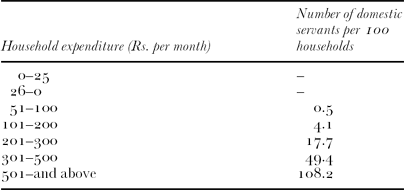
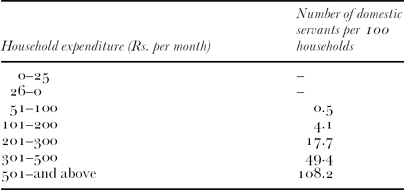
The figures in Table 6 hint at who were the employers of domestic workers in Calcutta during the early 1950s. In Calcutta city in 1953 the incidence of employing domestic workers, as expected, is most frequent in the highest expenditure class. It is likely that each of these households is employing at least one domestic worker and some of them more than one. However, it needs to be remembered that, although the incidence in employment is much lower in the lower expenditure classes, the two groups together generate a sizeable demand for the workers. Arguably most of the working bhadramahilas belonged to the expenditure classes from Rs. 100 a month upwards. It is worth noting that at least some families in the expenditure class of Rs. 51–100 a month also employed domestic staff.
Distribution of domestic servants per 100 households according to different expenditure classes in Calcutta city, 1953
Source: National Sample Survey, Report No. 17, Report on Sample Survey of Employment in Calcutta, 1953.
As noted above, the duties performed by the full time workers included cooking, other household chores, and often looking after the children. The nature of the duties implies that these might be performed in the absence of the housewife who went out to work outside the home. Short stories by Narendranath Mitra published during the late 1940s and the 1950s in the Bangla periodicals aptly portray middle class and lower middle class families (many of whom were immigrants) whose women were employed in paid work leaving their homes in the care of female domestic staff (for example, Abataranika (Sequel), later made into a classic film titled Mahanagar (The Big City) by Satyajit Ray).Footnote 62 In Abataranika we find the maid performing the wifely duties such as looking after the children and making the beds, a fact which the husband of the working wife accepts grudgingly. In many other short stories Mitra portrayed how maids and cooks (often full time) were becoming a necessity for those middle class families whose women went to work, and also how poor refugee women were often seen to cater to this new social need.Footnote 63 This ‘necessity’ has also been borne out by contemporary memoirs. Pramila Dutta, a refugee woman teaching in a school in post-partition Calcutta, in her memoir Phire Dekha Footnote 64 (Glancing Back), gratefully remembers how she had been able to go out to work leaving her child in the custody of a very responsible old maid. Thus the paid maid was emerging in a new social role of housekeeper-cum-caregiver in post 1947 Calcutta. This was a role which the male servants were not expected to perform. Housekeeping was introduced as a new category within Division 9 of the 1961 Census and showed some concentration of women in this sphere; and newspaper advertisements from the 1950s also reflect the social demand for women housekeepers. The gradual breakdown of traditional, joint families with a number of adult women, and the emergence of nuclear families composed of husband, wife and children, also point to the urban middle class preference for full-time female domestic workers.Footnote 65
Away from home: women and girl children domestic workers from within the state
Being unable to feed me anymore after thirteen years of marriage my husband, an agricultural labourer, asked me to go to the city and earn my living by working as a domestic there.Footnote 66
Refugee women were not the only competitors of the up-country males in the domestic job market in post independence Calcutta. Internally migrating female domestic workers, like Kalidasi, were also found to be numerous in Calcutta in the Census estimates of 1971. In 1974 a government reportFootnote 67 discussed the issues of women and girl children domestic workers in Calcutta, reporting that some women migrated on their own to the city for employment from the districts of West Bengal, and not as part of a migrant family. These women, often assisted by their very young daughters, are reported to have left their share cropper husbands at home to earn a living as domestic workers. This trend of ‘women only’ migration to meet the increasing preference for female domestic workers in the city was corroborated by a newspaper report based on a survey of city maids. The case of one of the respondents, Kalidasi, from the 24 Parganas has already been mentioned at the beginning of this section. Another, named Minati (cited in the same report), from the Sunderban area of the same district and 17 years of age is also reported to have migrated alone to work as a live-in domestic in the city.Footnote 68
Internal distress migration of men and women from the hinterlands to Calcutta city can, however, be traced way back to the waning years of colonialism. From the late 1920s and early 1930s Calcutta and its suburbs experienced the migration of poor labourers from rural Bengal. They, if fortunate, acquired jobs as domestic workers, but generally made a living as petty workers and beggars. Goswami (1990) points out that this type of migration was closely related to the earlier agrarian crisis in Bengal, which intensified during the years of the Depression from 1930 to 1938. This is also likely to have played an increasingly important role in feminizing domestic service. The 1921 Census shows that the main suppliers of female domestic workers to Calcutta city were the six districts of the 24 Parganas, Midnapore, Dacca, Hooghly, Howrah and Burdwan. Of the total 12,256 female migrant workers to Calcutta in 1921, 20.5 per cent came from the 24 Parganas and another 20.11 per cent from Midnapore. An interesting feature of the migrant workers from within Bengal in some districts was that the proportion of females was very close to that of males (see Table 1). indicating that women moved to find employment in comparable numbers with men when migration took place within short distances. With an increase in distance, however, the share of women migrants decreased.
This continuous process of rural-urban migration before partition reached its peak during the Bengal famine of 1943. Amongst the large numbers of starving people who migrated to Calcutta from rural areas in search of food, many were women and children.Footnote 69 Studies have shown that during the famine numerous women and children were abandoned by the earning male members of their family.Footnote 70 Migration related to rural dispossession following partition continued after independence but has not received due scholarly attention as research in the main has focussed on cross-border migration. The internally migrating destitute women must also have swelled the lower rungs of the economy, mostly as petty service workers such as domestic workers illustrated in Tables 2 and 3 by the recorded trend of increasing feminization of such services. Newspaper advertisements during the years immediately following partition for female domestic staff also indicate a distinct preference for women from within West Bengal, at least amongst a small section of advertisers alongside the obvious preference for refugee women.Footnote 71 The following is a typical example of advertisement in the ‘situations vacant’ column preferring a woman domestic from West Bengal:
Wanted a middle aged unencumbered female for household chores. Food, accommodation and a salary of rupees 8 to 10 offered. Only the residents of West Bengal need apply.Footnote 72
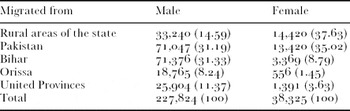
Table 7 reveals that in 1961, most of the migrant female service workers to Calcutta came from the rural districts of West Bengal, closely followed by Pakistan.Footnote 73 Male migration for service work, on the contrary, was still dominated significantly (more than 50 per cent) by the up-country male workers along with migrants from the neighbouring state of Orissa. The second largest supplier of male service workers was, of course, again Pakistan. Male migrants from within the state, absorbed in service work were meagre. Narrowing down the statistics further, domestic service as a category was mainly the domain of migrants in 1961 Calcutta (see Table 8). Furthermore, by combining the figures in Tables 7 and 8, it can be argued that it was the up-country male migrants on the one hand and female migrants from the rural areas of the state along with those from East Pakistan, on the other, who dominated domestic service in Calcutta during the early 1960s. Thus, the 1961 Census data also confirm the increasing incidence of refugees joining domestic service, a trend noted in the previous section. As many refugees settled in the neighbouring districts of Calcutta, partition might have also played a crucial role in intra-state distress migration.Footnote 74 However, since only the 1951 Census gives information on the ‘displaced population’ and the total population separately, it is not possible to estimate the percentage share of refugees, neither in different services nor in rural-urban migration, from later censuses.
Migrants in other services: Calcutta, 1961

Note: Percentages are given in parentheses.
Source: Census of India, 1961 Vol.XV1 West Bengal and Sikkim Part 11-C (iii) Migration Tables.
Domestic workers (housekeepers, cooks, maids and related workers): Calcutta City, 1961

Note: Percentages are given in parentheses.
Source: Census of India, 1961 Vol. XV1 West Bengal & Sikkim Part X-A, Tables on the Calcutta Industrial Region Book (ii) and Vol.XV1 West Bengal & Sikkim Part 11-C (iii) Migration Tables.
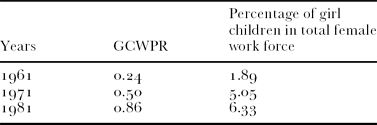
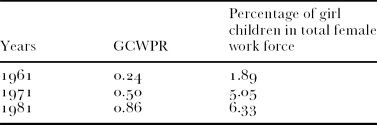
The post-partition years in Calcutta also witnessed an increasing number of girl children in the job market, often as domestic workers. Although information on girl childrens’ paid work is sparse in the 1951 Census, the 1961 Census gives both the total number of working girl children and an estimate of their sector-wise participation. Table 9 shows a quite significant and continuous increase in girl childrens’ work force participation rate in urban West Bengal over the two decades from 1961 to 1981. As there are conceptual differences between successive censuses regarding the definition of workers, the percentage share of working girl children in the total volume of female work force in the three census years concerned, also needs to be discussed. There is a sharp increase in the incidence of working girl children as a percentage of female work force in urban West Bengal in 1971 over the figures published for 1961. This also points to a steady increase in 1981.Footnote 75
Girl childrens’ work participation rate (GCWPR) and their percentage of total female work force during 1961 to 1981 in Urban West Bengal
Source: Census of India, 1961, 1971, 1981 Part 11-B (i), General Economic Tables.
The next question is whether the increase in girl childrens’ work-participation rate was in any way related to the increase in distress migration. According to 1981 Census data, 4,642 migrant girl children in Calcutta (Calcutta urban agglomeration) reported seeking employment as the reason for their migration to the city from different parts of the state. Another 1,352 girl children from outside the state had migrated for employment to Calcutta city also in 1981. Of these 5,994 migrant girl children, 3,559 were reported to be working as main workers in Calcutta city by the 1981 Census. Again, according to the 1981 Census the total number of girl children in Calcutta working as main workers was 6,522. Therefore the percentage of migrant girl children amongst the main workers was as high as 55 per cent in 1981. It needs to be remembered here that the remaining migrant girl children who reported employment as the major reason for their migration in 1981 (who did not work as main workers but were quite likely to be working in some status) were most likely to be working as domestic staff in city homes under different (probably familial) disguises.
The 1981 Census revealed another remarkable feature of migration for employment to the city from different parts of West Bengal. For the first time girl children emerged as a major constituent of migrant females coming to the city to find employment. Moreover, in 1981, girl children constituted 54 per cent of the total migrant children who had reported employment as the major reason for their migration to the city from different parts of the state. Furthermore, there was a dramatic change in gender of child main workers who reported employment as the major cause of migration to Calcutta from different parts of the country. In 1961 boys (0–14 years) constituted around 93 per cent and girls around 7 per cent in the total volume of working migrant children in Calcutta. Twenty years after, girls (0–14 years) constituted 37 per cent of all children who were reported as migrant main workers in 1981 Calcutta. This was not all. In 1981 girl children below 14 years of age were recorded as 19 per cent of all women who came from different parts of the state to Calcutta for employment. Interestingly, 20 years previously, girls below 14 constituted a meagre 0.84 per cent of all women migrant workers to Calcutta.Footnote 76 This reveals two points: first, girls outnumbered boys in terms of migration for employment within the state of enumeration, and second, the increasing importance of girl children in the urban female migrant workforce.
As already mentioned, migrant girl children constituted around 55 per cent of the total number of girl children engaged in different divisions of work in the city in 1981 as main workers. According to 1981 census data, around 88 per cent of working girl children were engaged in domestic service in Calcutta, so it is reasonable to conclude that those girls who migrated to seek employment were mostly employed as domestic staff. Domestic service was thus emerging as a new job market for migrant girl children who displaced at least some adult women, and girl children outnumbered boys in domestic service in 1981 for the first time in Calcutta (see Table 4). As noted earlier, girl children were found to be working as helping hands for their migrant mothers who worked as domestic staff in early 1970s Calcutta (as reported in Towards Equality Footnote 77), and were preferred by at least some middle class families as early as the 1950s.
It must be reiterated that the ‘internal migration’ is primarily distress migration caused by a shortage of food in rural areas. This is why internal migration decelerated as a consequence of rural institutional reforms during the 1980s.Footnote 78 But, as the land reforms were not all pervasive,Footnote 79 the lowest classes continued to migrate to the city in search of food and remained the main source of domestic servants for the urban elite. Even as late as 2004, the West Bengal Human Development Report noted a substantial amount of distress migration from agriculture and industries in to the services sector.Footnote 80 Incidentally, in 2004–2005, in urban West Bengal more than 50 per cent of women were employed in the low-paid manual services sector,Footnote 81 and this significant increase in the incidence of poor migrant women employed in low-paid manual services in the cities is now commonplace all over India.
But West Bengal also has a unique feature. The 1981 Census revealed that at least 500 more girls than boys in the same age group migrated from rural areas of the state to Calcutta to seek employment, and that this movement by girl children continued unabated until 1991. The gender gap by such migration also widened: The percentage of migrant girl children to Calcutta against all children who migrated for work rose from 54 per cent in 1981 to 56 per cent in 1991. This increasing trend of feminization of migration for work in the child group continued even to 2001. Incidentally, according to the 1991 Census, the percentage of migrant girl children seeking employment in Calcutta from different parts of West Bengal was the highest amongst all Indian cities from their hinterlands. West Bengal was also the only case where girl children outnumbered boys in migration seeking employment. In a survey conducted in 1997, Ananya Roy found that in a village named Tetultola in the South 24 Parganas district of West Bengal an increasing number of households sent their very young, unmarried daughters to Calcutta in order to meet the growing urban demand for girl children live-in domestic workers. Roy also located houses in that village from which young daughters were despatched to the city one after the other.Footnote 82 On the basis of much larger data samples, Save the Children documented the same trend.Footnote 83
From the data provided by Save the Children on the wage rate of girl children domestic staff, although relating to a period much later than the one considered in this paper, it seems that to employ them is less costly than employing adult women. This is particularly true when domestic workers are appointed on a full time basis. A recent survey of middle class households in Kolkata conducted by us reveals that girl children seemed to have replaced at least a section of adult women in domestic service in the urban areas of West Bengal by providing cheaper and, understandably, more ‘manageable’ labour.Footnote 84 Earlier it was noted how adult women replaced the up-country male migrants in domestic service in post-partition Calcutta. Apart from the more obvious reasons there are a few other causes as to why families prefer to employ girls rather than adult women as live-in domestic help.Footnote 85 The most important reason is that the female child domestic worker can be expected to act as a natural care-giver as well as a playmate to the employer's child. Moreover she can be accountable for all sorts of odd jobs. This assumption has been borne out in reports by Save the Children and also by our own survey mentioned above.
In an earlier paper we have argued that in an increasingly urbanizing India the trend amongst the richer classes of both parents doing paid work has been on the rise in recent years.Footnote 86 West Bengal, still a poor performer in the field of adult women's work participation rate, shows a significantly high work participation of urban women in the richest class of the state in 2004–2005. Such upper-class families seem to be in most urgent need of providing paid company for their children in the absence of negligible institutional support such as crèches. However, the dynamics of the market pulling girl children from rural areas to city houses has not been discussed in this paper, as the subject requires separate study.
Conclusion
The large scale migration of girl children for employment, outnumbering boys in the same age-group, and often substituting adult women, is particularly unique in a state which historically has a low female work-participation rate. Such migration, which probably began sometime during the 1970s, singles out West Bengal in its record of gender-based discrimination. There also appears to be a strangely morbid form of patriarchy which prevents adult women from working out of the home, but which has no qualms about forcing girl children to take on paid jobs. Here comes the crucial role of the family in matters regarding migration. The family calculates the comparative advantages and decides to part with the most vulnerable members. However, the family calculates according to market demands. Thus, when the market demanded women domestic workers and there was an increase in the supply of women labour, the up-country migrant male workers were gradually pushed out of the Calcutta middle class homes during the 1950s and the 1960s. In the 1970s the market tilted towards girl children domestic workers. This dynamic of the market, however, has not been elaborated in this paper.Footnote 87
The continuing migration of girl children from rural areas in to the city to seek employment seems particularly alarming when consideration is given to the regular abuses these isolated domestic workers meet within employers’ houses.Footnote 88 Newspapers often carry reports on such abuses ranging from brutal beating, keeping in starvation, to murder and rape.Footnote 89 Such news reports, however, fail to create much reaction in the life of the Calcutta elite. Rights activists in the city do not place the issue on their priority list. This seems all the more unexpected in a state which historically takes pride in its supposedly advanced level of consciousness. The Bengali literati who often previously articulated on their ‘cordial’ relationship with domestic workers in memoirs and fictional works till the 1950s and 1960s, now appear conspicuously silent on the issue of abuse. The only notable contemporary piece of writing on the relationship between domestic workers and their middle class employers, is Kharij (The Case is Closed) by Ramapada Chowdhury.Footnote 90 This is a story about the death of a migrant child domestic due to the negligence of the employers in a middle class home in Calcutta in the 1970s. Interestingly the dead child was portrayed as a boy. The story was later made into a film with the same titleFootnote 91 by Mrinal Sen in 1982. Sen also portrayed the child domestic worker as a boy and not as a girl, though in reality there already was a much higher incidence of girl children than boys as domestic workers, in Calcutta during the 1970s. Given the realities this paper has sketched out, this portrayal is interesting and significant.