Amid the ongoing coronavirus disease 2019 (COVID-19) pandemic, lives have been altered by the restrictions on movement and social contacts. Since it began in 2020, the severe acute respiratory coronavirus 2 (SARS-CoV-2)/COVID-19 pandemic has brought economic, social, and mental stress to people worldwide. In particular, health-care professionals (HCPs), who have continued to work in such a critical situation, are constantly at risk of being infected by COVID-19. They must regularly optimize the treatment of patients with COVID-19 and make complicated clinical and ethical decisions that affect the mortality of their patients at unprecedented rates. Therefore, among the categories of professionals, HCPs might be considered as 1 of the most vulnerable to developing psychological stress and other mental health symptoms. Reference Lai, Ma and Wang1,Reference Tian, Li and Tian2 It is, therefore, important to identify and support HCPs who are struggling during the pandemic. Reference Krystal and McNeil3
Widespread infection and high stress levels among HCPs have been reported in past epidemics. Reference Tam, Pang and Lam4,Reference Lee, Kang and Cho5 These emergencies can introduce new kinds of stress to HCPs that they had not experienced in their practice. Reference Verma, Mythily and Chan6,Reference Liu, Kakade and Fuller7 Excessive stress levels represent a critical factor that could affect the work environment and compromise performance, especially during an emergency. Reference Buselli, Corsi and Baldanzi8 Moreover, chronic work stress among health-care workers may be associated with job satisfaction, physical health, and posttraumatic symptoms Reference Sim and Chua9 ; it also leads to long-term psychological consequences. Reference Heritage, Rees and Hegney10 Based on previous emergencies, HCPs responding to the SARS-CoV-2/COVID-19 pandemic can be expected to have difficulties with respect to their lives and physical and mental health.
Professional quality of life (ProQOL) is defined as “the quality one feels in relation to their work, as a helper,” the measurement of which is appropriate for individuals exposed to potentially traumatic events. Reference Buselli, Corsi and Baldanzi8 During the COVID-19 pandemic, HCPs are at a high risk of experiencing traumatic symptoms, including burnout and secondary traumatic stress, which have a negative effect on their ProQOL. Reference Sim and Chua9 These symptoms can lead to anxiety and depression, as well as negative psychological consequences, if they persist for a long time. Eventually, these complex factors can affect the health-related quality of life (HRQOL) of health-care workers. Reference Heritage, Rees and Hegney10
The present study aimed to determine the kind of stress experienced by HCPs and confirm the effects of such stress. We recruited HCPs in charge of COVID-19-related work who had worked in the ICU for a certain period and had special experience in the ICU or HCPs with more than 5 y of experience who were not currently working in the ICU. We formulated the following hypotheses: (i) HCPs involved in COVID-19-related work will experience stress; (ii) HCPs’ stress is work related; (iii) The work-related stress they experience affects their quality of life. To address these hypotheses, we first evaluated the type of stress experienced by the selected HCP group using a tool called viral epidemic-related stress scale. Second, we used a ProQOL scale to evaluate whether the stress of the HCP group was related to their work. Finally, using an HRQOL measure, we investigated how stress affects their quality of life.
This study addressed the question, “What are the main stress factors that impact HRQOL in a group of HCPs responding to COVID-19?” The study used the viral epidemic-related stress scale, a measurement tool developed to identify individual psychiatric problems with specific rating scales for viral epidemics. In contrast to existing scales, it is a psychiatric scale measuring tool that addresses the COVID-19 pandemic. It has been used to prove whether the stress of experts in COVID-19 pandemic situations is related to the virus itself. Reference Chung, Kim and Ahn11 We also used the ProQOL scale, which has been applied in many previous studies to evaluate whether occupational stress affects the quality of life in the occupational group and has been verified as a reliable tool. Finally, we also used the WHOQOL-BREF (an abbreviated generic Quality of Life Scale developed through the World Health Organization) to evaluate HRQOL. It is a highly credible tool, developed simultaneously by field centers in 15 countries and is useful for QOL assessment.
Methods
Study Design and Participants
We designed a cross-sectional and descriptive study to define viral epidemic-related job distress and psychological problems associated with frontline HCPs during the COVID-19 pandemic. We conducted a convenience sample of HCPs who took care of patients with COVID-19 at 2 tertiary hospitals in provinces P and Y, Republic of Korea. We determined the inclusion criteria for frontline HCPs as follows: (i) medical staff with over 3 y of experience in caring for critical or infectious patients, and who are in charge of the treatment of confirmed COVID-19 patients since its outbreak, and (ii) nursing professionals who have worked in intensive care units (ICUs) for more than 2 y or in a negative pressure isolation ward for more than 5 y, and who currently provide direct care for patients with COVID-19.
Data were collected from October 28 to November 4, 2020. We placed the questionnaires at the staff lounge for HCPs caring for patients with COVID-19 to minimize face-to-face contact. After understanding the purpose, procedure, and methods of our study, the HCPs who decided to participate filled out the consent form and questionnaires. They then enclosed each questionnaire in an envelope and placed them in the return box. In total, 95 HCPs (P = 45 and Y = 40) at 2 hospitals had direct contact with and provided treatment to COVID-19 patients. Sixty questionnaires were returned and analyzed. This study was approved by the Institutional Review Board of Pusan National University, Yangsan Hospital, Republic of Korea (05-2020-217).
Outcomes and Measurements
Viral Epidemic-Related Job Distress
We used the 9-item Stress and Anxiety to Viral Epidemic (SAVE) scale to examine viral epidemic-related stress in HCPs. The SAVE scale was developed by psychiatrists and psychologists at the Asan Medical Center in Korea to assess the psychological impact of viral or influenza outbreaks on health-care workers. Reference Chung, Kim and Ahn11 Items are rated on a 5-point scale, ranging from 0 (never) to 4 (always), and belong to 2 subgroups: anxiety about the viral epidemic and work-related stress associated with the viral epidemic. The scale had satisfactory internal consistency (Cronbach alpha) at the time of development (0.80). Reference Chung, Kim and Ahn11 In our study, its Cronbach alpha was .80.
ProQOL
We examined the compassion satisfaction (CS), burnout (BO), and secondary traumatic stress (STS) of HCPs using the Korean version of the Professional Quality of Life Scale version 5 (K-ProQOL 5). Reference Yi and Mak12 The 30-item K-ProQOL consists of three 10-item subscales, namely, CS, BO, and STS, with each item rated using a 5-point Likert scale ranging from 1 (never) to 5 (very often). Reference Stamm13 A higher score on each subscale represents higher satisfaction related to a caregiver, a higher risk of BO, and a higher risk for STS. The Cronbach alpha values for the original scale were 0.88 for CS, 0.75 for BO, and 0.81 for STS. Reference Stamm13 In a study that used the K-ProQOL 5 to assess nurses, Reference Park and Kim14 the scale had Cronbach alpha of 0.90 for CS, .78 for BO, and 0.73 for STS. In our study, the corresponding values for CS, BO, and STS were 0.87, 0.71, and 0.68, respectively.
Psychological Problems
To identify psychological problems of HCPs, we used the Beck Depression Inventory version 2 (BDI-II) Reference Beck, Steer and Brown15 and Beck Anxiety Inventory (BAI) Reference Beck, Epstein and Brown16 translated into Korean by Lim et al. Reference Lim, Lee and Hwang17 and Lee et al., Reference Lee, Lee and Hwang18 respectively. The BDI-II and BAI measure symptoms of depression and anxiety, respectively. Both inventories consist of 21 items using a 4-point Likert scale ranging from 0 to 3. Additionally, they categorize the status of depression and anxiety by score as follows: minimal (0-7 points), mild (8-15 points), moderate (6-25 points), and severe (26-63 points). The Cronbach alpha for BDI-II was .92 at the time of its development, Reference Beck, Steer and Brown15 .86 for the Korean BDI-II, Reference Lim, Lee and Hwang17 and .88 in our study. For BAI, the Cronbach alpha was .92 in the original study, Reference Beck, Epstein and Brown16 .91 for the Korean version, Reference Lee, Lee and Hwang18 and .87 in our study.
HRQOL
We investigated HRQOL using the Korean version of the WHOQOL-BREF. 19 The 26-item WHOQOL-BREF consists of 2 items for general HRQOL and 24 items for the following 4 domains: physical health (7 items), psychological health (6 items), social relationships (3 items), and environment (8 items). We computed each domain’s score using the calculation methods in the WHOQOL-BREF manual, which was provided by the WHOQOL group. 20 In a previous study on the validation of the Korean version of the WHOQOL-BREF, Reference Min, Kim and Lee21 the internal consistency (Cronbach alpha) for the total scale was 0.90, and the values for the 4 domains were .78 (physical), 0.76 (psychological), 0.58 (social), and 0.77 (environmental). In our study, the alpha values were 0.92 for the total scale, and 0.76, 0.75, 0.58, and 0.79, respectively, for the physical, psychological, social, and environmental domains, respectively.
Statistical Analysis
The data were analyzed using IBM SPSS version 25.0 and AMOS 18.0 for Windows. The level of significance was set at 0.05. Descriptive statistics, including numbers, percentages, means, and standard deviations (SDs), were computed to summarize the demographic characteristics, viral epidemic-related job distress, depression, anxiety, and HRQOL. We used independent t-tests and 1-way analyses of variance (ANOVAs) to compare outcome variables according to demographic characteristics. Pearson correlation coefficient analysis was used to examine the relations between variables. Subsequently, we performed a path analysis to determine the associations between the variables. To evaluate the fitness of each model, we completed the fit indices test: chi-squared (χ2), root mean square residual (RMR), goodness of fit index (GFI), normed fit index (NFI), comparative fit index (CFI), and adjusted goodness of fit index (AGIF). After confirming the appropriateness of the model, we used the bootstrap method with AMOS to show the direct, indirect, and total effects of the variables.
Results
Demographic Attributes
Table 1 presents the demographic characteristics of the participants. The mean age was 29.0 y, and 86.7% of the participants were female. More than half of the participants lived alone, and one-quarter lived with their parents. Fifty-four participants were nursing professionals, and 6 were medical staff who consisted of infectious or pulmonology internal medicine specialists and cardiothoracic surgeons. Most of them (83.3%) had treated COVID-19 patients with high severity that required advanced medical treatment, such as mechanical ventilation, extracorporeal membranous oxygenation, and continuous renal replacement therapy in the ICU. Ten participants (16.7%) had over 5 y of work experience in a negative pressure isolation ward to care for patients with infectious diseases. The average working duration was 5.9 y, and the range of working experience was 2 to 25 y. All 32 participants (53.3%) with 2 to 5 y of working experience were nurses in the ICU.
Demographic characteristics of the participants (N = 60)

Job Distress and Psychological Problems
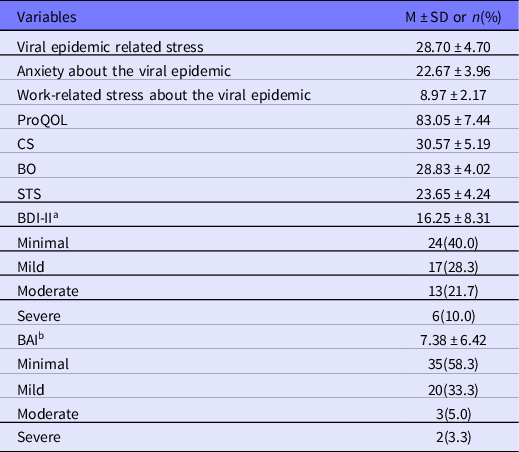
The results of our analysis of the assessment scores are presented in Table 2. Regarding the viral epidemic subcategories, the mean score was 28.7 for total viral epidemic-related stress, 22.7 for anxiety, and 9.0 for work-related stress. The average total score for ProQOL was 83.1, and the average scores for CS, BO, and STS were 30.6, 28.8, and 23.7, respectively. Depression scores ranged from 1 to 39, with a mean score of 16.3. Six HCPs reported having severe depression (10.0%), 13 had moderate depression (21.7%), 17 had mild depression (28.3%), and 24 had minimal depression (40.0%). The average anxiety score was 7.4, and the maximum score was 29. Anxiety status was categorized as severe, moderate, mild, and minimal, and the number of HCPs in each category was 2 (3.3%), 3 (5.0%), 20 (33.3%), and 35 (58.3%), respectively.
Health outcomes of the participants (N = 60)

Abbreviation: M, mean.
a,b The BDI-II and BAI categorized the status of depression and anxiety by score as follows: minimal (score 0-7), mild (score 8-15), moderate (score 6-25), and severe (score 26-63).
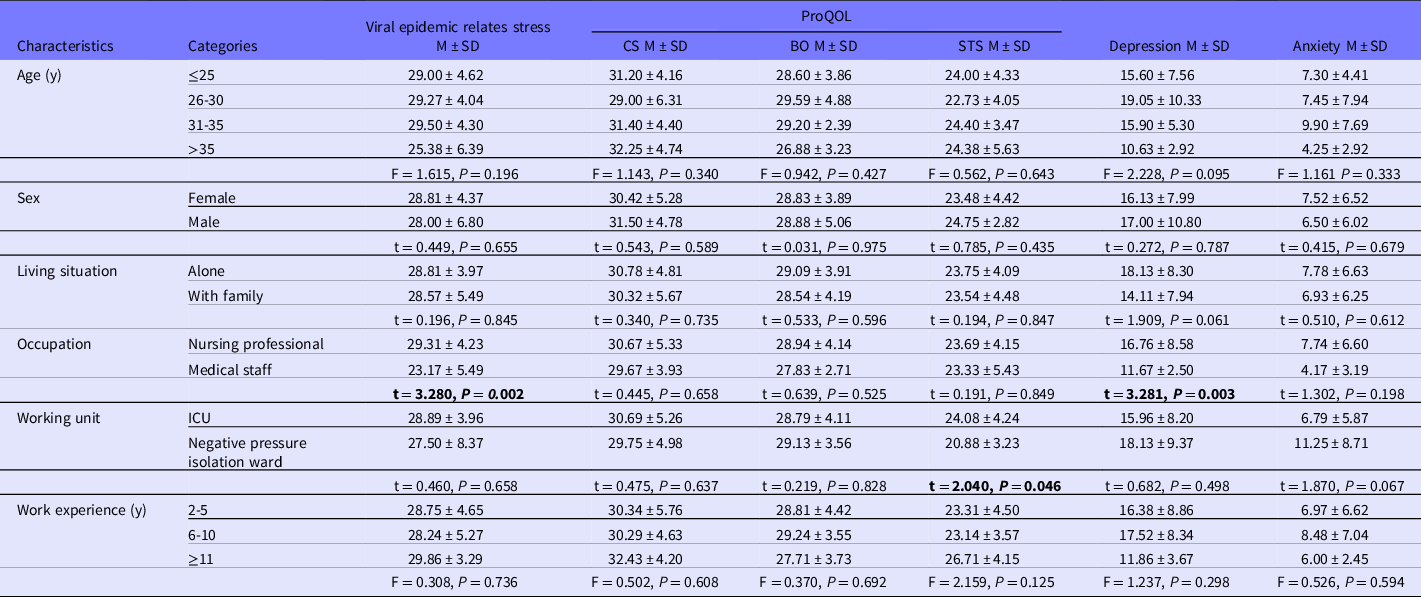
Table 3 shows the differences in scores for the variables of job distress and psychological problems according to demographic characteristics. We found significant differences between nursing professionals and physicians, with nurses having higher scores for viral epidemic-related stress (t = 3.280; P = 0.002) and depression (t = 3.281; P = 0.003). STS among HCPs working in isolation wards was significantly higher than that among critical care unit workers (t = 2.040; P = 0.046). We found no significant differences in job distress and psychological problems according to age, sex, living situation, and work experience.
Job distress and psychological problems of participants since COVID-19 outbreak (N = 60)

Abbreviation: M, mean.
HRQOL
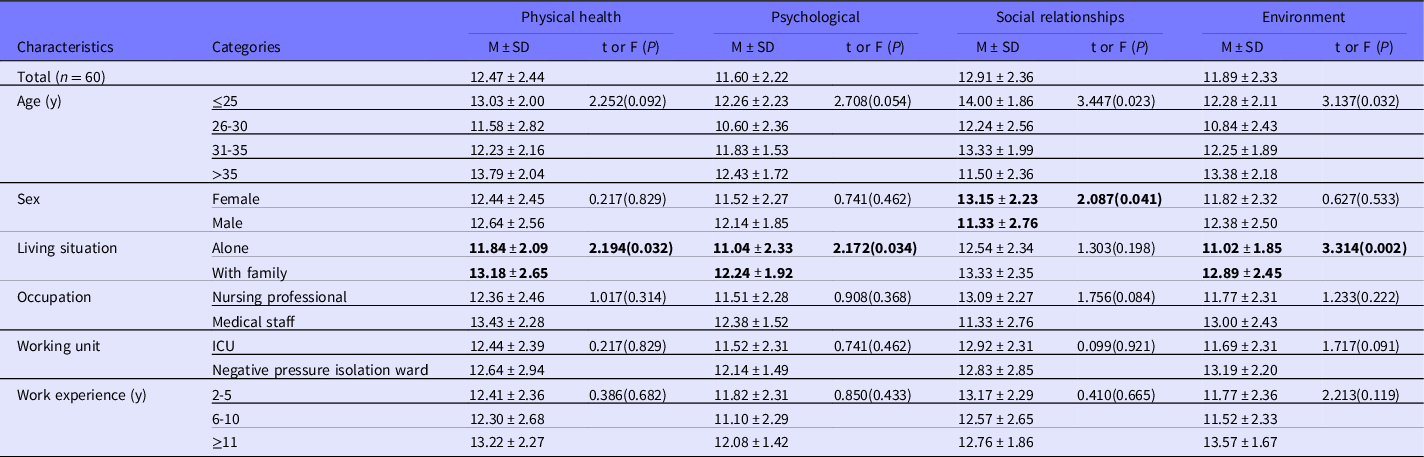
The mean scores for the subcategories of HRQOL were as follows: 12.5, physical health; 11.6, psychological health; 12.9, social relationships; and 11.9, environment (Table 4). The results showed significant differences by age group for social relationships (F = 3.447; P = 0.023) and environment (F = 3.137; P = 0.032). However, no differences were observed between each group post hoc. We found that the social relationship scores of women tended to be higher than that of men, at 13.15 ± 2.23 (t = 2.087; P = 0.041). Compared with those who lived with their families, those who live alone scored significantly lower in the physical health (t = 2;194, P = 0.032), psychological (t = 2.172; P = 0.034), and environment (t = 3.314; P = 0.002) subcategories.
HRQOL according to demographic characteristics (N = 60)

Abbreviation: M, mean.
Note: Values in bold P < 0.05.
Factors Associated with HRQOL
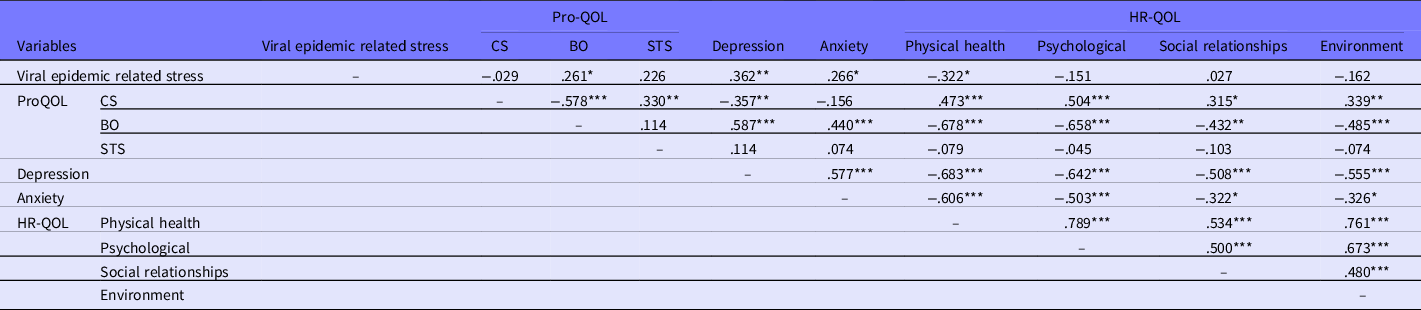
We used Pearson correlation and path analysis to identify the relationship among the variables viral epidemic-related stress, CS, BO, STS, depression, and anxiety with the HRQOL of frontline HCPs. The correlation of all variables was calculated using Pearson correlation coefficient, and the results are presented in Table 5. The average BO and depression scores showed a significant correlation with all variables except for STS. In addition, the mean STS score was related only to CS. We identified negative correlations between BO, depression, and anxiety, and all subdomains of HRQOL. Meanwhile, CS and the mean of the subdomains of HRQOL showed positive correlations.
Relationship between the health-related variables (N = 60)

* .01 ≤ P < 0.05.
** .001 ≤ P < 0.01.
*** P < 0.001.
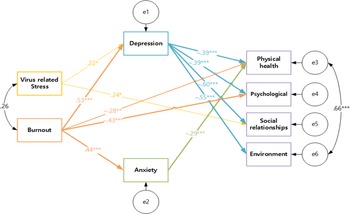
To investigate the association of the variables, we assumed the following, based on previous studies: (i) the job stress from the COVID-19 pandemic, such as viral epidemic-related stress, CS, BO, and STS, affects depression and anxiety levels, and (ii) psychological problems, such as depression and anxiety, influence HRQOL. Preliminary path analyses were performed to verify these assumptions. Subsequently, we excluded paths with no significant relations between variables. The proposed path model is illustrated in Figure 1. The results of the fit indices of the model were as follows: χ2 = 42.209, χ2/df = 2.814, RMR = .129, GFI = .860, NFI = .847, CFI = .890, and AGIF = .663 (Supplementary Material 1).
Path analysis diagram of the changing health outcomes of health-care professionals during the COVID-19 outbreak. Path analysis was used to determine the associations among the variables. To evaluate the fitness of each model, we completed the fit indices tests, which yielded the following results: χ2 = 42.209, χ2/df = 2.814, RMR = 0.129, GFI = 0.860, NFI = 0.847, CFI = 0.890, and AGIF = .663. After confirming the appropriateness of the model, the bootstrap method with AMOS was used to show the direct, indirect, and total effects of the variables. * .01< P <.05, ** .001< P <.01, *** P <.001.

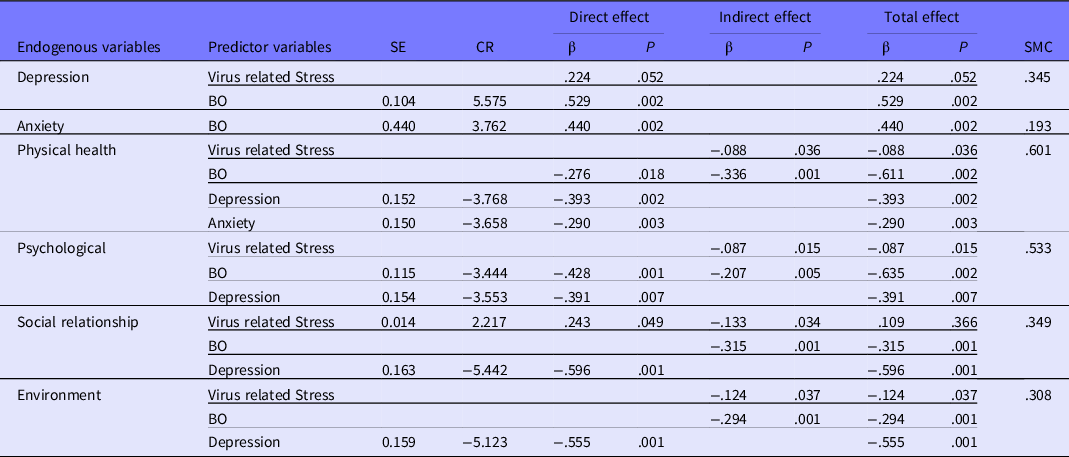
The results in Table 6 show the direct, indirect, and total effects between the variables in the proposed model. The direct effects of BO were statistically significant for depression (β = .529), anxiety (β = .440), physical health (β = −.276), and psychological (β = −.428) HRQOL. In addition, the indirect effects of BO were statistically significant for all subcategories of HRQOL (β = −336, −.207, −.315, and −.294, respectively). Viral epidemic-related stress had no significant direct effect on any of the variables but had significant indirect effects on all subcategories of HRQOL (β = −088, −.087, −.133, and −.124, respectively). The total effect of viral epidemic-related stress was not significant only on the social relationship subcategory of HRQOL. The endogenous variables as mediators were depression and anxiety. Depression was found to influence HRQOL subcategories directly and significantly (β = −393, −.391, −596, and −.555, respectively). However, anxiety was significant only for physical health HRQOL (β = −.290; P = 0.003). Thus, BO on physical health (β = −.611; P = 0.002) and psychological (β = −.635; P = 0.002) HRQOL, and depression on social relationships (β = −.596; P = 0.001) and environmental (β = −.555; P = 0.001) HRQOL were the most significant factors.
Factors Associated with HRQOL in participants (N = 60)

Abbreviations: SE, standard error; CR critical ratio; SMC, squared multiple correlation.
Discussion
The number of medical professionals who can directly treat patients with COVID-19 is limited. Maintaining their mental and physical health is particularly important as the fight against COVID-19 continues. We investigated the role of work-related stress by analyzing the virus-related stress of an HCP group amid the COVID-19 situation, focusing on CS, BO, and STS. The results of this study elucidated the kinds of stress experienced by HCPs, and show the effects of such stress. This can be used to inform strategies to help reduce stressors and their impact. In addition, the insights shaped by our findings on anxiety and depression can be used to stabilize the life of medical staff by addressing HRQOL related to stress.
A notable result of our study was that viral epidemic-related stress had no effect on ProQOL in the HCP group. As mentioned earlier, the ProQOL scale was used to confirm the work-related psychological impact on the selected professional group. The ProQOL scale has also been used to examine the degree of job-related QOL in professionals. In the HCP group, the fact that viral epidemic-related stress had no effects indicated that the staff had no fear of the virus itself nor traumatic stress. In contrast, among the ProQOL subcategories, CS and BO were related to almost all items of the XX scale. CS showed a close correlation with all items except anxiety among the subcategories of HRQOL and depression. BO was related to CS, depression, anxiety, and all subcategories of HRQOL. BO had the greatest psychological impact on the HCP group. When they experience BO, their overall stress level and QOL may worsen. The factor involved in BO was CS. In other words, when CS decreases in one’s work, it is perceived as a decrease in work ability. This was felt more in the HCP group, and after working harder to compensate for this, BO would eventually occur. This path ultimately leads to a poor HRQOL.
Depression was also strongly associated with anxiety and showed a high correlation with HRQOL. Anxiety showed high correlation values for physical and psychological health. Our analysis of the correlation between depression, anxiety, and QOL, in terms of direct and indirect total effects, showed that BO directly affected depression. Depression caused by BO lowered all 4 indicators of HRQOL at meaningful magnitudes. In other words, BO doubly impacted QOL. Anxiety also had a great impact on the subcategories when starting from BO. Therefore, BO directly affected depression and anxiety and indirectly affected physical health, psychological health, social relationships, and the individual’s environment. The 4 subcategories showed a greater response when affected by BO through depression and anxiety indirectly than when directly affected by BO.
Overall, the findings showed that the viral epidemic-related stress in HCPs was not high, unlike in the general population. HCP stress was closely related to work-related CS, and low satisfaction resulted in BO, ultimately affecting HCP’s QOL. The degree of impact on QOL was worsened by depression and anxiety attributable to BO.
Our study has 2 strengths: an intensive enrollment group and a special evaluation scale. This study focused on the analysis of the psychological impacts on only HCPs who had direct contact with confirmed COVID-19 patients, HCPs considered to be the most stressed group among all medical personnel, Reference Maunder, Hunter and Vincent22,Reference Nickell, Crighton and Tracy23 as well as those with more than 10 y of experience, specialists in internal medicine and thoracic surgery, and those with special work, such as ICU experience. Thus, our study is different from previous works that analyzed the entire health-care workforce, enrolling only medical staff and professional nurses who came in direct contact with confirmed patients. Furthermore, our study also used evaluation scales that were different from the general depression and anxiety analyses; we used scales appropriate for special population analysis. The ProQOL scale was used to evaluate the levels of CS (work satisfaction), BO (compassion fatigue), and STS. SAVE was used to analyze the stress and anxiety for viral pandemic situations. Using these scales, we targeted HCPs and focused on analyzing work- and virus-related stress.
However, a limitation of this study is that long-term stress effects cannot be determined immediately after the COVID-19 pandemic. Stress can have a significant effect on individuals in the long term; therefore, a study on this is necessary. A large-scale study should be conducted on the effect of the COVID-19 pandemic on medical staff after the end of the pandemic.
Conclusions
Exposure to COVID-19 patients was not associated with stress, anxiety, ProQOL, or HR-QOL in HCPs, such as staff and senior nurses. Low CS resulted in BO, and BO was significantly associated with depression, anxiety, and low HRQOL. HRQOL showed a greater response when affected by indirect BO through depression and anxiety than when directly affected by BO.
Supplementary Material
To view supplementary material for this article, please visit https://doi.org/10.1017/dmp.2021.279.
Data Availability
The datasets used and/or analyzed in this study are available from the corresponding author upon reasonable request.
Author Contributions
T.K. and Y.L.: substantial contributions to the conception and design of the work: T.K. was responsible for the acquisition, analysis, and interpretation of data, and drafted the work; J.Y. revised it. All authors read and approved the final manuscript. All authors have agreed to be personally accountable for their contributions and to ensure that questions related to the accuracy or integrity of any part of the work, even those in which the author was not personally involved, are appropriately investigated and resolved, with the resolution documented accordingly.
Funding
This work was supported by a clinical research grant from Pusan National University Yangsan Hospital in 2021.
Declaration of Conflicting Interests
The authors declare that they have no competing interests or conflicts of interest.