The Roman colonia of Gloucester is home to nearly 500 civic stamped tiles, the majority of which were stamped with the letters RPG that is known in 36 different die forms. Roman Inscriptions of Britain II.5 (RIB)Footnote 1 expands the letters RPG as Res Publica Glevensium, indicating that these tiles were the product of the municipal tileworks of Glevum which was based at St Oswald’s Priory, immediately outside the city walls. Some of the dies also included the names of the city magistrates, either the duoviri who were elected in pairs annually in the first four years of the administration cycle or the quinquennales who took office every fifth year. Twenty different magistrate dies are known: 14 duoviri and six quinquennales. Gloucester is the only town in Britain to have such civic dies.
In the course of a reorganisation and rationalisation of the Gloucester Museum store, a box of stamped tiles from the St Oswald’s Priory excavations was uncovered.Footnote 2 This box contained 12 stamped tiles which had been overlooked in the excavation reportFootnote 3 and from the subsequent listings in RIB. Ten of these stamped tiles had been impressed with known dies but the other two,Footnote 4 both on similar flat lydion bricks, were made using a previously unrecorded die.
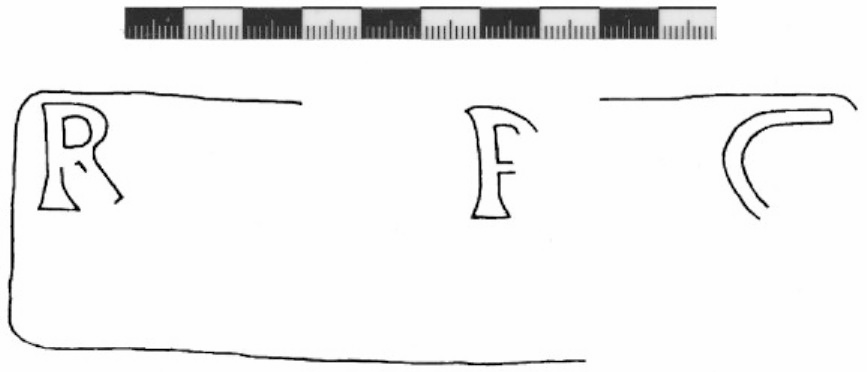
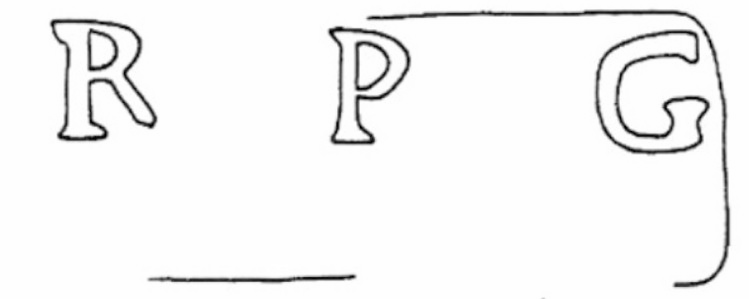
Figs 1 and 2 are images of the two stamped tiles which have been impressed with the same die and Fig. 3 is a composite drawing of the die utilising both stamps. Note that the tile in Fig. 2 has been inadvertently struck twice: the first strike at the top of the image was lighter, leaving no outline of the die, and the second much heavier, obliterating any underlying evidence of the first strike. The apparent frame line surrounding the incuse lettering is caused by the impression of the edge of the baseplate onto which the projecting letters of the die had been fixed and is only fully visible when the die has been heavily impressed into the clay as in Fig. 2. Normally the baseplate leaves no impression, or only a partial impression caused by the die being presented at a slight angle to the tile.
New RPG die (SF 1143).

New RPG die (SF 1145).

Composite drawing of new die (half scale).

Incuse die tools are presumed to have been formed by soldering or brazing metal (probably copper) letters onto an iron baseplate. Although no such tools have actually been found, the method is inferred from examples of defective stamped tiles from Gloucester that have an element of the lettering missing, leaving no trace, despite the element being present on other instances of the same die. If these dies had been formed of wood (like all of the relief tile-stamp dies) then it is unlikely that the damage would have produced a clean break; however, defective soldering would allow bits of the lettering to break off leaving no visible trace.
Fig. 4 presents two examples of the duoviri die RIB 2487.2; the upper image shows the die in its original state where the letters below the G are ligatured ETR, whereas in the lower image the ligature is just ET and the R has disappeared, leaving no trace. A more blatant example is provided in Fig. 5, where the diagonal element of the R is missing, again without leaving any trace. The size and unusual spacing of these letters match RPG die 2486.13.Footnote 5 The incuse TPF and LHS dies from the Cirencester area also exhibit similar defects.
Two states of RIB 2487.2 (St Oswalds SF 1135 and 344).

Defective RPG die (St Oswalds unstratified).

The new die as drawn in Fig. 3 is unusual because the frame line shows the baseplate was twice as tall as necessary for the lettering that it was apparently designed to carry whereas the baseplates normally matched their lettering with a small margin around the sides. The explanation proposed here is that this ‘new’ RPG die is in fact a repurposed magistrate die. The magistrates’ terms of office only lasted for a year, after which their dies would have been defunct and presumably normally destroyed. However, it seems that in this case the old magistrate die with the names of the two quinquennales was not destroyed but repurposed as an RPG die by the removal of the quinquennales’ names. This could be done simply by heating the solder that fixed the lettering to the baseplate and floating the letters off. Provided the surplus solder was also wiped off, then no trace of the original lettering would remain.
The matching quinquennales die is a reconstruction based on five overlapping fragments as shown in Fig. 6 (top).Footnote 6 The RPG letters in the reconstruction are a good match in terms of shape, size and spacing to those in the new RPG die. None of the fragments in the reconstruction included a frame line, but the frame of the RPG die fits tightly around all the text, particularly at the bottom, which explains why the tails of the two letter Qs of the quinquennales die had to take an unusual horizontal form. It could be argued that, as the stamp in Fig. 1 was only lightly impressed, it was actually the complete magistrate die shown in Fig. 6 (top) where the letters from the lower half of that die had failed to register on the surface of the tile. However, this cannot be said for the other example in Fig. 2, which had been deeply impressed and was still missing the magistrate text.
Reconstruction of quinquennales dies (Warry Reference Warry2017, 108, fig. 8).

The only other RPG die with a significantly oversized frame where it might have been possible to have squeezed in a line of text below is RIB 2486.24 (Fig. 7). Another, more speculative, proposed reconstruction of a magistrate die as shown in Fig. 6 (bottom) (identified as 2488.5) looks very likely to have been the source.Footnote 7 Unlike in the first reconstruction, these fragments were not overlapping, so for the reconstruction it was assumed that the RPG letters would have been equally spaced as measured from their left-hand side, but this does not match the RPG die. However, if instead the G fragment in the reconstruction is pulled slightly towards the RP fragment, then an exact match can be achieved with the RPG die and, importantly, the outline of the baseplate on that die will neatly enclose all of the quinquennales text.Footnote 8
RIB die 2486.24 (half scale).

This speculative reconstruction was originally proposed because it brought together the last two unassigned pieces of magistrate die that had been found which would otherwise have been left as ‘orphan’ fragments.Footnote 9 The fact that the reconstruction can now be paired with RPG die RIB 2486.24 is not only evidence of the repurposing of defunct magistrate dies, but also a vindication of the proposed magistrate die reconstruction which has implications for the number of magistrate dies produced and hence the longevity of their production. If there were many more dies produced that have yet to be found, then we would expect to have a good number of orphan fragments without matches. As it is, we now have none — all the known pieces can be tied into the 20 known magistrate dies.Footnote 10 As a consequence, we can now infer that there are very few, and conceivably no more, magistrate dies yet to be discovered and therefore that the minimum number of years of production is determined by the six known quinquennales dies which give a span of 26 years if the sequence starts and ends with a quinquennales die. In practice it is likely that production lasted longer than this, because the absence of a corresponding number of duoviri dies (20 are needed for the 26 year span compared to the 14 known) indicates that dies were not made, or at least not used, every year.
Acknowledgements
My thanks go to Andrew Armstrong for uncovering the lost box of tiles and to Neil Holbrook for commenting on a draft of the paper.