Introduction
Since the first reports of elder abuse in the early 1970s, awareness of elder abuse as a social problem has increased among the general public and older people (Podnieks et al., Reference Podnieks, Anetzberger, Wilson, Teaster and Wangmo2010). This has been achieved through a combination of public information campaigns, the reportage of high profile cases of elder abuse in the media, and through the work of older persons’ advocacy groups at both national and international levels. There is an underlying assumption that increasing public awareness of this social problem will serve to de-stigmatize abuse. However, there is little or no empirical evidence that this has happened (Werner et al., Reference Werner, Eisikovits and Buchbinder2005; Penhale, Reference Penhale2008).
Awareness of elder abuse
Awareness has been defined as a level of “perception of stimulus information capable of influencing feeling, thoughts or actions” (Merikle et al., Reference Merikle, Smilek and Eastwood2000, p. 116). In the field of elder abuse, studies tend to use the concept of awareness and perception interchangeably. Such studies have mainly reported whether people have heard the term elder abuse and the personal meaning people attached to it (Hudson et al., Reference Hudson, Beasley, Benedict, Carlson, Craig and Mason2000; Daskalopoulos et al., Reference Daskalopoulos, Mulin, Donovan and Suzuki2006; Lafferty et al., Reference Lafferty2009). Although awareness of elder abuse, at least at this simple level, is likely to have increased, it still remains an ill-defined concept within society and for older people in particular. There is no legal definition of elder abuse, and the broader area of elder law is only starting to emerge as a field within the legal discipline (Doran, Reference Doran2006; Podnieks et al., Reference Podnieks, Anetzberger, Wilson, Teaster and Wangmo2010). There is variation in theoretical and operational definitions of elder abuse (Killick and Taylor, Reference Killick and Taylor2009; De Donder et al., Reference De Donder2011), but a broad acceptance of five overarching typologies of abuse (psychological/emotional, physical, sexual, financial abuse, and neglect) has emerged. The majority of prevalence studies on elder abuse have a narrow focus on behaviors perpetrated within inter-family relations or by caregivers (Biggs et al., Reference Biggs, Manthorpe, Tinker, Doyle and Erens2009; De Donder et al., Reference De Donder2011; Harbison et al., Reference Harbison2012). This is often at odds with older people's perceptions of what constitutes elder abuse. For example, most states consider stranger break-ins or attacks on older people as crimes and are not captured in elder abuse statistics, but older people regard these experiences as both crimes and elder abuse. They tend to hold broader and more encompassing views of elder abuse compared with official definitions, and more readily recognize the role of wider societal, state, and commercial institutions in perpetrating or facilitating elder abuse (World Health Organization, 2002; Dixon et al., Reference Dixon2010).
Under-reporting of elder abuse
Despite on-going publicity and efforts to educate the general public and older people in particular about elder abuse, the recent elder abuse study in New York State provides unequivocal evidence that the vast majority of cases of elder abuse go unreported and undetected by official services (Berman and Lachs, Reference Berman and Lachs2011). Under-reporting of elder abuse is one of the major barriers in this area of adult protection (Cohen et al., Reference Cohen, Levin, Gagin and Friedman2007; Killick and Taylor, Reference Killick and Taylor2009). Some of the reasons given for this are that older people or their families may not recognize the behavior as abusive and, even if it is recognized, older people may decide not to act to change their circumstances out of fear, dependency, or a sense of loyalty to the perpetrator of the abuse (Bonnie and Wallace Reference Bonnie and Wallace2003; Walsh et al., Reference Walsh, Olson, Lohfeld and macMillan2010).
Internationally, a primary strategy in the management of elder abuse is empowering older people to protect themselves through providing education and information on the specific typologies of elder abuse and sources of help (World Health Organization, 2011). An underlying principle in any education campaign is that increasing awareness can alter attitudes and behavior (Sacco and Trotman, Reference Sacco and Trotman1990). The existing evidence in relation to media campaigns on family violence is equivocal, with no convincing and consistent evidence that such campaigns work (Sacco and Trotman, Reference Sacco and Trotman1990). In Ireland, the first public information campaign on elder abuse commenced in 2008. It involved national and local radio and newspaper campaigns as well as the distribution of information leaflets specifically targeted at older people (Health Service Executive (HSE), 2009). The effectiveness of this campaign has not been formally evaluated. However, a deeper understanding of how awareness of elder abuse and experiences of elder abuse relate to each other could help to refine both the message and mode of delivery of public information. There is a dearth of research exploring links between older people's underlying awareness and perception of elder abuse as a social problem and their personal experiences of abusive behavior, and how this subsequently impacts on help-seeking behavior.
This study aimed to (1) describe the prevalence of five typologies of elder abuse (including stranger abuse) since the age of 65 years and compare the characteristics of older people who experienced such behaviors with a general population of older people; (2) compare the level of awareness of the term “elder abuse” among older people who subsequently disclosed experiences of elder abuse since the age of 65 years with that of a general population of older people; (3) examine the relationship between people's specific experiences of elder abuse and how they characterized the term elder abuse compared to a general older population and; (4) examine the relationship between an awareness of the term elder abuse and the help-seeking behavior of those who disclosed experiences of mistreatment.
Methodology
A national prevalence study of elder abuse was conducted in Ireland in 2010. Following ethical approval, the research used a cluster random sampling strategy to generate a nationally representative sample of 2,021 community-dwelling people aged 65 years or older. Using face-to-face interviews a response rate of 83% was achieved (Naughton et al., Reference Naughton2010).
Participants were asked to describe what the term elder abuse meant to them and unprompted replies were recorded verbatim. Participants were subsequently asked about specific experiences of abuse. Thirty-eight behavioral-type questions related to the five typologies of elder abuse were used; for example, since the age of 65 years, have you ever had money stolen from you (see supplemental file Table 1) (see supplemental file Table 1, available as supplementary material attached to the electronic version of this paper at www.journals.cambridge.org/jid_IPG). A respondent was considered to have experienced abuse if he/she answered “yes” to any one of the 38 questions, all other respondents were categorized as part of the non-abuse population. Thus, in this analysis the operational definition of elder abuse used was experience of abuse since the age of 65 years encompassing any episode of neglect, psychological, physical, sexual, or financial abuse and included episodes perpetrated by strangers. This definition of abuse is used as it is more closely aligned to older people's perception of elder abuse (World Health Organization 2002; Dixon et al., Reference Dixon2010).
Help-seeking behavior was defined as disclosing to a third party any incident of financial abuse, physical or psychological mistreatment, or neglect since the age of 65 years. Participants were also asked about whom they reported the abuse to, what actions were taken, and what were the outcomes, i.e. abuse stopped, lessened, or on-going (no change).
The questionnaire used was modeled on the UK and New York elder abuse prevalence surveys (O'Keeffe et al., Reference O'Keeffe2007; Berman and Lachs, Reference Berman and Lachs2011). It was tested with a group of older people using cogitative interviewing technique to test questions for cultural appropriateness, clarity, and consistency in interpreting questions. It was further piloted with 30 older people and interviewers who had received specific training; minor adjustments were made prior to the final survey.
Survey instruments
A number of validated instruments were used in the survey. The short form 8 (SF-8), an eight-item instrument, was used to measure the overall physical and mental health of respondents. The aggregated physical and mental health scores were transformed to achieve norm-based scores (mean 50, SD 10) based on the general US population (Ware et al., Reference Ware2001). Scores of 50 or above were considered to indicate average or above average physical or mental health. The usability, reliability, and validity of the SF-8 are reported elsewhere (Lefante et al., Reference Lefante, Harmon, Ashby, Barnard and Webber2005, Roberts et al., Reference Roberts, Browne, Ocaka, Oyok and Sondorp2008). The Oslo-3 Social Support scale, a three-item instrument using 4- or 5-point Likert response scale, was used to measure levels of social support. This was categorized as poor support (score 3–8), intermediate support (score 9–11), and strong support (score 12–14). The Cronbach's alpha in this study was 0.61, similar to that reported by Boen et al. (Reference Boen, Dalgard, Johansen and Nord2010).
Community deprivation index
A community deprivation index was assigned to each of the sampling clusters in the study. Each sampling cluster corresponded to an electoral division (ED), which is the smallest legally defined administrative areas in the State. Based on the 2006 census data, each ED has been allocated a deprivation index based on a number of indicators (unemployment, car ownership, rented accommodation, etc.) to generate the current National Deprivation Index for Health and Social Research (Kelly and Teljeur, Reference Kelly and Teljeur2007). The index contains ten categories, from 1 least deprived to 10 most deprived. In this study, communities were grouped into the following three categories: low (1–3), moderate (4–7), and the most (8–10) deprived.
Statistical analysis
Responses to the open-ended question on awareness of elder abuse were coded using a thematic analysis approach. Words and phrases were categorized into minor themes, then regrouped into major, and finally overarching themes. Minor themes were constructed from specific elder abuse terminology or abusive behaviors detailed by respondents; similar behaviors and associated terminology were regrouped into major themes (see supplemental file Table 2 for coding categories used) (see supplemental file Table 2 available as supplementary material attached to the electronic version of this paper at www.journals.cambridge.org/jid_IPG). The following three overarching themes emerged categorizing participants level of elder abuse awareness: Specific awareness of the term elder abuse captured responses that identified one or more typology of abuse (e.g. psychological, physical) or associated behaviors (e.g. shouting, hitting, not providing food, stealing money); the second category was labeled Non-specific awareness of elder abuse and captured responses that used broad or vague terms (e.g. repeated the word abuse but did not elaborate, mistreatment, not being good, or kind to older people); and the third category captured Don't know responses.
Descriptive statistics were used to analyze the data with frequencies and percentages presented. The prevalence of elder abuse since 65 years of age was calculated and the 95% confidence intervals (CI) adjusted for the survey design effect and cluster sampling. Differences between categorical variables were calculated using chi-squared statistic, and p < 0.05 was regarded as statistically significant. Logistic regression was used to explore the strength of the association between awareness of the term elder abuse and experiences of elder abuse. Odds (OR) and 95% CI were reported. Analysis was carried out using SAS (V9).
Results
Prevalence of elder abuse
In this sample 5.9% (120/2,021) (95% CI 4.6–7.30) of people disclosed experiences of behavior that may be considered elder abuse since the age of 65 years. Psychological abuse at 3.8% (95% CI 2.62–4.89) was the most common type of abuse reported, followed by financial abuse 2.1% (95% CI 1.34–2.91), neglect 1.2% (95% CI 0.63–1.74), and physical/sexual abuse 1.1% (95% CI 0.56–1.62).
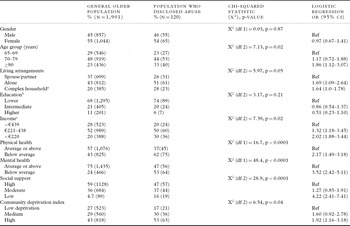
In a univariate analysis, older age but not gender was associated with a higher prevalence of abuse, as was living alone or in complex households, that is sharing with adult children or other extended family (Table 1). Lower income and living in more deprived communities were associated with a higher prevalence of abuse. Participants with below average physical and mental health and lower levels of social support also reported a higher prevalence of elder mistreatment over the course of old age. These associations must be interpreted with caution as the data captured age and socioeconomic status at the time of interview rather than circumstances at the time of the abuse, which may have occurred more than 12 months ago in some cases.
Demographic and socioeconomic characteristics of older people who disclosed elder abuse since the age of 65 years compared with general population

Note: aHousehold with adult children or other extended family.
blower education = no education, primary lower secondary school, intermediate = completed secondary level, technical/vocational qualification, higher = degree or higher.
c€219 minimum state pension for a single person.
Awareness of elder abuse
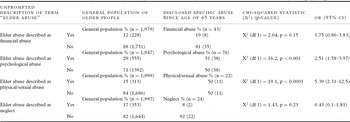
Just over half the older population (52%) who disclosed any experience of abuse since the age of 65 years demonstrated a specific awareness of the term through terminology associated with the typologies of elder abuse or concrete examples of abuse behaviors compared with the general population of older people (47%), but this did not reach statistical significance (OR 1.20; 95% CI 0.83–1.73; p = 0.33; Table 2). In both the population of older people who had not experienced abuse and those who had experienced abuse, approximately 20% were not familiar with the term elder abuse and were unable to provide an unprompted response.
Awareness of term elder abuse

Note: aElder abuse described as a typology or using behavioral examples.
bElder abuse described using broad terms, e.g. mistreatment, abuse, treated badly.
Specific experiences of elder abuse
In this cohort, people who disclosed experiences of physical/sexual abuse were over five times more likely than older people who had not been abused to describe the term elder abuse using examples of physical mistreatment. Similarly, people who disclosed psychological abuse were over twice as likely to characterize elder abuse as behaviors associated with their personal experience of abuse (Table 3). This suggests that personal experiences of physical or psychological abuse were related to awareness of the term elder abuse. In relation to financial abuse and neglect, there was no significant association between people's awareness of the term elder abuse and their experiences of financial abuse or neglect compared with the general older population. This suggests that certain types of abusive behaviors experienced by older people were more readily recognized as elder abuse than others.
Association between actual experience of a specific type of abuse and description of the term elder abuse as a corresponding typology of abuse

Across the five typologies of abuse examined, there was a substantial portion of people who disclosed abusive behaviors, yet did not readily associate their experiences with elder abuse. This was most notable with neglect, 92% of the respondents who reported neglect did not perceive the term elder abuse to include neglect. Similarly, 80% of the people who disclosed financial abuse did not associate it with the term elder abuse (Table 3).
Awareness of elder abuse and impact on help-seeking behavior
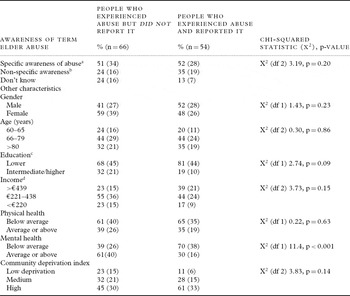
In this study, 45% (54/120) of people who disclosed abuse, including stranger abuse, demonstrated some help-seeking behavior. Awareness of the term elder abuse was not associated with a higher level of disclosure of abuse to a third party. There was a tendency for people who were unable to respond to what the term elder abuse meant not to report their experiences of mistreatment (Table 4).
Comparison of help-seeking behavior and other characteristics of people who did and did not disclose abuse

Note: aElder abuse described as a typology or using behavioral examples.
bElder abuse described using broad terms, e.g. mistreatment, abuse, not good too, treated badly.
b,cLower education = no education, primary lower secondary school, intermediate = completed secondary level, technical/vocational qualification, higher = degree or higher.
d€219 minimum state pension for a single person.
Comparison of socio-demographic and health characteristics between people who did and did not report their experience of abuse found no statistical difference, with one exception (Table 4). People with below average mental health scores were significantly more likely to report abuse compared to those with average or above average scores (OR 3.65; 95% CI = 1.70, 7.85; p < 0.001).
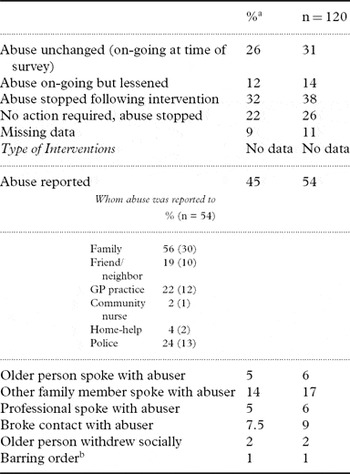
The actions taken by respondents and outcomes from the abuse were examined (Table 5). In nearly 40% of cases the abuse was on-going to a greater or lesser extent at the time of the survey, while in 54% of cases the abuse had stopped spontaneously or following intervention. The most frequent action taken by older people was reporting the abuse to a third party, mainly other family members, followed by the police (Table 5). Physical/sexual abuse was the most frequently reported mistreatment, i.e. 72% (16/22), followed by financial abuse, 60% (26/43). The least frequently disclosed forms of mistreatment reported were psychological abuse (50%, 38/76) and neglect (29%, 7/24). Other interventions included a family member or a professional (mainly the police) speaking to the abuser or breaking contact with the abuser.
Outcomes and interventions to stop the abuse

Note: aPercentages add to more than 100 as more than one answer may have been given.
bA barring order is an order of the court which requires the violent person to leave the family home. The order also prohibits the person from further violence or threats of violence, and from watching or being near the home.
Discussion
Using a broad definition of elder abuse, the prevalence of abusive behaviors experienced by people since turning 65 years of age was 5.9% (95% CI 4.6–7.30). Psychological abuse followed by financial abuse emerged as the most common types of abuse experienced by this population. The risk factors associated with higher levels of abuse were older age, lower levels of income, health, social support, and living in a more deprived community.
The relationship between a general awareness of elder abuse as a social problem and personal experiences of abuse was not straightforward. People who had experienced psychological and physical abuse were more likely to associate and characterize elder abuse using their personal experiences. However, people who experienced financial abuse or neglect did not readily associate these experiences with the term elder abuse. In this cohort a specific or broad awareness of elder abuse was not associated with help-seeking behavior for experiences of elder abuse, with the majority of people not reporting their experiences of mistreatment.
A small number of studies have measured elder abuse over the course of older age and have reported results broadly similar to this study. However, there is significant heterogeneity in the definitions used and methodological approaches (Cooper et al., Reference Cooper, Selwood and Livingston2008; De Donder et al., Reference De Donder2011). For example, the definition of older age varies from 50 up to 80 years; perpetrators can mean family only or extend to wider society; and data collection methods included postal, telephone, or face-to-face interviews. Prevalence estimates in these studies vary between 3.2% in the United States to 19.7% in Belgium (Pillemer and Finkelhor, Reference Pillemer and Finkelhor1988; O'Keeffe et al., Reference O'Keeffe2007; Acierno et al., Reference Acierno2010; De Donder et al., Reference De Donder2011). Given that both self-report and official statistics on elder abuse are likely to underestimate true prevalence, it is important that such statistics alone do not act as the bases for elder protection policy, strategies, and resource allocation (Cohen et al., Reference Cohen, Levin, Gagin and Friedman2007; Biggs et al., Reference Biggs, Manthorpe, Tinker, Doyle and Erens2009).
This is the only study the authors are aware of that examines the associations between awareness of elder abuse as a concept and actual experiences of abuse in older age. The study suggests that some types of abuse experienced by older people, such as psychological and physical abuse, are more recognizable as inappropriate behaviors, while experiences of financial abuse and, more significantly, neglect may be less readily associated with elder abuse.
Approximately 80% of this cohort was able to demonstrate some insight into the meaning of the term elder abuse. However, for a significant number of people who experienced mistreatment, there may be a disconnection between a general awareness of elder abuse and the ability to recognize certain types of behavior as inappropriate within their personal lives. This, in turn, may impact on help-seeking behavior. In the case of physical and psychological abuse, nearly 50% of those who had experienced this behavior did not readily associate it with elder abuse, this rose substantially for financial abuse and neglect with between 80%–90% of people not associating their experiences with the term elder abuse.
The phenomenon observed in this study may align to typologies of elder abuse described by Gorgen et al. (2006) (cited in Van Bavel et al., Reference Van Bavel, Janssens, Schakenraad and Thurlings2010). In type 1, there is no intension to harm the older person and the abuse may be due to a lack of knowledge or trying to do the best for the older person. In type 2, there is situational intension to harm the older person and may include physical or psychological abuse during an argument or using the older person's money in return for providing care. In type 3, there is an overall intension to harm the older person arising out of long-term conflicts (Gorgen et al., 2006 cited in Van Bavel et al., Reference Van Bavel, Janssens, Schakenraad and Thurlings2010). It is likely that most of the abuses disclosed in this study was type 1 or type 2 in nature. The older person may not have viewed the behavior as a deliberate attempt to harm them or there was a co-dependent relationship that although difficult may be perceived as beneficial. In part, this classification of abuse may help to explain the poor recognition of neglect and financial abuse as forms of elder abuse by the participants in this study. Our understanding of the triggers used by older people to recognize inappropriate behavior and the subsequent motivation to disclose these experiences remain limited.
In this study nearly 40% of the participants still experienced some level of mistreatment and less than half of the participants had reported their experiences to a third party. In addition, activities to resolve the abuse, with the exception of a small number of cases, remained concentrated within the family unit. This study suggests that there is an on-going need for the further development of public information campaigns in Ireland around the area of elder abuse. The immediate challenges are as follows: First, to reach the 20% of older people who remain unaware of elder abuse as a concept or a social problem; second, to build on the existing but often non-specific knowledge base of older people around elder abuse; third, to enable older people to bridge the gap between a theoretical understanding of elder abuse and to recognize inappropriate behaviors in their own lives; and fourth, to provide a range of service response options that allow older people to deal with these behaviors.
The risk profile of older people who disclosed abuse identified in this and similar studies (Cooper et al., Reference Cooper, Selwood and Livingston2008; De Donder et al., Reference De Donder2011) suggests that there is a need for targeted communication strategies at both individual and community levels, and, above all, a sustained approach to educating the public and older people about this issue and response options (Podnick et al., Reference Podnieks, Anetzberger, Wilson, Teaster and Wangmo2010; Walsh et al., Reference Walsh, Olson, Lohfeld and macMillan2010; World Health Organization, 2011). The majority of elder abuse cases are unlikely to come to the attention of official services, but will remain within the family unit (Walsh et al., Reference Walsh, Olson, Lohfeld and macMillan2010). This necessitates that older people and/or their family can recognize inappropriate behavior and have the confidence, knowledge, and access to appropriate advice and services to manage the mistreatment. This study highlights that there is a spectrum of behaviors that older people may be reluctant to describe as elder abuse yet require assistance in managing. The development of alternatives to official elder abuse services that may be more acceptable to older people should be explored alongside awareness raising strategies.
Limitations
The paper used a broad definition of elder abuse and may have identified some spurious behaviors or subclinical incidents that may not be regarded as elder abuse, thus providing a higher estimate of elder abuse since the age of 65 years. However, an estimate of 5.9% is within the range reported in other studies (De Donner et al., Reference De Donder2011). Estimating prevalence of elder abuse since the age of 65 years is likely to be more prone to difficulties with recall, especially if there is cognitive decline. It is also likely that due to the sensitive nature of the topic or non-participation of higher risk groups such as those with physical or mental impairment that the prevalence may be underestimated (Biggs et al., Reference Biggs, Manthorpe, Tinker, Doyle and Erens2009).
This study makes the assumption that people who provided unprompted, more detailed, and specific responses to an open-ended question on what the term elder abuse meant had greater insight into the concept of elder abuse. It is possible that people who provided non-specific or “don't know” responses, if allowed more time or limited prompting, could also have provided more detailed responses.
Conclusion
Increasing awareness of elder abuse at a general and older population level is one of the key strategies in elder protection. This study suggests that even when people are aware of elder abuse as a concept and experience abusive behavior, especially neglect and financial abuse, they may not be able to recognize behaviors in their own lives as elder abuse. In addition, a general awareness of abuse may not influence help-seeking behavior. Public information campaigns need to move beyond simple awareness rising and utilize diverse strategies to help people bridge the gap between awareness and an ability to critically examine interactions or relationships that impact on their physical, psychological, or financial well-being.
Conflict of interest
NCPOP is funded by the Health Service Executive (HSE) Ireland, this project was part of the work package of this Academic Centre.
Sponsor's Role: None.
Description of authors’ roles
Dr C. Naughton contributed to study design, supervised data collection, data analysis, report writing, and was the lead author in writing the paper. J. Drennan contributed to study design, data analysis, report writing, and the current paper. I. Lyons and A. Lafferty contributed to study design, report writing, and the current paper.
Acknowledgments
The authors would like to thank the study participants and the interviewers for their time and courage in talking about elder abuse. The authors acknowledge: the National Centre for the Protection of Older People (NCPOP) research team, the NCPOP Board of Directors, Tim Grant, CSTAR, for statistical advice; the NCPOP International Advisory Committee: Professor Karl Pillemer, Cornell University Institute for Translational Research on Aging, Professor Simon Biggs, Kings College London, Dr Isabel Iborra Marmolejo, Queen Sofia Centre for Studies on Violence, Valencia, Spain for the contribution of their time, effort, and dedication. Also, Dr Mark Lachs, Cornell University Centre for Aging Research for advice on instrument design. The complete report “Abuse and Neglect of Older People in Ireland: Report on the National Study of Elder Abuse and Neglect” and the survey instrument is available for download from www.ncpop.ie.