INTRODUCTION
The term “utilization behavior” (UB) was proposed by Lhermitte (Reference Lhermitte1981, Reference Lhermitte1983) to describe a clinical sign in which the visuo-tactile presentation of objects compels patients to grasp and use them, despite not being instructed to do so. This behavior persists even if the examiner asks them to stop. The first group study on UB was published by Lhermitte, Pillon, and Serdaru (Reference Lhermitte, Pillon and Serdaru1986), who evaluated 75 patients, including 29 patients with frontal lobe lesions. UB was present in 13 of the patients with frontal lesions but was absent in patients with posterior brain damage. Since Lhermitte’s work, several publications have addressed UB. One of the most noteworthy is “The origins of utilization behaviour” by Shallice, T., Burgess, P., Schon, P., & Baxter, D. (Reference Shallice, Burgess, Schon and Baxter1989). On the basis of a case study (patient L.E.), the authors claimed that Lhermitte’s methodology (1983) “induced” UB, due to the fact that no preliminary instructions were given before the tactile stimulation with objects. Shallice et al. (Reference Shallice, Burgess, Schon and Baxter1989) suggested that this situation might lead patients to believe that the examiner expects them to demonstrate the use of the objects presented to them. LE exhibited UB when tested with the procedure developed by Lhermitte (Reference Lhermitte1983). However, he also demonstrated UB while performing other cognitive tasks that did not direct his attention to the objects. Thus, Shallice et al. (Reference Shallice, Burgess, Schon and Baxter1989) distinguished two forms of UB. The behavior reported by Lhermitte (Reference Lhermitte1983) was termed “induced” UB, because it was considered as provoked by the examiner, whereas the behavior noted during their protocol was called “incidental.”
A review of the literature reveals several interesting points. First, studies on UB are primarily single case reports. In fact, only two group studies have been recorded since the seminal work by Lhermitte et al. (Reference Lhermitte, Pillon and Serdaru1986). Brazzelli, Colombo, Della Sala, and Spinnler (Reference Brazzelli, Colombo, Della Sala and Spinnler1994) assessed incidental UB in 42 patients with frontal lobe lesions; only one patient exhibited UB. De Renzi, Cavalleri, and Facchini (Reference De Renzi, Cavalleri and Facchini1996) tested 52 frontal patients using the protocol of Shallice et al. (Reference Shallice, Burgess, Schon and Baxter1989); two patients demonstrated incidental UB. Therefore, group studies on UB produced contradictory results depending on the methodology used. Lhermitte et al. (Reference Lhermitte, Pillon and Serdaru1986) noted that 45% of frontal patients presented UB, whereas Brazzelli et al. (Reference Brazzelli, Colombo, Della Sala and Spinnler1994) and De Renzi et al. (Reference De Renzi, Cavalleri and Facchini1996) only reported UB in 3% of their samples. Second, authors use the term “induced” UB, but they never strictly reproduce Lhermitte’s protocol (1983), simply placing objects on the desk without tactile stimulation (e.g., De Renzi et al., Reference De Renzi, Cavalleri and Facchini1996; Hashimoto, Yoshida, & Tanaka, Reference Hashimoto, Yoshida and Tanaka1995; Ishiara, Nishino, Maki, Kawamura, & Murayama, Reference Ishiara, Nishino, Maki, Kawamura and Murayama2002). Furthermore, there has been no direct comparison between the two procedures in the same sample of patients.
Theoretically, UB is unanimously considered to be the result of an imbalance between the presence of environmental stimuli and the subject’s intentions, regardless of whether it is interpreted using neuroanatomical (Boccardi, Della Sala, Motto, & Spinnler, Reference Boccardi, Della Sala, Motto and Spinnler2002; Lhermitte, Reference Lhermitte1983) or cognitive frameworks (Frith, Blakemore, & Wolpert, Reference Frith, Blakemore and Wolpert2000; Shallice et al., Reference Shallice, Burgess, Schon and Baxter1989). More specifically, the account of UB by Shallice et al. (Reference Shallice, Burgess, Schon and Baxter1989) refers to the theory of cognitive control of action developed by Norman and Shallice (Reference Norman, Shallice, Davidson, Schwartz and Shapiro1986), which involves several different levels. The lowest level of the model includes “action schemas”, defined as abstract representations of well-learned action sequences that are selected once the activation level exceeds a “threshold” that depends on environmental stimulation. Norman and Shallice (Reference Norman, Shallice, Davidson, Schwartz and Shapiro1986) also proposed that the highest level of the model, the “supervisory attentional system” (SAS), thought to be located in the frontal lobes, has a monitoring function that includes planning ability, decision-making skills, or suppressing a dominant response. Thus, the SAS is closely related to executive functioning abilities (e.g., Miyake, Friedman, Emerson, Witzki, & Howerter, Reference Miyake, Friedman, Emerson, Witzki and Howerter2000; Rabbit, Reference Rabbit1997). Shallice et al. (Reference Shallice, Burgess, Schon and Baxter1989) interpreted UB from this perspective, suggesting that frontal lobe damage impairs the SAS, leaving the subject under the influence of perceptual input. According to the authors, the visual perception of an object can lead to activation of the associated routine action schemas. In the absence of the inhibitory control usually exerted by the SAS on these schemas, the behaviors supported by the action schemas are carried out. Most authors are in agreement with this point of view, considering UB as the consequence of an impairment of the capacity to inhibit actions triggered by the perception of objects (e.g., Archibald, Kerns, Mateer, & Ismay, Reference Archibald, Kerns, Mateer and Ismay2005; Cooper, Reference Cooper2007; Derouesné & Boller, Reference Derouesné and Boller2007; Hurley, Reference Hurley2008; Juillerat Van Der Linden, Reference Juillerat Van der Linden, Juillerat Van der Linden, Aubin, Le Gall and Van der Linden2008).
In addition, perceptual and motor processes play an essential role in recent theories of human cognition (“embodied cognition” and also “grounded cognition,” see for example Shapiro, Reference Shapiro2007; Barsalou, Reference Barsalou2008). Sensory-motor experiences are conceptualized as a re-enhancement of neural activation patterns. Furthermore, a reciprocal interaction between perceptual systems and cognitive abilities is suggested. Neuroimaging studies have confirmed these ideas by revealing anatomical networks common to performing and simulating a gesture, including the supplementary motor area, the basal ganglia, and the cerebellum (for a review, see Jeannerod, Reference Jeannerod2001). Action simulation can occur when subjects simply look at an object (Bub, Masson, & Cree, Reference Bub, Masson and Cree2008) or read the name of a tool (Tucker & Ellis, Reference Tucker and Ellis2004), suggesting a link between language and action. In a recent study, Glover, Rosenbaum, Graham, and Dixon (Reference Glover, Rosenbaum, Graham and Dixon2004) demonstrated that reading words influences grip aperture while grasping blocks of wood. They interpreted their results as an illustration of “affordance activation” by words that follows from Gibson’s “theory of affordances” (1979). Grafton, Fadiga, Arbib, & Rizzolatti (Reference Grafton, Fadiga, Arbib and Rizzolatti1997) noted that evocation of actions relating to an object increased the activation of the same motor areas that are activated when the object is simply seen. Grèzes and Decety (Reference Grèzes and Decety2001) also suggested that silent verbalization of actions requires the inhibition of motor behaviors, demonstrated by frontal activation seen during this task. In sum, the evocation and/or mental simulation of actions seems lead to motor behavior preparation.
Lhermitte (Reference Lhermitte1984, Reference Lhermitte1986) considers UB as a precursor of the “environmental dependency syndrome” (EDS), a disturbance occurring in social environments that are more complex than the patient/examiner interaction (e.g., museum, gift shop, gaming room). Patients respond as though they have a specific role in those situations. If UB can be considered as the first level of EDS and as a “pathognomonic” sign of frontal lobe damage, an effective methodology for identifying and characterizing UB is needed. However, existing procedures for eliciting UB (Lhermitte, Reference Lhermitte1983; Shallice et al., Reference Shallice, Burgess, Schon and Baxter1989) have yielded contradictory results.
The aim of this study was to propose a methodology for investigating UB that takes into account the suggestions of cognitive model of action control by Norman and Shallice (Reference Norman, Shallice, Davidson, Schwartz and Shapiro1986), as well as more recent theories of cognition (e.g., Barsalou, Reference Barsalou2008). Our methodology uses a cognitive task involving the verbalization of scripts combined with the presentation of several objects. It was hypothesized that patients with frontal lobe lesions would show more UB than patients with retrorolandic lesions and normal subjects. Furthermore, in patients with frontal lesions, UB would be expected to occur more frequently when objects are linked with the script evoked, due to a “double activation” of processes involved in the control of action. First, the visual perception of objects will activate the action schemas associated with them. Second, mobilization of the same schemas by mental simulation of actions required for verbalization will reinforce this activation. We hypothesized that this double activation will exercise greater demands on the inhibitory control system (SAS), which would be impaired by frontal brain damage. This situation should lead to the utilization of some objects, despite instruction not to do so. In summary, we proposed that there will be a relationship between UB and the content of the verbal generation task. We also examined the efficacy of our procedure as compared to the methodologies proposed by Lhermitte (Reference Lhermitte1983) and Shallice et al. (Reference Shallice, Burgess, Schon and Baxter1989). Moreover, if UB corresponds to an executive control deficit, we would expect to find strong correlations between the frequency of this behavior and performance on tasks assessing the functions of the central executive.
METHOD
Participants
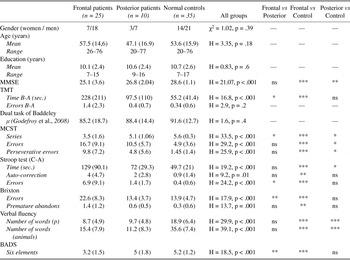
The sample consisted of 70 subjects: 35 brain injured patients admitted to the Neurological Department of the University Hospital or to the Regional Centre for Functional Rehabilitation, and 35 control participants recruited from local associations, ranging between 20 and 76 years of age. All subjects had no previous history of psychiatric or neurological illness. Patients and control participants were matched on typical demographic criteria (see Table 1). This study was conducted in compliance with the Helsinki Declaration.
Demographic and clinical data

Note
Between-group comparisons were performed with Kruskal-Wallis analyses of variance (ANOVAs), except for “Gender” (χ2 analyses). When Kruskal-Wallis ANOVAs were significant, these were followed by pairwise comparisons using Mann-Whitey U-tests. ns = non-significant (p > .05); *p < .05; **p < .01; ***p < .001. Values in brackets are standard deviations.
Using computed tomography and/or magnetic resonance imaging, patients were divided into two groups: a frontal group, composed of 25 patients whose damage encroached on the frontal lobe, and a posterior group (n = 10), in whom the frontal lobe was spared. If the lesion involved both frontal and nonfrontal areas, the patient was classified as frontal. Clinical MRI/or CT scans were available for 22 of 25 frontal patients and nine of 10 posterior patients. There were neuroimaging reports for all patients. Lesion location was interpreted by experienced neurologists (V.C and F.E.-B.) and conducted according to the procedure of Damasio and Damasio (Reference Damasio and Damasio1989), which maps brain lesions onto standard templates. In the frontal group, the etiology of the lesions included vascular (n = 9), traumatic (n = 9), tumor (n = 1), and degenerative (n = 5) causes. One patient sustained carbon monoxide intoxication. The posterior group consisted of 10 patients (6 with lesions due to cerebral vascular accident, 3 due to trauma, and 1 patient had temporal atrophy of unknown origin). None of the patients presented signs of aphasia or alexia, assessed using the “protocole Montréal-Toulouse d’Examen Linguistique de l’Aphasie” (Beland & Giroud, Reference Beland and Giroud1992) or the “Boston Diagnostic Aphasia Examination” (Mazaux & Orgogozo, Reference Mazaux and Orgogozo1981).
The dysexecutive syndrome was assessed with the GREFEX protocol tests (Azouvi et al., Reference Azouvi, Didic-Hamel, Fluchaire, Godefroy, Hoclet and Le Gall2001), which included seven tasks sensitive to frontal lobe dysfunction. Table 1 outlines the demographic information and the criteria taken into account for the executive tasks. Because of unequal group sizes and unequal variances, nonparametric tests were used. Between-group comparisons were performed using Kruskal-Wallis one-way analyses of variance (ANOVAs) and with Mann-Whitney U-tests. When Kruskal-Wallis ANOVAs were significant, these were followed by post hoc comparisons using Mann-Whitney U-tests. As shown in Table 1, frontal patients demonstrated impairment on all of the criteria considered. Patients with posterior brain damage performed significantly worse than control subjects on the Mini Mental State Examination (MMSE), the Modified Card Sorting Test (MCST) and verbal fluency. They were also slower than healthy controls on the Stroop test. Five frontal patients, one posterior patient, and none of the normal subjects demonstrated a MMSE score below 24.
Procedures
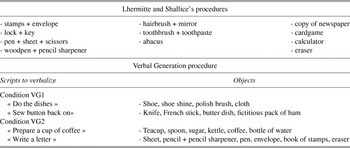
The UB research protocol comprised two procedures: a “control” procedure and a “verbal generation” procedure. The number of objects in each of the procedures was substantially equivalent, and sometimes the same items were presented. Only one trial was administered under each method, thus the opportunities to demonstrate UB can be considered to be identical. The two procedures were carried out on the same day, separated by a neuropsychological test. Table 2 and Figure 1 summarize the methodological conditions of the UB protocol.
Extracts of videotape. a) Stimulation with objects (e.g., hairbrush plus mirror) according to Lhermitte’s methodology (1983), a’) Instance of UB (coherent activity: the patient takes the brush and combs his hair) ; b) Schematic representation of the procedure of Shallice et al. (Reference Shallice, Burgess, Schon and Baxter1989); c) Arrangement of objects during the VG procedure (e.g., VG2 condition: “prepare a cup of coffee”).

Items submitted for each procedures

Control procedure
The control procedure involved a direct comparison of the two methodologies widely used in the literature to investigate UB, namely those of Lhermitte (Reference Lhermitte1983) and Shallice et al. (Reference Shallice, Burgess, Schon and Baxter1989). During Lhermitte’s procedure (1983), the examiner stimulated subjects’ palms and fingers with objects, without looking them in the eyes. He did not say anything and did not reply to their possible questions. If the patient took hold of the objects and used them, the examiner said, “Why are you using these objects? I did not ask you to. Please do not do it any more.” After a brief period of distraction, the examiner started the stimulation again to confirm that the patient did not use the objects. After a short interview, these same objects were scattered across the desk, within reach and field of vision, whilst the patient carried out an auditory-verbal calculation task (the examiner insisted that the calculation should be done mentally). The situation was similar to the methodology of Shallice et al. (Reference Shallice, Burgess, Schon and Baxter1989); the patient executed a cognitive task in the presence of objects without his or her attention being drawn to these objects. During the entire procedure, the examiner made notes of the patient’s behavior.
Verbal generation procedure
According to the recent theories of cognition, the links between perception, action and cognition lead to the involvement of the same mental processes both during the visual perception of objects and during the internal mobilization of concepts relating to them. We asked subjects to describe the actions involved in various activities of daily living (such as doing the dishes or writing a letter) in the presence of objects within their reach and field of vision. The actions to be verbalized were sometimes linked to the objects (condition VG2), and sometimes were not (condition VG1). During the VG procedure, the examiner first explained what the subjects had to do and told them explicitly not to touch or use the objects. He said: “I am going to ask you to describe the actions that make up some everyday activities. I am going to place some objects in front of you, but you must not touch or use them. This instruction has also been written on this sheet of paper. Do you have any questions?” The piece of A4 paper with the instruction was displayed near to the patient. The examiner checked that the patient understood the directions and placed a cardboard shield across the table and placed the relevant objects out of sight of the patient. The shield was removed so that the objects were within the patient’s field of vision, and the patient then started to verbalize the relevant script. At the end of each exercise, the examiner changed the objects for the verbalization of the next script behind the shield (n = 4). At the end of the procedure, the examiner asked the patient to recall the instruction that he had given at the beginning.
Scoring utilization behavior
Instances of utilization behaviors were coded using the categorization and coding scheme by Shallice et al. (Reference Shallice, Burgess, Schon and Baxter1989): (1) “toying”—a single action in which an object was simply manipulated (such as seizing a pencil without writing); (2) “complex toying”—using two objects with a functional link, but either not for the purpose for which they were designed, or using them in an incomplete way (such as inserting a pencil into a pencil sharpener without actually sharpening it); and (3) “coherent activity”—the most developed form of UB involving a set of actions integrated in an appropriate way with respect to one or many objects (such as sharpening a pencil using a pencil sharpener). For each procedure, we recorded the instances of UB and categorized it (with the exception of toying for Lhermitte’s procedure, given that the objects were placed directly into the subject’s hands). During the VG procedure, the examiner did not evaluate the relevance of the script verbalization but simply recorded the behavior using an online pathological behavior analysis grid. Most patients were also filmed to facilitate the recording process.
RESULTS
Analyses of Behavior
Statistical analyses were performed with nonparametric tests, given the unequal group sizes and unequal variances. Kruskal-Wallis ANOVAs and Mann-Whitney U-tests were used for comparisons between groups. Friedman ANOVAs and Wilcoxon signed-rank tests were carried out for within-group comparisons. When Kruskal-Wallis ANOVAs or Friedman ANOVAs were significant, these were followed by post hoc comparisons using, respectively, Mann-Whitney U-tests and Wilcoxon signed-rank tests. The alpha level was selected at p < .05.
Comparison between groups and procedures
Three frontal patients (12%) demonstrated UB during Lhermitte’s procedure (1983), compared with none of the subjects in either the posterior or control groups. Similar results were observed using the methodology of Shallice et al. (Reference Shallice, Burgess, Schon and Baxter1989), but the patients who demonstrated UB were not the same (Shallice: S1, S3, S6, who showed 10 instances of UB -8 episodes of toying, 1 episode of complex toying, and 1 episode of coherent activity; Lhermitte: S8, S11, S14, who exhibited 10 coherent activities). Differences between frontal patients, posterior patients and healthy subjects were not significant with respect to the total number of UB (toying plus complex toying plus coherent activity) for each procedure (Kruskal-Wallis ANOVA: H = 5.5; p = .06).
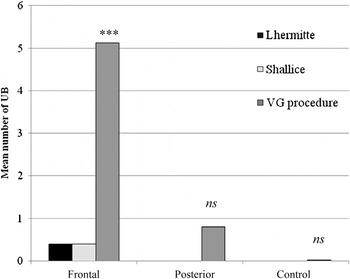
During the VG procedure, frontal patients demonstrated a total of 128 instances of UB (107 episodes of toying, 4 episodes of complex toying, and 17 coherent activities). Statistical analysis revealed a significant difference between the three procedures on the total number of UB (Friedman ANOVAs: χ2 = 13.9; p < .001). Post hoc testing indicated that UB was significantly more common during the VG procedure (Wilcoxon signed-rank test: VG/Lhermitte: T = 11; z = 3.1; p = .001; VG/Shallice: T = 7; z = 3.1; p = .001) in frontal patients. However, detailed analysis revealed that the differences between methodologies are only due to toying behaviors (Friedman ANOVAs: toying: χ2 = 25.4; p < .001, complex toying: χ2 = 4.6; p = .09; coherent activity: χ2 = 5.1, p = .07). One subject from the posterior sample exhibited 8 instances of UB (6 episodes of toying and 2 of complex toying). He could not recall the instruction. One healthy control demonstrated 1 instance of toying, but stopped immediately when he remembered the instruction. A Kruskal-Wallis ANOVA revealed a significant difference between the groups on the total number of UB instances during the VG procedure (H = 27.6; p < .001). Mann-Whitney U-tests indicated that frontal patients exhibited more instances of UB than posterior patients (U = 61; z = 2.3; p = .02) and control participants (U = 180.5; z = 3.8; p < .001). Differences between posterior patients and healthy subjects were not significant (U = 162; z = .35; p = .72). Figure 2 shows the distribution of UB for the three samples and each procedure.
Comparison of utilization behaviors in frontal, posterior, and normal control participants across procedures. (Within-group comparisons; Wilcoxon matched pairs test: *p < .05; ***p < .001; ns = not significant.)

Given the fact that one healthy control exhibited UB during the VG procedure, we used a cutoff criterion to determine pathological score. Patients who had a total UB score on the VG procedure of greater than 3 (more than twice of the highest control subject) were categorized as “Utilizers.” Using this scheme, 14 frontal patients (56%) and one posterior patient (10%) demonstrated UB during VG procedure. Results indicated that this difference is significant (Chi-square test: χ2 = 6.17; p = .013). Two frontal patients mentioned above also showed UB during the VG procedure (S1 and S14). Instances of UB during the VG procedure did not appear to be attributable to forgetting the instruction, because only 3 frontal patients could not recall it. If we consider the results of the three methodologies (Lhermitte plus Shallice plus VG procedure), UB appears in 18 frontal patients (72%), 1 posterior patient (10%) and none of the healthy controls. The number of subjects who demonstrated UB differed significantly across the three groups (Chi-square test: χ2 = 39.9; p < .001).
Comparison between the conditions of the verbal generation procedure
The aim of this analysis was to test our second hypothesis and determine the effect of task content on the occurrence of UB. Given that only one posterior patient showed UB during VG procedure, the comparison was carried out solely in the frontal group. Ten instances of UB under the VG1 condition (10 toying) and 117 during the VG2 condition (97 episodes of toying, 4 episodes of complex toying, and 17 episodes of coherent activity) were recorded. This difference was highly significant (Wilcoxon signed-rank tests: T = 0; z = 3.4; p < .001). Among the frontal patients who were categorized as “Utilizers” under the VG procedure, 4 patients (28.5%) exhibited UB during VG1 condition, whereas there were 14 (100%) under VG2 condition. A χ2 test revealed that this difference is significant (χ2 = 15.5; p < .001). Figure 3 outlines the distribution of instances of UB between the two conditions.
Comparison of utilization behaviors in the frontal group across conditions of the Verbal Generation procedure. (Wilcoxon matched pairs test: *p < .05; ***p < .001; ns = not significant.) Error bars are standard errors.

Influence of Patient Characteristics
Neuropsychological characteristics
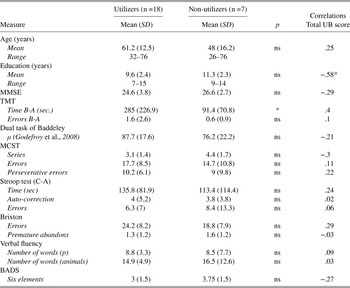
To explore the third hypothesis, correlation analyses between the clinical UB data and the GREFEX protocol variables were obtained. We studied the relationship between performance on executive functioning tests and total UB score (Lhermitte plus Shallice plus VG procedure) using Spearman rank order correlations. Analyses were carried out solely in the frontal group, given that only one posterior patient demonstrated UB. We did not find any significant correlation between the total UB score and executive functioning performance. To specify this analysis, comparisons were conducted between frontal patients who were categorized as “Utilizers” and “Non-utilizers,” using nonparametric Mann-Whitney U-tests. The two groups differed significantly in the completion time of the Trail Making Test (TMT): “Utilizers” performed more slowly than “Non-utilizers.” The effects of age, education level, gender, and cognitive state (MMSE) on the occurrence of UB were also examined. Only the education level had a significant effect (Spearman rank order correlation), but the two groups did not statistically differ on this variable (Mann-Whitney U-test). Table 3 gives an overview of the results of these analyses for the two groups of frontal patients.
Comparisons of frontal patients “Utilizers” and “Non-utilizers” on executive variables: Correlations between executive variables and total UB score

Note
Between-group comparisons were performed using Mann-Whitey U-tests. Spearman rank order correlations were used to study relationships between executive variables and total UB score. ns = non-significant (p > .05) ; *p < .05.
Neuro-anatomical and pathological characteristics
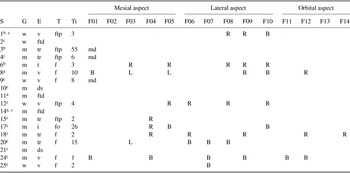
Among the “Utilizers,” there were six right and seven bilateral lesions; six patients had a cerebral vascular stroke, six a cerebral trauma, one a brain tumor, and one suffered from the consequences of carbon monoxide intoxication. Five patients had degenerative disease. In the “Non-Utilizers” group, there were four left, one right and two bilateral lesions; four patients had a traumatic brain injury, and three sustained a cerebral vascular stroke. We conducted further analyses in the “Utilizers” group. Table 4 shows the distribution of patients’ lesions in the different frontal areas of interest defined by Damasio and Damasio (Reference Damasio and Damasio1989). “Incidental” UB was predominantly associated with damage to the lateral frontal cortex (F08, F09, F10). For UB exhibited under the VG procedure and “induced” UB, the same three frontal lobe structures were involved. The mesial (F04) and lateral (F06, F07, F08, F09, F10) aspects are especially compromised in patients who exhibited UB during the VG procedure. In addition, Spearman rank order correlations revealed no association between total UB score and either time postlesion (ρ = −.45; p = .1) or size of the frontal lesions (ρ = −.33; p = .34). There was no relationship between total UB score and lesion etiology (Kruskal-Wallis ANOVA, vascular etiology versus traumatic etiology versus degenerative etiology: H = 1.97; p = .37). In addition, a comparison of patients with lesions restricted to the frontal lobe (n = 7) and patients with lesions extending beyond this lobe (n = 11) showed that the total UB score did not significantly differ between the two groups (Mann-Whitney U-test: U = 30.5; p = .46).
Frontal patients “Utilizers” ’etiology and lesions

S = Subject; a: UB under Lhermitte’s procedure; b: UB under Shallice’s procedure; c: UB under VG procedure; G: gender (w = woman, m = man); E: etiology (v = vascular, ftd = fronto-temporal dementia, ds = dementia syndrome, tr = trauma, t = tumor, i = intoxication); T: topography of the lesion (ftp = fronto-temporo-parietal, f = focal frontal, fo = fronto-occipital); Ti: time post-lesion (months); L: left unilateral lesion; R: right unilateral lesion; B: bilateral lesion; F01 and F02: Cyngulate Gyrus (Brodmann’s areas [BA] 23, 24, 31); F03: Supplementary Motor Area (BA 6); F04: Prefrontal Region (BA 8, 9, 10); F05: Rolandic Region (BA 1, 2, 3, 4); F06: Frontal Operculum (BA 44, 45); F07: Prefrontal Region (BA 8, 9, 46); F08: Premotor and Rolandic Region (BA 1, 2, 3, 4, 6); F09: Paraventricular Region; F10: Supraventricular Area; F11: Anterior Orbital Region (BA 10); F12: Posterior Orbital Region (BA 11, 12, 13, 47); F13: Basal Forebrain; F14: Subventricular Area; md: data not available. The lesions of the five patients with degenerative disease are not represented.
DISCUSSION
The aim of the present study was to propose a clinical methodology to investigate utilization behavior, based on the cognitive model of action control hypothesis (Norman & Shallice, Reference Norman, Shallice, Davidson, Schwartz and Shapiro1986), as well as predictions made by the recent theories of human cognition (e.g., Barsalou, Reference Barsalou2008; Shapiro, Reference Shapiro2007). The current interpretation of UB in terms of executive dysfunction was also studied. We compared, for the first time, the approaches by Lhermitte (Reference Lhermitte1983) and Shallice et al. (Reference Shallice, Burgess, Schon and Baxter1989), as well as a newly developed approach (the VG procedure) in the same sample of patients. The key finding of our study is that the VG procedure appears more efficient than the methodologies of Lhermitte (Reference Lhermitte1983) and Shallice et al. (Reference Shallice, Burgess, Schon and Baxter1989) for eliciting UB.
The incidence of UB in frontal patients is lower than that reported by Lhermitte et al. (Reference Lhermitte, Pillon and Serdaru1986), who found it in 45% of their sample: 3 frontal patients (12%) demonstrated UB under the “induced” protocol. Most patients simply picked up the objects and asked various questions such as, “What should I do?” or, “And now what do you want?” Some subjects just held all of the objects in their hands, awaiting the examiner’s instructions. Neither the patients with posterior lesions nor the healthy participants manifested UB. They generally picked up the objects and placed them on the desk, sometimes naming them. Most subjects asked questions about the goal of the task, but none concluded that they had to demonstrate how to use the objects. Using the methodology proposed by Shallice et al. (Reference Shallice, Burgess, Schon and Baxter1989), 3 frontal patients (12%) exhibited “incidental” UB, a higher percentage than in previous group studies (Brazzelli et al., Reference Brazzelli, Colombo, Della Sala and Spinnler1994; De Renzi et al., Reference De Renzi, Cavalleri and Facchini1996: 3% on average). UB took the form of purposeless manifestation (toying), results in keeping with those of De Renzi et al. (Reference De Renzi, Cavalleri and Facchini1996). Patients with posterior lesions and normal subjects did not demonstrate any UB and did not handle the objects. In the frontal group, the experimental procedure that asked patients to verbalize actions from a script in the presence of tools (the VG procedure) was more efficient than both methodologies for triggering UB by Lhermitte (Reference Lhermitte1983) and Shallice et al. (Reference Shallice, Burgess, Schon and Baxter1989). However, it resembled the “incidental” approach in that the patients were engaged in a cognitive task with objects in their field of vision. More precisely, under the VG procedure, the incidence of UB was higher when there was a relationship between the objects and the verbalized script (VG2 condition vs. VG1 condition). We interpret this result as the consequence of a “double activation.” The first aspect of the double activation is constituted by the visual perception of objects, which is enough to activate units of knowledge associated with them (e.g., Edwards, Humphreys, & Castiello, Reference Edwards, Humphreys and Castiello2003; Grèzes & Decety, Reference Grèzes and Decety2002; Grèzes, Tucker, Armony, Ellis, & Passingham, Reference Grèzes, Tucker, Armony, Ellis and Passingham2003; Shallice et al., Reference Shallice, Burgess, Schon and Baxter1989;). This explanation alone is not sufficient to explain the difference between the two conditions of the VG procedure, given that both involved the presentation of tools. The second aspect of the double activation suggests the simultaneous internal mobilization of the same action schemas, due to the verbalization of the script associated with the objects (VG2 condition). It is the coincidence between the internal representations of actions and the visual perception of objects that submit the action control system (SAS) to a double activation. This interpretation could explain why UB frequency appears dependent on the relationship between objects and the content of the task (verbalized script). In sum, the “double activation” interpretation combines the two dominant perspectives addressing the links between perception and action, namely “sensorimotor” and “ideomotor” approaches (see for a review Knoblich & Prinz, Reference Knoblich, Prinz, Freund, Jeannerod, Hallett and Leiguarda2005). The sensorimotor approach considers action to be determined primarily by perception, that is, as the consequence of environmental stimulation—a point of view adopted by most cognitive models. The ideomotor theory (Jeannerod, Reference Jeannerod1994; Prinz, Reference Prinz1997) sees action as a product of internal processes (e.g., intentions, plans), a premise inspired by the “principle of ideomotor action” (William James, Reference James1890; quoted by Chartrand & Bargh, Reference Chartrand and Bargh1999) who considered that the simple fact of thinking of an action increases the likelihood of doing it. Only one posterior patient exhibited UB under the VG procedure, due to forgetting the instruction. This interpretation cannot be considered for frontal patients, because most of them were able to recall what the examiner said.
In the frontal group, the frequency of occurrence of UB does not seem to depend on demographic variables, although education level appears to be associated with total UB score. Using the “incidental” procedures (Shallice’s and the VG procedures), we found that this behavior was predominantly associated with damage to the mesial and lateral aspects of the frontal lobe, a result in agreement with findings of De Renzi et al. (Reference De Renzi, Cavalleri and Facchini1996). In addition, the volume of the frontal lesions did not impact UB frequency. Neither the extent of the lesions beyond the frontal lobes nor the etiology of the lesion affected the total UB score. Nevertheless, the question arises as to whether UB emerges when disturbances of frontal lobe functions are induced by deep lesions of the brain, especially during the VG procedure.
At a theoretical level, our VG procedure is compatible with the model of Norman and Shallice (Reference Norman, Shallice, Davidson, Schwartz and Shapiro1986), if we consider that the activation threshold of action schemas has a greater probability of being reached in the double activation situation. On the other hand, if we accept the cognitive interpretation of UB, it is difficult to explain the lack of correlation between performance on executive functioning measures (in particular inhibition tests such as the Stroop) and UB frequency. In addition, there was no significant difference between patients with frontal lesions who were categorized as “Utilizers” and “Non-Utilizers” on executive functioning measures. Cognitive-behavioral dissociations have also been reported in two patients without dysexecutive syndrome (Boccardi et al., Reference Boccardi, Della Sala, Motto and Spinnler2002; Brazzelli et al., Reference Brazzelli, Colombo, Della Sala and Spinnler1994), but who exhibited UB and behavioral disturbances. Therefore, UB does not seem to depend solely on executive functioning impairments, and the cognitive interpretation of this behavior as the result of SAS impairment does not provide a satisfactory explanation for the dissociation noted in these studies, namely the preservation of cognitive skills versus socio-behavioral disturbances. In this context, Lhermitte’s (Reference Lhermitte1983) interpretation of UB as being a “social” deficit makes sense. We suggest that if UB can be interpreted as the consequence of comprehension deficits (Shallice et al., Reference Shallice, Burgess, Schon and Baxter1989), the impairment does not solely result from an aphasic disorder but rather from an inability to comprehend others’ intentions. This interpretation leads us to link this form of UB to a concept of social cognition defined as “theory of mind” (TOM) (e.g., Stone et al., Reference Stone, Baron-Cohen and Knight1998), which is the ability to attribute intentions to others. This ability is frequently impaired in frontal pathology and can lead to inappropriate behavior. This interpretation enables us to suggest different processes for “induced” and “incidental” UB which could explain why, in our study, different patients demonstrated each sort of UB. The association between UB and socio-cognitive deficits needs further investigation. Moreover, one clear limitation of our study was the failure to explore the behavior of patients with UB in social environments that are more complex than the patient-examiner situation to assess the potential relationship between UB and EDS, as relatively few studies have done (Conchiglia et al., Reference Conchiglia, Della Rocca and Grossi2007; Hoffmann & Bill, Reference Hoffmann and Bill1992) after Lhermitte (Reference Lhermitte1984, Reference Lhermitte1986). Future research should investigate this issue more specifically, to confirm the claim of Lhermitte and extend the scope of the study of utilization behavior.
ACKNOWLEDGMENTS
This study received financial support from the Pays de la Loire region in France. We thank John L. Woodard, PhD, for his English language editing assistance, under the auspices of the Research Editing Consultant Program of the International Neuropsychological Society’s International Liaison Committee.
The authors have no conflicts of interest to declare.