Roll call votes in parliaments may yield important insights into various aspects of political systems. They may inform us on the apparent conflict lines in parliaments,Footnote 1 the cohesionFootnote 2 of party groups,Footnote 3 the representativeness of members of parliaments (MPs),Footnote 4 etc. Thus, it is not surprising that studies using roll call votes from parliaments at the national and supranational level have become more frequent.Footnote 5
With few exceptions an important potential problem of such studies is neglected or glossed over, however. In most parliamentary settings not all votes are recorded as roll call votes. While some parliaments like the US Congress record and publish almost all votes,Footnote 6 others like the Swiss lower house record all votes but publish only a subset, while in still others, like the European Parliament (EP), recorded votes have to be explicitly requested. While using roll call votes for the purposes discussed above is not problematic for parliaments recording and publishing all votes,Footnote 7 this is hardly the case for all other parliaments. The reason is simply that the way in which the subsample of observable votes is formed may bias our substantive results. For instance, if party leaders request roll calls to discipline their rank-and-file, it is likely that, on the one hand, roll call votes will take place mostly for contentious decisions and, on the other hand, roll call votes will also discipline the members of a party.Footnote 8 Which of these possible effects dominates is an empirical and partly theoretical matter. If the two effects do not cancel each other out, however, measures of party cohesion based on published votes will be biased. Similarly, if only a subset of all votes is recorded, for instance final passage votes, particular characteristics of these votes may affect our inferences. Suppose only final passage votes on bills are published. It might be that at that time in the legislative process all conflictual elements have been resolved or that this final passage vote is largely a formality. As a consequence we would hardly expect the set of final passage votes to give us an accurate reflection of parliamentary conflict.
In this Note I discuss these problems of selection bias, offer empirical evidence that these biases may be considerable and suggest a way to correct for them. I first discuss the different ways in which roll call votes occur in parliaments around the world. Following this overview, I illustrate it with a discussion of how the publication of votes, or not, leads to biases for two legislatures (1995–99, 1999–2003) of the Swiss lower house. The empirical analysis relies on all votes in this parliamentary chamber, which allows us to distinguish parliamentary behaviour in votes not published, those published automatically, and those requested on the demand of members of parliaments. In the third section I offer some initial results based on an empirical model addressing the selectivity problems that arise when studying the cohesion of party groups. A final section draws the Note to a conclusion.
Institutions under which roll call votes occur and selection biases in the Swiss Parliament
The way in which roll call votes occur in parliaments varies quite dramatically. Many of these differences have to do with the traditions of parliamentary life in a particular country.Footnote 9 Building on earlier partial overviews by Saalfeld and Carey and complementing them with information from the Interparliamentary Union,Footnote 10 I provide a summary of these institutions for ninety-two countries and their parliamentary chambers in Table 1.Footnote 11 Table 1 clearly suggests that the analysis of roll call votes may be potentially problematic in many countries, given that the available information fails to cover all votes taken in parliament. More precisely, in only twenty of the ninety-two countries are all parliamentary votes published. In forty-nine parliaments, including Switzerland and the European Parliament, individual members’ votes are published either for specific votes or if a request is lodged. In these cases, it may be problematic to make inferences about MP behaviour in general on the basis of the published roll call data.
Parliamentary Voting in Ninety-Two Parliaments

To determine whether the conditions under which roll call votes occur may influence our inferences, I rely on a unique dataset of parliamentary votes. In 1994 the Swiss lower house introduced an electronic voting system that records all votes by the MPs.Footnote 12 Although all votes are recorded, only a subset of them is published. More precisely, only votes on emergency measures, final passage votes and total votes are published automatically. In addition, thirty members of parliament may request that a roll call vote, which is published, be taken.Footnote 13
The available dataset covers not only those votes recorded and published because they were requested or required, but all the information on all MPs’ voting decisions.Footnote 14 Hence, this dataset allows us to assess directly what biases would be introduced in empirical analyses if only a subset of the votes were to be considered. In this contribution I focus on the cohesion of the party groups present in the lower chamber of the Swiss parliament.Footnote 15
The main party groups in the Swiss lower house are formed around the parties represented in the executive, namely the Christian Democrats (CVP), the Radicals (FDP), the People’s party (SVP), and the Social Democrats (PS). Of lesser numerical importance are the Greens (GPS), the Liberals (LPS), and the party group formed by the Alliance of Independents and the Evangelical party (LdU/EVP). Finally, one party group only existed in the legislature between 1995 and 1999, and then disappeared from the political scene, namely the Freedom party (formerly known as the Car Drivers’ party).Footnote 16
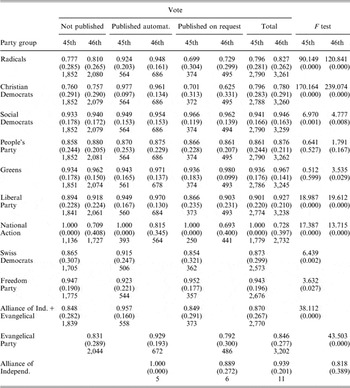
To assess whether employing only requested votes to assess party discipline is problematic. I compare in Table 2 the mean values of the Rice indicesFootnote 17 for all party groups present in the 45th (1995–99) and 46th (1999–2003) legislature for different types of votes. In columns 2 and 3 I report the mean Rice indices for votes that are recorded though not published. In columns 4 and 5 I list the mean Rice indices for the automatically recorded and published votes, while columns 6 and 7 list the same values for the requested votes. Finally, in the last four columns I report the overall averages as well as the results of an F-test for equal means across the three categories of votes in parliament.
Cohesion of Various Parties in Different Votes in the 45th and 46th Legislatures: Mean Rice Indices

Note: The mean, standard deviation and number of cases is shown for each party group in each legislature.
Table 2 shows first of all that for almost all party groups the average party cohesion scores vary systematically and markedly among the different types of votes. Only for three parties, namely the People’s party (45th legislature), the Greens (both legislatures), and the Alliance of Independents (46th legislature)Footnote 18 does the nature of the vote not appear to affect systematically the level of party cohesion (last two columns in Table 2). For the remaining parties we find a persistent pattern. Party cohesion is systematically highest for those votes that are automatically recorded and published. Cohesion is much lower in unpublished votes and even more so in votes requested by a set of MPs.
This clearly illustrates that relying on a subset of roll call votes biases our inferences on the cohesion of party groups. In the present case, it appears that the automatically published votes that comprise final and total votes, as well as votes on urgency measures, are votes for which conflict has already been resolved in earlier stages of the legislative process.Footnote 19 Given that in all remaining votes intra-party conflict is higher, published votes hardly give an accurate picture.
Roll call votes and selectivity
Given the likely problem of selectivity in analyses of those roll call votes that fail to cover all votes in a parliament, the issue becomes whether remedies are available. Possible solutions to this problem of selection bias require theoretical information on the selection process. This information can then be used to correct for possible selection biases through the estimation of a selection equation. Unfortunately, our dataset covering all votes in the Swiss lower house contains only little contextual information. First of all, I cannot identify the MPs who had called for a roll call vote. Secondly, the information on the various votes is very limited. Nevertheless, this latter information can be used to correct our inferences on the cohesion of party groups.
To demonstrate how this can be done, the following simple setup seems useful. Assuming only binary decisions (omitting abstention and absences) with y∈{0,1} (with 1 = yea and 0 = nay) most research questions dealing with roll calls can be framed in the following two equations:


In matrix notation X stands for the policy positions (possibly unobserved) of the MPs, W for variables related to party discipline (and possibly vote characteristics) and Z for constituency and other factors possibly explaining the votes of MPs. With the possible inconvenience that we cannot normally observe X,Footnote 20 Equation 2 could easily be estimated to find answers to the questions raised above, provided we have information on all votes in parliament. However, if a parliament does not record or make available all votes, then using this subset of data would cause problems for estimating Equation 2 unless the process leading to requests for published roll calls is completely random.
Given that the occurrence of a roll call vote, whose results will be published, is unlikely to be random, we may suspect that there are some systematic elements that help us explain its occurrence (ri = 1 if roll call occurs, ri = 0 else):


with V comprising characteristics of the votes in question. Assuming that Equation 3 accurately describes the occurrence of roll calls, we know that

Hence we can estimate Equation 2 only for observations for which  . At least since the seminal work by HeckmanFootnote 21 it has been well known that if there are data characterized by Equations 2 and 4, estimating the former equation without considering the latter may result in biased estimates. More precisely, Heckman demonstrated that as long as
 estimating Equation 2 from the observed data introduces a problem closely related to omitted variable bias.
Returning to the examples cited above, there is ample evidence that Equations 2 and 4 almost by definition will exclude variables being relegated into the respective error terms. Thus, the two error terms contain in part similar elements. Hence, the assumption  is very unlikely to hold.
Stating the problem in the terms used above also shows that models of selection bias allow us to address the problems in estimating Equation 2.Footnote 22 On the practical level, however, Equation 2 is often not our prime interest, because we wish to estimate, for instance, the cohesion of party groups.Footnote 23 In that case, it is easy to show that the well-known Rice index,Footnote 24 under the assumption of binary votes, can easily be expressed as an aggregation of Equation 2 over the j party groups:Footnote 25

Multiplying both sides by 2 and subtracting 1 yields on the left-hand side the Rice index.Footnote 26 Using complete data from two Swiss lower house legislatures (45th: 1995–99, 46th: 1999–2003), I estimated Equation 6 as transformed to have the Rice index as a dependent variable in conjunction with Equations 3 and 4 as a simple Heckman selection model. To explain the occurrence of a roll call vote, I used the type of vote,Footnote 27 while for Equation 6 I used as unique independent variables dichotomous indicators for all the party groups except the liberal one.
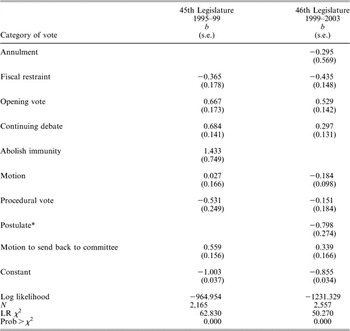
Table 3 shows the results of the first stage selection equation estimated as a probit model. Given that some categories of votes either always or never led to roll call votes, I had to drop some vote types and the corresponding observations. The same obviously also holds for all votes that are automatically published, which I eliminated from the present and all subsequent analyses.Footnote 28 The results clearly illustrate that some votes, like parliamentary initiatives or motions to send bills back to committees, are much more likely to be voted on in roll call votes than the base category of the probit analysis, namely votes on legislative details (i.e., particular articles of bills etc.). Some other types of votes also seem to be systematically more (or less) likely to be subject to roll calls, but this is not true of all legislatures.
Explaining Requests for Roll Call Votes

Note: Excluding automatically published votes.
*Parliamentary request demanding that the government examine whether a bill or another measure has to be taken on a particular topic.
The probit estimates allow us to determine the so-called Mills ratio, whose inverse HeckmanFootnote 29 has demonstrated to be an omitted variable in an equation subject to selectivity. Hence, I estimated a series of simple linear regressions in which the Rice index of party groups appeared as a dependent variable and the Mills ratio as one of the independent variables.Footnote 30 The other independent variables were either a constant, if I had used the Rice indices of one party group as the dependent variable, or a set of dummies for the party groups. Proceeding like this allows one to calculate predictions for the Rice indices under two assumptions.Footnote 31 Under the first assumption, the selection effect is the same for all party groups, while under the second one this effect may differ.
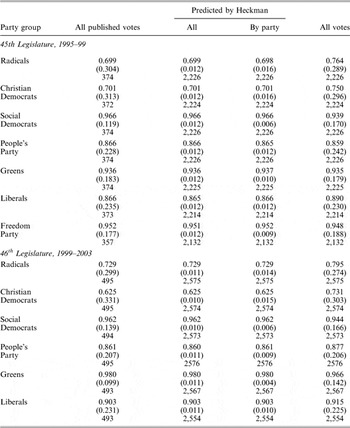
Table 4 reports these two sets of predicted Rice indices (columns 2 and 3) together with Rice indices for the requested roll call votes (column 1) and for the whole set of votes that are not automatically published (column 4). In the 45th legislature we note that the predicted Rice indices are closer to those based on all votes for four party groups if we assume that the selection effect is the same for all groups. More precisely, the values in column 2 are closer to those in column 4 than the Rice indices calculated on the basis of only the requested roll call votes (column 1).
Rice Index for 45th and 46th Legislatures

Note: Excluding automatically published votes. Entries for each party show Rice index, standard deviation and number of cases in party group.
This is the case for the Freedom party, the Greens, the Social Democrats and the People’s party. For the other party groups the corrections go in the wrong direction. Assuming that the effect of the Mills ratio may be party specific (column 3), the predicted values are closer to the true values for the Liberals and the People’s party. So it seems that the selection effects seem to work in the same direction for most of the party groups considered in the 45th legislature.
Turning to the 46th legislature, we find again that four predicted values approximate the true values better than the Rice indices based on the requested roll call votes assuming identical selection effects. In this legislature, these corrections work for the Christian Democrats, the Liberals, the Radicals and the People’s party. If we allow for party group specific effects for the Mills ratio we find also that four corrections go in the right direction, namely the ones for the Christian Democrats, the Liberals, the Socialists and the People’s party. Interestingly enough in this case, with the exception of the Christian Democrats, the corrections are substantially better if we assume party-group specific effects of the Mills ratio.
Given the sparseness of the empirical model estimated, the corrections I present in Table 4 are quite encouraging. For about half the Rice indices, the corrections based on the very simple Heckman model provide better estimates than the Rice indices calculated on the basis of the requested roll call votes. The fact that these corrections were calculated under the assumption of a selection effect common to all party groups suggests that a more precise theoretical model may improve the predictions based on the Heckman model even more. Especially, if it could be determined which party group had requested a roll call vote, much more precise estimates and corrections could be proposed. Clearly, an even harder test would be to estimate this model with an incidental truncation model, but elsewhere I have shown that quite a strong correlation between the error terms is required to make such a model a valuable alternative.Footnote 32 The results from the Heckman model used here suggest that this correlation is unfortunately not present in this case. Again, this is likely to be due to the sparseness of the empirical model for the selection equation.
Conclusion
Roll call votes are increasingly used in comparative studies of various aspects of legislatures. Such comparative work, however, should be carried out with caution because roll call votes occur under various institutional provisions. Since the institutional provisions restrict roll call votes in various ways or make them public only under particular circumstances, we need to worry about possible selection biases.
While Gabel and Carrubba and Carrubba et al.Footnote 33 were able to demonstrate that roll call votes in the European Parliament differ systematically along several dimensions from the remaining votes, I attempted to demonstrate the problems of selection bias by employing a unique data source. Relying on a dataset comprising information on all votes by MPs in the Swiss lower house for two legislative periods, I have demonstrated that for most parties requested roll calls and automatically published votes differ systematically in terms of party cohesion from the remaining votes that are not published. A simple selection model also shows that these biases may be corrected for, provided we have a reasonably well-specified empirical model for the selection equation.
Taken together with the theoretical argument concerning the requests for roll calls in the European Parliament by Carrubba and Gabel,Footnote 34 this clearly suggests that selection effects are very likely in roll calls, provided not all the votes are recorded and published. Hence, our research effort should address much more directly these issues of selection biases in roll call studies, especially in those with a comparative dimension. Neglecting these issues is likely to lead to biased inferences over important aspects of the legislatures studied.
APPENDIX TABLE A1
(See Table A1)
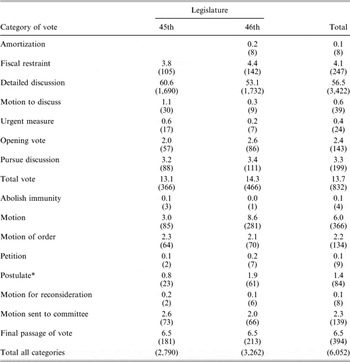
Types of Votes in 45th and 46th Legislatures, 1995–99 and 1999–2003 Respectively

Note: Entries for each category show percentage of total and number of votes in parentheses.
*Parliamentary request demanding that the government examine whether a bill or another
measure has to be taken on a particular topic.