The Global Entrepreneurship Monitor (GEM, 2013) report indicates that entrepreneurship is linked to the perception of opportunities, to orientation, to attitudes, to the fear of failure and to entrepreneurial motivations. Furthermore, the study suggests that the government authorities of the countries in the study should not only focus on providing enterprising people with external resources such as capital and easy financing terms, but they should also study their skills, their motivations and their experiences.
In the 1730s, Richard Cantillon used the French term “entrepreneur” to refer to people who undertake self-employment while also accepting an uncertain return. In subsequent years, entrepreneurs were also referred to as innovators of new ideas (Thomas Edison), individuals who find and promote new combinations of production factors (Bill Gates’ bundling of Microsoft’s products), and people who take advantage of opportunistic ideas to expand small enterprises (Mark Zuckerberg at Facebook). The underlying tenet of these conceptions of entrepreneurs is doing something new, as well as a sense that these individuals can make something of opportunities that others cannot (Certo, Moss, & Short, Reference Certo, Moss and Short2009).
Venkataraman (Reference Venkataraman, Katz and Brockhaus1997) stated that entrepreneurship as a field of study may be described as understanding how opportunities to bring into existence ‘future’ goods and services are discovered, created, and exploited, by whom, and with what consequence. Implicitly, this definition indicates that entrepreneurship applies to individuals in a variety of contexts.
Within this framework, a fundamental construct appears which explains entrepreneurship, entrepreneurial orientation (hereafter, EO). Today, emphasis has been placed on the importance of other aspects, such as attitudes (Oliver & Galiana, Reference Oliver and Galiana2015) and personal characteristics (Suárez, Pedrosa, García, & Muñiz, Reference Suárez, Pedrosa, García and Muñiz2014). The present research study has made use of other variables such as workaholism (driven and work enjoyment), irritation (emotional and cognitive) and burnout (exhaustion, cynicism and personal efficacy), given that both EO and entrepreneurial motivation were found to be significant in a previous paper (Boada-Grau, Sánchez-García, & Boada-Cuerva, Reference Boada-Grau, Sánchez-García and Boada-Cuerva2011). We have also used external constructs such as age, tenure in your present job, tenure in the profession, in line with what has already been proposed by Callaghan and Venter (Reference Callaghan and Venter2011).
The entrepreneurial orientation construct, which as Lumpkin and Dess (Reference Lumpkin and Dess1996, Reference Lumpkin and Dess2001) point out is multi-dimensional, has drawn considerable attention from researchers in recent years. This can be seen in the comprehensive meta-analysis carried out by Rauch, Wiklund, Lumpkin, and Frese (Reference Rauch, Wiklund, Lumpkin and Frese2009), in the reviews of the literature on EO (for example, Covin & Wales, Reference Covin and Wales2012; Edmond & Wiklund, Reference Edmond, Wiklund, Landstrom and Lohrke2010; Wales, Gupta, & Mousa, Reference Wales, Gupta and Mousa2013) and in the special issue Entrepreneurship Theory and Practice (Covin & Lumpkin, Reference Covin and Lumpkin2011) published on the subject.
In this sense, Lumpkin and Dess (Reference Lumpkin and Dess1996, pp. 136–137) consider that EO “refers to the processes, practices, and decision-making activities that lead to new entry” as characterized by one, or more of the following dimensions: “a propensity to act autonomously, a willingness to innovate and take-risks, and a tendency to be aggressive toward competitors and proactive relative to marketplace opportunities”. On the other hand, Pearce, Fritz, and Davis (Reference Pearce, Fritz and Davis2010, pp. 219) understand that EO to be “is conceptualized as a set of distinct but related behaviors that have the qualities of innovativeness, proactiveness, competitive aggressiveness, risk taking, and autonomy”.
So, it is clear that EO as a construct has been the source of a fair amount of controversy in the scientific literature, as it can be comprised of between two and nine different dimensions, depending on the researchers. Some consider EO to have two dimensions: Merz and Sauber (Reference Merz and Sauber1995), and Knight (Reference Knight1997) conceptualized EO as including only innovation and proactiveness, while Avlonitis and Salavou (Reference Avlonitis and Salavou2007) conceptualized EO as being composed of proactiveness and risk taking.
On the other hand, the original EO framework was first introduced by Miller (Reference Miller1983), who put forward three dimensions (innovation, proactiveness and risk-taking) for measuring entrepreneurship. These dimensions were also adopted by authors in later studies (Kreiser, Marino, & Weaver, Reference Kreiser, Marino and Weaver2002; Tarabishy, Solomon, Fernald, & Saghkin, Reference Tarabishy, Solomon, Fernald and Saghkin2005).
However, other authors (Bolton & Lane, Reference Bolton and Lane2012; Callaghan & Venter, Reference Callaghan and Venter2011; Hughes & Morgan, Reference Hughes and Morgan2007; Lumpkin & Dess, Reference Lumpkin and Dess1996, Reference Lumpkin and Dess2001; Rauch et al., Reference Rauch, Wiklund, Lumpkin and Frese2009) hold the view that EO has five independent dimensions that include autonomy, innovativeness, risk taking, proactiveness and competitive aggressiveness. Briefly, autonomy is defined as independent action by an individual or team with a view to coming up with a business concept (Lumpkin & Dess, Reference Lumpkin and Dess2001) and implementing it successfully (Bolton & Lane, Reference Bolton and Lane2012). Innovativeness is the predisposition to engage in creativity and experimentation through the introduction of new products/services (Lumpkin & Dess, Reference Lumpkin and Dess2001) as well as technological leadership via R&D in new processes (Bolton & Lane, Reference Bolton and Lane2012). Risk taking involves a tendency to take bold actions such as venturing into new and unknown markets (Lumpkin & Dess, Reference Lumpkin and Dess2001) and committing significant company resources to ventures in uncertain environments (Bolton & Lane, Reference Bolton and Lane2012). Competitive aggressiveness has to do with the intensity of one’s efforts to beat one’s rivals (Bolton & Lane, Reference Bolton and Lane2012), and is characterized by a combative stance and a forceful response to the actions of competitors (Lumpkin & Dess, Reference Lumpkin and Dess2001). Finally, proactiveness has an opportunity-seeking, forward-looking perspective characterized by devising new products and services ahead of the competition and acting in anticipation of future demand (Rauch et al., Reference Rauch, Wiklund, Lumpkin and Frese2009).
In keeping with the above, the present research study analyzes the adaptation into Spanish of Lee, Lim, and Pathak’s (Reference Lee, Lim and Pathak2011) Entrepreneurial Orientation Scale. The present scale is made up of our dimensions: autonomy, innovativeness, risk-taking and competitive aggressiveness. These are the most widely used dimensions in previous EO studies such as by Covin and Slevin (Reference Covin and Slevin1991), Gartner (Reference Gartner1989), Khandwalla (Reference Khandwalla1977) and Miller (Reference Miller1983). Furthermore, Belousova (Reference Belousova, Borch, Fayole, Kyör and Ljunggren2011) considers that these four dimensions are the ones that best define EO. Having said this, there are also other proposals such as, two dimension-based proposals (Avlonitis & Salavou, Reference Avlonitis and Salavou2007; Knight, Reference Knight1997; Merz & Sauber, Reference Merz and Sauber1995), three dimensions (Kreiser, Marino, & Weaver, Reference Kreiser, Marino and Weaver2002; Tarabishy et al., Reference Tarabishy, Solomon, Fernald and Saghkin2005) and five dimensions (Hughes & Morgan, Reference Hughes and Morgan2007; Rauch et al., Reference Rauch, Wiklund, Lumpkin and Frese2009). Therefore, the purpose of this research is to analyze the psychometric properties of the Spanish version of the Entrepreneurial Orientation Scale in a sample of Spanish employees, based on three objectives: (1) to analyze internal consistency, (2) to test the reliability of the instrument, and (3) to establish evidence of its validity.
Method
Participants
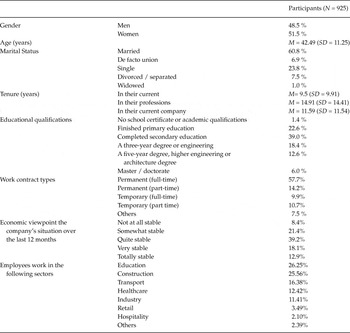
The study sample was made up of 925 employees from Spain. The characteristics of the sample are described in Table 1.
Sociodemographic characteristics of the participants

Instruments
The Entrepreneurial Orientation Scale (Lee et al., Reference Lee, Lim and Pathak2011) evaluates an individual’s orientation towards undertaking a professional or business activity. Based on the guidelines proposed by several different authors (Hambleton, Merenda, & Spielberger, Reference Hambleton, Merenda and Spielberger2005; International Test Commission, 2005), we first assessed the importance of the construct in a working population, given that no other scale currently exists in Spanish; second, we selected several native-speaker and bilingual translators as well as expert lecturers in entrepreneurialism with linguistic abilities in both languages (Spanish and English); we then carried out independent direct and back translations of the scale and tested the first Spanish version in a pilot study with 50 employees. This first study demonstrated that the instrument could be implemented in less than four minutes and allowed us to rectify some minor language-related issues. Lastly, we obtained information that would serve as evidence of the reliability and validity of the adapted scale. Accordingly, we used the list of 25 questions as a quality control measure for the translation-adaptation of the items proposed by Hambleton and Zenisky (Reference Hambleton, Zenisky, Matsumoto and van de Vijver2011).
The English version has 12 items and 4 factors, each factor having 3 items. The factors are: 1.- Autonomy (α = .67; for example, “I don’t want any financial support from my parents because I am now a grown up”), 2.-Innovativeness (α = .63; for example, “I enjoy working on new things, so I am usually up to date with recent trends and current fashions”), 3.- Risk Taking (α = .71; for example, “I think that starting up a new venture is the only way to succeed in life.”) and 4.-Competitive Aggressiveness (α = .73; for example, “Even if I launch new ventures and fail over and over again, I will keep on trying until I succeed”). The response format was a Likert 1 to 5 scale (1 = totally disagree to 5 = totally agree).
The Workaholism Scale (WorkBAT; McMillan, Brady, O’Driscoll, & Marsh, Reference McMillan, Brady, O’Driscoll and Marsh2002), in the Spanish version implemented by Boada-Grau, Prizmic-Kuzmica, Serrano-Fernández, and Vigil-Colet (Reference Boada-Grau, Prizmic-Kuzmica, Serrano-Fernández and Vigil-Colet2013) has 19 items and 2 subscales. The first subscale is “D (Driven)” (12 items; α = .82; for example, “I would often like not to be so involved with my work”), the second is “J (Work Enjoyment)” (7 items; α = .83; for example, “My work is so interesting that it often doesn’t seem like work”). The response format is a Likert 1 to 5 scale (From 1 = Totally disagree to 5 = Totally agree).
The Irritation Scale (Irritation Scale; Mohr, Müller, Rigotti, Aycan, & Tschan, Reference Mohr, Müller, Rigotti, Aycan and Tschan2006), in its Spanish version (Merino, Carbonero, Moreno, & Morante, Reference Merino, Carbonero, Moreno and Morante2006) has 2 factors (8 items). The first factor is Emotional irritation (5 items; α = .86; for example, “When other people talk to me I answer back rudely”). The second is “Cognitive irritation” (3 items; α = .87; for example, “I find it hard to switch off after work”). Responses were registered on a 7-point Likert scale (from 1.-Very much disagree to 7.-Very much agree).
The Spanish version of the Maslach Burnout Inventory-General Survey (MBI-GS; Salanova, Schaufeli, Llorens, Peiró, & Grau, Reference Salanova, Schaufeli, Llorens, Peiró and Grau2000) is made up of 15 items and 3 subscales. The responses were registered on a 6-point scale (ranging from “never” to “every day”). The subscales are: Professional Efficacy (6 items; α = .78) for example, “I have accomplished many worthwhile things in this job”), Cynicism (5 items; α = .85; for example, “I have lost enthusiasm for my job”) and Exhaustion (5 items; α = .87, for example, “I am ‘burnt out’ by the job”).
Finally, we also used a number of external correlates in order to measure the convergent validity (Boada-Grau, Sánchez-García, Prizmic-Kuzmica, & Vigil-Colet, Reference Boada-Grau, Sánchez-García, Prizmic-Kuzmica and Vigil-Colet2012) in the form of questions which the respondents were required to answer concerning certain sociodemographic aspects (for example, “Tenure in the profession”, “Feeling healthy”, etc.), the reasons for setting up their own company (for example, “To achieve personal success”, “To become more independent”, etc.) and the likelihood of starting up their own company in the next five years (for example, “Does the idea of setting up your own company appeal to you?”, “Would your friends support you if you set up your own company”, etc.).
Procedure
The sample was obtained through non probabilistic sampling, also known as random-accidental sampling (Kerlinger, Reference Kerlinger2001). We first of all obtained permission from the managers of the companies and organizations where the employees worked. We then contacted the employees and asked them to take part in the study. And finally, the scales were administered during working hours on an individual basis, while guaranteeing the confidentiality and anonymity of the data we obtained.
Data analysis
A Confirmatory Factorial Analysis was performed (hereafter, CFA) using the factor structure of the English version. This was done using the Exploratory Structural Equations Model (hereafter, ESEM) (Asparouhov & Muthén, Reference Asparouhov and Muthén2009) on the FACTOR Program (Lorenzo-Seva & Ferrando, Reference Lorenzo-Seva and Ferrando2006). The ESEM is an alternative to the traditional CFA put forward by Marsh, Liem, Martin, Morin, and Nagengast (Reference Marsh, Liem, Martin, Morin and Nagengast2011) due to the fit problems that one usually comes across when applying CFA to typical appraisal measures. This approach enabled us to incorporate the best features of the CFA, the structural equation models of Exploratory Factor Analysis (hereafter, EFA), and to combine them into a comprehensive framework thus adding flexibility to all their components (Marsh, Lüdtke, Nagengast, Morin, & Von Davier, Reference Marsh, Lüdtke, Nagengast, Morin and Von Davier2013). Briefly summing up, the ESEM (Morin, Marsh, & Nagengast, Reference Morin, Marsh, Nagengast, Hancock and Mueller2013) uses a measurement model based on an EFA with its corresponding rotation, to which a structural equations model is then applied, which combines the flexibility of the EFA with the possibility of obtaining the usual fit indices of structural equation models (Mai & Wen, Reference Mai and Wen2013). In this way it is possible to carry out analyses that confirm the factor structure proposed by a prior EFA, such as in the case we are dealing with, or even to perform more complex analyses such as for example factorial invariance analyses (Chahin, Cosi, Lorenzo-Seva, & Vigil-Colet, Reference Chahin, Cosi, Lorenzo-Seva and Vigil-Colet2010). The scale’s consistency as well as the validity coefficients were analyzed using the SPSS 20.0 program.
We also wanted to establish if the scales have bias related to sex. One possibility to analyze the presence of differential item functioning (DIF) is the use of multiple group mean and covariance structure (MACS) to detect it (Hernández & Gonzalez-Roma, Reference Hernández and González-Romá2003). This approach proposes a set of steps that first establishes the separate model fit for each group, and then tests the configurational invariance (the same number of constructs with the same indicators) model as a baseline model and finally tests different nested and more restricted models: Weak Invariance, represented by the equality of factor loadings and Strong Invariance which means that the indicator intercepts are equal (Byrne, Reference Byrne2008; Meredith, Reference Meredith1993). If the successive nested models do not imply a considerable reduction in model fit, and strong invariance is achieved, then it can be considered that the test gives the same score to individuals with the same true level in the latent variable assessed independently of their group, so the test do not show bias related to the grouping variable. If strong invariance is not achieved the consequence is that the test shows bias related to the grouping variable and it is necessary to analyze modification indexes in order to determine which items are showing DIF (Condon, Morales-Vives, Ferrando, & Vigil-Colet, Reference Condon, Morales-Vives, Ferrando and Vigil-Colet2006). To assess that the successive nested models do not implies a relevant decrease in model fit, we considered that there are not a decrease in model fit if the model do not implies a decrease in CFI greater than .01 in comparison with the previous tested model (Cheung & Rensvold, Reference Cheung and Rensvold2002).
Results
The CFA indices that were calculated were: the root mean square error of approximation (RMSEA ≤ .06), the comparative fit index (CFI ≥ .95) and the Tucker-Lewis index (TLI ≥ .95). Our results showed a good fit for the four-factor model given that the values for all three indices (RMSEA = .06; CFI = .97 and TLI = .95) were within the appropriate range. The one, two and three-factor models were rejected because they did not show a good fit.
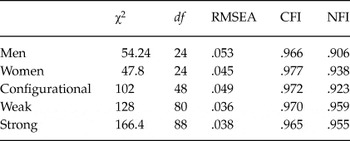
Table 2 shows the results obtained for the different models used to test the presence of bias related to sex in the EO. As can be seen the introduction of restrictions in the model (equal indicators, loadings and intercepts) do not imply a relevant decrease in the fit of the model so, it seems that the Entrepreneurial Orientation scale do not have bias related to sex.
Tests for invariance models of EOS for men and women

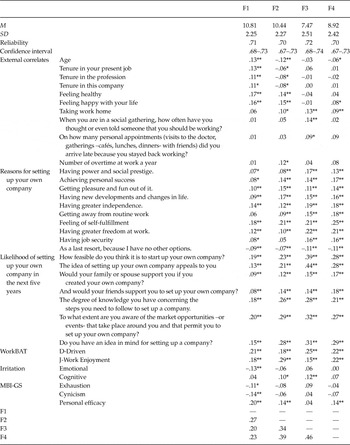
The entire sample was used in the creation of Table 3, which shows the mean, standard deviation, reliability, confidence interval and correlations for the four factors of the scale that we administered along with three contrast scales and 27 external correlates for the purpose of providing information about the validity indices. It also displays the reliability results for the four subscales, and the validity indices in the form of the significant correlations between the four factors and other variables.
Factors of the OE scale: Descriptive statistics, reliability, confidence intervals plus correlations with external variables and the factors of the WorkBAT, Irritation and MBI-GS scales, as well as the correlations matrix between the four factors and the scale under study

(F1.-Autonomy; F2.-Innovativeness; F3.-Risk Taking; F4.-Competitive Aggressiveness)
** p < .01; *p < .05.
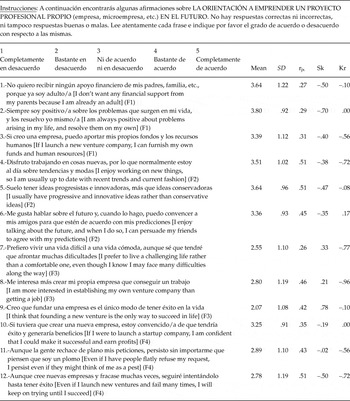
The items of the scale are shown in Table 4, which includes aspects like items, mean, standard deviation, item-total correlations, skewness and kurtosis.
The Spanish version of Entrepreneurial Orientation: Items, Mean, Standard Deviation (SD), item-total correlations (rjx), skewness (Sk) and kurtosis (Kr)

Discussion
In the present study we present the psychometric properties of the entrepreneurial orientation scale (Lee et al., Reference Lee, Lim and Pathak2011), which consists of 12 items. This scale enables us to evaluate an individual’s orientation towards undertaking a professional and/or start-up activity. Furthermore, this is the first time this scale has been presented in its Spanish language adaptation.
The first objective was achieved given that the CFA supports Lee et al.’s four-factor model (2011). This was confirmed by the resulting indices which showed a good fit of the model RMSEA = .06; CFI = .97 and TLI = .95). (Only an EFA was carried out in the original English version).
In the Spanish version, the first factor, Autonomy, is related to the rejection of parental and family support, a positive attitude towards problems, self-sufficiency in facing challenges and the contribution of one’s own resources in order to set up a business venture. It is made up of three items (numbers: 1, 2 and 3). The second factor, Innovativeness is made up of items 4, 5 and 6. It has to do with aspects such as enjoying working with new things, having innovative ideas and making future predictions. The third factor is Risk-Taking. It has to do with facing difficulties and an interest in creating and founding one’s own company. It consists of three items (numbers 7, 8 and 9). The last factor (Competitive Aggressiveness) is related to the conviction that one will be successful in setting up a company and to persevering despite previous failures. It is made up of items 10, 11 and 12.
We found the following he correlations between the four factors in the Spanish version: .27 (F1 and F2), .20 (F1 and F3), .23 (F1 and F4), .34 (F2 and F3), .39 (F2 and F4) and .46 (F3 and F4). This indicates that they are different dimensions because the association was moderate.
The third objective was also achieved because we found appropriate reliability for the four subscales in the Spanish version, which ranged from .70 to .72. Reliability, understood as consistency, is a measure of the homogeneity of the items in a test (DeVellis, Reference DeVellis2003) In Lee et al.’s (Reference Lee, Lim and Pathak2011) English version the reliability ranged from .69 to .71.
The three objective were verified given that we found indices of the scale’s validity. The correlations of the four subscales with the three contrast scales and various external criteria such as sociodemographic aspects, the reasons for setting up one’s own company and the likelihood of setting up one’s own company in the next five years showed some evidence of validity. Hence, we found significant correlations in the expected direction although these correlation coefficients indicated a low or moderate association. However, the sizes of these effects are quite typical in this domain. Mischel (Reference Mischel1968) Meyer et al. (Reference Meyer, Finn, Eyde, Kay, Moreland, Dies and Reed2001) have observed that correlations among variables rarely exceed .30 in this field of study.
The four factor correlated positively with the external correlates we employed, for example, “having power and social prestige”, “getting pleasure and fun”, “a feeling of personal self-fulfillment” and “having more freedom at work”. It should also be pointed out that the four factor correlated positively with workaholism. What is more, other positive correlations were found with cognitive irritation and personal efficacy. However, one correlate (“as a last resort, because I have no other options”) displayed a negative association with the four factors. Other variables that showed a negative correlation were age and tenure. In addition, cynicism, burnout and emotional irritation correlated inversely with Autonomy. It should be mentioned that Lee et al.’s version (Reference Lee, Lim and Pathak2011) did not provide data on validity indices.
To sum up, after looking at the results of the present research study we can safely say that the Spanish version of the Entrepreneurial Orientation Scale presents acceptable psychometric properties and may prove useful for evaluating the construct in question in both women and men. It is made up of 12 items and 4 factors, shows suitable reliability and has yielded strong evidence of validity.
The findings of this study have significant practical implications. The scale used here may be useful for public bodies in evaluating the entrepreneurial orientation of candidates in public competitions for setting up companies or initiating business activities. However, these findings need to be replicated with university students, entrepreneurs and business owners given that the present study was conducted with a sample of employees and workers. And finally, further research is also needed to look into whether variables such as creativity, proactiveness, risk-taking, and family culture, as well as other variables, may be moderators of entrepreneurial orientation.
This study has various limitations. In the first place, the use of the self report may have led to a higher association between the variables due to the variance from the common method (Podsakoff, MacKenzie, Lee, & Podsakoff, Reference Podsakoff, MacKenzie, Lee and Podsakoff2003). Nevertheless, the self-reporting has been widely used in studies into entrepreneurial orientation (Lee et al., Reference Lee, Lim and Pathak2011; Lumpkin & Dess, Reference Lumpkin and Dess2001). In addition, a cohabitation sample was used. These types of cohabitation samples are very frequently used in creating scales in the psychological sciences (International Test Commission, 2005) and in entrepreneurial orientation research studies (Lee et al., Reference Lee, Lim and Pathak2011; Lumpkin & Dess, Reference Lumpkin and Dess2001). According to Highhouse and Gillespie (Reference Highhouse, Gillespie, Lance and Vandenberg2008) the use of cohabitation samples does not constitute a substantial threat to the validity of the study. This type of sampling is often chosen due to practical, financial and logistical limitations. And finally, transcultural studies need to be undertaken (Lee et al., Reference Lee, Lim and Pathak2011) both in different Spanish speaking countries as well as in other population groups such as, for example, university students (Bolton & Lane, Reference Bolton and Lane2012).
The present study was made possible thanks to the collaboration of Authors Assistants.