Introduction
There were an estimated 1.7 million hip fractures worldwide in 1990. With population aging, this figure will increase to 6 million annually by 2050 if age specific incidence remains constant. About 2 million of these hip fractures will occur in the Asian region (WHO, 2003).
It is difficult to disentangle the consequences of hip fracture from the high levels of antecedent morbidity and disability of those in whom they occur. Nevertheless, studies designed to address this question indicate that hip fracture results in more than a doubling of subsequent death rates (Empana et al., Reference Empana, Dargent-Molina and Breart2004) mainly within the first 6 months after the fracture (Robbins et al., Reference Robbins, Biggs and Cauley2006). About one-quarter of formerly independent people become at least partially dependent, with 20% consequently requiring some form of assisted living. (Cooper, Reference Cooper1997) About one-quarter of hip fractures result in permanent lower-body disability that would not have otherwise occurred (Magaziner et al., Reference Magaziner2003). The mean functional decline attributable to a hip fracture after one year is 24%, with a commensurate attributable decline in quality of life (Boonen et al., Reference Boonen, Autier, Barette, Vanderschueren, Lips and Haentjens2004).
Since surgical treatment is generally effective and many patients recover well, these data can also be interpreted to indicate that the major burden and post hospital cost of hip fractures is borne by a minority of cases, albeit a substantial minority. Hence there is potentially significant utility in identifying those at increased risk of death and/or functional and quality of life decline following a hip fracture, and of introducing selective and focused intervention trials.
Although a huge number of studies have provided good evidence to indicate that specific and potentially modifiable physical comorbidity are associated with hip fracture outcomes, only a small number of reports suggest that mood and cognitive disorders in the form of depression or cognitive impairment are associated with excess mortality or poor functional outcomes (Cooper Reference Cooper1997; Wolinsky et al., Reference Wolinsky, Eitzgerald and Stump1997; Holmes and House, Reference Holmes and House2000; Nightingale et al., Reference Nightingale, Holmes, Mason and House2001; Lenze et al., Reference Lenze2004).
Very few studies have investigated the effects of combined depressive symptoms and cognitive impairment. This combination was reported to impact negatively on survival following hip fracture rehabilitation (Bellelli et al., Reference Bellelli, Frisoni, Turco and Trabucchi2008), and combinations of preoperative and peri-operative cognitive impairment, depressive symptoms and delirium were reported to be associated with adverse functional outcomes (Givens et al., Reference Givens, Sanft and Marcantonio2008). No studies have examined the impact of combinations of depression and cognitive impairment at the time of entry to a hip fracture rehabilitation program.
The aim of this study was to examine the individual and combined influence of cognitive impairment and depression on mortality, mobility, disability and quality of life during 12 months of follow-up among hip fracture patients admitted to a rehabilitation hospital in Singapore.
Methods
Patients
We conducted a prospective study of hip fracture patients in a rehabilitative care facility (St Luke's Hospital) in Singapore that included a randomized controlled trial of a care path management. Patients who were selected for the study were fully ambulatory before their hip fracture, were not referred from a nursing home, and were non-palliative care patients. Following informed consent for participation in the study, a total of 162 eligible consecutive patients were enlisted into the study. They were randomly allocated into the care path group (intervention) or conventional management group (control) and followed up for 1 year post admission. Baseline data were obtained through case records review and assessment scales were administered in face-to-face interviews with patients at admission. Follow-up interviews were conducted with patients at discharge, 6 months and 12 months post-hospital admission. In the present study, we analyzed the data for 146 patients who received surgical treatment and for whom complete data were available on admission baseline psycho-cognitive status. Trained research nurse interviewers interviewed eligible patients. Ethical approval for the trial was obtained from the hospital management committee.
Measures
Functional status
The Modified Barthel Index (MBI) is a 10-item questionnaire used to assess independence in activities of daily living (ADLs) (Shah et al., Reference Shah, Vanclay and Cooper1989a). It has been shown to have a higher content reliability and internal consistency (Keith, Reference Keith1988; Shah et al., Reference Shah, Vanclay and Cooper1989b). A summary score was computed by adding the point of each single item. Possible scores range from 0 to 100, with a higher score indicating greater independence in ADLs.
Ambulatory status was determined based on functional walking categories defined by Perry et al. (Reference Perry, Garrett, Gronley and Mulroy1995). It includes six walking categories, each of which was characterized according to observation of the participants’ ambulation, including the walking-speed test. The ambulatory status was used as a continuous variable in this study.
Quality of life
Quality of life was assessed by SF-12, a shorter alternative to the SF-36, and its reliability and validity have been documented (Ware et al., Reference Ware, Kosinski and Keller1996). Summary measures (PCS-12/MCS-12) were calculated using the standard SF-12 items and U.S. regression weights (Ware et al., Reference Ware, Kosinski and Keller1998). Scores were transformed to have a mean of 50 and standard deviation of 10 in the U.S. general population, which is the recommended scoring to ensure inter-country comparability (Gandek et al., Reference Gandek1998). Quality of life was determined only at 6 months and 12 months after admission.
Mood and cognitive status
Depressive symptoms. The presence of depressive symptoms was assessed using the 15-item Geriatric Depression Scale (GDS-15) (Yesavage, Reference Yesavage1988), which has been validated for use in local Chinese, Malay and Indian subjects (Lim et al., Reference Lim, Ng, Chiam, Ong, Ngui and Sahadevan2000; Broekman et al., Reference Broekman2008; Nyunt et al., Reference Nyunt, Fones, Niti and Ng2009) The internal reliability coefficient (Cronbach's α) was 0.84. GDS was assessed within 72 hours of admission. The presence of depressive symptoms was defined by a GDS score ≥5.
Cognitive impairment. Global cognitive function was measured by the Mini-mental State Examination (MMSE) (Folstein et al., Reference Folstein, Folstein and McHugh1975). The local translated versions of the instrument has been validated for local use among Singaporean older adults (Ng et al., Reference Ng, Niti, Chiam and Kua2007), with the conventional cutoff of 23/24 used to determine cognitive impairment.
Delirium. Delirium was assessed by a modified version of the Confusion Assessment Method (CAM) (Inouye et al., Reference Inouye, Dyck, Alessi, Balkin, Siegal and Horwitz1990). In our study, delirium was de fined as positive if inattention and either acute onset or fluctuating course and either disorganized thinking or altered level of consciousness was present.
Chronic medical conditions
Chronic medical conditions at admission were obtained from medical charts and included diabetes, hypertension, stroke, dementia, congestive cardiac failure, ischemic heart disease, COPD and arthritis. A modified Charlson comorbidity scale was created that excluded dementia and hypertension as disease conditions (Charlson et al., Reference Charlson, Pompei, Ales and MacKenzie1987).
Complications
Data on complications associated with hip fracture during the hospital stay were obtained by questionnaire. They included pain, deep vein thrombosis, anemia, wound/pressure ulcer, depression, delirium, constipation, urinary retention, malnutrition, osteoporosis, chest infection/UTI. The number of complications was calculated by aggregating positive responses (excluding depression and delirium).
Other medical information
Other information was obtained from medical records at admission and included age, gender, type of fracture, time from hip structure to admission, time from hip fracture to surgery, and length of stay in St Luke's Hospital.
Statistical analysis
In order to examine the impact of psycho-cognitive status at admission on the study outcomes, each patient's mood and cognition status was classified into four groups: (i) neither depressed nor cognitively impaired, (ii) depressive symptoms alone, (iii) cognitive impairment alone, and (iv) combined depressive symptoms and cognitive impairment.
For each outcome of functional status and quality of life, analysis of variance (ANOVA) was first used to examine the group distribution of these outcome scores at each assessment. The general linear mixed model using the MIXED procedure in SAS (SAS Institute, Cary, NC) was used to examine the association of psycho-cognitive factors with functional status and quality of life. The basic model consisted of mood and cognition status at admission, time since admission and interaction between mood and cognition status and time. Interaction was reported only when it was significant. Covariates that were adjusted for in all models included age, gender, fracture type, interventional type, Charlson comorbidity index, number of complications, time from hip fracture to surgery, and length of stay in rehabilitation center. For mortality and quality of life outcomes, we further controlled for MBI score at admission.
Survival analysis was used to examine the relative risk of mortality during the 12 months after admission for patients with depressive symptoms alone, cognitive impairment alone, and combined depressive symptoms and depression at admission. Owing to the small number of deceased subjects, we recoded the four groups into two groups: (i) neither depressed nor cognitively impaired and (ii) depressed and/or cognitively impaired. Cox proportional hazard models were used to determine the hazard ratios of association with the psycho-cognitive status.
We also repeated all the analyses using MMSE and GDS scores instead of one categorical variable. Since we wanted to examine the effect of comorbid cognitive impairment and depression on hip fracture outcomes, the interaction term between MMSE and GDS scores was added into each model. All analyses were performed using SAS software. (SAS Institute, Inc., Cary, NC)
Results
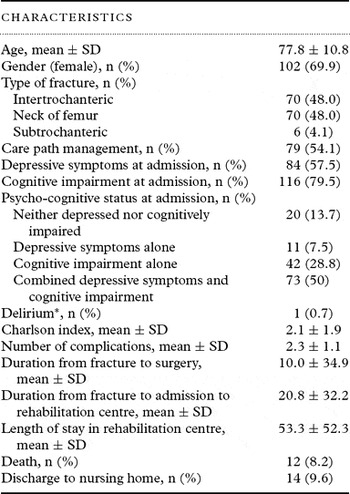
The characteristics of the 146 patients at admission are reported in Table 1. Their mean (SD) age was 77.8 (10.8) years; about 70% were female; and nearly half of them had a fracture of the femoral neck. At admission, 7.5% had depressive symptoms alone (GDS ≥ 5), 28.8% had cognitive impairment alone (MMSE ≤ 23), 50% had both depressive symptoms and cognitive impairment, and 13.7% had neither. Only one patient (0.7%) was diagnosed with delirium. The mean (SD) Charlson index score was 2.1 (1.9), and the mean (SD) number of complications was 2.3 (1.1). After their hip fracture, patients waited an average (SD) of 10 days (34.9) before surgical treatment, 20.8 days (32.2) before being admitted to a rehabilitation center, and the mean length (SD) of stay in the rehabilitation center was 53.3 days (52.3). Twelve (8.2%) patients died during the follow-up and 14 (9.6%) were discharged to nursing homes.
Characteristics of the respondents at admission and during follow-up (N = 146)

*The patient with delirium was also cognitively impaired.
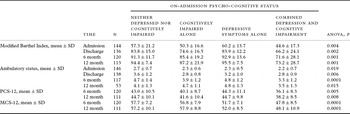
Table 2 shows unadjusted means of functional outcomes and quality of life by mood and cognition status at each time point. There were significant differences in the mean scores of MBI and ambulatory status among the four patient groups by mood and cognition status at each time point, and the functional scores increased over time in all the four groups. Similarly, significant group differences were also observed at 6 months and 12 months in both summary components of SF-12.
Distribution of functional status and quality of life in terms of on-admission psycho-cognitive status at each assessment

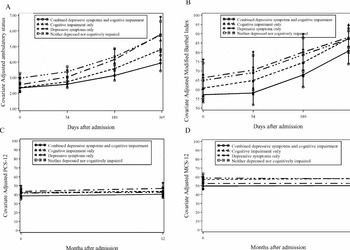
The results from the linear mixed models are illustrated in Figure 1. Ambulatory status tended to improve over time in all mood and cognition groups (β = 0.008, SE = 0.001, P = 0.0001 for time; see Figure 1A). Patients who had cognitive impairment alone (β = −0.60, SE = 0.18, P = 0.001) and patients who had combined cognitive impairment with depressive symptoms (β = −0.62, SE = 0.17, P = 0.0003) showed significantly lower ambulatory status than patients who were free of depressive symptoms and cognitive impairment (reference group) over the follow-up. Additionally, there was a significant interaction between time and combined depressive symptoms and cognitive impairment (β = −0.003, SE = 0.001, P = 0.021 for the interaction term) with ambulatory status, indicating less improvement in the ambulatory score of patients who had combined cognitive impairment and depressive symptoms versus patients with none (Figure 1A).
Change in function and quality of life over 1 year after admission by psycho-cognitive status.

For MBI, significant main effects of time and combined depressive symptoms and cognitive impairment were found. The MBI score improved over time in all four groups (β = 0.08, SE = 0.005, P = 0.0001), though the rates of improvement were similar (P = 0.390 for time × mood-cognition group interaction; see Figure 1B). Patients with combined depressive symptoms and cognitive impairment (β = −10.92, SE = 4.01, P = 0.007) had a significantly lower MBI score compared to those who were free of both depressive symptoms and cognitive impairment (reference group).
In terms of quality of life, although the PCS-12 score significantly increased from 6 months to 12 months (β = 1.77, SE = 0.59, P = 0.003 for time), it was not affected by mood or cognitive status (Figure 1C). Conversely, MCS-12 did not improve over the follow-up. However, patients who had combined depressive symptoms and cognitive impairment had a significantly lower MCS-12 score (β = −8.35, SE = 2.37, P = 0.0006) than those who were free of depressive symptoms or cognitive impairment (Figure 1D).
The results of the Cox-regression analysis of the association of psycho-cognitive status with mortality (Table 3) indicate that mood and cognitive status did not significantly predict mortality during the follow-up. Transfer to nursing home was another outcome of interest in this study; however, this was not analyzed due to there being no nursing home stays in the reference category of patients (those free of depressive symptoms and cognitive impairment).
Unadjusted and adjusted* associations (hazard ratio) of mood and cognitive status at admission with mortality.

*Adjusted for age, gender, fracture type, interventional type, Charlson comorbidity index, number of complications, time from fracture to surgery, length of stay in rehabilitation centre, Modified Barthel Index at admission.
†Total number of participants
‡Number of participants who died during the follow-up.
Overall, neither the intervention type nor its interaction with psycho-cognitive status affected the outcomes. In alternative analyses, we also treated GDS and MMSE scores as continuous variables and obtained similar findings for all the study outcomes.
Discussion
This Singaporean post hip-fracture cohort showed a high prevalence of depressive symptoms (57.5%) and cognitive impairment (79.5%), with only 13.7% of the cohort being free of both conditions. Other studies have also reported high prevalence rates, although they range widely for depression (9–47%) and cognitive impairment (31–88%) (Holmes and House, Reference Holmes and House2000). These high prevalence rates may, in part, be a function of age-related increases in the prevalence of hip fracture, cognitive impairment and depression in the community, and the multiple associations between hip fractures, cognitive impairment and depression. The Singapore hip fracture cohort comprised post acute patients in rehabilitative care in one community stepped care hospital and may have a particularly high prevalence because of selection characteristics including survivor status and referral selection criteria.
Also remarkable is the high degree of concurrence of these morbidities with combined depression and cognitive impairment affecting fully 50% of subjects. Few previous studies have reported the prevalence of comorbid depression and cognitive impairment in hip fracture patients. Givens et al. (Reference Givens, Sanft and Marcantonio2008) reported a 59% prevalence of at least one cognitive or mood disorder, with significant overlap including a 32% prevalence of combined cognitive impairment and depression, although in that study most of the cognitive and depression assessments were performed pre-operatively or peri-operatively and included a high prevalence of delirium.
In keeping with a number of studies (Cooper Reference Cooper1997; Wolinsky et al., Reference Wolinsky, Eitzgerald and Stump1997; Holmes and House, Reference Holmes and House2000; Nightingale et al., Reference Nightingale, Holmes, Mason and House2001; Lenze et al., Reference Lenze2004), our subjects who had either cognitive impairment or depression demonstrated greater functional reduction in a few isolated outcome measures compared to those without any mood or cognitive conditions. However, subjects with combined cognitive impairment and depression demonstrated functional reduction in multiple outcome measures. In terms of independence for activities of daily living, patients with combined depressive symptoms and cognitive impairment had significantly poorer performance over time, compared to the reference group without depressive symptoms and cognitive impairment, whereas the groups with depressive symptoms or cognitive impairment alone did not differ significantly from the reference group.
In terms of ambulation, patients in the combined group also showed a significantly reduced degree of improvement in ambulatory status compared to the reference group, whereas cognitive impairment alone – but not depression alone – was associated with poorer ambulatory status outcomes. In terms of quality of life measures, the group with combined depressive symptoms and cognitive impairment demonstrated significantly lower MCS-12 scores compared to patients without depressive symptoms and cognitive impairment.
The 12-month mortality rate of 8.2% in our study appears low by comparison with previous reports, which are often of the order of 25% both internationally (Lu-Yao et al., Reference Lu-Yao, Baron, Barrett and Fisher1995) and in Singapore (Wong et al., Reference Wong, Arjandas, Ching, Lim and Lo2002). However, our 12-month follow-up covered a period beginning at the date of transfer to a rehabilitation center and so does not include deaths occurring in the acute hospital. Deaths following hip fracture are known to be weighted early in the post-fracture period, with an acute hospital mortality rate of 5.7% (Wong et al., Reference Wong, Arjandas, Ching, Lim and Lo2002) and subsequent cumulative mortality rates of 7% at 1 month and 13% at 3 months (Lu-Yao et al., Reference Lu-Yao, Baron, Barrett and Fisher1995). In the current study, all patients were required to be medically stable at the time of transfer from the acute hospital. This accounted for the long length of acute hospital stay (mean 20.8 days) prior to transfer.
Eight of the 12 deaths in our subjects occurred among the group with combined depression and cognitive impairment but there was no significant statistical association between groups and mortality. This differs from the study of Givens et al. (Reference Givens, Sanft and Marcantonio2008), which showed that combined psychological and cognitive morbidity was predictive of mortality, because the setting and time course differed in the two studies. As noted above, in that study, depression and cognitive impairment were assessed pre- and peri-operatively and included a high number of cases of delirium. There is also evidence that the confluence of mortality and functional outcomes following hip fracture should not necessarily be expected since they may be related to differing sets of underlying patient and treatment variables (Hannan et al., Reference Hannan2001), transfer and the low rate of delirium (only one case) in our cohort.
The study has some limitations. A main limitation is related to the long average duration from hip fracture event to admission to the rehabilitation center. The subjects in this study therefore represent a selected medically stable population with low severity of risk profiles, and low rates of mortality, delirium and widespread functional gain. Therefore, these findings are unique to a rehabilitation care setting and do not apply generally to all patients with hip fracture.
Another limitation is the small sample size in subgroups such as “neither depressed nor cognitively impaired”, and “depressive symptoms alone”. Also, depression was assessed by GDS, which is not the same as a medical diagnosis of depression. However, GDS has been validated in local populations in Singapore and demonstrated to have high (over 80%) sensitivity and specificity in detecting major depression (Lim et al., Reference Lim, Ng, Chiam, Ong, Ngui and Sahadevan2000; Broekman et al., Reference Broekman2008; Nyunt et al., Reference Nyunt, Fones, Niti and Ng2009).
Our findings suggest that the identification of hip fracture rehabilitation patients with combined psychological and cognitive morbidity is important for improved care outcomes. There are data to indicate that hip fracture rehabilitation outcomes in groups with cognitive impairment can be enhanced through targeted or intensive rehabilitation programs (Huusko et al., Reference Huusko, Karppi, Avikainen, Kautiainen and Sulkava2000; Moseley et al., Reference Moseley, Sherrington, Lord, Barraclough, George and Cameron2009). However, there is an absence of evidence about effective interventions for combined psycho-cognitive morbidity following hip fracture. Treatment of depression in older hospital inpatients, even in the absence of cognitive impairment, has shown disappointing results in trials of medication against placebo (Evans et al., Reference Evans, Hammond, Wilson, Lye and Copeland1997), and a recent controlled study of multimodal interventions for depression in a hip fracture cohort failed to demonstrate any benefit in terms of functional outcomes (Burns et al., Reference Burns2007).
In conclusion, the results of this study in Singapore add weight to the growing evidence of very high rates of psycho-cognitive morbidity and comorbidity in hip fracture rehabilitation patients and provide new evidence that the combination of cognitive impairment and depression at the start of rehabilitation may be a more significant predictor of poor functional and quality-of-life outcomes than the presence of cognitive impairment or depression alone.
Conflict of interest
None.
Description of authors’ roles
Liang Feng performed the literature review, analyzed the data, and drafted and revised the manuscript. Samuel C. Scherer formulated the hypothesis, performed the literature review, drafted and revised the manuscript. Boon Yeow Tan, Gribson Chan and Ngan Phoon Fong designed the study, interpreted the results and reviewed the manuscript. Tze-Pin Ng conceptualized the study, formulated the hypothesis, interpreted the results, and reviewed and revised the manuscript.
Acknowledgments
We thank Ms Susie Goh, Dr Chong Tsung Wei, Ms Agnes Hew, Ms Tan Lee Ling and Ms Kung Beng Keng, who were in the original hip fracture trial group at St Luke's Hospital, for their help and cooperation in making this study possible.