Emotional valence and arousal are generally considered the two dimensions that define the structure of emotion (Feldman Barrett & Russell, Reference Barrett and Russell1999; Reisenzein, Reference Reisenzein1994; Russell, Reference Russell2003). Valence describes the extent to which an emotion is pleasant or unpleasant (positive, negative), whereas arousal refers to its degree of activation, that is, how exciting, agitating, or otherwise calming an emotion is perceived (Feldman Barrett & Russell, Reference Barrett and Russell1999). Despite the utility of these dimensions in affect research (Russell, Reference Russell2003), several issues remain unresolved. For example, it is not clear whether these dimensions are distinct. Moreover, no consensus has been achieved on the relation between positive and negative affect. For example, it is not known whether these represent distinct aspects or bipolar opposites of the same continuum (Feldman Barrett & Russell, Reference Barrett and Russell1999).
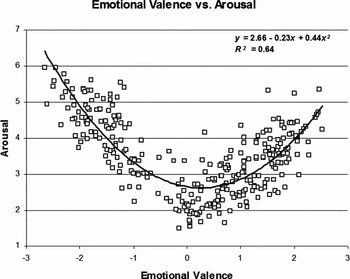
The relationship between emotional valence and arousal can be represented by a U-shaped function, whereby emotionally valenced words (positive and negative) are higher in arousal compared to neutral words (Bradley & Lang, Reference Bradley and Lang1999; Kanske & Kotz, Reference Kanske and Kotz2010; Võ et al., Reference Võ, Conrad, Kuchinke, Urton, Hofmann and Jacobs2009). Although arousal is intrinsically associated with valence (Kissler, Herbert, Peyk, & Junghofer, Reference Kissler, Herbert, Peyk and Junghofer2007; Scott, O'Donnell, Leuthold, & Sereno, Reference Scott, O'Donnell, Leuthold and Sereno2009), several models of emotion assume that valence and arousal are distinct variables (Reisenzein, Reference Reisenzein1994; Russell, Reference Russell2003). Support for this assumption comes from behavioral and neuroimaging research on emotion word processing (Lewis, Critchley, Rotshtein, & Dolan, Reference Lewis, Critchley, Rotshtein and Dolan2007). For example, Lewis et al. (Reference Lewis, Critchley, Rotshtein and Dolan2007) reported a double dissociation in brain activation between emotional valence and arousal during word processing. The amygdala was sensitive to arousal, whereas activation in the orbitofrontal cortex was influenced by emotional valence. Furthermore, different subregions of the orbitofrontal cortex were modulated by increasing positive or negative valence, apparently supporting a characterization of valence in terms of independent axes (positive, negative), rather than a bipolar continuum.
Emotional variables have an effect on single-word recognition during a variety of cognitive tasks including lexical decision (LD), valence judgment, silent reading, emotional Stroop, and self-referential judgment (Estes & Verges, Reference Estes and Verges2008; Kanske & Kotz, Reference Kanske and Kotz2007; Kissler et al., Reference Kissler, Herbert, Peyk and Junghofer2007; Larsen, Mercer, & Balota, Reference Larsen, Mercer and Balota2006; Lewis et al., Reference Lewis, Critchley, Rotshtein and Dolan2007; Scott et al., Reference Scott, O'Donnell, Leuthold and Sereno2009; Võ, Jacobs, & Conrad, Reference Võ, Jacobs and Conrad2006). Studies employing carefully controlled material generally report a different pattern of processing for emotionally valenced words compared to neutral words: valenced words are responded to faster than neutral words. Nevertheless, other studies found differences between positive and negative words depending on the task at hand, that is, slower LD latencies but faster valence judgments for negative words compared to positive words (Estes & Verges, Reference Estes and Verges2008), or a general slow-down effect for negative words when presented in a unique block, but not when intermixed with positive words, suggesting a carry-over effect of negative valence (Algom, Chajut, & Lev, Reference Algom, Chajut and Lev2004).
The manipulation of single emotion words has been employed in studies investigating emotion processing during text comprehension by means of short stories describing events and the subsequent emotional reaction of the protagonist. These texts typically consist of a context sentence (or paragraph) and a following target sentence containing an emotion word, which matches or mismatches the context (consistency paradigm; Gernsbacher, Goldsmith, & Robertson, Reference Gernsbacher, Goldsmith and Robertson1992). Texts containing emotional information are processed in a qualitatively different way than are texts containing chronological information (Ferstl, Rinck, & von Cramon, Reference Ferstl, Rinck and von Cramon2005): processing of emotional aspects of stories specifically activated the ventromedial prefrontal cortex and the amygdala, whereas processing of chronological aspects involved a bilateral frontoparietal network and the left precuneus.
We know that word recognition is influenced by a myriad of lexicosemantic features including word length, frequency, familiarity, age of acquisition (AoA), imageability, and concreteness, all of which predict word naming and LD latencies (Balota, Cortese, Sergent-Marshall, Spieler, & Yap, Reference Balota, Cortese, Sergent-Marshall, Spieler and Yap2004). These variables need to be taken into account and controlled when manipulating affective variables; otherwise, their effects on performance might be confounded with lexicosemantic effects, as was the case in many studies using the emotional Stroop task (for a review, see Larsen et al., Reference Larsen, Mercer and Balota2006). The same is true for studies manipulating lexicosemantic features; for example, abstract words seem to have more affective associations compared with concrete words (Kousta, Vigliocco, Vinson, Andrews, & Del Campo, Reference Kousta, Vigliocco, Vinson, Andrews and Del Campo2011).
Norms for lexicosemantic variables are usually strongly correlated, making it difficult to attribute variability in word recognition to any one dimension alone (Cutler, Reference Cutler1981); for example, word frequency and AoA are correlated (e.g., Juhasz, Reference Juhasz2005), as are concreteness and imageability (e.g., Paivio, Yuille, & Madigan, Reference Paivio, Yuille and Madigan1968). The quadratic (U-shaped) relationship between affective variables suggests that emotion variables may be unitized into a single cluster. It is also possible, however, that each affective variable will be correlated with different lexicosemantic features.
To date, only a few studies have investigated the relationship between affective and nonaffective word properties. Scott et al. (Reference Scott, O'Donnell, Leuthold and Sereno2009) found early interactions between word frequency and valence in event-related potential components, whereby high-frequency valenced words showed larger amplitude in the P1, N1, and early posterior negativity components compared to high-frequency neutral words. The same authors, as well as Kuchinke, Võ, Hofmann, and Jacobs (Reference Kuchinke, Võ, Hofmann and Jacobs2007), reported faster LD latencies for valenced words over neutral ones only for low-frequency words; high-frequency words, instead, showed faster LD latencies for positive stimuli over negative and neutral stimuli. Nakic, Smith, Busis, Vythilingam, and Blair (Reference Nakic, Smith, Busis, Vythilingam and Blair2006) found very low inferior frontal cortex activation for highly frequent negative words, but still significant for highly frequent neutral words, suggesting facilitated processing for the former and thus no need to recruit this region. Overall, these findings suggest that very salient emotional stimuli are prioritized and more easily processed; their salience cannot be attributed to a single variable but to a combination of variables (high frequency, high arousal, and positive valence), where affective dimensions have interactive contributions.
Knowing exactly which variables correlate with arousal and valence would be informative to the question of whether emotion is a distinct cluster whose effects on performance cannot be simply accounted for by the well-known lexicosemantic predictors.
This question has been partially investigated in previous studies. For example, in order to manipulate the affective and lexicosemantic features of single words, experimenters used large word corpora that include information on features such as length and frequency (CELEX; Max Planck Institute for Psycholinguistics, 2001), and subjective ratings of word properties from naive participants on features such as word familiarity, AoA, and imageability. Extant databases in English do not include ratings of emotion variables (Bird, Franklin, & Howard, Reference Bird, Franklin and Howard2001; Medical Research Council [MRC] database, Coltheart, Reference Coltheart1981; The Bristol Norms, Stadthagen-Gonzales & Davis, Reference Stadthagen-Gonzales and Davis2006), and corpora with affective ratings do not include ratings of lexicosemantic features (Affective Norms for English Words [ANEW]; Bradley & Lang, Reference Bradley and Lang1999). Therefore, nothing is known about the correlations between emotion ratings and lexicosemantic variables. One consequence of this gap is that experimenters must retrieve ratings for the same word from different corpora, which often do not overlap in terms of words sampled and scales used. For example, according to Kousta, Vinson, and Vigliocco (Reference Kousta, Vinson and Vigliocco2009), rated AoA and imageability for English words are available for only about a third of the words contained in the ANEW database.
The primary aim of the present study was therefore to generate a corpus of English words suitable for experiments investigating effects of affective as well as lexicosemantic features on single word recognition and on text comprehension. To ensure homogeneous evaluations across words and variables, 300 words were rated in a within-subjects design for emotional valence, arousal, familiarity, AoA, and imageability. The reliability of the results was tested against extant ratings from other corpora. Imageability was chosen, rather than concreteness, as the former feature has repeatedly been shown to better reflect human picturing activity compared to the latter one, in particular with respect to highly imageable abstract words and emotion words (Altarriba & Bauer, Reference Altarriba and Bauer2004; Paivio et al., Reference Paivio, Yuille and Madigan1968).
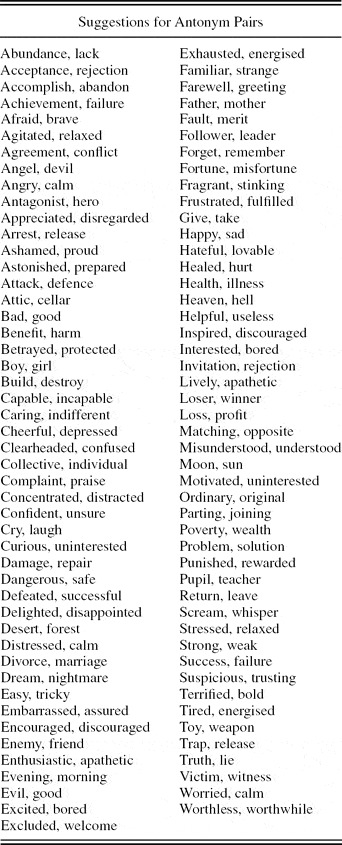
The corpus includes approximately 100 neutral words to allow comparison between valenced and nonvalenced items. A subset of words comprised adjectives denoting emotions (e.g., happy, sad, indifferent), which are useful for creating texts describing emotional reactions of the protagonists. Possible pairs of antonyms were included for the emotion word subset as well as for other words (i.e., delighted–disappointed, abandon–adopt; see Appendix A), in order to aid the construction of texts for consistency paradigms (Ferstl et al., Reference Ferstl, Rinck and von Cramon2005; Gernsbacher et al., Reference Gernsbacher, Goldsmith and Robertson1992).
The second aim of the study was to explore whether affective variables are correlated with lexicosemantic ones or whether they form a distinct cluster. The latter case would confirm that emotion effects cannot be simply accounted for by other word features, but rather that they contribute to explain additional variance in performance.
If emotional valence and arousal are distinct dimensions of affect, we should expect to observe differential patterns of correlations between lexicosemantic features and each of the affective variables. An additional prediction was that positive and negative words would differ in rated levels of arousal, based on previous studies on words (Võ et al., Reference Võ, Conrad, Kuchinke, Urton, Hofmann and Jacobs2009) and pictures (Lang, Bradley, & Cuthbert, Reference Lang, Bradley and Cuthbert1999). Correlations between word length, familiarity, AoA, frequency, and imageability were also expected, in line with previous studies (Bird et al., Reference Bird, Franklin and Howard2001; Stadthagen-Gonzales & Davis, Reference Stadthagen-Gonzales and Davis2006).
METHODS
Participants
Eighty-two students from the University of Sussex (71 women, 11 men) took part in the experiment and received course credits or £7.50. They were all native speakers of English, between 18 and 42 years (M = 20.5, SD = 3.98).
Material
Word selection
Some words were selected from preexisting emotion word lists: the Berlin Affective Word List (Võ et al., Reference Võ, Jacobs and Conrad2006) and the Compass DeRose Guide to Emotion Words (DeRose, Reference DeRose2005). These items were supplemented with additional words, including emotions expressed as adjectives, ranging from very positive (e.g., delighted) to very negative (e.g., terrified), through neutral (e.g., apathetic) as well as pairs of antonyms. These pairs represent simple suggestions; the appropriate selection of antonyms strongly depends on the experimental design and on the discourse context in which they are going to be embedded. A total of 525 words were initially categorized as positive, negative, or neutral by two native English speakers; 300 words were subsequently selected with approximately one third in each category of positive, negative, and neutral; semantically ambiguous and very infrequent words were eliminated.
The word corpus
The corpus used in the rating study comprised 300 words, approximately one-third positive, one-third negative, and one-third neutral, 90 adjectives, 118 nouns, 24 verbs, 55 words that could be either verbs or nouns in English, and an additional 13 words belonging to more than two categories. Sixty-one items were classified as concrete and 153 as abstract, according to the definition by Paivio et al. (Reference Paivio, Yuille and Madigan1968): “Concreteness was defined in terms of directness of reference to sense experience” (p. 1). Eighty-six items were emotions or adjectives that can be used to express feelings (e.g., “I am happy”; “I feel brave”); we included these categories in the corpus, as this distinction has proven useful in previous research (Altarriba & Bauer, Reference Altarriba and Bauer2004). Frequency of use per million (spoken and written combined) and length in letters, phonemes and syllables were taken from the web-based CELEX database (Max Planck Institute for Psycholinguistics, 2001).
The questionnaire
Online questionnaires were created using the software Macromedia Dreamweaver MX 2004. For each feature, a definition for subjective rating was given (see Appendix B), together with instructions including two examples of words at the extremes of a 7-point Likert scale. Definitions of familiarity, AoA, and imageability were adapted from the Bristol Norms (Stadthagen-Gonzales & Davis, Reference Stadthagen-Gonzales and Davis2006). The extremes were labeled as follows: the scale for emotional valence ranged from −3 (very negative) to +3 (very positive); arousal, familiarity, and imageability were scaled from 1 (not at all) to 7 (very high), and the AoA scale was labeled using the following age ranges: 0–2, 2–4, 4–6, 6–9, 9–12, 12–16, and older than 16. This type of age labels and the use of 7 points represent a standard method for representing AoA (Gilhooly & Loogie, Reference Gilhooly and Loogie1980; Morrison, Chappell, & Ellis, Reference Morrison, Chappell and Ellis1997). At the right end of each scale, the option “unknown word” was given.
Procedure
The participants were given a URL via E-mail to access the questionnaire and enter their details. Then, they read general instructions first, followed by the specific instructions for the first feature to be rated. The words were then presented, each one at the center of the page immediately followed by the 7-point scale. When all 300 words were rated for one feature, instructions for the next feature rating appeared. In this way, no influence was ensured among ratings for different features for the same word. The order of features and the order of words within each rating task were varied for each participant. Because of their similarity, familiarity and AoA were never adjacent, nor were emotional valence and arousal. The rating task was self-paced and could be completed in one or two sessions within a week. Completion took approximately 1.25 hr.
Data analysis
Overall, fewer than 0.19% of responses were rated “unknown.” Only four words in the corpus (1.3%) generated unknown responses. Means and standard deviations of ratings were calculated for each feature for each word. In addition, a categorical variable “valence category” was created based on the following criteria: words rated from +3 to +1 were categorized as positive, from +0.8 to −0.8 as neutral, and from −1 to −3 as negative. A gap between positive and neutral words, as well as between neutral and negative words was left to reduce ambiguity in categorization.
Reliability analyses were carried out, correlating the ratings of appropriate subsets of words from the current corpus with ratings from other corpora.
In line with previous literature, plotting valence and arousal ratings revealed a quadratic relationship between these variables (see Figure 1). A quadratic regression with valence as predictor and arousal as outcome variable was conducted: the effects of all other lexicosemantic features were partialled out by entering them as predictors in a first step; valence and valence squared were then entered in a second step.
Emotional valence ratings plotted with arousal ratings.

Partial correlations between pairs of lexicosemantic features (familiarity, AoA, imageability, log frequency, length in letters, phonemes, and syllables) were calculated by controlling the effects of the other lexicosemantic variables as well as arousal, valence and valence squared.
Partial correlations between each of the affective variables and each lexicosemantic feature were calculated by controlling the effects of the remaining variables. Because familiarity and imageability were correlated with valence, as well as with arousal, we decided to also calculate quadratic regressions between valence and each of these variables to explore whether this function more accurately reflects their relationships. All lexicosemantic variables along with arousal were entered in a first step, whereas valence and valence squared were entered in a second step.
RESULTS
The full word list of items from the Sussex Affective Word List (SAWL), their associated variables, and the means and standard deviations of all ratings are too extensive to provide here, but they can be viewed in their entirety online at http://journals.cambridge.org/aps.
Descriptive statistics
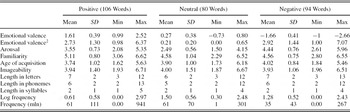
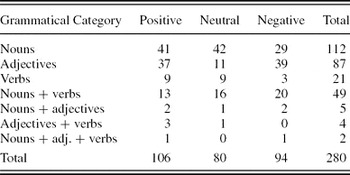
The descriptive statistics for all features are shown in Table 1 for the three categories defined according to emotional valence. In addition, Table 2 shows the number of words belonging to each grammatical category broken down by valence category.
Descriptive statistics of rated and objective features by valence category: positive (from 3 to 1), negative (from −3 to −1), and neutral (from 0.8 to −0.8) words

Note: Words that fell in between positive and neutral categories (10 words) or negative and neutral categories (10 words) are not included.
Frequencies of positive, neutral, and negative words broken down by grammatical category

Reliability analyses
The ANEW corpus (Bradley & Lang, Reference Bradley and Lang1999) contains valence and arousal ratings for 113 out of the 300 words used in the current study: 47 words were positive, 42 negative, and 21 neutral; 3 words were in between valence categories. Pearson correlations between the ANEW ratings and the present ratings were highly significant (valence: r = .97, p < .001; arousal: r = .73, p < .001).
The MRC Psycholinguistic database (Coltheart, Reference Coltheart1981) contains familiarity and imageability ratings for 181 words and AoA ratings for 72 words out of the 300 items. Correlations with ratings from the MRC database were highly significant (familiarity: r = .78, p < .0001; imageability: r = .92, p < .0001; AoA: r = .93, p < .0001). Finally, in the Bristol Norms (Stadthagen-Gonzales & Davis, Reference Stadthagen-Gonzales and Davis2006) familiarity, imageability, and AoA ratings for 53 words were available. Despite the lower number of shared words, correlations were high (familiarity: r = .91, p < .0001; imageability: r = .96, p < .0001; AoA: r = .95, p < .0001).
Relationships among word features
Relationship between affective features
In the quadratic regression predicting arousal from valence ratings, the first model, which included all lexicosemantic variables, accounted for 7% of the variance (r 2 = .07, r = .26), F (7, 299) = 3.08, p = .004, whereas the second model, which included valence and valence squared, accounted for an additional 59% (r 2 = .66, r = .81), F (9, 299) = 61.61, p < .001. The regression line including only significant predictors is the following: estimated arousal = 0.16 × familiarity + 0.16 × AoA + 0.09 × imageability − 0.24 × valence + 0.43 × valence2.
A t test revealed that rated arousal was significantly higher for negative words than positive words, t (198) = −8.46, p < .0001.
Correlations among lexicosemantic features
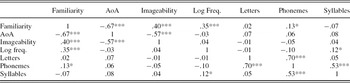
All correlations and their significance levels are reported in Table 3. Familiarity showed negative moderate correlations with AoA (r = −.67), positive moderate correlation with imageability (r = .40), an almost moderate positive correlation with log frequency (r = .35), and a low positive correlation with length in phonemes (r = .13). Familiar words are acquired earlier, are more imageable, and are used more frequently than unfamiliar words. AoA was also moderately negatively correlated with imageability (r = −.57), with early acquired words being highly imageable. Log frequency showed a low positive correlation with length in syllables (r = .12). Finally, length in letters and phonemes were highly positively correlated (r = .70), as well as length in phonemes and syllables (r = .53). No other significant correlations were found.
Correlations among lexicosemantic features (r values) and their significance levels

Note: AoA, age of acquisition.
*p = .05. ***p = .001.
Relationships between affective and lexicosemantic features
Familiarity showed a highly significant low positive correlation with valence (r = .29) and a significant low positive correlation with arousal (r = .14): positive words and arousing words are more familiar than negative and nonarousing words, respectively. Imageability showed positive low correlations with arousal (r = .15) and valence (r = .13), whereby arousing words and positive words are more imageable than nonarousing and negative words, respectively. AoA also showed a low negative correlation with arousal (r = −.13), whereby early acquired words are less arousing. See Table 4 for all correlations and their significance levels.
Correlations (r values) between each affective feature and lexicosemantic features and their significance levels

Note: AoA, age of acquisition.
*p = .05. **p = .01. ***p = .001.
In the quadratic regression predicting familiarity from valence ratings, all lexicosemantic variables and arousal predicted 62% of the variance in the first step (r 2 = .62, r = .79), F (7, 299) = 67.38, p < .001. Emotional valence only (not valence squared) was an additional significant predictor in the second model, accounting for an additional 4% of the variance (r 2 = .66, r = .81), F (9, 299) = 61.20, p < .001. The regression line is the following: estimated familiarity = 6.94 − 0.73 × AoA − 0.22 × imageability + 0.10 × phonemes + 0.41 × frequency_log + 0.13 × arousal + 0.13 × valence.
A linear function is therefore best suited to represent the relationship between familiarity and valence.
A similar result was obtained when computing the quadratic regression with imageability: the first model predicted 47% of the variance (r 2 = .47, r = .69), F (7, 299) = 37.10, p < .001, whereas emotional valence predicted an additional 1% (r 2 = .48, r = .69), F (9, 299) = 29.96, p < .001. estimated imageability = 11.25 − 0.75 × familiarity − 1.15 × AoA + 0.25 × arousal + 0.11 × valence.
Given linear correlations of imageability with both valence and arousal, we decided to separately examine them for each valence category. Imageability and arousal were correlated within positive: (r = .45, p < .0001) and negative words (r = .60, p < .0001), but not within neutral items (r = −.07, ns).
DISCUSSION
As expected, emotional valence and arousal showed a U-shaped relationship after having partialled out the effects of other lexicosemantic features: valenced words (positive and negative) were higher in arousal compared to neutral words. In addition, values for rated arousal were higher for negative than positive words. Affective variables showed partially distinct patterns of correlations with other lexicosemantic variables: familiar words are more positively valenced than unfamiliar words, whereas highly arousing valenced words are more imageable than nonarousing words. Arousing words also seem to have been acquired earlier than nonarousing words.
Our results suggest that, although emotional valence and arousal are related to each other, they must be distinguished carefully in studies manipulating emotion. For example, studies that manipulate valence must control for differences in arousal.
The corpus reported here can be used as a tool for designing psycholinguistic experiments investigating single-word processing as well as text comprehension. Other similar corpora comprise only a subset of these features and usually do not contain both affective and lexicosemantic features rated by the same participants. Furthermore, the present corpus is particularly suitable for text comprehension experiments employing the consistency paradigm (Gernsbacher et al., Reference Gernsbacher, Goldsmith and Robertson1992) because it contains emotion adjectives and pairs of antonyms. Approximately 86 words in the form of adjectives refer to emotions or feelings.
We have demonstrated high reliability of the SAWL with other corpora. Ratings for familiarity, AoA and imageability were highly correlated with the ratings from the MRC database and the Bristol Norms. There was little overlap between words in the SAWL and the Bristol Norms; the latter corpus is not rich in emotionally valenced words. In addition, within the words referring to emotions or feelings in the SAWL, only 11 overlapped with the Bristol Norms, whereas 13 emotion adjectives were present in the form of verb or noun in the Bristol Norms. This shows that extant databases are limited in their utility for designing experiments using single words; the SAWL will therefore prove to be a useful resource in the future. In addition, the collection of within-subjects ratings across the same set of words and the same variables provides more homogeneous evaluations and removes the interraters variability.
Our ratings for emotional valence and arousal were highly correlated with the ANEW norms, with arousal showing a slightly lower correlation. This might suggest that arousal is a less stable property, more influenced by environmental factors (e.g., mood changes). Alternatively, arousal represents a less well-defined construct compared to valence; cross-cultural research has shown that all known languages have words for the pleasant–unpleasant dimension (Wierzbicka, Reference Wierzbicka1999) and that this dimension exists in all cultures (Russell, Reference Russell1991). Many words referring to emotions or feelings were nonoverlapping in the two corpora (approximately half of the emotion adjectives from the SAWL), with some emotions included in the form of nouns or verbs in the ANEW (i.e., excitement vs. excited; annoy vs. annoyed) and with some emotions lacking an antonym compared to the SAWL (i.e., anxious vs. anxious–calm; lively vs. lively–apathetic; confident vs. confident–unsure). The SAWL is an advance on the ANEW because a wider range of ratings for affective and lexicosemantic features were taken from the same participants. Nevertheless, a limitation of the SAWL is that it contains less than one-third of the number of words in ANEW. Also, the corpus contains a small number of concrete words.
A second aim of the study was to explore possible relationships between affective and lexicosemantic features. Affective variables were strongly related with each other, but they only showed relatively weak correlations with other variables, suggesting that affective features are distinct from lexicosemantic ones and therefore they might contribute to explain additional variance in performance beyond other features. The specific correlations are discussed below.
The correlations found between familiarity and AoA and between familiarity and frequency are in line with previous findings (Bird et al., Reference Bird, Franklin and Howard2001; Stadthagen-Gonzales & Davis, Reference Stadthagen-Gonzales and Davis2006), suggesting that words that are familiar are also frequently used and are acquired early. Imageability correlated with AoA, confirming that highly imageable words are acquired earlier than less imageable words (Bird et al., Reference Bird, Franklin and Howard2001). Finally, moderate to high correlations among length measures, as well as low correlations of familiarity and frequency with one length measure, are also in line with previous literature (Bird et al., Reference Bird, Franklin and Howard2001; Stadthagen-Gonzales & Davis, Reference Stadthagen-Gonzales and Davis2006).
There are no prior reports of a relationship between arousal and imageability. The present results suggest that valenced words with higher levels of arousal more easily evoke a mental image. Arousing stimuli might represent a threat and require immediate action. These stimuli might be associated with intense experiences early in life, thereby forming a mental image of the event. It is notable that rating the imageability of a word draws on the sensory properties that can be imagined out of context, whereas rated familiarity of words draws on cognitive appraisal, similar to the metajudgment that is required for assessing emotional valence.
The correlation between emotional valence and familiarity could be accounted for by a response bias instead, with participants being reluctant to admit that they are very familiar with negative words. In support of this claim, we found a moderate partial correlation between familiarity and frequency log (r = .61, p < .001) for positive words (N = 106), by controlling for valence; the same variables showed a low correlation within negative words (r = .29, p < .01). A similar bias was found in a self-referential task (Lewis et al., Reference Lewis, Critchley, Rotshtein and Dolan2007) in which participants were asked to indicate whether each word could be used to describe themselves (i.e., “yes/no”) and showed a tendency to respond “yes” more often for positive words.
Positive and negative words differed in levels of rated arousal, with negative words being more arousing, suggesting that positive and negative valences are not just bipolar opposites of a continuum (for consistent evidence see Lang et al., Reference Lang, Bradley and Cuthbert1999; Võ et al., Reference Võ, Conrad, Kuchinke, Urton, Hofmann and Jacobs2009). We suggest that highly negative words are naturally more arousing than highly positive ones. Negative stimuli can be extremely threatening and need to be quickly avoided or tackled (e.g., Lang, Bradley, & Cuthbert, Reference Lang, Bradley and Cuthbert1990); therefore heightened physiological changes are tightly associated with them. Positive stimuli are associated with safety and wealth instead (e.g., Higgins, Reference Higgins1997), so very positive stimuli are not necessarily high in arousal (e.g., friend, paradise); furthermore, extremely arousing positive stimuli are often associated with risk and might elicit negative feelings beyond a certain threshold (e.g., rollercoaster, desire) (Higgins, Reference Higgins1997). An interesting but slightly different idea was proposed by Robinson, Storbeck, Meier, and Kirkeby (Reference Robinson, Storbeck, Meier and Kirkeby2004), who suggested that stimuli with positive valence and low arousal elicit approach, whereas stimuli with negative valence and high arousal elicit avoidance.
Nevertheless, the possibility exists that a sampling bias accounts for the higher arousal level of negative words. Our selection of roughly one-third positive, one-third negative, and one-third neutral words does not necessarily represent the distribution of these categories in natural language.
In sum, the present study showed that affective features are distinct from lexicosemantic features of single words, suggesting that consideration of the latter ones only in order to account for cognitive performance might cover the effects of the emotion factor. In light of these results and of studies showing interaction between valence and frequency (Kuchinke et al., Reference Kuchinke, Võ, Hofmann and Jacobs2007; Nakic et al., Reference Nakic, Smith, Busis, Vythilingam and Blair2006; Scott et al., Reference Scott, O'Donnell, Leuthold and Sereno2009), we suggest that models of word recognition should be integrated with affective features.
Emotional valence and arousal were also shown to be at least in part distinct from each other. In addition, valence appears to be a multifaceted variable and not a continuum (Feldman Barrett & Russell, Reference Barrett and Russell1999), raising several questions about the role of affect in cognition. It is likely that this corpus will be suitable for studies investigating the effects of affective and lexicosemantic features on single word processing. It also allows a well-balanced selection of words employed for text processing research, so that the effect of text context can be separated from word level effects. The corpus finally has potential utility for application in research on affective disorders, neuropsychology, and social cognitive neuroscience.
SUPPLEMENTARY MATERIAL
The supplementary material referred to in this article can be found online at http://journals.cambridge.org/aps
APPENDIX A
Pairs of antonyms from the Sussex Affective Word List
APPENDIX B
The following are the definitions of affective and lexicosemantic word properties given in the rating task. Definitions of familiarity, AoA, and imageability were adapted from the Bristol Norms (Stadthagen-Gonzales & Davis, Reference Stadthagen-Gonzales and Davis2006).
Valence
Words can evoke different feelings. Reading the word love might make you feel good, whereas war might make you feel bad. A word like chair does not usually evoke either feeling. In this task we want you to rate how positive or negative the words are to you. In the following list please rate each one as to the feeling that you experience when reading it. Simply tick a number according to a point scale from −3 to +3. −3 means that the word evokes very negative feelings, whereas +3 means that the word evokes very positive feeling; 0 represents neutral feelings.
If you do not know the meaning of a word, please tick the box “unknown word.”
This is not a speed experiment. You have as much time as you want. Nevertheless, do not spend too much time on each word, but respond spontaneously and use your own judgment.
Arousal
Arousal refers to the intensity of an event, ranging from not stimulating to highly exciting or agitating. In this task we want you to rate how intense each word is to you. For example, a word like rain might evoke low arousal, whereas tornado might evoke much more arousal. In the following list please rate each word by simply ticking a number according to a point scale from 1 to 7. 1 means that the word evokes calm feelings, whereas 7 means that the word evokes exciting or agitating feelings.
If you do not know the meaning of a word, please tick the box “unknown word.”
This is not a speed experiment. You have as much time as you want. Nevertheless, do not spend too much time on each word, but respond spontaneously and use your own judgment.
Familiarity
In this task we want to find out how often you have come in contact with certain words, how familiar they are to you. In the following list you have to rate how often you experienced a word by simply ticking a number according to a point scale from 1 to 7. 1 means that you have almost never experienced this word, whereas 7 means that you experience it all the time. For example, a word like riddle does not occur very often, whereas you might hear joke much more frequently. Words that are intermediate, of course, should be rated appropriately between the two extremes.
If you do not know the meaning of a word, please tick the box “unknown word.”
This is not a speed experiment. You have as much time as you want. Nevertheless, do not spend too much time on each word, but respond spontaneously and use your own judgment.
Age of acquisition
Please indicate in years the age at which you learned each of the words on the list. An approximate age is good enough for this rating. By “learning a word” we mean the age at which you would have understood that word if somebody had used it in front of you, even if you did not use, read or write it at the time. You have probably learned the word apple as a little child, but a word like avocado as a teenager. Please choose one of the age ranges given below each word and tick it.
If you do not know the meaning of a word, please tick the box “unknown word.”
This is not a speed experiment. You have as much time as you want. Nevertheless, do not spend too much time on each word, but respond spontaneously and use your own judgment.
Imageability
Words differ in their ability to evoke mental images of things and events. Some words evoke a sensory experience, such as a mental picture or sound, very quickly and easily, whereas others may do so only with difficulty or not at all. You can easily conjure up an image of fingernail, whereas it is much more difficult to imagine a word like permission. In the following list you should rate a list of words as to the ease or difficulty with which they evoke mental images. Your ratings will be made on a 7-point scale, where 1 is the low imagery end of the scale and 7 is the high imagery end of the scale. Words that evoke mental images most readily for you should be given a rating of 7; words that evoke images with the greatest difficulty or not at all should be rated 1; words that are intermediate in ease or difficulty of imagery, of course, should be rated appropriately between the two extremes.
If you do not know the meaning of a word, please tick the box “unknown word.”
This is not a speed experiment. You have as much time as you want. Nevertheless, do not spend too much time on each word, but respond spontaneously and use your own judgment.
ACKNOWLEDGMENTS
The first author was funded by a graduate teaching assistant scholarship awarded by the University of Sussex. The first author thanks Jamie Ward for his helpful comments on a previous version of this manuscript.