INTRODUCTION
Habitat destruction is one of the major threats to biodiversity and one of the main causes of species extinction (Pimm & Raven Reference Pimm and Raven2000). Habitat loss involves the reduction of natural areas, and is often worsened by various other perturbations such as pollution, invasions by exogenous species or fragmentation. Environmental impacts vary with the intensity and type of anthropogenic assaults, but they also depend on the quality, size and characteristics of areas concerned (Scott et al. Reference Scott, Brown, Mahood, Denton, Silburn and Rakotondraparany2006). On average, arid zones are more fragile than temperate and tropical areas, and irreversible desertification is rapidly increasing in the dry regions of the planet (Geist & Lambin Reference Geist and Lambin2004; Kéfi et al. Reference Kéfi, Rietkerk, Alados, Pueyo, Papanastasis, ElAich and de Ruiter2007). Indeed, for most types of organisms, low water availability severely restricts individual growth, reproduction and population regeneration rates.
Mediterranean ecosystems are considered major biodiversity hotspots (Médail & Quézel Reference Médail and Quézel1999; Myers et al. Reference Myers, Mittermeier, Mittermeier, Da Fonseca and Kent2000). Unfortunately, many arid areas of the Mediterranean region suffer from an intensification of human pressures owing to rapid population increase and global warming; rapid erosion of natural habitats entails environmental damage (Milchunas & Lauenroth Reference Milchunas and Lauenroth1993; Taïbi & El Hannani Reference Taïbi and El Hannani2004; McGregor et al. Reference McGregor, Dupont, Stuut and Kuhlmann2009). At numerous locations throughout the Maghreb (western North Africa), urbanization, extension of the road network and intensification of agriculture are occurring at a rapid rate (McGregor et al. Reference McGregor, Dupont, Stuut and Kuhlmann2009; Pleguezuelos et al. Reference Pleguezuelos, Brito, Fahd, Feriche, Mateo, Moreno-Rueda, Reques and Santos2010). It is therefore vital that key characteristics of critical habitats that allow the maintenance of important species are identified. Such assessment may be used to identify and retain crucial ecosystem elements, for instance to select optimal sites for natural reserves, improve specific protection status or promote effective habitat restoration programmes.
In this study, we investigated the relationship between habitat quality and the occurrence of a specific vertebrate species. We focused on one of the main bush species of the arid zones of Morocco, the jujube bush (Ziziphus lotus, a spiny plant species), and on one endemic threatened vertebrate species, the Moorish tortoise (Testudo graeca soussensis). These two species provide a clear illustration of the current conservation situation of many Maghreb ecosystems. Spiny shrubs and ephemeral grasses are the food source for a vast assemblage of species (Tripathi et al. Reference Tripathi, Kumari and Sharma2007; Bliege-Bird et al. Reference Bliege-Bird, Bird, Codding, Parker and Jones2008). Thorns, spines and prickles of the main bushes provide effective defences against large herbivores (Cooper & Owen-Smith Reference Cooper and Owen-Smith1986). Bushes also offer crucial shelters for many other animal species (such as insects, arachnids and rodents); they reduce soil temperature beneath them during hot periods, but also retain higher soil temperatures during cooler periods (for example at night), preserve soil moisture and enrich soil fertility (Castro et al. Reference Castro, Zamora, Hodar, Gomez and Gomez-Aparicio2004). As expected, mammals, birds and reptile populations decline when shelter availability is reduced (Webb & Shine Reference Webb and Shine1997; Grillet et al. Reference Grillet, Cheylan, Thirion, Doré, Bonnet, Dauge, Chollet and Marchand2010). However, jujube bushes compete with several agricultural land practices, particularly for space and nutrients, and are therefore considered to be a pest plant (Milchunas & Lauenroth Reference Milchunas and Lauenroth1993; Fleischner Reference Fleischner1994; McGregor et al. Reference McGregor, Dupont, Stuut and Kuhlmann2009). Consequently, shepherds and farmers often destroy spiny bushes; the wood is also harvested as firewood or to build fences (Slimani et al. Reference Slimani, El Mouden, Ben Kaddour, Lagarde and Bonnet2006). Moreover, official government agricultural authorities encourage the destruction of jujube bushes and have developed specific programmes and techniques to eradicate this plant, notably by chemical means (Regehr & El Brahli Reference Regehr and El Brahli1995; Rsaissi & Bouhache Reference Rsaissi and Bouhache2002; PNTTA [Programme National de Transfert de Technologie en Agriculture] 2002). Although jujube bush is particularly resistant to drought (Mader Reference Mader2003), and despite the fact that this species was considered as one the most important species in terms of abundance and for its ecological services in past decades (Mader Reference Mader2003), the intensification of such eradication programmes has made the jujube bush increasingly rare (Mamva Reference Mamva1996).
The Moorish tortoise is a typical inhabitant of the jujube bush steppes. Owing to habitat changes and to overcollection for the tourist trade, the once flourishing tortoise populations of Morocco have also drastically declined (Bayley & Highfield Reference Bayley and Highfield1996; Slimani et al. Reference Slimani, Ben Kaddour and Devaux2001, Reference Slimani, El Mouden, Ben Kaddour, Lagarde and Bonnet2006; El Mouden et al. Reference El Mouden, Slimani, Ben Kaddour, Lagarde, Oouhammou and Bonnet2006).
The importance of bushes for the survival of the Moorish tortoises (along with many other animal species) is intuitive, but precise field or experimental data are lacking. Bushes can provide food and shelter, but what critical densities and characteristics (for example dimensions) of bushes to offer suitable microhabitats? Answering such questions is fundamental to setting up cost-efficient conservation programmes, notably to provide the information required to enable the selection of the most appropriate conservation areas and/or propose specific conservation measures (such as replanting actions).
Many animals can survive food or water shortage, at least in the short term, but none can afford even short-term overheating (Vickers et al. Reference Vickers, Manicom and Schwarzkopf2011). This is especially true in the arid areas of Maghreb, which are characterized by high ambient temperatures for extensive periods of the year. In most places, jujube bushes represent the only shelter available; Moorish tortoises cannot dig deeply into the rocky substrate. We thus explored the relationship between the main characteristics of the spiny bushes, the thermal conditions within and outside the bushes, and the critical thermal limits of the tortoises. We emphasize that this study does not examine seasonal and daily patterns of thermoregulation of the Moorish tortoise, but instead assesses the physiological limits imposed by different types of microhabitats on their survival. The aim of this study is to evaluate the importance of the density and quality of the main spiny bush species (Ziziphus lotus) on the occurrence of an endemic tortoise (Testudo graeca soussensis) in a dry and overgrazed environment. We also performed surveys in a range of zones representative of strongly to less degraded habitats.
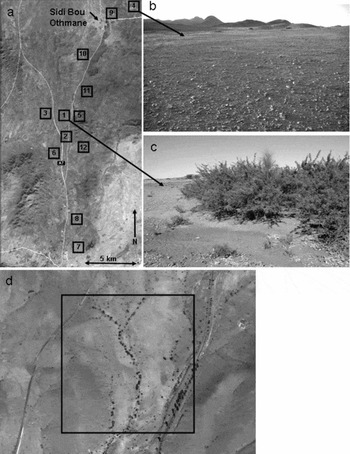
METHODS
Study sites
Our study site was located in the Jbilet mountains, north of Marrakech (central Western Morocco) towards the edge of the Haouz plain. The study site (550–600 m above sea level) covered 22 km2, from 5 km from the Tansift River to the village of Sidi Bou Othamne along the road to Casablanca (31°42′–31°55′ N, 7°54′–7°59′ W; Fig. 1). The substrate was essentially rocky and consisted of shale mixed with granite, with very limited arable soil. Climate data were obtained from the meteorological station at Sidi Bou Othmane and from the MétéoMaroc website (see http://www.meteomaroc.com). The vegetation of the Jbilet mountains is typical of the arid steppes that cover important areas of Morocco, being characterized by the presence of spiny shrubs, mainly jujube (Ziziphus lotus) and acacia bushes (Acacia gummifera), with retams (Retama monosperma) representing the main non-spiny bushes (Slimani et al. Reference Slimani, El Mouden, Ben Kaddour, Lagarde and Bonnet2006; El Mouden et al. Reference El Mouden, Slimani, Ben Kaddour, Lagarde, Oouhammou and Bonnet2006; Louzizi Reference Louzizi2006). An ephemeral herbaceous layer grows following late winter and spring rainfalls, essentially under the spiny bushes, where the impact of overgrazing is attenuated and where localized patches of soil persist. This herbaceous layer disappears quickly in late spring owing to the summer drought. As in many parts of Morocco, our study site was subject to a combination of overgrazing (sheep and goats) and use of the bushes for firewood and to build enclosures; the vegetation was consequently degraded (Rsaissi & Bouhache Reference Rsaissi and Bouhache2002; El Mouden et al. Reference El Mouden, Lagarde, Ben Kaddour, Slimani, Guillon and Bonnet2004).
(a) Location of the 12 study sites (each 1 km2) in the Jbilet mountains (Morocco); study site 1 is situated 25 km north of Marrakech. The vegetation of the different study sites covers a range of highly degraded habitats. (b) In study area 4, most of the jujube bushes have been destroyed. (c) In study area 1, habitat is less degraded and large jujube bushes can be observed. (d) Satellite image of study area 1: large jujube bushes are easily identified, especially along the small valleys, and eucalyptus trees are visible along the road.

Within the general study site, we selected 12 study areas (each 1 km2) representing a range of situations from highly degraded to relatively preserved habitats (Fig. 1). In order to estimate the number of bushes, we randomly divided each study area into three non-adjacent sub-areas (300 m × 300 m, total number of sub-areas = 36). Within each sub-area, we randomly selected four quadrats (100 m × 100 m, total number of quadrats = 144). As the jujube bushes were the most important bushes (both in quantity and size, they represented more than 90% of the bushes in the study area), we used the presence of this species to characterize the quality of the habitat. We counted all the jujube bushes within each quadrat. We measured the dimensions (maximum length L, width W and height H) of the jujube bushes using a measuring tape, and estimated the substrate area S occupied by each bush using the ellipsoid equation (S = π × [L/2] × [W/2]); we then estimated the bush volume. In practice, these measurements were highly correlated (tall bushes always covered a large substrate area) and our main results were unaffected by the use of one parameter in isolation versus varying combinations of parameters. For simplicity, we thus chose to characterize the bushes using their height, because a tall bush provided more shade than a short bush, while the remains of a recently-cut bush may occupy a large surface area but provide little shade. Based on field observations, we identified three main classes of bushes. Small jujube bushes corresponded to highly degraded plants: their maximum height was < 1.0 m, foliage was very sparse and the soil beneath was always visible through the bush. Medium bushes were 1.0–1.5 m tall, and at least part of the soil beneath was hidden by their foliage. Large bushes were > 1.5 m tall and their foliage was sufficiently dense to provide permanent shade on most of the soil surface beneath the bush. We noted any evidence of recent wood cutting. We determined the position of each jujube bush using a global positioning system (GPS; Garmin III, Chicago, IL, USA).
Thermal characterization of the microhabitats
Open rocky habitats and spiny bushes represented the two major types of microhabitats available for adult tortoises. We assessed the thermal characteristics of these microhabitats during October 2008–September 2009 for a representative area situated in the centre of the general study site (Fig. 1, study area 1) using temperature data loggers (iButton, Thermochron®, Maxim, Dallas Semiconductor, USA, accuracy ± 0.5 °C); two temperature data loggers were placed on open ground, two were placed beneath small jujube bushes, two in medium-sized jujube bushes and two in large jujube bushes.
Moorish tortoises spend almost all their time sheltered under bushes (El Mouden et al. Reference El Mouden, Slimani, Ben Kaddour, Lagarde, Oouhammou and Bonnet2006), therefore we recorded the thermal characteristics of models representing adult tortoises resting under bushes. For that we used six models fitted with two temperature data loggers. One logger was glued on the shell, a second logger was inserted inside the model at a central position. The models were constructed from empty (but intact) adult tortoise shells collected in the study site. The shells were consolidated using small amounts of resin. Each model was then filled with a hydro-gel (agar-agar) poured into a plastic bag positioned inside the shell. The mass of each model was adjusted using the regression between body mass against body size (shell length) obtained from more than 200 tortoises. We placed the internal temperature logger after the gel solidified. The model was then carefully sealed.
We examined the accuracy of the models in estimating the internal temperature of living tortoises. To do so, we generated six pairs, with one model associated to one living tortoise. For each pair, the deviations between the physical model versus living animal were low in terms of shell mass (mean deviation 2.7 ± 7.3% [± SD], n = 6 pairs) and in terms of shell length (5.6 ± 4.1%). The pairs were stored in a climatic chamber at 20 °C for at least 12 h and then exposed to the sun in a 10 m × 25 m outdoor enclosure without shelter. The internal body temperature of the living tortoises was recorded every 10 min using a probe thermometer inserted into the cloaca (5 cm). We stopped the experiment when body temperature reached 38 °C, or before if we detected any preliminary sign of overheating such as salivation (Hailey & Coulson Reference Hailey and Coulson1996). The comparison of the temperature recorded showed that the models provided values very similar to those recorded in the tortoise. Internal body temperatures for both the tortoises and the models were highly correlated (mean r2 values [Pearson correlations] = 0.79 ± 0.2, range 0.52–0.98). In practice, the models slightly, albeit systematically, underestimated the internal temperature of the associated living individual (t-test comparisons between tortoises and physicals models, all p < 0.0001); the mean difference was 2.12 °C ± 0.31 °C (± SE). Such underestimation was probably caused by the physiological capacity of the tortoises to limit overheating (Galli et al. Reference Galli, Taylor and Wang2004). We thus fixed the upper threshold temperature at 38 °C for body temperatures, and this equated to 40 °C for the models, taking into account the underestimation.
Three models were placed under small jujube bushes (< 1 m in height); three others were placed under large jujube bushes (>2 m height). The small jujube bushes did not provide strong shade, whilst the large jujube bushes had thick foliage. We also placed eight temperature data loggers in open habitats (directly on the rocky substrate) and within other jujube bushes of various dimensions (from small to large bushes). The data loggers were programmed to record one temperature value every 60 minutes.
Habitat use by the tortoises
Morphological and ecological characteristics of Testudo graeca soussensis in the Jbilet mountains have been previously assessed (Slimani et al. Reference Slimani, Ben Kaddour and Devaux2001; Ben Kaddour Reference Ben Kaddour2005; El Mouden et al. Reference El Mouden, Slimani, Ben Kaddour, Lagarde, Oouhammou and Bonnet2006; Lagarde et al. Reference Lagarde, Guillon, Dubroca, Bonnet, Ben Kaddour, Slimani and El Mouden2008; Sereau et al. Reference Sereau, Lagarde, Bonnet, El Mouden, Slimani, Dubroca, Trouvé, Dano and Lacroix2010). This species is diurnal, exhibits a peak of activity in spring (main period of sexual activity), and forages on various ephemeron herbaceous plant species that develop following late winter and early spring rainfalls.
In one study area (Fig. 1, study area 1), we fitted six adult tortoises (three males and three females) with long life (> 1 year) radio transmitters (AVM Instrument Company, Colfax, CA, USA). The electronic devices were glued on the shell using very small amounts of resin; the overall mass of the equipment was always less than 4% of tortoise body mass. This load was well tolerated by the tortoises and did not cause any detectable trouble to the animals (Lagarde et al. Reference Lagarde, Bonnet, Corbin, Henen, Nagy, Mardonov and Naulleau2003a, Reference Lagarde, Bonnet, Henen, Nagy, Corbin, Lacroix and Trouvéb, Reference Lagarde, Guillon, Dubroca, Bonnet, Ben Kaddour, Slimani and El Mouden2008). The tortoises were located on a weekly basis during one year (from early November 2008 until late October 2009) with a four-element Yagi antenna connected to a LA12Q-AVM receiver, and their position was noted using GPS. Each individual was located on an average of 50 occasions (mean = 49.7 ± 2.4, range 45–51). The broad activity of each tortoise was then recorded (sheltered, active, feeding) along with the microhabitat (open habitat, under a bush). The current study did not aim to precisely record tortoise behaviours (Lagarde et al. Reference Lagarde, Guillon, Dubroca, Bonnet, Ben Kaddour, Slimani and El Mouden2008), only the instantaneous activity of individuals was recorded (for example a tortoise firstly observed walking and later feeding was considered as walking only). At the end of the study we removed the equipment by gently pushing the blade of a knife between the shell and the synthetic resin (Lagarde et al. Reference Lagarde, Guillon, Dubroca, Bonnet, Ben Kaddour, Slimani and El Mouden2008). The tortoises suffered no shell damage.
Transects: number and dimensions of jujube bush versus tortoise occurrence
We assessed the occurrence of tortoises in each of the 36 sub-areas (hence in the 12 selected study areas) using visual transects. During one to two hours, the surface of each area was intensively searched by one person (T. Louzizi) during the estimated main activity period of the tortoises (Lagarde et al. Reference Lagarde, Guillon, Dubroca, Bonnet, Ben Kaddour, Slimani and El Mouden2008). Each tortoise observed was counted only once owing to the low velocity of the species. Because tortoises are often sheltered, and hence not easily detected in the field, we performed three transects in almost all sub-areas, except for sub-area 7 where only two transects were performed (total n = 101 transects, 8.5 transects per study area on average).
Analyses
Prior to analyses, thermal data were visually inspected to remove outliers. Our objective was not to describe and analyse the thermal profiles in the course of the year; instead we focused on potentially lethal temperature episodes. The precise lethal body temperatures (critical thermal minima and maxima) of the studied species are unknown, and we did not attempt to measure them for ethical reasons. Based on studies performed on reptile species including chelonians (Hutchison et al. Reference Hutchison, Vinegar and Kosh1966; Webb & Witten Reference Webb and Witten1973; reviews in Bartholomew Reference Bartholomew, Gans and Pough1982; Lillywhite Reference Lillywhite, Seigel, Collins and Novak1987; Peterson et al. Reference Peterson, Gibson, Dorcas, Seigel and Collins1993), we confidently estimated that exposure to prolonged periods (> 1 hour) of ambient temperatures of 40 °C are unsafe, and that a prolonged central body temperature > 38 °C precipitates dehydration and can be eventually lethal (there is no record of reptiles surviving an elevation of body temperature > 44 °C). Most reptiles can easily tolerate ambient temperature close to 0 °C for prolonged time periods, critical lower body temperatures are generally markedly negative (Bartholomew Reference Bartholomew, Gans and Pough1982). We emphasize that we distinguish central (internal) body temperature, from external (cutaneous) body temperatures, which can momentarily reach values > 40 °C or < –5 °C without visible damage, especially in relatively large species such as terrestrial chelonians (McGinnis & Voigt Reference McGinnis and Voigt1971; Webb & Witten Reference Webb and Witten1973). The main consequence of focusing on critical minimum and maximum body temperatures is the straightforwardness of the analyses: no individual can survive a single episode of prolonged overheating (for example >45 °C for one hour). Therefore the detection versus the lack of detection of potential overheating episodes is a sufficient criterion to assess the compatibility of microhabitats in terms of tortoise survival, and a visual inspection of the thermal profiles is a suitable method for achieving this. Home ranges were calculated by the minimum convex polygon (MCP) method (O'Connor et al. Reference O'Connor, Zimmerman, Ruby, Bulova and Spotila1994). We assessed home ranges and movements using ArcGIS 9.3 (Esri, New York, NY, USA) and performed statistical tests using STATISTICA 7.1 (Statsoft, Tulsa, USA).
RESULTS
Climate
Mean monthly temperature and precipitation values, along with monthly extreme temperatures, show that the study zone region is arid and hot: scarce and irregular rainfalls occurred between November and May, whilst the summer period (June–September) was characterized by very low rainfall and high ambient temperatures. Although maximum ambient temperatures recorded under shelters regularly exceeded 40 °C in summer, minimum temperatures always remained above 0 °C in winter.
Thermal characteristics of microhabitats
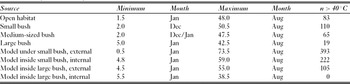
As expected, the temperatures recorded by the data loggers positioned in the field (n > 74 000 temperature readings) during the study period were strongly influenced by seasons, time of the day and the type of microhabitat, and they followed the average temperature fluctuations recorded over longer time periods. Because our study focused on extreme (potentially lethal) temperatures, we examined exclusively relevant patterns, notably those recorded during the coolest and hottest periods. The minimum and maximum ambient temperatures recorded in the open habitat (namely 1.5 °C and 48.0 °C) were obtained in winter (January) and summer (August), respectively; extreme temperatures recorded within small- and medium-sized bushes were relatively similar (Table 1). However, close inspection of the data revealed significant differences: for instance, considering only temperatures below 3.5 °C on open ground, the means were 3.46 ± 0.25 (n = 20) versus 3.98 ± 0.32 °C (n = 15) in small- and medium-sized bushes, respectively (T-test, p < 0.01). Importantly, although statistically significant, such differences remained weak in terms of mean values. In comparison, within large bushes, considerably buffered temperature values were recorded (Table 1, a fortiori further comparisons provided highly significant values, not reported here for conciseness). However, models provided higher maximum values, not lower, with marked differences between the temperatures recorded on the dorsal surface of the shell (hottest) versus inside the model (Table 1, more buffered). The number of values ≥ 40 °C varied markedly between habitats, and was always larger using models rather than using the data loggers alone (Table 1). The only data loggers that never recorded temperatures > 40 °C were inside the models situated under large bushes.
Extreme temperatures were recorded in the four main microhabitats used by the tortoises. The temperatures were recorded using data loggers alone ( = ambient temperature of the microhabitat) or using physical models ( = estimate of the body temperature of a tortoise in the microhabitat; external means on the shell, internal means inside model). The month of the record is indicated, along with the number of times data recorded exceeded the threshold of 40 °C. The last column provides the absolute number of temperature readings (n) above 40 °C in each microhabitat/model combination.

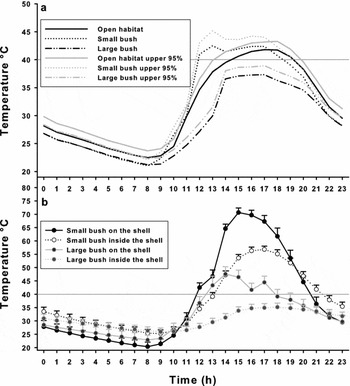
Inspection of the whole data set enabled us to discard low temperatures as a potentially lethal factor. Indeed, we never recorded temperatures < 0 °C. Consequently, we focused on the patterns recorded during the hot periods. For that, we pooled the 16 hottest days when ambient temperature exceeded 40 °C for more than five hours. During the hottest periods, the mean ambient temperatures recorded in open habitat, small bushes and medium bushes regularly exceeded 40 °C. By contrast, temperature remained systematically below 40 °C under large bushes.
Compared to the data loggers directly positioned in the field, the models accumulated heat at a greater rate when exposed to solar radiation (Fig. 2). We found marked differences between external (on the shell) and internal (within the model) temperatures. External temperatures fluctuated over a larger range of values, peaking during the day and cooling at night, and exhibited faster variations over time, especially at sunrise and sunset. Importantly, the internal temperature of the physical models situated under large bushes never reached 40 °C (maximum recorded temperature 38.5 °C).
Comparison of (a) ambient temperatures recorded using data loggers alone (the different microhabitats are indicated by different line patterns, mean values are shown in black and the upper 95% confidence interval limit is indicated in grey); and (b) mean estimated body temperatures (± SD) using data loggers glued on the back of the shell (‘on the shell’) or implanted (‘inside the shell’) into models for both large bush and small bush microhabitats.

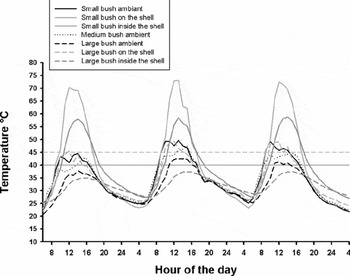
In order to assess the duration of the potentially lethal overheating episodes, we visually inspected the hottest daily patterns. During sun-scorching periods, the only microhabitat where estimated internal temperatures of models remained < 40 °C was represented by large bushes (Fig. 3). In all other microhabitats, hot episodes lasting several hours with ambient temperatures or estimated external and internal body temperatures markedly above 40 °C (sometimes > 45 °C) were observed; the models placed in these microhabitats presented particularly long periods with ‘body’ temperatures (internal estimate) > 50 °C.
Temperature fluctuations for areas below different sized bushes during three typical hot days (mid August). Temperatures were recorded using a data logger alone (ambient), glued on the top of the shell of physical models (on the shell) and inside the physical model (inside the shell). For clarity, only one temperature profile is presented for the medium-sized bush microhabitat. The horizontal lines indicate the danger threshold (40 °C, continuous line) and lethal threshold (45 °C, dashed line), respectively.

Habitat use by the tortoises
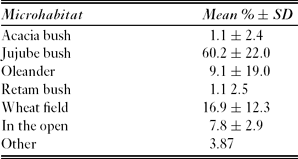
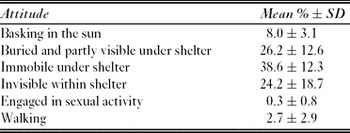
During the hottest and driest periods (late May to early September), 100% of the radio-tracked tortoises were found sheltered under large bushes. They did not exhibit any detectable movement and they were located at exactly the same spot every week, suggesting that they remained immobile between observations. During mild periods, notably spring and autumn, the tortoises spent most of their time under the bushes, but regular movements were detected (Tables 2 and 3). Three individuals visited a small wheat field situated in the study area, where they spent a significant amount of time (31–50% of the fixes). More than 80% of the jujube bushes used by the radio-tracked tortoises were large, exceeding three metres in height. The tortoises also sheltered under a few oleanders (Nerium oleander), which were taller than two metres. The tortoises were observed in the open on < 10% of occasions.
Mean proportion of time spent in the main microhabitats used by three females and three males monitored in the field for one year (2008–2009). Each individual was briefly observed once a week. Data are expressed as mean percentages of the total of observations (n = 298). The tortoises spent 71.5% of their time under bushes.

Main attitudes recorded in six females and six males monitored in the field for one year (2008–2009). Each individual was briefly observed once a week. Data are expressed as mean percentages of the total observations (n = 298).
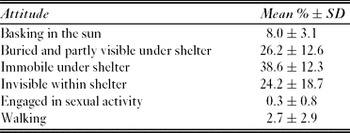
Behavioural observations provided complementary results (Table 3). On most occasions (89%), the tortoises located under shelter (essentially jujube bushes and wheat field) were immobile and often partly buried. Although our displacement data (see below) show that none of the monitored individuals remained under a single refuge, the tortoises were rarely observed moving in the open, suggesting that movements between shelters were relatively rapidly achieved.
Minimum convex polygon (MCP) home ranges represented less than one-third of a hectare on average (mean ± SD = 2708 ± 3365 m2, range 360–8877 m2, n = 6). The tortoises travelled 2.5 km on average (mean ± SD = 2529 ± 920 m, range 1310–3877 m). The distance travelled and home range were highly correlated (Spearman rank correlation: rs = 0.94, n = 6, p < 0.05). Males tended to travel over longer total distances than females (3178 ± 731 m versus 1880 ± 564 m) and to exhibit larger home ranges (4742 ± 3956 m2 versus 674 ± 495 m2) (our small sample size precluded robust statistics on these data).
Number and dimensions of jujube bush versus tortoise occurrence
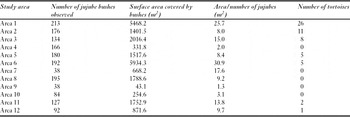
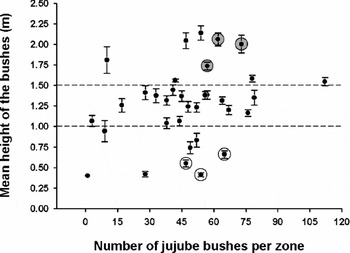
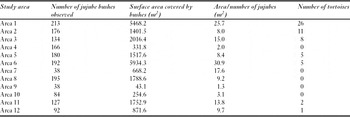
During the habitat assessment in the 12 selected study areas (each 1 km2), a total of 1635 jujube bushes were counted, providing an average density of 1.4 ha−1. Two of the 36 sub-areas did not contain any jujube bushes. Strong differences in the estimated number of jujube bushes were observed among the 12 areas (comparing the actual distribution against a theoretical homogeneous distribution, χ2 = 300.8, df = 11, p < 0.001; Table 4). The size (height) of the jujube bushes also varied greatly among study areas (ANOVA with jujube bush height as the dependent variable, the study area as the factor and sub-area as a random factor: F11, 22 = 10.40, p < 0.001). The number of bushes counted per area did not correlate with the mean size (height) of jujube bushes (Pearson's r = 0.42, F1, 10 = 2.09, p = 0.179); this result held true using sub-areas (n = 34 with bushes) instead of study areas (n = 12) to increase the power of the analysis (r = 0.28, F1, 32 = 2.80, p = 0.104; Fig. 4). For example, study area 4 contained approximately the same number of bushes as study area 6, but bushes were generally smaller in area 4 (Fig. 4). Using other bush characteristics (for instance volume) led to similar results.
Number and total surface area of the jujube bushes, and number of tortoises observed during transects in 12 areas monitored.
Absence of relationship between the mean height (mean ± SE) and the number of jujube bushes in the 34 areas (each 300 m2) sampled that contained bushes. The grey circles indicate the three sub-areas sampled in study area 6, the three open circles indicate the three sub-areas sampled in study area 4. The dashed lines indicate the limits between small bushes (< 1.0 m), medium-sized bushes (1.0–1.5 m) and large bushes (> 1.5 m).

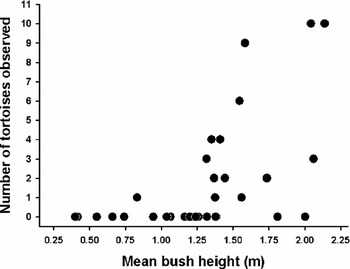
The probability of finding a tortoise increases with bush size (logistic regression with mean bush height as the independent variable and the presence/absence of tortoise as the dependent variable: χ2 = 10.95, df = 1, p = 0.001) and with bush number (χ2 = 3.73, df = 1, p = 0.053). The combination of these two independent variables (height and number) did not significantly improve the model however (both independent factors included: χ2 = 12.46, df = 2, p = 0.001), suggesting that bush quality (namely height) was the main factor involved. The mean height of the bushes positively influenced the number of tortoises detected in the field (Spearman rank correlation: r = 0.638, n = 34, p < 0.05). Closer inspection of the data suggested the existence of a bush-height threshold of 1.25 m for the occurrence of tortoises (Fig. 5).
Relationship between mean bush height and the number of tortoises detected in the 34 sub-areas that contained jujube bushes. Note that no tortoise was observed in the two other sub-areas without bushes (not presented).

DISCUSSION
Our results provide strong evidence that during the hot and dry periods that characterize arid zones of Morocco, the sole microhabitat that can provide safe shelters to adult Moorish tortoises are bushes taller than 1.25 m (namely the ‘large bushes’ in our study). In the absence of such relatively large bushes, the tortoises are under serious threat of lethal overheating, indeed ambient and estimated body temperatures largely exceeded 40 °C for prolonged time periods in all other microhabitats. Therefore, the short-term (hours in summer) survival of the tortoises depends closely on the presence of relatively large bushes; all individuals use this specific microhabitat intensively all year round, and exclusively in summer. Surveys in the 12 different study areas with contrasting vegetation cover provided complementary information: the probability of detecting a tortoise was very low (close to zero) in the study areas where the bushes were smaller than 1.25 m, and this probability markedly increased in the study areas containing taller bushes. The number of tortoises detected also correlated positively with the mean height of the bushes. The importance of shelters, notably provided by plants and burrows, as a means to control for temperature fluctuations experienced in an extreme environment has been documented in desert tortoises (Bulova Reference Bulova2002; McMaster & Downs Reference McMaster and Downs2006) and in other reptiles (Beck & Jennings Reference Beck and Jennings2003; Bonnet et al. Reference Bonnet, Brischoux, Pearson and Rivalan2009; Grillet et al. Reference Grillet, Cheylan, Thirion, Doré, Bonnet, Dauge, Chollet and Marchand2010; Lelièvre et al. Reference Lelièvre, Blouin-Demers, Bonnet and Lourdais2010), however our study is the first to report information demonstrating the vital importance of precise characteristics of the microhabitat.
Our results have strong conservation implications. The short-term maintenance of tortoise populations requires the retention of jujube bushes rather than their removal. In our 12 study areas, we counted 102 jujube bushes that had been cut to the ground, and all of them were situated in the study areas where large bushes and tortoises occur (it is not productive to harvest small bushes). Unfortunately, in many places, the growth rate of the jujube bushes is very slow (using a crude method of annually measuring the circumference of a subset of bushes, we found growth was undetectable over a three-year period; unpublished data) owing to the combination of regular droughts and overgrazing (goats are fond of jujube green leaves). Consequently, current official encouragements to destroy jujube bushes should be seriously reconsidered. Ideally, bush destruction, such as total cutting, should be banned and the use of alternative sources of energy (for example solar accumulators) should be promoted, at least in biodiversity rich areas. Our results may prove valuable when using satellite image analyses for habitat surveys, as large bushes are clearly visible (Pringle et al. Reference Pringle, Syfert, Webb and Shine2009; Fig. 1). Habitats suitable as shelter for populations of tortoises could then be located more rapidly and thus monitored. Bush replanting programmes could be better organized to reinforce and/or (re)connect disjointed populations.
We observed that even small areas (1 km2) sheltered tortoises and thus setting up appropriate small natural reserves (of for example several square kilometres) is likely sufficient, at least in the short term, to retain functioning populations. The mean home ranges of the individuals we monitored were indeed relatively small (4742 m2 for males and 831 m2 for females). Thus, urgent practical actions can be achieved with limited funding. Conversely, species exhibiting small home ranges and with limited travelling capacities are particularly vulnerable to habitat destruction and fragmentation (Pimm & Raven Reference Pimm and Raven2000). We thus emphasize that small natural reserves cannot be considered as a panacea, but rather as an immediate efficient response to target important areas. For example, we used our main study areas (for example study area 1) for long-term population monitoring, and each contained c. 30 ha of habitat suitable for tortoises. Such small areas do not benefit from any conservation status and are thus vulnerable, but it may be easier to improve the protection status of small areas (smaller areas mean fewer conflicts for the use of the land) and this would be thus be an efficient means of rapidly protecting populations (the resident tortoise population is > 200 individuals; Slimani et al. Reference Slimani, El Mouden, Ben Kaddour, Lagarde and Bonnet2006). Our data suggest that to provide suitable tortoise microhabitats, the total surface covered by large bushes in the selected areas must be > 800 m2 km−2 and the mean distance between large bushes should be < 400 m (our own unpublished observations).
One potential caveat of the current study is that the analyses were conservative. Firstly, we focused on a particular region of Morocco, but global climate projections predict a rapid elevation of mean temperatures in most regions of the Maghreb (see predictions by Intergovernmental Panel on Climate Change, URL http://www.ipcc.ch/), reinforcing the relevance of our analyses based on ambient temperatures. Secondly, our surveys were perhaps insufficiently efficient to accurately assess presence versus absence of secretive and often hidden animals. However, in our study areas, tortoises cannot dig into the rocky substrate to conceal themselves, except in the soft soil present at the foot of large bushes and in the cultivated fields (such as recently-managed wheat fields), and thus they are often forced to stay at the surface where their shiny shell is easily detected. By contrast, tortoises sheltering in large jujube bushes can remain invisible most of the time, requiring intensive effort to discern them. The probability of detecting a given individual was far greater in open areas as compared to bushy areas. Consequently, our counting probably markedly underestimated the abundance of tortoises in the high-quality habitat, but is unlikely to have underestimated populations in the bare soil study areas. Thirdly, our thermal profiles were obtained using immobile objects, but living individuals can navigate between shelters. However, our data show that remaining sheltered under a poor-quality bush (< 1 m) was insufficient to escape lethal overheating, and moving between shelters would further worsen the situation because the tortoises would then accumulate heat at a greater rate and suffer from dehydration, precipitating death. In a parallel study (our unpublished data), we evaluated the maximum distance that an adult tortoise can travel before overheating under various situations. During hot periods, individuals can move between large bushes separated by a maximum distance of 400 m without stopping; low-quality habitats do not offer such a possibility. In addition, we did not measure dehydration or energy budget, and we neglected small and more vulnerable individuals; all these factors place further constraints on the thermal biology of tortoises. During summer all the radio-tracked individuals remained well sheltered under large bushes, supporting the notion that in natural conditions they must not simply avoid lethal overheating, but also likely save water and energy. Finally, we observed females laying their eggs exclusively in the soft and well protected soil under large bushes. Overall, all the available information indicates the crucial role of large bushes.
Finally, we did not directly measure lethal body temperatures; for instance by forcing individuals to stay in the open during hot days. Instead we relied on physical models that exhibited strong overheating patterns. The rapid heat accumulation observed in our models as compared to the data-loggers is expected: relatively large objects with high water content accumulate heat as solar accumulators (Porter et al. Reference Porter, Mitchell, Beckman and DeWitt1973; Fasulo et al. Reference Fasulo, Follari and Barral2001). The tight correlation and the strong similarities we observed between the thermal patterns of the living tortoises versus models exposed to the sun during the testing phase indicate that although living tortoises possess physiological means to control body temperature (such as salivation or modification of the internal blood circulation; Stevenson Reference Stevenson1985; Bradshaw Reference Bradshaw1997), such capacities are limited. The patterns we provided are thus realistic; a tortoise exposed to the sun during a hot day probably accumulates heat and rapidly reaches lethal temperatures.
In the central Jbilet mountains, jujube bushes are still abundant (Louzizi Reference Louzizi2006). The importance of these bushes as shelter, although only assessed here for Testudo graeca soussensis, is probably equally crucial to other species living in this arid region. Jujube bushes may also help to control the rate of desertification and soil erosion in desert areas (Depommier Reference Depommier1988; Rsaissi & Bouhache Reference Rsaissi and Bouhache2002). Such arguments may be invoked to convince authorities to better protect this bush. Fortunately jujube bushes are extremely vigorous (Mader Reference Mader2003) and they have a strong colonization potential. Locals harvest the parts above the surface while the root system remains intact; this can penetrate to a soil depth of 50–80 cm, allowing bushes to regenerate (Regehr & El Brahli Reference Regehr and El Brahli1995). The species also spreads by fruiting and cuttings from roots and other plant parts (Long Reference Long1954; Mader Reference Mader2003).
In conclusion, for the jujube bush, a series of practical options is advised: (1) modification of official agricultural and educational programmes, (2) encouragement to change bush overharvesting (such as promoting the use of other sources for fuel for cooking and materials for fence building) and (3) construction of small natural reserves, reinforcing and connecting populations through replanting. Better protection of jujube bushes could considerably improve local habitats and richness of biodiversity in arid Mediterranean areas.
ACKNOWLEDGEMENTS
Substantial financial support was provided by the Programme International pour la Coopération Scientifique (PICS) Number 3949, CNRST (Morocco), CNRS (France) and the ANR DIAME. We are grateful to Michael Guillon for his help during field work, especially for radio tracking, and to Diane Desmonts for statistical analyses.