The struggle over the Muslim ‘veil’ in public schools in northern Cameroon provides evidence against the assumption that Muslim women are a homogeneous category.Footnote 1 In general, the popular as well as the academic media prejudge Islamic movements’ opinions and treatment of women (whether these movements are fundamentalist or not). Control over the conduct of women and their freedom of movement is an important issue, and veiling is often taken to be a symbol of the subordination of women within Muslim societies. Though the notion of the veil is imbricated with religious experience and beliefs in many religions,Footnote 2 since the turn of the twenty-first century this simple piece of cloth, which may cover a woman's head in various fashions and which I will discuss in more detail below, has become a focal point of the struggles between Islamic and non-Islamic ideologies, and between different tendencies within Muslim societies. Practices of veiling and segregation are often cited as emblems of the Muslim world in general, demonstrating not only that Muslim women are oppressed but also that Muslim societies are backward. This automatic association between Islam, fundamentalism and the debate on veiling has earned the Muslim world in general, and fundamentalist movements in particular, the reputation of being misogynist.3
In this discussion women are often portrayed as if they have but one identity – they are Muslims, born in an Islamic society – and have no say over their own lives. They are thereby, from the point of view of non-Muslim persons, ‘the other’ (Baumann and Gingrich Reference Baumann and A.2004).Footnote 4 However, as this article demonstrates by taking the life of one young woman, Maimouna, as a point of departure, women exercise agency in adopting particular attitudes to veiling. It will become evident not only that the opinions and desires of diverse groups of women living in Muslim societies varyFootnote 5 but also that an individual woman may alter her convictions in the course of her life.
Since the fourteenth century, when Islam came to northern Cameroon, education has been accorded high status within the Muslim communities. Following the Islamic faith, becoming literate by studying the Qur'an, and thereby deepening one's knowledge of the faith, are very much parts of an identity construction, especially among the Fulbe (Fulani or, in French, Peul). This originally nomadic people, to which Maimouna's ancestors belong, can be found throughout West Africa. The Fulbe, however, did not form a homogeneous community (van Santen 2000): because they were politically dominant yet numerically a minority, they intermarried with members of many other groups (van Santen and Schilder Reference Schilder1994).Footnote 6 For this entire mixed Muslim population, being educated remains an important goal. Until recently this meant Qur'anic education, and in retrospect, refusing education introduced by the missionaries and French colonials is considered to have been an act of resistance against colonial governance. This contrasted with the attitude of non-Islamic ethnic groups, who were keen on attending missionary schools in order to overcome their inferior status as ‘ethnicized subjects’ (Mamdani Reference Mamdani, Bryceson, Kay and Mooij2000) and (uneducated) ‘unbelievers’.
Since the turn of the twenty-first century veiling has been an issue within ongoing processes of fundamentalism in Cameroon, too – reflecting tensions between the norms of secular democracy and principles of religious tolerance. In state-subsidized schools children must attend classes bareheaded in obedience to the state's laïcité as prescribed in constitutional law. In popular discourse the ban on the wearing of veils in state schools is cited as a reason for the establishment of many private Islamic schools, primary as well as secondary. The founders of these schools argue that a space needs to be created where women, especially, can get a secular education while being able to hold on to their Islamic identity. Such schools are built with money mainly from Saudi Arabian-based NGOs, which locates the controversy in the wider context of a struggle for international influence and sovereignty.Footnote 7 In this article I explore how aspects of the new politicized fundamentalist discourse come to the fore in the subject of the veil, and how women negotiate and interpret this discourse. Maimouna's life and opinions give us insights into the pluriformity and diversity of Muslim women's lives in the region, not least by demonstrating their agency: already in her first years at secondary school Maimouna expressed her wish to continue her education at university level. Her case, her veiling, and her reasoning – as well as that of the people around her – serve as an example and will be set out after a brief introduction to the area.
ISLAM, CAMEROON AND THE NEW FUNDAMENTALISM(S)
Converting to Islam from the fourteenth century onwards, several major Islamic kingdoms and principalities have influenced historical events in the area we are concerned with in this article (Lebeuf Reference Lebeuf1980; Paques Reference Paques1977). From 1200 to 1700 the Sultan of Mandara ruled the region at the northern foot of the Mandara Mountains (the present Far North Province, on the Nigerian border). Further north the even more important Bornu Empire contributed to the wealth of the area. On the eastern bank of the Logon River (the present border with Chad) lay the Barghuirmi Empire (Lebeuf Reference Lebeuf1980; Paques Reference Paques1977). Only in a later period did the Sokoto Empire – founded in the first decade of the nineteenth century by Uthman dan Fodio, a Pullo (sing. of Fulbe) of the religious Toroodbe class – influence the region further south, that is, the present northern Nigeria, the nearby Cameroonian provinces of Adamawa and North, and the southern parts of Far North.
Uthman dan Fodio saw it as his duty to spread Islam by jihad, which was mainly carried out by the Fulbe, who had Islamized in the eighteenth century. The leaders of the jihad engaged in power struggles with hierarchically organized populations like the Mundang (Schilder Reference Schilder1994).Footnote 8 Acephalous groups – like the Guiziga – were subjugated (Mohammadou Reference Mohammadou1978, Reference Mohammadou1982, Reference Mohammadou1988) and the Sokoto Empire gave their conquerors the tutawal, the right to install Fulbe chiefs in defeated areas. Competence in matters concerning the Qur'an was the main qualification for becoming a chief (Tourneux and Iyébi-Mandjek Reference Tourneux and Iyébi-Mandjek1994). Evidently an imam played a role in these matters – sometimes even appointing the chief. This was the case with the first chief in the town of Maroua, the area Maimouna's ancestors hailed from: the imam under the first Islamic ruler (installed in 1801) had more power than the chief himself. Many citizens Islamized in this period. The verb ‘Islamize’ is a direct translation of the Fulfulde word silmugo and indicates that the transition from one religion (the so-called ‘traditional’ religion) to another (the world religion of Islam) is processual in character and also includes an orientation towards education.9
All these hierarchically organized provinces were occupied by the Germans when they marched northwards in 1900–1. The German colonial system was taken over by the French after the defeat of the Germans during the First World War, and they used the historically embedded political system to rule the local populations (van Santen Reference van Santen1993; Burnham Reference Burnham1996). For quite a long period local rulers were able to hold on to their power. Even today many citizens pay more respect to local chiefs, who are still installed and inaugurated by the state, than to administrators of the ‘modern’ political system.
Education for women is embedded in the Islamic historical context; knowledge for girls is a well-established and integrated aspect of Islamic culture in northern Cameroon. Recently Islamized people unable to read or write themselves have been sending their children to Qur'anic schools (van Santen Reference van Santen1993). In ‘traditional’ Qur'anic schools there are as many girls as boys, and many marabouts have been of the opinion that girls learn faster and in general have more knowledge. Uthman dan Fodio also underlined women's right to education. He stated:
Oh Muslim women, do not listen to the words of the misguided ones who seek to lead you astray by ordering you to obey your husbands instead of telling you to obey Allah and His Messenger. They tell you that a woman's happiness lies in obeying her husband. This is no more than a camouflage to make you satisfy their needs. They impose on you duties which neither Allah nor His Messenger imposed on you. They make you cook, wash clothes and do other things which they desire while they fail to teach you what Allah and His apostle have prescribed for you. Neither Allah nor His apostle charges you with such duties. (Ogunbiyi Reference Ogunbiyi1969: 53)Footnote 10
Uthman dan Fodio maintained that a woman ought to be allowed to go in search of knowledge if her husband could not teach her (Ogunbiyi Reference Ogunbiyi1969).Footnote 11 He also emphasized the importance of giving women secular instruction connected with business transactions.Footnote 12 His writings, dating from the beginning of the nineteenth century, are still part of the present Islamic discourse. Within Uthman dan Fodio's own family the intellectualism of five generations of women can be traced (Boyd and Shagari Reference Boyd, Adamu and Kirk-Greene1986).
Since the recent waves of ‘fundamentalism’– which started around 1992 – itinerant Islamic ‘white’ preachers, called nasaara, ‘Pakistanis’ or ‘Wahhabi-en’ by the local population, have been travelling around, a phenomenon indicated by the Arabic term daa'wa. The issue of veiling started to play its role from that period onwards: their refusal to speak to me as, according to them, my face was not covered properly, was a new experience for me. In the next section I turn to the case of Maimouna and place her life in the context of the aforementioned historical events.
MAIMOUNA
Maimouna's life is embedded not only in recorded historical phenomena but equally in the fundamentalist discourse I will set out in a later section. However, I would like to begin by giving an account of how she and the women around her strategically interpret what is going on around them. I would not be able to do so had I not known her well, so it seems right to give an account also of my own relationship with Maimouna and her family.
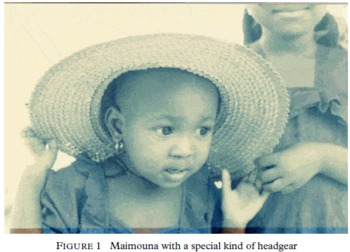
I have known Maimouna since she was six months old. I befriended her mother at the beginning of my first period of fieldwork (1986–8), which I carried out in the mountainous area that borders Nigeria. Our courtyards – I lived with my then six-year-old son – backed on to one another. We talked several times every day – in Fulfulde, for she did not speak any French – over the fence, and she would visit me regularly with Maimouna, whom she was still carrying on her back. As she needed to walk all the way round to my compound (which made other people gossip), and as our sons had also befriended each other, we decided to tear down part of the mud wall that separated our compounds. After that we could walk in and out of each other's compound and huts. We have never regretted this decision.
Ever since she was little, Maimouna and I have had a special relationship. I often took her along on fieldwork visits for special occasions like weddings. When she was 14 months old her mother became seriously ill; I took her to the hospital, which was 17 miles from our town. She needed to stay, but Maimouna, whom she was still breastfeeding, could not stay with her, so I took her home with me. Maimouna and I bought a bottle so I could wean her. At night she called for her father, but after he had fetched her she wanted to return to me, and so – ashamed because he was visiting another woman's house at night – her father brought her back to me. My son and I also got to know members of Maimouna's parents’ families, as we often accompanied them on family visits. At the end of the first fieldwork period – which lasted for 18 months without any visits home – her parents and all our acquaintances called her ‘Mama's girl’.
We kept in contact after my return to Europe, and I regularly phoned her via their neighbour. When we left we gave Maimouna a Fisher-Price toy phone; her mother told me that she would often find her at the back of the house, unseen by the others, pretending to phone me. One day – she must have been about three years old – she told me during a (real, this time) telephone conversation: ‘Mama, I am quite grown up now, I could come over and live with you if you want me to.’ The tears ran down my cheeks. My son – these days an anthropologist himself – remained friends with her brother, and we used to return every year and stay with them. As the mother, I and our children all slept in the same room, we talked long into the night, after the children had fallen asleep.
In Fulbe society an educated person has a high status: Maimouna's grandfather is a learned scholar – though without a French education – and a highly respected marabout. He sent his boys (six in total) to school but not the (nine) girls, so Maimouna's mother remained without secular education and does not speak French. However, she is skilled in Arabic and is also a marabout; she had her own Qur'an school and has continued studying to the present day. She always made it crystal clear that she wanted a secular education for all her children. Maimouna's father agreed, though it will never be known if they would have acted differently had they not known us.
Maimouna's father was related to the chief of a village 40 miles away, so he carried the title of ‘prince’; he had attended primary school but quit after a bad experience with the local teacher. He merchandised the local cash crop; he was a pious man, quiet, introvert – thus in accordance with the Fulbe norms of pulaaku – and with a strong sense of justice; he married Maimouna's mother when she was 13, the age that girls were (and often still are) ‘married out’, in the local expression. The children adored him and every day he brought something special home for them from the market, like sweets or fruit. It was an arranged marriage, but the parents had – so the mother told me – a warm relationship which they never showed in public: whenever someone (no matter who) entered the compound, they immediately split up and went to their separate spaces within it: according to FulbeFootnote 13 customs men's and women's activities are highly segregated. All the children – three boys and three girls – are writing and reading in Arabic and had finished reading the Qur'an by the age of 12. Their mother instructed them.
The parents sent the children to the Mission School, where they received a slightly better education than they would have at ordinary public schools, and the mother made a great effort to get to know all the teachers so that her children received special attention. Eager for any kind of knowledge, Maimouna would read from an early age everything she could lay her hands on. I used to bring books along for her.
It went without saying that Maimouna's parents would also send all their children to secondary school. (Islamic schools have not yet been founded in her hometown.) Maimouna is third in line, but the brightest; at secondary school – Lycée – she ‘surpassed in class’ her elder brother and sister. During our frequent stays we had many informal conversations, and also when she got older she often accompanied me on fieldwork visits. When she was about 13 years old she expressed her wish to become a ‘writer’ later in life. In 2001 I became scientific director of a development institute in the town of Maroua, 50 miles from her hometown. It meant that she could spend her holidays with me, which she often did, as did also her sisters and brothers. On these occasions we got involved in all sorts of activities, and I taught her how to swim.
Besides our informal conversations – at the outset in Fulfulde, later also in French – I occasionally interviewed her more officially (in French) and made a small film about her.Footnote 14 In an interview I conducted with her at the age of 15 the issue of veiling was discussed, and she explained to me:
I consider the ‘veil’ to be something from the past. It is African, related to ancient tradition, but it has nothing to do with the Islamic religion.
During the interview she also expressed her wish to continue at university and to study social sciences (anthropology or law). Her view was:
It was uncommon in former days to send children [girls] to school; take for example Maama [her grandfather]: he has denied his daughters access to secular education. Habiba [her mother's sister but of the same age as Maimouna] never went to school, but she would have liked to.
Concerning her own education and future, she expressed the desire to be independent in later life:
I never want to be financially dependent on a husband, sometimes we have these discussions in class, and the boys tell me: ‘But we would give you everything you like: food, nice clothes, whatever you want, and you need not do anything.’ Then I say: ‘Come on, do you honestly believe that that is what I want my whole life long?’
I thought these views quite remarkable, as Maimouna lives in an environment where men's obligation to provide – financially as well as in other matters – for their wives and children is underlined again and again. She stressed that her parents supported her:
My father … my father … I never really know what he thinks about me studying hard all the time. Sometimes I think he pities me as I leave early in the morning, and only come home after dark. But he gives me every morning small amounts of money so that I can buy a snack during the break so as not to go hungry. I have sometimes heard him talking to his friends, who say: ‘Why don't you marry them [her older sister and herself] out? Haven't they already reached the age to be “given in marriage”?’ Then he does not openly say he is against it; he may still say that he will ‘marry me out’, but I am not afraid that he will!
Maimouna's father's tacit support for her schooling was also evident when the English (Western) teacher organized a two-day trip for the pupils (girls and boys), 300 km further south. He allowed her to go and saw her off in the dark at four o'clock in the morning. During this trip her best friend drowned. At first the news reached us – I happened to be staying with them for the weekend – that an accident had happened, some pupils had drowned, and Maimouna was somehow involved. Maimouna's parents were so afraid that it would be their daughter. I could but repeat: ‘Maimouna can swim, Maimouna swims well.’ Afterwards it turned out that she had tried to save her friend, but her friend's hand had let go of hers. I went to mourn with the mother at the friend's parents’ house, and afterwards tried, together with Maimouna, to support the English teacher during the official inquiry that followed the event.
Maimouna's mother openly encouraged her – and the other children – in all she does. She gave her time to study at home and hardly ever asked her to do tasks within the household. She always stressed that Maimouna was not cut out for household jobs and needed to ‘go on in life like her mama’ – by which she meant me.
During the aforementioned interview Maimouna – who casually plays with her headscarf, which falls on her shoulders during the conversation, as can be observed on the film – also blames African ‘tradition’ when girls are not allowed to pursue a secular school education. In her opinion it is not Islam that is to be blamed; this she has deduced from the people – called ‘Pakistanis’ – who come to preach:
I am sure that their women are all literate – have jobs, and so on – unlike the women in our ‘African [Islamic]’ surroundings.
While I talk to her, we see on the film her older sister doing the cooking; she is bareheaded. Her mother wears simple headgear, she comes and goes; she is supervising the cooking and everything else that is going on within the compound. During the filmed discussion I reminded Maimouna that some years earlier she had said that she always ‘hated to take off the veil’ – which was a simple headscarf – when she entered the classroom. At that time she put it as follows: ‘Without my veil I feel naked.’ In the filmed interview she attributes these words to the ignorance of a young girl and to the persistence of her ethnic ‘traditional African’ practice:
I did not know that much then, I thought it was part of being Islamic, but now I realize it is related to the African tradition, and that people confuse the two. When people Islamized they did not understand that other things are much more important.
I treasure the image of her that I filmed, then still unaware that I was going to write this article: she enters the school – a space out in the open – walks towards the classroom, and at the very last moment she takes off her headscarf, lafaay.
At the age of 17 she attended the final class of the Lycée, having made all preparations to undertake, quite soon, a 1,500-mile journey to the capital, Yaoundé, and there continue her studies at university. Her father became ill in December 2004 and, after having had Maimouna close to him during the period of his sickness, he passed away in January 2005. I came over to mourn. Maimouna became ill from grief, but still passed her exams in July 2005 with good results; she travelled to the south and started university in September 2005. Her mother gave her all the confidence a young adolescent could get from a parent, and she kept in contact with her by mobile phone.
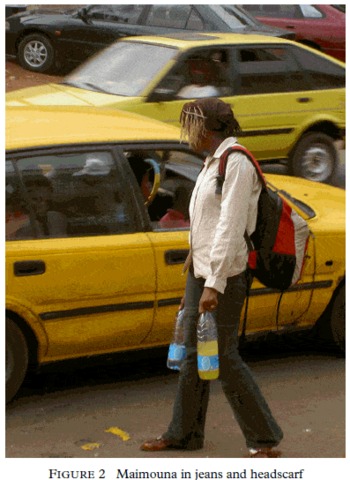
I visited Maimouna in the capital in 2006, 2007 and 2008, and stayed with her in her student room. In this part of the country most people are Christians, which is visible in women's manner of dress. Among young people tight trousers and miniskirts are not exceptional. In her first year Maimouna rented a room with Christian people, in a Christian quarter, as she considered the Muslim quarter to be too far away from the university. She found her surroundings unclean (from my own experience I can only agree that they were) and thought it was difficult to keep up with her prayers. However, she was and still is friends with all the members of this Christian household; I saw her pull up the daughter's blouse when it slipped down her shoulder and exposed a lot of her breast, while continuing to laugh with her and without making any comment. She herself still dresses like people in the north – long skirts and a headscarf, lafaay, though not an extra cloth. When I reminded her of her notions of ‘veiling’, she said that whenever she is wearing jeans she will not wear a headscarf, as ‘it does not go with my jeans’ – though I saw her wearing jeans only once, and on that occasion she was still wearing a headscarf, lafaay. Meeting female – also Islamic – friends in the street who went unveiled and dressed up, she did not comment on it, but just embraced them wholeheartedly, obviously glad to run into them. She never openly condemned these girls when they were out of her sight. It just seems not to be an issue with her. She got along fine with people in her neighbourhood, and the (southern, Christian) women, especially, made a point of speaking to me (‘We are so happy for her that her “Mom” came to visit her’) and mentioning that they were keeping an eye on her while underlining that they were very glad that a girl from the north – meaning from the Muslim community – attended university.
Whenever time permits, she meets with people from the north, Islamic people. The only place where she feels she can wash in such a way as to fulfil her religious obligations is with relatives of her mother's neighbours, who live a 15-minute walk away and whose home she passes every day. Once a week she goes with her laundry to other northerners: a marabout (who is active in spreading fundamentalist propaganda) and his wife. She gets along fine with both of them and supports the wife in those feminine aspirations that the latter cannot share with her husband. I can see, without having to ask her, that she takes good care to be properly dressed when she visits these people. Her older brother has visited her; he stayed for months and did the cooking for her. He obviously supports her in the way she is trying to shape her life. Though she hardly goes out in the evening to places where youth meet, dance and drink, she regularly meets with Christians as well as Muslim friends, male as well as female, who also visit her in her room.
Maimouna is now studying for a master's degree, and her latest wish is to get a scholarship to continue studying abroad: ‘What's your opinion about me asking a scholarship for the States?’ she asked me the other day. ‘Yes, well, you could give it a try, or perhaps Canada?’ I replied. ‘No’, she responded, ‘I want to go to New York.’
In order to be able to put the case of Maimouna in context, in the next section I will discuss the issue of veiling in present-day Cameroon.
VEILING AND THE LAIC STATE
In the European media people from of all walks of life regularly express their views concerning the negative effect they believe the veil or headscarf worn by Muslim women has on their liberal, progressive, secular, and above all enlightened society. The veil has in many respects become the symbol of fundamentalist Islam, understood in turn as synonymous with extremism or even terrorism. On the other hand, there is the view that Muslim women see the veil as part of their identity, which they express by wearing it. Since 9/11 the veil has also acquired a political meaning. More women are veiling, and more are ready to defend this choice. Structural discrimination against Muslims has led to stronger identification with a belief system and – in the case of national and international migration – with the society from which they come.15
Cameroon is a laic stateFootnote 16 which, as with its former colonizer France, means that no overt symbols of religion may be brought into school, since this is a public space.Footnote 17 The Cameroonian constitution prescribes an official separation between state and society. According to Cameroonian constitutional law:
• no person shall be harassed on grounds of his origin, religious, philosophical or political opinions or beliefs, subject to respect for public policy;
• the state shall be secular [laïc in the French version]. The neutrality and independence of the state in respect of all religions shall be guaranteed;
• freedom of religion and worship shall be guaranteed.18
In most Cameroonian communities, be they Christian or Islamic, women (and often also men) use various types of headscarf. Yet the official policy is to forbid wearing headgear in the classroom, in the southern, Christian parts of the country as well as in the north, where a majority of the population is Islamic. Hence the image of Maimouna taking off her headscarf, lafaay, upon entering the classroom.
In northern Cameroonian Islamic communities a distinction is drawn between various forms of headgear. The ordinary wrap around the head – worn by nearly all women, of all ethnic and religious origins – is called in Fulfulde (the local lingua franca) hadiko. Islamic women add a cloth around their heads and shoulders in the colour of the rest of their outfits, called kudel. A fashion from the 1990s is to place on top of this a shawl of a thin material, called lafaay. Maimouna used to wear a lafaay when she went to school, but not a kudel. In the capital she mostly wears a lafaay. Her mother will never go out without a kudel around her hadiko.
New, but still rare, are cases of women wearing the coloured veil, tope, as in Sudan and Chad. Even more uncommon is the Arab black dress called hijab or hidjâb – a word derived from the Arab verb hadjaba,Footnote 19 to cover up. It was introduced by women returning from the pilgrimage to Mecca, the hadj. Upon return they may wear it when they are receiving the guests who come to welcome them, but thereafter it often ends up in the suitcase underneath the bed, to remain there indefinitely.20
For Cameroon, the wearing of headgear in public has not been an issue worthy of general attention. In the north women working in the administration of various public institutions, like the town hall, prefecture, or banks, were and are mostly Muslim; they wear a headscarf and also a kudel and/or lafaay. But then, men performing public functions also wear Muslim outfits with headgear. Until the 1990s nobody ever discussed it. However, as a reason for the establishment of private Islamic schools – and their number is rapidly increasing – veiling suddenly came to be mentioned; thus a friend, then male director of one of the Islamic schools, explained in the company of an Islamic director of an ordinary state school:
After the arrival of the FrenchFootnote 21 the Fulbe considered the creation of Western schools to be a threat. What use was it to our own culture, which is Arab-Islamic and by definition anti-occidental? The French pressed us to go to school and with that we lost touch with the roots of our own culture, which is the reason why many fathers did not want to send their children to school, especially their daughters. State schools did not have the right spirit.
Because we did not want to lose another generation, to remain without a secular school education, and because there is this obvious division between the East and the West, we got together and founded Islamic schools. Parents have fewer objections to sending their daughters to school, because in the Islamic schools they learn about the Qur'an and they are allowed to wear their headscarves, the lafaay, whereas this is forbidden at state schools.
Now of course this is a good example of what Roy (2002) means when he speaks of the relation between Muslim intellectuals – and I consider this school director to be one – and the West: many Islamic intellectuals strive constantly to historicize Western culture in order to debunk its claim to be universal. But the critique of Western cultural hegemony is sustained not necessarily by a valorization of existing traditional cultures, but more often by modern reconstructions of new identities, even if these intellectuals resort to historical themes. Processes of Arabization in the context of Cameroon as a secular state – the director mentioned above called their culture Arabic-Islamic – seem to be a matter of (as Nageeb puts it in the case of Sudan) expelling the nation state with its Western (Christian) orientation and replacing it with something that comes closer to their own culture(s) (Nageeb Reference Nageeb2005); in a general context these processes mean that Western influences are replaced by better Islams (in the plural).
Concerning girls’ participation in the school, the director remarked:
We are very happy with these new developments, the fact that we have nearly as many girls as boys. What use is ‘development’ without the participation of women? Isn't it the case that ‘the state exists through the mediation of women’ [literally: La nation passe par les femmes]? Don't children spend half of their lifetimes with women, especially their mothers? In Fulbe culture women are respected, which is why they need not till the land. Islam, however, does not forbid women to work; women need to be as active as men in the development of a state. We therefore need to create the right conditions and Islamic schools are a start. They get the normal curriculum, as in other schools, but in addition knowledge of the Qur'an (in Fulfulde translation) and the Arabic script. Girls can wear their veils in these schools whereas they have to take them off in state-run schools. That fact makes it harder for them to go to school. Not only because their fathers may fear improper behaviour but also because they themselves feel ashamed. Those who founded the Cameroonian state and made the rules were all Christians from the south, and they never took our [Islamic] culture into account. …
This man, a Pullo, sends all his children to school; his very old father teaches them and the children of his brothers the Qur'an early every morning. The father narrates – knowing all the stories from his father – the coming in 1901 of the colonials, who met strong resistance in the area. His desire for ‘development’ has resulted in the foundation of agricultural cooperation in which the non-Muslim and Muslim population work together, and which so far has been quite successful.
The director of the ordinary, state-subsidized school agreed, adding that
they had forgotten that, at the time the French arrived, Islamic culture was deeply rooted in our culture,Footnote 22 and that we always have been learned and educated, women as well as men. With the arrival of Western influence, [the colonials] forced a culture upon us that is not ours. A school should be embedded in a culture, not the other way around.
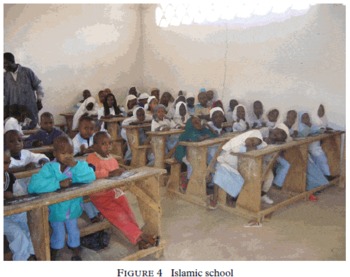
This particular Islamic school had 312 girls and 430 boys enrolled in 1998, but 387 girls and 348 boys in 2006. Girls indeed wear a (white) veil in the classroom; it also covers the shoulders and can't slip off the head. During state-organized events like the national youth festival and procession, all the children used to march past bareheaded. It was therefore remarkable that in 1999 in OlokomFootnote 23 – the town in northern Cameroon where Maimouna was born and grew up – the children from the (hitherto state-subsidized) Franco-Arab school, an institution dating back to colonial times, for the first time wore black veils that covered their shoulders and heads, leaving just their faces uncovered. However, in 2005 during the défilé,Footnote 24 in Maroua one could observe hundreds of pupils of the Islamic primary as well as secondary schools in their school uniforms. The secondary-school boys wore a khaki uniform and the girls wore a garment that was unlike anything worn by anyone else. It was a rose-coloured dress, underneath which they wore trousers in the same colour and a white garment that covered the head and shoulders. When I discussed with them their way of dressing, they said that it flowed naturally from their Islamic faith and that they wanted to be good Muslims; at home they took off their uniforms and wore the clothes that most women wear in Muslim society.
During the conversations I had with girls of these schools, many of them said that they were opting for university education, while adding: ‘At least, if our fathers do not “give us out in marriage”.’ They feared – and this was a danger Maimouna did not worry about – that their ‘surroundings’ (by which they meant their relatives) would prefer them to get married. In that case cooperation from the male population – such as Maimouna received from her father and oldest brother – was of the utmost importance in fulfilling their desires. Many girls even try to find a husband in the university cities, hoping that in that way they will be allowed to continue studying.
In addition, the madrasa, which in Maroua is situated next to the largest mosque, received a new impulse from Egyptian teachers. Here all subjects are taught only in Arabic, and women attending the madrasa cover themselves in a black hijab while leaving their faces uncovered. These women have passed the age of going to school and most of them do not speak French. Many of them said that as they did not have the opportunity to go to school when young they were now trying to catch up with education. They wear the black hijab only when they go to the madrasa; on other occasions they wear the coloured kudel.
Girls who do not cover their heads in state-run schools – like Maimouna, her sisters and many girls at the state secondary schools – are convinced they are also good Muslims. The fact that they may interpret wearing the veil differently makes it evident that dissimilar discourses are at stake here and that there is more to it than meets the eye. In daily discourses some believers, as well as imams and mallum'en (religious teachers), consider the introduction of the hijab and black headgear as an unnecessary influence from the ‘white Pakistanis’. In their opinion they bring in ‘Wahhabian’ influences, and such preachers are not necessarily well-regarded. As the imam of one village said:
We are not in need of those black crows. We do not need them in our streets. Fulbe women have always dressed correctly, with a cloth, kudel, around their head. Where in the Qur'an should I read that this cloth ought to be black?
In the 1980s the veil was not yet a topic of a general debate. However, in retrospect it seems to have been an issue after all: people now explain that Muslim girls often were not sent to school because they had to take off their headscarves in the classroom. When fathers – like Maimouna's grandfather – objected to sending their daughters to school, it was because they, as males, had and have the responsibility in this particular Muslim society of ensuring that their children were educated within the Islamic faith. If children grew up to be ‘bad’ Muslims, the fathers would be blamed. Many men did not and do not want the community to gossip about their daughters going to school bareheaded, as one of the results of this is to make it difficult to find proper marriage partners for them.
In official statistics and various state documents, it is reported that the north is still very ‘backward’ and that the rate of school attendance (taux scolaire) is still very low. Arabic education did not (and does not) count in the statistics. However, people often feared sending their children to secular schools because this could lead the youth to stray from the path of God (Tourneux and Iyébi-Mandjek Reference Tourneux and Iyébi-Mandjek1994: 108).Footnote 25 In their eyes girls have always been well educated, as Qur'anic education in Arabic has never been denied to them and continues to be most important. For Muslim fathers getting girls properly married was a far more important issue, and is becoming an ever-increasing problem, as is underlined over and over again when one discusses ‘modern’ life with adult males. The following can often be heard:
They just walk around in the streets of town, these adolescent girls. They search for boys, they often get pregnant out of wedlock … prostitution is a serious problem of modern times.
Fear of such a situation often leads fathers to arrange forced marriages for their daughters, as they are so afraid their daughters ‘will miss the wedding boat’. However, the daughters react: during Women's Day, 8 March 2004, women's groups marched in the street to demonstrate against forced marriages for young girls.Footnote 26 Unlike in former days – Maimouna's mother had not been able to choose her partner, either – girls are more often ‘married out’ to elderly men, and they often walk away after one or two years of marriage, and ‘wander around’. But it is also true that many girls do not get married at all. The deplorable economic situation is largely responsible for these developments, as marriage demands an enormous investment from both the groom's family and the bride's (see van Santen 1993).
SYMBIOSIS OF EDUCATION, RELIGION AND POLITICS
We may thus conclude that the male Islamic adult population in particular is in favour of the creation of an ‘Islamic private school system’. In negotiations that take place to set up these schools, political as well as religious leaders are involved. This has to do with the close connection in northern Cameroon between religious and political institutions. Attendance at Islamic schools – the issue of the headscarf is given as one of the reasons for it – may thus be explained as an act to give women the chance to receive secular education while observing proper conduct. However, the foundation of these schools with the headscarf as an excuse can also be interpreted as a political move, an act of resistance against the government in the south, if we relate it to the recent political past. The Muslim Fulbe in the north had lost political hegemony after the installation of a Christian southerner as President: Islamization and fundamentalism(s) as global forces are by the same token about restructuring the state even in secular countries like Cameroon, with women's proper conduct – wearing a veil – used as an excuse.
Here the support Qur'anic education has always enjoyed in Muslim society in northern Cameroon is of importance (van Santen 1998). Even the smallest settlement has a Qur'anic school. In fact, it is the first thing that is installed when a nomadic group settles (van Santen 2003) and even on transhumance journeys the nomads will create a place, by making a semicircle with pebbles, to pray and read the Qur'an when they put up their temporary homes. A distinction is thus drawn between a mallum (one who has completed reading and writing the Qur'an, and can explain it to others, without necessarily understanding it) and a moddibo (someone who is studying Qur'anic sciences) (Tourneux and Iyébi-Mandjek Reference Tourneux and Iyébi-Mandjek1994; Santerre Reference Santerre1968).Footnote 27 Women can also be mallum'en, as in the case of Maimouna's mother, who continued to study in order to grasp the meaning behind the Arabic texts, and thus is on her way to becoming a moddibo.
The majority of Muslim children who do not attend secular schools go to ‘traditional’ Qur'anic schools; when they do go to secular schools they continue attending traditional ones (Tourneux Iyébi-Mandjek 1994). Women's religious knowledge in Islamic surroundings differed according to class. French schools were established much later than in southern Cameroon. The first one in Maroua opened in 1918; it faced much opposition, especially from the Muslim population. The chief (lamido) of Maroua (a Muslim) pretended to promote secular education, which won him much credit with the French administration. In reality he paid parents when they later withdrew their children from the school, and parents who wanted their children to continue their education had to pay tribute to him (Tourneux and Iyébi-Mandjek Reference Tourneux and Iyébi-Mandjek1994: 100).Footnote 28 Only with the installation of the missions in the 1950s did secular education become a real issue (van Santen, Reference van Santen1993: 28) but it attracted mainly non-Muslim children. This goes mostly for males, though women were not excluded. Thus the non-Muslim population got ahead in education. This, in combination with the political domination of Western-educated (Christian) southerners made the population realize that, if they wanted alternative, non-Western-based ‘development’, secular education might be of use after all.29
The first private Islamic school in Maroua – not financed by the state, so teachers have to be privately paid – opened in the school year 1993–4. In 1987 the share of children attending secular state education in a town like Maroua was 59 per cent (the highest percentage at age eight); in 1993, 70.6 per cent of the boys went to school and 58 per cent of the girls. When girls can attend Islamic schools parents object less to modern education because the children also receive a religious education, girls and boys are segregated, and girls are allowed to wear the headscarf. In 2007 in the Far North Province Islamic private schools had 4,439 pupils, of which 2,430 were girls; the various regions in the Far North had 28 private Islamic primary schools, and 7 were in the process of being created. There were 6 secondary schools with a total of 1,318 pupils. In Cameroon as a whole there are 16 secondary Islamic private schools.Footnote 30 Unlike when they were first founded, the schools are now coordinated by the Ministry of Education. When secondary schools are opened, officials from the Saudi Arabian government are present.
During my visit at the Islamic private secondary school in Maroua in 2008, its director, who had completed his Western university education with an excellent masters thesis, urged me to encourage the girls to continue their studies, to succeed in their final exams, and to underline the necessity of women's education for the development of any society. Many conversations with national as well as local religious leaders in recent years have revealed to me that, on the one hand, they approve of the foundation of Islamic schools, while, on the other, they monitor closely the political aspirations of fundamentalist movements.Footnote 31 They are equally in favour of the laic character of their country, as it ‘means freedom of religion; thus it permits us to carry out our religion in the manner prescribed by the Qur'an’.
The importance attached to the education of girls, and the symbiosis of religious and political leaders, also came to the fore in a gender sensitivity training course organized by a Western NGO for imams, local chiefs and preachers in the Far North Province of Cameroon.Footnote 32 One of the dilemmas they had to discuss among themselves was the following:
You have a boy or a girl, who both went to primary school. You now need to send them to secondary school but you realize that you do not have the money to send them both. Whom will you send?
All but one of the participants answered that they were more likely to send the boy to secondary school, as he would have to provide for his family when he grew up. Then another element was added: at primary school it had turned out that the girl was far more intelligent, so whom would they send to school? It was the imam of the largest mosque in Maroua who from the beginning argued that, if you had two children, you had to send the one who was more intelligent, regardless of sex, to school.
Discussion in small groups finally led to a point at which at least 80 per cent of the participants were in favour of sending the brighter child to school. The outcome of the whole workshop, which lasted several days, was that much needed to be done to improve women's position; that their disadvantaged position in society was due to pre-Islamic ethnic residues; and that education for women needed to be encouraged. Again, it was felt that the dissemination of this message should be entrusted jointly to political and religious leaders, rather than to the agents of state-governed institutions (such as schoolteachers or prefects).
What conclusions can we draw concerning the relations between veiling, recurrent waves of fundamentalism , education and women's agency in Cameroon as a laic state?
CONCLUSION
Is it possible to draw conclusions from the simple story of the life of a girl (now a young woman)? Asad is of the opinion that a single case can certainly be taken as an example: he argues that we should not just come up with deconstructions or simple definitions if it concerns religion, but we should look at concrete historical processes, stay close to the ways religion is articulated and also talk about ‘religion’ in the singular (Asad Reference Asad2003). Placed in the historical and social contexts of her society, Maimouna's life story demonstrates that the shifting viewpoint on the veil is linked to local, national and international contexts, but in a different way at each level.
Cameroon, having inherited colonial institutional laws, is officially a laic state – thus the prohibition on wearing headgear at state schools. My image of Maimouna taking off her headscarf just before entering the classroom is related to this colonial legacy and is of significance. Within the recent processes of Islamic fundamentalism, this gesture symbolizes the discussion: embodied in this motion is the relationship between the nation state, modernity, Islamic discourse and the veil as a symbol of the Islamic faith.
In the new private Islamic schools girls need not take off the veil in the classroom, can get educated and in this way contribute, so the founders of these schools state, to ‘development’ and/or to modernity in a way that is not dictated by ‘Western’ society. However sympathetic (or correct from a feminist point of view) such an emphasis on women's right to education seems, the reality is also very political: the men on the founding councils of these schools seem to act in the interest of women. However, while treating the ‘veil’ as a sign of proper conduct on the part of women, they create institutions that bypass the official institutions of the state. In former days fathers decided not to send their daughters to secular schools, afraid that improper behaviour – going bareheaded into a classroom together with boys – would block their daughters’ chances of finding a good husband. Simultaneously they opposed the colonial state, and in retrospect they explain their refusal to send their children to secular schools as an act of resistance. The foundation of the Islamic schools could be regarded as the same sort of resistance, but this time against the post-colonial state.
The fundamentalist Islamic developments in Cameroon also demonstrate that fundamentalism need not have a connection with extremism (or ‘terrorism’). During many conversations I had with Muslim political and religious leaders, they stressed that they are in favour of a return to the Islamic principles in their local communities – which include the right of women to education – while they were against a ‘political Islam’: the founding of new private schools can be interpreted as ‘throwing out the state’ (with its rules decided upon in the political Christian centre of the capital) and ‘bringing in their own culture’, which they call ‘Arab-oriented’, but they reserve these aspects for their own localities.
In northern Cameroon, as everywhere else in the world, putting on the ‘veil’, or rejecting it, may seem to be the autonomous actions of individual girls, but behind them are also institutions, politics and discourses of what it means to be a good Muslim in a laic, modern society in which nowadays one needs a secular education, too. This does not contradict the fact that behind these acts women as ‘agents’ make strategic choices, as Maimouna's case reveals; she herself represents, in the course of her life, a variety of positions depending on time, place and situation. Her case makes it clear that the interface between Islam and gender cannot be reduced to an exclusive ‘viricentric perspective’. Her own account reveals that the desire for an education was much stronger than her sense – as she expressed it at the age of 12 – that not to wear a headscarf was ‘to go naked’.
Maimouna wanted to get a university education – and for this she took off her headgear in the morning when she entered the classroom at the state school, while consciously reflecting upon the Islamic faith. In her present life at university, wearing a veil seems not to be an issue; yet she continues to wear it, while remaining on good terms with her Islamic friends who do not. She considers the veil an ethnic leftover, making a distinction between ethnic and Islamic consciousness, and she modifies her understanding of the Islamic faith so as to align it with her wishes and views concerning her own future.
Her shift with regard to the veil is significant: though she says that ‘a veil does not go with her jeans’, her way of dressing is such that people (that is, men) from the north cannot accuse her of improper conduct. With this attitude, in the streets of the Christian south she is part of a homogeneous category of ‘Muslim women from the north’. The reality, however, is that she is an eager student, but wearing her lafaay at university she unconsciously contributes to a stereotype. She attracts attention as one of the few Islamic girls who attend university. People in the quarter where she lives also mention it, thus underlining the stereotype of the backwardness of education in the northern part of their country (most people in the south do not know that education in the north is in line with historical developments within the Muslim community there).
The story of Maimouna also indicates that modernity is gendered. Men opt for another type of school where the ‘veil’ is allowed, women opt for education. For Maimouna, modernity means being able to go to school and on to university, and she justifies this argument by reference to the process of Islamic purification around her: for her, the wandering priests from elsewhere – the ‘Pakistanis’ from Saudi Arabia – have brought this message: you are entitled to an education.
Thus, the veil has acquired new meaning and has become a catalyst: fundamentalist male discourse relates the veil to Islamic women's proper conduct; women relate it to their own interests.
Maimouna with a special kind of headgear

Maimouna in jeans and headscarf

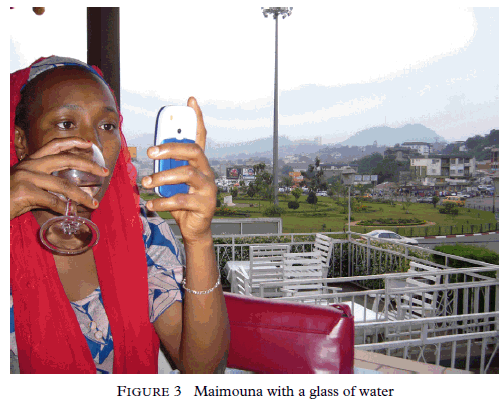
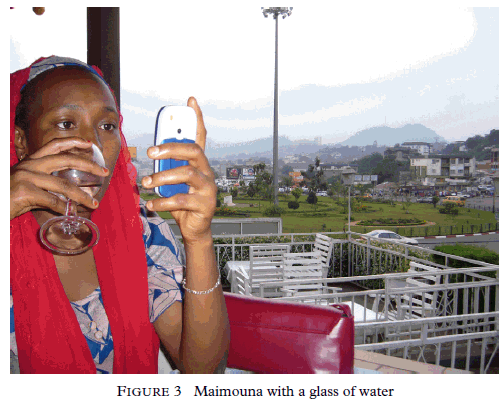
Maimouna with a glass of water
Islamic school