INTRODUCTION
Jury service is one of the few areas where lay people can have a direct impact on the criminal justice system. Not only is the jury system considered a cornerstone of American democracy (Diamond Reference Diamond and Litan1993; Dzur Reference Dzur2010; Gastil et al. Reference Gastil, Deess, Weiser and Simmons2010) but also, for many individuals, jury service is the only time they will have direct contact with the legal process (Diamond Reference Diamond and Litan1993). Although prior research shows that generally Americans view the jury system more positively than other legal institutions (Diamond Reference Diamond and Litan1993; MacCoun and Tyler Reference MacCoun and Tyler1988), little research has examined actual jurors’ change in views from the beginning to the end of the jury process. The vast majority of research on jurors’ experiences asks respondents to answer retrospectively concerning their views in one survey conducted after jury service (see, for example, Cutler and Hughes Reference Cutler and Hughes2001; Hannaford-Agor et al. Reference Hannaford-Agor, Hans, Mott and Munsterman2002; Bornstein et al. Reference Bornstein, Miller, Nemeth, Page and Musil2005; Sicufuse, Chomos, and Miller Reference Sicafuse, Chomos and Miller2013; Pyo Reference Pyo2018). Collecting data at the beginning of jury service raises ethical issues as jurors could be tainted by being exposed to ideas that are not part of the evidence at trial, potentially undermining the defendant’s constitutional right to a fair trial (Hannaford-Agor et al. Reference Hannaford-Agor, Hans, Mott and Munsterman2002; Bornstein et al. Reference Bornstein, Miller, Nemeth, Page and Musil2005). Yet without collecting data before jury service, it is nearly impossible to know whether participating on a jury has affected jurors’ views. Our article adds to the small body of work that asks actual jurors about their court experiences both at the beginning and the end of their jury service to capture whether deliberation changes individuals’ views of the jury system.
Understanding how being a juror affects attitudes toward the jury system is a crucial policy issue. Jury service is potentially an important way to address a critical lack of trust in legal institutions. The public’s trust in courts and the criminal justice system is at historic lows, particularly among members of racial minority groups (Tyler and Fagan Reference Tyler and Fagan2008; Morin and Stepler Reference Morin and Stepler2016; Newport Reference Newport2016). Yet individuals tend to hold more favorable views of the jury system than other criminal justice institutions (Diamond Reference Diamond and Litan1993; MacCoun and Tyler Reference MacCoun and Tyler1988). Some studies suggest that the positive effects of jury service go beyond each individual juror since jurors likely discuss their experiences with their community, communicating values concerning jury service and the legal process to others (Kalven and Zeisel Reference Kalven and Zeisel1966; Shuman and Hamilton Reference Shuman and Hamilton1992; Diamond Reference Diamond and Litan1993). Jury service, particularly when it includes deliberation on a criminal case, can lead to increased future political participation (Gastil et al. Reference Gastil, Deess, Weiser and Simmons2010). Jury deliberation offers a forum for active citizenship and an important place to build engagement with, and faith in, the justice system.
Examining how jury duty affects an individual’s views of jury service, particularly among nonwhite jurors, may help to address the reasons why large groups of people, particularly members of disadvantaged groups, do not appear for jury duty. Nationwide, there has been a steady drop in jury trials (Galanter Reference Galanter2004; Burns Reference Burns2009; Administrative Office of the US Courts 2010). If serving on a jury is indeed legitimacy building, fewer jury trials means losing an important opportunity to build these positive views of the justice system. Jurisdictions across the United States face a shortage of jurors, particularly in urban areas. Many people summonsed to jury service do not appear (Vidmar and Hans Reference Vidmar and Hans2007; Rose and Abramson Reference Rose and Abramson2011; Bloeser, McCurley, and Mondak Reference Bloeser, McCurley and Mondak2012; Musick et al. Reference Musick, Rose, Dury and Rose2015), which can lead to a deficit of available jurors to decide cases (Schultz Reference Schultz2017; Altman Reference Altman2018; Wright Reference Wright2019). High rates of failure to appear can greatly affect the overall representativeness of the jury pool. Members of racial minority groups and the poor appear for jury service in smaller numbers, leading to jury pools that are increasingly white and from higher income brackets (Fukurai, Butler, and Krooth Reference Fukurai, Butler and Krooth1993; Rose and Abramson Reference Rose and Abramson2011; Gau Reference Gau2016; Rose et al. Reference Rose, Diamond, Ellison and Krebs2018). In addition, one study suggests that Black and Hispanic jurors with low education are less likely to feel that they had sufficient time to express themselves in jury deliberation than other jurors, potentially leading to increased legal cynicism and disengagement for jurors of lower social status (Winter and Clair Reference Winter and Clair2017). Unlike other barriers to jury service, such as a lack of childcare and transportation, attitudes can potentially be changed through education efforts and other kinds of outreach (Rose et al. Reference Rose, Diamond, Ellison and Krebs2018).
This article uses original data from actual jurors surveyed both at the beginning and the end of their jury service to capture how jury deliberation changes jurors’ views of jury service. We match data from individual surveys of the same 248 jurors both pretrial and posttrial in one courthouse in the southeastern United States. These data include 138 jurors who heard a case and participated in jury deliberations and 110 prospective jurors who appeared for jury service but were not selected to hear a case. Since members of racial minority groups generally have less positive views of legal authorities and institutions than whites (Tyler and Fagan Reference Tyler and Fagan2008; Morin and Stepler Reference Morin and Stepler2016; Newport Reference Newport2016), and nonwhites are more likely than whites to believe that courts treat racial minorities unfairly (Rottman and Tomkins Reference Rottman and Tomkins1999; Brooks and Jeon-Slaughter Reference Brooks and Jeon-Slaughter2001), we gave particular consideration to the influence of juror race on whether views of the jury system change because of jury service.
JURORS’ VIEWS OF JURY SERVICE
Individuals with jury experience generally view the act of jury service positively. Research consistently shows that the vast majority of jurors leave the process very satisfied with their jury duty experiences and with positive views of the courts (Diamond Reference Diamond and Litan1993; Bornstein et al. Reference Bornstein, Miller, Nemeth, Page and Musil2005; Gastil et al. Reference Gastil, Deess, Weiser and Simmons2010; Sicafuse, Chomos, and Miller Reference Sicafuse, Chomos and Miller2013). Research in this area typically surveys respondents after their jury service is over (Bornstein et al. Reference Bornstein, Miller, Nemeth, Page and Musil2005; Sicafuse, Chomos, and Miller Reference Sicafuse, Chomos and Miller2013), sometimes comparing the views of jurors who deliberated on a case and jurors who appeared for service but who were not seated (Shuman and Hamilton Reference Shuman and Hamilton1992; Cutler and Hughes Reference Cutler and Hughes2001). Jurors with experience deliberating on a case generally report more positive views of the jury system than prospective jurors not seated (Shuman and Hamilton Reference Shuman and Hamilton1992; Diamond Reference Diamond and Litan1993; Cutler and Hughes Reference Cutler and Hughes2001). Prior research by Gastil and colleagues (2010) suggests that actively participating in a deliberative process can evoke a strong sense of civic responsibility, an effect that is strongest with jurors deliberating in criminal trials (but see Hans, Gastil, and Feller Reference Hans, Gastil and Feller2014, who found similar effects with civil juries in some types of cases).
Not all jurors view jury service positively, particularly at the beginning of jury service. Many report that receiving a jury summons is nerve-wracking, annoying, and a hassle (Fukurai and Krooth Reference Fukurai and Krooth2010; Berris Reference Berris2011; Bloeser, McCurley, and Mondak Reference Bloeser, McCurley and Mondak2012). In addition, some jurors report unfavorable experiences in the court process itself. Prior research identifies several factors leading to low juror satisfaction, including finding the process stressful (National Center for State Courts 1999; Bornstein et al. Reference Bornstein, Miller, Nemeth, Page and Musil2005), poor time management by court actors (Cutler and Hughes Reference Cutler and Hughes2001; Bornstein et al. Reference Bornstein, Miller, Nemeth, Page and Musil2005; Munsterman, Hannaford-Agor, and Whitehead Reference Munsterman, Hannaford-Agor and Whitehead2006), and unpleasant experiences during the deliberation process (National Center for State Courts 1999; Bornstein et al. Reference Bornstein, Miller, Nemeth, Page and Musil2005). Jurors with poor experiences have more negative attitudes toward the courts generally (Miller Reference Miller1985) and may be less likely to serve as jurors in the future (Benesh Reference Benesh2006). Individuals may share negative experiences with jury service through their social network, possibly weakening their friends’ and family members’ willingness to serve as jurors (Diamond Reference Diamond and Litan1993).
Very few studies have been able to survey actual jurors both before and after jury service, with no research primarily focusing on jurors’ views of the jury system itself. James Allen (Reference Allen1977) examined the changes in attitudes of one jury panel in a single courthouse over a two-week term, finding that jurors who deliberated on a jury were more likely to have higher beliefs in the justice and equity of the legal system generally than prospective jurors. Previous court contact had no effect on attitudes toward the legal system unless the previous experience was jury duty. Focusing on the educational effects of jury service with a sample of criminal cases not involving violent crimes, Paula Consolini (Reference Consolini1992) found that jurors’ knowledge of, and respect for, the legal system increases after jury service. Other work that has been able to survey jurors before and after their jury service focuses on how the act of deliberation affects future political engagement (Gastil et al. Reference Gastil, Deess, Weiser and Simmons2010).
Deliberating on a jury is likely to be a transformative experience for jurors. Prior work finds that individuals greatly value the ability to have a voice and to express opinions in the legal process, leading to more positive views of the justice system and to a greater sense that the legal system is legitimate (Tyler and Huo Reference Tyler and Huo2002; MacCoun Reference MacCoun2005). Participating in a deliberative forum allows diverse groups to come together “to clarify their opinions, consider alternatives, and work toward compromise” (Polletta Reference Polletta2008, 17). Research on the specific effects of deliberation experiences on jurors is more limited. Consolini (Reference Consolini1992) suggests that participating in the jury decision-making process provides individuals with an opportunity for active citizenship by working together with others to come to a group decision that best represents community standards and the public interest. Similarly, Albert Dzur (Reference Dzur2010, 609) emphasizes that “jury service is a civic education” where individuals must take an active role in interpreting and applying the law when deliberating and coming to an agreed upon decision. John Gastil, and colleague’s (Reference Gastil, Deess, Weiser and Meade2008, 351) “participation hypothesis” suggests that deliberating on a criminal jury trial transforms individuals to such an extent that they are more likely to engage in future civic activities such as voting.
The relationship between juror race and views of jury service is unclear (Bornstein and Greene Reference Bornstein and Greene2017). Most work in this area has found that nonwhite jurors view the jury process more negatively than white jurors (Shuman and Hamilton Reference Shuman and Hamilton1992; Rose Reference Rose2005). However, other research surveying jurors reports little or no significant differences among jurors of different racial groups (Cutler and Hughes Reference Cutler and Hughes2001). Brian Cutler and Donna Hughes (Reference Cutler and Hughes2001) found that general opinions of the court system and willingness to serve on a jury again did not vary by race with jurors surveyed after jury service. They suggest that jury service may be “a domain in which appraisals [of the system] are less sensitive to background influences” such as demographics (317). In particular, juror race may influence how the process of jury deliberation is experienced. Amy Farrell, Liana Pennington, and Shea Cronin (2013) suggest that nonwhite jurors are more likely than white jurors to act on their trust in legal authorities in jury deliberations. Alix Winter and Matthew Clair (Reference Winter and Clair2017) found that black and Hispanic jurors of low social status are less likely than other jurors to feel they had sufficient time to express themselves during the deliberation process. Important questions remain concerning the effects of deliberation on the views of the jury system, including whether there are differences among racial groups.
In this article, we examine the effects of jury deliberation on jurors’ views of jury service, using jurors who deliberated on a criminal case and a control group of prospective jurors who appeared for jury service but who were not selected for trial. We look at the effect of deliberation on jurors’ views of jury service in two different ways. First, we examine whether jurors are hopeful that they will be seated on a jury and participate in jury deliberation. To have a functional jury system that is truly a jury of one’s peers, community members must appear for jury duty and be willing to serve on a trial. Given the high rates of failure to appear for jury service (Rose and Abramson Reference Rose and Abramson2011; Bloeser, McCurley, and Mondak Reference Bloeser, McCurley and Mondak2012; Musick et al. Reference Musick, Rose, Dury and Rose2015), it is important to understand whether potential jurors hope to take part in the justice system in this way and whether after their jury service they would hope to serve again. This “hope to serve” variable examines how jurors view their individual burden of jury service. We look at possible differences among jurors of different racial groups since American juries tend to greatly underrepresent black individuals and other individuals of color (Rose and Abramson Reference Rose and Abramson2011; Gau Reference Gau2016; Rose et al. Reference Rose, Diamond, Ellison and Krebs2018).
Second, we examine the extent to which jurors view the jury system as the fairest way to determine the guilt or innocence of a person who has been accused of a crime. The measure “fairness of the jury system” addresses the more community-level aspects of jury service. Trust in the justice system is at historic lows among members of the public (Tyler and Fagan Reference Tyler and Fagan2008; Morin and Stepler Reference Morin and Stepler2016; Newport Reference Newport2016), and jury trials are potentially an important way to build positive views of the court system. We also look at possible differences between white and nonwhite jurors regarding views of the jury system’s fairness because prior research has found that whites have more positive attitudes toward juries (Rose et al. Reference Rose, Ellison and Diamond2008) and more positive views of legal institutions and the criminal justice system than nonwhites (Morin and Stepler Reference Morin and Stepler2016; Newport Reference Newport2016). Understanding how juror race affects views of the jury system is an important issue for continuing research.
RESEARCH QUESTIONS AND METHODS
This research surveys individuals summonsed to jury duty at both the beginning of jury service and at the end of jury service, comparing the responses of those seated on a case (deliberating jurors) and those not seated on a case (prospective jurors). Our research questions were:
-
1. Does a deliberating juror’s hope that he or she will be seated on a jury change over time from the beginning of jury service to the end of jury service compared to prospective jurors?
-
1-A. If yes, does race moderate the degree of change over time from the beginning of jury service to the end of jury service among deliberating jurors?
-
2. Does a deliberating juror’s belief in the jury system as the fairest way to determine guilt in criminal cases change over time from the beginning of jury service to the end of jury service compared to prospective jurors?
-
2-A. If yes, does race moderate the degree of change over time from the beginning of jury service to the end of jury service among deliberating jurors?
Data: Participants and Instruments Used
Participants in this research included all individuals responding to a jury summons in one county courthouse serving a rural area and a small city with a large public university in the southeastern United States. Data were collected from September 2014 to May 2015 over a period of nine jury selections. This research was approved by the appropriate university human subjects board. The county’s population was just above two hundred thousand people, with approximately half of that population living in the city and the other half in the more rural surrounding areas. The racial makeup of the county was nearly two-thirds white, with the nonwhite population predominately African American. Approximately 30 percent of residents held a college degree, and nearly 16 percent met the national poverty guidelines (US Census Bureau 2018).
In this jurisdiction, between seventy and 125 individuals reported to the courthouse for a two-week period of jury service each month. On the first day, all individuals reporting for that jury session gathered in one courtroom to be welcomed by one of four judges serving in that courthouse. The clerk of the court asked them questions regarding their general qualifications to be a juror, including their age, felony history, and residency in the county. The judge dismissed only a very few individuals at this stage of the process. The clerk then grouped members of the jury pool for particular trials that would be heard either that day or sometime later in the two-week period.Footnote 1 To select a panel of jurors to hear a particular trial, attorneys questioned these small groups of jurors separately regarding any bias or prejudgment concerning the relevant issues in that specific case.
Surveys were administered to jurors at two different time periods. The first survey was conducted on the first day of jury service (Time 1). The judge briefly introduced all of the individuals answering a jury summons to the first author and then left the courtroom during the survey. Jurors consenting to participate filled out a short survey concerning their views of jury service and trust in legal authorities and institutions such as the police and the courts. At Time 1, 715 jurors completed the survey, with an initial response rate of 81.9 percent. At the end of their jury service, usually when the two-week period was ending or after they had finished deliberating on a case, all jurors were asked to take a second survey (Time 2). To maximize the number of surveys taken, a graduate student was available at the courthouse during the entire two-week period of jury service. The majority of Time 2 surveys were distributed at the courthouse, although nine surveys were returned by mail. At Time 2, 405 jurors completed the survey for a calculated response rate of 56.43 percent from Time 1 to Time 2.Footnote 2
To protect jurors’ privacy and the integrity of the trials, jurors’ names were not collected at either stage of the research process. Time 1 and Time 2 surveys were matched using a unique yet non-identifiable ten-digit code, which was created through respondents’ answers to both demographic and preference questions.Footnote 3 We only utilize matches with all ten digits at Time 1 and with nine or more corresponding digits at Time 2 in order to ensure a high degree of confidence in the matching process. This increased the discriminating power of each code substantially from more standard five-digit to seven-digit codes to reduce the risk of false positives (Schnell, Bachteler, and Reiher Reference Schnell, Bachteler and Reiher2010). The two researchers independently confirmed all matches.
Additionally, in cases with only nine matched digits at Time 2 (four cases), the two members of the research team conducted handwriting analysis of subjects’ handwriting at Times 1 and 2 to further verify the match. This analysis only includes matched cases that were able to meet these high standards, resulting in 248 jurors with matched data from Time 1 to Time 2. A set of two t-tests (for independence) was conducted to confirm that a random sample of fifty respondents failing to provide nine or more digits at Time 2 did not significantly differ in either levels of hope to serve (t(98) = –0.661, p = 0.512) or belief that the jury system is the fairest way to determine guilt (t(98) = –0.657, p = 0.527) from a sample of respondents providing a confirmed match. Of the confirmed 248 jurors with matched data from Time 1 to Time 2 (61.23 percent of the Time 2 surveys), 138 jurors, or just over half (55.6 percent), had deliberated in a criminal case.
Variables of Interest
The two main variables of interest—hope to serve and belief in the fairness of the jury system—measure different aspects of how jurors view jury service at both the beginning and the end of their jury service. Both questions are modeled after similar questions from the Jury and Democracy Project conducted by Gastil and colleagues (Reference Gastil, Deess, Weiser and Simmons2010). Given the complex ethical issues involved with pretrial surveys, the Time 1 survey was limited to a few questions deemed not to pose a significant risk to the integrity of the jury process. The longer Time 2 survey conducted after jury service did not raise these same ethical issues.
Each juror was asked about his or her individual views concerning participating in jury duty. Respondents were asked at Time 1 to what extent they agreed with the statement: “I am hopeful that I will be seated on a jury today,” using a seven-point Likert scale that ranged from one, “strongly disagree,” to seven, “strongly agree.” Respondents were asked about the same concept worded slightly differently at Time 2 to make more sense conceptually at that time period. At the end of their jury service, respondents were asked to what extent they agreed with the statement: “I am hopeful that I will be seated on a jury in the future,” using the same seven-point Likert scale that ranged from one, “strongly disagree,” to seven, “strongly agree.” Although the wording of these two questions necessarily differs from Time 1 to Time 2, the same two questions were used with both deliberating and prospective jurors to examine any differences in change between these two groups.
Jurors were also asked about their views of jury service generally, apart from how they feel about their individual burden of appearing for jury duty. Respondents were asked at both Times 1 and 2 to what extent they agreed with the statement: “The jury system is the fairest way to determine the guilt or innocence of a person who has been accused of a crime.” This wording has been used in previous research to examine the degree to which an individual trusts the jury system and views it as fair (Gastil et al. Reference Gastil, Deess, Weiser and Simmons2010). This question also uses a seven-point Likert scale, ranging from one, “strongly disagree,” to seven, “strongly agree.” Jurors were divided into two categories for analysis: those who decided on criminal cases and those who did not participate in a jury deliberation involving a criminal case. At Time 2, the conclusion of their jury service, respondents were asked: “Did you deliberate on a case?” If the answer was yes, respondents were asked if they had deliberated on a criminal case and whether their jury came to a verdict. There were no hung juries in this sample.
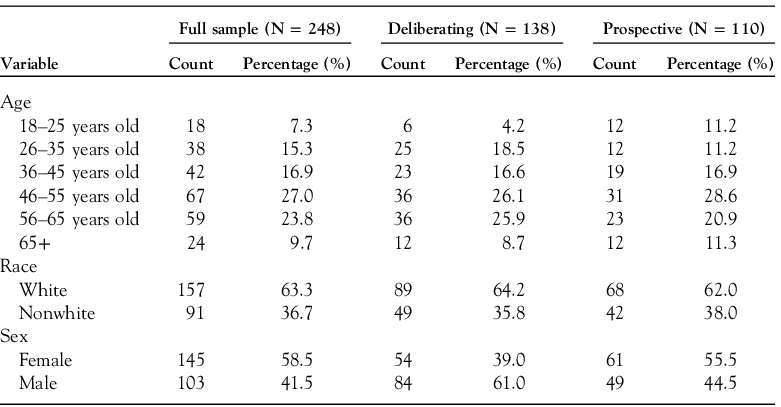
Of the 248 total jurors included in the study, 157 (63.3 percent) were white, eighty-five were Black, two were Hispanic, two were Native American, and two replied other (36.7 percent nonwhite). Given this breakdown, respondents’ race was coded “1” for white and “0” for nonwhite for the purpose of analysis. Similar breakdowns were observed among both the deliberating and prospective groups. Among those deliberating, 64.2 percent were white and 35.8 percent were nonwhite; among those not seated on a jury 62.0 percent were white and 38.0 percent were nonwhite. Juror demographic variables were used as controls, including sex (coded “1” for males and “0” for females) and age.
Sample Size Calculation
An a priori power analysis using GPower 3.1.9.2 indicated a minimum sample size of 128, with sixty-four in each group to achieve an alpha of 0.05 and power (1-β) of 0.80 for the set of t-tests used in assessing Research Questions 1 and 2. Barbara Tabachnick and Linda Fidell’s (Reference Tabachnick and Fidell1996) power analytic formula (for the calculation of the minimum sample for use with F tests such as ANOVA and multiple regression) was initially used to calculate a desired sample size, given that this work is concerned with hypothesis testing rather than modeling an aspect of the population. Tabachnick and Fidell’s (Reference Tabachnick and Fidell1996) formula of 50 + 8k, where k represents the number of independent variables, gave a desired sample of (50 + 8(4)) = 82. This was further confirmed using an a priori calculation in GPower 3.1.9.2, which gave a minimum sample size of forty-four for the set of mixed ANOVAs used in Research Questions 1 and 2 and eighty-five for the Simple Slope analysis used in Research Question 2-A to yield a power of 0.80 and alpha of 0.05 in each case respectively. As a result, the final sample size of 248 enabled the power (1-β) for detection of type II errors to be set at 0.96 and the alpha (α) for detection of type I errors to be set at 0.001. These finalized calculations were confirmed using a post hoc analysis in GPower 3.1.9.2.
Analytic Strategy
Despite the use of a naturally occurring sample using actual jurors, which made it not possible to stratify participants on age, race, or gender, the overall sample was nevertheless found to be well balanced in terms of all three demographics. A set of chi-square analyses was used to confirm the representativeness of the sample. The US Census Bureau (2007) lists whites as making up 63.2 percent of the county used in this research compared with the 63.3 percent composition in our sample overall (as well as 64.2 percent and 62.0 percent in the deliberating and prospective subgroups, respectively). As expected, the results of the chi square analysis confirmed that this was not a significant set of differences. However, the sample was made up of 58.6 percent females, compared with 51.6 percent in the county. This difference corresponds to about twelve additional females in the sample. A similar breakdown was found in both the deliberating and prospective groups at 61 percent and 57.5 percent, respectively. Here, the chi square analysis did indicate that this was a significant difference, and, as a result, the sample was weighted for gender accordingly. The jurors in the sample were relatively evenly spread in terms of age. The average age of jurors in the sample was between thirty-six and forty-five, and jurors ranged in age from nineteen to sixty-five or older (Table 1).
Juror demographics (N = 248)

Our research questions asked whether deliberating jurors’ hope to serve on a jury and whether their belief in the fairness of the jury system changed from the beginning to the end of jury service when compared to prospective jurors. In order to address both relationships, a descriptive analysis and a set of t-tests were used in addition to a mixed ANOVA. Given that both groups of deliberating and prospective jurors were measured at Time 1 and Time 2 on both measures, a set of two separate (two group x two time points) mixed ANOVAs were used to address these questions. This strategy was employed over conducting a single mixed MANOVA where jurors’ hope to serve and belief in the fairness of the jury system (the two dependent variables) did not show a meaningful correlation with one another. At Time 1, jurors’ hope to serve and belief in the fairness of the jury system did not show a significant correlation (r(248) = 0.10, P < 0.095), and this was echoed at Time 2 (r(248) = 0.12, P < 0.11. Finally, Research Questions 1-A and 2-A asked whether a juror’s race moderates either the change in hope to serve or belief in fairness of the jury system among deliberating jurors. An analysis of potential interaction effects and the slopes of both white and nonwhite jurors were used to assess this potential moderation effect. Prior to analysis, all data were first checked for normality, outliers, heteroscedasticity, and potential multicollinearity and were found to be within normal ranges for each.
FINDINGS
Research Question 1 examines differences between deliberating and prospective jurors’ change in their hope to serve, while Research Question 2 examines differences between deliberating and prospective jurors’ views of the fairness of the jury system. First, a one-sample t-test showed that looking across jurors’ initial (Time 1) hope to serve (M = 4.11, SD = 1.9) did not significantly differ from neutral or a score of four, the midpoint on the Likert scale for this question (t(247) = 0.91, P < 0.364). Conducting this test again for jurors at Time 2 (M = 4.43, SD = 1.98) showed a signifigant difference from neutral (t(247)=3.41, P<0.001). This same test on jurors’ views of fairness of the jury system (M = 5.65, SD = 1.37) showed a significant positive difference from neutral at Time 1 (t(247) = 18.95, P < 0.000). This difference was seen again at Time 2 (M = 6.00, SD = 1.23) with jurors substantively differing from neutral (t(247) = 77.04, P < 0.000).
Next, a separate mixed ANOVA was used to address Research Questions 1 and 2 independently. Results of the set of two separate (two group x two time points) mixed ANOVAs indicated support for the finding that deliberating on a jury does impact views of fairness of the jury system but not of one’s hope to serve on a jury. Turning first to Research Question 1—jurors’ hope to serve on a jury—results for the impact of deliberation on jurors’ hope to serve in the future indicated that there was no significant impact resulting from serving on a jury and deliberating on a criminal case. Descriptive results showed that both deliberating and prospective jurors experienced a parallel, 0.30-point increase in their average hope of future service between Time 1 and Time 2. Deliberating jurors moved from a mean of 4.02. (±1.93) at Time 1 to a mean of 4.32 (±2.02) at Time 2. Comparatively, prospective jurors moved from a mean of 4.17 (±1.95) at Time 1 to a mean of 4.47 (±1.84) at Time 2, despite not serving on a jury. The result of the ANOVA further confirmed that deliberating did not have a significant impact on participants’ hope to serve in the future (F(1,243) = 0.01, p = 0.92, η p2 < 0.001). Moreover, there was also no main effect of time (F(1,243) = 0.07, p = 0.78, η p2 < 0.001) and no interaction between time and deliberation (F(1,243) = 0.24, p = 0.62, η p2 < 0.001). Given that deliberation was not found to impact a change in jurors’ hope to serve, Research Question 1-A examining the potential moderating impact of race on hope to serve among deliberating jurors was not examined.
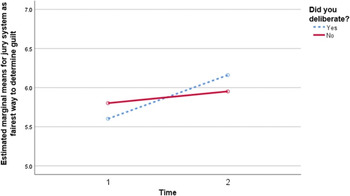
Next we turned to the influence of deliberation on jurors’ views of the jury system as the fairest way to determine the guilt or innocence of a person who has been accused of a crime. In examining Research Question 2, descriptive results indicated that participants who deliberated had a greater increase in scores from an average of 5.60 (±1.44) before trial to 6.16 (±1.12) after trial compared with an average of 5.81 (±1.19) at Time 1 and 5.95 (±1.174) at Time 2 for prospective jurors. Results of this analysis are illustrated in Figure 1. Results of the ANOVA for Research Question 2 confirmed that serving on a jury did have a significant interaction effect with time on jurors’ belief in the fairness of the jury system (F(1, 243) = 5.07, p = 0.03, η p2 = 0.02). However, there was not a significant main effect for either time alone (F(1, 243) = 0.01, p = 0.92, η p2 = 0.02) or deliberation (F(1, 243) = 1.29, p = 0.26, η p2 = 0.03).
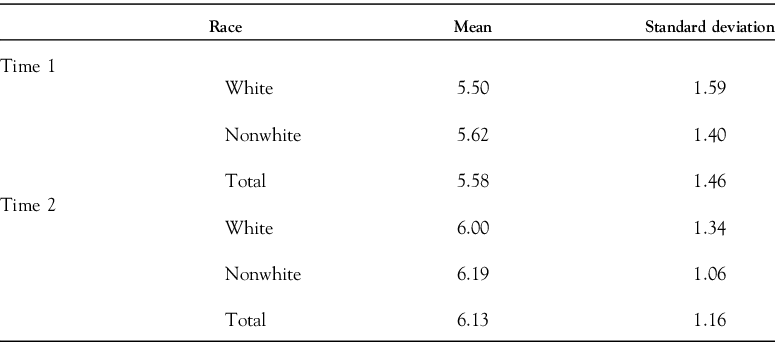
Race was not found to have a main effect among either deliberating or prospective jurors (F(1, 243) = 2.81, p = 0.10, η p2 = 0.01). However, it is worth noting briefly that this is a borderline marginally significant result (p = 0.10). Nonetheless, in light of the impact of jury deliberation on jurors’ belief in the fairness of the jury system, Research Question 2-A asked if race moderates this change seen among the subset of jurors who deliberated. Table 2 shows the average scores for white and nonwhite jurors before and after deliberation.
Deliberating jurors’ belief in the fairness of the jury system (N = 138)
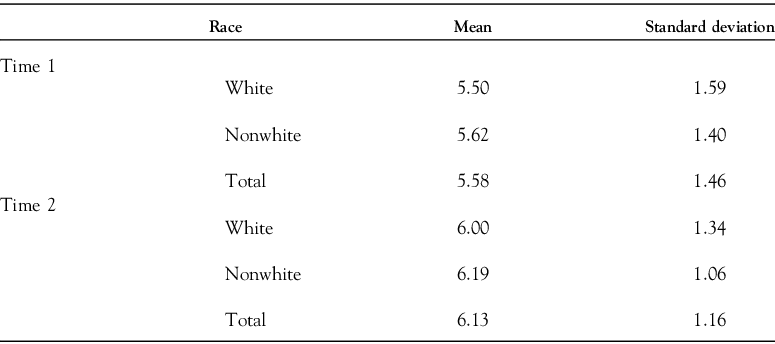
The results of the ANOVA testing the impact of race showed that there was not a significant interaction between juror race and taking part in deliberations (F(1,136) = 0.06, p = 0.80, η p2 = 0.000). These findings suggest that, while the experience of deliberating influenced participants’ belief of the fairness of the jury system, this effect was not significantly impacted by the race of the juror. Given this finding, we further examined the two racial groups for disparities in income. Importantly, it should be noted that both the white and nonwhite groups of jurors in this sample showed a similar breakdown by socioeconomic status. The similarly in the breakdown of the two groups was further confirmed by a chi square analysis that did not suggest any statistically significant difference between racial groups by income distributions (χ 2 (6, N = 136) = 1.52, p = 0.22).
Estimated marginal means for jurors’ belief that the jury system is the fairest way to determine guilt.

DISCUSSION
Understanding how jury service affects views of the jury system has important implications for developing positive views of the justice system. This research is one of the few studies to capture change in actual jurors’ views of the jury system from the beginning to the end of their jury service. With few exceptions, prior work has surveyed jurors only after their jury service is completed. Yet correlational research using data from one time period is not able to examine whether or not the act of jury service itself changes jurors’ views, particularly when the act of jury service likely affects how individuals reflect on what their views were before their jury experience. In addition, this research is better able to isolate how jury service affects views without other complicating factors because the second survey was conducted directly at the end of jury service.
We find that jurors’ views of jury service become more positive from the beginning to the end of their jury service. This was true for both measures used, whether jurors are hopeful they will be seated on a jury and jurors’ view of the jury system as the fairest way to determine guilt or innocence. Regarding jurors’ hope to serve, the experience of jury deliberation did not have a significant effect, with both deliberating and prospective jurors demonstrating similar rates of change. In contrast, deliberating on a criminal case had a significant effect on the rate of change regarding jurors’ views of the fairness of the jury system. While jurors’ views of the fairness of the jury system increased for both deliberating and prospective groups, views increased significantly more for deliberating jurors. Race did not moderate this change, as there were no significant differences between white and nonwhite jurors.
Our different findings regarding jurors’ hope to serve on a jury and jurors’ belief in the fairness of the jury system demonstrate that these two variables measure different constructs. Deliberating jurors’ change regarding their hope they will serve on a jury in the future is not significantly different than prospective jurors. This suggests that jurors may continue to see jury service as an inconvenience on an individual level. However, belief in the fairness of the jury system increases for both groups of jurors, suggesting that simply showing up to jury duty has the potential to increase positive views of the jury system. Deliberating on a criminal case magnifies this increase, regardless of jurors’ racial group membership. These findings suggest that proposals aimed at removing barriers to jury service can have important policy outcomes. Once individuals appear for jury service, even if they are initially reluctant, their views of the jury system’s fairness become more positive even if that juror never deliberates on a case.
Unlike prior research on jurors’ views of jury service, nonwhite jurors in this sample start off viewing the jury system as fair, as do white jurors, and their view of jury fairness increases because of their deliberation experience at similar rates to white jurors. These findings are somewhat surprising given prior research suggesting Blacks and Hispanics may have more negative views of the jury system and negative experiences relating to jury service than whites (Shuman and Hamilton Reference Shuman and Hamilton1992; Rose Reference Rose2005; Rose, Ellison, and Diamond Reference Rose, Ellison and Diamond2008). In addition, nonwhite individuals consistently have far lower levels of general trust in criminal justice and legal institutions (Tyler and Fagan Reference Tyler and Fagan2008; Morin and Stepler Reference Morin and Stepler2016; Newport Reference Newport2016).
Yet we find in this research that jurors of all races increased their positive views of the fairness of the jury system from the beginning to the end of jury service, particularly deliberating jurors. These findings suggest that jury participation, particularly when it involves deliberating on a criminal case, is a unique circumstance where racial group membership may not have the same effect as interactions with other criminal justice institutions. The absence of a race effect with these jurors is noteworthy, given the long history of racist and exclusionary behavior in the United States regarding jury service (see, for example, Swain v. Alabama).Footnote 4 More research is needed to confirm these findings and to explore why juror race does not lead to differing views of the jury system in contrast to the negative views that Blacks and Hispanics hold regarding other criminal justice institutions compared to whites. In addition, further research is needed concerning which specific experiences in the deliberation process may lead to jurors viewing the jury system as more fair. Although we find belief in fairness increases for deliberating jurors in both racial groups, this change could possibly be explained by different factors in the process for white and nonwhite jurors.
Our finding that deliberation increases the belief in the fairness of the jury system for all jurors, regardless of juror race, is notable in light of prior research concerning individuals of color and legal estrangement (see Bell Reference Bell2017; Winter and Clair Reference Winter and Clair2017). Nonwhite jurors in this research still view the legal system as fair in the context of jury duty, a time when they likely perceive themselves as having an active and important role in the legal process. It may be that jury service is a circumstance where otherwise legally estranged individuals can find a voice, which increases jurors’ positive views of the jury system. Our findings here provide additional support to research suggesting that individuals’ views of the police operate much differently than their views of courts, particularly in the jury context (Farrell, Pennington, and Cronin Reference Farrell, Pennington and Cronin2013). Although this notion of legal estrangement certainly exists in other contexts, it may be that Black and Hispanic individuals who appear for jury duty are less likely to be estranged and cynical about the legal system. More research is needed to understand this phenomenon and whether these positive views are specific to the juror’s role as active decision maker.
CONCLUSION
By surveying actual jurors both before and after jury service and comparing deliberating jurors’ changes in views with a group of prospective jurors not selected for a trial, this article provides novel insights into the effects of jury service on jurors’ views of the jury system. This research finds a significant difference between these deliberating and prospective jurors concerning their belief that the jury system is the fairest way to decide criminal cases, suggesting that jury deliberation positively affects jurors’ views of the jury system. Juror race did not significantly affect this change.
There are several limitations to this research. First, our sample here is relatively small and from one courthouse in the southeastern United States. The findings here may not be generalizable to other locations. Second, although necessary to preserve the anonymity of jurors for ethical reasons, our technique to match jurors’ data from Time 1 to Time 2 resulted in a smaller sample size. In addition, individuals who are chosen to serve on a jury may have different characteristics than those not chosen to sit on a case because the assignment to a jury is not a completely random process. However, the design of this research is able to account somewhat for this effect as each group is acting as its own control when measuring change from Time 1 to Time 2. Another limitation occurred when the judge introduced researchers to respondents, causing potential social desirability effects. It is possible that the judge’s role may have led to respondents answering more positively, although judges left the room while the survey was being administered, and both deliberating and prospective jurors had the same experience regarding the administration of the Time 1 survey. Finally, the variable regarding jurors’ hope to serve on a jury necessarily involved slightly different wording from Time 1 to Time 2, from whether a juror was hopeful to serve on a jury today to whether he or she was hopeful to serve on a jury in the future. It is possible that the two questions measure different concepts. However, the main research objective was to examine any differences in change between these deliberating and prospective jurors, and the same questions were asked at Time 1 and Time 2 to both groups.
These findings can have important policy implications. As research in trust and legitimacy of legal institutions has taken a more proactive approach to encourage public engagement (Jackson et al. Reference Jackson, Bradford, Hough, Mythill, Quinton and Tyler2012; Tyler and Jackson Reference Tyler and Jackson2014), it is particularly important to examine jury service as an important way that members of the public directly engage with the criminal justice system. It may be that courts can better capitalize on individuals’ positive views of jury service to create cooperative relationships with community members and to build positive views of the court system that go beyond the jury experience. Finding ways to involve members of disadvantaged and underrepresented groups in jury service is a particularly important avenue for increasing positive views of the jury system and perhaps the justice system more broadly.