Introduction
The constitutions of western liberal democracies have traditionally paid little attention to the role of intermediary organizations such as political parties (Stokes, Reference Stokes1999: 245). The absence of political parties from the national constitution might be explained by a variety of factors, including a historical sequence in which the adoption of the constitution generally predated the appearance of political parties. Furthermore, the long-standing absence of political parties from national constitutions can be seen as a product of particular normative conceptions of democracy, which have long been incompatible with the phenomenon of political parties, generally seen as a threat to the supposed neutral common interest (Daalder, Reference Daalder2002). In addition, the phenomenon of the political party was fundamentally incompatible with important democratic traditions, such as the liberal tradition rooted in the philosophy of Locke, or the radical tradition inspired by Rousseau. Both are difficult to marry with partisan institutions, which by their very nature transcend individual interests and are difficult to reconcile with the existence of a volonté générale.
In contemporary democracies, however, political parties have come to be seen as procedurally necessary and democratically desirable institutions, even amidst increasing concern that their actual functioning may sometimes undermine the quality of democracy. The relevance of political parties for modern democracy has also become recognized increasingly in constitutional terms, to the point that political participation, representation, pluralism, and competition in many democratic constitutions have come to be defined increasingly, if not almost exclusively, in terms of the party. Little is known, however, about the substantive content of the constitutional position of political parties, about the regional or temporal variation between and within countries, or about the normative connotations of their constitutional codification.
Constitutions not only outline the organizational basis of the state and the procedural rules for the exercise of power, but can also be seen to reflect the fundamental values and principles upon which the polity is based. They thus provide an important insight into conceptions of democracy and political parties and the ways in which these have changed over time. In other words, the constitutional codification of political parties provides an important indication of the place of parties within the institutional architecture of the democratic polity, as well as their relationship with its citizens. As recent decades have witnessed an ongoing process of party constitutionalization, as we shall see below, national constitutions have become an important source for investigations into the nature of modern party democracy and the prevailing ideas about the place of political parties within it. However, the phenomenon of party constitutionalization, or indeed party regulation more generally, has hitherto received relatively little systematic scholarly attention from political scientists and constitutional lawyers (Janda, Reference Janda2005).Footnote 1
This article addresses that gap in the literature by exploring the empirical and normative dimensions of party constitutionalization and providing, to our knowledge, a unique cross-sectional and longitudinal overview of the patterns of party constitutionalization. It encompasses the entire range of democratic polities in post-war Europe, including both the longer established liberal democracies in Western Europe and the democracies in Southern and Eastern Europe that emerged from more recent waves of democratization (cf. Huntington, Reference Huntington1991). In doing so, we aim not only to contribute to a better understanding of the underlying normative conceptions of their role and place within the institutional architecture of the democratic polity but also of the ways in which the constitutional codification of political parties varies between countries and over time.
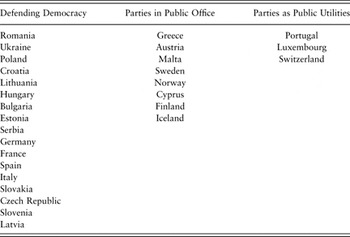
In investigating the nature and intensity of the constitutionalization of political parties in post-war European democracies, this article proceeds as follows: in the first part, we present a chronological overview of the process of party constitutionalization, which is followed by the presentation of an integrated analytical framework. In subsequent parts, we develop quantitative measures in order to enable a systematic and comparative analysis of the constitutional regulation of political parties, and explore and analyze the different regional, temporal, and substantive patterns of party constitutionalization. Finally, we arrive at three general models of party constitutionalization in post-war Europe: Defending Democracy, Parties in Public Office, and Parties as Public Utilities. Each of these, we argue, can be seen to be derived from a particular conception of party democracy.
The chronology of post-war party constitutionalization
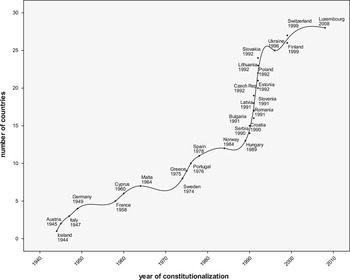
This section presents an overview of the timing of party constitutionalization, by which we understand the incorporation of (an) explicit reference(s) to political parties in the national constitution, across European democracies in the post-war period. As can be seen from Figure 1, which schematically represents the chronology of party constitutionalization in the aftermath of World War II (WWII), the earliest case of party constitutionalization occurred in Iceland in 1944, when it became formally independent from Danish rule.Footnote 2 Iceland was subsequently followed by Austria in 1945, Italy in 1947, and the Federal Republic of Germany in 1949. Each of these new or reinstated democratic constitutions makes reference to political parties, although it was only in the German Basic Law that parties, rather than citizens (as in Italy) or elections (Iceland and Austria), became the direct subject of constitutionalization. Indeed, the German Basic Law is the first, and probably best known, example of the direct and positive constitutional codification of political parties. At a time when political parties had been constitutionally codified in only a handful of European democracies, article 21 of the Basic Law represented the most comprehensive set of constitutional rules on political parties (see Tsatsos, Reference Tsatsos2002).
Chronology of party constitutionalization in post-war Europe.
Note: indicated is the year when parties were first constitutionalized, denoting the year of approval (rather than promulgation) of the constitution. Countries not included have not constitutionalized political parties (Belgium, Denmark, Ireland, the Netherlands) or do not have a written constitution codified in a single document (UK).

Subsequent cases of party constitutionalization followed in the 1950s and 1960s with the break-up of the French and the British colonial empires, resulting in the first constitutionalization of political parties in France, where parties were granted a constitutional status with the institution of the Fifth Republic in 1958, as well as Cyprus (1960) and Malta (1964) on independence from the United Kingdom. In the 1970s, parties were incorporated in the newly integrated Swedish constitution (1974) as well as in each of the democracies that emerged from the third wave of democratization in Southern Europe, that is, Greece (1975), Portugal (1976), and Spain (1978). Norway added political parties to its constitution in 1984, after which the next and largest wave of constitutional regulation of political parties followed from the establishment of the newly independent democratic states in Central and Eastern Europe. Without exception, each of the new post-communist democracies incorporated political parties in their constitutions, including Hungary in 1989, Serbia and Croatia in 1990, Bulgaria, Latvia, Slovenia and Romania in 1991, the Czech Republic, Slovakia, Lithuania and Poland in 1992, and Ukraine in 1996. Finally, Finland and Switzerland (both in 1999) and, most recently, Luxembourg in 2008, amended their constitutions so as to explicitly include special references to the role and functions of political parties.
The pattern of party constitutionalization appears to correspond closely to the waves that Elster (Reference Elster1995) has identified as waves of constitution-making and that Huntington (Reference Huntington1991) has observed for democratization processes, albeit without any evidence of reverse waves (for a more elaborate discussion, see van Biezen, Reference I. van2012). As a consequence of this ongoing process, the large majority of post-war European democracies (28 out of 33) now acknowledge political parties in their constitutions in one form or another.Footnote 3 It is in only a handful of countries, that is the four long-established European democracies of Belgium, Denmark, Ireland, and the Netherlands, that political parties are not mentioned in the national constitution, while the United Kingdom does not have a constitution in the sense used here. This increased regulation of parties by national constitutions corresponds with a more general trend by which political parties in contemporary democracies are becoming increasingly subject to regulations and laws that govern their behavior, activities, and organization. Indeed, as Katz (Reference Katz2002: 90) has argued, party structures have become ‘legitimate objects of state regulation to a degree far exceeding what would normally be acceptable for private associations in a liberal society.’ Hence, while the constitutionalization of political parties constituted somewhat of a novelty in the immediate post-war period, the pattern presented here clearly shows that in modern European democracies today, the constitutional codification of political parties has become a widespread practice.
The evidence thus suggests that in contemporary European democracies, both old and new, political parties are increasingly accorded a formal constitutional status. In that sense, the European pattern trails that of regions elsewhere in the world, in particular Latin America, where the phenomenon of party constitutionalization is both older and more pervasive (Zovatto, Reference Zovatto2006; van Biezen and Kopecký, Reference I. van and Kopecký2007). The increased incidence of party constitutionalization in modern democracies not only attests to changed historical contexts and different empirical realities but also to changes in ideas and normative beliefs about parties and democracy. First of all, it suggests that, unlike in earlier epochs, political parties today have become a permanent reality as structures of political representation in representative democracies. It furthermore implies that the existence of political parties is no longer necessarily seen as incompatible with predominant conceptions of democracy. Instead, it points to a more or less general acceptance of political parties as the necessary foundations of democratic politics. Finally, it suggests not only that conceptions of democracy have changed but also those of parties themselves, in that parties are no longer understood as primarily private associations (albeit ones that fulfill important public functions) but as predominantly public institutions or even public utilities (van Biezen, Reference I. van2004), or at least as organizations whose public role has become so important that it warrants their formal codification as permanent features of the institutional architecture of representative democracy.
Analytical framework
In the following sections, we further investigate the empirical and normative dimensions of contemporary party constitutionalization, focusing on both the nature and the intensity of their constitutional codification and the variation between countries and regions, as well as the changes over time. For the purpose of our investigation, we have analyzed all textual references to political parties in the national constitutions of all European democracies throughout the entire post-war period.Footnote 4 Given the relative newness of the subject and the lack of existing theories of party constitutionalization, the nature of this study is largely exploratory. In developing our analytical framework, we have drawn on insights from both legal and constitutional theory, on the one hand, and party scholarship, on the other. Although they have hitherto existed largely in mutual isolation of one another, our integrative approach allows us to synthesize the main tenets and insights from these disciplines.
Although constitutional theory is largely silent with regard to the formal codification of political parties, the insights from the different varieties of constitutionalism can guide us in the development of our analytical framework. Our approach leaves aside the philosophical arguments viewing the constitution as a complex political concept and constitutionalism as an ideological construction, focusing instead on the descriptive content of the constitution as well as its constitutive and regulative functions (see Castiglione, Reference Castiglione1996). Two of the core principles of a (democratic) constitution are the political form of the state and the rights of the individual. On the one hand, constitutions describe and prescribe both the sources and the limits of power. They thus define the composition and scope of authority of the organs of the state and institutions in the public sphere, as well as the distribution of power between them. On the other hand, premised on the liberal and rights-based model of constrained government, they define the relationship between the institutions of the state and the citizen, posing injunctions on public authority and identifying a private sphere that requires protection vis-à-vis the state. Whether viewed from the perspective of liberal rights-based constitutionalism or democratic republican constitutionalism, which are in many ways complementary (Squires, Reference Squires1996), constitutions can thus be seen to both organize and constrain. That is, constitutions not only restrain the operation of the government with a view to safeguarding the fundamental rights and freedoms of the citizens of the polity, they also contain structural provisions dealing with the general organization of the polity, the separation and division of powers, as well as the representativeness of the system (see also Blondel and Vile, Reference Blondel and Vile1967; Bellamy, Reference Bellamy2007).
In addition to these two broader domains pertaining to rights and duties, on the one hand, and provisions regarding the institutional infrastructure of the political system, on the other, constitutions also frequently appeal, often but not necessarily in a preamble, to the symbolic values and principles upon which the polity is based. These fundamental values, however incomplete and sometimes unrealistic, provide the underpinning of the organizational basis of the state (Sartori, Reference Sartori1994). Finally, as the set of fundamental rules contained in the constitution can be conceived as the supreme law governing the powers of the state, they often include so-called meta-rules or rules of constitutional interpretation and adjudication, which determine the hierarchy within the legal order and which deal with questions of constitutional validity, interpretation, and revision (Frankenberg, Reference Frankenberg2006).
Based on these insights of legal and constitutional theory, therefore, and following Frankenberg (Reference Frankenberg2006), we conceive of the architecture of modern constitutions as a layered narrative with four broad domains: (i) principles and values, defining the fundamental principles and values upon which the polity is based; (ii) rights and duties, outlining basic democratic liberties and responsibilities; (iii) the organizational structure of the political system; and (iv) ‘meta-rules’, establishing the hierarchy within the legal order and outlining the rules of constitutional interpretation and revision. The relative importance of these elements, as well as the normative importance attached to them, has fluctuated over time and may also vary between countries, with some constitutions emphasizing some aspects more than others. We expect that the same is also true for constitutional provisions that deal with political parties.
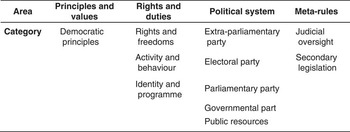
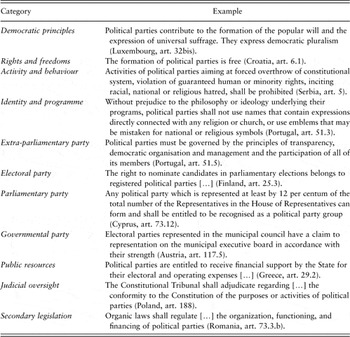
Based on an in-depth content analysis of the actual constitutional texts, as well as the insights of recent scholarship on political parties, we have made a further refinement of these four broader categories. More specifically, as can be seen from Figure 2, the first domain includes the category of democratic principles, which includes constitutional references that associate political parties with key democratic principles and values, such as participation and representation for example. The second domain contains three sub-categories: rights and freedoms, which includes those constitutional references that associate parties with fundamental democratic rights and liberties such as the freedom of association and assembly, while the parties’ duties are encompassed by the categories of activity and behaviour and identity and programme, which include rules that proscribe certain forms of behavior, such as violence, and prohibit parties based on certain ideological or programmatic foundations, such as nationalism, religion, ethnicity, or those that are simply anti-democratic. The third domain encompasses constitutional provisions, which position political parties within the broader institutional structure of the political system. Because parties are not monolithic entities but can be disaggregated into various interconnected components or ‘faces’ (e.g. Key, Reference Key1964; Katz and Mair, Reference Katz and Mair1993), this domain has been divided into various sub-categories, that is, those that apply to the party as an organization (extra-parliamentary party), parties in their electoral capacity (electoral party), parties as parliamentary groups (parliamentary party) and the party in public office (governmental party), as well as the public resources that the political system provides to the parties, such as state funding or free time on state-owned broadcasting media. Finally, within the fourth domain, the category of judicial oversight relates to the external judicial monitoring of the lawfulness and constitutionality of party activity and identity, while secondary legislation encompasses constitutional provisions that reflect the hierarchical legal order and dictate the enactment of further legislation on political parties.Footnote 5 This analytical framework, which is thus founded on a combination of deductive and inductive approaches and draws on insights from both legal theory and party scholarship, serves to guide us in our exploration of the over-time and cross-country nature and intensity of party constitutionalization.
Analytical framework.

Despite a relative lack of research on the constitutional regulation of parties, we do know that constitutions tend to reflect the particular historical and political contexts within which they were designed (e.g. Elster, Reference Elster1995). We therefore also expect constitutions to reflect these political legacies when it comes to the codification of political parties. Given the importance of historical contexts and the way in which conceptions of parties and democracy have changed over time, for example, newer democracies are more likely than older ones to constitutionally acknowledge the relevance of political parties, as we have shown above. With regard to the substantive content of party constitutionalization, we expect to find substantial differences in the nature and intensity of party constitutionalization between the established liberal democracies in Western Europe and the post-communist democracies in Central and Eastern Europe. More specifically, we anticipate that a legacy of the previous totalitarian regime in post-communist democracies will be reflected in the new democratic constitutions insisting on a clear separation between parties and the state by underlining the private nature of party organization and ideology and by primarily associating parties with basic democratic citizen rights and freedoms. This expectation follows from the way in which the constitutional design of the newer democracies has tended to position the state and society vis-à-vis one another in the wake of democratization: the corollary of the liberalization of formerly non-democratic polities was often the constitutional establishment of an explicitly private sphere of social life (Shapiro and Stone, Reference Shapiro and Stone1994: 402). It is conceivable that the constitutional recognition of political parties in newer democratic polities should be understood in light of the desire to identify and strengthen spheres of life that are free from state intervention.
Second, we expect that not only the newness of democracy but also the continuity of the democratic regime matters for the nature and intensity of party constitutionalization. Following Avnon (Reference Avnon1995) and Karvonen (Reference Karvonen2007), who point out that countries that choose to legislate on political parties have often experienced a collapse of their democratic system, we anticipate that constitutions adopted in democracies that were (re)established after a period of non-democratic rule will pay special attention to the (democratic) role of political parties, in particular with a view to ensuring that their activities and behavior are commensurate with the principles and practices of modern democracies.
Third, we expect a shift in the nature of party constitutionalization over time. This follows from the fact that the relative importance of the core elements of the constitution has fluctuated over the course of the centuries. More specifically, as the bill of rights has grown in importance with time (e.g. Bellamy, Reference Bellamy1996), we anticipate that this will also be reflected in constitutions placing an increased emphasis on the democratic rights and freedoms of political parties. In addition, we expect that the post-war constitutions will increasingly attest to the relevance of political parties by acknowledging them as fundamental for the healthy functioning of the democratic system. Finally, we expect constitutions to reflect the general trend for the state to intervene in party politics (van Biezen, Reference I. van2008), in that they will tend increasingly toward prescribing and proscribing certain forms of party activity and organization.
Cross-national patterns of party constitutionalization
In order to examine the differences in the intensity and variety between countries, we advance two measures in order to enable cross-national comparisons and shed light on the variation across European countries: the range and magnitude of party constitutionalization. The range refers to the total number of categories of party constitutionalization, as outlined in Figure 2, that can be identified in a national constitution. The range of party constitutionalization can thus take values between a minimum of 1 (when all constitutional provisions belong to a single category) and a maximum of 11 (when the constitutional references to parties span the entire spectrum from democratic principles to secondary legislation). This measure gives us an indication of the nature of party constitutionalization and the scope encompassed by the different constitutional provisions. The magnitude of constitutionalization, on the other hand, represents the frequency with which the categories of party constitutionalization occur within a constitution. The magnitude of constitutionalization for a country thus refers to the total number of constitutional provisions on parties that can be identified. This measure gives us an indication of the intensity of party constitutionalization and the level of detail with which parties are described in the constitution. These two measures may vary independently from one another, except that the magnitude cannot be lower than the range.Footnote 6
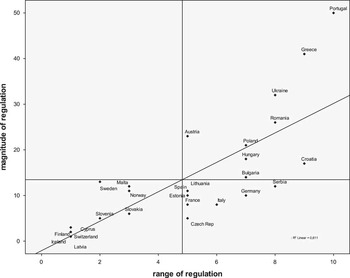
Figure 3 shows a graphical representation of the distribution of countries on the basis of the range and magnitude of party constitutionalization, showing the diversity in intensity and nature that can currently be found across Europe. It identifies three more or less equal groups of countries: (i) Countries that show a relatively low score on both measures, scoring below the European average on both range and magnitude (4.8 and magnitude 13.5, respectively). In this group, located in the lower left corner and including countries such as Iceland, Finland, Switzerland, Cyprus, and Luxembourg, the constitutionalization of parties appears to be concentrated mainly around one or two categories, which are dealt with relatively sparsely in only a few clauses. (ii) Countries with high levels of constitutional regulation of parties, which are characterized by both a range and a magnitude above the European average (upper right). As can clearly be seen, Portugal and Greece, for example, stand out in particular for their extensive regulation, occupying spaces near the extremes on both variables. (iii) Countries such as Germany and Serbia, where the constitutional regulation of parties encompasses many categories (i.e. a high range) but with a relatively limited amount of detail (i.e. a low magnitude). These are represented in the bottom right quadrant. The upper left corner is empty. Sweden comes closest, with a magnitude of 13 on only two categories, outlining the parties in the electoral and parliamentary arena in relatively close detail.
Intensity of party constitutionalization.

Although the range and magnitude of regulation may in principle vary independently, it can be seen that in practice there is a strong correlation between the two (Pearson's r = 0.78; sig. 0.00). Furthermore, the actual distribution of countries in Figure 3 seems to suggest that there is a difference in the intensity of party constitutionalization between old and new democracies, with older democracies mostly located in the lower left quadrant, tending toward a lower intensity of constitutionalization than their newer counterparts. The pattern is not unequivocal, however, and countries belonging to similar ‘waves’ of party constitutionalization are not necessarily located close to one another, or even in the same quadrant. Differences between individual countries might be due to factors not considered here, such as the overall length of the constitution or the ease with which it can be amended. In the following sections, we will examine the different dimensions of party constitutionalization in more detail, exploring the question of whether significant differences in the intensity and nature of constitutionalization exist in terms of democratic maturity, continuity of democratic history, and experience with communist rule.
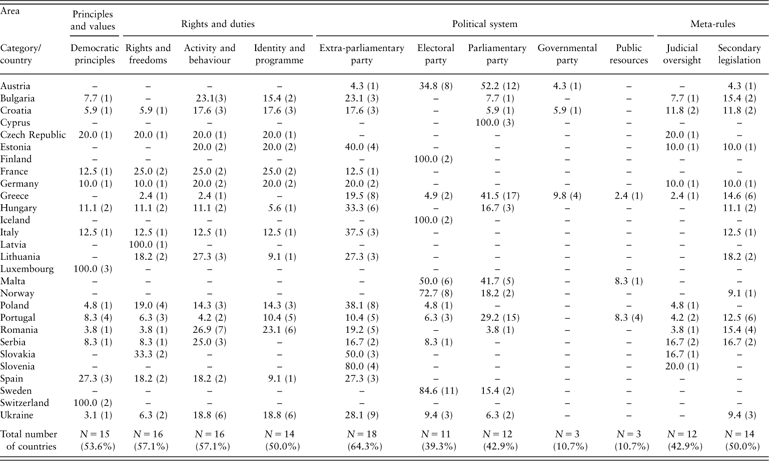
First of all, Table 1 provides a general overview of the relative importance of the different dimensions of party constitutionalization in the current constitutions of our 28 countries. The category of democratic principles is predominant in Luxembourg, where it is actually the only dimension on which the constitution regulates political parties. Similarly, rights and freedoms are the only dimension associated with political parties in the constitution of Latvia. Activity and behaviour is the predominant regulatory category in Lithuania and Romania, comprising one fifth of the constitutional regulation of parties in both countries, while France scores highest in the category identity and programme, comprising a quarter of all provisions on parties. The extra-parliamentary party is the predominant area of constitutionalization in Slovenia, where 80 percent of the total provisions on parties relates to the internal structure of the party organization. Political parties are seen only as part of the electoral arena in Iceland and Finland and only as part of the parliamentary arena in Cyprus. Few constitutions regulate parties in their governmental capacity, with Greece outscoring the others in terms of their relative importance. Malta and Portugal pay the most attention to the regulation of access to public resources offered to parties, albeit in the context of a very small number of countries. Judicial oversight of the operation and activities of parties predominates in Slovenia and the Czech Republic (20 percent), while secondary legislation records the highest score in Lithuania (18.2 percent).
Relative importance of dimensions of party constitutionalization by country (%)Footnote *
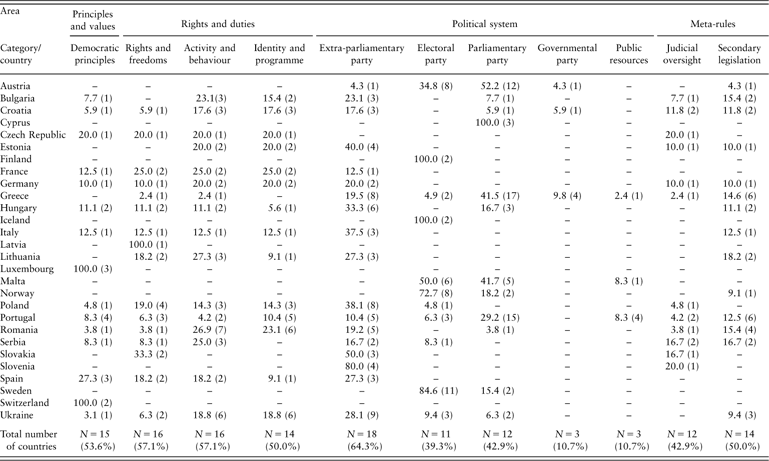
* Current constitutions; raw count magnitude in parentheses; N = number of countries. Updated from van Biezen (Reference I. van2012).
Overall, the evidence presented here shows that, of all national constitutions that acknowledge political parties, more than half (N = 15) associate parties with the realization of essential democratic principles. A slightly larger group of countries (N = 16) associate parties with the basic democratic freedoms of association, assembly, and speech. In a similar number of countries, the constitutions include constraints on party ideology or behavior while half of the countries restrict their programmatic or ideological identity. The extra-parliamentary organization receives the most attention, with nearly two thirds of the constitutions (N = 18) regulating matters pertaining to the internal organization of party structures. The electoral and parliamentary domains are somewhat less extensively constitutionalized (in 11 and 12 countries, respectively), while the governmental domain is rarely subject to constitutionalization. Only three constitutions contain provisions in this category. A similarly small handful of countries endow political parties with special access to public resources such as state funding or the broadcasting media, granting them a constitutionally unique and privileged position in terms of direct and indirect state support. Finally, a large number of countries, although a minority, provide for judicial oversight of party activity (N = 12) and behavior while half stipulate the need for further legislation on political parties (N = 14).
At first glance, Table 1 suggests that there is a notable difference between the established democracies and the more recently created democracies. For example, the established democracies appear to predominate in the regulation of parties in their electoral role, while this domain appears to be less prevalent in the democracies established more recently in the third and fourth waves of democratization. In the older democracies, moreover, the regulation of parties in their electoral role on average comprises a significantly larger share of constitutional references than in the newer democracies. The constitutions of the more recently established democracies, on the other hand, appear to regulate parties significantly more extensively in nearly all the other domains, including democratic principles, rights and duties, extra-parliamentary organization, and judicial oversight.
In order to assess the possible impact of regional variation and the legacy of authoritarian and communist rule, we have carried out three different types of comparisons: (i) Western European vs. Central and Eastern European democracies; (ii) old vs. new democracies; and (iii) countries with a continuous vs. countries with a discontinuous (or non-existent) democratic experience.
Western vs. Eastern Europe
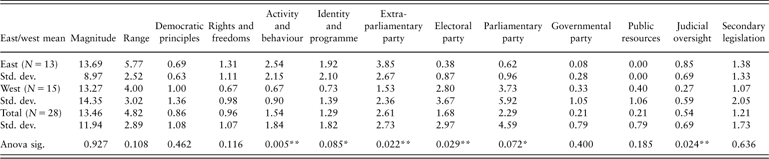
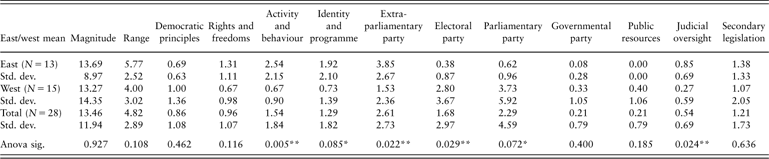
In order to assess the possible relevance of the legacy of communism, we first contrast the patterns of party constitutionalization in Western Europe with those in the post-communist Central and Eastern European democracies (hereafter also: Eastern Europe). This analysis reveals a number of significant differences between the two regions. First of all, we can observe that the range of regulation is greater in Eastern Europe than in Western Europe, although the difference is not statistically significant (see Table 2). The constitutions in Eastern Europe regulate political parties in an average of 5.8 areas, while the average for their Western European counterparts stands somewhat lower at 4.0. The magnitude of party constitutionalization in Eastern Europe (13.7) is only marginally higher than in Western Europe (13.3), and this difference is not statistically significant either.
Western vs. Central and Eastern Europe
*Significant at 0.10 level.
**Significant at 0.05 level.
A more detailed breakdown by category suggests, however, that there are significant differences between the two regions in terms of the substance of party constitutionalization. This can be seen from the data in Table 2, which report the outcome of Anova significance tests based on the mean magnitudes of the two groups for each category. The results show that the differences between East and West are significant for almost half of the categories, and more specifically for activity and behaviour, the extra-parliamentary party, the electoral party, and judicial oversight. Differences in the categories of identity and programme and the parliamentary party are smaller and are only significant at a level lower than 0.10. On the other hand, Eastern and Western democracies are similar to one another in terms of the constitutional regulation of parties on democratic principles, rights and freedoms, the governmental party, public resources, and secondary legislation.
With the significance level just over the 0.10 threshold for the category of rights and freedoms, the findings suggest that one of our expectations, that is, that the legacy of totalitarian rule would make the post-communist democracies more inclined to strengthen a private sphere free from state intervention and underline the private nature of the parties, is not confirmed. Although the constitutions of post-communist democracies contain, on average, nearly twice as many provisions associating parties with fundamental democratic rights and freedoms than their western counterparts (1.31 against 0.67), the difference is not statistically significant.
At the same time, it should be noted that the Eastern European democracies show a significantly higher intensity of regulation in areas such as activity and behaviour, identity and programme, the extra-parliamentary party, and judicial oversight. This suggests that in the process of constitutional engineering, the post-communist countries have sought to lay down specific requirements for the internal organizational structures and external operations of political parties and have sought to subject their activities and behavior to a greater degree of external judicial control than is the case elsewhere. In other words, while the post-communist constitutions tend to emphasize the parties’ democratic freedoms of assembly, association, and speech somewhat more, they also establish clear boundaries beyond which the activities and behavior of parties are not tolerated. These often relate to the demand that parties respect democratic principles or that they structure their internal organizations democratically. The question remains, however, whether this is a particular post-communist characteristic or a more general feature of all democracies with an immediate non-democratic past, aiming to safeguard their newly institutionalized democratic regime. This will be examined in more detail below.
One final observation to be made is that Western European constitutions include significantly more constitutional provisions relating to parties’ electoral role than their counterparts in Eastern Europe. These include provisions on electoral rules, candidate selection, and campaigning activities, and predominate in Western Europe with an average magnitude of 2.80 against only 0.38 in Eastern Europe. Indeed, with only a handful of exceptions, all countries that constitutionally regulate parties in their electoral capacity are Western democracies. At a lower level of significance, the operations of the parliamentary party are also more frequently constitutionalized in Western than in Eastern Europe. The rules in these two domains do not necessarily acknowledge parties as institutions in their own right but tend to refer to them in their manifestation as parliamentary groups or in their electoral capacity (the Austrian constitution tends to speak of Wahlparteien for example). Even though couched in indirect terms, and linking the relevance of parties essentially to their electoral and parliamentary roles, they effectively acknowledge the institutional relevance of political parties for a system of representative democracy. It is possible, however, that this aspect too should be attributed to a contrast between the older established democracies and the more recently created democracies of the third wave, rather than the particularities of post-communism.
Old vs. new democracies
In order to assess whether some of the differences described above should be attributed to a contrast between old and new democracies rather than the legacy of communism, we carried out a similar set of comparisons contrasting the longer established democracies with the more recently created ones. Included in the latter group are the younger Southern European democracies of Greece, Portugal, and Spain, which emerged in the third wave of democratization, along with the post-1989 democracies in Central and Eastern Europe. We expect the Southern European democracies to show commonalities in terms of party constitutionalization with the Central and Eastern European democracies, given that they both form part of more recent waves of democratization.
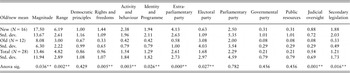
Table 3 displays the result of this comparison, reporting the results of the Anova significance tests of the mean magnitudes for each category in the older and the more recently established democracies. The intensity of constitutionalization appears to differ substantially between the two groups. The magnitude of party constitutionalization in the newer democracies (17.5) is more than twice as high than in the older ones (8.1). In addition, the constitutional codification of parties in the new democracies encompasses twice the number of areas, with an average of 6.2 compared with only 3.0 in their older counterparts. The difference between the two groups of countries in both the magnitude and the range of constitutionalization is statistically significant at the 0.05 level.
Old vs. new democracies

*Significant at 0.10 level.
**Significant at 0.05 level.
As shown by the results in Table 3, when the Southern European democracies of Greece, Portugal, and Spain are considered alongside the post-communist democracies, the differences between the blocs of old and new democracies become more significant (i.e. for 7 of our 11 categories). This would seem to support the argument that the newness of democracy makes a fundamental difference in how political parties are defined within modern constitutions, therefore supporting our expectations. The parliamentary party ceases to be significant in the old–new comparison, while the categories of democratic principles, the governmental party, and public resources remain insignificant in this comparison as well. For the latter two, however, it is not inconceivable that the lack of significance may be attributed to the low number of countries (N = 3) in each of these categories.
The difference between old and new democracies is statistically significant, this time at .00 level, for the category of rights and freedoms. Newer democracies also show a higher inclination to regulate the extra-parliamentary party and to further restrict the parties’ activity and behaviour as well as their identity and programme, while they also tend to provide for external judicial oversight of the parties’ activities and identity. In addition, the need for further legislation turns out to be significant in the old vs. new comparison, but not in the comparison between East and West. The only category where the degree of regulation is significantly higher in the older democracies is the electoral party, a category that also proved significant in our East–West comparison. These findings suggest that the differences found in the earlier comparison between East and West should not necessarily be attributed to the particularities of post-communism but instead appear to be related to the newness of democracy.
Continuous vs. discontinuous democracies
It is possible that the significance of the differences we have found is due not so much to the newness of democracy per se but to the continuity of a country's democratic history. On this view, we might expect countries with an unstable democratic experience to differ from those with a continuous democratic history, by building in constitutional safeguards for the protection of democratic institutions, for example. This distinction is most relevant to categories of rights and freedoms, activity and behaviour, identity and programme, the extra-parliamentary party, and judicial oversight, which occur not only in the more recent third and fourth wave democracies but also in re-established democracies such as Austria, Germany, and Italy (see Table 1). We therefore also analyzed whether the continuity of a country's democratic experience is associated with the nature and intensity of regulation. For this purpose, Austria, Italy, and Germany, previously grouped with the old and West European democracies, were assigned to the category of discontinuous democracies, as in each of these cases, the new democratic constitution was a product of post-authoritarian re-democratization.Footnote 7
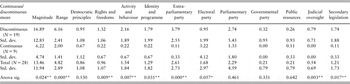
Table 4 contrasts the constitutionalization of political parties of these two groups, showing that overall there appears to be a higher level of intensity of party constitutionalization in countries with an interrupted history of democracy than in countries with a continuous democratic experience. The range of constitutionalization differs significantly between the two groups. Countries with a history that was not interrupted by a non-democratic experience regulate parties on average in only 2.0 areas, compared with 6.2 in the so-called discontinuous democracies. The magnitude of party constitutionalization in these latter democracies (16.9) is substantially higher than in the continuous democracies (6.2) too. The differences between the two groups of countries are significant at the 0.05 level on both dimensions.
Continuous vs. discontinuous democracies

*Significant at 0.10 level.
**Significant at 0.05 level.
The differences that were already found to be significant in the previous comparison between old and new democracies – that is, in relation to rights and duties (rights and freedoms, activity and behaviour, identity and programme), the extra-parliamentary party, and the rules of constitutional interpretation (judicial oversight and secondary legislation) – persist in the continuous vs. discontinuous comparison. Countries with an interrupted history of democracy display, as do new democracies more generally, more regulation in these areas. The electoral party remains significant, albeit only at the 0.10 level. As was to be expected, it is the group of continuous liberal democracies that shows higher levels of constitutional regulation of parties in their electoral capacity.
This matches the pattern found in the previous comparison between old and new democracies. Like the more recently established democracies more generally, democracies that are established in the wake of a period of authoritarian or totalitarian rule tend to emphasize that parties enjoy fundamental democratic rights and freedoms while at the same time being more inclined to curtail their activity and behavior in order to avoid them threatening the democratic constitutional order, national sovereignty, or the territorial integrity of the state. In addition, the constitutions of the discontinuous democracies tend to subject parties to external judicial control and further legislation more frequently than countries that have not experienced an interruption in their democratic history. This suggests that the non-democratic experience is a powerful driving force behind the constitutional prescription or proscription of the activities and behavior of political parties, as well as their programmatic identity.
Overall, our results show that the differentiation within Europe in terms of party constitutionalization is largely based on the newness of democracy and on democratic experience rather than the impact of communism. This suggests that the comparison between old and new democracies and between continuous and discontinuous democracies in many ways constitutes a more meaningful way of contrasting the patterns of party constitutionalization across Europe than the comparison between East and West, and that patterns of significance are associated more with the newness and discontinuity of democracy than with the particularities of post-communism.
Models of party constitutionalization
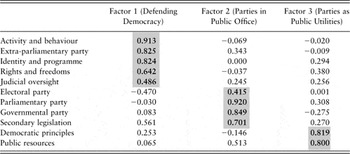
In this final section, we explore the associations between the different regulatory categories in an attempt to uncover the underlying substantive dimensions of party constitutionalization and corresponding conceptions of party democracy. We used factor analysis to reduce the complexity of the data and uncover underlying patterns. The factors are constructed on the basis of the categories with the highest factor loadings, where the factor loadings signify the correlation of each variable with the underlying factor and the variables with the highest factor loading represent the strongest feature within the ordering structure of each factor. The analysis yields three factors, each of which represents a latent underlying dimension of party constitutionalization and that together explain 72.7 of the variance in our data.Footnote 8 As can be seen in Table 5, the category of activity and behaviour has the highest loading on the first factor (0.91); the parliamentary party has the highest factor loading (0.92) on the second; and democratic principles has the highest loading (0.82) on the third factor.Footnote 9
Models of party constitutionalization

Note: Extraction method: principal component analysis. Rotation method: Varimax with Kaiser normalization. Rotation converged in five iterations.
The bold shaded areas represent the categories which together constitute each of the factors.
On the basis of our analysis, we arrive at three distinct models of party constitutionalization, which we have called Defending Democracy, Parties in Public Office, and Parties as Public Utilities. Each of these can be seen to signal a particular conception of party democracy, whereby the first model places emphasis on the regulation of political parties with a view to safeguarding the continued existence of democracy, the second on the public roles of political parties as central actors in parliament, government, and elections, while the third conceives of political parties as a special type of public good.
Defending democracy
The first factor explains 31.4 percent of the variance in our data. This model of party constitutionalization encompasses five categories, that is – in descending order of their factor loadings – activity and behaviour, extra-parliamentary party, identity and programme, rights and freedoms, and judicial oversight. This shows that constitutions that identify political parties with fundamental democratic rights, such as the freedom of association, assembly, and speech, also tend to constrain parties in their activities and behavior or their ideological profile and programmatic identity, prohibiting political parties that are adverse to the fundamental values of the democratic constitutional order. In an attempt to safeguard the democratic regime from insurrectionary and separatist parties, these constitutions demand that parties respect democratic principles, as well as the national sovereignty and territorial integrity of the state. The emphasis on the regulation of the extra-parliamentary organization of the party furthermore suggests that, according to this model of party constitutionalization, parties are seen essentially as extra-parliamentary organizations, rather than as electoral, parliamentary, or governmental organizations (as in the Parties in Public Office model discussed below). In addition to their activities and programs, the internal organizational procedures and structures of the parties are also subject to constitutional prescription in order to serve the functioning of a democratic government. This may entail the prescription of internal democracy, the incompatibilities of party membership with elected or public offices, and the transparency of party financing.
According to this model of party constitutionalization, political parties are only qualified bearers of their democratic freedoms, retaining their rights only to the extent that their activities and behavior do not contradict the basic democratic principles of the constitutional political order, and that their internal structures are democratic and their finances transparent. The association of the category of judicial oversight with this model suggests that the functioning of parties is subject to external monitoring by the (constitutional) courts in order to ensure lawfulness and constitutionality. We have called this model Defending Democracy because of the concern it reveals for the continued survival of the constitutional democratic order.Footnote 10 It signals ‘a form of constitutional democracy authorized to protect civil and political freedom by pre-emptively restricting the exercise of such freedoms’ (Macklem, Reference Macklem2006) and is likely to be particularly prevalent in newly established or re-established democracies. The German Basic Law constitutes perhaps the best-known example, but, as we shall see below, the model is also well illustrated by the post-communist democracies, thus tying in with the distinction between continuous and discontinuous democracy we described earlier. This model explains the largest percentage of variation in our data and is therefore one of the dominant approaches in current European party constitutionalization.
Parties in public office
The second factor explains nearly 24.5 percent of the variation in our data and is the second most significant model of party constitutionalization in contemporary Europe. This model comprises three different categories related to the various manifestations of parties in their capacity as electoral agents, parliamentary groups, or governmental actors, as well as the category of secondary legislation. This model is illustrative of a more instrumental view of political parties and can be found principally in older and established liberal democracies such as those in Scandinavia. According to this model of constitutionalization, parties are not necessarily recognized or acknowledged as institutions or organizations in their own right. It is thus no coincidence that in countries that are associated with this model, parties tend not to be a direct subject of constitutionalization. Rather, their constitutional importance is derived from their association with electoral functions, their manifestation as parliamentary groups, or their governmental capacity. Nevertheless, by creating an association between political parties and the electoral, parliamentary, and governmental domains, this mode of party constitutionalization effectively signals that political parties are a functional necessity for democratic elections, parliaments, and governments. It thus reflects the unequivocal connection that exists between political parties and some of the democratic structures fundamental to modern representative democracy and the reality of party government in particular (cf. Katz, Reference Katz1986). Because it concentrates primarily on the public face of parties, we have labeled this model Parties in Public Office.
Parties as public utilities
The third model explains nearly 17 percent of the variation in our data. In this model, there is a high association between the constitution defining key democratic principles in terms of political parties and giving them access to public resources such as state funding or free time on state-owned broadcasting media. We have labeled this model Parties as Public Utilities because it closely corresponds to elements of that particular conception of party democracy in which, as Epstein (Reference Epstein1986: 157) put it, political parties are understood as ‘an agency performing a service in which the public has a special interest sufficient to justify governmental regulatory control, along with the extension of legal privileges, but not governmental ownership or management of all the agency's activities’.
In this view, political parties are the crucial mechanisms for the realization of democratic values and principles, such as participation, representation, and the expression of the popular will. This explicit association between political parties and the realization of substantive democratic values implies an especially close relationship between parties and the state, as these values ‘reside in a realm beyond the disposition of the individual and call for their authoritative enforcement from above – usually by the state’ (Frankenberg, Reference Frankenberg2006: 456). In order that parties perform their unique democratic services effectively, therefore, parties are to be supported by the state, a condition that is reflected in the constitutionally enshrined availability of public resources, as in Portugal for example, the country that constitutes the best illustration of this model. The conception of party democracy signaled by this model of constitutionalization is one in which parties are quasi-official agencies of the state because of the critical functions they perform in a modern democracy, and in which the democratic importance of political parties justifies that they be supported by public means (cf. van Biezen, Reference I. van2004). By associating them with democratic principles and giving them access to public resources, this model of party constitutionalization reflects a notion of party democracy in which the state assumes a proactive role in supporting parties financially as indispensable institutions for a healthy functioning of democracy.
The analytical utility of these models primarily lies in the fact that they reflect particular trends in party constitutionalization, signaling that there are (at least three) distinct conceptions of political parties and democracy that have motivated the constitutionalization of parties in post-war Europe. It should be noted that a clear-cut country distribution cannot easily be assigned to the models. Some countries may be seen to be representative of a particular model, but, as the underlying normative conceptions are not necessarily mutually exclusive, it is also possible that more than one model applies to a specific country, or that a model only partly applies to a particular country. Having said that, however, it is possible to identify to which model of party constitutionalization each country is most closely related. Table 6 shows which of the three models can be seen to be prevalent in which country.
Models of party democracy per country

Note: The table lists, for each country, which model of party constitutionalization it is most closely related to. Countries are ranked in descending order according to their association with the model.
The Defending Democracy model encompasses the largest number of countries (N = 17), as it is the model with the highest explained variance in our data. In addition to well-known examples such as Germany and Italy, it is noteworthy to observe that all of the post-communist countries are also associated with this model. The predominance of this model, at the heart of which lies the concern with the survival of democracy, is perhaps not surprising, as the bulk of European democracies have witnessed some form of democratic rupture in the past. Their mode of party constitutionalization thus pays special attention to the democratic role of parties, aiming to ensure that their activities and behavior are commensurate with the fundamental principles of democracy. The second model, Parties in Public Office, includes eight countries. With the exception of Austria and Greece, which belong to the second and third waves of democratization, respectively, most of these belong to the group of continuous democracies. The third model, Parties as Public Utilities, includes the smallest number of countries (N = 3), as it is also that with the lowest explained variance. The group of countries associated with this conception of political parties includes one Southern European democracy (Portugal) and two of the older democracies (Switzerland and Luxembourg), in which the constitutionalization of political parties occurred relatively late. This may suggest that the emergence of this particular conception of democracy is more recent and that its importance may have increased with time. The following section will explore the longitudinal trends in party constitutionalization in more detail.
Longitudinal trends
A longitudinal analysis demonstrates that there is substantial variation in terms of the relative importance of the different categories of party constitutionalization over time. From the very first codification of parties in the Icelandic constitution in 1944, the parliamentary party and the electoral party have constituted two of the most important categories of constitutionalization. Conversely, the lowest importance appears to be attributed to the governmental domain, which is also the domain regulated in the lowest number of countries. The relative importance of the parliamentary and electoral arenas has, however, experienced a steady decrease over the post-war period, with the decrease most pronounced in the latter. It is now the extra-parliamentary party that constitutes the second most important category of constitutionalization. As noted earlier, this is also the area of party constitutionalization that is present in the largest number of countries. Moreover, it is in this area that we find the largest increase in importance, starting with the constitutional regulation of the extra-parliamentary party in Austria, Italy, and Germany in the first wave after the war, and gaining further momentum with the appearance of the post-communist democracies in the late 1980s and early 1990s.
The variation within other categories is more muted. No clear temporal patterns emerge and much of the within-category differentiation can be explained at the level of individual countries with some evidence of regional variation. For example, the regulation of political parties in relation to democratic principles received considerable importance in the early years after the war, and in 1949 (Germany) and 1958 (France) in particular. Thereafter, it remained relatively constant, although individual country experiences have at times given this category some impulse, such as the adoption of the Portuguese and Spanish constitutions in 1976 and 1978, respectively, some of the post-communist constitutions in Central and Eastern Europe after 1989, as well as Switzerland and Luxembourg in 1999 and 2008. The importance of judicial oversight, which started with the German Basic Law of 1949, has increased since the early 1990s as a result of post-communist democratization after an initial peak in the early post-war years and a subsequent dip in the 1970s and 1980s. The relative importance of access to public resources has decreased since it was first enshrined in the constitutions of Malta, Greece, and Portugal. None of the countries in subsequent waves of party constitutionalization appears to have followed this example.
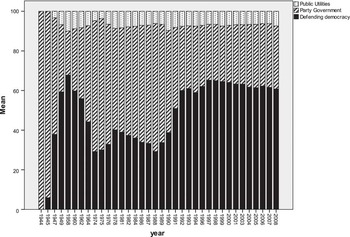
The overall trends are illustrated in Figure 4, which presents a schematic representation of the longitudinal trends in party constitutionalization, showing the changes in the relative importance of the three different models of party constitutionalization over time. The graph shows that the model Defending Democracy, where the constitutional codification of the parties concentrates on their rights and their democratic duties, as well as the democratic structures of their party organizations, predominates virtually throughout the entire post-war period. It reached its peak in 1958, after the constitutionalization of political parties in the French Fifth Republic and following the earlier examples of Italy and Germany. In the subsequent decades, the constitutionalization of political parties was oriented primarily towards their role as public office holders. This is the predominant conception of party democracy emanating from the constitutions adopted by the newly established independent republics of Cyprus and Malta in the 1960s, as well as the Scandinavian countries. The collapse of communism in 1989 brought about a revival of constitutionalization of parties in relation to the defence of democracy. From the early 1990s onwards, this model accounts for some 60 percent of constitutional provisions. Finally, the conception of democracy in which parties are seen as akin to a special type of public utility is clearly smaller in comparison with the other two. While it experienced some fluctuation in the first decades after the war, its presence has been more or less stable since the early 1990s.
Models of party constitutionalization over time. Note: the longitudinal analysis is based on the changes in the magnitude of regulation over time. A weighting factor has been applied, considering both the number of countries having constitutionalized parties in a given category and the total number of countries having constitutionalized parties in a given year.

Conclusion
This article has offered a systematic and comprehensive comparative analysis of the constitutionalization of political parties in post-war European democracies. It has found that a clear tendency exists for modern democracies to accord a formal constitutional status to political parties. While the constitutions of western liberal democracies have historically paid little attention to the role of political parties, today, only a small minority of European democracies do not acknowledge the role of political parties in their constitution. In this article, we define the concept of party constitutionalization, advance an integrated analytical framework that synthesizes the central tenets of the liberal and republican traditions of constitutionalism as well as some of the core aspects of party scholarship, and develop measures to gauge the intensity and scope of party constitutionalization over time and across countries.
While our comparative analysis cannot account for all the variation between individual countries, it does show that a clear and significant correlation exists between the nature and the intensity of party constitutionalization, on the one hand, and the newness and historical experience with democracy, on the other. New and re-established democracies are not only more likely than older ones to constitutionally acknowledge the relevance of political parties, they also tend toward more regulation in a larger number of areas, and thus toward more state intervention in party politics. This, we argue, can be explained by the preceding experiences with authoritarian or totalitarian dictatorship. It implies, first of all, that countries with a non-democratic past are more inclined to associate political parties with basic democratic rights and freedoms. At the same time, it has encouraged them toward more stringent prescription of parties’ behavior, ideology and organization, as well as a larger degree of judicial oversight of party activity by the courts.
Because constitutions define the set of supreme rules of the game, the constitutional codification of political parties implies that the constitution acquires prominence in political practice as the explicit legal foundation and point of reference for the judicial adjudication of issues about the operation of political parties. This may involve questions about the admissibility of certain forms of party behavior or the compatibility of certain ideologies with the fundamental principles of democracy and the constitutional order. This is evidenced, for example, by the increasingly prominent role of Constitutional Courts in the outlawing of anti-democratic or insurrectionist parties. It can also be seen from the rulings by Constitutional Courts such as the German Bundesverfassungsgericht on the constitutionality of certain forms of party financing.
In terms of the normative underpinnings of the different modes of constitutional codification, we have shown that three distinct models of party constitutionalization can be identified – Defending Democracy, Parties in Public Office, and Parties as Public Utilities – of which the first two predominate throughout most of the post-war period. Each of these can be seen to reflect a particular conception of party democracy. The first model places emphasis on the regulation of political parties with a view to safeguarding the continued existence of democracy and is to be found predominantly in new as well as re-established democracies. The second model focuses on the public roles of political parties as central actors in parliament, government, and elections, and is primarily associated with the longer established democracies. The third model, which conceives of political parties as a special type of public good because of their unique democratic functions and their consequent entitlement to the resources of the state, is mostly connected with countries where the constitutionalization of political parties is of a more recent date, although our longitudinal analysis shows that the importance of this model is relatively constant over time.
Overall, our analysis suggests that constitutions reflect the particular historical and political contexts within which they are designed, also with respect to the nature and intensity of party constitutionalization. The increased incidence of party constitutionalization thus attests to changing empirical realities and to shifting normative beliefs about parties and democracy. Regardless of which model they most closely approximate, national constitutions thus reify Schattschneider's (Reference Schattschneider1942) oft-cited observation that democracy is inconceivable, except in terms of political parties, while at the same time underscoring that the predominant conception of modern democracy today is one that is unquestionably couched in terms of party. The analysis presented here, therefore, not only tells us about the constitutional status of parties, it also tells us something about the functioning and self-conceptions of modern democracies, how they vary between countries, and how they are changing over time.
Acknowledgments
A first version of this article was presented at the International Political Science Association conference, Santiago de Chile, July 2009. In addition to the conference participants, we are grateful to Lisa Anderson, Patrick Bernhagen, Kenneth Janda, Paul Lewis, Martin Morlok, Huib Pellikaan, Richard Rose as well as the three anonymous reviewers of the European Political Science Review for their helpful comments and suggestions. This research was funded by the Economic and Social Research Council (ESRC; RES-061-25-0080) and the European Research Council (ERC; Stg07_205660). Their financial support is gratefully acknowledged.
Appendix data and methods
Case selection
The countries covered in this research include all European democracies that have a written constitution, taken to be that law that is called or commonly referred to as the constitution or the Basic Law, and codified in a single document. This means that the United Kingdom does not form part of our final sample because it does not have a constitution in the sense used here. Furthermore, the constitutions of Sweden and Finland are taken to be the texts that resulted from the consolidation of various constitutional laws into a single document. The new integrated Finnish constitution of 1999 is based on four older constitutional acts (the Constitution Act, the Parliament Act, and two acts on Ministerial Liability). The Swedish constitution of 1974 consists of four fundamental laws (the Instrument of Government, the Act of Succession, the Freedom of the Press Act, and the Fundamental Law on Freedom of Expression) and is the result of a similar process of constitutional integration (see Ruin, Reference Ruin1988).
‘Democracy’ has been operationalized as an independent country classified as ‘Free’ by Freedom House at the end of 2008, with the exception of smaller states with a population under 100,000. The general criteria for the selection of our cases are thus the existence of an independent and democratic nation state with a written constitution codified in a single document. Out of a total of 33 European democracies, 28 countries comply with these criteria, that is, Austria, Bulgaria, Croatia, Cyprus, Czech Republic, Estonia, Finland, France, Germany, Greece, Hungary, Iceland, Italy, Latvia, Lithuania, Luxembourg, Malta, Norway, Poland, Portugal, Romania, Serbia, Slovakia, Slovenia, Spain, Sweden, Switzerland, and Ukraine. In Belgium, Denmark, Ireland, and the Netherlands, political parties are not mentioned in the constitution, while the United Kingdom does not have a written constitution codified in a single document.
The following specifications apply for coding the year of party constitutionalization, that is, the year in which the constitution first incorporates a reference to political parties:
1. Only democratic states in the post-war period are considered. Our cases thus exclude cases of party constitutionalization from the interwar period, such as the 1919 constitution of Weimar Germany, or the 1920 constitution adopted in Austria following the collapse of the Austrian–Hungarian monarchy (subsequently amended in 1929). For Austria, the first democratic constitution is taken to be the constitution of 1945, adopted in the wake of the restoration of democracy after WWII, which reinstated the pre-war federal constitution of 1929 while at the same time rescinding the Austro-fascist constitution of 1934. For Germany, the first democratic post-war constitution is the Basic Law of 1949 (for a chronology of post-war party constitutionalization, see Figure 1).
2. Excluded are non-democratic constitutions that were still in force after a transition to democracy. For Poland, for example, the first democratic constitution is taken to be the so-called ‘small constitution’ of 1992, which repealed parts of the communist constitution, even though the country had acquired ‘Free’ status in 1990. Included, however, are revised non-democratic constitutions that were adjusted to the standards of democracy before the transition had been completed. Thus, in the case of Hungary, we consider the first democratic constitution to be the amended constitution of 1989, even though the ‘Free’ status was first obtained only in 1990. The same is true for Romania, which first revised its non-democratic constitution in 1991 but did not become ‘Free’ until 1996.
3. For cases where we are dealing with a dual process of democratization and the (re)establishment of independent nation states, the first democratic constitution is taken to be the constitution adopted (or amended) after the collapse of the non-democratic regime and after the establishment of an independent nation state. This means that for Croatia, for example, the first democratic constitution is considered to be the one approved in December 1990, which was adopted a few months after the proclamation of the independent Republic of Croatia in the spring of the same year, but before the country became considered ‘Free’ in 2000. For Ukraine, the first democratic constitution is the one adopted in 1996, after the country formally achieved independence in 1991, but before achieving ‘Free’ status in 2006.
Coding
The textual sources that constitute the basis of our analysis are the English language translations of national constitutions. In most cases, we have relied on the comprehensive collection of documents available in Flanz (Reference Flanz2004), but many of the more recent versions of constitutions have been traced from the websites of national parliaments, governments, and constitutional courts. The period under investigation effectively commences with the first reference to political parties in the 1944 Icelandic constitution and concludes with the constitutions in force at the end of 2008. Recorded for all countries are the year in which parties were first codified in the national constitution, the range and magnitude of constitutionalization, and, for each constitutional provision and subsequent amendment, the category of constitutionalization. These data are available in a comprehensive and searchable online database on party regulation. The database can be accessed at www.partylaw.leidenuniv.nl
The unit of analysis is the sentence of the constitutional article that contains a reference to political parties. Each constitution has been scrutinized for the appearance of the word ‘party’ or ‘parties’, whereby textual interpretation has aided us to include only their occurrence in the socio-political sense and exclude ‘parties’ in the legal sense. At least two coders evaluated the texts to ensure reliability. Table A1 provides coding examples for each of the categories. The categories are jointly exhaustive but not mutually exclusive: each sentence has been assigned to at least one category but it is possible that a single sentence pertains to more than one category.
Coding examples

As a specific example of how a single constitutional provision may encompass several categories, consider the constitution of the Czech Republic, which states that:
The political system is based on the free and voluntary foundation and free competition of political parties respecting fundamental democratic principles and rejecting force as a means for asserting their interests. (art. 5)
This provision falls into four different categories: democratic principles (free competition between parties), rights and freedoms (the free and voluntary foundation of parties), activity and behaviour (the rejection of force as a means for asserting the party's interest), and identity and programme (respect for fundamental democratic principles).
The case of Luxembourg illustrates the difference between the range and the magnitude of constitutionalization. The only provision referring to political parties in the Luxembourg constitution is article 32bis, which was added in 2008 to read that:
Political parties contribute to the formation of the popular will and the expression of universal suffrage. They express democratic pluralism.
This article comprises two sentences, which both fall within the category of democratic principles. The range of constitutionalization in the case of Luxembourg thus equals one. These two sentences, which contain three statements – on popular sovereignty (‘popular will’), participation (‘universal suffrage’), and democratic pluralism –have therefore been assigned to as many sub-categories. The magnitude of party constitutionalization in Luxembourg thus equals three.