The first stage of Norwood reconstruction is performed for a heterogeneous group of anatomic defects, including different types of functionally univentricular hearts with obstruction to systemic blood flow. In most centres, early surgical mortality has improved markedly in recent years, and mid-term follow-up studies are increasingly prevalent in the literature. In a prior review from our institution evaluating risk factors for death, associated cardiac anomalies, such as integrity of the atrial septum, anomalous pulmonary venous return, or more than moderate tricuspid regurgitation, genetic syndromes, major additional non-cardiac anomalies, and lower weight, but not the size of the ascending aorta or intraoperative support techniques, were associated with an increased risk of death.Reference Gaynor, Mahle and Cohen1 During an earlier time period, similar risk factors for hospital mortality were identified in a large series of patients undergoing reconstruction at the University of Michigan.Reference Bove and Lloyd2 More recent reports from both institutions show a neutralization of some risk factors over time, while others, such as low birth rate remain.Reference Stasik, Gelehrter, Goldberg, Bove, Devaney and Ohye3, Reference Tabbutt, Dominguez and Ravishankar4 Impressively for a lesion which was universally lethal one-quarter of a century ago, recent series have reported risk-unadjusted mortality rates approaching 10% or less.Reference Tabbutt, Dominguez and Ravishankar4–Reference Tweddell, Hoffman and Mussatto7
Despite improving surgical results, the perioperative course is less predictable than that following other neonatal surgical procedures, and includes frequent complications involving the cardiac, pulmonary, infectious, renal, gastrointestinal, and central nervous systems. Despite the significant postoperative morbidity, and use of resources in this heterogeneous group of patients, there has been little systematic categorization to date of the postoperative course.Reference Cua, Thiagarajan and Gauvreau5, Reference Jeffries, Wells, Starnes, Wetzel and Moromisato8 In addition, many centres are now advocating significant changes to the surgical approach to the newborn with hypoplastic left heart syndrome, including modifications such as placement of a shunt from the right ventricle to the pulmonary arteries, continuous cerebral perfusion during reconstruction of the aortic arch, “hybrid” procedures utilizing interventional catheterization and banding of the pulmonary arteries,Reference Bacha, Daves and Hardin9–Reference Takeda, Asou, Yamamoto, Ohara, Yoshimura and Okamoto15 or routine use of medications such as aprotinin or long-acting alpha blockade,Reference Tweddell, Hoffman and Mussatto7, Reference Burke, Zahn and Rossi16–Reference Shen and Ungerleider18 with the goals of decreasing perioperative mortality and morbidity. As risk factors for hospital mortality in our institution have previously been described,Reference Gaynor, Mahle and Cohen1 the purpose of our present investigation was to describe and characterize the course in the cardiac intensive care unit following the first stage of Norwood reconstruction at the Children’s Hospital of Philadelphia, including estimation of the baseline incidence of major postoperative morbidity during a time period when a systemic-to-pulmonary arterial shunt was routinely used as one of the possible sources of blood flow to the pulmonary arteries. A secondary aim was to determine risk factors for sub-optimal outcome in that era.
Methods
We reviewed retrospectively the medical records of all patients born between 1 September, 2000, and 31 August, 2002, who had undergone the first stage of Norwood reconstruction at our institution, establishing details of their perioperative course. This time frame was selected because strategies for intraoperative and postoperative management were fairly constant through the period, and have been previously reported.Reference Gaynor, Kuypers and van Rossem19–Reference Wernovsky, McElhinney, Tabbutt, Rychik and Wernovsky23 Briefly, surgery is electively undertaken in stable neonates within a few days of birth, earlier if the atrial septum is either very restrictive, resulting in significant hypoxemia and the need for mechanical ventilation, or non-restrictive, the latter resulting in excessive flow of blood to the lungs with systemic hypoperfusion, and later if multi-organ system dysfunction is noted at presentation. We routinely use deep hypothermic circulatory arrest and modified ultrafiltration during cardiopulmonary bypass, as well as placing a shunt from the central circulation, usually the brachiocephalic artery, to the pulmonary arteries.Reference Gaynor, Kuypers and van Rossem19 Of the patients in this series, a shunt from the right ventricle to the pulmonary arteries was created in 5, depending upon the preference of the surgeon. Long acting alpha blockade was not used, and delayed sternal closure and aprotinin were used on a case-by-case basis. During the time period of this study continuous infusions of neuromuscular blockade were given during the first postoperative night. We routinely used fentanyl, at 2 to 4 micrograms per kilogram per hour, for analgesia. Most patients received dopamine, typically 3 micrograms per kilogram per minute, in addition to afterload reduction with milrinone, given at 0.5 to 1.0 micrograms per kilogram per minute, for the first 2 to 4 days after surgery through the initial attempt at extubation. It has been our more recent practice to use lower rates of infusion of milrinone in oliguric patients.Reference Zuppa, Nicolson and Adamson24 Patients were weaned from mechanical ventilation and extubated once they satisfied standard clinical parameters, including appropriate respiratory effort, normal neurological state, and acceptable analyses of arterial blood gases. Standardized criterions or protocols for extubation and advancing of feeds were not in place, and were at the discretion of the physician of record. Enteral feedings, by mouth or nasogastric tube, were generally withheld until patients were extubated, had their umbilical catheters removed, and were not receiving intravenous inotropic support or afterload reduction.
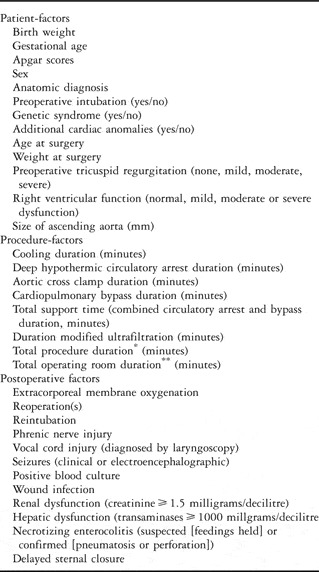
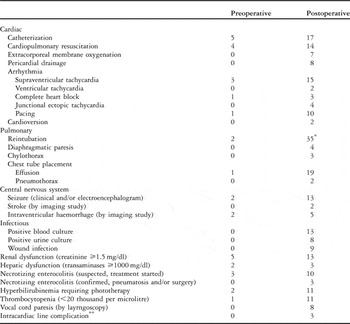
We reviewed the records to extract information specific to the patient and procedure as shown in Table 1. The complete hospital course was reviewed for adverse “events” as detailed in Table 2. Patients who were transferred back to their referring institution for the completion of their recovery had their total postoperative length of stay calculated, although postoperative morbidity was captured only from our institution to assure consistency in coding. No patient was transferred back to the referring institution receiving either mechanical ventilation or intravenous inotropic support. The first 48 hours following surgery were categorized in 4-hour intervals, during which we collected routinely representative haemodynamic and laboratory parameters, along with details of inotropic support and urinary output. Data from patients on extracorporeal life support during the first 48 hours was excluded from the summary statistics.
Potential risk factors analyzed for adverse outcomes.

*Time from skin incision to closure of skin (or silastic patch if delayed sternal closure).
**Time from entering to leaving operating room.
Perioperative events.

*13 with multiple reintubations.
**Bleeding requiring exploration (2) or entrapment requiring surgical removal (1); excluding infection.
To estimate the amount of cardiac support required in the early postoperative period, a modified “inotrope score” was calculated, based upon previously systems reported by Wernovsky, Kulik and Hoffman.Reference Hoffman, Wernovsky and Atz25–Reference Wernovsky, Wypij and Jonas27 Baseline values for dopamine or dobutamine were established as 1, doses of milrinone were assigned a multiple of 10; and those of epinephrine, phenylephrine and isoproterenol of 100. Thus, a patient receiving dopamine at 3 micrograms per kilogram per minute, milrinone at 0.5 micrograms per kilogram per minute, and epinephrine at 0.07 micrograms per kilogram per minute, had a total inotrope score of 15. We did not use long-acting agents providing alpha blockade, such as phenoxybenzamine, nor other drugs such as vasopressin, so these agents were not calculated in the inotrope score. Finally, daily assessment of fluid state, as well as routinely collected laboratory values for the first 5 days after surgery were recorded. Throughout this 5 day period, total urinary output was calculated as millilitres per kilogram per hour. We report representative laboratory values typically obtained between 0400 and 0600 each day.
Statistical methods
Summary statistics were generated for anatomic and physiologic outcomes. Data analysis involved two distinct phases. The first phase consisted of generating measures of central tendency, variability, and association for all relevant variables in the data set, with a special emphasis on anatomic, ventilatory, and length of stay related variables. Histograms, pie-charts, and box-and-whisker plots, cross-sectionally as well as longitudinally, were generated for a number of operative variables, for example, bypass time, circulatory arrest time, cross-clamp time, total support time; haemodynamic variables, for example, diastolic and systolic blood pressure and heart rate, and variations in blood gases. The second phase consisted of specifying and testing three sets of linear regression models. All models were tested using each of three different durations of length of stay, specifically the total stay in hospital, the total stay in the intensive care unit, and the stay in the postoperative intensive care unit, and also with a number of patient-related, procedurally-related, or postoperative risk factors (see Table 1). All models were sequentially tested based on information available to clinicians at three well-defined points in time during the clinical course. These were, first, at the time of admission to the cardiac intensive care unit, this permitting establishment of patient-related risk factors; second, immediately following completion of the first stage of reconstruction, establishing patient-related and procedurally-related risk factors; and finally early in the post-operative period, when we included postoperative events as described above. All models were initially tested using only single-covariate equations. Any variables with P-values of the third type, being equal to or less than 0.15, were considered as candidates for inclusion in a multiple covariate equation for each endpoint. We used the hypothesis-wise error rate of αADJ equal to 0.005, due to the very highly related outcomes using adjustment for highly correlated endpoints.Reference Tukey, Ciminera and Heyse28, Reference Zhang, Quan, Ng and Stepanavage29 All data were analyzed using SAS v9.0 (SAS Institute, Cary, NC).
Results
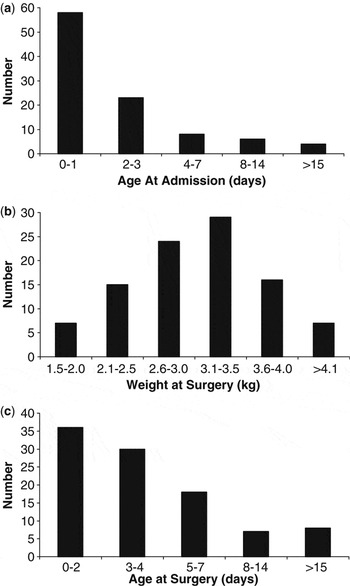
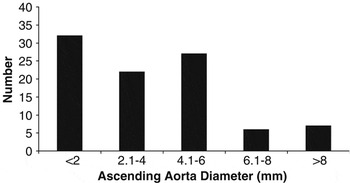
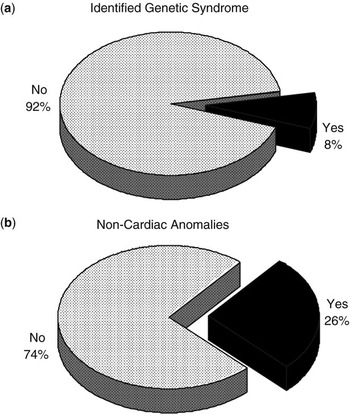
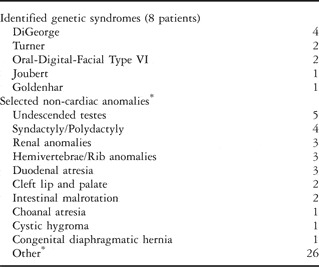
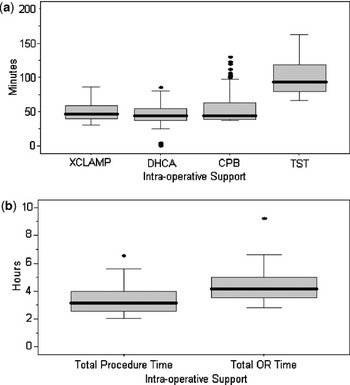
We found 99 patients who met the criterions for inclusion. During the same period of time, first stage reconstruction was not attempted in 6 patients meeting the anatomic criterions because of major non-cardiac malformations, an abnormal karyotype or severe multi-system end-organ failure, with all 6 patients dying. The majority of patients was admitted within the first week of life (Fig. 1a), with a median weight at surgery of 3.1 kilograms, and a range from 1.6 to 4.7 kilograms (Fig. 1b), at a median age of 3 days, with a range from 0 to 69 days (Fig. 1c). The classical anatomic findings of hypoplasia or atresia of the left ventricle, aortic and mitral valves were present in 71 patients. The other 28 had different types of functionally univentricular heart with obstruction to systemic flow, including those with dominant left ventricles and discordant ventriculo-arterial connections, heterotaxy and isomerism of the atrial appendages, and those with potentially biventricular circulations, but a remote ventricular septal defect unsuitable for septation. The size of the ascending aorta based upon the echocardiographic report is shown in Figure 2. Associated identified genetic syndromes were present in 8, and major or minor non-cardiac malformations in 26 patients (Fig. 3a, b, Table 3). Multiple anomalies and syndromic associations frequently occurred together. The periods of intraoperative support are shown in Figure 4a, b. A modified Blalock-Taussig shunt was created in 94 patients, and a shunt placed from the right ventricle to the pulmonary arteries in 5 patients.
The figures shows (a) age at admission, (b) weight at surgery and (c) age at surgery. Kg: kilograms.

Diameter of ascending aorta. mm: millimetres.

The incidence of (a) genetic syndromes and (b) non-cardiac anomalies.

Major additional non-cardiac anomalies.

*Multiple minor anomalies (for example, small intraventricular haemorrhage, periventricular leukomalacia, low set ears, optic nerve hypoplasia, agenesis corpus callosum) are not listed separately.
Intraoperative support times (a). The box represents the 25th to 75th percentile, with the thick line representing the median value. The 10th to 90th percentiles are represented by the error bars, with outliers identified as individual data points. CPB: cardiopulmonary bypass, DHCA: deep hypothermic circulatory arrest, TST: total support duration (DHCA+CPB), XCLAMP: aortic cross clamp duration. In Figure 4B, we show the total procedural time, equaling the time from skin incision to closure of skin (or silastic patch if delayed sternal closure). Total OR time is the time from entering to leaving operating room (OR).

Mortality, reoperations and hospital morbidity
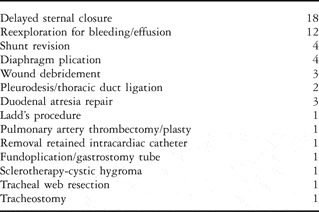
Fifteen of the 99 infants died during the hospital stay, giving a mortality of 15.2%. Of the remaining 84 patients, 1 remained hospitalized until the cavopulmonary anastomosis was performed. Data from the hospital course was collected until just prior to this procedure, which took place at 171 days of age, so the data from this patient is excluded from the summary statistics on length of stay. Extracorporeal life support was utilized in 7 patients, 6 of whom died. The sole survivor could not be weaned from cardiopulmonary bypass, and required 192 hours of support before eventual decannulation. The remaining 6 patients were placed on support during active cardiopulmonary resuscitation, and all died. The median duration between surgery and extracorporeal support was 35 hours, with a range from 0 to 578 hours. Cardiopulmonary resuscitation was necessary in an additional 7 patients who had spontaneous recovery of circulation, with 5 surviving to leave hospital. Excluding delayed sternal closure and cannulation for extracorporeal support, 24 patients underwent 33 additional cardiothoracic operations, as summarized in Table 4. Additional perioperative morbidity is summarized in Table 2. Not uncommonly, individual patients had postoperative complications in more than one organ system, for example, of the 7 patients on extracorporeal support, 5 had seizures, 5 had thrombocytopenia and 3 had necrotizing enterocolitis. Of the 7 patients who had cardiopulmonary resuscitation without the need for extracorporeal support, 3 had necrotizing enterocolitis and one had thrombocytopenia.
Additional operations.

Mechanical ventilation
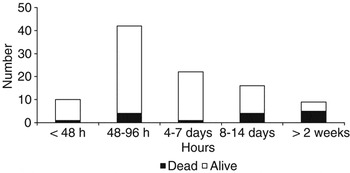
During the period of study, the median duration of mechanical ventilation until the first attempt at extubation was 3.2 days, with a range from 0.7 to 33.8 days. The median duration of total mechanical ventilation was 4.0 days, and the range was 0.7 to 80.5 days (Fig. 5). Excluding those who died, the median total duration of mechanical ventilation was 3.8 days, with a range from 0.9 to 46.3 days. In a multivariable model, using only patient-related factors, the only risk factor for longer duration of mechanical ventilation was lower Apgar score at 5 minutes (p < 0.01). When intraoperative and postoperative variables were added to the model, reoperation (p < 0.01), reintubation (p < 0.01), renal dysfunction (p < 0.01), and delayed sternal closure (p = 0.01) were associated with a longer duration of mechanical ventilation. Reintubation was the most common postoperative event. Excluding reintubations associated with non-surgical procedures, for example cardiac catheterization or magnetic resonance imaging, as used in 4, 12 patients were acutely reintubated for stridor and extrathoracic airway obstruction, while 19 were reintubated for cardiopulmonary failure, defined as progressive haemodynamic instability with or without tachypnea or respiratory distress. Factors associated with non-elective reintubation, performed in 31 patients, included lower Apgar scores at 1 minute (p < 0.01), and a more positive cumulative fluid balance at the time of extubation (p = 0.03). These patients were also more likely to have a postoperative wound infection (p = 0.04), and positive blood cultures (p = 0.11). The smaller group who were reintubated for stridor was more likely to have been intubated preoperatively (p = 0.03). Multiple reintubations were necessary in 12 patients, 5 in the group reintubated for stridor, and 7 of those reintubated for cardiorespiratory failure, including 1 patient who eventually underwent tracheostomy.
Total duration of mechanical ventilation.

Length of Stay
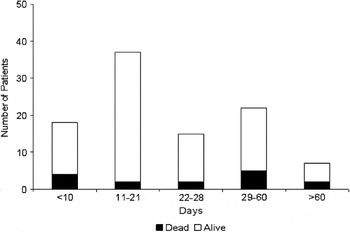
The median postoperative length of stay in the cardiac intensive care unit was 11 days, with a range from 2 to 85 days, and in the hospital was 14 days, with the range from 2 to 85 days. Excluding deaths, the median values were 10, with a range from 4 to 70, and 14, with the range from 8 to 77 days (Fig. 6). Patient-related factors associated with an extended length of stay in the intensive care unit, as separated by quartiles, were lower Apgar scores at 1 (p = 0.04) and 5 minutes (p = 0.02), the presence of a genetic syndrome (p = 0.02), and preoperative intubation (p < 0.01). Intraoperative variables included longer duration of cross clamping the aorta (p = 0.03), and total intraoperative support time (p = 0.02). A number of postoperative variables were associated with longer length of stay, including reoperations (p < 0.01), reintubation (p < 0.01), a positive blood culture (p = 0.02), wound infection (p = 0.04), greater cumulative fluid balance at the time of extubation (p = 0.05) and thrombocytopenia (p = 0.04).
Total length of stay in hospital.

Haemodynamic and laboratory results
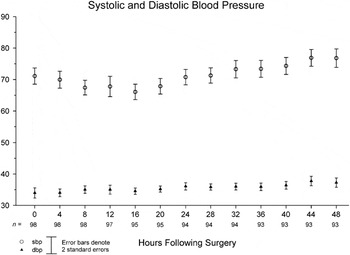
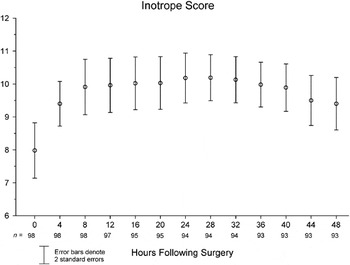
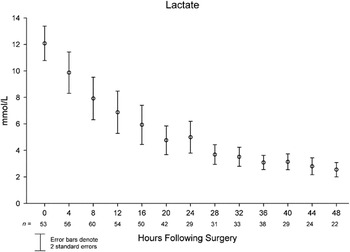
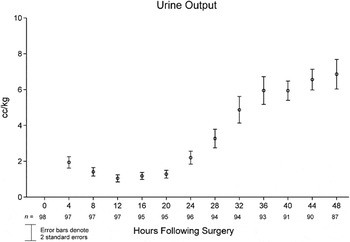
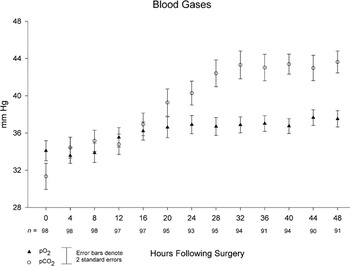
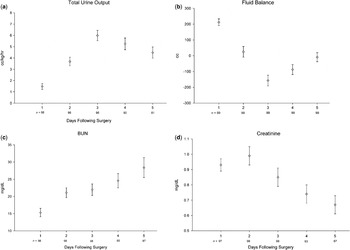
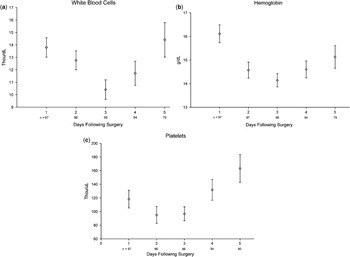
Graphical representation of haemodynamic parameters, inotropic support, lactate values, urinary output, and blood gas data obtained in the first 48 hours after surgery are shown in Figures 7–11. Urinary output, daily fluid balance, and routine laboratory studies obtained for the first 5 days after surgery are shown in Figures 12–13.
Systolic and diastolic blood pressure at 4 hour intervals following the procedure. Numbers under the hours are the number of patients with available measurements.

Inotrope score (see text for details of calculation) at 4 hour intervals following surgery. Numbers under the hours are the number of patients with available measurements.

Serial serum lactate measurements at 4 hour intervals following surgery. Numbers under the hours are the number of patients with available measurements.

Serial assessment of urine output at 4 hour intervals following surgery. Calculations at each time frame reflect the total urine output in the preceding 4 hours, divided by body weight. Numbers under the hours are the number of patients with available measurements.

Serial assessment of arterial pCO2 and pO2 at 4 hour intervals following surgery. Numbers under the hours are the number of patients with available measurements.

Total urine output (a) for the first 5 days after surgery. See text for details of calculations. Numbers under the hours are the number of patients with available measurements. Daily fluid balance (b) combining all input and output for the patient for the first 5 days after surgery. Numbers under the hours are the number of patients with available measurements. Blood urea nitrogen measurements (c) during the first 5 days after surgery. Numbers under the hours are the number of patients with available measurements. Serum creatinine measurements (d) during the first 5 days after surgery. Numbers under the hours are the number of patients with available measurements.

Serum measurements of white blood cells (a), hemoglobin (b) and platelet number (c) in the first 5 days after surgery. Numbers under the hours are the number of patients with available measurements.

Disposition
Excluding the 12 patients who died in our institution, 26 patients were transferred back to their referring institutions, 3 of whom subsequently died before eventual hospital discharge. In all, 41 were transferred from the intensive care unit to the cardiology floor, and 20 were discharged directly to home from the intensive care unit, generally due to unavailability of beds in our cardiologic floor, and/or the preference of the practitioner. At the time of discharge or transfer, 46 of the 83 patients (55.4%) were taking all feedings by mouth, and an additional 28 (33.7%) were taking a combination of nasogastric feeds and oral feeds. A total of 9 (10.8%) were fed solely by nasogastric tube, in 7, or gastrostomy in the other 2.
Discussion
The outlook for patients born with a functionally univentricular heart and obstruction to systemic flow, as typically seen in the hypoplastic left heart syndrome, has improved considerably since the initial reports of definitive surgical palliation over 20 years ago.Reference Norwood, Lang and Hansen30 A once lethal disease can now be palliated with early mortality risks of less than 10% for patients at standard risk, and with outcomes over the longer term similar to other children with a Fontan circulation.Reference Gaynor, Mahle and Cohen1, Reference Freedom, Hamilton and Yoo31–Reference Thies, Breymann, Boethig, Blanz, Meyer and Koerfer35 As previously reported by Cua and colleagues from Children’s Hospital, Boston,Reference Cua, Thiagarajan and Gauvreau5 nonetheless, the early postoperative course is complicated and prolonged in a significant proportion of patients. A longer length of stay in the hospital is due to a combination of patient-related factors, the course in the operating room, including occasional injury to hilar structures such as the phrenic or recurrent laryngeal nerves, and complications which occur in the intensive care unit. Underlying anatomy was not related to any postoperative outcomes.
Not surprisingly, morbidity related to the cardiovascular system was the most common set of problems we encountered in the postoperative period. Bleeding may be a significant problem early after surgery in these patients. Indeed, re-exploration for bleeding was necessary in 12 of our patients, and was the most common indication for delayed sternal closure. Bleeding may be exacerbated by a dilutional coagulopathy, platelet dysfunction, and thrombocytopenia coexisting with the multiple suture lines necessary in these small neonates. It has been our practice to use fresh whole blood in the operating room and cardiac intensive care unit to reduce bleeding in this population, although this practice is somewhat controversial.Reference Friesen, Perryman, Weigers, Mitchell and Friesen36–Reference Manno, Hedberg and Kim38
Objective measurements of cardiac output are problematic in the neonate following the first stage of Norwood reconstruction, as thermodilution techniques cannot be used because of intracardiac mixing, and other non-invasive estimates, such as Doppler velocities in the aorta, have not been validated after this type of surgery. Surrogate markers may be used, such as the saturation of oxygen in the superior caval vein, which is not routinely monitored in our institution, and similarly has not been validated as a true estimate of “mixed” venous saturations of oxygen following neonatal cardiac surgery. As has been reported following other neonatal procedures, the initial 24 hours after the first stage of reconstruction is marked by surrogate signs of decreased systemic cardiac output, such as a slight fall in systolic blood pressure and the need for increased inotropic support in the first 8 hours after surgery, as well as oliguria and elevated measurements of lactate in the serum. In our series, the initial values for lactate are higher than previously reported, and may possibly reflect the combined effects of intraoperative and bypass management, for example, flushing of the intravenous lines with lactated Ringer’s solution, the use of deep hypothermic circulatory arrest, and local blood banking policies. High initial values, nonetheless, are not associated with adverse outcomes unless there is an atypical fall in the values.
The postoperative course is remarkably similar in many respects to that seen after the arterial switch operation,Reference Wernovsky, Wypij and Jonas27 but the fall in cardiac output may have a greater clinical impact than that seen following biventricular repair, given the fact that the ventricular output is divided between the pulmonary and systemic circulations, as well as the regurgitant fraction, if present. In support of this supposition, in our series inotropic support was approximately 50% higher, the urinary output was roughly 50% less, and the serum creatinine nearly twice that seen in a population of neonates following the arterial switch operation.Reference Wernovsky, Wypij and Jonas27
Cardiopulmonary resuscitation was necessary in nearly 15% of the cohort, including the need for mechanical support in nearly 8%, similar to other reports.Reference Cua, Thiagarajan and Gauvreau5, Reference De Oliveira, Ashburn and Khalid39–Reference Malec, Januszewska, Kolcz and Mroczek43 During our chosen period of study, the results with extracorporeal membrane oxygenation were disappointing, but have improved in recent years.Reference Ravishankar, Dominguez and Kreutzer44 Acute decompensation may be due to arrhythmia, tamponade, shunt thrombosis or acute changes in loading conditions,Reference Wright, Crowley, Charpie, Ohye, Bove and Kulik45 and may be most amenable to acute resuscitation with extracorporeal life support.Reference Ravishankar, Dominguez and Kreutzer44 Additional cardiovascular morbidity seen in this cohort included the need for reintervention either in the operating room or catheterization laboratory in nearly one-fifth of the patients, and arrhythmias most likely related to the combination of atrial incision, septectomy, haemodynamic disturbances and electrolytic shifts.
Once the initial postoperative period has passed, most patients will begin to diurese effectively and achieve negative fluid balance, allowing for decreased mechanical ventilation and extubation. The incidence of reintubation in our cohort, at 31%, was disappointingly high, and considerably greater than the figure of 7.9% recently reported for a population of older patients undergoing surgery on an elective basis during a similar period of time.Reference Gillespie, Kuijpers and van Rossem46 In our series, factors related to reintubation, which was itself related to a prolonged stay in the hospital, were preoperative intubation, lower birth weight, and a less negative cumulative fluid balance since surgery at the time of extubation. The decision to extubate patients was made on clinical grounds on the day of extubation by the caregivers based upon traditional clinical and laboratory parameters as discussed in the methods. The need for reintubation in nearly one-third of the patients suggests further development of decision-making protocols might reduce the incidence of reintubation. It is difficult to know what the “correct” frequency of reintubation should be to obtain an acceptable balance between early extubation, to reduce the iatrogenic risks, and a more conservative approach, which might result in less reintubations but unnecessary days of mechanical ventilation for many.
In addition to the palliative nature and abnormal cardiovascular physiology following the first stage of Norwood reconstruction, additional causes of failed extubation specifically related to the surgical procedure include injury to the phrenic and/or recurrent laryngeal nerves in a small number of patients. In a recent report,Reference Skinner, Halstead, Rubinstein, Atz, Andrews and Bradley47 true injury to the vocal cords was identified in nearly one-tenth of the patients, as in our series, and may contribute both to feeding and airway difficulties. In the absence of unexpected fluid accumulation, upper airway or diaphragm issues, most patients can be extubated within a few days of surgery and no longer require intravenous inotropic support and afterload reduction.
Prolonged length of stay, particularly in the intensive care unit, has been associated with an increased risk of short term complications, infection, medical errors,Reference Bracco, Favre and Bissonnette48 and worse long-term outcomes.Reference Mahle, Visconti and Freier49, Reference Newburger, Wypij and Bellinger50 The duration of mechanical ventilation is one of the strongest factors associated with the need for invasive monitoring and a prolonged length of stay in the intensive care unit. As a result, our usual approach is to wean mechanical ventilation and invasive monitoring catheters as rapidly as possible, to reduce nosocomial complications and shorten overall length of stay. Premature extubation or removal of inotropic support resulting in the need for reintubation may be associated with additional complications and a prolonged length of stay. Further studies will be necessary to determine weaning protocols to simultaneously reduce the duration of mechanical ventilation as well as the need for reintubation. If a patient does not follow a typical course over the first 2 to 4 days after surgery, diagnostic studies should be considered, such as echocardiography, bronchoscopy, diaphragmatic fluoroscopy, and cardiac catheterization, depending upon the signs and symptoms in the individual patient.
In our series, risk factors for a prolonged length of stay were a combination of patient-related, procedurally-related, and postoperative factors. Most patient-related factors are unmodifiable, such as the presence of a genetic syndrome and low birth weight. Apgar scores and preoperative metabolic status may be improved by a prenatal diagnosis, but these were not consistently recorded in the medical record during this time frame. Importantly, in recent reports, the two factors most consistently associated with higher mortality, morbidity and increased length of stay have been lower birth weight and preoperative intubation.Reference Stasik, Gelehrter, Goldberg, Bove, Devaney and Ohye3, Reference Tabbutt, Dominguez and Ravishankar4, Reference Gillespie, Kuijpers and van Rossem46, Reference Krasemann, Fenge and Kehl51 In some cases, preoperative intubation is performed for haemodynamic or respiratory instability, reflecting treatment necessary in a more unstable patient. “Routine” or “elective intubation for transport” may be performed, resulting in additional preoperative morbidity from airway trauma and nosocomial infection.Reference Stieh, Fischer and Scheewe52 In this retrospective study, we were unable to distinguish the different indications for preoperative intubation to determine the relative contribution of preoperative instability or the independent effects of intubation.
Not unexpectedly, longer cross clamping of the aorta and total support on cardiopulmonary bypass were associated with a longer postoperative stay in the hospital. The duration of deep hypothermic circulatory arrest was not associated with any adverse postoperative outcomes. A longer intraoperative support may be a reflection of more complex anatomy, and has been associated with increased postoperative fluid accumulation following the arterial switch operation.Reference Wernovsky, Wypij and Jonas27 This in turn may lead to a longer duration of mechanical ventilation, invasive monitoring, and the potential for nosocomial and iatrogenic complications. Indeed, the rate of nosocomial infections was unsatisfactorily high, and protocols have since been instituted which have significantly reduced the rate of catheter related blood stream infections (Tezner E, personal communication, 2007).
Finally, while not life threatening in most cases, difficulties with feeding may dominate the later postoperative course in many patients. Abnormal gut permeabilityReference Malagon, Onkenhout, Klok, van der Poel, Bovill and Hazekamp53 and flow in the superior mesenteric arteryReference Harrison, Davis and Reid54 have been implicated as contributory to the increased risk of necrotizing enterocolitis, as well as the diastolic run-off in patients with a Blalock-Taussig shunt as the source of flow of blood to the lungs.Reference McElhinney, Hedrick and Bush55 Although the risk of necrotizing enterocolitis is higher than in other forms of neonatal heart disease,Reference McElhinney, Hedrick and Bush55 less than 5% of children require prolonged periods of hyperalimentation or surgical exploration. In our series, 10 of 13 instances of necrotizing enterocolitis were “suspected” because of emesis, irritability or the tracing of blood in the faeces, and feeds were typically reinstituted within a few days. In 3 patients, nonetheless, severe gastrointestinal complications meant that the patients required 2 weeks or more of intravenous nutrition and antibiotics. No patient required surgical exploration for gut ischaemia. In contrast, difficulties obtaining adequate oral intake were very common, and affected over half of the neonates in the immediate postoperative period. The causes are most likely multifactorial, including aspiration,Reference Skinner, Halstead, Rubinstein, Atz, Andrews and Bradley47 persistent tachypnea, gastroesophageal reflux and congenital and/or acquired central nervous system abnormalities resulting in oral motor dyscoordination.Reference Wernovsky56 Feeding difficulties may result in the need for home nasogastric feedings, as is a common practice in our group, prolonged hospitalization to achieve caloric goals,Reference Cua, Thiagarajan and Gauvreau5 the placement of surgical gastrostomy tubes, persistent failure to thrive,Reference Kelleher, Laussen, Teixeira-Pinto and Duggan57 and an increased risk of interstage death.
While we have investigated a large, 2 year, experience at a single institution, during which time strategies of management changed very little, the results may not be applicable to patients undergoing surgery at other institutions, with different pre-, intra- and post-operative strategies. Strict protocols were not in place for weaning from mechanical ventilation, nor the type, timing and technique of enteral feeding. Nosocomial infections were unacceptably common, and protocols have since been established to reduce this risk. The applicability of the current findings to patients undergoing surgery in the current era may be limited, given constant improvements in perioperative and intraoperative strategies. The currently ongoing trial at 14 centres, sponsored by the National Heart, Lung and Blood Institute, in which patients are randomized to receive either a Blalock-Taussig shunt or a shunt placed from the right ventricle to the pulmonary arteries will help answer questions not only related to mortality, but differences in morbidities at multiple centres. In contrast to previous reports where shunt type was at the discretion of the surgeon during the same time frame,4 or those in which the type of shunt was compared to historical controls,12 the multicentric trial will employ randomization of shunt type to minimize bias and better assure comparability between groups of patients.
In conclusion, despite the falling rates of death after the first stage of Norwood reconstruction, the course in the cardiac intensive care unit is remarkable for significant morbidity, especially in the cardiac, pulmonary, gastrointestinal and central nervous systems, and utilizes significant resources. Risk factors for morbidity include patient-, procedurally- and postoperatively-related variables, some of which are non-modifiable, such as weight at birth, while others may be improved upon, such as preoperative intubation, improved fluid state, postoperative reintubation and nosocomial infection. Further studies are necessary to determine methods to reduce perioperative morbidity, and to determine the long-term implications of short term complications, such as diaphragmatic paresis, injury to the vocal cords, prolonged mechanical ventilation, feeding intolerance, and postoperative seizures.
Acknowledgments
We acknowledge the notable contributions of Tom R. Karl and William M. DeCampli, who operated upon some of the patients in this series. We also thank Timothy M. Hoffman and Mitchell I. Cohen, who provided postoperative care; as well as Tina Alvarado-Taylor for her assistance with the artwork. We also acknowledge and thank the nursing and respiratory therapy staff in the cardiac intensive care unit for their diligence and commitment to these patients and their families.