


Introduction
After the devastating tsunami that struck Asian and African coastlines on 26 December 2004, several articles reported psychiatric consequences, particularly post-traumatic stress disorder (PTSD) among children and adolescents (Jensen, Dyb and Nygaard, Reference Jensen, Dyb and Nygaard2009; John, Russell and Russell, Reference John, Russell and Russell2007; Kristensen, Weisaeth and Heir, Reference Kristensen, Weisaeth and Heir2009; Neuner, Schauer, Catani, Ruf and Elbert, Reference Neuner, Schauer, Catani, Ruf and Elbert2006; Piyasil et al., Reference Piyasil, Ketuman, Plubrukarn, Jotipanut, Tanprasert and Aowjinda2007; Thienkrua et al., Reference Thienkrua, Cardozo, Chakkraband, Guadamuz, Pengjuntr and Tantipiwatanaskul2006; Ularntinon et al., Reference Ularntinon, Piyasil, Ketumarn, Sitdhiraksa, Pityaratstian and Lerthattasilp2008). PTSD can lead to substantial functional impairments. Untreated PTSD can run a chronic course, coupled with comorbid conditions with additional impairments such as depression and substance-related disorders (Breslau, Davis, Andreski and Peterson, Reference Breslau, Davis, Andreski and Peterson1991; Clark, Lesnick and Hegedus, Reference Clark, Lesnick and Hegedus1997; Kessler, Sonnega, Bromet, Hughes and Nelson, Reference Kessler, Sonnega, Bromet, Hughes and Nelson1995). Evidence-based, effective treatment of PTSD in young people who are exposed to disaster is clearly needed.
Positive results of several randomized controlled trials have demonstrated the efficacy of cognitive behavioural therapy (CBT) delivered individually for children and adolescents with PTSD following sexual abuse (J. A. Cohen, Deblinger, Mannarino and Steer, Reference Cohen, Deblinger, Mannarino and Steer2004; Deblinger, McLeer and Henry, Reference Deblinger, McLeer and Henry1990; Deblinger, Steer and Lippmann, Reference Deblinger, Steer and Lippmann1999) and traumatic events related to motor vehicle accidents and exposure to violence (Smith et al., Reference Smith, Yule, Perrin, Tranah, Dalgleish and Clark2007). Fewer studies have evaluated the efficacy of group CBT for children and adolescents who developed PTSD symptoms after natural disasters or exposure to violence (Chemtob, Nakashima and Hamada, Reference Chemtob, Nakashima and Hamada2002; Stein et al., Reference Stein, Jaycox, Kataoka, Wong, Tu and Elliott2003). Giannopoulou, Dikaiakou and Yule (Reference Giannopoulou, Dikaiakou and Yule2006) reported short- and long-term benefit of group CBT in children with PTSD after the exposure to the Athens 1999 earthquake, although natural recovery process could not be ruled out due to the lack of a no-treatment control group. Group treatment offers the benefit of positive modelling through child-child or children-therapist interaction. When a disaster strikes developing countries, intervention delivered in a group setting can be highly practical because of the limited availability of mental health services and healthcare providers. The situation after the tsunami in Thailand was that in Phang-nga (population 234,200), which was the province most severely hit by the waves, there was only one psychiatrist working in the provincial hospital. There was clearly a shortage of mental health personnel to take care of the children and adolescents who were affected. One way to cope with this problem was to transfer trained personnel from Bangkok but they could not be sustained in the area for very long, whereas CBT is conventionally delivered in a weekly format of 8–16 sessions, which therefore could take months to complete. There was therefore a need to modify CBT for a briefer, more economical version to suit the setting. The modified intervention needed to incorporate local staff without lengthy training.
The present study aimed to test the efficacy of a brief, group CBT on PTSD symptoms in young tsunami victims. We hypothesized that the participants in CBT group would improve significantly in comparison with the participants assigned to wait list condition. Additionally, homework assignment would result in maintaining improvement at 1-month follow-up.
Method
Participants
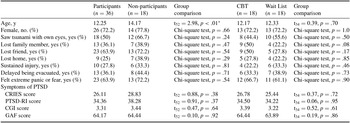
The sample size was determined by power calculations based on the effect size of 2.20 in one RCT study (Smith et al., Reference Smith, Yule, Perrin, Tranah, Dalgleish and Clark2007). With 80% power to detect the difference between CBT and WL at a 5% alpha level (two-tailed), the calculated minimum sample size per group was 5. Thirty-six children (10 boys, 26 girls) opted into the study, with their parents providing opt-in consent. The children were 10–15 years old, with an average age of 12.25 years (SD = 1.27). Inclusion criterion was primary diagnosis of DSM-IV-TR PTSD. The diagnosis was made from clinical interview by board-certified child psychiatrists using a checklist according to DSM-IV-TR criteria of PTSD (American Psychiatric Association, 2000). The checklist consisted of 21 items from the criteria with dichotomous response (present/absent) of each item based on clinical judgment. Exclusion criteria were mental retardation, pervasive developmental disorders, psychotic symptoms, or current involvement in psychopharmacological treatment. Demographic and level of exposure data are presented in Table 1.
Demographic characteristics of participants and those who refused to participate

*p < .05
Measures
Participants assigned to CBT were tested at pre- and posttreatment, as well as at 1-month follow-up with two measures. The measures were the Thai version of Children Revised Impact of Events Scale (CRIES) and UCLA PTSD Reaction Index (PTSD-RI) completed at each assessment time point. CRIES was 13-item self-report scale designed for use with children aged 8 years and above to assess PTSD symptoms across three domains (Intrusion, Avoidance, and Arousal). Items were rated on a 0 to 5 scale. A score of 17 or more on 8 items involving intrusion and avoidance was generally used as a cut-off, which correctly classified 75–83% of the children in the two different base-rate samples (Perrin, Meiser-Stedman and Smith, Reference Perrin, Meiser-Stedman and Smith2005). PTSD-RI was a 20-item self-report scale designed to assess PTSD symptoms in children aged 6 to 16 following exposure to a broad range of trauma. Items were rated on a 0 to 4 scale. Scores were classified into degree of severity of symptoms as “mild PTSD reaction” (total score of 12 -24), “moderate” (25–39), “severe” (40–59), and “very severe” (above 60) (Pynoos et al., Reference Pynoos, Frederick, Nader, Arroyo, Steinberg and Eth1987). Participants assigned to the wait list also completed these measures at the same time point and then received CBT afterwards. All assessments were facilitated by the staff members who were blinded to the condition assignment.
Cognitive behavioural therapy
Three treatment groups were conducted simultaneously with a composition of six children per group. The age range of each group spanned 4–5 years. Each group was run by two certified child psychiatrists independent of the assessment process. CBT was delivered in 3-day, 2-hour-daily group format, followed by 1-month posttreatment self-monitoring and daily homework. The treatment was manual-based and adapted from the Teaching Recovery Techniques (TRT) (Smith, Dyregrov and Yule, Reference Smith, Dyregrov and Yule1999). TRT is an evidence-based psycho-social-educational manual aimed to help boost children's strategies to cope with the psychological aftermath of war and disasters and it has been used and empirically tested in many countries (Yule, Dyregrov, Raundalen and Smith, Reference Yule, Dyregrov, Raundalen and Smith2013). We modified and consolidated the program from five sessions in TRT to three in our study and had it run for 3 consecutive days to compensate for a lack of resources in the area since the mental health professionals who could run the program had to travel from the centre and could not stay for very long. Each session was longer than the original version to accommodate the content. It was taught to the therapists during a 3-day training workshop by a certified cognitive behavioural therapist in the team (NP), and piloted before the start of the trial. During the pilot the team learned that some vocabulary was not easily understood by the children in the area so some southern words and dialect were added to enhance understanding. The treatment components included psychoeducation, breathing exercise, establishing safe place, distraction, imagery techniques (projecting images onto the screen and dual attention task) on Day 1. The treatment on Day 2 involved auditory technique, coping self-statement, introducing graded exposure, grading traumatic reminders, imaginal exposure, and dream work. The first 2 days of the group activities were conducted in school. The last day of the program, conducted under the shades along the beach 300 metres from the school as a part of exposure component of the treatment, consisted of reliving the trauma through storytelling and drawing, followed by cognitive restructuring with regard to the issues such as loss and guilt. Towards the end of the session here-and-now concept and hopeful cognitions were encouraged. The group ended with fun activities on the beach. The participants who were not ready to join were prompted to use techniques learned from the program and proceed to in vivo exposure.
After the program finished the participants were asked to complete a single sheet daily homework and return it to the school nurses every day. The homework was designed to encourage the children to monitor their symptoms and promote the use of techniques learned from the intervention. The symptom monitoring was assessed through the children answering the questions of “How frequently does intrusive memories about the tsunami disturb you today?” and “How much are you affected by them” in four Likert ratings. To help the children remember the techniques, they were provided with a tick-box sheet of all the techniques learned from the intervention for them to check when used. The school nurses also encouraged application of relevant techniques that the children might not recall. However, the nurses had no role in teaching CBT again to the children; their role was only to “prompt” them to use what they had learned. The children were rewarded by the school nurses for handing in the homework with a few pieces of candy or biscuit
Wait list
After randomization, participants in the wait list (WL) group were given an appointment for CBT after they completed the final measures. No contact with the therapists and administrators was made during the waiting period.
Procedure
The study has been approved by the ethics committee of the institute of one of the authors (VP). All participants were from a boarding school in Phang-nga Province, Thailand. All the students resided in the school dormitory. Informed consent to participate was obtained from the children, parents, and the school director.
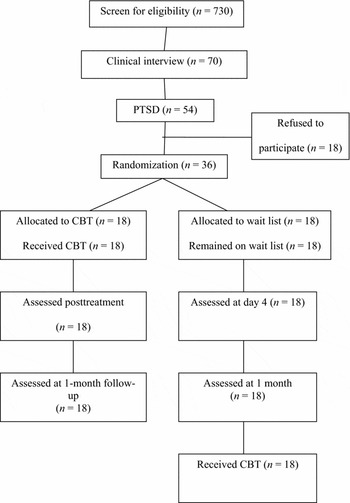
The study was conducted from August to October 2009, more than 4 years after the tsunami. Screening procedure with CRIES and PTSD-RI was carried out in 730 students. Those who scored at or above the cut-off point of 17 in CRIES or 25 in PTSD-RI were interviewed by two board-certified child psychiatrists using the PTSD symptoms checklist according to DSM-IV-TR criteria. The interviewers had undergone specific training in a workshop in PTSD diagnosis and management. They were blind to the screening status and would not be involved in the treatment. The diagnostic severity was determined by clinician-rated Global Assessment of Functioning (GAF) and Clinical Global Impression (CGI). After the interview, 54 students were diagnosed with PTSD, and 36 agreed to participate in the study. Table 1 shows there was no statistically significant difference in sex percentage, level of exposure, and severity of PTSD symptoms between those who agreed and those who refused to participate, except that the former were younger. There was no statistically significant difference in age, sex percentage, level of exposure, and severity of PTSD symptoms between the CBT and WL groups. Block randomization was carried out with the participants stratified according to age and symptom severity. Participants were assessed at pretreatment, posttreatment, and 1-month follow-up by blind assessors. Due to limited resource of child psychiatrists, the participants did not undergo blind clinical interview to determine the diagnosis status, GAF, and CGI at posttreatment and 1-month follow-up. Details of participant flow are presented in Figure 1.
Participant flow

Data analysis
Parametric and nonparametric tests were used to determine differences in baseline demographic characteristics, exposure levels, and symptom severity between CBT and WL. Analysis of covariance (ANCOVA) was performed on dependent measures (CRIES and PTSD-RI) of CBT and WL to detect any differences between the group at posttreatment and 1-month follow-up by controlling initial symptom severity. In order to detect changes in PTSD symptoms from pretreatment to posttreatment and 1-month follow-up in the CBT and WL groups, repeated measures ANOVA was carried out. Effect sizes were calculated using Cohen's d. (J. Cohen, Reference Cohen1988)
Results
Immediate effects of treatment
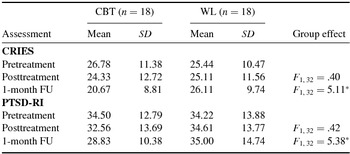
ANCOVA performed at posttreatment with pretreatment scores as covariates demonstrated no significant difference between the CBT and WL groups in PTSD symptoms on CRIES (F1, 32 = .40, p > .05) and PTSD-RI (F1, 32 = .42, p >.05) (see Table 2).
Outcome measures at each assessment

*p < .05
Follow-up
ANCOVA performed at 1-month follow-up with pretreatment scores as covariates showed that the CBT group scored significantly lower than the WL on CRIES (F1, 32 = 5.11, p < .05) and PTSD-RI (F1, 32 = 5.38, p <.05) (see Table 2).
Within group effects
In the CBT group repeated measures ANOVA showed significant difference in CRIES scores between three time points (F 2, 34 = 4.73, p <.05). Pairwise comparisons revealed no significant improvement in CRIES scores between pre- and posttreatment (mean difference = 2.44, 95%CI [−2.12–7.00], p > .05). However, significant improvement in CRIES scores from pretreatment was observed at 1-month follow-up (mean difference = 6.11, 95%CI [.152–12.07], p < .05). In the WL group repeated measures ANOVA showed no significant difference in CRIES scores between three time points (F 2, 34 = .12, p >.05).
The analysis using PTSD-RI as dependent variable also yielded comparable results. In the CBT group repeated measures ANOVA showed significant difference in PTSD-RI scores between three time points (F 2, 34 = 3.69, p <.05). Pairwise comparisons revealed no significant improvement in PTSD-RI scores between pre- and posttreatment (mean difference = 1.94, 95%CI [−4.19 −8.08], p > .05). However, significant improvement in PTSD-RI scores from pretreatment was observed at 1-month follow-up (mean difference = 5.67, 95%CI [.44 – 10.89], p < .05). In the WL group repeated measures ANOVA showed no significant difference in PTSD-RI scores between three time points (F 2, 34 = .02, p >.05).
Treatment and follow-up effect sizes
Controlled (between group) and uncontrolled (within group) effect sizes were calculated using CRIES and PTSD-RI scores and mean differences of pre- and posttreatment scores, and pretreatment and 1-month follow-up scores. The interpretations of effect sizes are from Cohen's criteria: 0.2–0.5 means small effect size, 0.5–0.8 means medium, and >0.8 means large. For CRIES scores the controlled effect sizes at posttreatment and 1-month follow-up were 0.24 and 0.69. The uncontrolled effect sizes at posttreatment and 1-month follow-up for CBT were 0.20 and 0.60, and for WL were 0.03 and -0.07. For PTSD-RI scores the controlled effect sizes at posttreatment and 1-month follow-up were 0.21 and 0.41. The uncontrolled effect sizes at posttreatment and 1-month follow-up for CBT were 0.15 and 0.49, and for WL were –0.03 and –0.05.
In terms of clinical significance, at 1-month follow-up 8 out of 18 in CBT lost the diagnostic status of PTSD according to the cut-off of CRIES compared to only 1 out of 18 in WL. By the same token, when analyzed for symptom severity category using PTSD-RI, 9 out of 18 in CBT showed a reduction in at least one level of the severity of PTSD compared to only 4 out of 18 in the WL.
Attrition and adverse effects
No participants dropped out from the program and no adverse effect of CBT was detected.
Discussion
The present study aimed to assess the efficacy of group cognitive behavioural therapy for the treatment of PTSD in children exposed to the tsunami. Participants randomly assigned to CBT showed greater improvement on self-rated standardized measures of PTSD symptoms than those in the wait list condition. The improvement was not statistically significant at posttreatment, but after a one-month period in which the children were encouraged to monitor their symptoms and use relevant techniques to counter them as homework, significant improvement was observed. The effect sizes of improvement in scores measured at posttreatment were in the range of small (0.21–0.24), while the effect sizes at 1-month follow-up were in the range of small to medium (0.41–0.69).
The controlled effect sizes as measured by CRIES in this study (0.24 at posttreatment and 0.69 at 1-month follow-up) was lower than the effect size of 2.20 detected from the previous RCT using the same self-report measure (Smith et al., Reference Smith, Yule, Perrin, Tranah, Dalgleish and Clark2007). The most obvious explanation is that the cognitive behavioural intervention used in this study was substantially briefer than the previous one (3 vs 10 sessions), and the group format in this study could not provide as much intensive CBT as individual therapy delivered in the previous trial. By the same token, when compared with another well-controlled trial (Stein et al., Reference Stein, Jaycox, Kataoka, Wong, Tu and Elliott2003) using group CBT for the treatment of PTSD with young participants, the current study's effect size was also lower than that of the previous study (1.08), which used 10 sessions of CBT, although the interpretation of results needs to be taken into account that the measures were different. In addition to delivery of group CBT over a longer time period, this study also included a “pull out session” for individual exposure work which was a potentially important factor in the significantly better outcome. In another study that used the 6-week program of Teaching Recovery Techniques in the acute aftermath of earthquake, albeit uncontrolled, the posttreatment improvement in PTSD symptoms was also detected (Giannopoulou et al., Reference Giannopoulou, Dikaiakou and Yule2006). The longer treatment format could allow more time for children to understand and practise the skills taught to them, resulting in better clinical improvement. All the data suggest the preference for a longer and more individualized version of CBT when resources are available.
However, mental health professionals may need to work in some settings when the availability of resources is a major obstacle, not only in terms of number, but also the continuation of the service the workers could provide. The modification of the standard treatment protocol is essentially a survival strategy (Pityaratstian, Ketumarn, Piyasilpa, Sitdhiraksa and Ularntinon, Reference Pityaratstian, Ketumarn, Piyasilpa, Sitdhiraksa and Ularntinon2010). With such shorter intervention, the current randomized trial demonstrated that it was relatively ineffective when the treatment evaluation was conducted immediately after the intervention finished. Nonetheless, after the period of symptom monitoring and encouraging the use of learned skills through homework, the improvement was detected with moderate efficacy compared to control. Previous trials, (Hardy and Stallard, Reference Hardy and Stallard2008) reported the positive effects of symptom monitoring in children and adolescents exposed to road traffic accidents, with 25% of the participants falling below the PTSD threshold criteria after 3 weeks of daily diary recording. Likewise, in Smith et al. (Reference Smith, Yule, Perrin, Tranah, Dalgleish and Clark2007) the benefit of symptom monitoring was observed when a quarter of participants who underwent 4-week symptom monitoring no longer met the criteria for PTSD, which led the authors to recommend this very economical procedure in clinical practice. The usefulness of symptom monitoring was also detected in an adult population (Ehlers et al., Reference Ehlers, Clark, Hackmann, McManus, Fennell and Herbert2003), although the mechanism that led to clinical improvement has yet to be clearly understood. In our study the children in the CBT group were consistently encouraged to use the skills learned from the group to counteract post-traumatic stress symptoms as their daily homework. This was a more intense approach than only symptom monitoring as in the previous studies. The significant improvement observed after this 1-month period suggests the importance of homework in CBT. Homework is seen as an essential part of CBT in children (Hudson and Kendall, Reference Hudson, Kendall, Kazantzis, Deane, Ronan and L'Abate2005) and adolescents (Friedberg and McClure, Reference Friedberg, McClure, Kazantzis, Deane, Ronan and L'Abate2005). It allows more opportunities for the treatment to occur out of the session in which the clients practise their acquired skills in a natural context, and it eventually leads to the generalization of the learned skills. Research with children and adolescents examining the specific effectiveness of homework to determine the outcome is still lacking, although one study reported the association between checking homework and improvement in depressive symptomatology (Manassis et al., Reference Manassis, Wilansky-Traynor, Farzan, Kleiman, Parker and Sanford2010). In our study the school nurses were instrumental in facilitating the treatment program through homework. The school nurses to whom the participants were expected to “hand in homework” daily had received no other training in CBT apart from sitting in the group CBT to observe the process. They would act as a “bridge” from potentially useful symptom recognition through symptom monitoring to the application of relevant CBT techniques learned from the program. The benefit of inclusion of the local staff with limited training is also of high practical significance, particularly in the context of large-scale disaster with limited resources.
The CBT in this study was not compared with a control condition such as supportive therapy, but rather with the wait list. Therefore, the participants in both groups were not blinded to the treatment condition, which could lead to contamination effect either in the intervention process or the assessments. The boarding school setting could make it more difficult to control this issue. However, if the contamination did really occur, the possible direction should be that the participants in the CBT group shared the information readily learned from the treatment to the children in the wait list condition, leading to improvement in PTSD symptoms in the wait list group as well. This was not the case in this study as there was no change of scores at posttreatment and follow-up in the wait list condition. The lack of improvement in the wait list was not consistent with previous trials (Smith et al., Reference Smith, Yule, Perrin, Tranah, Dalgleish and Clark2007; Stein et al., Reference Stein, Jaycox, Kataoka, Wong, Tu and Elliott2003) which detected relatively high rates of spontaneous improvement during the waiting period. Time elapsed since the exposure to trauma is a possible explanation for this difference as the young people in the previous trials had experienced trauma within a year prior to being recruited to the study, whereas the current study was conducted more than 4 years after the tsunami. The rate of spontaneous recovery could be conceivably inversely correlated to the elapsed time after the trauma, as reported in a previous study (Meiser-Stedman, Yule, Smith, Glucksman and Dalgleish, Reference Meiser-Stedman, Yule, Smith, Glucksman and Dalgleish2005) which found almost half of the young people who had been diagnosed with PTSD after exposure to assault or road traffic accident recovered within 6 months, whereas Goenjian et al. (Reference Goenjian, Walling, Steinberg, Karayan, Najarian and Pynoos2005) reported only mild rate of improvement in PTSD symptomatology in the untreated group when the measures were conducted at 1.5 and 5 years after the earthquake.
The current study did not take into account the comorbidity of PTSD of the participants such as depression and other anxiety disorders. Previous controlled studies that demonstrated the efficacy of CBT in young participants also showed the improvement in depression (Smith et al., Reference Smith, Yule, Perrin, Tranah, Dalgleish and Clark2007; Stein et al., Reference Stein, Jaycox, Kataoka, Wong, Tu and Elliott2003) and anxiety (March, Amaya-Jackson, Murray and Schulte, Reference March, Amaya-Jackson, Murray and Schulte1998; Smith et al., Reference Smith, Yule, Perrin, Tranah, Dalgleish and Clark2007). There was a suggestion from the previous research that depression and anxiety often developed secondarily to PTSD and successful treatment of PTSD should lead to improvement in other emotional symptoms. (Bolton, O'Ryan, Udwin, Boyle and Yule, Reference Bolton, O'Ryan, Udwin, Boyle and Yule2000).
Limitations
Limitations of this study include the relatively small sample size of the participants, and the fact that older children significantly refused to participate in the trial, although further analysis did not find any difference in PTSD symptoms scores in younger and older participants. In terms of external validity, the boarding school setting limits the generalizability of the results to another context. The treatment outcome here reflects only the short-term efficacy of the program. As a result, future research with a longer period of follow-up is clearly needed to determine how long the positive effects of CBT together with homework, as in this study, can carry on. With better resources, the outcome of the treatment could be more clearly figured with the posttreatment and follow-up blind clinical interview to determine the diagnosis status and psychosocial functioning using GAF and CGI. Replication with a larger sample size could also be beneficial in determining the moderators of response. The mechanism that brought about improvement in this study was not answered by the study design. Although symptom monitoring and homework checking seemed to significantly enhance the efficacy of the CBT, it is difficult to ascertain which one is the active ingredient. Further study exploring the specific role of each component is needed.
Conclusion
The results of this study have shown preliminary empirical evidence for the efficacy of brief, school-based, group CBT for children and adolescents with PTSD. Although the effect sizes detected from this trial were predictably lower than previous individual and group trials which used longer and more individualized CBT, this time-limited, low-cost model could be a significant alternative mode for delivering CBT, especially when the disaster happens in countries with limited mental health resources. Another implication concerns the importance of symptom monitoring and homework on the outcome. The results suggest that inclusion of both components after the intervention could be a crucial factor in the success of the program. It is also advisable to obtain postintervention measures not only immediately after the program finishes but also at a considerable period of time afterwards in order not to miss the possible later-emerging effect of the intervention.
Acknowledgements
The authors are very grateful to the school and students who participated in this study. We greatly appreciate the work of delivering CBT to the participants of Ketsiri Liamwanich, Natthinee Chinajitphant, Tiraya Lerthattasilp, Amornrut Bangphichet, Worawan Ngamrungnirun, Sarinna Sangarun, Thanyalak Wanlieng, Janarpar Sookatup, Nisarat Wadchareeudomkarn, Chukiat Yongpitayapong, and Pranee Paweenchana. We also appreciate the help with data collection of Peerayut Chiayakun, Lukkana Tasri, Buppathip Khumsam, Naratip Sanguanpanich; and the statistical consultation of Napakkawat Buathong. Most of all, the authors are deeply grateful to Khun Arthit Wangwasu who has continuously funded the rehabilitation project for children who were affected by the tsunami in Phang-nga.



Comments
No Comments have been published for this article.