This article examines the ‘dissensus’ in mediation literature and speculates on the reality of multiple aims, methods and expectations that embody modern international mediation. Mediation is one of the oldest forms of conflict management and has been used extensively by states and non-state actors since the beginning of human conflict. While definitions of approaches to mediation vary, there is little dispute over its prevalence in International Relations (IR) and its importance to the promotion of peace and security in the world's most troubled regions. Mediation has proved to be the most popular form of conflict management between 1945–2003, present in nearly 60 per cent of international and intrastate disputes, while nearly half of all post-Cold War crises were mediated by third parties.Footnote 1 Research on mediation is extremely diverse and draws on studies in political science, sociology, psychology, as well as economics and labour disputes. However despite the diversity of approaches, mediation can be commonly understood as a process undertaken by a third party to facilitate an agreement between disputing parties. In the field of international relations, Princen describes mediators as ‘third parties who intercede for the purpose of influencing or facilitating the settlement of a dispute but who do not impose a solution. They are actors with incentives to be involved but without direct interests in the disputed issues’.Footnote 2 Over the years students of mediation have offered a plethora of definitions and classifications for the purpose of untangling the complex process of mediation. Why do mediators mediate, and why do the disputing parties seek the assistance of third parties? What conditions are necessary for successful mediation, and how should success be measured? How do we know if a conflict is ripe for resolution, and what strategies can mediators employ during the various phases of the conflict? These are important questions that have been addressed copiously in the literature, though the answers they generate are far from consensual.
The article is concerned with a particular debate in mediation literature, revolving around the merit and necessity of power as a legitimate strategy employed by third parties in their efforts to negotiate a successful resolution. Power as defined in this debate centres on the leverage that the mediator can exert on the disputants in order to move them towards a compromise, by using a wide range of manipulative or even arguably, coercive tactics, such as the offering of incentives or tacit ultimatums. The mediator's power base usually derives from the organisation he or she represents or from the reputation or status carried by the individual mediator.Footnote 3 Power can be used positively (carrots) or negatively (sticks), and can be of material (economic or military aid) or immaterial (psychological or moral pressure) in nature.
The issue of a mediator's leverage over the disputants is therefore central to our understanding of the nature of the bargaining process between the parties. According to Jeffery Rubin, a mediator may enjoy up to six different bases of power: (1) reward power, which enables the mediator to offer the disputants side payments in exchange for changes in behaviour; (2) coercive power, which relies on threats and sanctions in order to change disputants' behaviour; (3) expert power, which derives from the mediator's knowledge and expertise on relevant issues; (4) legitimate power, based on legal authority or international law; (5) referent power, which stems from the relationship between the mediator and the disputants and, (6) informational power, which positions the mediator as a message carrier between the disputants. In reality these sources of power may be used differently by different mediators at various points of the mediation process, though Rubin concedes that in any case ‘some sort of influence must be exercised successfully’.Footnote 4
In a similar fashion to Rubin, Zartman and TouvalFootnote 5 suggest five possible sources of power which the mediator may dip into in order to put the disputants on the path to reconciliation. These are: (1) persuasion, the ability to convince the disputants that an alternative course of action is preferable to the status quo; (2) extraction, the ability to persuade the disputants to produce an attractive position; (3) termination, the ability to withdraw from the entire mediation process – this should not be exercised too often, due to the risk of credibility loss on behalf of the mediator; (4) deprivation, the ability to withhold resources from one or both parties and, (5) gratification, the ability to provide incentives to one party or both. This is not to say, however, that mediators who do not have access to these bases of power are less effective. What matters here is the fit between the expectations of the disputants from the mediator, and the latter's ability to deliver. Thus if the purpose of mediation is simply to provide good offices, then there is little need for the mediator to resort to deprivation or gratification. While these taxonomies are analytically useful, this concept of power provides only limited interrogation of the underlying assumptions upon which it is premised, and does not provide sufficient consideration of the broader theoretical context in which sources of mediation influence operate. Stated differently, it is necessary to establish explicit links between the mediator's utilisation of specific sources of power and underlying perceptions of politics and the nature of human interaction.
Kleiboer correctly observes that the notion of leverage ‘makes for fuzzy conceptualizations, and research produces contradictory results concerning its importance for successful mediation outcome’,Footnote 6 while Kriesberg concurs that the question of power in mediation is a ‘matter of dissensus’.Footnote 7 For some, like Bercovitch and Rubin, Touval, and Beardsley et al., power is an essential ingredient – indeed the ‘centrepiece of mediation’, according to Carnevale.Footnote 8 For others, including Burton and Duke (1990), Moore (1986) and Slim (1992) the exercise of power may be detrimental for the prospects of a lasting peaceful resolution.Footnote 9 These different outlooks on the role of power in mediation stem from associated assumptions about trust, impartiality and the motivations behind the decision of the mediator and the disputants to enter the bargaining process. Accordingly it is possible to discern between two bookends in the literature – those who advocate a ‘power’ approach to mediation, and those who emphasise a ‘pure’ form of intervention. This useful distinction between low power-low stake and high power-high stake mediators was made more than a decade ago by Smith,Footnote 10 who suggests that in essence, the power debate is a matter of expectations. We expect, indeed choose, ‘power’ mediators because they can tap into a rich pool of resources and strategies in attempting to reach a resolution. The expectation from ‘pure’ mediators, on the other hand, is that they position themselves in between the parties and use mainly communicative tactics to push toward an agreement.
While these rhetorical debates often provide us with persuasive arguments about the linkage between degrees of exercised power and expected mediation outcomes, they rarely concern themselves with the concept of power in mediation itself. Eager to produce empirical or normative justifications for either a ‘power’ or ‘pure’ types of mediation, students of the field rarely stop to decipher the ontological and epistemological assumptions inherent their concept of power mediation.
Accordingly it is the task of this article to redefine the concept of power mediation so it projects a closer fit between both conflicting parties' and mediators' understanding of their situation, methods, aims and motivations of action. Breaking away from the existing pure-power spectrum, we propose a heuristic framework which entails a typology of four distinct ‘routes’ to power mediation, defined here as real, made, critical and structural. These types are intrinsically linked to established paradigms of thought in the field of international relations, and based on the sociological work of Burell and Morgan and Kleiboer and t'Hart, enable us to provide a more nuanced model which is aware of different ontological and epistemological inferences present in each of these four possible ‘routes’ to mediation power.Footnote 11
We therefore suggest that neo-realism propels real power mediators to focus on leverage, de-escalation and self-interest; (Wendtian) constructivism informs made power mediators about the recalculation of perceptions and the possibility of positive sum gains in the mediation process; structuralism explains how structural power mediators work for the purpose of managing empire and maintaining the systemic status quo; and finally idealist approaches to IR are at the base of critical power mediation, typically characterised by an altruistic imperative to make the world a better place. The contribution of our heuristic model is threefold. First, it assists us in asking the most basic question of social science research, ‘of what is this a case’, which in turn ought to lead to a more sophisticated observation of mediation instances. Second, through the frame of ‘power’, it establishes common understanding of observable phenomena that makes the study of mediation more accessible to a wider audience beyond the students of this modest literature, while theoretically grounding mediation literature's cacophony of known types, sources and forces. Finally, the synthesis of epistemological and ontological inquiry of conflict and power with established IR approaches, allows real, made, critical and structural types of mediation power to be applied in policy and practice.
The following discussion consists of four parts. First, we provide the necessary conceptual background by discussing the relevant mediation literature that addresses known points on the pure-power spectrum. Second, we add intellectual depth to the construct of mediation by problematising pure and power mediation on dimensions of their respective ontological and epistemological roots. Third, a synthesis of our philosophical findings to the aforementioned approaches to IR, namely realism(s), constructivism, critical discourse and structuralism, produces a new framework of power mediation that consists of real, structural, made and critical routes to mediation power. We conclude by offering empirical observations of mediation instances in the Arab-Israeli conflict, and put forth likely incidents in which each mode was accepted by the disputants. We suggest that ultimately, these alternative routes to mediation power will be adopted based on their perceived likelihood of delivering an acceptable outcome. Importantly, we use the heuristic not to treat these conceptual forms as competing or vying for recognition as the important operation of mediation in a particular situation. Instead, we urge scholars to see how the typology captures different and interrelated routes in which mediators can be accepted by disputants to facilitate interactions between them. More than a reshuffling of scholars' ontological and epistemological deck for its own sake, we argue that the new typology of power mediation can help interpret how disputants perceive, diagnose and react to their conflicts and resolution therein. Specifically, circumspect policy towards disputants who perceive identity as the source of conflict, and demand a specific type of mediator power vis-à-vis disputants perceiving bargaining failure as the source of conflict, and thus require another type of mediator power is possible. We would suggest that both scholars and practitioners would be in disservice if insistent on using only the power of what one might call traditional leverage when an alternative such as critical power is expected and therefore required.
The pure-power spectrum
Although perpetuated in the literature beforehand, the distinction between pure and power forms of mediation was made explicit by Fisher and Keashley, and has recently been revived in the quantitative context by Rauchhaus.Footnote 12 Pure mediation commonly involves attempts to ‘facilitate a negotiated settlement […] and uses reasoning, persuasion, the control of information, and the suggestion of alternatives’, whereas power mediation ‘includes the use of leverage or coercion by the third party in the form of promised rewards or threatened punishments. In a very real sense, the third party becomes a member of a negotiating triad and bargains with each party, using carrots and sticks, to move them toward a settlement’.Footnote 13 In his study of bias and impartiality in mediation, James Smith draws on this distinction to suggest that rather than asking whether impartiality is conducive to successful mediation, we should study the fit between impartiality and specific types of mediation. Thus a ‘power’ mediator may use his or her bias as leverage for success, whereas for ‘pure’ mediators impartiality is necessary for the development of trust and confidence between the disputants and the mediator. Smith concludes that neither approach to mediation is more valid than the other, since ‘when both pure and power mediators become involved in conflicts, both will face certain obstacles’.Footnote 14 Understanding mediation as a dynamic and evolutionary process with relation to the changing nature of conflict is essential here. When a conflict reaches ‘polarisation’ (to use Fisher and Keashley's terminology), pure mediation is desirable, but as conflict becomes ‘destructive’, more active intervention or ‘mediation with muscle’ is required to curb escalation.Footnote 15
Understanding the difference between pure and power forms of mediation is important not least because they also inform our conceptualisation of mediation success and failure. For the pure mediator, success may be defined as the facilitation of communication between the disputants, or a change in motivation to negotiate.Footnote 16 For the power-savvy mediator on the other hand, achievements of this sort may be labelled as ‘pre-mediation’ or conciliation, and success is therefore understood as the conclusion of a tangible agreement.Footnote 17 Conversely, purists will classify some forms of power mediation as ‘coercive intervention’ which exists outside the legitimate strategies of mediation.Footnote 18 Thus the issue at hand is not merely definitional but a metatheoretical debate which penetrates into the normative assumptions that are essential for our understanding of pure and power approaches to mediation and the framing of success and failure.
Beyond the simple ability to move the disputants toward an agreement, power also implies indirect interest in the conflict on behalf of the mediator. PrincenFootnote 19 makes the useful distinction between neutral and principal mediators, depending on their respective stakes in the conflict. Accordingly neutral mediators intervene for seemingly altruistic reasons. They have no real interest in the peculiarities of the conflict, or indeed its outcome, and tend to have little resources to bring to the table. Thus by concentrating on providing good offices and facilitating channels of communication they offer a ‘pure’ form of mediation, free from manipulation and the rewarding or withdrawing of incentives to the parties. Their legitimacy may stem from their reputation as ‘peacemakers’ (like Norway in the Middle East and the Caucasus) or their consensual position in society (like the Pope in the Beagle Channel dispute between Chile and Argentina). On the other hand principal mediators are less modest both in their motivation to mediate and the resources they bring to the negotiation table. The most obvious example here is the active involvement of successive American administrations in the Middle East peace Process. The frequent mediation efforts by US representatives are driven mostly by a strategic interest in the region, circumspect of any ongoing or emerging crises. However rather than being deterred by this type of power mediation, American intervention is generally welcomed by the parties as it carries with it the prospect of rewards and incentives for cooperation, that pure, or neutral mediators cannot offer. The mediator's indirect interest in the conflict therefore may serve as an important determinant of the mediator's exercise of power.
Other determinants of the approach to mediation are environmental factors. Among these are the effects of Western versus non-Western cultures. Eastern or non-Western mediators generally value harmonious approaches to mediation, but they are also prone to use power tactics due to the nature of a traditional, status-conscious society.Footnote 20 On the other hand, Western mediators may be less inclined to resort to manipulative and coercive tactics of mediation because they are perceived as not wholly legitimate in the context of a liberal egalitarian society.Footnote 21 Note that the seemingly exceptional case of US coercive mediation in the Middle East during the Kissinger era took place in a non-Western environment, where at least one party (Egypt) was conscious of the merit of power in mediation. Indeed Murray suggests that the concept of power is not alien to Egyptian negotiators.Footnote 22
Another important environmental factor may involve the mediator's assessment of the likelihood of success within the constraints of time and space.Footnote 23 The prospect of failure, much like the hangman's noose, wonderfully focuses the minds of mediators (and disputants alike), and may result in more active and forceful tactics of mediation.
In an attempt to quantify success, a recent study by Beardsley et al. utilises a common typology in the literature of mediation styles, that of facilitation, formulation and manipulation.Footnote 24 Drawing on empirical data from the International Crisis Behaviour Project, Beardsley and his colleagues contend that each of the three mediation styles has a distinct impact on the outcome of mediated crises. Thus a manipulative style of mediation (understood here as power mediation) has the strongest effect on the likelihood of reaching a formal agreement and crisis abatement. This is not to say that facilitative or formulative (pure) styles of mediation are less effective. Indeed they can be useful in reducing tensions for the long-term. That Beardsley et al. drop another point on the power-pure spectrum confirms not only the relevance of different mediation ‘types’, but also the need to increase the depth of the concept of mediation from the single set of bookends developed by Smith.
A shift away from pure-power duality
By studying mediation ‘styles’ along a pure-power spectrum, and labelling each end as disparate (albeit valid) approaches, Smith identifies, but glosses over important differences in how conflicts are analysed and reacted to. Exploring layers of assumption behind this one-dimensional duality will allow a more nuanced discussion of what mediation is an instance of and reconceptualise the dimensions of power in mediation. Distinct differences in aim, method and motivation found in pure and power styles of mediation highlight important philosophical divides that can be extrapolated through to the study of politics writ large. We shall now try to identify those ontological and epistemological assumptions within the ‘power’ and ‘pure’ styles of mediation on multidimensional spectra concerning the nature of conflict and the constraints of reality, before linking these assumptions back to contemporary approaches of IR.
First, it is relevant to point out similar dualities to that mentioned by Smith in the wider literatures of conflict management and resolution, multiparty negotiations and general diplomacy. Writing on conflict management in Northern Ireland, BloomfieldFootnote 25 identifies two divergent approaches to the troubles; one deals with settlement brought about by power induced de-escalation of violence to a point that is agreeable by the parties involved, while the other emphasises resolution of causal factors. From the latter approach, to ease the long-term tensions in conflicts (mediated or not), merely manipulating power structures to some sort of livable stasis will not suffice in and of itself. Indeed a ‘pure’ approach to conflict resolution is seen to compete with conflict management. With regard to multiparty negotiations, Crocker et al. identify a divergence of what they label structuralist and social-psychological paradigms of mediation. The former looks to objective problem-solving, ‘mutually acceptable’ to both parties, while the latter focuses on collaborative learning and resolution via changing (of) perceptions.Footnote 26 Again, Smith's pure and power spectrum can be generalised from respective methods and aims found in psychosocial change or bargained compromise. Past the strict discipline of mediation, this same delineation can be overlaid to Track I and Track II diplomacy. In the latter, unofficial channels of communication can create levels of interaction and opportunities for compromise not available to official diplomatic tracks focused on alleviating conflict through state-to-state bargaining.Footnote 27 Finally, one can infer a similar duality running through Bush's attempt to connect the practice and theory of negotiation with the language of ‘top down’ and ‘bottom up’ approaches used to describe practitioner methods observed in the diplomatic experiences of David Malone, Harold Saunders, and Jan Eliasson.Footnote 28
Observing reoccurring dualities similar to those of pure and power mediation, may be evidence of the disparate philosophical approach different mediators assume and parties may or may not accept. Deeper than procedural differences, the evidence suggests a substantive difference in both aims and motivations of mediation. Aims of mediators (and disputants) are influenced by what they think conflict is and their motivations influenced via what they think conflict does. In other words, the philosophies underpinning pure and power mediation grow from different epistemologies and ontologies. Karin Aggestam among others provides a cogent trace of the above dualities to assumptions of ontology and epistemology.Footnote 29 For Aggestam, how power and pure styles of mediation (or ‘manipulation-power [and] communication-facilitation’ styles in her words), conceptualise the origin and nature of conflict, is directly reflected in their mediation techniques, aims and measurements of success. For those Track II, ‘social-psychological’ descriptions, an ontology of conflict as opportunity for change brings techniques aimed at subjective, relational understanding of viewpoints and party concerns. Aims are to understand, from the bottom up, the causal factors that lead to conflict between parties and constitute new positions. Rather than identify and compensate via bargaining, they wish to modify both parties understanding and identification with the conflict itself. Success then rests on the cornerstone of constructing a shift in the subjective perception of parties' relations to each other. Power savvy mediation-based techniques on the other hand, feature the concept of leverage and rational reciprocity. Success can include brokering a compromise through divvying gains and threats between parties until a reasonable stasis is tenable.
Mediator motivations are played out on a second philosophical axis, divided by rational explanation on one hand, and more subjective descriptions on the other: students of mediation seem caught up in the larger positivist/post-positivist debate of international relations theory.Footnote 30 ‘Positivist’ mediators aim to correct unbalanced appropriations and relationships through incentive of (non-direct) gains from dissuading conflict to either maintain larger order of power structures or affect relative gains within that zero sum order. ‘Post-positivist’ mediation aims to shift perceptions of the conflict to create a change of relations for internal or external goals. It is motivated to create gains from the status quo – create change and positive sum games from situations that were previously defined as intractable. These different combinations of motivations, goals – and subsequently, perceived effectiveness – encapsulate divergent philosophical assumptions that pure and power styles of mediation identify but gloss over.
Thus, James Smith's ironic play on the phrase ‘Banishing the Chimera’ in his 1994 study of mediator impartiality, attempts to accept a ‘both and’ approach, valuing both the rational power processes and the subjective pure processes of mediation. However, a more substantive appraisal of both is required to facilitate not only the traditional identification of those circumstances ‘ripe’ for mediation, but more so, how to approach what mediation is itself an instance of and how to find measures of available success. Thus, problematising pure and power mediation opens for analysis larger casual beliefs, normative claims and the very conceptual mechanisms assumed within each style of mediation on axes of ontology and epistemology, which influence if not define mediation aims, methods and motivations.
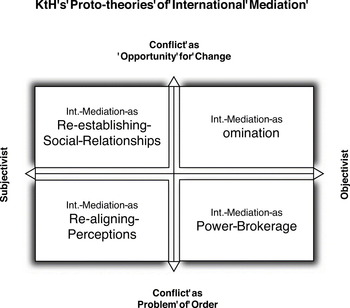
The added ontological and epistemological dimensions explored above – and flattened to pure and power mediation – are artfully dealt with in the heuristic employed by Kleiboer and t'Hart (henceforth KtH) to study mediation timing and success. KtH provide a cogent framework with which to ‘generate coherent theoretical positions’ with regard to mediation and international relations. They employ a matrix based on Burell and Morgan's sociological inquiry to elicit claims that mediation may consist of three additional ‘distinct interpretive frameworks’,Footnote 31 based on the two divergent philosophical axes discussed above. Adding to the traditional rational brokerage model of ‘power’ mediation, KtH explain the frameworks to stem from spectra that dispute both the nature of society (and by extension, conflict) and philosophy of science. On one spectrum, there is rationalist thought, perpetuating the observable reality of positivism set against a subjectivist epistemology of post-positivism. Second, KtH differentiate on an ‘order-change’ dimension of conflict analysis, that delineates conflict as a challenge to order or conversely as an opportunity for change. From these two axes, four ‘styles’ of mediation are deducted. The three conceptual departures from the conventional view of power brokerage mediation are labeled, mediation as: Re-aligning Perceptions, Re-establishing Social Relationships and as Domination.Footnote 32
Figure 1.

By refining KtH's work, we can move to a more nuanced representation of mediatory options with regard to underlying political assumptions, while describing these options in terms of power and political utility. This approach may allow some clarity to the exercise of attempting to fit seemingly diverse sources of mediator power, or leverage, across the one-dimensional spectrum of Smith. Significantly, this exercise may also help predict situations where certain types/powers of mediation will be appreciated by the parties in conflict and thus, more readily lead to effective mediation. Examples of where (and how) each idealised route empowers mediation will be explored after a survey of all four. It should be noted that the forthcoming ‘ideal types’ of option and situation, in the Weberian sense, are somewhat unreal constructs designed to ‘penetrate to the real casual interrelationships’Footnote 33 and hope to hypothesise more accurate directions past pure and power styles. Importantly, we do not draw conclusions from a static ‘referent object’ of mediation as an analytical end point. Instead we seek to re-examine the concept of mediation itself, by asking ‘of what is this an instance’ in relation to assumptions of ontology and epistemology present in common IR theories.
To link mediation to politics and specifically the discipline of international relations, we must also consider that ‘instance of’ which real politik considers the most important. While KtH used the above matrix to focus temporal considerations of mediation to their proto-theories, we relate modified ‘proto-theories’ to what defines the political: power. Of course, projects to define and explain power in international politics offer a similar cacophony within the interdisciplinary debates on mediation.
For (neo-)realists, the power equation is quite simple: power defined in traditional terms is, as Kim Nossal argues, ‘the ability to prevail in a conflict of interests with someone else […] Power is thus always and necessarily highly negative, at least for the one being prevailed against’.Footnote 34 Not surprisingly, a similar debate to pure and power mediation appears in discussions on power, with the critique of such hard realist assumptions. Joseph Nye, promoting more positive power within a rational world, famously defined ‘soft power’ as ‘the ability to achieve desired outcomes in international affairs through attraction rather than coercion’.Footnote 35 Although scholars such as Nossal concede that soft power can change the definition of adversarial interests and by definition, can eliminate that conflict of interest, they do not see it useful to define such as power as adequate descriptors for these concepts already exist in persuasion and inducement. For the realist then, power is manifested in the ability to make decisions with force or its threat.Footnote 36
However, a second dimension of how to think about power lies not only within making decisions, but also in setting the agenda. Much a response to Mills' ‘elite’Footnote 37 and Dahl's ‘pluralist’ representations, this second dimension is relevant to soft power's ability to persuade and influence. Moreover, additional conceptual insights are found in Lukes’Footnote 38 ‘radical view’ of three-dimensional power, which adequately described repression and response not only at the end of bayonets or repressive diktats, but in structural constraints of the oppressed's own making – a process Giddens would later identify with structuration, while Robert Cox interpreted less optimistically in neo-Gramscian terms.Footnote 39 Within debates on structure, agency, influence and coercion, explanations of power have succumbed to the great debate of subjectivity that spans from power in politics to the essence of mediation. Power then, as a concept, holds similar philosophical assumption structures to those encountered when asking what mediation is an instance of.
Calling out these conceptual assumptions, Barnett and Duval's taxonomy of power in international politics proposes a related mechanism of deciphering power to our inquiry of mediation.Footnote 40 They premise that Carr'sFootnote 41 wedding of realism to power has led realism's theoretical rivals to neglect the development of how power is conceptualised and operates within their own theories. Filling the conceptual gaps, they identify different types of power in those social relations that constitute relationship and identity from those that let static actors interact, and a further delineation between direct relations (compelling another to do something he/she would not otherwise do) and a more ‘distant’ or diffuse power, which is found in both the rules of institutions and more radical discursive accounts of knowledge structures and (neo-)historical materialism.
Without explicitly referencing the debates at hand, Barnett and Duval have identified epistemological and ontological divides within social science. Social relations that are constitutive rather than merely interactive speak to a post-positivist epistemological understanding versus the objective reality, while direct and diffuse power can be linked to more normative statements regarding social relations' ability to manage or resolve questions of hierarchy or change within power and conflict. Although these axes do not precisely overlay KtH's heuristic, nor our realignment to dimensions of mediation power, discussion on the multiple conceptions of power highlights the utility of asking the question ‘of what is this an instance’ and thus best influences its outcome.
A typology of power mediation
We now turn to focus our analysis on relating the assumptions behind the KtH models with specific IR theory to synthesise concepts of mediation power. We propose a heuristic framework composed of four ideal concepts of power mediation with their related aims, processes, and motivations that can be delineated as:
– ‘real power’, which focuses on leverage, de-escalation and self interest,
– ‘made power’, which changes perceptions and uses leverage for positive gains,
– ‘critical power’, which emancipates sectors of humanity for the unabashed ‘public interest’, and lastly,
– ‘structural power’, which manages empire and maintains the current order of the larger system.
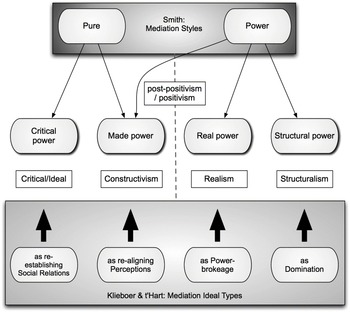
Figure 2.

The conventional power brokerage view of mediation as described by KtH is largely congruent with Smith's power style and fits on the positivist side of the ontological divide. More importantly however, are the normative assumptions present. First, the endemic nature of conflict means conflicts cannot be easily resolved, and therefore, the ‘maximum feasible form of conflict management reduces the intensity of the conflict below escalation thresholds’. Barnett and Duval would label this an instance of ‘compulsory’ power that is direct and focused on the interactions of the specific actors/parties to mediation.Footnote 42 Under this rubric, and in accordance with Smith, mediators need not be and rarely are impartial, while they are usually powerful.Footnote 43 Indeed, in endemic conflict, the most important tool for a mediator becomes what can be termed real power, or leverage via the proverbial sticks and carrots. In the mediation literature, mediators using what Carnevale might identify as strategic resources or real power to influence situations of indirect interest explains not only real actions, but describes realist conceptions of conflict. Thus, we may be able to predict in which situations real power will be appreciated by the parties involved, and can achieve results.
The next mediator option clearly falls outside Smith's pure/power dimension. Related to both the ideational purity and material power mediation, those mediators utilising what we call here made power make their efforts from a neo-realist milieu, but attempt to shape perceptions in, and ‘sense making’ of conflicts.Footnote 44 Although Kleiboer and t'Hart shy from the term constructivism in their analysis, Wendtian links are clear.Footnote 45 Interestingly, Kleiboer's subsequent study steers further away from the constructive approach, instead opting for the rather generic ‘problem solving’ concept of mediation.Footnote 46 Still, a similar ontology, if not epistemology to constructivism can easily be fleshed out from what KtH formally title ‘Mediation as Re-aligning Perceptions’.Footnote 47 From our perspective, that ‘made power’ mediators should possess leverage but not be perceived as overtly partial for reasons of trust via psychological empathy and identification is not surprising. Pushing KtH's prototheory to be more in line with the (neo-)realist tendencies of Wendt while helping ground claims of mediation literature, we argue that mediators invoking ‘made power’, in addition to self help, are more concerned with what Thomas Princen terms ‘private interests’ such as enhancing prestige or extracting relative gains from one of the disputants, than ‘public interests’ such as peace, stability and order for the larger community ‘for its own sake’. Our distinction disambiguates Princen's concept of the ‘neutral mediator’ who seemingly becomes involved in conflict mediation for an array of reasons, ranging from the desire to see agreement reached, peace realised, efficiencies gained, through to the need to improve self image or burnish reputations as peace makers or statesmen, or even religious and philosophical reasons.Footnote 48
The distinction is also conceptually important as public interests, or commencing mediation for its own sake, makes a normative statement on the importance of a ‘more humane world society’ and implies motivation of ‘changing social relationships’ in KtH's language.Footnote 49 Thus, in its third conceptual iteration, mediation (and conflict) is seen in a critical light, as an opportunity for social change, which should not be mitigated by traditional power structures. Smith's pure style of mediation is largely in line with this iteration of mediator who ‘should be a skilful neutral actor with no stake in the conflict’ other than more humane world society.Footnote 50 However, our conception of ‘critical power’ mediation further develops impartiality past Smith's assertion that not having a ‘stake in the outcome’ is a ‘measure of impartiality’,Footnote 51 and Princen's subtractive description of the neutral mediator. First, there is clearly a normative critical ‘stake in the outcome’ if one views conflict as a transformative emancipatory process rather than a shuffling of hierarchy. Staking opportunity within conflict holds moral, critical, discursive power, and therefore acknowledges the importance of impartiality. This is in line with Zartman's realisation that ‘moral authority’ can be a major source of strength in mediation.Footnote 52 Second, critical power mediators are normatively attached to Princen's ‘public interests’ and do not mediate out of ‘private interests’ nor flip back and forth indefinitely. Importantly, this critical normative authority is not present in all mediators – nor is it necessary in management of situations where conflict is conceptualised as endemic and coercion is deemed necessary to satisfy goals of indirect interest, or maintaining the larger system. Indeed, for these ‘critical power’ mediators, the essence of power is ‘productive’, moving away from structures per se, to systems of signification and meaning, and to networks of social forces perpetually shaping one another.Footnote 53
Finally, looking to the last KtH-based type, takes mediation as ‘an instance of’ domination, where the powerful act to prevent shuffling of the larger international political/economic structure. Mediators can include powerful states and international institutions. Back to objective reality based in gains, treasure and materiel, the fulcrum of mediator leverage in this case is administered via parties' desire to remain part of the world system and the mediator's structural power to allow them to do so. Conceptualising this type of mediation power, it can be argued that within structural power mediation, parties may not have a choice in accepting mediation terms as the context for mediation and any negotiation may actually be created, controlled and concluded by the mediator. Although KtH point to the obvious structural IR approaches such as Dependency and World Systems Theories, structural power may be present outside of their strict Marxian constraints.
Students of historical materialists bordering on the ideational explanations such as Gill, Cox and other (neo-)Gramscians might also explain international mediation in terms of structural appeasement. Further, in regards to power, Barnett and Duval identify the structure of global capitalism as substantially determinative of the capacities and resources of its actors. From their perspective, while power exists in coercion and institutional arrangements (and possibly emancipatory morality), to understand the workings of the global capitalist economy requires recognition of the constitutive structure of global production relations.Footnote 54
For current students of IR theory, the value of our discrete types of power mediation is notable in even basic exploratory rubrics of the discipline. Applying the perspective of an atomistic prisoner's dilemma ‘game’, as first developed by the RAND Corporation and Nash,Footnote 55 in order to dissuade parties from ‘cheating’ by exacerbating the conflict or maintaining the status quo stalemate, an impartial mediator utilising critical power has distinct advantages to other routes of power mediation, as well as more the ambiguous pure and power types. Critical power not only provides ‘perfect information’ with respect to the game, but also ensures a normative stake in the conflict that strives for the ‘win-win’ outcome of the game matrix: critical power ensures progressing the ‘public good’ rather than progressing the mediator's own private interests, which might easily lead to suboptimal outcomes of the game.Footnote 56 These suboptimal outcomes are a valid possibility when dealing with neutral and pure mediators, whose incentives, motivations and assumptions on what conflict is may interfere with the game – or even the definition of wining.Footnote 57
Our typology of power mediation can also be applied to conflicts defined by, or perceived through, power asymmetries. First, building on Copeland's study of major wars, if a state's waning power is seen as a variable contributing to conflict, the state may welcome the methods of a mediator with the structural power to uphold the current system and the state's position in it.Footnote 58 Conversely, through Krasner's lens, a rising state, cognisant of how carrots (and sticks) could influence its assent, may respond best to real power mediation.Footnote 59 This noted disconnect between the rise and fall of nations may in fact preclude mediation from becoming an acceptable option in resolving conflicts perceived as such by the paired parties involved. However, in either asymmetrical power situation, a partial mediator employing routes of real or structural power has a better chance of affecting influence over the stronger state in a conflict than the weaker state could hope for by itself or with an impartial mediator relying on critical power. Bias may then be as much a marker of underlying epistemological and ontological assumptions as it is predicted through more traditional relational connections (trade, culture, history). A question to answer becomes not if the mediator is biased, but how one becomes so. The above two constructs of international relations and multidimensional power seem to provide preliminary evidence of improved explanations of success compared to canonical pure and power positions. In short, with a typology of power mediation, epistemological and ontological nuances of conflict are accounted for and can be responded to in kind. Importantly, that even disputants using mediation for ‘devious objectives’ forward their perceived interests and define success via the mediator. Observing and reacting to past and present behaviour and circumstance that suggest certain ontological and epistemological stances would benefit mediator acceptability and capability.
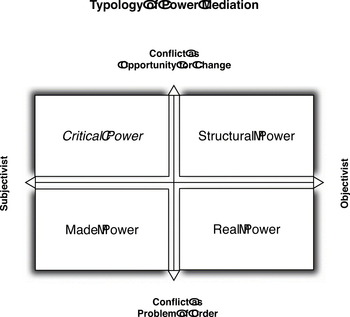
Figure 3.

As shown in the revised axis of Figure 3, each of the four types discussed is based on unique ontological and epistemological assumptions, aligned to a major IR theory, and conceptualised through power. These routes to power mediation and the options they afford provide improved conceptual depth to the original line of Smith's one dimensional spectrum of pure and power mediation. Visualising the conceptual power(s) of mediation as shown allows comparison of the epistemological and ontological assumptions beneath so-called pure and power mediation. We build from KtH's own heuristic to channel answers ‘of what is this an instance’ through a multi-dimensional, but conceptually aligned subject of political inquiry: Power Mediation. Our resultant typology presents not only a more nuanced basis from which to understand mediator action, motivation and bias of success, but also a platform from which better-informed mediation theory can be applied to practice. Specifically, as will be explored below, our typology is applicable in mediation practice vis-à-vis disputants' perceptions, actions and the requirements for and definitions of success.
Conclusion: The four types of power mediation in the Arab-Israeli conflict
Moving to the application of the typology of power mediation, we aim to find those situations in international relations where the distinct mediation powers are accessible and agreeable to parties seeking third party mediation. Building on Barnett and Duval's view on power in politics, we expect that different forms of mediation power will have different domains of application, illuminating ways in which mediators can affect the ability of actors to control their fates. In his study of nationalist rivalries, Barry Posen remarks on the explanatory power of the ‘security dilemma’ in adding to the inevitability of conflict, ‘if outsiders wish to understand and perhaps reduce the odds of conflict, they must asses the local groups' strategic view of their situation.’.Footnote 60 This strategic view of what groups define as their situation – what they believe their conflict is an instance of – could be a crucial factor in determining how mediation power(s) are agreed upon as able to alleviate or as necessary, resolve conflict. Returning to Smith's claim that there are certain situations where certain types of mediation are best suited, we shall now examine the practical implications of our heuristic by applying each of the four types of mediation power to distinct phases in third party mediation in the Arab-Israeli conflict.
We argue that the main utility of this study lies beyond the advancement of a heuristic framework to the study of power mediation. The ontological and epistemological positions postulated here are not merely derived from competing intellectual stances; rather they are directly linked to the very perceptions of the actors in the conflict. The way in which actors perceive the causes of conflict informs their chosen type of mediation. Whereas some scholarsFootnote 61 argue that there is only one type of power mediation – commonly depicted as the traditional use of carrots and sticks – we advance that all mediators have ample power, understood as and expressed through the abovementioned typology.
When this typology is applied to the experience of third party mediation throughout the various phases of the Arab-Israeli conflict, it is evident that mediators are indeed cognisant of their choices of mediation. The record of mediation here suggests that the abundance of approaches to conflict management and resolution, and the resultant mediation strategies, can be successfully linked to the mediator's ontological and epistemological stances on the causes of conflict and desired routes to bring to its resolution. These stances frame the mediator's behaviour, almost independently of ongoing patterns of bargaining between the disputants, and can therefore account for the degree of effectiveness of a given mediation process. The wider the gap is between the mediator's own construction of the nature of the conflict, and the actual necessities of the disputants to the conflict, the less likely we are to see the convergence of expectations and attitudes between the mediator and the disputants. We argue that for a mediator to be accepted by the disputing parties and to perform its role effectively, not only does the mediator need to be aware of its own ontological and epistemological positions, but there must also be a close fit between these positions (as derived from our typology) and the expectations of the disputants. American efforts to mediate peace between Israel and her Arab neighbours have historically taken the form of real power. Here Henry Kissinger's step-by-step diplomacy is an obvious case in points. His successful deployment of the coercive and reward-based powers in mediating agreements between Israel and Egypt and Syria in the aftermath of the 1973 Yom Kippur War has not only led to de-escalation of hostilities between the disputants, but has also stabilised the system at large. Other examples of such application of real power may include President's Carter's unprecedented aid packages to Israel and Egypt during the 1978 Camp David negotiations, and President George H. W. Bush's uncompromising stance on the issue of Israel's settlements policy.Footnote 62
At the same time however, American mediation may also be conceptualised as encompassing structuralist power, meaning mediation as the utilisation of tools to hold on to power and to maintain or reshape the current order of the larger system. Thus Kissinger's efforts to de-escalate tensions in the Middle East must also be understood as part of an American strategy to ensure the steady flow of Arab oil to the West in the aftermath of the 1973 oil embargo, as well as permanently relegating the Soviets to the sidelines of Middle East diplomacy by making the US the first-choice mediator for both Israelis and Arabs.Footnote 63 The same can be argued for Secretary of State James Baker's frantic efforts to persuade (but not coerce) all sides to the conflict to attend the Madrid Peace Conference in 1991. Against the background of the collapse of the Soviet Union and the end of the Cold War, the US was presented with a propitious opportunity to reshape international order and position itself as a truly consensual honest broker, accepted by all parties to the conflict. It is thus readily apparent that our typology does not necessitate the mediator to align itself with one strand of mediation power. Indeed in complex and protracted environments of bargaining such as the Arab-Israeli conflict, the mediator's stance on the issues may be informed by an amalgamation of ontological and epistemological assumptions about the nature of conflict and the approach to its resolution. Thus it is the mediator's adaptability and ability to habitually reconsider its position which may dictate its very relevance to the disputants and to any future agreements. Accordingly the diminishing role of the UN in mediating Arab-Israeli peace post-1967 cannot only be attributed to the rising power of the US as the principal mediator in the conflict, particularly following the Yom Kippur War. Concurrently it was the organisation's failure to adequately respond to the new contours of the conflict, which, following Israel's occupation of Jordanian, Egyptian and Syrian lands in the Six Day War, were now defined primarily as territorial rather than ideological-political. The leveraging of interests and calibrating of perceptions had to be readjusted in order to secure Israeli withdrawal in exchange for Arab recognition of the Jewish state, thus calling into question established views on the sources of the Arab-Israeli conflict, and indeed the methods necessary to bring to its resolution. The UN's inability to offer Israel tangible alternatives to territory, or a saving face alternative to the Arabs for recognising Israel, had gradually led to its redundancy.
Made power mediation largely combines aspects of critical and real power modes by providing real gains for disputants who are desperate to escape a hurting stalemate,Footnote 64 but need not be associated with manipulative or coercive zero sum methods, and indeed is less concerned with relative cost-benefit calculations. Here the emphasis is on changing motivations and perceptions by offering a problem-solving approach. A prime case in point here is Dr. Ralph Bunche's successful efforts to end the first Arab-Israeli War in 1948–1949. By shifting away from previous efforts to offer a comprehensive solution to the problem, the UN mediator had changed the nature of the bargaining process by negotiating separate armistice agreements between Israel and Egypt, Lebanon, Syria and Jordan. Most importantly, Bunche succeeded in redefining the solution as a series of limited bilateral agreements rather than a single comprehensive peace treaty, without having to compromise his position as an honest broker or resorting to coercive tactics to enhance parochial interests.Footnote 65 As noted above, this approach as espoused by the UN would become wholly irrelevant in the more complex, post-1967 environment of Arab-Israeli and Israeli-Palestinian peace negotiations.
Finally, critical modes of mediation power stem from (at least notionally) egalitarian and idealistic concepts of public interests. There is little attention here to the system at large and power here is understood as a facilitator of social networks. Accordingly, the efforts of the Norwegian government, in conjunction with a small Oslo-based Think Tank in the early 1990s, demonstrate the effectiveness of such approach. Impartiality and informational bases of power were crucial here to the success of the secret talks between the Israeli and Palestinian camps. Most importantly, the mediators understood their role well as that of a facilitator offering good offices, which had made the bargaining process between the disputants normatively transparent and free of triad manipulation structures.Footnote 66 Crucially, the Norwegians had succeeded where President Carter had initially failed. Carter's first efforts to bring about Israeli-Egyptian peace rested on his self-perceived image as the honest broker and the complete seclusion of the talks away from the prying eyes of the media and domestic constituencies. However it was only when Carter resorted to more manipulative tactics (such as threatening to lay the blame for failure with Egyptian President Sadat) and the offer of generous military and economic aid packages that he managed to bring the parties to sign an agreement.Footnote 67 Conversely, the Norwegians knew their limitations as mediators and applied this knowledge as an alternative type of power mediation, creating a route that was attractive to both parties. The policy lesson from these cases is clear – no matter how hard a real power mediator may try to conceal his resources, once they have been deployed successfully in previous mediation processes (as in the case of Kissinger), the parties will tend to respond favourably to future mediation efforts only if such resources are displayed again.
In assessing the relative advantages and weaknesses of each of the four types of power mediation, at least in relation to the Arab-Israeli conflict it does not seem that one is more closely linked to mediation success (or acceptance) than others. What matters is the close fit between the ontological and epistemological stances which inform the mediator in its approach, and the expectations of the disputants at the outset of the mediation process. Where some types seem to compliment each other (as noted above, for example real and structural), the differences between the four types are nevertheless substantial enough to preclude an all-encompassing approach to peacemaking which would bring together all four types of power mediation. Mediators may be required at times to reassess their positions and amend their stances and expenditures of power either due to external or contextual pressures, as witnessed in changing American approaches to the conflict during and after the Cold War, or as a result of internal changes which then affect the promulgation of public policies towards the conflict (as witnessed by the process of European integration and the so-far unsuccessful efforts to implement a consistent and coherent approach to the management and resolution of the conflict between Israelis and Palestinians). Indeed the later case demonstrates the pitfalls of imposing a unitary approach when the ontological and epistemological outlooks on peace and conflict are spread between 27 member states.
In a similar fashion, the case of the Quartet represents a germane lesson on the utilisation of these four types of power mediation. At least notionally, the Quartet illustrates multiparty mediation which encompasses the four types of mediation power which together equip its members with what Rubin understands as the full six bases of power. Each of the Quartet members – the UN, the EU, the US and Russia – have different bases of power which are relevant to previous and current efforts to bring about just and lasting peace to the Middle East. Accordingly the UN may provide international legitimacy to the process, whereas previous and existing relationships of the members with the disputants provide for the creation of effective social networks. Expert, reward, coercive and informational bases of power can also be found in the composition of the Quartet. Projecting to our heuristic of mediation power, one can identify the ubiquitous real power present in the American position, which cannot be detached from its own interests in the wider context (structuralist), whereas the UN provides a more critical power approach to mediation, emphasising the emancipatory, global interest in the resolution of the conflict. Russia, the least active member of the Quartet clearly has its own interests in mind which may be linked to restoring its relevance in international diplomacy (structuralist), whereas the EU's extensive list of economic and political policies towards the region (including the European Neighbourhood Policy and a series of bilateral agreements with Israel and the Palestinian Authority), may serve as useful alternative tools to change perceptions and affect motivations to compromise (made power).
The numerous manifestations of the Arab-Israeli conflict help to further substantiate the argument that while some form of power is necessary for effective mediation, it may take different routes even within a seemingly constant environment. It must be added that in reality, those four types of power mediation may overlap depending on the circumstances, or indeed may be deployed interchangeably by the same mediator. This contextual analysis paints an effective survey of interpreting political situations that may be well served by epistemologically and ontologically aware mediation responses, identified in patterns of real, made, critical and structural powers. Further study of the applicability of these concepts may provide for interesting research cases, as well as projects on how to interpret parties' conceptions of the conflicts they are part of. Querying future disputants and mediators understanding of the nature of conflict, and the importance they give to the subjective/objective dimension of their own current conflict could lead to empirical measurement of resolution to epistemological and ontological distance between both disputants and their mediators.
We thus have reframed yet held to Zartman and Touval's comment that, a mediator's acceptance ‘depends entirely on its likelihood (potential power) of producing an outcome acceptable to both sides’.Footnote 68 Our approach may provide more sophisticated dimensions than a pure-to-power mediation spectrum, while relating the world of political power more accurately to canonical mediator options and explaining how the parties involved may conceptualise their expectations of the mediator and the process of mediation more generally, from its initiation to its conclusion.