INTRODUCTION
Palliative care is an approach that improves the quality of life (QOL) for patients and their families who are facing the problems associated with life-threatening illness. The goals are to prevent and relieve suffering by means of early identification and thorough assessment; to treat pain; and to address physical, psychosocial, and spiritual problems (World Health Organization, 2002).
One of the most important goals of palliative care is achieving a good death or a good dying process at the terminal stage (Payne et al., Reference Payne, Langley-Evans and Hillier1996; Emanuel & Emanuel, Reference Emanuel and Emanuel1998; Singer et al., Reference Singer, Martin and Kelner1999; Steinhauser et al., Reference Steinhauser, Christakis and Clipp2000a, Reference Steinhauser, Clipp and McNeillyb; Patrick et al., Reference Patrick, Engelberg and Curtis2001; Steinhauser et al., Reference Steinhauser, Christakis and Clipp2001; Teno et al., Reference Teno, Casey and Welch2001; Hirai et al., Reference Hirai, Miyashita and Morita2006; Miyashita et al., Reference Miyashita, Sanjo and Morita2007). In Europe and the United States, there have been attempts to qualitatively and quantitatively conceptualize what constitutes a good death since the 2000s (Payne et al., Reference Payne, Langley-Evans and Hillier1996; Emanuel & Emanuel, Reference Emanuel and Emanuel1998; Singer et al., Reference Singer, Martin and Kelner1999; Steinhauser et al., Reference Steinhauser, Christakis and Clipp2000a, Reference Steinhauser, Clipp and McNeillyb; Patrick et al., Reference Patrick, Engelberg and Curtis2001; Steinhauser et al., Reference Steinhauser, Christakis and Clipp2001; Teno et al., Reference Teno, Casey and Welch2001). Furthermore, attempts have been made to define a good death in Japan (Hirai et al., Reference Hirai, Miyashita and Morita2006; Miyashita et al., Reference Miyashita, Sanjo and Morita2007).
“Having some pleasure in daily life” is important for the cancer patient at the end of life (Miyashita et al., Reference Miyashita, Sanjo and Morita2007). Miyashita et al. (Reference Miyashita, Sanjo and Morita2007) quantitatively identified that a good death for Japanese people included 10 consistently important domains. One of the domains was “maintaining hope and pleasure” and the most important component in this domain was “having some pleasure in daily life.” The general population (91%), bereaved family (93%), and cancer patients (96%) all responded that “having some pleasure in daily life” was necessary.
However, at present, it is difficult to ensure that patients have pleasure in daily life at the end of life. Miyashita et al. conducted a survey to evaluate end-of-life cancer care from the perspective of the bereaved family (Miyashita et al., Reference Miyashita, Sato and Tsuneto2009). Bereaved families responded that “patients had some pleasure in daily life” at cancer centers (31%) and even at palliative care units (51%).
To date, no research has explored how to care for end-of-life cancer patients in order to ensure that they have some pleasure in daily life. In the present study, the care that contributed to having some pleasure in daily life for end-of-life cancer patients was investigated using a qualitative approach to explore the opinions and methods used by experts in palliative care units. Palliative care units were selected because bereaved families did indicate that “patients had some pleasure in daily life” in the palliative care setting.
This aim of this study was to identify, from the perspective of physicians and nurses, a care strategy that ensures that cancer patients have pleasure in daily life at the end of life. Furthermore, this type of care can contribute to the achievement of a good death for cancer patients.
METHOD
Participant Selection
Participants were selected from 25 palliative care units in Japan by using the snowball technique. Participants were palliative care experts: one physician and one nurse from each palliative care unit. The participants were required to have >5 years of clinical experience and >3 years of experience in palliative care units. We sent a letter or an e-mail to the director of medical services and the director of nursing services in each palliative care unit to explain the purpose and outline of the research. We requested selection of a physician and a nurse who would agree to participate and cooperate in the research. On the day of the interview, we again explained the purpose and outline of the research to each participant. One facility had no physician who met the eligibility criteria. In two facilities, the interview could not be conducted because the physicians had too many other duties. In two other facilities, there were no nurses who met the eligibility criteria.
Interview Procedure
Preliminary Research
We conducted preliminary research to develop an interview guideline and to ascertain whether the participants could concretely describe some of the elements of care for end-of-life cancer patients, in order to allow them “to have some pleasure in daily life.” The author interviewed one physician and three nurses, who agreed to participate and met the eligibility criteria. These four participants were from two of the selected palliative care units, but were not part of the main research sample. During this preliminary interview, one open-ended question was posed, “How do you care for end-of-life cancer patients, in order to have some pleasure in daily life?” This preliminary research identified many examples of care that ensured patients experienced pleasure in daily life.
Main Research
The interviews were conducted using a guideline that was based on the preliminary research results. Before conducting the interview, we asked participants to complete a questionnaire that included demographic data, such as occupational category, gender, age, years of clinical experience, and years of experience in a palliative care unit. Second, the semistructured interviews were conducted by the author. The same open-ended question was posed: “How do you care for end-of-life cancer patients, in order to have some pleasure in daily life?”
Data Collection
All interviews were tape recorded. The mean interview duration was 38 ± 22 minutes (mean ± SD) range 13–115 min. For palliative care physicians the mean duration was 41 ± 23 min and for nurses it was 35 ± 18 minutes. The data collection period was May 2009–October 2009.
Analysis
All interviews were audiotaped and fully transcribed. Content analysis was performed on the transcribed data (Krippendorff, Reference Krippendorff2004). First, the author (NK) extracted all statements related to the study topics, such as care that was related to patient's pleasure and joy, from the interview transcripts. Then, the author carefully conceptualized and categorized the extracted excerpts of care, based on similarities and differences in the content, under the supervision of palliative care researchers. Next, definitions for all categories of care were created. Finally, two coders were recruited from among the experienced palliative care nurses, and they independently determined whether each participant had made remarks that belonged to any of the categories, according to the definitions of the care elements. When the coding was inconsistent, the final judgment was made after discussion. The concordance rate and κ coefficient of the determinations of the categories by the two independent coders were 92% and 0.66, respectively. In addition, we conducted descriptive analysis of the frequencies of the care. The frequencies of subcategories were counted by combining the frequencies of the examples of care. We summarized that data by two groups: palliative care physicians group and palliative care nurses group. Fisher's exact test was used to test group differences in the responses for each category. All the statistical analyses were performed using SAS statistical software version 9.1 (SAS Institute, Cary, NC). The protocol of this study was approved by the Department of Medicine Ethics Committee, The University of Tokyo. All participants received an information sheet and gave signed informed consent before the interview.
RESULTS
Participants’ Demographics
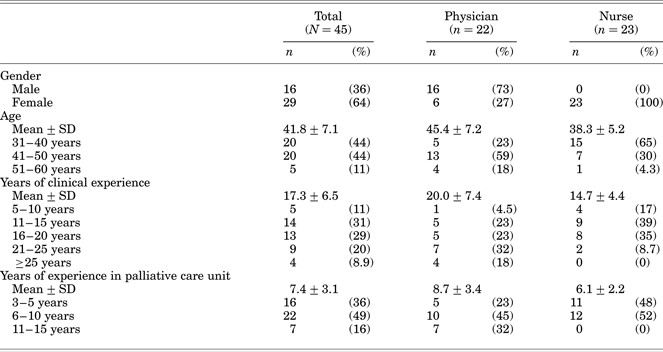
The participants’ demographics are shown in Table 1. A total of 45 participants were interviewed including 22 palliative care physicians and 23 nurses. Sixteen were male (36%) and 29 (64%) were female. The mean age was 41.8 ± 7.1 years (mean ± SD). Clinical experience was 17.3 ± 6.5 years and experience in palliative care units was 7.4 ± 3.1 years. Among physicians, 16 were male (73%) and 6 were female (27%). Their mean age was 45.4 ± 7.2 years and their experience in palliative care units was 8.7 ± 3.4 years (mean ± SD). Nurses were all female, the mean age was 38.3 ± 5.2 years, and their experience in palliative care units was 6.1 ± 2.2 years.
Participants’ demographics

Care for End-of-Life Cancer Patients, in Order for Them to Have Some Pleasure in Daily Life
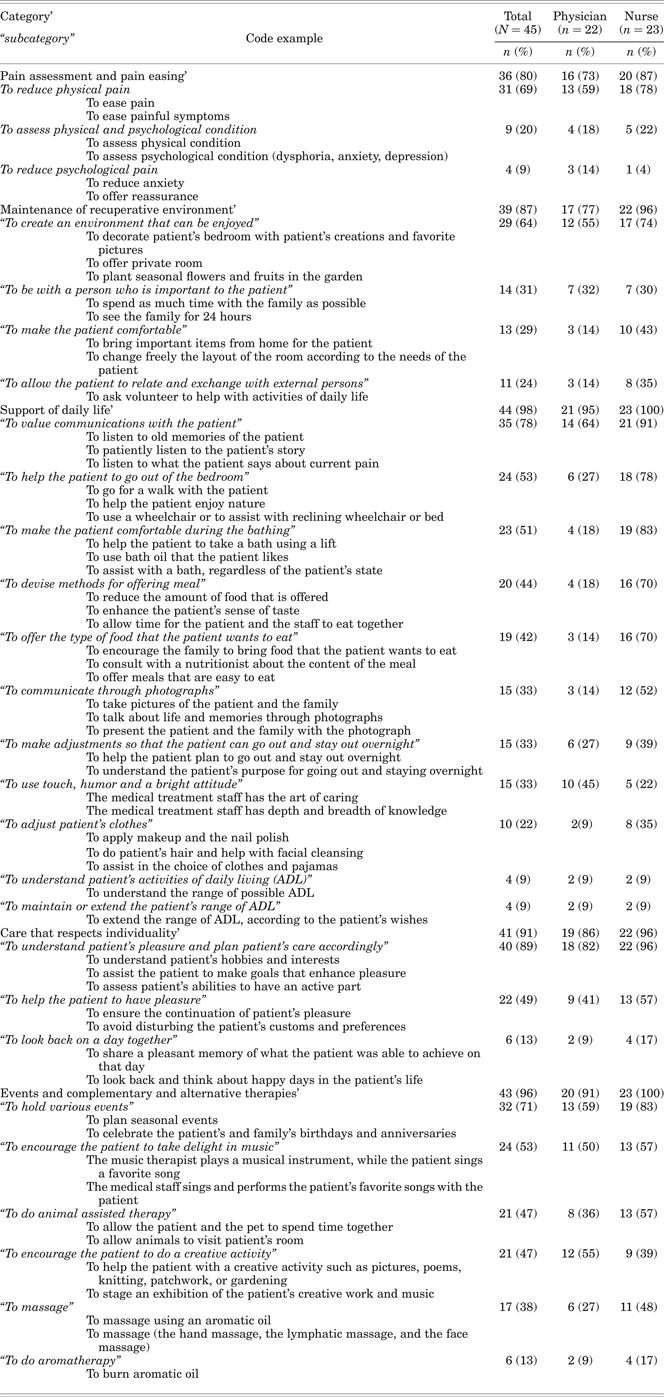
From the interviews, 210 items were extracted that related to care for end-of-life cancer patients, in order for them to have some pleasure in daily life. These coded items were consolidated into 27 subcategories. The 27 subcategories were further consolidated into the following 5 categories: “Pain assessment and pain easing,” “Maintenance of recuperative environment,” “Support of daily life,” “Care that respects individuality,” and “Events and complementary and alternative therapies.” The five subcategories and specifics of care for end-of-life cancer patients are shown in Table 2.
Care strategy for the cancer patient to live with pleasure in daily life at the end-of-life
“Pain Assessment and Pain Easing”
Thirty-six (80%) participants indicated that “pain assessment and pain easing” are required so that patients can experience some pleasure in daily life. This category included three subcategories and 11 coded items.
For these subcategories, 31 (69%) participants recommended interventions, “to reduce physical pain,” 9 (20%) participants reported a need “to assess physical and psychological condition,” and 4 (9%) participants indicated an obligation, “to reduce psychological pain.”
“Maintenance of Recuperative Environment”
Thirty-nine (87%) participants indicated that “maintenance of recuperative environment” was a necessary aspect of care for end-of-life cancer patients, in order that they might have some pleasure in daily life. This category included four subcategories and 28 coded items.
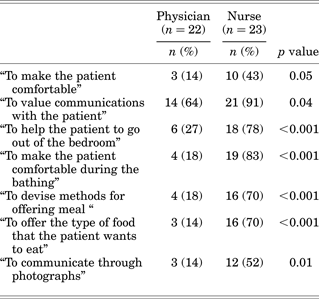
For these subcategories, 29 (64%) participants indicated a need “to create an environment that can be enjoyed,” such as decorating the patient's bedroom with personal creations and favorite pictures; 14 (31%) participants reported the importance of “to be with a person who is important to the patient,” such as encouraging the family to spend as much time with the patient as possible; 13 (29%) participants recommended the need “to make the patient comfortable,” such as encouraging the family to bring familiar items from the patient's home and 11 (24%) participants indicated the need “to allow the patient to relate and converse with external persons,” such as a volunteer. Nurses scored significantly higher than physicians in the subcategory of “to make the patient comfortable” (p = 0.05). Subcategories with between-group differences are shown in Table 3.
Subcategories with between-group differences
Fisher's exact test was used to test group differences
“Support of Daily Life”
Forty-four (98%) participants indicated that “support of daily life” was necessary when caring for end-of-life cancer patients, to assist them in having some pleasure in daily life. This category included 11 subcategories and 81 coded items.
For these subcategories 35 (78%) participants indicated a need “to value communications with the patient,” such as to listen to the patient recite old memories; 24 (53%) participants suggested the intervention of “to help the patient go out of the bedroom,” such as to go for a walk with the patient; 23 (51%) participants recommended the need “to make the patient comfortable during bathing,” such as providing human or mechanical assistance during bathing; 20 (44%) participants pointed out the need “to devise methods for offering meals,” such as offering reduced amounts of food; 19 (24%) participants suggested the idea “ to offer the type of food that the patient wants to eat,” such as having the family bring meals and foods that the patient wants to eat; 15 (33%) participants suggested the need “to communicate through photographs,” such as discussing family photographs with the patient; 15 (33%) participants indicated the importance of “to make adjustments, so that the patient could go out and stay out overnight,” such as helping the patient make a plan and arrangements to facilitate outings and overnight stays; 15 (33%) participants indicated the need “to use touch, humor and a positive attitude as part of the medical treatment,” such as the medical treatment staff using appropriate humor to encourage the patient; 10 (22%) participants used the strategy of “to adjust the patient's clothes,” such as appearance; 4 (9%) participants indicated the need “to understand the patient's activities of daily living (ADL),” such as understanding the range of possible ADL; and 4 (9%) participants indicated the desirability of “to maintain or extend the patient's range of ADL,” such as extending the range of ADL, according to the patient's wishes. Nurses scored significantly higher for the following subcategories: “To value communications with the patient” (p = 0.04), “To help the patient to go out of the bedroom” (p < 0.001), “To make the patient comfortable during bathing ” (p < 0.001), “To devise methods for offering meals” (p < 0.001), “To offer the type of food that the patient wants to eat” (p < 0.001), and “To communicate through photographs” (p =0.01). Subcategories with between-group differences are shown in Table 3.
“Care That Respects Individuality”
Forty-one (91%) participants indicated the importance of “care that respects individuality” in care for end-of-life cancer patients, in order that they may have some pleasure in daily life. This category included three subcategories and 32 coded items. For subcategories, 40 (89%) participants indicated a need “to understand what the patient considered pleasurable and plan the care accordingly,” such as finding out about the patient's hobbies and life interests; 22 (49%) participants indicated the desirability of “to encourage the patient to do a pleasurable activity,” such as helping the patient to continue a pleasurable activity for as long as possible; 6 (13%) participants suggested the strategy “to look back on a day together,” such as sharing a pleasant memory of what the patient was able to achieve on that day.
“Events and Complementary and Alternative Therapies”
Forty-three (96%) participants indicated a role for “events and complementary and alternative therapies” when caring for end-of-life cancer patients, to help them have some pleasure in daily life. This category included six subcategories and 58 coded items. For subcategories, 32 (71%) participants advised the idea “to hold various events,” such as planning for a seasonal event, 24 (53%) participants advocated for the strategy “to encourage delight in music,” such as having a music therapist play a musical instrument, while the patient sings favorite music; 21 (47%) participants recommended the intervention “to do animal assisted therapy,” such as allowing the patient to spend as much time as possible with a pet, 21 (47%) participants suggested the intervention “to encourage the patient to do creative activities,” such as helping the patient to accomplish a creative activity such as illustrated letters, pictures, poems, knitting, patchwork, or gardening; 17 (38%) participants liked “to massage,” such as massaging the patient using aromatic oil; and 6 (13%) participants suggested the idea “to do aromatherapy,” such as burning aromatic oil.
DISCUSSION
In this qualitative study, experts in palliative care units helped us to identify important elements and components that comprise care for end-of-life cancer patients that allow them to have some pleasure in daily life. To the best of our knowledge, this study is the first to investigate how medical and nursing care can affect pleasure in daily life for end-of life cancer patients. We identified five important areas of care: “Pain assessment and pain easing,” “Maintenance of recuperative environment,” “Support of daily life,” “Care that respects individuality,” and “Events and complementary and alternative therapies.”
“Pain Assessment and Pain Easing”
“Pain assessment and pain easing” is a major area of care that must be addressed before end-of-life cancer patients can have some pleasure in daily life. If pain has not been eased, it is difficult to proceed to the next step. A meta-analysis found that 64% of advanced-stage cancer patients have pain (Van den Beuken-van Everdingen et al., Reference Van den Beuken-van Everdingen, de Rijke and Kessels2007). Other studies found that end-of-life cancer patients have various challenges including aggravated physical and mental symptoms, deteriorated level of consciousness and communication ability, and ethical issues relating to treatment (Morita et al., Reference Morita, Tsunoda and Inoue1999; Ellershaw & Ward, Reference Ellershaw and Ward2003; Plonk & Arnold, Reference Plonk and Arnold2005). Assessing and relieving pain and other physical symptoms and psychological problems are the most fundamental parts of palliative care for end-of-life cancer patients (World Health Organization, 2002). Previous studies have reported that physical symptoms in end-of-life cancer patients cause a deterioration of their QOL, a decrease in hope, and an increase in anxiety (Hsu et al., Reference Hsu, Lu and Tsou2003; Tavoli et al., Reference Tavoli, Montazeri and Roshan2008; Utne et al.,Reference Utne, Miaskowski and Bjordal2008), and an increase in despair related to spiritual distress (McClain et al., Reference McClain, Rosenfeld and Breitbart2003). These results suggest that physical and psychological distress interfere with the ability to experience “pleasure.”
“Maintenance of Recuperative Environment”
“Maintenance of recuperative environment” was one category of care for end-of-life cancer patients that could ensure that they have some pleasure in daily life. “Maintenance of recuperative environment” included care that helped the patient maintain a current lifestyle, allowed the patient and the family to spend time together, provided assistive devices and equipment in the patient's room, and encouraged relationships and exchanges with external persons. According to a general population survey of 2548 Japanese, ~50% preferred home as the place for end-of-life cancer care (Sanjo et al., Reference Sanjo, Miyashita and Morita2007). Providing inpatients at palliative care units with home-like care environments enabled them to “have some pleasure.” Furthermore, opportunities were provided for patients to have contact with people other than medical professionals. Volunteers’ participation has been actively utilized in palliative care units. In contrast, the amount of work volunteers can complete in general wards is limited. Therefore, it is necessary to increase the number of volunteers who visit the patient's bedside.
“Support of Daily Life”
“Support of daily life” was a basic part of care for end-of-life cancer patients that could ensure some pleasure in daily life. “Support of daily life” included offering care that helped the patient accomplish activities of daily life, such as meals, bathing, movement and assessment of daily life activities, and expanding the range of daily activities. “Not being a burden to others” is an important component of a good death in Japan (Hirai et al., Reference Hirai, Miyashita and Morita2006; Miyashita et al., Reference Miyashita, Sanjo and Morita2007) and international studies have suggested that maintaining and improving a degree of independence in daily life decreases patients’ psychological, social, and spiritual distress (Ganz & Heinrich, Reference Ganz, Heinrich and Haskell1990; Fialka-Moser et al., Reference Fialka-Moser, Crevenna and Korpan2003). Therefore, support that extends the range of and abilities to fulfill activities of daily life leads to patients’ having “pleasure.” In addition, support that gives patients “pleasure” in daily life has been provided by small gestures, such as “using the patient's favorite bath additives” or “applying make-up or giving manicures.”
More nurses than physicians replied that they provide daily life support, more specifically support relating to small events in daily life; whereas both physicians and nurses were providing support related to assessment of daily life, extension of range of daily life activities, and communication with patients. Therefore, daily life support is considered to be provided specifically by nurses. Providing daily life support in general wards, as frequently as in palliative care units, may be difficult because of differences in nurse–patient ratios, but providing daily life support in general wards is feasible.
“Care That Respects Individuality”
“Care that respects individuality” provides more direct support for each patient and can ensure some pleasure in daily life. “Care that respects individuality” incorporates offering care based on each patient's hobbies and interests, and other preferences that contribute to “having pleasure,” and then providing support for them to continue their enjoyment after admission. In this study, we were unable to identify what types of care actually lead to patients’ pleasure. However, at the very least, medical treatment staff needs to make an effort to assess each patient's idea and preferences of pleasurable activities and experiences and plan care accordingly.
“Events and Complementary and Alternative Therapies”
“Events and complementary and alternative therapies” are other forms of direct support focusing on “giving pleasure” to patients. “Events, and complementary and alternative therapies” includes offering care such as animal assisted therapy, massage, and aromatherapy. Aromatherapy and massages have been reported to improve QOL or reduce anxiety (Hadfield, Reference Hadfield2001; Imanishi et al., Reference Imanishi, Kuriyama and Shigemori2009; Sharp et al., Reference Sharp, Walker and Chaturvedi2010). In order to provide such support, human and material resources are indispensable. However, according to current Japanese medical services, the only fee applicable to the provision of “events and complementary and alternative therapies” is a lymphedema management fee. This medical service makes the provision of such support in general wards difficult. In the future, the effects of “events and complementary and alternative therapies” on “giving pleasure” need to be verified, and ways to provide such support in general wards at minimal cost need to be explored.
Limitations and Future Research
The limitations of this study are as follows: First, according to a survey conducted with bereaved families to evaluate the achievement of a good death, only 51% of the bereaved families of palliative care unit inpatients replied that the patients “had some pleasure,” which suggests that insufficient support was provided even in palliative care units. However, support provided in palliative care units is currently considered to be the most appropriate; therefore, our selection of subjects working for palliative care units was appropriate. Second, because one physician and one nurse were selected from each institution, their answers may not have reflected all types of support provided in their wards. Third, it is unknown whether support identified in this study does contribute to giving pleasure to patients.
Further study is needed to verify the effects of the care identified in this study on end-of-life cancer patients. It is necessary for intervention that results found relating to patients’ “having pleasure” be planned and tested.
CONCLUSION
In conclusion, this study identified some important elements of care for end-of-life cancer patients that allow them to have some pleasure in daily life. Five concrete categories were identified: “Pain assessment and pain easing,” “Maintenance of recuperative environment,” “Support of daily life,” “Care that respects individuality,” and “Events and complementary and alternative therapies.” These five categories are a valuable reference that can help cancer patients everywhere achieve a good death. Furthermore, the elements of care that were identified in the present study are useful for all terminal cancer patients, not just those who are admitted to palliative care units. Potential funding sources for “Events and complementary and alternative therapies” should also be investigated. The next step for research is to investigate and substantiate the interventions and therapeutic outcomes of care that enhances pleasure in daily life for end-of-life cancer patients.