INTRODUCTION
Stranding of cetaceans occurs worldwide due to several reasons. Natural factors, such as diseases (Dhermain et al., Reference Dhermain, Soulier and Bompar2002), navigational error (Bompar, Reference Bompar1996), abnormalities in the Earth's magnetic field (Klinowska, Reference Klinowska1991), oceanographical or climatic events (Perrin & Geraci, Reference Perrin, Geraci, Perrin, Würsig and Thewissen2002), escaping predators (Nores & Perez, Reference Nores and Perez1988), pursuing prey (Casinos & Vericad, Reference Casinos and Vericad1976), and anthropogenic causes, such as boat collisions (Laist et al., Reference Laist, Knowlton, Mead, Collet and Podesta2001; Jensen & Silber, Reference Jensen and Silber2003), pollution (Kannan et al., Reference Kannan, Tanabe, Borrell, Aguilar, Focardi and Tatsukawa1993) and entanglement in fishing gear (Read et al., Reference Read, Drinker and Northridge2003) are the main reported causes of these strandings.
Stranding events provide useful information for determining species occurrence, distribution and abundance (Berrow, Reference Berrow and Nunn2001). They are also sources of information about the causes of deaths in cetaceans and provide baseline data for management and conservation actions (Mignucci-Gianonni et al., Reference Mignucci-Giannoni, Pinto-Rodriguez, Velasco-Escudeiro, Montoya-Ospina, Jimenez-Marrero, Rodriguez-Lopez, Williams and Odell1999; Norman et al., Reference Norman, Bowlby, Brancato, Calambokidis, Duffield, Gearin, Gornall, Gosho, Hanson, Jefries, Lagerquist, Lambourn, Mate, Norberg, Osborne, Rash, Riemer and Scording2004).
On the Brazilian coast, cetacean stranding events have been reported since the 1970s (Carvalho, Reference Carvalho1975; Gianuca & Castello, Reference Gianuca and Castello1976), but it was only in the 1980s that the first census of species that stranded along the coast became available (Bittencourt, Reference Bittencourt1984; Geise & Borobia, Reference Geise and Borobia1987; Ximenez et al., Reference Ximenez, Simões-Lopes and Praderi1987). Nevertheless, little attention was given to the events that occurred in north-eastern Brazil. An effort to collect this information in the state of Ceará began in 1992 with creation of AQUASIS, a non-governmental organization that promotes research and actions for the conservation of marine mammals in the region. The first report on the cetacean species stranded in the state was published by Alves-Júnior et al. (Reference Alves-Júnior, Ávila, Oliveira, Furtado-Neto and Monteiro-Neto1996). The present paper aims to review and update the information available from strandings on species diversity, temporal and geographical distribution, sex and age-class of the stranded animals and possible causes of strandings and deaths.
MATERIALS AND METHODS
Study area
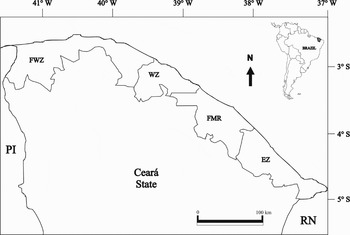
The study area included the 573 km coastline of the state of Ceará, Brazil (02°30′S 41°15′W–04°30′S 36°45′W) (Figure 1). The region is characterized by low primary productivity, high biodiversity and low abundance of aquatic organisms. Prevailing trade winds drive the surface currents nearly parallel to the coast in a north-westerly direction. Current intensity is high from July to November, reaching velocities above 4 m/s. The oceanic waters are influenced by the north-westerly branch of the Brazilian Current. Average sea surface temperatures range from 27 to 29°C. The continental shelf width ranges from 41 km on the eastern coast, widening towards the west and reaching 101 km (Campos et al., Reference Campos, Monteiro, Monteiro-Neto and Pollete2003).
Map of the study area, showing the National Coastal Zone Management in four region divisions: FWZ, Far Western Zone; WZ, Western Zone; FMR, Fortaleza Municipality Region; EZ, Eastern Zone.

Following the National Coastal Management Plan (Brazil, 1997), the coastline was divided into four zones: Far Western (FWZ), Western (WZ), Fortaleza Metropolitan Region (FMR), and Eastern (EZ) (Figure 1). This sub-division was used for grouping data and stranding records, in order to evaluate possible spatial distribution patterns.
Surveys
From July 1996 to December 1999, one field trip per month was conducted to one or several municipalities along the coast. During these surveys, awareness campaigns were implemented in the communities in order to promote a collaboration network and improve strandings reports. Information obtained on cetacean strandings in Ceará from 1992 to June 1996, was reported by Alves-Júnior et al. (Reference Alves-Júnior, Ávila, Oliveira, Furtado-Neto and Monteiro-Neto1996) and is also considered in this study. In this earlier period, and from 2000 to 2005, no systematic surveys were performed. Stranding records were obtained through opportunistic surveys and reports from fishermen, government officials and tourists, most of them as part of the collaboration network established during previous surveys.
Data collection
Data on stranding locality and zone, species, total length and sex of the animals were collected at each stranding event. Species were identified according to Jefferson et al. (Reference Jefferson, Leatherwood and Webber1993). Taxonomy is that of Reeves et al. (Reference Reeves, Smith, Crespo and Notarbartolo di Sciara2003), except for the estuarine dolphin, which follows Caballero et al. (2006). Protocols for attending strandings, evaluating carcasses and collecting samples followed Geraci & Lounsburry (Reference Geraci and Lounsbury1998) and IBAMA (2005). When possible, detailed external examination of specimens was carried out to assess parameters related to the event and to elucidate cause of death. Necropsy was also performed on fresh and moderate decomposed animals to gather information on potential causes of death.
Data analysis
To analyse spatial distribution of strandings, records were grouped into the four previously defined state zones. The Chi-square (χ2) statistical test was used to verify univariate significant differences in the frequency of strandings between zones. For temporal analysis, stranding events were categorized by year, month and seasons. We used two seasonal categories for comparisons. The first followed the usual four austral seasons classification (summer: January–March; autumn: April–June; winter: July–September; spring: October–December). The second scheme followed the rainy (January–June) and dry (July–December) seasons. Chi-square (χ2) statistics were also used to test differences in stranding frequencies between years, months and both seasonal categories.
Sex and age-class definitions were based on observation during necropsy dissection and the available information from the literature for each given species. Carcass condition was classified in: live animal; fresh carcass; moderated decomposition; advanced decomposition; and mummified or skeletal remains (Geraci & Lounsbury, Reference Geraci and Lounsbury1998). The cause of death or stranding followed the categories proposed by Mignucci-Giannoni et al. (Reference Mignucci-Giannoni, Pinto-Rodriguez, Velasco-Escudeiro, Montoya-Ospina, Jimenez-Marrero, Rodriguez-Lopez, Williams and Odell1999): (a) natural—illness, dependent calf; (b) human-related—direct capture, incidental captures, ingestion of debris; and (c) undetermined.
RESULTS AND DISCUSSION
A total of 252 cetacean strandings were recorded in Ceará from January 1992 to October 2005. There were no records of mass strandings. Nineteen species of cetaceans were reported, including 11 Delphinidae, one Physeteridae, two Kogiidae, two Ziphiidae and three Balaenopteridae. Three species comprised the majority (79%) of stranding events: estuarine dolphin, Sotalia guianensis (62%); sperm whale, Physeter macrocephalus (10.3%); and rough-toothed dolphin, Steno bredanensis (6.7%). Strandings of S. guianensis from 1992 to 2005 were analysed by Meirelles et al. (Reference Meirelles, Ribeiro, Silva and Soares-Filho2006). As previously reported by Monteiro-Neto et al. (Reference Monteiro-Neto, Alves-Júnior, Ávila, Campos, Costa, Silva and Furtado-Neto2000), the artisanal fishery in Ceará has a negative impact on this species, with 32% of the reported specimens displaying entrapment marks.
The first report of cetacean strandings at Ceará state (Alves-Júnior et al., Reference Alves-Júnior, Ávila, Oliveira, Furtado-Neto and Monteiro-Neto1996) documented 14 cetacean species. Another five species were recorded after 1996, including northernmost records of the Gervais' beaked whale, Mesoplodon europaeus (Martins et al., Reference Martins, Alves-Junior, Furtado-Neto and Lien2004) and Antarctic minke whale, Balaenoptera bonaerensis (Meirelles & Furtado-Neto, Reference Meirelles and Furtado-Neto2004) in the south-western Atlantic, the first record of the Fraser's dolphin, Lagenodelphis hosei, in north-eastern Brazil (Barros et al., Reference Barros, Silva, Costa, Campos, Oliveira and Meirelles2001), and the first strandings of B. acutorostrata (Meirelles et al., in press), pygmy sperm whale, Kogia breviceps, killer whale, Orcinus orca, and spinner dolphin Stenella longirostris (this paper) in Ceará.
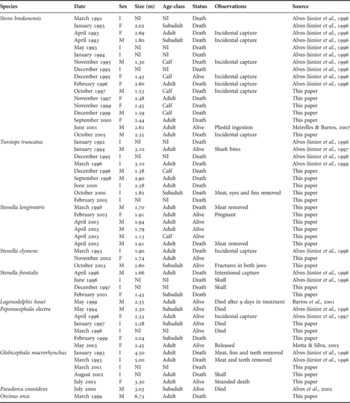
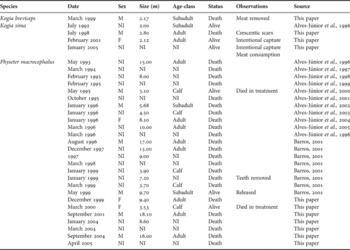
Detailed information on other stranded species can be observed in Table 1 (family Delphinidae), Table 2 (families Kogiidae and Physeteridae), Table 3 (family Ziphiidae) and Table 4 (family Balaenopteridae).
Delphinidae specimens (not including Sotalia guianensis) stranded in the state of Ceará from 1992 to 2005.

Kogiidae and Physeteridae specimens stranded in Ceará from 1992 to 2005.

Ziphiidae specimens stranded in Ceará from 1992 to 2005.

Balaenopteridae specimens stranded in Ceará from 1992 to 2005.

Temporal and spatial distribution
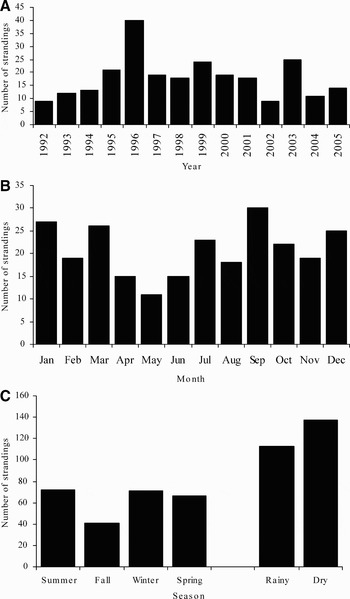
There is a significant difference in the number of strandings per year (χ2 = 48.22; P < 0.05), with an increasing trend in the number of cases reported in the first five years with a highest frequency achieved in 1996 (Figure 2A). This increase was not necessarily related to an increase in the death rate of cetaceans, but may be a response from the coastal communities to the awareness campaigns conducted by AQUASIS during the period. Campaigns not only informed the public about the needs of protecting cetaceans, but also compelled communities to report strandings. Although the educational campaigns also occurred between 1997 and 1999, there was no increase in the number of reports in these years.
Distribution of cetacean stranding records in Ceará per year (A), per month (B), per four season and two season classifications (C), from 1992 to 2005.

Stranding events occurred in all months (Figure 2B), but monthly frequencies were quite variable and showed no significant differences (χ2 = 16.88; P > 0.05), even when related only to live or fresh carcasses (χ2 = 10.88; P > 0.05). Also, the difference between rainy and dry seasons was non-significant analysing all strandings (χ2 = 2.30; P > 0.05), and only live and fresh animals (χ2 = 0.72; P > 0.05); but there were significant differences between the four seasons (χ2 = 10.19; P < 0.05), with the lowest frequency occurring in the autumn (Figure 2C).
Most of species have more stranding records in summer and autumn months, while species such as Sotalia guianensis and K. sima, and Steno bredanensis, Stenella clymene and Megapetra novaeangliae, stranded more in winter and autumn, respectively.
According to Norman et al. (Reference Norman, Bowlby, Brancato, Calambokidis, Duffield, Gearin, Gornall, Gosho, Hanson, Jefries, Lagerquist, Lambourn, Mate, Norberg, Osborne, Rash, Riemer and Scording2004), whether cetacean strandings are recorded usually depends upon factors such as: (1) presence of the public at the coast; (2) abundance of certain species during a certain period; and (3) oceanographic features (e.g. wind speed and direction, and currents). In the study area, the increase of human presence at the beaches occurs in July (winter) and from December to February (spring–summer). There is no information on cetacean species abundance in the state of Ceará, but information on migratory species indicates the presence of Physeter macrocephalus mainly from December to May (spring–summer–autumn) (Ramos et al., Reference Ramos, Siciliano, Borobia, Zerbini, Pizzorno, Fragoso, Brito, Azevedo, Lopes and Santos2001), and Balaenopteridae species from June to November (winter–spring—calving and breeding seasons) on the Brazilian north-eastern coast (Stewart & Leatherwood, Reference Stewart, Leatherwood, Ridgway and Harrison1985). In the region, coastal upwelling occurs most frequently from July to November (winter–spring), when it is promoted by strong north-westerly winds (Campos et al., Reference Campos, Monteiro, Monteiro-Neto and Pollete2003), the period when carcasses have more chance to come ashore. Thus, these factors apparently could influence the stranding records mostly in spring, summer and winter months.
Melon-head whale stranded only in summer–autumn months, and most of the animals stranded alive. In Ceará, the rainy season lasts from January to June, with highest average rainfall values in April and May (Campos et al., Reference Campos, Monteiro, Monteiro-Neto and Pollete2003). In this period, the increase in primary productivity and consequently in food availability, can lead this whale group to come closer to the coast for foraging and this may increase the probability of a sick animal to come ashore.
Sperm whales stranded mainly from January to May (summer–autumn). There is no information on the occurrence of sperm whales in low latitudes of the south-western Atlantic. However, the presence of this whale is well known in low latitudes of the South Pacific Ocean, mainly off the Galapagos Islands, where breeding and calving can be observed during summer–spring austral months (Whitehead et al., Reference Whitehead, Weilgart and Waters1989). Thus, sperm whales probably use the area for breeding and calving during summer–autumn, when most strandings were recorded. This hypothesis can be supported by the strandings of two live newborns in Ceará.
Humpback whales stranded during winter–spring months, when this species migrates to lower latitudes for mating and calving. In Ceará, strandings of M. novaeangliae were not recorded before 1997. New reports of humpback whale sightings and strandings in low latitudes have been related to a re-occupation of a historical occurrence area, since it is inferred from the literature that 1542 humpback whales were taken off Paraiba Whaling Bases (COPESBRA) and they were commonly in those areas (Paiva & Grangeiro, Reference Paiva and Grangeiro1965; Stevick et al., Reference Stevick, Aguayo, Allen, Avila, Capella, Castro, Chater, Engel, Felix, Flórez-González, Freitas, Hasse, Llano, Lodi, Munoz, Olavarría, Secchi, Scheidat and Siciliano2004; Zerbini et al., Reference Zerbini, Andriolo, Rocha, Simões-Lopes, Siciliano, Pizzorno, Waite, DeMaster and VanBlaricom2004).
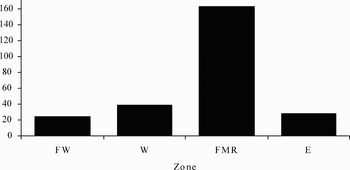
A highly significant difference in the frequency of strandings was observed among the four zones (χ2 = 209.08; P < 0.01). The majority of strandings events were reported for FMR (64.3%). Only 9.5% of all records were reported for the FWZ (Figure 3). Number of strandings per km was also higher in FMR (1.55), and the lowest value was observed in FWZ (0.12). These results may be a consequence of AQUASIS monitoring and rescue efforts, and not necessarily indicate that more animals strand in FMR. The institution that rescues animals and recovers carcasses is located in Fortaleza Metropolitan Region, the most densely populated area along the coast. Therefore, stranding events have a higher probability to be reported in this zone than in any other area of the state. In the other state coastal zones the absence of coastal communities in some regions, the least accessible sites, limits the number of reports from those areas.
Number of cetacean stranding records in each region of the Ceará coast from 1992 to 2005.

Analysing species strandings related to zones, it can be observed that most of them have more stranding records in FMR. However, species such as K. sima stranded exclusively in the WZ, and P. macrocephalus stranded more both in the FMR and FW Zones.
Sex and age-class
Sex was not determined for 42.9% of the stranding specimens, due to the carcass decomposition or, in case of large cetaceans, the animal position. In specimens where sex was determined, 86 males (59.7%) and 58 females (40.3%) were recorded. This difference is significant (χ2 = 5.44; P < 0.05), and may be due to the fact that males are easier to identify, especially when the penis is exposed. Results like these were also observed in Puerto Rico and the Virgin Islands by Mignucci-Giannoni et al. (Reference Mignucci-Giannoni, Pinto-Rodriguez, Velasco-Escudeiro, Montoya-Ospina, Jimenez-Marrero, Rodriguez-Lopez, Williams and Odell1999). Age-class was determined for 77.8% of the events. Of these, 64% were adults, 22% were subadults and 14% were calves.
Condition of carcass and cause of death
The carcass condition was registered in 77.8% of all cases. Of those for which condition was documented, 15.3% (N = 30) stranded alive, but the majority were in distress and died during rescue or treatment. Only two animals, a subadult male sperm whale and an adult female melon-headed whale were considered successfully released, since no reports of subsequent stranding events were registered. Dead animals were usually found in advanced state of decomposition (38.3%) or as mummified/skeletal remains (21.4%). Animals found recently dead (10.2%) or moderately decomposed (14.8%) were not common.
Cause of death or stranding was determined in 28.3% of all reports. Natural causes accounted for 4% of the events, and human-related causes for 24.6%. The fact that 74.5% of the recovered carcasses were decomposed in a condition that did not allow adequate necropsy, explains the high incidence of undetermined cause of death.
Estuarine and rough-toothed dolphins were the species with more records of incidental captures, mainly in FMR, where the fishing activity is higher than in other zones. However, other species, such as P. electra and S. clymene were also recorded in this category.
Although the intentional capture of cetaceans has not been allowed in Brazil since 1987, species such as Stenella frontalis and Kogia sima were reported to be captured by fishermen in Ceará, to remove meat for human consumption and bait. Meat removal for human consumption or bait was observed in 6.7% of stranded animals, mainly S. guianensis. Interviews in coastal communities indicated that the meat can be dried with salt and then fried for consumption. The removal of eyes to be used as ‘lucky charms’ and the teeth, which are sold to artisans to make earrings, necklaces and bracelets were also recorded. Consumption of dolphin meat has already been reported in north-eastern Brazil (Meirelles et al., Reference Meirelles, Ribeiro, Silva and Soares-Filho2006; Attademo, Reference Attademo2007; Tosi et al., Reference Tosi, Magalhães and Garri2007), and this custom has been indicated as a social problem, as hunger is motivating the use of cetaceans as a protein source.
Stranding data on cetacean management
Data gathered from stranding events may facilitate cetacean management in several ways. According to Maldini et al. (Reference Maldini, Mazzuca and Atkinson2005), species stranding in a particular area are usually those found in surveys of live animals. Thus, stranding data can be a useful indicator of species composition in a region, when other data are not available. The abundance of stranding records in most cases also reflects the abundance of the free-living population in a particular region. Species that stranded only on one or two occasions may be designated as rare or occasional visitors to the area (Sergeant, Reference Sergeant, Geraci and Aubin1979). Consequently, in Ceará, Sotalia guianensis, Physeter macrocephalus and Steno bredanensis are the most abundant cetacean species, whereas L. hosei, P. crassidens, O. orca, K. sima, M. europaeus, B. acutorostrata and B. bonaerensis are probably rare in the area.
Two out of 19 species recorded in Ceará are considered as Vulnerable by the IUCN (2007): M. novaeangliae and P. macrocephalus. Studies to identify the occurrence areas and the human impacts on these species in Ceará are very important, since they are considered to be facing a high risk of extinction in the wild. Another seven species (Sotalia guianensis, Stenella clymene, S. frontalis, Steno bredanensis, Tursiops truncates, Mesoplodon europaeus and Ziphius cavirostris) are listed as ‘Data deficient’. Surveys on the ecology of these species (especially S. guianensis and Steno bredanensis that have coastal habitats) are very important to promote their conservation, and also to help to assess their category of real threat in the future.
ACKNOWLEDGEMENTS
We would like to thank the AQUASIS team for their work in responding to strandings and collecting data; Caio Carlos and two anonymous referees for their revision and important suggestions to improve this paper; Instituto de Ciências do Mar—LABOMAR/UFC and Serviço Social do Comércio—SESC/Ceará, for important logistical support. The collection and handling of specimens was carried out under the permit of Instituto Brasileiro do Meio Ambiente e Recursos Naturais Renovávei—IBAMA.