According to our reconstruction of the sociopolitics of tenth-century Chichen Itza, the polity was ruled by a paramount king who identified himself with the sun. A high priest, the second-ranking figure, stood by the king's side. A political and military elite, with an S-shaped serpent as its emblem, shared power with these top figures. Finally, the whole community of warriors was treated as a collective corps with important religious and political responsibilities. The iconography of the Temple of the Wall Panels depicts the initiation of jaguar knights by a warrior figure designated as Serpent Jaguar. The same individual, also represented and designated on the slab covering the cache buried in the upper temple, was assisted or controlled by personages who ranked above him. The panels illustrate the destiny of the jaguar-warriors after their glorious death, first as they accompany the rising sun and, later, as they transform themselves into birds. This interpretation appears very close to the destiny of the dead Aztec warriors as recounted by Sahagún and other chroniclers. The butterfly/bird theme, associated with warriors, indicates that similar beliefs were current at Teotihuacan. The Temple of the Wall Panels, too small to be a telpochcalli was probably a house used by warriors, as indicated by its images and its distinctive architecture, which are shared at the same site by the Temple of the Warriors.
Between 1980 and 1995, two new hypotheses disrupted our archaeological and art historical conceptions on Chichen Itza. Rejecting the traditional view of an Early Postclassic “New Chichen,” also called “Toltec-Maya,” following a Puuc Terminal Classic “Old Chichen.” It was claimed that the many cultural differences observed at the site were not due to the passage of time but to other factors, such as function. While some scholars advocated a total overlap model (Lincoln Reference Lincoln1990), many others favored a partial overlap of varying importance. Following the identification of a glyph by David Stuart (in a 1988 letter to Maya epigraphers), some scholars further suggested that Chichen Itza had not been ruled by divine kingship but by a joint rulership or multepal type of government (Schele and Freidel Reference Schele and Freidel1990; Grube Reference Grube and Prem1994).
After many debates, both private and public, most Mayanists felt that more work was needed to resolve these discrepancies. A surge of activity then ensued: archaeologists, ceramicists, art historians, and epigraphers dedicated much time and effort to Chichen Itza. At the same time, added work was undertaken on Tula, with the hope of making inroads into the thorny subject of the Chichen-Tula relationships.
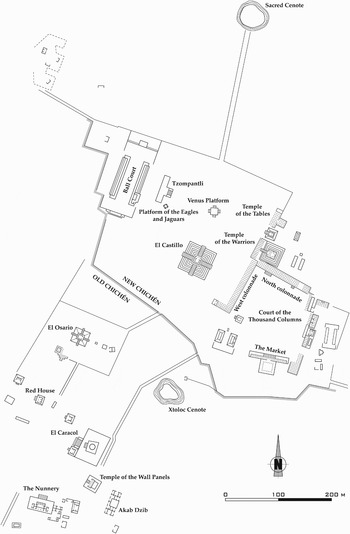
A recent volume brings forth syntheses written by the major actors in these new developments (Kowalski and Kristan-Graham Reference Kowalski and Kristan-Graham2007). Rejecting the total overlap model proposed by Lincoln (Reference Lincoln1990), most scholars now agree that “the incorporation of foreign groups at Chichen Itza was a gradual process that began sometime after a.d. 800 and did not necessarily involve conquest” (Kowalski and Kristan-Graham Reference Kowalski and Kristan-Graham2007:10). Inscriptions on public monuments and the reign of K'ak'upakal coincide with the early Sotuta ceramic facet. While the authors of the Twin Tollans volume may disagree on the respective chronological placement of individual structures (Cobos Reference Cobos, Kowalski and Kristan-Graham2007; Bey and Ringle Reference Bey, Ringle, Kowalski and Kristan-Graham2007), they concur in placing the construction of the Northern Terrace (also called Northern Group, Great Terrace, or Gran Nivelación) coeval with Late Sotuta ceramics, beginning just after a.d. 900 and lasting tentatively until the end of the tenth century (Figure 1).
Monumental center of Chichen Itza, showing the Northern Terrace and some “Old Chichen” buildings.

The multepal hypothesis, based on an insecure reading of the y-itaaj hieroglyph as “sibling,” has been discarded. Today, it is agreed that the inscriptions at Chichen Itza cover a short span of 58 years, from a.d. 832 (Temple of the Hieroglyphic Jambs) to a.d. 890 on Stela 2 (Grube and Krochock Reference Grube, Krochock, Kowalski and Kristan-Graham2007). The pillar from the Osario is the only later exception with a date of a.d. 998 (Graña-Behrens et al. Reference Graña-Behrens, Prager and Wagner1999). A large share of this epigraphic activity belongs to the reign of K'ak'upakal with the first mention of his name in a.d. 869 in the Casa Colorada texts and the last mention in a.d. 890 on Stela 2 (Grube and Krochock Reference Grube, Krochock, Kowalski and Kristan-Graham2007:229). K'ak'upakal's brother, whose name is read today K'inilkopol, seems to have played an important political role at the king's side, according to the inscriptions on the Temple of the Initial Series and the Temple of the Four Lintels (dated a.d. 878 and a.d. 881, respectively). Grube and Krochock (Reference Grube, Krochock, Kowalski and Kristan-Graham2007), while sensing that K'inilkopol was of lesser rank than K'ak'upakal, admit that the inscriptions do not give “clear indications of the hierarchy between the two brothers” (Grube and Krochock Reference Grube, Krochock, Kowalski and Kristan-Graham2007:240). Besides the above two persons, “there are many other nominal phrases referring to real people at three monuments situated at the small outlying sites of Halakal and Yula” (Grube and Krochock Reference Grube, Krochock, Kowalski and Kristan-Graham2007:228).
Breaking with a very long Maya tradition of royal portraits on stelae and other monuments, the political figures of the second half of the ninth century, while having their names mentioned in inscriptions carved on the buildings of “Old Chichen,” did not leave portraits of themselves. Even in the absence of writing in the tenth century, the successors of K'ak'upakal may also have avoided portraiture. Rulers, at Chichen Itza as well as at Teotihuacan, may not have felt the need to perpetuate their image on carvings or paintings.
The main purpose of this paper is to show that during the tenth century, the Mexicanization of Chichen Itza increased dramatically, as demonstrated by the Temple of the Wall Panels, a building probably dating from that time. Based on the analysis of its iconography, we propose that the Maya of Chichen Itza had military schools where they taught an ideology very close to the Aztec beliefs reported by the Spanish chroniclers of the sixteenth century. But since our paper deals with sociopolitics, a domain in which scholarly opinions do not yet converge, we believe it necessary, before entering into the heart of the matter, to state our positions on the subject and the arguments on which these are founded. We wish to show that tenth-century Chichen Itza was ruled by a paramount king who identified himself as the sun; that a high priest, probably the second-ranking figure in the state, stood by the king's side; that a political and military elite, with an S-shaped serpent as its emblem, shared power with these top figures; and, finally, that the whole community of warriors was treated as a collective corps sharing religious as well as political responsibilities.
THE SUN DISK MAN: CELESTIAL BODY OR POLITICAL FIGURE?
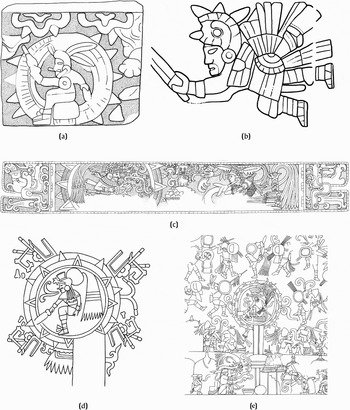
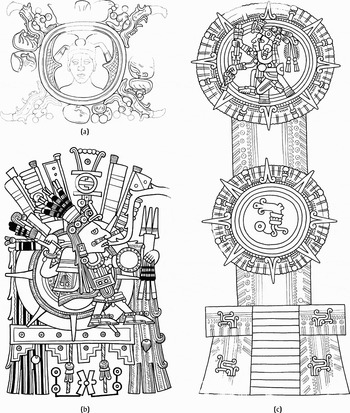
The sun, figured as a human warrior in front of a spiked disk, is engraved on the top of some piers in the Northwest Colonnade (Tozzer Reference Tozzer1957:Figure 274). The anthropomorphic figure, whose lower body is hidden by the half-disk, is seen diving or flying over the standing personage who takes up most of the carved pillar's surface. It represents the sun, for its attitude is that of a celestial body and also because it appears very similar to the Mexican sun deity Tonatiuh (Figure 3). The central figure of the north panel in the Temple of the Wall Panels appears as a variant of these images: a human figure—a sun disk framing its head—is flying or floating through the air (Figure 2b).
The sun disk man at Chichen Itza: (a) Temple of the Wall Panels, detail of the south panel; (b) detail of the north panel; (c) Upper Temple of the Jaguars, carved wooden lintel of the inner doorway (after Maudslay 1889–1902, vol. 3:Plate 35a); (d) Detail from the northwest mural; (e) Detail from the southwest mural.

The sun disk man motif elsewhere: (a) Palenque, House A, Medallion 5 (after Robertson Reference Robertson1985, vol. 3:Figure 124b); (b) Codex Borgia 71, detail; (c) Codex Vienna 23, detail.

In the Upper Temple of the Jaguars (UTJ), the man in the sun disk is much more sophisticated. Inscribed within a complete spiked disk, he is shown seated on a jaguar throne or kneeling; he holds atlatl and darts and wears a multirowed jade collar; a small butterfly mask adorns his forehead (Figure 2c). An elaborate speech scroll, in serpent form, issues from his mouth. Considering the chronological and geographical distance between Chichen Itza and the Aztecs of central Mexico, the resemblances between the Chichen man in the sun disk and the central Mexican Tonatiuh are intriguing (Figure 3b). However, a Classic Maya version of this icon can be seen at Palenque, with the 13 stucco medallions decorating House A and composing a gallery of royal portraits (Robertson Reference Robertson1985:25–31). Every medallion consists of a human bust placed at the center of a circular cartouche forming a k'in glyph, from which four skeletal serpent heads radiate (Figure 3a).
The man in the sun disk appears several times on the murals of the UTJ inner room. Coggins (Coggins and Shane Reference Coggins and Shane1984) has suggested that the paintings (recorded by Adela Breton at the beginning of the twentieth century) were determined by the daily cycle of the sun and the related cycle of Venus; according to this author, the warriors on most scenes would compete for these two celestial bodies, ending with the victory of Venus over the sun. According to Milbrath (Reference Milbrath1999:183, 196; Reference Milbrath, Rubio and Gubler2008) the eight-part division relates to eight years in the Venus cycle, and the warfare iconography relates to a series of battles conducted by Chichen Itza against neighboring polities, timed in accord with Venus events taking place during the dry season, the season of warfare.
One cannot deny that the presence of the sun in different positions on most murals suggests that each mural is part of a whole story, more allegorical than historical; however, since four murals out of seven have lost more than 50% of their paintings, a convincing reconstruction of the whole may turn out to be an impossible task. We agree, however, that on these murals the sun disk figure is the star-sun and not the image of a king or a “captain.”
On the northwest and southwest murals, the icon appears at the top of a vertical construction and towers above the landscape. On the former example (Figure 2d), four stylized serpent heads—a mixture of the Maya zip monster and the later Aztec xiuhcoatl—radiate from the disk, recalling the serpent heads radiating from the Palenque medallions. A very similar image can be seen on page 23 of the Codex Vienna where it stands for the primordial sunrise (Figure 3c) (Anders, Jansen, and Pérez Jiménez Reference Anders, Jansen and Pérez Jiménez1992). On the southwest mural, the best preserved of the UTJ murals, two or three rows of houses can be seen at the top (background) and another row of huts at the base (foreground) of the composition (Coggins and Shane Reference Coggins and Shane1984). The warriors in between are not fighting as suggested by Anderson (Reference Anderson, Robertson and Fields1994) but perform on a plaza a war dance in celebration of the rising sun (Figure 2e). The scene recalls the dead Aztec warriors welcoming the sun as it rises: the brave warriors who died in war “met the sun as it emerged, brought it forth, came giving cries for it, came gladdening it, came skirmishing” (Sahagún Reference Sahagún, Dibble and Anderson1956–1982, VI:162). Miller (Reference Miller and Hammond1977) recognized in the Adela Breton watercolors two major warrior figures that he named Captain Sun Disk and Captain Serpent, supposedly representing the leaders of hostile armies. However, no mural shows such antagonism; two of them (northeast and southeast) do not include any of these “captains” while some murals include several Captain Serpents (southwest and south).
The sun-disk figure is depicted on the three visible sides of the carved wood lintel above the inner door of the temple (Figure 2c). He is facing another warrior whose emblem is a feathered S-shaped serpent behind him. The two figures are neither antagonistic nor equals; the serpent-man places his atlatl on his left shoulder, a respectful or submissive gesture. Coggins and Shane (Reference Coggins and Shane1984) wrongly state that both figures hold their atlatls across their chests. Only the serpent man makes this gesture to show his respect toward a superior. In Maya art, the submissive gesture is used to state ranking. Coggins, following Miller, sees on the lintel Captain Serpent and Captain Sun Disk “in peaceful confrontation” (Coggins and Shane Reference Coggins and Shane1984). We do not see any evidence of war leaders or of confrontation but a gesture of submission toward a superior. Here the sun disk figure, shown on the same ground and same level as his vis-à-vis, might represent a man—the sun king. As epigraphy (the k'inich title) and iconography (Baudez Reference Baudez, Boone and Willey1988, Reference Baudez2004) indicate, Classic Maya kings were likened to the sun. Therefore, a Mexicanized solar metaphor, using a spiked disk as an emblem, would not be alien to Maya ideology. The offering between the two figures is a cuauhxicalli, a sacrificial vessel (identified by the eagle feathers decorating the vessel's exterior rim) filled with human hearts. The Chichen Itza cuauhxicallis can be compared to analogs at Tula that contain hearts and lancets (Tozzer Reference Tozzer1957:Figure 676).
The man in the sun disk on the upper register of the south panel of the Temple of the Wall Panels is seated on the same bench as the serpent man he faces and another serpent man sitting behind him, therefore indicating that he is not a supernatural figure but a real human being (Figure 2a).
A similar icon is placed at the top of the west wall in the Lower Temple of the Jaguars (Maudslay Reference Maudslay1889–1901, III:Plate 50); it occupies a central position above a serpent man, who is himself above the main personage of the building. The sun disk figure is level with the group of warriors he is facing, very much like the serpent man who meets warriors on the register below. They both look like living persons and the sun disk man, very probably, represents the ruler. We reach a similar conclusion about the sun disk man surrounded by 17 small standing figures, from the lintel of the Castillo north doorway.
After this survey of sun disk figures that might pretend to be king images, we must confess that the results are thin. Without being iconoclasts, the Chichen rulers were not especially interested in leaving their portraits to posterity. But again, this discretion cannot be taken as indicating the absence of a paramount king. In fact, it can be assumed that only a paramount ruler could have held together such a complex, stratified, and cosmopolitan society. Who but he could have had the authority to control the “powerful lineages …which had previously enjoyed greater political independence and autonomy as lords of their own domains”? (Kowalski Reference Kowalski and Prem2003:237). Who but such a figure could have ordered the construction of such an imposing building as the Castillo?
THE JADE-SKIRTED PRIESTLY FIGURE
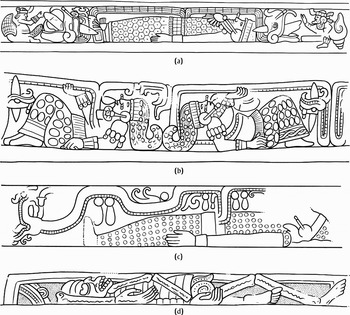
We suggest that the existence of a high priest, second only to the king, can be found in the Great Ball Court complex. We agree with most of Linnea Wren's analysis of the iconography of the Great Ball Court North Temple. She interprets the carvings of its southern vault as depicting the rituals surrounding the death of “an elite individual, possibly a ruler,” and those of the northern wall as showing the accession of his successor (Wren and Schmidt Reference Wren, Schmidt and Culbert1991:215). “Visits to sacred shrines after investiture” are illustrated on the northern vault while the east and west walls tell of additional festivities and rites, among them a ball game followed by decapitation (Wren and Schmidt Reference Wren, Schmidt and Culbert1991, Figures 9–11). In another article (Wren Reference Wren, Robertson and Fields1994), she describes, in the north wall's basal band, a huge recumbent figure flanked by small bacabs and vines that indicate that this figure is lying within the earth. Two serpents, with a flint knife in place of their tongues, emerge from his belly (Figure 4a). He wears a long robe sown with perforated chalchihuitls that Wren compares with the garment, also covered with jade disks, worn by the acceding figure in the center of the north wall.
The jade-skirted figure: (a) Great Ball Court North Temple, detail of the north wall; (b) Roll-out detail of a column (after Seler Reference Seler1990–1998, vol. 6:100, Figure 182); (c) Upper Temple of the Jaguars, wall painting above the inner doorway; (d) detail from a Late Classic cylindrical vase (K6547).

On the base of the round columns at the entrance of the same temple, the recumbent jade-skirted figure may be seen twice below the two earth monster masks on which stand two human figures. The jade-skirted individual appears clearly as a man—with nose rod, ear plugs, bead necklace, and bracelets; a single serpent springs from his belly (Figure 4b). The pilasters of the temple also have a partly recumbent jade-skirted figure carved on their base below an earth monster mask from which plants sprout. Since the prismatic pillars of the South Temple also display at their base this same figure (here squatting), we assume that the whole Ball Court was built to celebrate the succession to the same deceased personage. Finally, a recumbent jade-robed figure was painted twice in the UTJ. It appears once above the lintel of its inner door (Figure 4c) below the remains of the decorated vault—a scene of human sacrifice, preceded by captors leading their captives to the altar. The figure appears a second time in the basal band under the two personages standing on the east wall, opposite the entrance (Coggins and Shane Reference Coggins and Shane1984:159). As Ringle (Reference Ringle2004:196) demonstrated, the same individuals are depicted on the table bench from the UTJ (Schele and Mathews Reference Schele and Mathews1998:Figure 6.38). We propose that these much-defaced figures are the same individuals that we see at the center of the north wall of the North Temple (WrenReference Wren, Robertson and Fields1994:Figure 3): to the left, the newly elected high priest would be standing, with his fanlike feathered crest and panache; and to the right, the serpent man who, in the North Temple, is seated—with a three-feathered headdress. The human sacrifice scene that remains on the UTJ vault probably represents part of accession rituals similar to those illustrated on the North Temple.
Coggins sees the jade-robbed figure as “Mother Earth” (Coggins and ShaneReference Coggins and Shane1984:Figure 202). Taube (Reference Taube and Prem1994:216) agrees, seeing a relation between the serpents issued from the belly of the figure and the myth of Quetzalcoatl and Tezcatlipoca who transform themselves into serpents to tear apart the earth monster. For Schele and Mathews (Reference Schele and Mathews1998:236), it is the sacrificed maize god. Milbrath (Reference Milbrath, Rubio and Gubler2008) interprets it as a goddess, or two aspects of Venus or the Milky Way. Wren (Reference Wren, Robertson and Fields1994) identifies it as “a goddess associated with water and fertility,” and does not carry further her observation that the central figure of the north wall and the personage lying underground are wearing similar jade costumes. We think, however, that the similarity in costumes is a sign of close relationship and suggest that the north wall central individual is succeeding to the post held by the deceased figure.
Ringle (Reference Ringle2004:174) also sees a connection between the two personages but sees in them Quetzalcoatl incarnations: “The supine figure is perhaps identifiable as the deceased Quetzalcoatl or deceased king-as-Quetzalcoatl.” On a drawing by Adela Breton, published for the first time by Ringle (Reference Ringle2004, Figure 36a), the lower body of the central figure is eroded; it is then likely that this individual was wearing, like the buried figure, a robe and not the jacket drawn by other artists.
We question the interpretation of the recumbent figure as a fertility or earth goddess, arguing that the Aztec goddess Chalchiuhtlicue, whose name means “the one with the jade skirt,” is a deity of terrestrial waters who is never shown lying in the underworld. At Chichen Itza, the earth is most often represented in the Maya tradition as a frontal mask (Tozzer Reference Tozzer1957:Figures 336–343, 345) or as a serpent head with upper and lower jaws aligned (Lothrop Reference Lothrop1952:Figure16) or as a cauac monster with bacabs emerging from its sides and a young figure sprouting from its upper cleft (Tozzer Reference Tozzer1957:Figure 346). Few examples are known of an upside-down Tlaltecuhtli-like mask (Lothrop Reference Lothrop1952:Figures 41, 42). There are no examples of a “Mother Earth” or any impersonator of the earth as an anthropomorphic figure lying supine. On the other hand, many Classic Maya stelae show captives lying underground under the ruler's feet. There is also on a Late Classic Maya engraved bowl, kept at Berlin (K 6547), an example of a skeleton lying supine underground, level with a water frieze (Figure 4d).
We think that the jade garment is a priestly costume. In the Temple of the Chac Mool (Kowalski Reference Kowalski, Kowalski and Kristan-Graham2007:265, 271–273, Figure 13), one can see benches for members of a royal council. The first three figures painted on the south bench are identified as priests, for they are presenting offerings in bowls. They wear long skirts adorned with perforated jade elements sewn on it. Similar figures stand on the pillars of the same temple (Pillar 4) and on some of the Northwest Colonnade (Robertson Reference Robertson and Prem1994:Figure 4.). We then suggest that the individual, lying supine within the basal band of the North Temple and elsewhere, is also a priest and a high priest at that because of his relative size and the importance of the buildings where he is depicted.
Based on the iconography of the buildings associated with the Great Ball Court we suggest that the successors of K'ak'upakal shared power with an important political and religious figure, probably corresponding to the ninth-century K'inilkopol. Lincoln (Reference Lincoln and Prem1994) also proposed a dual division of power at Chichen Itza, pairing Miller's “Captain Sun Disk,” an image of K'ak'upakal, with “Captain Serpent,” associated with K'uk'ulkan. The pair would be an equivalent of the external and internal rulers of Aztec Tenochtitlan, the Tlatoani and the Cihuacoatl. However, we cannot accept this hypothesis since it is founded on the pair constructed by Miller (Reference Miller and Hammond1977) that we do not recognize.
We suggest that the Great Ball Court was built to celebrate the accession of a new high priest, since his buried predecessor is depicted several times in the North Temple and the South Temple. This hypothesis is strengthened by the observation that the ball game is “part of the initiation ritual” (Ringle Reference Ringle2004:174) as the decapitated player on the east wall of the North Temple shows. The lateral structures may have preexisted the new ball court, forming an E Group (or astronomical observatory) because of the presence of three diminutive structures on their top which could have been used as markers for sighting sunrises and sunsets (Maudslay Reference Maudslay1889–1901, III:Plate 26). Archaeoastronomers will tell us whether this hypothesis can be seriously considered or if it should be dropped.
As a court to play ball, it features a good number of anomalies that led Merle Greene Robertson (Reference Robertson, van Bussel, van Dongen and Leyenaar1991:109) to think that “the actual game may never have been played in the Great Ball Court.” If the court presents the expected I-shape, its colossal dimensions (167 × 70 m) are truly exceptional. Passing the ball through the stone rings, even with the use of hands, would have been “a feat deemed next to impossible” considering that the rings are set ten meters high on vertical walls that are set back three meters from the top of the sloping carved benches. The low-relief decoration includes six sets of fourteen figures each. Every set shows processions of individuals approaching from opposite directions—a central decapitation scene. We do not recognize in the costume and outfit of the human figures the usual elements that make us identify ball (tlachtli) players. They do not have yugos, hachas, or palmas (Robertson Reference Robertson, van Bussel, van Dongen and Leyenaar1991:109), but they do have belts supporting big sticks; we are unable to explain why the men do not wear the same footwear on both feet, how they use of their stick (a bat, perhaps) and their handstone, or why both teams have their knee pads on the same right side. Assuming they are ball players, we do not know what kind of game they are playing: are they using their hips, their hands, their protected foot, a stick? It is as if they were not actual players but actors in some allegory of the ball game and other rituals. This concept is not entirely new. Earlier (i.e., ninth-century) ball courts at Chichen Itza offer the same iconography with standing figures on both sides of a decapitation scene: the Casa Colorada ball court and the Monjas ball court (Bolles Reference Bolles1977:77–80; Robertson Reference Robertson and Prem1994:Figure 11; Krochock and Freidel Reference Krochock, Freidel and Prem1994). In the Monjas court, the actors also display different footwear. The iconography of the Mercado ball court appears different: there, processions of individuals leading captives converge toward a central scene composed of a serpent man wielding a bent stick in front of an individual holding a flaming censer (Krochock and Freidel Reference Krochock, Freidel and Prem1994:Figure 14). The latter authors, using epigraphic as well as iconographic arguments, suggest that the ball courts at Chichen Itza were open to additional ritual activities such as “the parading of captives, human sacrifices and fire ceremonialism” (Krochock and Freidel Reference Krochock, Freidel and Prem1994: 369).
Building the UTJ destroyed the diminutive construction that could have been used as a southeastern marker in the E-group observatory, making sunrise sightings impossible. The UTJ orientation was also new. We consider this building to be a monument celebrating the anniversary of the high priest succession since his buried predecessor is depicted twice—and since the central scene of the enthronement from the North Temple is reproduced on its East mural, as we will see later.
THE SERPENT MAN FIGURE
Described as Captain Serpent by Miller (Reference Miller and Hammond1977) and Coggins (Coggins and Shane Reference Coggins and Shane1984) this figure is a rather frequent icon at Chichen Itza. While he may be the only one of his kind in a given image, several serpent men are often seen together. Therefore the S-serpent does not qualify an individual person (K’ uk’ ulkan or Quetzalcoatl) but members of a social group. On the lintel of the UTJ we see one of them paying his respect to the sun disk figure (Figure 2c), and on the murals of the same temple several serpent men are leading warriors to battle or to the war dance. We recognize two serpent men on the central and privileged axis of the north wall of the North Temple: one of them is seated in front of the newly designated priest, who is standing; the seated men around them are not warriors but rather members of some council (Wren Reference Wren, Robertson and Fields1994:Figure 3). In the register above, another serpent man, carrying weapons this time, stands leading a group of five warriors. Close to him, framed by a knotted serpent forming a sort of cartouche, an important figure floats in the air; as his jaguar throne and his serpent speech scroll indicate, he is probably an ancestor who patronizes the ceremonies. Serpent men are the only actors of the scene carved on the dais of the Northwest Colonnade: as if they were the only personages allowed to let their blood, they form two files that converge toward a bowl where autosacrificial implements are planted (Morris et al. Reference Morris, Charlot and Morris1931). On the dais of the Mercado, the main figure is a serpent man, dressed in an eagle costume, who tramples on two victims and is ready to execute the tied captives who walk toward him (Ruppert Reference Ruppert1943:Figure 23). We will see that several serpent men play a role in the Temple of the Wall Panels: they appear as major figures superior to everyone but the king.
The inner decoration of the Lower Temple of the Jaguars (LTJ) shows that, while pertaining to the same class, all serpent men do not pretend to be equal. The structure is a small, vaulted room built against the eastern side of the Temple of the Jaguars. The inner walls and vaults were covered with painted low-reliefs; at the time of Maudslay's visit, most of the northern half of the building and its sculptures were rather well preserved, in opposition to the much-ruined southern half. Since then, the Mexican government has reconstructed the temple. The carved walls are divided into three registers (not including the basal band), and the vaults into two (Maudslay Reference Maudslay1889–1901, III:Plates 44–51). As on the north wall of the North Temple, two lines of men meet at the center of each register from opposite directions; it seems that the most important people come from the south and are aligned along a central vertical axis. From top to bottom, we recognize a sun king, a serpent man, a masked serpent man whose body extends over two registers, and a “fish-man.” The masked man, placed exactly at the center of the composition, outclasses the others through the exceptional size of the feathered serpent placed behind him; his costume, which includes a round pectoral and a feather cape; and the gifts or tribute he receives. These include a sub-globular vessel or basket at his feet and oblong objects held by the two people in front of him. It seems that each of these objects is composed of three scaly, supple parts like reptile or fish skins.
The masked man is also the dominating figure for catching the attention of the people surrounding him: the first two or three individuals of each file in the first register raise their heads towards him while those of the third register lower theirs. The jaguar throne at the entrance of the structure was probably his. This man appears as a serpent man superior to his fellow serpent men. The crowd around him is much more diverse than that depicted on the North Temple, and some appear to be strangers, notably the men carrying harpoons on the first register—maybe coastal people.
Ringle (Reference Ringle2004) suggested that serpent men were “associated with the Quetzalcoatl cult.” While this is possible, there are cases when the S-serpent appears as a general emblem conferring sacredness and importance to the action. For instance, in the UTJ and the Temple of the Warriors, a feathered S-serpent rises above a scene of human sacrifice. Does sacrifice have anything to do with Quetzalcoatl, or is the serpent conferring a sacred quality to the rite? Some serpents display hooks attached to their bodies instead of feathers, (the serpent-man at the top of the LTJ inside decoration), evoking the clouds of the deity Mixcoatl. Do we have serpent men associated with a Mixcoatl, Quetzalcoatl's father cult? What is the meaning of plain S-serpents without feathers or hooks that rise behind bacabs (Maudslay 1889–1902, III:Plate 43c)? Chichen Itza iconography is replete with signs that would need a detailed contextual analysis to understand them: serpent heads, more or less stylized, some like zip monsters, others like jewel serpents (Maudslay Reference Maudslay1889–1901, III:Plate 51c); undulating forms, serpents, or flames radiating from the body of important individuals (the new high priest from the North Temple, the masked man from the LTJ, the right figure painted on the back wall of the UTJ). The vines, water lilies, and other plants that rise from a decapitation scene (the Ball Court frieze), an offering or tribute (the masked man in LTJ), are probably fertility icons. The earth monster with vines issuing from its eyes (the UTJ lintel) is a more developed fertility figure that comes out of a water frieze.
THE WARRIORS
Warrior images are ubiquitous at Chichen Itza. Even if they ranked fourth in the Chichen Itza political hierarchy, they are the kingdom's elite and are not standing on the lowest steps of the social scale: those who do are never represented on public monuments. Many warriors are individualized through their costume, mask, or weapons—besides the iconic signs or glyphs that supposedly give information on their name or lineage (Kristan-Graham Reference Kristan-Graham1989). At the same time, the Chichen Itza warriors are shown forming a real corps and not a simple collection of individuals sharing the same office. The new colonnaded halls in the North terrace were built not to shelter popolna (or council houses), but thousands of warriors. The pillars of the Northwest Colonnade, far from being “a multiple stela” format (Kowalski Reference Kowalski, Kowalski and Kristan-Graham2007:268), present images that draw their meaning more from the context of neighboring pillars than from the images carved on the same stone. The warriors participate in a vast mise en scène where the outfit, the place, the orientation of each one give their meaning to the whole composition (Morris et al.Reference Morris, Charlot and Morris1931:269; Baudez Reference Baudez2004). This is also true for the other corps, still badly defined, of masked “sorcerers” and unarmed “dignitaries.”
The warriors considered their mission to be a sacred one and felt honored to belong to the most important class of citizens. This is what they were taught in school, at least. We propose that the iconography of the Temple of the Wall Panels illustrates the training of young warriors in colleges in which they were taught an ideology very close to the one taught in the Aztec telpochcalli (military college). War was conceived as a collective sacrifice to the benefit of the sun, and the warriors could expect a reward only after their glorious death.
THE TEMPLE OF THE WALL PANELS
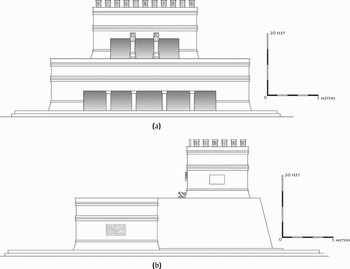
At Chichen Itza, the Temple of the Wall Panels, between Las Monjas and the Caracol, was excavated in 1927 by archaeologists from the Carnegie Institution. Originally, as Ruppert (Reference Ruppert1931) noted, its distinctive architecture and orientation reproduce, at a smaller scale, those of the Temple of the Warriors. Both constructions may have been contemporaneous—that is later than a.d. 900. The Temple of the Wall Panels, devoid of any inscriptions, is located in the center of “Old Chichen” among earlier constructions such as Akab Dzib, Las Monjas, Caracol, and Casa Colorada, which include hieroglyphic texts. On its western façade, the two-room temple presented two serpent columns flanking its door; at its corners were stacked masks of the earth monster, and silhouetted elements (almenas) adorned its roof (Figure 5a, b). A cache, covered with a carved slab, had been buried in the back room, beneath an altar. A colonnaded hall had been built in front of the high platform that supported the temple, and its facade included four columns that formed five entrances. Access to the temple was through an inner stairway joining the hall with the platform's top. A bench ran along the north, east, and south walls, and an altar was located to the right of the stairs.
Chichen Itza, Temple of the Wall Panels, first stage: (a) western elevation; (b) southern elevation (after Ruppert Reference Ruppert1931:Figure 2).

For unknown reasons, the plan and organization of the structure were later completely remodeled (Ruppert Reference Ruppert1931:Figure 3). The inner stairway was filled, and another one was built against the hall's façade, leading directly to the hall's roof; thus, access to the temple was no longer from the hall's inside but from the outside. Inside the temple, a wide bench was built covering the altar, and the cache was emptied of its content.
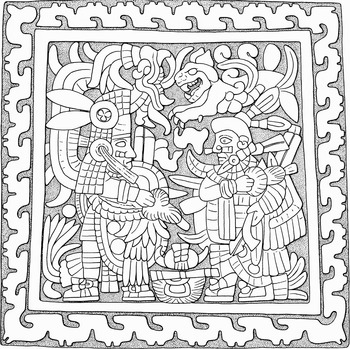
We are concerned only with the first of these two building phases, with which the sculptures are associated. Besides the slab covering the cache (Figure 6), the carved decoration of the temple included two panels on its outer north and south walls. Only eight out of eighteen carved stones were recovered, but we were unable to find any picture of them in the Carnegie photo archive. According to Ruppert (Reference Ruppert1931) the better preserved north panel showed two warriors facing each other, like the scene carved on the cache's lid. One of them had a long tubular bead through his nose and wore a feathered headdress and feathered robe.
The slab inside the temple (after Ruppert Reference Ruppert1931: Plate 10c).

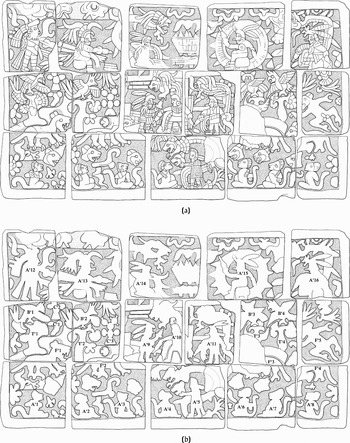
Two more panels graced the outer north and south walls of the colonnaded hall (Figures 7, 9). The low reliefs had been stuccoed and painted; the painting consisted of “extended areas washed in red and blue without attention to the motives;” the frame was painted blue. Ruppert (Reference Ruppert1931) published the retouched photos of both panels and had the background painted black in order to emphasize the motifs. The whole composition is easy to make out, but many details are doubtful or impossible to interpret. The new version (by Latsanopoulos) confirms most of Ruppert's illustrations and makes clear some details that were inconspicuous before. For instance, some plants were confirmed as cacti and sorted into two different species. In the Ruppert version, the uppermost part of the south panel is made of amorphous elements that look like a sky band in the new drawing.
Prior to drawing them, a complete photographic coverage of both panels was made, taking overall views plus detailed slides of each block. A one-to-one record of the panels was made in order to limit any loss of the data at the time of their reproduction. A single sheet of thin transparent film was laid on each panel, and every block was then completely and directly recorded (edges, carved elements, gaps) with fine, indelible felt pens. As a convention, he recorded the upper contours of the reliefs, aware that the motifs that protrude from the background are in fact slightly larger if the contour on the background is taken into account.
During the recording process, the artist constantly referred to the retouched Carnegie photos and found this check very useful since some blocks were greatly eroded and their motifs often hard to make out. Thanks to the Carnegie photos, it was possible to recover blurred contours and incised details. Some night photography and recording, however, would have been welcome. Back in the lab, the field records were reduced on the photocopier in order to piece together every panel at a convenient scale (A3). A new pencil drawing was then executed with the help of the field photos—a necessary step for selecting the good solution on questionable parts. This version, once mended and improved, was used for the final step, inking.
The Slab Inside the Temple (Figure 6)
The carved slab that was used as a lid to the cache buried in front of the temple's altar measures 66-x-68-x-15 cm. It is framed with a continuous chain of sectioned shells. The framed scene depicts two standing men, facing each other. Unidentified objects, maybe a sacred bundle and a ritual instrument, rest on the ground between the two figures. The man to the left is a serpent man. The reptile's head faces to the right, and its body, which ends with a bunch of feathers, resembles an S behind the man down to ground level. The figure's feet are shown in profile facing opposite directions, showing that the figure is standing motionless. His right hand holds an atlatl. His left hand, not visible, holds two darts whose far ends can be seen in front of the figure's face. Some details of his costume can be surmised: the sandals are toppedwith a knot; bands circle the figure's legs; a cylindrical cap is topped with a piece of crisscrossed cloth that hangs down to the shoulders; on the cap, a large ring fixes two feathers; a tubular bead pierces the nose and the earring includes a tube. A kind of apron, adorned with several layers of feathers and round elements, conceals the figure's left leg.
The other figure has both feet oriented to the left, meaning that he is walking toward the serpent man who stands motionless, as if waiting for him. The front part (legs and head) of a jaguar are visible above him. The feline's body evolves into a feathered serpent; first interrupted by the frame, it is seen again in front of the figure's body down to knee level. Then it disappears with the exception of its feathered tail, visible behind the left foot. An S-shaped jaguar-serpent emblem, symmetrical to the left figure's serpent, thus characterizes the right figure. The latter appears to be expressing submission and respect toward the man he faces by placing his atlatl on his left shoulder. In the other hand he holds a curved club, a common weapon at Chichen Itza, together with two darts whose far ends can be seen above his left shoulder. Two feathers adorn the man's cropped hair. He wears a layered feather cape, a wide belt, and knotted sandals. His left arm is covered with protective padding. His jewels consist of a tubular bead passing through his nose and a complex ear ornament apparently in dart form. To sum up, the slab inside the temple presents two human figures of unequal rank. The superior figure is a serpent man who faces a submissive individual whose emblem (probably indicating his function) is a jaguar-serpent.
The North and South Panels (Figures 7–9)
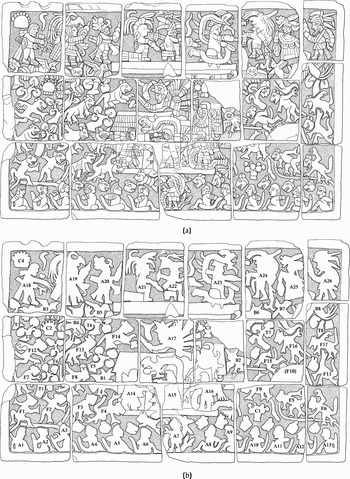
Both panels are carved directly on their respective wall, at a height of about two meters above the ground. They consist of three rows of five to six carved stones each. The north panel measures 114 × 180 cm, while the one to the south is also 114 cm high but 196 cm long. A plain frame, a few centimeters wide, surrounds the carved area.
The north panel and its reference sketch.

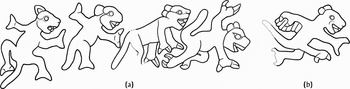
Details from the north panel: (a) The F1–F4 sequence showing jaguar knights becoming true felines; (b) F12, a feline transforming into a bird.

The south panel and its reference sketch.

Formal analysis
The panels combine two projection systems. First the orthogonal projection, in which the projected rays of light are parallel and intersect the panel plane at right angles; in this system there are no orthogonals, the edges in the scene are represented by points, and the front faces of objects are drawn as true shapes (Willats Reference Willats1997). Whatever their relative distance to the viewer, the objects are shown on the same scale: in other words, the image is flattened. As an example, in the lower register of both the north and south panels, the artist has placed on the same plane the individuals sitting in front and behind the figure standing in the middle. It seems that the purpose of this composition is to show that the seated people are either forming a circle around the standing individual or are facing him. There is no reason why the standing individual would turn his back to the six people on his right.
The other drawing system used here is the vertical oblique projection where the projection rays are parallel and intersect the picture plane at an oblique angle in the vertical plane. In this system the lower register is foremost while the upper register is to the back. There is no overlap or occlusion. On the temple slab and on the upper register of the south panel, for instance, the offerings seen one above the other are, in the real world, one in front of the other. In this system, the spatial order of the different episodes is vertical and goes upward; the sitting individuals around their leader come in front, then the jaguars, then the birds; the presiding dignitaries take up the upper register, meaning they are seen on the back stage. On the north panel, all dignitaries are shown in profile. The bench, on which the central figures are seated, occupies a lower position than the level on which the side figures stand, meaning that the bench is to be seen first, the side figures second. In perspective, all the figures would be facing the viewer: the dignitaries seated on the bench would take front stage with the side figures standing behind them.
Unlike what one would expect with orthogonal projection, the objects on both panels are not drawn at the same scale. Their relative size does not conform to the natural size, and sometimes expresses hierarchy. Thus, the dignitaries are taller than the sitting people (while their master is not). The birds are almost as large as the trees on which they are perched. In fact, here the birds are what matters; if the artist had drawn the trees at the same scale, that would have taken much space for no practical end.
The images include humans, felines, birds, and plants. The heads of all animated beings are shown in profile with the exception of nocturnal birds; the bodies are in profile or sometimes in three-quarter view. The two panels have the same narrative structure and tell the same story with variants. A scene with three humans occupies the center of both panels. On the lower register, seated human figures wearing a feline costume surround the principal protagonist, who is standing. On the sides, leaping jaguars converge toward the center of the composition while above them birds are perched on trees. The upper register displays seated or standing dignitaries of different rank, who preside over the scene below.
The central scene consists of three human figures in profile, two of them facing a third one, in front of a house. Because of its central situation and its “realistic” treatment, it may have been the first scene to be read, although we do not know exactly what it represents. Both panels combine the real world and the mythical world; to the former belong the sitting figures and their master, the central scene in front of the building, and the presiding dignitaries. Jaguars and birds are actors in the mythical world. The former converge from both sides toward the center, occupied, at least on the north panel by a flying figure; their jumping postures are dynamic and suggest movement. Contrasting with this dynamic progression, the birds settle on trees, motionless, expressing the stability of a later stage.
Within each panel, the main story progresses from bottom to top and includes two transformations: humans in feline costume into jaguars and felines into birds. The comparison of the two panels indicates a progression of the narration and a reading order from the north panel to the south panel.
In spite of being wider than the north panel, the south panel includes fewer subjects but of larger size: seven seated figures instead of twelve, five leaping jaguars instead of seventeen, no flying figure above the thatched building at the center, four birds instead of eight, five dignitaries instead of nine, and so on. It is as if the details of the story on the north panel could be summed up on the south panel.
Iconographic analysis
Curiously enough, the iconography of the Wall Panels sculpture has been seldom studied. Ruppert (Reference Ruppert1931), who investigated and published his findings on this structure, interpreted the figures of the lower register as monkeys, an interpretation that did not allow him to go further and offer a coherent analysis of the whole. Roys (Reference Roys1967) saw in the central part of the south panel “the four trees and birds set at the cardinal points to commemorate the previous destruction of the world.” Unfortunately for this reading, there are, on the north panel, six trees on one side and two on the other, plus eight birds.
For Wren, “each panel appears to function as part of a propagandistic campaign to magnify the hegemony of the Itza elite” (Wren et al. Reference Wren, Spencer, Hochstetler, Koontz, Reese-Taylor and Headrick2001:260–261; Wren Reference Wren and Prem2003). She sees the antagonism between the Itzas and their enemies illustrated in environmental terms: the barrel cacti in the north panel would refer to central Mexico, while the quetzals in the south panel refer to the southern Maya lowlands. Unfortunately for this hypothesis, there are cacti and quetzals in both panels. According to Wren, the Itza victory is celebrated by the display of bound, naked captives who occupy the lower registers of both panels. They “are identified not by rank, ethnic costume, or individual name but instead by their mythic role. A jaguar head emblem floats in front of each captive's face” (Wren et al. Reference Wren, Spencer, Hochstetler, Koontz, Reese-Taylor and Headrick2001:264). The author does not explain why “the defeated enemies of the Itza are identified by jaguars” (Wren et al. Reference Wren, Spencer, Hochstetler, Koontz, Reese-Taylor and Headrick2001:266).
We suggest that the major themes of the Temple of the Wall Panels iconography refer to the training of jaguar knights and their fate after death in the battlefield or on the sacrificial altar. It will be shown that the myths and beliefs illustrated in this temple of tenth-century Chichen Itza are remarkably similar to the Mexican mythology of the sixteenth century, as reported in indigenous and Spanish sources.
North Panel (Figure 7)
The central scene
Three men are standing in front of a long house with a thatched roof. A15, the central figure, stands in front of the house's only door. He is facing an individual without any of the regalia that would give him rank or function (A14) and precedes A16, a serpent man; the latter has a shield covering his left arm, and his right hand holds unidentified objects. We do not know if he is the same person as the serpent man depicted on the temple's slab. A jaguar-serpent with triangles (that may represent feathers) is drawn above and around A15. As the serpent's tail is not visible, one is tempted to conclude that the reptile's body undulates down to the lower register forming another S behind A7. However, the small jaguar floating in front of A7's face seems to be connected to the serpent with knives, naming A7 as a jaguar-serpent. Thus, A15 and A7 are designated with the same name jaguar-serpent and represent the same individual. The jaguar-serpent, like a glyphic compound, may refer to a class of people (like the serpent men), a function, or a name. It has not been reported in other Chichen Itza compositions.
A warrior is seen flying in the sky, above the building's roof (Figure 2b). Although no solar disk surrounds him, we think he is an image of the sun because he wears a helmet fringed with radiating spikes or rays, like the solar disk seen with the flying or falling warrior figure carved on top of pillars of the Northwest Colonnade (Tozzer Reference Tozzer1957:Figure 274).
The lower register
To the left, A7 faces six seated figures (A1–A6), while six others (A8–A13) are seated behind him. It is very likely that the sculptor wanted to show a man standing and surrounded by twelve seated figures. Since all figures were shown in profile, the sculptor had no other choice but to present six men in right profile and six in left profile. The left arm of A7 extends forward to show he is addressing the seated figures. Each has one leg flexed and resting on the ground, while the other leg has its foot resting in front of the knee of the opposite leg. Their faces and limbs are human while their bodies show long raised tails. They do not represent monkeys, as Ruppert (Reference Ruppert1931) thought, but jaguars since each seated figure (except for A1, A2, and A6 because of lack of space) has, close to him, a jaguar helmet to complete his disguise. All twelve figures have their arms tied back with ropes, the ends of which can be seen on A1, A3, and A8. Some seem to be wearing rope armbands. Most of the figures have cropped hair, while A1 and A6 seem to be topped by tightly bonnets. Ear ornaments are circular or tubular. Noticeably, A5 lacks an ear ornament.
The felines
Felines (F) with dynamic poses are disposed in three rows around the central scene. Converging from both sides, they run, leap, or jump toward A17, who is flying above the house. We think that these felines are the former jaguar knights of the lower register. A narrow band, looking like a branch or a rope, separates F1–F2 from A1–A3, F5–F6 from A11–A13, indicating a new episode. It represents the transformation of a knight into a feline, well illustrated by the F1–F4 sequence (Figure 8a). F1 and F2 are still human since they are standing on their hind legs, F3 is inclined forward, and F4 walks on all fours; a less obvious progression is shown from F7 to F6 and then to F9. The second row includes F7 and F8 to the left, F11 and F15 to the right; to these can be added another jaguar of which only very little remains (F10). The last and upper row is composed of F12, F13, and F14 to the left, and F16 and F17 on the other side. It is likely that another feline, symmetrical to F14, originally occupied the gap between C3 and T7.
The birds
Nocturnal as well as diurnal birds (B) perched on trees occupy the upper part of the middle register. With two exceptions (the nocturnal birds B1 and B2), they are situated above the felines. We suggest that the jaguars are transforming into birds. This transformation is shown on F12, a feline with its right paw in the process of becoming a wing (Figure 8b). Nocturnal birds are represented by screech owls, shown frontally with two tufts of hornlike feathers (B1, B2, B4, B6). It seems that quetzals, identified through their crest and long tail feathers (B3), represent most of the diurnal birds, while others have a crestless rounded head and a shorter tail (B5, B7).
Flora
The flora includes cacti (C) and trees (T). The former are of two kinds: the rounded biznaga or echinocactus (C1, C2) with shoots on top, and the nopal, with broad leaves and their pears (C3). Trees include a twisted trunk that divides itself into two or three branches that end with a rounded or oval leaf, simple or dented. Most often, trees support a bird (T4, T6, T7, T8). B3, a quetzal, is perched on a cactus. A bird from the cloud forest resting on a plant growing only in arid climate is ecological nonsense. The cacti may refer to the house of the sun that, in Aztec ideology, “was a place like a desert” (Sahagún Reference Sahagún, Dibble and Anderson1959–1982, III:49).
The upper register
Nine dignitaries are divided into three groups. In the center are the three most important people (A21–A23) seated on small stools that rest on the same bench. They are warriors, armed with atlatl and darts. Some of them wear a round shield on their backs; others, according to the junior author of this paper, show no signs of shields. Here Latsanopoulos differs from Ruppert in not seeing bird helmets on A19, A20, and A24. The figure to the front (A23) of the central group is a serpent man who faces three standing people: A24, who has ringed eyes, holds darts and what looks like a bag; A25 is very eroded; A26 holds an atlatl and a curved weapon. A last group of three warriors stands behind the central group; A19 and A20 have headdresses, while only A18 has cropped hair.
Interpretation
A15, A7, and the right figure on the temple's slab are the persons designated as jaguar-serpent. As A15, he appears under the patronage of A16, (a serpent man who may be the same individual as the one on the temple's slab) and welcomes—as he stands on the house's threshold—A14, who may be a young man entering the college or one of his parents.
A7 addresses the individuals seated in front or behind him, who form a circle around their master. We interpret them as young would-be warriors whose training involves the demonstration, by their teacher, of their fate and rewards. They wear a feline disguise, with only the helmet lacking to be complete. They are also shown as captives since their fate is to die on the battlefield or on the sacrificial altar. They wear captivity (and sacrifice) emblems of their own destiny and, in fact, are not shown with their hands bound and forming lines as true captives. On the northeast jamb of Copan Structure 10L–18, the warrior king is armed with lance and shield but has paper strips (a captive emblem) hanging from his ears instead of jade ornaments. A rope surrounds his head, and another very long one is ostensibly displayed on his chest (Baudez Reference Baudez1994:Figure 95). We may be surprised at seeing future warriors presented as captives. However, we should remember that the Aztec midwife, when addressing the mother who had just given birth to a boy, compares her to an eagle knight, to a jaguar knight not because, as we would expect, she had given birth to a warrior, but because she “had fought a good battle, had become a brave warrior, had taken a captive, had captured a baby” (Sahagún Reference Sahagún, Dibble and Anderson1959–1982, VI:167). A7 is the master, equivalent to the Aztec telpochtlato, master of youths (ibid, III:55), who trains the young recruits, telling them the destiny that awaits them.
Progressively, the students transform themselves into jaguars as shown in the F1–F4 sequence, in which jaguar knights become true jaguars (Figure 8a). This transformation may be explained in two different ways: either the jaguars are the jaguar knights who gather around the sun to offer their lives, or they are already dead warriors who, in the house of the sun (the tonatiuh ilhuicac of the Mexicas, an arid environment), rejoice when the star rises above the horizon and accompany it during its morning course before delivering it at noon to the cihuateteo. We favor the latter hypothesis as far as the jaguars’ move toward the sun precedes immediately their transformation into birds. In one version of the Aztec myth, told in Book 6 of the Florentine codex (Sahagún Reference Sahagún, Dibble and Anderson1959–1982, III:49), the dead warriors leave the sun at midday to the benefit of the cihuateteo and transform themselves into birds that suck flowers “everywhere.” In another version told in Book 3, they leave it after four years and, as birds, suck the flowers “where they dwelt” (that is, still in the house of the sun) and “upon earth.” What matters for the comparison with the Wall Panels is that in both versions (and in the variants reported by other authors), the warriors accompany the sun for some time before transforming into birds. The latter (Figure 8b) are supposed to come back to earth to gather the flowers' nectar. While the cacti allude to the desert environment of the house of the sun (“And where the war dead were, there were the magueys, the tziuactli plants, the mesquite groves” [Sahagún Reference Sahagún, Dibble and Anderson1959–1982, III:49]), the trees on which the birds perch refer to the earth's surface.
All figures of the upper register appear in profile, six looking to the right and three to the left. A23, the serpent man, shares the same bench with two other seated dignitaries (A21, A22) and faces three warriors (A24–A26). Three others stand behind the bench (A18–A20). The three central figures are the most important, and the serpent man, in front, is the leader of the other two. The three warriors to the right have no contrasting features in regard to the three individuals to the left; neither their gestures nor their attitudes indicate submission, welcoming, or confrontation. The distinct orientation of the figures indicates that three warriors are standing on both sides of a bench on which three dignitaries of superior status are seated. One may note that the feet of all these figures, be they standing or sitting, are on the same level; therefore, the throne-bench is lower than the ground on which the warriors are standing. It would then occupy the foreground, and the standing warriors would occupy the background.
What are these nine personages doing in such a mythological evocation? It is likely that they play a role in the training of the future jaguar knights, as illustrated in the lower register. They are accomplished warriors—real, not mythical—who would patronize the military school (perhaps a telpochcalli equivalent). Their chief is a serpent man, maybe the same individual as A16, seen in front of the house, and the one to whom the master is paying homage on the temple's slab.
South Panel (Figure 9)
The central scene
Rectangular elements in the background may represent the remnants of a building in front of which stand three figures (A’9, A’10 and A’11). The jaguar-serpent man (A’10) is in the center; his body faces forward with his feet oriented in opposite directions, meaning he stands motionless. He is armed with an atlatl and darts. Like on the north panel, a serpent man (A’11), who is holding an atlatl in his right hand and unidentified objects (weapons, perhaps) in his left, follows him. The body of his serpent is fringed with jade beads or chalchihuites. A’9 differs from his counterpart on the north panel (A’14), for he wears more sophisticated jewels and feathers in his headdress and brandishes an atlatl. The three armed men of the central scene may refer to the military training of the jaguar knights.
The lower register
Four seated figures to the left and three to the right surround A’5, the jaguar-serpent man. His elaborate striped costume includes tails; the stripes may indicate a distinctive material (maybe feathers) or fabric. He is holding and presenting a jaguar helmet to A’4, the figure immediately in front of him. All other seated individuals have the same posture with their arms tied in back, are donning the same feline costume with an long erect tail, and seem to be waiting to receive their helmet from their master's hands. The scene is interpreted as a graduation rite. The jaguar helmet the young warriors receive from A’5, completes their feline costume and makes them accomplished knights of the sun.
The felines
Three jaguars to the right (including the ithyphallic—a frequent attribute given to felines in Maya iconography—F’5) and two to the left are leaping toward the center of the panel. However, the sun that they are supposed to welcome or to follow is absent from the image. We do not give any special meaning to this absence, thinking that since the north panel is explicit enough on that subject, the carvers of the south panel were permitted to eliminate as much detail as they wished. Besides, we must be aware that the sun was not the only recipient of wars and sacrifices. There are 16 felines on the north panel, but here they are only five; with such a reduced number, the bodily transformation of the initiates is implied but not really shown as it is on the north panel.
The birds
They are perched on trees, immediately above the jaguars, confirming the transformation of felines into birds. There are two birds, assumed to be quetzals because of their crests and long tail feathers (B’1, B’2), on the left side; one owl (B’3) seen frontally; and another quetzal (B’4) on the right. No other species are suggested; the indication of both diurnal and nocturnal birds is what matters here. The owl may be interpreted as an emblem of military iconography, a role it played at Teotihuacan. However, when pairing with the quetzal, the emblematic nocturnal bird may simply refer to the night and the bird with the long green feathers, to the day. According to this interpretation, the dead warriors could transform themselves into either nocturnal or diurnal birds.
Flora
C’3 is clearly a nopal, while C’1 and C’2 are possible candidates for this plant. No other cacti, such as the echinocacti of the north panel, are present. The four trees that give shelter to the birds have big branches with a bunch of leaves at the ends. Many unidentified small elements are scattered among the panel's figures. Some of them could represent flowers or fruits. They seem to have been used mainly to fill empty spaces.
The upper register
Like on the north panel, it is composed of dignitaries but of a higher rank, justified by the importance of the graduation ceremony. Four of the five personages are seated on stools; only the warrior to the far left is standing. A’15, the sun king, brandishes his atlatl in the direction of the serpent man who is facing him, (A’14) and who keeps his (eroded) weapons in a lower position, a respectful gesture toward his superior. An offering, placed between the two men, consists of a large tripod open bowl containing rounded triangular elements. Under it (that is to its side, according to the perspective used) is a bunch of darts resting on two feet. Although the design is not precise enough to identify the container as well as its contents, it appears different from the cuauhxicalli depicted on the UTJ lintel (Figure 2c) that is identified through the eagle's feathers incised around the vessel's opening.
Behind the sun king another serpent man (A’16) is seated, holding an atlatl and what looks to be a club. Behind A’14, a warrior is seated holding atlatl and darts, and a standing warrior displays the same weapons. A starry sky extends over these personages; the stars are depicted as the central Mexican star glyph, a three-lobed affair with spikes for light-rays between the lobes.
One could interpret the stars as the dead warriors who, in some Aztec versions, were transformed into stars during the night. More simply, the celestial vault may confer to the personages—first of all the king—the cosmic importance they are entitled to. In Classic Maya art, the king is most often shown standing or seated on an earth monster mask with the serpent that represents the sky above his head. The starry sky figuring above important scenes or personages is a common trait in Late Postclassic wall paintings at Tulum (Miller Reference Miller1982:Plate 28) and Santa Rita (Gann Reference Gann1900).
CONCLUSIONS
The structural similarity of the two panels has led the way to fruitful comparisons. On the lower register of the north panel, the jaguar-serpent-man addresses the future jaguar knights while the students graduate on the corresponding scene of the south panel. Thus, the north panel precedes the south panel in time. The more warlike aspect of the figures in the central scene of the southern panel may be interpreted as a consequence of the graduation.
The upper register changes accordingly. While, on the north panel, the most important figure to preside over the daily activities of the military school is a serpent man, on the south panel it is the sun king who is invited to attend the graduation ceremony. Recall that on the temple slab the jaguar-serpent man, whom we identify as the master who trains the future knights and attends to their graduation, pays homage not to the king but to a serpent man presented as his immediate superior. This is probably the same personage who occupies the higher position on the upper register of the north panel. On the south panel, he is probably the one who pays homage to the king. The serpent man who receives allegiance from the master on the temple's slab may detain his power directly from the king; but he may also have some autonomy, as the ruler of the lineage of which the telpochcalli may depend. Therefore there exists the possibility of several military schools in Chichen Itza under the direct authority of the king.
The structure of both panels, the dynamics of their composition and the iconography suggest the following reading order: the upper register would be first in stating under which authority the scenes depicted below are placed. Then the central scene would introduce the master under the protection or supervision of the serpent man, who stands addressing someone in front of the telpochcalli building. The viewer's gaze then proceeds to the lower register, which depicts the warriors' training on the north panel and their graduation on the south panel. Finally, the viewer would be invited to enter the mythical world with a depiction of the warriors' destiny—movement around the sun and, later, their transformation into birds.
Our interpretation of the middle register of both north and south panels as an illustration of the fate of dead warriors is suggested by elements comparable to Aztec beliefs: jaguar knights surrounding the sun, birds succeeding jaguars. On the panels, the movement of the jaguars toward the sun may be interpreted either as the jaguar knights serving the sun before their glorious death or as the dead warriors in the house of the sun rejoicing when the star rises and then following it during its morning course. Assuming the jaguars transform into birds, this transformation may occur at the middle of the day with the quetzals following the sun in the afternoon and the owls during the night; it is also possible that both birds do not follow the sun anymore but are sent to earth to gather the nectar of flowers.
Although both versions of the Aztec myth do not include nocturnal birds, the hymn sung at the feast of Atamalcualiztli, which evokes the Tamoanchan paradise before sin, nocturnal birds—owls and barn owls—are cited among the birds of the afternoon paradise: “And still others imitated birds, owls, barn owls; and they appeared in the guise of still other birds” (Sahagún Reference Sahagún, Dibble and Anderson1959–1982, II:177).
Telpochcallis in Chichen Itza?
We noted how close the original architecture of the Temple of the Wall Panels is to that of the Temple of the Warriors. It is therefore assumed that the Temple of the Warriors was dedicated not only to the warriors but also to their activities, such as meetings, rituals, training, and the like. We later interpreted an important part of the structure's iconography as the education of future jaguar knights, followed by their graduation. Was the Temple of the Wall Panels—at least in part—a telpochcalli? We doubt it for several reasons: first, our structure is completely different from the thatched-roofed building depicted in the center of the north panel, which most likely represents the building where students and masters meet. Secondly, it is a small space, even for training a dozen students. If, however, it were a telpochcalli, it was certainly not the only one in Chichen Itza. According to the demands of its large warlike population, this city needed many military colleges of that size. From this perspective, it can be suggested that the Temple of the Wall Panels was reserved for the warriors of a lineage (or of a group of lineages or barrios) under the authority of a serpent man, a hypothesis confirmed by the temple's slab. This was the situation at Tenochtitlan where, according to Sahagún (Reference Sahagún and Garibay1956, III:301), every barrio had from ten to fifteen telpochcallis ruled by the telpochtlatoque or “masters of the young men.”
We do not have much information on the training received by the jaguar knights; while it probably included military practice such as combat and capture techniques, emphasis was placed on religious matters, as both north and south panels demonstrate. It was mandatory to persuade the young students that the main purpose of their engagement was to serve the sun by giving their life. While it was excellent to capture one's adversaries and offer them in sacrifice, the ultimate fate of any of them was to be killed or captured (as the arms tied in back recall) and sacrificed.
Military Orders
It is a demonstrated fact that warriors played a very important role in Chichen Itza society and religion. What remains to be studied in greater detail is the existence and importance of military orders comparable to the ones at Teotihuacan and to the Aztec knights of the sun. The tableros on the sides of the pyramid which supports the Temple of the Warriors are carved with animals of various species devouring human hearts (Tozzer Reference Tozzer1957:Figure 431); since animals other than birds of prey and felines are depicted, military orders may have been more diversified than previously thought. Curiously enough, these orders are not illustrated on the piers of the colonnaded hall of the same structure.
Besides being closely associated with power, as demonstrated by the thrones in feline form, the jaguar appears as the most frequently displayed military emblem in Chichen Itza iconography. The procession of jaguars and spears on the Temple of the Big Tables (Structure 2D–7), a close neighbor to the Temple of the Warriors (Schmidt Reference Schmidt, Kowalski and Kristan-Graham2007:Figure 7), corresponds to the procession of jaguars and shields on the façades of the Castillo sub (Marquina Reference Marquina1964:Lámina 263) and of the Temple of the Jaguars (Tozzer Reference Tozzer1957:Figure 85). The Temple of the Jaguar Atlantean Columns (Ruppert Reference Ruppert1952:Figure 143b) has its columns carved with warriors disguised as felines (the jaguar helmet opened); the warriors wear the butterfly or bird pectoral, a warrior emblem at Chichen Itza as well as Tula and later among the Aztecs.
Birds are second in importance to the jaguars. On the Platform of the Eagles, carved panels show eagles and jaguars devouring human hearts. A similar platform with an identical iconography has been excavated close to the Osario. On the altar-bench in the gallery of the Mercado, a bird-man – who is also a serpent man – holds the rope that chains captives, and tramples on two enemies (Ruppert Reference Ruppert1943). The recent excavation and restoration works at El Osario have revealed a façade decoration in which birds have a prominent role; some are shown in profile while warriors wearing bill masks are frontally presented with splayed arms sustaining wings (Schmidt Reference Schmidt2005; Reference Schmidt, Kowalski and Kristan-Graham2007). Paradise emblems, such as fruits, cacao pods, and jewels, surround these figures. On the Temple of the Owls, these nocturnal birds are, as usual, presented with open wings; the pop sign, a mark of power, is their emblem; here too the environment is loaded with fruit trees, cacao included, as well as flowers.
The Teotihuacan paintings show processions of jaguars, birds, and coyotes that represent military orders rather than gods if one compares them to processions of the same animals at Chichen Itza or Tula. Some sites seem particularly concerned with these warlike images, such as Atetelco and the Sun Complex. There Mural 2 of Portico 13 (De de la Fuente Reference de la Fuente1995, I :72, Figure 6.8) can be compared to the Chichen Wall Panels, with their depiction of jaguars, luxuriant vegetation, birds, and butterflies. In the Sun Complex, the diving bird-butterfly appears like another allusion to the myth (de la Fuente coord. Reference de la Fuente1995, I: 68, Figure 6.2).
The Warriors' Fate
We have interpreted the lower part of the south panel as a sort of graduation ceremony where the master makes true knights by completing their costume with the jaguar helmet; it can be assumed that the youths are then leaving their college. As far as we know, there is nothing of the kind depicted at Teotihuacan. Among the Aztecs, when the parents of a youth thought that it was time for him to marry, they asked the telpochtlatoque permission to allow their son to leave the college; the masters of the youths were invited to a banquet and received from the parents an axe as a sign of severing college bonds (Sahagún Reference Sahagún and Garibay1956, VI, chapter 23). In the words exchanged between parents and masters, no mention is made of the young man's future except for his wedding.
However, the fate of the young Aztec male of giving his life to the sun Tonatiuh and to the earth Tlaltecuhtli by dying on the battlefield or on the altar is described on several occasions, beginning with the boy's birth. When cutting the umbilical cord, the midwife tells the baby that “it was all affliction, travail, that would befall him on earth, and that he would die in war, or would die in sacrifice to the gods” (Sahagún Reference Sahagún, Dibble and Anderson1959–1982, VI:171). She also insists that “thy home is not here [in the family home], for thou art an eagle, thou art an ocelot.” She goes on: “Thou hast been sent into warfare. War is thy desert, thy task. Thou shalt give drink, nourishment, food to the sun, the lord of the earth. Thy real home, thy property, thy lot is the home of the sun there in the heavens”. At the ceremony of bathing the baby, the midwife raises “him as an offering to the heavens. She addressed, she cried out to the sun” (Sahagún Reference Sahagún, Dibble and Anderson1959–1982, VI:203) restating the warriors' sacrifice and gives additional details on their fate after death: “perhaps he will go to know thy home, the place of contentment, the place of happiness, there where the eagle warriors, the ocelot warriors, the valiant warriors, those who died in war, rejoice, are glad, are happy, remain gladdening thee, remain giving cries to thee”. The child's vocation to give his life to the sun and the earth is again mentioned in his parents' discourse when he enters the young men's house (Sahagún Reference Sahagún and Garibay1956: vol.I, Lib.3, cap.4, p.298).
The Sun Cult at Chichen Itza and Teotihuacan
Chichen Itza includes more images related to the sun cult. We mentioned above the southwest painting in the UTJ that represents a war dance performed in a village plaza that seems to mimic the celebration of sunrise by dead warriors (Coggins and Shane Reference Coggins and Shane1984). The carved ramps that flank the stairs of the North Temple of the Great Ball Court may illustrate the return to earth of the dead warriors as birds and butterflies (Tozzer Reference Tozzer1957:Figure 184). The latter are shown gathering nectar from the flowers of a tall tree whose roots penetrate an earth monster's mask. One can identify on the tree top a quetzal and a hummingbird, but no nocturnal bird.
In her study of the butterfly iconography at Teotihuacan, Headrick (Reference Headrick, Brown and Stanton2003) showed this motif represented a dead warrior's soul. She also indicated the frequent conflation, the butterfly-owl, suggesting that the Teotihuacanos believed that the warriors' souls took the appearance of these two animals. It is not surprising, then, that several centuries later, Chichen Itza worked out a comparable “system of rewards for dead warriors” (Headrick Reference Headrick, Brown and Stanton2003:161).
The birds carved on the front and sides of the pillars surrounding the patio of the Quetzalpapalotl palace offer an interesting comparison with those on the Chichen Itza Wall Panels. The birds depicted on the north, east, and south pillars are shown in profile while only those on the western side, where the sun sets, face the viewer (von Winning Reference von Winning1987, I:Figure 2a). This opposition has been justified by the fact that the visitor entering the patio from the east sees the birds he faces frontally and the birds on the sides in profile. While aesthetic considerations may have influenced the architect of the Quetzalpapalotl palace, we think that the front/profile contrast refers rather to two types of birds, nocturnal (owls) to the west and diurnal (be they quetzals or eagles) to the other directions.
The presence of bird-butterfly images associated with warriors at Teotihuacan, Chichen Itza, Tula, and Tenochtitlan suggests that these societies shared similar beliefs about the warriors' souls: to transform themselves into birds and/or butterflies and suck the nectar from flowers. At Teotihuacan, butterflies appear with military attributes while warriors display butterfly features on their costumes (Headrick Reference Headrick, Brown and Stanton2003). The mask, which makes up the central piece of the theater censers from Teotihuacan and Escuintla, often displays a nose plaque that looks like a butterfly body, a likely reference to the dead warrior that many of these censers celebrate. At Chichen Itza, as well as at Tula, warriors in the form of chacmools and atlantes, wear pectorals in the shape of a conflated bird-butterfly; in processions or battle scenes a stylized bird is part of the headdresses (Tozzer Reference Tozzer1957:Figure 555). The head-first position of the bird emphasizes the soul's descent to earth. The Aztecs adorned their warriors with both bird-butterfly pectorals and headdresses as can be seen from a warrior costume in the form of a xolopapalotl—a butterfly representation made with yellow feathers. In the Codex Mendoza (Berdan and Anawalt Reference Berdan and Anawalt1992:64), this peculiar costume is worn by a warrior who has captured three enemies. The butterfly image here alludes to the reward for his bravery.
RESUMEN
A través del análisis iconográfico podemos observar que en el siglo décimo de nuestra era, Chichen Itza estaba dirigida por un rey todopoderoso quien se identificaba con el sol, continuando con esta característica tradición maya del período clásico. En el complejo del Gran Juego de Pelota, varias imágenes en bajo relieve muestran las ceremonias de acceso al poder de un gran sacerdote tras la muerte de su predecesor y nos indican su probable función al lado del rey, como segundo personaje del reino. Al mismo tiempo, la elite política-militar estaba representada por individuos acompañados por una serpiente erguida en forma de S. Los demás guerreros formaban un cuerpo colectivo con muchas responsabilidades, tanto políticas como religiosas.
Este fue el contexto en el que se construyó y se adornó el Templo de los Tableros, cuya iconografía es el tema principal de este trabajo. Los tableros describen la formación de caballeros-tigres a cargo de una figura militar designada como Serpiente-Jaguar. Este último, que también figura esculpido en la laja que cubría el depósito enterrado en el templo superior, estaba asistido o controlado por otros personajes. El discurso iconográfico de los tableros anticipa el destino de los caballeros-tigres después de su gloriosa muerte, primero cuando acompañan el sol al amanecer y posteriormente cuando se transforman en aves. Este relato gráfico es comparable al destino de los guerreros aztecas tras su muerte si tenemos en cuenta los relatos de Sahagún y otros cronistas. Creencias similares debían ser usuales también en Teotihuacan como lo indica la frecuente asociación de la mariposa y del ave, a menudo combinados, con los guerreros. El Templo de los Tableros, sin duda demasiado pequeño para ser un telpochcalli (un colegio militar), era probablemente un lugar de reunión usado por guerreros, como lo sugieren su iconografía y su distintiva arquitectura que, dentro del mismo sitio, comparten con el Templo de los Guerreros.
ACKNOWLEDGMENTS
We thank the former director of the INAH Yucatan Center, Arqlgo Luis Millet Camara for giving his permission to record the sculptures on May 7 and 8, 2005 (Oficio D_618/2005). We are indebted to Annabeth Headrick, Heather McKillop, Cynthia Kristan-Graham, Linnea Wren and an anonymous reviewer, for their comments and suggestions that made us broaden the scope of our original paper and, we hope, improve it. We also thank Yvette Castro-Kornfeld for revising the English text and Carmen Varela for correcting the Spanish summary. Finally, we acknowledge the editorial work of Carrie Dennett.