SYLLABLES VERSUS PHONEMES
Phonological awareness is the ability to manipulate sounds in spoken words. There is much evidence that it helps beginners learn to read and write across different alphabetic systems (Castles & Coltheart, Reference Castles and Coltheart2004; Duncan et al., Reference Duncan, Castro, Defior, Seymour, Baillie, Leybaert and … Serrano2013; Ehri et al., Reference Ehri, Nunes, Willows, Schuster, Yaghoub-Zadeh and Shanahan2001; Rayner, Foorman, Perfetti, Pesetsky, & Seidenberg, Reference Rayner, Foorman, Perfetti, Pesetsky and Seidenberg2001). However, controversy persists about whether phonemes, onsets and rimes, or syllables are the optimal orthographic units of instruction when children first learn to read (Christensen & Bowey, Reference Christensen and Bowey2005; Seymour & Duncan, Reference Seymour and Duncan1997; Twist, Reference Twist2004). The debate arises from the contrast between small-unit theories and large-unit theories. These two approaches acknowledge the central role of phonological awareness in alphabetic literacy acquisition, but they differ mainly in their assertions about the nature and size of the optimal phonological segment during the initial phase of reading acquisition: phonemes for small-unit theories, onsets and rimes or syllables for large-unit theories (Duncan, Seymour, & Hill, Reference Duncan, Seymour and Hill1997; Ziegler & Goswami, Reference Ziegler and Goswami2005).
Large-unit researchers base their claims on the greater ease that beginners have detecting larger units in speech such as onset-rimes and syllables than detecting phonemes (Bryant, Reference Bryant1998; Ferreiro & Teberosky, Reference Ferreiro and Teberosky1999; Goswami, Reference Goswami1988, Reference Goswami1990; Treiman, Reference Treiman1985; Vernon & Ferreiro, Reference Vernon and Ferreiro1999). Small-unit researchers argue that because alphabetic writing systems represent speech at the level of phonemes, phonemic awareness is crucial in order to learn how letters (or graphemes) symbolize phonemes in speech. They regard grapheme–phoneme knowledge as central at the outset of literacy acquisition (Duncan et al., Reference Duncan, Seymour and Hill1997; Ehri, Reference Ehri2014; Hulme et al., Reference Hulme, Hatcher, Nation, Brown, Adams and Stuart2002; Seymour & Duncan, Reference Seymour and Duncan1997).
In Brazil, the issue is especially relevant as there is much disagreement about the best method to teach reading and writing. One of the main issues involves the role of syllables and phonemes in the initial acquisition of reading and writing (Soares, Reference Soares2016). Some researchers have advocated starting with a systematic phonics approach (Cardoso-Martins, Capovilla, Gombert, Oliveira, & Morais, Reference Cardoso-Martins, Capovilla, Gombert, Oliveira and Morais2005) whereas others have argued for a whole-language or meaning-centered approach (Weisz, Reference Weisz2004). Since the 1990s, the predominant literacy curricula in Brazil, especially in public schools, have been based on Emilia Ferreiro’s (Reference Ferreiro2009) theory, which advocates a syllable-based, meaning-centered approach in which grapheme–phoneme correspondences are only incidentally taught.
SYLLABIC APPROACH
According to Ferreiro (Reference Ferreiro2009; Ferreiro & Teberosky, Reference Ferreiro and Teberosky1999), before children grasp that the writing system is alphabetic, they pass through stages in which they believe that writing represents syllables. Beginners start by counting the number of syllables in a word and then writing as many letters as syllables. When this belief is challenged, they move to a more advanced stage toward alphabetic writing. The teacher’s job is to identify a child’s stage of literacy development (presyllabic, syllabic, syllabic-alphabetic, or alphabetic) and then help the child move to the next stage through application of whole-language instruction (Treiman, Pollo, Cardoso-Martins, & Kessler, Reference Treiman, Pollo, Cardoso-Martins and Kessler2013). This involves teaching children about reading and writing using texts with whole words embedded in context and with little or no attention given to individual letters and phonemes. Rather, syllables are taught as the basic unit of written language.
In spoken Portuguese, the syllabic structure is simpler than in English. It has fewer monosyllables and clearer syllable boundaries, so even beginners can detect where one syllable ends and another begins in disyllabic words (Vale, Reference Vale2011). This has led many educators in Brazil to believe that teaching syllabic spelling–sound units at the outset of instruction makes it easier for children to learn to read and write than teaching grapheme–phoneme units (Alves-Martins & Silva, Reference Alves-Martins and Silva2006; de Melo & Correa, Reference de Melo and Correa2013; Mousinho & Correa, Reference Mousinho and Correa2009; Weisz, Reference Weisz2004). However, this hypothesis lacks experimental evidence and is based mainly on anecdotes, correlational studies, and a belief in Ferreiro’s (Reference Ferreiro2009) theory.
What evidence there is regarding literacy acquisition comes mainly from studies with English speakers. Critics have suggested that because the English writing system is less transparent and much more complex than other writing systems, research in English may have limited relevance for a universal science of reading (Duncan et al., Reference Duncan, Castro, Defior, Seymour, Baillie, Leybaert and … Serrano2013; Share, Reference Share2008a; Ziegler & Goswami, Reference Ziegler and Goswami2005). This is one reason why many educators in Brazil prefer a theory like Ferreiro’s based on Spanish rather than theories based on English.
PHONEMIC APPROACH
A contrasting theory has been proposed by Ehri (Reference Ehri1992, Reference Ehri1998, Reference Ehri2014), who portrays reading and spelling development as a sequence of alphabetic phases. According to this theory, children learn to read words quickly and accurately by acquiring a powerful alphabetic mnemonic system to store the spellings of words bonded to their pronunciations in memory. This system enables the formation of connections between graphemes in the spellings of words and phonemes in their pronunciations, called orthographic mapping (OM). OM skill requires knowledge of grapheme–phoneme correspondences and phonemic segmentation.
Ehri (Reference Ehri2005) depicts reading and writing acquisition as a sequence of overlapping phases, each characterized by the predominant type of connection linking spellings of words to their pronunciations in memory. During development, the connections improve in quality and word-learning value, from visual nonalphabetic, to partial alphabetic, to full graphophonemic, to consolidated graphosyllabic and graphomorphemic connections. Thus, according to Ehri, children only conduct orthographic mapping with larger units (e.g., syllables) after they have mastered orthographic mapping with small units (graphophonemic correspondences).
EVIDENCE FAVORS A PHONEMIC APPROACH
Findings from several studies have questioned the importance of syllables in literacy acquisition in romance languages, especially Portuguese (Treiman et al., Reference Treiman, Pollo, Cardoso-Martins and Kessler2013). There is evidence raising doubt that a syllabic stage exists (Cardoso-Martins, Reference Cardoso-Martins2013; Cardoso-Martins & Côrrea, Reference Cardoso-Martins and Corrêa2008; Pollo, Kessler, & Treiman, Reference Pollo, Kessler and Treiman2005). Cardoso-Martins (Reference Cardoso-Martins2013) assessed literacy acquisition in Brazilian children to compare Ferreiro’s stage theory (Ferreiro, Reference Ferreiro2009; Ferreiro & Teberosky, Reference Ferreiro and Teberosky1999) and Ehri’s phase theory (Ehri, Reference Ehri2005, Reference Ehri2014). Her evidence showed clearly that alphabetic phases more accurately describe the early development of beginning readers than syllabic stages. Children were observed to move through alphabetic phases rather than syllabic stages.
In addition, there are data showing that instead of children writing letters to match only the number of syllables in words, a better explanation is that children write letters that represent salient sounds they detect in words (Cardoso-Martins & Batista, Reference Cardoso-Martins and Batista2005). Sometimes this happens to correspond to the number of syllables when the words written are dissyllabic with canonical syllables (consonant-vowel; CV; Sargiani & Albuquerque, Reference Sargiani and Albuquerque2016). The fact that they choose letters that represent sounds rather than random letters unrelated to sounds shows that they are not just counting syllables.
Several experimental studies conducted with European Portuguese beginning readers have demonstrated that beginning readers benefit more from small-unit decoding at the outset of learning to read (Vale, Reference Vale2006; Vale & Bertelli, Reference Vale and Bertelli2006). In addition, studies with Brazilian preschoolers have shown that beginners benefit more from phonemic knowledge than from syllabic knowledge in learning to read (Cardoso-Martins, Reference Cardoso-Martins1995, Reference Cardoso-Martins2013; Cardoso-Martins & Batista, Reference Cardoso-Martins and Batista2005; Cardoso-Martins, Mesquita, & Ehri, Reference Cardoso-Martins, Mesquita and Ehri2011; Treiman et al., Reference Treiman, Pollo, Cardoso-Martins and Kessler2013). Results are similar in other studies with regular writing systems such as German (Wimmer & Goswami, Reference Wimmer and Goswami1994), Italian (Degasperi, Micciolo, Espa, & Calzolari, Reference Degasperi, Micciolo, Espa and Calzolari2011), Welsh (Spencer & Hanley, Reference Spencer and Hanley2003), and Greek (Nikolopoulos, Goulandris, Hulme, & Snowling, Reference Nikolopoulos, Goulandris, Hulme and Snowling2006). A question addressed in the current study was whether Brazilian Portuguese children benefit more from orthographic mapping instruction at level of phonemes (small units) than at the level of syllables (larger units) at the outset of learning to read and write.
PHONEMIC AWARENESS INSTRUCTION
Among the different levels of phonological awareness, phonemic awareness (PA) has been found to be the best predictor of learning to read and write across different alphabetic systems (Cardoso-Martins, Reference Cardoso-Martins1995; Ehri et al., Reference Ehri, Nunes, Willows, Schuster, Yaghoub-Zadeh and Shanahan2001; Rayner et al., Reference Rayner, Foorman, Perfetti, Pesetsky and Seidenberg2001). This is because PA contributes to the teaching of grapheme–phoneme correspondences and their application in acquiring word decoding and spelling skill (National Early Literacy Panel, 2008; National Reading Panel, 2000). However, because phonemes are abstractions and require additional effort to be perceived in the speech flow, PA does not develop naturally but rather needs explicit teaching (Liberman, Cooper, Shankweiler, & Studdert-Kennedy, Reference Liberman, Cooper, Shankweiler and Studdert-Kennedy1967; Liberman, Shankweiler, Fischer, & Carter, Reference Liberman, Shankweiler, Fischer and Carter1974; Morais, Reference Morais1991).
The importance of teaching PA to beginners appears to depend on the transparency of the alphabetic writing system. A meta-analysis (Ehri et al., Reference Ehri, Nunes, Willows, Schuster, Yaghoub-Zadeh and Shanahan2001) found that effect sizes favoring PA instruction over non-PA instruction were larger in English studies than in non-English studies. According to psycholinguistic grain size theory (Ziegler & Goswami, Reference Ziegler and Goswami2005), in a less regular orthography such as English, PA instruction is more important because of the greater difficulty detecting phonemes that match up to graphemes. In contrast, in a more regular orthography such as Spanish or Italian, children can use one-to-one mapping to read almost any word, so PA instruction is less necessary.
Goldenberg et al. (Reference Goldenberg, Tolar, Reese, Francis, Bazan and Mejia-Arauz2014) interpreted their evidence to show this. They compared reading instruction and achievement in the United States and Mexico to explore the role of PA instruction in promoting early Spanish reading achievement. Results showed that Spanish-speaking children in the United States, regardless of whether their literacy instruction was in English or in Spanish, began in first grade with higher levels of PA in Spanish than children in Mexico, due to the emphasis on PA instruction in the United States. However, within 2 years Mexican children had caught up or surpassed US children in reading skills yet remained behind in PA. One possible explanation is that due to the transparency and relative simplicity of Spanish orthography, PA instruction was unnecessary for reading acquisition. Teaching PA might facilitate reading acquisition in opaque orthographies such as English, but not in transparent orthographies such as Spanish.
Although Spanish and Portuguese are considered shallow orthographies (Seymour, Reference Seymour2005; Seymour, Aro, & Erskine, Reference Seymour, Aro and Erskine2003), grapheme–phoneme correspondences are more consistent in Spanish than in Portuguese, which is intermediate in transparency. Grapheme–phoneme correspondences are not one-to-one in Portuguese. It has a greater number of vowels and explicit and implicit rules for pronouncing some consonants and vowel spellings. Defior, Cary, and Martos (Reference Defior, Cary and Martos2002) compared reading acquisition in Spanish and in European Portuguese. They showed differences favoring Spanish in reading time, accuracy of decoding, and the pattern of errors produced, especially in Grades 1 and 2. These findings reveal that Portuguese beginning readers have to cope with a less predictable orthographic system and hence face a more difficult task than Spanish beginners (Defior et al., Reference Defior, Cary and Martos2002). Hence, PA instruction may prove more valuable in Portuguese than in Spanish.
PHONEMIC SEGMENTATION INSTRUCTION WITH ARTICULATORY GESTURES
Teaching PA is not an easy task, considering the difficulty of perceiving phonemes in the flow of speech. Because phonemes are not separate acoustic segments but rather overlap seamlessly with other phonemes, and because their duration is brief and ephemeral, they are difficult for beginning readers to detect in phonemic segmentation tasks. Several PA teaching methods have been tested. Research has shown that training is most effective when segmentation is taught with tokens or letters because they provide a concrete rendering of these fleeting sounds (Ehri et al., Reference Ehri, Nunes, Willows, Schuster, Yaghoub-Zadeh and Shanahan2001).
Another way to make sounds concrete is to focus learners’ attention on the mouth positions and movements involved in producing the sequence of phonemes within words. This allows children to hold onto sounds and to distinguish one from another. According to the motor theory of speech perception, articulatory gestures are more central to the representation of phonemes in the brain than acoustic cues (Ehri, Reference Ehri2014; Liberman, Reference Liberman1999). Studies by Castiglioni-Spalten and Ehri (Reference Castiglioni-Spalten and Ehri2003) and Boyer and Ehri (Reference Boyer and Ehri2011) conducted with preschoolers and kindergartners who were prereaders suggest that teaching phonemic segmentation in English is facilitated when the instruction includes letters combined with information about the articulatory gestures involved in the production of phonemes. Siccherino (Reference Siccherino2013) found similar results with Brazilian Portuguese children. A question of interest in the current study was whether phonemic segmentation taught with letters and articulatory gestures would prove more effective than segmentation instruction taught only with letters.
THE CURRENT STUDY
The current experiment was conducted with Brazilian Portuguese-speaking kindergartners in Ehri’s (Reference Ehri2005) prealphabetic phase of reading and writing development. We explored whether emergent readers benefit more from graphophonemic OM instruction or graphosyllabic OM instruction, and whether the inclusion of articulatory gestures in teaching OM facilitates reading and writing acquisition more than teaching OM without gestures.
In our experiment, 4-year-old prereaders with very limited letter knowledge and PA were randomly assigned to one of four conditions. Children in the orthographic mapping of phonemes with articulation (OMP+A) group were taught to segment and blend words into phonemes using letters and pictures of articulatory gestures. Children in the orthographic mapping of phonemes without articulation (OMP) group were taught to segment and blend words into phonemes using only letters. Children in the orthographic mapping of syllables (OMS) group were taught to segment and blend words into syllables using letters. Children in the control group drew pictures to control for the Hawthorne effect. Students were taught in small groups following findings that segmentation instruction is most effective when taught to small groups (Ehri et al., Reference Ehri, Nunes, Willows, Schuster, Yaghoub-Zadeh and Shanahan2001). After training, all children were taught to read CVC, VCV, and CVCV words, and their memory for spellings of these words was tested. The questions of interest were whether children who received OM training at the level of phonemes would outperform children who received OM training at level of syllables, and whether children who received phonemic OM training with mouth pictures would outperform children who received phonemic OM training without mouth pictures. Effects were measured on word reading and spelling tasks. A follow-up study was conducted 1.5 years later to investigate the long-term effects of training.
METHOD
Participants
The sample consisted of 96 Brazilian kindergartners. Six children were dropped from the control group because they were absent during the posttests. This left 90 children, 52 girls and 38 boys ranging in age from 47 months to 60 months (M=53 months, SD=3.4). Participants were drawn from eight kindergarten classrooms in one public school serving predominately middle and low socioeconomic students in São Paulo. The kindergarten curriculum did not include any literacy instruction. Children were proficient speakers of Brazilian Portuguese, enrolled in regular classrooms. They were prereaders as no child could read or spell any words and knew few if any letters.
Preschool attendance in Brazil is optional before the age of 4 but obligatory for 4- and 5-year-old children, who may attend private or public preschool or kindergarten where little or no formal literacy instruction is provided. At most, they may learn about the alphabet and how to write their names. Children attend elementary school at age 6 when they begin formal literacy instruction.
Materials and procedures
Children completed pretests and posttests either individually or in groups. The number of correct responses was scored. Children received one of four types of training. The first author administered all the training sessions and posttests. Research assistants were trained to administer the pretests. The average time between pretest and posttest was 40 days for each of the groups. Children completed the tasks in the order listed below.
Naming letters
Children were pretested individually. They named 26 capital letters printed in random order, including 16 target letters: A, E, O, P, B, M, T, D, L, N, C, R, F, V, S, and Z. The names of target letters (all but C) contained the phonemes that were taught as sounds for letters during phonemic OM training. Children were tested again at the end of training. Test–retest reliability was 0.92 based on pretest and posttest scores.
Reading words
Children were pretested individually. They were asked to read 22 high-frequency words printed in capital letters and consisting of two or three phonemes. Words were mixed with eight unrelated pictures. No child read any words.
Spelling nonwords
Children were pretested individually. The ability to generate phonemic spellings was assessed by asking them to write nine nonwords containing two or three phonemes created from the 16 target letters. No child spelled any words.
Syllable counting
Children were tested in small groups before and after training. They were asked to segment nine spoken words into syllables. One training item (pipa – [kite]) was practiced with corrective feedback before children segmented the test items. They were shown a picture of each word and they counted the number of syllables (one to three) while drawing a mark for each on paper next to the picture. The words included three monosyllables (sol [sun], mão [hand], flor [flower]), three dissyllables (vaca [cow], casa [house], cobra [snake]), and three trisyllabic words (banana [banana], cavalo [horse], panela [pan]). The words were presented in mixed-up order. The number of words correctly segmented into syllables (max 9) was scored. The Cronbach α reliability on the posttest was 0.70.
Phoneme counting
Children were tested in small groups before and after training. The procedure was very similar to the syllabic counting task, but they were asked to segment six spoken words into phonemes. They were shown a picture of each word, and they counted the number of phonemes (two to four) by drawing a mark for each on paper. One training item (lua – [moon]) was practiced with corrective feedback before the test. The words were (pé [foot], bola [ball], ovo [egg], foca [seal], nó [knot], and asa [wing]) presented in this order. The number of words correctly segmented into phonemes (max 6) was scored. The Cronbach α reliability on the posttest was 0.60.
Learning to read words
Children were tested twice in small groups at the end of training. They were taught to read two sets of words on flash cards, five CVC/VCV words on the day that training ended and five CVCV words on the next day. The words were nóz (walnut), óca (a type of Brazilian indigenous house), ema (emu), mar (sea), avó (grandmother), pera (pear), lata (can), boca (mouth), fada (fairy), and sapo (frog). Two of the words, nóz and óca, lack diacritics in their conventional forms but were taught with diacritics to represent correct pronunciations.
The same procedures were used to teach both word sets. The task was administered to small groups. During the first study trial, each word was shown on a card, the experimenter pronounced it, and children were told to remember the word. On subsequent test trials, each word was shown, children read it aloud chorally as a group, and then the experimenter said the word. The group of children was given a minimum of 5 and a maximum of 12 trials to learn to read the words. Children were told to say the word immediately. The test trials continued until at least six of the eight children read all five words immediately as soon as each was shown. It was clear when this point was reached because there were few if any stragglers waiting to hear how the others responded. The number of trials to criterion was recorded. Once criterion was reached, children’s memory for the words was assessed with a spelling test described below.
Spelling memory
At the end of each of the two word learning tasks, children were asked to spell the words they had just learned to read. The researcher pronounced each word twice and children wrote the set of five words from memory. The number of correctly spelled letters in words (maximum of 15 in CVC/VCV words and 20 in CVCV words) was scored. Diacritics were not scored as no child wrote them. Cronbach α reliability calculated on the two sets combined was 0.89.
Experimental and control training conditions
Children were randomly assigned to blocks of eight students. Blocks were then randomly assigned to treatments, with three blocks in each of the four treatments. Instruction was delivered to these groups of eight children. In the OMP+A and OMP conditions, children received instruction in the orthographic mapping of phonemes. Training procedures were adapted from those used by Boyer and Ehri (Reference Boyer and Ehri2011). In the OMS condition, children received instruction in the orthographic mapping of syllables. Children in the control condition drew pictures to control for the Hawthorne effect.
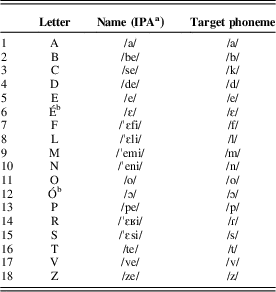
The same words were taught in all three forms of OM training during the final sessions and did not appear on any pretests or posttests. They included 5 VC, 15 CV, 10 VCV, 15 CVC and 15 CVCV words and nonwords. The Portuguese grapheme–phoneme correspondences were simplified in this study so that children were taught only one letter for each sound. Table 1 provides a list of target letters, letter names, and letter sounds that were taught. In most cases, the name of the letter contained its phoneme. The acute accent (´) over the letters E and O represented stressed phonemes and were taught as separate letters from unaccented, unstressed E and O.
Target letters and target phonemes from Brazilian Portuguese taught in this study

Note: Classification based on Mateus and D’Andrade (Reference Mateus and D’Andrade2000). The phonology of Portuguese. Oxford: Oxford University Press.
a International Phonetic Association.
b É and Ó are letters with diacritcs used to represent a stressed vowel.
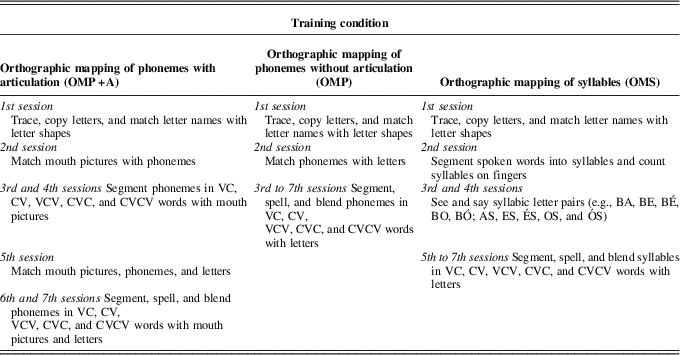
The content and sequence of instructional events in the experimental conditions are summarized in Table 2. The first training session consisted of 20 min of letter name instruction and was given to the three experimental groups but not the control group. This was followed by six sessions of training, each lasting approximately 25 min. Comparison of the OM training activities in Table 2 across conditions reveals the impact of fixed training time. The OMP+A group received less segmenting and blending practice than the other groups because these children had more to learn. They had to practice correspondences between phonemes, mouth pictures, and letters.
Orthographic mapping training activities by treatment condition and session

Letter instruction
The experimenter showed and named 18 uppercase letters printed on cards. Children repeated each name, associated letters with familiar spoken words, and drew the shapes of the letters at least once. Two of the letters, E and O, were presented twice, once printed with a diacritic and once without. Table 1 shows the target letters and names that were taught.
OMP+A condition
Children in the OMP+A condition used 8 cards displaying mouth pictures and 18 cards displaying uppercase letters. Two of the letters, E and O, were repeated twice, once with and once without acute accents to represent different vowel phonemes (see Table 1). Children used the cards to practice segmenting and spelling the phonemes in words and nonwords. Instruction consisted of the following steps.
Step 1: Matching mouth pictures to phonemes
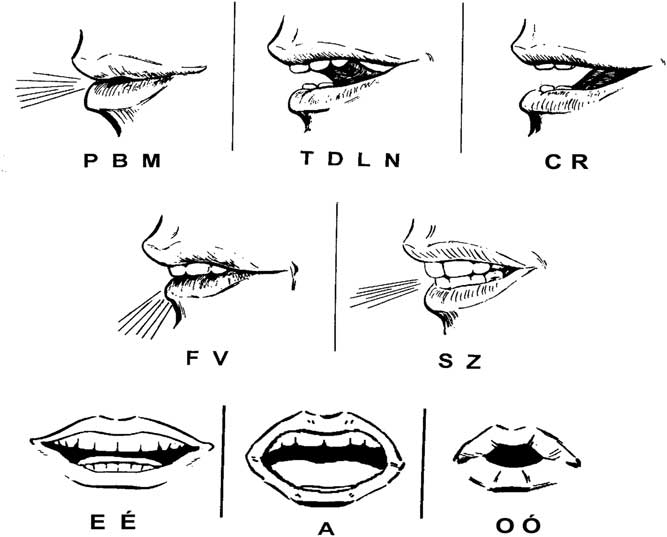
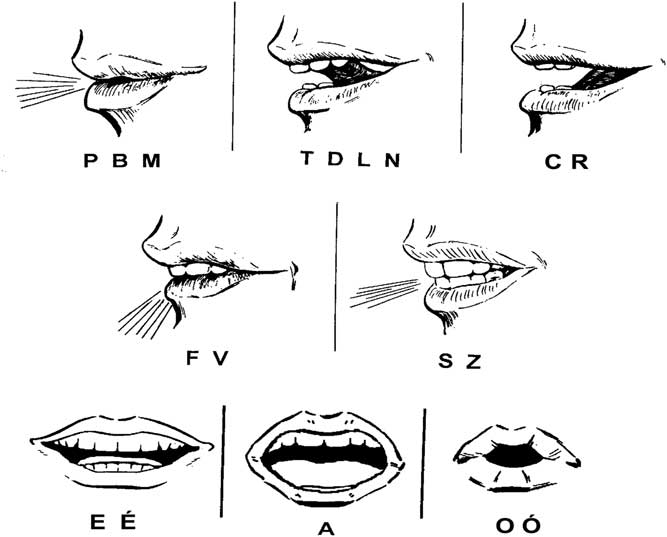
Children were taught to match pictures of 8 mouth positions with one or another of 18 phonemes. As shown in Figure 1, each picture depicted from 1 to 4 phonemes. Closed lips depicted /p/, /b/, and /m/. An open mouth with tongue lifted was associated with /t/, /d/, /l/, and /n/. An open mouth with the back of the tongue lifted was matched to /k/ and /r/. Teeth resting on lower lip with air escaping represented /f/ and /v/. Teeth exposed with air escaping depicted /s/ and /z/. Three different shapes of the lips depicted the five vowels.
Pictures of articulatory gestures depicting phonemes and letters taught in the, orthographic mapping of phonemes with articulation (OMP+A) condition. Letter C represented /k/. Drawings of mouth adapted from C. Lindamood and P. Lindamood (Reference Lindamood and Lindamood1975). Copyright 1975 by C. Lindamood & P. Lindamood. Reprinted by permission.
The researcher explained and demonstrated how the mouth moves to pronounce each phoneme. The children were placed in pairs and observed each other’s mouth movements. The researcher showed each picture, and children spoke the sounds it represented followed by corrective feedback. Then, the researcher spoke the sounds, one child at a time chose the matching mouth picture, and they received corrective feedback. This procedure took one session.
Step 2: Segmenting and blending phonemes in words with mouth pictures
Eight cards displaying the mouth pictures and a diagram of five square boxes arranged horizontally were shown. The researcher explained that they would select and move the mouth pictures into the boxes to reflect the sequence of phonemes that were pronounced in words. Children analyzed their mouth movements and received guidance from the researcher. They took turns moving the pictures into boxes for each word followed by a black square to mark the end of the word. After each word was segmented, the mouth pictures were sounded out and blended to say the word. The fact that mouth pictures depicted multiple phonemes was not a problem in the blending task because the specific phonemes associated with the pictures had just been pronounced in segmenting the word. Segmentation began with two-phoneme CV and VC words followed by VCV, CVC, and CVCV words (60 total). This training took two sessions.
Step 3: Matching mouth pictures, phonemes, and letters
Eight mouth pictures and 18 letters were displayed on cards. Children reviewed the names and sounds of the letters. Then each mouth picture was shown, and children pronounced each of the phonemes for that picture and chose the corresponding letter symbolizing that phoneme. The researcher provided explanations and corrective feedback. This required one session.
Step 4: Segmenting, spelling, and blending phonemes in words with mouth pictures and letters
The OM training here was very similar to Step 2 above, but now children used both letter cards and mouth pictures to segment words. The researcher spoke each word, children repeated it aloud, they segmented the word into its phonemes, they moved mouth pictures into a horizontal row of five boxes, and then they moved letters into a second row of boxes. Placement of a black square ended the word. After segmenting a word, they read the word by transforming letters into a blend of phonemes. Corrective feedback was given when needed. They took turns segmenting, spelling, and blending each of the 60 words, which were recycled until everyone could perform the procedure. This step occurred in two sessions.
OMP condition
Children in the OMP condition received the same materials, instructions, training, and number of sessions as children in the OMP+A condition except that training with mouth pictures was omitted. Children were taught to match phonemes and letters, to segment and spell phonemes in words by moving letters into horizontal boxes, and to blend the letters to form words. They took turns segmenting, spelling, and blending each of the 60 words, which were recycled until everyone could perform the procedure. Because the number of sessions was held constant across conditions, the OMP children received more training in grapheme–phoneme correspondences and use of letters to segment, spell, and blend than the OMP+A group (see Table 2).
OMS condition
Children in the OMS condition were taught to segment spoken words into syllables, to decode all possible letter combinations forming CV and VC syllables, and then to move letters into boxes representing spoken syllables.
Step 1: Segmenting spoken words into syllables
Detection of syllables in words was explained, examples were given, and children were taught to lift a finger as each syllable was spoken in 10 familiar single and multisyllabic words. This training took one session.
Step 2: Decoding all possible letter combinations representing CV and VC syllables
Children reviewed the names of 18 individual letters with corrective feedback. No attention was draw to phonemes that represented the letters. Children were shown the same individual letter cards used in the other conditions. The researcher selected one consonant card (e.g., B) and all the vowels cards (A, E, É, O, and Ó). He paired the consonant card with each vowel card to form different CV and VC syllables (e.g., BA, BE, BÉ, BO, BÓ; AB, EB, ÉB, OB, and ÓB). Children were taught to read each CV and VC blend always as a whole unit, never as separate phonemes. The vowels were presented always in the same order (A, E, É, O, and Ó), so first children practiced reading BA, BE, BÉ, BO, and BÓ, and then they practiced reading AB, EB, ÉB, OB, and ÓB. For each consonant, the CV set of vowels was introduced followed by the VC set of vowels. They practiced reading a total of 130 pairs (summing all possible CV and VC syllables based on 13 consonants and 5 vowels). Children took turns in reading all the pairs. This training took two sessions.
Step 3: Segmenting, spelling, and blending syllables in words
Children were provided with 18 letter cards and a drawing of five square boxes. The same 60 words used in the other training conditions were taught. The set included 5 VC, 15 CV, 10 VCV, 15 CVC, and 15 CVCV words and nonwords. The researcher spoke each word aloud and children repeated the word. Then they spoke the separate syllable(s) while lifting one or more fingers. Then they selected letters to move into boxes to spell the syllables in the word.
Children pronounced each VC and CV monosyllable and then selected two letters representing the syllable and moved them into one box. Children pronounced the two separate syllables in V-CV words and moved the initial vowel letter into the first box and the CV letter pair into the second box. CVC words are monosyllabic. Children realized that they were not divisible into the CV and VC syllables they had practiced. They were told to figure out how to write them as one syllable. Typically, they recognized the first CV part of the syllable and picked two corresponding letter cards but then realized something was missing. They were told to include one extra letter at the end, a letter whose name sounded like the final sound, to say the name of the letter, and to put the third letter in the same square with the others to spell the syllable. Detecting and selecting the final letter was made easier by the fact that the final letters (R, Z, S, and B) all contained the relevant sound in their names (see letter names in Table 1). Children pronounced the two syllables in CV-CV words and selected two pairs of letters to fill two boxes.
They were taught to place a black square in a box to separate spellings of the two syllables within V-CV and CV-CV words, and to mark the end of CV, VC, and CVC words. Then they blended the letter pairs to say the word. They were taught to pronounce whole syllables as they spelled or blended the letters. They were not taught to pronounce separate phonemes within syllables. Corrective feedback was given when needed. This took three sessions.
Control condition
Children were given colored paper and drew pictures. The researcher interacted with the children by asking about the drawings and giving suggestions. Two sessions each lasting 25 min were conducted.
Design and data analyses
The design consisted of an experiment with random assignment to three treatment groups and a treated control group. Pretests were administered to assess entry-level skills, and posttests to assess effects of training. Children were trained and tested in small groups for two reasons. Results of the National Reading Panel (2000) meta-analysis indicated that PA was more effective when taught to small groups of children rather than individually. In addition, small groups bear a greater resemblance to typical classroom instruction.
Because the sample involved emergent readers with very limited letter knowledge and no reading or spelling skill, performance on the literacy tasks was expected to be weak with skewed distributions and floor effects. A question of interest was whether training would lift children off the floor. To address this, the data were analyzed in multiple ways to cross check the pattern of results. These analyses included analyses of variance (ANOVAs) comparing effects across the four treatment groups on pretest and posttest measures. Significant main effects of treatment were followed by Bonferroni planned pairwise comparisons of means and Dunnetts post hoc test comparing each treatment mean to the control mean to localize the source of differences. It included within-subject t tests to assess pretest to posttest gains for each treatment group. Because distributions were expected to deviate from normal, Kruskal–Wallis nonparametric tests were conducted to assess whether the distributions of scores were equivalent across treatment groups, and if not to conduct pairwise tests to locate the source of differences. In addition, to examine how much training lifted these emergent readers’ posttest scores off the floor, the percentage of scores above zero on posttests in each treatment group was examined. Findings were accepted when multiple analyses yielded the same pattern of results.
RESULTS
Pretests
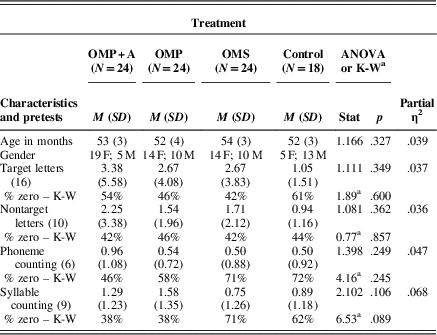
Table 3 displays mean scores of the four experimental groups on age and several pretests as well as test statistics. ANOVAs revealed no main effect of treatment indicating that mean performance of the groups did not differ significantly on any of the measures. Kruskal–Wallis nonparametric tests revealed that the distributions of scores did not differ significantly across the treatment groups on any pretest. It is apparent from means and the percentage of zero scores that children were emergent readers with very limited knowledge of letter names, and phonemic and syllabic segmentation. On the word and nonword reading and spelling tasks, all scores were zero.
Characteristics of children, means, standard deviations, and test statistics comparing the OMP+A, OMP, OMS, and control groups on age and pretest measures

Note: aTest statistics and p values for Kruskal–Wallis nonparmetric test are provided. This tests whether the distributions of scores are equivalent across treatment groups. The null hypothesis of no difference is retained when p>.05. OMP+A, orthographic mapping of phonemes with articulation. OMP, orthographic mapping of phonemes without articulation. OMS, orthographic mapping of syllables. ANOVA, analysis of variance.
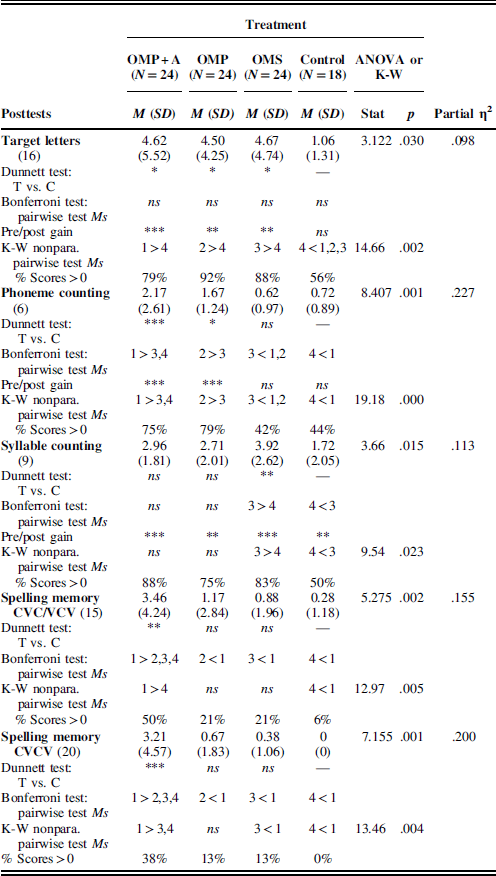
Three groups of students received relevant forms of instruction, either phonemic or syllabic, while the control group practiced an irrelevant task. Statistical tests were conducted on posttest scores to compare performance across the groups. Mean scores and test statistics are reported in Table 4.
Means, standard deviations, and test statistics comparing OMP+A, OMP, OMS, and control groups on posttest measures

Note: OMP+A, orthographic mapping of phonemes with articulation. OMP, orthographic mapping of phonemes without articulation. OMS, orthographic mapping of syllables. Statistically significant differences between pairs of means are noted by numbers corresponding to treatments: 1=OMP+A, 2=OMP, 3=OMS, 4=control. Pre/post gains in means were tested with paired-sample t tests for each treatment. K-W refers to Kruskal–Wallis nonparmetric test testing whether distributions of scores across treatment groups are the same. When null hypothesis (no difference) is rejected, pairwise comparisons of distributions are tested at p=.05. Significance values are adjusted by Bonferroni correction for multiple tests. *p<.05. **p<.01. ***p<.001.
Letter names
Training was effective in teaching some letter names in all three treatment groups. As shown in Table 4, a significant main effect of treatment group was detected on the measure of target letters. Both the Kruskal–Wallis test and Dunnett’s test comparing each experimental group to the control group revealed that all three treatment groups significantly outperformed the control group. Within-subject t tests conducted on each group separately revealed that pre- to posttest gains were significant in all three treatment groups but not in the control group (see Table 4). The percentage of trained students scoring above zero rose from 53% on the pretest to 86% on the posttest. Multiple analyses converged to reveal that letter training was effective. By the end of OM training, children in the treatment groups could name on average around 4.6 target letters.
Phoneme counting
Phonemic segmentation training was provided in two of the conditions, one conducted with letters and articulatory gestures (OMP+A) and the other just with letters (OMP). The posttest required children to record pencil marks for each phoneme in six words spoken by the experimenter. This task differed from the training task, which required children to use mouth pictures, letter tiles, or both to identify phonemic segments in words. Results of the ANOVA revealed a significant main effect of treatment on the number of words correctly segmented into phonemes (see Table 4). Dunnett’s test showed that only the OMP+A and OMP groups significantly outperformed the control group (both ps < .05), not the OMS group, which was trained to segment syllables, not phonemes (p=.987). Bonferroni tests showed that each of the two phoneme-trained groups segmented phonemes better than the OMS group (both ps < .05). The Kruskal–Wallis test showed the same pattern of results (see Table 4). Within-subject t tests confirmed that posttest scores were significantly higher than pretest scores in the OMP and OMP+A groups (both ps < .001) but not in the OMS and control groups. These analyses converge to confirm that both types of OM training with phonemes were effective in improving children’s ability to segment words into phonemes. In contrast, teaching children to use letters to map syllables did not improve their phonemic awareness.
One question of interest was whether training that included articulatory gestures as well as letters (OMP+A) would help children learn to segment phonemes more effectively than training with just letters (OMP). Both the Bonferroni and the Kruskal–Wallis pairwise tests revealed no difference between these two groups (p=.974 and .439, respectively). Both methods were equally effective in teaching phoneme segmentation.
Syllable counting
Use of letters to map syllables in words was taught in the OMS group. The syllable counting posttest required children to record pencil marks for each syllable in nine words spoken by the experimenter. The ANOVA revealed a significant main effect of treatment group (see Table 4). Findings of Dunnett’s, Bonferroni, and Kruskal–Wallis pairwise tests converged to confirm that only the OMS group marked more words correctly than the control group (p=.004), not the other two groups (ps>.16; see Table 4). This shows that syllable training but not phoneme training was effective in teaching syllable awareness. A within-subjects t test of mean syllable-counting scores showed that the syllable group improved significantly from pretest to posttest (p<.001). Mean syllable counting scores in the other three groups improved significantly as well (ps < .01), showing that performance improved even without training. This may have occurred because the identity of syllables in speech is transparent. Syllables can be distinguished by separate beats or stress points in words and hence are more accessible units than phonemes.
Reading words
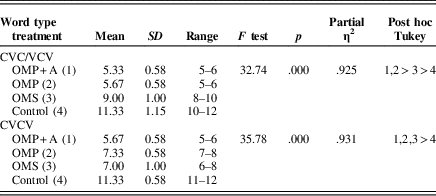
Children were taught to read one set of five CVC/VCV words and one set of five CVCV words on separate days. During the word-learning task, the experimenter recorded the number of trials to a criterion of one perfect reading of each set of words by at least six of the eight members of each subject group. ANOVAs were conducted with experimental treatment as the independent variable (four conditions) and number of trials for each subject group (three groups per treatment) as the dependent variable. Means and test statistics are reported in Table 5. Results revealed significant main effects of treatment. Tukey post hoc tests showed that the OMP+A and OMP groups who were taught to map phonemes took significantly fewer trials to reach criterion in reading CVC/VCV words than children who were taught to map syllables (OMS group), and all three treatment groups took significantly fewer trials than the control group. In learning to read CVCV words, all three treatment groups significantly outperformed the control group but did not differ among themselves. These results indicate that instruction in orthographic mapping of phonemes helped children learn to read CVC/VCV words better than orthographic mapping of syllables. Orthographic mapping of both phonemes and syllables facilitated learning to read both CVC/VCV and CVCV words more than no training.
Mean number of trials to criterion (12 max) in learning to read words by the four treatment conditions with performance of each subject group (3 per treatment) as the unit of observation

Note: OMP+A, orthographic mapping of phonemes with articulation. OMP, orthographic mapping of phonemes without articulation. OMS, orthographic mapping of syllables.
Spelling words
Following the word learning trials, children were asked to spell the words they had learned to read. The number of letters written correctly was the dependent variable. Diacritics were not scored because no child wrote any letters with diacritics. ANOVAs revealed significant main effects of treatment on both the CVC/VCV and CVCV sets of words (see Table 4). Dunnett’s test applied to CVC/VCV spellings revealed that only the OMP+A group significantly outperformed the control group (p=.002), not the other two groups (ps>.614). The Kruskal–Wallis and Bonferroni tests confirmed these results. The same pattern favoring only the OMP+A group over the control group was detected in the ANOVA of CVCV word spellings (see Table 4). In addition, Bonferroni tests showed that the OMP+A group significantly outperformed the OMP and OMS groups in spelling both the CVC/VCV and the CVCV words. These findings indicate that teaching children orthographic mapping with both letters and mouth pictures (OMP+A) was the only form of instruction that enhanced children’s ability to remember how to spell words that they practiced reading. Spelling ability remained very limited in the other two treatment groups, with only 21% of the children remembering how to spell any sounds in CVC/VCV words and only 13% remembering any CVCV spellings.
Supplementary analyses
The ANOVAs of pretests and all but one posttest were conducted with individual children as the unit of analysis. However, children were trained in three groups of eight in the treatment groups and three groups of five to seven in the control group. Despite low power (i.e., only three means per condition were compared), the ANOVAs were repeated with subject group means as the unit of analysis. Results revealed no significant differences among the treatments on all of the pretests (all ps>.14) and on the target letter posttest (p=.16) and the CVCV spelling posttest (p=.23). However, significant main effects of treatment were detected on three posttests: the phoneme counting posttest (p=.03), where Tukey post hoc pairwise comparisons revealed that the OMP+A group outperformed the OMS group and the control group; the syllable counting posttest (p=.038), where Tukey revealed that the OMS group outperformed the control group; the CVC/VCV spelling posttest (p=.038), where Tukey revealed that the OMP+A group outperformed the control group. These findings support previous results showing superior performance by the OMP+A group in phoneme segmentation and spelling, and the OMS group in syllable segmentation.
One important feature of the current study was its focus on emergent readers, that is, children with very limited literacy skills at the outset of the study. We were interested in how far they could be moved into reading and spelling when given training in orthographic mapping, with either letters representing phonemes or letters representing syllables. Results revealed significant gains from pretest to posttest on several measures, showing that training exerted a positive impact (see Table 4). Many children were lifted off the floor by OM training as shown by the percentages of scores that rose above zero on the posttests in Table 4. Most children (86%) could name at least one target letter following training. Phoneme segmentation instruction was effective in enabling 77% of the children to segment at least one word correctly. Syllable training enabled 83% to succeed in marking syllables. In spelling words, many fewer trained children showed any ability to recall letters in the words they had learned to read, only 31% spelling CVC/VCV words and 21% spelling CVCV words. Thus, although orthographic mapping training was effective with the majority of emergent readers in performing tasks they were taught, it was much less effective on a spelling transfer task.
DISCUSSION
Overall these results show that training in orthographic mapping was most effective when it focused on teaching phoneme segmentation with letters and mouth pictures. Although both phoneme-trained groups improved in their ability to count phonemes in words, and both learned to read words in the same number of trials to criterion, only phoneme training with articulation improved children’s ability to remember letters in the spellings of words they had learned to read. Syllable training improved children’s ability to count syllables in words but was less effective than phoneme-based training in supporting word reading and spelling memory. These findings support the hypothesis that phoneme-size letter units are more effective for moving emergent readers into word reading and spelling tasks than syllable-size letter units.
The current study advances our knowledge of literacy development in several ways. Our study extends previous research conducted in English by Boyer and Ehri (Reference Boyer and Ehri2011) and Castiglioni-Spalten and Ehri (Reference Castiglioni-Spalten and Ehri2003) by confirming the contribution of letters plus articulation to teach orthographic mapping in Brazilian Portuguese. Our findings show the superiority of teaching orthographic mapping with graphophonemic units over graphosyllabic units. Findings show also that orthographic mapping instruction can be conducted effectively with small groups of prereaders. This is consistent with the National Reading Panel’s (2000) meta-analysis showing the effectiveness of small group instruction to teach phonemic awareness.
Although some may wonder whether 4- and 5-year-olds are capable of monitoring mouth movements to segment words into phonemes, we found not only that they could learn to do this but also that they enjoyed the training. Boyer and Ehri (Reference Boyer and Ehri2011) and Castiglioni-Spalten and Ehri (Reference Castiglioni-Spalten and Ehri2003) reported the same observation and success with their emergent readers. Whereas in the previous studies, children were trained individually and were given mirrors to detect their mouth movements, in our study we worked with groups of children and had them pay attention to their peers’ mouth movements. Many children described their own experience when they helped others notice differences in the pronunciation of phonemes. Very likely this peer interaction enhanced their engagement and enjoyment of the training.
It is interesting that children ignored diacritics in learning to read and spell words. This was evidenced by the absence of any diacritics when they wrote words they had learned to read. Apparently at the outset of learning to read, children focus their attention exclusively on letter shapes. Future research is needed to explore when diacritics are noticed and how they are effectively taught. In Portuguese, teaching diacritics is a much overlooked and confusing issue. There is no research indicating when children begin to use diacritics or when teachers should teach them and how. Teachers may teach them only incidentally or they may teach formal rules. However, the rules do not work for all words, and they can change when reforms are introduced (i.e., three recent reforms in Brazil and six in Portugal). There are many rules for the use of diacritics. Some of them are regular. Some vary according to regional pronunciations. Others are dependent on the context or are a result of historical factors and have to be memorized for individual words.
A second study was undertaken to see whether children still retained the skills they had been taught 1.5 years later, and whether superior performance of students who received orthographic mapping instruction persisted. At this point in time, children were enrolled in their second year of kindergarten.
FOLLOW-UP STUDY
Method
Participants
Of the 90 participants comprising the original sample, 74 children were still enrolled in the school 1.5 years later. To equate the number of participants to be compared, 12 children were randomly selected from those who had previously participated in each condition. Participants were 48 children (30 girls, 18 boys), ranging in age from 65 months to 77 months (M=71 months, SD=3.3). During the interim period, children had not received formal literacy instruction in school.
Material and procedures
Children were assessed individually in one session lasting about 30 min. Children were readministered tasks given earlier: letter naming (α reliability=0.96), phoneme counting (α reliability=0.71), and syllable counting (α reliability=0.84). Three additional tasks were given as well.
PHONEMIC SEGMENTATION (MRS. MAGIC MOUTH)
The phonemic segmentation task consisted of a mix of 12 words and pseudowords containing two to four phonemes constructed from the 16 target letter-sounds. A drawing of a woman’s face called “Mrs. Magic Mouth” (Uhry & Ehri, Reference Uhry and Ehri1999) was shown with five blank tiles placed in her open mouth. The experimenter demonstrated how to remove a tile from the mouth as each phoneme in a word was spoken, and children copied him. Then children heard, repeated, and segmented the target words without any feedback. The numbers of words and phonemes correctly spoken and marked with tiles were scored. The α reliability was 0.92.
READING OF FREQUENT WORDS AND NONWORDS
Children were asked to read 22 words printed in capital letters and frequently found in books for children according to Pinheiro’s (Reference Pinheiro1996) word frequency list, mixed with 12 nonwords, and 8 object drawings to ensure some success. The α reliability was 0.99.
SPELLING WORDS
Children were asked to write 15 common words composed of two to four syllables. The number of phonemically acceptable letters was scored. The α reliability was 0.98.
Results and discussion
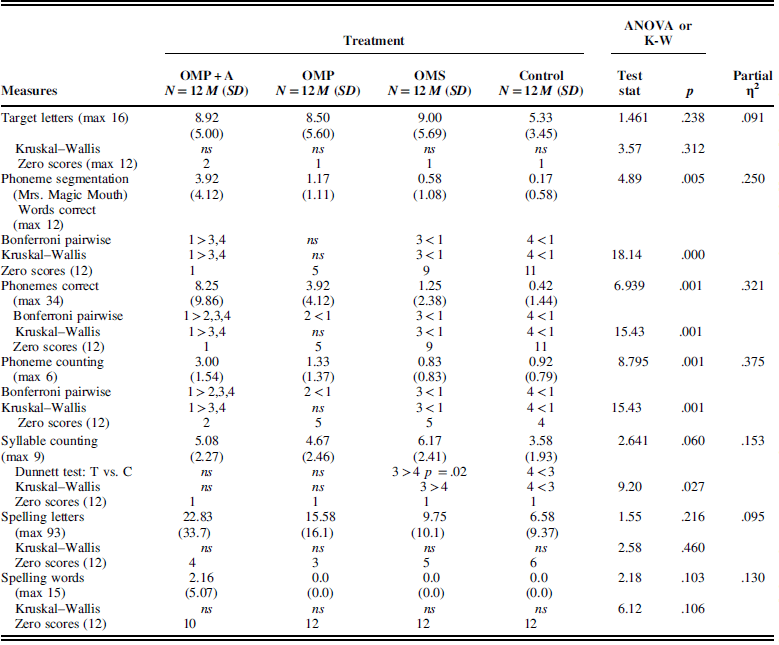
Table 6 shows mean scores on tests for the treatment and control groups. An ANOVA revealed no differences among the groups in naming target letters. Only one or two children failed to name any letters in each group. On average, children in the treatment groups had learned 56% of the letters at this point, so they were still far short of mastery.
Means, standard deviations, and test statistics comparing treatment and control groups in the follow-up study

Note: OMP+A, orthographic mapping of phonemes with articulation. OMP, orthographic mapping of phonemes without articulation. OMS, orthographic mapping of syllables. Statistically significant differences between pairs of means are noted by numbers corresponding to treatments: 1=OMP+A, 2=OMP, 3=OMS, 4=control. K-W refers to Kruskal–Wallis nonparmetric test testing whether distributions of scores across treatment groups are the same. When null hypothesis (no difference) is rejected, pairwise comparisons of distributions are tested at p=.05. Significance values are adjusted by Bonferroni correction for multiple tests. ns, not statistically significant.
Two phoneme segmentation tasks were given. In both the Mrs. Magic Mouth and the phoneme counting tasks, only the OMP+A group showed much success. Floor effects were evident on the number of correct words and phonemes in the other groups (see Table 6). ANOVAs revealed a main effect of treatment. Bonferroni tests showed that the OMP+A group significantly outperformed the OMS and control groups on the number of words segmented correctly, and outperformed the OMP group as well as the other groups on the number of phonemes segmented correctly. The Kruskal–Wallis nonparametric tests showed that the distribution of OMP+A scores differed significantly from the OMS and control group distributions on the word and phoneme measures. These results converged to confirm that effects of orthographic mapping training with letters and mouth pictures persisted 1.5 years later and enabled almost all OMP+A students to segment phonemes in words. In contrast, the other forms of OM training showed no lasting impact on phoneme segmentation.
In the syllable counting task, results of the ANOVA revealed a marginally significant main effect (see Table 6). Dunnett’s test showed that only the syllable trained group (OMS) significantly outperformed the control group. The Kruskal–Wallis test confirmed this effect. These results provide evidence that students who received orthographic mapping with syllables showed long-term memory for what they had been taught.
In the reading task, performance was poor with only five children reading any words and only two reading any nonwords. Greater success was evident in the spelling task, so the number of letters spelled phonemically was analyzed statistically (see Table 6). Mean performance of the OMP+A group was somewhat higher than the other groups, but both the ANOVA and Kruskal–Wallis tests showed no main effects of treatment. Performance was poor on the measure of correctly spelled words with only two students writing any words correctly, both trained with letters and mouth pictures.
In sum, results of the follow-up study showed that 1.5 years after training in orthographic mapping, some effects persisted. The group taught to segment words into syllables still outperformed the control group, suggesting a lasting effect of syllable segmentation training. Children who had been taught to map phonemes with mouth pictures and letters still outperformed the other groups in phonemic segmentation ability as shown on three different measures. However, they no longer possessed superior orthographic mapping ability, evidenced on the reading and spelling measures. All of the groups performed poorly on the reading and spelling tasks that required the processing of letters. There are several possible reasons for this. At the outset of the study, the children possessed very limited letter knowledge and no reading or spelling skill. Still 1.5 years later, they lacked full knowledge of letters. Our OM training was not extensive but consisted of only seven sessions that were group administered. Moreover, little if any literacy instruction intervened at children’s schools, so the skills that we taught received no further support.
GENERAL DISCUSSION
To summarize, orthographic mapping instruction was conducted with emergent readers who possessed very limited letter knowledge and no reading or spelling ability at the beginning of the study. OM training with letters and with letters combined with mouth pictures improved children’s ability to segment words into phonemes and to learn to read words in fewer trials compared to OMS training and no training. However, only OM training with letters and articulation pictures enhanced children’s ability to spell the words they were taught to read, and to remember how to segment words into phonemes 1.5 years later. Training showed no long-term benefits in reading or spelling tasks as children were still nonreaders with limited letter knowledge.
To our knowledge, ours is the first study to compare the benefits of OM instruction with syllables to the benefits of OM instruction with phonemes. Results support the hypothesis that training novice beginners to process the spellings of phoneme-size units is more effective for moving them into literacy than training them to process the spellings of syllabic units, despite the salience and simplicity of spoken syllables in Brazilian Portuguese. This is because the basic written units in Brazilian Portuguese are graphemes symbolizing phonemes. Syllables are represented by larger spelling units consisting of blends of grapheme–phoneme units. What beginners need to learn first are the basic grapheme–phoneme building blocks in order for the larger units to be processed and remembered.
What explains the advantage of OMP and OMP+A training in learning to read and spell words? According to connectionist theories (Ehri, Reference Ehri2014; Perfetti & Hart, Reference Perfetti and Hart2002; Share, Reference Share2008b), when readers decode individual written words, graphemes in their spellings become connected to phonemes in their pronunciations, and this secures spellings of the words bonded to their pronunciations in memory along with their meanings. To perform this mapping to memory procedure, readers must possess phonemic awareness and knowledge of grapheme–phoneme relations, and they must apply this knowledge when they read words. In our study, the two forms of phoneme OM training taught children the requisite knowledge they needed to learn to read words, as evidenced by their need for fewer trials to criterion in the word reading task. In addition, the OMP+A training provided children with greater clarity about phonemes within words, which better secured graphemes to phonemes in memory as they practiced reading the words and enabled them to spell the words better than children in the OMP condition. Children who received syllable training may have had more difficulty learning and remembering the words, because they were trying to use larger graphosyllabic units and this may have been premature. According to Ehri’s (Reference Ehri2005) phase theory, effective use of larger spelling units requires prior knowledge of grapheme–phoneme relations.
The greater effectiveness of OM instruction that included articulatory gestures is noteworthy. Typically phonemic awareness and phonics are taught by directing children’s attention to the sounds they hear in spoken words. However, sounds provide very limited cues about phonemes that are fused with other phonemes in speech, are brief in duration, and disappear as soon as they are heard. In contrast, the mouth positions and movements involved in producing speech are much easier to distinguish, because they are concrete and more amenable to monitoring and analysis. In addition, the motor theory of speech perception suggests that articulatory gestures are central to the representation of phonemes in the brain (Liberman, Reference Liberman1999). This theory combined with previous and present findings suggests that directing children’s attention to mouth movements as well as sounds is the best way to conduct phonemic segmentation and orthographic mapping instruction for the purpose of moving emergent readers into literacy.
Orthographic mapping instruction that includes articulatory gestures has been studied by others. Boyer and Ehri (Reference Boyer and Ehri2011) and Castiglioni-Spalten and Ehri (Reference Castiglioni-Spalten and Ehri2003) observed superior ability to learn to read words compared to segmentation instruction without mouth pictures. These studies like the present study were conducted with 4- and 5-year-olds. However, Wise, Ring, and Olson (Reference Wise, Ring and Olson1999) did not observe any advantage of instruction in phoneme segmentation conducted with articulatory gestures. Their participants were second- to fifth- grade struggling readers, suggesting that the benefit of mouth pictures may be limited to prereaders and beginning readers. A focus on articulation may sensitize young children to the phonemes in words and may strengthen the connections between letters and phonemes in the phonological representations of words in memory based on the motor theory of speech perception (Liberman, Reference Liberman1999).
According to Ehri’s (Reference Ehri2005) phase theory of reading development, children with very limited letter knowledge function at the prealphabetic phase. They rely on visual or other nonalphabetic information when asked to read or spell words. They are essentially nonreaders. Results of the current study revealed that with training, these prealphabetic readers can acquire some rudimentary alphabetic skills even though their letter knowledge is still very limited. Training in the orthographic mapping of phonemes can lift them off the ground and sensitize them to phonemes in words. OM training that includes not only letters but also articulatory positions can improve their ability to remember how to read and spell words. Phoneme segmentation instruction with letters may be the first step in moving them to the next partial alphabetic phase in learning to read words.
Orthographic mapping of phonemes was compared to the OM of syllables. Because syllables are salient units in spoken Portuguese, some have claimed that these are the optimal units for teaching children to read (Alves-Martins & Silva, Reference Alves-Martins and Silva2006; de Melo & Correa, Reference de Melo and Correa2013; Mousinho & Correa, Reference Mousinho and Correa2009; Spinillo, Maria, Elia, & Correa, Reference Spinillo, Maria, Elia and Correa2010). However, results failed to support this belief. Children who received training in syllable mapping performed worse than children who were taught mapping at a phonemic level. One explanation is based on Ehri’s (Reference Ehri2005) phase theory of development. Orthographic mapping with larger graphosyllabic units requires prior learning of graphophonemic units and hence emerges later during the consolidated phase after children have learned and applied graphophonemic units to read and spell words during the full alphabetic phase of word learning.
Another explanation deserves consideration. Proponents of the syllabic method might question the adequacy of the syllabic method that was used. One possible concern is that OMS children were taught orthographic mapping with separate consonant and vowel letter cards to represent spoken syllables. Having children select and position separate letter cards together may have drawn their attention to phonemes and distracted them from focusing on syllable units. Moreover, after OMS children segmented, pronounced, and spelled the initial CV in a CVC syllable, they spelled the final phoneme in the CVC by selecting a single letter and saying its name. This too may have confused them by drawing attention to individual letter–sound relations. However, several points argue against these possibilities. Children only practiced pronouncing syllables, never separate phonemes. In the CVC task, they only named final letters. They did not pronounce their sounds. Performance of OMS students segmenting words into phonemes on the posttest showed that OMS students did not become aware of phonemes. They performed worse than the phoneme-trained groups and no better than the control group (see Table 4). In addition, the likelihood that children would become aware of phonemes is challenged by research showing that prereaders have great difficulty detecting phonemes in words without explicit instruction (Ehri et al., Reference Ehri, Nunes, Willows, Schuster, Yaghoub-Zadeh and Shanahan2001). The syllable method was effective in teaching OMS children to segment words into syllables, as evidenced by their superior performance on this posttest, and training enabled them to learn to read words better than controls, suggesting that any phoneme distraction effects during OMS training were minimal. Nevertheless, concerns about the adequacy of the syllable training method invite further research to determine whether minimizing attention to subunits within syllables would improve the effectiveness of this method.
The procedure of working with groups of students rather than individuals to administer training and some posttests in the current study merits consideration. In its favor are findings of the National Reading Panel’s (2000) meta-analysis indicating that phonemic awareness training was most effective when delivered to small groups of children. In addition, group instruction has more ecological validity for classroom practice. However, groups also impose some limitations. It is harder to monitor whether each student is learning. Instruction must rely on exposure to information and group practice. Despite these limitations, results of the current study showed that group training was effective.
Although children trained in orthographic mapping of phonemes showed movement toward alphabetic processing at the end of training, the effect on reading and spelling was gone 1.5 years later. The OMP+A group who received training in letters and articulation remembered how to segment words into phonemes, and the OMS syllable-trained group showed some memory for syllable counting, but these phonological skills did not support reading and spelling skills. These children remained in the prealphabetic phase. One likely reason why growth was halted was because these children subsequently did not receive any literacy instruction at school. They still fell short in their letter knowledge. According to Ehri’s (Reference Ehri2005) phase theory, these conditions would keep them from moving into the partial alphabetic phase.
Current findings combine with evidence from previous studies to show that phonemic awareness and letter knowledge are essential skills to teach at the beginning of learning to read and write in Portuguese (Cardoso-Martins, Reference Cardoso-Martins1995; Cardoso-Martins et al., Reference Cardoso-Martins, Mesquita and Ehri2011; Maluf & Sargiani, Reference Maluf and Sargiani2014; Siccherino, Reference Siccherino2013; Vale & Bertelli, Reference Vale and Bertelli2006). Findings raise doubt about the assumption that syllabic awareness is more important at the outset in learning to read and write in Brazilian Portuguese (Alves-Martins & Silva, Reference Alves-Martins and Silva2006; de Melo & Correa, Reference de Melo and Correa2013; Mousinho & Correa, Reference Mousinho and Correa2009; Spinillo et al., Reference Spinillo, Maria, Elia and Correa2010). However, future research is needed to extend the current study. Selection of children with more extensive knowledge of letters should improve the effectiveness of orthographic mapping instruction. Children might be trained individually to a criterion of mastery to compare the course of learning with graphophonemic versus graphosyllabic units.
Results of this study carry implications for instruction. They show that young Brazilian children can benefit from group-administered instruction in orthographic mapping of phonemes in words, especially when both mouth pictures and letters are used. Early childhood teachers should be encouraged to teach phonemic awareness in this way (Vale & Bertelli, Reference Vale and Bertelli2001) to prepare their students for formal reading instruction. This instruction should be viewed as a right of children and the duty of schools.
ACKNOWLEDGMENTS
This study was completed by the first author as a doctoral dissertation in psychology at the University of São Paulo, Brazil. The study was supported by Fundação de Amparo à Pesquisa do Estado de São Paulo (the São Paulo Research Foundation, FAPESP), through Doctorate Grant 13/12602-5 and Research Internships Abroad Grant 14/00711-7.