INTRODUCTION
It is well-established that a visually presented word is recognized more easily by native (i.e., L1) speakers when it has been preceded by a masked prime that is morphologically related to it through either suffixation (e.g., agreement–AGREE) or prefixation (e.g., disagree–AGREE), relative to an unrelated baseline (e.g., happiness–AGREE). Importantly, no such masked priming is observed when the prime and target also overlap orthographically, but where the extra letters in the prime do not form an affix (e.g., sandwich–SAND or thousand–SAND). Such a finding indicates that derived words are decomposed into their stem and affix during word recognition (see Rastle & Davis, Reference Rastle and Davis2008, for a review).
When it comes to nonnative (i.e., L2) speakers, the picture is rather different (e.g., Diependaele et al., Reference Diependaele, Duñabeitia, Morris and Keuleers2011; Heyer & Clahsen, Reference Heyer and Clahsen2015; J. Li et al., Reference Li, Taft and Xu2017; M. Li et al., Reference Li, Jiang and Gor2017; Li & Taft, Reference Li and Taft2019). While there is ample evidence that L2 speakers, regardless of proficiency, demonstrate facilitation when the target is derivationally related to the masked prime (e.g., agreement–AGREE; disagree–AGREE), they also demonstrate facilitation when the prime and target are related orthographically but not morphologically (e.g., sandwich–SAND; thousand–SAND). That is, L2 speakers, unlike L1 speakers, appear to be more sensitive to the form relationships between words than morphological relationships, at least when it comes to the early stages of processing into which masked priming taps.
There is, however, a situation in which purely form-based facilitation (i.e., “form priming”) is observed in the masked priming paradigm even for native speakers, namely, when the prime is a nonword. In particular, when the nonword prime consists of the target plus letters that do not create an affix (e.g., sandwost–SAND or cloisand–SAND), responses to the target are faster than to an unrelated prime (Beyersmann et al., Reference Beyersmann, Casalis, Ziegler and Grainger2015, Reference Beyersmann, Cavalli, Casalis and Colé2016, Reference Beyersmann, Kezilas, Coltheart, Castles, Ziegler, Taft and Grainger2018, Reference Beyersmann, Grainger and Taft2020; Hasenäcker et al., Reference Hasenäcker, Beyersmann and Schroeder2016; Heathcote et al., Reference Heathcote, Nation, Castles and Beyersmann2018; Morris et al., Reference Morris, Porter, Grainger and Holcomb2011; Taft et al., Reference Taft, Li and Beyersmann2018). So, given that such orthographic priming occurs with nonword primes and not with real word primes (e.g., sandwost–SAND, but not sandwich–SAND; cloisand–SAND, but not thousand–SAND), the implication is that the lexical representation of a word embedded at the beginning or end of a prime is activated, but is then inhibited when there is a lexical representation for the whole word to compete with it. For example, sandwich and thousand have a lexical representation to compete with sand, but sandwost and cloisand do not. Morphological factors override this inhibitory effect, though, hence explaining why word primes continue to facilitate their morphologically related targets (e.g., agreement–AGREE). Such a mechanism is captured in the model of word recognition proposed by Grainger and Beyersmann (Reference Grainger and Beyersmann2017) where edge-aligned embedded words are initially activated in the prime, but then inhibited when the remaining letters fail to contribute to a coherent morphological structure.
Given the pattern of priming observed with native speakers, then, what nonnative speakers appear to lack is the inhibitory mechanism that eliminates priming when the orthographically overlapping prime and target words are not morphologically related. That is, the lexical representation of an edge-aligned embedded word remains active for longer than is the case for native speakers. A lack of inhibition for L2 speakers is also seen when the potentially competing lexical representation is activated through orthographic similarity rather than through an edge-aligned embedding. Qiao and Forster (Reference Qiao and Forster2017) showed that word primes that differed from the target by a single substituted letter (e.g., protect–PROJECT) facilitated recognition of the target for L2 speakers, but not for L1 speakers. However, even native speakers showed facilitation when the prime was a nonword (e.g., pronect–PROJECT). It seems, then, that the orthographic similarity between a prime word and a target word helps nonnative speakers recognize the target but generates competition between the prime and target for native speakers that eliminates any facilitation arising from letter overlap.
So, the argument is that, in the process of activating the lexical representation of a visually presented word, both native and nonnative speakers activate other words that orthographically overlap with it because these words either have many letters in common with the presented word or are embedded at its beginning or end. Native speakers then suppress any such extraneously activated word unless there is the prospect that it forms a morpheme that is relevant to the presented word. If there is no such prospect, the only lexical representation that remains active is the representation of the presented word, which means that there will be no facilitation in recognizing the extraneously activated word if it is subsequently presented (e.g., the sand of thousand). In contrast, it appears that nonnative speakers fail to inhibit the extraneously activated word, as is seen in the priming of that word when it is subsequently presented for recognition (e.g., Diependaele et al., Reference Diependaele, Duñabeitia, Morris and Keuleers2011; Heyer & Clahsen, Reference Heyer and Clahsen2015; J. Li et al., Reference Li, Taft and Xu2017; M. Li et al., Reference Li, Jiang and Gor2017; Li & Taft, Reference Li and Taft2019; Qiao & Forster, Reference Qiao and Forster2017).
In fact, the priming that nonnative speakers exhibit could potentially arise from one of two alternative sources. The first possibility is that the lexical representation for the word that was extraneously activated in the prime remains active when the target is presented (as is assumed to happen for L1 speakers when the prime is a nonword). The alternative possibility is that the priming arises merely from repetition of the overlapping letters. If so, it would indicate that the sublexical units that L2 speakers make use of when activating their lexical representations during word recognition are of a smaller grain size than for L1 speakers.
The present study looks at this by examining cases in which the word embedded at the end of the prime is not itself the target but, rather, is embedded at the end of the target as well. The logic behind this is outlined in the following text. The reason for looking at final embedding is that J. Li et al. (Reference Li, Taft and Xu2017) only observed priming of a word embedded at the beginning of the prime when the L2 speakers were of lower proficiency, whereas the priming of a word embedded at the end of the prime was observed by Li and Taft (Reference Li and Taft2019) regardless of L2 proficiency. Therefore, the examination of final embedding reduces any concerns that might be raised with regard to the English proficiency of the L2 speakers.
THE PRESENT STUDY
As pointed out earlier, recognition of a target word is facilitated for L1 speakers when it is embedded at the end of a nonword prime even when the other letters of that prime do not form a prefix (e.g., Beyersmann et al., Reference Beyersmann, Cavalli, Casalis and Colé2016, Reference Beyersmann, Grainger and Taft2020; Heathcote et al., Reference Heathcote, Nation, Castles and Beyersmann2018). So, cloisand primes responses to SAND, and sabagree primes responses to AGREE. According to the Grainger and Beyersmann (Reference Grainger and Beyersmann2017) account, this is because the lexical representation for the target is activated through edge-aligned processing when the prime is presented and is not inhibited by competing activation in a lexical representation for the prime. What should happen, though, when the target has a prefix, such as sabagree–DISAGREE?
If the prefixed word shares a representation with its stem (as would be the case if it is recognized through a representation of its stem, e.g., Taft & Ardasinski, Reference Taft and Ardasinski2006; Taft & Forster, Reference Taft and Forster1975), then preactivation of the embedded word should still facilitate responses to the target for native speakers. If priming also arises for nonnative speakers from preactivation of lexical information, they should show a similar magnitude of sabagree–DISAGREE priming as the L1 English speakers (unless they are insensitive to the fact that disagree is a morphological variant of agree). However, even if priming for L2 speakers were to arise from pure orthographic overlap, they should still show priming in this condition given the shared letters between the prime and target. So, the existence of sabagree–DISAGREE priming would not differentiate between the two possible sources of priming for nonnative speakers. To do so requires a different priming condition.
Consider plerough–THOROUGH, where the extraneously activated word embedded in the prime (i.e., rough) is found in the target, but is not the stem of that word. Because the lexical representation for thorough has no special relationship with the lexical representation for rough, unlike disagree and agree, there is no reason for a native English speaker to show priming for stimuli like plerough–THOROUGH. The same should be true for nonnative speakers if it is the case that priming arises for them from lexical preactivation. However, if priming arises from mere orthographic overlap, then the shared orthographic component of plerough and thorough should lead to facilitation. To test whether this is the case, then, an experiment was carried out comparing masked priming effects for items like sabagree–DISAGREE with those for items like plerough–THOROUGH. While L1 English speakers should only show priming in the former condition, it is possible that L2 English speakers will show priming in both conditions, hence indicating a focus on smaller units of processing during word recognition than is seen with native speakers.
METHOD
PARTICIPANTS
The native English-speaking participants were 64 monolingual undergraduate students from the University of New South Wales (UNSW Sydney), who received course credit for their participation. The mean age of the monolingual participants was 19.87 (SD = 4.23). The nonnative English speakers (to be referred to as “bilinguals”) were 60 students at Zhejiang University undertaking their masters or PhD in English literature or linguistics who had passed the Test for English Major Band 8 (TEM 8), indicating moderately high English proficiency. Indeed, the self-rated English proficiency of each bilingual participant corresponded to one of the two highest levels of China’s Standards of English Language Ability (National Language Standard GF 0018–2018), namely, level 8 or 9. The mean age of the bilinguals was 25.6 (SD = 6.2), with their age of English acquisition being 9.8 (SD = 2.61). All bilingual participants received ¥20 cash for their participation.
MATERIALS
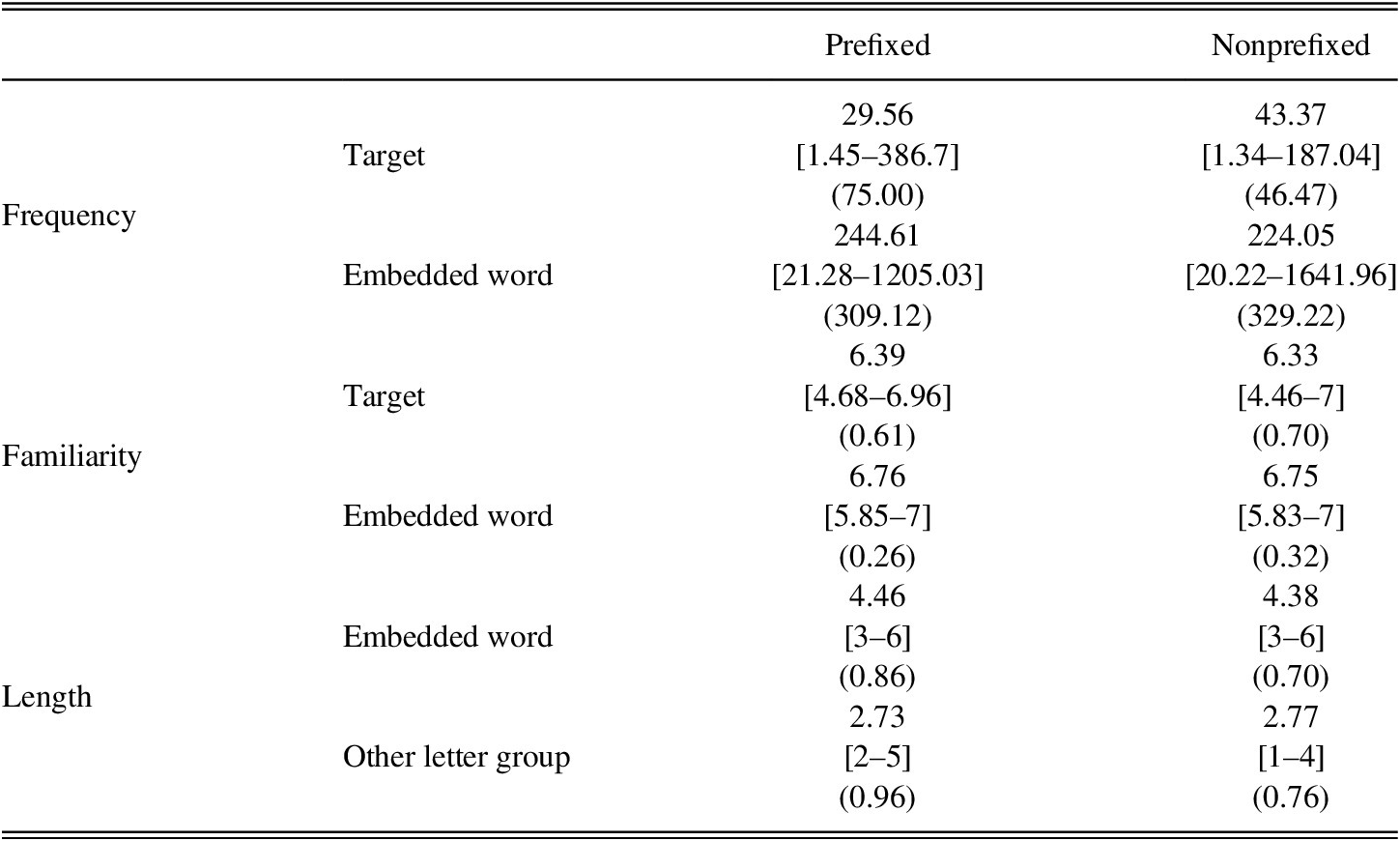
There were two sets of experimental items, the first consisting of 26 prefixed target words (e.g., DISAGREE) that were paired with a nonword prime constructed by replacing the prefix of the target with a nonprefix (e.g., sabagree). This was the “Prefixed” condition. The other set consisted of 26 nonprefixed targets that had an unrelated word embedded in final position (e.g., THOROUGH ending in ROUGH), which were paired with a nonword prime constructed by adding another nonprefix to the embedded word (e.g., plerough). This was the “Nonprefixed” condition. The length and log frequency (taken from Davis, Reference Davis2005) of both the target and embedded word/stem were matched between the two conditions, as was their familiarity as rated on a 7-point scale by 20 bilingual judges independently drawn from the Zhejiang University undergraduate population, all p’s > 0.1 (see Table 1). Each target was also paired with a control prime consisting of the same initial letters as the related prime followed by an unrelated word (e.g., sabempty–DISAGREE, plestate–THOROUGH). Length and log frequency were matched between the related and unrelated conditions, p’s > 0.1. All items can be found in the Appendix. Each of the two sets of items was split into two sublists according to a Latin Square design so that half the items seen by each participant were in the related condition and half were in the unrelated condition, with each target only being seen once.
Mean values of the target variables for the Prefixed and Nonprefixed conditions along with their range (in square brackets) and standard deviation (in parentheses). The variables are word frequency (per million) of the target and the embedded word (which was the stem of the prefixed targets), rated familiarity (on a 1–7 scale) of the target and the embedded word, and length in letters of the embedded word and the other letter unit (which was the prefix of the prefixed targets)

For the purposes of the lexical decision task, 52 nonword distractor items were also constructed. These included 26 targets created by changing the stem of a real prefixed word by one or two letters, half of which had a nonword prime consisting of the original stem plus a nonprefix (e.g., dosmarine-SUBMALUNE), with the other half having a nonword prime ending in an unrelated real word (e.g., idsmoke-EXCRAIL). The other 26 nonword targets were derived from monomorphemic words by changing one or two letters of a final embedded word, half having a nonword prime consisting of the original embedded word plus a nonprefix (e.g., lischant-MERCHOND) and half ending in an unrelated real word (e.g., ibunity-MIGRAST). The same nonwords were used in both sublists.
PROCEDURE
The DMDX program (Forster & Forster, Reference Forster and Forster2003) was used to display the letter strings by using the masked priming paradigm. For each trial, there was a 500-ms forward mask of hash marks followed by the lowercase prime in size 20 Arial font for 50 ms. The target was then presented in the same font, but in uppercase, and remained onscreen for 1,000 ms. The items were presented in a different random order to each participant who was instructed to decide whether the uppercase letter-string was a real word or not and to respond as quickly but as accurately as possible. Participants were instructed to press the right shift key if the letter string was a real English word and the left shift key if it was not. Twelve practice trials of a similar structure to the experimental items were presented prior to the experiment.
RESULTS
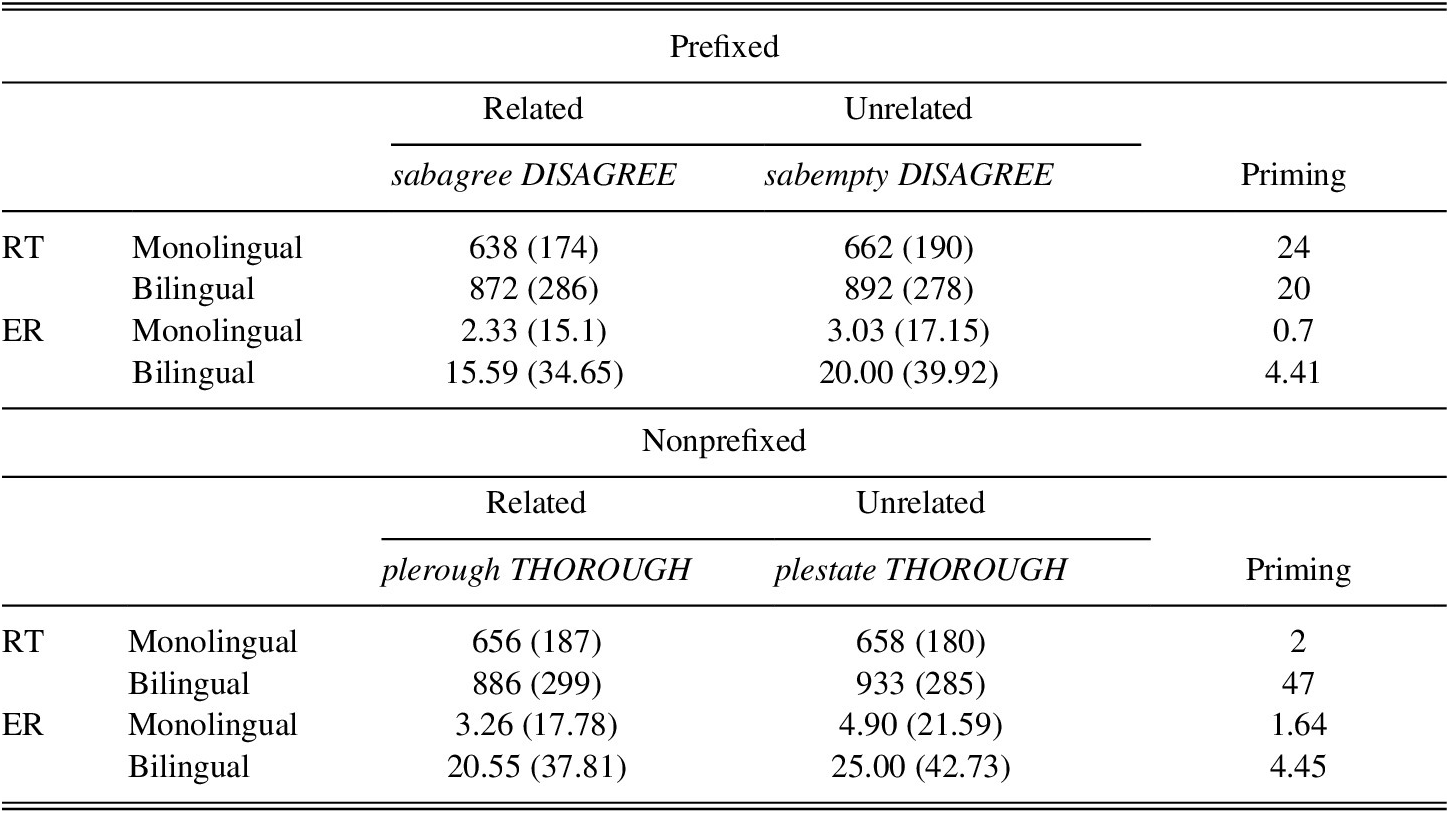
Four bilingual and two monolingual participants were removed because they made more than 50% errors. Three target items (BILLION, UNEQUAL, and PARENT) were also eliminated from the analysis of the bilingual data because of error rates more than 50%. The data were trimmed by removing reaction times (RTs) that were faster than 200 ms and longer than 2,500 ms. The removed data accounted for 8.26% of the bilingual responses and 3.68% of the monolingual responses. Mean response times and error rates are presented in Table 2.
Reaction time (RT) in ms and % error rate (ER) in each condition for both the monolinguals and bilinguals. Standard deviation in parentheses

Linear mixed-effect models were used to perform the main analyses (Baayen et al., Reference Baayen, Davidson and Bates2008). An inverse transformation was applied to the RT data (–1,000/RT) to reduce the positive skew. Fixed and random effects were included only if they significantly improved the model’s fit in a backward stepwise model selection procedure. Models were selected according to their Akaike information criterion value. The best model included prime type (Prefixed vs. Nonprefixed), relatedness of the prime and target (related vs. unrelated), and Group (monolingual vs. bilingual) as fixed factors. The covariates that were considered in the model were response time on the previous trial, log frequency and familiarity of the target, log frequency and familiarity of the embedded word, length of the embedded word, and length of the other letter group. These were centered according to their respective means. The model selection procedure revealed that all covariates improved the model’s goodness of fit and, hence, were retained in the final model. The best-fitted model also included subjects and items as crossed random effect variables. Values for p were obtained by using the R package lmerTest (Kuznetsova et al., Reference Kuznetsova, Brockhoff and Christensen2014). Error rates (ER) were analyzed using the same factors as in the RT analysis, but with ERs being entered as a binary variable using the glmer function in the lme4 package. The Wald z statistic for the fixed factors was used to determine p values.
In the main model, Prime type, Relatedness, and Group were entered as fixed-effect variables. Fixed-effect factors were sum-coded (Condition: Prefixed [−1] vs. Nonprefixed [+1]; PrimeType: Unrelated [−1] vs. Related [+1]; Language Background: Monolingual [−1] vs. Bilingual [1]). The RT analyses revealed main effects of relatedness, ß = −0.06, SE = 0.02, t = 3.60, p < .001, prime type, ß = −0.08, SE = 0.03, t = −2.78, p = .006, and Group, ß = −0.50, SE = 0.05, t = −9.90, p < .001, with an interaction between Relatedness and Group, ß = −0.05, SE = 0.02, t = −2.28, p = .02, and an interaction between Prime type and Group, ß = −0.06, SE = 0.02, t = −2.83, p = .005. The significant covariates were length of embedded word, ß = 0.04, SE = 0.01, t = 3.01, p = .003, length of other letter group, ß = 0.03, SE = 0.01, t = 2.24, p = .03, and stem frequency, ß = −0.05, SE = 0.02, t = 2.47, p = .02. Importantly, the three-way interaction between Relatedness, Group, and Prime type was also significant, ß = 0.08, SE = 0.03, t = 2.81, p = .005.
Additional models were fitted separately to the monolingual and bilingual data. The specifications of these models were the same as the main model. Monolinguals showed an interaction between Prime type and Relatedness, ß = 0.05, SE = 0.02, t = 2.08, p = .04, with significant priming for Prefixed targets, ß = 0.03, SE = 0.008, t = 3.48, p = .001, but not for Nonprefixed targets, ß = 0.007, SE = 0.008, t = 0.93, p = .36. Among the covariates, the length of other letter groups showed a significant effect ß = 0.05, SE = 0.02, t = 2.71, p = .009.
In contrast, bilinguals showed no significant interaction between Prime type and Relatedness, ß = −0.04, SE = 0.02, t = 1.91, p = .06. There was a main effect of Relatedness, ß = 0.07, SE = 0.01, t = 4.54, p < .001, with priming being significant for both the Prefixed and Nonprefixed conditions, ß = 0.01, SE = 0.007, t = 2. 01, p = .049, and ß = 0.03, SE = 0.007, t = 4.53, p < .01, respectively. In addition, there was a main effect of the length of the embedded word, ß = 0.06, SE, = ,0.02, t = 3.39, p = .001, and the length of the other letter group, ß = 0.06, SE = 0.02, t = 3.20, p = .002, familiarity of the target, ß = 0.23, SE = 0.1, t = 2.43, p = .02, and familiarity of the embedded word, ß = −0.28, SE = 0.1, t = −2.94, p = .005.
As there was a large priming effect in the Nonprefixed condition for the bilingual group and no such priming effect for the monolingual group, another model was fitted to examine the Group × Relatedness interaction for the Nonprefixed targets. This showed that priming was significantly larger for the bilinguals than for the monolinguals, ß = −0.05, SE = 0.02, t = −2.27, p = .02.
Analysis of ER revealed that, although there were no significant interactions with Group, all p’s > 0.83, there was main effect of Group, ß = −1.89, SE = 0.23, z = −8.22, p < .001 and Relatedness, ß = 0.40, SE = 0.15, z = −2.58, p = .009. Further analysis revealed that bilinguals showed priming in both the Prefixed and Nonprefixed conditions, ß = 0.18, SE = 0.08, z = 2.10, p = .04, and ß = 0.16, SE = 0.08, z = 1.96, p = .049, respectively, while the monolinguals showed neither, all p’s > 0.06.
DISCUSSION
The results of this experiment are very clear. When a nonword prime and a word target end in the same embedded word, monolingual English speakers show facilitation when the shared word is the stem of the target (e.g., sabagree–DISAGREE) and no facilitation when it is not (e.g., plerough–THOROUGH). The former result is also true for Chinese–English L2 speakers, but remarkably, these nonnative speakers also show facilitation when the target is not a prefixed word. All that seems to matter for L2 speakers to show priming is that the word embedded at the end of the prime and target be the same, with the morphological structure of the target being irrelevant.
Previous research (e.g., Diependaele et al., Reference Diependaele, Duñabeitia, Morris and Keuleers2011; Heyer & Clahsen, Reference Heyer and Clahsen2015; J. Li et al., Reference Li, Taft and Xu2017; M. Li et al., Reference Li, Jiang and Gor2017; Li & Taft, Reference Li and Taft2019; Qiao & Forster, Reference Qiao and Forster2017) has shown that nonnative English speakers show priming between words that are form related, but not morphologically related (e.g., thousand–SAND, thorough–ROUGH), while native speakers do not. It is apparent that the lack of such priming for native speakers is because the lexical representation for the target that has been preactivated through edge-aligned processing of the prime is inhibited by the lexical activation of the prime. Therefore, the form priming observed for nonnative speakers could be ascribed to edge-aligned activation of the embedded word, but without any counteracting inhibitory mechanism. However, priming could also arise from the mere repetition of the overlapping letters without preactivation of the lexical representation for the embedded word. The present study supports the latter explanation.
The results indicate that the priming shown by the L2 speakers arose from facilitated processing at the letter level. If the lexical representation for rough were activated through edge-aligned processing when plerough is presented as the prime, it can only compete with the lexical representation for thorough when that word is presented as the target. Yet facilitation was observed for L2 speakers. Such facilitation can be explained in two possible ways, both involving letter-based processing. Either the processing of the letters contained in the target was facilitated through preactivation of letter units that had already been processed in the prime (i.e., the r, o, u, g, and h of thorough), or the lexical representation of the target was preactivated through the relevant letters in the prime (i.e., plerough overlaps sufficiently with thorough for the latter to be activated when the former is presented). Neither of these accounts incorporates edge-aligned processing. Nor do they require the idea that L2 learners lack an inhibitory mechanism because there is nothing competing with the lexical representation for the target in either of these accounts.
There is an alternative possibility, however, that arises from the fact that both native and nonnative speakers not only show form priming when the target is embedded in a nonword prime (e.g., cloisand–SAND) but also when there are overlapping letters (e.g., pronect–PROJECT: Andrews & Lo, Reference Andrews and Lo2012; Forster & Veres, Reference Forster and Veres1998; Qiao & Forster, Reference Qiao and Forster2017). Perhaps even native speakers preactivate the lexical representation for thorough through its overlapping letters with plerough, but the lexical representation for rough is also preactivated through concomitant edge-aligned processing, with the latter inhibiting the former. Thus, priming of THOROUGH is eliminated for native speakers, but not for L2 speakers if they lack such an inhibitory mechanism. Note, though, that preactivation of both rough and thorough during the processing of plerough will be equally true for native speakers when the target is ROUGH as when it is THOROUGH. Therefore, this dual-process account needs to explain why native speakers show facilitation for plerough–ROUGH (equivalent to cloisand–SAND) despite the competition that rough experiences from the preactivation of thorough. Facilitation would only occur if rough were always to win the competition for native speakers against thorough, hence maintaining the preactivation in the lexical representation for the target when it is ROUGH and not when it is THOROUGH. However, it then needs to be explained why rough loses the competition against thorough when the latter is the prime (equivalent to the lack of priming for thousand–SAND where the edge-aligned activation of sand is inhibited by the activation of thousand). What can be suggested is that the longer word only successfully competes with the embedded word when it is the actual prime (thorough), and not when it is only partially activated through letter overlap with the prime (plerough). It can be seen then that if it is going to be argued that words are activated through both letter-level overlap and edge-aligned processing (with inhibition for native speakers and not for nonnative speakers), there are complexities that still need to be explored.
When contrasted with their lack of priming for nonprefixed targets, the fact that native speakers show priming for prefixed targets (e.g., sabagree–DISAGREE) can be taken to indicate that they recognized prefixed words through a representation of the stem, either as the sole pathway to recognition (e.g., Taft & Ardasinski, Reference Taft and Ardasinski2006; Taft & Forster, Reference Taft and Forster1975) or in parallel with access to a representation of the whole word (e.g., Bertram et al., Reference Bertram, Schreuder and Baayen2000; Grainger & Beyersmann, Reference Grainger and Beyersmann2017; Schreuder & Baayen, Reference Schreuder, Baayen and Feldman1995). That is, recognition of a prefixed word is facilitated by the preactivation of its stem, which would not be the case if the prefixed word were activated as a whole (i.e., in the same way that a nonprefixed word such as thorough is activated). The fact that nonnative speakers showed the same facilitation for the Prefixed and Nonprefixed conditions might be taken to mean that they processed the two types of word in the same way, with the priming arising only from letter-level processing. If there were concomitant decomposition of prefixed words, one might have expected an additive effect whereby priming was stronger for the Prefixed than the Nonprefixed condition. So, unless the assumption of additivity is incorrect, the results suggest that the L2 speakers are insensitive to the morphological structure of English, at least in terms of prefixation.
When considering the different pattern of priming shown by the L1 and L2 speakers, there is a potentially confounding factor that needs to be addressed. The word embedded in the related prime maintains its pronunciation in the target when the latter is a prefixed word (e.g., agree in DISAGREE), but rarely when it is a nonprefixed word (e.g., rough in THOROUGH). Perhaps it is the case that native English speakers are sensitive to pronunciation in the masked priming task while nonnative speakers are not. The sensitivity of native speakers to phonology has been supported by significant, even if weak, masked priming effects when the prime is a nonword that is homophonic with the target (e.g., koan–CONE; see Rastle & Brysbaert, Reference Rastle and Brysbaert2006). However, the fact that masked phonological priming has also been found with L2 speakers (Brysbaert, Reference Brysbaert, Kinoshita and Lupker2003) throws doubt on the idea that phonological factors can explain the difference between the L1 and L2 speakers in the present study.
Finally, the question can be raised whether the form priming observed in the present study is specific to Chinese–English bilinguals. It is possible that the lack of affixes in Chinese means a lack of sensitivity to the morphological structure of affixed words in English (as is suggested by Li & Taft, Reference Li and Taft2019, in relation to prefixed words). Moreover, the fact that the processing of individual letters is not required when reading logographic script might lead Chinese speakers to focus too heavily on the individual letters when faced with an alphabetic script. Having said this, however, there is evidence that masked form priming is not limited to those whose L1 is Chinese, because Diependaele et al. (Reference Diependaele, Duñabeitia, Morris and Keuleers2011) reported form priming in English when L1 was Spanish or Dutch, as did Heyer and Clahsen (Reference Heyer and Clahsen2015) when L1 was German.
Given the fact that L2 speakers are generally less proficient than native speakers, the finding that the former show an effect that the latter do not show is quite remarkable. The implication is that the effect reflects nonoptimal processing. It seems that nonnative speakers focus too much on the letter level when they read complex words compared to native speakers, and if the precise mechanisms that underlie such processing can be established, it may contribute to L2 speakers being able to improve their proficiency when reading in their second language.
APPENDIX