

1. Introduction
Individuals growing up with more siblings are likely to have more children. This intergenerational correlation of fertility has been consistently observed in both developed and developing countries (Murphy, Reference Murphy2012, Reference Murphy2013). Despite the widely documented evidence for this correlation, it is not clear whether the effect is causal. The association can simply arise due to some third factors that affect the fertility of both generations. Socioeconomic status, for example, can be similar for two successive generations (Kolk, Reference Kolk2014). Moreover, parents and children share some genes which can partly determine fertility (Rodgers et al., Reference Rodgers, Kohler, Kyvik and Christensen2001; Pluzhnikov et al., Reference Pluzhnikov, Nolan, Tan, McPeek and Ober2007; Kosova et al., Reference Kosova, Abney and Ober2010). Therefore, to make causal inferences, one must account for and isolate the effects of confounding factors.
In this paper, I ask three closely related questions. First, does the number of siblings that an individual has have a causal effect on his/her number of children? Second, what is the underlying mechanism behind such an effect? Third, how does the effect change if people face restrictions in achieving their fertility ideals? To answer these questions, I draw on the experience of China, where population policies not only induced a variation in people's number of siblings by affecting their parents but also restricted their own fertility decisions. China was one of the first countries to implement population policies, and its policies are recognized as among the most stringent in the world (Cleland et al., Reference Cleland, Bernstein, Ezeh, Faundes, Glasier and Innis2006). Following the Later Longer Fewer (LLF) Campaign in the early 1970s, China introduced the world-famous One-Child Policy (OCP) in 1979. The stringent policies have been found to contribute to the modern decline in fertility rates in China (McElroy Yang, Reference McElroy and Yang2000; Li et al., Reference Li, Zhang and Zhu2005; Ding Hesketh, Reference Ding and Hesketh2006; Chen Huang, Reference Chen and Huang2020; Yin, Reference Yin2023).
Women were unequally affected by these policies across birth cohorts and regions. First, the impact varied across birth cohorts. Women who were exposed to the LLF Campaign and the OCP at ages with high fecundity were more affected. Second, the timing of the LLF Campaign varied across regions, resulting in unequal effects on women within the same birth cohort. To measure a woman's exposure to a specific policy, I use the duration of her life under that policy weighted by the age-specific fertility rate prior to its implementation. Hence, a woman who experienced ten years of a policy in her twenties was more exposed than a woman in her thirties, because women are more likely to have children at a younger age. I find that women who were more exposed to the population policies have fewer children on average. By exploiting the variation in fertility due to different levels of exposure, I can identify the causal effect of the number of siblings on the number of children in the next generation.
Based on two waves (2010 and 2014) of survey data from the China Family Panel Studies (CFPS), I demonstrate that couples who have fewer siblings, due to higher exposure of their parents to the population policies, tend to have fewer children themselves. The results reveal that a couple tends to have 0.034–0.068 fewer children (2.3–4.6% of the average number of children) and is 2.4–6.8 percentage points less likely to violate the OCP (9.3–27.1% of the violation rate) if both the husband and the wife have one fewer sibling. Moreover, the effect on fertility is larger for couples living in low-income provinces, where the fertility rate is higher, and in rural areas, where the OCP was less strictly enforced. Finally, I show that individuals with fewer siblings have smaller ideal family sizes, which in turn leads them to have fewer children. I also find that the number of siblings of a couple has a larger effect on their ideal family size than on their actual number of children, suggesting that some factors, particularly the OCP, have prevented couples from achieving their fertility ideals.
This study contributes to the literature on the intergenerational transmission of fertility. Most studies focus on the correlation between the number of siblings and the number of children (e.g., Booth Kee, Reference Booth and Kee2009; Murphy, Reference Murphy2012; Beaujouan Solaz, Reference Beaujouan and Solaz2019), but two studies attempt to identify the causal effect of the number of siblings on fertility. Kolk (Reference Kolk2015) exploits the exogenous increase in the number of siblings caused by twin births. Using administrative register data on Swedish men and women born between 1940 and 1965, the study shows that the number of siblings does not affect one's fertility behavior per se and concludes that the commonly observed intergenerational correlation of fertility appears mainly due to other factors shared by parents and children. In contrast, using the sex composition of the first two children of parents as an instrumental variable for the number of siblings, Cools Hart (Reference Cools and Hart2017) do observe a positive effect of the number of siblings on fertility for men but a negative effect for women based on Norwegian register data.Footnote 1 Compared to the two studies, this paper exploits a new variation in the number of siblings, i.e., the variation caused by parental exposure to population policies. The findings are also different as I find positive effects for both men and women. Moreover, this study provides new evidence in the context of a developing country, complementing the extensive evidence in currently developed countries.Footnote 2 Because of its unique population policies, China also provides an ideal context for studying how the effects change when couples face constraints in achieving their ideal family size.
This study also contributes to the literature on preference formation and transmission. There is a growing literature showing that one's preferences, beliefs, and behaviors in various aspects can be shaped by his/her living environment. For example, a male tends to be less biased against his wife working if he had a working mother or if his mother had a positive attitude toward female labor supply when he was young (Fernández et al., Reference Fernández, Fogli and Olivetti2004; Fernández Fogli, Reference Fernández and Fogli2009; Farré Vella, Reference Farré and Vella2013).Footnote 3 Fernández Fogli (Reference Fernández and Fogli2006, Reference Fernández and Fogli2009) show that women's fertility is affected by their family environment. They find that second-generation American women whose ancestors came from countries with higher fertility rates tend to have more children themselves. Since these women share the same socioeconomic environment in the U.S., the authors attribute the results to the culture and preferences transmitted from the previous generation. As a complement, this paper provides new evidence that people's preferences for fertility can be shaped by the number of siblings that they have, which might operate beyond the direct transmission of preferences from parents.
Finally, this paper contributes to understanding the long-run effects of population policies on fertility. Given the strictness of China's policies, a large literature has been devoted to examining the effects of the policies on various outcomes, such as fertility (McElroy Yang, Reference McElroy and Yang2000; Ding Hesketh, Reference Ding and Hesketh2006; Chen Huang, Reference Chen and Huang2020), child quality (Qian, Reference Qian2009; Liu, Reference Liu2014; Li Zhang, Reference Li and Zhang2017), and parental life quality (Chen Lei, Reference Chen and Lei2009; Wu Li, Reference Wu and Li2012; Islam Smyth, Reference Islam and Smyth2015; Chen Fang, Reference Chen and Fang2021).Footnote 4 However, to the best of my knowledge, there is no paper that focuses on the long-run effect of the policies on the fertility of the next generations. This, however, can be important for a better understanding of the long-run effects of China's population policies.
Since the effects of population policies can extend to future generations, the implication is that policymakers should be more moderate in their policies to avoid overshooting the target. This study also implies that population projections can benefit from explicitly accounting for preference formation. As noted by Kolk (Reference Kolk2014), intergenerational transmission of fertility will lead to an increase in the fertility rate over time, as the proportion of individuals with more children will increase.
The paper proceeds as follows. Section 2 introduces the institutional backgrounds of China's population policies. In section 3, I introduce the data and explain the variables used in the empirical analyses. Section 4 is on the identification strategy. Section 5 presents the results. Conclusions are made in section 6.
2. Institutional backgrounds
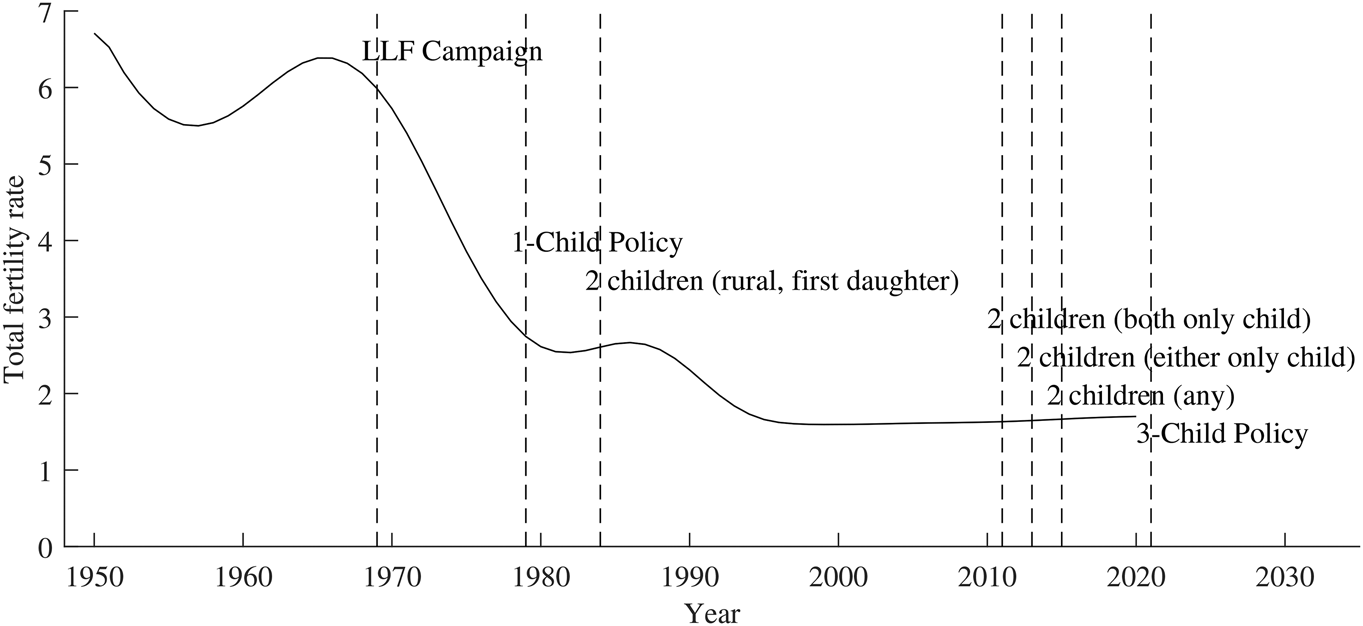
China was one of the first countries to implement population policies. After the great famine during 1959–1961, China's fertility rate bounced back, and the total fertility rate (TFR) exceeded 6 in 1962, as shown in Fig. 1. In 1962, China issued Document No. [62]698 to advocate “family planning in urban areas and densely populated rural areas” to control population growth (Peng, Reference Peng1996). In 1964, the family planning commissions were gradually established first at the national level and then at the provincial, prefecture, and county levels (Chen Huang, Reference Chen and Huang2020). However, the Cultural Revolution in 1966 promptly shut down most of the institutions.
China's population policies, Note: Data on TFR are from the 2019 Revision of World Population Prospects (United Nations, 2019).

By the end of the 1960s, China's population exceeded 800 million. Meanwhile, economic growth stagnated. China's leaders attributed the economic stagnation to the large population size rather than the economic institutions (Zhang, Reference Zhang2017). In early 1970, Premier Enlai Zhou stressed that the implementation of family planning policies should not stop (Chen Huang, Reference Chen and Huang2020). In 1971, the State Council issued a document requiring the establishment of family planning leading groups at the provincial level to promote family planning (Peng, Reference Peng1996). A pilot trial was launched in Guangdong in 1969 and in Shandong in 1970, and by 1975 all provinces had established a leading group.Footnote 5 The leading group was an important and superior provincial organization. In most cases, its leader was also the chief leader of the party committee at the provincial level (Chen Huang, Reference Chen and Huang2020).
As summarized by Chen Huang (Reference Chen and Huang2020) from Peng (Reference Peng1996), the main work of the leading group was to organize professionals to propagate family planning, which encouraged people to get married “later” (23 years for women and 25 for men), to have a “longer” interval between the second birth and the first one (more than three years), and to have “fewer” children (at most two for each couple). As part of the propaganda, the leading group organized people to spread knowledge about contraception and sterilization and the benefits of birth control. In addition, they organized professionals to carry out research on contraception and sterilization methods, to introduce the relevant technology and equipment, and to distribute contraceptive pills and condoms. Finally, they developed a system of rewards and penalties. Specific examples included paid leave after sterilization and priority in housing arrangements.
Although voluntary in principle, the LLF Campaign was effective in reducing fertility (Babiarz et al., Reference Babiarz, Ma, Miller and Song2018). Chen Huang (Reference Chen and Huang2020) show that the total fertility rate dropped earlier in provinces that formed a leading group earlier. They first note that the year of establishment of the group is exogenous to the provincial demographic and economic variables before the policy, especially the total fertility rate, the sex ratio, and GDP per capita. Next, using the difference-in-difference approach, they show that the campaign can explain about half of the decline in the total fertility rate from 5.7 in 1969 to 2.7 in 1978. The result suggests that the timing of the campaign can be exploited to identify the effects of declined fertility on other outcomes.
The OCP introduced in 1979 was the last shot to curb population growth. This policy required each couple to have no more than one child. Additional children would be excluded from free public education, and parents would be fined (Ebenstein, Reference Ebenstein2010) and lose their jobs if they were working in government or state-owned enterprises (Zhang, Reference Zhang2017). However, this policy was strongly resisted by rural families, especially those with only one daughter, due to the traditional son preference and large ideal family size. After a coercive abortion campaign in 1983 that led to civil unrest, China relaxed the policy in 1984 to make it less strict (Gu et al., Reference Gu, Wang, Guo and Zhang2007). Considering the geographic variation in demographic and socioeconomic conditions, the government enacted a localized population policy, under which residents in different regions were subjected to different restrictions. In general, urban couples were restricted to having only one child, while rural couples were allowed to have a second child if the first one was a daughter. In addition, couples in remote areas and other various groups, including ethnic minorities, could have a second or third child or even be exempted from such restrictions (Zhang, Reference Zhang2017).
While socioeconomic development plays a role in the decline of fertility since 1979 (Cai, Reference Cai2010; Guo et al., Reference Guo, Wu, Schimmele and Li2012), empirical studies indicate a notable negative impact of the OCP (McElroy Yang, Reference McElroy and Yang2000; Ebenstein, Reference Ebenstein2010; Li et al., Reference Li, Zhang and Zhu2005). Overall, under the combined influence of the OCP and socioeconomic development, the TFR declined from 2.75 in 1979 to 1.50 in 2000. The drop in fertility following the OCP suggests once again that the population policies can be exploited to identify the effect of the number of siblings on the number of children.
The Chinese government has become increasingly aware of the negative effects of the population control policies, including a rapidly aging population, a shrinking workforce, and an imbalanced sex ratio, which may threaten China's future economic growth (Hvistendahl, Reference Hvistendahl2010; Peng, Reference Peng2011; Banister et al., Reference Banister, Bloom and Rosenberg2012; Basten Jiang, Reference Basten and Jiang2015). The stringent policy has been gradually relaxed since 2011, when couples in which both the husband and the wife were only children themselves were allowed to have a second child. In 2013, the requirement became that either the husband or the wife be an only child. In 2015, the universal Two-Child Policy was introduced, and any couple was allowed to have a second child thereafter. In 2021, the Two-Child Policy was further replaced by the Three-Child Policy.
3. Data and variables
3.1. Data
The data used in the study are from the China Family Panel Studies (CFPS), which is a nationally representative, biennial longitudinal survey of Chinese households launched in 2010.Footnote 6 The baseline survey covers 144 counties/districts and 32 towns in 25 provinces in mainland China. Nearly 15,000 households and nearly 30,000 individuals over the age of nine were interviewed. Most respondents were tracked in the follow-up surveys. The dataset is suitable for the study because it contains detailed information on parents, siblings, and children. I use the data from the 2010 and 2014 waves for the analysis.
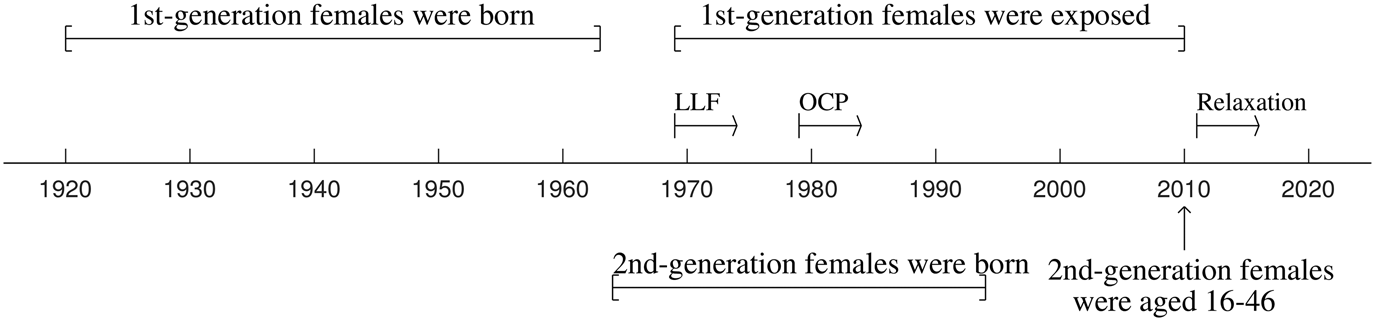
Since I seek to understand the intergenerational transmission of fertility, I divide couples into two generations based on women's birth cohort: the parent generation and the grandparent generation. The parent generation consists of couples where the woman was born between 1964 and 1994. Therefore, all the women were subject to the OCP once they started their fertile life (at the age of 15) and none of them were directly affected by the LLF Campaign. In the grandparent generation, women were born between 1921 and 1963. They had varying degrees of exposure to the LLF Campaign in the 1970s and to the OCP after 1979. There is no overlap between the two generations. This analysis focuses on how the number of siblings in the parent generation, which was influenced by the population policies faced by the grandparent generation, affects the number of children of the parent generation. Since one's fertility is affected not only by his/her number of siblings, but also by the number of siblings of his/her spouse, I conduct the analysis at the couple level.Footnote 7
In addition, I restrict the parent generation to couples who were in their first marriage or cohabitation. Otherwise, the husband and wife may report different numbers of children. These restrictions leave 4,382 observations. Table A.1 in Appendix A shows how the sample size and variable means change when these restrictions are imposed step by step.
3.2. Variables
3.2.1. Actual and ideal number of children
The main variable of interest is the number of children of couples in the parent generation. In the survey, this information is not readily available. Instead, an adult respondent reported the basic information (year and month of birth, sex, etc.) for each child, whether the child was alive or not.Footnote 8 Based on this information in the 2010 survey, I count the total number of children. Note that couples were still subject to the OCP until 2011, so the number of children is an outcome variable under this restriction.
In addition, the ideal number of children reported by both the husband and wife is available in the 2014 survey, as an answer to the question, “How many children do you think is best if there was no policy restriction?” Because the ideal family size was not measured before childbirth, one concern is that the number of children ever born may affect one's fertility preference. However, this concern can be mitigated by the fact that one's fertility preference is quite stable over time (Ray et al., Reference Ray, Harcey, Greil, Tiemeyer and McQuillan2018).
3.2.2. Number of siblings and parental exposure to the policies
For couples in the parent generation, the information on the number of siblings is readily available in the CFPS data. In the 2010 survey, CFPS asked the question, “How many siblings do you have, including those who have passed away?”Footnote 9
For couples in the grandparent generation, I construct measures of exposure to the population policies, which I use as instrumental variables for the number of siblings of individuals in the parent generation. Following Wang (Reference Wang2016), Chen Huang (Reference Chen and Huang2020), and Chen Fang (Reference Chen and Fang2021), I define exposure based on a woman's birth cohort. More specifically, for the cohort in Province p and born in Year y, the exposure to a policy that started in Year y p,0 and ended in Year y p,1 is defined as,

where AFR p(a) is the age-specific fertility rate in Province p before the policy, which measures the probability of childbearing at Age a. Note that I use the pre-policy fertility rate to ensure its exogeneity. I is an indicator function that takes the value one if the cohort was of childbearing age (15–49) while the policy was in effect. Hence I measures whether the cohort was exposed to the policy at Age a. Therefore, PP is the duration of exposure weighted by probabilities of childbearing.Footnote 10 Finally, note that we need to know the province of the husband/wife's mother to measure her exposure. I use the province of birth of the husband/wife.Footnote 11
I construct two sets of measures, for the LLF Campaign and the OCP, respectively. For the LLF Campaign, the implementation year ranges from 1969 to 1975 for different provinces. For the OCP, the implementation year is 1979 for all provinces. Therefore, I use the age-specific fertility rate at the provincial level in 1968 and 1978 for the two policies, respectively.Footnote 12
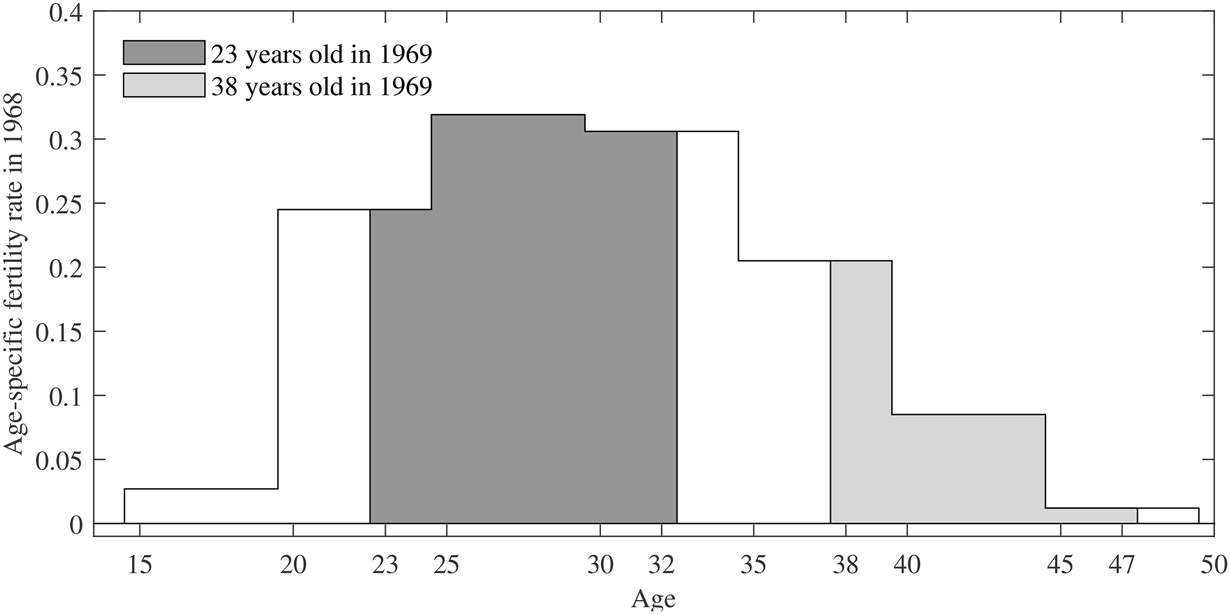
Figure 2 illustrates how to calculate policy exposure using the example of the LLF Campaign in Guangdong province. The LLF Campaign in the province was initiated in 1969 and was replaced by the OCP in 1979. The age-specific fertility rate in 1968 is shown on the vertical axis. A woman who was 38 years old in 1969 would be exposed to the campaign for 10 years until she was 47 years old. Her exposure can be measured by the light gray area, the sum of the age-specific fertility rates between the ages of 38 and 47. In contrast, a woman who was 23 years old in 1969 would be exposed to the campaign until she was 32 years old, with high age-specific fertility rates during the period. Her exposure is measured by the dark gray area, which is much larger than the light gray area.
An example of exposure to the population policies (Guangdong Province), Note: The age-specific fertility rate is from Coale Chen (Reference Coale and Chen1987). It is available for each five-year age interval (15–19, 20–24, …, 45–49).

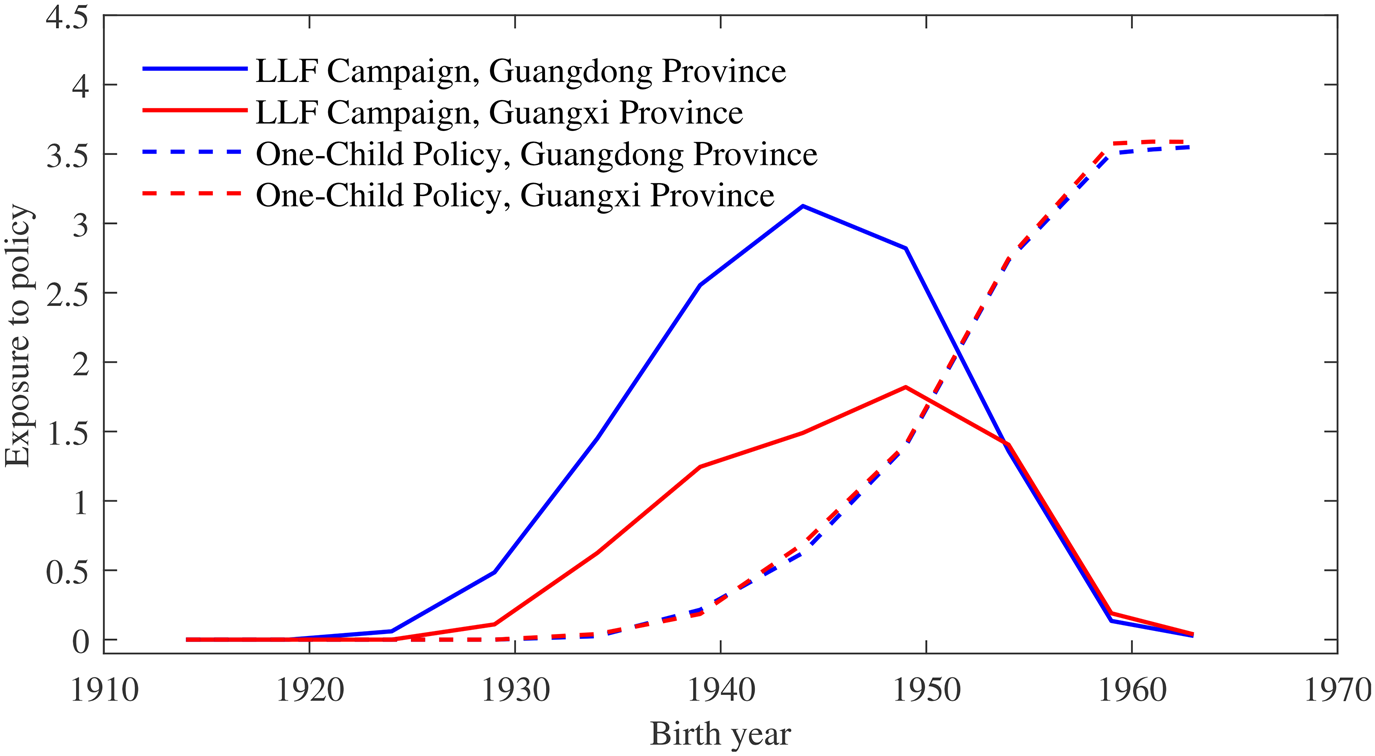
Since the timing of the LLF Campaign varied from province to province, women in the same birth cohort might also be unequally exposed. This is illustrated in Fig. 3, by taking Guangdong and Guangxi provinces as an example. While the LLF Campaign was started in 1969 in Guangdong, it was initiated five years later in Guangxi. Therefore, women born between 1920 and 1963 were more exposed to the campaign in Guangdong than in Guangxi. In contrast, the OCP was introduced at the same time in both provinces. Therefore, women in the same birth cohort were almost equally exposed to the OCP regardless of where they lived.
An example of exposure to the population policies across cohorts and regions.

3.2.3. Control variables
In the analysis, I control for some other variables that may affect fertility, including education, birth quota, residence status, ethnic minority, and age of the husband and the wife. Previous studies show that education tends to reduce fertility (Caldwell, Reference Caldwell1980; Axinn Barber, Reference Axinn and Barber2001), so I control for the number of years of education of both partners. Since parents were still subject to the OCP until 2011, I control for the birth quota to capture its direct effect on fertility. The birth quota is computed simply according to the OCP. It is one for urban couples. For rural couples, it is one if the first child is a son and two if the first child is a daughter. If a rural couple has no children, the birth quota is set to 1.5, which is the expected quota.Footnote 13 On top of the birth quota, the enforcement of the OCP was more lenient in rural areas (Ebenstein, Reference Ebenstein2010), so I control for residence status (rural/urban) as well. Considering that rural–urban migration may be endogenous to fertility decisions, I use the wife's hukou type at age 12 to define the residence status.Footnote 14 Finally, since ethnic minority couples were subject to less stringent restrictions than their Han counterparts (Peng, Reference Peng1996; Li et al., Reference Li, Zhang and Zhu2005, Reference Li, Yi and Zhang2011), I construct a dummy variable indicating that either the husband or the wife belongs to an ethnic minority group. The summary statistics for all the variables are reported in Table A.2 in Appendix A.
4. Empirical strategy
To estimate the effect of a couple's number of siblings on their fertility, I use the following ordinary least square (OLS) regression model,

where Children i,p,yh,yw is the number of children of Couple i in Province p with the husband born in Year yh and the wife born in Year yw. SibH i,p,yh,yw denotes the number of siblings of the husband, and SibW i,p,yh,yw is the number of siblings of the wife. X i is a set of control variables explained in the previous section. Since couples in the sample are at different points in their life course, I control for the husband's age fixed effect (FE), ζ yh, and the wife's age FE, ξ yw. Finally, I control for the province FE, γ p. Considering that migration across provinces may be endogenous to fertility decisions and education (Ding, Reference Ding2021), I use the province of the wife at age 12.Footnote 15, Footnote 16 $\epsilon$ is the error term. In all regressions, the standard errors are clustered at the wife's birth cohort-province level, and the sample weights for women are used.Footnote 17
To estimate the effect of a couple's total number of siblings on their fertility, I use the following empirical model,

where SibT i,p,yh,yw ≡ SibH i,p,yh,yw + SibW i,p,yh,yw denotes the total number of siblings of the husband and wife.
The OLS estimate may be biased because the intergenerational correlation in fertility could be due to shared socioeconomic background (Kolk, Reference Kolk2014) or shared genes (Rodgers et al., Reference Rodgers, Kohler, Kyvik and Christensen2001) of two successive generations. To identify the causal effect, I instrument the number of siblings of individuals in the parent generation with the exposure measures of their mothers (in the grandparent generation). Specifically, I perform two-stage least square (2SLS) regressions with the first stage specified as,

where PPH i and PPW i measure exposures to the population policies of the husband and the wife's mothers, respectively. ϕ, ψ, and λ denote the husband's age FE, the wife's age FE, and the province FE, respectively. u is the error term.
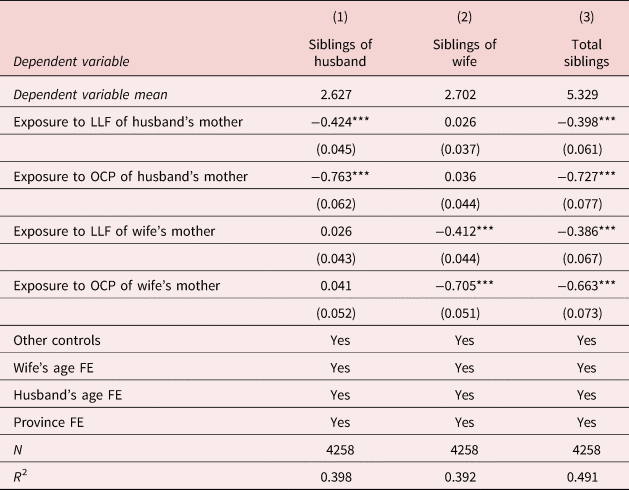
The validity of the instrumental variables relies on the fact that exposure to the population policies of one's parents reduced his/her number of siblings. Previous studies show that both the LLF Campaign (Babiarz et al., Reference Babiarz, Ma, Miller and Song2018; Chen Huang, Reference Chen and Huang2020; Chen Fang, Reference Chen and Fang2021) and the OCP (McElroy Yang, Reference McElroy and Yang2000; Li et al., Reference Li, Zhang and Zhu2005; Ding Hesketh, Reference Ding and Hesketh2006; Ebenstein, Reference Ebenstein2010) were effective in reducing the fertility rate. This is further confirmed by the first stage results in Table 1. Column (1) shows that the husband's number of siblings is significantly reduced by his mother's exposure to the population policies, while column (2) shows that the wife's number of siblings is significantly reduced by her mother's exposure. Finally, column (3) shows that the total number of siblings of the couple is reduced by the exposure of their mothers.
Mother's exposure to the population policies and the number of siblings

Notes. 1. Standard errors clustered at the wife's birth cohort-the wife's age-12 province level are in parentheses. 2. * p < 0.10, ** p < 0.05, *** p < 0.01.
Figure 4 recaps the empirical strategy. The analysis focuses on the fertility outcome of the parent generation with the women born between 1964 and 1994. To identify the causal effect of the number of siblings, I exploit its exogenous variation induced by the population policies. Women in the grandparent generation were born in between 1921 and 1963 and were exposed to the LLF Campaign and the OCP to different degrees. The unequal exposure resulted in the variation in the number of children of the grandparent generation, which is also the variation in the number of siblings of the parent generation.
Empirical strategy.

5. Results
The results are presented step by step. First, I show the effects of the number of siblings on the number of children and the violation of the OCP. Next, I explore how the effects depend on other factors, including income at the provincial level, the hukou type (rural or urban), and the wife's age. Finally, I examine the preference formation mechanism through which the number of siblings affects fertility.
5.1. Effect of the number of siblings on the number of children
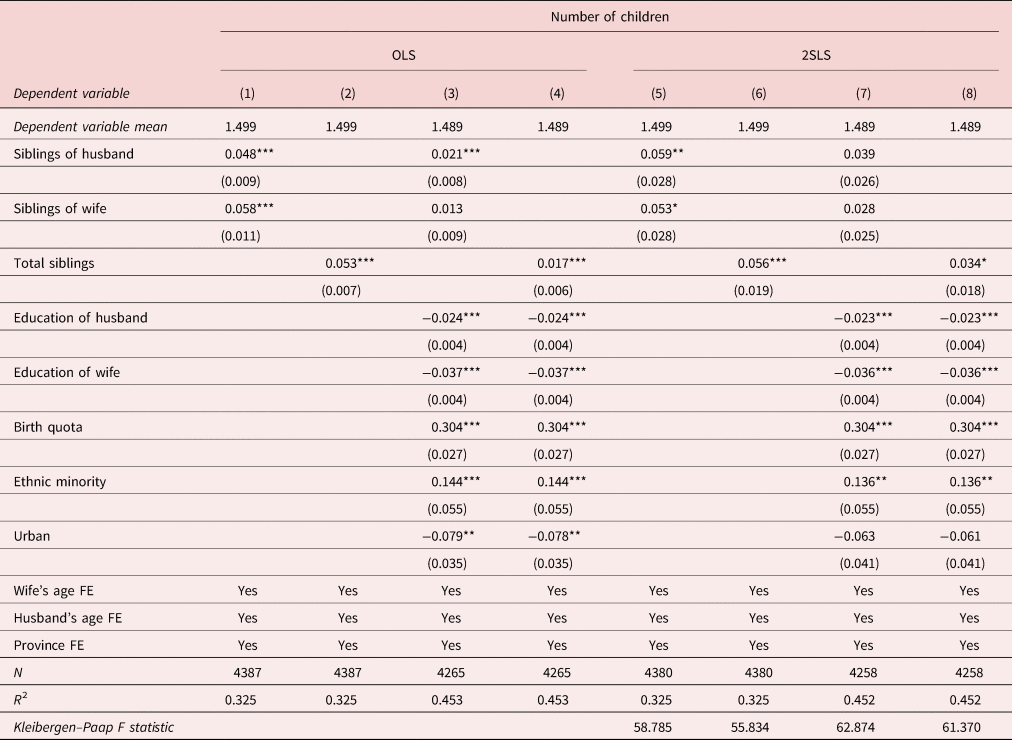
The OLS results are reported in columns (1)–(4) of Table 2, which reveal a small but statistically significant effect of the number of siblings on the number of children.Footnote 18 In columns (1)–(2), I only control for the husband's age FE, the wife's age FE, and the province FE. In column (1), I consider the number of siblings of the husband and the wife separately. The results suggest that a couple tends to have 0.048 more children if the husband has one more sibling and 0.058 more children if the wife has one more sibling. In column (2), I look at the total number of siblings of the husband and wife and observe a similar effect. In columns (3)–(4), I repeat the analysis controlling for more variables, in particular the years of schooling of the husband and wife. The coefficients on the number of siblings become much smaller. However, the association is still statistically significant at the conventional level, except for the number of siblings of the wife, which is nearly significant at the 10% level. Indeed, the couple would have 0.034 more children if the husband and wife have one more sibling each, ceteris paribus. The smaller coefficients on the number of siblings are due to controlling for the level of education of the couple, as individuals with more siblings generally tend to receive less education (e.g., Li et al., Reference Li, Zhang and Zhu2008; Becker et al., Reference Becker, Cinnirella and Woessmann2010; Kugler Kumar, Reference Kugler and Kumar2017; Klemp Weisdorf, Reference Klemp and Weisdorf2019), and those with less education tend to have more children (e.g., Breierova Duflo, Reference Breierova and Duflo2004; Becker et al., Reference Becker, Cinnirella and Woessmann2010; Brand Davis, Reference Brand and Davis2011; Cygan-Rehm Maeder, Reference Cygan-Rehm and Maeder2013).Footnote 19 As shown in columns (3)–(4), one more year of education of the husband is associated with 0.024 fewer children, while one more year of education of the wife is associated with 0.037 fewer children.
The number of siblings and the number of children

Notes. 1. Standard errors clustered at the wife's birth cohort-the wife's age-12 province level are in parentheses. 2. * p < 0.10, ** p < 0.05, *** p < 0.01. 3. Kleibergen–Paap F statistics for weak instrument variable test are reported (Kleibergen Paap, Reference Kleibergen and Paap2006).
The results of the 2SLS regressions are shown in columns (5)–(8) of Table 2. In columns (5)–(6), the effects are still statistically significant for the number of husband's siblings and the number of total siblings, although the estimation is less precise. In column (7), the effects of the number of siblings on the number of children are not statistically significant at the conventional level, but the direction of the effects is consistent with the OLS results. However, column (8) suggests that the effect is statistically significant when we consider the total number of siblings. Indeed, the couple would have 0.068 more children if the husband and wife have one more sibling each, ceteris paribus.Footnote 20
Regarding other control variables, couples who were less restricted by the policy, as measured by having a higher birth quota and belonging to an ethnic minority group, tend to have more children. In contrast, couples from urban areas tend to have fewer children.
In summary, the results in Table 2 suggest a small but statistically significant effect of the number of siblings on the number of children. As will be discussed later, the number of siblings has a larger effect on one's ideal number of children, suggesting that some factors, including the OCP, may have prevented couples from achieving their fertility ideals.Footnote 21 In this sense, the effect would probably be larger if these constraints were removed.
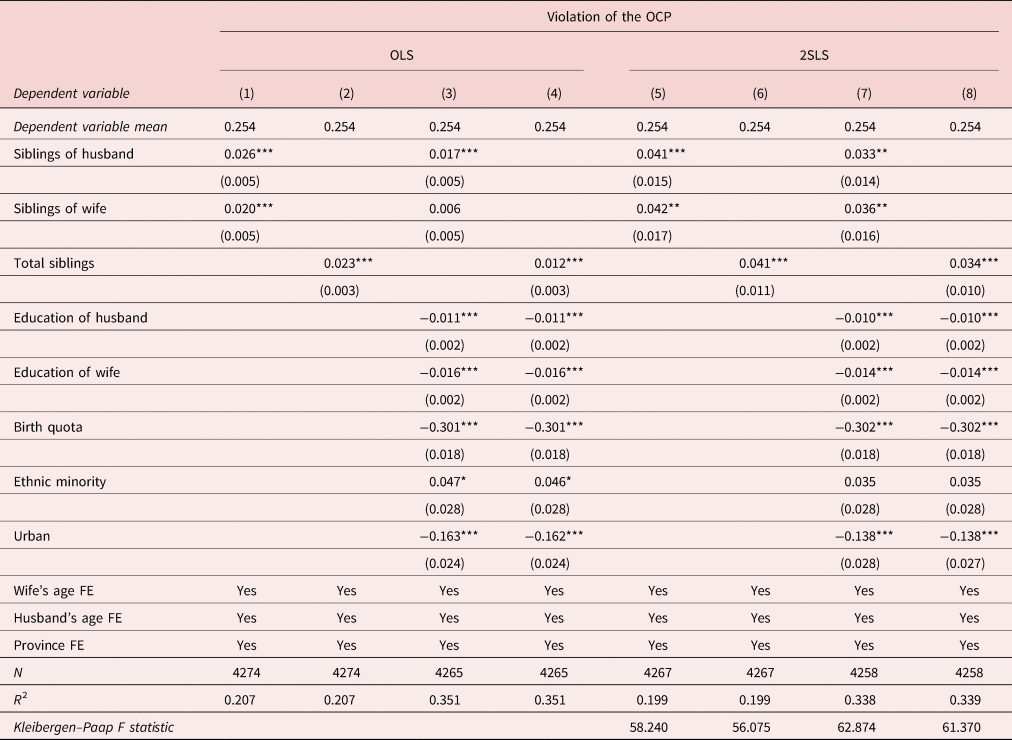
5.2. Effect of the number of siblings on the violation of birth quota
Another perspective to look into the effect on fertility is to examine the impact on the violation of the ongoing OCP. To this end, I construct a dummy variable that takes the value one if a couple has more children than allowed by the policy and takes the value zero otherwise. Next, I examine the effect of the number of siblings on the violation of the OCP. Table 3 shows that a couple is more likely to violate the OCP if they have more siblings.Footnote 22 More specifically, columns (4) and (8) suggest that the probability of a couple violating the policy will increase by 2.4–6.8 percentage points if the husband and the wife each have one more sibling. Given that only about 25.4% of the couples in the parent generation violate the policy, this implies an increase of 9.3–27.1%.
The number of siblings and violation of the OCP

Notes. 1. Standard errors clustered at the wife's birth cohort-the wife's age-12 province level are in parentheses. 2. * p < 0.10, ** p < 0.05, *** p < 0.01. 3. Kleibergen–Paap F statistics for weak instrument variable test are reported (Kleibergen Paap, Reference Kleibergen and Paap2006).
5.3. Heterogeneous effects
This subsection explores the possibility that the effects may be heterogeneous along other dimensions. First, I examine how the effects depend on income at the regional level. Next, I compare the effects between rural and urban areas. Finally, I analyze how the effects vary by women's age. Here I focus on 2SLS estimates. The OLS regression results are presented in Tables A.9–A.11 in Appendix D, which are in line with the 2SLS regression results.
5.3.1. Heterogeneous effects across provinces with different income
It is widely documented that fertility declines with long-run economic growth in both developed and developing countries (e.g., Galor, Reference Galor2011; Chatterjee Vogl, Reference Chatterjee and Vogl2018; Delventhal et al., Reference Delventhal, Fernández-Villaverde and Guner2021). Across Chinese provinces, income disparities also lead to differences in fertility rates. Can the economic disparity influence the effect of the number of siblings on the number of children? To answer this question, I divide the provinces into high- and low-income groups based on their GDP per capita in 2000, which consist of roughly equal numbers of observations.Footnote 23, Footnote 24 Next, I include interaction terms between the number of siblings and the high-income dummy in the regressions and examine their coefficients.
The results are reported in Table 4. In columns (1)–(4), the dependent variable is the number of children, while in columns (5)–(8), it is the violation of the OCP. The results show that in low-income provinces, the effects of the number of siblings on the number of children and the violation of the OCP are substantial and statistically significant, while in high-income provinces, the effects are much smaller. Column (4) shows that a couple in a low-income province will have about 0.078 more children if the husband and wife each have one more sibling. However, the effect is reduced by 0.048 if they come from a high-income province. In terms of violating the OCP, column (8) shows that a couple in a low-income province is 8.4 percentage points more likely to violate the OCP if the husband and wife each have one more sibling. However, the effect is reduced by 4.6 percentage points if they come from a high-income province. One possible reason for the negligible effects in high-income provinces is that couples there tend to have fewer children. This leads to a smaller variation in the number of children and leaves little room for the number of siblings to play a role.
The number of siblings and fertility by different income (2SLS)

Notes. 1. Standard errors clustered at the wife's birth cohort-the wife's age-12 province level are in parentheses. 2. * p < 0.10, ** p < 0.05, *** p < 0.01. 3. Kleibergen–Paap F statistics for weak instrument variable test are reported (Kleibergen Paap, Reference Kleibergen and Paap2006).
5.3.2. Heterogeneous effects across rural and urban areas
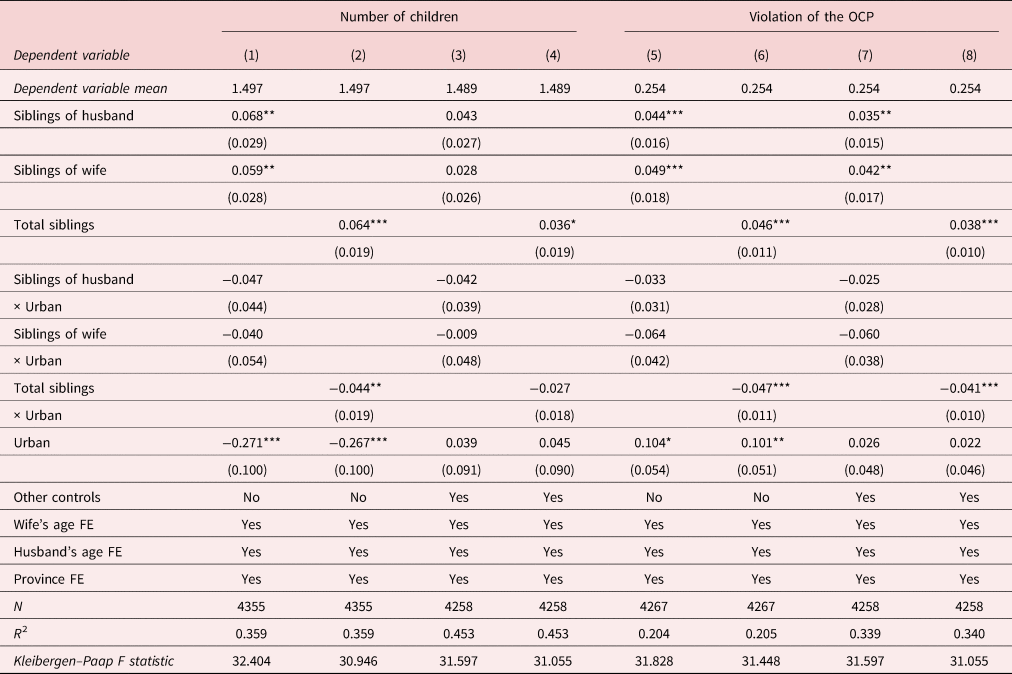
During the study period, the OCP was still effective. However, the policy per se and its enforcement were different in urban and rural areas. First, as mentioned above, an urban couple was generally restricted to having only one child, but a rural couple was allowed to have another birth if the first child was a daughter. Second, the policy was less strictly enforced in rural areas than in urban areas. By controlling for the urban dummy, I can deal with the first fact. However, the second fact implies that the marginal effect itself may depend on the type of residence, since the lenient enforcement in rural areas left more room for the number of siblings to affect the number of children. Therefore, the number of siblings may have a larger effect in rural areas. To test the heterogeneous effects, I include interaction terms between the number of siblings and the urban dummy in the regressions and examine their coefficients.
The results are reported in Table 5, suggesting that the intergenerational transmission of fertility is stronger in rural areas than in urban areas. In columns (1)–(4), I examine the effect of the number of siblings on the number of children. It is positive and significant in rural areas, but it is much smaller in urban areas. For example, column (4) shows that one more sibling of the husband/wife increases the number of children by 0.036 in rural areas, but the effect is reduced by 0.027 in urban areas. Regarding the violation of the OCP, columns (5)–(8) show that the effect of the number of siblings is large in rural areas but is very small in urban areas. For example, column (8) shows that one more sibling of the husband/wife increases the probability of violating the OCP by 3.8 percentage points in rural areas, but the effect is close to 0 in urban areas.
The number of siblings and fertility across rural and urban areas (2SLS)

Notes. 1. Standard errors clustered at the wife's birth cohort-the wife's age-12 province level are in parentheses. 2. * p < 0.10, ** p < 0.05, *** p < 0.01. 3. Kleibergen–Paap F statistics for weak instrument variable test are reported (Kleibergen Paap, Reference Kleibergen and Paap2006).
5.3.3. Heterogeneous effects across women's ages
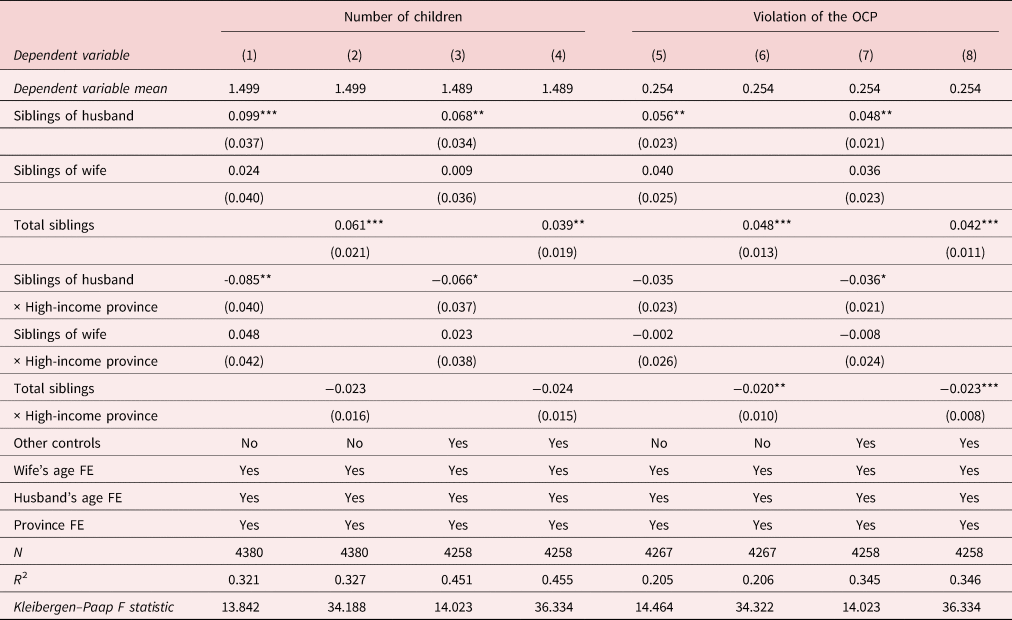
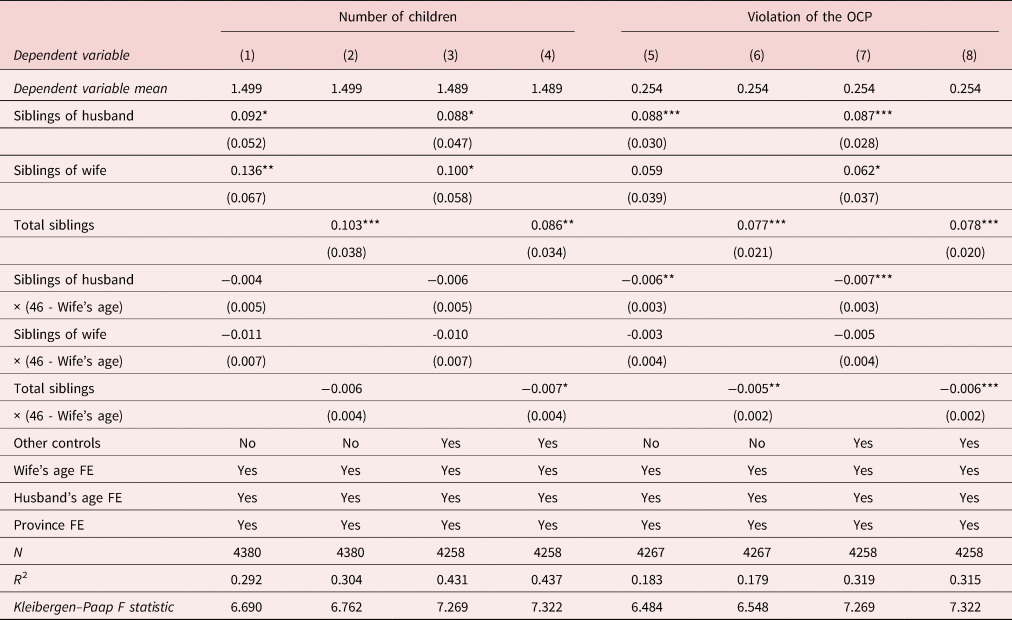
The couples in the sample are at different points in the course of their lives. In particular, women range in age from 17 to 46 years, and most of them have not yet completed childbearing. How can a woman's age influence the effect of the number of siblings on fertility? To answer this question, I assume a linear trend of the effect across women's ages. I take couples where the woman is 46 years old as the reference group and examine how the effect changes as women get younger.
The results are presented in Table 6, which suggests that the effect of the number of siblings on fertility is smaller for younger women. For example, columns (4) and (8) suggest that for women aged 46 years, one more sibling of the husband/wife increases their number of children by 0.086 and increases their probability of violating the OCP by 7.8 percentage points. However, the effects drop to about zero for women who are 13 years younger, i.e., those who are 33 years old. One possible explanation for the smaller effects for younger women is that younger women are further away from completed fertility and therefore have fewer children. This implies a smaller variation in the number of children, which compresses the effects of the number of siblings.Footnote 25
The number of siblings and fertility by women's age (2SLS)

Notes. 1. Standard errors clustered at the wife's birth cohort-the wife's age-12 province level are in parentheses. 2. * p < 0.10, ** p < 0.05, *** p < 0.01. 3. Kleibergen–Paap F statistics for weak instrument variable test are reported (Kleibergen Paap, Reference Kleibergen and Paap2006).
5.4. Mechanism of preference formation
In discussing the forces that may reinforce the fertility decline in Europe, Lutz et al. (Reference Lutz, Skirbekk and Testa2006) suggest that the ideal family size for younger cohorts may decline as a consequence of the lower fertility they observe in previous cohorts. To test the ideal family size mechanism, I conduct analyses in three steps. First, I examine the effect of the number of siblings on one's ideal family size. Next, I examine how the ideal family size translates into the number of children. Finally, I examine how the effects of the number of siblings on the number of children change when the ideal family size is controlled for.
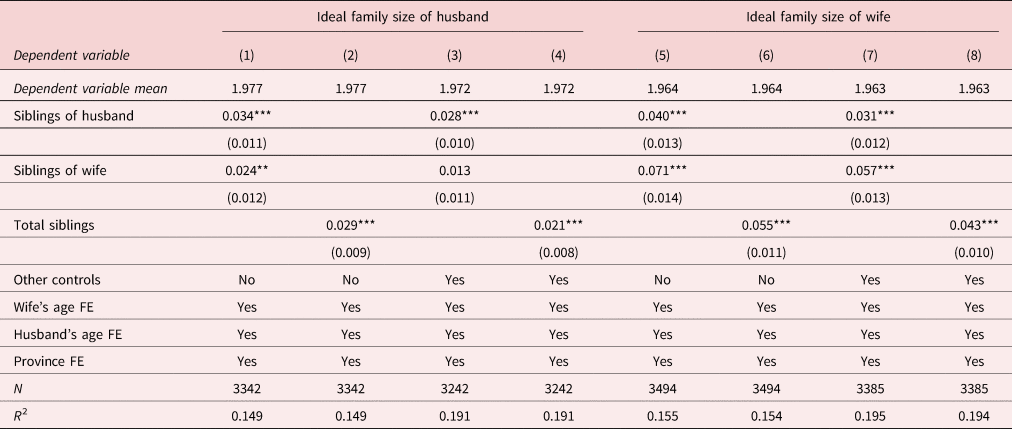
Table 7 shows the effects of the number of siblings on one's ideal family size. Columns (1)–(4) show that the number of siblings has a positive effect on the ideal number of children for men, while columns (5)–(8) show that the effect is much larger for women. In particular, column (3) shows that a man would like to have 0.028 more children if he has one more sibling, while column (7) suggests that a woman would like to have 0.057 more children if she has one more sibling.Footnote 26
The number of siblings and the ideal family size (OLS)

Notes. 1. Standard errors clustered at the wife's birth cohort-the wife's age-12 province level are in parentheses. 2. *p < 0.10, ** p < 0.05, *** p < 0.01.
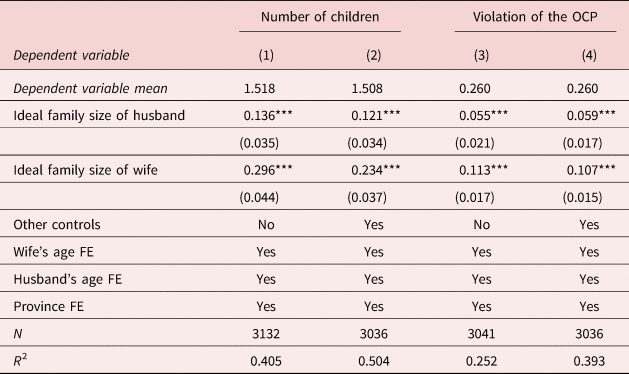
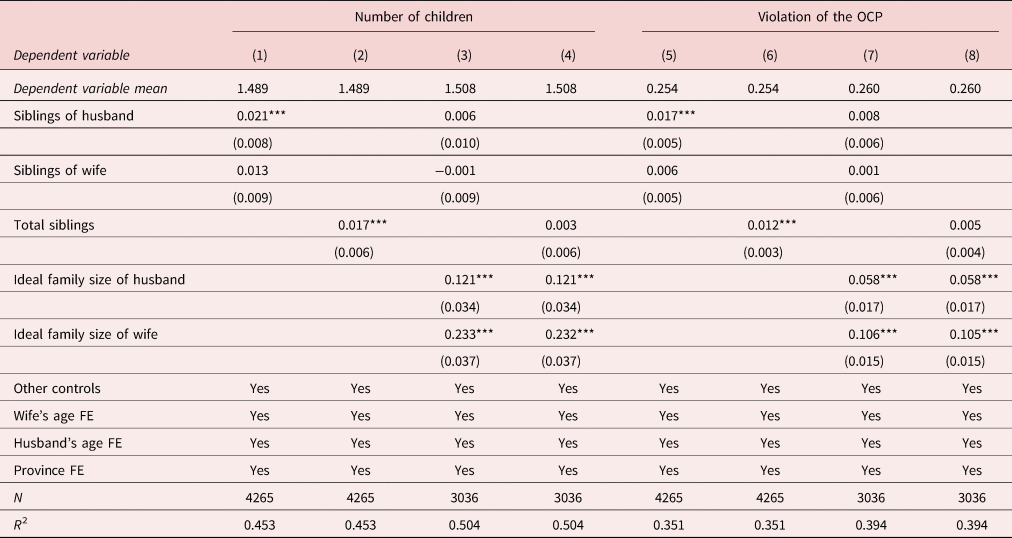
Table 8 reports the effects of a couple's ideal family size on their fertility. The results reveal that the ideal number of children can substantially increase his/her number of children and their probability to violate the OCP and that the effects are much larger for women. In columns (1)–(2), the outcome variable is the number of children. Column (2) shows that an increase in the husband's ideal family size by one leads to 0.121 more children. The effect is much larger for the wife, as the number of children increases by 0.234 if her ideal family size increases by one. In columns (3)–(4), I look at the probability that the couple has more children than allowed by the OCP. Column (4) shows that the likelihood of violating of the OCP will be increased by 5.9 percentage points if the husband has one more sibling and increased by 10.7 percentage points if the wife has one more sibling.
Ideal family size and fertility (OLS)

Notes. 1. Standard errors clustered at the wife's birth cohort-the wife's age-12 province level are in parentheses. 2. * p < 0.10, ** p < 0.05, *** p < 0.01.
Table 9 shows how the effects of the number of siblings on fertility change before and after controlling for the ideal family size. Columns (1)–(2) replicate the results in Table 2 and show that the number of siblings of the husband and wife has positive effects on their number of children. However, these effects disappear once the ideal family sizes are controlled for, as shown in columns (3)–(4). Columns (5)–(6) replicate the results in Table 3 and show that the number of siblings of the husband and wife increases their probability of having more children than allowed by the OCP. Again, the effects disappear once the ideal family sizes are controlled for, as shown in columns (7)–(8). These results confirm that the ideal family size is the channel through which the number of siblings affects fertility.
Number of siblings, ideal family size and fertility (OLS)

Notes. 1. Standard errors clustered at the wife's birth cohort-the wife's age-12 province level are in parentheses. 2. * p < 0.10, ** p < 0.05, *** p < 0.01.
An interesting pattern is that the number of siblings has much larger effects on the ideal family size than on the number of children (columns (3)–(4) of Table 2 vs. columns (3)–(4) and (7)–(8) of Table 7). The reason is that one unit increase in the ideal family size can only lead to 0.121–0.234 more births (Tables 8–9), suggesting that the OCP and some other factors might have constrained people from reaching their ideal family size.Footnote 27 Therefore, one can infer that the intergenerational transmission of fertility could be more substantial if the OCP is less restrictive for the parent generation or if other factors that reduce fertility are relaxed.
6. Conclusions
This paper examines the causal effect of the number of siblings on fertility in China, where the government implemented stringent population policies in the last several decades. By exploiting the timing of the policies, I show that couples who have more siblings because their parents were less exposed to the population policies tend to have more children themselves and that they are more likely to violate the One-Child Policy. Moreover, the effect on fertility is stronger for couples living in low-income provinces where the fertility rate is higher and in rural areas where the One-Child Policy was less strictly enforced.
Previous studies have proposed various explanations for the intergenerational transmission of fertility. Commonly cited explanations include shared genes (Rodgers et al., Reference Rodgers, Kohler, Kyvik and Christensen2001; Pluzhnikov et al., Reference Pluzhnikov, Nolan, Tan, McPeek and Ober2007; Kosova et al., Reference Kosova, Abney and Ober2010) and shared socioeconomic status (Kolk, Reference Kolk2014) between two successive generations. Other explanations include transmitted culture and preferred family size (Fernández Fogli, Reference Fernández and Fogli2006, Reference Fernández and Fogli2009; Blau et al., Reference Blau, Kahn, Liu and Papps2013). In this paper, I show that fertility preferences can indeed be shaped by the family environment in adolescence and that preference formation is an important mechanism through which the number of siblings affects the number of children.
Finally, I find a couple's number of siblings has a larger effect on their ideal family size than on their actual number of children. One possible reason is that couples in the sample were constrained by the OCP and therefore could not achieve their fertility ideals.
Supplementary material
The supplementary material for this article can be found at https://doi.org/10.1017/dem.2024.15
Acknowledgements
I am grateful to Nezih Guner for his support and guidance at different stages of the project. I also thank the associate editor, two anonymous referees, Jianghua Liu, Nan Zhang, Tom Zohar, and seminar participants at CEMFI for their valuable comments and discussions. I acknowledge the support from Spain's State Research Agency through its María de Maeztu Units of Excellence program (MDM-2016-0684). The author declares no competing interests.