


Introduction
The clinical topic of this paper is behaviours that challenge (BtC), which was previously referred to as either challenging behaviour, or behavioural and psychological symptoms of dementia (BPSD). It is estimated that more than 90% of people with dementia develop at least one BtC during the course of their illness (Lyketsos, Reference Lyketsos2007). Within this population residing in 24-hour care, the prevalence of one or more BtC is 78% (Seitz et al., Reference Seitz, Purandare and Conn2010), and findings show that BtC are predictors of nursing home admission (Gaugler et al., Reference Gaugler, Yu, Krichbaum and Wyman2009).
Many BtC occur around carer interactions; we refer to these interactions as ‘Stop Start Scenarios’ (SSS; James and Hope, Reference James and Hope2013). In such scenarios, carers need to negotiate with people with dementia (PWD) in their best interests, either to stop them doing something problematic they desire to do, or to start them doing something helpful they currently do not wish to do. We believe that the essence of dealing well with problem behaviours is the ability of carers to intervene appropriately with SSS. The common SSS around which problem behaviours occur include: getting someone up in the morning; helping someone go to the toilet; helping someone engage in self-care activities; encouraging someone to take medication; asking someone to stop shouting; preventing someone from leaving the building. We suggest that training carers to communicate around these common daily activities is essential to delivering good dementia care. Eggenberger's review on training staff to communicate well with PWD is particularly helpful with respect to such interventions (Eggenberger et al. Reference Eggenberger, Heimerl and Bennett2013). The guidelines indicate the importance of communicating in a person-centred manner, taking the perspective of PWD.
However, on occasions, communicating with a person with dementia is made more difficult because the person is ‘time-shifted’. For example, Joan (aged 80) believes she is in her 30s, and still has young children to collect from school. Every strategy to date has failed to shift her from her current reality, and she gets extremely distressed when she is prevented from leaving the care home to meet her children. In this scenario, the only effective strategy to date has been to tell Joan that her sister is collecting her children today, and Joan does not have to worry. When this is said to her she calms immediately and an ‘as required’ (pro re nata) dose of a psychotropic does not need to be administered. But how ethical is the use of this type of communication, which is clearly a lie?
The use of such deception has been termed ‘therapeutic lying’ (James et al., Reference James, Powell, Smith and Fairbairn2003). Over the last ten years, the topic's profile has been raised in a number of studies, which have investigated the views of clinicians, carers and PWD (Mackenzie et al., Reference Mackenzie, James, Morse, Mukaetova-Ladinska and Reichelt2006; Mental Health Foundation, 2016; Turner et al., Reference Turner, Eccles, Keady, Simpson and Elvish2017). Previous work has highlighted that lies are used by over 90% of care home staff on a regular basis, and there is an appreciation of the pros and cons of their use (Blum, Reference Blum1994; James et al., Reference James, Wood-Mitchell, Waterworth, Mackenzie and Cunningham2006; Tuckett, Reference Tuckett2004). From a nursing perspective lying may be particularly problematic because the Nursing and Midwifery Council (2008) urges nurses and midwives to ‘be open and honest, act with integrity and uphold the reputation of your profession’, and warns that ‘failure to comply with this code may bring your fitness to practise into question and endanger your registration’ (Nursing and Midwifery Council, 2008). In addition, the regulations of the General Medical Council underline that a professional must ‘be honest and trustworthy in all your communication with patients and colleagues’ (GMC, 2013). Despite such apparent clarity in terms of professional guidelines, it has been shown that many health care professionals, including psychiatrists and medical professionals (Caiazza et al., Reference Caiazza, James, Rippon, Grossi and Cantone2016), are frequently prepared to lie in certain circumstances. Unfortunately, the nature of these circumstances and the clinical and legal framework supporting the use of lies are not well understood. Owing to the prevalence, and the complex clinical and ethical issues associated with the topic, we (the authors) think it is timely to offer training to help clinicians explore the implications of lying and if selected as a suitable approach, training them to lie in an ethical and person-centred manner. This view is even more relevant since the recent publication of the Mental Health Foundation report in 2016 (What is truth?), which endorsed the use of ‘untruths’ in dementia care if they are used in the best interests of PWD. The views of psychologists regarding the use of training have been investigated in the present study because this group of professionals have been studied previously (Elvish et al., Reference Elvish, James and Milne2010).
Method
Design
This was a pre/post-teaching questionnaire survey of the views of participants attending a teaching event organized by a branch of FPOP (Faculty of Psychologists working with Older People, British Psychological Society). The first questionnaire was administered prior to the training and the second, similar, questionnaire was completed following the session. Members of the Newcastle Challenging Behaviour Team had been invited to provide a one-day teaching course on BtC, led by the first author (I.J.). A module of the teaching was on ‘Communication with PWD’. There were three elements to the module: Person-centred communication; Stop Start Scenarios; Illustrative DVD. The latter presented case material illustrating the use of formulation-led lies in the care of PWD. The questionnaires on lies were administered as part of this module. The participants were aware that any questionnaires returned at the end of the day's training were going to be analysed for a research project. The survey was registered as a Service Evaluation project with Northumberland, Tyne and Wear Mental Health Foundation Trust (NTW SER-14-031). The project was judged as not requiring ethical approval by NTW R&D, because the data were collected as part of a teaching programme seeking to improve clinical practice, and did not involve patients or patient information.
Participants
Thirty-eight NHS clinicians working with older people returned pre- and post-questionnaires; three people did not return completed questionnaires. This represents a return rate of 92.7%. Thirty participants (73.1%) were female; twenty-nine (70.7%) were qualified clinical psychologists, four (9.7%) were occupational therapists, and the remainder were psychology assistants and trainees. Owing to the nature of the study, no further information was asked of the participants because it would reveal clues to their identities.
Measure
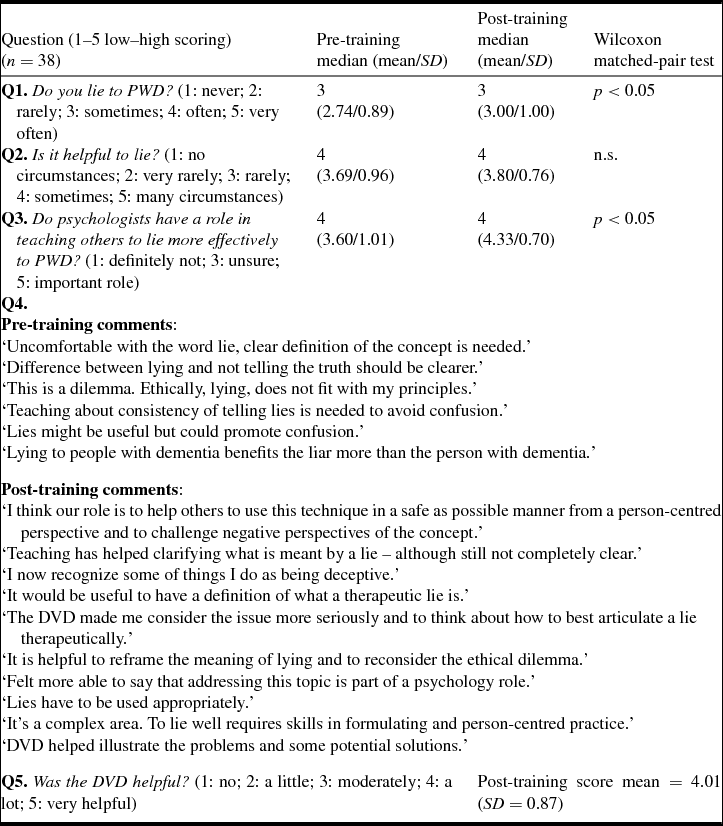
Two questionnaires were administered. The pre-training tool was a bespoke four-item questionnaire assessing the views of the participants about lying to PWD. The questions employed are presented in Table 1. The first three items were scored using a Likert scale, while the fourth asked for people's qualitative opinions about lying. The post-questionnaire contained an additional item which asked whether a DVD specifically produced for the topic of ‘lying to people with dementia’ (Mackenzie, Reference Mackenzie2013; see also Gibbons et al., Reference Gibbons, Keddie and James2018) was a useful aid in the training process. Questions (Q) 1, 2 and 4 were based on items used in previous studies (James et al., Reference James, Powell, Smith and Fairbairn2003, Reference James, Wood-Mitchell, Waterworth, Mackenzie and Cunningham2006), while the other two questions were designed for this particular set of participants and study.
Summary of survey quantitative and qualitative responses

Results
The findings of the two questionnaires are summarized in Table 1.
The data were not normally distributed and so a Wilcoxon non-parametric two-tailed set of analyses were undertaken; this is a ‘conservative’ repeated measures test. The pre–post comparisons show that in Q1 clinicians, having reflected on the matter, state they lied more frequently (Z = –2.52, p < 0.05). The frequency scores showed that 68.6% of participants scored ‘3 or higher’ after the training, compared with 60.0% prior. In Q2, there was a non-significant increase in the view that lies were helpful. The findings from Q3 showed a significant increase in opinions about the role of psychologists helping people to lie more effectively (Z = –3.82, p < 0.05). The frequency scores showed that 100% of participants scored ‘3 or higher’ after the training, compared with 57.1% prior.
Q4 was used to examine if the role of the DVD was helpful in getting people to reflect on the issue of lying. It was evident that participants found the information and case material outlined in the DVD ‘a lot’ helpful.
Discussion
Over the last decade, this topic has received a great deal of attention (Hughes et al., Reference Hughes, Hope, Reader and Rice2002; Wood-Mitchell et al., Reference Wood-Mitchell, Waterworth, Stephenson and James2006, Reference Wood-Mitchell, Mackenzie, Cunningham and James2007; Mitchell, Reference Mitchell2014). Past research has been characterized by conflicting opinions and little acceptance of lies (Schermer, Reference Schermer2007). Indeed, when the authors first introduced the topic into their work, in addition to criticism (Müller-Hergl, Reference Müller-Hergl2007), fellow therapists would occasionally walk out of sessions in opposition to the content of the material being debated. Therefore this study indicates an increasing degree of acceptability regarding the use of lies within clinical psychology. First of all, clinicians have shown that even prior to the delivery of training they had an awareness of the use of lies within care settings and that lies could be helpful with PWD. It was also noteworthy to see, that even prior to training, there was a trend for psychologists to see themselves as having a role in teaching others to lie more effectively. This study has highlighted that our training module helped clinicians to recognize that they lie more frequently than they had initially thought. It appears from the qualitative findings that statements they previously would not have labelled as a lie, were now recognized as deceptive practices (and thus appropriately relabelled). Indeed, from observations of the participants during the teaching it was evident that many began to recognize that they were routinely – ‘going along with a PWD's incorrect belief’; ‘redirecting people's attention via a partial truth’; ‘bending the truth’. Via our training, participants began to recognize the practical and ethical complexities associated with using lies. In particular they started to see the relevance of formulating the lies within a person-centred conceptualization, and ensuring the lies were used consistently and collectively by the carers and families. For example, the participants were taught that a ‘good’ lie needs to be consistent with the person's historical script or personal schema. So telling a person who constantly asks to see her deceased husband that he's gone fishing is only effective if the husband actually fished. Indeed, if the husband never fished, even someone with moderate–late stage dementia would recognize this, and realize they were being lied to. The person would then ponder why we were lying about her husband's whereabouts, and she may think – ‘Has he left me?’ ‘Is he having an affair!’ Such thoughts are likely to lead to agitation and possibly aggression (see James and Jackman, Reference James and Jackman2017, for full review). Thus it seems our workshop gave participants an opportunity to recognize that there is a need to teach carers how to lie effectively from a person-centred perspective.
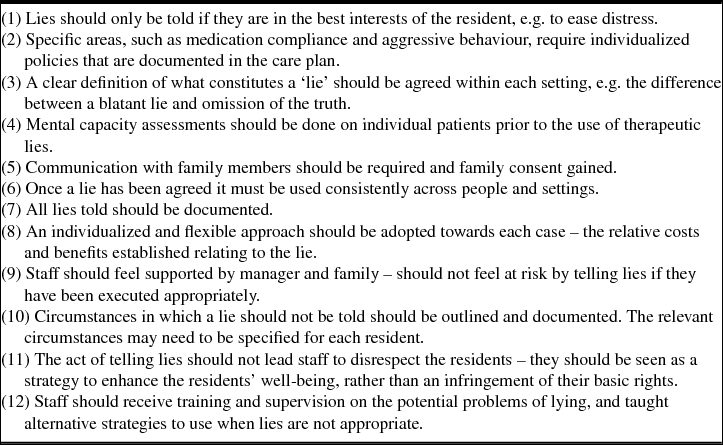
It is evident that the educational module, and particularly the use of the DVD, served to highlight the complexities associated with the topic. Indeed, we believe the greater appreciation of the complexity of lying as a communication tool, as illustrated in the case material of the DVD, was a key reason why there was such a significant change in Q3. Mackenzie and colleagues (Mackenzie and James, 2010; Mackenzie, Reference Mackenzie2013) have already produced a set of guides for carers on the use of therapeutic lies (James et al., Reference James, Wood-Mitchell, Waterworth, Mackenzie and Cunningham2006; Table 1). These guidelines were recently updated in a study undertaken with psychiatrists (Culley et al., Reference Culley, Barber, Hope and James2013).
The current guidelines are outlined in Table 2.
Guidelines adapted from James et al. (Reference James, Wood-Mitchell, Waterworth, Mackenzie and Cunningham2006)

One of the main developers of the guidelines (Mackenzie, Reference Mackenzie2013), has provided a protocol on how lies should be used. She suggests that lies should only be used as a last resort, and only after the trialling of less controversial strategies, such as: (i) meeting the person's perceived needs; (ii) simulation of their needs; (iii) distraction, and then finally (iv) therapeutic lying (James and Jackman, Reference James and Jackman2017).
When one looks at these guidelines (Table 2), one may be struck by the complexity involved in delivering a therapeutic lie. As such, the level of intricacy may further support the need for clinicians to become involved in the teaching and supervision of this controversial form of communication. Notwithstanding the more positive perceptions towards therapeutic lying, it is important to recognize that there are numerous ethical problems associated with the phenomenon. These problems are discussed in detail elsewhere (Müller-Hergl, Reference Müller-Hergl2007). Such difficulties are chiefly concerned with perceived treachery (Kitwood, Reference Kitwood1997), manipulation and damage to autonomy (Müller-Hergl, Reference Müller-Hergl2007) and untrustworthy practices (General Medical Council, 2013). A good example of the debates occurring in this area is illustrated in a short series of articles in the journal Nursing Ethics (Mitchell, Reference Mitchell2014; Brannelly and Whitewood, Reference Brannelly and Whitewood2014); the second article is a commentary on the first. Mitchell describes a case in which a lie is told to a person with dementia in order for the patient to accept medication. Problems occur, however, because not all of the nurses are willing to tell the lie, leading to sub-therapeutic treatment. Mitchell believes that the case highlights a clash between the concepts of beneficence and veracity, and asks whether lying is even legal. He thinks that a case can be made for the occasional use of a lie, but he believes ‘. . . it will be difficult for any nursing professional to advocate for the routine use of therapeutic lying irrespective of beneficent principles’ (p. 845). In response to the first article, Brannelly and Whitewood advocate examining the case through an ethics approach informed by Tronto's integrity of care framework (Moral Boundaries, 1993; Caring Democaracy Markets Equality and Justice, 2013). In this approach each clinical case needs to be examined under five headings: competence, responsibility, attentiveness, responsibility and solidarity. The authors illustrate their use of the framework via their own case study. Interestingly, the ethical treatment of choice using the Tronto approach leads them to employ covert medicating, which we would argue is also a form of deception, and therefore a type of therapeutic lying. The current authors are using the Tronto framework to examine practices on NHS in-patient wards. A nurse, undertaking a PhD, will be analysing the use of lies as part of her clinical practice on the wards. To our knowledge this will be the first ecologically valid assessment of lies in a care setting; prior to this the research has mainly used questionnaires, debriefs and qualitative approaches.
It is relevant to note that the present study mainly examined the opinions of psychologists, which clearly limits its generalizability. However, this was a deliberate selection strategy because previous work on lying had been done with this population (Elvish et al., Reference Elvish, James and Milne2010). Yet, in truth, there is no specific reason to believe that other professions should not take the lead in the training and supervision of this topic. In an attempt to maintain anonymity the authors did not obtain demographic data with respect to the participants; such an omission means that we are unable to undertake a more sophisticated analysis of the data. For example, differences in opinions may occur with experience, age or gender. Analyses of such factors should occur in future studies, particularly ones using larger populations. Before summarizing it is important to stress that the current findings do not mean that our participants endorsed the use of lies, rather it suggests the participants were keen to support having greater clarity around what is meant by lying, and what constitutes ‘therapeutic lying’. Furthermore, the brief study calls for training in the pros and cons, usage and ethics, of lying.
The project has implications for clinical practice, and it highlights the communication dilemmas faced by many clinicians providing hands-on care to people with dementia. Good communication is at the heart of all effective care, but problems can occur when the person being cared for has a different view of his/her current reality to the carer. Should the carer try to bring people into their ‘correct’ reality, or empathize with the world view in which PWDs may incorrectly perceive themselves to be fitter, competent and a member of a rich interpersonal network? This debate is similar to the ongoing discussions about the pros and cons of using reality orientation (RO; Spector et al., Reference Spector, Orrell, Davies and Woods2002) techniques in dementia care. The argument with RO is whether we should attempt to orientate people to the caregiver's reality as opposed to validating them in their time-shifted view, which may be providing a sense of comfort and security? Such questions require more systematic investigation, stressing the need for clinicians and researchers to work together to develop empirically informed communication and interaction strategies (James, Reference James2015). Once we have a better understanding of communication techniques we would be able to develop teaching programmes to increase our abilities to engage with people with dementia and de-escalate problematic situations. The present work also calls into question whether we need to revise clinical and professional guidelines, firstly because the findings (James et al., Reference James, Wood-Mitchell, Waterworth, Mackenzie and Cunningham2006) inform us that the recommendations on deception are being flouted in everyday practice, and secondly, it is recognized that in a number of specific situations lies may be beneficial and therapeutic.
Conclusion
Therapeutic lying in the care of PWD is currently receiving positive attention and is becoming recognized as a communication strategy. This survey highlights three key points: acceptance, defining and training. Firstly, it is important to recognize and accept that the use of lies in care contexts happens. Secondly, there is a need to be clearer about what is meant by a therapeutic lie, as opposed to merely ‘bending the truth’. Thirdly, training should be characterized by a set of informative tools and guidelines. Above all, because of the complexity and ethical issues associated with the topic, we believe it is appropriate for clinicians to offer training in how to employ this person-centred form of communication.
Acknowledgements
Ethical statements: The work was approved as a Service Development project, which did not involve patients, and was registered with NTW NHS Trust Research and Development Team. The authors have abided by the Ethical Principles of Psychologists and Code of Conduct as set out by the APA.
Conflicts of interest: Ian James and Roberta Caiazza have no conflicts of interest with respect to this publication.
Financial support: This research received no specific grant from any funding agency, commercial or not-for-profit sectors.



Comments
No Comments have been published for this article.