INTRODUCTION
As of 2000, the Hispanic population of the United States (excluding the Commonwealth of Puerto Rico) reached 35.3 million, representing 12.5% of the total population. Hispanics grew in numbers by 57.9% in the last intercensal period, as compared with 13.2% for the national population (U.S. Bureau of the Census 2001). Without its Hispanic component, the growth of the national population would have fallen into the single digits, and a number of cities and states would have actually lost population. These facts are well-known, as is the source of this rapid growth: sustained immigration.
I will present the numbers behind this massive demographic trend, but first it is appropriate to place it in context by noting five basic facts: (1) immigrants from Mexico, and Latin America in general, have become a national presence, no longer limited to certain states or regions; (2) during the last decade, Mexico, and Latin America in general, consolidated its role as the principal reservoir of low-wage labor for the U.S. economy; (3) efforts to deter the inflow of Latin immigrants through new legislation and various new enforcement programs have consistently failed, indicating the flawed character of the theories underlying these policies; (4) Latin American immigrant communities have evolved from a barely noticed presence to a major structural factor in the economic and political development of their sending countries; and (5) the Latin immigrant population is having a profound influence on the culture and politics of the cities and regions where it concentrates. However, neither the culture nor the political orientations that these immigrants bring is incompatible with integration into U.S. society.
This latter point is particularly important in the light of recent and widely publicized critiques, including those by Harvard professor Samuel Huntington, about the negative effects of the Hispanic presence for U.S. national integration. I will discuss such critiques in the conclusion.
NATIONAL REACH
While Latin immigrants, and the Hispanic population in general, remain concentrated in the South and West, where three-fourths of them still live, new immigrants have begun to migrate and settle in significant numbers in regions outside the traditional areas of settlement. In 1990, eleven states had less than 1% Hispanic population; by 2000, the number of those states dropped to just three. Georgia, for example, went from 1.7% Hispanic in 1990 to 5.3% in 2000, a 312% increase that resulted from an inflow of over 300,000 persons.
Although just two states, Texas and California, continue to account for about half of the Hispanic population, it is clear that new clusters are being created continuously by two forces: the gradual expansion of Mexican labor migration eastward, and the settlement of immigrants from Central and South America in new areas of the country. Driven, in part, by the rigors of tighter border enforcement, which has made the traditional cyclical migrant flow more difficult, Mexican laborers have become more settled and have trekked east, attracted by new and better employment. New York, Florida, and the Carolinas have been principal targets of this eastward flow, which has turned Mexican labor migration into a national phenomenon (Massey et al., Reference Massey, Durand and Malone2002; Smith Reference Smith1992, Reference Smith1998).
At the same time, Central and South Americans, who comprise just 8.6% of the Hispanic population but are its fastest growing components, have spread around the country, targeting both traditional and new areas of settlement. There are, for example, large concentrations of Dominicans in Providence, Rhode Island, and Boston, Massachusetts; Colombians in New Jersey and Los Angeles; Salvadorans in Washington, D.C., and Los Angeles; and Brazilians in Massachusetts (Guarnizo et al., Reference Guarnizo, Sánchez and Roach1999; Itzigsohn et al., Reference Itzigsohn, Dore, Medina and Vázquez1999; Landolt Reference Landolt2000; Levitt Reference Levitt1997). Such movements have turned Hispanics into a truly national presence.
HISPANIC IMMIGRANTS AS MANUAL LABORERS
The most potent factor accounting for the surge in Latin American immigration, aside from the consolidation of social networks across national borders, has been the labor needs of the U.S. economy. This huge economy, surpassing $14 trillion of GDP in 2006, generates a vast demand for foreign labor at both the high end of professional and technical occupations and the low-end of low-paid manual jobs (Bean and Stevens, Reference Bean and Stevens2003; U.S. Bureau of the Census 2000, p. 451). While Mexican, Argentinian, and Colombian engineers are found in significant numbers in Silicon Valley and other areas of high-tech industrial concentration, the bulk of Latino and especially Mexican migrant labor comes to fill needs at the bottom of the U.S. labor market. With just 31% of high school graduates and 5% of college graduates, the Mexican immigrant population of the United States ranks dead last in human capital among major foreign nationalities and is separated by a vast gap from the average education of the native-born population, 84% of whom have a high school diploma and 24% a college degree. Central Americans, especially Salvadorans and Guatemalans, are not in a much better position (U.S. Bureau of the Census 1999).
It is commonly forgotten that the modest educational and occupational composition of Mexican and Central American migrants is not due to unusually bad educational systems in the sending countries, but to geographic location. Other countries in Asia and Africa are poorer and have larger proportions of poorly educated peasants. However, they do not share a 2000-mile border with the world's first economy. This geographic accident has operated to turn Mexico, a large country, into the principal labor reservoir for the U.S. economy. The recruitment process started in the nineteenth century, when paid agents were sent into the interior of the Mexican republic to ship peasants north to labor-hungry ranches and railroads (Barrera Reference Barrera1980; Massey et al., Reference Massey, Alarcón, Durand and González1987; Portes and Bach, Reference Portes and Bach1985). The process never really ended and has continued, in one form or another, to this day. Establishment of the Mexican inbond or maquiladora program in the 1960s represented just another way to tap into the vast Mexican labor reservoir (Fernández-Kelly Reference Fernández-Kelly1983; Gereffi et al., Reference Gereffi, Spener and Bair2002).
Salvadoran and Guatemalan peasants were not targets of deliberate labor recruitment, at least not at the start of their massive trek north. The countries of origin were just too small and too remote for that purpose. Instead, murderous civil wars in both countries turned large numbers of their rural populations into refugees, who first escaped to Mexico and then to the United States, attaching themselves to the northward labor flow. Once in the United States, most Salvadorans and Guatemalans found themselves in conditions of disadvantage comparable to those of Mexicans—with low levels of formal education, facing discrimination by the native population, and often without papers. Not surprisingly, they joined Mexicans at the bottom of the labor market, reinforcing the characterization of Hispanics as a population of poor menial workers (Landolt et al., Reference Landolt, Autler and Baires1999; Landolt Reference Landolt2000; Menjívar Reference Menjívar2000; Popkin Reference Popkin1999).
Quite clearly, this characterization does not apply to the entire Latin American–origin population. Cuban refugees, possessing higher levels of human capital and having been favorably received by the U.S. government, created a vibrant entrepreneurial enclave in Miami, propelling themselves and their children into positions of social and economic advantage. A quarter of a century after their arrival, they had taken over the city politically, controlling a large number of electoral and appointed positions (Portes and Stepick, Reference Portes and Stepick1993; Stepick et al., Reference Stepick, Grenier, Castro and Dunn2003). Dominicans also created an entrepreneurial enclave in northern Manhattan and operate many businesses in their principal areas of concentration along the New York–Boston corridor (Itzigsohn et al., Reference Itzigsohn, Dore, Medina and Vázquez1999; Portes and Guarnizo, Reference Portes, Guarnizo, Díaz-Briquets and Weintraub1991). Many South Americans, coming from more distant lands, also arrive with higher levels of human capital. Colombians, Argentinians, and Brazilians often become entrepreneurs or make their way into professional occupations (Guarnizo et al., Reference Guarnizo, Sánchez and Roach1999; Margolis Reference Margolis1994). Finally, descendants of early Mexican and Puerto Rican migrant workers have also moved up the occupational ladder through higher educational attainment (Bean and Stevens, Reference Bean and Stevens2003; De la Garza et al., Reference De la Garza, DeSipio, Garcia, García and Falcon1992; Moore and Pachon, Reference Moore and Pachon1985).
Yet, for all of these differences, the overwhelming size of Mexican immigration, its human-capital characteristics, and the continuation over time of these characteristics, now reinforced by large Central American contingents, have given the Hispanic population its dominant economic and occupational profile. A clear bifurcation is currently emerging between the two main components of U.S.-bound immigration: well-educated immigrant professionals and entrepreneurs, mostly immigrants from Asia, are poised to occupy positions of increasing advantage and social rank in U.S. society. In contrast, driven by a sustained low-wage manual-labor flow, Hispanics will have to climb their way up over several generations. Even those groups with higher levels of human capital and entrepreneurial prowess cannot escape the dominant public characterization of Hispanics, which is being defined by continuing manual-labor immigration.
ENFORCEMENT POLICIES
Although couched in general language, all U.S. legislative and policy efforts at controlling unauthorized immigration have been directed mainly at one region, Latin America, and at one country, Mexico, where over 90% of the “problem” originates. Take Mexico and Latin America off the map and all the “threats” to the United States allegedly posed by illegal immigration would instantly go away. Efforts to achieve the goal of stopping this flow—implemented after endless select commissions, study groups, and congressional hearings—have come to naught and have in many instances backfired, leading to the consolidation and growth of the unauthorized population (Massey et al., Reference Massey, Durand and Malone2002).
Apprehensions of unauthorized migrants declined slightly after passage of the 1986 Immigration Reform and Control Act (IRCA), only to climb right back up in the 1990s. For every year during the last decade, over 1 million apprehensions of unauthorized aliens have been reported by the government. In 2005, the number reached 1.3 million, 98% of which took place along the southwestern border. Over 95% of apprehended migrants were Mexicans and Central Americans (Office of Immigration Statistics 2005). As is well-known, apprehended migrants try again and again to enter the United States until they have successfully entered undetected. According to the “repeated trials model,” developed empirically by Espenshade, such migrants generally succeed after two or three attempts. The chance of succeeding rises to 80% by the fourth attempt. Thus, the figure for apprehensions can be read as a conservative estimate of the number of immigrants who actually manage to slip by (Espenshade Reference Espenshade, Bean, Edmonston and Passel1990, Reference Espenshade1995).Footnote 2
The principal reason why border-control policies have failed so resoundingly, turning unauthorized immigration into a national rather than a regional phenomenon, is that they clash directly with the structural demands of the U.S. economy, as described above. The same unauthorized worker caught and turned back at the border is the one for whom thousands of U.S. employers—ranchers, farmers, landscapers, construction- crew bosses, restaurant owners—are clamoring. The fit between the widespread demand in the U.S. economy for low-wage laborers and the desire of migrants to take manual jobs as a way to improve their lot is so strong as to defy police barriers (Portes Reference Portes1979; Bach Reference Bach1978; Cornelius Reference Cornelius, Weiner and Hanami1998a). If high fences and more agents are put in place in San Diego or El Paso, the flow just moves elsewhere, with migrants braving the desert and risking death, if necessary (Massey et al., Reference Massey, Durand and Malone2002; Cornelius Reference Cornelius and Suárez-Orozco1998b).
While the continuation of mass unauthorized migration leaves in its wake a series of negative consequences (to be discussed below), it should be kept in mind that responsibility for this phenomenon lies as much with the immigrants as with their employers, a point which the new nativists and self-appointed guardians of national integrity conveniently forget. To anticipate the argument concerning Samuel Huntington's recent critique, the “alien invasion” from Mexico and elsewhere is ultimately a “made in America” product, driven by the structural characteristics of the U.S. economy.
The second reason why the unauthorized flow is unstoppable is the consolidation of social networks between places of origin and destination. These networks include not only the migrants themselves and their kin left behind, but their U.S. employers and the vast number of subcontractors that have emerged to sidestep restrictive provisions of the immigration law. Every time an employer approaches one of his Mexican or Central American workers for a referral to fill an opening, every time a large corporation asks its cleaning or landscaping subcontractors for new services, they mobilize social networks reaching back into remote corners of Mexico, Guatemala, and El Salvador. Mature migrant networks can sustain the flow across the border even in the face of fluctuations in labor demand. Once such cross-border networks become consolidated, other reasons for migration, including those involving family obligations, enter the picture, while the community itself can become a source of employment for newcomers (Portes and Bach, Reference Portes and Bach1985; Massey and Espinosa, Reference Massey and Espinosa1997; Goldring Reference Goldring2002). These forces have been repeatedly ignored by border enforcement efforts, leading, with equal regularity, to their failure.
For the current Hispanic population of the United States, the continuation of the unauthorized inflow has three major consequences. First, the relentless expansion of their numbers easily outstrips in relative and even absolute terms that of any other segment of the U.S. population. Second, the unauthorized inflow results in the consolidation of their objective position and the public's perception of their position at the bottom of the U.S. labor market and the national hierarchies of wealth and social status. No matter how many professionals, business people, and political figures are generated by immigrant communities from other Latin American countries, no matter how much progress descendants of earlier Mexican migrants manage to make, the relentless flow of unauthorized migrants from south of the border drives down the aggregate figures, reinforcing the image and the reality of a predominantly low-income, low-status population. This strengthens, in turn, stereotypes among the native-born about the character and the place of Hispanics in U.S. society.
The third consequence is the rise of a second generation growing up in conditions of severe disadvantage, an issue which will be addressed at length in the final section of this paper. Here, it suffices to point out that the policy of vigorous border enforcement, while failing to stop the unauthorized labor flow, has succeeded in producing an unexpected consequence for the second generation. Because workers without papers find it more and more difficult to maintain their traditional commuting pattern across the border, they opt to bring their families and settle with them permanently on the U.S. side. This leads, in turn, to the growth of an infant population which would otherwise have grown up in Mexico or Central America. Instead they grow up in the United States, as part of a second generation subject to the challenges of poverty, feeble communities, and generalized prejudice. Figure 1 graphically portrays this sequence of events. Each of these three consequences has evident implications for the current Hispanic population of the United States.
Immigration Border Control and Its Unexpected Consequences

THE RISE OF TRANSNATIONAL COMMUNITIES
There was a time when Mexican immigrants who left their country to settle in the United States were regarded as little more than defectors. If they became U.S. citizens, they lost all rights to their Mexican nationality, and their children were derisively referred to as pochos (Grebler et al., Reference Grebler, Moore and Guzman1970; Barrera Reference Barrera1980). How times have changed. Today, Mexico's president refers to his nationals abroad as VIPs (Very Important Paisanos). For no less than two decades now, the Mexican federal and state governments have devised a series of measures to court their emigrant population and retain its loyalty. Such measures have culminated in laws allowing Mexicans abroad to vote in national and state elections and permitting them to become U.S. citizens while retaining their Mexican nationality (Goldring Reference Goldring2002; Smith Reference Smith1998).
Roberts et al. (Reference Roberts, Frank and Lozano-Asencio1999) have applied Hirschman's (Reference Hirschman1970) famous typology of “exit, voice, and loyalty” to the specific case of Mexico's diaspora. They argue that Mexican emigration has had a major consequence for the status of those who went abroad: by exiting their country, these former peasants and workers, who previously lacked any voice in national or local political affairs, have acquired a powerful one, as federal and state governments seek to maintain and increase their loyalty. Today, a visit by the governor of Zacatecas or the mayor of a large Mexican city to their constituents in Los Angeles or Houston is a common event (Guarnizo and Smith, Reference Guarnizo, Smith, Smith and Guarnizo1998). By implementing the Tres-por-uno [Three-for-one] program, the Mexican government, first, and some state governments, subsequently, have sought to encourage the flow of migrant dollars to their home communities by tripling each dollar sent for public works from abroad (Goldring Reference Goldring2002).
The transformation of the Mexican diaspora from a derided and forgotten group to an integral part of the nation has been repeated in every major country of emigration in Latin America—from El Salvador to Colombia, and from the Dominican Republic to Brazil. An extensive literature on what are now called “transnational communities” describes these linkages and the progressive integration of emigrants with their hometowns and nations (Portes Reference Portes2001; Guarnizo et al., Reference Guarnizo, Sánchez and Roach1999; Landolt et al., Reference Landolt, Autler and Baires1999).
In every case, the consolidation of communities straddling national borders has resulted from the combination of two sets of forces. First, migrants themselves have sought to preserve these ties through remittances to family and kin, periodic visits home, and the creation of philanthropic and civic committees to help to improve public services and opportunities in their places of origin (Vertovec Reference Vertovec1999; Levitt Reference Levitt2001). Second, new communications and transportation technologies have greatly facilitated these movements, transforming what originally were scattered individual initiatives into a social phenomenon of massive, regular, and predictable dimensions. Governments of sending countries have increasingly taken note of these transfers, and of their economic and political significance. Today, remittances sent by Latin American expatriates far exceed the foreign aid received by the region, and rival in size the sum total of foreign direct investments (Latin American Weekly Report 2003). In countries such as El Salvador, the Dominican Republic, Guatemala, and even Mexico, expatriate remittances figure among the top three sources of foreign exchange, often exceeding the combined total of the country's traditional exports (Itzigsohn et al., Reference Itzigsohn, Dore, Medina and Vázquez1999; Landolt Reference Landolt2001; Portes et al., Reference Portes, Escobar and Walton2007).
The volume of migrant remittances is not only vast, but it exhibits remarkable regularity and stability over time. These features have allowed international banks to collateralize loans to sending countries with the amount of expected migrant remittances in future years. As Guarnizo (Reference Guarnizo2003) notes, the migrant worker laboring hard to support his family at home could scarcely imagine that the few dollars that he sends home every month are recorded, along with those sent by thousands of his compatriots, in the financial houses of New York and used as predictors and estimates of balance of payment accounts, national foreign-currency reserves, and aggregate growth rates.
Transnational communities carry increasing weight, not only in the economic sphere, but in the political and cultural ones as well. Political parties in Mexico, the Dominican Republic, and Colombia have offices and representatives in Los Angeles, Miami, New York, and other cities where their nationals concentrate. Electoral candidates in these and other countries regularly travel abroad to solicit campaign contributions and, these days, votes from their compatriots (Guarnizo and Smith, Reference Guarnizo, Smith, Smith and Guarnizo1998; Portes Reference Portes2001). In turn, this dense back-and-forth traffic of information, goods, and people deeply influences the hometowns whose culture and everyday social life are thus transformed. Cities and regions are “transnationalized,” with events occurring in distant North American locations being as important and as closely monitored as those taking place locally. As a young Salvadoran sociologist has put it: “Migration, remittances, and the rise of communities abroad have become the true economic adjustment program of the poor” (Ramos Reference Ramos2002). And, as Levitt adds in the case of Miraflores, a migrant-sending town in the Dominican Republic:
Migration has completely transformed village life. Numerous houses have been renovated with U.S. dollars. They are crowded with the clothes, appliances, toys, and food that migrants bring back. Almost everyone in Miraflores can talk about “La Mozart” or “La Centre” or Mozart Street Park and Centre Street, two focal points of the migrant community in Boston (Levitt Reference Levitt2001, p. 200).
The growth of transnational ties is significantly transforming both the Hispanic immigrant communities in the United States and their nations of origin. Formerly forgotten and marginalized immigrants have acquired an increasing economic, political, and cultural presence, such that the future development prospects of their home nations and communities become inextricably linked to the expatriates' material and cultural resources. Three decades ago, theories of development in Latin America focused on issues of dependency, imperialism, and modernization, with little attention paid to emigration. No longer. Little by little, the humble activities of migrant peasants and workers have moved from nowhere to take center stage in the present situation and future prospects of their communities and countries. Figure 2 summarizes this process.
The Rise and Impact of Immigrant Transnationalism

The consolidation of transnational communities has, unfortunately, added ammunition to the complaints of neonativists about the cultural and political disintegration of the United States brought about by immigration. Writing without knowledge of the facts, these critics—currently led by Professor Samuel Huntington—decry these activities as evidence that Mexicans and other immigrants do not wish to assimilate. Such arguments are contradicted by two important considerations. First, adult immigrants have always maintained an abiding interest in the affairs of their homeland, but these activities are essentially a first-generation phenomenon. Now, as in the past, their offspring promptly acculturate to their new environment, dropping in the process parental concerns about the places left behind. By the second generation, active transnationalism effectively disappears (Portes and Rumbaut, Reference Portes and Rumbaut2001).
Second, most of the transnational activities in which immigrants engage are directed at improving their places of origin according to the standards learned abroad—that is, in the United States. These aims include not only promoting public works and physical improvements, but infusing local politics with moral standards so as to render it less corrupt and more participatory (Landolt et al., Reference Landolt, Autler and Baires1999; Goldring Reference Goldring2002; Smith Reference Smith1998). Seen through this optic, it is more likely that places of origin will come to resemble those where migrants settle in the United States, rather than vice versa (Levitt Reference Levitt2001; Guarnizo Reference Guarnizo2003).
It is worth reflecting, finally, on the relationship between these developments and those described above. There is more than a little irony in the fact that the masses of low-paid manual workers from Latin America, continuously pulling the Hispanic population toward the bottom of U.S. society, become so important and so celebrated in their countries of origin. At the core of this paradox are the enormous disparities in power and wealth and the hegemony exercised by the United States throughout the hemisphere. U.S. employers can safely tap what is, in effect, an inexhaustible labor supply, and in the process recreate and redefine the Hispanic population of the United States. The wages that these migrants receive, albeit low by U.S. standards, become important in the aggregate for the survival and improvement of families, communities, and, today, entire national economies. Thus arises the paradox that the migrant, discriminated and frequently exploited in the United States, becomes an economic hero, a VIP, for the people and the places left behind.
DIVERSITY AND UNITY
As sociologist Douglas Massey observed a few years ago, the term Hispanic is problematic:
There is, in short, no Hispanic population in the sense that there is a Black population. Hispanics share no common historical memory and do not comprise a single, coherent community. Rather, they are a disparate collection of national origin groups with heterogeneous experiences of settlement, immigration, political participation, and economic incorporation … the only thing reasonably certain is that the person in question or some progenitor once lived in an area originally colonized by Spain (Massey Reference Massey1993, p. 454).
Indeed, there is a great deal of diversity in national origin and generation among the population classified as Hispanic. Contemporary immigrants from Latin America who replenish and add to this population (by having children) are themselves different in terms of human capital, modes of incorporation, patterns of settlement, levels of transnationalism, and political orientation. Table 1 presents data on the five largest Hispanic immigrant nationalities in 2000, and the respective legal immigrant flows in the following year.Footnote 3 Three things are immediately apparent from these figures. First, there is an enormous disparity in size, with Mexicans eclipsing all other groups. Mexicans are almost twenty times more numerous than Cubans, the next largest nationality, and Mexicans outnumber all other legal immigrants from Latin America by a ratio of ten to one.
The Hispanic Population of the United States—Its Five Largest Immigrant ComponentsFootnote 4Footnote 5Footnote 6

Second, these figures show the very different spatial settlement patterns of these five nationalities. Cubans are, by far, the most concentrated, with two-thirds settling in Miami and its environs. They are followed by Dominicans, who cluster heavily in New York City and surrounding areas. The Mexican and Salvadoran flows are similar, being more dispersed and featuring their largest concentrations in Los Angeles. The principal secondary cluster of Mexican immigrants is, perhaps surprisingly, in Chicago, while that of Salvadorans is in Washington, D.C. Finally, Colombians are also dispersed, featuring smaller concentrations in Miami and New York City and their environs.
Third, the table also makes apparent the significant differences in the human-capital composition of each immigrant nationality. Professionals and administrators represented 62 per 1000 of all Colombian immigrants in 2001 (38% among those declaring an occupation). The figure drops to less than 50 per 1000 among Cubans and Dominicans, and then to less than 10 per 1000 among Mexicans and Salvadorans (approximately 10% among those declaring an occupation). The size of these last two groups combined dominates the averages, reinforcing the characterization of the Hispanic immigrant population as, overwhelmingly, a low-skilled work flow.
To these differences must be added those in political orientation, and in transnational ties with sending countries. As is well-known, Cuban American politics in Miami, characterized by a strong right-wing tilt and militancy, differs dramatically from Hispanic politics in the rest of the nation. Because of their spatial concentration and high levels of citizenship acquisition and electoral mobilization, Cubans have become a very influential force in local and state politics, electing a number of their own to mayoral posts, the Florida legislature, and the U.S. Congress. Because of well-known historical reasons, Cubans have aligned, by and large, with the Republican party and played an important role in the State of Florida in the 2000 presidential election (Portes Reference Portes2003a; Pérez Reference Pérez, Grenier and Stepick1992).
The Mexican population is, potentially, a far more important political force, but its dispersion, low rates of citizenship acquisition, and low rates of electoral mobilization have, until recently, reduced its influence. This situation has been changing rapidly, as the Mexican American population mobilized to fight off discriminatory and anti-immigrant measures, such as Proposition 187 in California, and as Mexican American leaders conducted effective campaigns to increase naturalization and electoral registration rates (De la Garza et al., Reference De la Garza, DeSipio, Garcia, García and Falcon1992; López and Stanton-Salazar, Reference López, Stanton-Salazar, Rumbaut and Portes2001; Watanabe Reference Watanabe2003). In contrast to Cubans, Mexican Americans have overwhelmingly supported progressive political forces aligned with the Democratic party. As their political power has increased, however, sustained efforts have been made by Republicans to break into this Democratic stronghold. These efforts have so far yielded mixed results.
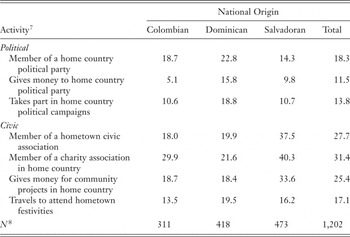
Colombians, Dominicans, and Salvadorans are more recent immigrant groups whose political activities are dominated by concerns with their home country or with immigration-related issues. These groups are, overwhelmingly, first-generation immigrants whose politics are not driven by the fervent anticommunism of Cubans or the struggle to overcome historic patterns of ethnic and racial discrimination, as in the case of Mexicans. By and large, the political activism of these three groups is of a transnational character, although there are significant differences among them. Table 2 reproduces results of a study that sought to map the extent of transnational political and cultural activities among these groups in their principal areas of destination: New York and environs, for Colombians and Dominicans; and Los Angeles and Washington, D.C., for Salvadorans (Portes Reference Portes2003b; Guarnizo et al., Reference Guarnizo, Portes and Haller2003).
Transnational Political and Civic Activities among Colombian, Dominican, and Salvadoran Immigrants in the United States, 2001Footnote 7Footnote 8

The study found that up to one-fifth of sampled immigrants are members of a home country political party and/or make contributions in time and money to electoral campaigns there. Dominican immigrants are significantly more likely to take part in these activities, an orientation that is reflected and promoted by the offices maintained by the major Dominican parties in New York (Itzigsohn et al., Reference Itzigsohn, Dore, Medina and Vázquez1999). For their part, Salvadorans, are adept at organizing civic committees and philanthropic associations in support of their hometowns. Up to 40% of sampled Salvadoran immigrants take part in these activities, which are often explicitly defined as “apolitical.” Despite this self-definition, the civic and philanthropic activities of Salvadoran expatriates can have significant influence in local and departmental politics at home, given the magnitude of the resources that they are capable of mobilizing (Menjívar Reference Menjívar2000; Landolt Reference Landolt2000; Portes and Mooney, Reference Portes, Mooney, Guillen, Collins, England and Meyer2002).
Despite numerous differences among Latin American–origin groups, there are also signs of convergence. The emergence of a unified Hispanic population out of these very diverse origins and patterns of settlement is promoted by four mutually reinforcing forces. First, there is a common culture, grounded in language and religion. Unlike the groups classified as Asian who cannot understand one another, nearly all Latin American immigrants share the same language: Spanish (in the case of Brazilians, the closely related Portuguese). While a rising number of these immigrants have converted to Protestantism, they share a common religious background: Catholicism. Despite the inroads made by Protestant sects, the Catholic Church is still paramount in the daily lives of most Latino immigrants in the United States (Levitt Reference Levitt2003; Hirschman Reference Hirschman2003).
Second, the power of the state is bent on turning Hispanics into a “real” ethnic minority. Nagel (Reference Nagel, Nagel and Olzak1986) demonstrated some time ago that the state can manufacture ethnicities and even races by the simple expedient of cataloguing and treating people “as if” they belonged to the same group. Something of the sort is happening with Latin American immigrants and their descendants. Whether they like it or not, they are classified by federal institutions as part of the same ethnic minority; endless reams of government-issued documents and academic studies label them accordingly; and second-generation children are taught, in no uncertain terms, that Hispanic is the ethnic group—or even race—to which they belong (Portes and Rumbaut, Reference Portes and Rumbaut2001, Chapter 8; Massey Reference Massey1993).
The enormous power of the media has also contributed to this manufacturing of ethnicity, as press articles, television programs, and films regularly dismiss national differences within the Spanish-speaking population, referring to its members by the same uniform term. There are, for example, frequent references to Hispanic music, films, literature, and sports, though they may originate from different countries and reflect distinct national cultures.
A third reason for convergence is the absolute numerical dominance of Mexican immigrants and their descendants in the population labeled Hispanic. Without Mexicans, all other Latin American-origin groups would have no more than local significance. Mexican immigration and its descendants have turned Hispanics into a truly national presence. Thus, all other groups are driven by the Mexican population as cars by a locomotive. The homogenizing pressures of the state and the media are not applied to a set of numerically comparable nationalities, but to a population dominated by a single, core group, with others as mostly local phenomena.
The fourth reason for convergence is closely related to the last and has to do with both self-interest and strength in numbers. Despite all the differences, politicians, entrepreneurs, and professionals have a vested interest in a unified Hispanic population. For politicians of Mexican and non-Mexican origin alike, this means more votes and greater clout. For entrepreneurs, it means a larger, richer market. For professionals, it means access to government and corporate jobs as representatives of a large minority population; and access to a larger clientele, for those in private practice. The growth of the Hispanic population and its public image as a unified entity thus offer opportunities and paths of mobility that would not exist were its component groups dealt with as separate minorities.
For these reasons, it is quite possible that what started as a label of convenience used by census officials to group together diverse Spanish-speaking groups becomes a sociological reality. A telling indication of that trend is the fact that, in the 2000 U.S. Census, 17.3% (6.1 million persons) of those who classified themselves as Hispanic did not specify any national origin. This proportion was higher than that of any national group, except Mexicans. This suggests that a significant number of U.S. Hispanics have come to accept the label, having left their national origins behind (U.S. Bureau of the Census 2001).
Running against this trend are the continuousness of immigration and the growing transnational ties between first-generation immigrants and their countries of origin. New immigrants replenish the ranks of those who retain strong loyalties toward their home countries and regions. Sending-country governments cannot be all that sympathetic with the emergence of a synthetic, made-in-the-U.S.A. ethnicity that undermines national loyalties. Thus, they can be expected to continue implementing programs designed to preserve enduring and exclusive country ties and commitments among their expatriates.
In the end, the emergence of a pan-national Hispanic minority in the United States is a product of assimilation and, hence, of the “race” between continuing immigration and time. New Cuban, Dominican, or Mexican immigrants do not know that they are Hispanic until they are informed of that fact upon arrival. It takes time for the four-fold set of forces described above to make itself felt. By and large, its weight and influence fall far more heavily on the children—with the second generation undergoing rapid acculturation to U.S. society—than on their foreign-born parents. Thus the irony that a label originally coined to refer to the Spanish-speaking immigrant population has become more real and more self-consciously accepted among assimilated descendants for whom Spanish and the countries from which their ancestors came have become a fading presence.
THE NEW SECOND GENERATION
Until recently, the study of contemporary immigration to the United States focused on the immigrants themselves, their reasons for coming, and their patterns of adaptation. Only in the last few years has this focus shifted, upon realization of the lasting importance of the second generation. First-generation immigrants have always been a restless bunch—here today and gone tomorrow; in the country, but not yet of it. By contrast, their U.S.-born and reared children are, for the most part, here to stay. As citizens, fully imbued with U.S. culture and aspirations, this second generation and their patterns of adaptation will play the decisive role in the long-term fate of the ethnic groups created by contemporary immigration (Zhou Reference Zhou1997; Portes and Rumbaut, Reference Portes and Rumbaut1996, Chapter 7).
Today, one in almost four Americans under the age of eighteen is an immigrant or the child of an immigrant. This proportion is growing fast, fueled by continuing immigration and the higher-than-average fertility of many immigrant groups. Although still young, a rising number of children of post-1960 immigrants are reaching adulthood; a majority of this emerging population is of Latin origin (Jensen Reference Jensen, Rumbaut and Portes2001; Rumbaut Reference Rumbaut1994). At first glance, and based on the experience of descendants of earlier European immigrants, we might assume that the adaptation process of the new second generation will be relatively straightforward: children will gradually leave foreign languages and identities behind, embrace U.S. culture, and claim and receive their rightful place in the economic and social mainstream (Gordon Reference Gordon1964; Alba and Nee, Reference Alba and Nee1997).
While there is some truth in this “straight-line” assimilation story, there are important ways in which it does not capture reality. There are groups among today's second generation slated for a smooth transition into the U.S. middle and upper classes, riding on their parents' human capital and material resources. Their ethnicity will become optional, displayed on occasion and when convenient. There are others who will claw their way upward, despite poverty, based on family solidarity and the support of coethnic communities. For them, ethnicity and the social networks linked to it will become a key resource and a strong basis for self-identity and pride. Still others are at risk of joining the underworld of gangs, drugs, prison, adolescent pregnancies, and early death that comprise the nightmare of U.S. inner cities. For these youths, their ethnicity will be neither an option nor a badge of pride, but a sign of permanent subordination (Vigil Reference Vigil2002; Bourgois Reference Bourgois1995).
These divergent paths have been labeled segmented assimilation to highlight the fact that integration into U.S. life and culture is not always a ticket to upward economic mobility and social acceptance (Portes and Zhou, Reference Portes and Zhou1993). Despite the rosy descriptions of nativists and assimilationists, the United States is not a uniform dreamland, but a complex entity marked by profound class and racial inequalities and featuring very different lifestyles and levels of opportunity. The future of the immigrant second generation largely depends on the sectors of this complex society toward which it assimilates. This process is, in turn, determined by how the immigrant parents are received, the resources that they bring with them, and the social and economic challenges that their offspring confront. The Hispanic second generation experiences all of these challenges, and its members can be found along each of the segmented assimilation paths. The next sections summarize the forces at play and their likely results.
OBSTACLES TO UPWARD ASSIMILATION
Racism: American Style
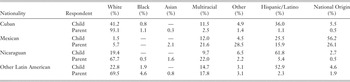
Many immigrants confront the reality and impact of racism only upon arrival in the United States. Still, they have the resources of their early socialization in other countries to fall back upon. This is not the case with their U.S.-born offspring, who must face the reality of American racism head on. A telling demonstration of the difference is provided by data from the Children of Immigrants Longitudinal Study (CILS), the largest study of the contemporary second generation conducted over a ten-year period in the metropolitan areas of Miami and San Diego (Portes and Rumbaut, Reference Portes and Rumbaut2001). Table 3 presents responses of Latino immigrant parents and their children to a question about their race. The question was asked during the second CILS survey, when children's average age was seventeen. The closed-response options of this survey were based on the standard census categories: White, Black, Asian, Multiracial, or Other. If the latter, respondents were asked to write in their racial self-definition.
Racial Identifications of Latin American Immigrants and their Children, 1996

As seen in Table 3, most immigrant parents did not confuse their ethnicity with their race, but many of their offspring did. Among Cubans, 93% of the parents self-identified as White, but only 41% of their children agreed. Of the latter, 36% said that they belonged to the Hispanic race, a figure that climbed to 62% for second-generation Nicaraguans, and 53% for others. A majority of Mexican parents self-identified as Multiracial or Other, while over 80% of their children identified themselves as belonging to the Mexican or the Hispanic race (Portes and Rumbaut, Reference Portes and Rumbaut2001, pp. 176–177).
This conflation of ethnicity and race is a clear reflection of acculturation to U.S. stereotypes and their impact on self-perceptions. By being constantly defined and treated as Hispanic, young people come to see the label not only as a matter of culture, language, or religion, but as a genetically transmitted phenotype. For Mexican Americans, the situation is still more egregious, as they come to identify their nationality with their biological race. The fact that the majority of the Latin second generation regard themselves as members of a racial minority is a consequence of their real-life experiences in a society where prejudice and discrimination are common and racial features paramount. In the process, the label Hispanic has traveled all the way from a classificatory convenience to what is regarded as a biologically transmitted trait.
It is thus not surprising that half of second-generation Latin youths and up to two-thirds of Mexican Americans report having suffered discrimination, and that one-third of the latter group believe that they will continue to experience discrimination “no matter how much education I get” (Portes and Rumbaut, Reference Portes and Rumbaut2001, pp. 38–40). The irony noted earlier—that the Hispanic label “hardens” among acculturated groups whose knowledge of the Spanish language and culture is increasingly attenuated—further solidifies when their ethnicity becomes identified as their race. The initially implausible but socially created belief that Hispanics are a race has definite consequences on the plans, perceptions, and actions of young people adapting to mainstream U.S. society.
Segmented Labor Markets
There was a time when children of unskilled working-class immigrants could improve their situation as skilled workers and supervisors by working in the same factories that employed their parents. This slow movement upward gave rise to the stable working-class ethnic communities dotting the U.S. industrial heartland. Descendants of Italian, Polish, and Russian immigrants lived there; they were content with a well-paid manual job; a college education was a dream that often had to wait until the third or fourth generation (Rosenblum Reference Rosenblum1973; Bonacich Reference Bonacich1976; Edwards Reference Edwards1979).
No longer. The very fast process of deindustrialization beginning in the 1960s and accelerating thereafter did away with the industrial job ladders of the past during the very period when the immigration doors reopened, following the abolition of national quotas in 1965 (Bean and Stevens, Reference Bean and Stevens2003). The result was a progressive segmentation of the U.S. labor market into an upper tier of professional and technical occupations requiring advanced education, and a lower tier of menial, poorly paid occupations in services, construction, and agriculture. The metaphor of an hourglass aptly captures these developments (Bluestone and Harrison, Reference Bluestone and Harrison1982; Piore and Sabel, Reference Piore and Sabel1984; Romo and Schwartz, Reference Romo and Schwartz1995). Low-skilled immigrants from Mexico and elsewhere responded to this situation by crowding into the bottom of the hourglass. Their offspring, however, imbued with U.S. culture and values, aim much higher (Gans Reference Gans1992; Portes and Zhou, Reference Portes and Zhou1993).
The problem is that to achieve these lofty aspirations, the children of immigrants must bridge in the span of one generation the educational gap that took earlier immigrant groups several generations to cross. The decisive role of education in gaining access to professional, technical, and entrepreneurial opportunities means that only those who manage to stay in school and achieve a college degree or a solid vocational education stand a good chance of turning their “American dream” ambitions into reality. For others, the future looks rather grim, as they are likely to face occupational prospects not much better than those of their parents. Those who regard such jobs as beneath them have few other options and may turn toward deviant and semideviant lifestyles, leading to downward assimilation.
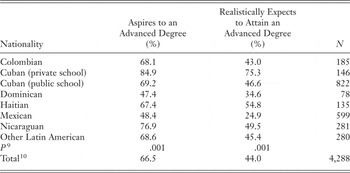
Second-generation youths are well aware of the importance of education. As shown in Table 4, large proportions of late adolescents aspire to attain an advanced postcollege degree, and many actually expect to achieve it. Note, however, the marked differences among nationalities. Cuban Americans attending private school in Miami are mostly the children of early middle-class exiles who arrived prior to the Mariel exodus of 1980 (Pérez Reference Pérez, Rumbaut and Portes2001; Portes and Stepick, Reference Portes and Stepick1993). Among these youths, 85% aspired to an advanced university degree in late adolescence, and three-fourths were confident of attaining it. The proportion expecting such a degree drops significantly to about 50%, among public school Cubans (mostly the offspring of Mariel and post-Mariel exodus arrivals), Nicaraguans, Colombians, and other Latin Americans. It then drops further, to just 25% among children of Mexican immigrants.
Educational Aspirations and Expectations of the Latin American Second Generation, 1996Footnote 9Footnote 10Footnote 13Footnote 14

The research literature consistently shows that educational aspirations and expectations are among the strongest predictors of educational attainment (Sewell and Hauser, Reference Sewell and Hauser1972; Alexander and Pallas, Reference Alexander and Pallas1983; Rosenbaum Reference Rosenbaum2002). Our own findings, presented below, confirm that fact. Thus, from adolescence on, we detect a divergent pattern, where second-generation youths from some nationalities can look confidently into the future based on their own and their family's resources, while majorities of other groups disqualify themselves, at an early age, from this key instrument for upward mobility. No doubt, Mexicans, Dominicans, and other youths in this situation are probably voicing a realistic assessment of their chances, given the poverty of their families and the quality of schools that they have been forced to attend (Fernández-Kelly and Curran, Reference Fernández-Kelly, Curran, Rumbaut and Portes2001; López and Stanton-Salazar, Reference López, Stanton-Salazar, Rumbaut and Portes2001).
Poverty and Crime
The third and perhaps more difficult problem faced by children of immigrants and their families is the proliferation of drugs, gangs, and deviant lifestyles in U.S. inner cities. The structural origins of these mutually reinforcing social pathologies have been the subject of intensive research (Wilson Reference Wilson1987; Sullivan Reference Sullivan1989; Massey and Denton, Reference Massey and Denton1993). It is not my intention to review here the complex set of causes accounting for the nightmarish situation of U.S. urban ghettos, but to note that immigrants and their children confront it as a fait accompli. This difficult situation is, of course, one more of the issues conveniently ignored by nativists and by boosters of assimilation at any price.
Because of their poverty, many immigrant families are forced to settle in inner cities. In the mid-1990s, 89% of second-generation children aged eighteen and under lived in metropolitan areas, as compared with 75% of their native-parentage peers; only 22% of the latter lived in inner cities, while the figure among children of immigrants rose to 31% (Jensen Reference Jensen, Rumbaut and Portes2001, p. 29). In streets and schools located in poor urban areas, children are exposed to conditions that are in direct opposition to parental expectations for them. The lure of gangs and drugs as a quick way to money and power, and the difficulties in dodging them for those intent on pursuing their education, are everyday facts of life on inner-city streets (Vigil Reference Vigil2002; Dance Reference Dance2002).
Some immigrant parents have become so distraught at what they see as the permissiveness of U.S. culture and the specific threats posed by gangs and drugs that they have taken to sending their children back home to be educated in the care of grandparents and other kin. In the Dominican Republic, El Salvador, and other countries, private schools have sprung up for the specific purpose of reeducating these “refugees” from U.S. streets (Matthei and Smith, Reference Matthei, Smith, Korzeniewicz and Smith1996; Rohter Reference Rohter1998). The over 2500 immigrant parents interviewed in the course of the second CILS survey in 1996 voiced similar concerns. As Figure 3 shows, significant majorities (over 80%) of these parents were preoccupied by the negative influences received by their children in school and by the gap between their own values and goals and those of their children's friends. These concerns were universal and were emphasized by all parents, regardless of their nationality or socioeconomic status.
Immigrant Parents' Concern with Negative Influences on their Children, 1996

A Nicaraguan father expressed his preoccupation in anguished ways, representative of comments repeatedly heard throughout the course of the study:
Why? Why? Why should this country, the richest in the world, have such low educational standards and disruptive behavior? It is sad to see this country's children smoking grass or wearing their hair in spikes. How are these youngsters paying back for the opportunities that they receive? You can wear anything to school, you can talk in class—no one can stop you.Footnote 11
Segmented Assimilation on the Ground
A final survey of the CILS project took place in 2001–2002, when the original respondents had reached an average age of twenty-four years. By this time, it was possible to ascertain how the combination of challenges and resources described above played itself out. While prior results of the study had documented early outcomes of the adaptation process in adolescence, results documented by this last survey are “hard” in the sense of showing real-life paths to success and failure, as experienced by these young people. Such outcomes include educational attainment, family and personal income, employment and occupation, language knowledge and use, marriage, early childbearing, and run-ins with the law in the form of arrests and incarceration.
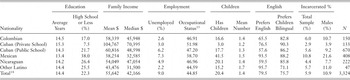
CILS-III contains information on all of these variables. The survey retrieved data on 3564 original respondents, representing 84% of the preceding wave. There is some evidence of bias in this sample relative to the original one, but this can be readily corrected through well-known statistical methods. Table 5 presents our results for Latin American-origin respondents and for the entire sample in Miami and San Diego, adjusted for sampling bias. In terms of education, it shows the offspring of middle-class Cuban exiles who attended private school in Miami to have gone the farthest, with an average of 15.3 years of education, and with only 8% having an educational attainment of high school or less. Many of these respondents are still in school, so educational attainment can be expected to continue to rise.
Key Second-Generation Adaptation Outcomes by National Origin, 2002

Colombian Americans come next in educational attainment, followed by Nicaraguan Americans and other Latinos, among whom the number of those ending their education with a high school diploma or less increases to 26%, and the average years of education to just above junior college, at 14.4 years. The worst profile is that of Mexican Americans, among whom almost two-fifths (38%) failed to go beyond high school, and whose average educational attainment is the lowest in the sample. The pattern repeats itself with other indicators of socioeconomic status, such as unemployment, occupational prestige, and family income. On the latter variable, Cuban Americans who attended private school in Miami are the only group to have exceeded $100,000 in average family income. The figure drops to about $60,000 among public school Cubans, Colombians, and Nicaraguans, and just under $40,000 for Mexicans.Footnote 12
Despite their socioeconomic disadvantage, or perhaps because of it, Mexican Americans are far more inclined to communicate solely in English than are other Latin American–origin groups. A sizable minority of young adults of Cuban, Colombian, and Nicaraguan origin (about 40%) prefer bilingualism, combining English with extensive use of Spanish. Despite these personal differences, strong majorities of all second-generation Hispanics express a clear preference for raising their own children to be bilingual.
The mean age of the sample is twenty-four years, an age when young people are completing their education or initiating their work careers. Having children at or before this age represents an extra burden of time and money that often hinders efforts to move ahead educationally or economically. The dictum that “the rich get richer, and the poor get children” is well supported by our results, as shown in the next column of the table. Only 3% of middle-class Cuban Americans had children by early adulthood. The figure rises to 15% to 20% among other Cubans, Colombians, Nicaraguans, and other second-generation youths. Among Mexican Americans, however, it reaches a remarkable 42%. Thus, the Hispanic minority with the lowest average education, the poorest jobs, and the highest rate of unemployment in early adulthood is also the most burdened by premature parenthood. The picture is consistent, demonstrating the cumulative effects of early parental and community characteristics along with external obstacles to successful integration.
The CILS-III survey contains information on incidents of arrest and incarceration. I report results for the latter variable for two reasons. First, unlike instances of arrests, which may be for trivial or erroneous reasons, incarceration generally entails a conviction for a serious offense. Second, the study was able to supplement self-reports by respondents with data from the Florida and California Departments of Corrections. The identity of convicted felons and reasons for their incarceration are public information which can be accessed through the internet sites of these agencies. It is thus possible to arrive at a more reliable estimate of the number of incarcerated youths than through the use of self-reports alone.
Figures in the last column of Table 5 tell the story. Compared with a crime index of 7.6% for the general population of the Miami metropolitan area in 2000, only 3% of Cuban Americans from middle-class families were ever incarcerated. The number climbs steadily to 4% among Nicaraguans, 6% each among Colombians and other Latins, and 11% among Mexicans, the latter of which doubles the sample average. These rates are for both sexes. As is well-known, incidents of arrest and incarceration are far more common among young males. The results portrayed in Figure 4 show the male incarceration rate to be approximately 10% for most second-generation nationalities and for the sample as a whole. The rate then climbs to 19% for other Latins (mostly offspring of Central American immigrants) and over 20% for Mexican Americans.
Incarceration Rates of Second-Generation Latino Males, 2002

By way of comparison, the probability of having ever been incarcerated for adult Black males up to the age of forty is 27% (Western Reference Western2002). Since respondents in our sample are only in their early twenties, there is every likelihood that offspring of Mexican and Central American immigrants will match or exceed the Black incarceration rate by that age. This is the most tangible evidence of downward assimilation available in these data. The negative outcomes of the process cluster overwhelmingly among children of non-White and poorly educated immigrants, reflecting the effects of low parental human capital, racial discrimination, and a difficult external environment.
While the figures also show that a majority of young persons from the same groups somehow manage to graduate from high school, find jobs, and avoid jail, a sizable minority is being left behind. This conclusion is even more poignant when we realize that the latter group is formed by the fastest growing Hispanic nationalities, created by large and sustained immigrant flows. For example, if present trends continue, the number of young Mexican Americans at risk of downward assimilation into poor education, early parenthood, crime, and jail will exceed the total of all other individual Hispanic nationalities combined, as identified in the CILS sample.
CONCLUSION
The rapid growth of the Latin American–origin population represents a phenomenon of great significance both for the United States and for the groups directly involved in the process. While the growing Hispanic presence is viewed with increasing alarm by nativist organizations, there is no intrinsic reason why this population should not be able to integrate successfully into the U.S. mainstream. Latin American immigrants share the same Western and Christian traditions as the receiving population; and their work ethic, family values, and aspirations for the future are the same. Spanish is a Western language with many affinities to English.
The barriers to successful integration are not cultural but structural, along the lines described above. The rapid growth of the Hispanic population is fueled by the continuous arrival of immigrants of generally low human capital, who come to fill a vast demand for manual labor in the U.S. labor market. Their arrival not only drives down the averages in terms of education, occupational status, and income of this population, but it recreates anew the problems and the difficulties confronted by earlier arrivals.
This is the situation giving rise to recent nativist reactions, including Huntington's (Reference Huntington2004a) well-known article “The Hispanic Challenge.” Written without any original field research, the essay sounds the alarm about what Hispanics, particularly Mexicans, can do to U.S. society, and places responsibility directly on them. Huntington's statements about Hispanic resistance to learn the English language and American ways are so contrary to the evidence that they do not deserve a response.
More on target are Huntington's complaints about the low levels of education of the Mexican immigrant population, its poverty, the low educational aspirations of its youths, and these youths' propensity to drop out of school and have children prematurely. As seen previously, there is evidence to support all these tendencies, but not Huntington's interpretation of their causes. Mexican laborers coming in such large numbers are in the United States not only because they want to be, but also because they are wanted. U.S. employers—from mom-and-pop businesses to large corporations—benefit greatly from this inflow while neatly sidestepping its social consequences. Vulnerable and unprotected by the law, unauthorized workers are left to fend for themselves once their usefulness to the businesses that hire them runs out. The economic benefits of immigration are privatized, while the costs are socialized.
Compounding the problem is a misguided federal immigration policy that represses the unauthorized flow without actually stopping it. This has forced Mexican laborers to abandon their traditional commuting across the border and to settle farther north, bringing their families along in the process. This situation has led to the emergence of a second generation growing up in conditions of severe disadvantage. Like all parents, Mexican and Central American laborers earnestly want their children to succeed, and they go to great lengths to support them. However, neither the external environment nor their own meager material and human-capital resources provide the wherewithal to make this outcome possible in many cases. Empirical evidence, including the CILS parental survey, documents the high aspirations that all immigrant parents have for their children, along with their willingness to make great sacrifices in order to turn those aspirations into reality.
From his academic post, Huntington fulminates against these immigrants and their families, accusing them of all sorts of evil. The book-length version of Huntington's argument, Who Are We? (Reference Huntington2004b), elaborates these denunciations. Following Centeno (Reference Centeno2005), we may ask, Who are you, Samuel Huntington to so carelessly pontificate about matters so dimly understood? What the United States needs to do now is not to engage in another round of ethnic chauvinism, a practice that went out of style almost a century ago (Pierpont Reference Pierpont2004). Instead, what needs to be done is to engage in a serious search for ways to produce three key outcomes: (1) to bring the unauthorized labor flow above ground and regularize it; (2) as the U.S. economy continues to depend on foreign labor, to seek ways to reestablish a circular pattern by creating incentives for voluntary return; (3) for immigrant families already settled in the United States, to find means to support parental aspirations and parental authority to fend off the threat of downward assimilation.
These are, in my view, the concerns that should occupy the minds and energies of serious scholars and responsible public intellectuals. To this end, and by way of conclusion, I offer some concrete proposals to address the third of these questions, namely the future of the second generation. The difficulties that this young population confronts indicate that this outcome of past immigration requires the most immediate attention. Sadly, state institutions, particularly public schools, have proven notoriously inept at supporting immigrant families and implementing compensatory programs. In particular, public schools have been found consistently to reinforce rather than reduce inequalities in human and social capital among their students (Coleman et al., Reference Coleman, Hoffer and Kilgore1982; Coleman Reference Coleman1993; Bryk et al., Reference Bryk, Lee and Holland1993; Portes and MacLeod, Reference Portes and MacLeod1996).
In this situation, there are three types of institutional actors who can help: First, Hispanic organizations should prioritize the educational needs of their own second generation. The fact that Latin American–origin students, in general, and Mexican Americans, in particular, have the highest levels of high school abandonment and the lowest level of educational achievement should be viewed as a problem of the highest priority for them. Parents and migrant communities need assistance in the form of after-school programs, remedial and tutorial education, SAT preparatory courses, and vocational orientation. As shown by Zhou (Reference Zhou1997, Reference Zhou2004), the institutional density of Asian communities—such as Koreatown in Los Angeles—has been a key factor in preventing their children from leaving school and guiding them toward high levels of achievement. Hispanic communities, especially those where the offspring of working-class migrants grow up, are bereft of these resources. Rather than concerning themselves exclusively with political and adult-centered issues, existing Hispanic organizations should turn their attention to the issue of decisive significance: the future of their youth.
Second, churches can also play an important role in the process of institution building and educational guidance. As is well-known, the Catholic Church played the central role in ensuring the education of the descendants of illiterate or near-illiterate Irish, Italian, and Polish peasants in the nineteenth and early twentieth centuries. The enviable educational system that the Catholic Church built—from grammar school to first-rate colleges and universities—ensured something close to parity in educational opportunities for the children and grandchildren of Catholic immigrants, thus allowing them to compete effectively in the U.S. labor market (Dolan Reference Dolan1975; Bodnar Reference Bodnar1985; Hirschman Reference Hirschman2003). In recent years, a Catholic-school education has been consistently shown to be superior to a public school education in terms of rates of high school graduation, academic performance, and college admission (Bryk et al., Reference Bryk, Lee and Holland1993; Coleman et al., Reference Coleman, Hoffer and Kilgore1982; Coleman Reference Coleman1993).Footnote 15
There is no reason why the Catholic Church cannot do for the children of Mexican and Central American migrants what it did for the Italian and Polish second generations. If many of these children cannot pay for a Catholic school education, they may still be supported and guided by outreach, remedial, tutorial, and college-prep programs sponsored by nearby parishes. The Protestant churches to which an increasing number of Latino immigrants have gravitated can and should play a similar community-building role. Historically, religion has been a major instrument to ensure the survival and the integration of successive immigrant cohorts within U.S. borders (Glazer and Moynihan, Reference Glazer and Moynihan1970; Greeley Reference Greeley1971; Hirschman Reference Hirschman2003). There has been no time in which the presence and activities of religion are as much needed as with the Latin American immigrants and their offspring of today.
A third and initially implausible source of institutional assistance are the governments of sending countries. We have seen how these governments have increasingly involved themselves in the affairs of their migrant communities, seeking to increase and maintain remittances, investments, and philanthropic contributions. Rather than just seeking to extract short-term gains from their expatriates, sending nations should consider ways to promote their long-term successful adaptation. Of these, none is more important than helping parents to keep their children in school and further their educational achievement. Scholarship programs, prizes for academic progress, paid trips home, free courses to promote fluency in Spanish and knowledge of the history of their parents' native homeland, are all means to motivate the second generation, sustain its self-image, and give it the moral grounding and guidance needed to succeed in a challenging environment. So far, very few of these initiatives have been implemented, despite the growing importance of transnational ties between expatriate communities and their respective home-country governments.
A final paradox of the process of assimilation is that it has seldom succeeded through a drastic unilateral shift into the English language and an equally drastic abandonment of the culture of origin. Instead, a gradual process that combines learning the language and culture of the receiving society with the preservation of parental languages and selected elements of their culture has been shown to yield the best adaptation outcomes for the second generation (Rumbaut and Portes, Reference Rumbaut and Portes2001). This process, selective acculturation, can be effectively buttressed by each of the three sets of institutional actors named above. Ironically, fierce advocates of immediate and unilateral assimilation have seldom helped immigrants to assimilate. They command newcomers and their offspring to become instant Americans without providing any effective support or guidance to do this and then denounce them for failing to comply. Coethnic organizations, church-based agencies, and home government institutions may jointly do a much better job by reinforcing and legitimizing immigrants' language, culture, and self-esteem as a natural springboard for their children's successful integration into U.S. society.