INTRODUCTION
Human food sources are a cornerstone of human society and profoundly influence the way people live. Hence, knowledge of food sources is essential to understanding ancient human societies and cultures. According to the theory of “you are what you eat” (Schoeninger Reference Schoeninger1989; Kohn Reference Kohn1999), the chemical composition of human and animal bones, together with the faunal and plant remains unearthed in archaeological excavations, provides a record of food intake of ancient inhabitants. The stable isotope ratios of bones are directly related to the isotope ratios of food consumed, and the isotopic values in bone gelatin mainly reflect dietary protein (Ambrose and Norr Reference Ambrose and Norr1993; Sealy Reference Sealy2001; Rutgers et al. Reference Rutgers, van Strydonck, Boudin and van der Linde2009; Schoeninger Reference Schoeninger2010; Malainey Reference Malainey2011; Lubritto et al. Reference Lubritto, Sirignano, Ricci, Passariello and Quiros Castillo2013; Zazzo et al. Reference Zazzo, Munoz and Saliege2014). The usefulness of isotope analyses for paleodietary studies derives from the fact that isotopic ratios of different types of food are incorporated and preserved by the consumers. Carbon isotope ratios provide information about the ecosystem of a consumer, allowing us to distinguish between terrestrial versus marine food sources (Tauber Reference Tauber1981; Rutgers et al. Reference Rutgers, van Strydonck, Boudin and van der Linde2009; Reitsema et al. Reference Reitsema, Crews and Polcyn2010; Craig et al. Reference Craig and Bondioli2013; Kuzmin Reference Kuzmin2015) or can be used to distinguish between the consumption of temperate versus arid plant types (Hu et al. Reference Hu, He and Dong2005, Reference Hu, Ambrose and Wang2006). Nitrogen isotope ratios reveal information about an organism’s trophic position in the local foodweb, distinguishing between herbivores, omnivores, and carnivores (Ambrose Reference Ambrose1993; Schoeninger and Moore Reference Schoeninger and Moore1999; Ambrose Reference Ambrose2000; Reitsema et al. Reference Reitsema, Crews and Polcyn2010). Thus, stable isotope ratio measurements of bone contribute not only to our understanding of the dietary structure of ancient inhabitants, but also to their lifestyle and living environment (Hu et al. Reference Hu, Yang and Wang2000). Individual isotope data complement historical and archaeological data to understand nuances of early societies, such as sex-based differences, religious practices, environmental impacts and other dietary behaviors (Reitsema et al. Reference Reitsema, Crews and Polcyn2010; Kinaston et al. Reference Kinaston and Walter2013).
Plants with different photosynthetic pathways have great differences in δ13C values. Typically, the average δ13C values of C3 and C4 plants are –26.5‰ and –12.5‰, respectively (van der Merwe et al. Reference van der Merwe, Roosevelt and Vogel1981; van der Merwe Reference van der Merwe1982). People who consumed terrestrial proteins (from herbivores and C3 plants) typically have δ13C values around –20‰, and those who subsided mainly on marine protein (from mammals, fish, and mollusks) have δ13C values around –12‰ (Choy and Richards Reference Choy and Richards2010). In the absence of marine food sources, human bone collagen δ13C values ≤ –18‰ indicate a reliance on C3 food sources. Values from δ13C=–18‰ to –12‰ point to a mixture of C3 and C4 foods and δ13C values≥–12‰ argue for a C4 plant-dependent diet (Ma et al. Reference Ma, Dong, Lightfoot, Wang, Liu, Jia, Zhang and Chen2014)
Nitrogen isotopic compositions (δ15N) follow trophic levels and can be used to estimate of the amount of animal protein in the diet (Ambrose Reference Ambrose1993; Ambrose Reference Ambrose2000; Schoeninger and Moore Reference Schoeninger and Moore1999). The δ15N of a typical omnivore is around 7‰ ~9‰, while δ15N of carnivores and fresh water fish are normally higher than 9‰ (Ambrose Reference Ambrose1991). Thus, δ13C and δ15N ratios can both contribute to the understanding of dietary habits of individuals in an archaeological context.
It is important to keep in mind that δ15N and δ13C values provide a macroscopic view of paleodiet, and cannot be used on their own to identify exact food sources (Richards Reference Richards2002; Harrison and Katzenberg Reference Harrison and Katzenberg2003; Zhang Reference Zhang2003; Hu et al. Reference Hu, He and Dong2005). However, data on faunal and floral remains can also be used to augment our understanding of production mode and specific food types.
There are many faunal, floral, and human remains unearthed at Neolithic cultural sites in China, which provide excellent materials for the study of paleonutrition of ancient inhabitants. In North China, at the Jiahu site (9000–7800 BP), Henan province, inhabitants consumed both C3 plants and meat as their staple foods based on δ13C and δ 15N. Phytolith assemblages indicate that the proportion of rice opal was higher (Zhang Reference Zhang1999). Meat was obtained through hunting, fishing, and domesticated animals (Hu et al. Reference Hu, Ambrose and Wang2006). The paleodiet of ancient inhabitants from the Xigongqiao site (5000–4500 BP), Shandong province, show a heavy reliance on rice and millet, with some supplemental meat sources. The remains of individuals that relied heavily on C3 plants were found to have lower δ15N values, while those depending heavily on C4 plants had higher δ15N values (Hu et al. Reference Hu, He and Dong2005). A dietary study of the skeletal remains of an unusually tall human male, “the Giant,” from the Longshan Period (5000–4000 BP), Zijin site, Shanaxi province, showed that millet accounted for about 85% of his diet and meat was supplementary (Zhu et al. Reference Zhu, Cheng and Yang2013). However, in the South of China, human bones excavated from Neolithic cultural sites (5000–3300 BP), such as Songze site in Shanghai, and Dingshishan site in Guangxi Province, had δ13C values ranging from –18‰ to –20‰. The proportion of C3 plants (mainly rice) accounted for 85–99% of the diet and the average δ15N was 11.14‰, indicating that their animal-based food intake included both aquatic and terrestrial sources (Zhang Reference Zhang2003).
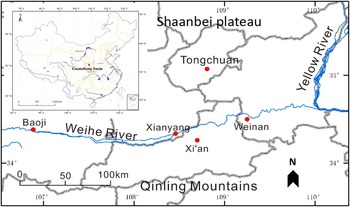
The Guanzhong basin, in central Shaanxi Province, is recognized as the cradle of ancient Chinese civilization. This area covers the Jing and Wei River basins, east to Baoji, and west to the Yellow River, is bordered on the north by the Shaanbei plateau and to the south by the Qinling Mountains (Figure 1). The overall physiography of the region is that of a broad loess terrace bound by mountains, and incised by a number of of rivers. This combination made Guanzhong area an ideal spot for agricultural development. Here they met with a relatively mild and wet climate with rich biological resources.
Map of China (left), including Shaanxi province and Guanzhong region; (right) detail of Guanzhong region.

We measured 14C ages of bones unearthed from the Zhouyuan site in the western Guanzhong region, and used published carbon and nitrogen isotopic results of the local flora and fauna. We find that the food structure of ancient inhabitants in this region changed along with changes in the natural environment, craftsmanship, political culture and ideology. Our paper quantifies the timing of food resource changes in the Gaunzhong region from the Laoguantai period (8000–7000 BP), Yangshao period (7000–5000 BP), Longshan period (5000–4000 BP), and Proto Zhou and Western Zhou period (4000–2700 BP) to trace the development of human paleodiet in the region since 8000 BP.
SAMPLING
Zhouyuan was the former capital of the Western Zhou Dynasty (1046–771 BC). Ancient inhabitants dwelled here at the beginning of Yangshao period, about 3000 years before the Western Zhou Dynasty. Successive cultural remains have been found here, from the Longshan period to the Warring States period. The area is located about 100 km northwest of Xi’an, Shaanxi province, near the city of Baoji.
MATERIALS AND METHODS
The method used to extract collagen from bone follows the procedures of Brown et al. (Reference Brown, Nelson, Vogel and Southon1988) and Collins and Galley (Reference Collins and Galley1998). The bone sample was broken into smaller pieces and washed by ultrasonication. Decalcification was performed in 0.5 N HCl, at room temperature. After centrifugation, the bone was rinsed with distilled water, and soaked in 0.5 N NaOH for 30 min, and then rinsed with distilled water until neutral. The samples were gelatinized at 90°C in a basic solution (pH=3) for 48 hr. The solid residue was removed after centrifugation. The purified “collagen” was lyophilized for 48 hr (Yuan et al. Reference Yuan2000; Zhu et al. Reference Zhu, Cheng and Yang2013).
The residue was then combusted and purified. Liquid nitrogen and alcohol traps were used to remove H2O and other gases. The purified CO2 gas was frozen in liquid nitrogen and stored until graphitization. Then, it was reduced to graphite with a Zn/Fe catalytic reduction (Slota et al. Reference Slota, Jull and Linick1987; Jull Reference Jull2007). The graphite samples were pressed into aluminium target holders with a 1-mm internal diameter for 14C analysis. Anthracite served as a background material to quantify the procedural blank for the 14C measurements. NBS oxalic acid II (SRM-4990C) was used as a 14C standard. The 14C specific activity was calculated by 14C/12C ratio measurements using the 3 MV accelerator mass spectrometer (AMS) at the Xi’an AMS Center, CAS (Zhou et al. Reference Zhou, Zhao, Lu, Liu, Wu, Cheng, Zhao and Huang2006). The results are reported using the conventions of Stuiver and Polach (Reference Stuiver and Polach1977).
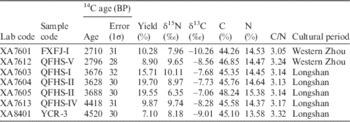
The δ13C and δ15N values were analyzed by EA-IRMS (Finnigan Mat 252 differentially pumped isotope ratio mass spectrometer). The carbon and nitrogen isotopes were measured relative to V-PDB and AIR standards, respectively. The proportions of C and N were measured with an elemental analyzer (Cheshire, UK) in the Institute of Earth Environment, Chinese Academy of Sciences (IEECAS) (see Table 1).
The 14C dating, δ15N, δ13C, C, and N results from human burial in the Zhouyuan site.Footnote *

* The accuracy of δ13C is 0.1‰ and of δ15N is 0.2‰.
The 14C dating results were consistent with the archaeological ages of the layers where the bones were unearthed. The δ13C and δ15N results from all the samples are shown in Table 1. the δ13C values fall between –10.26‰ and –7.06‰. The δ15N values fall between 6.35‰ and 10.11‰, with an average value of 8.79‰. The carbon and nitrogen stable isotope ratios from the Zhouyuan site yielded good quality collagen. All of the C/N ratios fall within the collagen quality criteria of 2.9–3.6 (DeNiro Reference DeNiro1985; Ambrose Reference Ambrose1993). According to criteria outlined in Ambrose (1990) for detecting diagenesis, all samples were in excellent condition (Table 1). Collagen quality indicators measured included %C, %N and atomic C/N ratios (van Klinken Reference van Klinken1999; Millard. Reference Millard2014).
RESULTS AND DISCUSSION
δ13C and δ15N in Human Bone
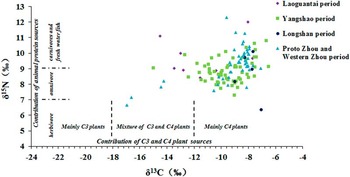
The δ13C and δ15N results of human bone from main sites in the Guanzhong area are used in constructing the food web model, shown in Figure 2. These data are taken from published sources and measurements from this study (all data are listed in the supplementary material). The δ13C values range from –17‰ to –7‰, with most samples in the range –12‰ to –7‰. The δ15N values varied from 4‰ to 12‰, with most samples falling in the range 7‰ to 11‰. In general, ancient inhabitants in the Guanzhong area consumed a diet dominated by C4 plants, with supplementary meat sources.
Human isotopic results plotted with respect to food source isotopic value ranges. C and N isotope value ranges for animal protein and plants in the Laoguanai, Yangshao, Longshan, Proto-west Zhou periods from this study and published values. See supplementary online material.

The ranges of δ13C and δ15N values vary for different time periods. Results from human bones from two sites dating to the Laoguantai period include 3 samples from Baijia (Pia and John Reference Pia and John2001; Wang Reference Wang2004) and 5 samples from Beiliu (Guo et al Reference Guo2016). δ15N values ranged from 8.4 to 12‰, and δ13C values ranged from –7 to –14‰ (Figure 2). The Laoguantai period was characterized by relatively higher δ15N and lower δ13C values, suggesting that the ancient inhabitants consumed a mixture of C3 and C4 plants as their major plant protein source and a higher proportion of meat as compared to other periods.
Stable carbon and nitrogen isotopic analyses of human bones from five sites from the Yangshao period have been reported, with 23 samples from Jiangzhai (Wang Reference Wang2004; Ekarina 2005; Guo et al. Reference Guo and Hu2011), 5 samples from Banpo (Cai and Qiu Reference Cai and Qiu1984; Ekarina 2005), 9 samples from Shijia (Ekarina 2005), 25 samples from Yuhuazhai (Zhang and Qiu Reference Zhang and Qiu2010), and 4 samples from Beiliu (Guo et al. Reference Guo2016), shown in Table 2 in the supplemental data. The results show a consistent pattern between sites, with δ15N values that range from 7.3 to 10.8‰ and δ13C values mostly in the range of –12 to –7‰ (Figure 2). Hence, the Yangshao period was characterized by intermediate δ15N values and higher δ13C values, indicating a strong reliance on C4 plants, with relatively less meat intake.
We performed stable carbon and nitrogen isotope measurements on 5 human bone samples that date to the Longshan period, from a site at Zhouyuan site (this study), seen in Table 2 (supplemental data). δ15N values ranged from 6.4 to 8.9‰, and δ13C values varied from –17 to –7‰ (Figure 2). Three of the four results indicate a continued dominance of C4 plants in the diet, while the δ15N results point to an omnivorous to hebivorous diet.
Stable C and N isotopic results are also available for several Proto-Zhou and Western Zhou sites, including 13 from Zhougongmiao (Ling Reference Ling2010), 32 from Liangjiacun (Ling Reference Ling2010; Chen Reference Chen2012), and 2 from Zhouyuan (this study), shown in Table 2 (supplemental data). δ15N values varied from 6 to 12‰ and δ13C values ranged from –7 to –17‰ (Figure 2). On the whole the diet was dominated by C4 plants and ranged from omnivorous to carnivorous, according to the δ15N results.
Plant and Faunal Remains from Guanzhong Area Sites
Laoguantai Period (8000–7000 BP)
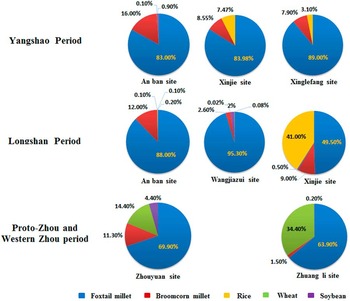
Farming implements unearthed from sites dating to the Laoguantai period indicated that the inhabitants had developed agricultural techniques (Beiliu site 1986). While systematic plant flotation analyses are not available for the Laoguantai sites in the Guanzhong area, there was no quantitative statistics of the plant remains. But data from Hebei (Tong Reference Tong1984) and Inner Mongolia (Xinglonggou site 2004), both of which border on Guanzhong area, show that broomcorn millet and foxtail millet were the two main crops at this time (Figure 3). Therefore, we can infer that millet was consumed also by the ancient inhabitants in the Guanzhong area. During this period, the sub-humid climate in the Guanzhong area made it possible for people to go in for gathering. Tender leaves and rootstock were likely to be taken from gathering.
Percentage of cultigens from sites An ban (Liu Reference Liu2012), Xinjie (Liu Reference Liu2013), Xinlefang (Liu et al. Reference Liu2013), Wangjiazui (Zhao et al. Reference Zhao2004), Xinjie (Zhong et al. Reference Zhong and Yang2015), Zhouyuan (Zhao et al. Reference Zhao2004), and Zhuangli (Zhao Reference Zhao2011). The data in this figure are from plant flotation experiments. A systematic plant flotation has not yet been done for the Laoguantai sites, so there were no quantitative statistics of the plant remains.

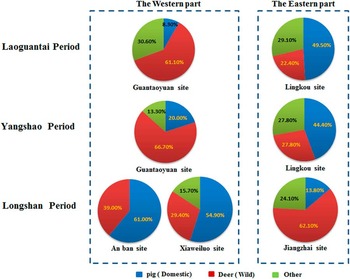
From the number of animal bones found in each site, we identified a rich meat source for inhabitants in those areas, together with some regional differences (Figure 4). In the eastern part of the Guanzhong area, Lingkou site (Lingkou Village of Lintong 2004), the amount of domesticated animal bones (pig) was higher than those of wild animals (red deer, river deer, and others), seen in Figure 4. However, in the western part of the Guanzhong area, Guantaoyuan site (Hu Reference Hu2007), the amount of domesticated animal bones (pig) were much lower than those of wild animals (red deer, river deer) (Figure 4). This could be because the western portion of the Guangzhong area provided an optimal environment for wild animals, so that people living there did not have to raise domestic animals to insure a stable meat supply (Zhao Reference Zhao2011).
Percentage of pig (domestic) and deer (wild) from sites of Guantaoyuan (Hu Reference Hu2007), Lingkou (Lingkou Village of Lintong 2004), Anban (Fu Reference Fu2000), Xiaweiluo (Zhang Reference Zhang2006), and Jiangzhai (Zhang Reference Zhang2006). Only a little statistical work has been done on the animal remains of the Western Zhou period.

Yangshao Period (7000–5000 BP)
The Yangshao Culture represents a high point in the prehistoric civilization in the Guanzhong area with rapid and widespread agricultural development. More than 2040 sites of Yangshao period have been discovered in the Shaanxi province, about 60% of which are located in the Guanzhong area (China’s State Administration of Cultural Heritage 1992). Systematic plant flotation analyses are available for many of these sites, An ban site (Liu Reference Liu2012), Xinjie site (Liu et al. Reference Liu2013), Xinglefang site (Liu et al. Reference Liu2013), facilitating our understanding of the agricultural development during this period. C4 plants such as foxtail millet and broomcorn millet were quite common in the main sites, shown in Figure 3. The percentage of broomcorn millet was lower than that of foxtail millet,shown in Figure 3. Meanwhile, the proportion of a certain amount of C3 plants was lower, including rice, wheat, and soybean. At the Xinjie site and Xinglefang site, the amount of rice account for 7.47%, 3.10%, respectively. (Figure 3). It is likely that the ancient inhabitants here relied heavily on millet-farming and consumed millet as their staple food source.
We also observed differences in the proportion of meat sources consumed through time, between inhabitants from the eastern part of the Guanzhong area as compared to the west (Figure 4). A greater proportion of domestic animal remains were unearthed in the eastern part of the Guanzhong area, Lingkou site (Lingkou Village of Lintong 2004), including pig, dog, and goat. Domestic animals account for 44.4% and wild animals 27.8%. However, in the western part of the Guanzhong area, Guantaoyuan site (Hu et al. Reference Hu2007), a greater proportion of wild animals persisted through time, such as deer, wild horses, wild boar, and fresh fish, but with fewer species. Domestic animals accounted for 20% and wild animals 66.7%. The occurrence of fences found in sites like Banpo (Xi’an Banpo 1963) and Jiangzhai (Jiangzhai 1988) suggests that livestock husbandry was already an established practice during the Yangshao period.
Longshan Period (5000–4000 BP)
During the Longshan period, farming and animal husbandry developed with considerable speed in the Guanzhong area. Figure 3 shows the percentage of each crop unearthed in the An ban site (Liu Reference Liu2012), Wangjiazui site (Zhao et al. Reference Zhao2004), Xinjie site (Zhong et al. Reference Zhong and Yang2015). Hence foxtail millet remained the primary crop at the Xinjie site and phytolith assemblages also indicate that the proportion of rice opal was 41% higher than during the Yangshao period (Figure 3). Only one grain of wheat was found at the Wangjiazui site in Zhouyuan, preserved as a plant impression in a wall with mud and straw plaster, indicating that wheat cultivation was very limited in the Guanzhong area at that time.
At this time the contribution of wild meat from fishing and hunting decreased; animal husbandry appears to have developed because the proportions of domestic pig, dog, and cow show an increase in the archaeological record. At the Anban (Fu Reference Fu2000) and Xiaweiluo sites (Zhang Reference Zhang2006), located in the western part of the Guanzhong area, livestock husbandry developed rapidly as fishing and hunting decreased, with a heavy reliance on pig, dog, and cow (Zhang Reference Zhang2006). Domestic animals account for about 58% and wild animals 34%, shown in Figure 4.
Proto-Zhou and Western Zhou Period (4000–2700 BP)
The major crops recorded in Oracle were foxtail millet, broomcorn millet, soybeans, wheat, rice, barley, and sorghum. (Song Reference Song2005). Archaeological remains of foxtail millet and broomcorn millet increase, and there is decrease in soybean and wheat in the Zhouyuan site (Zhao et al. Reference Zhao2004) and Zhuangli site (Zhao Reference Zhao2011) (Figure 3). The Zhou people’s farming skills produced a variety of crop types and stable resources, which raised the consumption of plant foods, including an increase in C4 plant foods. Compared with the samples of Longshan culture, the percentage of wheat significantly improved, shown in Figure 3. We can infer that though spring drought, common in the North, was not suitable for the growth of wheat, it could still be grown on a large scale since the Zhou people developed effective irrigation methodologies (Zhao et al. Reference Zhao2004; Zhao Reference Zhao2011).
A great variety of seeds of vegetables and fruits were found in the sites together with many types of fermented spirits made from different raw materials. The demand for domestic animals and poultry increased over time, either for human consumption or for sacrifice and funeral offerings. Increases in meat consumption from domesticated animals led to development in animal husbandry and cattle breeding, including domestic animals, such as pig, dog, cow, goat, chicken, and horse, as well as consumption of wild animals obtained by hunting and fishing, as noted in ancient literary records. For example, songs like Xintai, Shuoren and Tu’ai, collected in Book of Songs, depicted scenes of people fishing and hunting animals.
Main Features of the Paleodiets in the Guanzhong Area
The paleodiet of the ancient inhabitants in the Guanzhong area can be divided into three stages: (1) high meat consumption with a small proportion of C4 plants, (2) less meat consumption with an increased reliance on C4 plants, and (3) increase in both meat and C4 plant consumption.
During the Laoguantai period, the sub-humid climate in the Guanzhong area made it possible for people to gather food, fish, and hunt, with supplemental farming and some livestock. For this period, few sites have been discovered in the Guanzhong area, and the population was likely smaller at this time. Natural resources were rich, especially in the western Guanzhong area, providing people with an ample supply of wild meat at this time. Human bone δ15N values fall within the range of carnivores and freshwater fish while δ13C values fall in the range of both C3 and C4 plants, but with C4 plants such as millet as the major source, and wild plants in the diet of this period. The transition from the Yangshao to the Longshan period coincided with the Holocene Climatic Optimum, a mild and wet climate that was favorable for agricultural development (Shi Reference Shi1992; Zhang Reference Zhang2007; Zhou Reference Zhou2008). The archaeological data show that more than 1200 sites from the Yangshao period and 750 sites from the Longshan period have been discovered in the Guanzhong area (China’s State Administration of Cultural Heritage 1992). The increased population is expected to have put pressure on resources available for a hunter/gatherer lifestyle. Farming and the development of animal husbandry gradually displaced the hunter/gatherer subsistence mode. A great number of C4 plants were discovered in sites from this time, together with a larger number of animal species. Average δ15N values decreased while δ13C values increased, as compared to the preceding Laoguantai period. Plant food sources prevailed in the human dietary structure at the time, dominated by foxtail millet and broomcorn millet. Rice appeared during the later period of the Yangshao period and C3 plants like wheat appeared during the Longshan period. Wheat did not overtake the dominant role of millet, however. Meat varied little, with a slight decrease in quantity and types. Domestic animals gradually became the dominant meat source, with smaller wild animals and aquatic animals as a supplementary source. The ratio between wild animals and domestic animals varied greatly from site to site. The higher δ15N and δ13C values from the Western Zhou period indicate more access to meat, while C4 plants remained a staple food source. Most δ15N values were greater than 9‰, indicating that fishing provided people with aquatic animals for consumption.
CONCLUSION
With the development of dry farming, farming and animal husbandry gradually displaced the previous mode of hunter/gathering in the Guanzhong area. Meat sources for the ancient inhabitants were initially abundant during Laoguantai period, however, their proportion declined as the population increased and the cultivation of millet spread. An increase in the proportion of domestic animals in the diet shows the development of a stable meat source. A demand for meat likely drove the development of animal husbandry and cattle breeding in particular. It is evident that the diet of the ancient inhabitants was greatly affected by regional differences. The Guanzhong basin is conventionally thought of as a whole with respect to the timing and process of subsistence change, but in reality, there are clear differences between east and west. The west part of the Guanzhong area neighbors Mt. Qinling, and features a rich natural habitat for wild animals. The above analysis makes it evident that the proportion of domestic animals was higher in the east while that of wild animals was higher in the west. The paleodiet of the inhabitants reflects their adaptive strategies to cope with environmental change.
Our paper provides only a sketch of the paleodietary changes for inhabitants in the Guanzhong area over the past 8000 BP. More evidence shall be investigated in newly found sites to further our study.
Acknowledgments
The authors would like to express sincere thanks to the staff of the Xi’an AMS Center for their technical support. This work was jointly supported by grants from National Basic Research Program of China (2013CB955900), Fundamental Scientific Research (2015FY110800), Chinese Academy of Sciences (QYZDY-SSW-DQC001 and ZDBS-SSW-DQC001), and State Key Laboratory of Loess and Quaternary Geology.
SUPPLEMENTARY MATERIAL
To view supplementary material for this article, please visit https:/doi.org/10.1017/RDC.2017.66