The now voluminous scholarship on the development of a consumer society in Renaissance Europe, and especially on the burgeoning market for such luxury items as paintings, has had relatively little to say about the English experience prior to the long eighteenth century. Given the much more advanced state of their consumer culture and the far greater availability of luxury goods, the city-states of the Italian Peninsula and then the transalpine centers of the Low Countries have dominated the discussion.Footnote 1 The ensuing silence regarding the English experience in the sixteenth and early seventeenth century is not so much a case of scholarly neglect as it is the perceived general absence of the subject itself.
London may have taken its place among the largest cities in Europe by the mid-sixteenth century, yet it remained slow to establish anything like either the vibrant retail trade in luxury items like paintings on offer in many of the continental cities of the day; neither did it have the infrastructure for the retail sale of such goods that facilitated that exchange. While painters’ guilds in some Dutch cities, for example, had been running salesrooms for paintings by the 1460s and public auctions by the mid- or late sixteenth century, the English trailed far behind in consumer activity. Even as late as 1641, John Evelyn, hardly a country bumpkin, was astonished at the annual art mart of the much smaller city of Rotterdam, “so furnish'd with pictures (especially Landscips and Drolleries . . .) as I was amazed.” He went on to note that “tis an ordinary thing to find a Common Farmor lay out two, or 3000 pounds in this Commodity, their houses are full of [pictures] and they vend them . . . to very greate gaines.”Footnote 2 As David Solkin has noted, an “art world” only “came into being in London after the turbulent events of the mid-seventeenth century,”Footnote 3 while the first public auction of paintings in London took place at Somerset House only in 1674.Footnote 4 The contrast between the Dutch and English experiences is one both of historical reality and scholarly observation. Linda Levy Peck has chipped away at this chronology by writing of a consumer culture for luxury goods in existence a few decades sooner, but she concentrated on aristocratic and other well-heeled consumers who were able either to commission paintings directly from the painter or to employ dealers to purchase them or import them from abroad. “In 1603,” she concluded, “there were few if any shops and no auctions in England in which to buy art.”Footnote 5
This statement may strike us as surprising. The spirited social competition of the era and the critically important role of conspicuous consumption in that competition appear to have generated ample demand for at least some sorts of luxury goods by that time. As Lawrence Stone memorably observed, “Noblemen and gentlemen . . . demanded evidence of the sitter's position and wealth by opulence of dress, ornament, and background.”Footnote 6 The acquisition of paintings, which could fix on board or canvas for all time representations of that “opulent dress, ornament, and background” ranked high on the wish list of an aspiring clientele. Yet while the scholarly literature describing this cultural frenzy has been copious in its attention to the more elevated rungs of the social ladder, it thins out in its consideration of a similarly acquisitive urge among the middling ranks of society or among provincial consumers. It is those middling ranks of the more highly urbanized society of, for example, the Italian or Netherlandish centers—extending even to Evelyn's “Common Farmor”—upon which those centers’ more advanced consumer culture substantially rested.
Much of the conversation about the development of art markets in continental Europe revolves around the production and sale of portraits, landscapes, and other figurative works. Here again, the English lagged behind. Few native English painters were producing landscapes even by 1640, and, as David Piper once memorably noted, the British “were slow to show their faces.”Footnote 7 A viable market for portraiture in England began to appear only in the latter decades of the sixteenth century, after which it gradually extended from the aristocratic into the middling rungs of that society—to Stone's “noblemen and gentlemen” to be sure, but also to affluent and aspiring city merchants, senior master craftsmen, professionals, government officials, clerics, and the like, along with institutions like town and borough governments, livery companies, schools, and colleges.Footnote 8 While it is true that many of these consumers were not always as sophisticated and certainly not for the most part as affluent as their more aristocratic contemporaries, the intensely competitive and imitative nature of their ambient society spurred them on. The painted image of one sort or another helped satisfy their aspirations; the possession and display of such images proclaimed their social standing.
Whatever the particular genre of choice, the social imperative for the acquisition of paintings had surely arrived in England by the mid-sixteenth century, if not before. Yet in contrast to what has come to be known of the marketing infrastructure and consumer culture of many continental societies, the practical arrangements for acquisition available to that burgeoning English public remain to be more fully explored. Especially if they were remote from the great metropolis of London, aspiring consumers were less frequently able than their social superiors to purchase paintings abroad or to commission their purchase from agents. Yet while the demand side of the equation has long been recognized, there is far less known about the mechanisms of supply. When, for example, did the retail sale of paintings develop in England? What kinds of paintings might they have been? How and where would they have been sold? Who sold them? Finally, what were the implications of these mechanisms for the further development of the English retail economy?
An appropriate place to begin such an investigation is not, for example, with Charles I's protracted negotiations to purchase the fabulous collection of the Gonzagas of Mantua, or with the collecting activities especially of the Duke of Buckingham and Anne of Denmark at the court of James I, or even with the extensive efforts of the Earl of Leicester or John, Lord Lumley, to acquire the best continental paintings available in the age of Elizabeth. It lies instead even before the accession of Elizabeth.
If one did not require the panache of a continental master or yearn to possess a Holbein or a Hilliard, the easiest way to acquire a painting in those earlier times was simply to commission a painter to paint one. In his autobiography of 1569, the musician Thomas Whythorne describes his youthful experience in what seems to have been 1549. Having dropped out of Oxford where he had gone to study music, young Thomas fetched up in London, hoping to find work as a music tutor. Fortunately for us, and unusually for that era, he began in later years to recount his life's story. In that work, he recalled that soon after his arrival in London he “caused a table [i.e., a framed painting] to hang in my chamber, whereon was painted, in oil colours, the figure and image of a young woman playing the lute.” Then he “caused [himself] to be painted by and with her in the same table.” Finally, he “caused, in a pair of virginals, to be painted mine own counterfeit or picture.”Footnote 9 The latter two would be the first of four portraits that Whythorne would commission of himself over the course of his lifetime. It can reasonably be inferred from that description that he located a London painter in his workshop, saw and admired samples of his work, and commissioned him to produce the portraits so described.
We also know that finished paintings could be sold “off the peg” in Tudor times and after by stationers and booksellers. Sales of politically significant works remained enshrined in oral tradition so long that at two centuries’ distance Horace Walpole could note how the demand for images of the Duke of Anjou and Alençon surged when he came to woo Queen Elizabeth in 1579; by that time, Walpole tells us, “his picture, state and titles were advanced in every stationers’ shop, and many other public places.” A similar craze emerged on Francis Drake's return in 1580 from his circumnavigation, when, to cite Walpole again, “there were books, pictures, and ballads published of him.”Footnote 10 In 1588, Francis Walsingham received a report of a painting of the Queen of Scots, with verses praising her and slandering Queen Elizabeth, which was for sale in a Courthall (i.e., Westminster Hall) shop.Footnote 11 In the same decade, the Stationers’ Company of London admitted to its ranks the Frenchman Jan de Horse, “who vseth selling of pictures and making of brushes” as his occupation.Footnote 12 The results of searches (periodic efforts to find illicit or shoddy work) by the Painter-Stainers’ Company are not recorded before the company's surviving minutes begin in 1623, but those minutes frequently include thereafter comments such as “defective [painted] work which is commonly sould in many booksellers shopps about the Citie.”Footnote 13 These critiques can be taken to indicate the wariness with which the company regarded the sale of their work by those outside its ranks, but they also indicates how commonplace the sale of paintings in such shops had become. (Prints were also widely available at retail in these years and coveted by a similar clientele. The market for them prompted John Sudbury and his nephew, George Humble, to open London's first dedicated print shop in 1603. Located at the sign of the White Horse near Newgate, it remained in business for over a century.Footnote 14 But though prints and paintings were closely related genres, the sale of prints caused less concern among painter-stainers, who were not, for the most part, engaged in their production.)
The discovery of the 1583 inventory of the London stationer Henry Bynneman provides us with some idea of the stock on hand in such a shop. Along with other items, Bynneman left one framed picture of the queen worth 5s., seven chalk drawings worth 6d. in all, three “pictures in tables” (i.e., framed pictures) at 2s., one “little painted cloth of St John” worth 4d., “one frame with the Queen's picture” at 5s., and five “small pictures” at 1s. each.Footnote 15 Though “picture” need not necessarily mean “painting,” the contemporary use of the word “table” in this context usually did.Footnote 16 Bynneman's would likely have been one of the shops that did sell paintings, to the consternation of the Painter-Stainers’ Company. It was not an extensive stock, but it tells us what Bynneman thought he could sell, perhaps to a passing browser like Whythorne. As stationers and booksellers sold a wide range of goods in what must be assumed was limited space, Bynneman's meager selection was probably typical of such shops. The portraits of the queen are especially suggestive. They indicate Bynneman's response to a growing demand for collecting portraits of celebrities, whether living or historic, so as to suggest a personal affinity between the consumer and the subject or with the civilization, faith, or regime that subject exemplified.Footnote 17
Whether or not Thomas Whythorne's painter kept a retail shop as well as, or as part of, a workshop, remains unclear. But the Dutch-born stranger-painter Jacob Matheeuson appears to have been keeping a retail shop and a workshop at the time of his death in 1570.Footnote 18 Just a few decades later, the well-known court painter Robert Peake (1551–1619) also ran a retail shop. Though it is the shop's stock and sale of the important treatise on painting by Sebastian Serlio that has drawn it to scholarly attention, Peake, one of the leading portrait painters of his day, appears to have sold paintings in the same shop.Footnote 19 Walpole relates how, when Peake's son William, also a painter and a retailer,Footnote 20 took the shop over in about the late 1610s, he sold copies of continental masters, eventually including those of Van Dyck, along with other, English-produced work. Though the tale may be apocryphal, Walpole relates the story of Van Dyck himself passing Peake's shop, spying paintings by one of Peake's apprentices, and liking it so much that he asked the painter's name. He proved to be the young William Dobson, whom Van Dyck, or so Walpole says, proceeded to introduce to the king and steal away for his own studio.Footnote 21
These recollections focus on portraiture. It is, after all, that genre that played such a vital role in bringing social legitimation, even celebration, to the subject, and that has also held the closest interest for those historians and curators who have written of both art and society in this era. Yet portraits were not the only form of visual expression that might have answered the call for conspicuous consumption as a marker for social status. Nigel Llewellyn has usefully reminded us of the critical importance of heraldic imagery in responding to that same call.Footnote 22 I would argue that the most common type of painting sold at retail in the Tudor and early Stuart era may not have been the portrait at all but rather the coat of arms, for which a brisk retail trade had emerged at least by the latter decades of the sixteenth century.
There can be little question about the demand for such work. In one of the most socially mobile societies of Europe, such talismans of status and legitimacy as a coat of arms became critically important. As anthropologists have long understood, social recognition did not happen by itself, nor was it invariably inherited. Rather, in a society with England's spirited social competition and highly porous lines of demarcation between social strata, recognition could readily be contrived and manufactured by a variety of props, signs, and symbols. The anthropologist Clifford Geertz, for example, famously wrote of the “limousines and conferences” of modern times but also of the “crowns and coronations” of past times, all of which have long been mustered to create the illusion of charisma, grandeur, and authority.Footnote 23 Upon these trappings, including ceremonial robes, badges and emblems, wands of office, particular furnishings, and other such accoutrements, countless local officials like borough mayors or guild and livery company masters came to depend.Footnote 24 The same could be said for the aspiring laity, who simply but earnestly strove for social recognition from their peers.
Some of those material accoutrements remained beyond their financial reach. Some were even kept out of reach by contemporary sumptuary laws contrived to keep the hoi polloi at bay.Footnote 25 But coats of arms, in their wide variety of forms and sizes, could be readily obtained, easily transported, and widely flaunted. One could display them in the home and at family occasions like weddings and funerals; they could be sewn to clothing and painted on furnishings, ships, coaches, and buildings of all sorts—and indeed, on portraits. In all such displays, they were (and were universally understood to be) concise visual compendia of a family's lineage and its place in the social hierarchy. Whether legitimately designed and bestowed or not, they suggested—virtually proclaimed—the possession of defined lineage and attainment of gentle status. Better yet, they did so at much less cost than a grand country house, a stable of horses, a lavish wardrobe, or most of the other common coin of social demarcation. William Harrison's oft-cited dictum that one who could “live ydlely and without manuell labour, and thereto is able to beare the port, charge, and countenance of a gentleman . . . he shall be reputed as a gentleman”Footnote 26 meant that evidence of conspicuous expenditure proved just as important as the accumulation of the wealth on which it could be based.Footnote 27 Bearing the “port and charge” of a coat of arms answered this description very well. To do so contributed to what Richard Cust has described as the “remarkable flowering of the visual and material culture associated with lineage” in the late Tudor and early Stuart era.Footnote 28 And, though these intensely talismanic objects could be acquired more cheaply than most comparable forms of display, their power of suggestion, conveyed by a widely and well understood visual vocabulary, went a long way.
In addition to what it might mean for the individual bearer of arms, the purchase of the arms of royalty or other admired and eminent personages conferred additional legitimacy as badges of one's loyalty and affinity. Displaying the arms of friends and relatives, a useful means of “claiming” them as social intimates, also became something of a fashion among the ambitious gentry, even in the more remote corners of the realm. In about 1567, the aspiring but still distinctly minor backwoodsman John Kaye of Woodsome, Yorkshire, for example, had a panel painted to show no fewer than sixty-eight coats of arms of what he labeled “family and friends” and displayed in his home for visitors to see. Both the workmanship and, quite possibly, some of the arms themselves, appear amateurishly done, like Kaye's own contrived and unregistered arms.Footnote 29 The panels also include images of Kaye and his wife, Dorothy, exemplifying the flourishing market in these same years for the commission and sale of panel portraits. Right from the start of that fashion until well into the next century, these and many other portraits included the arms of the sitter.
Churches and chapels were also adorned with arms, either of their patrons and leading parishioners or of royalty. From the Elizabethan years onward, it might well have seemed as if every parish in the kingdom came eventually to display the royal arms where the rood had once stood. Some were modest in size; others were enormous constructions, typically of painted and gilded wood and sometimes canvas.
These social imperatives created a robust opportunity for the enterprising painter, for arms painting could be a lucrative business. By the early seventeenth century, painters’ bills for heraldic funerals ran in the range of ten to sixty pounds, with every crest, banner, helm, mantle, sword, wreath, and escutcheon individually priced as if chosen from a catalogue (which, in fact, many would have been).Footnote 30 True, overhead costs could be substantial, as the work involved several skills beyond mere painting and several hands beyond the master painter's. The erection of the hearse, along with the provision of the required cloths, tassels, ribbons, banners, and other textile materials, were standard accoutrements for any heraldic funeral. Celebrating the great figures of the realm could extend much further than that. But the rewards were worth it. An arms painter licensed by the College of Arms to provide for armigerous funerals could easily take on several commissions a month. In March 1622, Richard Kimby and Richard Munday each took on four such assignments from the College of Arms; Munday took on four again in June and fifteen overall for the nine months of the year that have been recorded.Footnote 31 Henry Lilly also took on four funeral commissions in June 1622, and John Taylor took on an astonishing six in the single month of August.Footnote 32 At that rate, arms painters at the pinnacle of their profession might conceivably gross as much as a thousand pounds a year. Painters who were not licensed to paint armigerous funerals or other forms of arms still managed, as I discuss below, to skirt the rules and do so anyway. They would have earned far less but would still have found arms painting a profitable business.
From the painter's perspective, the clamor for such armigerous displays came at a useful time, for what he may have lost in the decline of ecclesiastical patronage in the mid-sixteenth century he may well have gained back by painting arms thereafter. Then, too, arms painting called for a more modest level of skill than the easel portraiture that was then also coming into its own as a common marker of social status. The arms painter need not have feared competition from the stranger-painters who were bringing into England the more refined techniques and sophisticated styles of their continental homelands, but who were rarely engaged in painting arms. Some of the most successful arms painters of their time, including Richard Scarlett of London (d. 1606), whose portraits for the Merchant Taylors were refused as inferior works,Footnote 33 and Randle Holme the elder of Chester (c. 1570–1655), whose crude portrait of Sir Roger Mostyn of Mold in Cheshire speaks for itself,Footnote 34 lacked the skill and refinement of a successful portraitist. They were wise to relegate their time and energy to the more modest demands of the trade in which they excelled.
Those who painted arms could also be moderately skilled, and even engaged in fraudulent production. A skilled and honest arms painter or herald painterFootnote 35 would have drawn upon detailed genealogical research in order to produce an accurate and legitimate rendition. Some arms painters were so good at this that they were occasionally hired to do only the genealogical research.Footnote 36 But an unskilled or illicit arms painter could simply throw together likely looking elements and pass them off as authentic. He could thereby cut his costs, and may or may not have passed along those savings to his client. The very extent of shoddy and counterfeit production eloquently attests to the value placed upon such items by the ardent consumer. Even by the end of the fifteenth century, as Anthony Wagner and George Squibb have noted, “The growing fashion for quarterings increased the risk of incorrect shields being concocted by ignorant or venal craftsmen.” Such work was causing increasing concern.Footnote 37
Illicit arms were probably more prevalent in provincial England than in those areas within the purview of London, where the Painter-Stainers’ Company's searchers or the heralds of the College of Arms were more likely to find them. Legitimate arms painters of the day complained that on the report of a death, people known as “hedge painters” (painters who metaphorically plied their trade from under a hedge or by the roadsideFootnote 38) would dash to the family with offers to provide a range of suitable funeral trappings at cut-rate prices, with little concern for the accuracy or legitimacy of their work.Footnote 39 According to William Smith, Rouge Dragon Pursuivant between 1597 and 1618 and a leading defender of the heralds’ putative monopoly on arms painting, “there is never a shyre towne in England which hath not a paynter or two, that Playeth the herald. As every Esquyres wth Baners, as if they were barons, & let their herses stand in ye churches, in some places a whole year together.”Footnote 40 Smith may have been something of a crusader among his fellows, but he spoke for many in expressing his revulsion at such practices.
Still, he spoke in vain. To make matters worse, some of the illicit arms painters were or had been deputy heralds themselves, and their office, or former office, would have brought them into close contact with a continuing clientele. Among them are Richard Anyston, who painted arms in the 1580s in Nottinghamshire and Yorkshire for funerals that were illicitly conducted by the “counterfeit herald” William Dakins. Though caught and presumably censored for his transgressions, Anyston was at it again on his own in 1609.Footnote 41 Dakins also employed Edward Binks of York to do the same, though Binks should also have known better. He had been appointed deputy herald for Yorkshire in July 1600 and would be reappointed for three years in August 1612. He would certainly have known the rules. But in the interim he was obviously willing to keep at the trade without a legitimate appointment. Smith discovered and reported him in 1609 for illicitly painting heraldic devices throughout Nottinghamshire and Yorkshire under Dakins's direction.Footnote 42
Robert Frere is nowhere listed as a freeman of either London or Chester but was reported in 1623 by the deputy herald and renowned arms painter Randle Holme the elder for painting fraudulent arms and contriving pedigrees for clients in Holme's Cheshire jurisdiction.Footnote 43 In some cases the painting of fraudulent arms amounted to a virtual family business. Melchoir and Samuel Applyne, father and son, were cited, also by Smith, as having illicitly painted heraldic devices for funerals.Footnote 44 Even in London, the practice of illicitly producing coats of arms pertained at the highest levels of officialdom, with such senior officials as William Dethick (1543–1612), Garter King of Arms, notoriously providing such counterfeits for what (given his official status) must have been a handsome price.Footnote 45
It remains unclear whether such counterfeiters worked strictly on commission or sold pre-painted arms at retail. But by at least the end of the sixteenth century, it appears that just about anyone could walk into a London shop and commission a painter to paint a coat of arms (just as Whythorne had commissioned a portrait), or even pick one off the peg. Many painters openly displayed such merchandise in their stalls and shops.Footnote 46 The same William Smith attested to this, claiming that “every Painters Shopp is now become an Office of Armes,” and he proceeded to describe a man named Leigh who went to a painter's shop in London to commission a coat of arms. The painter had obviously earned a reputation for his work: his shop was not located in an obscure back alley or in out-of-the-way Southwark across the river, but rather on Silver Street, within the walls in the northwest corner of the city, midway between Cripplegate and Aldersgate. Leigh knew where to find him: it had become part of his social knowledge as it applied to retail shopping.Footnote 47 When he arrived at the shop door, the painter is said to have offered him a selection of sixteen patterns from which to choose. In the end, the painter fabricated them all into a single, fanciful escutcheon, though he may have carried out this production in a separate workshop.Footnote 48 Some painters appear to have kept catalogues of arms on hand from which a client could choose, and this also caught William Smith's eye. He tells of a gentleman of his acquaintance who walked into a painter's shop on Fleet Street to see if the painter had a design of his arms in stock. When the painter produced them, the client commissioned him to fill in the colors and complete the work.Footnote 49
Aside from the genealogical research that might be entailed, arms painting was a far less exacting skill than most forms of figurative painting. Coats of arms were not subject to the vagaries of fashion as were some other types of painting. Their value lay instead in sustaining ancient forms and traditions. Some of their components were sufficiently standardized in shape, form, or other detail so that someone like Smith's Fleet Street painter could have in stock a selection of designs in advance of a client's enquiry, fill in details and colors to suit, and complete the sale. Such two-stage production from a pre-drawn outline was far from novel in the sixteenth century. Precursors of the practice may be seen in Roger Leigh's mid-fifteenth-century generic drawings of London aldermen, in which both the figure of the alderman and the escutcheon employed to represent him were filled in from pre-drawn outlines; some surviving examples have the escutcheon yet to be filled in the blank form.Footnote 50
These accounts derive from London, but they describe practices that would undoubtedly have pertained among provincial arms painters as well. Retail shops had existed in provincial towns for many years. Though they sold a great many types of goods before they came to sell arms, some of them appear to have been engaged in that retail trade in this era.Footnote 51 Certainly they did so in Norwich, for when William Le Neve was appointed deputy herald for Norfolk and Suffolk in 1618, he was specifically empowered to restrict the kinds of arms that the tradesmen of that city could sell in their shops.Footnote 52 But, again as in London, such efforts at restriction were sporadic, local, and largely unsuccessful. By 1630, “painted standards”—that form of heraldic imagery usually hung from a pole in the form of an ensign—could be purchased at retail from a shopkeeper even in Grantham, Lincolnshire, then a town of some fifteen hundred people.Footnote 53
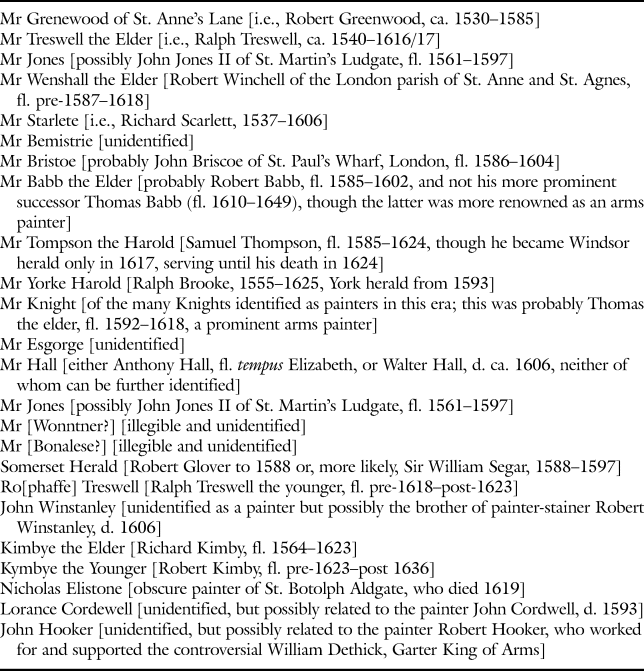
Still, given its size and position as England's one true metropolis, London was clearly the center for the painting and retail sale of arms. William Smith did not identify Leigh's Silver Street painter, but an early seventeenth-century list of London arms painters has come to light in the National Library of Scotland (see table 1). It identifies those who “kepte open shops and shows of arms according to the Custom of London and . . . [were] never questind nor for byden by any athourty.”Footnote 54 That majority of the twenty-four people on the list who can be identified suggests how widespread the practice had become among London-based painters at that time, and it illustrates the range of prominence and expertise of painters engaged in the retail trade.
List of Arms Painters Keeping “Open Shops” in Late Sixteenth-Century LondonFootnote 55

Neither the provenance nor author of the document has been identified, nor is its precise date indicated. It is bound in a volume that has been catalogued as “A Collection of English Arms in Trick, a working notebook for use by herald painters one of whom appears to have worked with Sir Henry Saint George, Garter King of Arms,” and it would have been one of many such collections in use at that time. But there are some salient clues to its purpose that are worth considering. The reference to St. George can be dismissed as being helpful in dating the document: it may have applied to other items in the volume, but as St. George did not become Garter until 1644, it cannot apply to this one. Then, too, not all those named in this list were precise contemporaries. Robert Greenwood died in 1585, while some of the rest, including both Richard and Robert Kimby,Footnote 56 were active only from the first decade of the following century. That makes the list something of a cumulative record rather than a snapshot of current activity, thus obviating its use, for example, as an accurate shopping guide for those seeking to purchase arms at retail at any one time.
There remain several other interpretations of its intent. All of them derive from the long-standing dispute between the College of Arms and the Painter-Stainers’ Company of London over the right to paint arms.Footnote 57 That dispute proved especially heated between the 1590s, when (in his capacity as earl marshal) the Earl of Essex put his shoulder to the heralds’ wheel, and 1622, when the aged William Camden mediated a compromise that allowed eight painter-stainers to be licensed by the college to paint arms, but it sputtered back into life from time to time thereafter. The inclusion of all the names known to the list's compiler, whether still active or not, could have supported either case. The list could be taken to point out that in keeping open shops “according to the Custom of London . . . [by those who were] never questind nor for byden by any athourty”, the painters had established a de facto right to sell their paintings at retail in such spaces, and to do so without violating any authority. The inclusion of two heralds on the list would have bolstered that case for selling at retail: heralds were doing it as well as painters. Yet—notwithstanding the two heralds’ inclusion—it could also have been taken by the College of Arms to show how widespread and (from their perspective) pernicious the practice of painters painting and selling arms had become over the same putative duration. If intended to support the heralds’ case, it could certainly have come from someone like William Smith, who had such interlopers in his sights from his appointment as Rouge Dragon in 1597. A further possible explanation derives from the appearance of a very similar phrase, referring to “Painters that keep open shops of Armourie,” which appears in the Earl Marshal's Commissioners’ Orders of 1618.Footnote 58 It may have been taken in that instance freshly from the list of arms painters, thus additionally supporting the heralds as the source. Yet that wording may simply have rattled around the rhetoric of that dispute, on either or both sides of the issue, at any time in between. More important to this point is what the document tells us about those who kept their “open shops,” and the nature of the shops they kept.
In addition to Robert Greenwood, the most prominent painters on the list are Richard Scarlett (ca. 1560–1606), Samuel Thompson (d. 1624), Ralph Treswell (d. 1616/17), Robert (d. post-1622) and Richard Kimby (d. post-1638), and William Winchell (d. 1637). Both York and Somerset heralds also appear. They would have been Ralph Brooke, who served from 1593 to 1625, and probably his archrival William Segar, who held the office between 1589 and 1597. Those of the first set were among the most eminent and successful arms painters of their time: ambitious, enterprising, and often aggressive men who had successfully battled to the top of their profession. All seven came to serve in the ruling body of the Painter-Stainers’ Company; most of them served at one time or another as master. A number were connected to each other by family or master/apprentice relationships. Greenwood, born around 1530 and thus the oldest of the bunch, had engaged in arms painting almost from the start of his long working life, providing arms for the Order of the Garter as well as for a fair-sized roll call of the senior aristocracy.Footnote 59 Not the least of his accomplishments was the encouragement in that same trade of Samuel Thompson, who was his nephew and may have served as his apprentice, and became an executor of Greenwood's will.Footnote 60 Greenwood also taught William Winchell, his last apprentice, in the painting of arms, thus launching another long career in that métier.Footnote 61 It may well be that Greenwood gave both their starts in retailing as well as in painting. Scarlett was best known and widely regarded for his arms painting, and he garnered major commissions for heraldic and decorative work from some of the most important livery companies of his time.Footnote 62 Treswell is best known to us as a surveyor and for his work in surveying landed estates, but he engaged in a variety of decorative commissions for London livery companies and obviously in arms painting as well.Footnote 63 The Kimbys, who were either father and son or brothers, were both successful arms painters and prominent members of the Painter-Stainers’ Company.Footnote 64
Brooke and Segar, senior figures in the College of Arms, also ranked among the most successful and prominent heralds and arms painters of that time. Segar in particular blossomed into one of the true polymaths of his age. His extensive additional involvement in scholarship and diplomacy shows an astonishing breadth of accomplishment. He was the author of heraldic treatises, a painter of portraits, miniatures, and heraldic devices, and a noted calligrapher. In addition, he forged a distinguished career as a herald (Portcullis Pursuivant, 1585–1588; Somerset Herald, 1589–1597; Norroy King of Arms, 1597–1604; Garter King of Arms, 1607–1633) and diplomat. His achievements were recognized with a coat of arms (1612) and a knighthood (1616). But his license legitimately to engage in retail trade would have come in his additional capacity as a freeman of the Stationers’ Company of London.Footnote 65
These are the sort of names one might expect. All were experienced producers of the whole range of heraldic trappings and accoutrements which they provided for livery companies, schools, and colleges, for civic and royal officials, and of course for the weddings, funerals, and residential premises of myriad individual clients. Richard Kimby, Winchell, and Treswell were among that handful of painter-stainers eventually licensed by the College of Arms to paint arms.Footnote 66 All would have employed sundry assistants to carry out specific aspects of their work and look after their retail operation. It is unlikely that at least these most prominent figures on the list would have sat minding their own shops; rather, they had others, perhaps relatives or apprentices, do it for them. Save for the level of success and notoriety that they attained, they probably typify in this respect other legitimate arms painters who kept retail shops as well.
Given the prominence of these seven, there is no reason to think that they were necessarily engaged in producing illicit arms, yet a few other names on the list do invite that suspicion. These were strivers, determined to advance their fortunes by hook or by crook and willing to push hard against standing conventions in both their personal relations and their economic activities. Brooke, a shoemaker's son, was notorious for his disruptive, even violent behavior, engaging in protracted disputes with several colleagues, which earned him a brief spell in prison.Footnote 67 At one time or another, both Robert and Richard Kimby were flagged and punished for producing illicit work.Footnote 68 Winchell certainly had a rebellious disregard for convention. In addition to fathering several illegitimate children, he refused to pay his dues to the Painter-Stainers’ Company, for which they reported him to the Lord Mayor's Court. Though he had gained permission from the College of Arms to paint arms at heraldic funerals, he violated the rules of that agreement on several occasions and was eventually imprisoned for his offenses. And in 1634 he confessed in the Court of Chivalry to having painted a false pedigree and arms for Peter Framden.Footnote 69 It is no stretch to suggest that men such as these would likely have supported their ambitions by extending their efforts into the world of retail sale.
In one sense, those names on the list that are not familiar and have left little or no archival footprint may have even greater significance. Their involvement would suggest how the production and retail sale of painted arms had become sufficiently widespread to sustain even more obscure painters of the day. Most of those on the list who can be identified seem to have been painter-stainers who counted arms painting among their diverse skills. Some of the lesser names also had family connections that probably helped them gain a foothold in retail sales. John Hooker may well have been related to the painter Robert Hooker (1562–post-1595),Footnote 70 who worked for and supported the notoriously corrupt and controversial William Dethick, Garter King of Arms.Footnote 71 John Hooker may have sold illegitimate arms at retail, perhaps even for Dethick. John Winstanley may have been related to the known painter-stainer Robert Winstanley (d. 1606),Footnote 72 and Lorance Cordewell may have been related to the Southwark painter John Cordewell (d. ca. 1593).Footnote 73 Such relationships at least hint at family-centered networks engaged in both production and sale.
Several names are so obscure as not to appear even among the nearly three thousand names on my database, Early Modern British Painters, c. 1500–1640, which as far as I know remains the most comprehensive database of British painters available for this era. These men may not have been painters at all but instead worked, perhaps as painters’ relatives or employees, simply as retailers to the trade. As has long been known, the emergence of the retailer or middleman was one of the most prominent themes of the early modern London economy, emerging over the longe durée to the consternation and detriment of the craftsmen themselves.Footnote 74 Though they first emerged in the textile and other trades, the appearance of their names on this list affirms that they were beginning to make their mark in the luxury trades as well.
Traditionally, guilds would have protected their members from such interlopers, employing their power of search to locate and prosecute those who, in this case, were selling paintings at retail without being freemen or being licensed to do so. The Painter-Stainers’ Company's power of search had been recognized in an inspeximus of 1467 and more formally in their 1581 charter.Footnote 75 But despite early seventeenth-century efforts to reinstitute weekly searches, such operations appear only sporadically in that company's earliest surviving minute book. A search of 1632 identified and fined several retailers, including a London bookseller named Sherman, for selling paintings without being company members or freemen of London.Footnote 76 Yet by that time such a search may have become a more isolated incident. The notation on the list that those who kept open shops were “never questind nor for byden by any athourt[y]” from so doing could, as I have shown, mean that they were all entitled to do so as Painter-Stainers’ members. But it could also be taken to mean that the company no longer exercised its power of search with its former consistency or force, in effect allowing some nonmembers to get away with the illicit practice. For its part, the best the city itself seemed able to do was to enforce the tradition whereby only freemen could sell at retail.
Such inconsistencies of enforcement may well have created opportunities for shopkeepers—whether stationers, booksellers, or other retailers—to sell paintings at retail that they had not themselves produced. That would also account for at least some of the disposition of the shipments of paintings being imported by those who were essentially dealers rather than artisans. While an occasional member of the Painter-Stainers’ Company may have travelled abroad and imported paintings,Footnote 77 it is more likely that most such imports were brought in, either by English or foreign merchants, for retail sale in London or elsewhere without any involvement of native English painters. Given the extraordinary rate of production of paintings in Antwerp and elsewhere in the Low Countries on the one hand and the increasingly voracious appetite for paintings in England on the other, this would not have been a difficult trade.Footnote 78 In addition to a portrait of Mary, Queen of Scots, with verses slandering Elizabeth which was purchased at retail and then brought to Walsingham's attention in 1588,Footnote 79 a London dealer named Henry Payne typified such practice when, in 1577, he purchased for import to London two chests of paintings by the Antwerp painter Adam van Oort, while other Dutch and Flemish painters brought works for sale with them directly to London.Footnote 80 Some such imports may have been commissioned by aristocratic clients, while other works, especially paintings by less distinguished painters like van Oort (whose name rang no bells at court), would have been sold at retail in shops. The practice ensued provincially as well as in London. Even a middling-sized provincial port (albeit one with a long-standing Netherlandish trade) like King's Lynn could receive shipments of paintings, perhaps to satisfy the aspiring and often affluent gentry of the surrounding region of North Norfolk.Footnote 81 These paintings, too, may have wound up for sale on the shop floor.
Along with their growing opposition to middlemen in the trade, other English painters aside from those who painted arms also began to take up the retailing operation. Robert Peake's shop, located at Holborn Conduit next to the “Sunne Taverne,” was separate from his workshop and probable residence, a tenement in Green Dragon Court, Holborn. It is unlikely that Peake, who had become sergeant painter to the crown by that time, staffed it himself. He probably employed a journeyman, an apprentice, or perhaps even his wife to mind it for him until his son became old enough to take over. Robert Greenwood's home in the parish of St. John Zachary probably housed his workshop, but he kept his retail shop in St. Anne's Lane.Footnote 82
By the 1630s, the practice whereby painters, and perhaps especially arms painters, kept retail shops was so widespread that the eminently successful painter-stainer and herald Henry Lilly (1589–1638) not only freely admitted that he “kept a shop of paintings” and “wold do such paintynge work as was brought to him to do and wold not lose the custom of his shop” but expressed indignation that anyone should object to the practice.Footnote 83 Lilly was yet another hard-nosed, feisty man. The orphaned son of the London joiner John Lilly, he was admitted to Christ's Hospital school at the age of six in 1595 and worked his way into the painters’ trade through skill and hard work. The institution's administration had apprenticed him to the painter Robert Goodman in 1605, and then, at Goodman's death, to Ralph Treswell. Though Lilly trained and worked as a herald painter and member of the College of Arms, he was also admitted a freeman of the Painter-Stainers’ Company of London, with which the college was frequently at odds. Lilly was appointed Rouge Croix Pursuivant in 1634 and Rouge Dragon in 1638.Footnote 84 He had by that time many strings to his bow, but he probably spoke for many others when he defended maintaining his retail operation.
Finally, what does one make of the “open shops of armourie” described in the list of arms painters keeping such premises? Retail shops were of course no great novelty in the London of this era. Derek Keene has reminded us that they existed there even in 1300 and possibly for some time before.Footnote 85 Most substantial market towns also had retail shops by the end of the sixteenth century; many had them long before.Footnote 86 But what did such shops consist of, and where would they have been found?
Clearly, retail spaces took a number of forms. Many were attached to larger buildings that may have functioned as workshops, warehouses, or residences. Jon Stobart has emphasized the physical contiguity of shop and residential space from the Restoration era onward, but such contiguity seems to have been a common enough pattern well before that time.Footnote 87 Kathryn A. Morrison has noted that some craftsmen in Elizabethan London transformed their workshops into retail shops.Footnote 88 Other shops may have been freestanding. But though Peter Blayney overstates the case that the word “shop” “invariably meant . . . a place where commodities were sold by retail,”Footnote 89 many shops of this era were just that. In addition, most were, and had long been, small operations.Footnote 90 Given his large workshop at Green Dragon Court, which would have accommodated the work of several people at a time, Peake's Holborn Conduit retail shop may not have been more than a salesroom for paintings and books. The same function probably applied to the shop taken “at the church door” of St. Peter Westcheap by the painter-stainer William Wiggington between 1556 and 1574.Footnote 91 These modest structures were little more than stalls or simple lockups of a type long common in and around parish churches in London and elsewhere and could easily be knocked together by a competent joiner.Footnote 92 Such spaces would have allowed retailers to display their wares in a single street-side opening or window.
Some contemporary uses of the term “open shops” suggest more of a warehouse or showroom in which goods were to be displayed so that the buyer could see them before sale and not be defrauded by false impressions. The English merchant and writer Gerard Malynes employed that meaning of the term in his treatise of 1622, though he may have been describing continental shops instead of English ones.Footnote 93 But even by 1600, some retail shops were likely large enough to accommodate such browsing.Footnote 94 In his Ortho-epia Gallica of 1593, John Eliot describes the visit of a prospective client to a painter's shop where he was able to browse and comment on a variety of paintings on display.Footnote 95 As the book was intended as a guide to learning the French language, Eliot had no reason to describe something that would have been unfamiliar to his readers. It is very likely this sort of shop that Whythorne entered half a century earlier. Yet several other spatial arrangements also met such a criterion. While some more elegant shops were located in upper stories or interior rooms, many would have displayed their wares on a simple ground-level counter supported by trestles, or else a fixed stall-board with storage space below, at which clients could browse or make a purchase while standing in the street. Some shops may have had a covering in the form of a pentice roof to offer some protection from the elements, or been sheltered by an overhanging jetty projecting from an upper story.Footnote 96
Still others would have been much more modest affairs. The lockups alongside St. Botolph outside Aldgate—a parish densely settled by paintersFootnote 97—are estimated to have measured only four to five feet deep.Footnote 98 Such a space would have been inadequate for actual production, storage, or much else, but its location would ideally have suited a retail operation. The painter-stainer Francis Romney (fl. ca. 1599–post-1618) kept a similar shop beneath London's St. Mary Colechurch, suggesting he may have been a shopkeeper as well as a painter.Footnote 99 Such shops, however small, would have contributed to the image of a city coming to be renowned for its variety and abundance of consumer goods and their public display.
That role and reputation would most emphatically have been marked by the opening of Thomas Gresham's Royal Exchange in 1566, by Robert Cecil's New Exchange in 1609, and by the continued operation of such grand frontages as those that marked Goldsmith's Row along Cheapside. Even these shops were small—smaller on the whole than many retail shops elsewhere. Booths at the Royal Exchange, not much more than simple wooden frames partitioned from their neighbors, came in at a mere seven and a half by five feet, making them largely unsuitable for much beyond display and sale.Footnote 100 Yet they nonetheless served an affluent clientele as the most visible symbols of a city that was quickly joining its continental rivals as one of Europe's great commercial centers and one in which retail shops lined almost every major street.
While some painters, including the arms painters Thomas Adams, Ralph Robinson, and Edmund Stedman, retailed their wares in the Royal Exchange,Footnote 101 and some wealthy painter-stainers held shops on the Exchange as investments,Footnote 102 myriad lesser painters apparently displayed and sold their works off the peg without the benefit of a shop at all. When the poet Ben Jonson chided his friend Inigo Jones for his fear of being mocked, he wrote,
The suggestion that the Strand might have been a place for the outdoor display of works by “some hungry painter” with his rotten chalk echoes a slightly earlier verse published in 1623 by the aptly named William Painter. He referred to
Neither of these locations were chosen at random. They formed that thin corridor that directly connected the older parts of the city with the newer, more affluent West End that had developed so rapidly in the Elizabethan and Jacobean years. One might see them as symbolically linking the hoi polloi with the upper crust, a route that the purchase of arms and other paintings was intended socially to smoothen. The verse refers to limners as well as painters. (The former term may still have borne its earlier reference to someone engaged in calligraphy,Footnote 105 but by the seventeenth century usually referred to portrait painters in general or miniaturists in particular.Footnote 106) Some such displays would have been mounted by less talented painters, more likely the London version of the “hedge painters” of rural England than members of the Painter-Stainers’ Company. These improvised spaces offered some painters a means of attracting a trade that their reputations alone could not achieve.
Outdoor displays made for a risky business subject to the vagaries both of inclement weather and company search. But some painters, at what must have been the very bottom rung of the occupational ladder, simply peddled their wares as best they could in the streets and open spaces of the city and its environs—a tough way to earn a living, to be sure, but also one that could more easily avoid the scrutiny invited by a fixed place of business. By 1582, the practice of peddling paintings in the streets had become sufficiently pernicious in the eyes of the Painter-Stainers’ Company that they specified in their ordinances of that year where paintings could and could not be sold, forbidding anyone from going “from shop to shop, inn to inn, house to house, or place to place, within the said City or suburbs thereof, but only in those shops, warehouses or workhouses” to sell paintings, nor were they to go “in and about the streets to do the same.”Footnote 107
In 1588 the company anticipated that London's Court of Aldermen might crack down on such activities, but the efforts had little lasting effect.Footnote 108 From time to time, as in 1632, the Painter-Stainers launched regular weekly searches throughout the city and its environs, and even assigned some of its most senior members to the task.Footnote 109 But in the long run, regular searches proved an unsupportable burden on company officials who had their own rows to hoe, and such exercises inevitably remained sporadic in their occurrence.Footnote 110
What might one make of all this? Given the state of surviving evidence, much of what one would still like to know about the sale and purchase of paintings off the peg in these early years remains beyond reach. A more detailed run of retailers’ inventories might tell us more about precisely what sorts of paintings were sold in that manner and to what extent painters sold the work of others as well as their own. It might shed more light on the growing distinctions, and the economic relations, between the artisan and the retailer, and on when middlemen from provincial centers began commonly to come up to buy paintings in London shops for resale elsewhere.
It may well be the case that, as Linda Levy Peck has put it, “there were no shops in [in the early Stuart years] in which to buy the Tintorettos and Bassanos” for which courtiers clamored.Footnote 111 The English retail market for paintings even in London had not yet caught up with the complex retail infrastructure of sundry continental centers. But it now becomes clear that some paintings had indeed begun to be sold at retail in English shops and even streets, especially but not exclusively in London, by the mid-sixteenth century and that painters themselves were among those engaged in such activity. Such a retail market aimed particularly at a clientele of the middling sort: those who shared the aspirations of their social superiors without comparable means of importing or commissioning the paintings they desired.Footnote 112 That market certainly included portraits, either of consumers themselves or of celebrated figures, both contemporary and historical, with whom such consumers sought an affiliation, and of which numerous copies could be produced. But in addition, and especially given the relatively more fluid and porous nature of English society, it should not surprise us that the sale of arms—those coveted talismans of social status—would also have played a prominent part in the retail sale of paintings. Neither should it surprise us that the myriad shops that specialized in their sale could by that time be found in London and at least some larger urban centers elsewhere in the realm. That burgeoning retail infrastructure added a further component to the activities of some enterprising painters of the day who extended their operations from production into retail sales.
These conclusions illuminate yet another dimension of London's role as an engine of economic growth in late Tudor and early Stuart times. They tell us a little more about the expanding strategies of consumption among the middling and upwardly mobile ranks and of the entrepreneurial strategies emerging to serve them in those years. Finally, these early efforts at the retailing of paintings of one type or another constitute a viable prelude to the culture of consumption that blossomed over the following century into the fully developed, London-based, but also provincially operative art market with its eventual infrastructure of such elements as public sales, dealers, auction houses, and catalogues.