Introduction
Glass-ceramics for optical applications are easy and flexible to manufacture, and are more cost efficient than corresponding single crystals and optical ceramics. Higher optical quality, larger samples, and higher doping concentrations can be achieved in glass-ceramics. Some crystals precipitated in glass-ceramics are difficult or impossible to obtain in single crystal form. Moreover, a variety of metastable and stable crystals can be obtained in the same glass by appropriate heat treatments.
Glass-ceramics, in contrast to glasses, have optical properties similar to those of the single crystals, including well-defined structures with long-range order that is missing in glasses, specific properties determined by active ion position in the crystal structure leading to relatively narrow spectroscopic absorption and emission lines, and unique functionality inherent to noncentrosymmetric crystals (e.g., second-harmonic generation, piezoelectricity, electro-optic effects). One drawback of glass-ceramics is that active ions are not only located in the desired crystal phase, but may also be distributed between and at the interfaces of both crystalline and amorphous phases. Optical glass-ceramics are produced by melt-quenching, sinter-crystallization, Reference Prado and Zanotto1 and laser patterning. Reference Komatsu2,Reference Qiu3 Glass-ceramic fibers have also been developed. Reference Qiu3–Reference Mashinsky, Karatun, Bogatyrev, Sigaev, Golubev, Ignat’eva, Lorenzi, Paleari and Dianov5 This article concentrates on materials that are not only promising optical glass-ceramics, but also within the field of our research for many years.
Light scattering in glass-ceramics
Some demanding optical applications requirements can be met by transparent glass-ceramics. All glass-ceramics have inhomogeneous structure since they contain crystals distributed in glass. This inhomogeneity causes light scattering. In glass-ceramics for transparent optical elements, scattering needs to be reduced to a minimum. However, for diffuse reflection standards, light scattering is the determining property.
Previously, it was stated Reference Beall and Duke6–Reference Berthier, Fokin and Zanotto8 that the scattering coefficient (turbidity) of glass-ceramics varies in a wide interval of wavelengths λ (e.g., in the range of visible light) according to the power law λ−p , where (−p) is the exponent of constant value, and p ≤ 4. If the crystals are randomly distributed in the glass and are much smaller than the wavelength, then p = 4 (Rayleigh scattering).
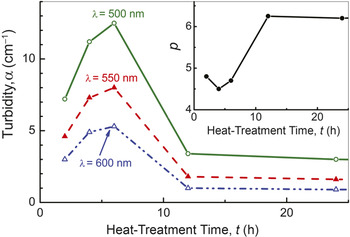
Our studies Reference Shepilov, Dymshits, Golubkov and Zhilin9,Reference Alekseeva, Dymshits, Zhilin, Zapalova, Shepilov, Golubkov, Kalmykov and Myacoedov10 as well as analysis of published data Reference Zhu, Ma, Calvez, Zhang, Lucas, Adam, Shang and Rouxel11,Reference Chavoutier, Caurant, Majérus, Boulesteix, Loiseau and Jousseaume12 show that glass-ceramics frequently demonstrate “anomalous light scattering” Reference Andreev13 with p > 4 (up to 9). This effect is a result of interference of light scattered by different crystals demonstrating short-range ordering in their mutual arrangement. Reference Shepilov14 Interference can reduce light scattering by several times or more. Reference Andreev13,Reference Shepilov14 This is demonstrated for Na2O-Nb2O5-SiO2 glass crystallization by the optical studies data ( Figure 1 ) supplemented by x-ray diffraction data for NaNbO3 nanocrystals. Reference Shepilov, Dymshits, Golubkov and Zhilin9 At the early stage of heat treatment (time t = 2, 4, and 6 h), scattering is close to Rayleigh scattering (p ≅ 4.5–4.8, see inset in Figure 1). At this stage, turbidity increases with the number of NaNbO3 nanocrystals per unit volume according to x-ray diffraction data. As the number of nanocrystals further increases during longer heat treatments (t > 6 h), when their volume fraction becomes greater than ≈0.2 and increases up to ≈0.3, interference suppresses scattering, yielding p ≅ 6.2 and reducing turbidity.
Turbidity α at three wavelengths λ (500, 550, and 600 nm) in the course of the crystallization of Na2O-Nb2O5-SiO2 glass as a function of heat-treatment time, t. At the early stage of crystallization (t ≤ 6 h, volume fraction of NaNbO3 nanocrystals is less than 0.2), turbidity increases with increasing number of independent scatterers (nanocrystals) per unit volume. As the number of nanocrystals further increases (at t > 6 h, volume fraction becomes greater than 0.2 and increases up to ≈0.3), interference leads to a decrease in turbidity. At a given heat-treatment time, t, the wavelength dependence of the turbidity is described by the power law λ−p and characterized by the magnitude of p. The inset shows values of p for different heat-treatment times. At the early stage (t ≤ 6 h), p ≅ 4.5–4.8, close to the Rayleigh value of 4 that is characteristic of small independent scatterers (nanocrystals). At t > 6, interference leads to p ≅ 6.2 (anomalous scattering). Reference Shepilov, Dymshits, Golubkov and Zhilin9

The greater the dispersion of scattering properties of crystals in glass-ceramics, the lower the interference and greater the scattering. Reference Shepilov15 Based on this approach, glass-ceramics for laser components and standards of whiteness with high diffuse reflectance have been developed. Reference Bortkevich, Varshavchik, Dymshits, Zhilin, Leykin, Polushkin, Seredenko, Chuvaeva and Shashkin16
Systems for transparent glass-ceramics
Transparent glass-ceramics have been fabricated from many systems thus far and depending on the system, can be used for various applications. For example, glass-ceramics can be based upon “stuffed” β-quartz solid-solution structures with network replacement of Si4+ by Al3+ accompanied by filling of interstitial vacancies by Li+, Mg2+, and Zn2+ cations to preserve electrical neutrality Reference Höland and Beall17 —in the Li2O-MgO-ZnO-Al2O3-SiO2 system with titania and/or zirconia as nucleators; Reference Beall and Duke6,Reference Beall and Pinckney7,Reference Höland and Beall17,Reference Bach and Krause18 spinels in the (Li, Na, K, Mg, Zn)O-(Al, Ga)2O3-(Si, Ge)O2 system Reference Qiu3,Reference Beall and Duke6,Reference Beall and Pinckney7,Reference Höland and Beall17,Reference Chenu, Véron, Genevois, Matzen, Cardinal, Etienne, Massiot and Allix19,Reference Zhuang, Ueda and Tanabe20 with or without nucleators; mullite in the Al2O3-SiO2 system Reference Beall and Duke6,Reference Höland and Beall17 with BaO, K2O, or Cs2O additions; forsterite in the K2O-MgO-Al2O3-SiO2 system nucleated by TiO2; Reference Höland and Beall17 on ZnO or β-willemite in the K2O-ZnO-Al2O3-SiO2 system; Reference Pinckney21 and mixed orthosilicates, Mg2SiO4-Zn2SiO4-Li4SiO4, in the K2O-Li2O-MgO-ZnO-Al2O3-SiO2 system. Reference Höland and Beall17 The distinct feature of these transparent glass-ceramics is that transition-metal (TM) ions (Cr3+, Cr4+, Ni2+, Co2+, V4+, Mn2+) can enter their crystalline phases, thus producing materials that can be used in broadband optical amplification, in tunable and IR lasers, in solar collectors, and as phosphors for solid-state lighting.
There are glass-ceramics based on fluoride crystals in oxyfluoride systems, Reference Wang and Ohwaki22–Reference Qiu, Jiao, Zhou and Yang25 upon fresnoite-type crystals in the BaO-TiO2-(Si,Ge)O2 system, Reference Komatsu2,Reference Komatsu and Honma26 upon various niobium-containing phases in the (Li, Na, K)2O-Nb2O5-(Ge, Si, Te)O2 Reference Komatsu2,Reference Shepilov, Dymshits, Golubkov and Zhilin9,Reference Komatsu and Honma26–Reference Jain28 system, upon yttrium aluminum garnet in the Y2O3-Al2O3-SiO2-Li2O-TiO2-ZrO2 system, Reference Fujita and Tanabe29 upon halogenides in the fluorozirconate Reference Edgar, Spaeth, Schweizer, Assmann, Newman and MacFarlane30 system, and upon chalcogenides. Reference Calvez, Adam and Zhang31 In these transparent glass-ceramics, rare-earth (RE) ions enter the crystalline phase, allowing for their use in solid-state lasers, fiber amplifiers, solid-state lighting, and color displays. There are several excellent reviews Reference Komatsu2,Reference Qiu3,Reference Berthier, Fokin and Zanotto8,Reference de Pablos-Martín, Duran and Pascual23–Reference Komatsu and Honma26,Reference Jain28,Reference Fujita and Tanabe29,Reference Calvez, Adam and Zhang31–Reference Rüssel, Bocker, Stoica, Thieme and Keshavarzi35 devoted mainly to these transparent glass-ceramics that will not be discussed here.
Low-expansion glass-ceramics
Glass-ceramics based upon lithium aluminosilicate crystals with the β-quartz solid-solution structure in the Li2O-Al2O3-SiO2 (LAS) system that combine high transparency, near-zero coefficient of thermal expansion (CTE), excellent optical polishability, and strength Reference Beall and Duke6,Reference Höland and Beall17,Reference Bach and Krause18 are used in the most important precision optical applications for telescope mirrors, laser gyroscopes, and optical parts. In addition, low-CTE, near-IR transparent LAS glass-ceramics form the foundation for glass-ceramic cooktop panels. In all of these transparent glass-ceramics, the substitution of (SiO4) units in the β-quartz structure by (AlO4) ones is achieved with charge compensation by Li+, Mg2+, Zn2+, or by AlPO4. Reference Höland and Beall17,Reference Bach and Krause18
It was demonstrated by in situ high-temperature x-ray diffraction analysis Reference Artukh, Astakhova, Zhilin, Filatov and Chuvaeva36 that in glass-ceramics with SiO2 content ranging from 44–70 mol%, the CTE of disordered β-quartz solid-solution nanocrystals is near zero or slightly negative. The residual glass is highly siliceous with small TiO2 and Al2O3 content, and its CTE is close to zero. The CTE of transparent glass-ceramics with high crystallinity fraction is thus determined to a large extent by the CTE value of the crystalline phase. Reference Beall and Duke6,Reference Artukh, Astakhova, Zhilin, Filatov and Chuvaeva36 The precise tailoring of the glass composition and crystallization schedule allows for adjustment of CTE values to zero. Reference Bach and Krause18
Thermal shock-resistant color filters
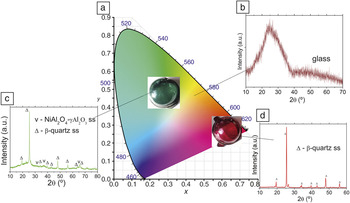
Attracted by excellent transparency and low CTE values of glass-ceramics in the LAS system, we have developed violet, blue, green, red, purple, and neutral thermal shock-resistant color filters for laser systems and high-power light sources that can operate in high-temperature gradient fields, for instance, as aircraft signal lamps. Reference Alekseeva, Dymshits, Tsenter, Zhilin, Golubkov, Denisov, Skoptsov, Malyarevich and Yumashev37 Spinel nanocrystals precipitate in these materials in a narrow “low-temperature” range of 720–770°C. TM ions enter their structure, while prolonged heat treatments lead to crystallization of β-quartz solid solution without decomposition of spinel crystals, resulting in transparent glass-ceramics with low CTE and unusual coloration. At elevated temperatures of 780–900°C that prevent spinel crystallization, TM ions entering the β-quartz solid solution produced differently colored thermal shock-resistant transparent glass-ceramics. Different tints can be obtained in the transparent glass-ceramics with the same composition by varying the heat-treatment temperature (e.g., Ni2+ ions in spinel nanocrystals produce green, and in β-quartz solid solution, the ions produce purple and red coloration Reference Dymshits, Zhilin, Chuvaeva and Shepilov38 [ Figure 2 ]).
(a) Images of green and red aircraft navigation lights made of Ni-doped Li2O-Al2O3-SiO2 transparent glass-ceramic; color coordinates in the Commission Internationale de l’Eclairage (CIE) chromaticity diagram, an international standard for primary colors that allows all other colors to be defined as a weighted sum of the three primary colors, and x-ray diffraction patterns of (b) the initial glass and transparent glass-ceramic, which is (c) green due to Ni2+ absorption in spinel nanocrystals and (d) red due to Ni2+ absorption in nanocrystals of β-quartz solid solution. Reference Alekseeva, Dymshits, Tsenter, Zhilin, Golubkov, Denisov, Skoptsov, Malyarevich and Yumashev37,Reference Dymshits, Zhilin, Chuvaeva and Shepilov38 The blue numbers on the main plot represent wavelengths. When the initial brown-colored amorphous glass, whose x-ray pattern is presented in (b) and whose color coordinates are shown, is heat-treated at 720–770°C, (c) it transforms into a thermal shock-resistant green-colored glass-ceramic containing nanocrystals of Ni2+-doped spinel and β-quartz solid solution. (b) The position of the green signal lamp image on the CIE chromaticity diagram shows the color coordinates of green glass-ceramics. (d) When prepared by heat treatments at elevated temperatures of 780–900°C, red-colored transparent glass-ceramics contain nanocrystals of Ni2+-doped β-quartz solid solution. (b) The position of the red signal lamp image on the CIE chromaticity diagram shows the color coordinates of red glass-ceramics. Note: ss, solid solution; x, y, chromaticity coordinates; 2θ, diffraction angle.

Transparent glass-ceramics for broadband amplifiers and tunable lasers
The limited bandwidth of RE ion-doped amplifiers caused by narrow luminescent bandwidths of their 4f–4f optical transitions is a problem of communication technology. TM ions such as Ni2+ in octahedral coordination exhibit broadband near-IR emission with high quantum efficiency in crystals, yet there is no luminescence in Ni-doped glasses. Therefore, development of glass-ceramics suitable for fiber drawing with crystalline phases containing Ni2+ ions in octahedral position could solve this problem. Pinckney and Beall Reference Höland and Beall17 demonstrated that transparent glass-ceramics based upon various spinels show wide-IR luminescence when doped with Ni2+ ions located in octahedral positions.
Further investigations by many research groups developed novel transparent glass-ceramics based on spinels and other crystals wherein Ni2+ ions located in octahedral sites and evaluated their spectral properties. Studies Reference Qiu3,Reference Loiko, Dymshits, Zhilin, Alekseeva and Yumashev39 showed that one can control the strength of the local ligand field and the local symmetry around [VI]Ni2+ ions by precise tailoring of the transparent glass-ceramic composition, the nature and content of nucleating agents, the NiO concentration, and heat-treatment conditions. Some transparent glass-ceramics were developed containing a single crystalline phase with different octahedral sites. Other transparent glass-ceramics contain a combination of different crystalline phases where Ni2+ ions act as a single emission species in multiple octahedral local environments, Reference Qiu3 which leads to broadening of the IR luminescent band. Energy transfer from Cr3+ ions to Ni2+ in spinel and from Yb3+ ions in glass to Ni2+ ions in spinel was achieved, increasing the luminescence intensity, while additions of Er3+and Bi ions resulted in a broad-IR luminescence provided by independent active ions without energy transfer. Reference Qiu3 Broadband optical amplification in β-Ga2O3:Ni2+-based transparent glass-ceramics was demonstrated. Reference Qiu3
Transparent glass-ceramics for passive Q-switching of Er-lasers
“Eye-safe” Er lasers with emission wavelengths approximately 1.5–1.7 µm are used for applications that involve human contact with laser radiation and require short (nanosecond long) high peak power pulses that can be produced via passive Q-switching, a method for obtaining such pulses by modulating the intracavity losses by a saturable absorber (SA) inserted into the laser cavity. In SAs, absorption decreases with increasing fluence of the incident radiation. Materials for SAs need to have an absorption band that matches the laser emission wavelength, provide low saturation fluence and low nonsaturable losses, fast recovery time of the initial absorption, and high laser damage threshold. SAs based on Co2+:MgAl2O4 spinel single crystals were acknowledged as the best for Er, Yb:glass lasers with an emission wavelength of ∼1.54 µm. In these crystals, Co2+ ions with 3d Reference Beall and Pinckney7 electronic configuration are predominantly located in tetrahedral sites, and their broadband IR absorption perfectly matches the ∼1.54 µm Er emission wavelength. Boiko et al. Reference Boiko, Okhrimchuk, Shestakov, Bosenberg and Fejer40 were the first to introduce Co2+-doped transparent glass-ceramics based on spinel-type gahnite (ZnAl2O4) crystals as SAs. Following this, transparent glass-ceramics based on Co2+-doped spinel MgAl2O4 nano-sized crystals were introduced. Reference Malyarevich, Denisov, Volk, Yumashev, Dymshits and Zhilin41,Reference Volk, Malyarevich, Yumashev, Dymshits, Shashkin and Zhilin42 A comparison with Co2+:MgAl2O4 single crystals demonstrated that glass-ceramics based on Co-doped MgAl2O4 spinel nanocrystals are good competitors to corresponding single crystals. Reference Volk, Malyarevich, Yumashev, Dymshits, Shashkin and Zhilin42 Based on these encouraging results, transparent glass-ceramics for SAs with IVCo2+-doped nano-sized crystals of different spinels Reference Alekseeva, Dymshits, Tsenter, Zhilin, Golubkov, Denisov, Skoptsov, Malyarevich and Yumashev37,Reference Boiko, Okhrimchuk, Shestakov, Bosenberg and Fejer40,Reference Malyarevich, Denisov, Volk, Yumashev, Dymshits and Zhilin41 were developed in ZnO-Al2O3-SiO2 (ZAS), MgO-Al2O3-SiO2 (MAS), and LAS systems. Other transparent glass-ceramics for SAs were also suggested. Reference Yu, Chen, Feng, He, Wang and Hu43
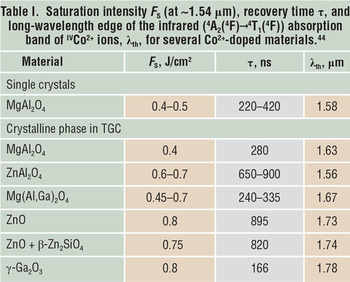
Motivated by the recent progress in directly pumped Er crystal lasers that provide oscillations at 1.6–1.7 µm, a new series of SAs based on transparent glass-ceramics were developed whose distinct feature is a shift of the absorption band of IVCo2+ ions to longer wavelengths due to the lower ligand field strength around Co2+ ions as compared to that in MgAl2O4 spinel ( Table I ). Reference Loiko, Dymshits, Vitkin, Skoptsov, Zhilin, Shemchuk, Tsenter, Bogdanov, Malyarevich, Glazunov, Mateos and Yumashev44
Saturation intensity F S (at ∼1.54 μm), recovery time τ, and long-wavelength edge of the infrared (4A2(4F)→4T1(4F)) absorption band of IVCo2+ ions, λth, for several Co2+-doped materials. Reference Loiko, Dymshits, Vitkin, Skoptsov, Zhilin, Shemchuk, Tsenter, Bogdanov, Malyarevich, Glazunov, Mateos and Yumashev44

Note: TGC, transparent glass-ceramic.
Glass-ceramics with RE ions embedded into crystalline phases have been studied in the search for efficient photoluminescent and up-conversion materials. An attractive idea to introduce RE ions into LAS glass-ceramics was not realized because β-quartz solid solution is a poor host for fluorescent cations. Reference Höland and Beall17,Reference Qiu, Jiao, Zhou and Yang25 Recently, researchers were able to incorporate RE ions into the crystalline phases of aluminosilicate glass-ceramics, where these crystalline phases were not β-quartz solid solution, but RE titanates, titanites-zirconites, and niobates. Reference Dymshits, Zhilin, Chuvaeva and Shepilov38,Reference Dymshits, Zhilin, Alekseeva, Skoptsov, Malyarevich and Yumashev45–Reference Loiko, Dymshits, Alekseeva, Zhilin, Tsenter, Vilejshikova, Bogdanov, Mateos and Yumashev49 Similar to RE fluorides, these nanocrystals ensure a low-phonon energy lattice surrounding the RE ions, but these glass-ceramics possess high thermomechanical properties and their compositions are highly reproducible.
Transparent glass-ceramics based on nano-sized crystals of RE titanates and titanates-zirconates
When LAS or MAS glasses nucleated by TiO2 or ZrO2 are doped with RE ions, RE2(Ti, Zr)2O7 crystals with the defect-fluorite structure precipitate. Reference Dymshits, Zhilin, Chuvaeva and Shepilov38,Reference Dymshits, Zhilin, Alekseeva, Skoptsov, Malyarevich and Yumashev45–Reference Dymshits, Loiko, Skoptsov, Malyarevich, Yumashev, Zhilin, Alekseeva, Tsenter and Bogdanov47 At elevated temperatures, a disordered and then ordered pyrochlore-type structure is formed.
When doped with Er3+ and Yb3+ ions, these transparent glass-ceramics demonstrate substantial enhancement (near 10×) of red up-conversion emission around ∼650 nm, Reference Dymshits, Loiko, Skoptsov, Malyarevich, Yumashev, Zhilin, Alekseeva, Tsenter and Bogdanov47 which is important for phosphors and solid-state lightning. They are also candidates for a medium for effective laser generation in the spectral range of 1.5 μm. Reference Dymshits, Zhilin, Chuvaeva and Shepilov38
Transparent glass-ceramics based on nano-sized crystals of RE orthoniobates
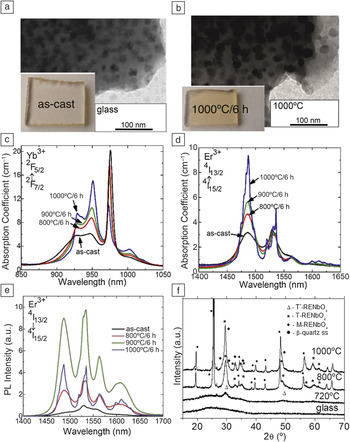
Recently, transparent glass-ceramics with the RE niobate nanophase in the dual role of luminescent active crystal and nucleator of β-quartz solid solution in LAS glasses were prepared. Reference Dymshits, Alekseeva, Zhilin, Tsenter, Loiko, Skoptsov, Malyarevich, Yumashev, Mateos and Baranov48,Reference Loiko, Dymshits, Alekseeva, Zhilin, Tsenter, Vilejshikova, Bogdanov, Mateos and Yumashev49 The optical properties of these glass-ceramics were directly linked to the structure of RE niobates, which changes from the defect fluorite to the tetragonal, and then, to the monoclinic form ( Figure 3 ). RENbO4 nanocrystals provide promising spectral-luminescent properties while the large amount of β-quartz solid solution ensures high thermal shock resistance of the glass-ceramics. Transparent glass-ceramics with the tetragonal (Er, Yb)NbO4 nanophase have potential for laser operation in the eye-safe region. Reference Dymshits, Alekseeva, Zhilin, Tsenter, Loiko, Skoptsov, Malyarevich, Yumashev, Mateos and Baranov48 RENbO4-based transparent glass-ceramics are interesting materials for double (RE3+, Yb3+) or triple (RE1 3+, RE23+, Yb3+) codoping for color-tunable phosphors in the visible region, for generation of warm/cold white light. Reference Loiko, Dymshits, Alekseeva, Zhilin, Tsenter, Vilejshikova, Bogdanov, Mateos and Yumashev49
(a) Image of polished sample (inset) and transmission electron microscope (TEM) image of lithium aluminosilicate glass doped with Er2O3, Yb2O3, and Nb2O5; (b) Image of polished sample (inset) and TEM image of lithium aluminosilicate glass-ceramics doped with Er2O3, Yb2O3, and Nb2O5 prepared at 1000°C for 6 h. Reference Dymshits, Alekseeva, Zhilin, Tsenter, Loiko, Skoptsov, Malyarevich, Yumashev, Mateos and Baranov48 The value indicated in the figure denotes heat-treatment schedule. Both TEM images demonstrate nearly uniform distribution of inhomogeneous regions (dark regions) without any clustering. The sizes of the regions of inhomogeneity are approximately 10 nm in the initial glass and approximately 15 nm after the heat treatment. (c) Absorption spectra related to the 2F7/2→2F5/2 (Yb3+) transition for the initial glass and glass-ceramics containing (Er, Yb)NbO4 nanocrystals. (d) Absorption spectra related to the 4I15/2→4I13/2 (Er3+) transition for the initial glass and glass-ceramics containing (Er, Yb)NbO4 nanocrystals after the indicated heat-treatment schedules. (e) Near-infrared photoluminescence of Er3+ ions for the initial glass and glass-ceramics doped with Er2O3, Yb2O3, and Nb2O5 and prepared at 800, 900, and 1000°C for 6 h; the excitation wavelength is 960 nm. (f) X-ray diffraction patterns of the initial and heat-treated glasses doped with 3 mol% Yb2O3 and 3 mol% Nb2O5 at the indicated heat-treatment temperatures and duration. Patterns are shifted for ease of observation. The absorption and luminescent properties of these glass-ceramics are directly linked to the structure of rare-earth (RE) niobates, which change structure from the defect fluorite to tetragonal and then to monoclinic due to heat treatment. RE orthoniobates provide promising spectral-luminescent properties, while the crystallization of a large amount of β-quartz solid solution ensures near-zero coefficient of thermal expansion of these novel, transparent glass-ceramics. Note: 2θ, diffraction angle; PL, photoluminescence; T′, crystals with disordered fluorite-type structure; T, crystals with tetragonal structure; M, crystals with monoclinic structure; ss, solid solution. Reference Dymshits, Alekseeva, Zhilin, Tsenter, Loiko, Skoptsov, Malyarevich, Yumashev, Mateos and Baranov48,Reference Loiko, Dymshits, Alekseeva, Zhilin, Tsenter, Vilejshikova, Bogdanov, Mateos and Yumashev49

Summary
Detailed knowledge of the sequence of phase transformations in the course of glass-ceramic formation is required to find the balance between (a) maximizing the fraction of desired crystalline phase accommodating active ions; (b) minimizing the fractions of crystalline and amorphous phases accommodating active ions in coordinations different from that desired; and (c) minimizing scattering losses.
Based on this strategy, transparent glass-ceramics doped with Co2+ and Ni2+ ions for thermal shock-resistant color filters, for broadband near-IR optical amplifiers, and for passive Q-switching of eye-safe Er lasers as well as glass-ceramics with RE titanates, titanates-zirconates, and niobates in dual roles of nucleators and active crystals were developed. The selective partition of transition-metal ions into the crystals with spinel structure and of RE ions into titanate, titanate-zirconate, niobate, and fluoride crystals is an approach to the design of new multifunctional materials. In addition to traditional melt quenching and sinter crystallization, laser patterning and glass-ceramic melt-in-tube fiber drawing are fascinating methods for forming glass-ceramics that broaden the compositions and shaping of transparent glass-ceramics.
Acknowledgments
The authors express their gratitude to the Russian Foundation for Basic Research (Grant 16-03-01130) for partial support of this work. We also thank M.J. Davis for his valuable suggestions and comments.

Olga Dymshits is a deputy head of the Glass Department and head of the Laboratory of Glass-Ceramics at NITIOM Vavilov State Optical Institute, Russia. She received her doctoral degree in chemistry in 1991 from the Institute of Silicate Chemistry, Russian Academy of Sciences, Russia. Her research interests include synthesis, characterization, and investigation of structure and optical properties of amorphous and nanocrystalline materials. She has published more than 100 scientific papers and holds many patents. Dymshits can be reached by phone at +7 921 864 02 17 and +7 812 560 19 11 or by email at vodym1959@gmail.com.

Michail Shepilov is a senior researcher in the Laboratory of Glass-Ceramics at NITIOM Vavilov State Optical Institute, Russia. He received his doctoral degree in physics from the Institute of Physics, Ukrainian Academy of Sciences, Ukraine, in 1976. He has conducted calculations of electronic band structure of fluoride and modeling of phase-transformation kinetics. His research focuses on the relationship between microstructure and light-scattering properties of glass-ceramics. He has published more than 50 scientific papers. Shepilov can be reached by phone at +7 911 9330339 or by email at m.shep@mail.ru.

Aleksander Zhilin is deputy director of NITIOM Vavilov State Optical Institute, Russia. He received his doctoral degree in physical chemistry from Vavilov State Optical Institute in 1975. He has conducted investigations in areas of structure and properties of glasses and glass-ceramics. His research focuses on the optical applications of glass-ceramics. He is a member of the editorial boards of the journals Glass Physics and Chemistry and Optical Technology. He has published more than 130 scientific papers. Zhilin can be reached by phone at +7 921 9654763 or by email at zhilin1311@mail.ru.