Introduction
It is increasingly recognized that the use, development and conservation of livestock biodiversity are of great importance to food security, rural development and the environment (Pilling et al., Reference Pilling, Boerma, Scherf and Hoffmann2008). Phenotypic characterization of the indigenous livestock breeds is critical in breed improvement and conservation (Jing et al., Reference Jing, Ren-jun, Guo-rong, Quing-ran and Hua-ming2010; Kugonza et al., Reference Kugonza, Nabasirye, Mpairwe, Hanotte and Okeyo2011). The Achai is an as yet undocumented but well-adapted indigenous cattle breed of the Hindu Kush Mountains in northern Pakistan (Saleem et al., Reference Saleem, Rahim, Rueff, Khan, Maselli, Weismann and Muhammad2012). It is a dairy and light draught breed that can thrive under scarce fodder availability, and it can produce adequately under a hilly and sub-hilly subsistence production setup (Khan et al., Reference Khan, Rehman, Khan and Ahmad2008). The Achai grazes freely, is resistant to diseases and is better adapted to high altitude areas, and has a better efficiency index than all other cattle breeds of Pakistan, except Jersey crosses and Sahiwal (Kenyanjui and Sheikh-Ali, Reference Kenyanjui and Sheikh-Ali2009). Achai cows also have a better reproductive performance than other cattle breeds in Pakistan (Saleem et al., Reference Saleem, Rahim, Rueff, Khan, Maselli, Weismann and Muhammad2012).
Though the official livestock census (Anonymous, 2006) has reported the total population to be 0.59 million with 55 percent concentration in Hindu Kush Mountains, however, these figures include all the non-descript crosses having some resemblance to Achai breed. We estimate the population of phenotypically true Achai breed to be no more than 0.15 millions. This population is limited to the less accessible Hindu Kush Mountain valleys, where the agro-pastoralists still depends on Achai bulls to plough the narrow mountain terraces and hence can afford keeping Achai bull for plough as well as breeding. In these areas the average herd size of Achai cattle is four and seven animals in sedentary farming system (SFS) and transhumant farming system (TFS), respectively (Saleem et al., Reference Saleem, Rahim, Rueff, Khan, Maselli, Weismann and Muhammad2012).
Owing to its important role in the future, the public sector in Khyber Pakhtunkhwa has recently initiated an Achai cattle conservation programme (Khan et al., Reference Khan, Rehman, Khan and Ahmad2008). However, such conservation programmes remain ineffective because of the lack of scientific information on phenotypically pure Achai cows and bulls (Yakubu et al., Reference Yakubu, Idahor, Haruna, Wheto and Amusan2010). The current investigation shall thus fill this gap while providing the crucial information needed to establish efficient conservation efforts. The generated information will also help breeders to select better animals to keep the breed in its best condition for subsisting in remote mountains. This will insure food security for the poorest segments of Pakistani society living in the Hindu Kush Mountain region.
Material and methods
Study area
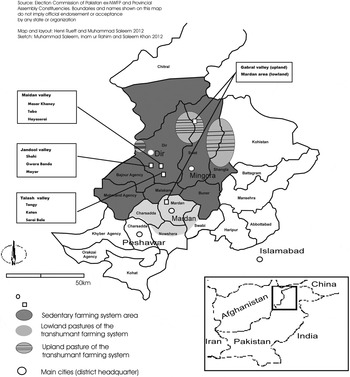
The broader home tract of the Achai cattle is spread over the northwestern Hindu Kush Mountains of the Khyber Pukhtunkhwa province in Pakistan. SFS are distributed over the mountain and rain-fed areas of the province. For the current study, the district of Lower Dir was taken as the study area for SFS (34°37′ to 35°07′N and 71°31′ to 72°14′E), with a mild, temperate climate, 700–1000 mm annual rainfall and 42 to 70 percent relative humidity (Anonymous, 1999). The SFS study area includes the mountainous Talash, Jandool and Maidan valleys (Figure 1). Under TFS, Achai herders spend summers in the uplands of Swat, Dir and Indus Kohistan, and winters in the major sugarcane growing lowlands of the Peshawar valley. The TFS involving transhumance between the Gabral uplands of Swat and the Mardan lowlands was taken as a representative area for the study (Figure 1). The Gabral valley lies between 35°20′ and 35°48′N and 72°12′ and 72°32′E, with a typical dry temperate zone climate (Hamayun, Afzal and Khan, Reference Hamayun, Afzal and Khan2006). The Mardan lowlands lay between 34°12′0N and 72°1′60E, and has a temperature range from 2.1 to 41.5°C, an average rainfall of 524.40 mm and humidity of 73 percent.
Map of the study area and locations of the villages where adult Achai cows and bulls were sampled.

Attributes of the farming systems
The seasonal feeding in SFS is known as a cut-and-carry system, which provides wheat straw, weed thinning and hay in spring; wheat straw, tree leaves and hay in summer; wheat straw, maize stalks and weed thinning in fall; and wheat straw, maize stalks and hay in winter. Farmers also graze their cows on stubble fields (Saleem et al., Reference Saleem, Rahim, Rueff, Khan, Maselli, Weismann and Muhammad2012). For TFS at Gabral (upland), the herders take dry cows, heifers and bulls to the high pastures for grazing, and keep milking cows at the settlements in the valley bottoms for homestead use. Milking cows are taken for grazing daily to the hillsides near the settlements. In the lowlands, sugarcane tops and maize stover are given during winter, and are complemented with grazing along the canal sides and on stubble fields. The breeding season spreads over the entire year. However, the majority of cows come into heat during summer. In uplands and lowlands, cows are served with the available Achai bulls (Saleem et al., Reference Saleem, Rahim, Rueff, Khan, Maselli, Weismann and Muhammad2012).
Sampling pattern
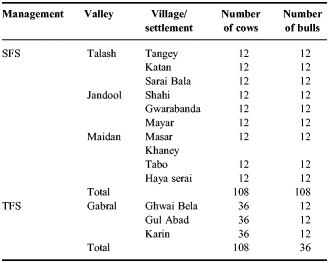
The sampling pattern for the study in SFS and TFS is presented in Table 1.
Sampling pattern of adult Achai cows and bulls in SFS and TFS.

Sedentary farming system
Three villages each from the Talash, Jandool and Maidan valleys in the Lower Dir district were randomly selected. From each village, 12 adult Achai cows and 12 adult Achai bulls were then randomly sampled.
Transhumant farming system
Three settlements were randomly selected in the Gabral valley where 36 adult Achai cows and 12 adult Achai bulls were observed at each settlement for physical and morphometric characteristics.
Physical characteristics like colour of the coat, horns, eyelashes, muzzle, hooves and switch were recorded for each animal, and morphometric measurements including heart girth, body length, height at withers, height at hipbone, face length, horn length (along the greater and smaller curvature), horn circumference (at base, mid and tip), ear (length and width), neck (length and circumference), dewlap (length and circumference), chine length, loin length, rump (length and width), length below knee, hoof circumference, tail length and switch length were carried out with the help of measuring tape according to the Food and Agriculture Organization's (FAO) standard procedure (FAO, 1986). Body weight was estimated according to Shaffer's method as described by Al-Amin et al. (Reference Al-Amin, Nahar, Bhuiyan and Faruque2007).
Statistical analysis
Chi-square test and Student's t-test was used to study the effect of a farming system (SFS, TFS) on physical and morphometric characteristics respectively performed in GraphPad Prism-5 software (GraphPad Software, San Diego, CA, USA).
Results
Physical characteristics
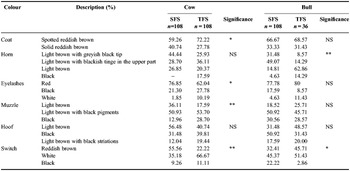
Physical characteristics of Achai cows and bulls in SFS and TFS are presented in Table 2.
Physical characteristics of Achai cows and bulls in SFS and TFS.

NS = not significant.
*P < 0.05; **P < 0.01.
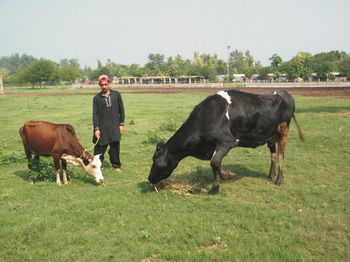
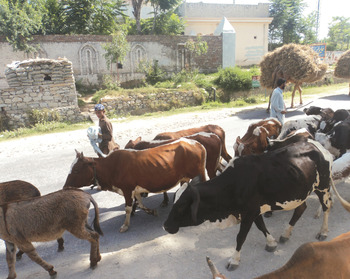
The dominant coat colour of the cows and bulls in both farming systems is spotted reddish-brown (Figures 2 and 3). However, the farming system significantly (P < 0.05) affects the coat colour of Achai cows, with a higher percentage of spotted reddish-brown colour Achai cows in TFS as compared with SFS. Significant variations in the distribution of the colour of eyelashes (P < 0.05), muzzle (P < 0.01) and switch (P < 0.01) of the Achai cow were also observed between SFS and TFS. In the case of bulls, significant variations were observed only in the prevalence of the colour of the horn (P < 0.01) and the switch (P < 0.05) of the tail between the two systems.
Spotted reddish brown Achai (left) with Friesian cow (right) in SFS.

Spotted reddish brown Achai cows in a transhumant cattle herd in TFS.

Morphometric measurements and adult body weight
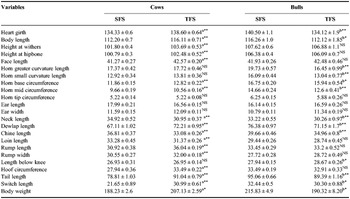
Morphometric measurements and body weight of Achai cows and bulls in SFS and TFS are shown in Table 3.
Mean values (±SEM) of morphometric measurements (cm) and adult body weight (kg) of Achai cows and bulls in SFS and TFS.

a,bMeans with different superscript letters in the same row for the same sex differ significantly between SFS and TFS.
NS = not significant.
*P < 0.05; **P < 0.01.
Achai cows in TFS have significantly higher values for most of the morphometric measurements and adult body weight than do Achai cows in SFS, except chine and loin length, which were significantly longer in SFS cows. There was no significant difference in horn length, ear length and width and height below the knee joint between Achai cows in SFS and TFS.
Achai bulls in SFS have significantly larger heart girth size, longer bodies, longer and thicker horns, long neck, dewlap, chine, tail and switch and adult body weight than TFS Achai bulls. Achai bulls in TFS only have a significantly higher value for height below knee joint. There were no significant differences for the rest of the body measurements.
Discussion
Variation in coat colour in cattle depends upon geographical and climatic features and is reinforced by herder's preferences (Seo et al., Reference Seo, Mohanty, Choi and Hwang2007; Desta, Ayalew and Hedge, Reference Desta, Ayalew and Hedge2011). The spotted reddish-brown coat colour of Achai cows and bulls in SFS and TFS may be due to the similar environmental condition in both farming system. However, the significantly (P < 0.05) higher percentage of spotted reddish-brown coat coloured cows in TFS could be due to the preference of the transhumant herders for this type of cows owing to better productivity. Such preference for spotting colour pattern has not been observed in SFS. Kugonza et al. (Reference Kugonza, Nabasirye, Hanotte, Mpairwe and Okeyo2012) also reported coat colour as the most important selection criteria among physical characteristics by the pastoralists rearing Ankole cattle in Uganda. In the case of bulls, the significant (P < 0.01) variations in the prevalence of horn colour between SFS and TFS may also be due to the herders' preference for light brown colour in TFS. In SFS, the herders give more attention to body frame followed by horn colour and orientation. Wurzinger et al. (Reference Wurzinger, Ndumu, Banumung, Drucker, Okeyo, Semambo, Byamungu and Solkner2006) and Kugonza et al. (Reference Kugonza, Nabasirye, Hanotte, Mpairwe and Okeyo2012) also considered horn colour and shape as the most important phenotypic features among the physical characteristics, followed by coat colour, all of which are used as selection criteria in bulls as compared with cows.
Various morphometric measurements have been identified as the most appropriate variables to discriminate between and within cattle breeds (Mwacharo et al., Reference Mwacharo, Okeyo, Kamande and Rege2006; Yakubu et al., Reference Yakubu, Idahor, Haruna, Wheto and Amusan2010). Within the breed variation in morphometric measurements reflect adaptation to the specific production system (Hall, Reference Hall1998; Kugonza et al., Reference Kugonza, Nabasirye, Mpairwe, Hanotte and Okeyo2011).
The significantly higher values (Table 2) for most of the morphometric measurements of Achai cows in TFS than Achai cows in SFS seem to be an adaptation to TFS, where tall (height at withers) and large body size (heart girt and body length) are suitable for trekking long distances to water and grazing points (Hall, Reference Hall1998; Mwacharo et al., Reference Mwacharo, Okeyo, Kamande and Rege2006). Kugonza et al. (Reference Kugonza, Nabasirye, Mpairwe, Hanotte and Okeyo2011) also recorded significantly larger body dimensions for Ankole cattle in a pastoral system as compared with a crop-livestock production system.
Achai bulls in TFS have significantly lower values for most of the body measurements than Achai bulls in SFS, except for length below the knee joint, which was significantly higher for TFS bulls (Table 2). This could be an adaptation to mountain terrain grazing as the taller and leggier animals are more suitable for grazing in steep and rugged terrains than short-legged animals (Mwacharo et al., Reference Mwacharo, Okeyo, Kamande and Rege2006). The Achai bulls in TFS also have significantly (t (141) = 2.55; P < 0.01) shorter body length to height at withers ratio than bulls in SFS (1.05 ± 0.01 and 1.08 ± 0.01, respectively), which indicates that TFS bulls are taller with respect to body length than SFS bulls. This sort of morphological feature is best suited to draught power in rocky mountains (Berthouly et al., Reference Berthouly, Maillard, Phan, Nhu, Bed'Hom, Leroy, Hoang, Laloe, Bruneau, Vu, Nguyen, Verrier and Rognon2010).
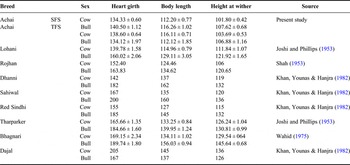
The smaller body size of Achai cattle among all the cattle breeds of Pakistan, as indicated by the smaller heart girth, body length and height at wither (Table 4), seems to be an adaptive trait for survival during seasonal fodder fluctuation. This is because smaller animals are reported to be less susceptible to fodder shortages (Hall, Reference Hall1998), and they can move more easily and quickly (Ouma et al., Reference Ouma, Abdulai, Drucker and Obare2004) on mountain slopes for grazing.
Comparison of morphometric measurements (cm) of Achai cattle in SFS and TFS with other cattle breeds of Pakistan.

Conclusion
Because of the diversity of the Achai cattle production system, it has developed diverse morphological characteristics that suit mobility and draughtability in rugged mountain terrain, as well as better reproductive and productive performance under scarce fodder availability. These characteristics make it an ideal breed that can insure food security, particularly in relation to the changing climate that is predicted in the Hindu Kush and Himalayan regions (Hussain et al., Reference Hussain, Mudassar, Sheikh and Manzoor2005). Our findings contribute to the basic information that characterizes this breed, and is relevant as a source of essential information to support the selection and conservation programmes of the Achai cattle breed under both SFS and TFS. However, comprehensive research is needed to find out the breeding goals of the relevant farming systems through which an in situ conservation can be made.
Acknowledgements
This study was conducted within the framework of the Joint Research Partnership funded by the Swiss National Science Foundation (SNSF) and the Swiss Agency for Development and Cooperation (SDC). It was also conducted within the framework of the Swiss National Centre of Competence in Research (NCCR) North–South: Research Partnerships for Mitigating Syndromes of Global Change. The NCCR North–South is co-funded by SNSF and SDC, and the participating institutions.