One of the most important tasks before the field of developmental psychopathology is to identify the conditions and mechanisms for transmission of disorder from one generation to the next. A large body of research points to the negative implications of maternal depression for her child's emotional and cognitive development (e.g., Maughan, Cicchetti, Toth, & Rogosch, Reference Maughan, Cicchetti, Toth and Rogosch2007; Murray & Cooper, Reference Murray and Cooper1997; Toth, Rogosch, Sturge-Apple, & Cicchetti, Reference Toth, Rogosch, Sturge-Apple and Cicchetti2009) and further suggests dysregulation of the stress response via the hypothalamic–pituitary–adrenal (HPA) axis as a mechanism for these effects (see Goodman & Gotlib, Reference Goodman and Gotlib1999). However, there remains a lack of clarity about how and when exposure to maternal depression translates into a defining biobehavioral vulnerability for her child. We propose to push further on this front by investigating prospective effects of the timing and course of maternal depressive symptoms across the perinatal period on both the mother's and infant's HPA response to a realistic interpersonal stressor. In keeping with the move toward a more nuanced multisystem and multilevel approach in the field of developmental psychopathology (see Cicchetti and Toth, Reference Cicchetti and Toth2009), we pay careful attention to the temporal unfolding of both differences in adjustment between mother–infant dyads, and facets of the stress response within dyads. In characterizing between-dyad differences, we address not only timing of exposure to depression, that is, earlier or later onset of symptoms, but also the course, whether symptom levels remain steady, increase, or decrease across the perinatal period. Within dyads, we look not simply to the level of an HPA response trajectory to describe and interpret (dys)regulation, but more important to its shape, that is, whether and when it shows a dynamic reactivity peak and recovery. We are also interested in the synchrony of stress systems within the dyad: the “same timing” of response trajectories, reflecting parallel activation across systems or divergence. In particular, we explore the positive or negative implications of synchrony between HPA and sympathetic nervous system (SNS) responses within individuals (coordination) and between the infant's and mother's HPA responses within the dyad (attunement). Finally, we conceptualize stress response profiles seen in these infants (and their mothers) as attempts to adapt to a particular environment that prove more or less functional for meeting the challenges life presents, rather than as inherently pathological. With this starting point, we hope not only to advance an understanding of the transmission of depression risk but also to offer new ways of approaching the complexity of the human stress response within a multilevel dyadic context.
HPA Response: The Good and the Bad
When confronted with a physical or psychological stressor, a prototypical response involves activation of the HPA axis, a neuroendocrine cascade of events that involves the release of corticotropin-releasing hormone from the hypothalamus, stimulating adrenocorticotropic hormone release from the pituitary gland, and finally cortisol from the adrenal gland. This process is both normative, preparing the organism to deal with the stressor, and one that shows variability across the population in the degree and duration of response. Although extremes in this variability can have adverse consequences, as described below, there is a growing recognition that a range of responsiveness is evolutionarily adaptive for the population as a whole, and that greater reactivity may mark sensitivity to both positive and negative environmental influences, rather than a risk per se (Boyce & Ellis, Reference Boyce and Ellis2005).
One of the more robust findings in depression research is dysregulation of the HPA axis, although the nature of this dysregulation appears to depend on a multitude of factors. The HPA profile most commonly associated with melancholic depression involves hypercortisolism (i.e., higher basal and stress-reactive levels) thought to be due to a deficit in the negative feedback system regulating the HPA (see Young, Haskett, Murphy-Weinberg, Watson, & Akil, Reference Young, Haskett, Murphy-Weinberg, Watson and Akil1991). In contrast, a well-documented pattern of hypocortisolism (i.e., blunted basal and stress-reactive levels) and heightened negative feedback has been found in chronic stress-related disorders that may involve depression, such as posttraumatic stress disorder (PTSD; see Heim, Ehlert, & Hellhammer, Reference Heim, Ehlert and Hellhammer2000). Although the reasons for an individual undergoing extreme or extended stress to develop one pattern versus the other remain unclear, hypercortisolism is generally interpreted as a more immediate upregulated response to contend with perceived threat, whereas hypocortisolism may represent an adaptation over time to protect the organism and conserve resources in a chronically stressful environment (Fries, Hesse, Hellhammer, & Hellhammer, Reference Fries, Hesse, Hellhammer and Hellhammer2005). A review of the relevant research suggests that the shape of the overall HPA response, rather than the level, is a critical characteristic of depression-related dysregulation; compared to the dynamic reactivity/recovery pattern of their nondepressed counterparts, depressed individuals tend to show an extended response with delayed recovery (Burke, Davis, Otte, & Mohr, Reference Burke, Davis, Otte and Mohr2005). In practice, it can be difficult to disentangle level of cortisol activity during a stress episode from response dynamics/shape, but this research highlights the importance of considering both. In this paper, we use the terms “response trajectory” or “response profile” to describe the full range of changing stress levels over the course of a stress episode, and to examine which factors impact the level versus shape of these trajectories. To maintain continuity with the language of prior research while keeping this distinction, we use the terms “hyper/hypocortisolism” to refer to higher or lower levels in the most general sense (including basal and stress reactive), whereas “hyper/hyporesponse” refers to levels or changes in levels specifically during the peak stress phase of a stress episode, and “dynamic” refers to response shape determined by the timing of reactivity and recovery across the episode.
Much of the above research is based on adults, but studies of infants and children at risk for and/or showing early signs of internalizing disorders reveal a similar bifurcation of hypercortisolism (e.g., Luby et al., Reference Luby, Heffelfinger, Mrakotsky, Brown, Hessler and Spitznagel2003) versus hypocortisolism (e.g., Hart, Gunnar, & Cicchetti, Reference Hart, Gunnar and Cicchetti1995) effects. The maturation of the HPA system occurs rapidly within the first several years of life, with children establishing mature diurnal rhythms by preschool age. These early years of infancy/toddlerhood also appear to represent a sensitive period for biosocial dysregulation; the stress hyporesponsive period (during which an HPA response to acute stress is rare) lasting normatively from about 12 months through toddlerhood, is thought to be a critical developmental step toward resilience against stress and one that can be disrupted by the absence of a reliable caregiver (see Gunnar & Donzella, Reference Gunnar and Donzella2002). In general, conditions of early neglect or maltreatment signifying chronic stress have been associated with hypocortisolism (Gunnar & Vazquez, Reference Gunnar and Vazquez2001) whereas the early temperament features of inhibition and later development of major depressive disorder have been associated with hyperresponse to stress in infants and young children (e.g., Nachmias, Gunnar, Mangelsdorf, Parritz, & Buss, Reference Nachmias, Gunnar, Mangelsdorf, Parritz and Buss1996; Ronsaville et al., Reference Ronsaville, Municchi, Laney, Cizza, Meyer and Haim2006). As observed in adults, there may be at least two pathways to dysregulation: one involving a downward adaptation of HPA activity and/or responsiveness to an overwhelming environment, and the other involving heightened activity/responsiveness in an attempt to manage a threatening environment.
The limits to our understanding of how or why a particular HPA response profile confers risk likely have to do with several factors, including the type of stress paradigm used to evoke HPA response (often far from the naturalistic stressors contributing to depression) and the level of analysis (generally a comparison of levels or difference scores rather than the shape of response trajectories). Another potentially crucial limitation, which we as investigators of human development are just beginning to overcome, is the tendency to study the HPA in isolation rather than taking a multisystemic approach to stress.
A Multisystem Approach to Stress: HPA and SNS
Stress generally evokes a multipronged mobilization of not only the HPA system but also the SNS,Footnote 1 yet it is only relatively recently that a multisystem approach to stress has been widely espoused (Bauer, Quas, & Boyce, Reference Bauer, Quas and Boyce2002). In particular, it is suggested that the degree of symmetry versus asymmetry between HPA and SNS response is of importance in judging whether the overall pattern is adaptive. The two systems have a complex relationship to one another that allows for both permissive and suppressive effects (see Sapolsky, Romero, & Munck, Reference Sapolsky, Romero and Munck2000). Generally, one would expect the two systems' activities to unfold together (though lagged somewhat in time) over the course of an acute stress episode, allowing them to modulate various target tissues and one another as part of a coordinated response. At the same time, the elicitation and meaning of each system's response may differ, with SNS activity thought to be less valenced and reflective of both approach- and withdrawal-related arousal, and HPA activity more specifically associated with negative affect and withdrawal (e.g., Buss, Davidson, Kalin, & Goldsmith, Reference Buss, Davidson, Kalin and Goldsmith2004; Nigg, Reference Nigg2006). It is still unclear which profile of joint response is most adaptive for managing which type of psychological stressor; but the ability to index SNS activity through a salivary analyte, the enzyme α-amylase (AA; see Chatterton, Vogelsang, Lu, Ellman, & Hudgens, Reference Chatterton, Vogelsong, Lu, Ellman and Hudgens1996, as well as Granger et al., Reference Granger, Kivlighan, Blair, El-Sheikh, Mize and Lisonbee2006, for a review), has sparked new interest in questions of symmetry in human samples.
Salivary AA (sAA) develops as a marker of SNS activity over the first years of life, showing adultlike levels by 24 months of age (Davis & Granger, Reference Davis and Granger2009). Patterns of sAA reactivity to stressors used to evoke HPA response have been found in infants as young as 6 months, although the timing of peak response (5 min poststress) and recovery (10–20 min poststress) differ from that of salivary cortisol (peak closer to 20 min poststress, recovery by 45 min poststress). Furthermore, the types of physical and psychosocial stressors that evoke sAA versus HPA response at different points in development may differ (see Davis and Granger, Reference Davis and Granger2009; Stroud et al., Reference Stroud, Foster, Papandonatos, Handwerger, Granger and Kivlighan2009). As indicated above, differential activation of each of these systems may be attributable to broader distinctions in what components of stress response they support and their relevance for meeting developmental needs in a particular situation; whereas SNS measures have been more closely tied to an “effort” component, cortisol has been associated with a “distress” component (Lundberg & Frankenhauser, Reference Lundberg and Frankenhauser1980).
Investigations of HPA/SNS symmetry in relation to depression-relevant variables have yielded conflicting findings, underlining the need for further contextualization of the concept. Whereas symmetry in the sense of high (basal) cortisol and sAA predicted internalizing symptoms in one sample of children (El-Sheikh, Buckhalt, Erath, Granger, & Mize, Reference El-Sheikh, Buckhalt, Erath, Granger and Mize2008), another group found that (pretask) cortisol predicted negative affect independently of sAA, and it was asymmetry in the sense of low cortisol and high sAA that predicted reduced approach behavior (Fortunato, Dribin, Granger, & Buss, Reference Fortunato, Dribin, Granger and Buss2008). Still another study found that symmetry in cortisol and sAA reactivity to social stress, defined here as correlated changes in levels regardless of absolute magnitude, distinguished a healthy group of nonmaltreated youth (Gordis, Granger, Susman, & Tricket, Reference Gordis, Granger, Susman and Tricket2008). As in the HPA-depression literature, the inconclusiveness of some of the above findings may be attributable to a focus on basal or reactivity levels rather than the shape of the stress response over time.
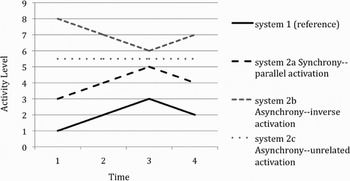
An as yet unexplored (although recently proposed by Powers, Laurent, & Granger, Reference Powers, Laurent and Granger2011) extension of the multisystemic approach is the question of whether one system supports or coordinates with the other across a given reactivity and recovery period. As introduced earlier, the HPA and SNS system response trajectories may be synchronous, unfolding together over time, or asynchronous, either occurring independently of one another or inversely, with one rising as the other falls (see Figure 1 for an illustration of these different possibilities). Normative stress system research provides a basis for expecting any of these patterns; whereas the differences in speed of HPA and SNS acute stress response might give rise to the asynchronous-unrelated activation profile (System 2c), permissive or stimulatory effects would likely be reflected in greater synchrony-parallel activation (System 2a), and suppressive effects could create asynchrony-inverse activation (System 2b). Given the findings of the one study above addressing stress reactivity (rather than basal levels), it may be that an HPA response to acute stress (of whatever degree) coordinated with a similar SNS response dynamic represents a healthier form of arousal than either alone.
Possible synchrony/asynchrony patterns across stress systems.

Effects of Maternal Depression
The roots of a particular stress response profile lie in inherited and environmentally mediated factors, both of which have to do with the mother's own adjustment. Goodman and Gotlib (Reference Goodman and Gotlib1999) outlined an integrative developmental framework for investigating routes of transmission of depression risk from mother to child, including neuroregulatory mechanisms such as HPA function. They also underlined the importance of a developmental perspective that considers the particular needs and capacities of the child (and mother) at a particular point in time, as well as the timing and course of maternal symptoms, to explain variability in child outcomes. This framework has guided subsequent research validating HPA dysregulation as a mechanism of risk, yet crucial questions regarding the nature of this dysregulation (i.e., hyper- vs. hypocortisolism and responsiveness) and the effects of timing and course of maternal depression remain. Several studies suggest that the early postnatal period (first 2 years) represents a sensitive period for exposure to maternal depression, predicting elevated cortisol responses and eventual depression in their offspring (Ashman, Dawson, Panagiotides, Yamada, & Wilkinson, Reference Ashman, Dawson, Panagiotides, Yamada and Wilkinson2002; Essex, Klein, Cho, & Kalin, Reference Essex, Klein, Cho and Kalin2002; Hessl et al., Reference Hessl, Dawson, Frey, Panagiotides, Self, Yamada, Hann, Huffman, Lederhendler and Minecke1998), although other research has found antenatal maternal depression to be preferentially predictive of cortisol hyperreponse and negative affect in infants (Huot, Brennan, Stowe, Plotsky, & Walker, Reference Huot, Brennan, Stowe, Plotsky and Walker2004). Also, whereas the prototypical response profile involves hypercortisolism, some children of chronically stressed and depressed mothers show hypocortisolism and/or a hyperactive SNS response (Gump et al., Reference Gump, Reihman, Stewart, Lonky, Darvill and Granger2009; Yehuda et al., Reference Yehuda, Engel, Brand, Seckl, Marcus and Berkowitz2005).
Despite some disagreement about the relative importance of ante- versus postnatal depression, most evidence converges in concluding that maternal depression during the perinatal period (from pregnancy through early postnatal) is most relevant to child HPA outcomes (e.g., Brennan et al., Reference Brennan, Pargas, Walker, Green, Newport and Stowe2008). This conclusion is supported by animal models demonstrating mechanisms by which maternal stress impacts the offspring's developing stress response systems via the fetal environment and early rearing experiences (e.g., Vallee et al., Reference Vallee, Mayo, Dellu, Le Moal, Simon and Maccari1997; Weinstock, Matlina, Maor, Rosen, & McEwen, Reference Weinstock, Matlina, Maor, Rosen and McEwen1992). Researchers following human mothers from pre- to postpartum have tended to find stronger effects of antenatal (as opposed to subsequent postnatal) depression and anxiety on infant neurobehavioral reactivity (Davis et al., Reference Davis, Snidman, Wadhwa, Glynn, Schetter and Sandman2004), with maternal stress during midpregnancy entraining stable patterns of reactivity in the fetus (Dipietro, Costigan, & Gurewitsch, Reference Dipietro, Costigan and Gurewitsch2003). Similarly, findings of poor birth outcomes in infants of chronically depressed mothers were attributed to effects of maternal cortisol during midpregnancy, but not late pregnancy or postpartum (Field et al., Reference Field, Diego, Hernandez-Reif, Figueiredo, Schanberg and Kuhn2008). These effects are consistent with a fetal programming model in which maternal HPA activity during pregnancy shapes the developing fetal nervous system (including HPA) via placental axis regulation, with strong correlations between maternal and fetal plasma cortisol levels appearing by midgestation (Gitau, Cameron, Fisk, & Glover, Reference Gitau, Cameron, Fisk and Glover1998). Although the placental enzyme 11β-HSD-2 acts as a barrier shielding the fetus from excess maternal cortisol, the effectiveness of this barrier is itself impacted by prenatal stress, and cortisol exposure is thought to be a major programming vector by which maternal adjustment shapes the infant's subsequent vulnerability to stress and disease (O'Donnell, O'Connor, & Glover, Reference O'Donnell, O'Connor and Glover2009; Seckl, Reference Seckl2004). In turn, heightened placental corticotropin-releasing hormone during midgestation has been found to predict maternal depressive symptoms postpartum, suggesting bidirectional dysregulating effects (Yim et al., Reference Yim, Glynn, Dunkel-Schetter, Hobel, Chicz-DeMet and Sandman2009).
Less clear is the importance of chronicity versus change in depression across this period, that is, course, and overlap with effects of anxiety. One study of infant stress reactivity demonstrated a greater effect for maternal depression across pre- and postpartum periods than for either alone (Diego et al., Reference Diego, Field, Hernandez-Reif, Cullen, Schanberg and Kuhn2004), but there is a lack of prospective longitudinal research across the perinatal period that addresses the interactive effects of pre- and postnatal depression as has been called for (Talge, Neal, Glover, & the Early Stress, Translational Research and Prevention Science Network, Reference Talge, Neal and Glover2007). It may be that the importance of maternal antenatal symptomatology lies not simply in direct effects on the fetus during pregnancy, but rather in its ability to moderate (intensify) the impact of subsequent environmental conditions. Also, doubt has been cast on whether it is perinatal depression itself, or the anxiety with which it is often comorbid, that is decisive for child outcomes (O'Connor, Heron, & Glover, Reference O'Connor, Heron and Glover2002).
The Mother–Infant Relationship Context
A final area of ambiguity in this research regards the pathways by which maternal depression affects child stress response. Although we have some evidence that the mother's HPA dysregulation can directly affect the infant prenatally through fetal programming (see Talge et al., Reference Talge, Neal and Glover2007) and that behavioral insensitivity can contribute to infant stress dysregulation in the early postnatal period (e.g., Dawson & Ashman, Reference Dawson, Ashman and Nelson2000), there has been relatively little attention to the possibility that the depressed mother's ongoing HPA dysregulation could continue to impact her child via physiological attunement, or the synchrony of response across persons. Similar to the coordination of HPA/SNS and possible (a) synchrony patterns described above, mother and infant HPA response trajectories may be more or less related to one another over time. When partners' responses occur in parallel across a given stress episode (System 2a, synchronous), they may be said to be attuned, whereas divergent response trajectories may signify inverse attunement (i.e., as one partner becomes more stressed, the other becomes less so, illustrated by System 2b) or nonattunement (unrelated responses, as in System 2c). Early research investigating mother–child cortisol attunement has suggested that this is a positive process distinguishing more behaviorally sensitive mother–child dyads (Sethre-Hofstad, Stansbury, & Rice, Reference Sethre-Hofstad, Stansbury and Rice2002). However, if the perinatally depressed mother is responding in a problematic way to stress herself, one might expect infant attunement with her to perpetuate harmful patterns. That is, her dysregulation would be mirrored by her infant's (similarly dysregulated) response.
Again, the direction of this effect (i.e., toward hyper- or hypocortisolism) may go one of two ways: some research points to the former pattern in perinatally depressed mothers (Nierop, Bratsikas, Zimmerman, & Ehlert, Reference Nierop, Bratsikas, Zimmerman and Ehlert2006) and some toward the latter (Jolley, Elmore, Barnard, & Carr, Reference Jolley, Elmore, Barnard and Carr2007). The direction may depend on timing: when the mother became depressed and what would be adaptive at that perinatal stage, not necessarily for the individual, but at a broader species-wide level. There is some evidence that mothers experiencing high stress during pregnancy show blunted HPA responsiveness that protects both them and their infant from an early delivery (as discussed by Fries et al., Reference Fries, Hesse, Hellhammer and Hellhammer2005), whereas elevated cortisol after the birth of the infant heralds ongoing depression and impaired mother–infant interactions (Field et al., Reference Field, Pickens, Prodromidis, Malphurs, Fox and Bendell2000) that could elicit much-needed social support. Besides reiterating the advisability of looking beyond a single time point to assess depression and cortisol level to assess response, this research suggests that effects on mother and infant should not be considered in isolation from one another and from their evolving joint needs. Clearly, a better appreciation of the dyadic interactional context in which they are operating is needed, and this entails a consideration of both mother and infant stress profiles.
One way to study this context is through a sequence of mother–infant separations and reunions designed to induce stress in the dyadic system, and then allow opportunities for repair or recovery. The Strange Situation procedure (Ainsworth, Blehar, Waters, & Wall, Reference Ainsworth, Blehar, Waters and Wall1978) has been used to evoke differences in mothers' sensitive caregiving and infants' ability to use the mother to regulate distress, characteristics related not only to attachment security (which it was designed to measure) but also to depression. Previous research with the Strange Situation has yielded equivocal findings for “normative” stress responses in mothers and infants, with little evidence for sample-wide task-related change in cortisol (Nachmias et al., Reference Nachmias, Gunnar, Mangelsdorf, Parritz and Buss1996; Spangler & Grossman, Reference Spangler and Grossman1993) or sAA (Hill-Soderlund et al., Reference Hill-Soderlund, Mills-Koonce, Propper, Calkins, Granger and Moore2008). Even a study utilizing a more nuanced trajectory approach to infant cortisol and sAA values before and after the Strange Situation failed to demonstrate significant changes in the group as a whole (Frigerio et al., Reference Frigerio, Ceppi, Rusconi, Giorda, Raggi and Fearon2009). When individual differences were considered, these studies and others (Hertsgaard, Gunnar, Erickson, & Nachmias, Reference Hertsgaard, Gunnar, Erickson and Nachmias1995) have found theoretically consistent elevations in pre- and/or posttask stress levels in insecurely attached infants, although sometimes the effect depended on an interaction with another variable such as infant temperament or genotype. This work suggests that attachment may be a relevant variable to consider in evaluating mother–infant stress response profiles, while underlining some of the caveats regarding measurement and interpretation of infant HPA function discussed by Egliston, McMahon, and Austin (Reference Egliston, McMahon and Austin2007), namely, high interindividual variability in the power of separation to evoke a clear stress response, the timing of such a response, and the difficulty of obtaining a true “baseline” in the laboratory. Given these factors, an evaluation of stress regulation within the mother–infant relationship should include multiple measures of stress during and after a task like the Strange Situation, examine individual differences in stress trajectories, and take a broader view of “response” that acknowledges multiple adjustment-relevant factors (diurnal rhythms, general laboratory-related stress, and task-specific reactivity/recovery) driving observed cortisol levels during a stress task.
The Current Study
The present study was designed to address some of the unresolved questions left by the body of research reviewed above, while furthering a multilevel developmental model for understanding the transmission of vulnerability to depression. In keeping with Goodman and Gotlib's (Reference Goodman and Gotlib1999) framework, we aimed to clarify a neuroregulatory mechanism of risk by characterizing not just the level but also the shape of HPA response trajectories during a realistic interpersonal stressor in perinatally depressed mothers and their infants. Elaborating on this overarching aim, we asked, do the timing and course of maternal depressive symptoms matter? In particular, do antenatal depressive symptoms change the impact of postnatal symptoms on mother/infant stress response profiles? Secondarily, do depressive symptoms have a discernible impact when controlling for anxiety? Finally, to better explicate the basis for and implications of between-dyad differences exposed above, we asked, how do maternal depressive symptoms affect the synchrony of within-dyad stress patterns, and how does this relate to overall infant and mother HPA activation? The two within-dyad synchronies of interest were the temporal coordination of HPA and SNS, and the attunement of infant and mother HPA response trajectories.
We were able to approach these questions through data from a longitudinal study of mothers at risk for depression and parenting problems. They provided (concurrent) reports of depression and anxiety symptoms during the third trimester of pregnancy, as well as at 5 months and 18 months postnatal. These measures of maternal psychopathology across the perinatal period, which are both main effects and Antenatal × Postnatal interactions, were used to predict mother and infant cortisol response trajectories during an attachment stressor, the Strange Situation, at 18 months. In addition, mother and infant sAA measures were included to assess SNS response profiles in relation to HPA.
Guided by a developmental model of transmission of depression risk, as well as the research summarized above, we hypothesized that maternal depressive symptoms could be associated with higher or lower levels of cortisol in mother–infant dyads, but more consistently with a less dynamic response trajectory and impaired recovery. Given indications that chronic stress tends to give rise to hypocortisolism, we predicted that a course of consistently high depressive symptoms across pre- and postnatal time points would more likely predict lower cortisol levels, whereas a more recent (postnatal) rise in symptoms would predict the opposite, higher cortisol levels for both mother and infant. An alternative time course hypothesis was informed by research implicating maternal depression during pregnancy in lasting infant stress dysregulation; this hypotheses stated that antenatal depressive symptoms could intensify the effects of postnatal symptom levels. Finally, although no prior research addressing cortisol–sAA temporal coordination and cortisol attunement in relation to depressive symptoms was available to guide us and this study was conceived in part to address this gap, we hypothesized that effects of maternal symptoms on these within-dyad synchronies would help to explain the above effects. More specifically, we predicted that lower depressive symptoms and associated cortisol levels would relate to greater cortisol–sAA coordination and mother–infant attunement.
Method
Participants
Participants were drawn from the From Pregnancy to Parenting Your First Baby project, which followed 105 women at risk for parenting problems and their infants across the perinatal period. The current study sample comprises the 86 mother–infant dyads (36 male, 50 female infants) who completed all three longitudinal assessment: Time 1 (T1; antenatal—third trimester pregnancy), T2 (5 months postnatal), and T3 (18 months postnatal). Women were recruited from two local public assistance organizations, Lane County Oregon Women, Infants, and Children and Lane County Oregon MothersCare. Women were informed of the study by Lane County Oregon Women, Infants, and Children and Lane County Oregon MothersCare program officials during regular appointments and, if interested, received a flier about the study and a consent form to establish telephone contact with the Project Coordinator. Exclusion criteria included high-risk pregnancies, severe psychopathology (e.g., psychoticism), and plans to give the baby up for adoption. The sample was primarily European American (80%) and English speaking, with a mean household income of $9,634 per year, below the 2005 US Census Bureau's poverty threshold for single-person households. The mothers' mean age at the first assessment was 24 years (SD = 4.5).
Procedure
At the initial antenatal assessment (T1; M = 33 weeks gestation, SD = 3), mothers completed a set of questionnaires measuring psychological symptoms (e.g., depression, anxiety; see below), as well as measures of their preparation for and expectations about parenthood and their own early attachment experiences. After the birth, mothers were screened for continued inclusion criteria for the study, which included relatively healthy birth outcomes (i.e., no extreme prematurity or severe infant health problems; only one dyad was excluded on this basis). The majority of infants in the current study thus fell within a normative range for birth weight (M = 7.5 lb., SD = 1 lb.) and gestational age (M = 37.5 weeks, SD = 1.4). At the first postnatal assessment (T2; M infant age = 21 weeks, SD = 2), they returned to the lab to complete questionnaires including some of the same symptom measures, as well as other measures relevant to their experiences as new parents. Mothers also completed several interaction tasks with their infants at this time. For the purposes of the present study, only the measures of depression and anxiety symptoms given at these time points were of relevance.
At the second postnatal assessment (T3; M infant age = 17.8 months, SD = 1.6), mothers returned with their infants to complete many of the same questionnaire measures, as well as to participate in the Strange Situation. This procedure is designed to activate the attachment system in parent–child dyads through a series of separations and reunions (for a full description, see Ainsworth et al., Reference Ainsworth, Blehar, Waters and Wall1978). In this study, not only were infants generally distressed by the procedure, but mothers were also exposed to their infants' distress because they watched the separation behavior on a remote monitor. This task was thus regarded as a potential interpersonal stressor for both the mother and the infant. It was also well suited for studying stress response in relation to emotion regulation and adjustment within the mother–infant dyad; the separation and reunion introduced an acute stress to respond to and recover from while potentially triggering a more chronic stress experience in insecure dyads that could be reflected in the shape of response trajectories (i.e., extended, nonrecovering). It was the first task participants engaged in during the T3 session; afterward, mothers completed questionnaires while infants engaged in a developmental assessment with a research assistant in the same room as the mother.
Four saliva samples were collected from both mothers and infants over the course of the T3 session to evaluate HPA (indexed by cortisol) and SNS (indexed by sAA) response profiles associated with the Strange Situation. All sessions were conducted in the afternoon (M start time = 3:17 p.m., SD = 47 min) to minimize variability in diurnal rhythms of these markers. Participants were asked to refrain from eating or drinking (except water) for 1 hr before the session, and other potential confounding factors for salivary assay (e.g., recent dental work, illness) were assessed at the beginning of the session. According to mother reports, the majority of infants arrived at the session “alert” (90%) and with no alterations in their usual mood (93%) or daily routine (70%).
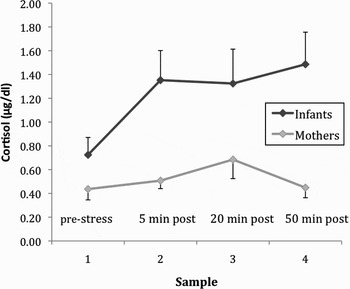
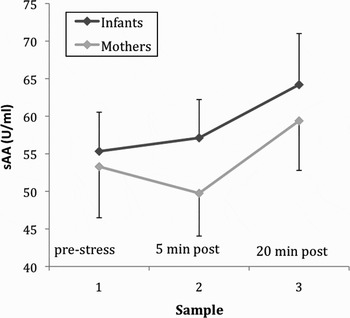
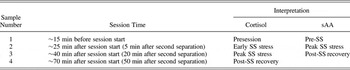
Because of differences in the response time course associated with the HPA (slower) and SNS (faster) systems, as well as in the time it takes for their activity to appear in salivary assay, different samples were used to index phases of stress response in cortisol and sAA (see Stroud et al., Reference Stroud, Foster, Papandonatos, Handwerger, Granger and Kivlighan2009). The first saliva sample, collected soon after the dyad arrived for the session, was used to index a prestress “baseline” for both systems while acknowledging that this also represented reactivity to coming into the lab (see, e.g., Egliston et al., Reference Egliston, McMahon and Austin2007). The second sample, collected directly after the conclusion of the Strange Situation (approximately 5 min after the second separation), was used to index peak stress for sAA and early task-related stress for cortisol. The third sample, collected approximately 15 min later, was used to index peak stress for cortisol and recovery for sAA, and the fourth sample, collected approximately 30 min after that, indexed cortisol recovery. Some variability in timing of these samples across dyads occurred, primarily due to differences in the Strange Situation procedure (i.e., separations terminated early due to extreme and/or extended infant distress). The actual timing of each dyad's samples was recorded and used in subsequent analysis. See Table 1 for the average timing and interpretation of each of these samples. Figure 2 and Figure 3 show mean mother and infant cortisol and sAA levels (with standard error bars) across these time points in the current sample.
Mean mother and infant cortisol across sampling points.

Mean mother and infant salivary α-amylase across sampling points.

Cortisol and sAA sample timing

Note: sAA, salivary α-amylase; SS, Strange Situation.
Measures
Depressive symptoms
Mothers' depressive symptoms at T1 through T3 were assessed with the Center for Epidemiological Studies Depression Scale (CES-D; Radloff, Reference Radloff1977), a 20-item self-report measure designed to measure depressive symptomatology among adults in the general population. Internal consistencies ranged from 0.87 to 0.90 for women in the sample across time points. In keeping with the high-risk nature of this sample, 30% of mothers scored in the elevated range (>16) at T1, 21% at T2, and 27% at T3 (T1, M = 13.17, SD = 7.23; T2, M = 10.07, SD = 8.41; T3, M = 11.78, SD = 9.30).
Anxiety symptoms
To differentiate depressive from more generalized internalizing symptoms, mothers also completed the Beck Anxiety Inventory (BAI; Beck, Epstein, Brown, & Steer, Reference Beck, Epstein, Brown and Steer1988), a 21-item self-report measure of anxiety symptoms. Internal consistencies in this sample were adequate (0.83–0.89 across time points). Anxiety symptoms tended to diminish from antenatal to postnatal time points (T1, M = 11.06, SD = 6.94; T2, M = 6.72, SD = 7.48; T3, M = 5.86, SD = 5.81). Correlations of 0.53–0.65 with CES-D scores from T1–T3 confirmed substantial overlap of these constructs while demonstrating that they are separable (i.e., less than half the variability in CES-D scores explained by BAI).
Salivary assay
Whole unstimulated saliva samples were collected by sorbette from both mothers and babies. These were sealed in cryogenic vials and immediately placed in frozen storage (−20°C) until shipped on dry ice to Salimetrics (State College, PA) for analysis. On the day of testing, all samples were centrifuged at 3000 rpm for 15 min to remove mucins.
Cortisol
All samples were assayed for salivary cortisol by enzyme immunoassay (Salimetrics). The test used 25 µl of saliva and had a lower limit of sensitivity of 0.007 µg/dl, a range of sensitivity from 0.007 to 3.0 µg/dl, and average intra- and interassay coefficients of variation of less than 5% and 10%, respectively.
sAA
Samples 1–3 from each dyad member were assayed for sAA by kinetic reaction assay (Salimetrics). The assay employs a chromagenic substrate, 2-chloro-p-nitrophenol, linked to maltotriose. Intraassay variation computed for the mean of 30 replicate tests was less than 7.5%. Interassay variation computed for the mean of average duplicates for 16 separate runs was less than 6%.
Analytic strategy
Because the primary outcome data for this investigation (cortisol levels measured within a dyad over time) were dependent, multilevel modeling was selected as the analytic framework of choice. At Level 1, within-dyad variation in (mother or infant) cortisol over time was modeled with a set of growth parameters (i.e., intercept, slope, quadratic) that were allowed to vary across dyads. Other within-dyad characteristics varying over time that could help to explain cortisol variability, including (own) sAA and partner cortisol, were added as covariates at Level 1 in relevant coordination or attunement analyses.Footnote 2 At Level 2, between-dyad variability in these Level 1 parameters was explained by characteristics that varied across mother–infant dyads, in this case, maternal perinatal psychopathology.
Hierarchical linear modeling (HLM; Raudenbush & Bryk, Reference Raudenbush and Bryk2002) was used to test a series of models examining the impact of mothers' T1–T3 depressive symptoms on their own and their infants' stress response profiles during the Strange Situation at T3. This modeling technique allowed us to test effects of mothers' symptoms not only on cortisol response trajectories themselves (taking into account both level and shape of response) but also on the synchrony of these responses across systems (i.e., with sAA) and across partners. We were also interested in the time course of maternal perinatal symptoms as a shaper of infant stress adaptation; in particular, we wanted to test whether the effect of postnatal (T2, 3) depressive symptoms would vary depending on the mothers' level of antenatal (T1) symptoms.
Main effects and cross-time interactions of mothers' CES-D scores were entered as Level 2 predictors of (a) own and infant cortisol trajectories—cortisol response profiles, (b) covariation of mother/infant cortisol with sAA across time points—HPA–SNS coordination, and (c) covariation of infant with mother cortisol across time points—attunement. At Level 2, depressive symptom scores (and other between-dyad predictors) were grand mean centered to reflect variability relative to the sample as a whole, whereas Level 1 covariates (i.e., partner cortisol, sAA) were group mean centered to capture the relative variability within the dyad.
Results
Missing data
As described above, the current sample (n = 86) represented the subset of the original 105 women who completed all three study assessments. A comparison of these intact cases with those missing one or more assessments revealed nonsignificant differences on BAI scores and T2–T3 CES-D scores. A difference in T1 CES-D, t (103) = 3.07, p = .003, showed that women who failed to complete all assessments had higher antenatal depressive symptoms. This suggested that the current sample was likely to underrepresent extremes of perinatal depression, and that any effects found would not be driven by such extremes. At the same time, the substantial proportion of women scoring above-threshold at each time point (indicated above) ensured that the sample still contained a range useful for studying depressive symptom effects.
Within these dyads, missing cortisol and sAA values were allowed, and model parameters were computed based on existing data points using full information maximum likelihood estimation (FIMLE) in HLM. Missingness could be caused by extreme assay values suggestive of interference (6 cortisol samples were excluded on this basis), insufficient saliva quantity for assay, or failure to collect the sample (generally, due to infant noncooperation). Of the 657 samples available for testing, 478 (73%) yielded valid values and were included in analyses. Under the FIMLE method, cases missing one or more sample values were not excluded, but were weighted less heavily in model estimation.
Control variables
A series of potential control variables that could impact salivary cortisol assay were tested in relation to mothers' and infants' measured cortisol levels across the session. These included medications, recent eating/drinking or brushing teeth, dental work, illness, sleep time/duration, body mass index, age, and arrival time (in relation to which a participant-specific sample time variable used to define HLM linear/quadratic terms was constructed). Of these, cups of coffee within the past 2 hr and arrival time related to mothers' cortisol, and arrival time and age related to infants' cortisol; these were included as controls in all subsequent analyses.
Other potential confounds in the interpretation of mother/infant stress markers and their association with depressive symptoms included infant birth outcomes (i.e., gestational age, birth weight, health problems at and following delivery) and attachment status. Although 30% of the infants were classified as preterm (<37 weeks gestation) and 4% as “premature” (<35 weeks, range = 33.9–34.3), none of the birth variables were associated with the outcomes of interest (mother/infant cortisol and sAA levels, mother CES-D scores). Similarly, although there was some variability in attachment classification (8% avoidant, 5% resistant, 21% disorganized, 66% secure), there were no significant differences in mother/infant cortisol or sAA values by attachment status. There was one marginal effect of maternal depressive symptoms on attachment—higher T2 CES-D scores tended to predict higher likelihood of disorganized status (B = 0.07, SE = 0.04, p = .06), but there were no effects of symptoms at other time points, nor of time-course interaction effects. This makes it unlikely that the effects explored below could be attributed to differences in attachment.
Description of depressive symptoms and cortisol/sAA across time points
Paired samples t tests indicated both stability and change in mothers' average depressive symptoms across assessments. Moderately sized but significant paired-samples correlations (0.36 for T1–T2, 0.43 for T2–T3, 0.28 for T1–T3, all ps < .01) demonstrated the former, whereas a significant decrease from T1–T2, t (85) = −3.24, p = .002, and marginal increase from T2 to T3, t (85) = 1.67, p = .099, argued for the latter. An examination of individual mothers' changes in CES-D scores (“change” judged by increase/decrease of >1 SEM) showed that, although predominant sample-wide tendencies dictated these trends, that is, 72% decreased from T1 to T2 and 60% increased from T2 to T3, there was also variability in symptom trajectories that could be modeled.
Average change in cortisol and sAA across sampling points was explored using repeated-measures ANOVA with follow-up contrasts against the initial “baseline” sample. It should be noted that these analyses were limited to the subset of mothers and infants who had no missing cortisol/sAA values and, as such, do not necessarily reproduce what could be found in the more inclusive HLM analyses. On this basis, only the infants as a group showed a significant change in cortisol, F (3, 25) = 3.54, p = .029; this reflected a significant increase from Sample 1 to subsequent samples (reactivity) but no decrease back to baseline (recovery). For sAA, only the mothers as a group showed a significant change, F (2, 45) = 4.00, p = .025. This reflected a significant increase from baseline to the final sample, consistent with delayed reactivity but no recovery.Footnote 3 These patterns at the sample level, which do not neatly fit a classic stressor-specific reactivity and recovery profile, are consistent with previous research using the Strange Situation (e.g., Frigerio et al., Reference Frigerio, Ceppi, Rusconi, Giorda, Raggi and Fearon2009; Hill-Soderlund et al., Reference Hill-Soderlund, Mills-Koonce, Propper, Calkins, Granger and Moore2008; Spangler & Grossman, Reference Spangler and Grossman1993). At the same time, the failure to find consistent reactivity/recovery in the sample as a whole leaves open the possibility that some dyads do respond dynamically to the stressor while others do not, a question that can best be addressed via multilevel modeling of individual trajectories. Furthermore, individual differences in stress levels across the session, and particularly during the Strange Situation itself, may offer complementary information about adjustment to that offered by the shape of response profiles.
Growth curve modeling: Baseline models
Prior to fitting explanatory models, baseline models of mother and infant cortisol containing no predictors were run to describe their average trajectories and between-dyad variability in these trajectories. Because cortisol (and to a lesser extent sAA) scores were positively skewed, a natural log transformation was applied, and transformed scores used in analyses.
For both mothers and infants, a model that included a curvilinear growth term (quadratic model) provided the best fit to the data as determined by the deviance statistic. This model, which showed rising cortisol at the beginning of the session and falling cortisol by the end, also fits theoretically with the HPA reactivity/recovery pattern associated with an acute stressor. Because models were centered at the second separation sampling point, intercept terms represented the level of cortisol response trajectories during the peak stress of the Strange Situation. The shape of cortisol response trajectories was addressed by the linear and quadratic components. The linear term, which was slope of the curve at the second separation time point, indicated whether the individual had begun to recover during the separation stress (negative slope) or was continuing to react (positive slope). Finally, the quadratic term, which was the deceleration rate of the curve, depicted the steepness of the response trajectory as a whole; more negative values suggested a dynamic reactivity and recovery and more positive values indicated a less dynamic curve and impaired recovery.
According to the baseline cortisol model, mothers' average linear slope was decreasing, b = −0.26, p = .009, from an intercept (log-transformed cortisol level) of −1.28. Infants' average slope, in contrast, was still increasing, b = 0.44, p < .001, from an intercept of −0.67. This implies that infants tended to maintain higher cortisol levels throughout the separation stress, whereas mothers tended to be recovering; at the same time, significant variability in these parameters demonstrated that these patterns varied across dyads. Mothers, on average, displayed a significant quadratic (deceleration) component (b = −0.40, p = .001), reflective of a classic reactivity and recovery curve. Infants failed to show a significant deceleration on average (b = −0.33, p = .10), but significant variability in this term again suggested that some were accelerating and some decelerating in cortisol change across the session. Each of these model terms (intercept, linear slope, and quadratic) served as a random effect to be explained by between-dyad predictors at Level 2.
Baseline models of mother and infant sAA were also run to describe SNS response trajectories. Because only three time points were available, this was constrained to a linear (rather than curvilinear) model. Whereas mothers showed a significantly increasing linear slope across the session (b = 0.37, p = .02), the infants' slope was nonsignificant, on average (b = 0.04, p = .69). The between-dyad variability in these terms again suggested that these patterns varied across mother–infant dyads in the sample.
Main model testing
For each of the outcomes reported below, we first tested a main effects model of mothers' perinatal depressive symptoms to address timing effects. To assess the unique contribution of maternal depression at each of the three study periods of antenatal (T1), early postnatal (T2), and later postnatal (T3; current), each CES-D depression score was entered as a simultaneous predictor of the outcome of interest (i.e., mother/infant cortisol trajectory terms, mother/infant cortisol–sAA covariation, or infant–mother cortisol covariation). To further distinguish effects of depression from anxiety, BAI anxiety scores from each time point were entered as covariates in the same models. We then tested two cross-time interaction models addressing the impact of course of depressive symptoms from pregnancy through postpartum. These comprised (a) a main effects plus T1 × T2 depressive symptoms model and (b) a main effects plus T1 × T3 depressive symptoms model. If none of the interaction terms were found significant for a given outcome, the main effects (timing) model is reported; otherwise, the more complex interaction (time course) model is reported as the final model.
Mothers' and infants' cortisol response profiles
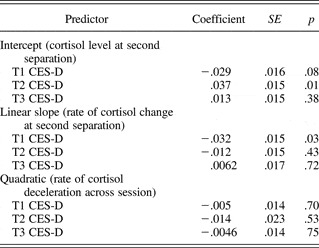
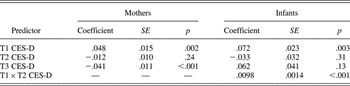
For mothers, T2 depressive symptoms proved the strongest predictor of their own cortisol intercepts; women who had been more depressed in the early postnatal period exhibited higher cortisol levels during the Srange Situation second separation. Antenatal (T1) depressive symptoms had a negative effect on mothers' linear terms, as well as a marginal negative effect on mothers' cortisol intercepts. In other words, mothers with elevated depressive symptoms during pregnancy tended to show lower cortisol levels and quicker recovery during the separation (see Table 2). Neither of the time course interaction effects (i.e., T1 × T2 or T1 × T3 symptoms) significantly predicted maternal cortisol. The main effects model was thus selected as a final explanatory model for mothers' cortisol. It provided a significant improvement in fit, according to the deviance statistic compared to a model without T1–T2 depressive symptoms, χ2 (6) = 13.79, p = .03. In other words, mothers' T3 cortisol response profiles were best predicted by the timing of earlier symptoms occurring closer to the birth of their infants, with opposite effects for antenatal versus early postnatal depression; whereas the former predicted a dampened response, the latter predicted a heightened profile of maternal response to separation from her infant.
Main effects of T1–3 depressive symptoms predicting mothers' cortisol trajectories

Note: T1–3, Times 1–3; CES-D, Center for Epidemiological Studies Depression Scale.
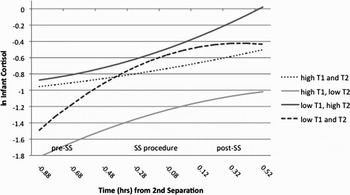
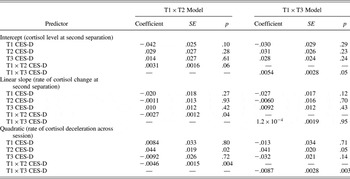
There were no significant main effects of maternal depressive symptoms on infants' cortisol trajectories, but several significant interaction effects demonstrated that the course of mothers' depressive symptoms across the perinatal period did impact infant cortisol. Mothers' T1 × T2 symptoms significantly predicted infants' linear and quadratic terms, with a marginal effect on their intercepts (see Table 3, left panel). Plotting expected infant trajectories at combinations of low (25th percentile) and high (75th percentile) values of maternal depressive symptoms at these time points helped to decompose these effects, which showed that the strength of (T2) postnatal symptom effects depended on the level of antenatal symptoms. For the effect on the intercept, T1 depressive symptoms tended to strengthen the effect of T2 symptoms, which were associated with higher infant cortisol (see Figure 4). Infants whose mothers reported low depressive symptoms during pregnancy but became more depressed postnatally showed the highest cortisol levels during the separation, and infants of mothers with high antenatal symptoms who recovered postnatally showed the lowest levels. Effects on the linear and quadratic components, in contrast, revealed stronger effects of T2 symptoms in the context of low T1 symptoms. Higher postnatal maternal symptoms were associated with an increasing infant cortisol slope and more positive quadratic term, meaning a more extended response and slower recovery from the separation stress, especially given low antenatal depressive symptoms. Deviance tests showed that the T1 × T2 model provided a marginal improvement in fit compared to the main effects model, χ2 (3) = 6.8, p = .07 (a significant improvement compared to a model without T1 or T2 depressive symptoms, χ2 (9) = 17.42, p = .04).
Mothers' antenatal and early postnatal depressive symptoms interact to predict infant cortisol trajectories.

Interactions of T1 and subsequent (T2, T3) depressive symptoms predicting infants' cortisol trajectories

Note: T1–3, Times 1–3; CES-D, Center for Epidemiological Studies Depression Scale.
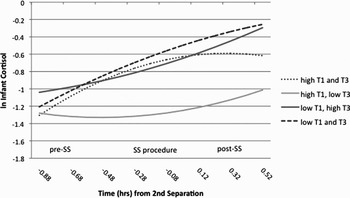
Significant effects of T1 × T3 symptoms on infant cortisol trajectories confirmed that mothers' antenatal depressive symptoms moderated the effect of later postnatal symptoms as well. The interaction of antenatal (T1) and current (T3) depressive symptoms exhibited similar effects on infant cortisol intercepts and quadratic terms as those reported above (see Table 3, right panel), although here the interactions revealed crossover effects. As before, T1 symptoms strengthened the effect of postnatal (T3) symptoms on infants' intercepts. Given high antenatal symptoms, higher postnatal symptoms again predicted elevated cortisol levels. Given low levels of antenatal symptoms, higher current symptoms predicted slight suppression (see Figure 5). As above, infants of mothers who went from high antenatal to low postnatal symptoms showed the lowest cortisol levels. The effect of T3 symptoms on the quadratic term was also strongest in the context of high T1 symptoms, with higher current symptoms predicting a steeper curve and better recovery. Given low T1 symptoms, T3 symptoms predicted the opposite pattern of a more extended response curve. Infants whose mothers shifted from either higher to lower depressive symptoms, or vise versa, from T1 to T3 displayed an accelerating curve/lack of recovery, as opposed to the expected rising and falling curve. The T1 × T3 model offered a significant improvement in fit over the main effects model, χ2 (3) = 7.61, p = .05.
Mothers' antenatal and later postnatal depressive symptoms interact to predict infant cortisol trajectories.

Overall, these T1 × T2 and T1 × T3 models revealed that the time course of maternal depressive symptoms predicted their infants' cortisol response profiles, with generally stronger effects of postnatal symptoms when antenatal symptoms were high. Specifically, infants of mothers who were depressed during pregnancy showed a bigger jump from suppressed to elevated cortisol levels associated with increased postnatal symptoms. In addition, effects on the shape of infant response trajectories showed a more extended curve and poorer recovery in the case of transitions from high to low depressive symptoms (or vise versa) from the antenatal to postnatal periods.
To assess whether effects on cortisol levels simply reflected overall differences in HPA activation unrelated to the Strange Situation, similar analyses centered at other sampling points were conducted. These showed that the effect of T2 symptoms on maternal cortisol level was specific to samples leading up to and including the Strange Situation (no effect on final level). The T1 × T2 effect on infant cortisol level was specific to samples indexing Strange Situation response (2 and 3), and the T1 × T3 effect on infant cortisol level was specific to the Strange Situation peak stress sample (3). Thus, maternal depressive symptoms appeared to affect cortisol response trajectories not just in the sense of overall cortisol activation, but more particularly in the sense of responsiveness to the Strange Situation task.
Infant and mother cortisol–sAA coordination
To address effects of maternal depressive symptoms on the temporal coordination across HPA and SNS stress response systems, (own) sAA was entered as a time-varying covariate predicting mother or infant cortisol levels across samples. The cortisol outcome was modeled as a function of a (random) intercept and sAA levels, which were group mean-centered to capture the degree to which relative increases/decreases in sAA across the session were associated with parallel changes in cortisol level. Between-dyad variability in this term was predicted by T1–T3 symptoms and interactions. On average, cortisol–sAA coordination was nonsignificant but variable across dyads.
For mothers, T1 depressive symptoms had a positive main effect on their cortisol–sAA coordination, whereas T3 symptoms had a negative effect (see Table 4, left panel). An examination of the typical shape of sAA response profiles in this sample (gradually increasing across the session) in relation to cortisol and effects of maternal symptoms helped to interpret these timing effects.Footnote 4 Mothers with higher antenatal symptoms showed positive coordination because modest cortisol reactivity was more closely matched by a rising sAA profile (synchrony). Mothers with higher current symptoms, by contrast, showed greater differentiation of marked cortisol reactivity from a relatively flat sAA profile (asynchrony). This main effects model provided a significant improvement in fit compared to one without T1 and T3 depressive symptoms, χ2 (2) = 8.54, p = .01.
Main effects and interaction of T1 × T2 depressive symptoms predicting mothers' and infants' cortisol–salivary α-amylase coordination

Note: T1–3, Times 1–3; CES-D, Center for Epidemiological Studies Depression Scale.
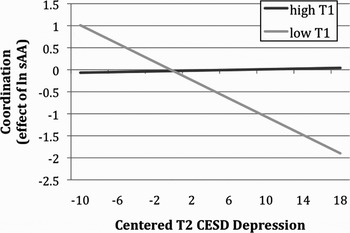
For infants, T1 maternal depressive symptoms also had a positive main effect on coordination, although this was moderated by a significant interaction with T2 symptoms (see Table 4, right panel). Decomposition of the interaction revealed that the effect of postnatal symptoms was strongest at low levels of antenatal symptoms; given low T1 symptoms, higher T2 symptoms predicted a negative coordination (asynchrony – inverse activation) between infant cortisol and sAA levels across the session, whereas T2 symptoms given high T1 symptoms failed to predict coordination (see Figure 6). The interpretation of these effects was similar to that for mothers, above, in that positive coordination arose because of parallel increasing cortisol and sAA, whereas negative coordination arose because cortisol reactivity diverged from a relatively flattened or even falling sAA profile. This model provided a significant improvement in fit compared to a main effects model, χ2 (1) = 5.45, p = .02. Negative correlations between mother/infant cortisol intercepts and coordination terms further suggested that higher degrees of coordination were associated with lower cortisol levels across the session (and lower or negative coordination was associated with higher cortisol levels).
Mothers' antenatal and early postnatal depressive symptoms interact to predict infant cortisol–sAA coordination.

Infant–mother cortisol attunement
Finally, to address effects of maternal depressive symptoms on the degree of infant–mother cortisol attunement across the session, mothers' group mean-centered cortisol levels were entered as a time-varying covariate predicting infant cortisol levels across samples. Similar to the coordination analyses described above, the infant cortisol outcome was modeled as a function of an intercept and the maternal cortisol covariate, both of which were allowed to vary across dyads. On average, the infant–mother attunement effect was nonsignificant, but varied across dyads. Maternal psychopathology predictors were entered to explain between-dyad variation in this effect.
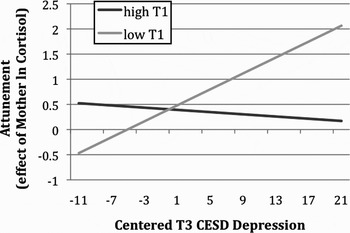
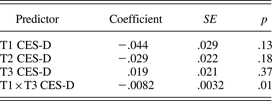
Again, no main effects of maternal depressive symptoms emerged, but the interaction of T1 × T3 symptoms significantly predicted the degree of attunement (see Table 5). Decomposition of this interaction revealed a stronger (and positive) effect of current symptoms on attunement given low levels of antenatal maternal symptoms (see Figure 7). If the mother remained stable at either low or high symptom levels, the infant tended to be less attuned to her (asynchrony), whereas a transition from lower to higher symptoms predicted markedly increased attunement (synchrony). This model provided a significant improvement in fit compared to a main effects only model of attunement, χ2 (1) = 6.79, p = .009. A positive association (tau correlation) between the infant cortisol intercept and attunement terms suggested that higher degrees of attunement were associated with higher cortisol levels across the session, or greater HPA activation overall.
Mothers' antenatal and later postnatal depressive symptoms interact to predict infant–mother cortisol attunement.

Interaction of T1 × T3 depressive symptoms predicting infant–mother cortisol attunement
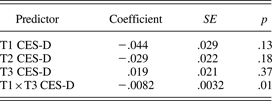
Note: T1–3, Times 1–3; CES-D, Center for Epidemiological Studies Depression Scale.
Taken together, the results of these coordination and attunement analyses complement and help to explicate possible contributing factors to the effects of maternal depressive symptoms on cortisol response profiles explored above. Both the heightened synchrony between infant and mother response trajectories, and the diminished synchrony between cortisol and sAA trajectories, associated with increasing maternal symptoms appeared to sustain the elevated cortisol levels found in these dyads. That increased postnatal symptoms related to more negative cortisol–sAA coordination in both mothers and infants further suggested that HPA response unsupported by a parallel SNS profile may be a relatively stable marker of (recent) maladjustment.
Discussion
The present study represents a step forward not only in delineating the developmental effects of perinatal depression on the HPA system but also in our broader understanding of the parameters of a dyadic stress response profile. In answer to our initial questions, it would appear that perinatal depressive symptoms do affect the level and shape of infant and mother HPA response trajectories during a separation stressor, that both the timing (for mothers) and course (for infants) of depressive symptoms matter, and that these effects are not due to overlap with anxiety. Moreover, we find that maternal depressive symptoms have implications for within-dyad coordination of HPA and SNS, as well as infant–mother attunement, and variability in the synchrony of these systems helps to explain between-dyad differences in HPA activation. Below, we consider what each of these effects means, both within the context of this study and for the development of stress regulation more generally. Without a base of prior studies utilizing the same approach to time course of perinatal symptoms and, especially, to the shape of interrelated stress profiles within dyads, much of our interpretation at this point is necessarily speculative. However, we believe these findings point in important new directions for reconciling some of the disparities in past research, as well as the way forward to a fuller understanding of mother–infant stress transmission.
Effects of maternal depressive symptoms on both her own and her infant's HPA response profiles pointed to a hyporesponsive pattern associated with earlier (antenatal) symptoms, and a hyperresponsive pattern with later (postnatal) symptoms, although for infants these depended on interaction effects of ante- and postnatal symptoms. In line with hypotheses, these depressive symptom timing effects on the mother indicated a downward adaptation of HPA associated with antenatal symptoms, perhaps as a protective mechanism, and a heightened drive associated with postnatal symptoms, perhaps as a more direct response to the new challenges of motherhood. The effects of depressive symptom course on the infant diverged from our initial hypothesis in that more chronic elevation of symptoms across the perinatal period did not exacerbate hypocortisolism. Infants tended to show more extreme response profiles given a transition from higher to lower maternal symptoms, or vise versa, compared to consistently high or low depressive symptoms. Specifically, infants of mothers who shifted from high depressive symptoms during pregnancy to lower postnatal symptoms exhibited the most hypocortisolemic profile, and those whose mothers shifted from low to higher symptoms exhibited a more hypercortisolemic profile, with both showing an extended response curve and lack of recovery.
These results could help to illuminate the basis for previous research showing both patterns of HPA dysregulation; that is, researchers finding elevated infant cortisol with ante- or postnatal depression (e.g., Ashman et al., Reference Ashman, Dawson, Panagiotides, Yamada and Wilkinson2002; Huot et al., Reference Huot, Brennan, Stowe, Plotsky and Walker2004) may have tapped samples resembling our chronically depressed (high ante- and postnatal symptoms) or increasingly depressed (low ante-, high postnatal) courses, whereas those finding blunted cortisol with antenatal psychopathology (e.g., Yehuda et al., Reference Yehuda, Engel, Brand, Seckl, Marcus and Berkowitz2005) may more closely resemble our recovered (high ante-, low postnatal) course, and lowered cortisol after prolonged postnatal depression (e.g., Gump et al., Reference Gump, Reihman, Stewart, Lonky, Darvill and Granger2009) could represent a future downregulated version of our chronically depressed course. The consistency of a nonrecovering response shape associated with maternal depression in this study further underlines the importance of considering not just the level of response, but also the dynamics of reactivity and recovery, to characterize risk.
A fetal programming model can help to interpret these time course effects on infant HPA response profiles, which generally supported the contention that antenatal depressive symptoms heightened the effect of subsequent postnatal symptoms. As elaborated in the predictive adaptation hypothesis recently applied specifically to HPA function (Oitzl, Champagne, van der Veen, & de Kloet, Reference Oitzl, Champagne, van der Veen and de Kloet2010), the infant's developing stress systems are being shaped in the womb to respond to a particular expected postnatal environment. Variation in exposure to maternal cortisol, due to both differences in the mother's own HPA regulation and in the strength of the placental barrier, exerts epigenetic effects on the expression of infant glucocorticoid receptors in areas of the brain critical for regulating (hippocampus) and driving (amygdala) HPA function (Seckl & Holmes, Reference Seckl and Holmes2007). Receptor density and function in turn shape tissue sensitivity to cortisol and feedback mechanisms, although there are different proposals for how maternal stress could lead to reduced versus enhanced sensitivity and associated cortisol levels (see Seckl & Meaney, Reference Seckl and Meaney2006). The present study suggests that the nature of maternal depression effects can be understood in terms of adaptation to particular antenatal conditions and fit with what comes later. If the mother is depressed during her pregnancy, it would make sense for the infant to downregulate stress responsiveness to prepare to withstand a highly stressful environment, whereas an infant whose mother is not depressed during pregnancy may be prepared with heightened responsiveness to a presumably nonthreatening environment. This would also fit with the biological sensitivity to context model introduced earlier (Boyce & Ellis, Reference Boyce and Ellis2005); whereas the former infant would be better off maintaining a sturdier, less responsive HPA system, the latter might expect to reap the rewards of being more open and responsive to stimuli.
Having been prepared for a particular environment, though, it appears to be harder for the infant to adapt to and recover from stress when the postnatal conditions change. Although speculative at this point, these patterns suggest different paths to biosocial dysregulation that could result in depression. The infant of the recovered (high to low depressive symptoms) mother may hypoactivate to the smaller scale stresses presented by a “normal” postnatal environment, to the detriment of his/her ability to learn from and be rewarded by subtle variations in interpersonal context (see Rüedi-Bettschen et al., Reference Rüedi-Bettschen, Zhang, Russig, Ferger, Weston and Pedersen2006, for a relevant animal model). The infant of the increasingly depressed (low to high) mother, conversely, may be driven into a state of hyperarousal in an attempt to respond to unanticipated stress, rendering him/her likewise incapable of fully benefiting from the opportunities offered in the social environment (i.e., due to behavioral inhibition and withdrawal; Buss et al., Reference Buss, Malmstadt-Schumacher, Dolski, Kalin, Goldsmith and Davidson2003, Reference Buss, Davidson, Kalin and Goldsmith2004). Regardless of level of response during the stressor itself, a common inability to recover following stress termination is likely to compound these infants' difficulties navigating socially stressful situations.
The infant of the chronically depressed mother, particularly when elevated depressive symptoms occur in the immediate perinatal period (ante- and early postnatal), also appears to suffer, with a relatively high and extended stress response profile. However, the softening of these features in comparison with the previous profile may signify a better matching of expected and actual stress and some degree of adaptation to these conditions, away from the more marked dysregulation observed previously in newborns of ante- and postnatally depressed mothers (Diego et al., Reference Diego, Field, Hernandez-Reif, Cullen, Schanberg and Kuhn2004). The infant of the consistently nondepressed mother, by contrast, is able to safely respond and show clear HPA recovery, much as studies of nondepressed adults have shown (Burke et al., Reference Burke, Davis, Otte and Mohr2005). Given this limited longitudinal slice, we cannot know whether these patterns would persist as relatively stable HPA response characteristics, in particular, whether the hyperresponsive infant would go on to develop the melancholic depression syndrome associated with HPA hyperactivity or lapse into a more hyporesponsive HPA pattern and associated psychopathology (i.e., PTSD, atypical depression); but they provide clues as to the possible origins of each of these profiles.
Beyond these effects on the HPA response trajectory itself, the relationship of maternal depressive symptoms to within-dyad synchrony characteristics helps to push the boundary of what a “regulated” stress response profile means. In the sample as a whole, coordination between HPA and SNS, and attunement between infant and mother HPA, were not the rule. However, because the degree of coordination and attunement varied by depressive symptom status, this gives us an initial basis for judging when and how these synchronies may be adaptive. Compared to the benchmark of the dyad with the consistently nondepressed mother, dyads in which the mother became more depressed postnatally showed a more inversely coordinated HPA/SNS profile, and a closer attunement of infant to mother HPA. In other words, increasing depressive symptoms meant that stress response profiles were more divergent across systems within a partner, but more unified across partners. In contrast to the effects on infant HPA discussed above, the impact of postnatal depressive symptoms was heightened in the context of low antenatal symptoms, highlighting the importance of both close prenatal monitoring/screening and ongoing attention to mood symptoms after giving birth.
To interpret these effects, we turn again to the ideas of fetal programming and predictive adaptation, while expanding on the concepts of asymmetry and attunement. The infants of mothers with this increasingly depressed course evinced the most marked adaptations within the stress system balance and sensitivity to the mother, perhaps in an effort to cope with the new demands of a high stress environment created by postnatal depression. The differentiation of HPA and SNS response profiles, with one appearing to compensate for the other across an acute stress episode, could be a testament to high allostatic load as suggested by previous researchers observing stress asymmetry (see McEwen, Reference McEwen1998). Previous research documents a connection between unmanageable stress and emerging HPA/SNS asymmetry due to habituation of one system but not the other, although the direction of asymmetry can go both ways (e.g., Britton, Segal, Kuczenski, & Hauger, Reference Britton, Segal, Kuczenski and Hauger1992; Schommer, Hellhammer, & Kirschbaum, Reference Schommer, Hellhammer and Kirschbaum2003). The nature of the disconnect observed in this sample, which was higher cortisol reactivity proceeding alongside relatively flat or lowered sAA activity, may underline the value of supporting a distress response associated with HPA with the more active effort response associated with SNS (see Frankenhauser, Reference Frankenhauser, Dembroski, Schmidt and Blumchen1983), although further investigation into the behavioral correlates of such temporal asymmetry is needed to confirm this idea. That increasingly depressed mothers also showed more inversely coordinated stress response profiles suggests that this may be a reliable marker of disturbance throughout development. At the same time, the pattern seen in mothers who had been more depressed antenatally (greater coordination with a lower level of HPA activation) points to a possible endpoint of stress adaptation after adjusting for allostatic load. In other words, ongoing adjustment of HPA and SNS system outputs may occur to restore the balance of stress components after a period of high stress-induced asymmetry.
Beyond a greater differentiation of stress response systems, infants of increasingly depressed mothers showed greater attunement to the mother's cortisol response trajectory, calling into question the notion that attunement is always a positive force for parent–child dyads. Although the postnatally depressed mother's heightened stress profile with her infant may serve a larger function of signaling that she needs support in this new challenge, the psychobiological link between the two ensures that the vulnerable infant is swept along on her wave of stress. We again suggest that this attunement marks an attempt to adapt to the demands of a changing environment, with infants developing greater sensitivity to the fluctuating responses of a distressed mother. Given that depressed mothers tend to be less sensitive to their infant's cues, at least at a behavioral level, the infant may compensate with heightened sensitivity to her state of arousal. At the same time, evidence that HPA attunement can mark well adjusted, behaviorally responsive dyads (Sethre-Hofstad et al., Reference Sethre-Hofstad, Stansbury and Rice2002) means that more work is needed to determine when positive attunement versus inverse attunement (i.e., as the mother experiences greater arousal, the infant is able to be soothed) is most adaptive. That both this heightened attunement and the inverse HPA/SNS coordination noted above were associated with higher HPA activation suggests that these within-dyad synchronies can help to explain the causes and/or consequences of hypercortisolism, although much remains to be clarified about what leads to what over the course of development.
Even as this work provides some answers about what stress regulation is and how it is passed down from mother to child, it also raises further questions that should be pursued. One major question is whether the effects found here are specific to timing and course of symptoms in relation to the child's birth (i.e., antenatal to early postnatal) or represent more general developmental trends. A related question is whether these patterns represent stable profiles that will continue to mark these children's response to stress as they develop into adults, or whether they will adapt further to changing social stress circumstances. Although using maternal depression as a measuring stick helps to interpret which HPA profiles, and especially which patterns of (a)synchrony, are likely to be “dysregulated,” much more converging evidence is needed to determine what the functional implications of these patterns might be.
The availability of multiple samples (rather than just pre- and poststress) and multilevel modeling techniques allowed us to overcome some, but not all, of the limitations noted in detecting stress response in infants. Like previous Strange Situation researchers, we were unable to confirm a clear cortisol “response” (defined as baseline-stress reactivity and recovery) in the sample as a whole, yet our analysis of cortisol response trajectories demonstrated individual differences in both level and shape related to maternal symptoms. It may be time to move from a focus solely on stress-induced “response” as traditionally defined to the “response trajectory” that encompasses multiple stress parameters relevant for adjustment, namely, cortisol levels and dynamics over the course of a stress episode. At the same time, the concentration of effects in the present study on cortisol levels during the sampling period associated with the Strange Situation (5 and 20 min post) argues for some specificity of depressive symptom effects on mother and infant HPA response to this stressor. Sample size was restricted by both participant dropout from the larger longitudinal study and missing/invalid saliva samples, limiting statistical power. That a consistent set of interaction effects reached significance even in this “milder” (less depressed mothers, more acquiescent infants) portion of the sample simply underlines the robustness of these effects. Finally, although we were fortunate to be able to discern these effects in the context of a population (low-income, at-risk mothers) and stress type (separation of the infant from the mother) that we regard as having high ecological validity, it remains to be seen how well these generalize to different types of stressors and different subgroups of the population.
The next step to pursue these questions and to support or refute the interpretations put forth here would be a longitudinal study assessing mother and fetal/infant stress response profiles in relation to maternal depressive symptoms across pregnancy, the postpartum, and maturation of the child's stress systems (i.e., 4–5 years). This extended longitudinal design would allow for a more conclusive measure of timing and course effects on HPA and SNS response profiles. More extensive concurrent measures of adjustment that include behavioral approach and inhibition, as well as other aspects of individual and dyadic emotion regulation, would better define the adaptive value or cost of each profile within its particular context. Finally, further clinical assessment of maternal (and eventually, child) internalizing syndromes would clarify whether depressive symptoms above a diagnostic threshold are needed to create these effects, or whether they exist at a range of subclinical levels.
Taken as a whole, the present study yields several novel messages about stress vulnerability that we hope will guide future research. To identify who is at risk for stress-related disorder, including depression, we should approach the stress response as a set of interlocking systems calibrating to past, current, and expected conditions. This calibration is likely to be most successful when actual conditions match those for which the systems are prepared, and the finely orchestrated reactivity/recovery dynamic may be compromised when a mismatch (i.e., due to shifting environmental stress conditions) occurs. In this way, we can make sense of how the infant's experience of maternal depressive symptoms across the perinatal period gives rise to differences not only in level, but also in the shape of HPA response profiles, with potentially more risky profiles arising when antenatal and postnatal conditions diverge. Although early in the interpretation of these multilevel effects, this work also points to the potential importance of synchrony among parts of the stress system within and across partners for understanding (dys)regulation. The range of human response to a complex, often stressful social environment is not surprisingly equivalently complex; and by delving further into these complexities rather than attempting to simplify them, we may be in a better position to help them work to our advantage.