1 Introduction
We have at present a good deal of knowledge about sound inventory types (Maddieson Reference Maddieson1984) while being in need of phonetic data on the sound production mechanisms, articulatory characteristics and allophonic patterns of vowel and consonant phonemes along the lines of work carried out by Ladefoged and colleagues (Clumeck Reference Clumeck1976, Nartey Reference Nartey1982, Disner Reference Disner1983, Keating, Linker & Huffman Reference Keating, Linker and Huffman1983, Dart Reference Dart1991, Ladefoged & Maddieson Reference Ladefoged and Maddieson1996). This paper is a contribution to the knowledge of these research aspects through the study of the articulatory typology of (alveolo)palatal consonants. A main concern of this investigation is whether the term ‘palatal’ is appropriate for referring to the consonants labeled as such by the International Phonetic Alphabet (IPA 1999), i.e. the fricatives [ç] and [ʝ], the lateral [ʎ], the oral stops [c] and [ɟ], the nasal stop [ɲ], and the approximant [j]. Our central hypothesis, which is based for the most part on static articulatory data taken from several literature sources (see Recasens Reference Recasens1990 for a preliminary review on the subject), is that the traditional ‘palatal’ place of articulation class ought to be subdivided into at least two independent, albeit closely related, ‘alveolopalatal’ and ‘palatal’ place categories. This proposal involves adding a new ‘alveolopalatal’ place of articulation to the IPA chart, thus capturing the fact that ‘palatal’ consonants are often articulated at the alveolopalatal zone in the world's languages. A comparison will also be drawn between the constriction location for [j] and for the vowel [i]. This comparison is motivated by the fact that [i] has been assigned a palatal place of articulation by some scholars (Wood Reference Wood1979), which is in partial contrast with the view that vowels do not involve a well-defined constriction location (IPA 1999).
Alveolopalatal consonants are realized through the formation of a simultaneous closure or constriction at the alveolar and palatal zones with a primary articulator which encompasses the blade and the tongue dorsum. Their place of articulation may include the postalveolar zone and the prepalate, but also a larger contact area extending towards the front alveolar zone and the back palate surface. The tongue tip is bent downwards and the tongue dorsum is raised and fronted during the production of these consonants. Alveolopalatals differ from palatoalveolars (typically [ʃ ʒ] which are labeled postalveolar in the IPA chart) in that the latter are articulated at the postalveolar zone exclusively, may involve the tongue tip as primary articulator (Catford Reference Catford1977), and exhibit less tongue dorsum doming. As indicated in the ‘Other Symbols’ section of the IPA chart, another set of fricative articulations may be considered to belong to the alveolopalatal class, i.e. [ɕ ʑ] in languages like Mandarin Chinese and Polish, which are essentially lamino-postalveolar and more palatalized than palatoalveolars (see Ladefoged & Maddieson Reference Ladefoged and Maddieson1996: 150–155).
The articulatory typification of alveolopalatals has often not been addressed properly in the phonetics literature. Catford allows for a palatal, but not for an alveolopalatal place of articulation; according to him, dorsopalatal segments may be more anterior (prepalatal) or more posterior (palatal), and do not always include the same sounds. Thus, for instance, [j] and front vowels such as [i e] are referred to as palatal articulations exclusively (Catford Reference Catford1977: 159). A similar approach is taken by Ladefoged, who considers French or Italian consonants such as [ʎ] and [ɲ] to be either palatal (Ladefoged Reference Ladefoged2001: 148) or lamino-postalveolar, not alveolopalatal (Ladefoged Reference Ladefoged, Hardcastle and Laver1997: 602). And even Keating, who classifies coronal consonants into anterior, palatoalveolar, alveolopalatal and palatal, indicates that alveolopalatal consonants are formed exclusively at the alveolar ridge and labels as ‘palatal’ an alveolopalatal realization of [ɲ] in Czech which is articulated simultaneously at the alveolar and prepalatal zones (Keating Reference Keating, Paradis and Prunet1991: 38).
The problem with accepting ‘alveolopalatal’ as a separate place of articulation appears to lie in the belief that vowels and consonants should be attributed discrete place features which proceed fairly categorically. According to this view, lingual phonetic segments produced at the alveolar and palatal zones are expected to be either coronal or dorsal, and the corresponding places of articulation alveolar or postalveolar if the segment is coronal and palatal if the segment is dorsal (Ladefoged Reference Ladefoged, Hardcastle and Laver1997). No provision is made for: (a) a primary articulator encompassing two traditionally accepted contiguous lingual articulators such as the blade and the tongue dorsum, (b) a place of articulation extending over two traditionally accepted contiguous articulatory zones such as alveolar and palatal. In order to cope with the independence of the coronal and dorsal articulators and the particular status of alveolopalatals, the notion was introduced that alveolopalatals should be considered complex segments specified for two independent lingual gestures activated more or less at the same time, i.e. a primary coronal gesture and a secondary tongue dorsum raising and fronting gesture (Keating Reference Keating1988, Reference Keating, Paradis and Prunet1991). According to this proposal, the independent status of the secondary tongue dorsum raising and fronting gesture for alveolopalatals would be supported both by the presence of a large dorsopalatal contact area behind closure or constriction location and of an audible [j] element at consonant release (see e.g. Catford Reference Catford1988: 94–95 regarding the latter attribute).
We have provided elsewhere arguments in support of the simple, non-complex status of alveolopalatal segments (Recasens, Fontdevila & Pallarès Reference Recasens, Fontdevila, Pallarès, Connell and Arvaniti1995, Recasens & Romero Reference Recasens and Romero1997). First, the proposal that two continguous lingual articulators, i.e. blade and dorsum, can be activated independently and simultaneously does not look feasible. This remark accords with the finding that the primary apical constriction in true complex consonants such as Russian palatalized dentoalveolars needs to be fairly anterior so that there is enough space left for the tongue dorsum to form the secondary constriction (Koneczna & Zawadowski Reference Koneczna and Zawadowski1956). Secondly, the presence of a large degree of dorsopalatal contact for alveolopalatals appears to be triggered not by the separate activation of the tongue dorsum but by an increase in lingual contact pressure at closure or constriction location. Linguopalatal contact data for [ɲ] in Catalan and other languages do indeed show a simultaneous increase in central contact at the place of articulation and in dorsopalatal contact from onset to the midpoint of the consonant as closure is being formed and the primary lingual articulator presses against the alveolo-prepalatal zone more firmly. Finally, the perception of a [j] element at the release of an alveolopalatal stop is not associated with an independent dorsal gesture but with the fact that the alveolopalatal consonant release proceeds gradually from front to back, thus leaving automatically a [j]-like configuration at closure offset. This is consistent with articulatory movement data showing a much longer lag between the tongue tip and the tongue dorsum for palatalized [n j ] (about 35 ms long) in Russian than for [ɲ] in Catalan (about 15 ms) (Recasens & Romero Reference Recasens and Romero1997). An independent glide may be argued to exist in the case of the sequence [nj], where [n] may exhibit different degrees of palatalization. The simple alveolopalatal consonant [ɲ] may be generated by merging the two consecutive apicolaminal and dorsal gestures for /n/ and /j/ in the sequence in question (as in the case of Spanish [monˈtaɲa] where the alveolopalatal nasal has developed from [nj] in the Latin word [monˈtanja] montanea), and may give rise to [nj] through gestural decomposition (as in the case of Argentinian Spanish speakers who no longer realize underlying /ɲ/ as a simple segment in Spanish lexical items such as the one above; Colantoni & Kochetov Reference Colantoni and Kochetov2010).
There appear to be specific reasons for postulating a subdivision of palatal segments into alveolopalatal and palatal. It may be that the consonants under analysis are typically alveolopalatal, palatal or both, and that in the latter event languages show a preference for either one or the two places of articulation. This possibility would even apply to the africates [tʃ] and [dʒ] which may be alveolopalatal rather than postalveolar depending on the language taken into consideration (Recasens & Espinosa Reference Recasens and Espinosa2007). Moreover, manner of articulation requirements may cause consonants labeled traditionally as palatal to exhibit relevant articulatory differences and even different closure or constriction locations. Thus, the need to allow the airflow to exit the vocal tract through the sides of the oral cavity may cause [ʎ] to be articulated more towards the front than the stops [c] and [ɲ], such that the final articulatory outcome is invariably alveolopalatal or even alveolar.
Another reason for advocating two place categories is to be sought in a symmetry relationship according to which the oral stop [c] and the nasal stop cognate [ɲ] tend to be produced at either the alveolopalatal or the palatal zone, depending on speaker and presumably language as well. This symmetry principle may fail to apply whenever one of the consonants subjected to comparison involves strict manner requirements, e.g. the lateral [ʎ] which, as argued above, is expected to be more anterior than the oral and nasal stops. A similar symmetry relationship accounts for language-dependent differences in base of articulation for other consonant sets. Thus, the (dento)alveolar stop consonants [t d n] have been reported to be more anterior, apicolamino-dental in French and more posterior, apico-alveolar in English (Dart Reference Dart1991). Moreover, analogously to the relationship between [ʎ] and [c ɲ], also dark /l/ may be articulated further forward than the other alveolars in English and than clear /l/ in French (see Recasens & Espinosa Reference Recasens and Espinosa2005, for references).
In order to answer all these questions, closure and constriction location will be quantified for [ɕ/ʑ ç/ʝ ʎ c/ɟ ɲ j] (also [i]) using linguopalatal contact and sagittal vocal tract configuration data for a number of languages taken from the literature. The phonetic symbols for the voiceless consonants [ɕ ç c] will be used for the transcription of the corresponding voiced cognates throughout the paper unless specified otherwise. Evidence will also be provided for [tʃ] and [dʒ] being alveolopalatal rather than postalveolar or palatoalveolar in several languages (the data sample for these consonants is more restricted than that for the other consonants since [tʃ] and [dʒ] are not typically alveolopalatal or palatal in the world's languages). Based on our articulatory analysis, a proposal to introduce some changes to the classification of palatal consonants in the IPA chart will be presented in Section 5.
2 Methodology
2.1 Speech material
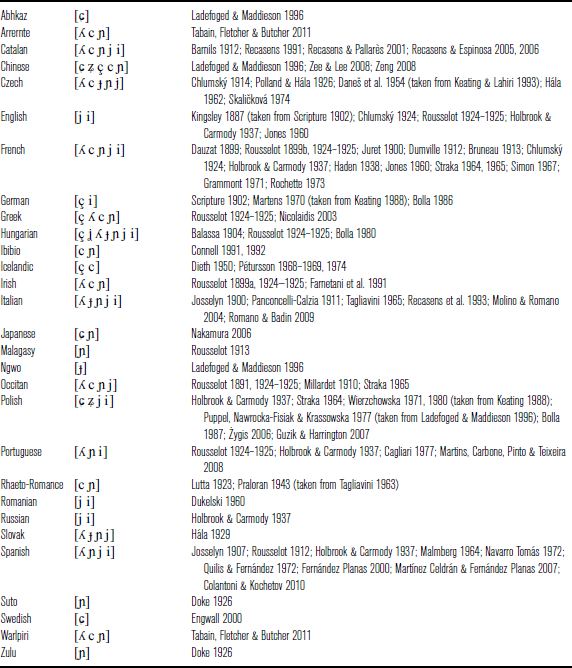
Table 1 presents the speech material under analysis classified by language together with the relevant literature sources where it has been taken from. Segment types are [ɕ ç ʎ c ɲ j i] and to a much lesser extent the voiced cognates [ʑ ʝ ɟ] of [ɕ ç c], respectively. Languages may be grouped into language families as follows: African (Ibibio, Ngwo, Suto, Zulu); Asian (Japanese, Caucasian (Abhkaz), Sino-Tibetan (Chinese)); Australian (Arrernte, Warlpiri); Austronesian (Malagasy); and European (Celtic (Irish), Germanic (English, German, Icelandic, Swedish), Greek, Romance (Catalan, French, Italian, Occitan, Portuguese, Rhaeto-Romance, Romanian, Spanish), Slavic (Czech, Polish, Russian, Slovak), Uralic (Hungarian)). The articulatory data may belong to the standard or most representative dialect or to several dialectal varieties of a given language. Languages where the phonetic material subjected to investigation belongs to more than one dialect are Catalan (Eastern, Majorcan), Chinese (Hakka, Mandarin, Xiangxiang), French (Parisian and several other dialects from France, Walloon), Greek (Eastern, Standard), Italian (Northern Italian dialects, Standard), Occitan (Lengadocian, Gascon) and Spanish (Castilian, Argentinian). The phonetic material for English belongs to the British and American varieties, that for Portuguese to the European variety from Portugal, and that for Rhaeto-Romance to Romansh and Ladin. Articulatory data have also been collected and will be described in Section 3.4 for the fricatives [ʃ ʒ] and the affricates [tʃ dʒ] in a few languages (Catalan, Czech, English, Hungarian, Slovak, Spanish) though these consonants are not listed in Table 1 since they do not qualify primarily as alveolopalatal.
(Alveolo)palatal consonants and vowels subjected to analysis organized according to language. The literature sources where the linguopalatal contact and sagittal vocal tract configuration data have been taken from are also included.

In the table and throughout the text, the consonant types are enclosed by brackets independently of whether they are phonemes or allophones (mostly, though not only, before a front vocalic segment) since the phonemic or allophonic status of a given consonant type in a given language is of no primary concern for the investigation. Whenever there was a choice of contextual realizations, data for consonants were analyzed if adjacent to a non-high front vowel, mostly [a], in order to avoid a potential increase in linguopalatal contact which may result from gestural overlap between an (alveolo)palatal consonant and [i]. This was the case for [ʎ], [ɲ] and [c] in languages where these consonants have phonological status, and for [c] in languages and dialects where the (alveolo)palatal oral stop may occur not only before a front vocalic segment but before [a] as well (e.g. Rhaeto-Romance, Majorcan Catalan). Linguopalatal contact patterns and sagittal vocal tract configurations for a given phonetic segment correspond usually to productions by different speakers, and the electropalatographic (EPG) displays may also belong to tongue contact averages across tokens for a given speaker. Linguagraphic data were gathered only for [ɕ] in Xiangxiang Chinese (Zeng Reference Zeng2008).
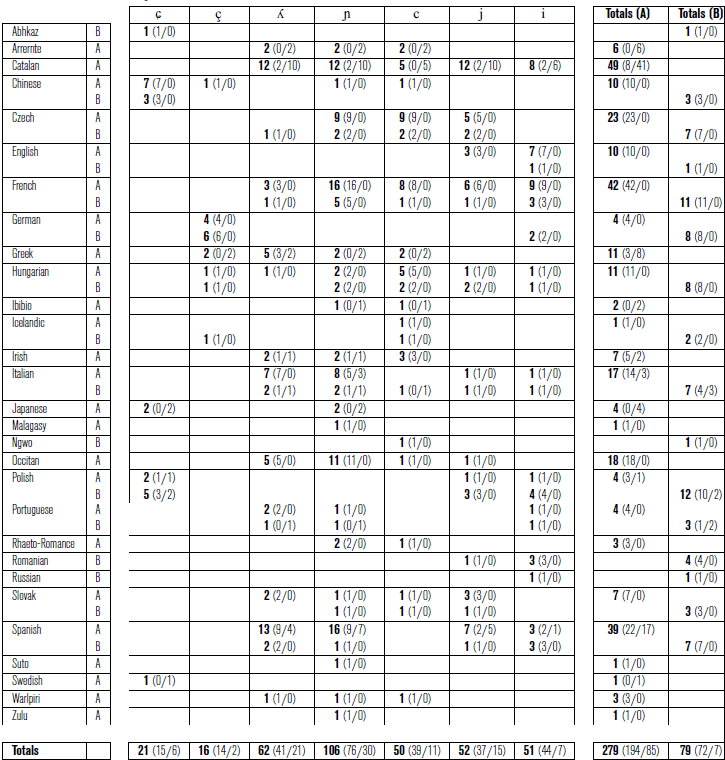
Table 2 presents the number of cases subjected to quantification for the same phonetic categories included in Table 1 classified according to language and data type, i.e. according to whether linguopalatal contact patterns were recorded by means of static palatography or electropalatography, and sagittal vocal tract configurations by means of X-ray or MRI. The table shows that there are about twice as many data samples for the nasal [ɲ] (106) than for the lateral [ʎ] (62), the stop [c] (50), the approximant [j] (52) and the vowel [i] (51), and a small number of samples for the fricatives [ɕ] and [ç] (21, 16). The number of cases also varies with language, i.e. it is largest for languages of the Romance and Slavic families (Catalan, 49; Czech, 30; French, 53; Hungarian, 19; Italian, 24; Occitan, 18; Polish, 16; Spanish, 46). Linguopalatal contact patterns amount to four times the number of sagittal vocal tract configurations (279 vs. 79). Moreover, the former were collected using static palatography (194) rather than electropalatography (85), and the latter with X-ray (72) rather than MRI (7).
Number of linguopalatal contact patterns (A) and sagittal vocal tract configurations (B) under analysis classified according to consonant/vowel and language. The two values appearing within parentheses in A correspond to contact patterns collected with static palatography (first value) and electropalatography (second value), while those in B correspond to vocal tract configurations obtained using X-ray (first value) and MRI (second value). The phonetic symbols for the fricative and oral stop consonants may refer to both the voiceless and voiced cognates.

2.2 Measurements
Two independent measures, i.e. contact percentages over the palate surface and place of articulation as determined by closure or constriction location, were derived from the palatographic contact patterns recorded by means of static palatography or electropalatography. Palatograms obtained using static palatography were divided into four equal areas over the length of the median line measured from the frontmost portion of the central incisors to about the rearmost portion of the second molars: the frontmost dividing line was located at 25% over the length of the median line (i.e. at about the mid alveolar zone and the lateral incisors or the canines), a second line at 50% (roughly at the postalveolar–prepalatal zone and the first premolar), a third at 75% (at about the prepalato–mediopalatal zone and the first molar) and a fourth one at 100% (at about the postpalate and the second molar). Contact percentages were computed over the total length of each of the four dividing lines. Linguagraphic data were processed in the same way as the linguopalatal contact data.
The electropalatographic data in all studies cited in this paper were recorded on artificial palates using the Reading EPG system (Hardcastle et al. Reference Hardcastle, Jones, Knight, Trudgeon and Calder1989). The artificial palates are endowed with eight equidistant rows of electrodes extending from the frontmost alveolar zone to the postpalate (the front teeth and the velar zone are not covered). Rows exhibit an even number of electrodes on the right and left sides of the median line: row 1 has six electrodes, three on each half; rows 2–8 have a total amount of eight electrodes, four on the right side and four on the left side. Contact percentages were computed over the total number of electrodes on rows 2, 4, 6 and 8, which were placed approximately at the same zones as the four dividing lines traced on the linguopalatal contact patterns recorded by means of static palatography. Since electrodes are either on or off, contact percentages for rows 2–8 amounted to 25%, 50%, 75% or 100% depending on whether the number of activated electrodes was 2, 4, 6 or 8. Whenever the calculation procedure was carried out on mean EPG contact configurations across tokens, only contact data for those electrodes which were activated at least 75–80% of the time were taken into consideration.
In order to determine the place of articulation for a given consonant realization, closure or constriction location was identified applying basically the same criteria used for the linguopalatal contact percentages. In view of the fact that the palatographic technique provides no direct information about linguodental contact, tongue contact not only at the alveolar zone but also at the central incisors, i.e. dentoalveolar contact, was taken to occur whenever the front edge of the alveolar zone (static palatography) or row 1 of electrodes (EPG) were completely occluded. Whenever dentoalveolar realizations need to be distinguished from purely alveolar ones, we will refer to the former as dental throughout the paper. The remaining articulatory zones were determined as indicated above, i.e. the alveolar zone at the 25% dividing line (static palatography) or at row 2 (EPG), the postalveolo–prepalatal zone at the 50% dividing line or at row 4, the prepalato–mediopalatal zone at the 75% line or at row 6, and the postpalate at the posterior palate edge or at row 8. Closure or constriction could extend over one or more zones simultaneously. Moreover, linguopalatal contact was considered to be continuous even if interrupted by small areas devoid of contact; thus, for example, a linguopalatal contact pattern showing full closure at the postalveolar and mediopalatal but not at the prepalatal zone was considered to correspond to an alveolopalatal articulation.
Information on consonant place of articulation was also derived from X-ray and magnetic resonance imaging (MRI) sagittal vocal tract configurations. In this case, closure or constriction location was taken to occur at the same five articulatory locations which were identified on the palatographic record (see Recasens Reference Recasens1990): dental, at the upper teeth; alveolar, between the teeth and the alveolar ridge; postalveolo-prepalatal, between the alveolar ridge and about the highest point of the palatal vault; prepalato-mediopalatal, at about the highest point of the palatal vault; postpalatal, between the palatal vault and the soft palate.
3 Results
3.1 The fricatives [ɕ] and [ç]
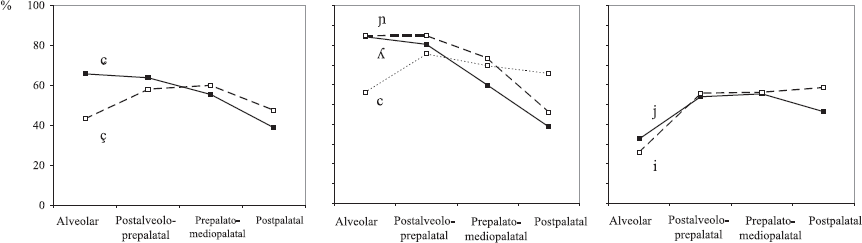
Figure 1 (left graph) provides linguopalatal contact percentages computed at the different articulatory zones for the fricatives [ɕ] and [ç]. Judging from these percentages it can be inferred that constriction location is more anterior for [ɕ] than for [ç], namely, it occurs mainly at the alveolar and postalveolo–prepalatal zones for [ɕ] and at the postalveolo–prepalatal and prepalato–mediopalatal zones for [ç]. As expected, palatal contact size measured at the prepalato–mediopalatal and postpalatal zone is greater for the more posterior fricative [ç] than for the more anterior one [ɕ].
Linguopalatal contact percentages at different articulatory zones for the fricatives [ɕ ç] (left), the lateral [ʎ] and the stops [c ɲ] (middle), and the approximant [j] and the vowel [i] (right), across languages.

Data for the individual languages reveal for the most part the presence of an alveolar constriction during the production of [ɕ] whether it extends into the prepalato–mediopalatal zone or not. This is the case for Chinese and for Japanese where the fricative may be plain alveolar or alveolopalatal (Ladefoged & Maddieson Reference Ladefoged and Maddieson1996, Nakamura Reference Nakamura, Warren and Watson2006, Zee & Lee Reference Zee, Lee, Sock, Fuchs and Laprie2008, Zeng Reference Zeng2008), and for Abhkaz and Polish where the alveolopalatal option prevails upon the alveolar one (Ladefoged & Maddieson Reference Ladefoged and Maddieson1996, Żygis Reference Żygis2006, Guzik & Harrington Reference Guzik and Harrington2007). [ɕ] in Swedish appears to be purely palatal and thus articulated behind the alveolar zone (Engwall Reference Engwall2000).
The fricative [ç] differs from [ɕ] in being mostly alveolopalatal (German, Hungarian, Icelandic; Martens Reference Martens, Hála, Romportl and Janota1970, Pétursson Reference Pétursson1974, Bolla Reference Bolla1986), though exclusively palatal realizations may also occur (Greek; Nicolaidis Reference Nicolaidis, Theophanopoulou, Laskaratou, Sifianou, Georgiafentis and Spyropoulos2003).
3.2 The lateral [ʎ], and the stops [c] and [ɲ]
3.2.1 Linguopalatal contact percentages
Palatographic contact percentages for the lateral [ʎ] and the stops [c] and [ɲ] in Figure 1 (middle graph) reflect the presence of differences in closure anteriority between [ʎ] (mostly alveolar), [ɲ] (alveolar, postalveolo-prepalatal) and [c] (postalveolo-prepalatal, palatal). Contact size at the palatal zone is greater for [c ɲ] than for [ʎ]. A trend may thus be observed for dorsopalatal contact size to vary inversely with place of articulation fronting such that the anteriormost lateral consonant ([ʎ]) exhibits less palatal contact than the more posterior two stop consonants ([c ɲ]).
Manner of articulation requirements appear to account for the differences in place anteriority and tongue dorsum contact size just mentioned. Thus, as noted in the Section 1 above, it makes sense to assume that a more anterior constriction location and less dorsopalatal contact for [ʎ] than for the two stops are related to the need for speakers to let airflow out the vocal tract through the sides of the oral cavity during the production of the lateral consonant. Moreover, more closure fronting for [ɲ] than for [c] could be associated with differences in intraoral air pressure between the two stops, i.e. a shorter back cavity for the oral stop as compared to the nasal stop could occur in order to ensure a greater intraoral pressure rise for the generation of a more prominent release. However, this possibility receives little support in the literature, reporting no clear correlation between cavity size and intraoral pressure level for other consonants (Subtelny, Worth & Sakuda Reference Subtelny, Worth and Sakuda1966, Fuchs & Koenig Reference Fuchs and Koenig2009).
3.2.2 Closure or constriction location
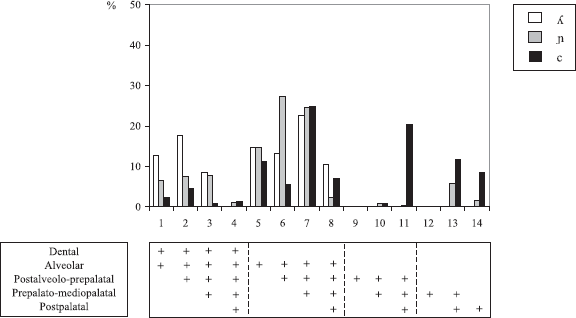
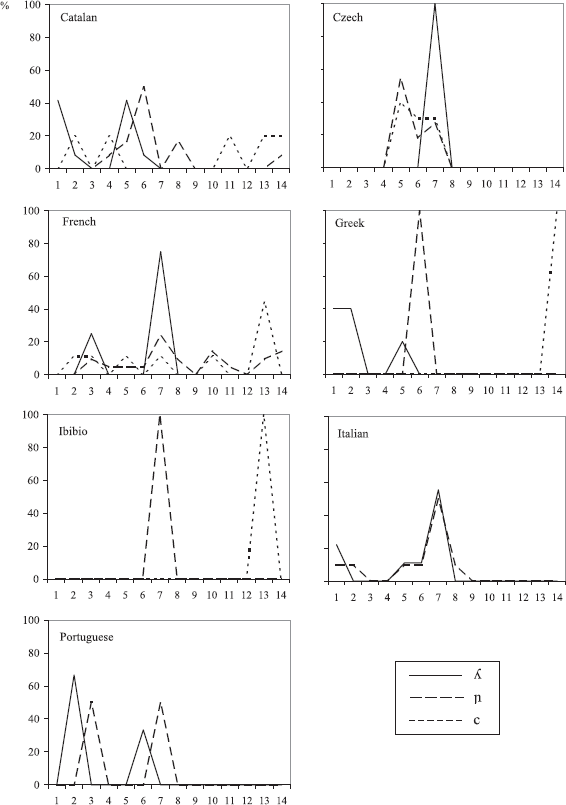
Figure 2 shows cross-language patterns in place of articulation for the lateral and the two stop consonants. The figure plots the percentages of occurrence for contact patterns exhibiting the following closure or constriction location characteristics indicated by the bundles of crosses displayed at the bottom of the graph: (1) dental + alveolar, (2) dental + alveolar + postalveolo-prepalatal, (3) dental + alveolar + postalveolo-prepalatal + prepalato-mediopalatal, (4) dental + alveolar + postalveolo-prepalatal + prepalato-mediopalatal + postpalatal, (5) alveolar, (6) alveolar + postalveolo-prepalatal, (7) alveolar + postalveolo-prepalatal + prepalato-mediopalatal, (8) alveolar + postalveolo-prepalatal + prepalato-mediopalatal + postpalatal, (9) postalveolo-prepalatal, (10) postalveolo-prepalatal + prepalato-mediopalatal, (11) postalveolo-prepalatal + prepalato-mediopalatal + postpalatal, (12) prepalato-mediopalatal, (13) prepalato-mediopalatal + postpalatal, (14) postpalatal.
Percentages of occurrence of linguopalatal contact patterns 1–14 for [ʎ], [ɲ] and [c] across languages.

As shown by the distribution of the bars in Figure 2, the palatal lateral (unfilled bars) may exhibit any of the contact patterns 1–8 (except for pattern 4) and, therefore, may show a dentoalveolar or alveolar closure with optional central contact occurring at more retracted articulatory areas. In sum, [ʎ] may be alveolar or alveolopalatal with possible dental contact. The languages under analysis may favor patterns involving both dental contact (1–3) or not (5–8), except for Czech and Hungarian, where [ʎ] is alveolopalatal only (patterns 7 and 8, respectively). No palatal place of articulation is ever available in the languages under investigation.
In comparison with the lateral, the nasal stop (grey bars) and the oral stop (black bars) may be produced with a more posterior place of articulation: for the two consonants, closure location occurs more often at the plain alveolar and alveolopalatal zones (patterns 5, 6, 7 and 8) than at the dentoalveolar and dento–alveolopalatal zones (patterns 1–4), and may take place exclusively at the palatal zone as well (patterns 10–14). Figure 2 also shows that closure location may be more anterior for [ɲ] than for [c], i.e. articulations involving dental contact occur for the nasal stop rather than for the oral stop (grey bars are higher than black bars in the case of patterns 1–3), while palatal realizations take place more frequently for the oral stop than for the nasal (black bars are higher than grey bars in the case of patterns 11, 13 and 14).
Languages may differ regarding the preferred place of articulation for the two stop consonants of interest (see data for a selected group of languages in Figure 3). The nasal stop [ɲ] may be just alveolopalatal (Greek, Hakka Chinese, Ibibio, Rhaeto-Romance, Zulu). Another common scenario occurs whenever the nasal stop shares the alveolopalatal closure location with a more anterior one occurring at the dentoalveolar zone (Italian, Occitan, Spanish), the alveolar zone (Czech, Hungarian, Italian, Occitan, Spanish) or the dento–alveolopalatal zone (Arrernte, Irish, Italian, Occitan, Portuguese, Spanish). Only in specific languages, namely Catalan and French, may a palatal place of articulation be found in addition to the alveolopalatal contact pattern and, less frequently, more anterior closure locations. Finally, according to our database, [ɲ] is exclusively dentoalveolar in Warlpiri, dentoalveolar or alveolar in Japanese, dento-alveolopalatal in Suto, alveolar in Slovak, and palatal in Malagasy.

On the other hand, [c] appears to be consistently alveolopalatal in a considerable number of languages (Hakka Chinese, Hungarian, Icelandic, Rhaeto-Romance) and palatal in some (Greek, Ibibio, Ngwo, Occitan). Other languages may show more than one contact pattern with an anterior closure location occurring exclusively or in addition to a purely palatal one: the first scenario takes place in Arrernte where [c] may be dento-alveolopalatal and alveolar, and in Czech where the stop may be alveolar and alveolopalatal; the second one is found in Catalan (dento-alveolopalatal, palatal), French (dento-alveolopalatal, alveolar, alveolopalatal, palatal), and Irish (alveolopalatal, palatal). Especially anterior stop realizations are found in Warlpiri (dentoalveolar) and Slovak (alveolar).
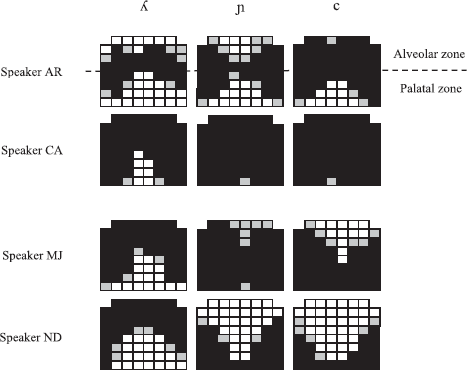
Several language-dependent trends arise from the data for [ʎ], [ɲ] and [c] just described regarding whether these consonants exhibit the same closure location or not. In parallel to the scenario for the contact percentages described in Section 3.2.1, there is a widespread trend for [ʎ] to be more anterior than [ɲ] and [c] if available (e.g. in Catalan, French, Greek, Portuguese and Slovak, as shown in Figure 3 for the first four of these languages), and for [c] to be more posterior than [ɲ] (e.g. in Greek, Ibibio, Irish and Occitan, as shown in Figure 3 for the first two of these languages). Differences in closure fronting for [ʎ] > [ɲ], [c] are also shown by the electropalatographic data for Majorcan Catalan appearing in the left and middle columns of Figure 4. In this figure, linguopalatal configurations have been averaged across seven tokens, and electrodes are represented in black, grey or white depending on whether electrode activation occurs 80–100% of the time, 40–80% or less than 40%, respectively. The figure shows that the lateral [ʎ] is alveolar for all speakers independently of whether the nasal stop [ɲ] is alveolopalatal or palatal. As noted in Section 1, the special status of [ʎ] may be attributed to requirements on the formation of one or two lateral passages placed at the back of the palatal zone (as for speakers AR, MJ and ND in Figure 4), or even further back (as for speaker CA).
EPG linguopalatal contact patterns for [ʎ], [ɲ] and [c] in utterance initial position before the vowel [a] according to the four Majorcan Catalan speakers AR, CA, MJ and ND. See text for details.

In other languages, manner requirements do not cause palatal consonants to exhibit different places of articulation. Thus, [ʎ] and [ɲ] (and also [c] if available) are essentially dentoalveolar in Warlpiri, alveolar and dento-alveolopalatal in Arrernte, and alveolopalatal in Czech and Hungarian, and exhibit alveolopalatal and more anterior contact patterns in Italian and Spanish (see data for Czech and Italian in Figure 3). Finally, the two stop consonants [ɲ] and [c] are alveolopalatal in Hakka Chinese and Rhaeto-Romance, and cover a wide range of places of articulation from dento-alveolopalatal to palatal in Catalan and French (see data for Catalan and French in Figure 3). The scenario for Majorcan Catalan is illustrated by the electropalatographic data appearing in the middle and right columns of Figure 4. The EPG data show that speakers AR and CA favor an alveolopalatal realization of [ɲ] and [c], the one for speaker CA exhibiting more central contact towards the back palate than that for speaker AR. Speakers MJ and ND, on the other hand, favor a palatal realization of the two consonants which differs in degree of anteriority as well, i.e. central contact occurs over almost the entire palatal zone for MJ and at the postpalate for ND. In sum, the linguopalatal contact patterns for [c] and [ɲ] are quite similar in the case of all four speakers, exhibiting an alveolopalatal or a palatal realization of both [ɲ] and [c]. As pointed out in Section 1, this situation for Majorcan Catalan and for the other languages referred to above leads us to propose that the two stops differing in manner of articulation may participate in a symmetrical relationship. The lateral may be more anterior but not necessarily.
3.3 The approximant [j] and the vowel [i]
Data on contact percentages for [j] and [i] plotted in Figure 1 above (right graph) indicate that both sounds exhibit maximum central contact at the postalveolo–prepalatal and prepalato–mediopalatal zones, and that the vowel may be articulated with more back palatal contact than the glide. In contrast with data for the fricatives, the lateral and the stops displayed in the right and middle graphs of the figure, both [j] and [i] exhibit almost no alveolar contact. Notice the similarity between the contact percentages for [j] and [ç].
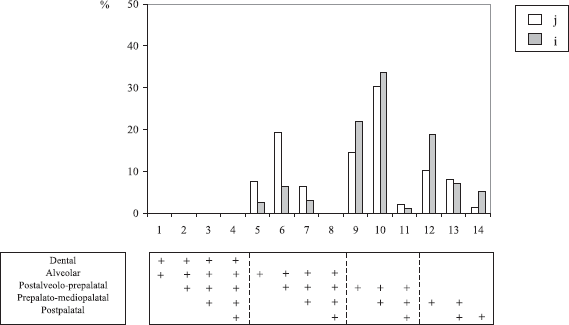
Cross-language linguopalatal contact patterns for [j] and [i] in Figure 5 reveal the presence of essentially the same constriction location for the two vocalic sounds mostly at the front palatal zone (patterns 9 and 10), but also at the alveolopalatal and alveolar zones (patterns 5–7) and at the mediopalate and postpalate (patterns 12–14). Moreover, there is a trend for the glide to favor a more anterior constriction than the vowel: an alveolar or alveolopalatal constriction occurs more often for the glide (the unfilled bars are higher than the filled bars at patterns 5–7), while a purely palatal constriction takes place somewhat more frequently for the vowel (the filled bars are higher than the unfilled bars at patterns 9, 10, 12 and 14).
Percentages of occurrence of linguopalatal contact patterns 1–14 for [j] and [i] across languages.

Languages may also differ as to whether they admit one or more constriction location(s). Thus, Catalan, Hungarian, Italian, Romanian, Russian and to a large extent Spanish appear to favor purely palatal realizations of both [j] and [i], while other languages may exhibit palatal and more anterior realizations of the two vocalic sounds, i.e. French and English (alveolar, alveolopalatal, palatal) and Polish (alveolopalatal, palatal). The approximant [j] also allows for alveolopalatal and palatal realizations in the Slavic languages Czech and Slovak. In fact, palatograms of [j] produced by 30 Czech speakers reported in Hála (Reference Hála1962: 422–423) show that the consonant may be articulated at the postalveolo–prepalatal zone (seven speakers), prepalate (seven speakers), prepalato–mediopalatal zone (five speakers) or mediopalate (11 speakers).
3.4 The fricatives [ʃ ʒ] and the affricates [tʃ dʒ]
As revealed by data for Czech, English and Slovak (Chlumský Reference Chlumský1924; Hála Reference Hála1929, Reference Hála1962), the fricatives [ʃ ʒ] and the affricates [tʃ dʒ] are realized fairly often at the back alveolar zone and show varying degrees of tongue dorsum raising and of lateral contact at the palatal zone. These articulatory characteristics are in agreement with the classification of [ʃ ʒ] as postalveolar in the IPA chart. Less often, the two affricates may be alveolopalatal and involve more or less dorsopalatal contact. Indeed, palatographic data gathered at the closing phase reveal that [tʃ] may exhibit an alveolar or alveolopalatal realization in Spanish (Josselyn Reference Josselyn1907), and an alveolopalatal realization with much dorsopalatal contact in Hungarian (Balassa Reference Balassa1904). Alveolopalatal productions of the affricate ought to be favored by the presence of fairly back alveolar realizations of the fricative in a given language or dialect, as it appears to be the case in Eastern Catalan (Recasens & Pallarès Reference Recasens and Pallarès2001).
4 Summary and discussion
Data reported in the previous section show that the so-called palatal consonants and vowels may be essentially alveolopalatal and/or palatal depending on the phonetic segment, the language and the speaker taken into consideration. The two place of articulation types have been found to hold for [ç], [c], [ɲ], [j] and [i], but not for [ɕ] and [ʎ] which cannot be articulated at the palatal zone exclusively. Moreover, there is another clear difference between [ʎ] and [ɕ] on the one hand, and [ç], [c], [ɲ], [j] and [i] on the other, in that purely alveolar realizations occur frequently for the two former phonetic segments and are relatively exceptional for the five latter ones. In addition, differences in manner of articulation account for why the production of [ʎ], [c] and [ɲ] but not that of [ç], [j] and [i] may involve dental contact and a central closure or constriction extending over more retracted articulatory zones. The palatoalveolar affricates [tʃ dʒ] may be articulated at the alveolopalatal zone.
It has also been shown that the consonants [ʎ], [c] and [ɲ] as well as the vocalic sounds [j] and [i] may differ in closure or constriction fronting in line with their manner of articulation characteristics, i.e. place of articulation may vary in the progression [ʎ] > [ɲ] > [c] and [j] > [i]. As for the three former consonants, these differences in place of articulation have been attributed to the need to allow airflow through the sides of the oral cavity for the lateral and to build up sufficient intraoral air pressure for the oral stop. As for the two vocalic sounds, differences in constriction location may be related to differences in spatiotemporal stability between the vowel and the glide, i.e. the tongue body may make contact with a more anterior articulatory zone during the gliding movement involved in the production of [j]. In addition to manner-dependent differences in place of articulation, a trend has been found for [ɲ] and [c] to show an anterior and/or posterior (essentially alveolopalatal and/or palatal) realization in several languages which could be attributed to a symmetry effect by which the two stops differing in manner of articulation share the same closure location. In other languages, this symmetry effect may also operate on [ʎ], [ɲ] and [c], or on [ʎ] and [ɲ], at one or more articulatory areas with the exclusion of the palatal zone.
Language groups may exhibit differences in closure or constriction location for (alveolo)palatal consonants. Overall, the data for [c] and [ɲ] indicate a preference for the alveolopalatal over the palatal place of articulation across languages which questions the notion that these consonants should be referred to as palatal rather than as alveolopalatal. A reason for this preference may be that speakers find it harder to form a stop closure at the hard palate with the dorsum of the tongue than at a more extensive area including the alveolar and palatal zones with a larger tongue region. Another trend reported in the present paper is a certain preference for palatal over alveolopalatal productions in specific African languages, and for alveolar realizations or articulations exhibiting dental contact over purely alveolopalatal productions in Australian languages. The validity of this trend should be taken with caution in view of the scarce amount of available data for these language groups. It could be that these language-dependent articulatory characteristics correspond to specific patterns of base of articulation and therefore apply to consonants at other places of articulation as well.
It has also been found that dialects where [c] is an allophone of /k/ (Parisian French, Majorcan Catalan) may exhibit both alveolopalatal and palatal realizations of [c] and [ɲ]. In addition to aerodynamically induced differences in fronting between the two consonants (see above), a possible reason why [c] may be articulated at the palatal zone in this case may be sought in its categorization as an allophone of /k/ by French and Catalan speakers. In support of this possibility, the palatal stop is realized invariably at the alveolopalatal and/or alveolar zone and thus exhibits a more anterior and less variable closure location in Slavic languages (Czech, Slovak) and in Hungarian where it has phonemic status and thus, cannot be associated with the velar stop phoneme. In sum, it could be that closure location and variability degree for [c] change depending on whether [c] is an allophone of /c/ (in languages where both phonemes /c/ and /k/ are present) or else an allophone of /k/ (in languages where only /k/ is available but /c/ is not). This hypothesis could have been investigated by carrying out an analyis of differences in place of articulation between other languages where [c] is an allophone of /k/ (Chinese, Greek, Ibibio, Occitan, Rhaeto-Romance) and languages where [c] is an allophone of /c/ (Arrernte, Icelandic, Irish, Ngwo, Warlpiri). We felt, however, that the number of samples of [c] in all these languages was too small to draw valid conclusions regarding this research topic. Possible language-dependent differences in closure or constriction location for [ʎ] and [ɲ] depending on phonemic status could not be looked into since the two consonants are phonemic in all languages under investigation, except for Greek [ʎ] and for Chinese, Greek and Japanese [ɲ] where the consonants in question are allophones and for which we had small data samples.
The issue as to whether variations in place of articulation for (alveolo)palatal consonants have acoustic consequences is raised next. Data reported below indicate that realizations of [c ɲ j] differing in fronting may also differ regarding several acoustic properties, i.e. vowel formant transition endpoints for all consonants and burst spectrum for [c].
Cross-speaker vowel transition endpoint frequency data for [c] adjacent to the vowels [i a] in Majorcan Catalan reveal that fronting closure location from the postpalate to the prepalato–mediopalatal zone causes F2 to increase from about 1650–2400 Hz to 2150–2510 Hz, while additional closure fronting towards the prepalate and the alveolar zone causes F2 to lower from 2150–2500 Hz down to 1600–2200 Hz (Recasens & Espinosa Reference Recasens and Espinosa2009). These data are to a large extent in agreement with Fant's nomograms for vocalic articulations produced with a small cross-sectional tongue constriction area (Fant Reference Fant1960), and differ in part from more recent studies reporting no F2 frequency lowering as the lingual constriction is fronted along the alveolopalatal zone (Ladefoged & Bladon Reference Ladefoged and Bladon1982, Badin et al. Reference Badin, Perrier, Boë and Abry1990). Regarding the burst spectral characteristics, data for [c] in Majorcan Catalan produced in the same conditions as above reveal that the front-cavity dependent burst spectral peak rises from about 2600 Hz to about 2800–3500 Hz as closure location moves forward from the postpalate to the prepalate, and remains at about this frequency as it reaches the alveolar zone (Recasens & Espinosa Reference Recasens and Espinosa2009). These burst spectral peak frequency values are similar to those reported for other languages (about 3000–4000 Hz according to Keating & Lahiri Reference Keating and Lahiri1993).
Based on our own auditory impressions, variations in formant frequency and the burst spectra associated with closure fronting for [c] do not have significant perceptual consequences, i.e. it is hard to distinguish among different realizations of the (alveolo)palatal oral stop based on degree of closure anteriority and palatal contact size. Changes along other articulatory dimensions affect the acoustic output more dramatically. Thus, an affricate may be heard whenever enough frication is generated through the lingual constriction at the (alveolo)palatal stop release, as exemplified by the evolution of the front allophone of /k/ in Latin to [tʃ] in Italian (e.g. Latin [ˈcɛnto] /kɛnto/ > Italian [ˈtʃɛnto]). There may be several affricate outcomes varying from palatal ([tç]) to alveolopalatal ([tʃ]) to alveolar ([ts]) as the (alveolo)palatal stop closure becomes more anterior and the corresponding burst spectral peak frequency becomes higher (Scripture Reference Scripture1902). Among languages where both the (alveolo)palatal stop and its affricate outcomes are available, it is worth mentioning Rhaeto-Romance where [c] has given rise to all three affricates (Recasens & Espinosa Reference Recasens and Espinosa2009), and Greek where the outcomes in question are [tç] in Cretan and [tʃ] in Cypriot (Trudgill Reference Trudgill2003).
5 A proposal
Results reported in this paper suggest the need for adding an ‘alveolopalatal’ place of articulation class to the IPA chart. The consonants [ç ʎ c ɲ j] are primarily or highly frequently alveolopalatal in the world's languages subjected to analysis in this paper and thus, may involve the formation of a closure or constriction at the alveolar and palatal zones with the tongue blade and the tongue dorsum. Among those consonants, [ç c ɲ j], but not [ʎ], may exhibit purely palatal realizations occurring at the hard palate. The fricative [ɕ] (also the affricate [tʃ]) is realized more often with a postalveolar articulation than with an alveolopalatal one.
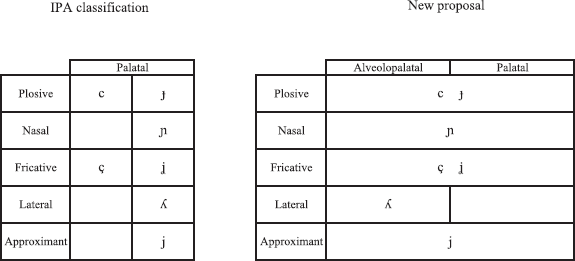
In order to capture this scenario, a new classification of palatal consonants is proposed in Figure 6 (right panel) which differs from the present IPA classification (Figure 6, left panel) in that the single palatal class is split into two classes, an alveolopalatal and a palatal one. Diacritics may be used for the transcription of especially anterior or especially posterior realizations of [ç ʎ c ɲ j], e.g. the diacritic ‘advanced’ may be appended to dentoalveolar realizations of [c] (such as those of Warlpiri) and the diacritic ‘retracted’ to postpalatal realizations of the same consonant (such as those occurring in Greek in Figure 3 above). There is still need for placing [ɕ ʑ] in the ‘Other Symbols’ section of the IPA based on the fact that, while [ç ʝ] may be alveolopalatal and palatal, [ɕ ʑ] are typically postalveolar.
Classification of the consonants [ç/ʝ], [ʎ], [c/ɟ], [ɲ] and [j] according to the IPA and a new proposal.

Two additional remarks need to be made. The new proposal involves modifying the phonetic classification of a set of linguistic sounds without introducing any new phonetic symbols with respect to those already available in the IPA chart. There is no motivation for adding new phonetic symbols for the transcription of (alveolo)palatal consonants since no language appears to make a phonemic distinction between palatals and alveolopalatals. It could certainly be claimed that there is no need for splitting the ‘palatal’ consonant class into two ‘alveolopalatal’ and ‘palatal’ categories: instead, the label ‘palatal’ could be used for referring to [ç ʎ c ɲ j] (as in the present version of the IPA chart) and the diacritic ‘advanced’ for the transcription of the alveolopalatal cognates. In our view, the problem with this option is that, for most of these consonants, alveolopalatal productions occur far more often than purely palatal ones in the world's languages making it inappropriate state that the consonants in question should be labeled ‘palatal’ because they are typically articulated at the hard palate. In so far as the IPA chart embodies a classificatory system for consonants and vowels, the articulatory labels for these sound types ought to reflect phonetic reality as close as possible. Moreover, the new proposal allows us to transcribe with diacritics a large number of articulatory distinctions, i.e. especially anterior alveolopalatal realizations and especially posterior palatal ones, which would not be differentiated from plain alveolopalatal and palatal productions if a single place of articulation class was available in the IPA chart.
Acknowledgements
This research was supported by projects FFI2009-09339 from the Ministry of Innovation and Science of the Spanish Government and 2009SGR3 from the Catalan Government. We would like to thank three anonymous reviewers and Adrian Simpson for comments. A preliminary version of this paper was published in Recasens (Reference Recasens, Lee and Zee2011).
 h,