Introduction
Convolvulaceae is the only family in the evolutionarily advanced asterid clade (APG, 1998, 2003) that produces seeds with physical dormancy [PY, dormancy caused by a water-impermeable seed (or fruit) coat] (Baskin et al., Reference Baskin, Baskin and Li2000). With the exception of Convolvulaceae (asterid) and Cannaceae (monocot), the other 15 families in which PY is known to occur are in the rosids. Thus, the evolutionarily advanced and isolated position of Convolvulaceae means that it is an important family to study to make inferences about the evolution of PY in angiosperms. Further, there have been no previous studies on the phylogenetic relationships of seed germination and dormancy characteristics within Convolvulaceae, or within any other plant family.
Convolvulaceae is a family with nearly cosmopolitan distribution, and it contains about 1600 species belonging to 55 genera (Mabberley, Reference Mabberley1997). This family is recognized by all recent major classification systems (Cronquist, Reference Cronquist1968, Reference Cronquist1988; Takhtajan, Reference Takhtajan1980, Reference Takhtajan1997; Dahlgren, Reference Dahlgren1991; Thorne, Reference Thorne1992, Reference Thorne2000, Reference Thorne2007; APG, 1998, 2003) with some differences in its placement in phylogeny. In some classification systems, Cuscuta (Takhtajan, Reference Takhtajan1980, Reference Takhtajan1997; Dahlgren, Reference Dahlgren1991) and Humbertia (Pichon, Reference Pichon1947) were placed in their own monogeneric families. In most systems, Convolvulaceae is included in the order Solanales (Hutchinson, Reference Hutchinson1926; Cronquist, Reference Cronquist1988; Thorne, Reference Thorne1992, Reference Thorne2000, Reference Thorne2007; APG, 1998, 2003), whereas in others it is placed in Polemoniales (Bentham and Hooker, Reference Bentham and Hooker1876; Bessey, Reference Bessey1915; Cronquist, Reference Cronquist1968), Gentianales (Goldberg, Reference Goldberg1986) or in its own order, Convolvulales (Takhtajan, Reference Takhtajan1980, Reference Takhtajan1997).
Although earlier workers further classified the family into subfamilies and tribes (de Jussieu, Reference de Jussieu1789; de Candolle, Reference de Candolle1845; Bentham and Hooker, Reference Bentham and Hooker1876), only a few characteristics were used in these classifications. Therefore, these systems do not reflect phylogenetic relationships within the family (Stefanovic et al., Reference Stefanovic, Krueger and Olmstead2002). However, Austin (Reference Austin1973, Reference Austin, Mathiews and Sivadasan1998) proposed phylogenetic relationships of genera in Convolvulaceae using morphological, anatomical and physiological characteristics, and subdivided the family into ten tribes: Convolvuleae, Merremieae, Argyreieae, Ipomoeeae, Poraneae, Erycibeae, Hildebrandtieae, Cresseae, Dichondreae and Cuscuteae. Austin (Reference Austin1973) considered Cuscuta to be in its own family, Cuscutaceae, whereas in 1998 he included Cuscuta in tribe Cuscuteae, one of the most primitive tribes in Convolvulaceae (Austin, Reference Austin, Mathiews and Sivadasan1998). Stefanovic et al. (Reference Stefanovic, Krueger and Olmstead2002) subdivided the family into two subfamilies: Convolvuloideae and Humbertoideae. Humbertia madagascariensis was included in Humbertoideae and all other species in Convolvuloideae. Stefanovic et al. (Reference Stefanovic, Krueger and Olmstead2002, Reference Stefanovic, Austin and Olmstead2003) proposed phylogenetic relationships in Convolvulaceae using molecular data. They identified 12 tribes: Ipomoeeae, Merremieae, Convolvuleae, Aniseieae, Cuscuteae, Jacquemontieae, Maripeae, Cresseae, Dichondreae, Erycibeae, Cardiochlamyeae and Humbertieae; and Erycibeae, Cardiochlamyeae and Humbertieae were considered to be the basal tribes in the family. However, evolutionary relationships between genera in Convolvulaceae still are not fully understood, and therefore phylogeny of the family remains hypothetical.
For the most part, seed germination studies in Convolvulaceae have been confined to economically important species, e.g. ornamental species of Ipomoea (Hardcastle, Reference Hardcastle1978; Horak and Wax, Reference Horak and Wax1991; Ogunwenmo, Reference Ogunwenmo2006) and Merremia (Azania et al., Reference Azania, Azania, Pavani and Cunha2003) and the weedy species Ipomoea spp. (Misra, Reference Misra1963; Chandler et al., Reference Chandler, Munson and Vaughan1977; Norsworthy and Oliveira, Reference Norsworthy and Oliveira2007), Convolvulus arvensis (Brown and Porter, Reference Brown and Porter1942; Weaver and Riley, Reference Weaver and Riley1982; Tamak et al., Reference Tamak, Narwal, Singh and Ram1994), Calystegia soldanella (Kondo et al., Reference Kondo, Takahashi and Shimomura2000; Ko et al., Reference Ko, Park, Min and Cha2004), Evolvulus alsinoides (Saharan et al., Reference Saharan, Kasera and Chawan2001) and Cuscuta campestris (Hutchison and Ashton, Reference Hutchison and Ashton1980; Benvenuti et al., Reference Benvenuti, Dinelli, Bonetti and Catizone2005). In their review of the biology and control of weedy Ipomoea spp., Elmore et al. (Reference Elmore, Hurst and Austin1990) suggested that seeds of morningglory species are dormant due to a water-impermeable seed coat, and they reported that most of them require high temperatures to germinate.
The studies cited above suggest that seeds of Convolvulaceae species have PY. However, in most of them water absorption of dormant and of non-dormant seeds was not determined. In some studies, seeds of Convolvulaceae species were assumed to have PY, and thus scarified seeds only were used to study germination requirements (e.g. Crowley and Buchanan, Reference Crowley and Buchanan1980; Thulen and Keeley, Reference Thulen and Keeley1983). However, Cuscuta pedicellata (Lyshede, Reference Lyshede1984, Reference Lyshede1992) and Erycibe griffithii (Ng, Reference Ng1991) were reported to be non-dormant, but neither imbibition nor clear germination data were available on either of them. Maripa panamensis seeds were also reported to be non-dormant and recalcitrant (Daws et al., Reference Daws, Garwood and Pritchard2005). Therefore, PY in most Convolvulaceae species has not been documented clearly.
Gaertner (Reference Gaertner1950) reported that seeds of Cuscuta epilinum and C. epithymum did not germinate after scarification with concentrated H2SO4, which facilitated germination of seeds of 14 other Cuscuta species that he studied. Meulebrouck et al. (Reference Meulebrouck, Ameloot, Van Assche, Verheyen, Hermy and Baskin2008) clearly showed that seeds of C. epithymum require cold stratification following breaking of PY to facilitate germination. Therefore, they showed that C. epithymum has combinational dormancy [physical dormancy (PY)+physiological dormancy (PD), i.e. (PY+PD)]. Gaertner (Reference Gaertner1956) reported that seeds of C. europaea from which the seed coat had been removed did not germinate until after they were cold stratified at − 8 to 5°C. This suggests that C. europaea also has combinational dormancy (PY+PD). Tingey and Allred (Reference Tingey and Allred1961) found that manual or acid scarification of C. approximata seeds did not facilitate germination. However, seeds germinated >90% after 2 weeks of cold stratification at 5°C. Therefore, they suggested that seeds of C. approximata have combinational dormancy. We found no available germination data in the literature on any representative species of tribes Aniseieae, Dichondreae, Cardiochlamyeae or Humbertieae.
Thus, according to these studies, seeds of species in Convolvulaceae are non-dormant recalcitrant, e.g. M. panamensis (Daws et al., Reference Daws, Garwood and Pritchard2005); non-dormant orthodox, e.g. C. pedicellata (Lyshede, Reference Lyshede1984, Reference Lyshede1992); physically dormant orthodox, e.g. Ipomoea turbinata [ = I. muricata (Staples et al., Reference Staples, Wiersema, Chambers and Austin2005)] (Chandler et al. 1977); and combinationally dormant orthodox, e.g. C. approximata (Tingey and Allred, Reference Tingey and Allred1961). However, no study has been carried out to determine the phylogenetic relationships among these kinds of seed dormancy (or non-dormancy) in Convolvulaceae or in any other family.
Sensitivity cycling to physical dormancy breaking treatments has been reported for species of Fabaceae [Trifolium subterraneum (Taylor, Reference Taylor1981, Reference Taylor2005), Ornithopus compressus (Taylor and Revell, Reference Taylor and Revell1999) and several other Papilionoid legume species (Van Assche et al., Reference Van Assche, Debucquoy and Rommens2003)] and Convolvulaceae [Ipomoea lacunosa (Jayasuriya et al., Reference Jayasuriya, Baskin and Baskin2008a), I. hederacea (Jayasuriya, 2008) and Cuscuta australis (Jayasuriya et al., Reference Jayasuriya, Baskin, Geneve, Baskin and Chien2008b)]. However, tribes Ipomoeeae and Cuscuteae are not closely related to each other. Ipomoeeae is the most advanced tribe, and Cuscuteae is derived from basal tribes of the family (Stefanovic et al., Reference Stefanovic, Austin and Olmstead2003). Therefore, sensitivity cycling may be a common phenomenon of seeds with PY in Convolvulaceae, and perhaps in other angiosperm families with this kind of seed dormancy. However, lack of experiments to determine natural dormancy breaking requirements of most seeds with PY, and lack of germination data for temperatures simulating those in nature that break dormancy, render it impossible to make general inferences about sensitivity cycling of seeds with PY.
Our research on seeds of Convolvulaceae species had six main objectives: (1) to gather available data on seed dormancy from the literature; (2) to verify (or not) physical dormancy using imbibition and germination tests; (3) to define levels of seed desiccation tolerance; (4) to determine germination requirements; (5) to identify the natural dormancy breaking requirements and test for sensitivity cycling; and (6) to analyse the phylogenetic pattern of kinds of seed dormancy (or non-dormancy) and of desiccation tolerance/intolerance.
Materials and methods
Seed collection
Seeds were collected from at least one species of 11 of the 12 tribes (Stefanovic et al., Reference Stefanovic, Austin and Olmstead2003); seeds of Humbertia madagascariensis (Humbertieae) could not be obtained for study. Seeds were collected in the USA (Florida, Kentucky, Tennessee, Hawaii), Panama, Taiwan and Sri Lanka. Seeds of eight species were furnished by the Millennium Seed Bank, Royal Botanic Gardens Kew, UK. Seeds were mailed to the University of Kentucky, Lexington, Kentucky, USA, except for those from Sri Lanka, which were studied (beginning 1 week after collection) at the University of Peradeniya, Peradeniya, Sri Lanka. Experiments were started within 1 week after seeds arrived at the University of Kentucky, or 1 week after the seeds of locally available species were collected by the authors.
Moisture content
Moisture contents of seeds of 23 species were determined by the oven-dry method. Initial seed mass was determined to the nearest 0.0001 g using a digital balance. These samples were then dried to constant mass in an oven at 110°C and reweighed. Three to five replicates of at least ten seeds each were used for measurement of moisture content of seeds of 21 species. Ten individual seeds each were used to measure the moisture content of seeds of Maripa panamensis and of Erycibe henryi.
Imbibition
Two samples containing at least 12 replicates (individual seeds or five seeds per replicate for Cuscuta species and for Dichondra micrantha) of untreated (intact) and manually scarified (individually with a scalpel) seeds were weighed to the nearest 0.0001 g using a digital balance. They were placed on moist filter paper in Petri dishes of diameter 50 mm. Seeds were retrieved from Petri dishes at 1–3 h intervals (depending on water absorption rate), surface blotted with filter paper, reweighed and returned to the dishes. The experiment was continued until all manually scarified seeds were fully imbibed. For M. panamensis and E. henryi, only non-treated (intact) seeds were used for imbibition experiments.
Germination
Germination tests were performed for Ipomoea lacunosa, I. hederacea, I. triloba, I. indica, I. microdactyla, Merremia dissecta, M. similis, M. tuberosa, Calystegia sepium, Jacquemontia ovalifolia, Evolvulus nuttallianus, Bonamia menziesii (non-treated only), Dichondra micrantha, Maripa panamensis (non-treated, tested at 30/15°C only), Cuscuta australis, C. gronovii, C. rostrata and Erycibe henryi (non-treated, tested at 30/15°C only). Three or four replicates of 15 or 25 seeds each were used in germination tests for most species, but only three replicates of ten seeds were used in germination tests of M. panamensis, E. henryi, I. microdactyla and B. menziesii. Samples of non-treated (intact) and manually scarified (individually with a scalpel) seeds of most species were incubated at 35/20, 30/15, 25/15, 20/10 and 15/6°C (12 h/12 h), or only at 35/20°C, in light/dark (14 h/10 h) and in dark for at least 30 d. Light was provided by cool white fluorescent tubes (approximately 40 μmol m− 2 s− 1, 400–700 nm) and darkness by wrapping with aluminium foil. However, seeds of some species (I. lacunosa, I. hederacea I. microdactyla, M. similis, M. tuberosa, C. sepium and J. ovalifolia) were incubated at temperature regimes (explained above) for 1 year. Germination of seeds of species collected in Sri Lanka (Hewitta sublobata, Ipomoea macrantha, I. rugosa, I. obscura, Merremia tridentata, M. umbellata, Operculina turpethum and Aniseia martinicensis) was tested at ambient room conditions [c. 25°C, >90% relative humidity (RH)]. Germinated seeds were counted at 2-d intervals for 14 d and then at 7-d intervals for an additional 14 d. Radicle emergence was the criterion for germination throughout the study.
Effect of drying on germination
Samples of four replicates of at least ten seeds each of E. henryi and M. panamensis, the only two species in the study with a high initial seed moisture content, were air-dried at 30/15°C to different moisture levels [15%, 25% (the only moisture contents tested for M. panamensis), 30% and 35%]. These air-dried seeds were incubated at 30/15°C in light/dark. Germinated seeds were counted at 7-d intervals until all seeds either germinated or rotted. Two samples of four replicates of ten seeds of E. henryi were incubated on wet sand or in a bare, sealed Petri dish at 100% RH (maintained using a vial with distilled water inside the sealed Petri dish), and four replicates of ten seeds of M. panamensis were incubated on wet sand at 30/15°C in light/dark as control treatment.
Effect of cold storage on germination
Six samples of three replicates of five seeds each of E. henryi and of M. panamensis were stored dry at 5/1°C for 2 or 8 weeks and at − 25°C for 8 weeks. After storage, seeds were incubated on moist sand in Petri dishes at 30/15°C in light/dark. Germinated seeds were counted at 7-d intervals until all of them either germinated or rotted.
Effect of storage on dormancy break
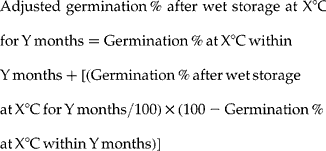
Samples of seeds of J. ovalifolia were stored wet or dry at 35/20, 15/6, 5/1°C and ambient laboratory temperature (22–24°C) for 2, 4 and 6 months; seeds of I. indica were stored wet or dry at 35/20°C and at ambient laboratory temperature for 1, 2 and 5 months; and those of I. triloba and M. similis were stored wet or dry at ambient laboratory temperature (only) for 1, 2, 3 and 6 months. Seeds were incubated on moist sand in Petri dishes at 35/20°C in light/dark. Germinated seeds were counted at 5-d intervals for 30 d. Data from wet storage treatments were adjusted for germination of non-treated seeds at corresponding temperatures. Adjusted germination data were used since some of the seeds germinated in the wet storage.
Artificial dormancy-breaking treatments
The following treatments were performed to break dormancy of physically dormant seeds: dipping in boiling water for 1, 2, 3, 4, 5, 6, 7, 8, 10, 15, 30 and 60 s; drying at 90°C for 5, 10, 15, 20 and 30 min; and alternately dipping in boiling water and ice water (10 s/10 s) 5, 10 or 20 times. After treatment, seeds were incubated at 35/20°C in light/dark.
Germination requirements after storage treatments
Samples of non-dormant seeds (made non-dormant by artificial treatment or by simulating natural conditions) were incubated at 35/20, 30/15, 25/15, 20/10 and 15/6°C regimes in light/dark and dark. Seeds were monitored for germination and imbibition at 5-d intervals for 30 d. Germination in dark treatments was checked only after 14 d, at the end of the incubation period.
Effect of wet and dry incubation at 35/20°C on germination at 25/15°C
Wet and dry preincubation treatments were done only for J. ovalifolia that did not germinate at lower temperature regimes ( < 35°C) after the storage treatment. Four samples of three replicates containing 15 preconditioned seeds (stored dry at 15/6°C for 4 months) were incubated on dry sand in Petri dishes (50–55% RH) or at 100% RH in closed containers at 35/20°C for 1 or 2 weeks. Pretreated seeds were transferred to Petri dishes containing moist sand and incubated at 25/15°C. Germinated seeds were counted at 5-d intervals for 30 d.
Analysis of data
A completely randomized design was used in all experiments. Arcsine-transformed germination data were analysed using one-way analysis of variance (ANOVA) or General Linear Model (GLM) procedures with SAS statistical software (SAS Institute Inc., Cary, North Carolina, USA). Duncan's and Dunnet's mean separation procedures were used to compare treatments.
Results
Studies on seed germination of 62 Convolvulaceae species were found in the literature. However, water absorption of non-treated (intact) and scarified seeds was recorded for only a few of the species. Only three species (C. pedicellata, E. griffithii and M. panamensis) were recorded as non-dormant, and another four species (C. europaea, C. epithymum, C. epilinum and C. approximata) were recorded as producing seeds with combinational dormancy. Based upon the literature, it would appear that seeds of all the other 55 species have PY.
Moisture content
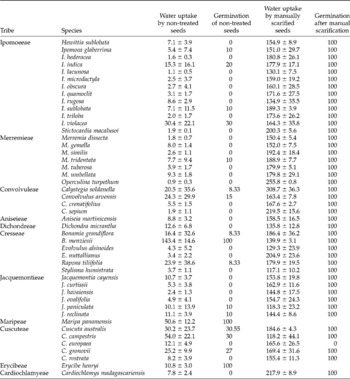
Seeds of most species had moisture contents < 13% (wet mass basis). Moisture content was about 45 ± 4% (wet mass basis) for seeds of M. panamensis and 58 ± 1% for those of E. henryi.
Imbibition of seeds
All manually scarified seeds increased in mass >110%, and all of them germinated to 100% except C. europaea, which did not germinate even after 30 d (Table 1). Non-treated seeds imbibed significantly less water than manually scarified ones, except those of B. menziesii, in which mass increased >140% and those of M. panamensis in which mass increased >50%. Although seeds of E. henryi increased in mass by only about 11%, the seed moisture content of imbibed seeds was >70%. One-hundred per cent of the non-treated seeds of B. menziesii, M. panamensis and E. henryi germinated within 5 d. Less than 35% of the non-treated seeds of the other species germinated.
Water uptake (% initial mass basis) and germination (%) of treated and untreated seeds of 46 species in 11 tribes of Convolvulaceae

Germination
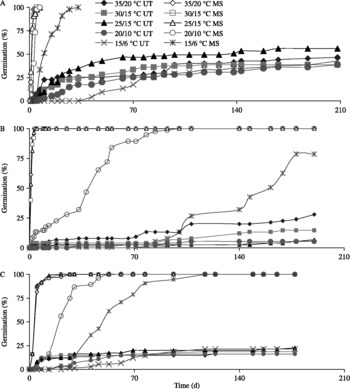
Non-treated seeds germinated < 30% at all temperatures in light/dark within 30 d, except those of I. lacunosa. Seeds of different collections of I. lacunosa germinated >30% at 35/20 and 30/15°C (data not shown). Manually scarified seeds of most of the species germinated to about 100% in all temperature regimes (e.g. C. sepium, Fig. 1A). However, at 15/6°C, I. hederacea (Fig. 1B) and Cuscuta gronovii (Fig. 1C) germinated < 10% within 30 d. I. lacunosa and D. micrantha germinated to 50% and 75%, respectively (data not shown). Seeds of C. gronovii (Fig. 1C), I. lacunosa and D. micrantha reached 100% germination after 4, 5.5 and 2 months, respectively. Manually scarified seeds of I. hederacea had germinated to 80% after 6 months (Fig. 1B). They germinated to about 30% (Fig. 1B) at 20/10°C and had reached 100% germination at this temperature regime after 3.5 months (Fig. 1B).
Germination of untreated (intact) and manually scarified seeds of (A) Calystegia sepium; (B) Ipomoea hederacea; and (C) Cuscuta gronovii at different temperature regimes in light/dark. MS, manually scarified; UT, non-treated.

Germination of manually scarified and non-treated seeds in the dark did not differ significantly from that of light/dark (14 d) incubation for most species (e.g. C. sepium, P = 0.471). However, seeds with low germination percentages at 15/6 and 20/10°C had significantly higher germination percentages in the dark at those temperatures within 2 weeks (e.g. I. hederacea and C. gronovii, P < 0.001 for both species).
Effect of drying on germination
Non-treated seeds of E. henryi germinated to 100% on wet sand and in bare Petri dishes at 100% RH. However, germination was reduced by drying the seeds. Seeds germinated to 66 and 16% when they were dried to 35 and 25% moisture content, respectively. None of the seeds that were dried to 15% seed moisture content germinated.
Non-treated seeds of M. panamensis germinated to about 95% on wet sand at 30/15°C. Seed germinability was reduced by drying, and when seeds were dried to 15% moisture content none of them germinated.
Effect of cold storage on germination
Seeds of E. henryi stored at 5/1°C for 2 weeks or for 1 month germinated >95% at 30/15°C, whereas those of M. panamensis stored at 5/1°C for 1 month germinated to only 6%. However, no seeds of either species germinated at 30/15°C after storage at − 25°C for 1 month.
Effect of storage on dormancy break
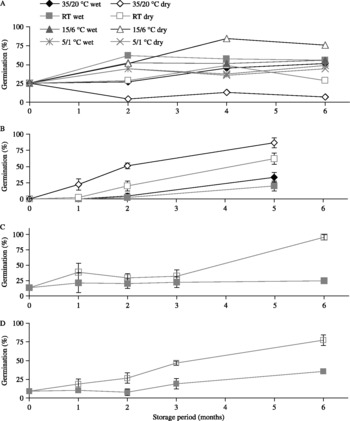
Non-treated seeds of J. ovalifolia germinated to 25%. Storage of seeds seemed to improve germination at 35/20°C, except for those stored dry at 35/20°C. One month of dry storage at 35/20°C reduced germination to < 5%, and longer periods of storage at this temperature did not significantly change germination percentage (Fig. 2A). After 1 month, there were no significant differences between wet storage at 35/20°C, wet storage at ambient laboratory temperatures, wet storage at 15/6°C, wet storage at 5/1°C, dry storage at ambient laboratory temperature and dry storage at 5/1°C. Germination after storage was around 50% for all conditions. Four months' dry storage at 15/6°C increased germination significantly to 85%. However, 6 months of dry storage at 15/6°C reduced germination to 75% (Fig. 2A).
Adjusted values for germination of (A) Jacquemontia ovalifolia; (B) Ipomoea indica; (C) Ipomoea triloba; and (D) Merremia similis seeds at 35/20°C after different storage treatments. RT, ambient laboratory temperature. Bars are ± 1 SE.

No untreated seeds of I. indica germinated at 35/20°C (Fig. 2B). After 1 month of dry storage at 35/20°C, germinability of seeds increased to 24%, and it gradually increased after further storage at 35/20°C. After 5 months' dry storage at 35/20°C, seeds germinated to 86% (Fig. 2B). Dry storage at ambient laboratory temperatures also increased germinability, but at a slower rate. Wet storage did not improve germination significantly. However, after 5 months of wet storage at 35/20°C and at ambient laboratory temperature, germinability of seeds increased 33% and 20%, respectively.
Untreated seeds of I. triloba germinated to 13% at 35/20°C. Dry storage at ambient laboratory temperatures gradually increased germinability (Fig. 2C). After 6 months of dry storage at ambient laboratory temperature, seeds germinated to 95% at 35/20°C. Non-treated seeds of M. similis germinated to 9% (Fig. 2D). With either dry or wet storage at ambient laboratory temperature, germinability of seeds increased. However, for seeds stored dry, germination increased significantly compared to those stored wet. After 6 months of dry storage, M. similis seeds germinated to 77% at 35/20°C.
Artificial dormancy-breaking treatments
Dipping seeds in boiling water for 4, 6, 10, 10, 10, 12, 15 and 15 s broke dormancy of I. lacunosa, M. dissecta, C. arvensis, J. ovalifolia, C. australis, Cardiochlamys madagascariensis, A. martinicensis and C. sepium, respectively. However, alternately dipping in boiling water and ice water (10 s/10 s) ten times broke dormancy only in seeds of C. soldanella, E. nuttallianus and D. micrantha.
Germination requirements after storage treatments
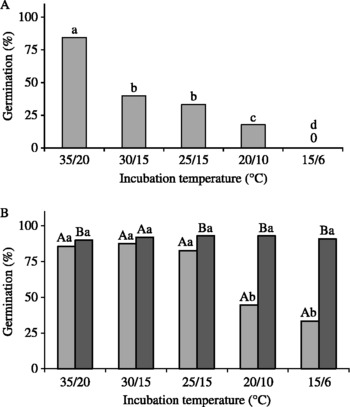
After 4 months of dry storage at 15/6°C, 85% of the seeds of J. ovalifolia germinated at 35/20°C, 45% at 30/15°C, 30% at 25/15°C and 20% at 20/10°C. None of the seeds imbibed or germinated at 15/6°C (Fig. 3A). However, for I. indica seeds dry stored at 35/20°C (Fig. 3B) and for I. triloba and M. similis seeds stored dry at room temperature (data not shown), a high percentage of seeds imbibed at every temperature after the storage treatment. Dry stored (at 35/20°C) I. indica seeds germinated < 45% at 20/10 and 15/6°C, although >85% of them imbibed. However, >80% of the seeds germinated in dark at 20/10 and 15/6°C within 14 d (Fig. 3B).
Germination of seeds of (A) Jacquemontia ovalifolia in light/dark (light bars) and (B) Ipomoea indica in light/dark (light bars) and dark (dark bars) at five temperature regimes following best storage treatment (dry storage at 15/6°C for 4 months). Different upper-case letters indicate significant differences between light/dark versus dark treatments within an incubation temperature, and different lower-case letters indicate significant differences between incubation temperatures within the same treatment.

Effect of wet and dry incubation at 35/20°C on germination at 25/15°C
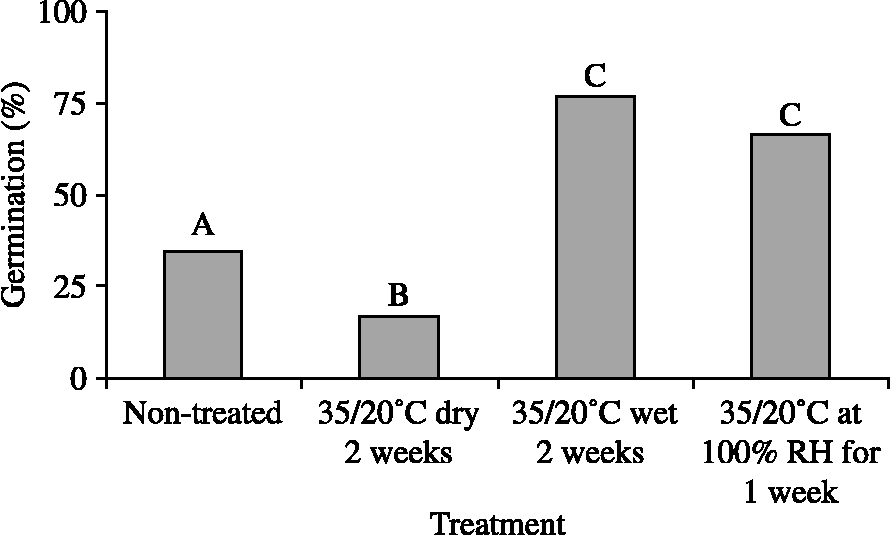
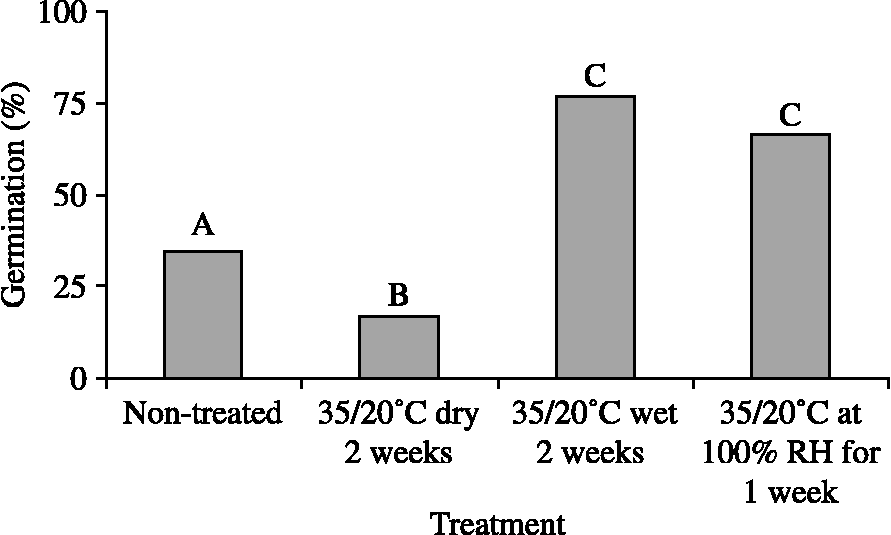
Untreated and 4 months dry-stored (at 15/6°C) J. ovalifolia seeds germinated to 4% and 33%, respectively, at 25/15°C (Fig. 4). However, seeds stored dry at 15/6°C, followed by 2 weeks of dry storage at 35/20°C, germinated to only 16% at 25/15°C. Seeds incubated at 35/20°C wet or at 100% RH germinated >65% at 25/15°C.
Germination of Jacquemontia ovalifolia seeds at 25/15°C following dry storage at 15/6°C for 4 months, and then subjection to different storage treatments at 35/20°C. Different upper-case letters indicate significant differences between treatments.
Discussion
Many studies on seed germination of Convolvulaceae species are reported in the literature. However, most of them assume that seeds of species in this family have physical dormancy. Thus, investigators scarified seeds manually, with concentrated H2SO4, by abrasion or by impaction prior to experiments; in most of these studies, uptake of water (imbibition) was not determined for either scarified (non-dormant) or non-scarified (dormant) seeds. Scarification can also break dormancy in water-permeable seeds with physiological dormancy (see Baskin et al., Reference Baskin, Thompson and Baskin2006). Anatomical work on seeds of Convolvulaceae shows that their seed-coat anatomy is very similar to that of other physically dormant species. All of them have water-impermeable palisade layers of macrosclereids (Baskin et al., Reference Baskin, Baskin and Li2000). In the present study, we compared imbibition of dormant versus non-dormant seeds of 46 species belonging to 11 of the 12 tribes of Convolvulaceae. Manually scarified seeds of all the species took up water and increased in mass >110%, whereas intact seeds of only three species took up a significant amount of water. Seeds of two of the three species were recalcitrant, and the other one was non-dormant. These results strongly indicate that most species of Convolvulaceae produce physically dormant seeds.
There was a relationship between initial seed moisture content and moisture content of intact seeds after 5 d of imbibition. Seeds with low initial moisture content ( < 13%) did not increase in mass, except those of B. menziesii, which were non-dormant, and seeds with high initial moisture took up high amounts of water. Initial moisture contents of seeds of 23 species were determined. Seeds of 21 of these species have low initial moisture content ( < 13%), whereas those of the other two species (M. panamensis and E. henryi) have high moisture content (45% and 55%, respectively). Of the 21 species whose fresh seeds had a low moisture content, only those of B. menziesii took up a high amount of water, showing that they are orthodox and not physically dormant. However, seeds of M. panamensis and E. henryi also took up water (moisture content after imbibition >90% and 60%, respectively). This shows that seeds of these two species are not physically dormant. Further, seeds of B. menziesii, M. panamensis and E. henryi germinated to high percentages at ambient laboratory temperatures within 5 d after imbibition. Thus, seeds of these species do not have any dormancy: they are non-dormant. This was confirmed by results of germination tests over a range of temperature regimes.
Drying and seed storage experiments at low temperature ( − 25°C) with M. panamensis and E. henryi showed that seeds of these two species are recalcitrant in storage behaviour. None of the seeds of either species germinated after they were dried to 15% seed moisture content (wet mass basis), and only a few seeds germinated after they were dried to 25% seed moisture content. E. henryi seeds seemed to be more tolerant to low temperature storage than those of M. panamensis. E. henryi seeds germinated to 100% even after they were stored at 5/1°C for 1 month, whereas no M. panamensis seeds germinated after the same storage treatment. Therefore, seeds of E. henryi may be closer to the intermediate storage type than those of M. panamensis. However, E. henryi seeds are not completely intermediate since they did not germinate after 1 month of storage at − 25°C. Ng (Reference Ng1991) reported that E. griffithii seeds germinated within 1 week without any treatment. Daws et al. (Reference Daws, Garwood and Pritchard2005) reported that M. panamensis seeds are recalcitrant. Therefore, it can be assumed that tribes Erycibeae and Maripeae contain species that produce recalcitrant seeds with no dormancy, since no literature was found to support the existence of other kinds of seed dormancy or of storage behaviour in these two tribes.
Intact seeds of B. grandiflora, E. nuttallianus, E. alsinoides and Stylisma humistrata imbibed a very small amount of water (mass increase < 20%, i.e. only a few seeds imbibed), whereas manually scarified seeds took up a large amount of water (mass increase >110%). Manually scarified seeds germinated within 5 d at ambient laboratory temperatures. Germination tests show that manually scarified seeds of E. nuttallianus can germinate to high percentages over a wide range of temperatures. Therefore, seeds of these species have physical dormancy only and not (PY+PD). Studies by Saharan et al. (Reference Saharan, Kasera and Chawan2001) and Todd et al. (Reference Todd, Coons and Owen2002) suggest that seeds of E. alsinoides and S. pickeringii are physically dormant. However, they did not check for water uptake of either intact or scarified seeds. These studies show that species of tribe Cresseae produce orthodox seeds with physical dormancy (B. grandiflora, E. nuttallianus, E. alsinoides, S. humistrata and S. pickeringii) and no dormancy (B. menziesii). It is interesting that intact seeds of B. grandiflora are water impermeable and thus have physical dormancy, whereas those of B. menziesii are water permeable and non-dormant. We are not aware of another genus (in any of the 17 families of angiosperms with PY) in which seeds of one (or more) species have a water-impermeable seed (or fruit) coat and the other(s) a water-permeable coat. B. menziesii is the only species of this genus in Hawaii, and Degener (Reference Degener1932) expressed some doubt that this taxon should be placed in the genus Bonamia. However, Wagner et al. (Reference Wagner, Herbst and Sohmer1999) retained the taxon as B. menziesii in the flora of Hawaii.
Manually scarified seeds of 45 of 46 species germinated within 5 d after imbibition at ambient laboratory temperature. Only seeds of C. europaea did not germinate, even after 30 d. Gaertner (Reference Gaertner1956) provided clear evidence of physiological dormancy in C. europaea seeds. He found that scarified seeds have to be cold stratified to germinate. Therefore, seeds of C. europaea have combinational dormancy (PY+PD). There also is evidence of combinational dormancy in other species of Cuscuta. Work of Tingey and Allred (Reference Tingey and Allred1961) and Meulebrouck et al. (Reference Meulebrouck, Ameloot, Van Assche, Verheyen, Hermy and Baskin2008) clearly showed that seeds of C. approximata and C. epithymum have combinational dormancy. Further, Gaertner (Reference Gaertner1950) speculated that seeds of C. epilinum and C. epithymum have combinational dormancy; thus, seeds did not germinate after acid scarification although they were fully imbibed. However, manually scarified seeds of C. gronovii, C. australis, C. rostrata and C. campestris germinated within a few days from imbibition, whereas only a low proportion of intact seeds imbibed and germinated in all of the temperature regimes tested. Thus, seeds of these species are physically dormant, but they do not have physiological dormancy. Lyshede (Reference Lyshede1984, Reference Lyshede1992) claimed that C. pedicellata seeds are non-dormant. However, she did not present the data that led her to this conclusion. Seeds of all Cuscuta species tested had low moisture content ( < 10%). Therefore, species in tribe Cuscuteae produce orthodox seeds with physical (e.g. C. rostrata, C. gronovii and C. australis) or combinational (C. europaea, C. epithymum and C. approximata) dormancy.
None of the untreated seeds of all Ipomoeeae species included in our study took up a significant amount of water, whereas scarified seeds took up water and increased in mass >110%. These manually scarified seeds germinated within 5 d, and they have physical dormancy. Available literature on Ipomoea species (Misra, Reference Misra1963; Chandler et al. 1977; Hardcastle, Reference Hardcastle1978; Crowley and Buchanan, Reference Crowley and Buchanan1980; Thulen and Keeley, Reference Thulen and Keeley1983; Azania et al., Reference Azania, Azania, Pavani and Cunha2003; Ogunwenmo, Reference Ogunwenmo2006) and Argyreia nervosa (Gupta, Reference Gupta2000) suggests that seeds of Ipomoea spp. and Argyreia spp. have physical dormancy. No report in the literature was found claiming any other type of dormancy in seeds of species in Ipomoeeae. Our study also supports lack of other kinds of dormancy (and of non-dormancy) in this tribe.
Studies on Merremia species (Sharma and Sen, Reference Sharma and Sen1975; Azania et al., Reference Azania, Azania, Pavani and Cunha2003), Calystegia soldanella (Kondo et al., Reference Kondo, Takahashi and Shimomura2001, Reference Kondo, Saki and Sasaki2002; Ko et al., Reference Ko, Park, Min and Cha2004), Convolvulus spp. (Brown and Porter, Reference Brown and Porter1942; Koller and Cohen, Reference Koller and Cohen1959; Weaver and Riley, Reference Weaver and Riley1982; Tamak et al., Reference Tamak, Narwal, Singh and Ram1994; Gonzalez-Martin, Reference Gonzalez-Martin1998) and Jacquemontia spp. (Crowley and Buchanan, Reference Crowley and Buchanan1980; Eastin, Reference Eastin1983; Spier and Snyder, Reference Spier and Snyder1998) support our conclusion that seeds of species in tribes Merremieae, Convolvuleae and Jacquemontieae have physical dormancy. No literature was found claiming or suggesting any other kind of seed dormancy for these species. Neither were any reports found on seed germination of species belonging to tribes Aniseieae, Dichondreae, Cardiochlamyeae or Humbertieae. However, imbibition and germination tests we performed on A. martinicensis (Aniseieae), D. micrantha, Rapona tiliifolia (Dichondreae) and C. madagascariensis (Cardiochlamyeae) clearly show that these species have physical dormancy. Apparently, no study has been done on seed germination of the rare and endemic (to Madagascar) H. madagascariensis, which is the only species in tribe Humbertieae and subfamily Humbertoideae.
According to the phylogenetic classification of Convolvulaceae (Stefanovic et al., Reference Stefanovic, Austin and Olmstead2003), most species in advanced tribes in the family produce orthodox seeds with physical dormancy. An exception is B. menziesii (tribe Cresseae), which produces non-dormant orthodox seeds. However, seed anatomy suggests that non-dormancy of B. menziesii is a secondarily derived condition from seeds with physical dormancy. The seed coat has similar anatomy to physically dormant seeds in general and to that of B. grandiflora in particular (Jayasuriya, 2008). Water enters into the seed only through the hilar fissure and micropylar opening during initial imbibition. M. panamensis, in the fairly advanced clade Dicranostyloideae, is another exception. Seeds of M. panamensis are non-dormant and recalcitrant (Daws et al., Reference Daws, Garwood and Pritchard2005; current study). These characters also seem to be secondarily derived from physically dormant orthodox seeds of related taxa in the family. Sister tribes to Maripeae are Jacquemontieae, Dichondreae and Cresseae, which produce only orthodox seeds. Seeds of M. panamensis have a palisade layer in the hilum area of the seed coat. Palisade cells are characteristic of physically dormant seeds. Seeds of at least two of the basal tribes of Convolvulaceae, i.e. Cardiochlamyeae and Erycibeae, and Cuscuteae, which is derived directly from basal tribes, are physically dormant orthodox (most species of Cuscuteae and Cardiochlamyeae), combinationally dormant orthodox (a few species of Cuscuteae) or non-dormant recalcitrant (Erycibeae). This suggests that physical dormancy in seeds of Convolvulaceae species may have evolved from species with non-dormant recalcitrant seeds. However, neither kind of dormancy nor storage behaviour is known for seeds of Humbertieae, the most basal tribe in the family.
Solanaceae, Hydroleaceae, Sphenocleaceae and Montiniaceae are the sister families to Convolvulaceae (Bremer et al., Reference Bremer, Bremer, Heidari, Erixon, Olmstead, Anderberg, Kallersjo and Barkhordarian2002), but we know of no studies on seed germination of species in these families, except Solanaceae. Germination studies of Solanaceae show that seeds of species in this family are non-dormant orthodox [e.g. Solanum melanocerasium (Zhou et al., Reference Zhou, Tao, Deckard and Messersmith2006)] and physiologically dormant orthodox [e.g. Datura spp. (Reisman-Berman et al., Reference Reisman-Berman, Kigel and Rubin1991); Atropa bella-donna (Genova et al., Reference Genova, Komistska and Beeva1997), Nicotiana plumbaginifolia (Grappin et al., Reference Grappin, Bouinot, Sotta, Miginiac and Jullien2000), Solanum sarrachoides (Zhou et al., Reference Zhou, Deckard and Ahrens2005) and Solanum lycocarpum (Pinto et al., Reference Pinto, Da Silva, Davide, De Jesus, Toorop and Hilhorst2007)].
However, Solanaceae are not derived from the phylogenetically primitive ancestor to Convolvulaceae. Both Convolvulaceae and Solanaceae are derived from a common ancestor. Therefore, it is hard to suggest a primitive character stage for seed dormancy and storage behaviour of Convolvulaceae using seed character stages of Solanaceae. However, recalcitrant non-dormant seems to be the most probable seed type since Erycibeae is a basal tribe within the family with non-dormant recalcitrant seeds. Baskin and Baskin (Reference Baskin and Baskin1998), Baskin et al. (Reference Baskin, Baskin and Li2000) and Finch-Savage and Leubner-Metzger (Reference Finch-Savage and Leubner-Metzger2006) suggest that PY is the most recently evolved kind of dormancy and that it developed from non-dormancy (ND). Evolution of seed dormancy in Convolvulaceae, and more specifically in subfamily Convolvuloideae, may be an example of the derivation of seeds with PY (species in advanced tribes) from those that are non-dormant (ND) (tribe Erycibeae). Further, we suggest that ND of seeds of the ancestor of Convolvulaceae may have evolved from a physiologically dormant-seed producing or non-dormant ancestor of a basal family in Solanales. However, due to lack of information on seed germination of families Hydroleaceae, Sphenocleaceae and Montiniaceae, no exact inferences can be made about the evolution of recalcitrance in Convolvulaceae.
In Convolvulaceae, species that produce orthodox seeds (tribes Cardiochlamyeae and Cuscuteae) may have evolved from an ancestor (closely related to tribe Erycibeae) that produced recalcitrant seeds, and species that produce recalcitrant seeds (tribe Maripeae) may have evolved from ancestors that produced orthodox seeds (closely related to tribe Dichondreae). Von Teichman and Van Wyk (Reference Von Teichman and Van Wyk1994) and Pammenter and Berjak (Reference Pammenter and Berjak2000a, Reference Pammenter and Berjakb) consider recalcitrant behaviour to be the ancestral character state, whereas Farnsworth (Reference Farnsworth2000) and Dickie and Pritchard (Reference Dickie, Pritchard, Black and Pritchard2002) consider orthodox behaviour to be the ancestral character state. However, seemingly having changed their view, Berjak and Pammenter (Reference Berjak and Pammenter2008) conclude that, ‘There appears to be little taxonomic relationship among species exhibiting the phenomenon of seed recalcitrance, suggesting that it is a derived trait with tolerance having been lost a number of times’. Within Convolvulaceae, desiccation behaviour has changed at least twice: (1) recalcitrant ND seeds (ancestor closely related to Erycibeae) → orthodox PY seeds (Cardiochlamyeae); and (2) orthodox PY seeds (ancestor closely related to Dichondreae) → recalcitrant ND seeds [Maripeae (assuming that all genera of Maripeae are recalcitrant)]. Further, desiccation-sensitive seeds of ancestral species of Convolvulaceae may have evolved from desiccation-tolerant seeds of species in Solanales, in which there are no records of recalcitrant-seed producing species (Dickie and Pritchard, Reference Dickie, Pritchard, Black and Pritchard2002; Daws et al., Reference Daws, Garwood and Pritchard2006).
Germination tests on manually scarified seeds and on non-dormant seeds (dormancy break by treatments simulating natural conditions) in a wide range of environments in light/dark and dark regimes show that Convolvulaceae seeds have no light requirement for germination. However, these studies revealed two types of germinability characteristics. Manually scarified and non-dormant seeds (made non-dormant by simulating natural treatments) of some species (C. sepium, E. nuttallianus, I. triloba, I. microdactyla, M. dissecta, M. tuberosa and C. rostrata) germinated well (>85%) over the entire range of temperatures and light/dark conditions tested. On the other hand, manually scarified or non-dormant seeds of other species (D. micrantha, B. menziesii, C. australis, I. hederacea indica, I. lacunosa, I. quamoclit, J. ovalifolia C. gronovii and M. similis) did not germinate well at the 15/6 or 20/10°C light/dark regimes. Germination of seeds of these species at 15/6 and 20/10°C seems to be faster in dark than in light/dark. This is not a phylogenetically constrained phenomenon. Seeds of species belonging to different tribes germinate slowly at 15/6°C. This may be a character with an adaptive advantage in subtropical and tropical habitats. Interestingly, all species with slow germination at 15/6°C are distributed in subtropical or tropical habitats. However, there are some species (I. triloba and M. tuberosa) distributed in subtropical or tropical habitats that germinate rapidly at 15/6°C. In fact, seeds of these species were collected in subtropical habitats. Obviously, then, more research needs to be done on this aspect of seed germination in Convolvulaceae.
A 5-month period of dry storage at 35/20°C breaks physical dormancy of seeds of I. indica, and a 6-month period of dry storage at ambient laboratory temperatures breaks dormancy in seeds of I. triloba and M. similis. After these storage treatments, seeds of these two species can imbibe and germinate to high percentages over the whole range of temperatures tested. J. ovalifolia seeds germinated to a high percentage (78%) at 35/20°C after dry storage for 4 months at 15/6°C, whereas only a low percentage ( < 25%) of untreated seeds did so. However, seeds dry stored at 15/6°C for 4 months did not germinate to as high a percentage at other temperatures as they did at 35/20°C. Thus, incubation at 35/20°C is the dormancy-breaking treatment for J. ovalifolia seeds pretreated by storing them dry at 15/6°C for 4 months. This is further supported by the effect of incubation at 35/20°C on wet sand and by storage in a container at 100% RH for 2 weeks on the germination of pretreated seeds (stored dry at 15/6°C for 6 months) of J. ovalifolia at 25/15°C. This wet incubation treatment increased germination of pretreated seeds from 25% to 75% at 25/15°C. Thus, wet incubation at 35/20°C is the dormancy-breaking treatment for pretreated seeds. However, dry storage of pretreated seeds at 35/20°C reduced the germination percentage at 25/15°C. These observations can be explained using two-stage dormancy-breaking mechanisms and sensitivity cycling to dormancy-breaking treatment (Taylor, Reference Taylor2005; Jayasuriya et al., Reference Jayasuriya, Baskin and Baskin2008a). Fresh seeds of J. ovalifolia are insensitive to the dormancy-breaking treatment (wet storage at 35/20°C). Sensitivity to dormancy-breaking treatment can be induced by storing seeds at 15/6°C for 4 months. However, this induced sensitivity is decreased by storing seeds dry at 35/20°C.
There is no evidence to suggest that seeds of I. indica, I. triloba or M. similis have sensitivity cycling (sensu Jayasuriya et al., Reference Jayasuriya, Baskin and Baskin2008a). However, further experiments need to be done to clarify whether seeds of these species have sensitivity cycling or not. Sensitivity cycling has been identified for seeds of I. lacunosa (Jayasuriya et al., Reference Jayasuriya, Baskin and Baskin2008a), I. hederacea (Jayasuriya, 2008), C. australis (Jayasuriya et al., Reference Jayasuriya, Baskin, Geneve, Baskin and Chien2008b) and J. ovalifolia in Convolvulaceae, and for seeds of Trifolium subterraneum (Taylor, Reference Taylor1981, Reference Taylor2005), Ornithopus compressus (Revell et al., 1999) and several other legumes (Van Assche et al., Reference Van Assche, Debucquoy and Rommens2003) in Fabaceae (subfamily Papilionoideae). This phenomenon does not seem to be phylogenetically constrained in angiosperms or in Convolvulaceae. Seeds of all species tested in our study for cycling of sensitivity to dormancy break exhibited sensitivity cycling. Therefore, perhaps at least in Convolvulaceae, sensitivity cycling is a common phenomenon in seeds with physical dormancy. However, more experiments need to be done to reveal the phylogenetic patterns of sensitivity cycling to dormancy break in physically dormant seeds.
Acknowledgements
We thank Mr Carl Weekley, Archbold Biological Station, Highlands, County Florida, USA; Dr John Dickie and the Millennium Seed Bank Project, Royal Botanic Gardens, Kew, UK; Dr Julissa Roncal, Center for Tropical Plant Conservation, Fairchild Tropical Botanic Garden, Miami, Florida, USA; Mr Alvin Yoshinaga, University of Hawaii, Manoa, Hawaii, USA; Mr John Geiger, Florida International University, Miami, Florida, USA; Dr Jeff Walck, Middle Tennessee State University, Murfreesboro, Tennessee, USA; Drs Ching-Te Chien and Shun-Ying Chen, Taiwan Forestry Research Institute, Taipei, Taiwan; and Mrs Adriana Sautu, Smithsonian Tropical Research Institute, Balboa, Panamá, República de Panamá, for collecting and sending us seeds used in studies reported in this paper; Dr N.K.B. Adikaram and Dr G.A.D. Perera, Department of Botany, University of Peradeniya, Peradeniya, Sri Lanka, for allowing Gehan Jayasuriya to use facilities in the Department of Botany, University of Peradeniya, Sri Lanka, in studies done in Sri Lanka; and Dr Thierry Deroin, National Museum of Natural History, Paris, France, for providing information about Humbertia madagascariensis.