Unfortunately, one in eight children in the United States will experience some form of maltreatment by 18 years of age (Wildeman et al., Reference Wildeman, Emanuel, Leventhal, Putnam-Hornstein, Waldfogel and Lee2014). Such adversities represent a severe hazard to the development of an individual, and particularly alarming, child maltreatment is related to a 60%–70% increase risk for lifetime mood and anxiety disorders (Chapman et al., Reference Chapman, Whitfield, Felitti, Dube, Edwards and Anda2004; Danese et al., Reference Danese, Moffitt, Harrington, Milne, Polanczyk and Pariante2009; Green et al., Reference Green, McLaughlin, Berglund, Gruber, Sampson and Zaslavsky2010; McLaughlin et al., Reference McLaughlin, Koenen, Hill, Petukhova, Sampson and Zaslavsky2013). Although well studied and well replicated in psychological and epidemiological research, the exact mechanisms mediating the association between maltreatment and later internalizing disorders remain unclear.
Suggestive from investigations focused on multiple levels of analysis is that this risk may be conferred by altered responses to later, more contemporaneous, stressful experiences. For example, maltreatment alters psychological processes after acute stress, because those who suffer such adversity report greater negative affect after subsequent stress (Glaser, van Os, Portegijs, & Myin-Germeys, Reference Glaser, van Os, Portegijs and Myin-Germeys2006) and also poorer emotion regulation including less emotional self-awareness (Herts, McLaughlin, & Hatzenbuehler, Reference Herts, McLaughlin and Hatzenbuehler2012; Kim & Cicchetti, Reference Kim and Cicchetti2010). Direct examination of this “stress sensitization” has supported these ideas, because recent stress after child maltreatment has been found to predict subsequent increases in symptoms of anxiety and depression as well as clinical disorder after exposure to stress later in life (Espejo et al., Reference Espejo, Hammen, Connolly, Brennan, Najman and Bor2007; Hammen, Henry, & Daley, Reference Hammen, Henry and Daley2000; Harkness, Bruce, & Lumley, Reference Harkness, Bruce and Lumley2006; McLaughlin, Conron, Koenen, & Gilman, Reference McLaughlin, Conron, Koenen and Gilman2010; Shapero et al., Reference Shapero, Black, Liu, Klugman, Bender and Abramson2013). Hammen et al. (Reference Hammen, Henry and Daley2000) found that women with exposure to childhood adversities had a lower threshold for developing a depressive reaction to stressors. Shapero et al. (Reference Shapero, Black, Liu, Klugman, Bender and Abramson2013) noted comparable results, finding that individuals with more severe childhood emotional abuse experienced greater increases in depressive symptoms when confronted with current stressors. McLaughlin et al. (Reference McLaughlin, Conron, Koenen and Gilman2010) extended these investigations to examine risk of major depression and also anxiety disorders, finding that the risk for psychopathology after past-year major stressors was nearly doubled for individuals with a history of childhood adversity compared to those without such a history.
Implicit in these stress sensitization studies is that vulnerability to depression and anxiety involves interactions among numerous processes at the neurobiological, environmental, and psychosocial levels. While research has focused on environmental and psychosocial factors, less work has centered on neurobiological processes. Preliminary evidence has found that child maltreatment and other types of early adversity increase reactivity to acute stress through physiological pathways, such as alterations in blood pressure (Gooding, Milliren, Austin, Sheridan, & McLaughlin, Reference Gooding, Milliren, Austin, Sheridan and McLaughlin2015; Leitzke, Hilt, & Pollak, Reference Leitzke, Hilt and Pollak2015), cardiac output (McLaughlin, Sheridan, Alves, & Mendes, Reference McLaughlin, Sheridan, Alves and Mendes2014), and cortisol release (Heim, Newport, Mletzko, Miller, & Nemeroff, Reference Heim, Newport, Mletzko, Miller and Nemeroff2008; Tarullo & Gunnar, Reference Tarullo and Gunnar2006). There has been limited work examining how this stress sensitization may be related to alterations in the brain, which mediates the effects of external stressors on internal physiological states. Thus, identifying the impact of child maltreatment on the brain directly will deepen basic knowledge of how such adversity can become embedded in our physiology and behavior. In addition, understanding how differences in the brain interact with environmental and psychosocial factors could also inform the search for strategies to offset the negative sequelae of child maltreatment leading to resiliency and greater well-being.
Prior research has identified a number of candidate structures in the brain that may be both centrally involved in the pathophysiology of internalizing psychopathology and sensitive to early life stress. Of particular note are two nodes within a distributed corticolimbic circuit supporting recognition and reaction to threat: the amygdala and the ventromedial prefrontal cortex (vmPFC). The amygdala is an information-processing hub, supporting both physiological (e.g., autonomic reactivity) and behavioral (e.g., reallocation of attentional resources) responses to environmental and social challenges (Davis & Whalen, Reference Davis and Whalen2001; Hariri, Reference Hariri2009; Ledoux, Reference Ledoux2000). These responses are subsequently integrated and regulated through activity of the vmPFC, which has extensive reciprocal connections with the amygdala (Bishop, Reference Bishop2007; Davidson, Putnam, & Larson, Reference Davidson, Putnam and Larson2000; Ghashghaei & Barbas, Reference Ghashghaei and Barbas2002; Milad & Quirk, Reference Milad and Quirk2012; Quirk & Beer, Reference Quirk and Beer2006). A number of investigations have begun to link different forms of maltreatment with alterations in the structure and function of the amygdala and vmPFC (Dannlowski et al., Reference Dannlowski, Stuhrmann, Beutelmann, Zwanzger, Lenzen and Grotegerd2012; De Brito et al., Reference De Brito, Viding, Sebastian, Kelly, Mechelli and Maris2013; Hanson et al., Reference Hanson, Chung, Avants, Shirtcliff, Gee and Davidson2010, Reference Hanson, Nacewicz, Sutterer, Cayo, Schaefer and Rudolph2015; Tottenham et al., Reference Tottenham, Hare, Millner, Gilhooly, Zevin and Casey2011). Relatively few investigations have, however, considered the relationship between maltreatment and the structural connections between these nodes.
The uncinate fasciculus (UF) is a major white matter tract that connects the amygdala to the vmPFC as well as other subregions of the PFC involved in top-down regulation of amygdala activity (Amaral & Price, Reference Amaral and Price1984; Barbas & De Olmos, Reference Barbas and De Olmos1990; Morecraft, Geula, & Mesulam, Reference Morecraft, Geula and Mesulam1992; Petrides & Pandya, Reference Petrides and Pandya1988; Porrino, Crane, & Goldman-Rakic, Reference Porrino, Crane and Goldman-Rakic1981). The structural integrity of the UF may thus be particularly important to consider in relation to child maltreatment, stress sensitization, and later internalizing psychopathology. Lower UF fractional anistropy (FA) has been observed in children exposed to early social neglect (Eluvathingal et al., Reference Eluvathingal, Chugani, Behen, Juhász, Muzik and Maqbool2006; Govindan, Behen, Helder, Makki, & Chugani, Reference Govindan, Behen, Helder, Makki and Chugani2010). However, other studies have not found evidence for similar alterations (Choi, Jeong, Polcari, Rohan, & Teicher, Reference Choi, Jeong, Polcari, Rohan and Teicher2012; Choi, Jeong, Rohan, Polcari, & Teicher, Reference Choi, Jeong, Rohan, Polcari and Teicher2009; Huang, Gundapuneedi, & Rao, Reference Huang, Gundapuneedi and Rao2012). These inconsistent results may reflect generally small and thus underpowered sample sizes or relatively crude group comparisons between maltreated and nonmaltreated individuals.
Here, we examined associations between a continuous measure of self-reported experience of child maltreatment and UF FA in 848 young adult university students. We further explored the extent to which alterations in UF FA associated with child maltreatment were expressed as self-reported symptoms of depression and anxiety. Finally, consistent with the stress sensitization model we tested if UF FA predicted the subsequent experience of these symptoms following stressful life events. We hypothesized that child maltreatment would be associated with reduced UF FA in young adulthood and that reduced UF FA would be associated with higher internalizing symptomatology as well as increased vulnerability to future life stress.
Method
Participants
A total of 848 participants (initial age range = 18–22 years old) were included from the ongoing Duke Neurogenetics Study (DNS), which assesses a wide range of behavioral and biological traits among nonpatient, young adolescent and adult student volunteers. This study was approved by the Duke University Medical Center Institutional Review Board, and all participants provided informed consent before participating in the study. Participants were excluded in the present sample if they met the following criteria: (a) medical diagnoses of cancer, stroke, diabetes requiring insulin treatment, chronic kidney or liver disease, or lifetime history of psychotic symptoms; (b) use of psychotropic, glucocorticoid, or hypolipidemic medication; and/or (c) conditions affecting cerebral blood flow and metabolism (e.g., hypertension); and (d) met quality control criteria for magnetic resonance imaging (MRI) scanning. Diagnosis of any current DSM-IV Axis I disorder or select Axis II disorders (antisocial personality disorder and borderline personality disorder) were assessed with the electronic Mini-International Neuropsychiatric Interview (Sheehan et al., Reference Sheehan, Lecrubier, Sheehan, Amorim, Janavs and Weiller1998) and Structured Clinical Interview for the DSM-IV subtests (First, Spitzer, Gibbon, & Williams, Reference First, Spitzer, Gibbon and Williams1996). Such diagnoses were, however, not exclusion criteria, because the DNS seeks to establish broad variability in multiple behavioral phenotypes related to psychopathology. One hundred and sixty-seven subjects met criteria for having a current or past Axis I disorder, including alcohol dependence (n = 43), alcohol abuse (n = 53), any type of anxiety disorder (n = 39), or any type of major depressive disorder (n = 28). Three participants met criteria for at least one Axis II disorder (antisocial personality disorder n = 1; borderline personality disorder n = 2).
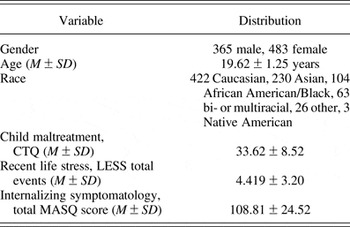
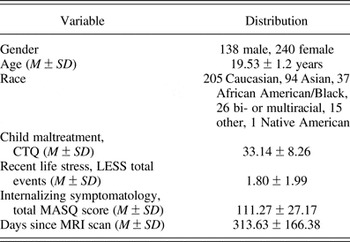
All successful DNS participants were then contacted every 3 months after initial study completion and asked to complete a brief online assessment of recent life events, mood, and affect in the past week. Secondary longitudinal analyses were restricted to a subset of 378 participants who completed these follow-up measures at least 6 months after their MRI scanning (mean time since scan = 313.6 ± 166.38 days, at the time of follow-up). Additional demographic information for the full sample and longitudinal subsample are detailed in Tables 1 and 2.
Demographic Information for the full sample

Note: CTQ, Childhood Trauma Questionnaire; LESS, Life Event Scale for Students; MASQ, Mood and Anxiety Symptoms Questionnaire.
Demographic Information for the longitudinal subsample
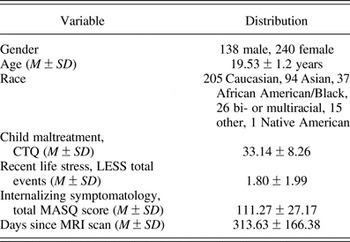
Note: CTQ, Childhood Trauma Questionnaire; LESS, Life Event Scale for Students; MASQ, Mood and Anxiety Symptoms Questionnaire; MRI, magnetic resonance imaging.
Procedures
Participants were recruited through posting on various university-related electronic mailing lists, flyers posted around the area, and our laboratory's website (http://www.haririlab.com/brain.php). This final recruitment source contained electronic screening forms and has been visited over 7,000 times to date. Once identified, adolescent and young adult participants came to our university-based laboratory to participate in the study. We collected MRI measures to assess neurobiology, specifically well-validated neuroimaging measures of structural connectivity. At the time of scanning, participants reported the number of stressful life events they had experienced in the prior year, as well as experiences of child maltreatment. Participants also reported on current levels of internalizing symptomatology. Individuals received an honorarium of $120 for completion of this initial study visit. After successful completion of the baseline protocol including MRI scan, all participants were subsequently contacted by E-mail every 3 months and invited to complete a short online assessment of their current mood and experience of stressful life events since their last assessment. Participants who completed this postscanning follow-up were then entered into a raffle for a $50 gift card at each round of follow-up assessment.
Self-report questionnaires
Participants completed a battery of self-report questionnaires to assess past and current experiences and behavior. The following were used for the present analyses: the Childhood Trauma Questionnaire (CTQ; Bernstein, Ahluvalia, Pogge, & Handelsman, Reference Bernstein, Ahluvalia, Pogge and Handelsman1997); Life Events Scale for Students (Clements & Turpin, Reference Clements and Turpin1996); and the Mood and Anxiety Symptom Questionnaire—Short Form (MASQ; Clark & Watson, Reference Clark and Watson1991).
The CTQ is a 28-item, retrospective screening tool used to assess exposure to childhood maltreatment in five categories: emotional, physical and sexual abuse, and emotional and physical neglect. Each of the CTQ's five subscales has robust internal consistency and convergent validity with a clinician-rated interview of childhood abuse and therapists' ratings of abuse (Fink, Bernstein, Handelsman, Foote, & Lovejoy, Reference Fink, Bernstein, Handelsman, Foote and Lovejoy1995). Scores on each subscale (range = 5–25) were summed to provide a total score (DNS range = 25–75, mean = 33.62 ± 8.52). This instrument and approach has been employed in other recent research studies focused on child maltreatment (Gorka, Hanson, Radtke, & Hariri, Reference Gorka, Hanson, Radtke and Hariri2014; Herringa et al., Reference Herringa, Birn, Ruttle, Burghy, Stodola and Davidson2013; Teicher, Anderson, & Polcari, Reference Teicher, Anderson and Polcari2012). To assess the occurrence of common stressful life events within the past 12 months, we used a modified version of the Life Events Scale for Students. In this checklist, participants indicated which stressful life events happened to them over the past year (e.g., broke up with romantic partner, failed a course, family health problems, or financial problems). Recent symptoms of internalizing psychopathology were assessed using the MASQ. The MASQ is a well-validated measure, yielding four subscales assessing symptoms experienced within the last 7 days specific to anxious arousal and anhedonic depression, as well as general anxiety and general depression. In line with past research (Swartz, Knodt, Radtke, & Hariri, Reference Swartz, Knodt, Radtke and Hariri2015), these four subscales were summed to create a measure of total internalizing symptoms.
MRI data acquisition and processing
Each participant was scanned on one of two identical research-dedicated GE MR750 3T scanners at the Duke–UNC Brain Imaging and Analysis Center. Each identical scanner was equipped with high-power high-duty cycle 50-mT/m gradients at 200 T/m/s slew rate and an eight-channel head coil for parallel imaging at high bandwidth up to 1 MHz. Following an ASSET calibration scan, two 2-min 50-s high angular resolution diffusion imaging acquisitions were collected, providing full brain coverage with 2-mm isotropic resolution and 15 diffusion weighted directions (10-s repetition time, 84.9 ms echo time, b value 1000 s/mm2, 240 mm field of view, 90° flip angle, 128 × 128 acquisition matrix, slice thickness = 2 mm). High resolution T1-weighted images were also obtained using a three-dimensional Ax FSPGR BRAVO sequence with the following parameters: repetition time = 8.148 s, echo time = 3.22 ms, 162 sagittal slices, 12° flip angle, 240 mm field of view; 256 × 256 matrix, slice thickness = 1 mm with no gap; and total scan time = 4 min 13 s.
Diffusion tensor images were processed according to the protocol developed by the Enhancing Neuro Imaging Genetics Through Meta-Analysis (Jahanshad et al., Reference Jahanshad, Kochunov, Sprooten, Mandl, Nichols and Almasy2013, or http://enigma.ini.usc.edu/protocols/dti-protocols/). In brief, raw diffusion-weighted images underwent eddy current correction and linear registration to the non diffusion-weighted (T2-weighted) image in order to correct for head motion. These images were skull stripped and diffusion tensor models were fit at each voxel using in FMRIB's Diffusion Toolbox (http://fsl.fmrib.ox.ac.uk/fsl/fslwiki/FDT). This produced a whole-brain FA image for each participant, which was next processed using tract-based spatial statistics in FMRIB's Software Library (Smith et al., Reference Smith, Jenkinson, Johansen-Berg, Rueckert, Nichols and Mackay2006). FA images were realigned to the FMRIB standard-space FA image and transformed into MNI standard space. A mean FA skeleton was created and thresholded at 0.2, and each participant's FA data were projected onto the skeleton. Regions of interest were then created using the Johns Hopkins University White Matter Tractography Atlas (Mori, Wakana, Van Zijl, & Nagae-Poetscher, Reference Mori, Wakana, Van Zijl and Nagae-Poetscher2005). The left and right UF regions were binarized and skeletonized in order to extract mean FA values from the left UF and right UF for each participant. Whole-brain average FA values were also calculated to include all voxels in the ENIGMA-DTI skeleton and included in all analyses as a covariate of no interest.
Statistical analyses
Relationships between child maltreatment and internalizing symptomatology were examined using linear regression models. For these statistical analyses, a composite internalizing measure (total score from the MASQ at initial assessment) was entered as the dependent variable and age (years), gender (entered as a dummy-coded factor), recent stressful life events, and CTQ total scores were entered as our independent variables. Of note, recent stressful life events were entered in these models to ensure that any results were unique to exposure to child maltreatment. To examine associations between structural connectivity and child maltreatment, we constructed linear regression models with FA values for the left or right UF entered as dependent variables (in separate regressions), and whole-brain average FA, age (years), gender (entered as a dummy-coded factor), recent stressful life events, and CTQ total scores were entered as our independent variables. Again, recent stressful life events were entered in these analyses to ensure specificity of our results for maltreatment. Additional analyses also sought to rule out the effects of past and present psychopathology in our sample. To these ends, supplemental analyses were conducted with a binary-coded covariate noting the presence of psychopathology (0 = no history of psychopathology, 1 = current or past psychopathology). To examine relationships between structural connectivity and internalizing symptoms, we next constructed linear regression models with our composite internalizing measure (total score from the MASQ) entered as the dependent variable. For these models, whole-brain average FA, age (years), gender (as a dummy-coded factor), and FA values for the left or right UF (in separate regressions) were entered as our independent variables. Supplemental analyses were again conducted with a binary-coded covariate noting the presence of psychopathology.
Using data from our longitudinal subsample, linear regression models were also employed to investigate the extent to which UF structural integrity (as measured by FA), child maltreatment, recent life stress, or their interactions influenced self-reports of internalizing symptomatology. For these analyses, total score from the MASQ at follow-up was entered as the dependent variable, while whole-brain average FA at baseline, age at baseline and at follow-up (years), gender (entered as a dummy-coded factor), total score from the MASQ at baseline, number of days since the neuroimaging session, recent stressful life events at baseline and at follow-up, CTQ total scores, UF FA, interaction terms for recent stress, CTQ, and UF FA (two- and three-way interactions) were entered as independent variables All predictor variables were mean-centered prior to analyses, and their product terms were computed using these standardized variables to minimize multicollinearity. All analyses were completed using the R statistical package (R Core Team, 2014) and tests of significance were conducted at conventional alpha (p < .05, two tailed).
Results
Sample demographics
For the CTQ total scores, the full-sample mean was 33.63 (SD = 8.52) and the range was 25–75, with a score of 25 being the lowest possible sum (with a participant selecting a 1 = never true for all items). These values are similar to previous research with adolescents and young adults in a community sample (Scher, Stein, Asmundson, McCreary, & Forde, Reference Scher, Stein, Asmundson, McCreary and Forde2001). Similar to previous research with adolescents and young adults (Covault et al., Reference Covault, Tennen, Armeli, Conner, Herman and Cillessen2007), our participants reported an average of 4.42 recent stressful life events. For the MASQ, the means and standard deviations for the total score were again similar to previous reports from adolescents and young adults (mean = 108.81, SD = 24.52, range = 60–245; Bogdan, Perlis, Fagerness, & Pizzagalli, Reference Bogdan, Perlis, Fagerness and Pizzagalli2010). In line with past reports and central to our questions of interest, CTQ total scores were positively correlated with total internalizing symptomatology (β = 0.429, p < .005) as assessed by the MASQ. None of the self-report measures differed between men and women (all ps > .4).
Structural connectivity, child maltreatment, and internalizing symptomatology for the full sample
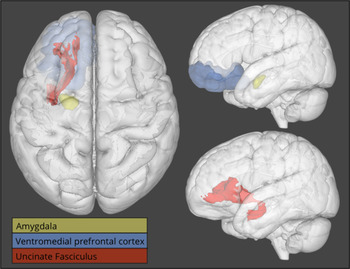
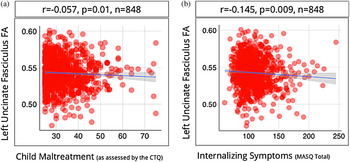
As predicted, childhood maltreatment was related to vmPFC–amygdala structural connectivity, with greater CTQ scores associated with lower FA in the left UF (β = –0.057, p = .013). This white matter pathway is shown in Figure 1, in relation to the vmPFC and amygdala. This relationship was seen after controlling for recent life stress exposure, gender, and age (scatterplot shown in Figure 2a). This relationship remained significant if the presence of psychopathology was controlled for (β = –0.055, p = .013). There was no association between childhood maltreatment and FA in the right UF (β = –0.022, p = .38). Individual differences in left UF FA were associated with self-reports of internalizing problems, with lower FA related to greater internalizing problems (β = –0.145, p = .009; Figure 2b). This relationship remained significant if the presence of psychopathology was controlled for (β = –0.15, p < .005).
(Color online) Three-dimensional overlays displaying the uncinate fasciculus (in red online only), the amygdala (in yellow online only), and the ventromedial prefrontal cortex (in blue online only). The left side of the figure depicts a view looking down from the top of the head (analogous to axial orientation). The right side of the figure depicts a view from the side of the head (analogous to sagittal orientation). The amygdala (in yellow online only) and the ventromedial prefrontal cortex (in blue online only) are shown in the top right corner, while the uncinate fasciculus (in red online only) is shown in isolation in the bottom right panel.

(Color online) Scatterplots showing fractional anisotropy of the left uncinate fasciculus (vertical axis in both panels) and (a) child maltreatment (horizontal axis) and (b) internalizing symptomatology (horizontal axis).

Structural connectivity, stress exposure, and later internalizing symptomatology for the longitudinal sample
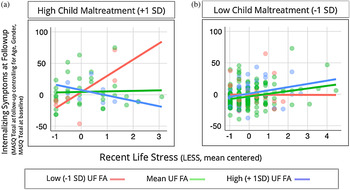
In regard to recent stress exposure and subsequent internalizing symptomatology, similar to past reports, we found a significant positive correlation between recent stressful life events and MASQ total scores at follow-up (β = 0.213, p < .005). Reports of child maltreatment at baseline were also related to MASQ total scores at follow-up (β = 0.235, p < .005). Of important note, these analyses controlled for a number of potential confounds including gender, age at baseline and follow-up, initial internalizing problems, days since initial assessment, and recent stress exposure at baseline. Central to our question of interest, there was a significant three-way interaction among UF FA, child maltreatment, and recent stressful life events (β = –0.11, p = .01). As shown in Figure 3, UF FA moderated the relationship between recent stressful life events and MASQ total scores at follow-up, but this was only seen in participants with higher reports of child maltreatment. The interaction of UF FA and recent stressful life events was only significantly different for participants with higher reports of child maltreatment (+1 SD on the CTQ; n = 52; p = .0038). All other interactions were nonsignificant. Our three-way interaction remained significant if the presence of psychopathology was controlled for (β = –0.11, p = .01) or when we used robust regression techniques (B = –3.55, SE = 1.16, t = –3.04).
(Color online) Scatterplots showing the relationship between recent life stress (as measured by the Life Events Scale for Students) and internalizing symptoms measured at least 6 months after initial assessment (as measured by the total score on the Mood and Anxiety Symptom Questionnaire at follow-up; controlling for age, gender, and total Mood and Anxiety Symptom Questionnaire at baseline). This is plotted at low (−1 SD), intermediate (mean), and high (+1 SD) levels of left uncinate fasciculus fractional anisotropy, for those with (a) high reports of child maltreatment and (b) low reports of child maltreatment.

Discussion
Our data reveal that child maltreatment is associated with reduced FA of the UF, which in turn predicts symptoms of depression and anxiety as well as psychological vulnerability to future life stress. Collectively, our results suggest a novel neurobiological mechanism linking childhood experiences of maltreatment with later internalizing symptoms, specifically altered structural connectivity within the brain's threat-detection and emotion-regulation circuitry. This risk is most strongly evident when individuals are exposed to increasing amounts of contemporaneous stress.
Our findings are consistent with earlier work reporting decreased UF FA in institutionalized children facing a lack of toys or stimulation, unresponsive caregiving, and an overall dearth of individualized care and attention (Rutter, Reference Rutter1998). Our large sample size and use of a continuous measure of maltreatment likely allowed for the detection of significant associations with more modest levels of maltreatment. Our findings are further consistent with past reports of lower FA in the UF in major depressive disorder and anxiety disorders as well as in individuals with higher trait anxiety. Reduced structural integrity of the UF (as indexed by lower FA) may result in a diminished vmPFC inhibition of responses to environmental threats and other negatively valenced stimuli. Investigations employing both DTI and functional MRI methods have supported this idea, with lower FA in the UF relating to reduced functional connectivity between portions of the prefrontal cortex and amygdala (Etkin, Prater, Hoeft, Menon, & Schatzberg, Reference Etkin, Prater, Hoeft, Menon and Schatzberg2010; Tromp et al., Reference Tromp, Grupe, Oathes, McFarlin, Hernandez and Kral2012). With internalizing psychopathology often being preceded by life events that possess a high degree of threat and unpleasantness (Hammen, Reference Hammen2005; Kessler, Reference Kessler1997; Monroe & Reid, Reference Monroe and Reid2008; Paykel, Reference Paykel2003), effective regulation of negative emotion, specifically through vmPFC–amygdala pathways, is critical to preventing increases in symptoms of depression or anxiety.
The results presented here also suggest new avenues of investigation, particularly in the development and refinement of interventions to promote resilience. Tracking when neurobiological differences related to maltreatment emerge in development could indicate critical or sensitive periods when treatments may be more effective. Furthermore, it may be possible to tailor psychological interventions based on differences in neurobiology; for example, recent research in treatments for depression have found brain activity pretreatment differentiated which individuals would have positive outcomes for cognitive–behavioral therapy or pharmacotherapy (McGrath et al., Reference McGrath, Kelley, Holtzheimer, Dunlop, Craighead and Franco2013). Neurobiological data could also be used as a marker of early treatment efficacy. Differences may emerge at a neurobiological level, earlier during an intervention that forecast later positive psychological outcomes.
Our work is not without limitations. First, our study is not a true community sample, instead drawing from a university population. Participants could be considered resilient, yet significant associations between neurobiology and maltreatment were still detected in these individuals. Our study therefore likely underrepresents the true effects of maltreatment. Second, only one neuroimaging time point was available for our analyses. With the pathways to either maladaptive or positive adaptive functioning being influenced by a complex matrix of factors (Cicchetti & Tucker, Reference Cicchetti and Tucker1994), additional research with longitudinal measures of both brain and behavior are needed. Such work could elucidate how neurobiological, environmental, and psychosocial factors continue to interact and potentially amplify (or diminish) risk over development. Related to this, it is possible that some of our participants will go on to develop psychopathology later in their lifetime, with the median onset of mood disorders such as major depression being between 25 and 30 years of age (Burke, Burke, Regier, & Rae, Reference Burke, Burke, Regier and Rae1990; Kessler et al., Reference Kessler, Berglund, Demler, Jin, Merikangas and Walters2005). Understanding different profiles of individuals at different developmental periods is critical to fostering resilience in maltreated children, adolescents, and adults. Third, we only focused on one developmental outcome: internalizing symptomatology. With maltreated individuals rarely manifesting competence across all developmental domains, a broader multilevel approach to risk and resilience could increase knowledge about the full sequelae of maltreatment (Cicchetti & Gunnar, Reference Cicchetti and Gunnar2008; Walsh, Dawson, & Mattingly, Reference Walsh, Dawson and Mattingly2010). For example, externalizing problems may relate to vmPFC–amygdala circuitry (McCrory & Viding, Reference McCrory and Viding2015). Alternatively, alterations in vmPFC–amygdala circuitry may cause increasing symptoms of depression or anxiety, and then these problems lead to rule breaking, aggression, and other behavioral problems over the course of development. Fourth, our measure of child maltreatment, the CTQ, does not richly assess factors of this adversity likely to influence outcomes. Information about the subtype of maltreatment suffered, severity, frequency/chronicity, developmental period during which these experiences occurred, whether a child was subsequently separated from their family, and perpetrator(s) of the maltreatment is important to consider moving forward. Surveying Child Protective Service records for such information, as well as considering variations in culture, parental systems, and child systems, could further clarify individual differences in neurobiological and psychological development (see Barnett, Manly, & Cicchetti, Reference Barnett, Manly, Cicchetti, Cicchetti and Toth1993, for extensive discussion of these issues; also Manly, Kim, Rogosch, & Cicchetti, Reference Manly, Kim, Rogosch and Cicchetti2001).
These limitations notwithstanding, our results provide evidence that maltreatment impacts important neurobiological circuitry involved with emotion regulation. Variations at this neurobiological level may convey risk for increases in internalizing symptomatology, particularly in the context of more recent exposure to stress. These results have important implications for the development and implementation of novel resilience-promoting interventions in those that have experienced insensitive, emotionally insecure, or physically harmful parent–child interactions. Additional research is needed to clarify the complex relationships between child maltreatment and related long-term physical and mental difficulties; our data are, however, an important step in the ability to predict, prevent, and treat maltreatment-related internalizing psychopathology.