Invasive plant species are key drivers of large-scale environmental change (Fei et al. Reference Fei, Phillips and Shouse2014; Gallardo et al. Reference Gallardo, Clavero, Sánchez and Vilá2016; Pyšek et al. Reference Pyšek, Jarošik, Hulme, Pergl, Hejda, Schaffner and Vilà2012; Vilà et al. Reference Vilá, Espinar, Hejda, Hulme, Jarošik, Maron, Pergl, Schaffner, Sun and Pyšek2011). Research that characterizes the ecological impacts of invasive plants has progressively emerged over recent decades (Pyšek et al. Reference Pyšek, Jarošik, Hulme, Pergl, Hejda, Schaffner and Vilà2012). Quantitative assessments comparing invaded and uninvaded communities are relatively scarce when considering the thousands of invasive plants that exist (Hulme et al. Reference Hulme, Pyšek, Jarošik, Pergl, Shaffner and Vilà2013; but see Vilà et al. Reference Vilá, Espinar, Hejda, Hulme, Jarošik, Maron, Pergl, Schaffner, Sun and Pyšek2011). Research quantifying plant community shifts has focused disproportionately on a small number of high-profile invasive plants (e.g., cheat grass [Bromus tectorum L.], Japanese knotweed [Fallopia japonica (Houtt.) Dcne], common reed [Phragmites australis (Cav.) Trin. ex Steud.]), with roughly one-third of all publications focusing on just nine species (Hulme et al. Reference Hulme, Pyšek, Jarošik, Pergl, Shaffner and Vilà2013). Recent research has demonstrated that native plant community responses to invasion events vary in scope, scale, and magnitude by species and plant functional type (Fried et al. Reference Fried, Laitung, Pierre and Chagué2014; Hejda et al. Reference Hejda, Pyšek and Jarošik2009; Powell et al. Reference Powell, Chase and Knight2013; Vilà et al. Reference Vilá, Espinar, Hejda, Hulme, Jarošik, Maron, Pergl, Schaffner, Sun and Pyšek2011). For example, in a field study investigating community impact of eight invasive plants, Fried et al. (Reference Fried, Laitung, Pierre and Chagué2014) found both increases and decreases in native species richness and diversity within plots depending upon the identity of the plant invader. Variable responses of native plant communities to invasion events are widespread throughout the literature (Fried et al. Reference Fried, Laitung, Pierre and Chagué2014; Hejda and Pyšek Reference Hejda and Pyšek2006; Hejda et al. Reference Hejda, Pyšek and Jarošik2009; Meffin et al. Reference Meffin, Miller, Hulme and Duncan2010; Powell et al. Reference Powell, Chase and Knight2013; Stohlgren et al. Reference Stohlgren, Chong, Schell, Rimar, Otsuki, Lee, Kalkhan and Villa2002; Vilà et al. Reference Vilá, Espinar, Hejda, Hulme, Jarošik, Maron, Pergl, Schaffner, Sun and Pyšek2011). Variable responses to invasion events coupled with a focus on a limited number of invasive plants often lead to poorly supported, speculative predictions of community effects after plant invasion. This speculation may lead to poorly prioritized invasive species management and ill-informed general hypotheses about plant invasion impacts.
The impact of invasive plants on native plant communities can vary with time since invasion (Dostál et al. Reference Dostál, Müllerova, Pyšek, Pergl and Klinerová2013; Strayer et al. Reference Strayer, Eviner, Jeschke and Pace2006). Most research has focused on single-aged invasions with no consideration of time since invasion, thereby potentially limiting the understanding of the invader’s effect on the native community (Strayer et al. Reference Strayer, Eviner, Jeschke and Pace2006). For example, tree species occupy different niches based on size and age. These changes in niches over time could lead to different community impacts as an invasive tree grows and increasingly affects ecosystem traits such as canopy cover and nutrient cycling (Dostál et al. Reference Dostál, Müllerova, Pyšek, Pergl and Klinerová2013; Gulezian and Nyberg Reference Gulezian and Nyberg2011; Staska et al. Reference Staska, Essl and Samimi2014; Vilà et al. Reference Vilá, Espinar, Hejda, Hulme, Jarošik, Maron, Pergl, Schaffner, Sun and Pyšek2011). Plant invasion can also alter the successional trajectory of some forests (Sullivan et al. Reference Sullivan, Williams and Timmins2007). These temporally dependent impacts may not be detected in projects that focus only on single-aged invasions. Studying multiple populations of an invader with varying times since invasion may help elucidate its effect over time.
Management Implications
We demonstrate that native plant communities change in response to princess tree (Paulownia tomentosa) invasion, highlighting the need to target invaded areas for P. tomentosa control. Previous research recommended a postestablishment lag period for P. tomentosa control based on its poor competition with regenerating native vegetation and a prioritization toward exposed and xeric areas where its persistence is greatest. However, our results suggest that because immature post-fire invasions impact community composition, structure, and diversity, immediate treatment to mitigate P. tomentosa impacts may be warranted. It is possible that treating immature populations rather than waiting for individuals to be outcompeted will also result in effective treatments and may reduce the total cost of control/eradication. Treatment of immature invasions may also be more appropriate because hand pulling seedlings with their roots can effectively control invasions.
Treating longer-lived populations limits the ability to hand pull individuals, and the efficacy of cutting larger individuals may be limited by the vigorous resprouting ability of P. tomentosa. Chemical treatment for larger individuals may also be hampered by the invader’s resprouting response and land regulations concerning herbicide use (e.g., herbicides are prohibited within U.S. National Wilderness Areas). However, it is unclear whether early treatment of seedlings will reduce effects of P. tomentosa invasion, particularly because invasion impact may be tied to effects on post-fire recruitment. Regardless of treatment lag times, P. tomentosa’s high fecundity and dispersal coupled with an ability to effectively reproduce without a large-scale disturbance supports the notion that treatment before maturity should be emphasized.
The strong promotion of P. tomentosa invasion following fire disturbances may influence management decisions regarding fire. If fire is used as a management tool in or near invaded areas, pre- and post-fire treatment will be important to mitigate the abundance and effects of post-fire invasions. Treatment of P. tomentosa following wildfire should also be emphasized. Additionally, P. tomentosa can form a persistent seedbank and remain viable for an estimated 15 yr, indicating that invasions could return after a population is initially controlled. However, most P. tomentosa seeds germinate within the first year and that seeds have high mortality when exposed to fire indicating that fire may not promote seedbank germination of P. tomentosa. Instead, post-fire recruitment of P. tomentosa is likely caused by seeds dispersed following the fire. While fire promotes invasion, P. tomentosa’s invasion success is not dependent on a persistent seedbank, and post-fire management should include P. tomentosa monitoring and treatment to account for external propagule pressure to which recently burned areas are especially susceptible.
Fire often acts as a large-scale disturbance that promotes recruitment of some invasive plants (Keeley Reference Keeley2006; Kuppinger et al. Reference Kuppinger, Jenkins and White2010; Pyšek et al. Reference Pyšek, Jarošik, Hulme, Pergl, Hejda, Schaffner and Vilà2012). Once established, these invaders may alter the fire regime of an area and promote large-scale community shifts through increased fire frequency and intensity (Keeley Reference Keeley2006; Pyšek et al. Reference Pyšek, Jarošik, Hulme, Pergl, Hejda, Schaffner and Vilà2012). The relationship between fire and invasive plants potentially complicates management efforts, because prescribed fire is increasingly used as a management tool (Brose et al. Reference Brose, Dey, Phillips and Waldrop2013). Conditions created by prescribed fire may promote plant invasion and thwart management goals, because post-fire invasion can drastically alter plant community structure and composition (Keeley Reference Keeley2006). Post-fire invasions may deter recruitment of fire-promoted/dependent plants that management efforts aim to encourage (Keeley Reference Keeley2006). The response of some invasive plants to fire (Keeley Reference Keeley2006; Kuppinger et al. Reference Kuppinger, Jenkins and White2010; Pyšek et al. Reference Pyšek, Jarošik, Hulme, Pergl, Hejda, Schaffner and Vilà2012) suggests additional research in varied post-fire invasions is necessary to better inform fire-related management efforts.
Population genetics has emerged as a powerful tool for tracking invasion histories, dispersal abilities, and genetic diversity of invasive plants (Dlugosch and Parker Reference Dlugosch and Parker2008; Dlugosch et al. Reference Dlugosch, Anderson, Braasch, Cang and Gillette2015; Estoup and Guillamaud Reference Estoup and Guillemaud2010; Yu et al. Reference Yu, He, Zhao and Li2014). Genetic diversity is an important factor contributing to invasive ability of plants, with two distinct diversity levels often promoting successful invasion (Dlugosch and Parker Reference Dlugosch and Parker2008; Sakai et al. Reference Sakai, Allendorf, Holt, Lodge, Molofsky, With, Baughman, Cabin, Cohen and Ellstrand2001; Yu et al. Reference Yu, He, Zhao and Li2014). High genetic diversity may promote invasive ability by increasing plasticity and flexibility when colonizing new environments (Sakai et al. Reference Sakai, Allendorf, Holt, Lodge, Molofsky, With, Baughman, Cabin, Cohen and Ellstrand2001) and has been supported by observational and experimental studies (Kirk et al. Reference Kirk, Paul, Straka and Freeland2011; Lavergne and Molofsky Reference Lavergne and Molofsky2007; Wang et al. Reference Wang, Shen, Jiao, Xu, Zhou, Shi and Chen2012). Conversely, some research indicates that low genetic diversity implies a single introduction event and can increase invasiveness due to a single or few highly adapted and plastic genotypes (Dlugosch and Parker Reference Dlugosch and Parker2008; Le Roux et al. Reference Le Roux, Wieczorek, Wright and Tran2007; Yu et al. Reference Yu, He, Zhao and Li2014). When comparing the genetic diversity of the invasive siamweed [Chromolaena odorata (L.) King & H. E. Robins.] between its native and invasive ranges in the Americas and Asia, Yu et al. (Reference Yu, He, Zhao and Li2014) found that all individuals sampled from 10 Asian countries existed as one haplotype with one central multilocus genotype. The authors’ hypothesize that a single introduction occurred in Asia and the invader’s success was attributed to the high competitive ability of this single genotype that allows for rapid invasion without a bottleneck period (Yu et al. Reference Yu, He, Zhao and Li2014). Comparing genetic diversity across multiple populations may help explain an invasive plant’s ability to disperse and establish new populations (Kirk et al. Reference Kirk, Paul, Straka and Freeland2011; Wang et al. Reference Wang, Shen, Jiao, Xu, Zhou, Shi and Chen2012; Yu et al. Reference Yu, He, Zhao and Li2014). Additionally, these genetic analyses may describe the effects of geographic features on dispersal ability and gene flow (Manel and Holderegger Reference Manel and Holderegger2013). Genetic diversity analyses might also indicate an invader’s introduction rate and history (Dlugosch and Parker Reference Dlugosch and Parker2008; Kirk et al. Reference Kirk, Paul, Straka and Freeland2011; Yu et al. Reference Yu, He, Zhao and Li2014). Understanding an invasive plant’s gene flow and rate of introduction across the landscape could aid land management in prioritizing invasive plant control and understanding the role of new introductions in populations.
Research characterizing community effects and genetic diversity of the invasive tree P. tomentosa is limited. Our study aims to increase understanding of P. tomentosa invasions with the following objectives: (1) characterize and compare shifts in native plant community composition and structure in response to immature and mature (i.e., seed-producing) P. tomentosa invasions across two burn areas and (2) describe genetic diversity among and within closely located (~1.5-km apart) P. tomentosa populations located on opposite edges of a geographic barrier (large gorge).
Materials and Methods
Study Species
Paulownia tomentosa is a widely planted ornamental and timber tree that was introduced to North America from Asia in the 1840s (Hu Reference Hu1961; Tang et al. Reference Tang, Carpenter, Wittwer and Graves1980). Similar to many other invasive plant species, P. tomentosa has qualities of the classic ruderal species (Grime Reference Grime1977), such as heavy production of seeds (as many as 20 million seeds per year from each mature tree), fast growth rates, a strong resprouting response, and early maturation (Carpenter et al. Reference Carpenter, Immel and Smith1983; Hu Reference Hu1961; Longbrake Reference Longbrake2001). Additionally, its small (2.25-mm diameter) seeds can disperse up to an estimated 10 km (Kuppinger Reference Kuppinger2008). Paulownia tomentosa often heavily invades areas following large-scale disturbances such as fire, surface mining, and timber harvest (Carpenter et al. Reference Carpenter, Immel and Smith1983; Kuppinger Reference Kuppinger2008; Kuppinger et al. Reference Kuppinger, Jenkins and White2010; Langdon and Johnson Reference Langdon and Johnson1994; Longbrake Reference Longbrake2001). Additionally, P. tomentosa is shade intolerant and benefits from competitor release following large-scale disturbances (Kuppinger Reference Kuppinger2008; Kuppinger et al. Reference Kuppinger, Jenkins and White2010).
Postdisturbance control efforts require significant time and expense (Jenkins and Johnson Reference Jenkins and Johnson2009), and eradication efforts are hampered by the propensity of individuals to inhabit areas that are difficult to access, such as vertical cliffs. While P. tomentosa seedlings may initially invade disturbed systems, they can be outcompeted by native canopy species in shaded areas (Kuppinger et al. Reference Kuppinger, Jenkins and White2010). Thus, P. tomentosa persistence is often greatest on exposed areas such as rock outcrops and cliffs with high light and few competing tree species (Kuppinger Reference Kuppinger2008; Kuppinger et al. Reference Kuppinger, Jenkins and White2010).
Study Area
The Linville Gorge Wilderness Area (LGWA; 4,850 ha) is located in western North Carolina within Pisgah National Forest. The LGWA lies on the eastern portion of the southern Appalachian Mountains and is defined by complex topography and extensive cliff systems. Approximately 5% of the LGWA experienced historic logging with the remainder protected by steep topography and subsequent designation as a U.S. National Wilderness Area (Newell and Peet Reference Newell and Peet1998). As such, it represents an important refugia for native plant biodiversity in the southern Appalachians. Sampled plots were largely dominated by Quercus and Pinus species, including northern red oak (Quercus rubra L.), chestnut oak (Quercus montana Willd.), and Table Mountain pine (Pinus pungens Lamb.), with an ericaceous shrub layer including mountain laurel (Kalmia latifolia L.), Vaccinium spp., and Rhododendron spp. Elevations ranged from 649 to 1,084 m. Slopes and aspects of plots were variable and ranged from 11º to 54º and 85º to 355º respectively. The LGWA experienced a period of fire suppression from the early 1950s to 2000 (Newell and Peet Reference Newell and Peet1998), ending with the Brushy Ridge Fire, which burned approximately 4,424 ha. Since the 2000 Brushy Ridge Fire, four additional fires have burned various areas of the LGWA. These include the Pinnacle (972 ha), Shortoff (1,992 ha), and Table Rock fires (1,044 ha) occurring in 2007, 2007, and 2013, respectively. These fires overlap large portions of the Brushy Ridge Fire but do not share any burned areas.
Vegetation Sampling
Vegetation sampling occurred in paired invaded and noninvaded 4-m2 plots (Fried et al. Reference Fried, Laitung, Pierre and Chagué2014; Hejda et al. Reference Hejda, Pyšek and Jarošik2009) in a variety of habitats, including rock outcrops, thermic oak–pine communities, and cliff talus areas across two fire exposures in the LGWA. Invaded plots were selected according to likely P. tomentosa presence (as reported in Kuppinger et al. Reference Kuppinger, Jenkins and White2010), site accessibility, P. tomentosa cover (mean P. tomentosa cover=60.74%), and the ability to select a comparable and adjacent noninvaded plot. Noninvaded plots that had similar abiotic factors of slope, aspect, and percent soil cover were then located within 35 m of the invaded plot. In a few cases, plots designated as “noninvaded” contained low amounts (<5%) of P. tomentosa cover (Fried et al. Reference Fried, Laitung, Pierre and Chagué2014; Hejda et al. Reference Hejda, Pyšek and Jarošik2009). Seven to eight pairs of plots were located in three areas defined by fire regime and invader life stage (hereafter called burn/invasion treatments). Mature invasions were classified by the presence of seedpods or flowers, whereas immature invasions lacked seedpods and flowers. Mature invasions were sampled in two areas burned twice (burned in 2000 and 2007, n=8; burned in 2000 and 2013, n=8), and immature invasions were sampled in one area burned twice (burned in 2000 and 2013, n=8) for a total of 46 plots across the three treatments. In a few cases within the 2000/2013 burn area, mature individuals were identified by dead scorched stems with seedpods present. In these cases, a new resprouted stem without seedpods reached the approximate height of the scorched stem. All vegetation sampling occurred in June to July 2015.
All vascular plant and bryophyte species were documented in each plot. Species percent cover and soil cover were visually estimated in each plot. Woody stem height and woody stem DBH (diameter at breast height) for P. tomentosa were recorded in each plot. To compare post-fire recruitment and competitive ability of P. tomentosa with dominant native species, stem height and DBH were also recorded for P. pungens and for the dominant native species (greatest cover) within each plot. Elevation, aspect, and slope were recorded for each plot. A composite burn index was visually estimated (1 to 5 scale) in each plot using the Fire Effects Monitoring System (FIREMON) landscape assessment protocols, which incorporate resprouting frequency, scorch height, and percent dieback of vegetation (Key and Benson Reference Key and Benson2002). Our primary objective in assessing fire severity in each plot was to ensure that each paired invaded and noninvaded plot had matching burn histories.
As necessary, vascular plant samples were transferred to a plant press in the field and later identified to species. If species identification was not possible, vascular specimens were identified to genus, family, or morphotype. Sampled bryophytes were identified to morphotype. To determine age, tree cores or cross sections were collected 25 cm from the base of one representative P. tomentosa individual >2-cm DBH for each size class present in each invaded plot. Because P. tomentosa has a high growth rate (approx. 1 to 2.5 m year−1; Hu Reference Hu1961), height classes were recorded in 2-m increments.
Leaf-Sample Collection
We collected leaf tissue from 19 individuals from each of two distinct patches of P. tomentosa individuals within the LGWA (n=38, Supplemental Figure 1). These patches were located approximately 1.5-km apart on the eastern and western rims of the Linville Gorge. Leaf samples from the western rim were collected from an established patch approximately 20 m2 and largely composed of mostly mature individuals on a rock outcrop. Leaf samples from the eastern rim were collected from an immature patch approximately 10 m2 and largely on a rock outcrop. More than 90% of all individuals present in each patch were sampled. Collected leaves were transported on ice, lyophilized within 24 h, then stored at −20 C.
DNA Extraction and Microsatellite Analyses
Genomic DNA was extracted from each leaf sample using the DNeasy Plant Mini Kit reagents and protocol (Qiagen, Venlo, Netherlands). Five pairs of co-dominate, genus-specific microsatellite markers were used for genotyping analysis (Wang et al. Reference Wang, Duan, Zhang, Cheng, Wu and Wang2013). PCR was completed with a final volume of 15 µl containing 7 µl Master Mix (Promega, Madison, WI), 4 µl nuclease-free water, 1 µl 100X bovine serum albumin (BSA) (New England BioLabs, Ipswich, MA), 1 µl DNA template diluted to 8 ng/µl, 1 µl 10 µM reverse primer, 0.5 µl 10 µM forward primer, and 0.5 µl 10 µM fluorescent dye (FAM, VIC, NED). PCR reactions were performed with a Mastercycler Nexus (Eppendorf, Hamburg, Germany) using the protocol described by Wang et al. (Reference Wang, Duan, Zhang, Cheng, Wu and Wang2013). Reactions were multiplexed using the GeneScan Liz 600 size standard (Applied Biosystems, Foster City, CA). Genotyping was conducted at the Georgia Genomics Facility (Athens, GA) using an ABI 3730 sequencer (Applied Biosystems, Foster City, CA). The produced chromatograms were scored using Geneious v. 9.0.5 (Biomatters Limited, Auckland, NZ).
Plant Community Composition Data Analyses
Shannon diversity (H′), species richness (S), and species evenness (J) were calculated for each plot. These metrics were compared using paired t-tests of invaded and noninvaded plots in each burn/invasion treatment (Hejda et al. Reference Hejda, Pyšek and Jarošik2009). Following Fried et al. (Reference Fried, Laitung, Pierre and Chagué2014), we quantified the impact of invasion on H′, S, and J by calculating a relative impact value (RI; Vilà et al. Reference Vilá, Tessier, Suehs, Brundu, Carta, Galanidis, Lambdon, Manca, Médail, Moragues, Raveset, Troumbis and Hulme2006), where RIV=(VNI − VI)/(VNI + VI), where V is the variable of interest, NI is the noninvaded plot, and I is the invaded plot. A positive RI represents a decrease in the variable of interest associated with P. tomentosa invasion, and a negative RI represents an increase. In addition, we employed the Jaccard dissimilarity index (DJ) to quantify differences in species composition between invaded and noninvaded plots (Fried et al. Reference Fried, Laitung, Pierre and Chagué2014).
To complement Jaccard dissimilarity index analyses, analysis of similarities (ANOSIM) tests were used to test the significance of community composition shifts within each burn/invasion treatment. P-values were calculated by permutation (999 permutations for α=0.05). We also used nonmetric multidimensional scaling (NMDS; using the metaMDS function in the ‘vegan’ R package; Oksanen et al. Reference Oksanen, Blanchet, Kindt, Legendre, Minchin, O’Hara, Simpson, Solymos, Stevens and Wagner2016) to determine whether communities differed between invaded and noninvaded plots in each burn/invasion treatment using species percent cover data and Jaccard distances. Indicator species analyses (using the multipatt function in the ‘indicspecies’ R package; De Cáceres and Legendre Reference De Cáceres and Legendre2009) were used to highlight species associated with either invaded or noninvaded plots within each burn/invasion treatment.
Plant Community Structure Data Analyses
To assess the effect of P. tomentosa invasions on native community structure, species were grouped by growth form as trees, shrubs, herbs, graminoids, vines (Fridley et al. Reference Fridley, Senft and Peet2009), and bryophytes. Total percent cover within each growth form group was calculated for each plot. Using these groups, we compared community structure in invaded and noninvaded plots with ANOSIMs and NMDS ordinations for each burn/invasion treatment. Paired t-tests compared the total percent cover of each growth form group within invaded and noninvaded plots in each burn/invasion treatment. Relative impact (RI) of invasion on community structure was calculated as described earlier. Jaccard dissimilarity (DJ) indexes quantified differences in community structure, and significant differences were determined via ANOSIM as described earlier for community composition analyses. A two-sample t-test compared total P. tomentosa abundance in invaded plots between mature invasions in the 2000/2007 and 2000/2013 burn areas.
The effect of P. tomentosa invasion on post-fire recruitment and establishment of the serotinous tree P. pungens was evaluated through paired t-tests comparing P. pungens coverage and frequency in invaded and noninvaded plots. Paired t-tests were repeated in each burn/invasion treatments with seedling (<1.5 m) data used for immature invasions in the 2000/2013 burn area. Frequency data for P. tomentosa age were compiled for each fire regime. All statistical analyses were performed using R v. 3.1.2 (R Core Team 2014).
Population Genetic Data Analyses
Individuals that did not amplify at a minimum of four out of five loci were excluded before analysis (~2.5%). Descriptive genetic statistics were generated with GenAlEx 6.5 (Peakall and Smouse Reference Peakall and Smouse2006, Reference Peakall and Smouse2012). Within-population statistics included allelic diversity (average number of alleles per locus), effective allelic diversity (average number of effective alleles per locus), average number of rare alleles per locus, expected heterozygosity, observed heterozygosity, and the fixation index.
Results
Invasion Impact on Species Composition
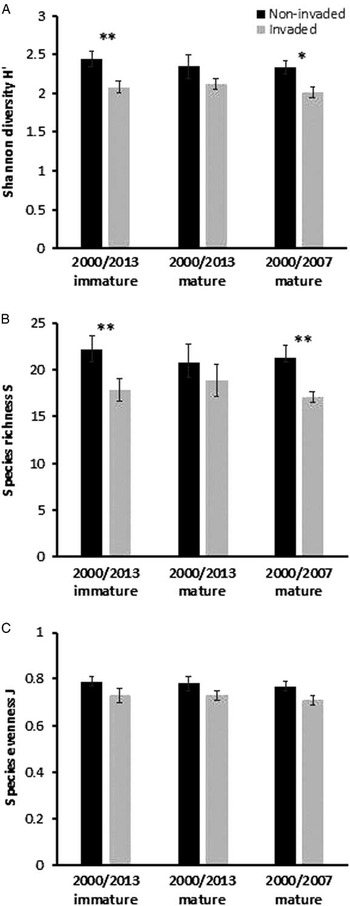
Native plant diversity (H′ and S) was lower in both mature and immature invasions in each burn area (Figure 1). While diversity indices trended lower in invaded plots of mature invasions in the 2000/2013 burn area, impacts were not significant (Figure 1). Species evenness was less responsive to invasion than was plant diversity, and we found no effect of invasion on species evenness in any burn area (Figure 1). The relative impact of P. tomentosa invasion on diversity indices follows a trend of progressively increasing impacts from J to H′ to S, respectively (Table 1).
Results for (A) Shannon diversity (H′), (B) species richness (S), and (C) species evenness (J) in invaded and non-invaded plots in each burn/invasion treatment (mean±SE). * P<0.05; ** P<0.01.

The relative impact (RI; RIV=(VNI − VI)/(VNI + VI), where V is the variable of interest, NI is the noninvaded plot, and I is the invaded plot) of invasion on community indices (H′, S, and J) was calculated for each plot pair.Footnote a

a RI values were averaged within each burn/invasion treatment.
b Jaccard dissimilarity (DJ) indicates differences in community structure between noninvaded and invaded plots (mean ± SE).
+P<0.10.
*P<0.05.
**P<0.01.
***P<0.001.
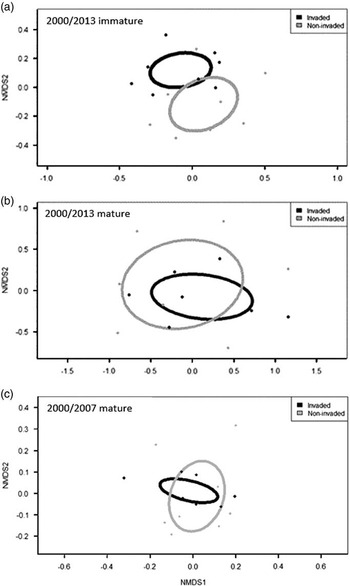
Jaccard dissimilarity indexes (DJ; Table 1) and ANOSIM results indicate community shifts in response to invasion across all burn/invasion treatments (2000/2013 immature R=0.550, P=0.001; 2000/2013 mature R=0.414, P=0.003; 2000/2007 mature R=0.436, P=0.001). The NMDS analyses complement the ANOSIM analyses and primarily serve to visually represent the community comparison (Figure 2). All NMDS ordinations were two-dimensional (2000/2013 immature final stress=0.23; 2000/2013 mature final stress=0.15; 2000/2007 mature final stress=0.15). Clarke (1993) suggests a rough guideline that stress values between 0.1 and 0.2 are moderate, while values above 0.2 are poor, and McCune and Grace (Reference McCune and Grace2002) report that most NMDS analyses of ecological data will have stress values between 0.10 and 0.20.
NMDS ordinations of vegetation plots grouped as invaded (black) and noninvaded (gray) areas with immature invasions burned in 2000/2013 (a), mature invasions burned in 2000/2013 (b), and mature invasions burned in 2000/2007 (c). Dispersion ellipses are based on the SEs of the plots’ weighted means at a 95% confidence limit.

Indicator species analyses reveal the tree, blackgum (Nyssa sylvatica Marshall; P=0.049), and a woody ground cover species, eastern teaberry (Gaultheria procumbens L.; P=0.074), to be associated with noninvaded plots in immature invasions in the 2000/2013 burn area. No other species were associated with invaded or noninvaded plots in any other burn/invasion treatment.
Invasion Impact on Community Structure
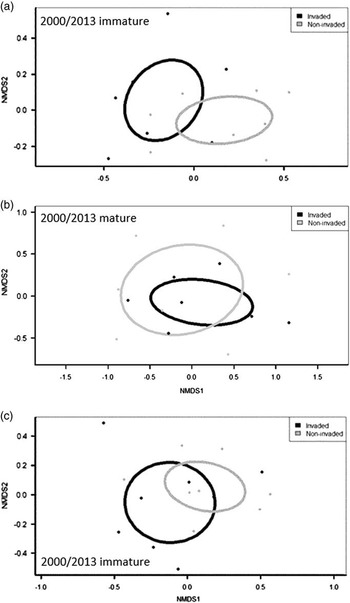
ANOSIM results indicate community structure is also different between invaded and noninvaded plots in immature invasions (2000/2013 immature R=0.461, P=0.002). This difference is largely explained by the increase in tree coverage (P=0.040) and marginal decreases in shrubs and vines in invaded plots (P=0.098 and P=0.067, respectively; Table 2). Mature invasions in both burn areas did not reveal shifts in community structure (2000/2013 mature: P=0.132; 2000/2007 mature: P=0.585). Each of these burn/invasion treatments exhibited differences in individual life-form groups, with an increase in tree coverage in invaded plots of the 2000/2013 burn area (P=0.021) and decreases in graminoid and bryophyte coverage in invaded plots of the 2000/2007 burn area (P=0.037 and P=0.084 respectively; Table 2). NMDS analyses mirrors ANOSIM results for community structure shift in each burn/invasion treatment (Figure 3).
NMDS ordinations of community structure for vegetation plots grouped as invaded (black) and noninvaded (gray) areas with immature invasions burned in 2000/2013 (a), mature invasions burned in 2000/2013 (b), and mature invasions burned in 2000/2007 (c). Species within each plot were grouped as trees, shrubs, herbs, graminoids, vines, and bryophytes. Dispersion ellipses are based on the SEs of the plots’ weighted means at a 95% confidence limit.

Percent coverage of plant life-forms in noninvaded and invaded plots.Footnote a

a Values represent aggregates of total species percent covers within each life form. The relative impact (RI; RIV=(VNI − VI)/(VNI + VI), where V is the variable of interest, NI is the noninvaded plot, and I is the invaded plot ) of invasion on community indices was calculated for each life-form. The aggregated percent covers for each life-form and RI values were averaged within each burn/invasion treatment. Abbreviations: Non-inv, noninvaded; Inv, invaded.
b Jaccard dissimilarity indicates differences in community structure between noninvaded and invaded plots (mean ± SE; n=8 and n=7 for mature invasions in the 2000/2013 burn regime).
+ P<0.10.
* P<0.05.
** P<0.01.
Post-fire Recruitment of P. pungens and P. tomentosa
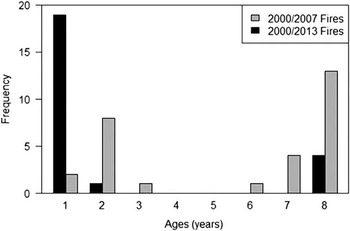
The serotinous tree P. pungens was dominant in many plots within immature invasions in the 2000/2013 burn area (mean cover=17.3%; mean seedling frequency=36.3). Pinus pungens seedling frequency did not differ between invaded and noninvaded plots in this immature group. Age class analysis of P. tomentosa demonstrates that it is promoted by large-scale fire, with the age of most collected specimens correlating with time since fire. This was particularly observed in the 2000/2013 burn area, where nineteen 1-yr-old individuals were sampled (Figure 4). Additional younger individuals in mature populations indicate that some subsequent recruitment also exists in seed-producing populations. Recruitment of P. tomentosa outside a burn area is also supported by some (n=8) 2-yr-old individuals located in the 2000/2007 burn area (Figure 4). This corresponds to timing of the 2013 fire. Some individuals (n=4) in the 2000/2013 burn area also have ages correlating to the 2007 fires (Figure 4).
Frequency data for P. tomentosa ages in two fire regimes in the LGWA. Ages were calculated from tree ring data collected from one representative P. tomentosa individual (>2.0 cm DBH) in each 2-m height class present in invaded plots (n=8 plots in 2000/2007 burn area; n=15 plots in 2000/2013 burn area).

Genetic Diversity
From 38 samples, we scored 37 for each of the five microsatellite loci. Genetic diversity within and among the two sampled populations was very low, with four of five loci characterized as monomorphic across populations. Only one locus (PT 187; Wang et al. Reference Wang, Duan, Zhang, Cheng, Wu and Wang2013) contained one rare allele in only one sample; all other samples were identical.
Discussion
Our results indicate that P. tomentosa alters native plant community composition within mature and immature invasions and across two areas with different recent fire exposures. This shift in community composition varies in magnitude according to P. tomentosa life stage and burn history. Beyond community composition, P. tomentosa invasions also changed community structure across each burn invasion treatment. These results support that P. tomentosa can be a significant plant invader capable of strongly impacting invaded communities.
Community Shift by P. tomentosa Invasions
Invaded plots differed from noninvaded plots in all three burn/invasion treatments based on Jaccard dissimilarity (DJ) values. While the stress values are not outstanding, the NMDS analyses complement our ANOSIM analyses and primarily serve to give the reader a visual representation of the community comparison. The invaded and noninvaded communities are significantly different, but there is still a large overlap in community members, as would be expected during an invasion event. While community shifts were significant in each burn/invasion treatment, scope and magnitude varied. Fires in areas where P. tomentosa is already established, but that do not result in additional recruitment, may promote lower impacts of invasion (Figure 1; Table 1). Community structure was inconsistently affected by P. tomentosa invasion, with only immature invasions causing shifts. These shifts in community structure decreased in older invasions; however, individual life-forms (trees, shrubs, graminoids, etc.) were impacted by invasion in each burn/invasion treatment (Table 2). The increase in tree coverage within mature and immature invasions of the 2000/2013 burn area is due to the presence of P. tomentosa in these plots. Also, the negative impact on graminoids and bryophytes coverage by mature invasions in the 2000/2007 burn area may be explained by reduced light levels for these ground cover species that are often light dependent in xeric and exposed areas (Newell and Peet Reference Newell and Peet1998). This explanation is supported by the work of Gulezian and Nyberg (Reference Gulezian and Nyberg2011), who also found decreases in graminoid cover as stands of an invasive Pinus sp. became more established. The authors posited that reduced light levels are likely responsible for a decrease in ground cover species (Gulezian and Nyberg Reference Gulezian and Nyberg2011).
Differences in community responses among burn/invasion treatments may be attributable to multiple factors, including native species characteristics, P. tomentosa population characteristics, and time since fire (Fried et al. Reference Fried, Laitung, Pierre and Chagué2014; Hejda et al. Reference Hejda, Pyšek and Jarošik2009; Keeley Reference Keeley2006). These differing community responses also indicate that effects of P. tomentosa invasion may shift as the invader changes life stages. Environmental variables also likely influence P. tomentosa invasion dynamics. While we attempted to limit environmental variation between treatments by using paired plots, we did not measure environmental variation that may have influenced P. tomentosa invasion. Consequently, we limit our discussion of P. tomentosa invasion to the effects of fire, but recognize that several environmental factors beyond fire history likely influence invasion. The shifts in diversity, community composition, and community structure in invaded plots of recently burned immature invasions may be explained by the dense ground cover (mean P. tomentosa cover=49.38%; range=40% to 70%) and large leaves of P. tomentosa that crowd out and shade competing native plants. These immature invasions also occur in fire-adapted communities and can decrease the post-fire recruitment of fire-promoted native plants (Keeley Reference Keeley2006). Mature invasions in the 2000/2007 burn area also were associated with altered community composition and decreased native plant diversity. The large impacts found in mature invasions of the 2000/2007 burn area may be the consequence of the long exposure of the native community to an aggressive invader (Staska et al. Reference Staska, Essl and Samimi2014). These larger impacts observed in the 2000/2007 burn area may also be attributable to greater P. tomentosa abundance in invaded plots, because invaded plots in the 2000/2007 burn area contained more P. tomentosa individuals than did mature plots in the 2000/2013 burn area (P=0.053). Additionally, multiple P. tomentosa age classes exist in the 2000/2007 burn area (Figure 4), indicating that the invader occupies multiple community levels (e.g., overstory, midstory, understory) and may crowd out native species that would otherwise fill these niches. This explanation is reinforced by Gulezian and Nyberg’s (Reference Gulezian and Nyberg2011) observation of increasing differences between invaded and noninvaded plots with in increasing time since invasion by Austrian pine (Pinus nigra Arnold). They argue these increasing differences were likely due to decreased light levels.
Post-fire Recruitment of P. tomentosa and Fire-promoted Native Species
We found that P. tomentosa recruitment coincides with fires, supporting earlier work by Kuppinger et al. (Reference Kuppinger, Jenkins and White2010) and Dumas et al. (Reference Dumas, Neufeld and Fisk2007). In addition to high frequencies of P. tomentosa individuals correlating in age to dates of fires, our data also indicate that recruitment could be promoted beyond fire boundaries, because the ages of some sampled individuals (n=12) that lie outside a specific burn area (2007 or 2013) correspond with the dates of those fires (Figure 4). Fire may promote P. tomentosa seed germination in nonburned areas through fire-related cues, including elevated light levels and chemical compounds associated with smoke (Todorović et al. Reference Todorović, Giba, Živković, Grubišić and Konjević2005, Reference Todorović, Božić, Simonović, Filipović, Dragićević, Giba and Grubišić2010). Working in the LGWA, Kuppinger et al. (Reference Kuppinger, Jenkins and White2010) found no subsequent P. tomentosa recruitment after the initial invasion following the 2000 fire. No mature individuals were present during their research. The multiple age classes we observed in the 2000/2007 burn area suggest that once a P. tomentosa population produces mature individuals, it can successfully recruit new individuals without a large-scale disturbance.
Invasions by P. tomentosa had limited effects on individual plant species. Recruitment of the serotinous tree P. pungens, which is a dominant species in our study area, was not affected by P. tomentosa invasion. Indicator species analysis revealed that the N. sylvatica was associated with noninvaded plots in immature invasions (P=0.49). Because N. sylvatica is long-lived and has fire-resistant properties (Abrams Reference Abrams2007; Silver et al. Reference Silver, Speer, Kaye, Reo, Howard, Anning, Wood and Wilbur2013), it is likely that many individuals survived the 2000 and 2013 fires in this area. Its strong association with noninvaded plots supports that its presence may decrease post-fire recruitment of P. tomentosa. We have no explanation for the association of the woody ground cover species G. procumbens with noninvaded plots (P=0.074).
Genetic Diversity
Almost no genetic diversity existed in five microsatellite loci of two P. tomentosa populations in the LGWA. Our results contrast sharply with previous research in the tree’s native range that found between two and six alleles at each locus we investigated here (Wang et al. Reference Wang, Duan, Zhang, Cheng, Wu and Wang2013). Our results, coupled with its high invasion success, suggest that P. tomentosa may be similar to other plant invaders with low genetic diversity that are facilitated by a few highly competitive genotypes and likely resulted from a single introduction (Poulin et al. Reference Poulin, Weller and Sakai2005; Taylor and Hastings Reference Taylor and Hastings2004; Yu et al. Reference Yu, He, Zhao and Li2014; Zhang et al. Reference Zhang, Zhang and Barrett2010).
Low genetic diversity is often thought to limit invasion success by hindering an invader’s ability to adapt to its new environment (Allendorf and Lundquist Reference Allendorf and Lundquist2003; Sakai et al. Reference Sakai, Allendorf, Holt, Lodge, Molofsky, With, Baughman, Cabin, Cohen and Ellstrand2001). Our research, however, adds to the growing body of literature that demonstrates that low genetic diversity can be associated with a successful plant invader (Poulin et al. Reference Poulin, Weller and Sakai2005; Taylor and Hastings Reference Taylor and Hastings2004; Yu et al. Reference Yu, He, Zhao and Li2014; Zhang et al. Reference Zhang, Zhang and Barrett2010). Possession of a highly competitive genotype with little differentiation may facilitate the invasive plant’s rapid invasion due to its ability to avoid the genetic bottleneck commonly associated with lag times in many plant invasions (Dlugosch and Parker Reference Dlugosch and Parker2008; Harrison and Mondor Reference Harrison and Mondor2011; Le Roux et al. Reference Le Roux, Wieczorek, Wright and Tran2007; Yu et al. Reference Yu, He, Zhao and Li2014). Additionally, selection for fast-growing and hardy P. tomentosa individuals in the timber and horticultural trades may promote more competitive genotypes in its exotic range.
Although additional data from more populations are necessary to better understand P. tomentosa gene flow, the low diversity in the LGWA offers some clues regarding dispersal and genetic diversity. The two closely genetically similar populations sampled here indicate that a large gorge does not serve as a dispersal barrier. The low genetic diversity in the LGWA is also likely the result of a founder effect following a single introduction of P. tomentosa to the area (Dlugosch and Parker Reference Dlugosch and Parker2008; Yu et al. Reference Yu, He, Zhao and Li2014). The founder effect is not mutually exclusive with the competitive genotype hypothesis and indicates that one introduction of P. tomentosa may be sufficient to facilitate a large-scale invasion.
Our results indicate that P. tomentosa can cause significant alterations in plant community composition, including decreases in species richness and diversity. While a large-scale disturbance is typically necessary for substantial invasions that affect plant communities (Kuppinger et al. Reference Kuppinger, Jenkins and White2010; Longbrake Reference Longbrake2001), the potential ability of P. tomentosa to successfully invade large areas such as the LGWA should direct increased monitoring and treatment efforts for the invader. This increased management investment should focus on areas where fire or other large-scale disturbances such as timber harvests are likely or planned.
Supplementary material
To view supplementary material for this article, please visit https://doi.org/10.1017/inp.2017.14