INTRODUCTION
The coastal regions of Brazil are characterized as areas of intense economic and social activity (Lacerda et al. Reference Lacerda, Molisani, Sena and Maia2008), with estuaries and bays being the most explored environments. In view of this, these sites have been used as important areas for industrial and port development, and they stand out as a significant source of mineral resources, including oil and natural gas (Silva et al. Reference Silva, Valentin and Vianna2015). They are also places for the development of flora and fauna that are indispensable for the functioning of the planet (Barbier et al. Reference Barbie, Koch, Siliman, Hacker, Wolanski, Primavera, Granek, Polasky, Aswani, Cramer, Stoms, Kennedy, Bael, Kappel, Perillo and Reed2008).
Bays are considered to be environments that are favorable to the deposition and preservation of the sedimentary record (Figueiredo et al. Reference Figueiredo, Toledo, Cordeiro, Godoy, Silva, Vasconcelos and Santos2014), supporting studies focusing on the evolution and paleoenvironmental reconstruction of these areas. The sediment transported by the rivers is deposited according to local hydrodynamics (Barreto et al. Reference Barreto, Vilela, Baptista Neto and Barth2012; Luz Reference Luz2012). Studies of these environments, with a focus on microfossil analyses, are still rare when it comes to the Brazilian coast. Nevertheless, the record identified in these areas may provide a broader view of the different vegetation gradients found around these sites (Brush and Brush Reference Brush and Brush1994). From the analysis and interpretation of these elements, we can infer changes in vegetation conditioned by climatic events, anthropogenic changes in the landscape (Flantua et al. Reference Flantua, Hooghiemstra, Vuille, Behling, Carson, Gosling, Hoyos, Ledru, Montoya, Mayle, Maldonado, Rull, Tonello, Whitney and González-Arango2016), and sea level variations (Woodroffe et al. Reference Woodroffe, Long, Punwong, Selby, Bryant and Marchant2015).
Sea level changes over different geological time periods have occurred at several time- and space-scales around the world (Milne et al. Reference Milne, Gehrels, Hughes and Tamisiea2009; Church et al. Reference Church, Woodworth, Aarup and Wildon2010). In the Brazilian coastal region, there is evidence of the alteration of the shoreline position and sea level changes during the Holocene (Suguio and Martin 1978). Many studies dealing with variations in the mean sea level in this period are based on various data such as sedimentary/stratigraphic, geomorphological, and paleontological records in Brazilian coastal areas (Angulo et al. Reference Angulo, Lessa and Souza2006; Castro et al. 2014). Fluctuations in the sea level during the Holocene were important in the construction and evolution of Brazilian coastal plains (Martin et al. 1997). A tendency toward sea level rises was observed at the start of the Holocene, while 7000 years ago the sea level crossed the actual Transgressive Maximum (TM) at about 5000 years AP. At this stage, the sea level was about 3–5 m above what it is now, and then gradually declined to what it is today (Angulo et al. Reference Angulo, Lessa and Souza2006; Gyllencreutz et al. Reference Gyllencreutz, Mahiques, Alves and Wainer2010).
Past knowledge and current assessments of the exploitation of these coastal areas are important tools for managing the ecosystems that surround them. By studying the continental palynomorphs preserved in sediment, important information can be obtained that can be correlated to changes in the landscape (Flantua et al. Reference Flantua, Hooghiemstra, Vuille, Behling, Carson, Gosling, Hoyos, Ledru, Montoya, Mayle, Maldonado, Rull, Tonello, Whitney and González-Arango2016). This also allows the creation of conservation measures with which to mitigate the effects of possible impacts generated by the anthropic occupation of the areas surrounding these sites. The main objective of the current research was to identify and interpret the environmental dynamics in the region surrounding Vitória Bay during the Holocene, which are associated with paleo-fire frequency and relative sea level oscillations on the Brazilian coast.
STUDY AREA
Vitória Bay is located between the coordinates 40°22′W, 20°15′S and 40°16′W, 20°20′S in the south-central part of the SES. Its formation began about 123,000 years ago during the sea transgression that raised sea levels to about 8 m above the current Brazilian coast (Suguio Reference Suguio2003; Gyllencreutz et al. Reference Gyllencreutz, Mahiques, Alves and Wainer2010). The sea level elevation in this region favored the drowning of the valleys, with the deposition of Pleistocene marine sediment that is characteristic of the northern region of Vitória Bay (Costa Reference Costa1999).
The Bay covers an extensive area that ranges from Praia de Camburi to the mouth of the Santa Maria da Vitória River, which is the largest continental water contributor to the interior of Vitória Bay. The water exchange from the interior of the Bay to the ocean occurs through the connection to the Canal do Porto and the Canal da Passagem. The central region of Vitória Bay has a mean bathymetry of 10–11 m, with the area near the Canal do Porto being about 23 m deep (Costa Reference Costa1999) and is characterized by the presence of fine and erosive sediment and/or fluvial notch (Bastos et al. Reference Bastos, Moscon, Carmo, Baptista Neto and Quaresma2015). The Canal da Passagem is a natural link between Espírito Santo Bay to the north and Vitória Bay to the south. It is approximately 10 km in length and has an average width of 80 m (Rigo and Chacaltana 2006). The bathymetry is variable, being 1 m deep during low tide periods and in other places up to 9 m deep. It has an average depth of 6 m throughout its length (Nascimento et al. Reference Nascimento, Chacaltana and Piccol2013).
The climate of the region is characterized as coastal tropical, with a dry and slightly accentuated winter, a pluviometric index of approximately 1250 mm annually (Melo et al. Reference Mello, Viola, Curi and Silva2012) and predominantly northeastern winds (Castro and Miranda Reference Castro and Miranda1996). The vegetation from the SES is extremely diverse and different vegetal formations are found (Ruschi Reference Ruschi1950). The exuberance of the flora has also been observed by naturalists, who emphasized the presence of well-developed primary vegetation, such as large mangrove formations (Saint Hilaire Reference Saint-Hilaire1974). Floristic and phytogeographic records in the surroundings of Vitória Bay and adjacent areas are scarce. However for the Vila Velha municipality, a very rich herbaceous vegetation was observed in a swamp. The main representative families were Asteraceae and Cyperaceae, followed by Fabaceae, Rubiaceae, and Poaceae (Valadares et al. Reference Valadares, Souza, Castro, Peres, Schneider and Martins2011). The large diversity of the plant species was also observed by Thomaz and Monteiro (Reference Thomaz and Monteiro1997) in a section of ombrophilous forest in the municipality of Santa Teresa (SES).
The occupation record of the area surrounding Vitória Bay can be dated from 1390±70 AD by indigenous Tupiguarani (Perota Reference Perota1974). There was intense occupation of the SES by European immigrants from the start of the 19th century, whose aim was to colonize the extensive native area and boost the foreign market through coffee cultivation (Nagar Reference Nagar1985).
MATERIALS AND METHODS
Sediment Core Collection
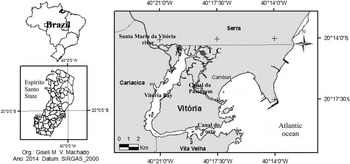
The 490-cm-long T_C sediment core was taken from the Canal da Passagem in a preserved area of mangrove vegetation at the coordinates 40°18′23′′W and 20°14′48′′S (Figure 1). After collection, the core was split into two halves and described in terms of its thickness, grain size, structure, contact, color, appearance, and the presence of shells. Each half of the core was sliced every 10 cm for analysis in the laboratory (Ybert et al. Reference Ybert, Salgado-Laboriau, Barth, Lorscheiter, Barros, Chaves, Luz, Ribeiro, Scheel and Vicentini1992).
Localization map from the sediment core collection point located at Canal da Passagem, Espirito Santo State, Brazil (Arc Gis 9.3; SIRGAS_2000_Zone_24S).

Particle Size Analysis
The process for the statistical treatment of the samples followed the grain size scale of Wentworth (Reference Wentworth1922). A particle size analysis was performed by dry sieving for the sand fractions and laser analysis for the mud fractions. The Master Size_2000 equipment was used for the laser granulometry of the mud fraction. The calculations of the statistical parameters of the grain size distribution proposed by Folk and Ward (Reference Folk and Ward1957) were applied for the percentiles of each granulometric fraction.
14C Dating
The T_C (480 cm depth) sediment sample and a well preserved shell of a bivalve (304 cm depth) were dated by the radiocarbon (14C) method. The analyses were carried out in the laboratories of the Center for Applied Isotope Studies, University of Georgia, USA and Beta Analytic Inc, Florida, USA. The Calib 7.1 program was used to calculate the calibrated ages (BP) using the SHCAL curve 13.
Palynological Analysis
For the palynological analysis, 2 g of dry sediment was collected each 10 cm from the sediment core. All the material received the standard chemical treatment for quaternary sediment proposed by Ybert et al. (Reference Ybert, Salgado-Laboriau, Barth, Lorscheiter, Barros, Chaves, Luz, Ribeiro, Scheel and Vicentini1992).
The samples were successively treated with 40% hydrofluoric acid, 10% hydrochloric acid, an acetolysis mixture, sodium pyrophosphate, KOH (10%), and zinc chloride (ZnCl2) density 2. One exotic spore tablet from Lycopodium clavatum (Stockmarr Reference Stockmarr1971) was added in order to determine the palynomorph concentrations. Subsequently, 300 pollen grains were counted per sample. The identification of the palynomorphs was achieved with the identification catalogs (Roubik and Moreno Reference Roubik and Moreno1991; Colinvaux et al. Reference Colinvaux, De Oliveira and Patiño1999; Luz and Barth Reference Luz and Barth2000; Barreto et al. Reference Barreto, Freitas, Vilela, Baptista Neto and Barth2013). Percentage and concentration calculations were performed for the statistical treatment of the data, and the graphs were plotted with the TILIA and CONISS programs.
Analysis of Carbonized Particles
In order to analyze the carbonized particles, 2 cm3 of wet sediment was collected every 10 cm along the sediment core at the same depths where the palynological analyses were performed. The sample treatments were based on the standard methodology proposed by Rhodes (Reference Rhodes1998). The samples were treated with the addition of hydrogen peroxide (H2O2) and subsequently washed with distilled water in a 125-μm mesh sieve. After this step, the material retained in the mesh was transferred to a Petri dish and the carbonized particles identified manually under a stereoscope microscope. The digital measurements of the particles were acquired through the IMAGE-J program and the area was then calculated (Abramoff et al. Reference Abramoff, Magalhães and Ram2004).
Geochemical Analyses
The sediment samples were selected each 30-cm depth, and 1 g of dry sediment was weighed and sent to the Stable Isotope Facility, UC Davis, University of California, USA, to obtain the isotopic values of the δ15N, δ13C, and TOC (total organic carbon).
RESULTS
Particle Size Analysis
The sediment core had sandy mud at the bottom at a depth of 470 cm followed by silt at a depth of 460 cm from the top. Three lithological units were grouped according to the textural groups presented in the statistical model Gradistat with the values of the mean diameter in phi. The sandy mud was, on average, 73% sand and 27% mud. It was composed of fractions of medium sand and thick silt (Mz: 1.5 to 5.9, average of 3.16 phi), which was very poorly to badly selected (σ=3.3–1.2) The mud textural group was, on average, 95% mud, and was composed of the mean diameter of fine silt (Mz=7.2 phi), which was poorly selected (σ=1.1–1.8) (Figure 2).
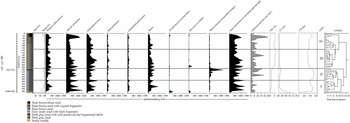
Concentration diagram (palynomorphs/g) from the identified vegetal formations; carbonized particles (cm3/mm3); TOC (%) and isotopic data (C and N) (‰) in the analyzed sediment core (T_C) located at Vitória Bay, Espírito Santo State.

Dating 14C
Two 14C dates were obtained (Table 1), with the oldest acquired through the analysis of organic sediment dated from 9396 to 9520 cal yr BP at a depth of 430 cm. Further dating was achieved by analyzing a preserved shell of Caryocorbula cymella Dall at a 304-cm depth. This second date had an age of 7423–7511 cal yr BP.
Dated samples by the radiocarbon method (14C) of the T_C sample collected in the Canal da Passagem, Espírito Santo State, Brazil.

a Center for Applied Isotope Studies, University of Georgia, USA.
b Beta Analytic Inc., Florida, USA.
Palynological Analysis
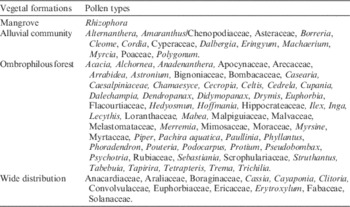
From the sediment core analyzed, it was possible to group the identified pollen types into three vegetal formations (mangrove, alluvial community, and ombrophilous forest). The pollen types that occurred in more than one vegetal formation were grouped into a “wide distribution” (Table 2) and four main zones were established (Figures 2 and 3).
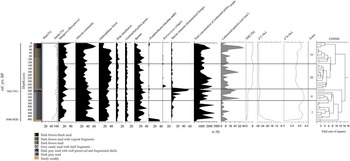
Frequency diagram (%) from the identified vegetal formations; carbonized particles (cm3/mm3); TOC (%) and isotopic data (C and N) (‰) in the analyzed sediment core (T_C) located at Vitória Bay, Espírito Santo State.

Pollen types classified and grouped in the vegetal formations from the analyzed samples from Vitória Bay, Espírito Santo State.

Zone I: depth of 490–360 cm
Zone I was characterized by a low total palynomorph concentration at its base (2608.2 palynomorphs/g) that was represented by all vegetal formations and spores (Figure 2). A presence of Pseudoschizaea (incertae sedis) (311.9 palynomorphs/g) was observed at the base of this zone. There was a gradual increase in all vegetal formations (4379.8–26,855.1 palynomorphs/g) after this phase. There was, however, a sharp decrease (15,840.4 palynomorphs/g) at a depth of 430 cm, followed by a subsequent increase in concentrations (25,891.9 palynomorphs/g) at a depth of 390 cm (Figure 2). The highest palynomorph accumulation values in this zone were observed in the alluvial (13,870.6 palynomorphs/g) and mangrove communities (5653.7 palynomorphs/g). However, the top of this zone had low concentration values (7330.9 palynomorphs/g). There was an increase in spores from the base to the top of this zone (415.9–1096.0 palynomorphs/g). High concentrations of Pseudoschizaea (incertae sedis) (311.9–496.4 palynomorphs/g) were observed at the base of the zone. The marine elements (foraminiferal linings) were observed to gradually increase (168.1–504.4 palynomorphs/g) from a depth of 470 cm toward the top of the zone (Figure 2).
The elements of the alluvial community had the highest percentage values, mainly due to the presence of Cyperaceae (40.5%) and Poaceae (19.6%), along with the Arecaceae (13%) pollen type that is representative of the ombrophylous forest and spores (39.6%). The values of the mangrove vegetation (Rhizophora) varied (5.6–25.02%) along this zone. Pseudoschizaea (incertae sedis) occurred in the bottom of the sediment core, with percentage values ranging from 11.3–12%. There were low numbers of marine elements (foraminiferal linings) (Figure 3).
Zone II: depth of 360–290 cm
The total palynomorph concentrations in zone II were higher than those at the top of the previous zone (16,812.9 palynomorphs/g) at a 350-cm depth. The highest total concentrated palynomorph value (22,978.5 palynomorphs/g) was observed at a 300-cm depth. This high concentration was obtained through the high values present in the vegetal formations represented by the alluvial community (90,22.9–9358.8 palynomorphs/g) and ombrophilous forest (4707.6–7608.8 palynomorphs/g). There was an increase in spores compared to the anterior zone and a posterior fall toward the top of the zone (4595.5–1489.1 palynomorphs/g). The Pseudoschizaea (incertae sedis) presence was low. However, the marine elements (foraminiferal linings) gradually increased from the base to the top of the zone (1289.0–3157.7 palynomorphs/g), with the highest values found throughout the entire sediment core (Figure 2).
The ombrophilous forest elements remained constant throughout the entire area (24.2–28.0%) through the pollen types Arecaceae, Caesalpineaceae, Malpiguiaceae, Paullinia, Psychotria, and Rubiaceae. Similarly, the alluvial community was stable along the zone (34.2–53.7%). The most frequent pollen types were Asteraceae, Cyperaceae, and Dalbergia. The mangrove vegetation represented by the Rhizophora pollen type had a tendency to increase the base toward the top of the zone (11.7–30.6%). The occurrence of Pseudoschizaea (incertae sedis) was low in this zone. There was, however, an increase in the concentration of the marine elements (7.7–56.8%), with the highest percentages observed throughout the sediment core (Figure 3).
Zone III: depth of 290–130 cm
High total concentration values were observed between depths of 270 and 220 cm (23,570.7–23,147.4 palynomorphs/g) in zone III. The mangrove vegetation had a tendency to increase (1722.4–1975.8 palynomorphs/g) in the same way as the alluvial community (1901.8–3168.1 palynomorphs/g) and the ombrophilous forest (1345.6–3815.3 palynomorphs/g) from the base toward the top of the zone. The spores increased from the base of the zone to the top of the sediment core (1489.1–1576.5 palynomorphs/g), with variations throughout the zone. The first occurrence of Botryococcus algae was also observed, with a concentration of 855.7 palynomorphs/g at a depth of 270 cm. The marine elements fell in number significantly throughout the zone compared to zone II (662.8–272.5 palynomorphs/g) (Figure 2).
The mangrove vegetation remained stable (19.3–31%) throughout the entire zone, with only small variations. The alluvial community also did not suffer from major variations (31–37.5%), and was represented by the Asteraceae, Cyperaceae, Dalbergia, and Poaceae pollen types. It was also possible to observe the stability of the ombrophilous forest (28.1–37.3%) along this zone. The most frequent pollen types were Alchornea, Arecaceae, Caesalpiniaceae, Malpiguiaceae, Moraceae, Psychotria, Rubiaceae, Sebastiania, and Trema. The Botryococcus algae first ocurred in the sediment core, with a frequency of 4% at a 270-cm depth. There were low numbers of marine elements (2.7–3.5%) compared to the previous zone (Figure 3).
Zone IV: depth of 130 cm to the sediment core top
The base of this zone had total concentration values that were similar to those of the top of the previous zone (13,627.9 palynomorphs/g). The highest concentration was observed at a 30-cm depth, where the total concentration was 21,057.9 palynomorphs/g. The mangrove area showed an increase in its concentrations at the zone base up to a depth of 10 cm (2301.4–28,883.2 palynomorphs/g), with the highest value at this stage found at a 30-cm depth (4897.2 palynomorphs/g) (Figure 2).
There was a significant increase in the alluvial community (3925.9–7052.8 palynomorphs/g), with a drop in the concentrations only at the top of the zone (1327.1 palynomorphs/g). The ombrophilous forest had a tendency to fall from the base toward the top of the zone (5685.8–603.2 palinomorphs/g). The spores also showed a decrease at the base toward the top of the zone (3429.5–72.4 palynomorphs/g). Pseudoschizaea was present in low concentrations and was more representative at a 10-cm depth with 133.1 palynomorphs/g. The marine elements fell in terms of their concentration from the base to the top of the zone (361–96.5 palynomorphs/g) (Figure 2).
The mangrove vegetation (Rhizophora) increased from the base toward the top of this zone (16.9–40.9%), with the same pattern as that observed for the alluvial community (28.8–36.5%). The most representative pollen types at this stage were Asteraceae, Cyperaceae, Dalbergia, and Poaceae. There was, however, a fall in the ombrophilous forest (41.7–16.6%). There was also a significant fall in spores (25.2–2%). There were low percentages of algae throughout this zone. The marine elements were represented at low frequencies but remained stable throughout the zone (2.6–2.7%) (Figure 3).
Carbonized Particles
The accumulation register of carbonized particulates throughout the sample was within the range of 2–18 cm2/mm3. However, compared to the other analyzed samples, higher accumulation values were observed at four different depths (340, 290, 180, and 30 cm): 30.6 cm2/mm3 at a 340-cm depth; 26 cm2/mm3 at a 290-cm depth; 31 cm2/mm3 at a 180-cm depth; and 39.4 cm2/mm3 at a 30-cm depth (Figure 2).
Geochemical Data (COT, δ15N, δ13C)
The analyzed sediment core had TOC values ranging from 0.04 to 10%. Among all the analyzed samples, the highest percentage value was observed at a 150-cm depth. The δ13C results were in the range of –14 to –27‰. The highest values were found at the core base. However, the values found for δ15N were observed in the range 0.0–5.22‰, with the highest values at depths of 360 and 330 cm (Figure 2).
Paleoenvironmental Interpretation
The δ13C values (between –14 and –27‰) associated with δ15N (between 0.0 and 5.22‰) and the low TOC values at the core base may be an indication of a C3 and C4 plant-blending environment with phytoplanktonic organisms. This mixed environment with plants of continental origin and organisms of marine origin was also observed by França et al. (Reference França, Alves, Castro, Cohen, Rosseti, Pessenda, Lorente, Fontes, Buso, Giannini and Franciquini2015) and Lorente et al. (Reference Lorente, Pessenda, Obooh-Ikuenobe, Buso Júnior, Cohen, Meyer, Giannini, Oliveira, Rosseti, Borotti Filho, França, Castro, Bendassoli and Macario2014) in transitional regions between the sea and the mainland on the SES coast.
From a vegetational point of view, mangrove (Rhizophora) was common throughout the entire sediment core and did not show any sudden drops, with only small variations over time between 9396 and 9520 cal yr BP. Mangrove vegetation adapts both physiologically and morphologically to its environment in the intertidal zone between tidal variations (Ellison Reference Ellison2015). The genus Rhizophora has a high pollen-production rate, with the pollen being small in size and easily transported over long distances by wind and water (Muller Reference Muller1959). Nevertheless, factors such as the circulation of the collection site, the wind direction, and the local sedimentation rate can influence the preservation and deposition of grains (Hoffman Reference Hofmann2002).
The Rhizophora sp. pollen was well represented in an analyzed sediment core in a bay located on the coast of India. Variations of this pollen type over time were used as a tool to assess sea level changes in the Indian Ocean (Punwong et al. Reference Punwong, Marchant and Selby2013; Woodroffe et al. Reference Woodroffe, Long, Punwong, Selby, Bryant and Marchant2015). Other authors have also observed this pollen type in a bay in North America and, in association with other proxies, have been able to infer the influence of sea level variations in this coastal region (van Soelen et al. 2010). However, a sediment core collected in a bay in the southeast of Brazil had low concentrations of this pollen type (Belem Reference Belem1985; Coelho et al. Reference Coelho, Barth and Chaves1999). Coelho et al. (Reference Coelho, Barth and Chaves1999) highlight that this may be related to the transport and leaching of grains through the influence of rivers. In the coastal area of the SES, this pollen type is observed to have been present in analyzed sediment since 7550 cal yr BP (França et al. Reference França, Alves, Castro, Cohen, Rosseti, Pessenda, Lorente, Fontes, Buso, Giannini and Franciquini2015).
Zone I: depth of 490–360 cm
There was a low palynomorph concentration at 9396–9520 cal yr BP at the base of this zone, which was associated with a lithology characterized as sandy mud. This association may be related to higher environmental energy. The rest of the zone had a finer lithology characterized by dark sediment (Figure 3).
At the base of this zone, the high frequency of the alluvial community followed by the ombrophilous forest and the expressive occurrence of Pseudoschizaea suggests an increase in flooded areas through a greater continental water supply. According to Scott (Reference Scott1992), this incertae sedis (Pseudoschizaea) is characteristic of swampy environments and is commonly found in tropical regions. This interpretation is corroborated by the δ13C values that presented –14‰ characteristic isotopic signals of C4 plants (Yang et al. Reference Yang, Siegwolf and Komer2015). This is associated with increased vegetation belonging to the alluvial community and a reduction of mangrove vegetation (Rhizophora; Figures 3 and 4).
Integrated palynological (palynomorphs/g), carbonized particles (cm3/mm3), and geochemical data (%) from the sediment core (T_C) and the paleoenvironmental reconstruction from Vitória Bay, Espírito Santo State.

França et al. (Reference França, Alves, Castro, Cohen, Rosseti, Pessenda, Lorente, Fontes, Buso, Giannini and Franciquini2015) point out that the coastal area of the SES underwent a period of humid conditions from the late to the middle Holocene, which is corroborated by the data of the present study. The increase in the palynomorph concentration in the middle of this zone, with an emphasis on the herbaceous plants of the alluvial community, was verified in the isotopic signal of δ13C (Figure 4). According to Ya et al. (Reference Ya, Anderson and Jaffé2015), this may reflect a source of available organic matter (e.g., by way of its decomposition) in the depositional environment. Sritrairat et al. (Reference Sritrairat, Peteet, Kenna, Sambrotto, Kurdyla and Guilderson2012), in analyzing sediment from a bay located in the northeast region of the United States, highlighted that the great expansion of the δ13C isotopic signal could be related to a higher occurrence of the Cyperaceae pollen type. This genus is a C4 plant that is highly enriched in δ13C, can vary from −12.1 to −15.9‰ (Yang et al. Reference Yang, Siegwolf and Komer2015), and was present in the highest percentage value in the current study. Species of this genus are characteristic of environments that have wet and marshy soils (Souza and Lorenzi Reference Souza and Lorenzi2005), colonizing environments formed under the influence of continental water, and transition areas under the influence of brackish water (Tavares et al. Reference Tavares, Araújo and Guimarães2007). It is worth noting that a slight increase in mangrove vegetation and the occurrence of marine elements (foraminiferal linings) may be associated with the entry of saline water into the Canal da Passagem, making the water brackish and favoring the establishment of Rhizophora sp. (Figure 3).
The occurrence of carbonized particles was low throughout this zone. According to Patterson et al. (Reference Patterson, Edwards and Maguire1987), carbonized particles or “amorphous inorganic carbon” are the result of the incomplete combustion of plant tissues. Whitlock and Larsen (2001) point out that carbonized particulates form after “fire events” and, when present in coastal sediment, have a direct influence on fluvial transport. Low values of carbonized particulates were also observed by Punwong et al. (Reference Punwong, Marchant and Selby2013) in a bay located in Tanzania with a domain of mangrove vegetation. The authors correlated this low carbonized particle preservation in the base of the sediment core with humidity conditions from 8000 yr BP and the influence of strong monsoons identified in the southwest Indian Ocean. The low values of carbonized particles observed in the present study in zone I, which were associated with low TOC values, less negative values of δ13C, and sandy sediment without foraminiferal linings, may indicate a greater continental influence due to the start of the Holocene. When the sea level drops, the transport capacity of the rivers increases and the watersheds become longer (Figure 4).
Zone II: depth of 360–290 cm
The start of this zone had high concentration values compared to the top of the previous zone. The highest values were related to alluvial community vegetation and ombrophilous forest. The mangrove vegetation represented by the Rhizophora genus maintained the frequency observed in the previous zone. Fragments and preserved shells associated with muddy sediment were observed at about a 300-cm depth at the top of this zone. The dating of a bivalve shell from Caryocorbula cymella Dall provided an age of 7423–7511 cal yr BP (Figure 4). The identified bivalve species is characteristic of eurialin environments (Rios 2009). The occurrence of this species has also been observed in an estuarine-lagoon environment in the southeast of Brazil (Martínez et al. Reference Martínez, Mahiques and Burone2013). According to Murray-Wallace and Woodroffe (Reference Murray-Wallace and Woodroffe2014), the malacological identification of organisms found in sediment are of great importance in the correlation of paleoenvironmental and paleontological interpretations.
The highest concentration of marine elements was observed in this same range of high shell concentrations in the sediment core (foraminiferal linings) (Figure 4). According to Stancliffe (1996), these organisms are always related to conditions of greater salinity in the environment. Traverse (Reference Traverse2008), however, highlights the lack of available information regarding the taxonomy and ecology of these organisms. The high accumulation of these organisms was observed by Pienkowski et al. (Reference Pienkowski, Mudie, England, Smith and Furze2011) in bottom sediment in an archipelago in Canada. This high concentration of foraminiferal linings was associated with high local productivity. The shell fragment occurrence associated with the greater deposition of foraminiferal linings may be linked to an increase in the sea level when it crossed the current level at approximately 7000 cal yr BP on the Brazilian coast (Angulo et al. Reference Angulo, Lessa and Souza2006). Lorente et al. (Reference Lorente, Pessenda, Obooh-Ikuenobe, Buso Júnior, Cohen, Meyer, Giannini, Oliveira, Rosseti, Borotti Filho, França, Castro, Bendassoli and Macario2014) report a transgressive phase on the coast of the SES between 7521 and 4847 cal yr BP based on microfossil organisms (foraminiferal linings and dinoflagellates cysts) found in a lake located about 23 km from the Atlantic Ocean.
This same pattern of marine transgression from 7550 cal yr BP was also observed by França et al. (Reference França, Alves, Castro, Cohen, Rosseti, Pessenda, Lorente, Fontes, Buso, Giannini and Franciquini2015) from the analysis of δ13C and δ15N in sediment collected from the Delta do Rio Doce. The authors point out that during this period there was a mix of marine and continental organic matter where the current delta was originally an estuarine channel. The data obtained by other authors corroborate those of the present study that at about 7423–7511 cal yr BP the SES was undergoing a transgressive phase. The reflection of a transgressive event during the Holocene was also observed by Bartholomeu et al. (Reference Bartholomeu, Barros, Lopes, Barth and Vilela2014) from the palynological analysis of peat sediment and by Barreto et al. (Reference Barreto, Baptista Neto, Vilela and Barth2015) in a sediment core, both of which were collected in different areas of Guanabara Bay located in the southeast region of Brazil.
The carbonized particulates showed high accumulation values at depths of 340 and 290 cm during a period of sea level rise. Whitlock and Larsen (2001) point out that high values of carbon particulates indicate the contribution of a “fire event.” This higher accumulation value in the present study may have been transported from different areas and deposited in the collection point during the sea level rise. Barreto et al. (Reference Barreto, Freitas, Souza, Vilel, Barth and Baptista Neto2016) observed a high accumulation of carbonized particles in a sediment core collected in Guanabara Bay in a southeastern region of Brazil. The authors correlated the high accumulation with the expansion of open areas, observed through pollen types from herbaceous vegetation, and possible fire events due to the colonization of the surroundings of the bay by European immigrants.
The increase in TOC in relation to the anterior zone may be the result of the high preservation of organic matter in an anoxic environment (Tyson Reference Tyson1995). It can also be associated with conditions of low hydrodynamism, the deposition of fine sediment, and a large supply and accumulation of organic matter. This increase of organic matter content marks the evolution of the environment for the establishment of the mangrove vegetation. Van Soelen et al. (Reference Van Soelen, Lammerstma, Cremer, Donders, Sangiorgi, Brooks, Larson, Damsté, Wagner-Cremer and Reichart2010) observed the highest TOC values in a sample collected from Tampa Bay, Florida, and correlated with the stratification of the environment. The data obtained from the carbonized particulates associated with the increase in TOC at a time of sea level rises may also reflect the stratification of the environment. Consequently, the analyzed particles (>125 μm) may have been transported and deposited in this range, since the hydrological regime is one of the main particulate transport agents (Patterson et al. Reference Patterson, Edwards and Maguire1987).
The δ15N data presented values that are slightly higher than the previous zone, while the δ13C values were similar from the top of zone I. This increase in the δ15N isotopic values associated with the δ13C values can suggest a greater input of organic matter of marine origin, indicating a continuous mix with sediment of a continental origin. With the preponderance of more negative δ13C values, a predominance of C3 plants was observed from the middle of the previous zone to the top of the sediment core (Figure 4). According to Hatté et al. (Reference Hatté, Gauthier, Rousseau, Antoine, Fuchs, Lagroix, Markovic, Moine and Sima2013), the isotopic signals of C3 plants are replaced by C4 plants when adverse environmental conditions such as temperature, altitude, precipitation, and wind changes are observed. Under normal ecological conditions, when the two niches (C3 and C4) overlap, the C3 plants have a greater advantage of establishment in the environments.
Zone III: depth of 290–130 cm
This zone had a tendency for increased concentrations of all vegetal formations and spores. This may be a reflection of the LMT, which was well recorded in the previous zone, where the current marine level was crossed at approximately 7000 cal yr BP (Angulo et al. Reference Angulo, Lessa and Souza2006). Accordingly, the increase of the edge limit of the Canal da Passagem may have facilitated the major deposition of the palynomorphs. The mangrove and the alluvial community were reduced along this zone compared to the previous zone. However, there were high levels of ombrophilous forest vegetation, evidencing the flooding of the areas surrounding the Canal da Passagem and the proximity of more regional vegetation. The difference in the frequency of the mangrove vegetation compared to the previous zone may in fact be associated with a Marine Transgression (MT) phase on the coast of the SES. This behavior in the mangrove vegetation was also observed in a coastal region of the Indian Ocean (Punwong et al. Reference Punwong, Marchant and Selby2013; Woodroffe et al. Reference Woodroffe, Long, Punwong, Selby, Bryant and Marchant2015). On the coast of the SES, other authors have also observed the MT record during the middle Holocene (Lorente et al. Reference Lorente, Pessenda, Obooh-Ikuenobe, Buso Júnior, Cohen, Meyer, Giannini, Oliveira, Rosseti, Borotti Filho, França, Castro, Bendassoli and Macario2014; França et al. Reference França, Alves, Castro, Cohen, Rosseti, Pessenda, Lorente, Fontes, Buso, Giannini and Franciquini2015).
A certain stability in this period is also observed in the accumulation of carbonized particles, with the highest values seen in the sample at a depth of 180 cm. The tendency toward increased TOC was observed from the end of the anterior zone, with higher values in this zone. This rise in TOC may be associated may be the result of the high preservation of organic matter in an anoxic environment (Tyson Reference Tyson1995) and could be a reflection of the end of the Holocene TM and the start of the LMR (Angulo et al. Reference Angulo, Lessa and Souza2006). High TOC values have been associated with the stratification of the environment in a bay located in Florida, USA (van Soelen et al. 2010). A possible marine regression in this zone in the present study may have favored the deposition of carbonized particles. The isotopic recording of δ15N revealed a decrease compared to the previous zone. The δ13C values, however, remained stable, with the more negative values observed in this zone, demonstrating the greater influence of C3 plants (ombrophilous forest) (Figure 4).
The first occurrence of Botryococcus algae in this zone was observed after the high values of the foraminiferal linings found in the previous zone. This may be related to greater stratification of the environment, as this genus of seaweed occurs in brackish water (Traverse Reference Traverse2008). This colonial algae was observed in bottom sediment in Coronation Gulf in Canada, and is associated with the input of continental water (Pienkowski et al. Reference Pienkowski, Mudie, England, Smith and Furze2011). Minor records of Pseudoschizaea and marine elements (foraminiferal linings) were observed from the top of the anterior zone to the start of this zone. This, associated with the greater occurrence of the species in flooded environments (Scott Reference Scott1992), tends to corroborate the interpretation that the environment changed from a condition of greater salinity from the base of zone II to the base of zone III to a transitional environment (Figure 4). The evolution of Tampa Bay in Florida during the Holocene was the focus of a study by van Soelen et al. (Reference Van Soelen, Lammerstma, Cremer, Donders, Sangiorgi, Brooks, Larson, Damsté, Wagner-Cremer and Reichart2010) from the proxies analyzed and correlated to the MT. From the sedimentary and vegetational dynamics of the surroundings of the bay, it was possible to observe a period of greater fluvial influence, passing through a period of transition and stabilization of the environment, culminating in the present stage, which is characterized as an estuarine environment.
Zone IV: depth of 130 cm to the top of the sediment core
This zone had similar patterns of palynomorph concentrations to the previous zone, although a slight decrease in the ombrophilous forest and spores could be observed at the top of the zone. This may be a reflection of the LMR observed on the coast of Brazil after the Holocene TM around 5100 cal yr BP (Angulo et al. Reference Angulo, Lessa and Souza2006). Accordingly, areas that were previously submerged and close to the ombrophilous forest were occupied by an increase in the vegetation of the alluvial community, which is associated with a tendency to increase mangrove vegetation.
The increase in vegetation that is characteristic of the alluvial community is highlighted by the greater occurrence of Asteraceae, Cyperaceae, Dalbergia, and Poaceae. Unlike zone 1, where the dominance of Cyperaceae was due to the greater contribution of continental water, the pollen types seen in this zone were not dominant, but were due to the colonization by other vegetational genera after the LMR. Valadares et al. (Reference Valadares, Souza, Castro, Peres, Schneider and Martins2011) reported that the Asteraceae and Cyperaceae families are common in herbaceous swamp regions in municipalities neighboring Vitória Bay and they were also observed as representatives of the alluvial community in the present study.
The carbonized particulates were present in their highest accumulations at a 30-cm depth, and were stable in this zone in terms of the frequency of the TOC, which can result from a high preservation of the organic matter in an anoxic environment (Tyson Reference Tyson1995). This was associated with stability in the δ13C isotopic register that occurs with a predominance of C3 plants. Meanwhile, a propensity for increased δ15N can confirm that there was a tendency to a sea level fall during the Holocene (Angulo et al. Reference Angulo, Lessa and Souza2006), favoring the occurrence of natural fire events in areas that were previously submerged. In view of this, the sediment and microfossils observed in this zone could have been carried to the region at the point of the collection of the sediment core. França et al. (Reference França, Alves, Castro, Cohen, Rosseti, Pessenda, Lorente, Fontes, Buso, Giannini and Franciquini2015) point out that, after the marine regression period observed on the ES coast, a greater sediment contribution may have favored the development of the Delta Rio Doce.
The TOC values in this zone were similar to those in the previous zone. Lorente et al. (Reference Lorente, Pessenda, Obooh-Ikuenobe, Buso Júnior, Cohen, Meyer, Giannini, Oliveira, Rosseti, Borotti Filho, França, Castro, Bendassoli and Macario2014) observed the highest TOC value at the top of a sediment core collected in a coastal lake in the SES after a period of marine regression. This was correlated with a larger continental input. Buso Junior et al. (Reference Buso Júnior, Pessenda, De Oliveira, Giannini, Cohen, Volkmer-Ribeiro, Oliveira, Favaro, Rossetti and Lorente2013) also observed a change in the colonization areas that were previously flooded by swamp vegetation after 4396 cal yr BP. These data corroborate those of the present study where, after the possible marine regression, a high carbonized particle value at the top of the sediment core was observed and associated with the low frequency of ombrophilous forest elements and spores. Accordingly, areas that were previously flooded were colonized by the characteristic vegetation of the alluvial community, with a tendency to expand mangrove vegetation (Figures 3 and 4).
CONCLUSIONS
The combined analysis of different proxies (pollen, carbonized macroparticles, stable isotopes, and 14C dating) demonstrated the evolution of Vitória Bay (Canal da Passagem) during the Holocene.
-
1. During about 9396–9520 cal yr BP, the Bay experienced a period of greater continental water and sediment contributions that were carried along the Canal da Passagem. This greater influence of a continental water supply was observed from the sediment core base at depths of 490–470 cm. During this period, a lithology characterized as sandy-muddy, low concentration values of vegetal formations, and a low frequency of carbonized particles was observed. This interpretation is supported by the less negative values of the δ13C isotopes (C4 plants) and the high concentrations of Pseudoschizaea that are characteristic of swamp environments.
-
2. After a phase with higher contribution of continental water, a greater marine influence was observed until approximately 7423–7511 cal yr BP (from depths of 470–290 cm). In this transition period, there was a greater mix of continental and marine water masses, which were possibly influenced by the Holocene TM. The main characteristics of this phase were the increase of the alluvial community, the emergence of the foraminiferal linings that had their highest values at the top of this interval, and the increase in the isotopic δ15N values associated with the δ13C values, indicating a greater contribution of organic matter of marine origin.
-
3. In the last interval, starting from a depth of 290 cm to the top of the sediment core, estuarine characteristics were observed, corresponding to a possible relative sea level regression. The first appearance of the colonial algae Botryococcus was observed after the abrupt diminution of the foraminiferal linings. There was a striking record of ombrophilous forest and an alluvial community at the start of this phase. Toward the top of the sediment core, there is a greater expression of the mangrove vegetation associated with the alluvial community. It is therefore believed that the environment was conditioned to a transgressive period of sea level rises followed by a regressive period. Meanwhile, the top of this phase represents conditions similar to those currently observed in Vitória Bay (Canal da Passagem). Analysis of the present sediment core also showed that the vegetation had passed through natural fire events in the last 9396–9520 cal yr BP.
Acknowledgments
The authors would like to thank CAPES, FAPERJ, FAPES, and CNPq for financial support.